23 B. Part Two: Bethlehem… The Walled City; Graffiti and More. 1/10/23
Greetings-
Here is the second part of the very powerful adventures in the West Bank.
After leaving the shameful display of the occupied city of Hebron (which, as a friend said “Every American Jew should be required to visit.”), we headed to the West Bank city of Bethlehem which is surrounded by walls—many of which are covered with graffiti.
But first one last explanation of Hebron—I believe it is the only Palestinian city that has Israeli settlements in the middle of the city itself. These settlements are choking the old city of Hebron to death. That old city, traditionally the center of Palestinian life is completely filled with barriers, closures, military zones, Israeli soldiers carrying assault weapons (generally drawn and ready to fire) and settlements. It’s created so much fragmentation in the city that it is actually difficult to understand the plan of the Old City .. and it appears that Israel is just trying to eliminate the history and life of Hebron and turn it into a Jewish quarter. The occupation policies do not allow freedom of movement and as such, the social and economic life for Palestinians is destroyed. Israel’s political/military strategy protects and expands the Jewish settlements in the surrounding hills, leaving the “real residents” of Hebron (the Palestinians) helpless and without any economic structure. What was interesting as we drove into Hebron was that there appeared to be plenty of land within Israel’s borders to build housing and “settlements,” without going into the area of Hebron. Frankly, I was embarrassed to be a Jew on this day. I felt like I was witnessing Apartheid. There is nothing “normal” about life in Hebron, for either the Palestinians or for these Jews who live in these ridiculous fenced-in settlement communities.
Onward to Bethlehem…
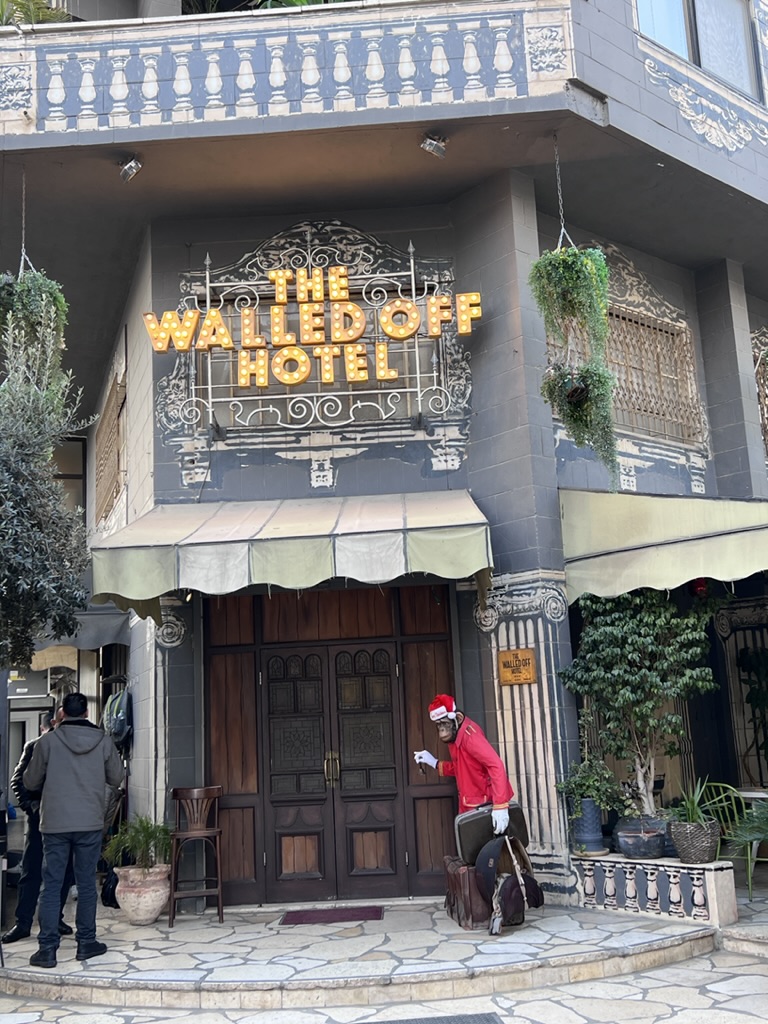
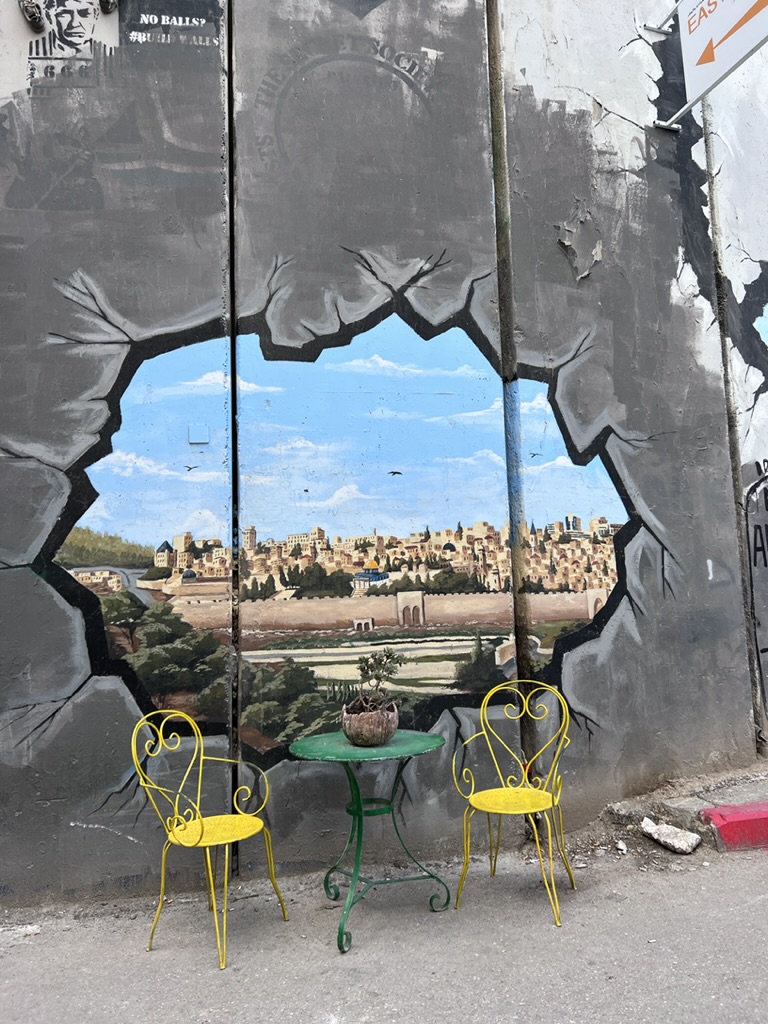
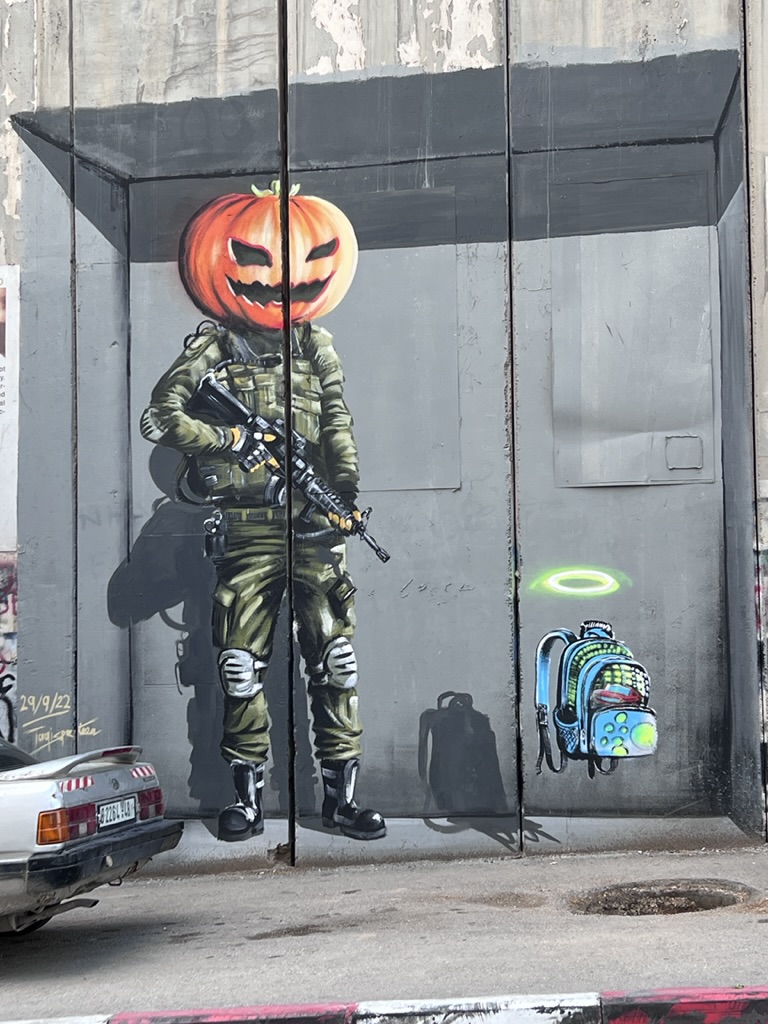
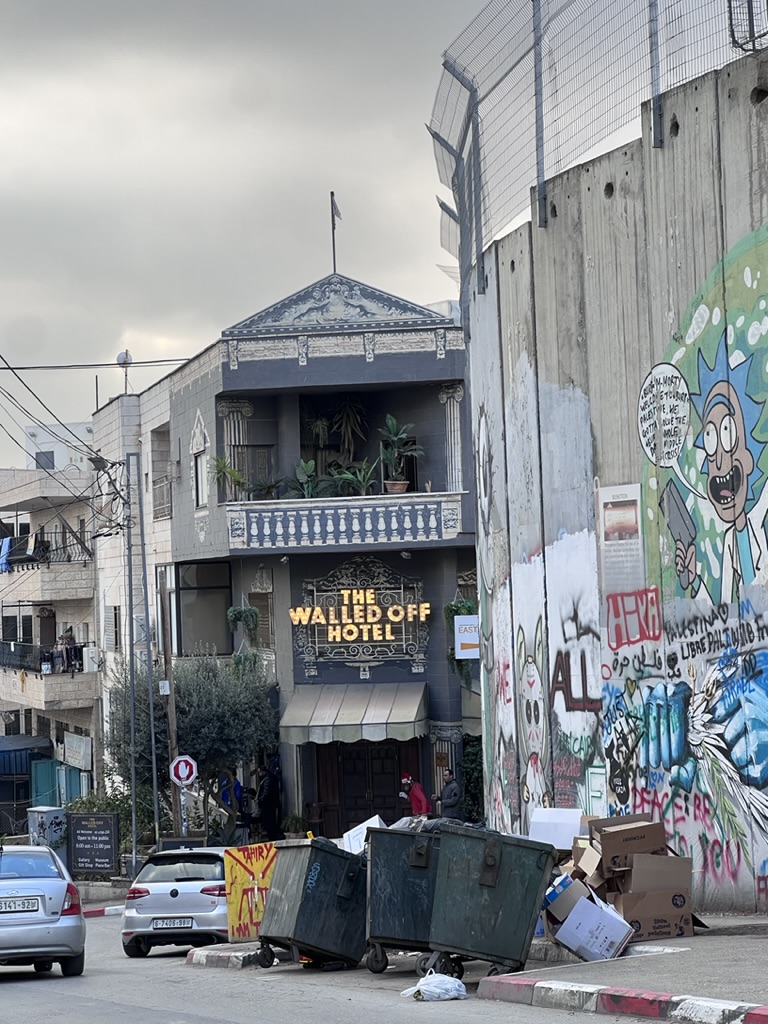
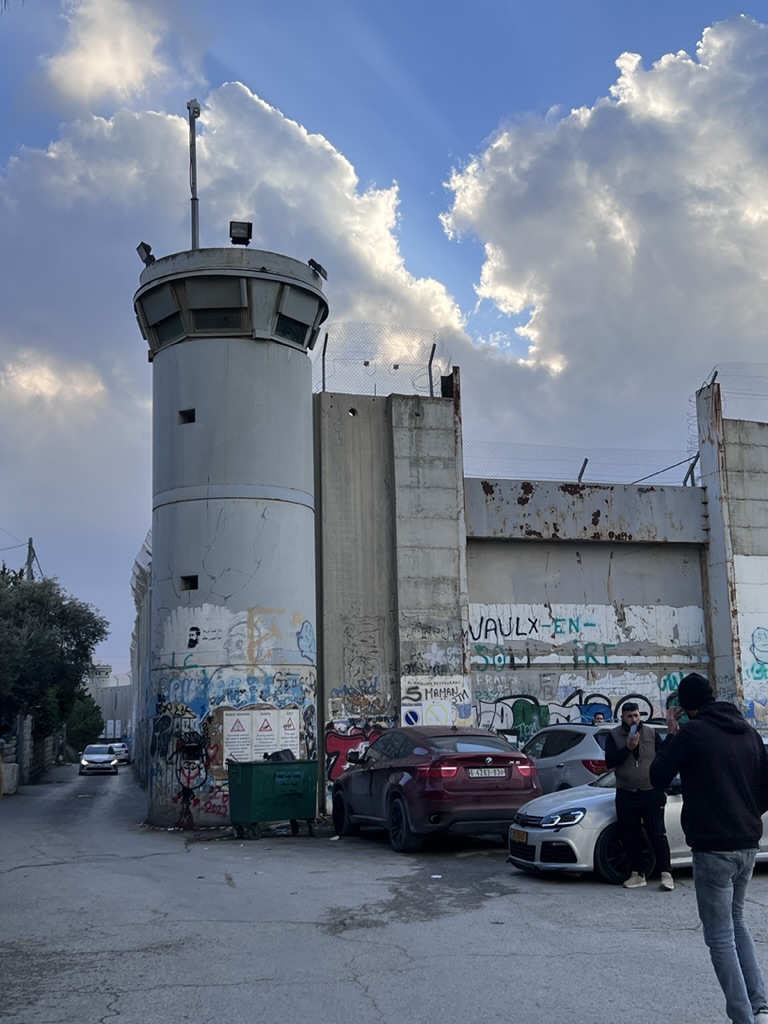
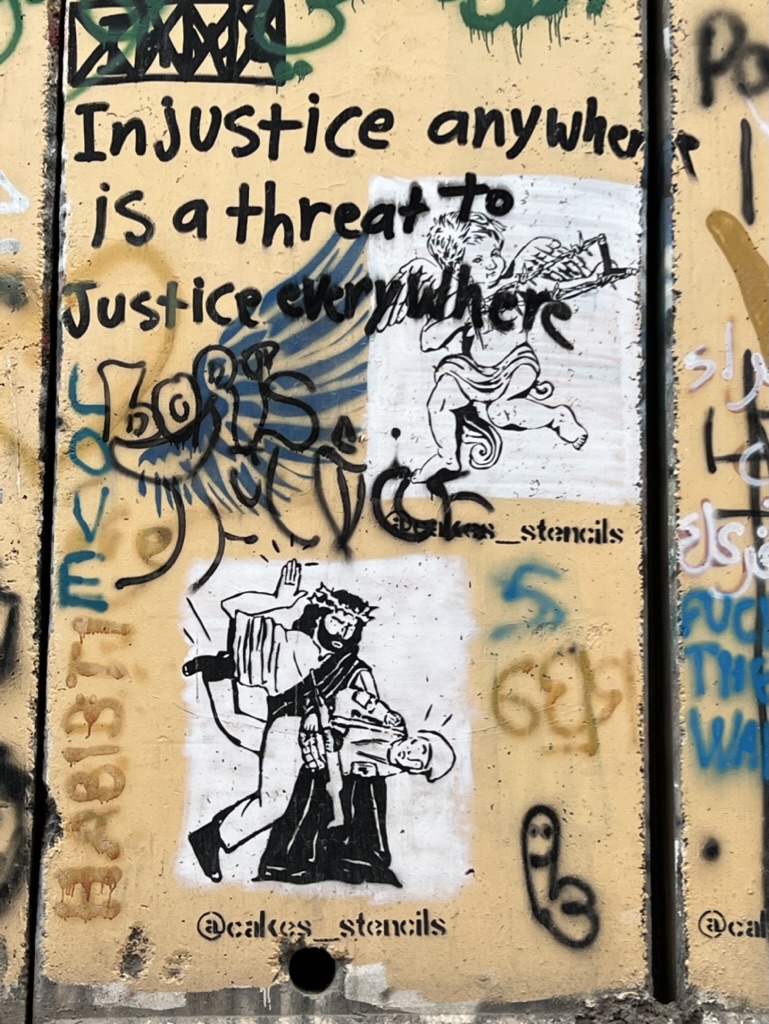
Covered with graffiti, the West Bank barrier wall completely cuts off the city of Bethlehem from the rest of Israel. The wall is now about 20 years old, and the layers and layers of graffiti attest to responses to the situation by mostly foreigners who visit and make their mark. Banksy, the anonymous London-based artist, made his mark on the wall in 2005, with both paintings on the wall and also the development of the “Walled-Off Hotel,” which was established in 2017 (aptly mocking the “Waldorf Hotel” in NY). The Walled Off Hotel was originally set up as a temporary exhibition at a building that sits opposite a portion of the West Bank Barrier (the wall) that separates Bethlehem from the holy site of Rachel’s Tomb (which we did not visit and which has two entrances—one for Jews and one for Palestinians). The hotel is obviously a work of social commentary on the plight of the Palestinians and is billed as “having the worst view of any hotel in the world.” From what I’ve read, the reviews of the “hotel” in which you can actually book a room, have been mixed: some say that the hotel makes profits off tragedy, and is like “war tourism;” but more than 150,000 people have come to see the hotel and thus seen the situation and reality of the conflict and how it plays out in Bethlehem, and perhaps brought money into the town.
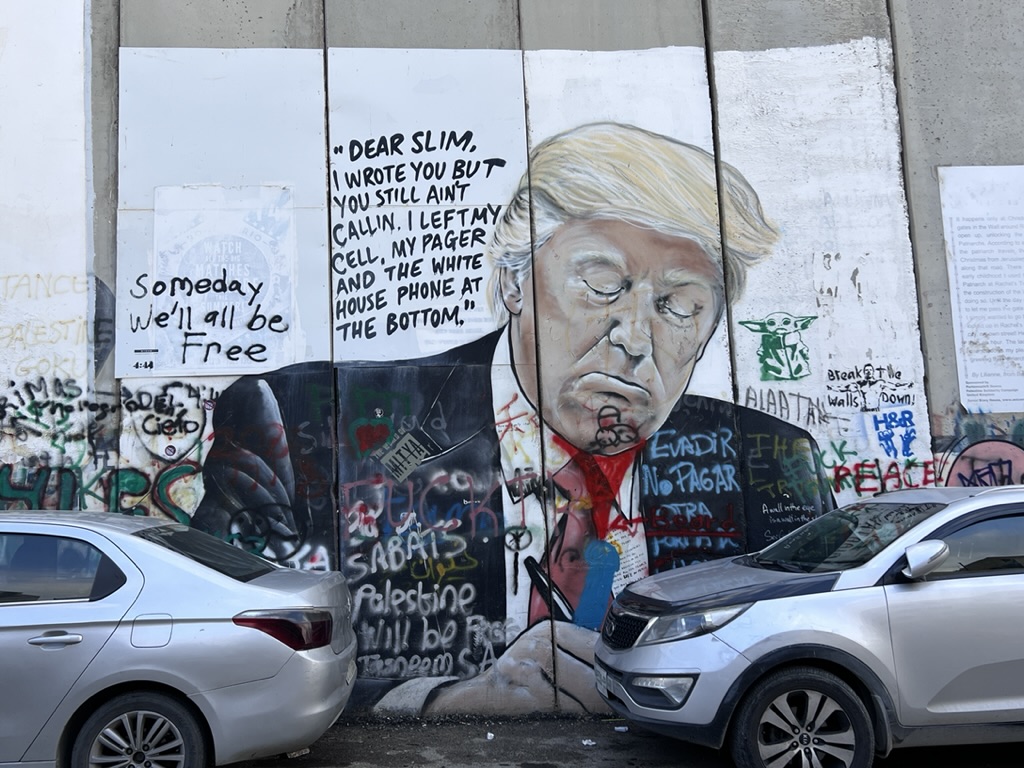

The wall, sometimes called the “separation wall,” is massive, concrete, and twice as tall as the Berlin wall. It twists throughout the region, lining highways and surrounding villages and cutting off cities like Bethlehem. The section of the wall that we saw up close was totally surrounding the city of Bethlehem. We walked many blocks of the wall here to view the political art and to sense life in a functioning Palestinian city, albeit one that has been cut off from access to family, friends, and neighbors. Clearly Trump must have learned from this wall as he chanted “Build the wall!” But this wall is not meant to halt immigration; people in Bethlehem are not interested in moving to Israel. But, they are interested in being able to visit family and friends, which is next to impossible. Charlie, the taxi driver is married to a woman whose family lives in Bethlehem, and he explained how difficult (maybe impossible) it is for her family to visit them in Israel. Charlie and his wife and family always go to Bethlehem because they have Israeli ID cards and it is perfectly OK for them to come to Bethlehem whenever they want, but it doesn’t work for those living in Bethlehem to come to Israel. Something is very wrong with this picture.
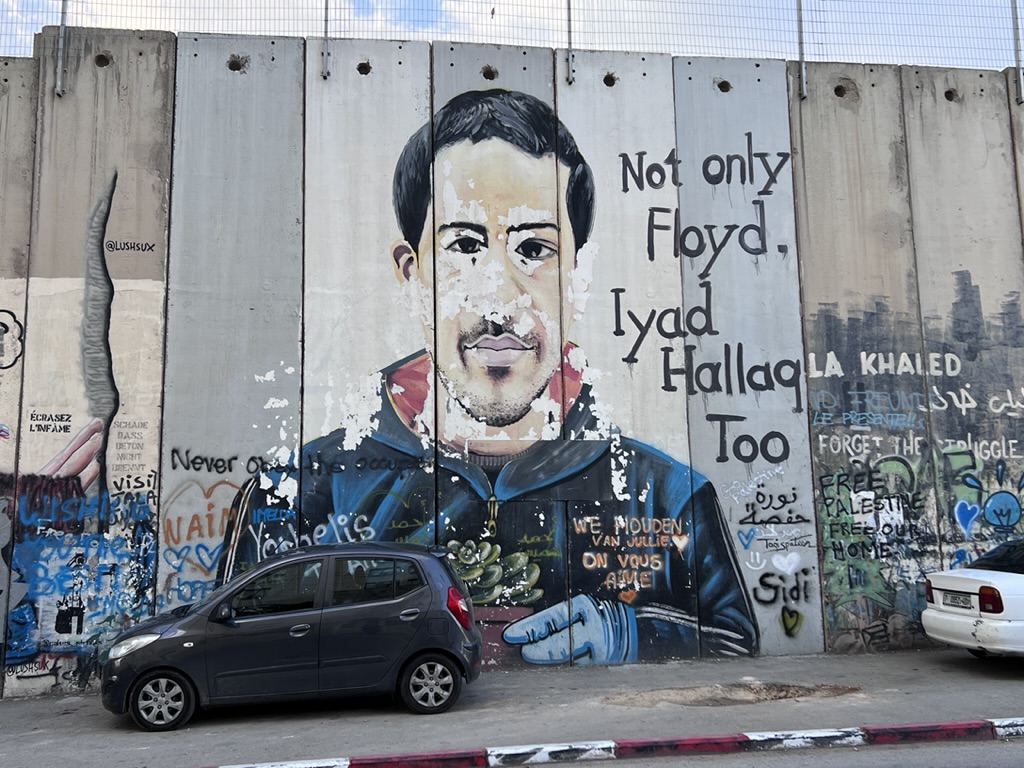
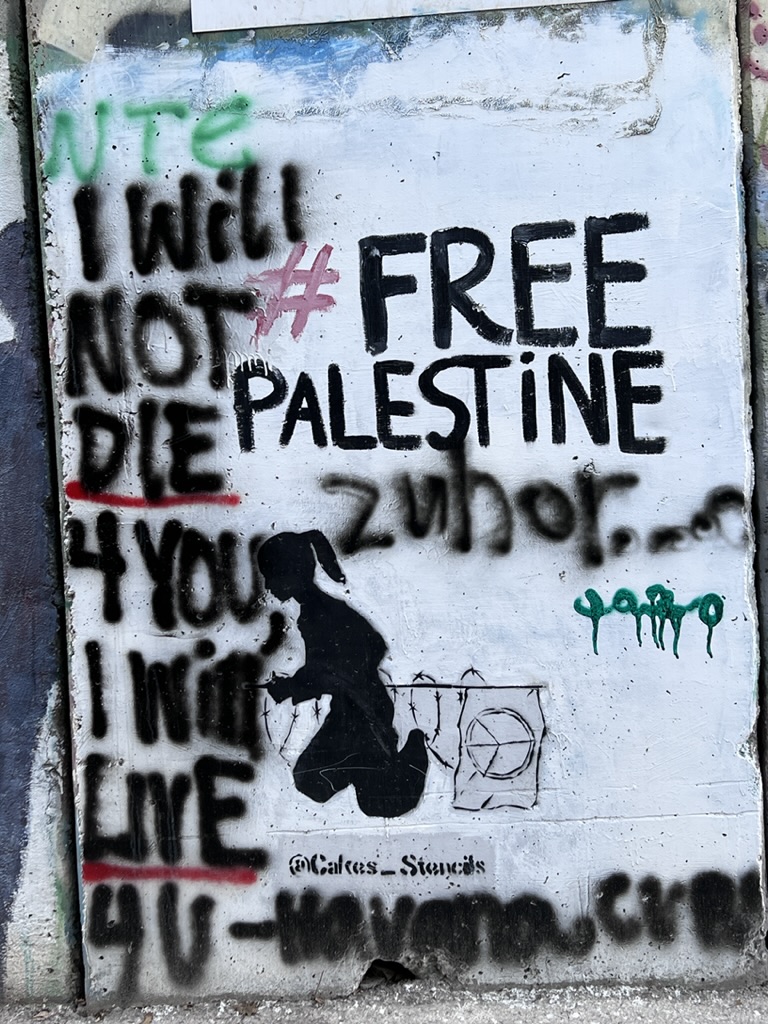
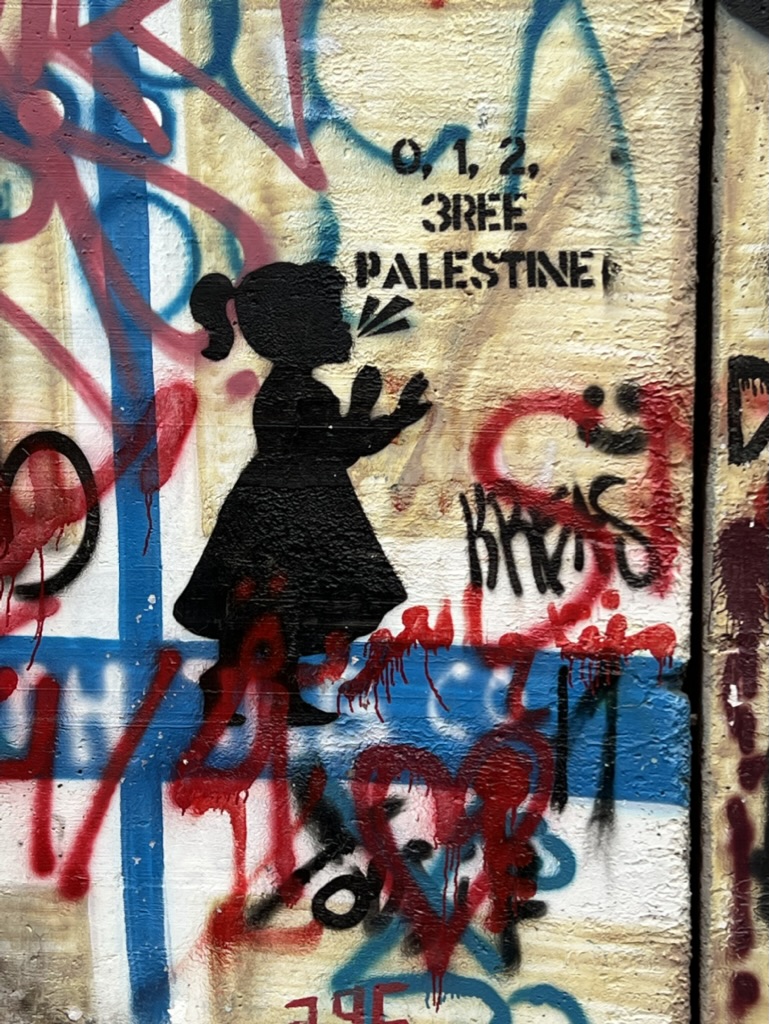

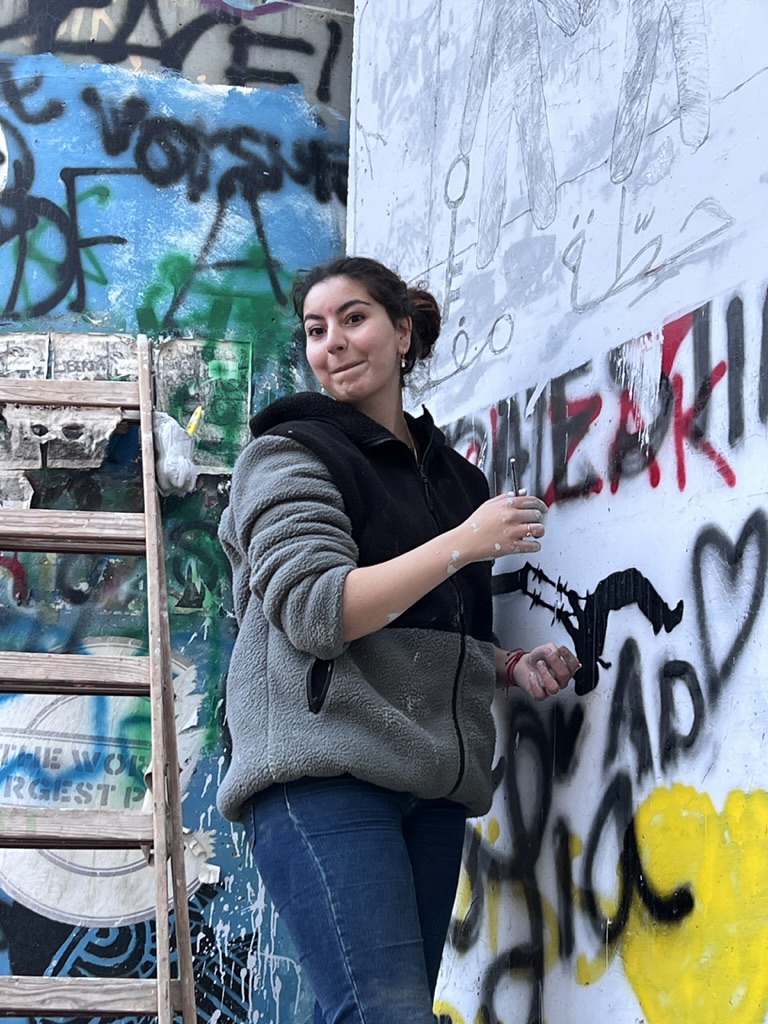
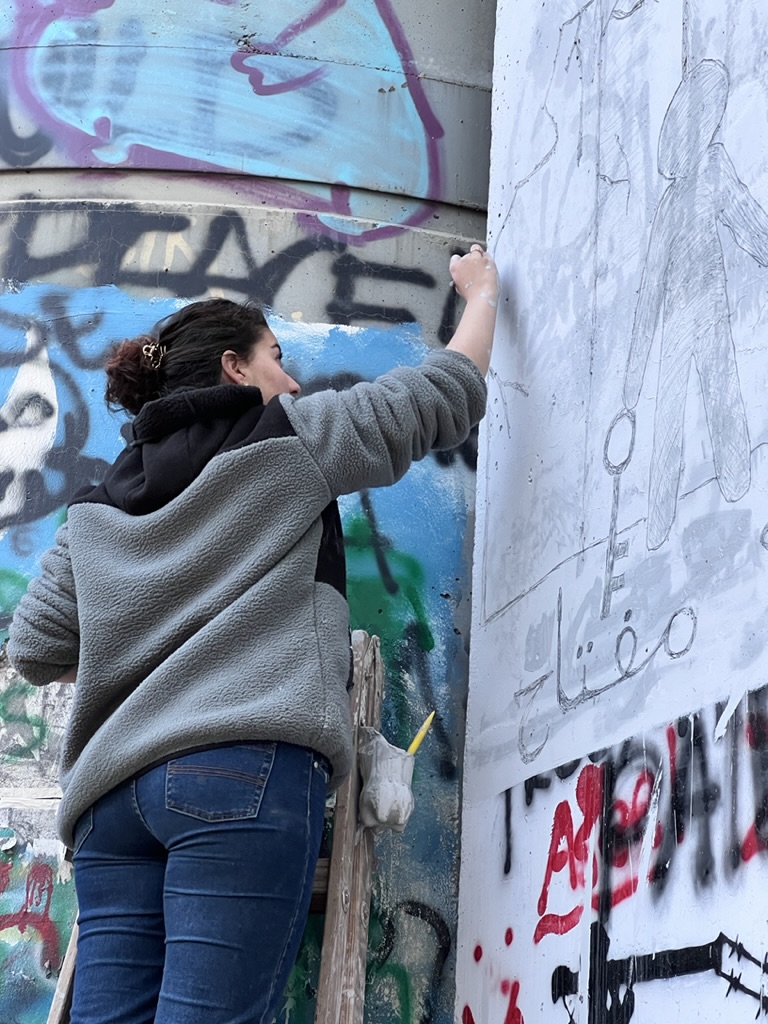
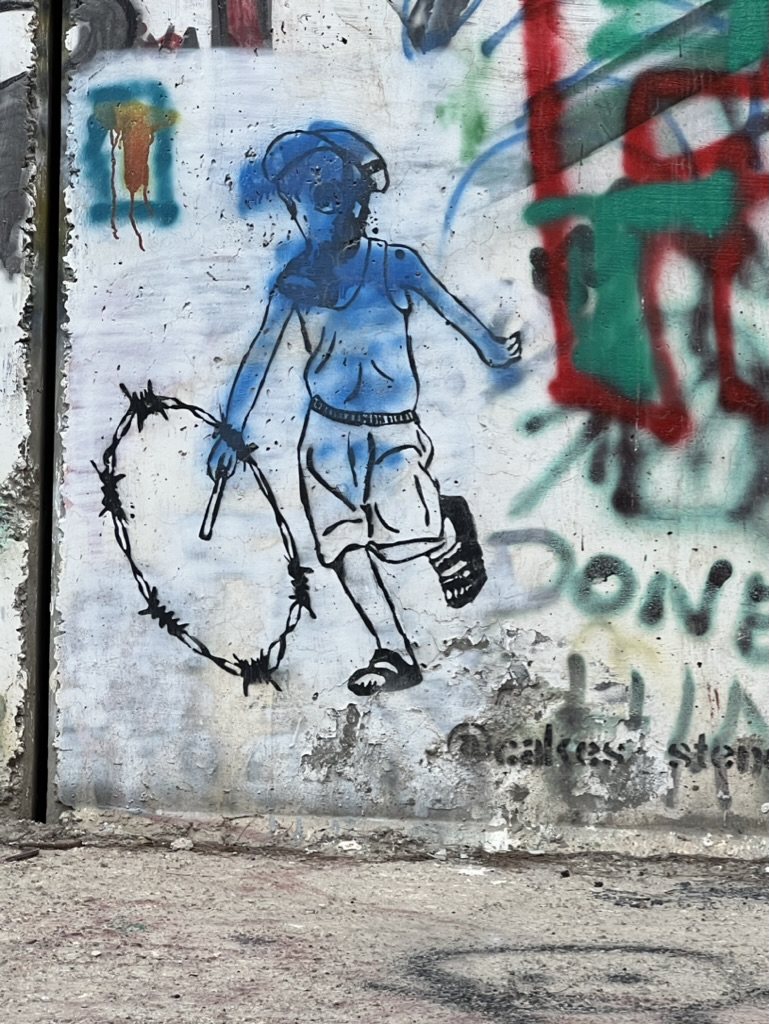
As we strolled the many blocks of the wall, we stumbled upon one young woman who was carefully painting a section with a scene of two young Palestinian children walking hand in hand; one is carrying a large key and the other an olive branch. It turns out that she is one of many Palestinians living in Santiago Chile (go know that there is a large Palestinian community in Chile—didn’t see that when I visited Chile); she is an art student in Chile and has Chilean citizenship. Somehow a group of Chilean students (mostly of Palestinian descent) are in Bethlehem for three weeks—touring, taking classes… and painting the wall with their own creative ideas. We chatted a bit and she explained (not verified elsewhere) that only foreigners can legally paint the wall. She says that if Palestinians paint the wall they can be arrested. There are watch towers all around the wall with soldiers and cameras. We chatted for quite a while, and she explained that one student in her class was painting the wall the other day and he had to escape to Jordan because he was not a Chilean citizen and could be arrested.
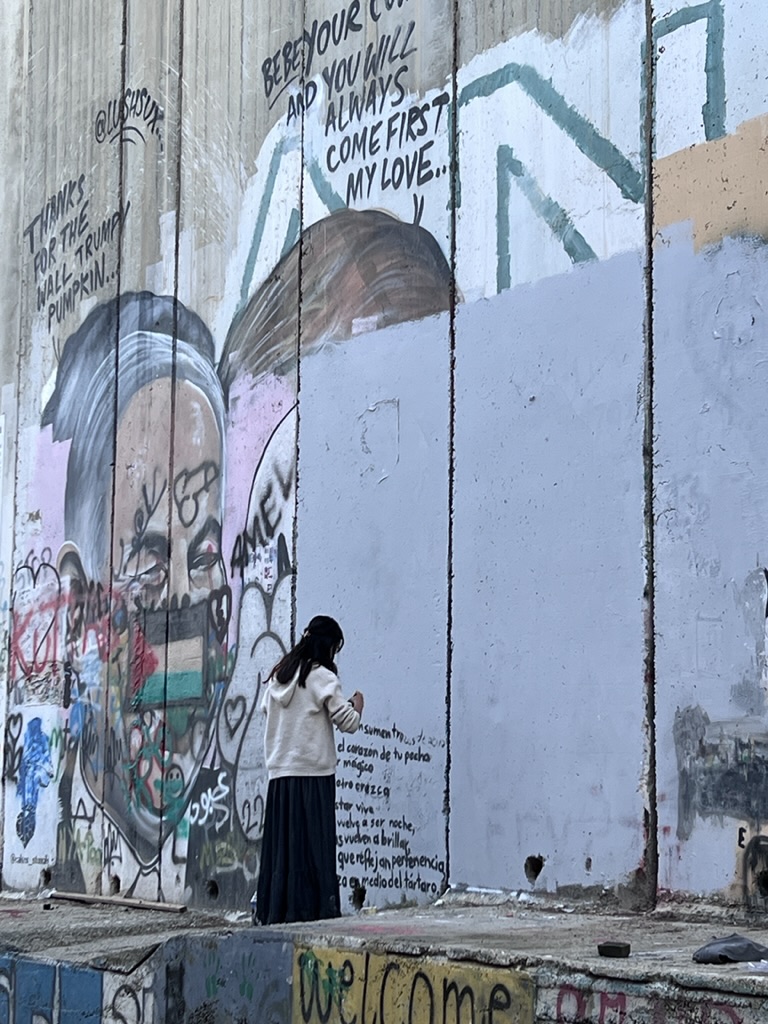
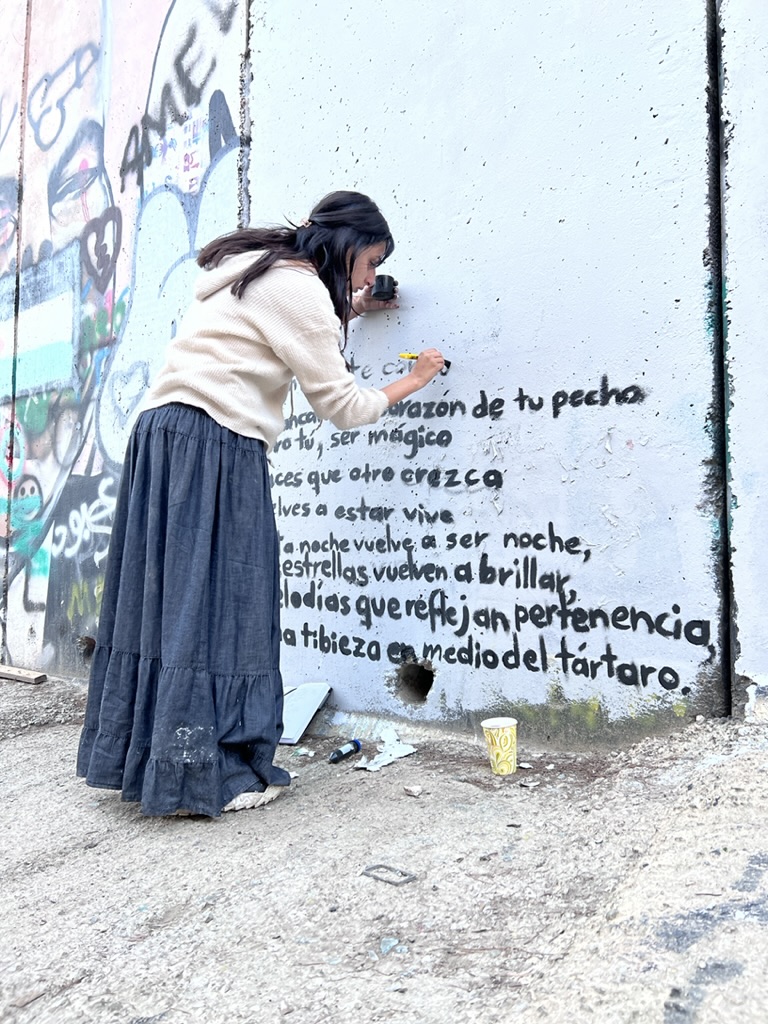
Much of the writing on the wall is in English; some in Spanish, Italian, French, Hebrew, and Arabic (but the Arabic is much less frequent). The dominant language is English. Many of the murals have included some humor, and some confusion about Bernie Sanders vs. Larry David (or maybe they were very attuned to Larry David playing Bernie Sanders on SNL).
The young Chilean woman explained her contribution and the inclusion of the excessively large key as a symbol (held by the young girl in the picture she was painting). She said that many Palestinians living in Chile, still have the keys to their houses in Palestine. They hope some day to return. Some have visited, only to find that their houses are now occupied by Israelis. This story was so hard to take because it was so reminiscent of stories about Jews who fled Germany and other European countries only to return years later to find their houses occupied by other families. How is it possible for Israelis to forget this history. What happened to “Never forget?”
The UN has stated emphatically about the 55-year occupation of Palestine: “There is today in the Palestinian territory occupied by Israel since 1967, a deeply discriminatory dual legal and political system, that privileges the 700,000 Israeli Jewish settlers living in the 300 illegal Israeli settlements in East Jerusalem and the West Bank,” said Michael Lynk, the UN Special Rapporteur for the situation of human rights in the Palestinian territory. Mentioning the lack of rights of people living in the same vicinity, but separated by walls, checkpoints and roads, Mr. Lynk acknowledged that “there are more than three million Palestinians living under an oppressive rule of institutional discrimination and without a path to a genuine Palestinian state that the world has long promised, is their right.” He further defined “apartheid,” as “a system of institutionalized racial segregation practiced in South Africa prior to its dismantling in the early 1990s. “Israel,” he said, “conforms to the definition as a ‘political regime which so intentionally and clearly prioritizes fundamental political, legal and social rights to one group over another, within the same geographic unit on the basis of one’s racial-national-ethnic identity.’”

Walked a bit more and then finally after several hours taxied back to the hotel in Jerusalem. We headed to dinner at The Workshop, located at the old Jerusalem train station. Had yet another amazing meal including a burnt eggplant carpaccio, that had brown butter, pesto, and almonds; followed by a mushroom risotto with mushroom ragout, porcini, chives, parmesan; and smoked brisket, hollandaise sauce, coleslaw, chimichurri and mustard. For dessert we had a wonderful tiramisu.
The shop and the outdoor eating areas are filled with objects and family photos from a more than 150 year span.
Then we fought traffic again and eventually arrived in Akko (Acre in English). More on Akko tomorrow.. our last real day and night in Israel.
Hope the sun may have cdome out breifly for all of the Californnia readers. We are certainly not looking forward to returning to the rain.. the torrential rain we have been hearing about.
All the best…
Fern

