12. Padua to Trieste via Portograuro. April 22 2023
From rustic to elegant… from small village to Village People! Greetings from Trieste
Hope you are doing well and enjoying what appears to be sunny spring weather in Oakland and perhaps in other parts of the region and the US. We have hit good weather and even here in Trieste where we expected it to be cooler, it is sunny and very moderate.
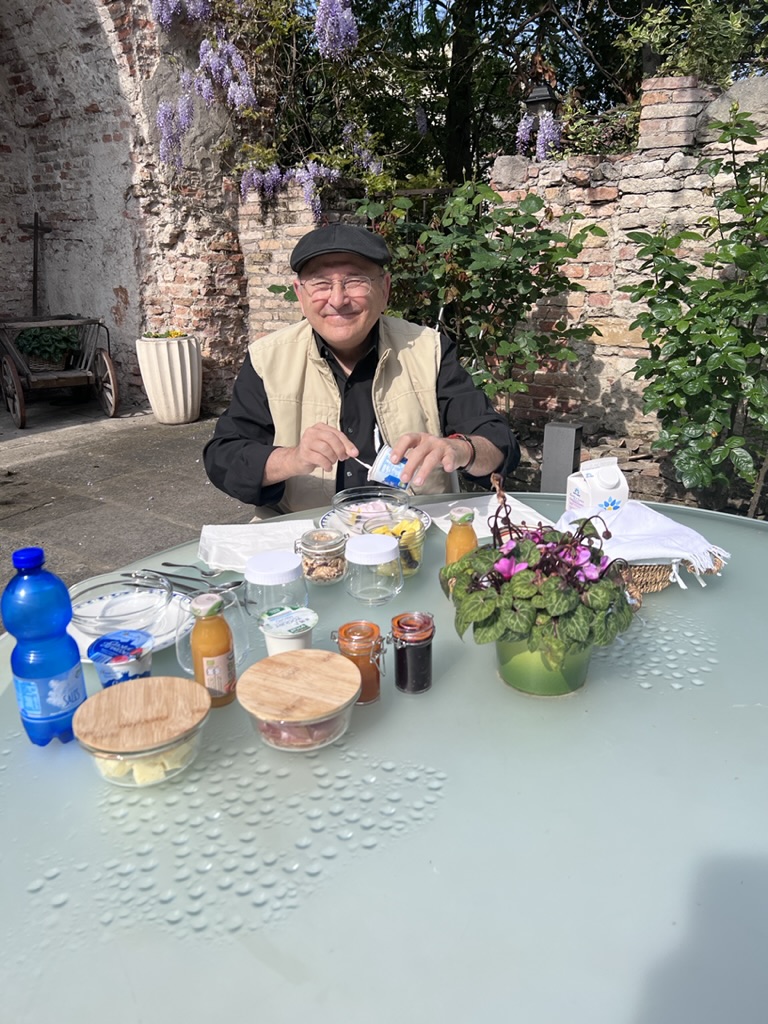
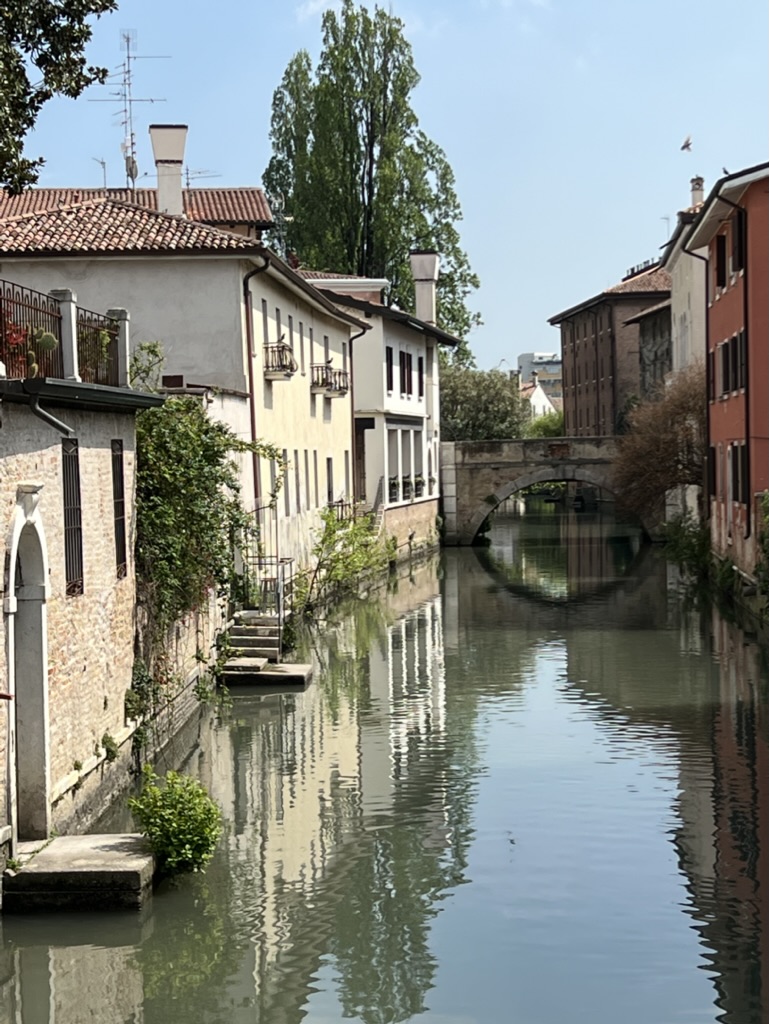
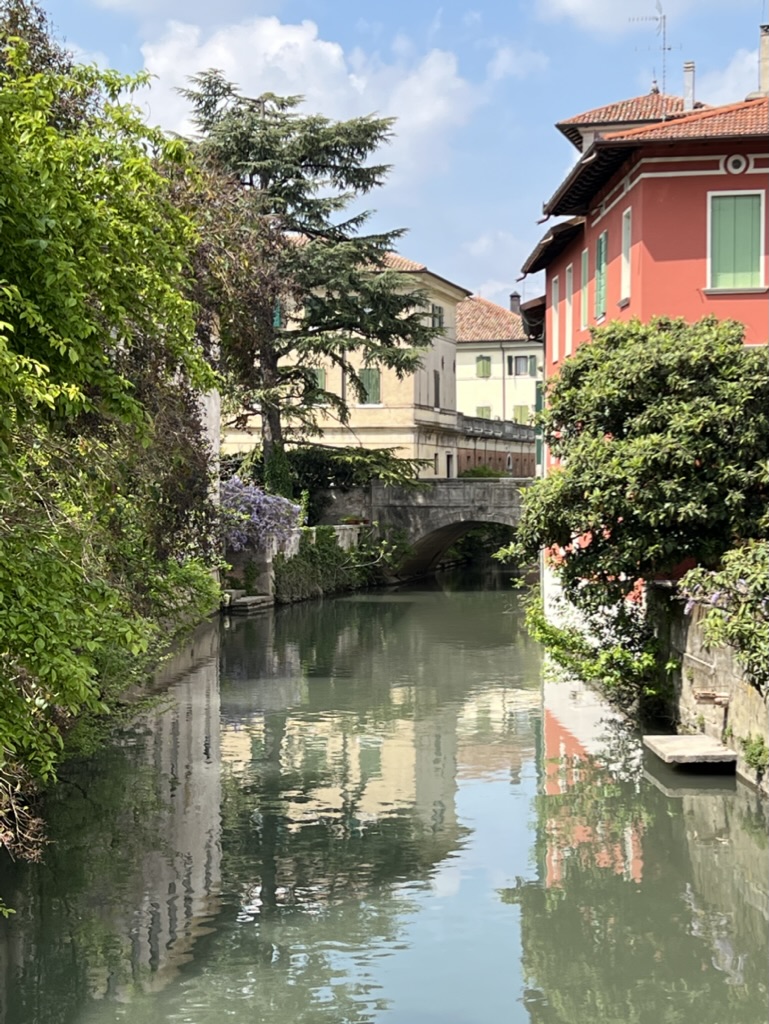
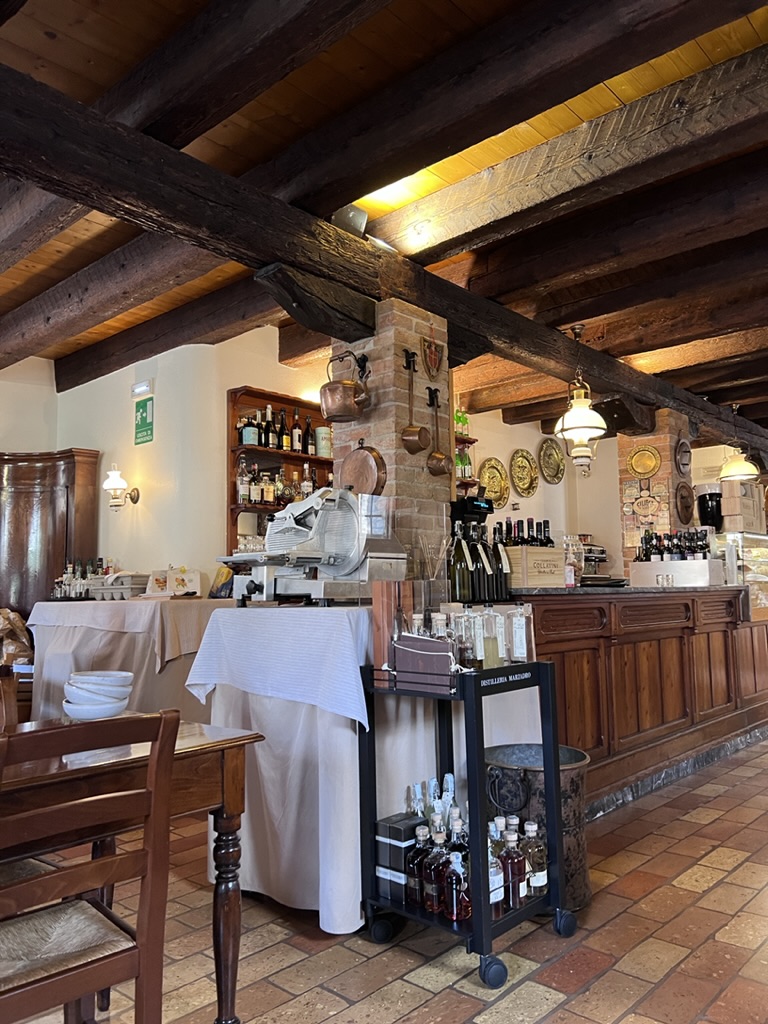
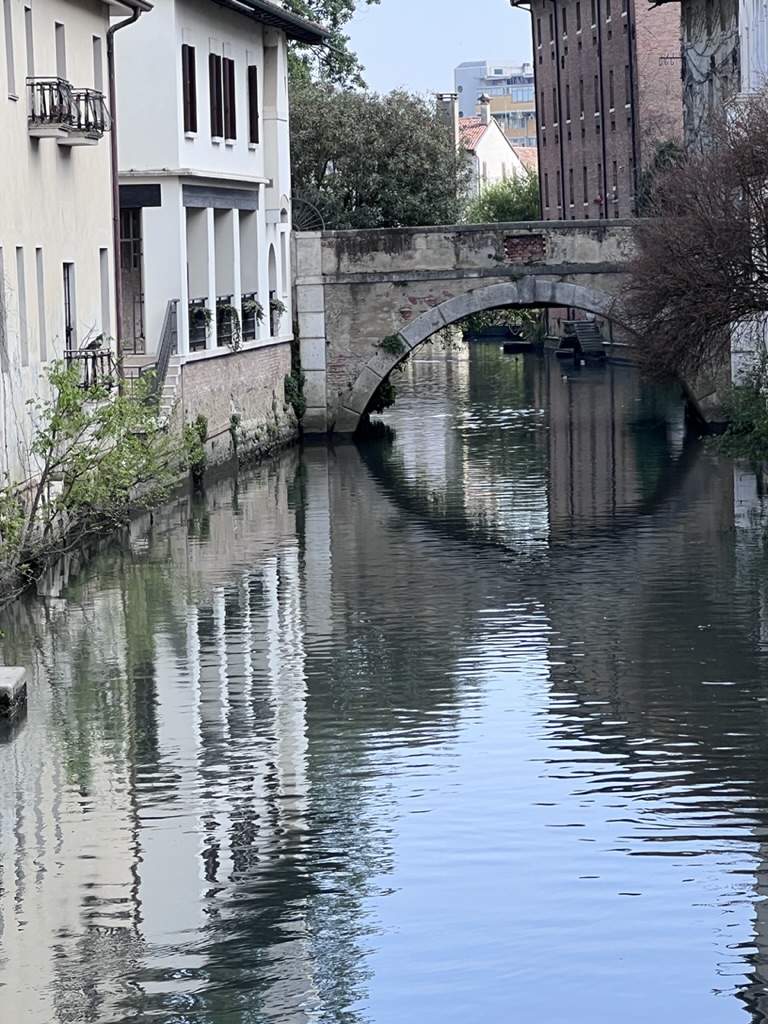
We left our little nirvana in Padova after a delightful breakfast that came to our door, once again, at around 10:00; today we took the “box” to our private outside patio, which was perfect. We got on the road at about 11 and headed to Trieste, but with a stop in a small 6,000 population town called Portograuro which was somewhat unplanned but totally cute with canals and wooden bridges. We ate at a little trattoria that was filled with locals, mostly families (it’s Saturday); food was good.. and after a brief stroll, we headed to Trieste.

Before going into our arrival at Trieste, a few points of observation— Italy seems to have latched onto technology in a big way; they have lots of remotes for everything from the drapes to the windows, to heat, to toll booths, elevators, etc. Italy also seems still to be more focused on Covid than we are in the US; while people are no longer masked, they have signs everywhere with warnings about covid; all restaurants use QR codes; there are antiseptic wipes and soaps everywhere; I went into a store to try on earrings and was not allowed.. could only hold them close to my ear. And there are many more examples.
And on a language matter, I have been trying to use my not-great-Spanish only to find that Italian is less like Spanish than I thought. Felt I was very clever the other day in asking about an umbrella and used “paraguas” only to see the person look very puzzled.. Turns out the word in Italian is “ombrello.” Go know!
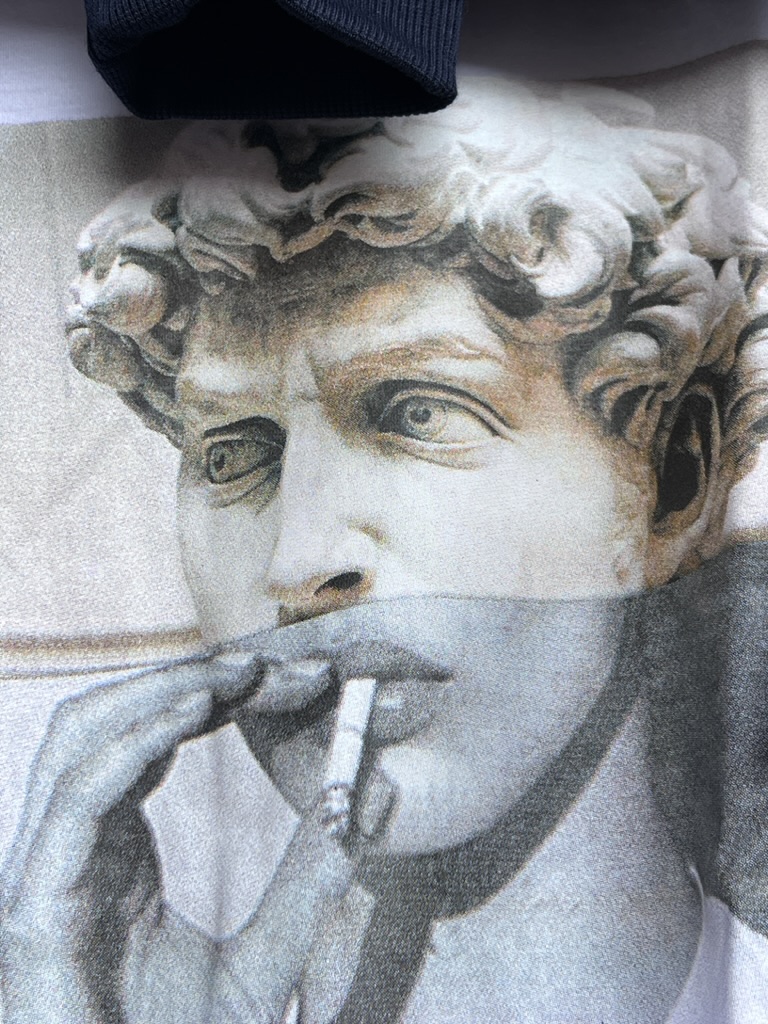
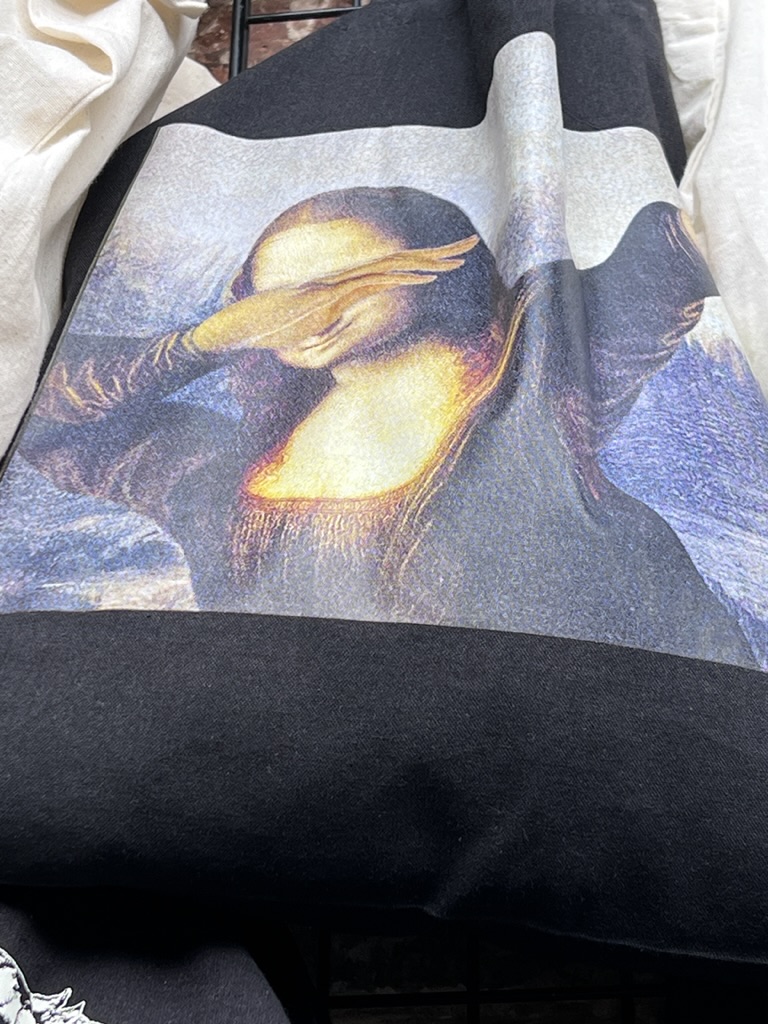
Also, seems like every child here in Italy, and many adults as well, wear tee shirts and sweatshirts and jackets that sport names of American cities or teams or musical groups; and the music playing in lots of bars is American music from the 80s, occasionally earlier. So American “culture” is strong here… for better or worse.
Anyway, after lunch we headed to Trieste, a city we have not been to in decades. What I remembered most about the city was that it seemed more like Vienna or Budapest than like Italian cities in the demeanor of the people. The physical nature of the city includes broader streets than in other parts of Italy, and the building stock is more 19th and early 20th century than 15th, 16th, and 17th century than the other places we’ve been traveling on this trip. I also remembered the large square and the walk along the sea, and lots of people strolling at night.
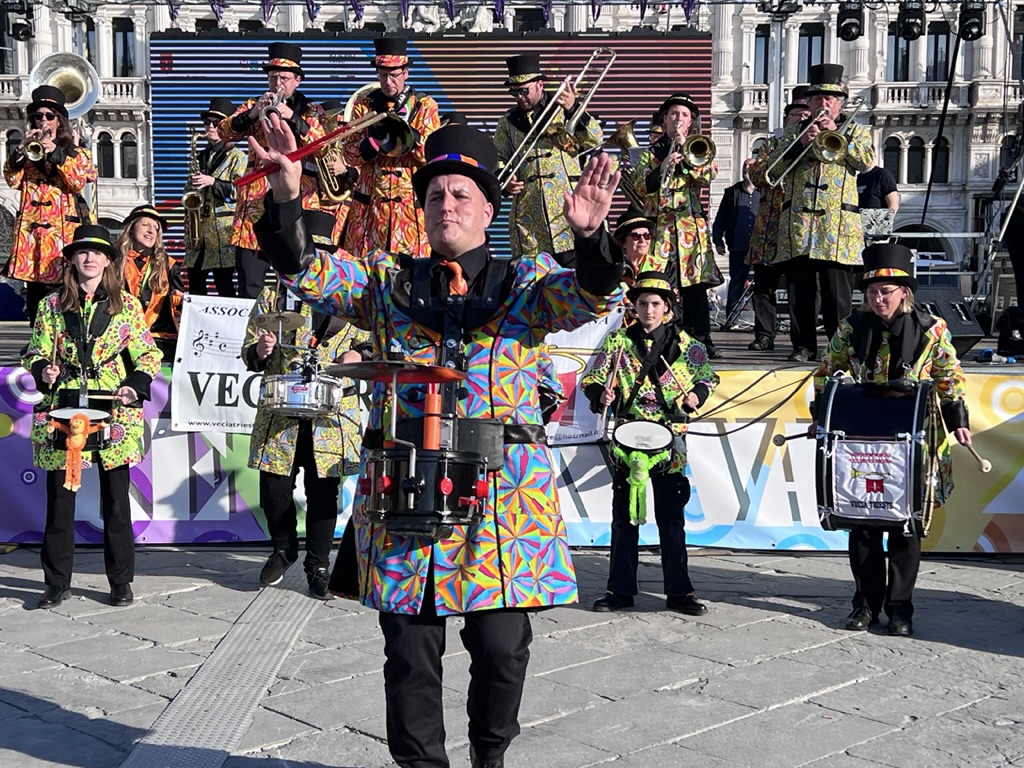
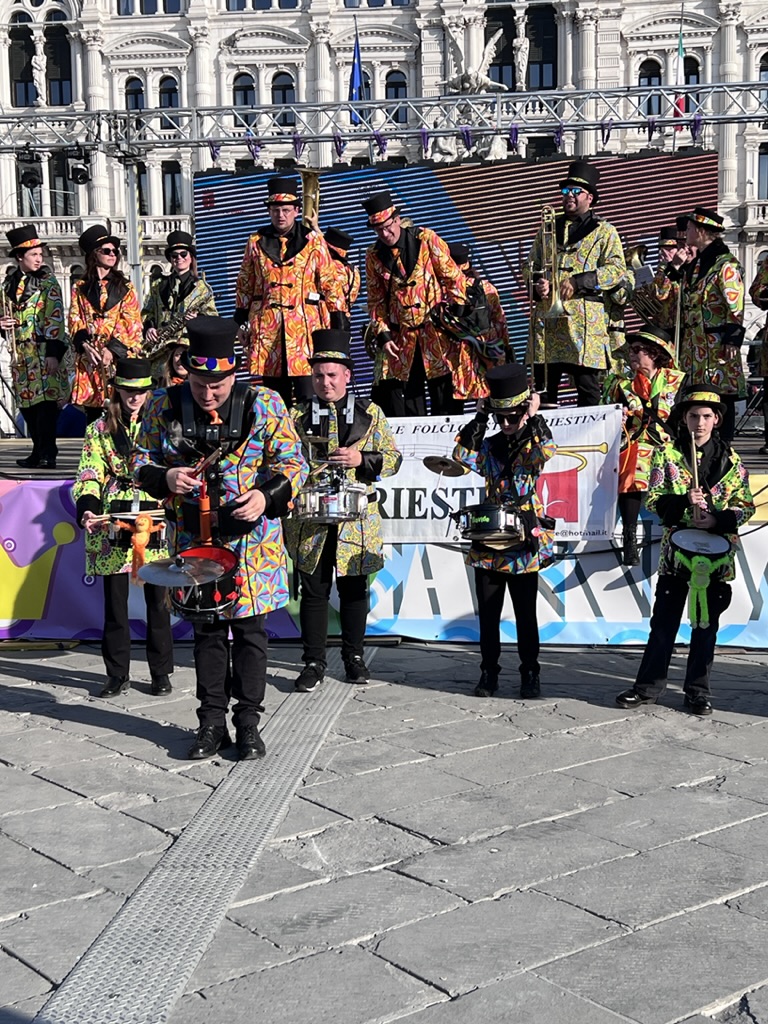
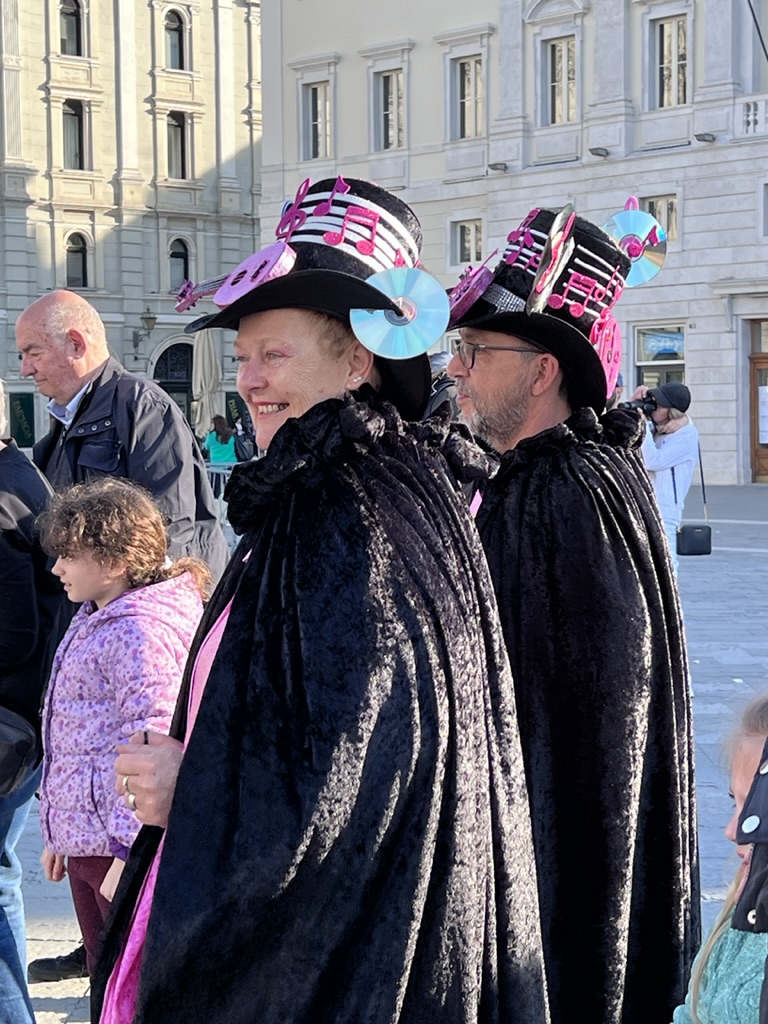
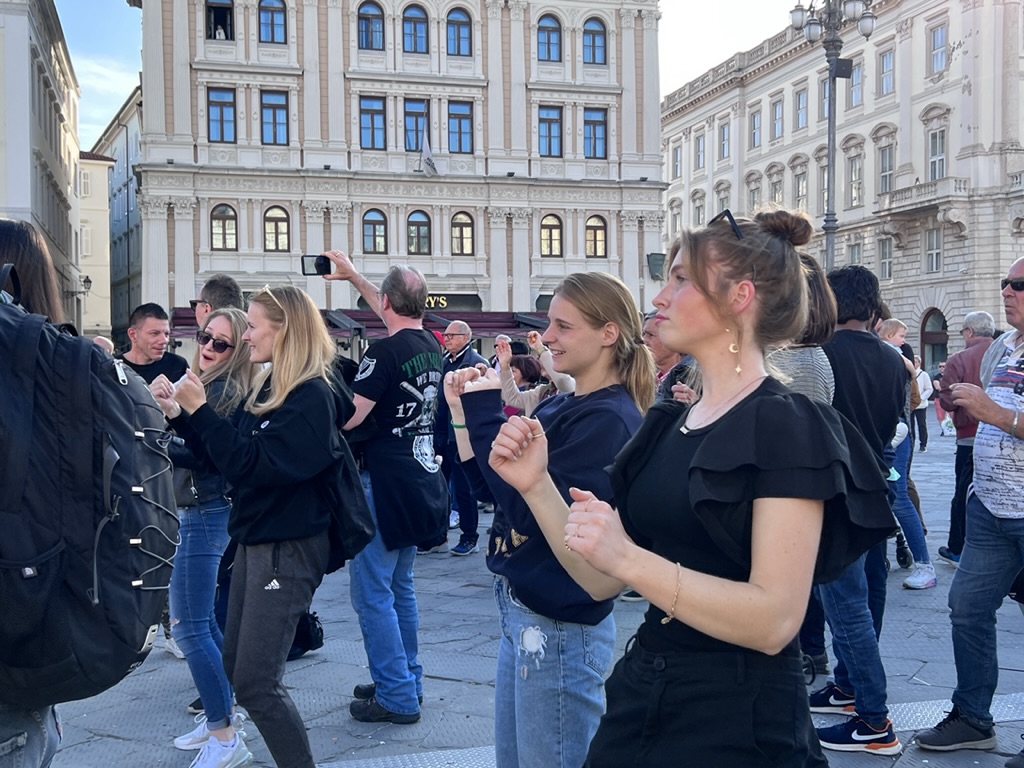
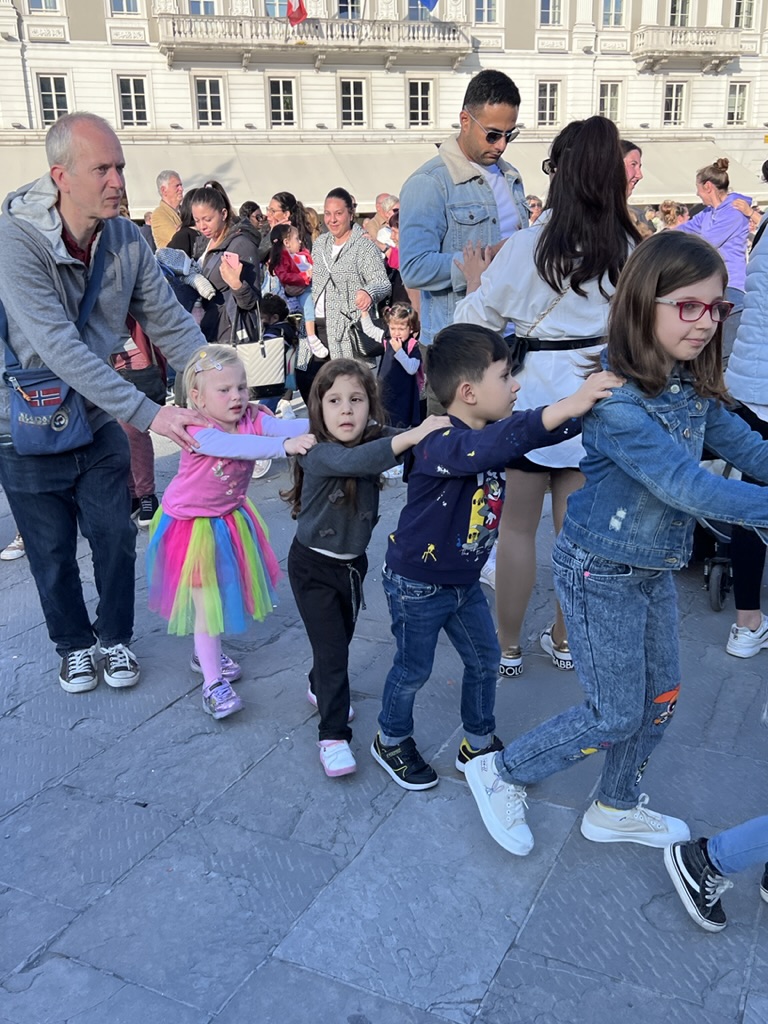
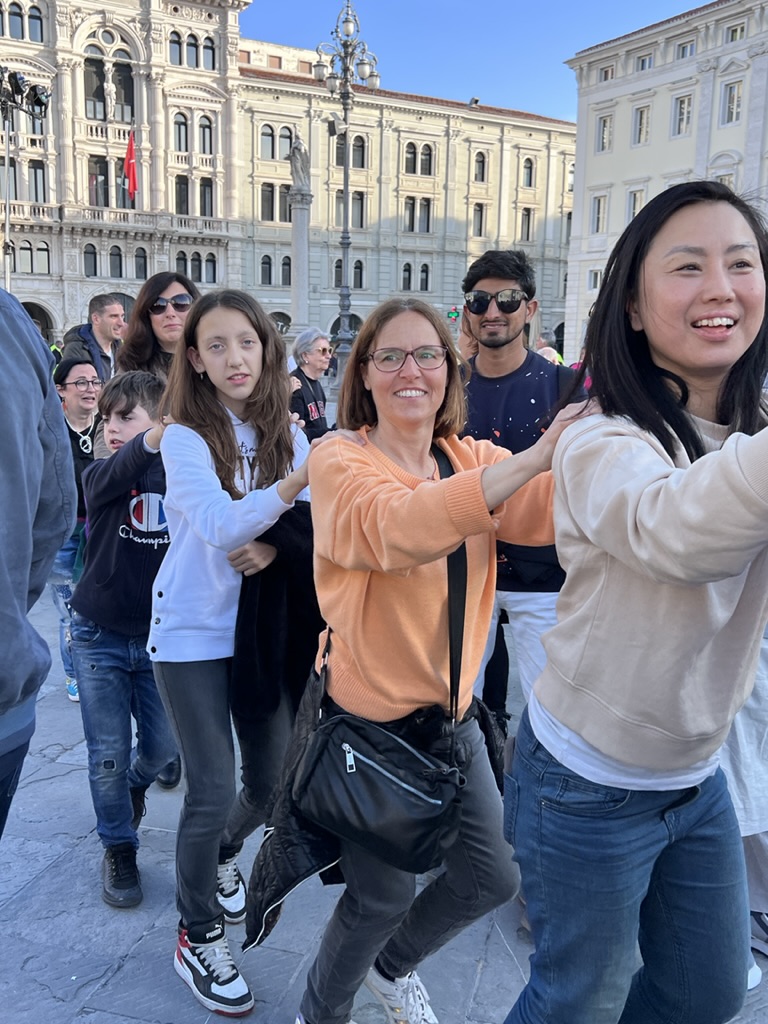
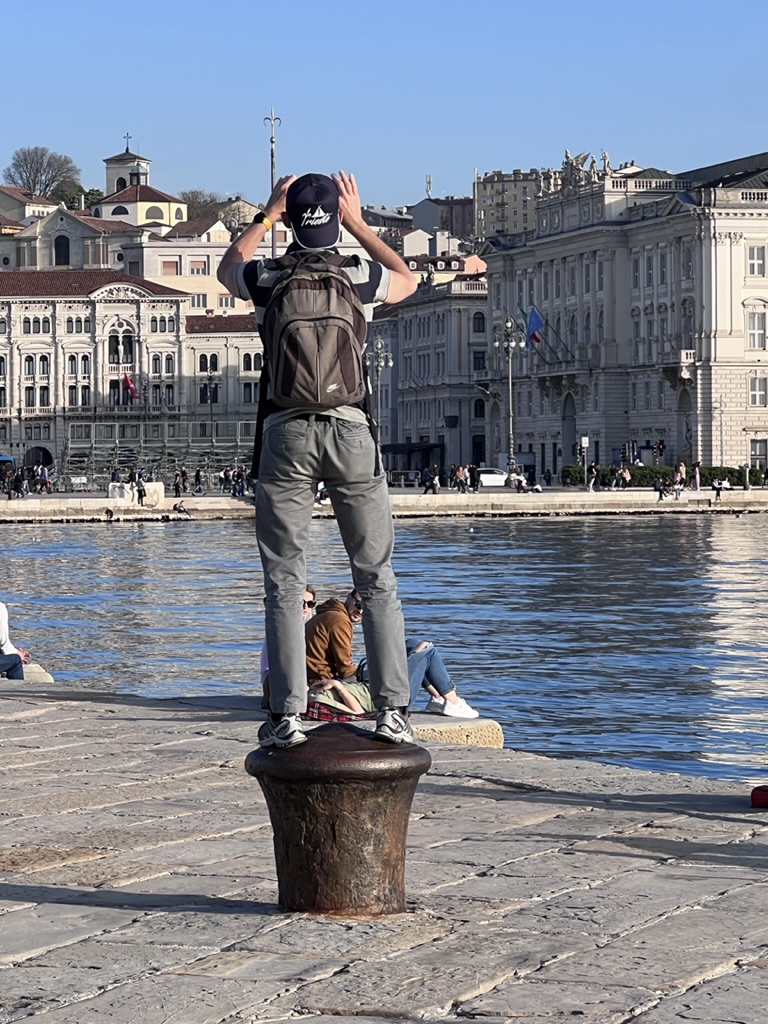
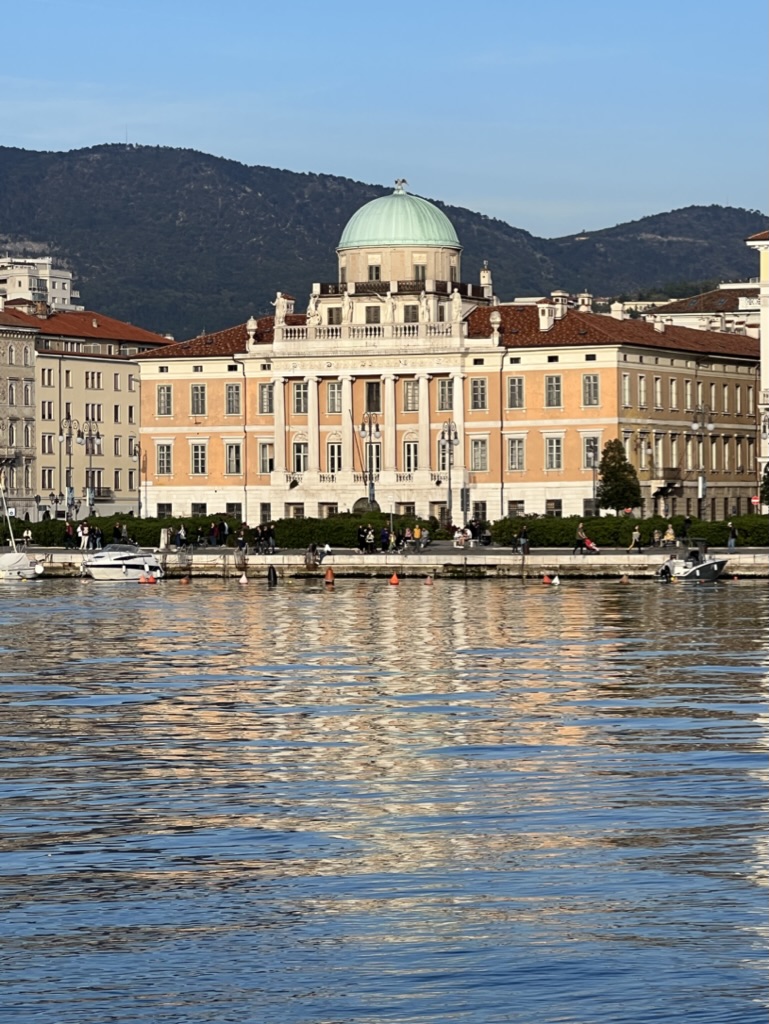
We arrived at around 4:00 and immediately left the hotel to stroll — with the intention of walking out to the big stone “pier” that is now a strolling hangout where you can watch ships come and go or just sit. It was packed with people of every age and ethnicity; actually we’ve seen more people of color here in a few hours than we’ve seen in Italy on the rest of the trip. But we were distracted by loud music and microphones coming from the square. So we headed that way. Turns out that today was “Carnival” in Trieste and the final part of it was music and dancing in the square. Many people were in costume, sort of like Mardi Gras. The emcee and singers were very funny, even though we didn’t totally understand what they were saying. One routine was having everyone in the square (about 400) dance and sing to “Y-M-C-A”… It was loud, it was raucous, it was lots of fun. Children and adults were singing and dancing throughout the square. After a few sets, we continued our stroll to the waterfront just in front of the square.
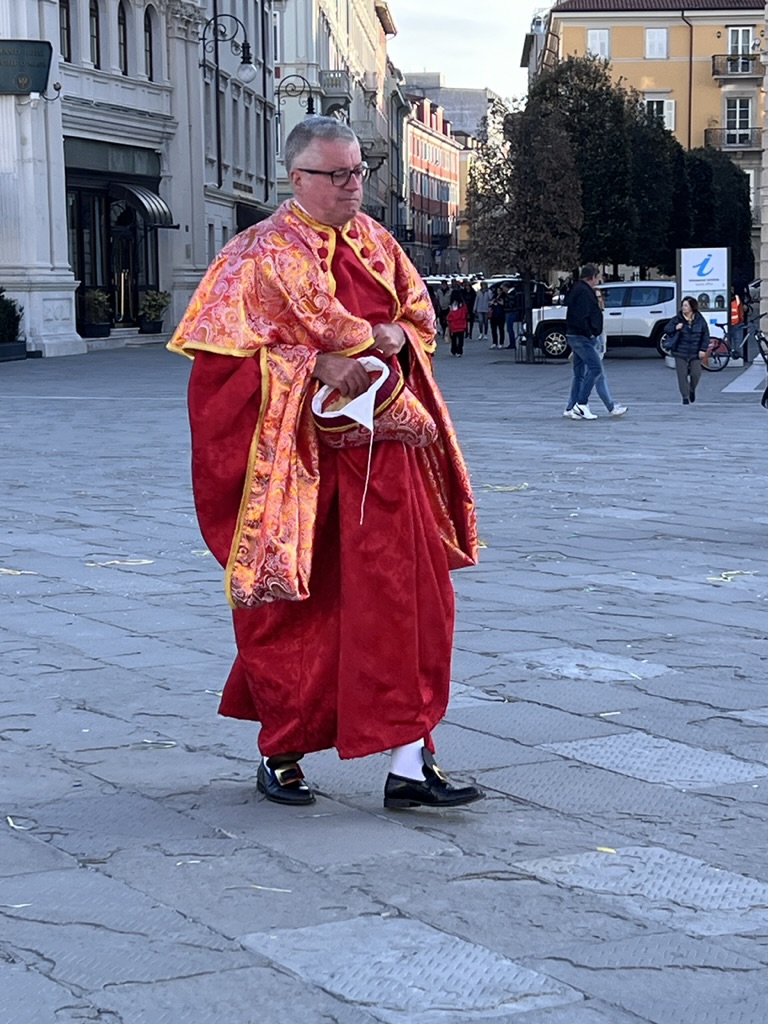
Then we headed to the hotel to get settled and head for dinner.
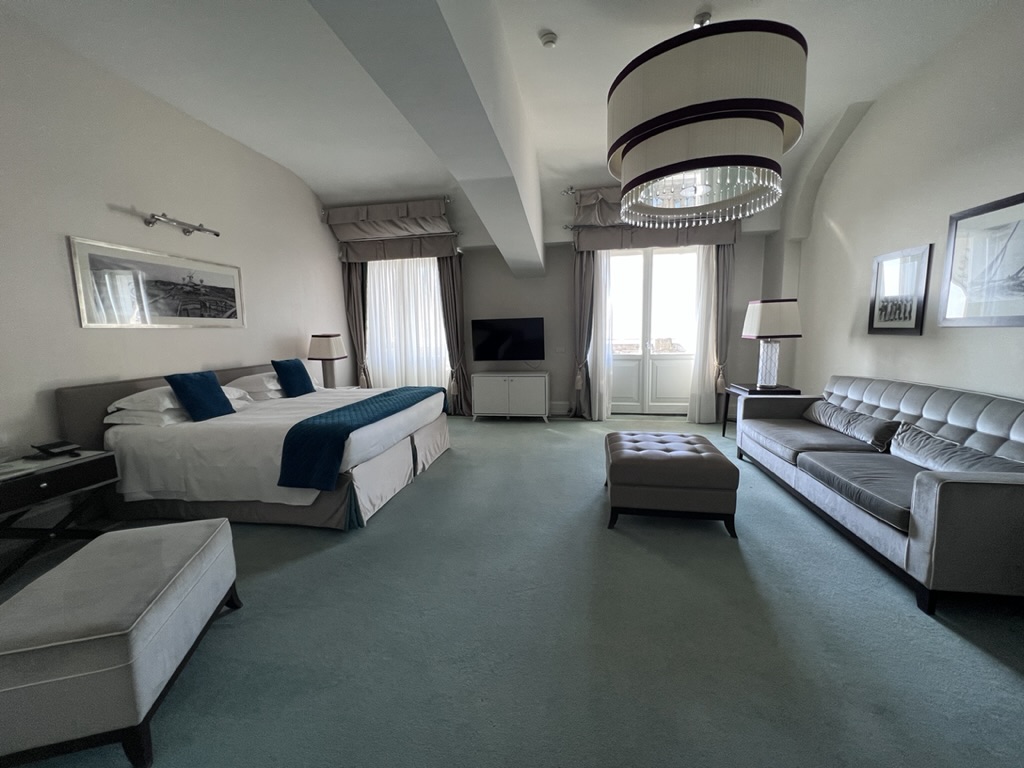
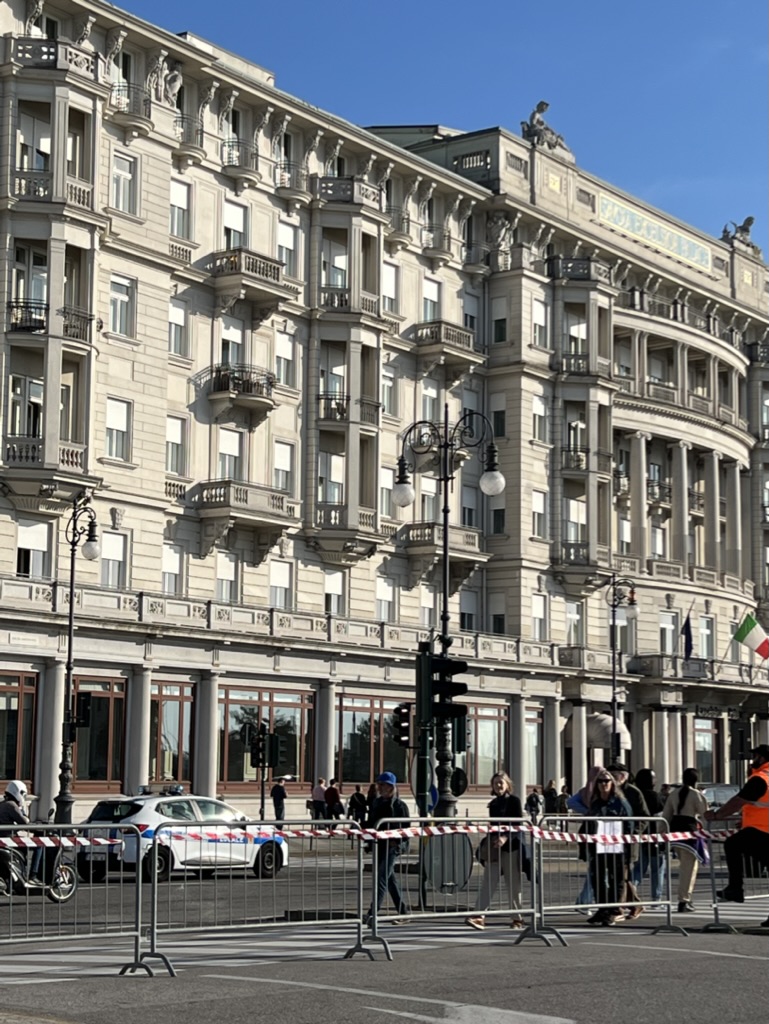
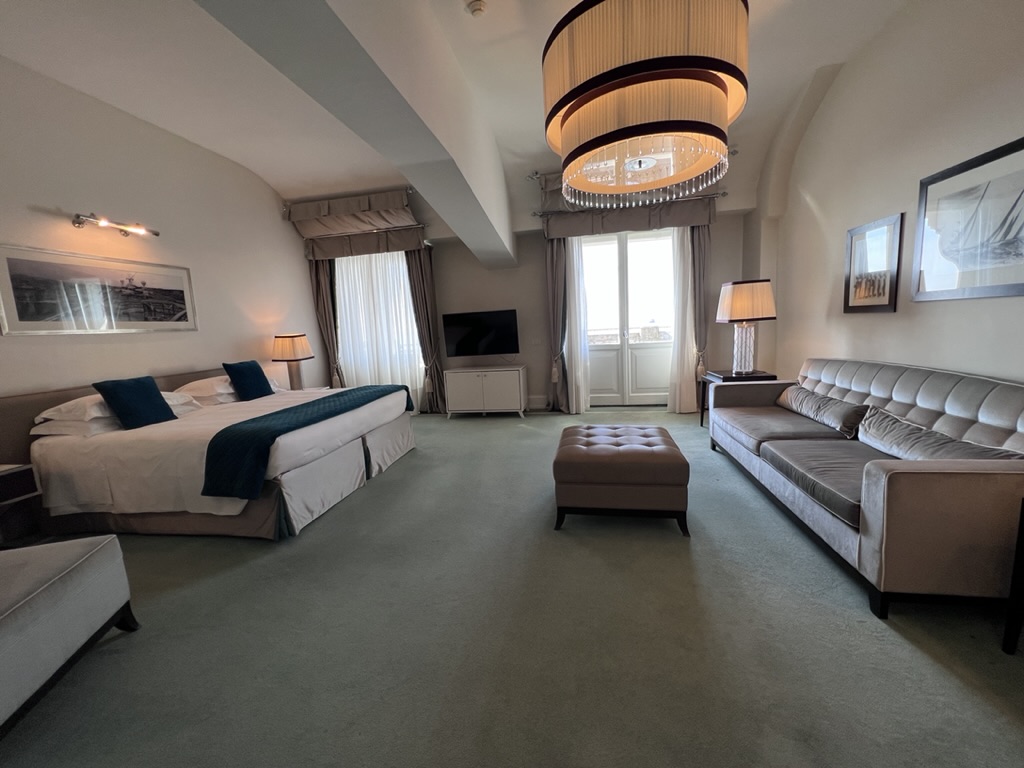
We are at the Savoia Excelsior Palace… which is like the antithesis of all the hotels we’ve been at on this trip. It’s super elegant; the building is more than a century old; it’s on the big side; our room is about 600 sq feet and we have a “luggage room” inside our room which Mike says is the size of the cabins he’s been designing for the homeless. It’s located in the prime spot in Trieste, and our room has two balconies. Ok.. the lap of luxury. Not sure how we got this room; I think we got upgraded for some reason… or maybe they upgraded us…not complaining.

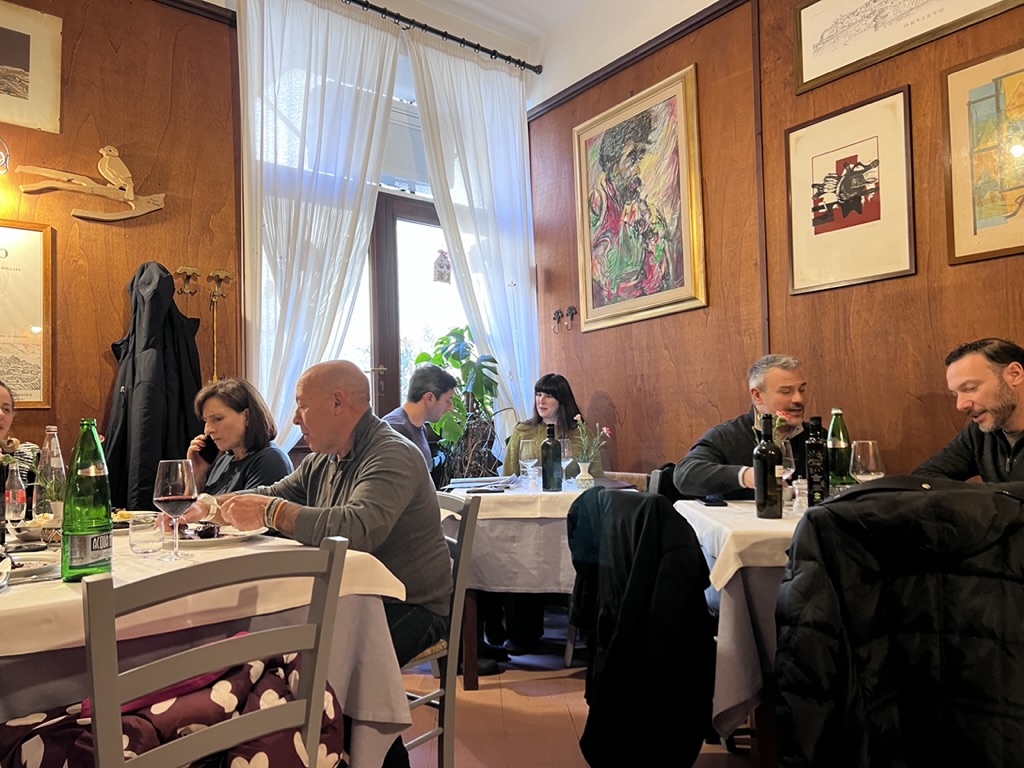
Eventually we headed to dinner—about a 16-minute walk (good to add to our steps given that we were in the car much of the day, but the walk to and from the restaurant) which enabled us to get the steps today to over 10,0000. We ate at Menarosti – a 120-year-old mainstay in Trieste. We were the only non-Italians. It’s one of those white tablecloth places with antique wall sconces and chandeliers. Everyone was local and seemed to know everyone else. We started with thinly sliced local shark that was lightly grilled and then covered with onions soaked in vinegar (great); then pasta vongole (with baby clams); then lightly grilled squid, served at room temperature with chard. All really good, very simple and oh so tasty. Yes, we could not resist the dessert so we had two —- Mike had apple strudel (I said they had some Viennese roots here) and I had tiramisu.

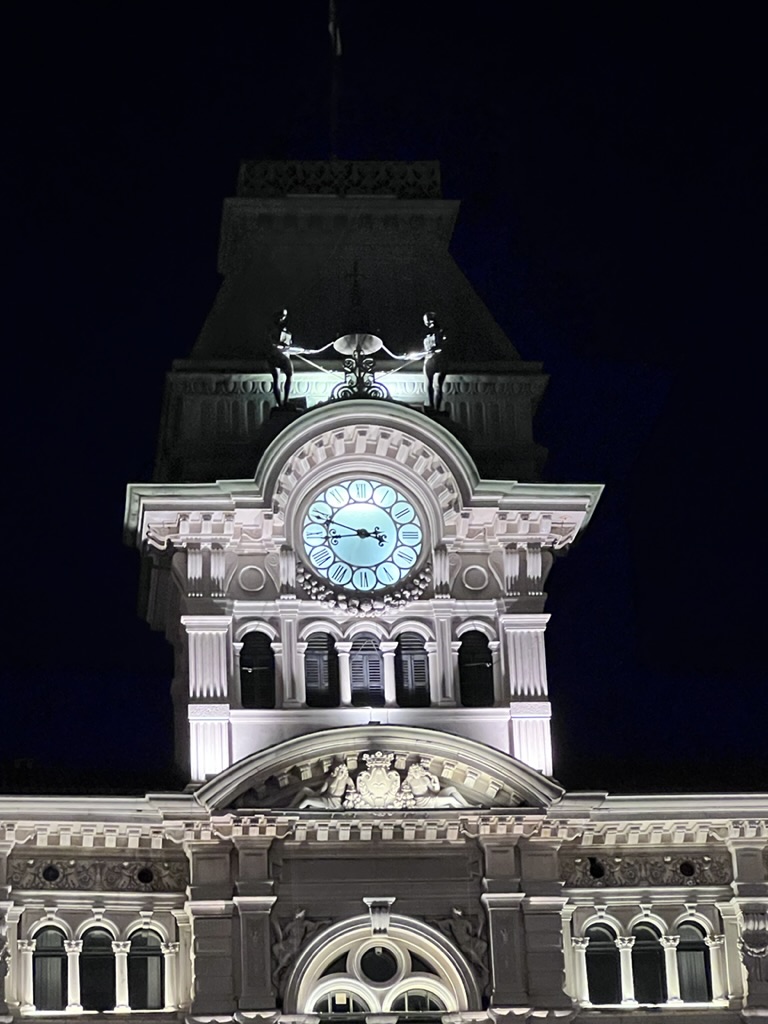
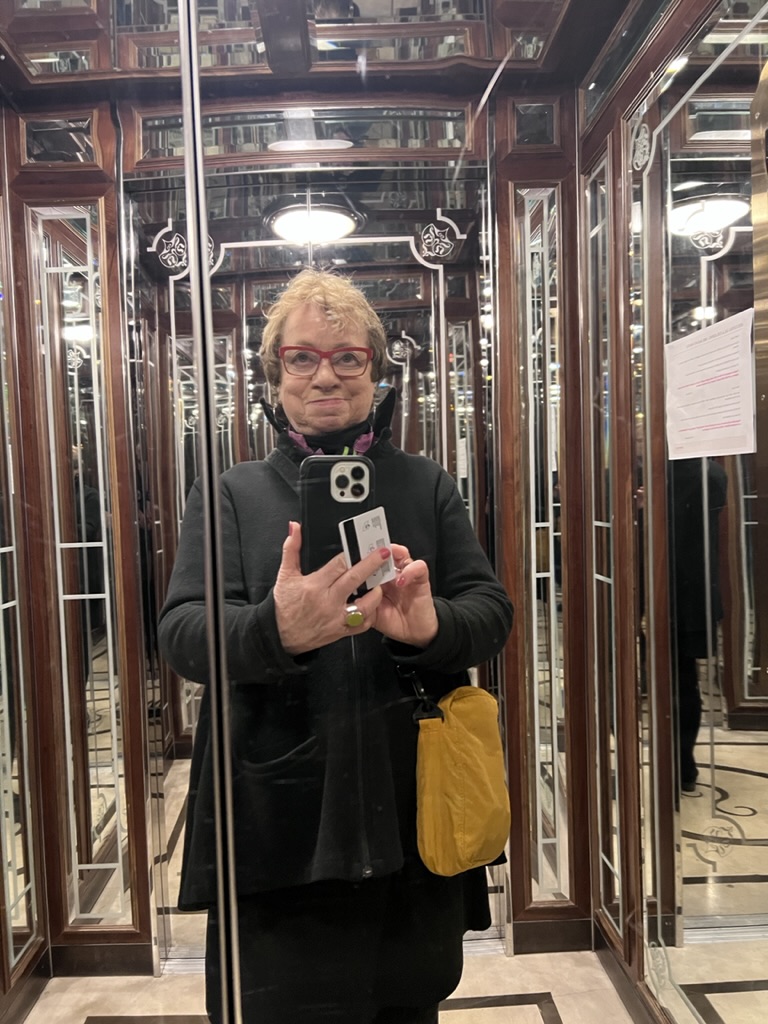
We walked back to the hotel… and now I’m ready for bed.
All the best
fern
Ciao from Padova –
Today we walked and walked and walked. Padova is very walkable, but I think we overdid it. We are exhausted. Figure we are averaging about 5-6 miles per day… so by the time we get back to Oakland we will probably have walked more than 100 miles in Italy. Just thinking about that makes me even more exhausted. Padua is one of the few stops on this trip which is a new city for us… and I recommend it.
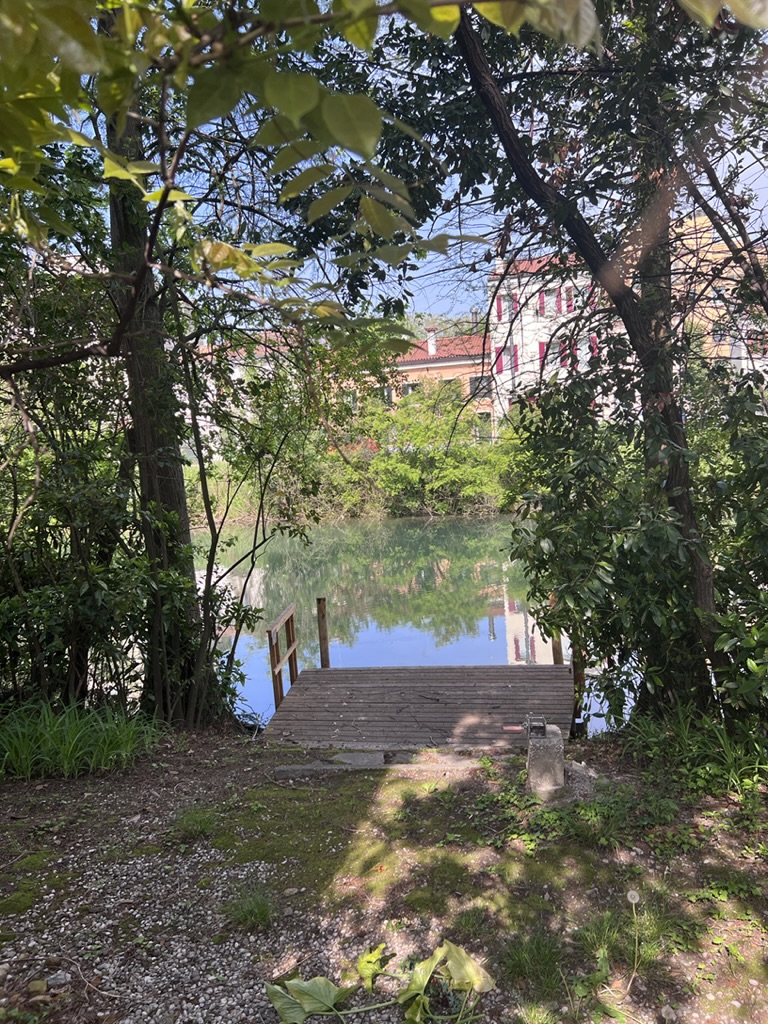
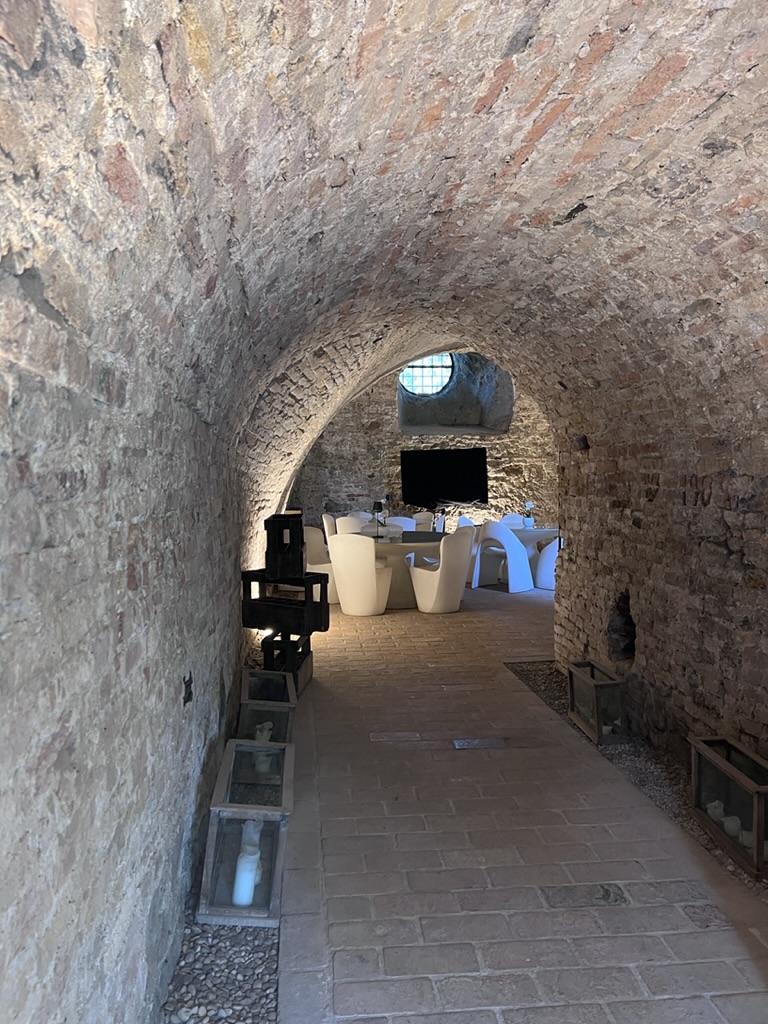
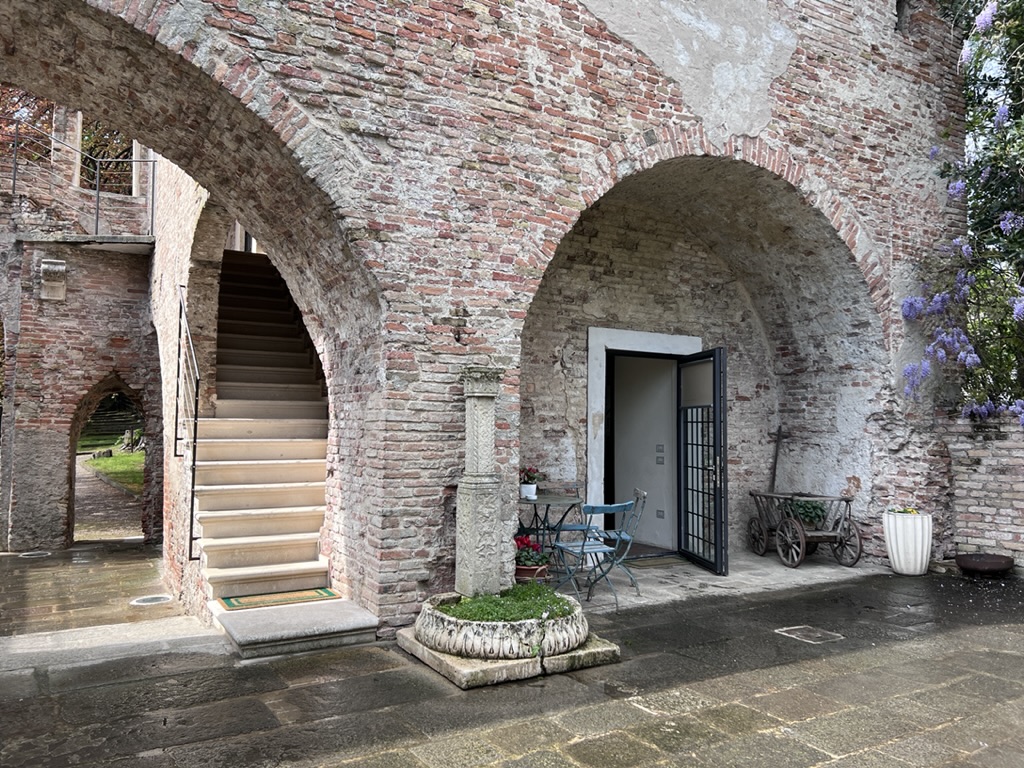
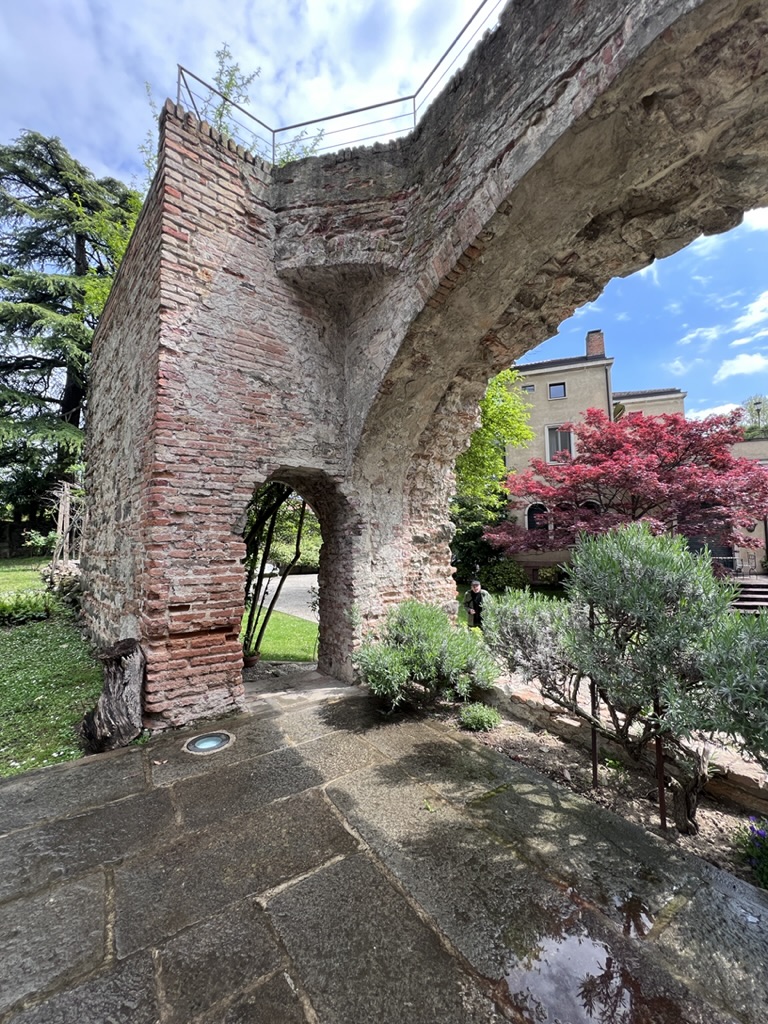
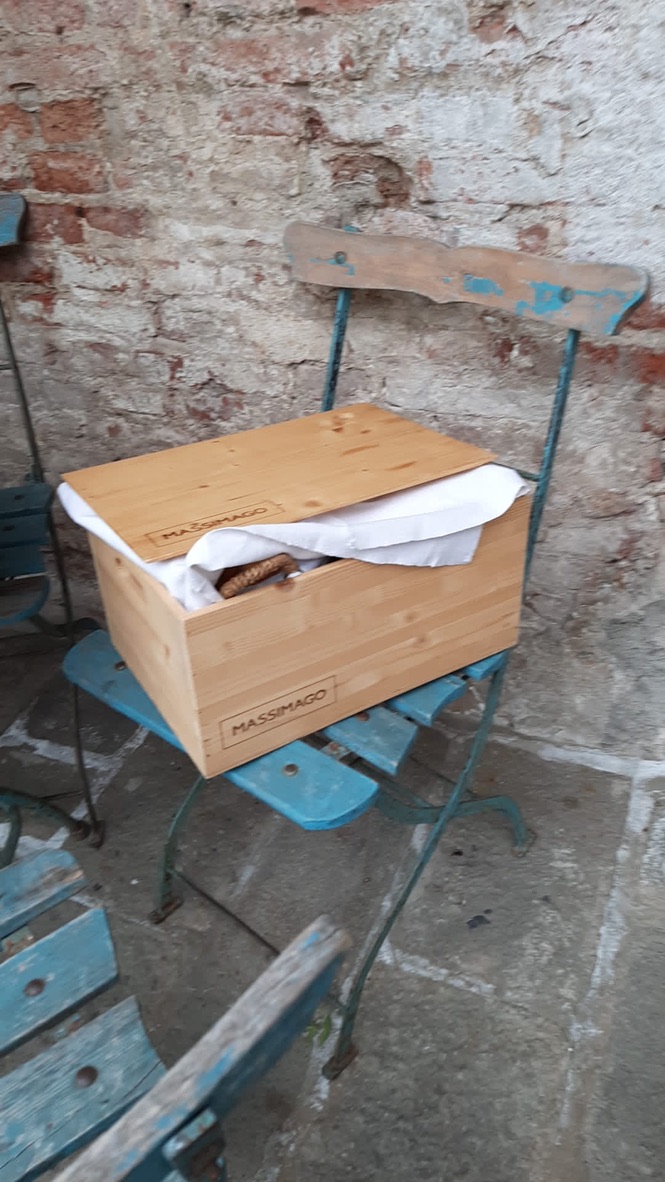
Began our day with breakfast at the Wine Tower… The hotel delivers a wooden box filled with lots of goodies for breakfast. It arrives on the outdoor patio, and they text a little picture of where they left the box, so you know it is there. The hotel only has 4 rooms so there isn’t any real restaurant. Still they put out quite a nice spread, Now about the Massiimago Wine Tower…It has a very complicated history dating to the 14th century as a defensive complex. Over the centuries, it was bought, sold, and rented by many different historical figures and was used for a range of activities and enterprises. In the 17th century a horrendous crime is said to have taken place here-–the murder of the owner’s pregnant wife (with fifth child) by her husband. Fast forward to the very beginning of the 20th century and the property was owned by a monsignor, until the end of the first world war… then sold to some very wealthy family who began to create gardens and vineyards. And then in the first part of the 21st Century, the buildings were restored and transformed into the little hotel and also some housing (although not sure where that housing is–maybe it’s for the manager).

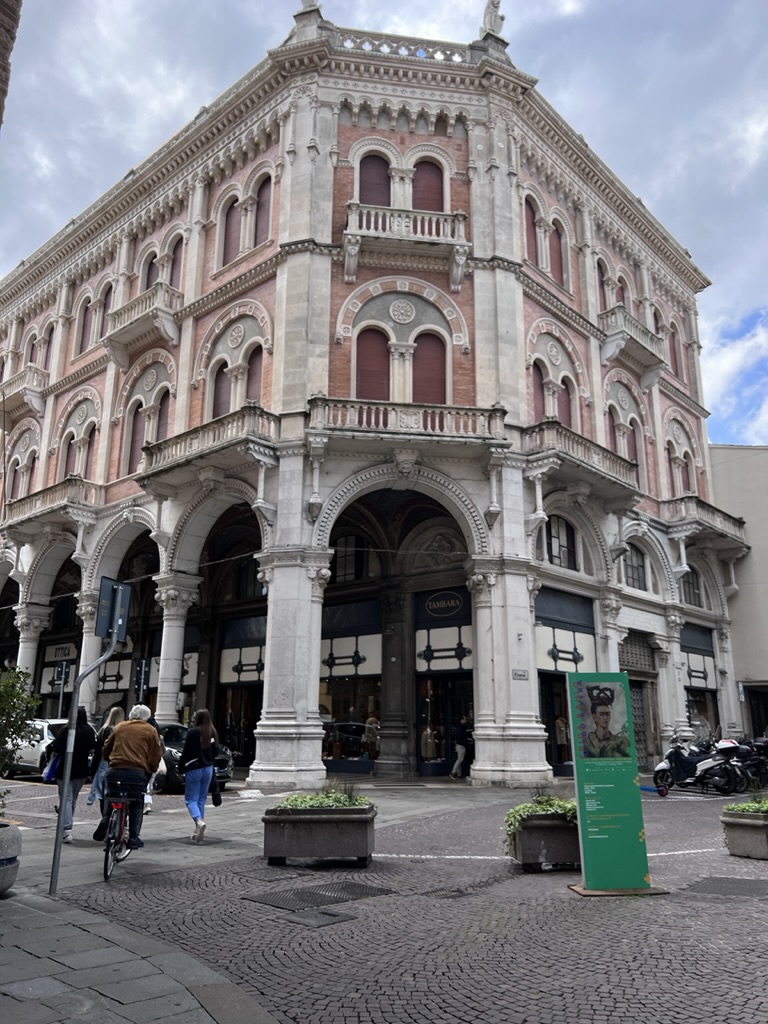
Our room(s) have ceilings that are about 11’ with wood beams about two feet apart that are about 8’x8′ spanning about 14’. The floors are stone or maybe clay tiles. The bedroom sits above a living area and the stair is open so you have a sense of an even bigger space and even taller ceilings. Ok.. enough about our accommodation which I’d say was both a lucky and accidental choice.
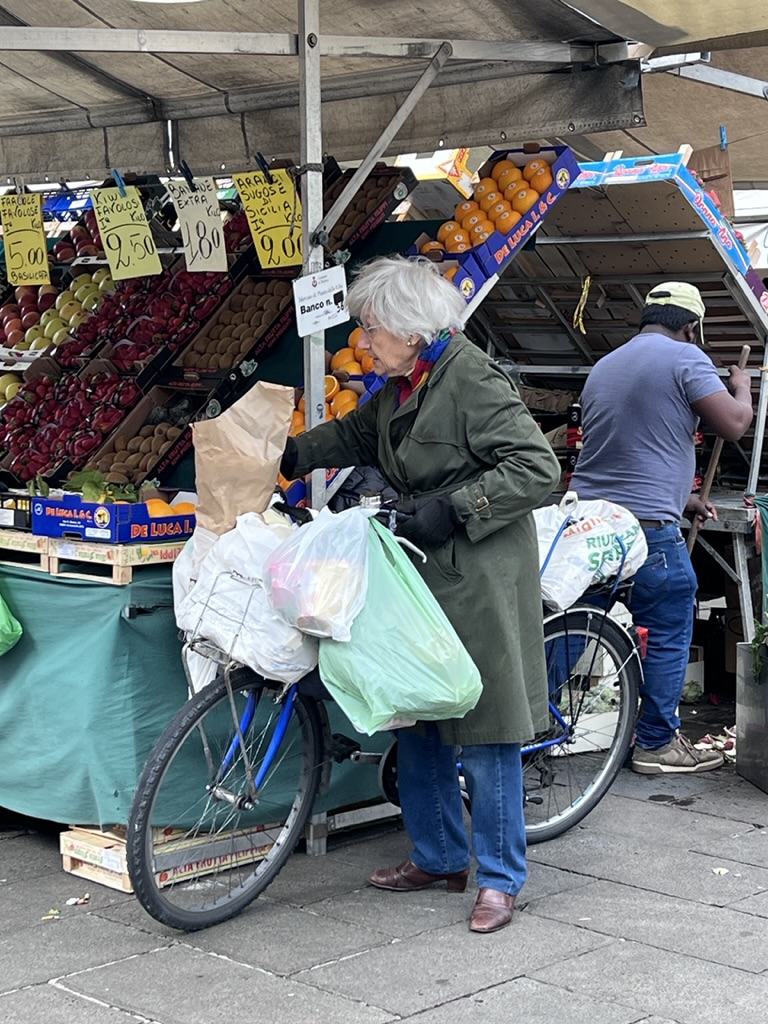
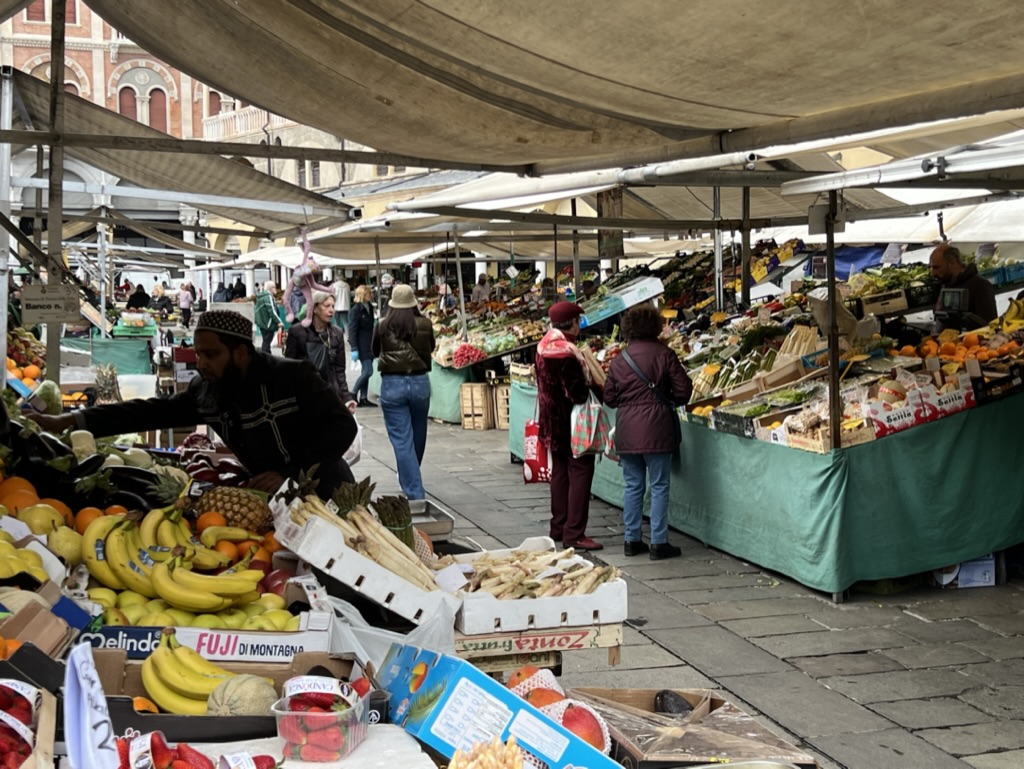
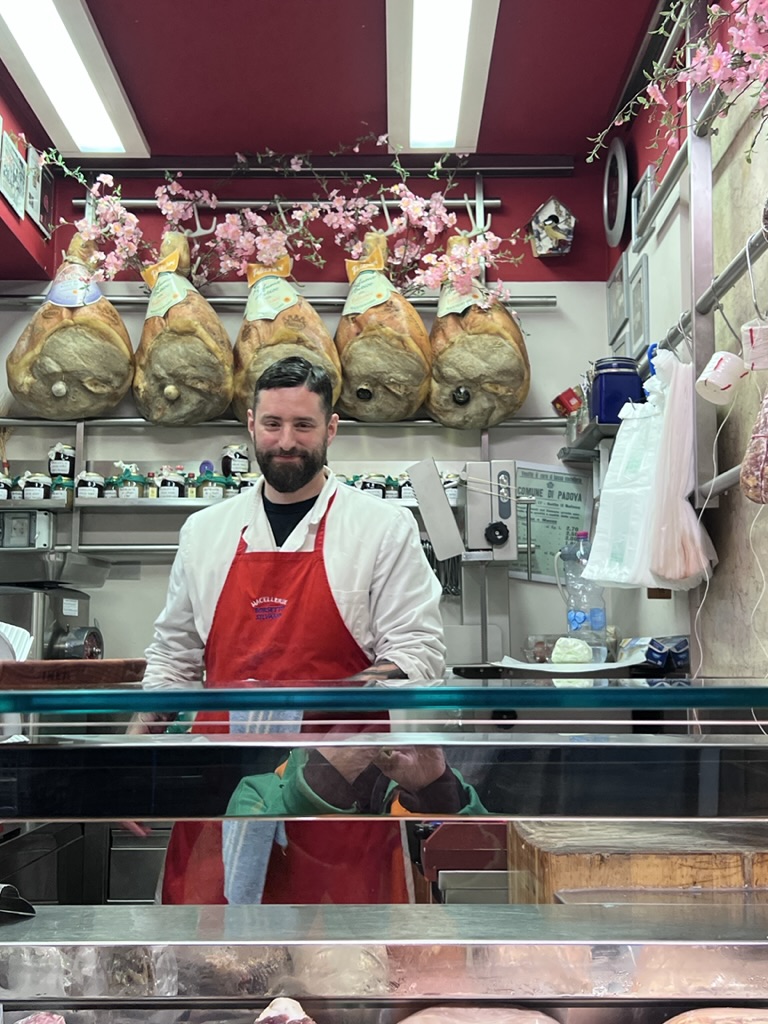
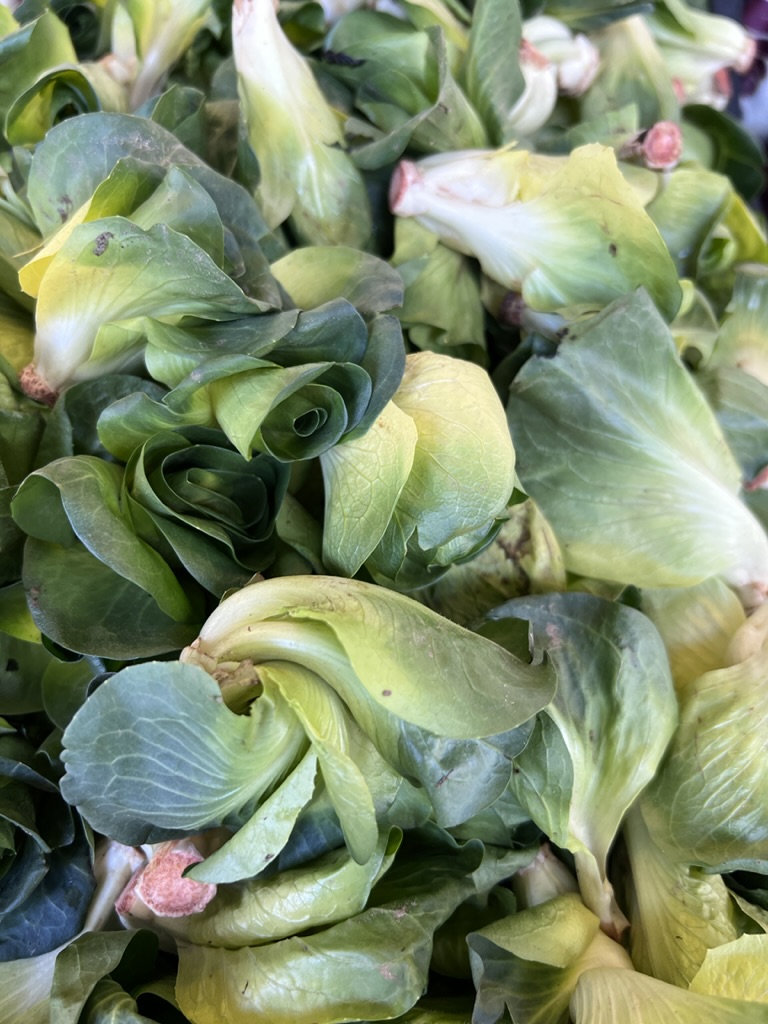
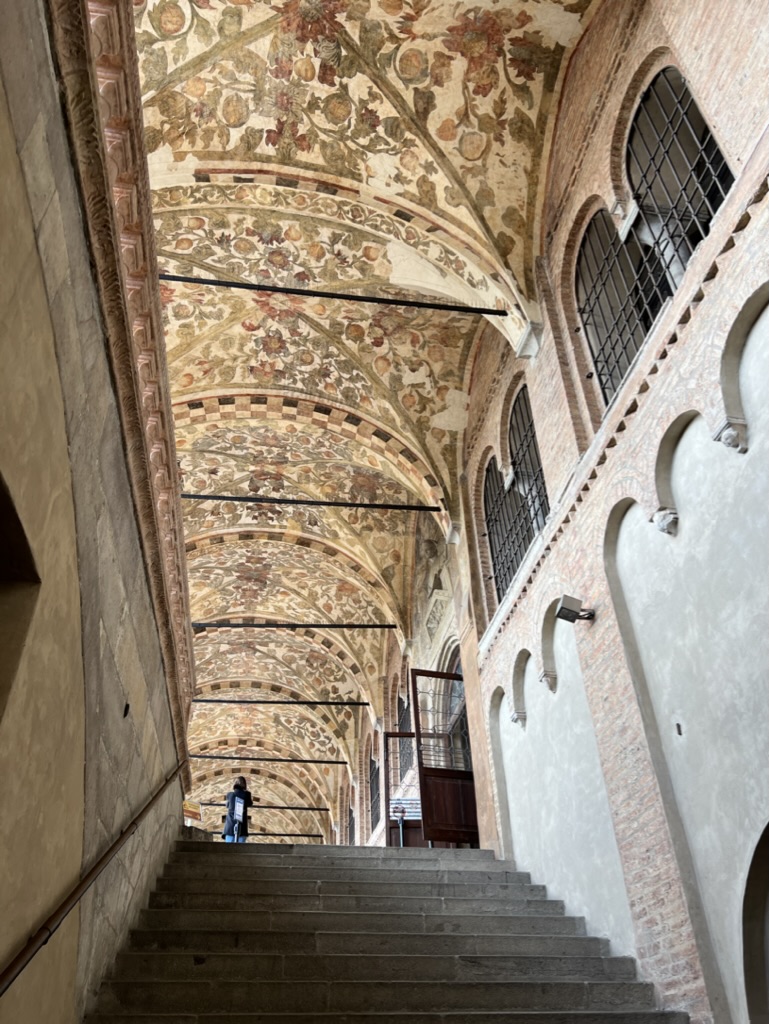
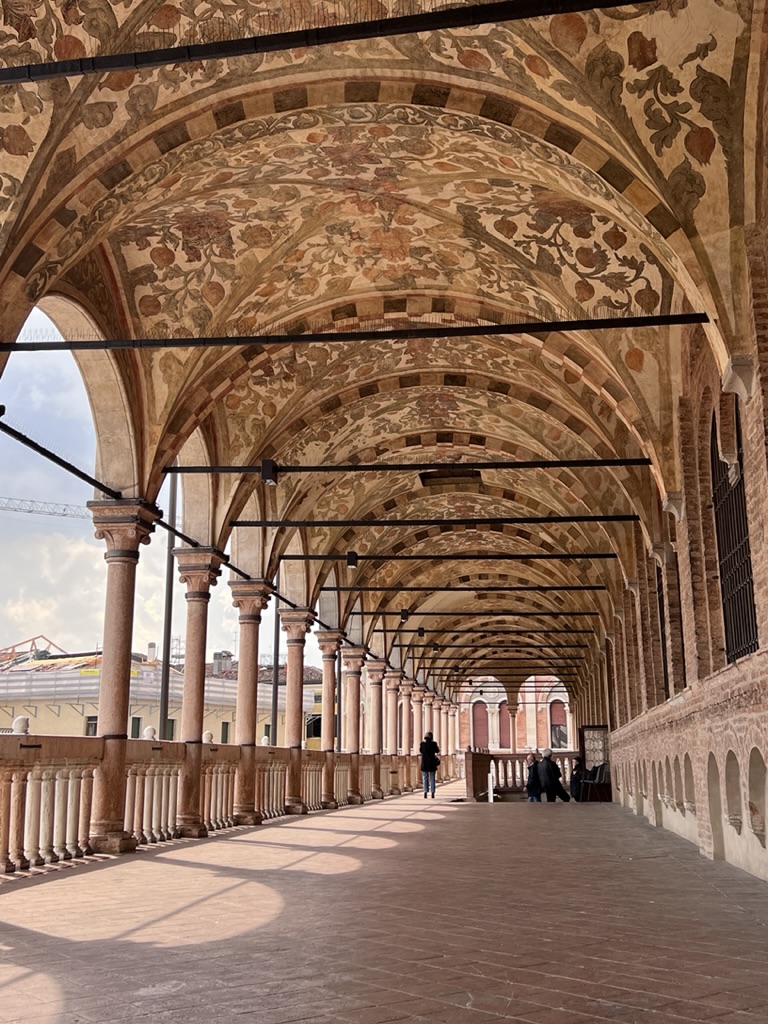
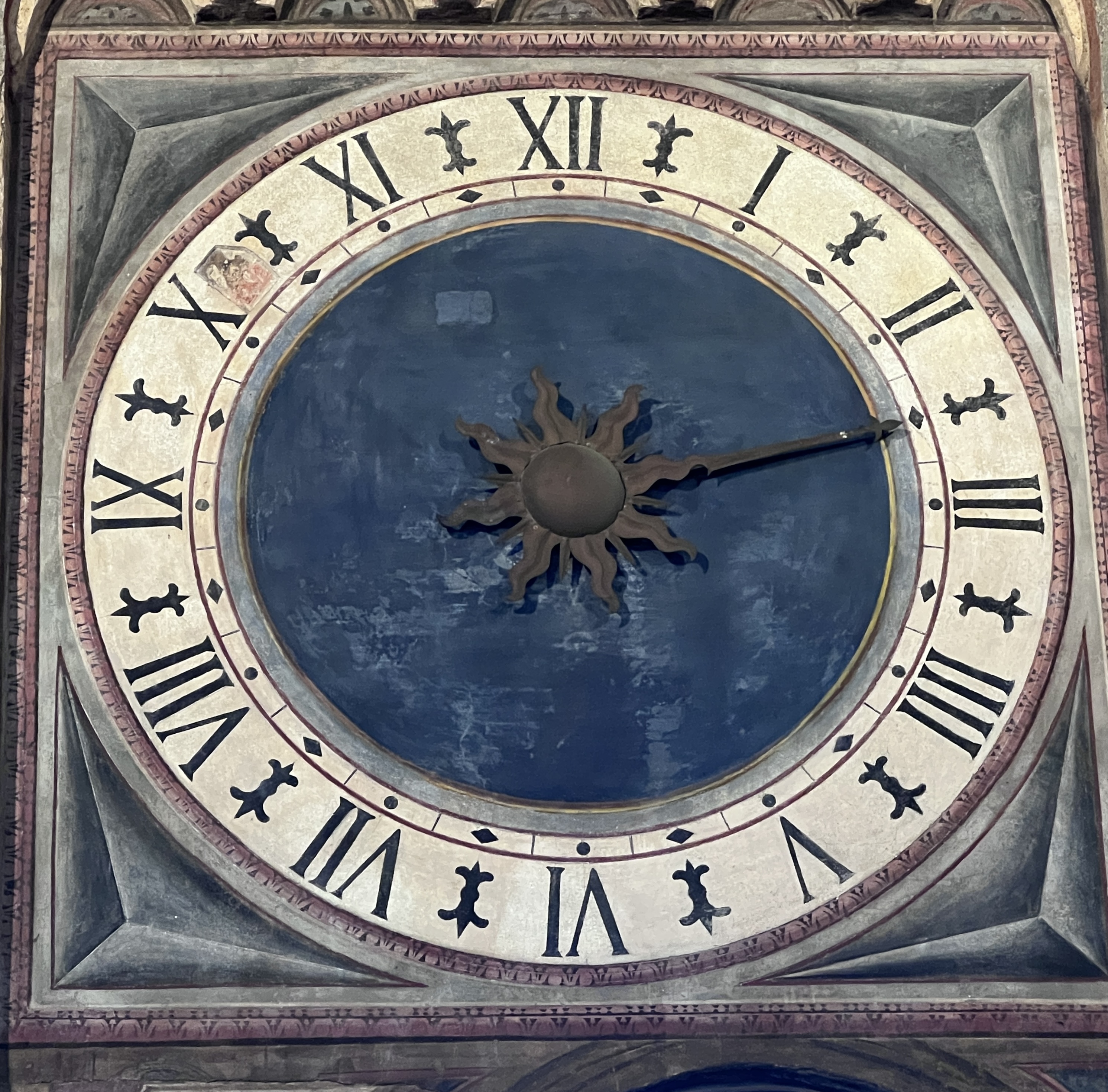
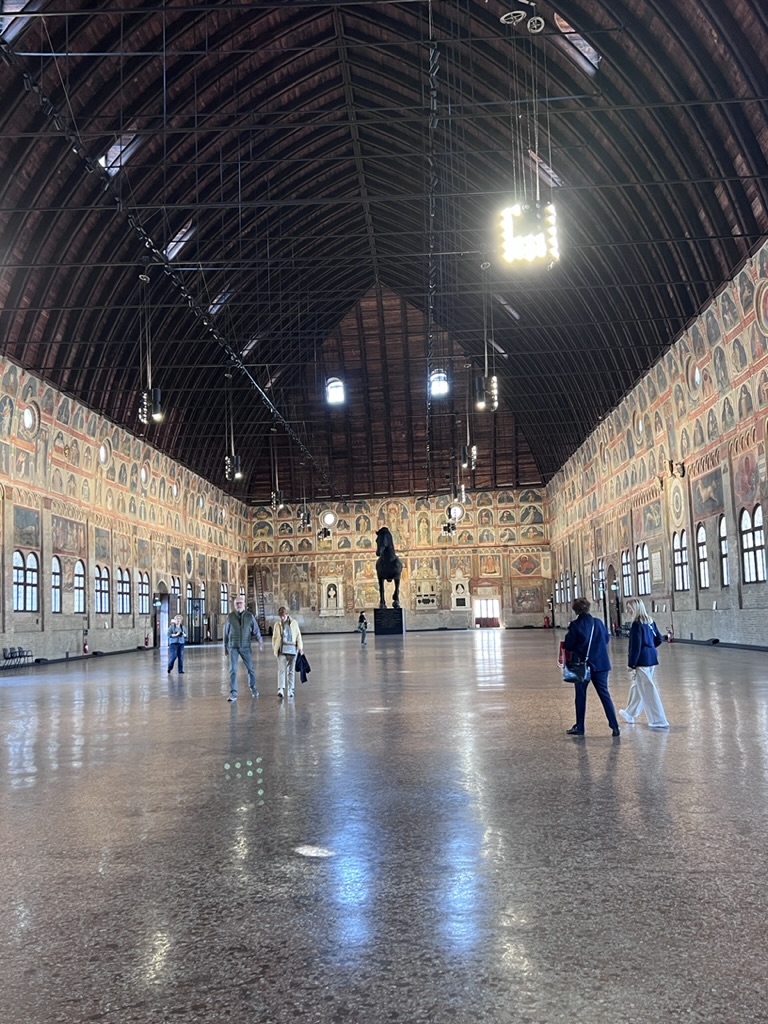
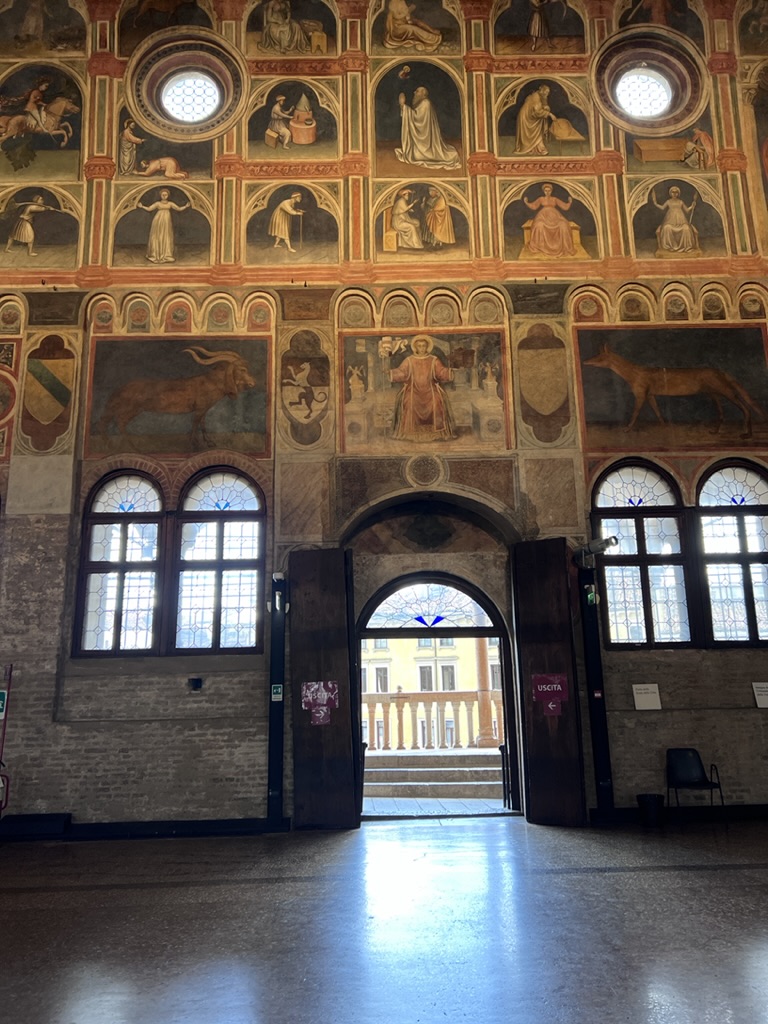
We headed first to Piazza delle Erbe. There are several squares in the historic center of Padua, but this is the largest and is adjacent and connected to Piazza della Frutta. Together they form one of the largest markets in Italy and it’s dominated by the very large Palazzo della Ragione. The market takes place daily on the two squares and on the first level of the Palazzo there are tiny shops, selling mostly food, and also numerous restaurants as well. We visited the upper floors of the palazzo which throughout history encompassed the medieval market hall, the town hall, and the palace of justice. The upper floor was dedicated to the town administration; while the ground floor still houses the historical covered market of the city. The palace separates the two squares, and you can move easily through the building to get from one to the other. The upper floor has the “great hall” which is 270 ft long and 88 ft wide and about 40 ft high. The walls are covered with allegorical frescoes.


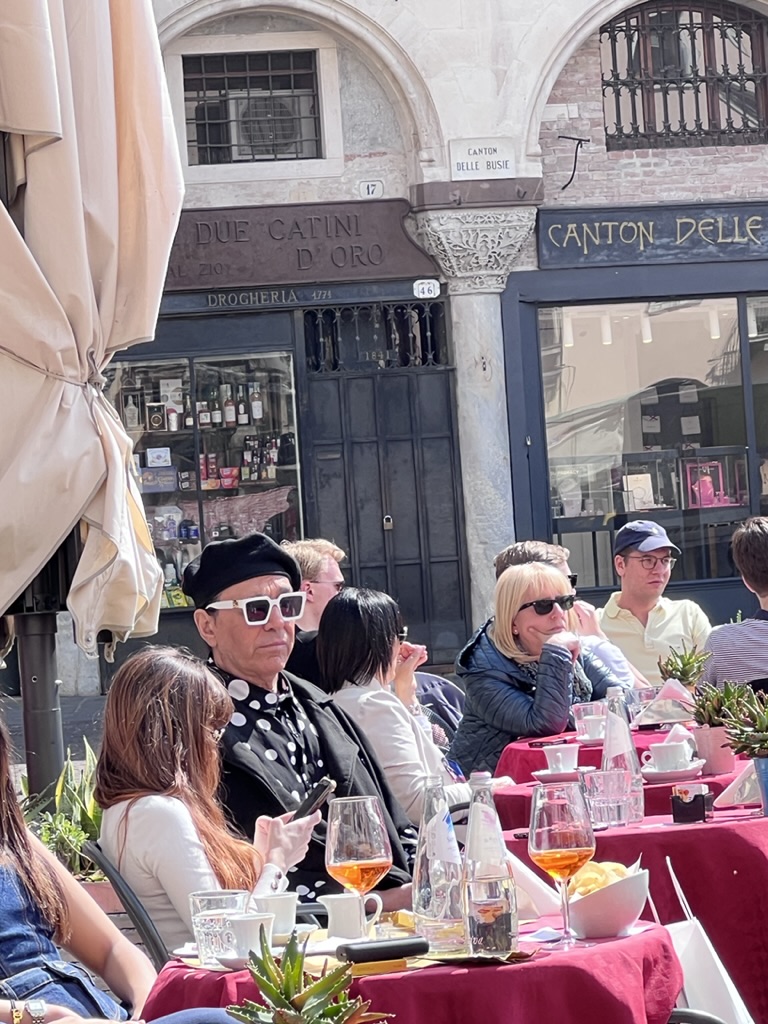
While Mike sat on a bench in the piazza, I checked out a few interesting shops and began a conversation with the owner of one. Turns out she was married to an American and has a child with him, but he has returned to the states—Memphis to be exact. He’s black and the child is bi-racial. She was talking about how shocked she is to hear about all the violence in the states and that her son does not like to visit the father in Memphis, because the father is very strict with him—fearful that the son who has grown up in Italy doesn’t understand the dangers in the states and about how police deal with Black teens.


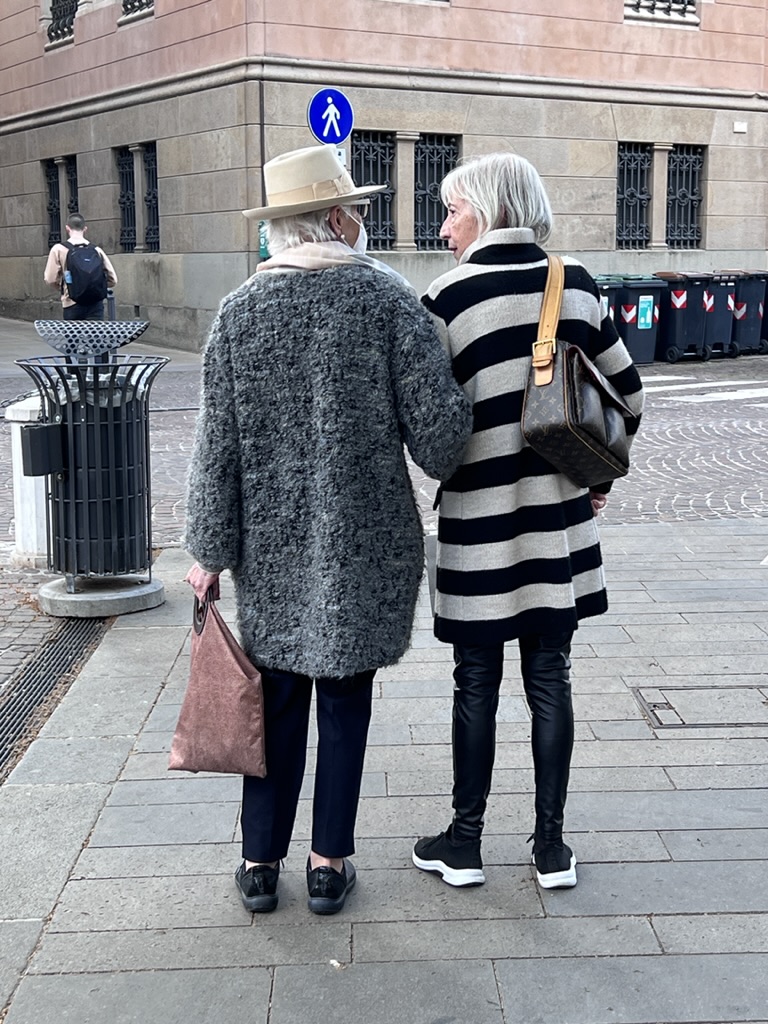
And while I was having this conversation and Mike was outside, Mike witnessed an interesting event: Three cops, cabanieri, (two male and one female) were walking; she had a bicycle. The male cops were teasing her and they knocked her bike down and she almost fell. She was pissed. The guys took off –running across the plaza.. She left her bike and started chasing the two male cops across the plaza and they all disappeared but everyone at the plaza continued to be shocked and were talking about what had happened. An older gentleman who works for the city stayed by the bike to see that it wasn’t stolen. Do not know the outcome of the story.
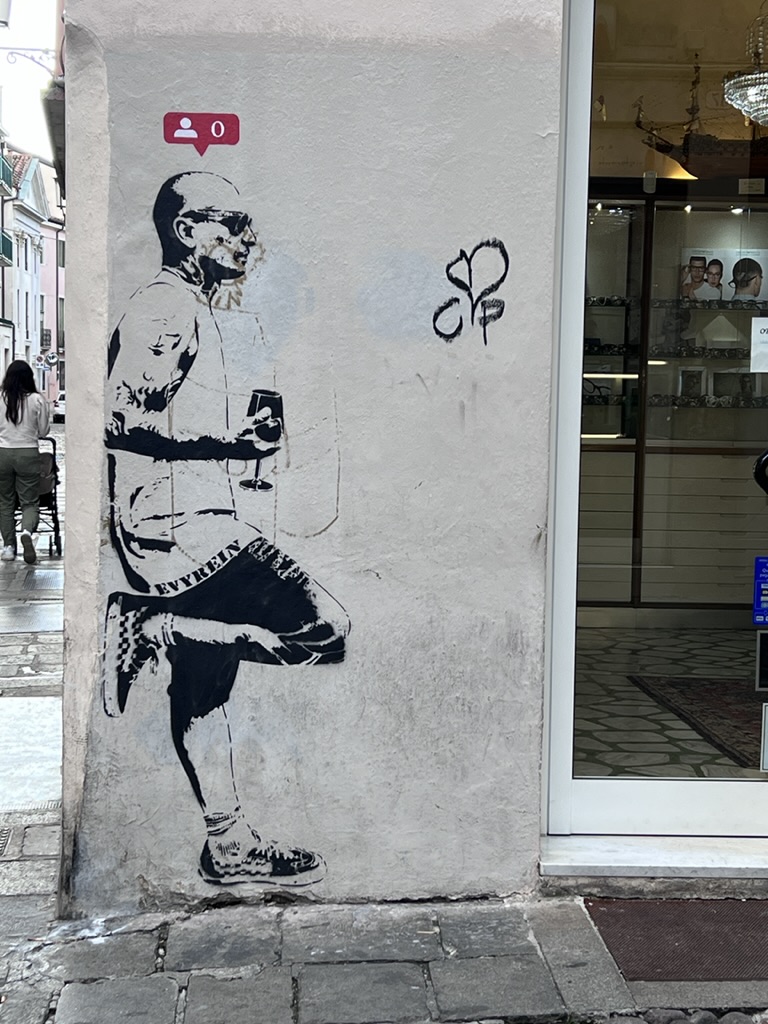

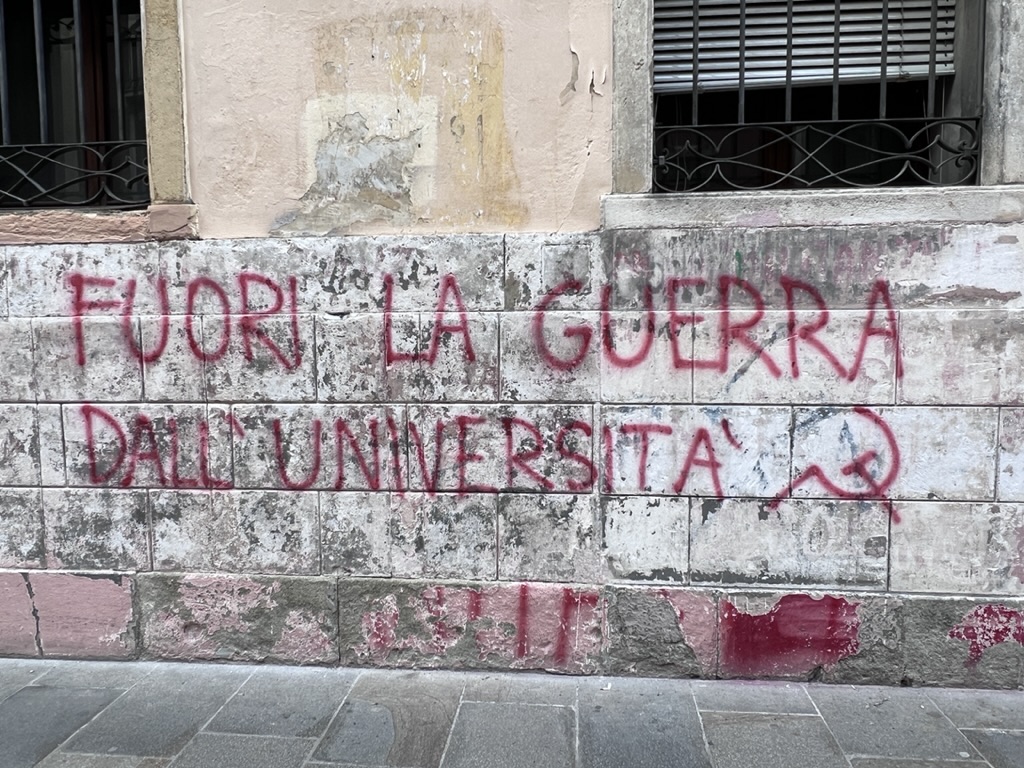
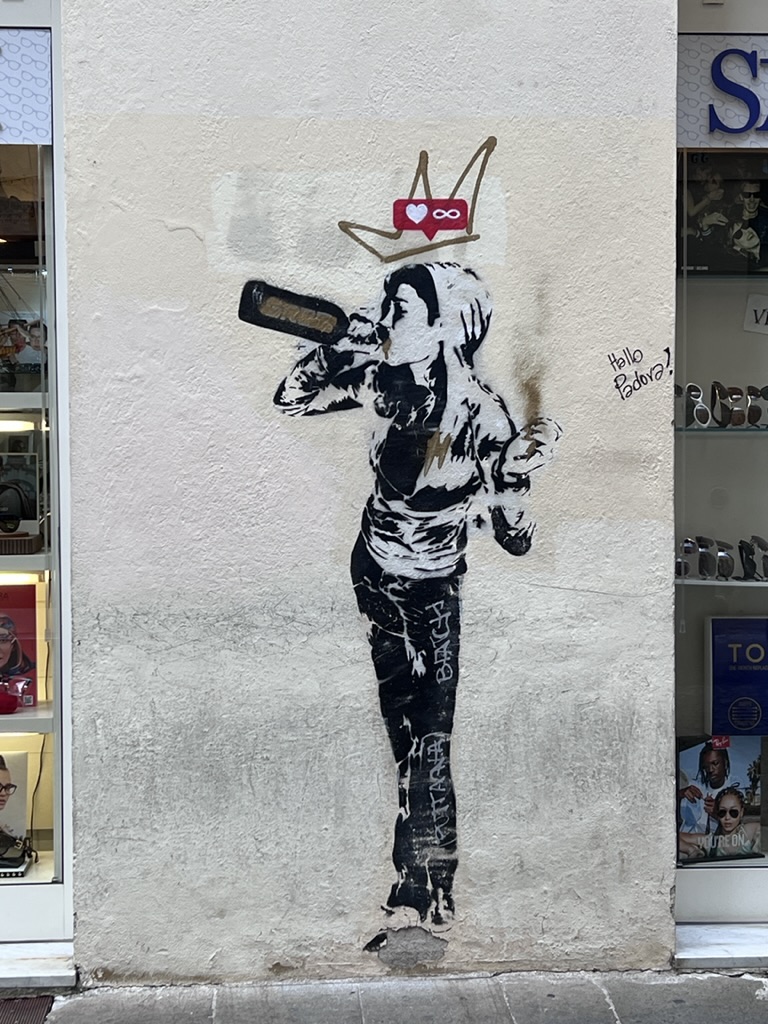
From there we meandered around the city, walking in the oldest medieval sections and also headed to the Scrovegni Chapel which has a lot of frescoes by Giotto. Interestingly, they are ‘monetizing light’ in that church as it is difficult to see some of the areas and the frescoes since they are in very dark parts of the church. There is a machine, into which you can put one, two, or three euros and then lights go on and stay on for specified periods of time, based on how many euros you put into the machine. I guess they are trying not to leave lights on all the time as that could damage some of the art.
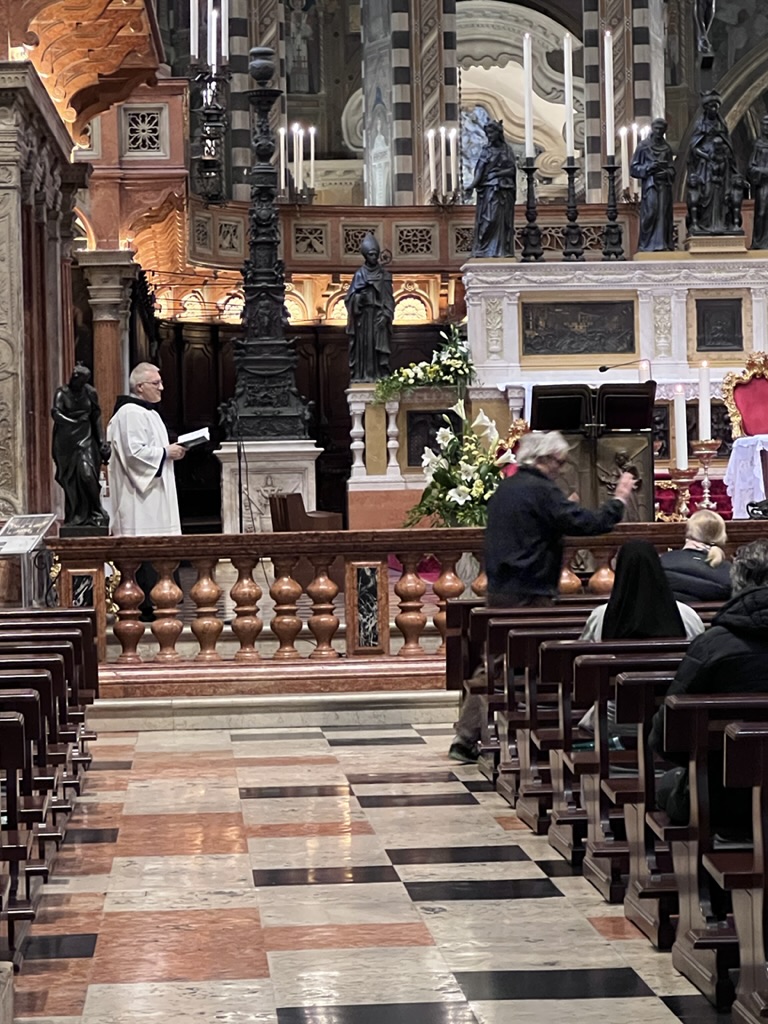
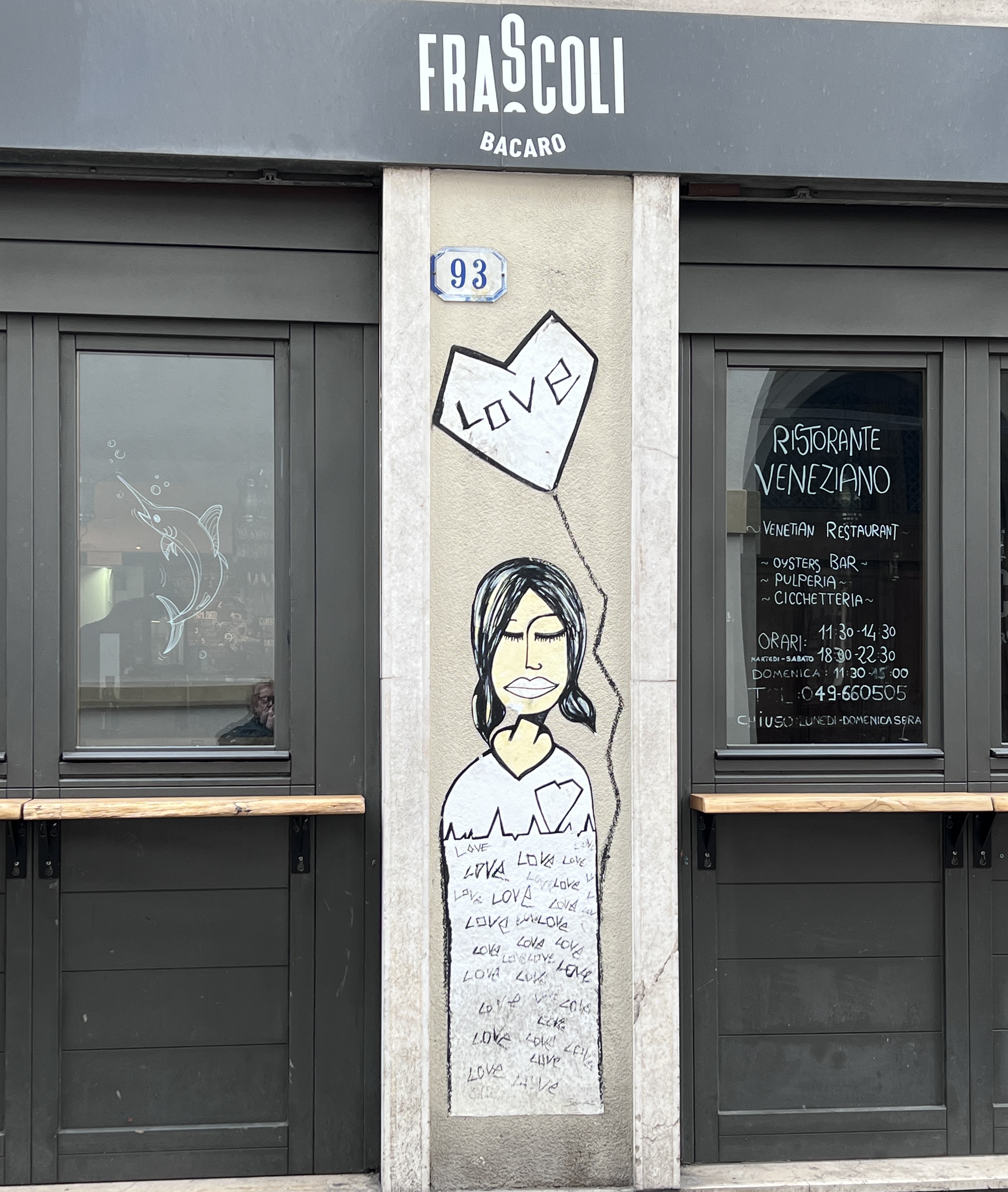

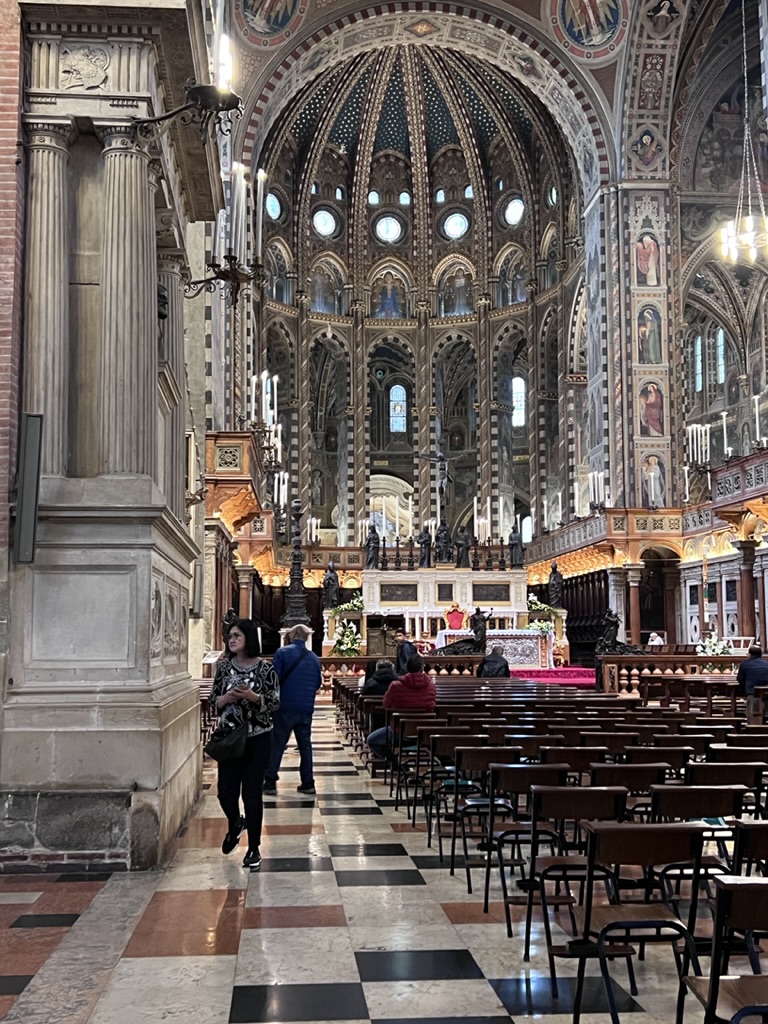
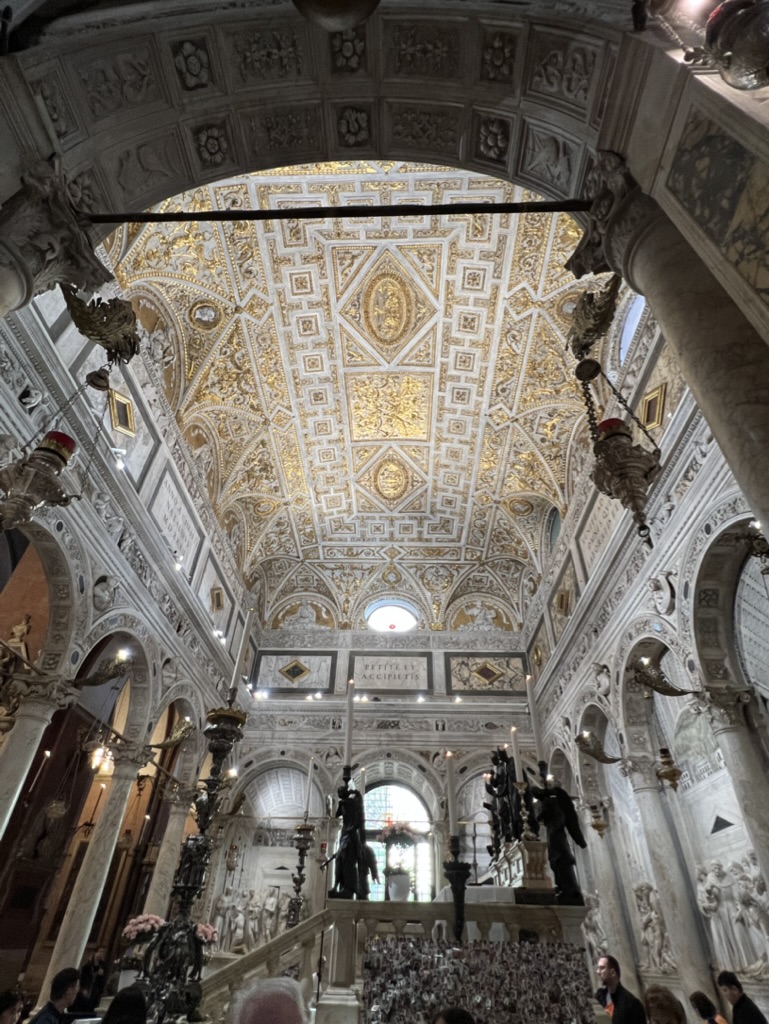

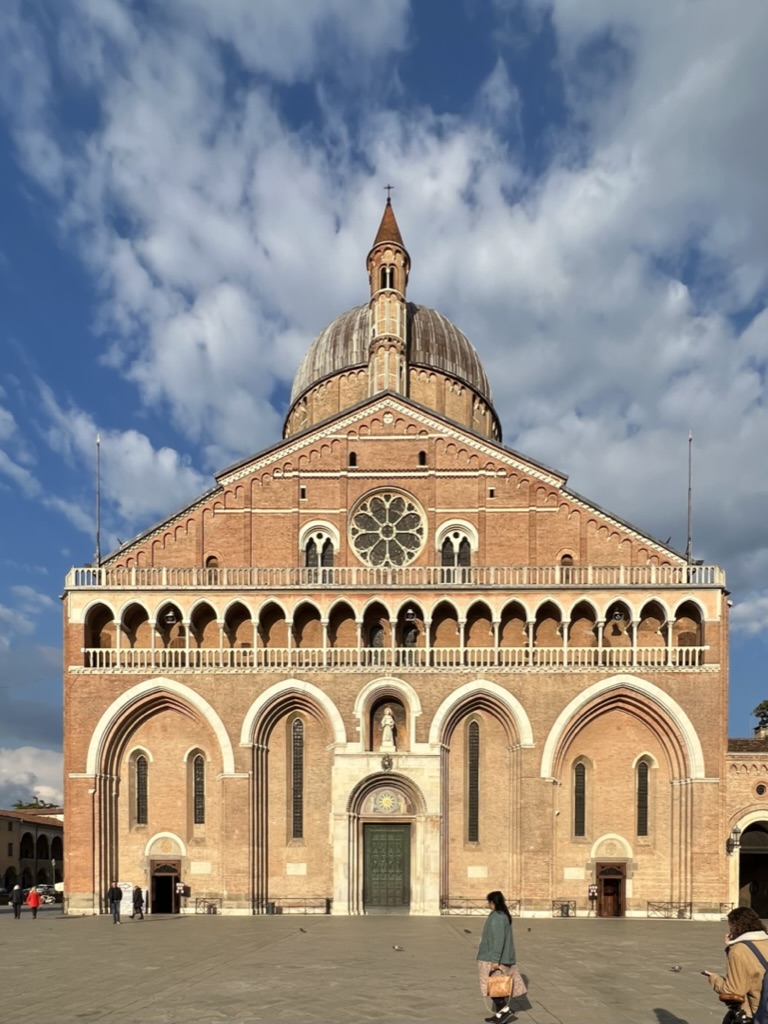
Then we strolled more in the medieval section (what was once the Jewish Ghetto) and eventually arrived at Saint Anthony’s Basilica— which is gigantic…. And filled floor to ceiling with art, sculptures, frescoes, and more. Given my rather simple tastes, this one was a bit much. As we were walking around inside the church, the music for the mass was beginning and we had to stay on the edges so as not to disturb participants. As you exit the basilica, you arrive in a very sweet courtyard and then walk through a narrow passage to get to the front plaza. From the basilica we walked back to the Wine Tower to relax and head to dinner.. very simple local pizza and salad.
We are beat. I’m sure more happened today, including a stop for gelato, but I think I will call it a night.
Tomorrow, we head to Trieste.
Be well.
Fern
10. Bologna to Dozza to Padova …April 20 2023

Ciao from Padova – From the Red City to the Mural City to Padova
April 20, 2023
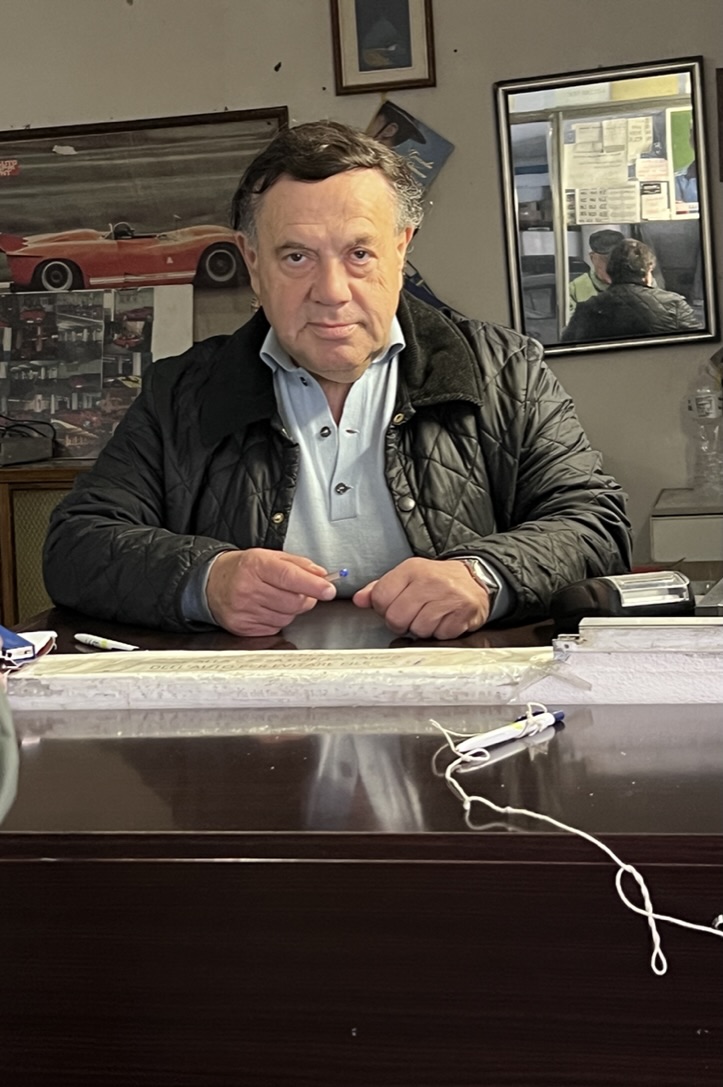
We left Bologna (the Red City – called this because of the proliferation of red tile roofs and because of its politics—Bologna has a history of being left leaning) after a brief stroll and picking up our car in the public garage not far from the hotel.. which included backing out of a one-way street after loading our luggage and being within inches of planters and motorcycles … and people. The garage guy had a news clipping tacked on the cashier wall.. so I took his picture and told him I thought he must be “Famoso.” Not a clue what the article was about.
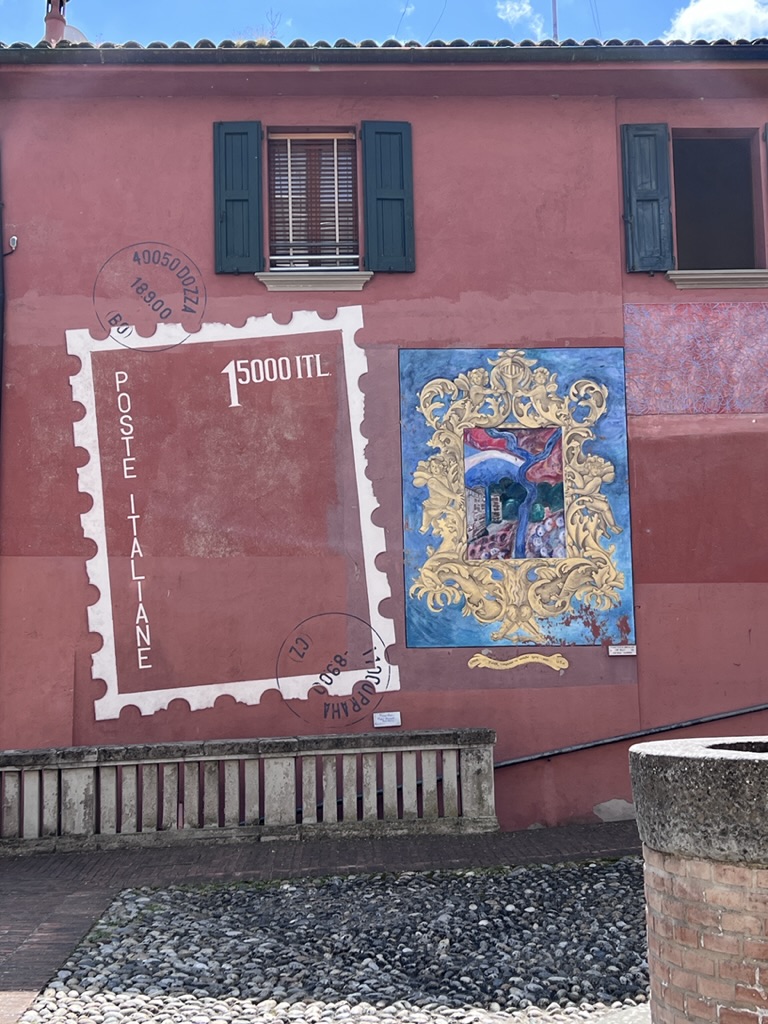
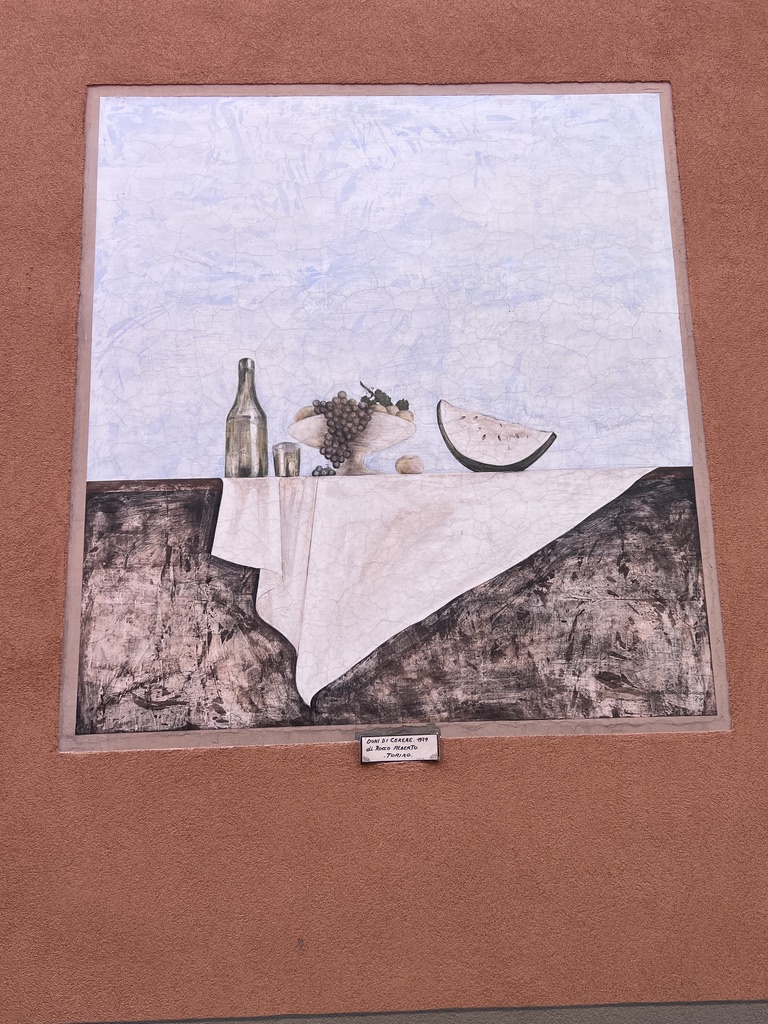
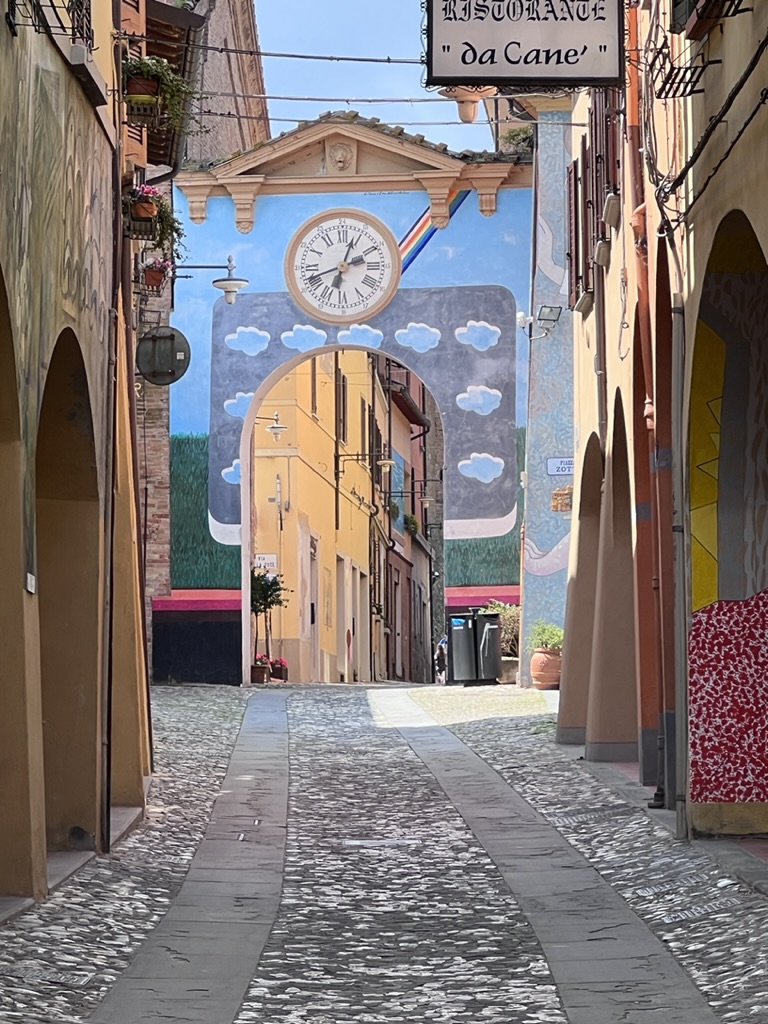
Then we drove through amazing countryside—lush green fields with yellow wildflowers everywhere as we headed south to Dozza (a town of just 6,000 that we had heard about, It was a bit of a detour as we needed to head north to get to Padova (Padua). For a short time (maybe 5 miles) we were on the autostrada, and when we exited at the toll booth and stuck in our ticket the amount that came up to pay was first 83 EU (about $89) and then it switched to 53 EU (about $56)… we laughed and started to push a few buttons. And then tried to insert 3EU but the arm did not lift; then we realized that an arm came down behind our car so we were just stuck at the toll booth. Italy is more automated than we are in many ways… The machine started to talk to us— in Italian. Then we pushed a big red button on the toll machine, and finally a woman came out. She looked at the toll and asked in mostly Italian where we had come from. We said Bologna and she laughed. The toll was supposed to be 5 EU. She and another guy did some maneuvering with the machine, and we gave them the additional 2 EU and we were on our way.
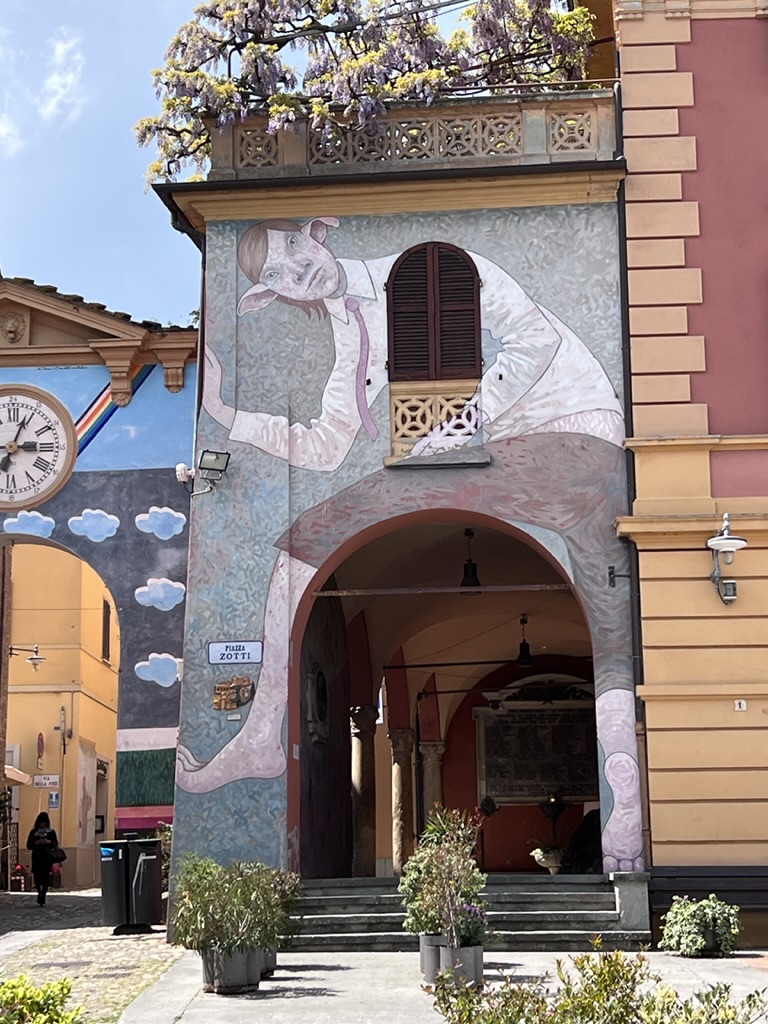
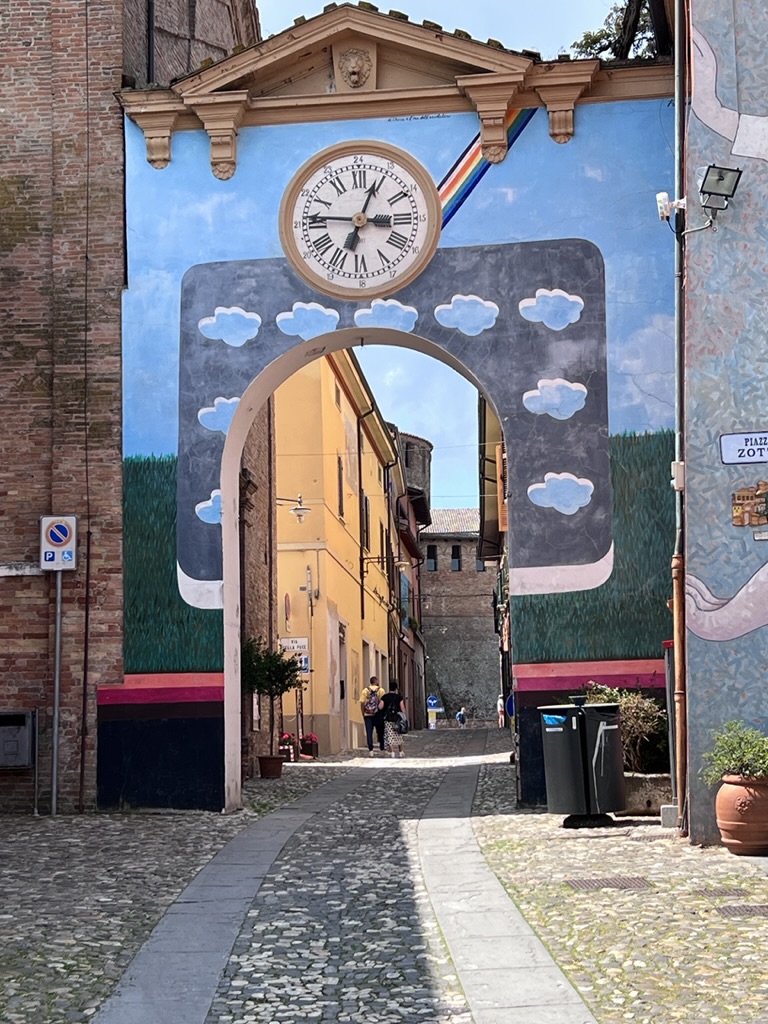
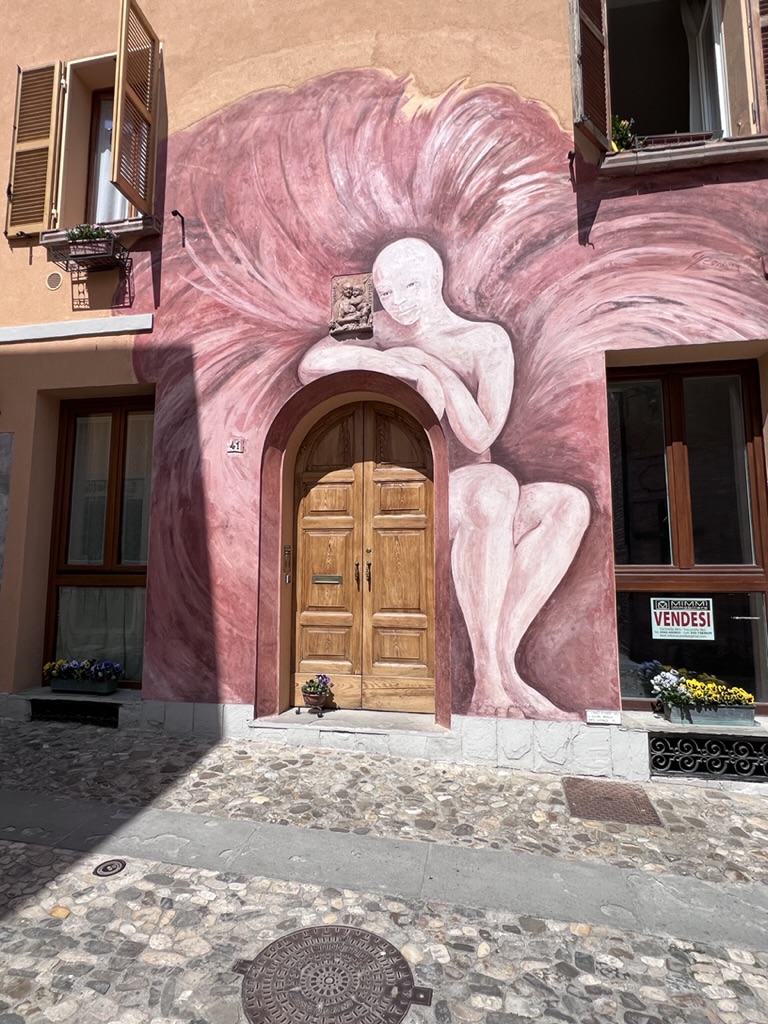

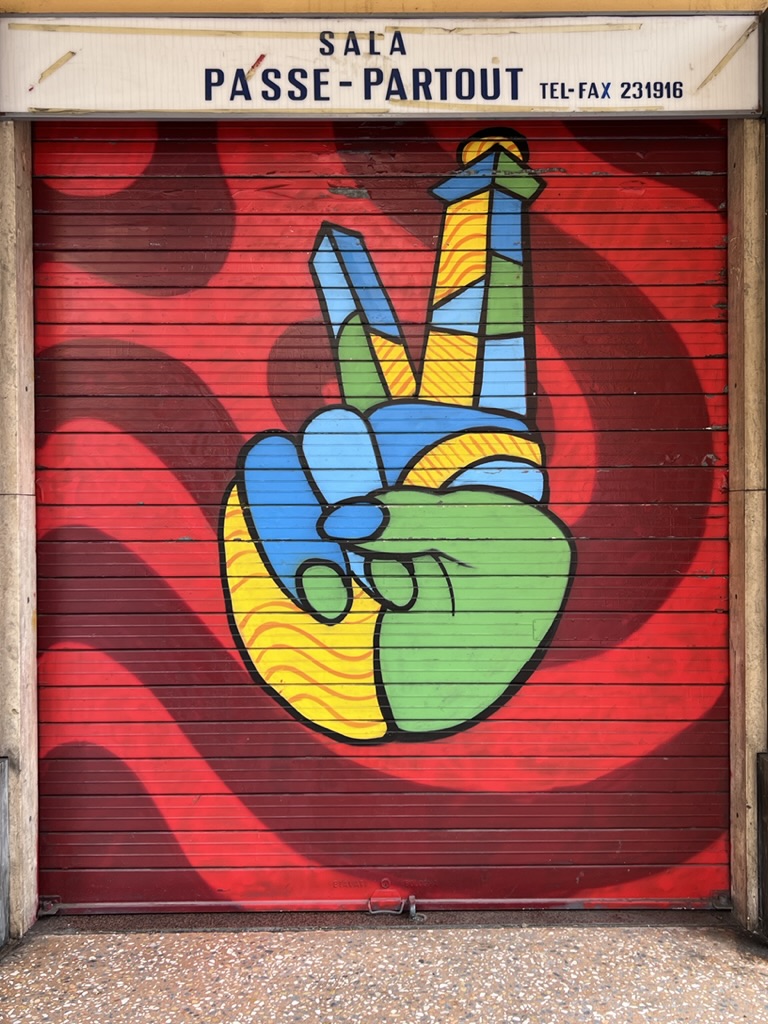
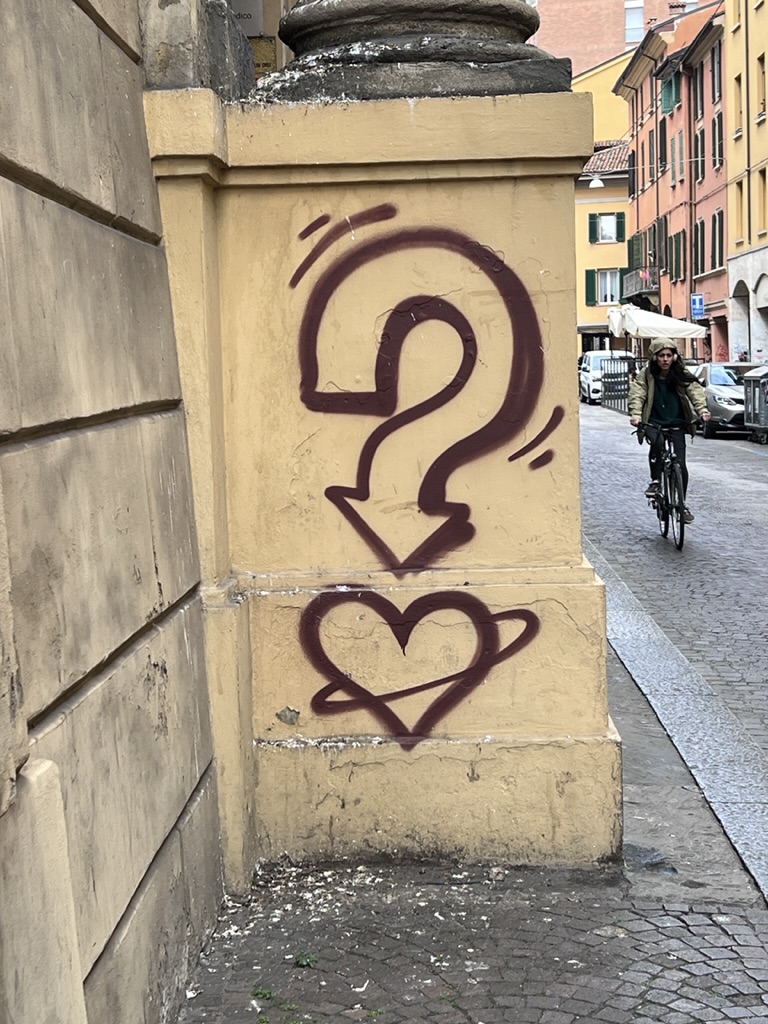
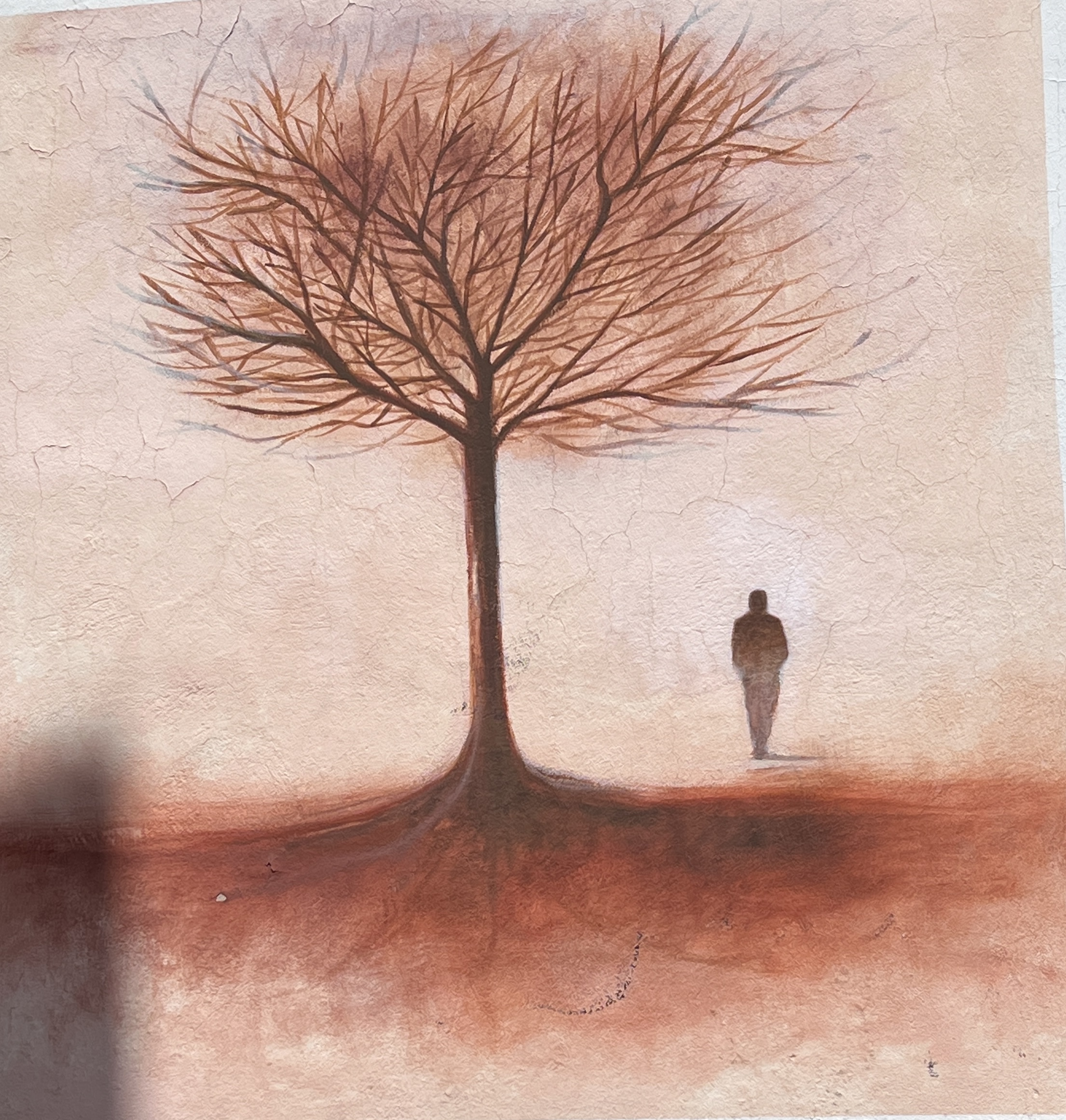
We arrived in Dozza around 12:30 and began walking through the very picturesque little village that some years ago (I assume in an effort to build its economy through tourism?) began a biannual festival of painted walls, when famous national and international artists paint permanent works on the walls of the houses and commercial buildings. I’d say there is a wide variety of skill and talent but it’s a delightful walk and the cutest town ever. Stopped for a quick (well nothing is really quick about eating in Italy) lunch and as we left the restaurant it began to rain. We headed to the car and as we left little Dozza, we realized that on the outskirts of town there were more murals… and we had not had our fill of gelato for the day. So we stopped at a bar/gelateria and walked around to see these other murals. When we went for the gelato, we realized this place was a real mix of “services”— full gelateria with about 25 flavors, a full bar, sandwiches, and in the back room, slot machines!
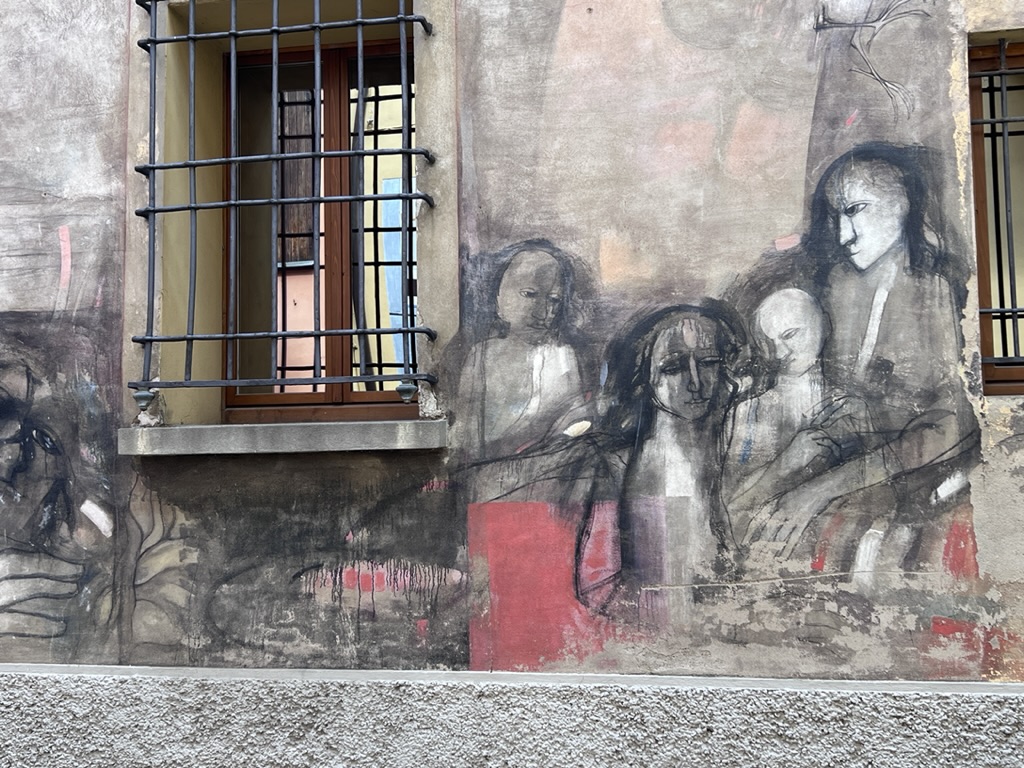
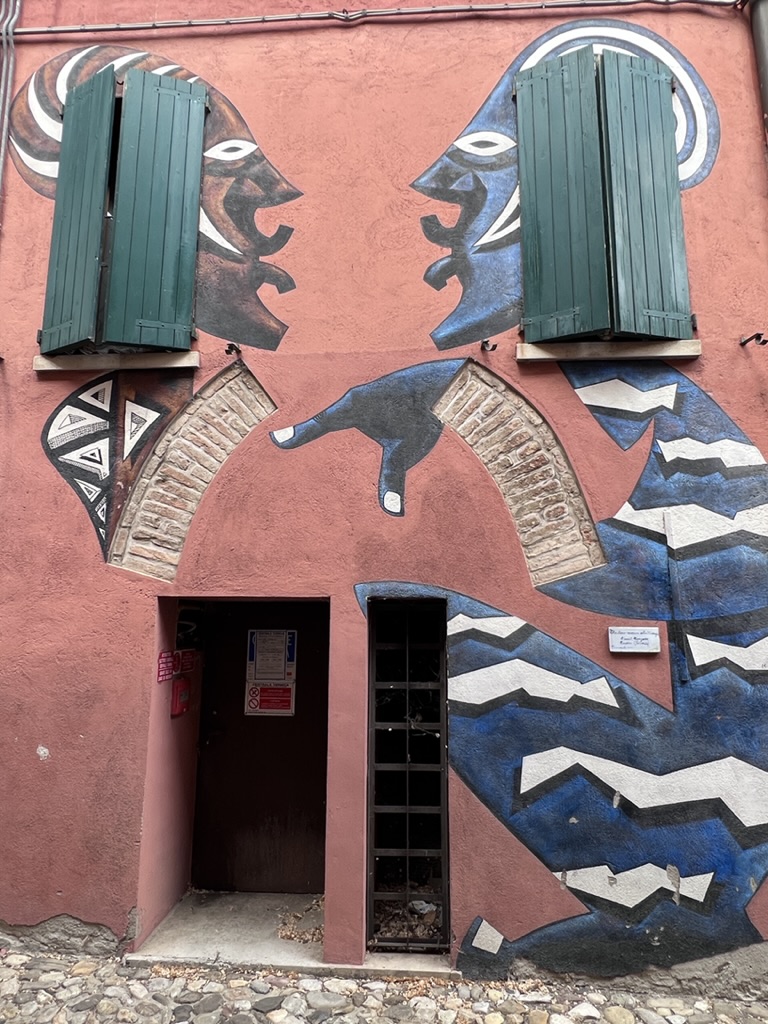
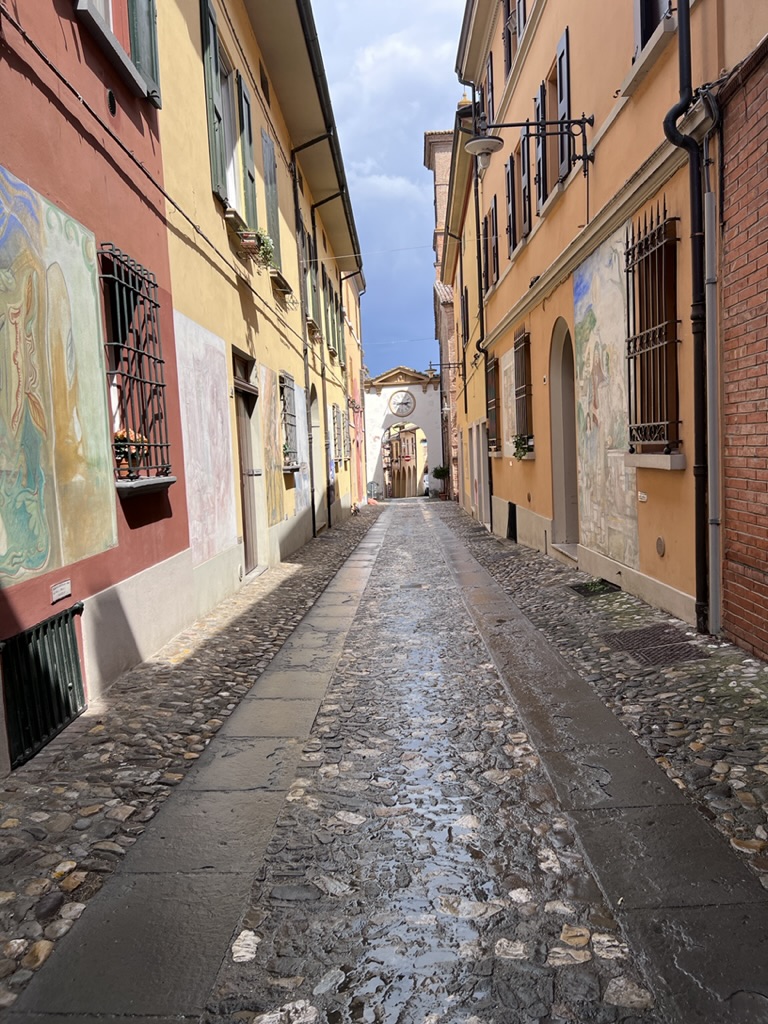
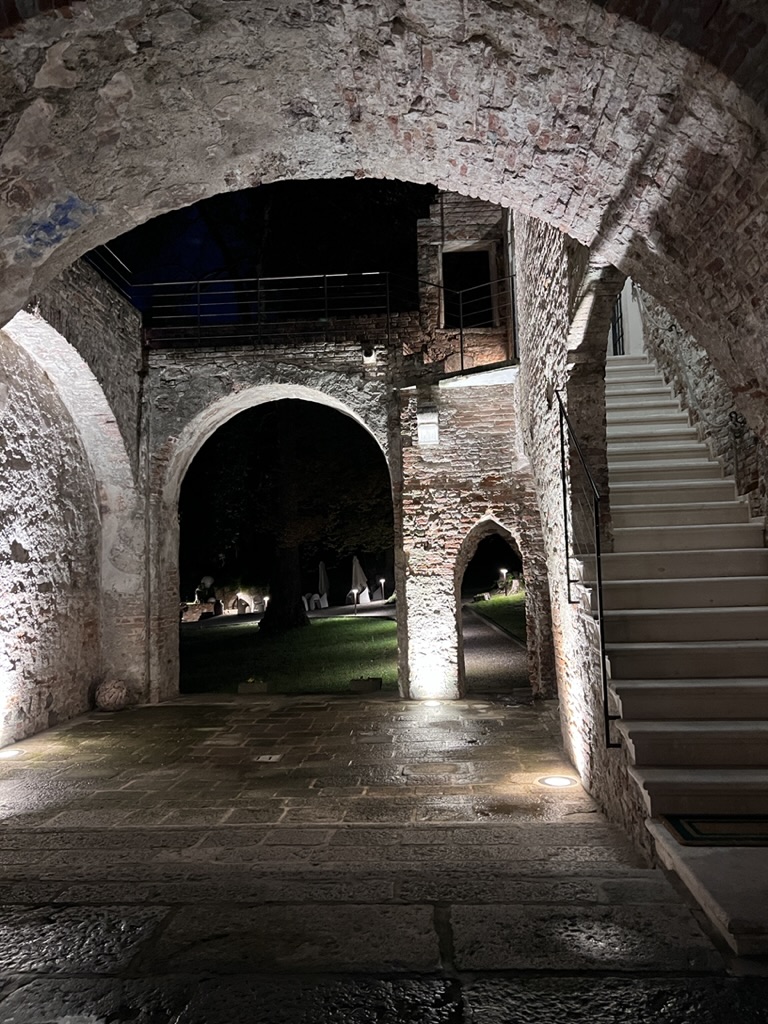
Then we finally got serious about getting to our hotel in Padova which would be about a two hour drive. All was going well, but we never saw any signs for Padova.. just Verona and Milan. Jokingly , I said… “gee maybe there are two hotels with the same name”… and one is in Verona!!” We pulled over and googled to learn that there is a Massimago Wine Suites Hotel in Verona and a Massimago Wine Tower Hotel in Padova. When I entered the name into the GPS as we left Dozza the hotel in Verona popped up quickly and I never checked that it was Verona.. only looked at the name and focused on Massimago. Both were two hours from Dozza and fortunately both were to the north. Readjusted and redirected and we were finally really on our way. Made it to Padova about 30 minutes later than expected but then the GPS just could not find the hotel.. so we circled a bit and finally drove over the little river that goes through the city about three times and made it to the very lovely Massimago Wine Tower Hotel with just 4 rooms. We are in a two level “suite”.. The place is wonderful (and we’ll see more of it tomorrow.) It’s very centrally located but sort of nestled in a park-like green space that feels as if it is in the countryside. Too small to have many services, but we don’t need much. They deliver a box breakfast in the morning to your door.
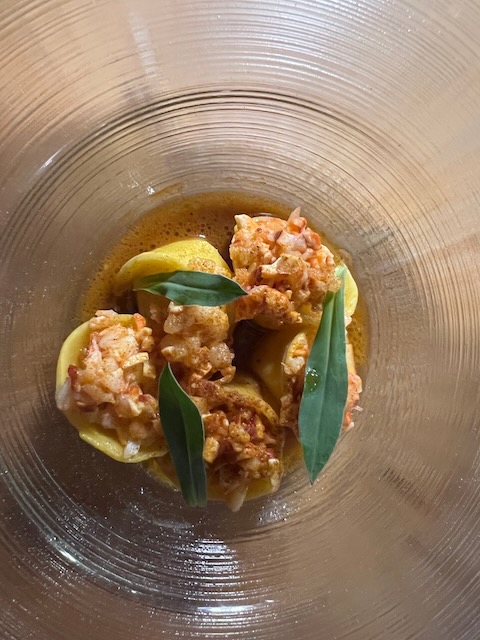

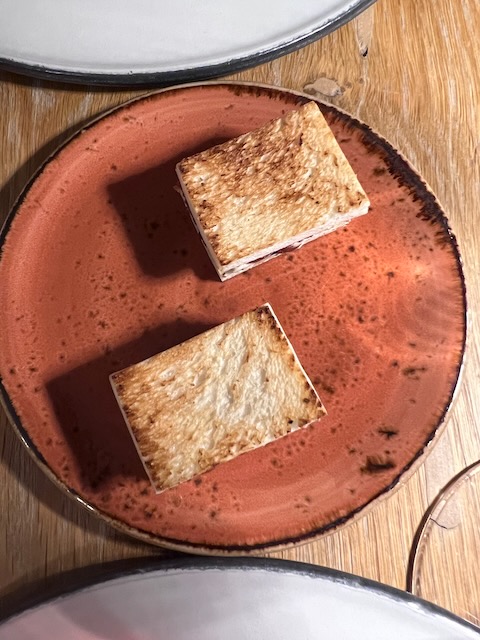
Once we were settled and dry, we walked about 25 minutes to an amazing restaurant called Fuel – the most upscale place we’ve been to during this trip. Dinner was wonderful; more about that tomorrow.
Fading now…
Fern
9. Bologna… The City of Arcades. April 19 2023
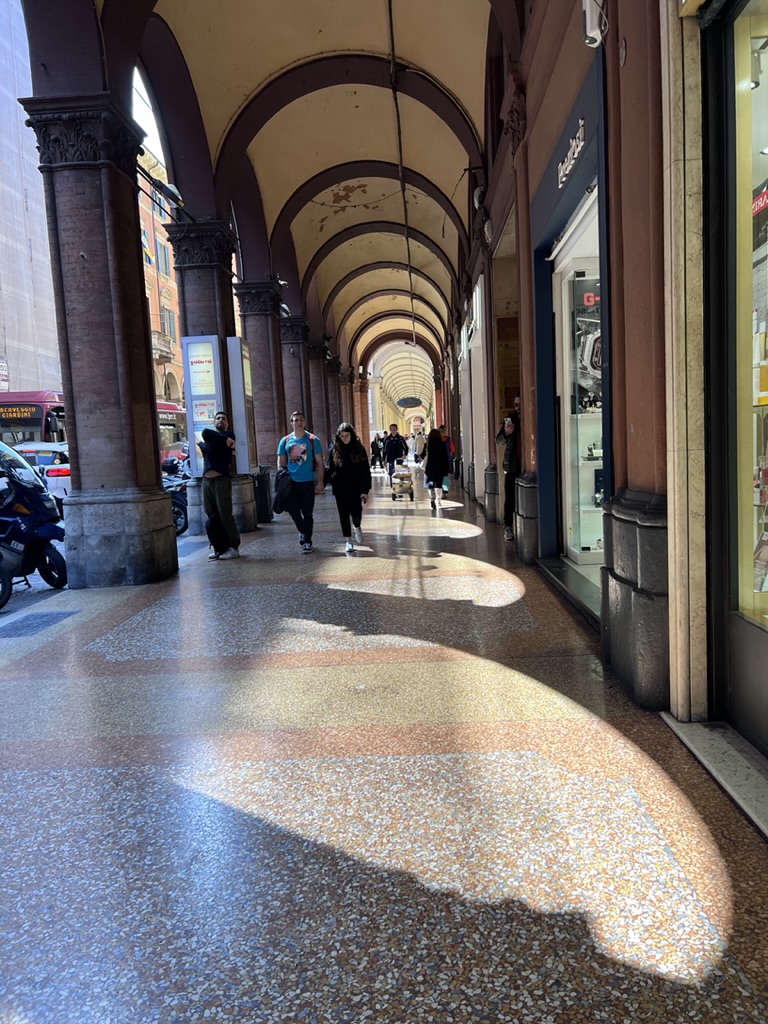


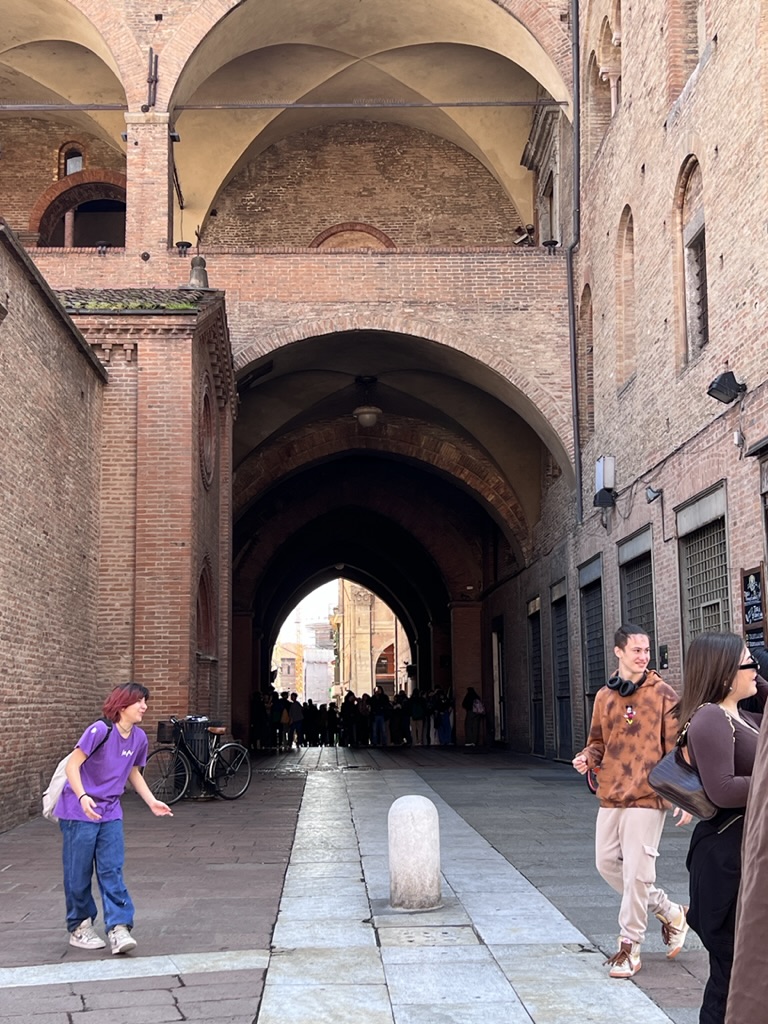
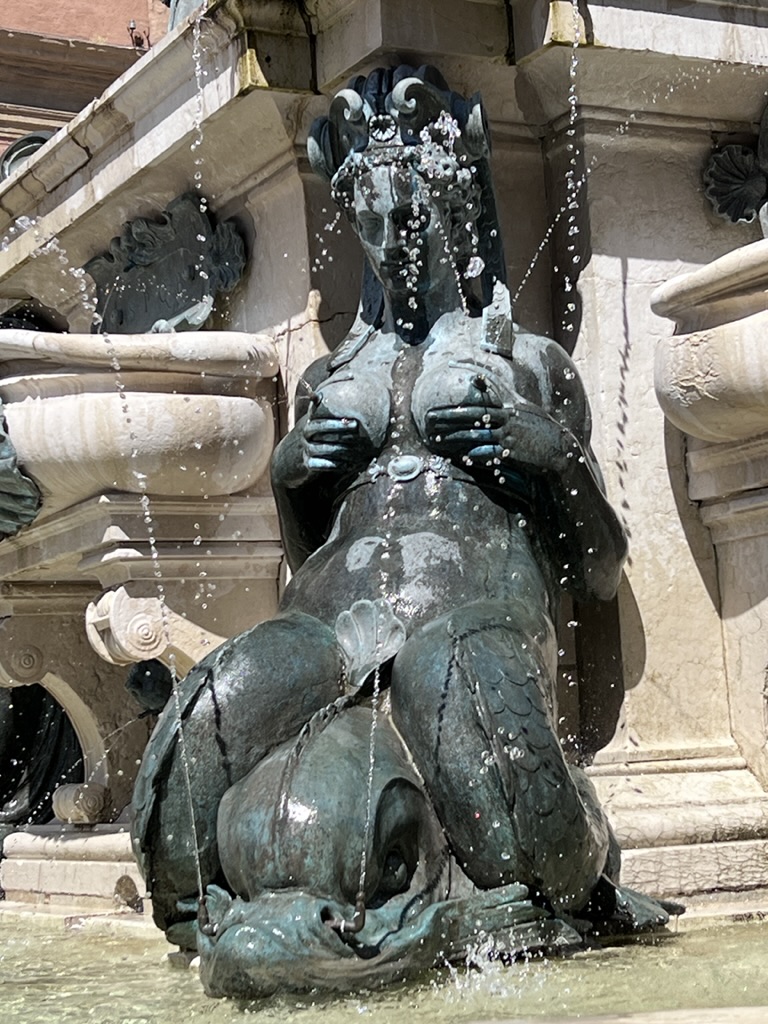
Ciao from Bologna –
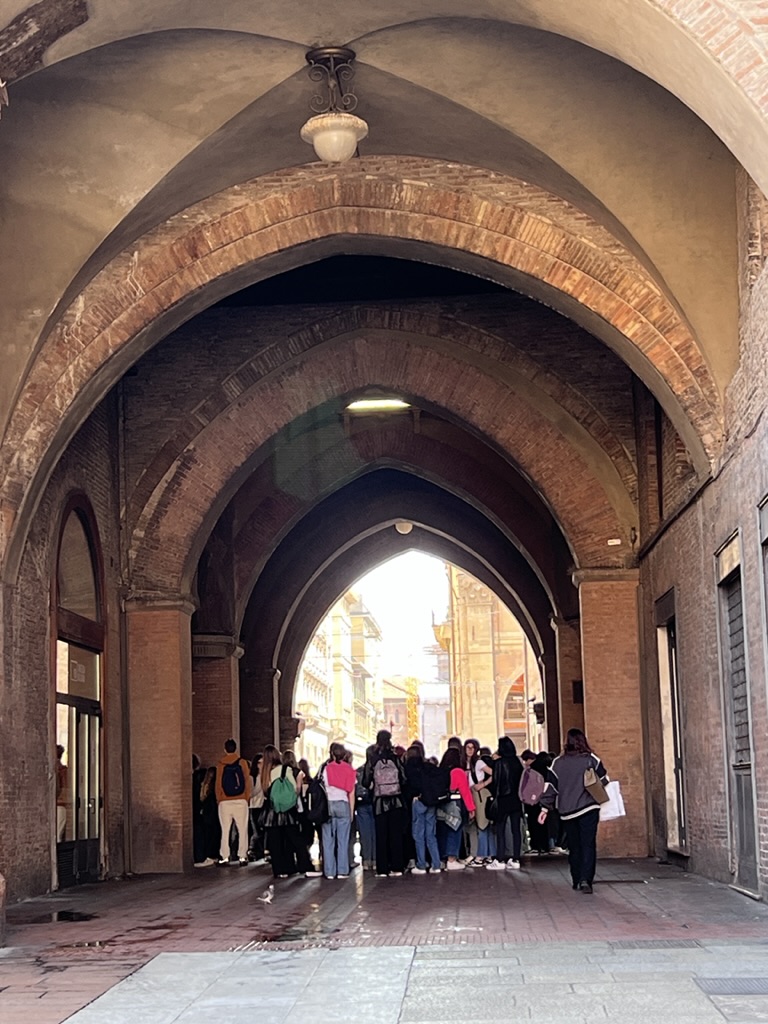
Following last night’s fantastic meal at Ahime we strolled back to the hotel through Via Independenzia which is arcaded for as far as you can see. I do remember walking these streets some years ago and while the structures are the same, the proliferation of international chain stores – has truly changed the nature of the city (in my humble opinion). And the amount of graffiti, while sometimes quite artistic and political, is also a newer phenomenon – more graffiti-like and less mural-like than in other cities we’ve visited.
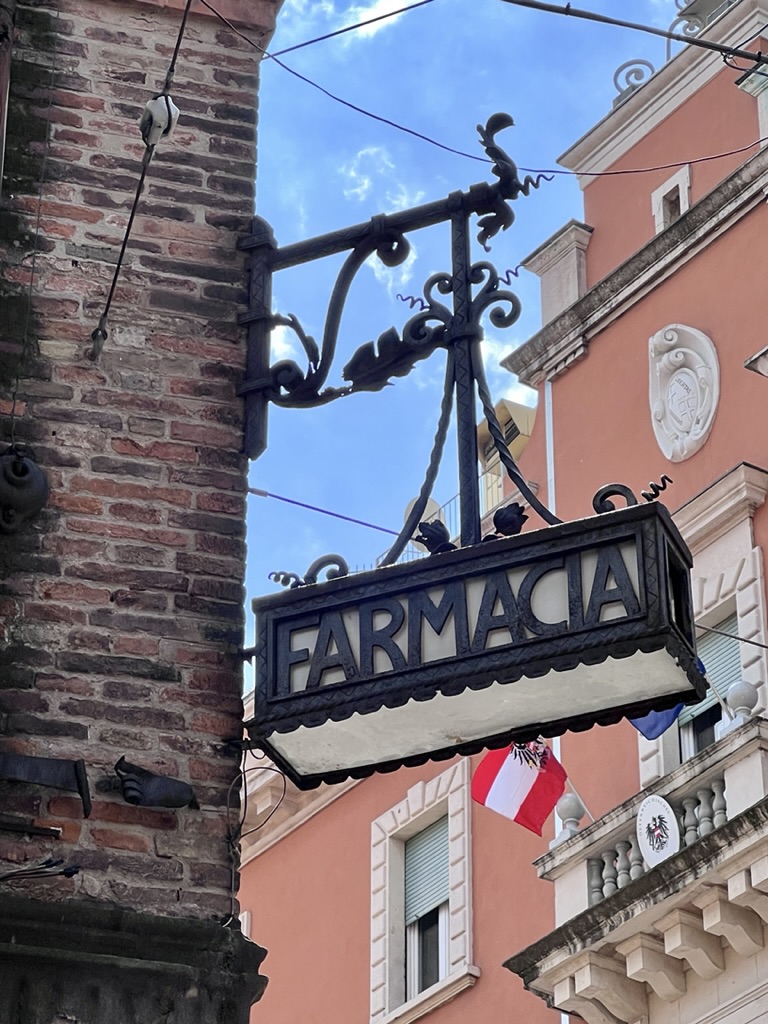
What I forgot to mention yesterday, is that I’ve come down with laryngitis and really can’t talk. I’ve been to about three farmacias and have lots of over-the-counter medicines and I’m having hot water with lemon and honey as well. I’m hoping for a miraculous cure by tomorrow. In the meantime, I can only whisper.
We began our day today, like probably every other foreigner who comes to Bologna, by walking to Piazza Maggiore which is really the heart of the city and the result of centuries of transformations that added important buildings around the perimeter, including the Basilica of San Petronio, the Palazzo dei Notai, the Palazzo d’Accursio, the Palazzo del Podestà and the Palazzo dei Banchi. The square itself dates back to the 13th Century, when different functions were brought to this central place. It’s roughly 200’ x 380’ which is about twice the width of a football field and half again as long. The piazza was (and I suppose is every day) filled with school kids on class trips, everyday Bolognans criss-crossing to get to work or home, and tourists. It’s got a real vibe, with cafes lining the fronts of all buildings, except the churches.

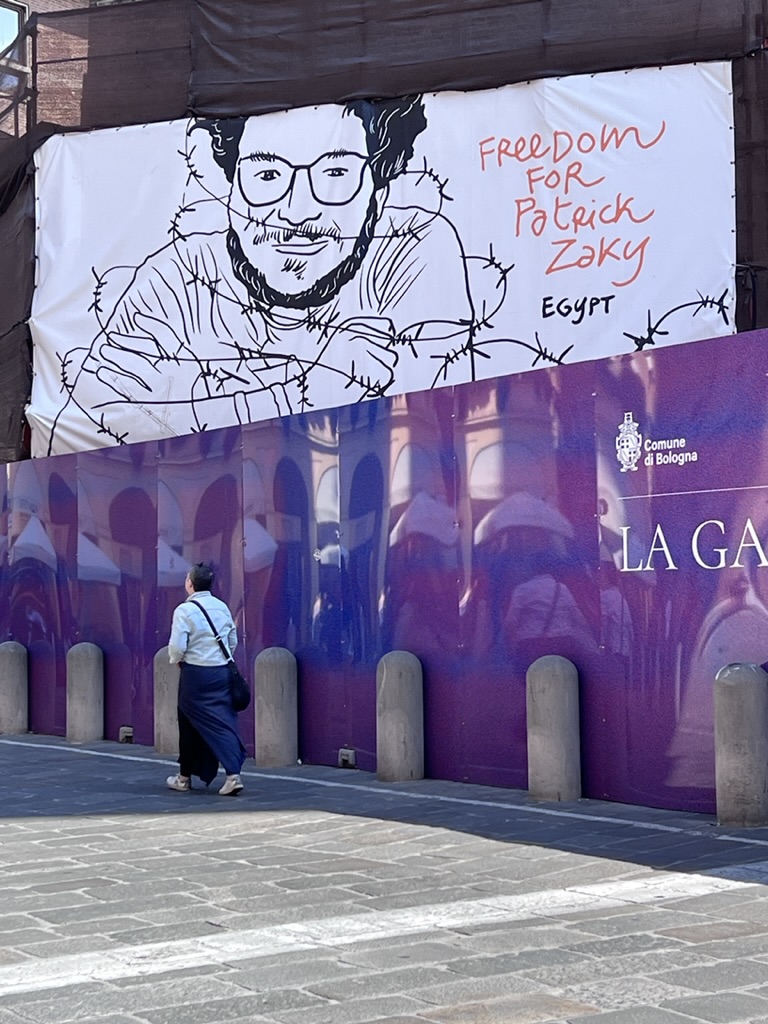
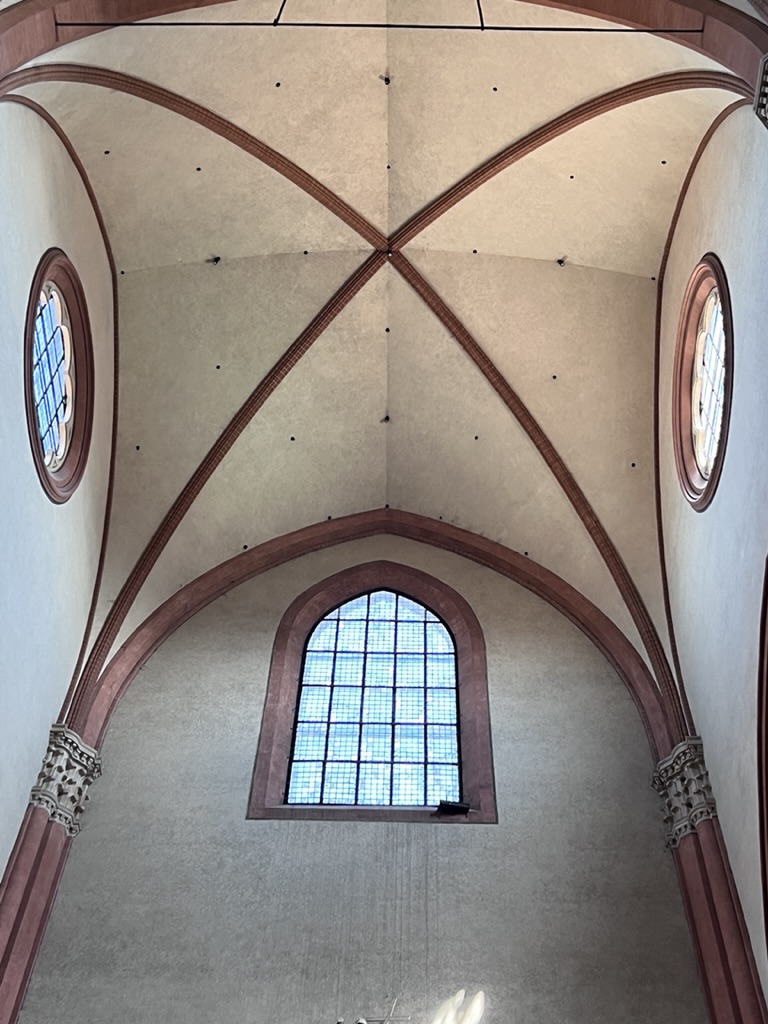
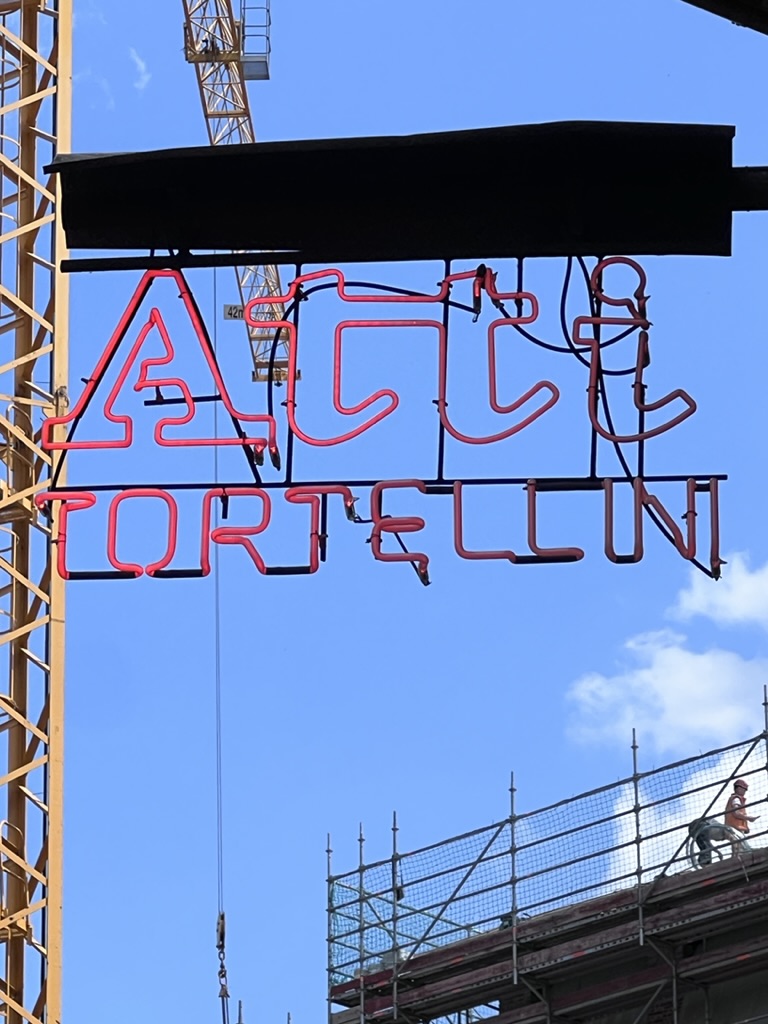
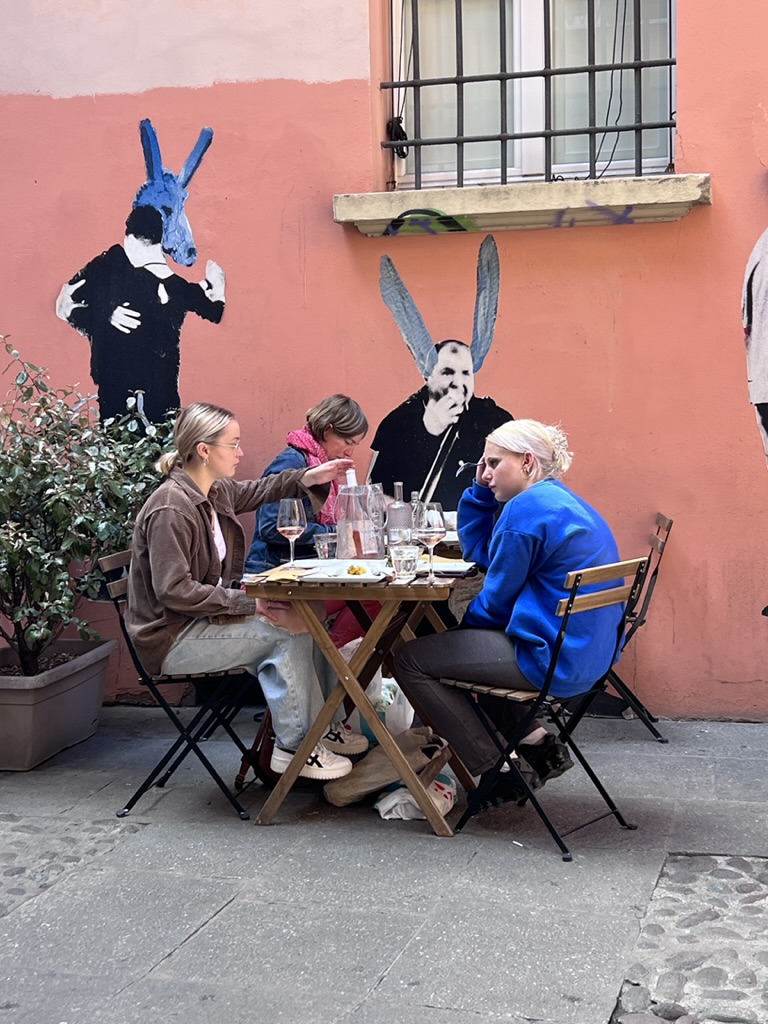
From there we walked down Via Rizzoli which is filled with food stalls and markets and restaurants, and then we left that immediate center and walked to the old ghetto where the streets are even narrower than in the other parts of town. Stopped briefly at a tiny museum devoted to the history of Jews in Bologna. Clearly off the beaten path as most of the exhibits were only in Italian and it was pretty thin in content. Then we stopped briefly at a little coffee shop called Camera A Sud (meaning South Room) for my now ritual hot water with honey and lemon. Really cute café with mostly outdoor seating.
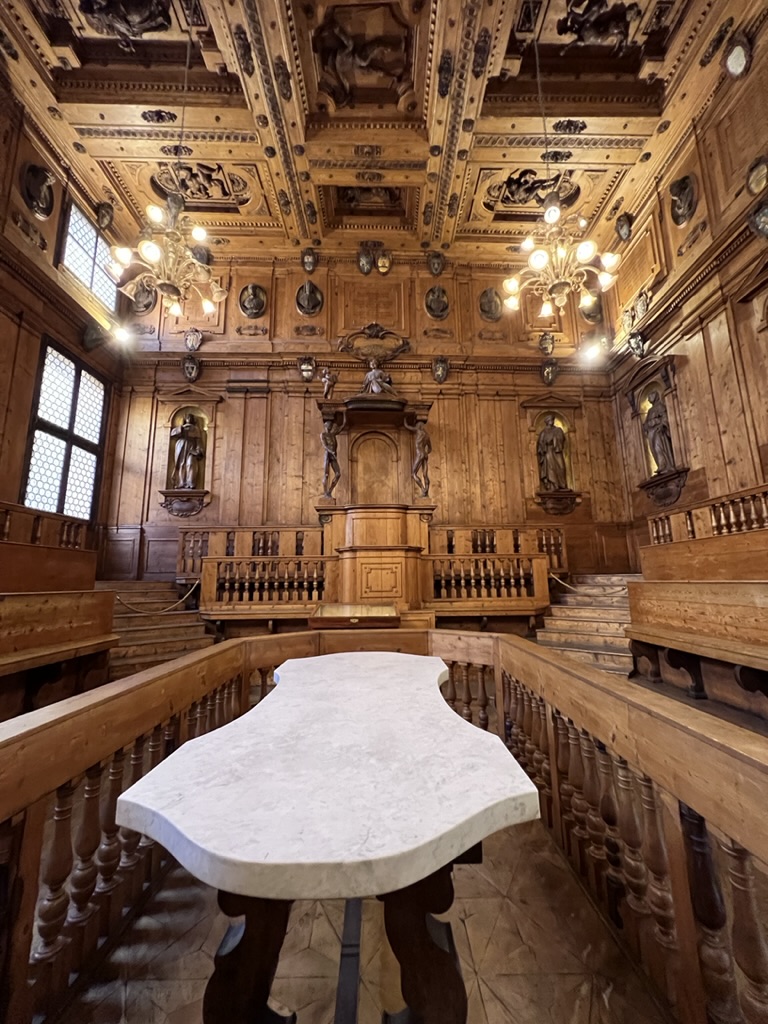
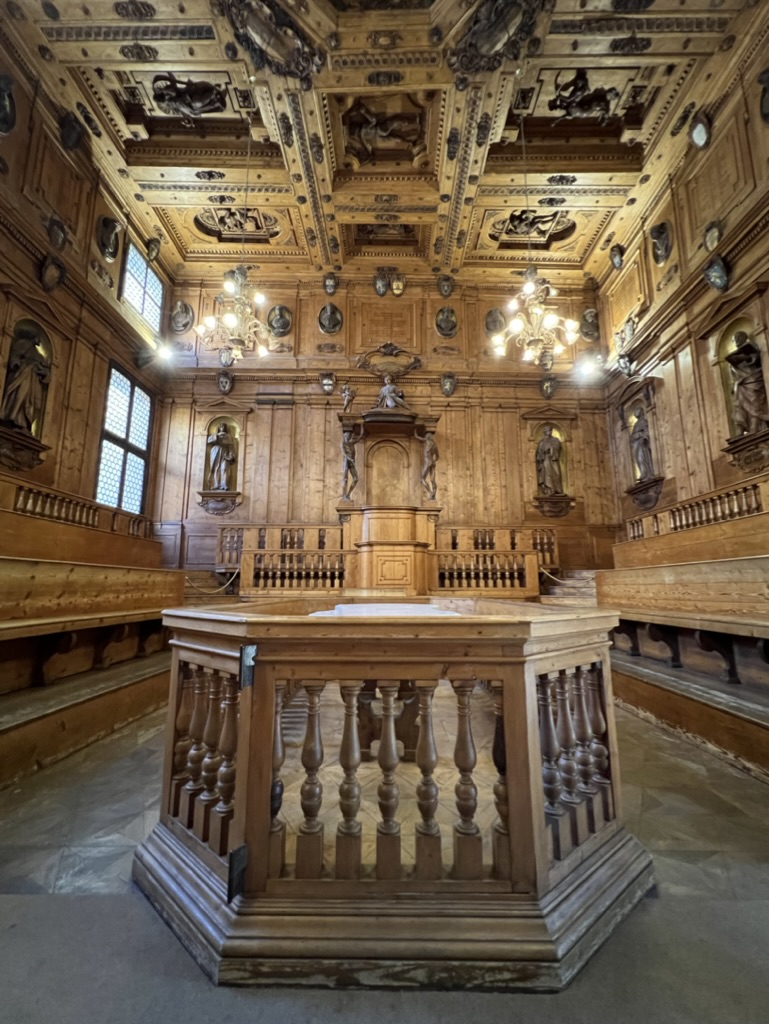
Then we strolled to the Teatro Anatomica which is housed in Palazzo dell’Archiginnasio which is home to an amazing library. The Teatro is from the 17th Century and is the room where public body dissections took place. According to the literature, these dissections were done with an Inquisition priest watching and ready to intervene “if proceedings became too spiritually compromising” — whatever that means. There are wood tiered seats around the room that surround a marble topped table, where the body used for the demonstration, was laid. Above the table there is a sculpted Apollo looking down from the ceiling. Also, the lecturer’s station at the front of the room has a wood canopy that is held up by two skinless, wood-carved figures. Boy, those were the days!!!
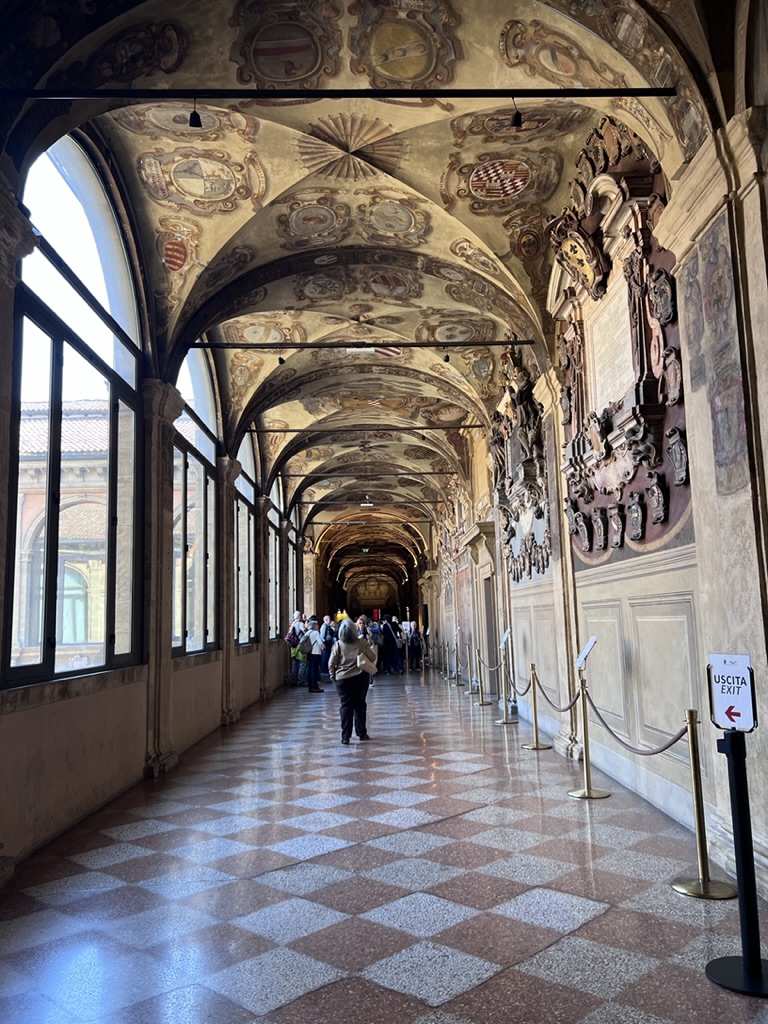
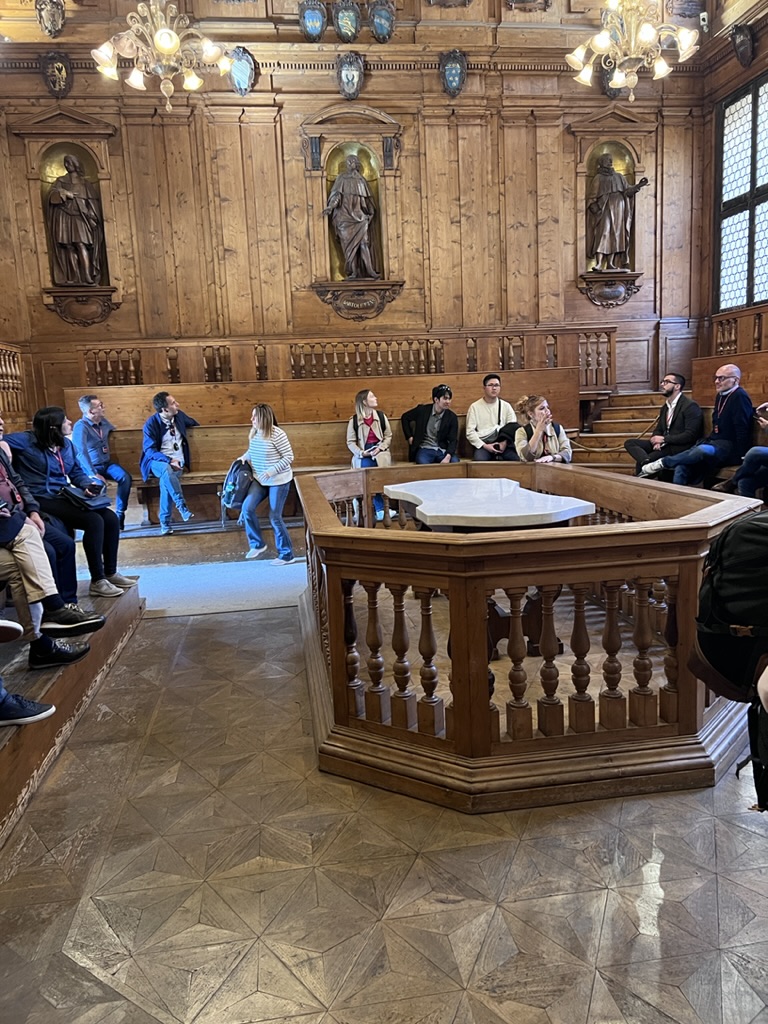
Then we took a leisurely stroll back to the hotel to relax on the 4th floor deck that is part of our room. We tried to make reservations at several restaurants for dinner and all were booked. Hard to be spontaneous these days when traveling. So we are headed to something called Colombine Alley (or Viccolo). Hope it’s good.
Will fill you in tomorrow, from Padua…
Best -Fern
8. From Siena to Bologna via Abbazia di San Galgano
18 April 2023
Ciao from Bologna –
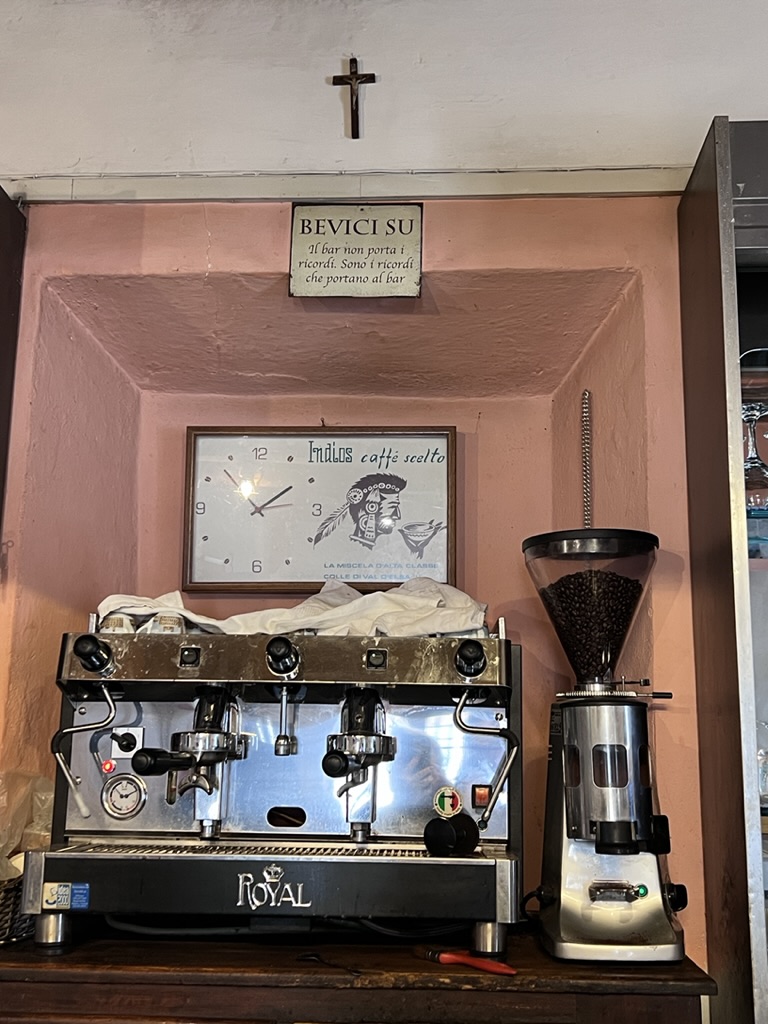



Before I begin today’s escapades, I wanted to respond to the question several have asked regarding both our decision to take this route and the rationale for many stops and short stints in each location. This is a road trip. We’ve been to Italy many times and wanted to both revisit some places and also see new ones. We have limited time as we are on our way to Geneva to see family; thus we will end up in Milan as our last Italy stop, where we will take the train to Geneva. We spent three nights in Rome and in Todi and two nights in Siena; we’re stopping for two nights each in Bologna, Padua, and Trieste, and then we’ll be in Milan for four nights. Along the drive we are stopping to see some things we had never seen in any of our other Italy journeys. I can write an essay now on the pros and cons of short stops in many places versus fewer stops and longer stays (the latter being our more usual travel mode). But this also has benefits and thus far has been great—with lots of variety.
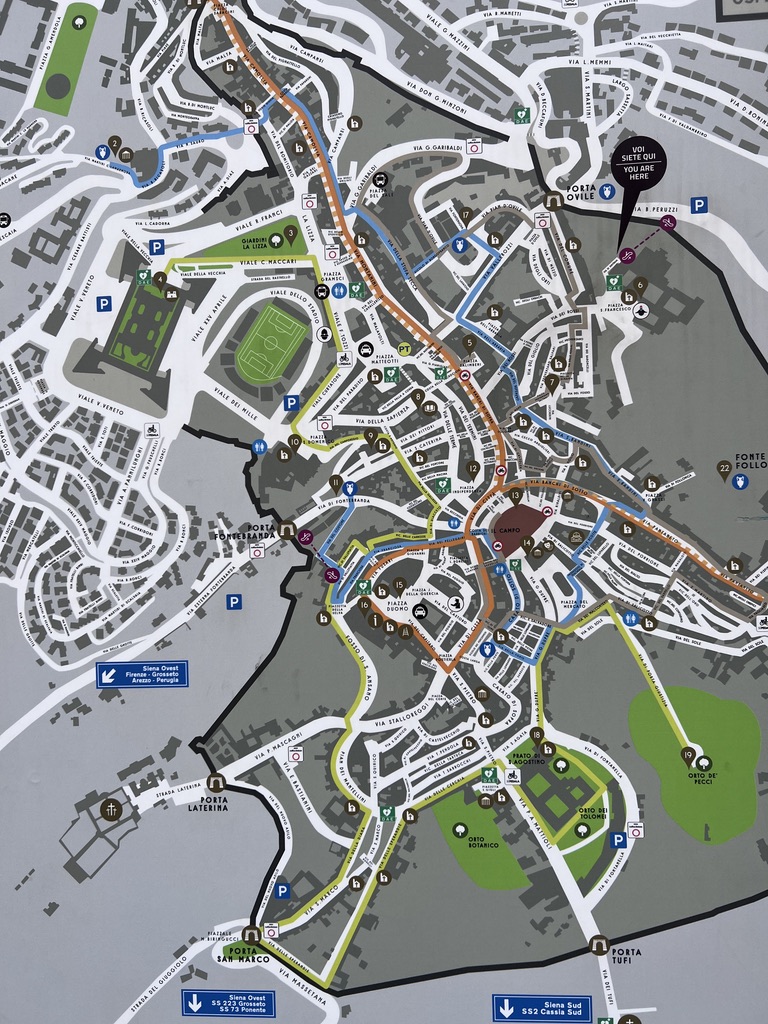
We left Siena around 11 am, after navigating our way from the public parking lot out of the town. I attached a map of the old part of Siena (the vecchia citta) to provide a sense of the “logic” of the street patterns—not just for Siena but for all European medieval cities — piece of cake to figure it out! We’ve been to many of these medieval cities throughout Europe; they are great to explore and impossible to navigate (especially with a car).
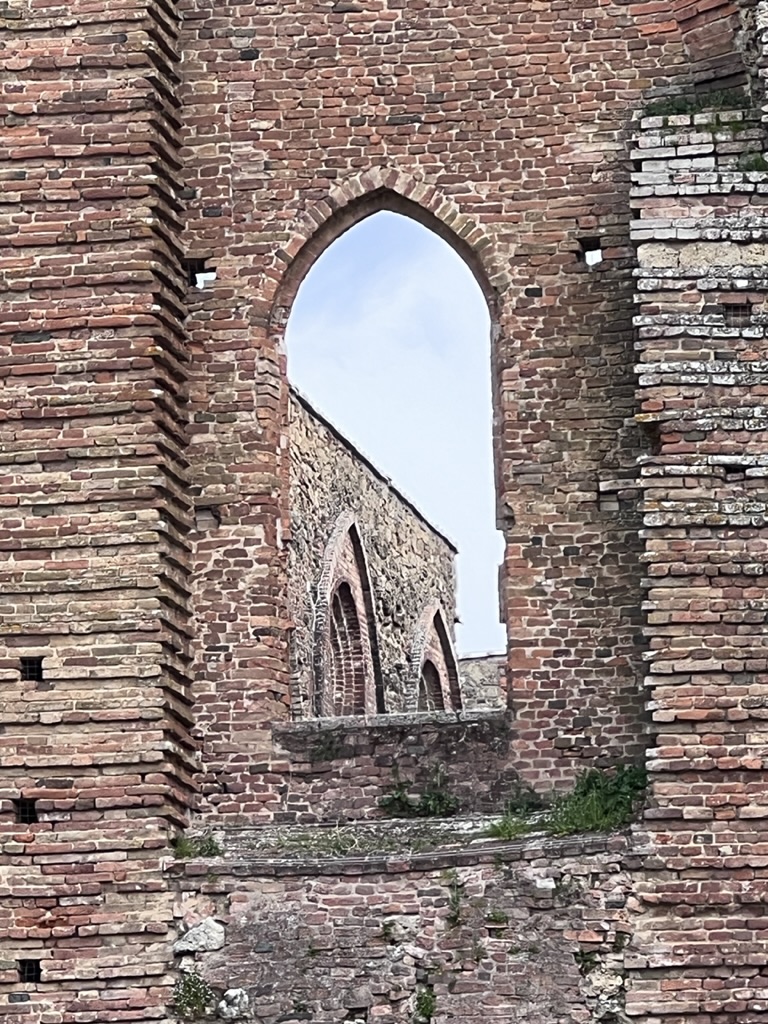
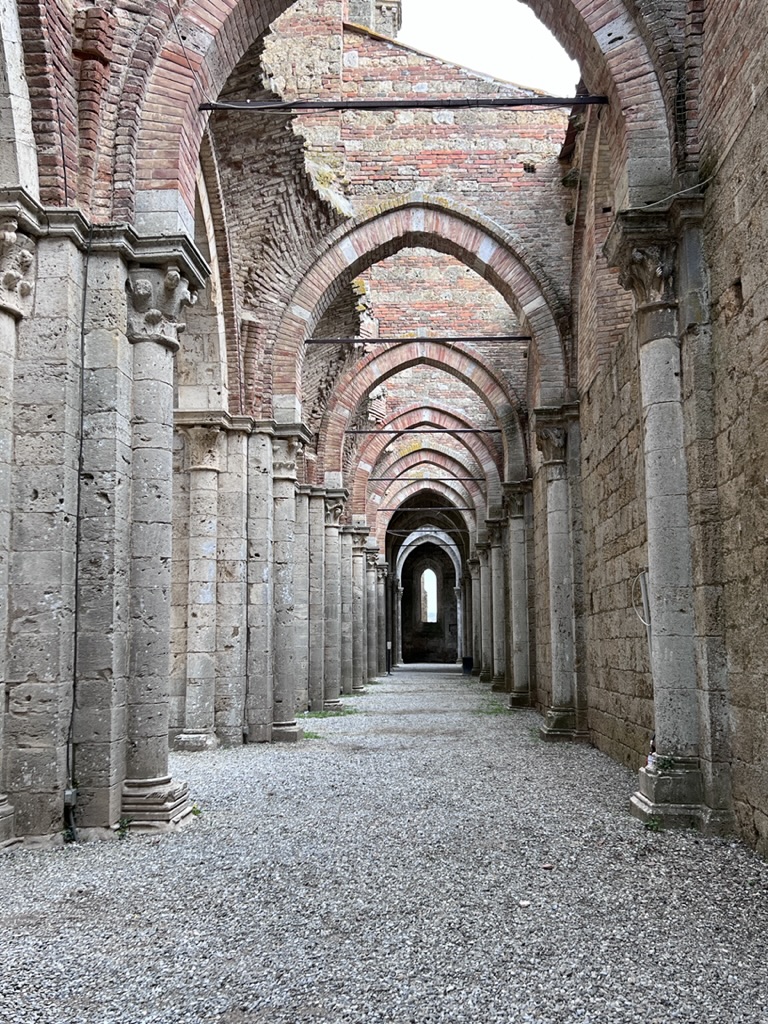
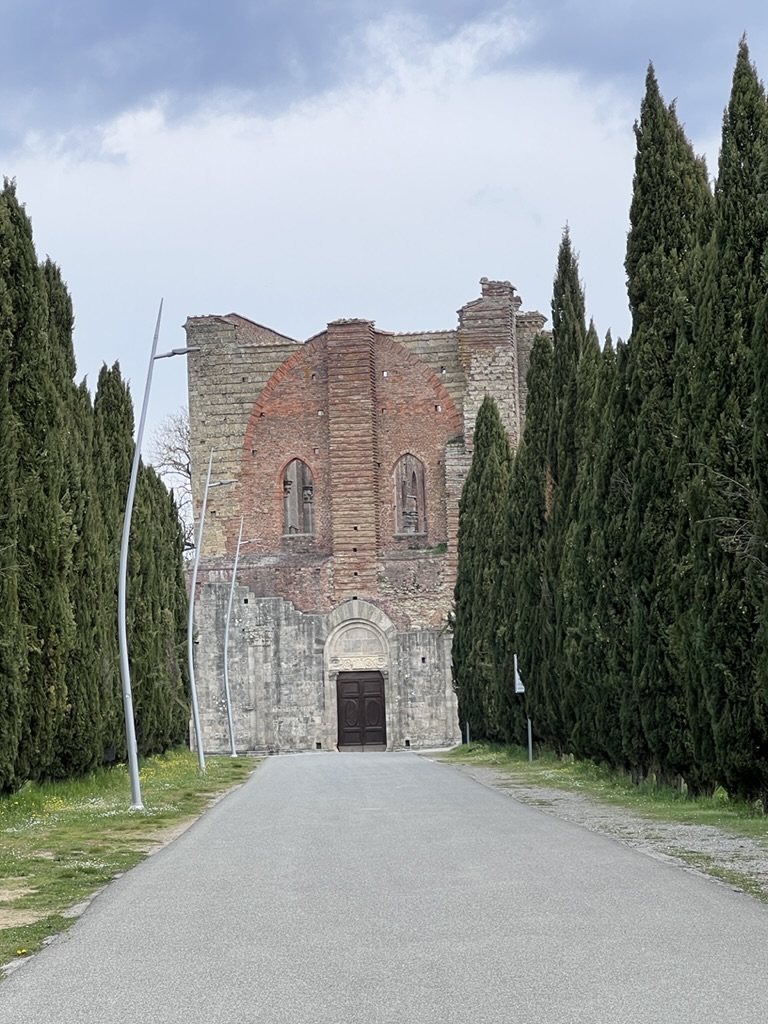
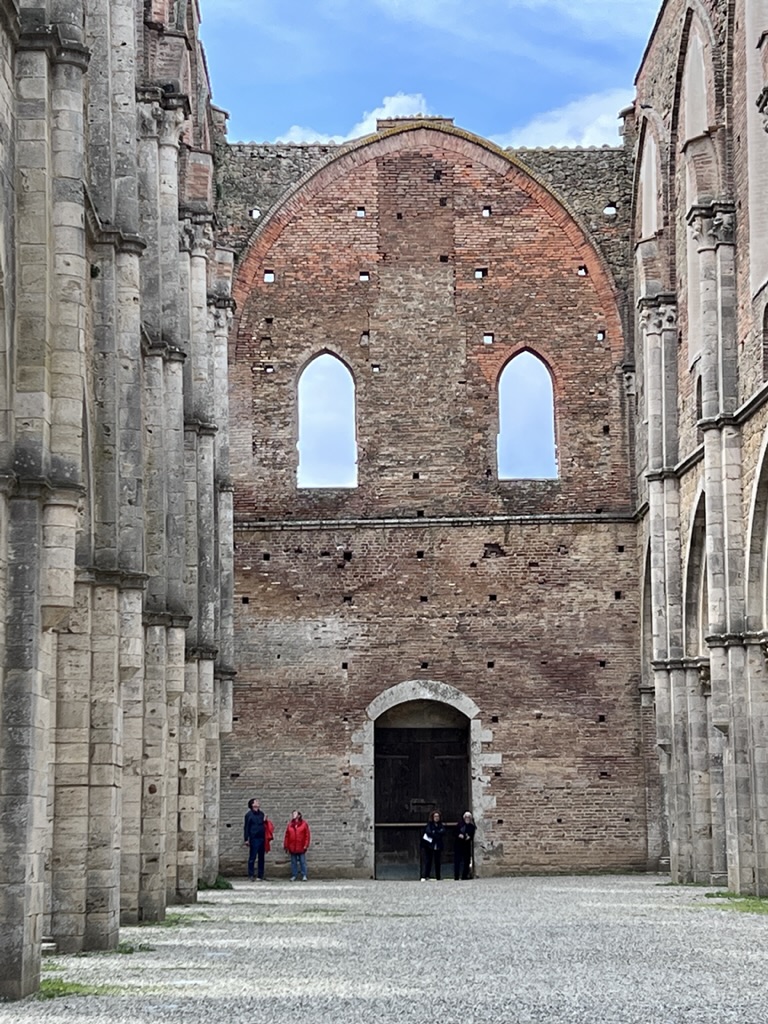
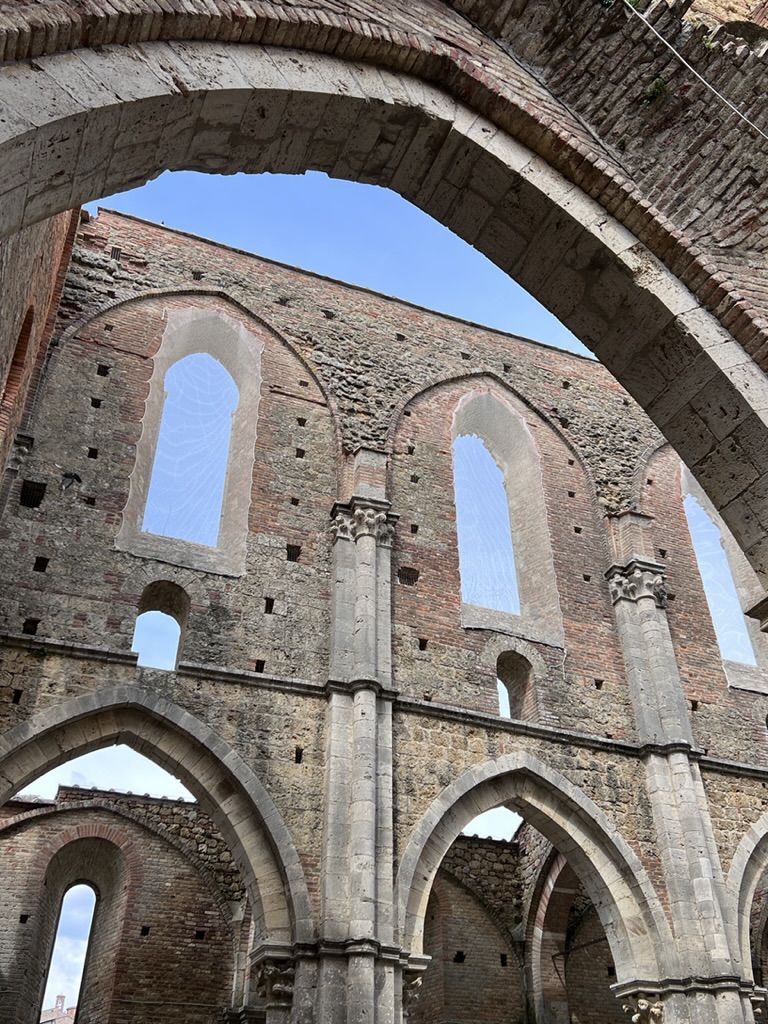
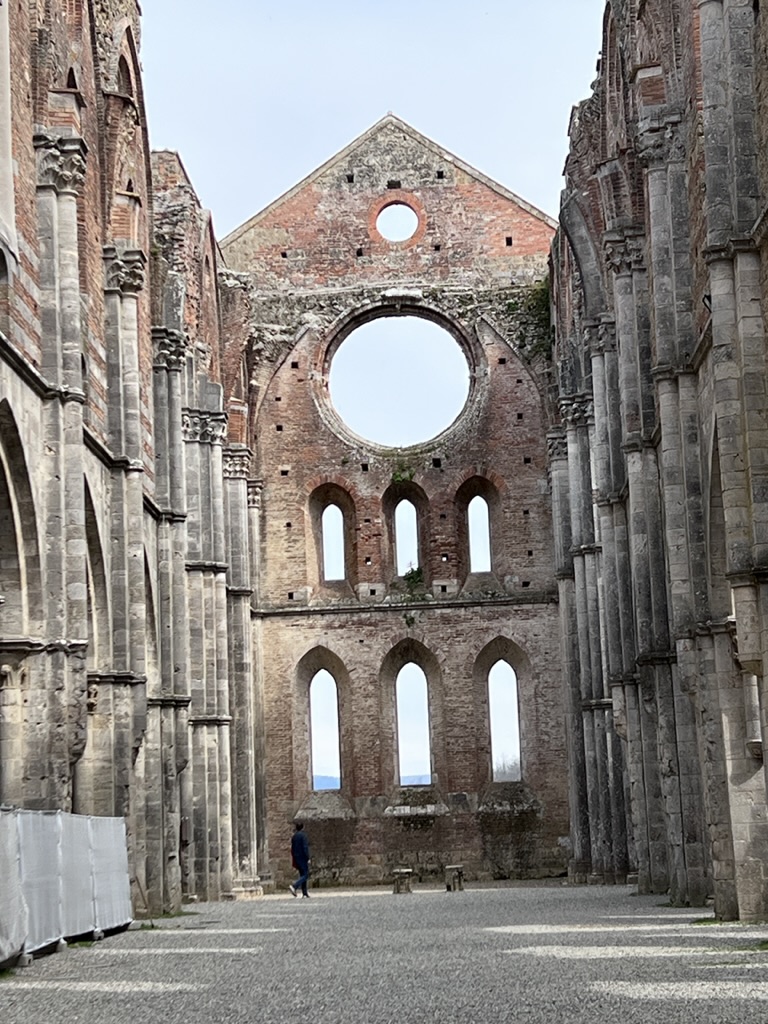
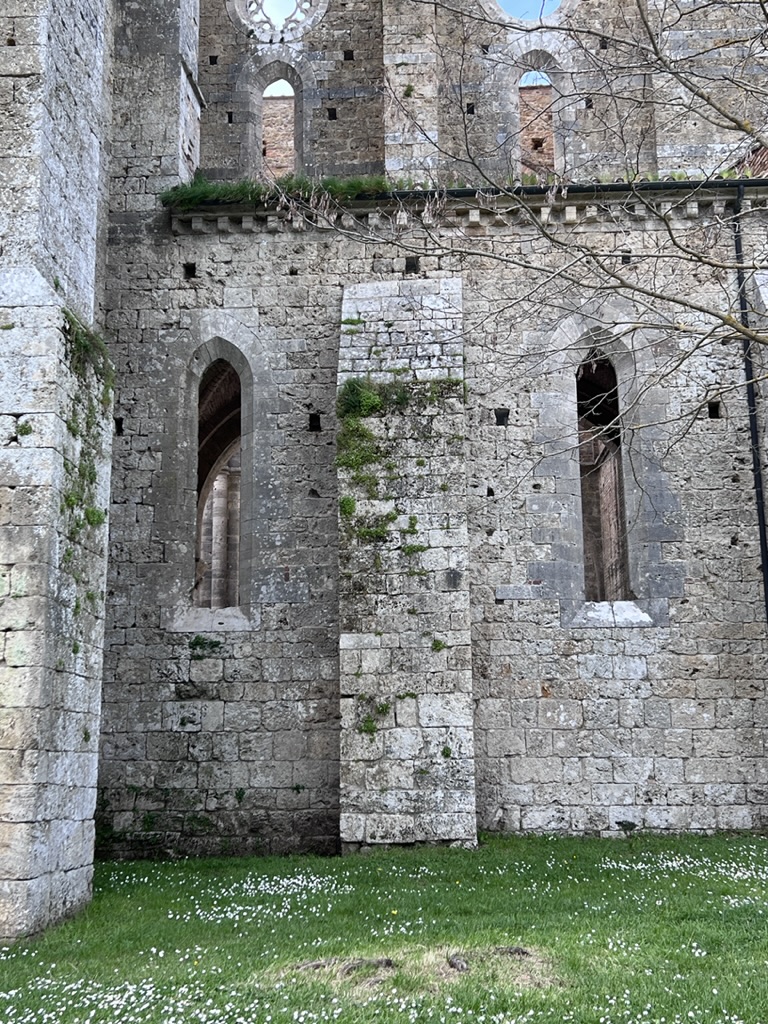
We went on a bit of a detour today because we wanted to stop at the Abbazia di San Galgano which is about an hour outside of Siena—the drive took us a bit out of our way to our Bologna destination, but we really wanted to see this Gothic church with a complicated history, and which is basically abandoned. The Abby of San Galgano was built over a 70-year period starting in 1218 by a group of monks. It is said to be the first gothic church built in Tuscany and was built here because these particular monks focused on building their monasteries close to rivers where woods, marshlands, and plains could be cultivated. But once they built this church, they had to withstand famine in the 1300s, and the plague a few years later. Then the abbey was devastated by mercenary bands … and at the end of the 15th century the monks moved to Siena… In the mid-1700s, lightning struck the bell tower which collapsed onto the roof of the Abbey and the church was finally “de-consecrated” in 1789. What we saw was the shell of the original church. We had seen a similar church—open to the sky—on a trip to the old Czechoslovakia and it seemed… well oh, so spiritual. When we heard about this one, we wanted to see it. The monks chose not to rebuild the roof but to leave the church open, transforming it into a stable after the de-consecration. In 1926 the Italian State recognized the cultural value of the structure and began to protect it. Today, there is scaffolding inside, and I guess someone is working to fix or stabilize the structure. It will take a long time.
But the Abbey also has some additional stories: San Galgano had apparently led a life of debauchery and wickedness as a youth. There is a large stone with of a sword stuck in the middle. The story is that in 1180, Galgano decided to convert to Christianity and made a vow, by sticking his blade into a stone to transform it into a cross. Some say there are too many similarities of this story to the story of Arthur, and the Knights of the Round Table.
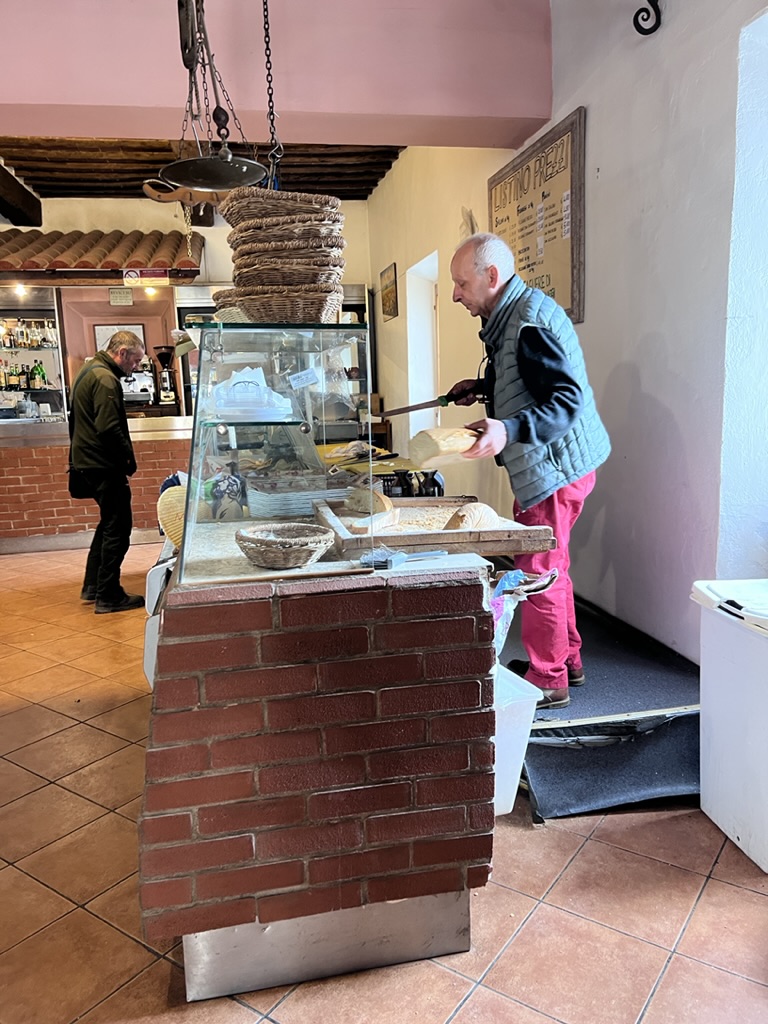
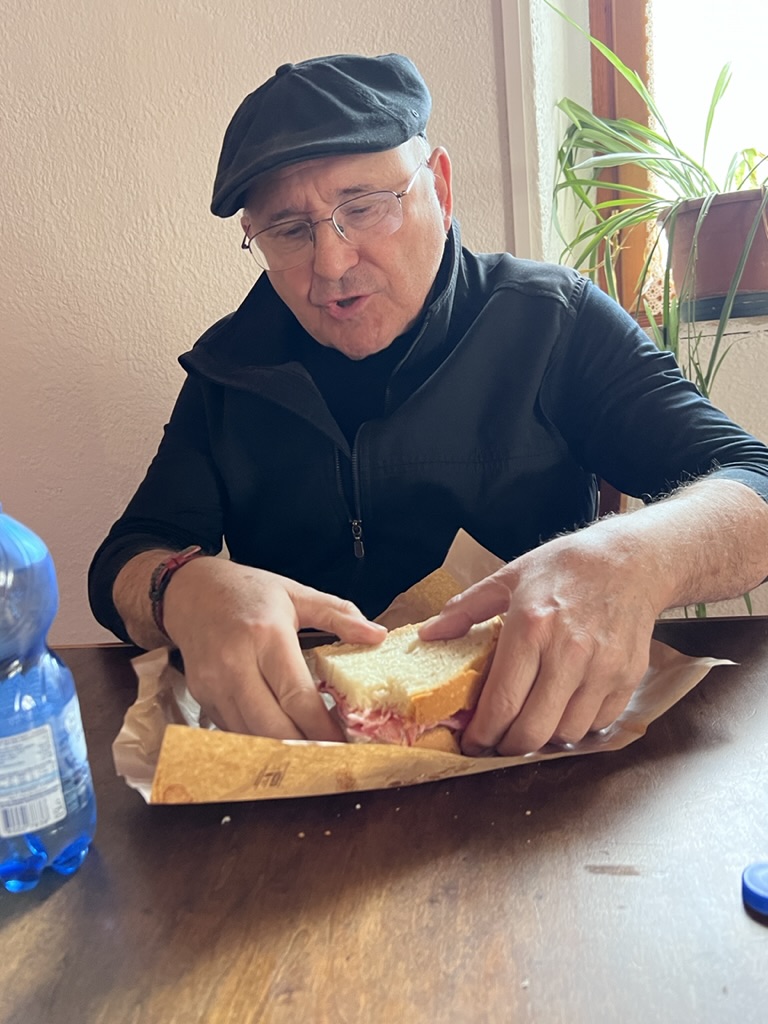
The drive to the Abbey, which was quite wonderful, followed small winding roads and fields of wildflowers; as we were getting close to the Abbey, we realized we were really hungry and that we were unlikely to find any place to eat. We resolved that we’d stop at the very first place that had food. About 3 kilometers before reaching the Abbey, we saw a sign for a bar and figured they’d have food. We parked and headed into this rather isolated, small bar. Outside some workers were having sandwiches. The guy who owned the place–-probably in his 60s—and who was the only staff, spoke absolutely no English. We said “panini” and he nodded. He then showed us a few different meats and we said “prosciutto” and he nodded; then he pointed to cheese and we nodded yes. Then we asked about tomato (“pomodoro”) and he repeated “formaggio” (cheese); I said “pomodoro” again and he said “formaggio” again, so I realized it was a lost cause. I then tried “verdura”- vegetables; and he said “formaggio”… so we had a cheese and prosciutto sandwich… that we shared. The place was like a throwback, complete with coca cola signs from the 50s (probably worth a lot on EBay) and a poster for some event in 2009. As we were leaving a bunch of motorcyclists arrived who seemed to know the place.
We ate and headed to the Abbey which provided real drama without roofs and windows.. just sky.. It was a powerful statement with typical gothic soaring columns. We strolled inside and outside.
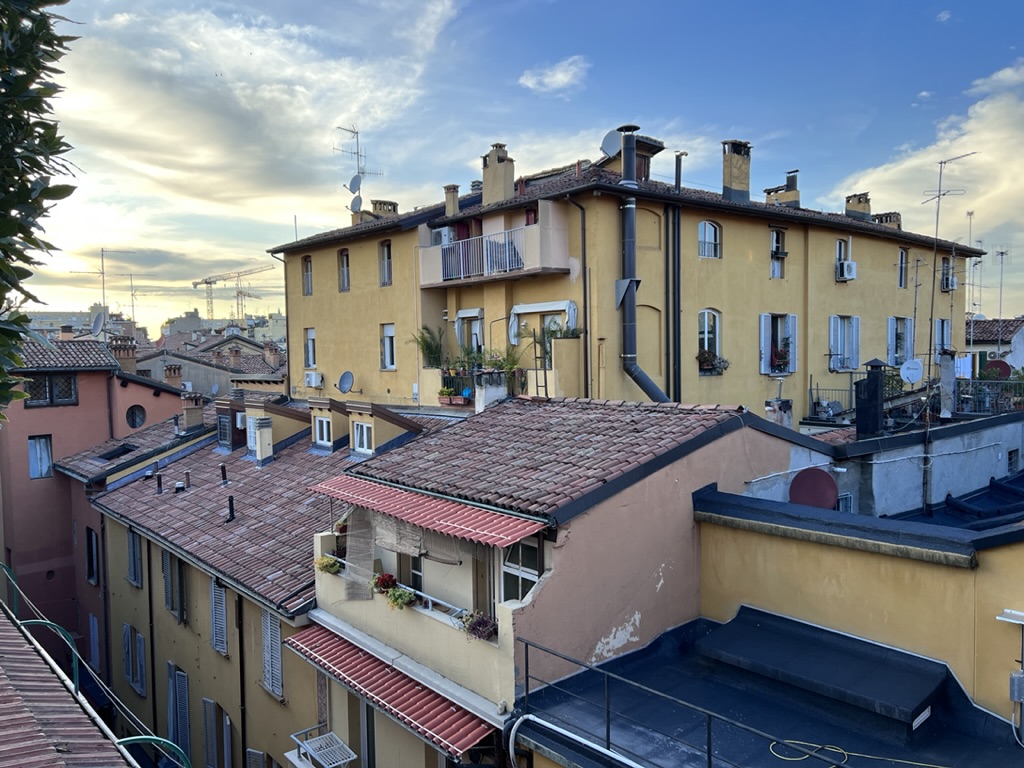
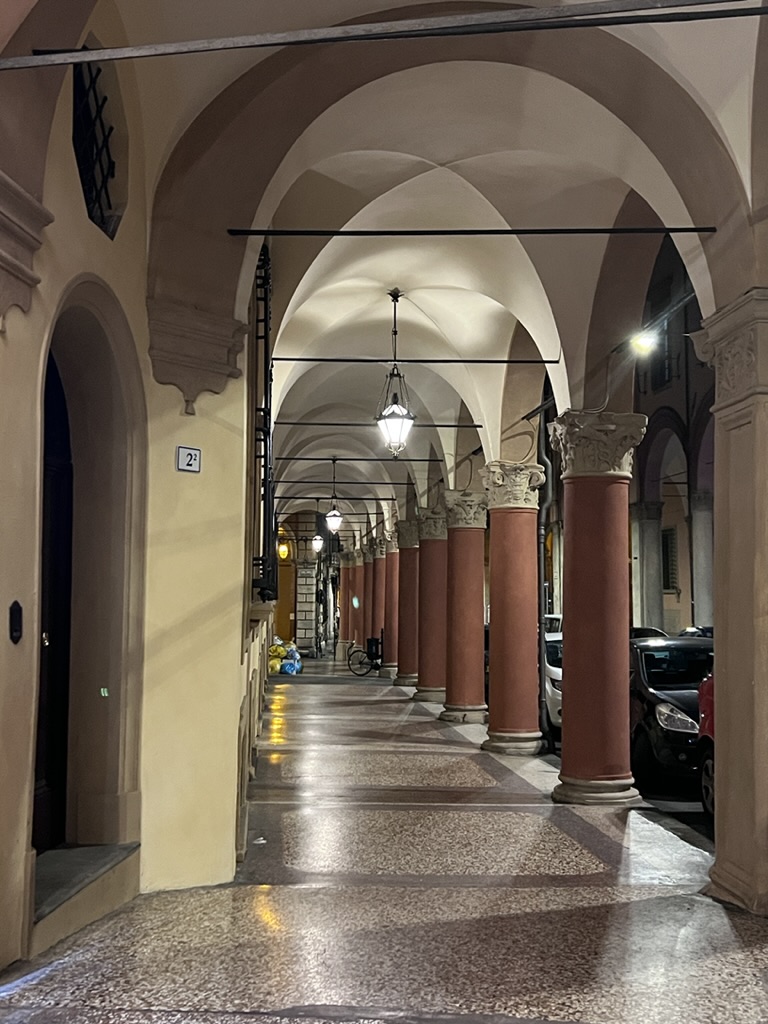
After strolling the site, we began our journey to Bologna where we will stay for two days. Tonight, we had dinner at a little place called Ahime—about 12 tables with a very creative menu that changes daily based on available ingredients. More about this tomorrow and our strolls through Bologna, a city of about 350,000 with some interesting neighborhoods and my strong memory of the many streets with covered archways and a grand town square.

More tomorrow.
Fern
7. Siena… Now we know where all the tourists are
Buona Serra – April 17, 2023
Greetings from Siena-
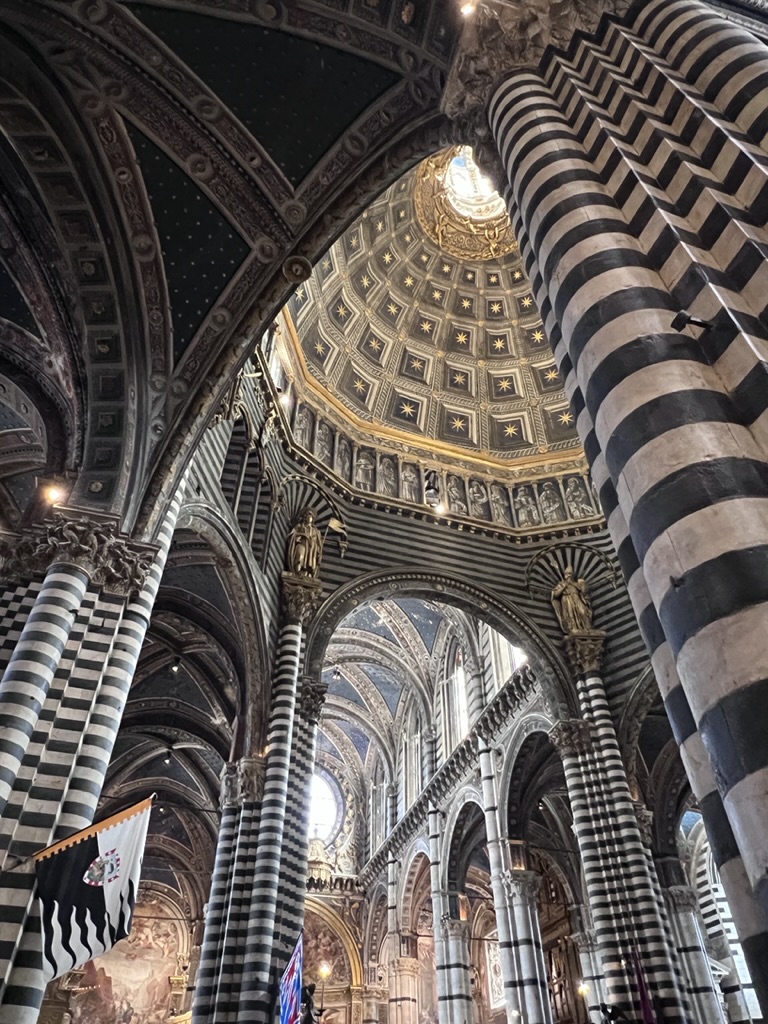

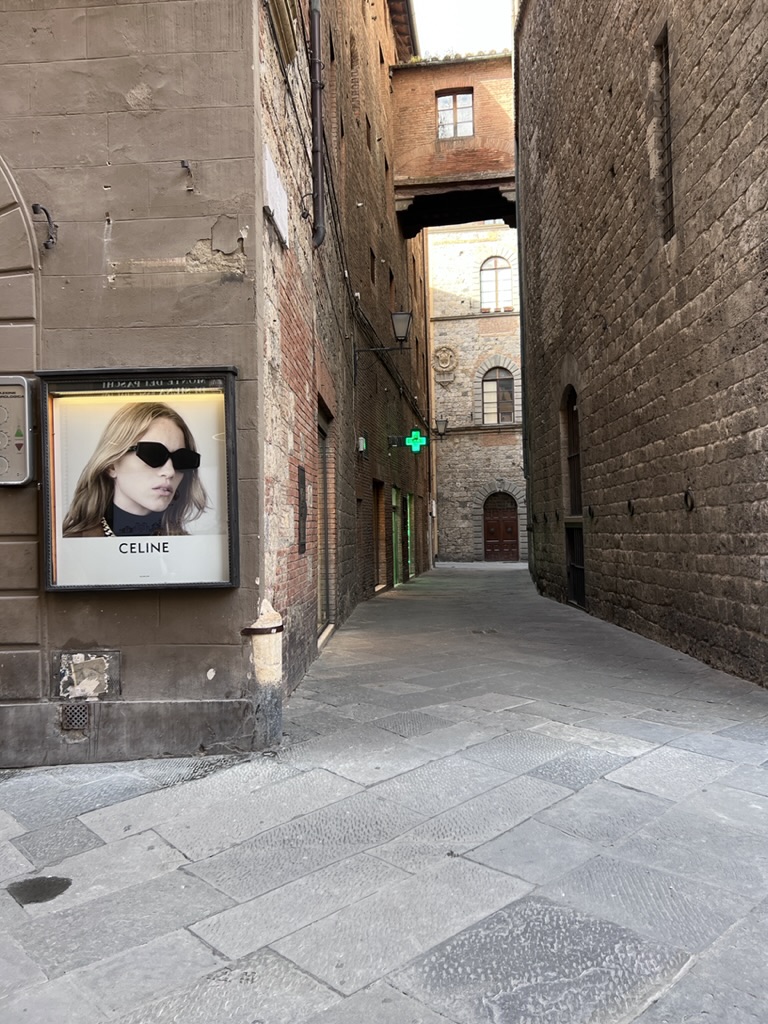
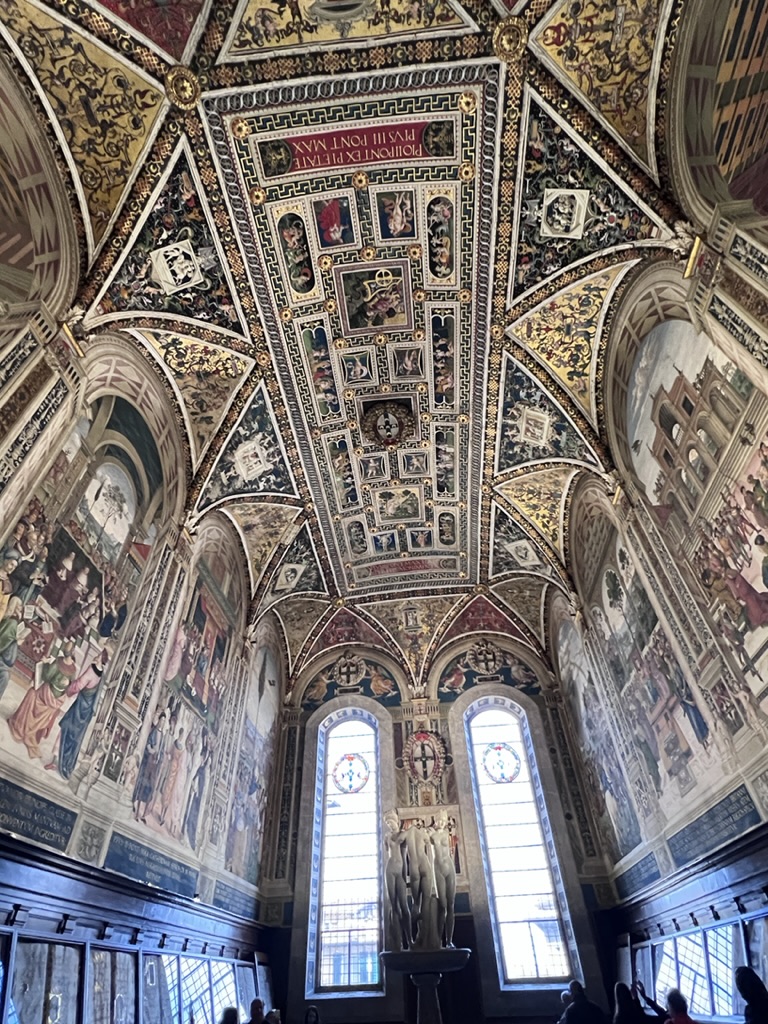
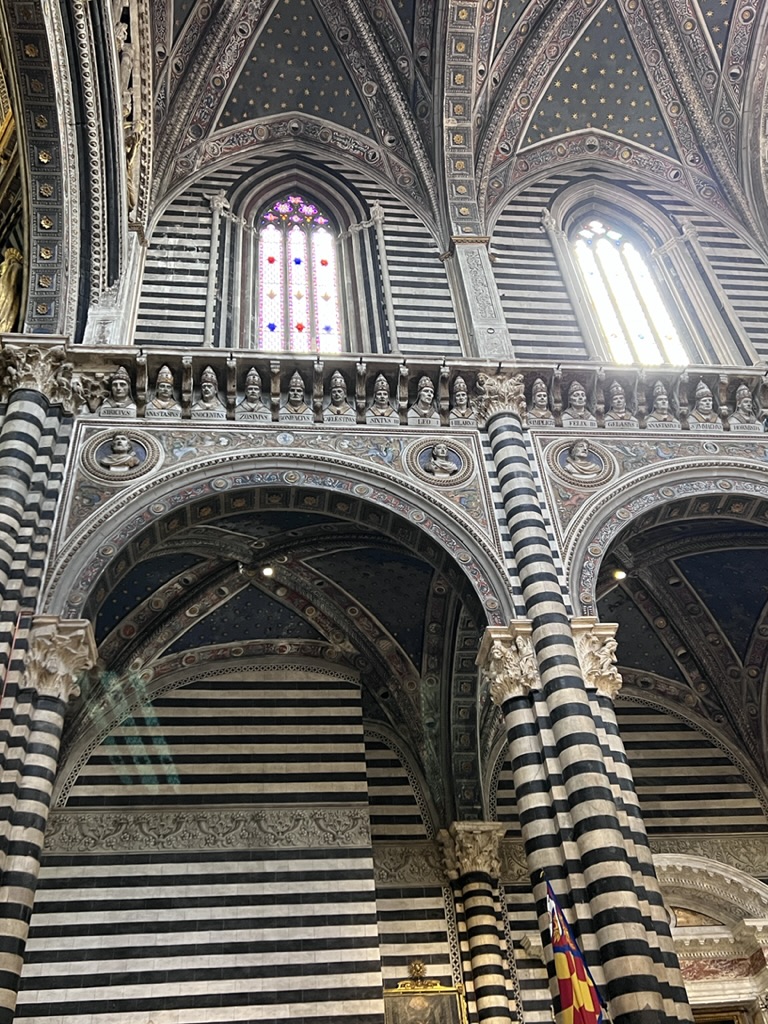
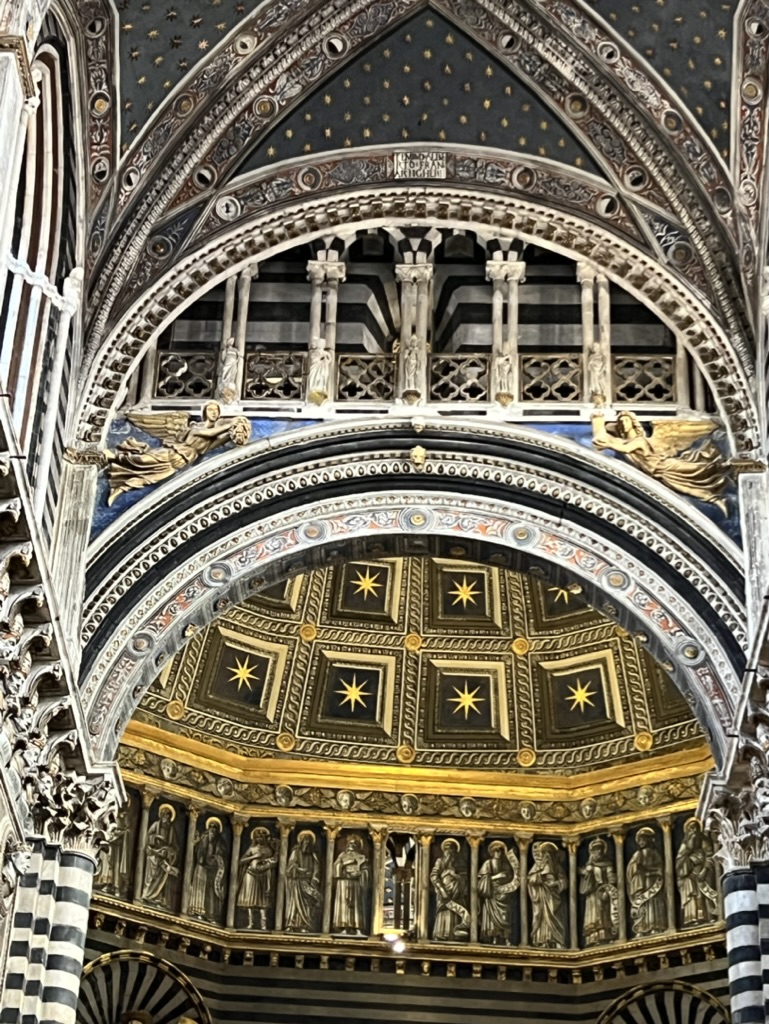
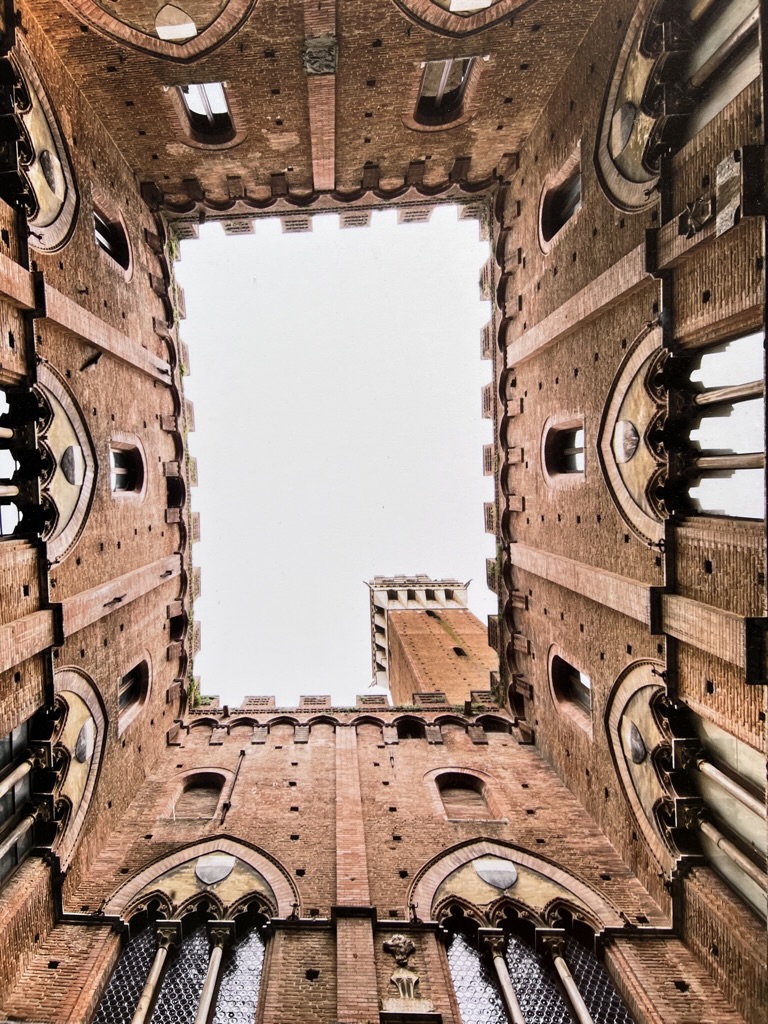
Today we walked and walked, starting from the hotel to the Duomo, which while inundated with tourists (indeed this is the first place we’ve really encountered lots of tourists) is as I remembered it. The Duomo took 175 years to build, and they built it from back to front (so that mass could be held during construction). Frankly, I don’t remember having to deal with long lines to enter (which fortunately we were able to bypass because we bought tickets online prior to today) and I don’t remember as much chaos brought about by having so many people inside at one time. Anyway, we persevered and then just walked out past and through the wonderful Piazza del Campo––the main public space in the historic center of Siena—one of Europe’s greatest medieval squares. In the 13th Century, there used to be a marketplace on this site. Today, the public space was filled with people of all ages—kids running around, school children visiting with their classes (and teachers trying to explain the significance of the space—as the kids were on cell phones and also playing cards), adults drinking wine and cappuccinos at the cafes that surround the space, and tourists taking selfies.
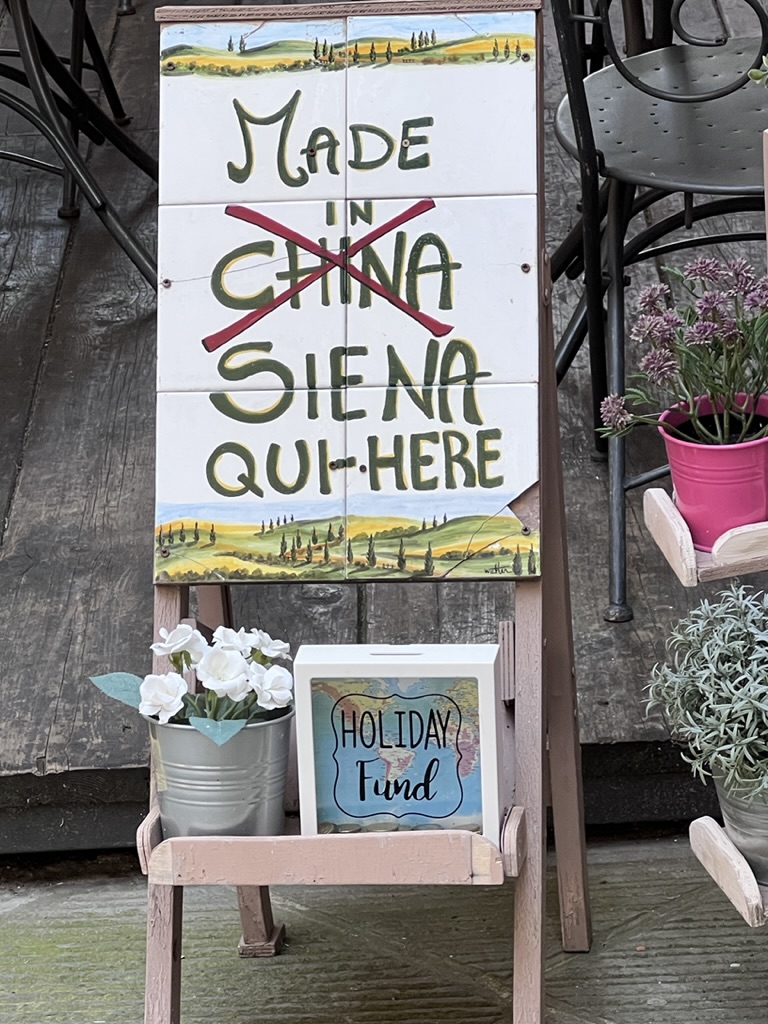
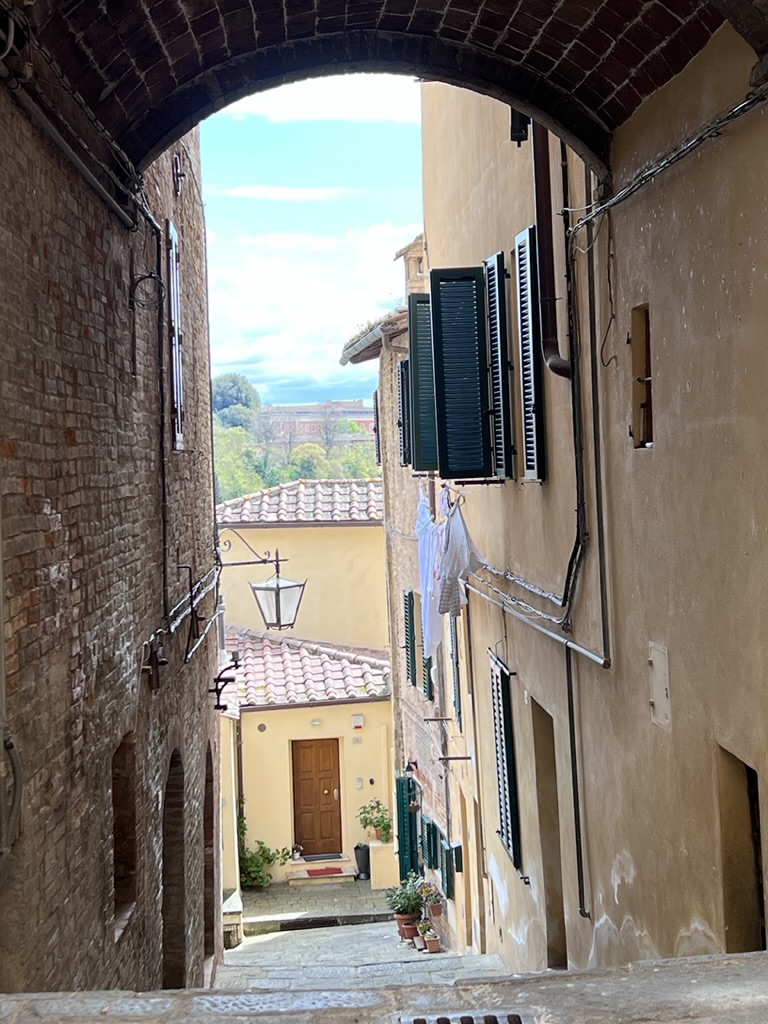
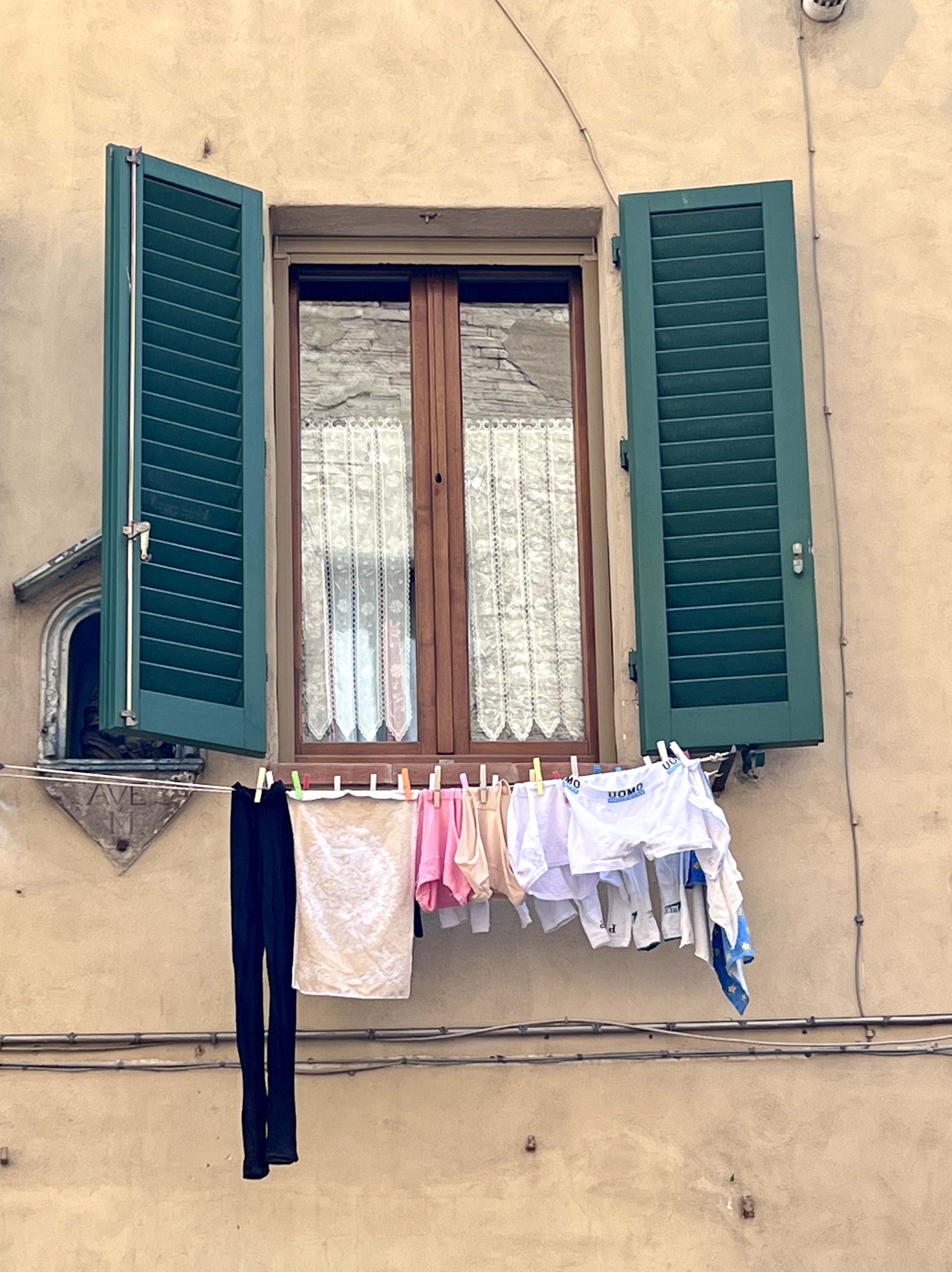

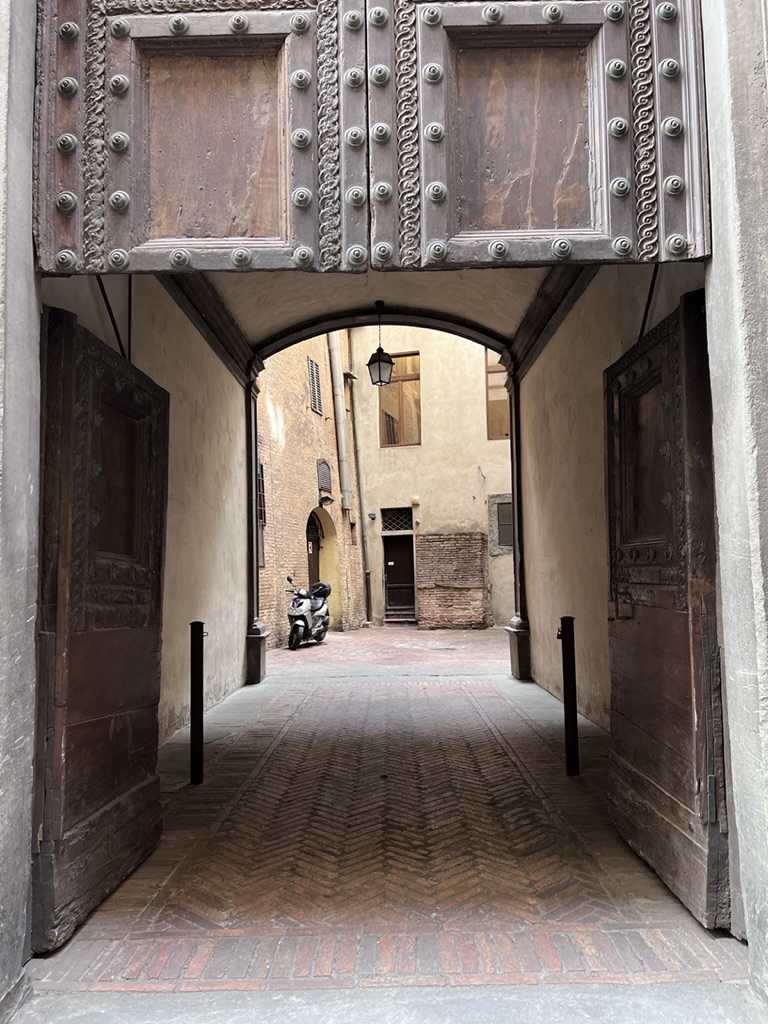
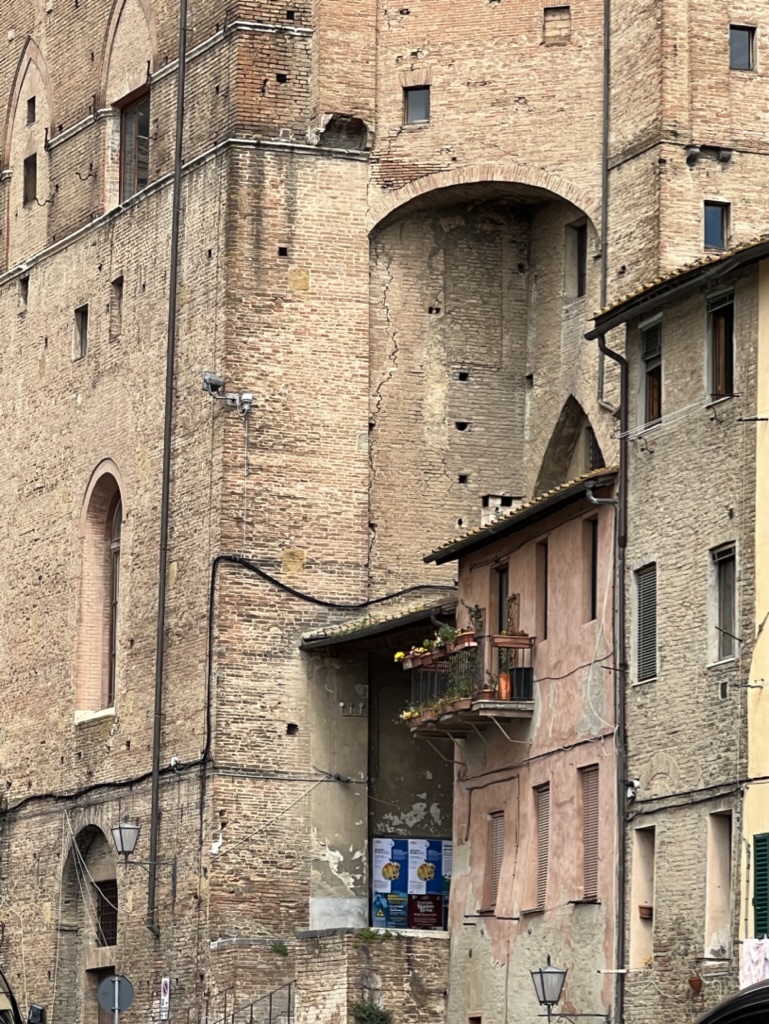
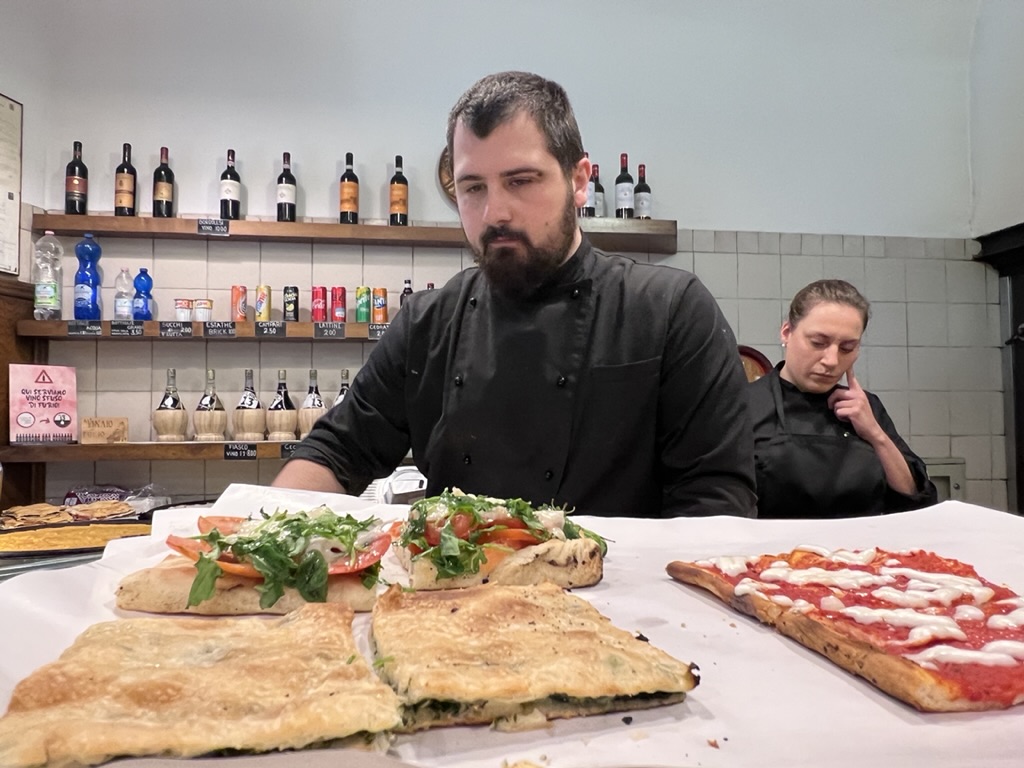
We then walked about a mile or so into a functioning neighborhood where people shop at small stores; where laundry hangs out windows; where people are walking and eating paninis; and where there are laundromats and little food shops. We strolled and strolled and eventually stopped at a little pizza place where we sat at a counter, ordered three different kinds of very large pizza slices that we shared and two glasses of local wine (the pours were huge—probably 8 ounces each). Our bill for all of this was about $12.00. We laughed at the amount of wine since last night at Campo Cedro we got about 4 ounces at most in a glass (thus requiring many glasses). We then stumbled upon the city’s old synagogue and went inside. It was quite a contrast to the Duomo where every inch of space is covered with frescoes and bas reliefs and decoration of some sort. The synagogue, like all synagogues, was devoid of imagery and decoration. We saw the main sanctuary and the “women’s section.” And then we continued our walk—enjoying Sienna in the sunshine. (Yes, the sun shined today, which was wonderful, although it is still cold.
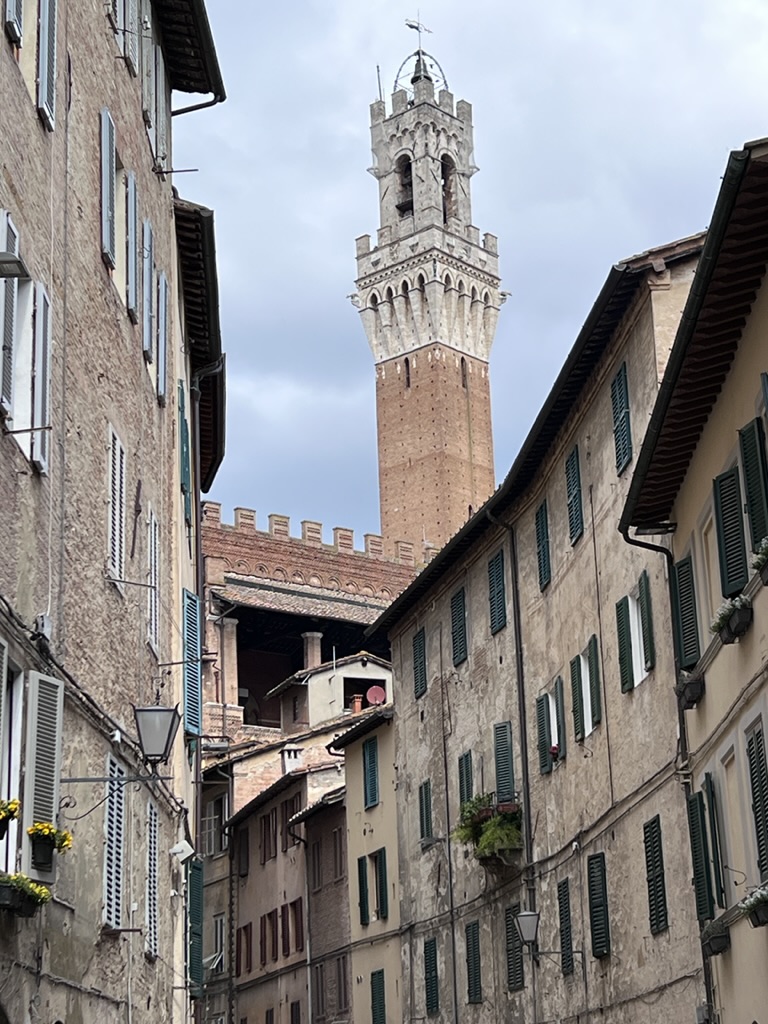
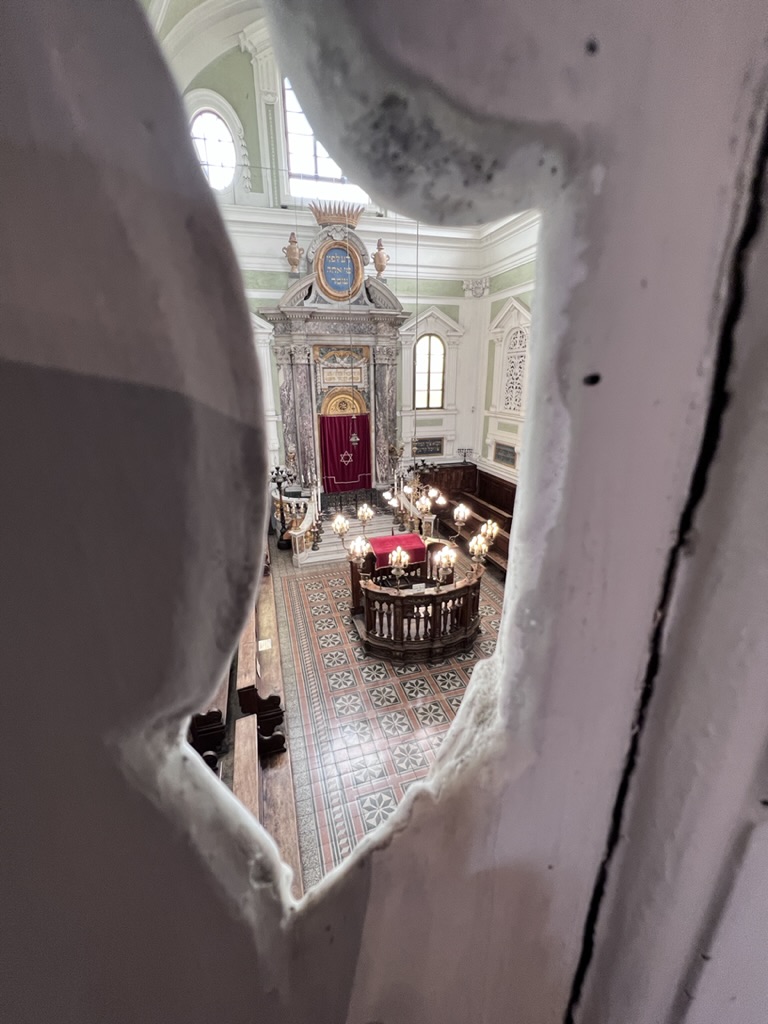
Apparently, there was a sizeable Jewish community in Siena as early as the 14th Century. In 1571 Jews were restricted to a particular neighborhood -– the ghetto—-and so the synagogue was built in that area. It wasn’t until 1860 that Jews were able to move out of that area. Interesting to note, Jews were not allowed to build houses of worship that could be identified at street level. Thus, the façade is very plain and looks like a residential building. The sanctuary is sort of neoclassical and there is a baroque ceiling. The women’s section on the second floor overlooks the main sanctuary but is only seen through an elaborately carved wood screen (painted white). At the entry level of the synagogue there was a small exhibit of photographs of Jewish families with their husbands and sons who fought for Italy during World War I and who fought with the Partisans against Mussolini and the Fascists; many died in both wars.
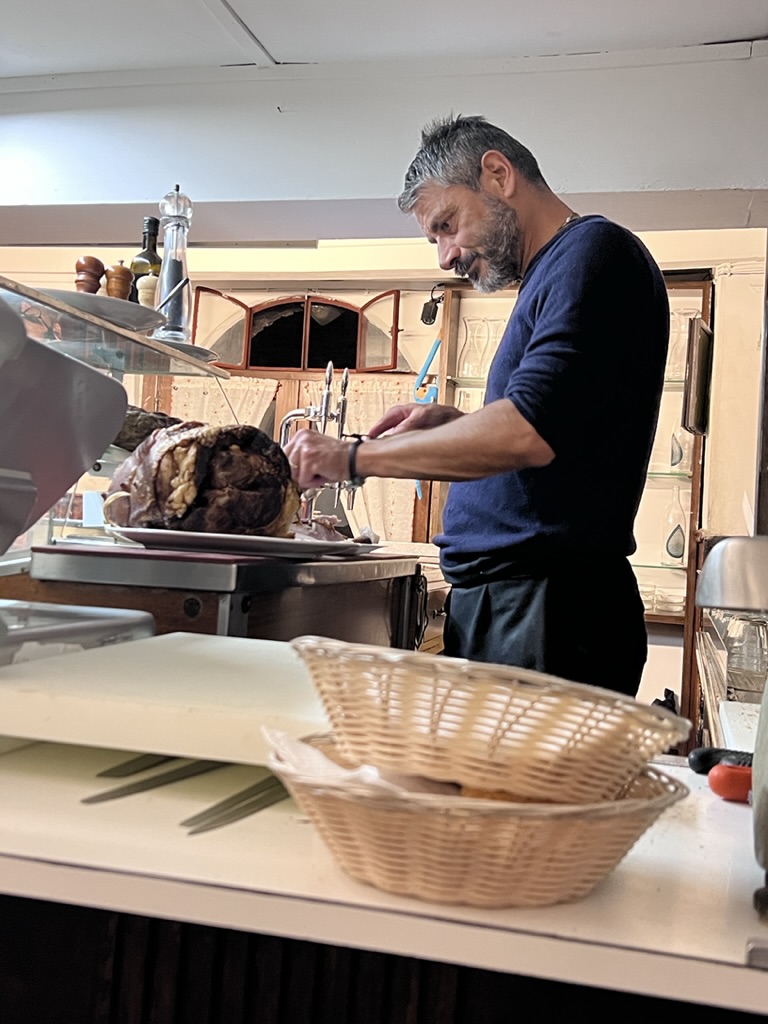
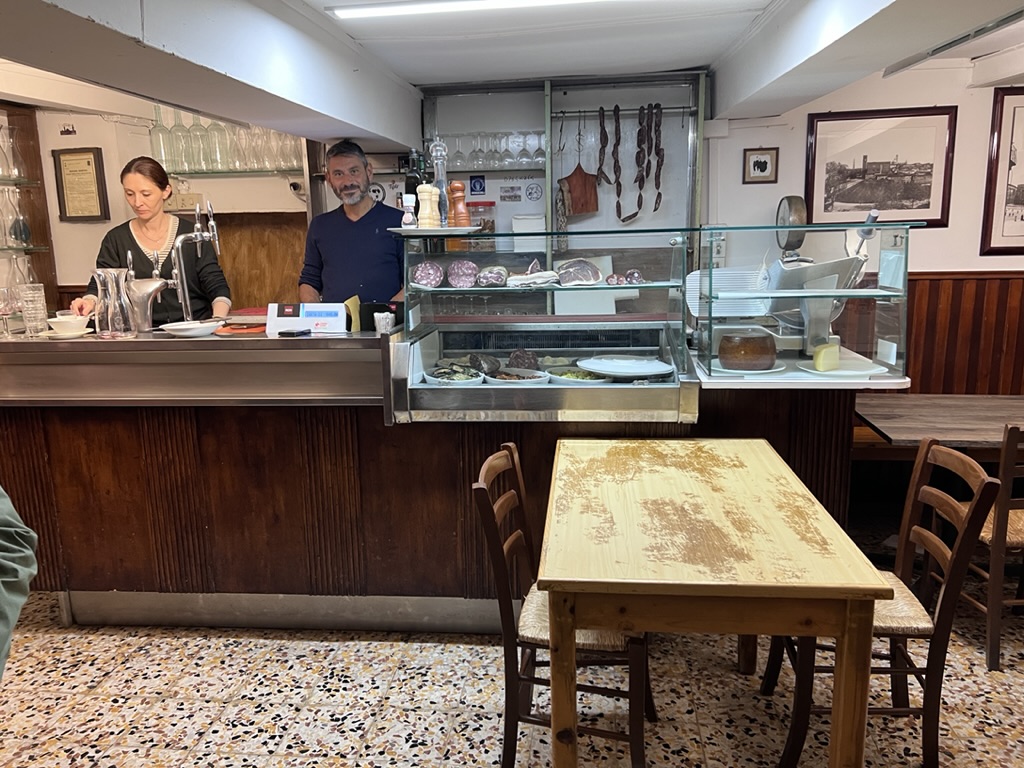
Then we took a long route back to the hotel and Mike decided to relax while I strolled for another hour or so, clocking in at 14,000 steps and six floors. Tonight, we ate at a tiny hole-in-the-wall place called Osteria il Grattacielo, where the owner (?)/chef prepares whatever he feels like cooking that day and that’s that. No menu. There are only about 5 tables inside and two tables outside. It’s on a somewhat hidden street under stone arches. The “chef” prepares an antipasti platter, three different kinds of pastas but the sauce is the same only the pasta shapes differ, and one main course, and biscotti and vin santo for dessert. He’s behind the counter all the time, but the restaurant is so small that he tells you what he’s offering and takes your order as well as prepares the food. There is a waitress—his wife– who delivers the food and clears the tables.

Tonight’s pastas had a pesto sauce with fresh tomatoes—I had it with linguini and Mike had it with a fat spaghetti. The main course tonight was pork (very tender, thin slices, room temperature, served with a sort of ratatouille. When we arrived, we were the only diners at 8:15, but by 8:45 all tables were filled and there was one group eating outside. Like eating at your uncle’s house if your uncle could cook.


We left, full and content.
Tomorrow, we head to Bologna, with a stop in Abbazia di San Galgano, which is a little out of the way and we’ll need to circle back a bit… more about that tomorrow.
Best –
Fern
6. Todi to Siena via Perugia. April 16, 2023
Buona Serra – April 16, 2023
Greetings –
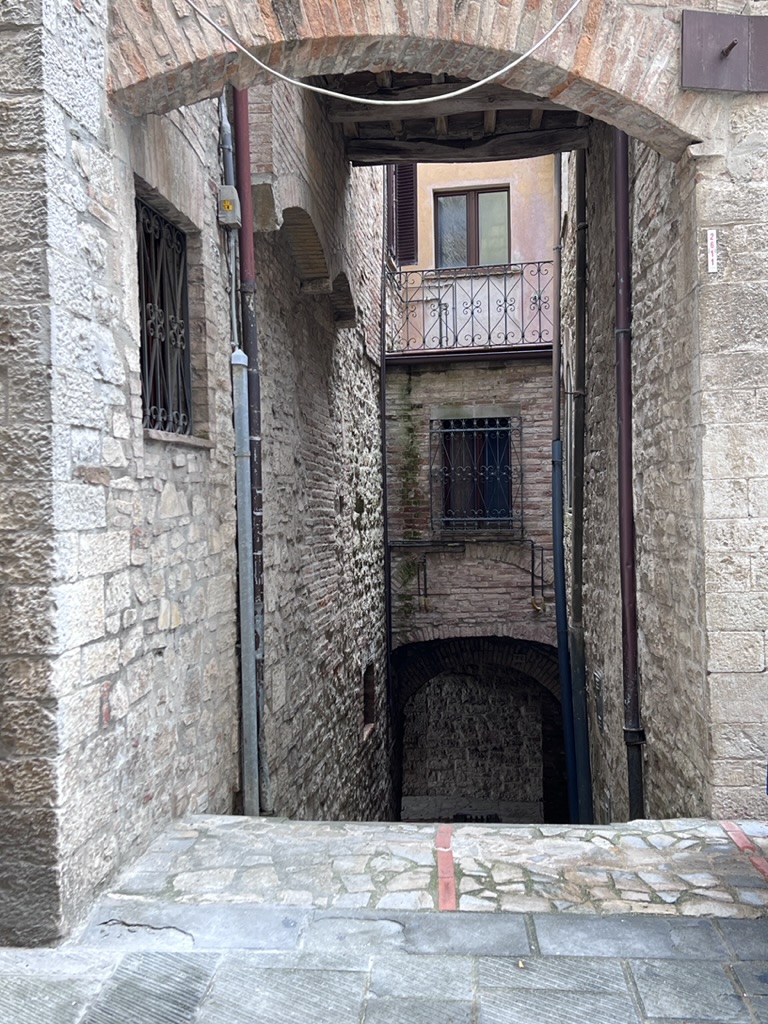
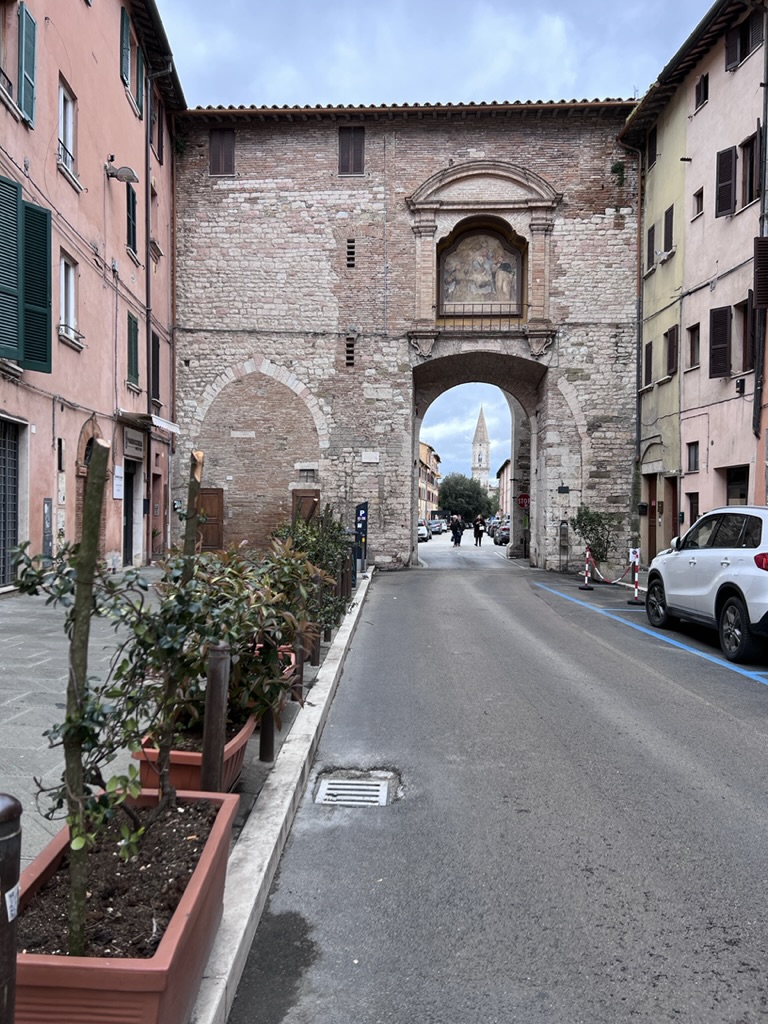
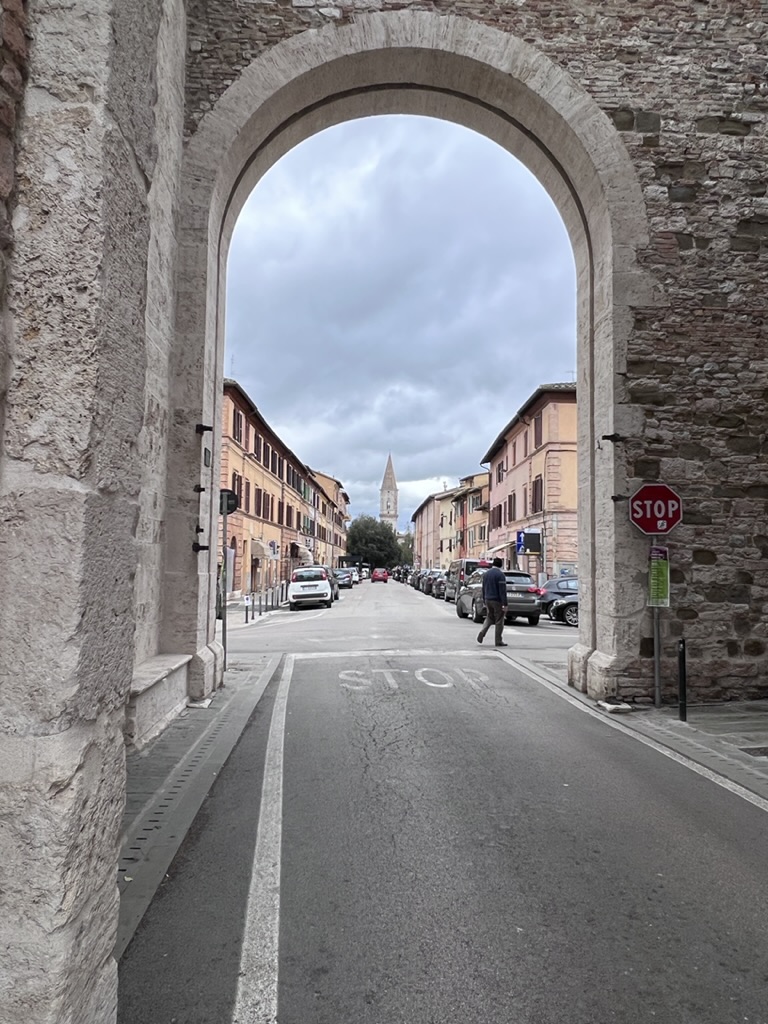
Arrived in Siena in the late afternoon, having left Todi mid-morning and making a very quick stop at the Food Coop in town to get some yogurt to eat on the road (breakfast). It was Sunday and most everything was closed. After so many rich and caloric meals, it actually seemed great to just have yogurt while sitting in the car in the Coop parking lot. And after 10 minutes we were off to Siena via Perugia. Perugia is the capital of Umbria and boasts a population of about 170,000. The drive was a big success—managing to avoid collisions, scratches, and other potential disasters given the fact that we drove half the time on streets so narrow the car could barely get through and on the autostrada where most cars are driving at about 50% above the speed limits.
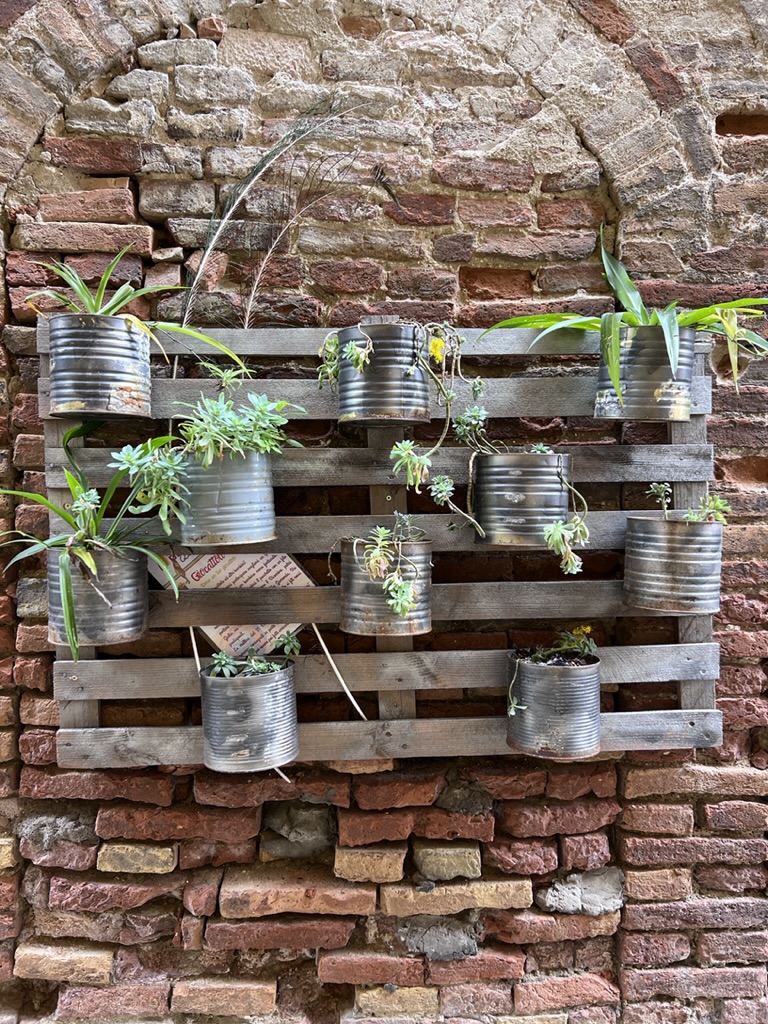
We parked car in the public garage in Perugia and then walked for several hours checking out the town, which has many not-very-interesting buildings from the 1800s or so. With 8 times as many people as Todi, you can sense the fact that it is simultaneously a university town, a government center, and an industrial center of the region. We passed ceramics factories and chocolate factories. It is the largest city in the Umbria region and with its old town and gothic main square, it’s known as a center for chocolate and other delicacies. We strolled and saw several large churches, but all were closed even though it was Sunday and the city was quiet. This was intended to be a brief stop and a chance for lunch. Many restaurants were closed, but we lucked out in that L’Oficina was open and we had a very elegant destination meal. L’Oficina serves really creative, artistically plated dishes—all of which have a lot of ingredients that I cannot possibly remember.
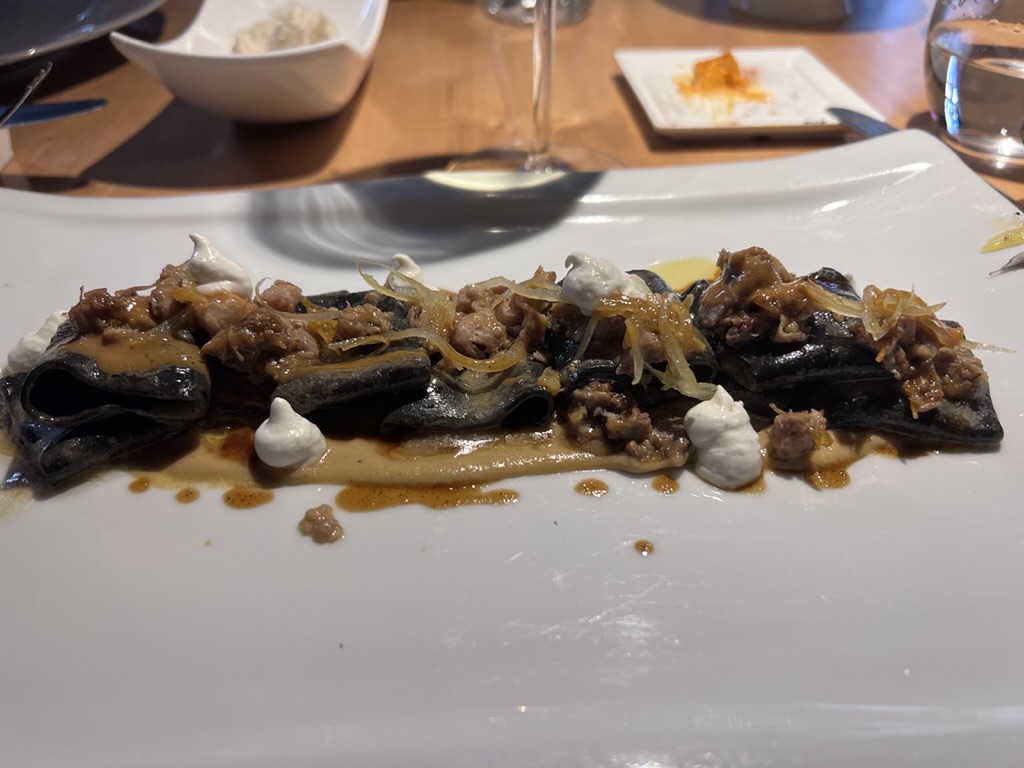
Not wanting to eat a lot, we opted to share three different dishes—each of which were wonderful and thankfully, very small. Before we could even order, they came out with three exquisite tiny plates of different amuse bouche… I think that one was some kind of mushroom dish with potato foam. We also had a squid dish that was prepared in some kind of vinegar—very very yummy. There was also a pate of squab that had foam made from beans and a strawberry reduction. Despite the small size plates (actually large plates with small amounts of food), we were totally full at the end, probably because of the high caloric count. If you are headed to Perugia, put this place on the list—probably for dinner when you have more time to linger. The place was tiny, or so we thought. We ate in the front room with just 9 tables, but when I went to the ladies room upstairs there were two other much larger rooms as well as the one we were in. By the way, we walked past (and actually into the entry way) of a shooting school and range that has been in operation for about 200 years. It was quite interesting as the translated version of their materials explained the organization’s commitment to gun safety and to shooting/guns as a sport and not as weapons; guns are left at the range and only used for either sport or gaining accuracy or for hunting. The range is a teaching location and all members go through lots of training and constant renewal training.


Then we strolled back to the garage and we were off to Siena. Haven’t been to Siena in about 20 years (realizing now that all of our far more exotic travel has limited the amount of travel we’ve done in recent years to in Europe). The drive to Siena was fine, although Mike who is doing most of the driving was totally stressed out with cars speeding past at speeds well beyond the limit and a good deal of construction on the road, making the already narrow lanes even more narrow and eliminating lanes for much of the drive. When we got close to our hotel (Palazzetto Rosso), the GPS got a bit confused or perhaps the navigator (me) was confused so we wound up circling the medieval center at least twice before finding our way. Actually, we needed to go through an arch into the center, but there was a car blocking the very narrow entrance so we thought it was a restricted road and missed the turn. Anyway, we found our way to the hotel through streets where we were glad the car didn’t scrape the walls on either side. Dropped off our bags and went back outside the city walls to park the car… and take a series of six escalators back up to the center and almost to the hotel door.

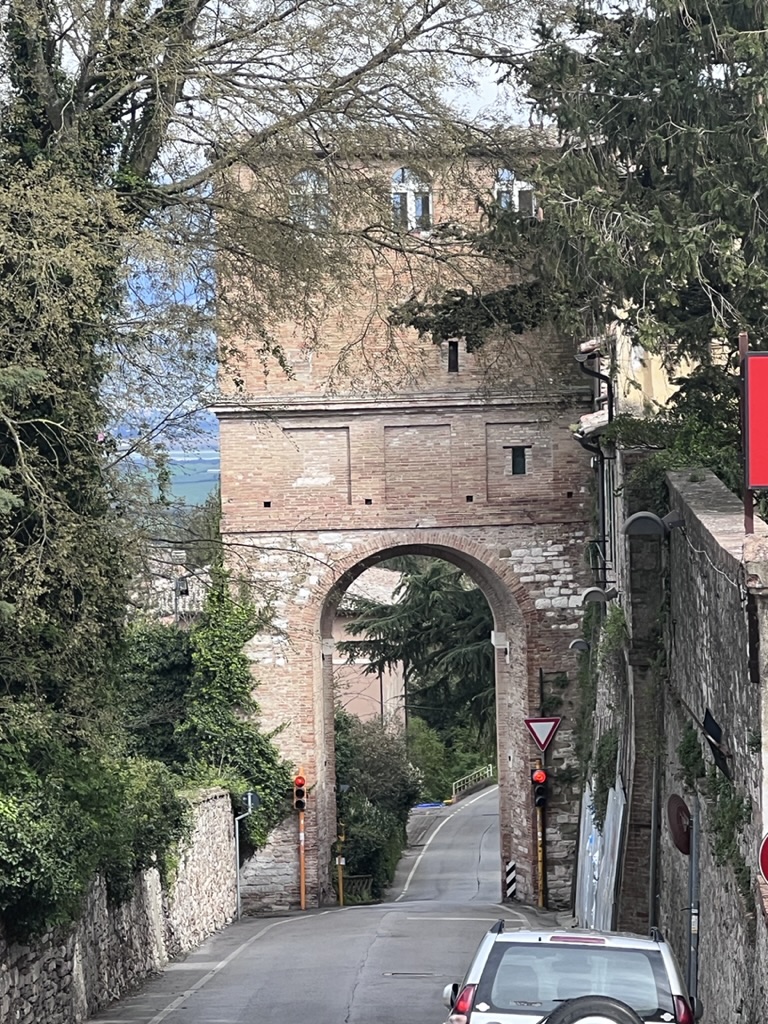


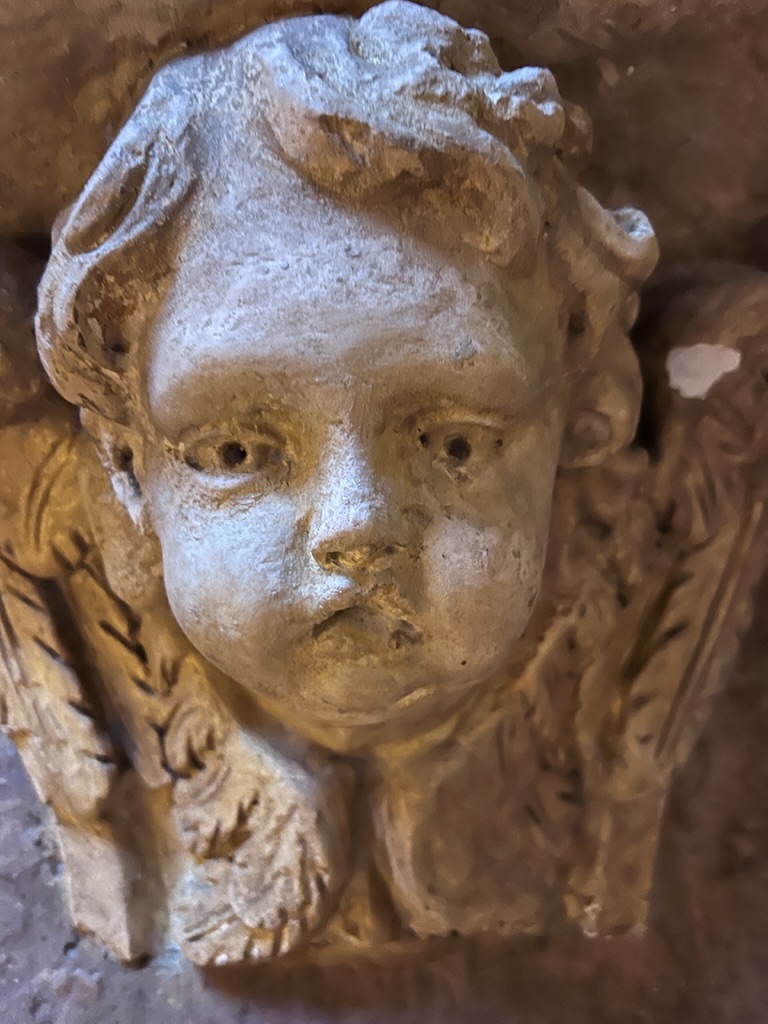
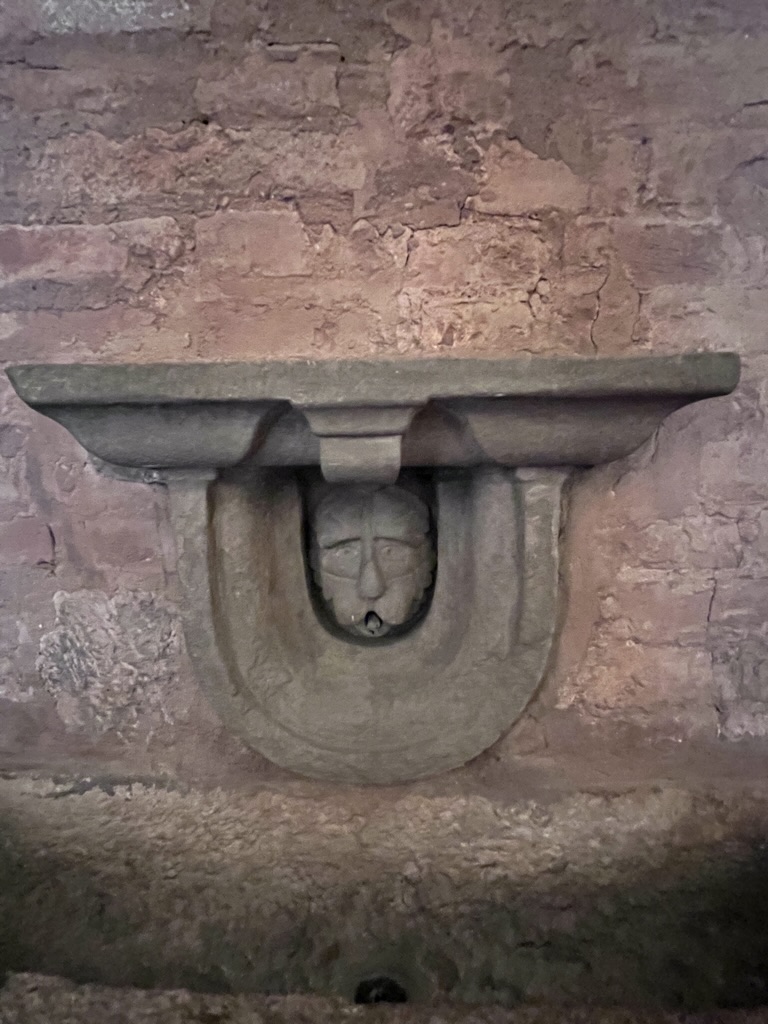
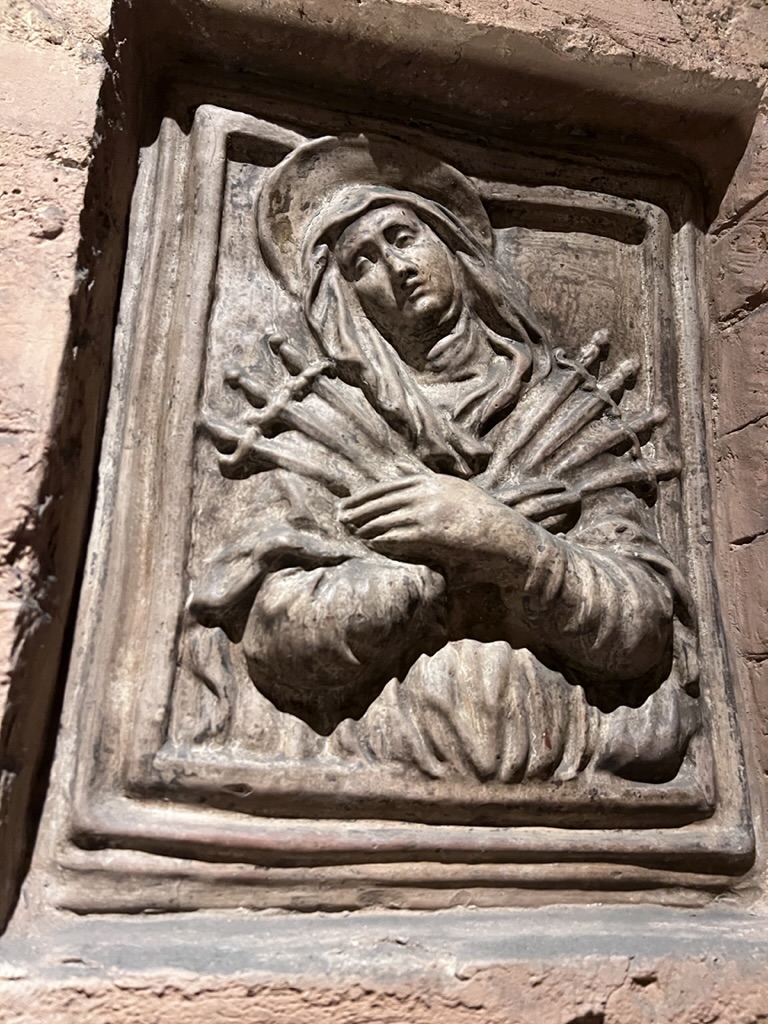
Palazzetto Rosso is located in the heart of the medieval center.. and has apparently hosted travelers since the Middle Ages, when traders from all over the world came to the Tuscany area to find work. The building is from the 13th century and retains the original facade (albeit very updated) complete with wrought iron signs. But, if those 13th century traders who stayed here could return, they’d be in shock. The hotel is a high design, elegant, tasteful, modern, and minimal statement. It has just nine rooms. We are on the top floor (third floor); the room is large including a sitting alcove and is furnished minimally with a glass desk, hip colors for accents (lime green and purple). There are Pedrali chairs and much of the furniture is by known high-end Italian designers. Given that we are on the top floor we have sloping beamed ceilings. But the architecture and shell of the building retain the old style with extremely high vaulted ceilings, frescoes, and arches. The floors are gray tiles and there are some pretty mod benches and light fixtures. It’s a good mix of the traditional Tuscan with modern design. Every room is different, we are told, and all contain some quirky combination of old and new… like painted friezes, beamed ceilings, Venetian drapes right next to modern design pieces. And we even have a large flat screen TV, so now—for better or worse— we can catch up on what’s been happening on the political scene. (or perhaps not). While we have a very modern bathroom, we were told that some rooms have sinks made from ancient fountains. We also have a glass wall between the shower and the bedroom so that you can see the view while taking a shower.
The location is quite central and so we can stroll and stroll and come back if necessary to refresh.
We had made reservations for dinner at Campo Cerdo; can’t remember where we got the reference. It’s only about 500 meters from the hotel and the walk there was easy—all downhill. As we happily strode to the restaurant at about 9 pm, we almost forgot that this easy stroll would mean a rigorous uphill hike on the return trip. Campo Cedro (translates to Cedar Field) was a big surprise… in a good way. It’s hidden away from any major or even minor street and indeed GPS had a hard time finding it exactly and led us astray a bit. The restaurant is led by a Japanese chef who has been cooking in Italy for more than twenty years. Like the hotel, the restaurant is in a centuries-old building, but the inside is very modern, stark- white with wood finishings. The food was wonderful— very fresh with interesting combinations. Michelin says it’s “one of the most interesting gastronomic stops in Siena.” For the foodies, I wrote down what we ate, except for the tiny starters (which like the ones at L’Oficina) were too hard to remember and they were not listed on the menu. We shared one antipasti, one primi, and one segundi, and one dessert…
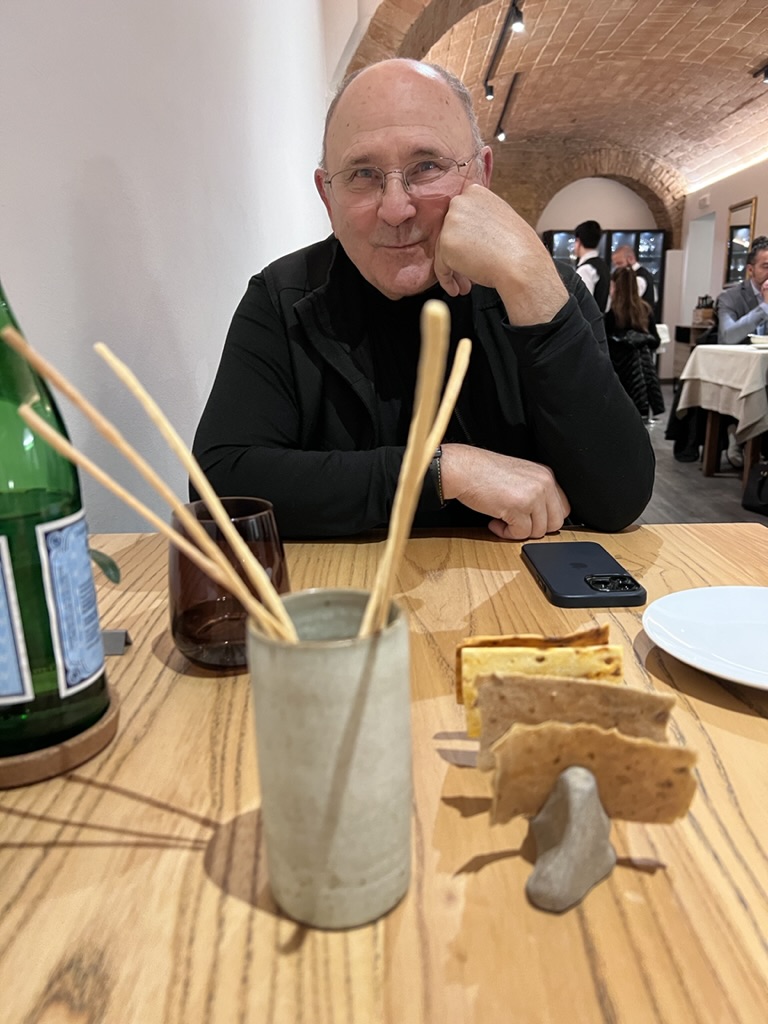
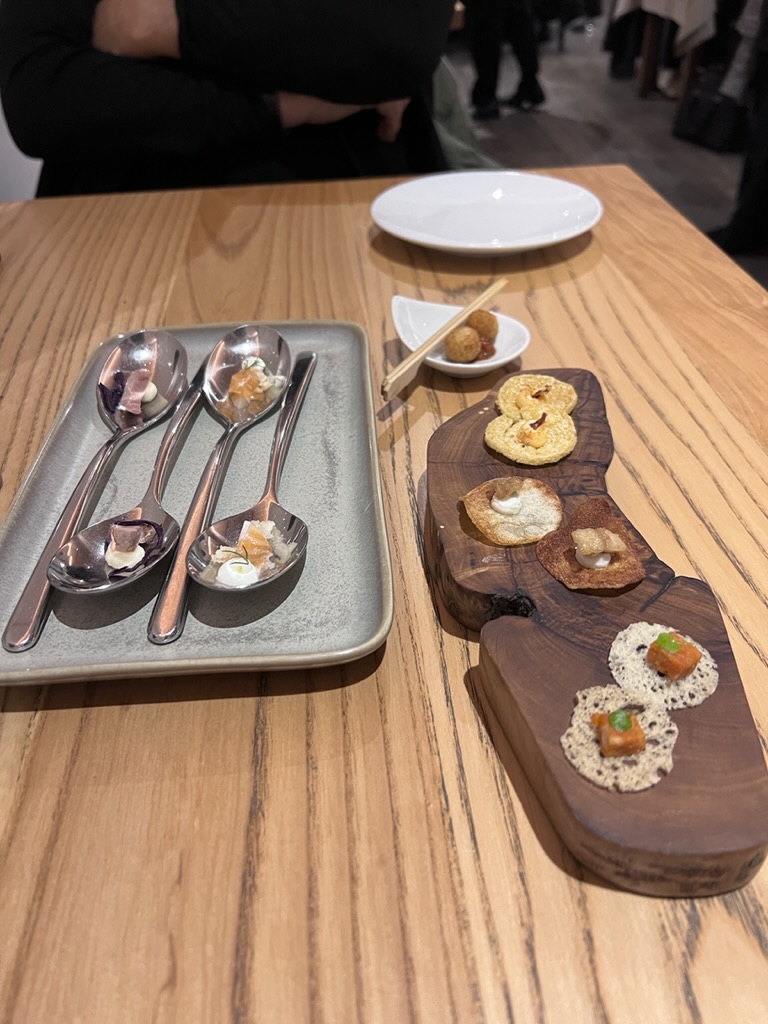
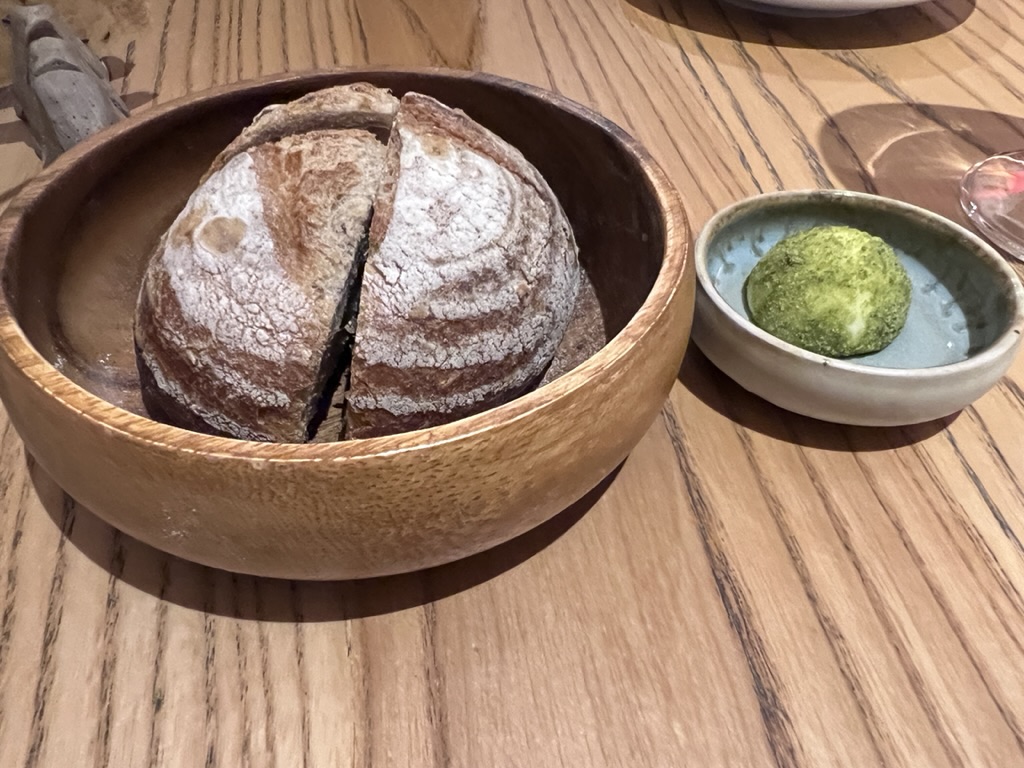
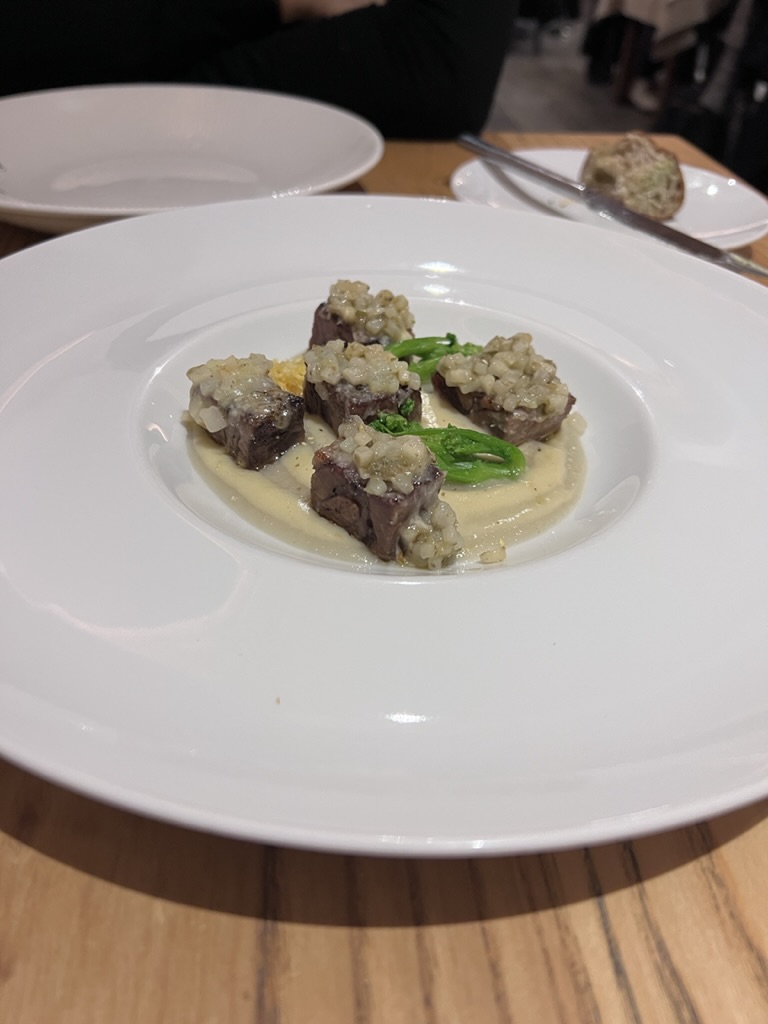
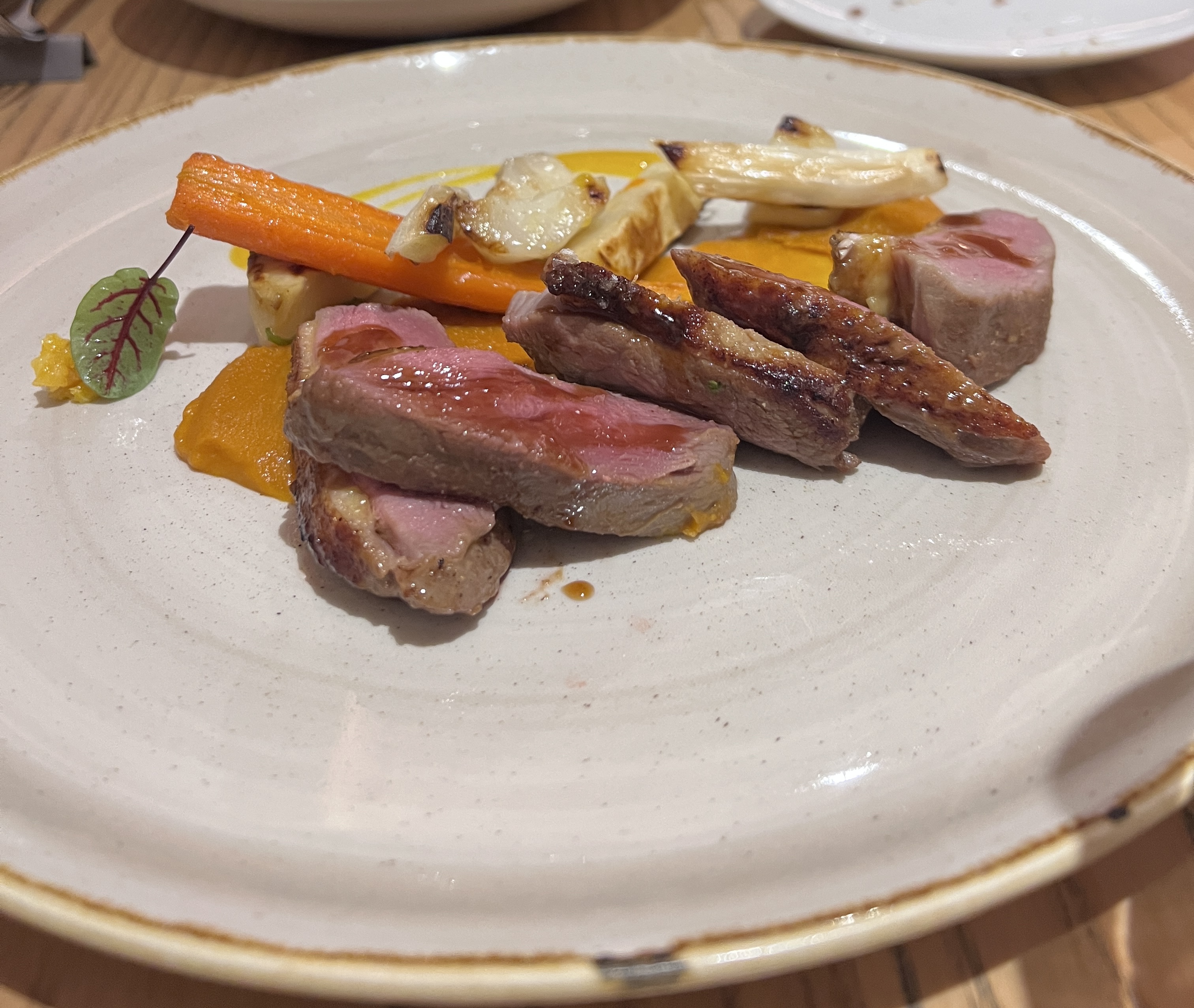
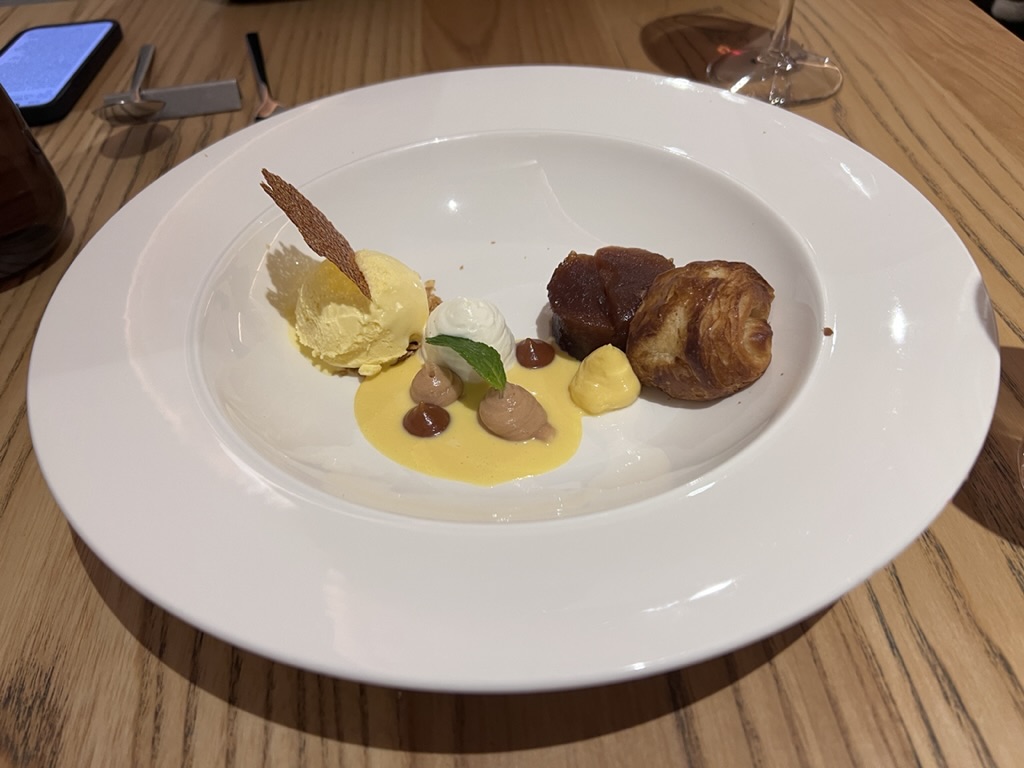
First we had veal tongue which had some kind of cheese and it was all sitting on Jerusalem artichoke cream and garlic. Then we had risotto with eel and chives (fantastic), and then we had a miso duck breast with orange and “tubers.” We’ve gotten pretty good at picking local wines which we are loving. For dessert we had a tarte tatin which was “deconstructed” with saffron ice cream. Everything was great and we are getting very spoiled. Campo Cedro is recommended by Michelin although it does not have a star… probably just waiting for one (it’s only 4-years-old). And for those interested, our four course meal plus the little starters, amazing bread and homemade bread sticks, 5 glasses of wine (should have done a bottle but started out thinking we would go easy on wine) and sparkling water… was under $100. Siena is a bit pricier than Todi, but still so much less than the Bay Area.
So we began our day in the 600-year-old palazzo in Todi where it’s all traditional on the inside and outside, and ended in Siena where we are sitting in this very mod hip room. Amazing what can transpire in 24 hours.
Best
Fern
5. Todi to Orvieto to Bomarzo to Todi


Greetings from Todi… April 15 – Tax day?
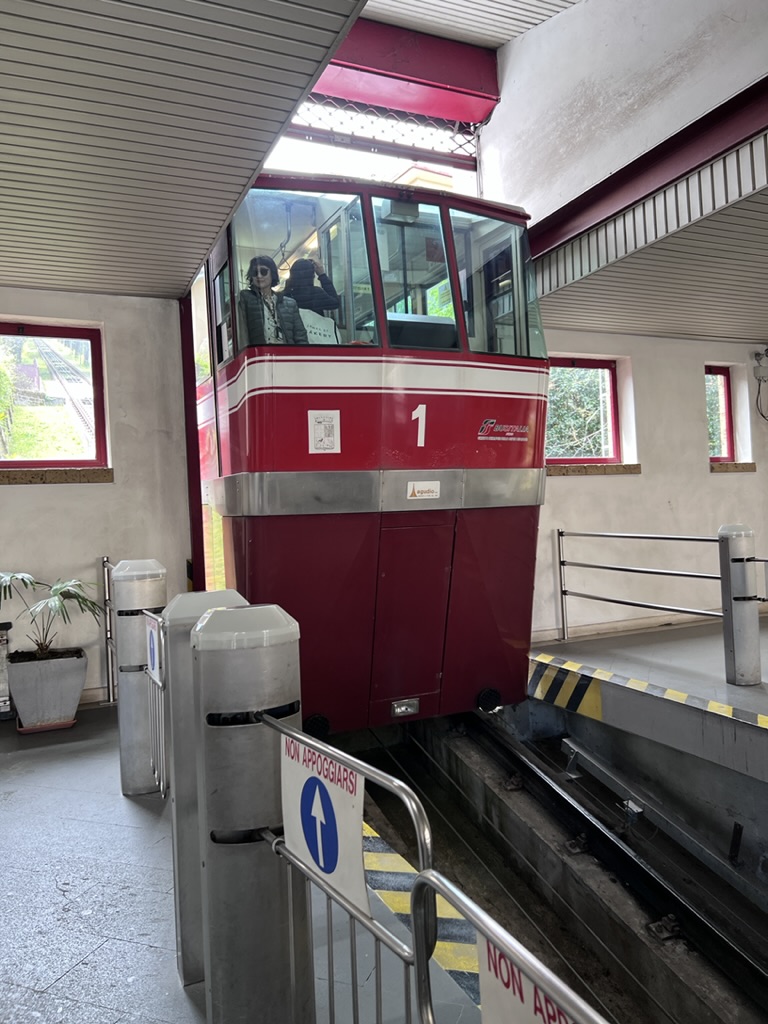
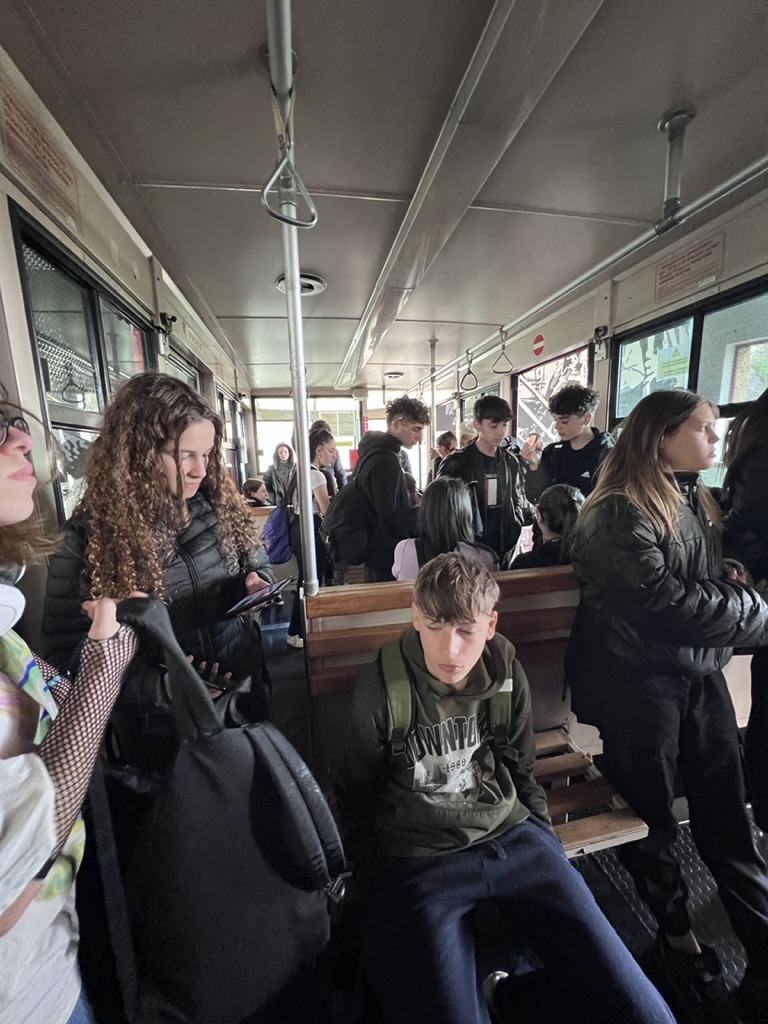
After a quick yogurt and another stroll around Todi, we headed to Orvieto, supposedly to see the famous Pozzo di San Patrizio (a historic well and a UNESCO Heritage Site) – St. Patrick’s Well… and of course to stroll around Orvieto. It’s been many years since we’ve been to this part of Italy so some stops bring back memories and others are totally new. We arrived in Orvieto about 45-minute s after leaving Todi–through lush landscape, through dozens of tunnels that cut through the mountains, and wonderful views of the river— and we parked in the public lot. We had been told to follow the signs to the train station to find parking, which we thought we did, and then we were supposed to take the funicular to the base of the town. All went well—parked, got our tickets for the funicular and also for the “well”.. and got on the funicular, without paying much attention to signs. Actually, the funicular was about to leave so we just hopped on. Then we began to descend, when we were supposed to ascend. We realized that we had actually found parking at the base of the town and the funicular was going lower – to the train station, where we thought we were going to park. So, we descended to the station and then got the next funicular going back to where we started..
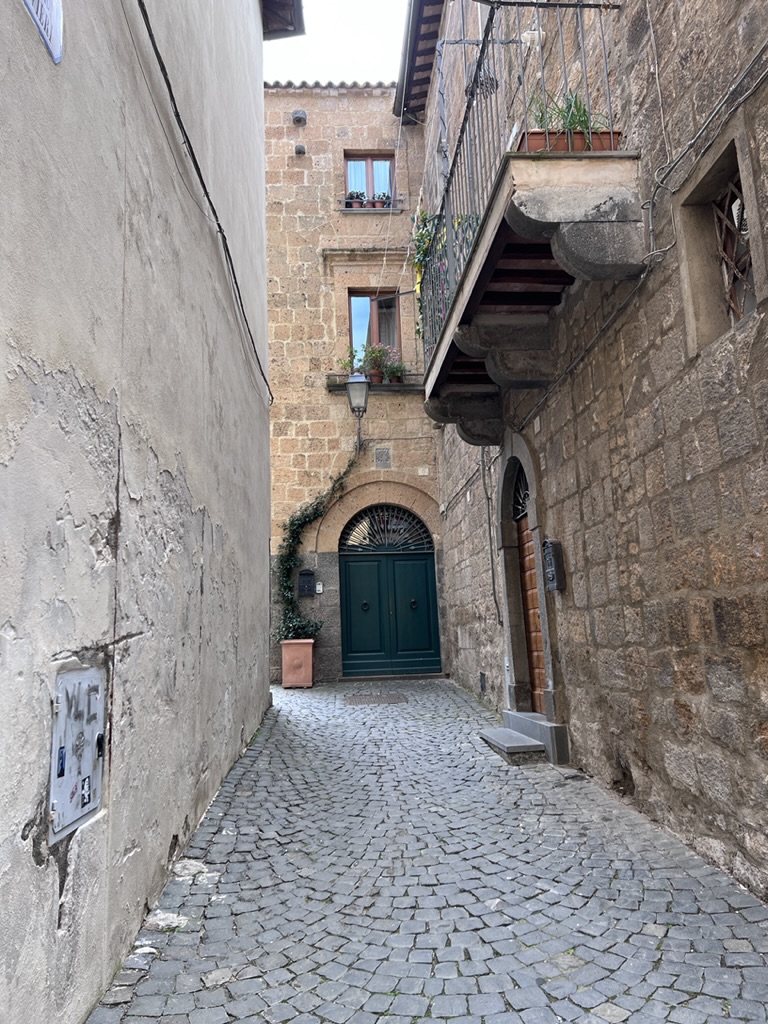
Then we walked through the town – Orvietto is lovely, a little larger than Todi but not as elegant, and not as steep a climb—the latter point being a positive. We had heard about a restaurant called Trattoria Palombo so we made our way there. The place was totally booked, but I went inside and used a little charm (I can do that) and a little NY moxie (I can do that too) and got us a table for 15 minutes later. We strolled a bit more and then went in to eat.. Shared a great lunch with antipasti, pasta arrabiata, and veal scallopini with lemon (lots of lemon!!).. had wine, but no dessert (exhibiting so much will power!). Then we had a mission—to find a jacket for Mike, preferably something waterproof. Somehow, he left his jacket at our house in Oakland and it’s really been cold and damp here. Mission accomplished. And although he thinks the greenish gray color is beyond his usual palette of black and navy and tan, I think it is perfect and the color is very chic.

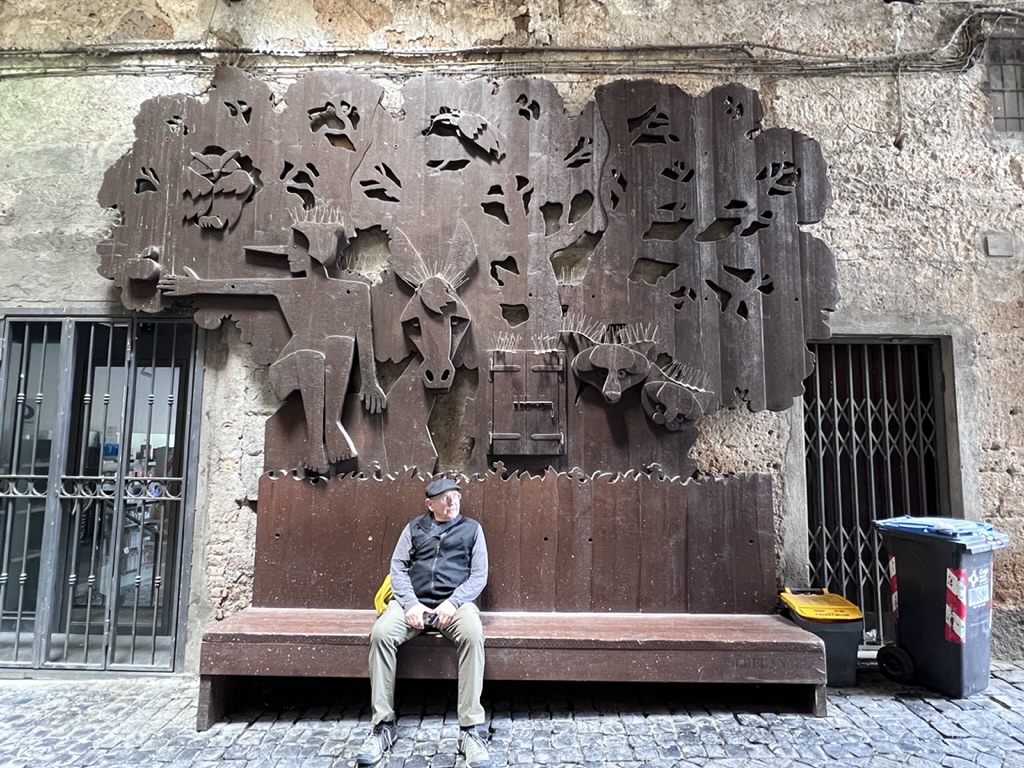
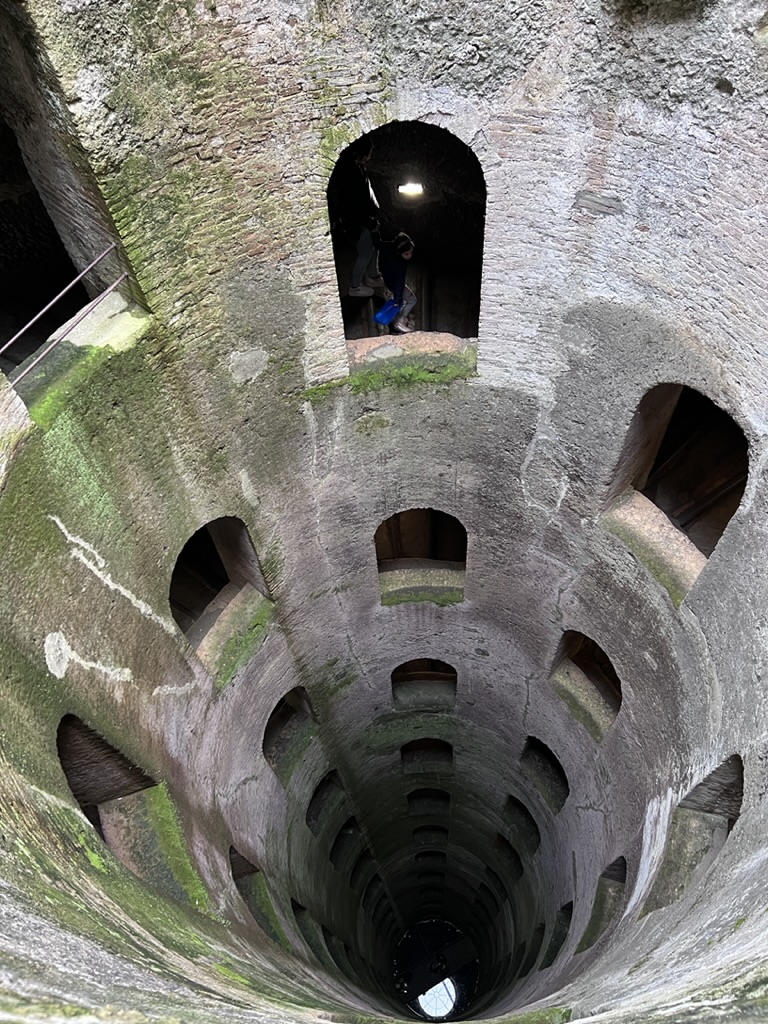
Then we went to St Patrick’s Well… The Pozzo di San Patrizio … a historic well designed and built between 1527 and 1537, by the architect/engineer Antonio da Sangallo the Younger of Florence, at the behest of the Pope at that time who had taken refuge at Orvieto during what is known as “the sack of Rome.” It was feared that the city’s water supply would be insufficient in the event of a siege. The name came from medieval legends that proclaimed that St. Patrick’s Purgatory in Ireland gave access down to Purgatory and that was defined as something very very deep. The well shaft is designed with two ramps that are like a double helix, with only two doors – one leading to the down ramp and one the up side, which enabled mules to carry empty water containers down and full containers up without obstruction. The well is 175 ft. deep and 43 ft. wide. There is a large dome over the well that provides light. A Latin inscription says “QUOD NATURA MUNIMENTO INVIDERAT INDUSTRIA ADIECIT” which Google translates as “Industry added what nature envied to the fort.” Mike, with his high school Latin translates it to say “What nature has provided, industry has enhanced.” Anyway, we started to descend to the base of the well, but quickly decided to just go a few landings and turn around (even though technically we should have gone to the bottom and then up the other side as planned, since if you reverse your route, you cannot exit at the entrance… but we cleverly waited for someone to enter so we could sneak through the door. The steps were very uneven; it was dark; because of recent rain, the steps were slippery; and the steps were very uneven. We decided we got the sense of the well by looking down and across. It would have been exciting, I suppose, to do the 527 steps.. but not slipping or falling was also a good idea.

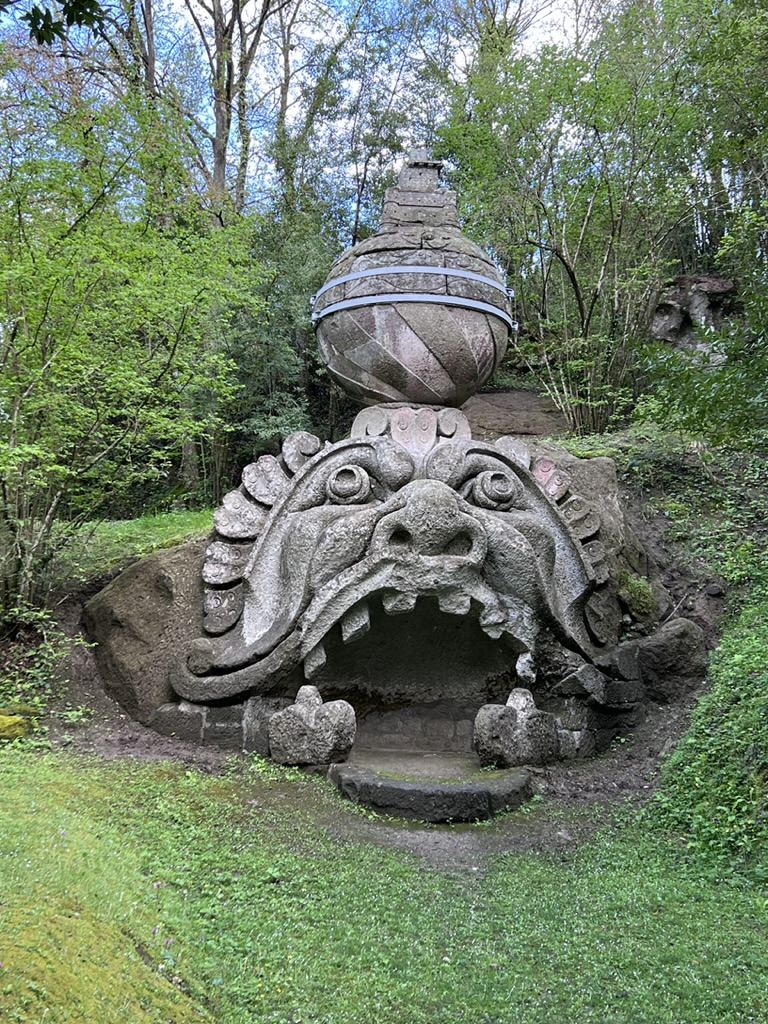
Then we headed to Bomarzo, the site of a very strange park—made even stranger by the cloud cover and slight damp ground. It’s called The Monsters’ Park of Bomarzo… with numerous larger-than-life sculptures.. and was created in the middle of the 16th Century by Vicino Orsini who had an estate on that site. He built a labyrinth of symbols where “Ladies and Knights could look to have their wishes fulfilled and wander until they got lost” (this comes from the brochure at the park). “He populated the ‘sacred wood’ with monsters and tortoises, obelisks, nymphs, and giant statues.” After his death, the place was abandoned, and no one cared for the structures—considered (again according to the catalogue) to be “jewels of mannerist art.” But after centuries of oblivion, the present owner–the Bettini family brought it back to life. According to Wikipedia, it was commissioned by Pier Francesco Orsini, called Vicino, a 16th-century patron of the arts, greatly devoted to his wife Giulia Farnese (not to be confused with her maternal great-aunt also named Giulia Farnese, the mistress of Pope Alexander VI). When Orsini’s wife died, he created the gardens to cope with his grief. During the 19th century, and deep into the 20th, the garden became overgrown and neglected, but after Salvador Dalí made a short movie about the park and completed a painting based on the park in the 1950s, the Bettini family implemented a plan to restore the park; the restoration project lasted throughout the 1970s.”
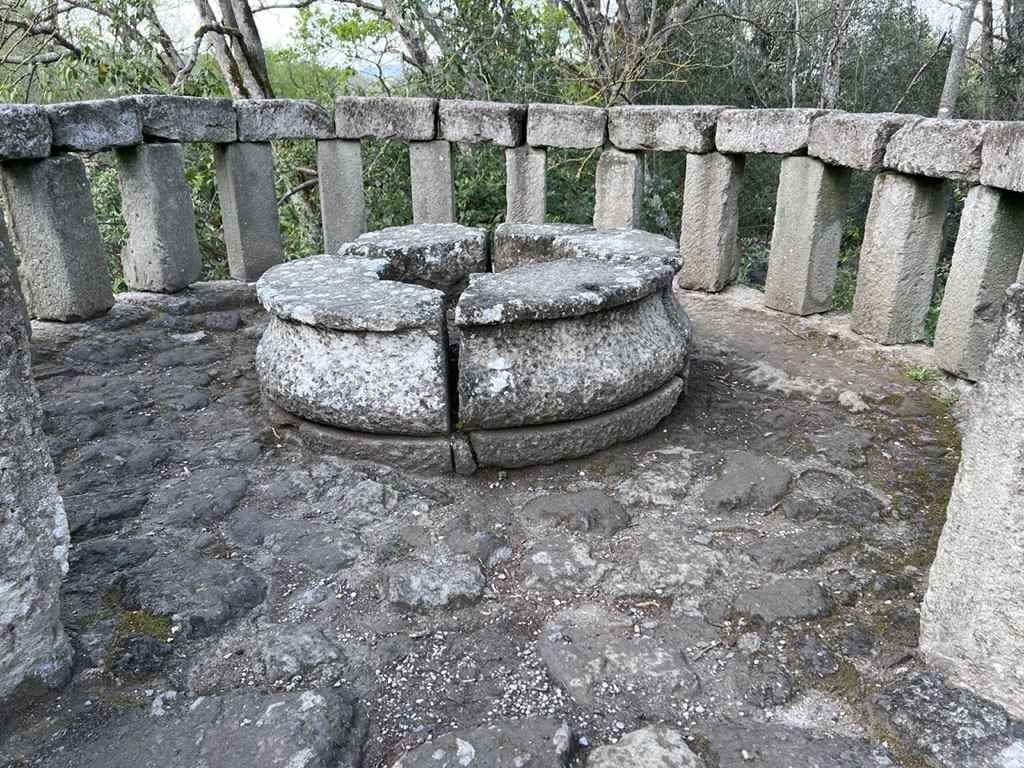
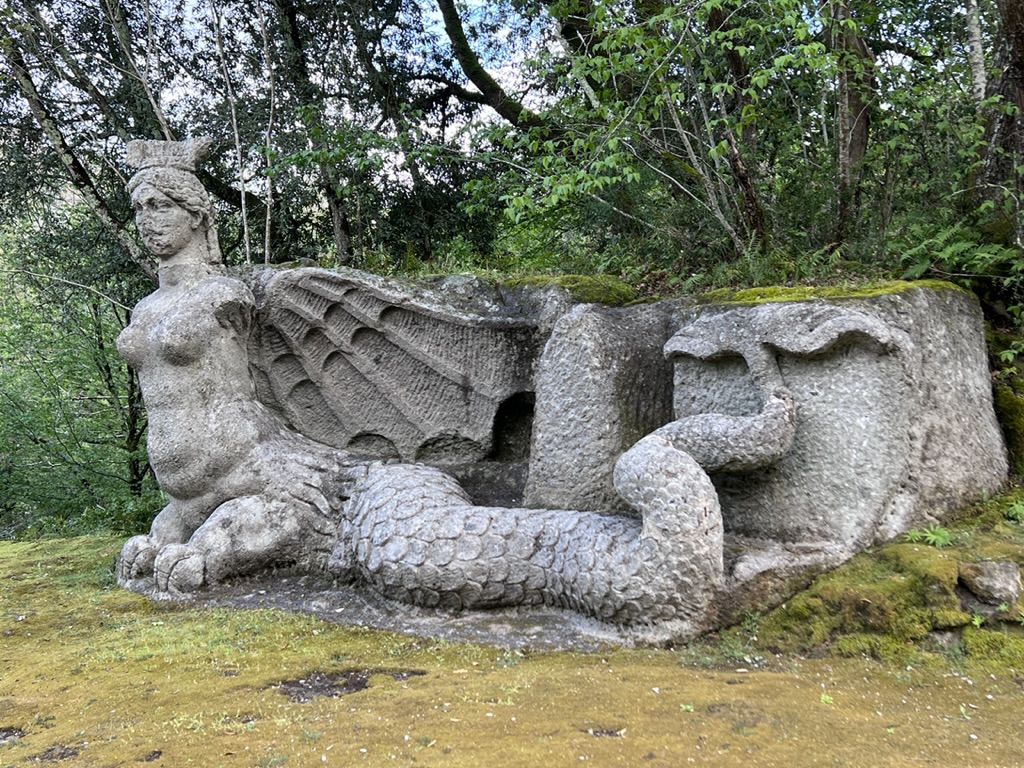
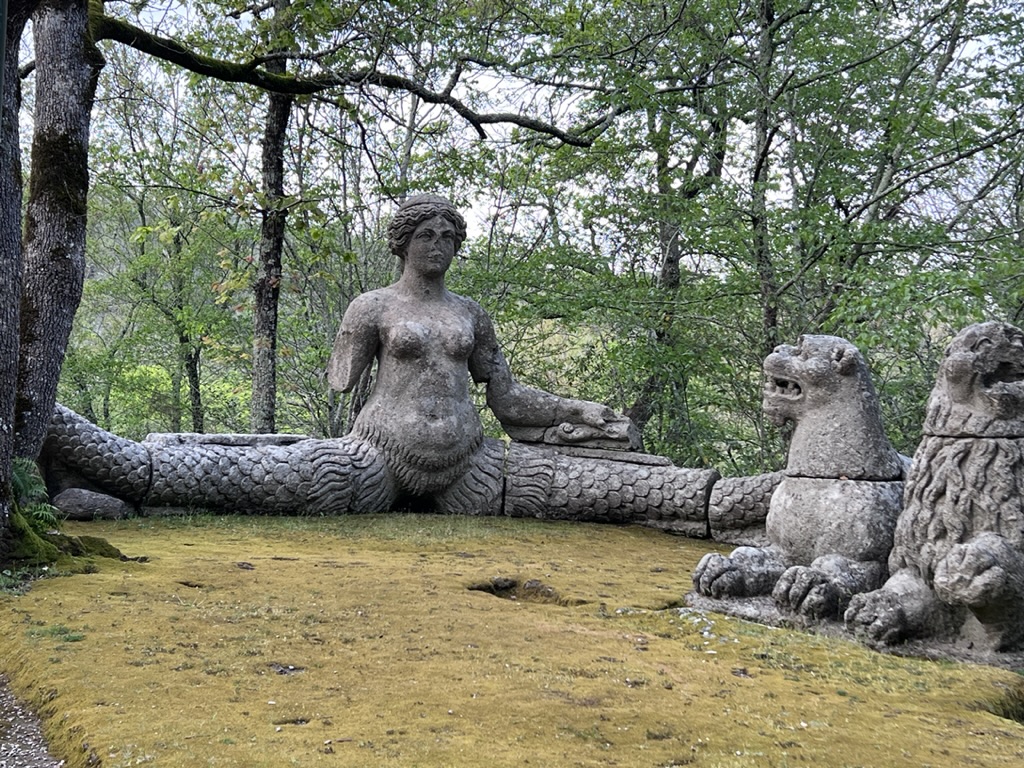
We strolled the Garden which is quite a site… and then as it began to rain we headed back to Todi for dinner.
We decided to save time and head back to Cavour which is a quick walk up to the square and off a small alley (close but steep). By the way, we’re averaging well over 12,000 steps and 8 flights a day which does not account for the steep pathways. (But alas, I think we are adding pounds rather than losing, given the amazing meals). We had had lunch at Cavour the first day we were in Todi, and the food was good; it was comfortable and not fussy. They were pretty crowded (unlike the lunch the other day) and we finally got a table in the downstairs stone-walled room, as opposed to the light-filled upper room with great views. As it turned out, there was a table of about 14, including 4 couples and their combined six children—all appearing to be under the age of 6. They were there before us and outlasted us, when we left at close to midnight. So, we watched family life in Italy up close. Not to generalize, but…. The four men (all in their early 40s I’d guess) sat together at one end of the table conversing about who knows what (soccer?) oblivious to the rest of their table which was comprised of their wives/partners and their children. The women, the moms, were totally occupied with the kids who were very very loud and running around the restaurant. The moms barely ate as they tried to make some kind of order (without success), but the dads continued their conversation, eating, drinking, laughing, eating, so casually that you would think they were a separate party from the rest of their group. Indeed, the men had about two chairs that separated them from the women and the kids. We thought we might have some peace by the time we got our dessert but no such luck as the men (the dads) lingered over coffees, desserts, and after dinner drinks… while the women and the children were at the other end of the table, ready to leave with jackets already on. Not generalizing, but maybe the macho culture really still does exist –even among the 40-something group…. In Italy?? Oh the meal… food was fine, but could not compensate for the chaos… oh.. what did we eat: a very nice steak tartare with sprinkling of pistachio dust and good spices, leg of lamb with roman artichoke…
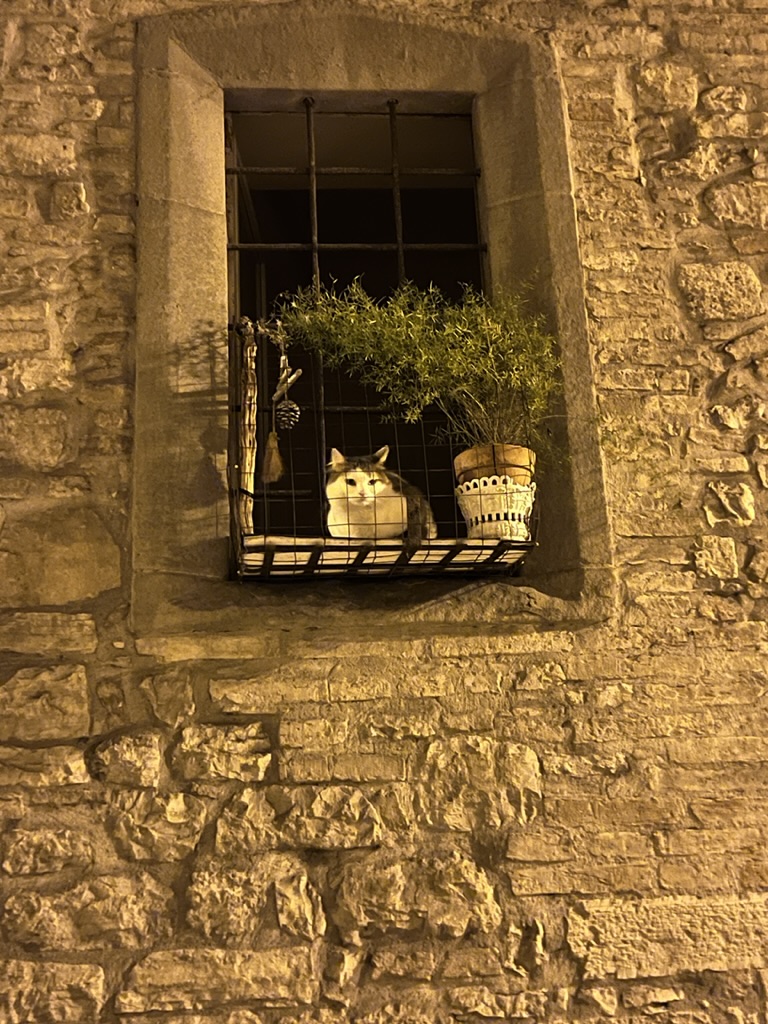
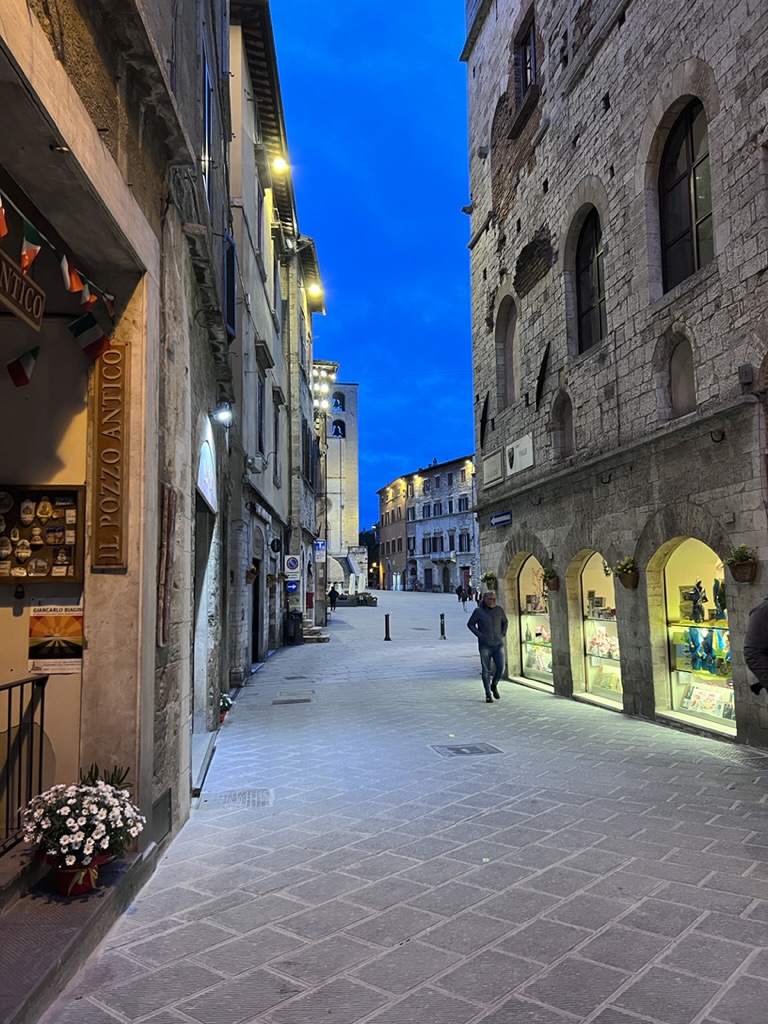
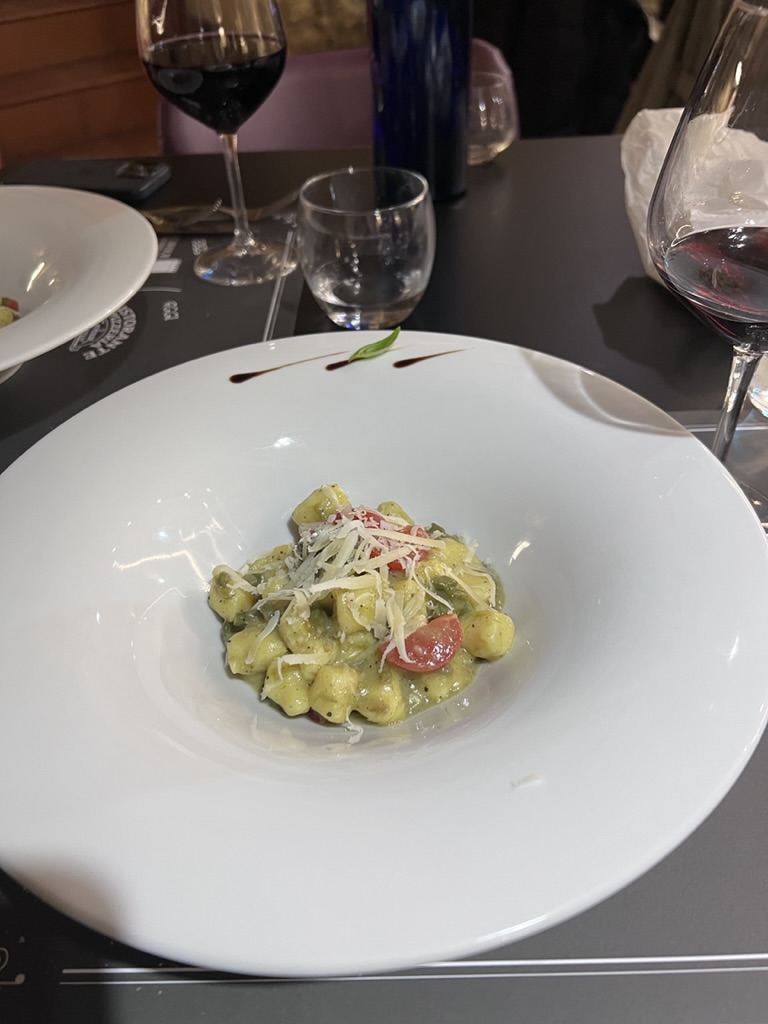
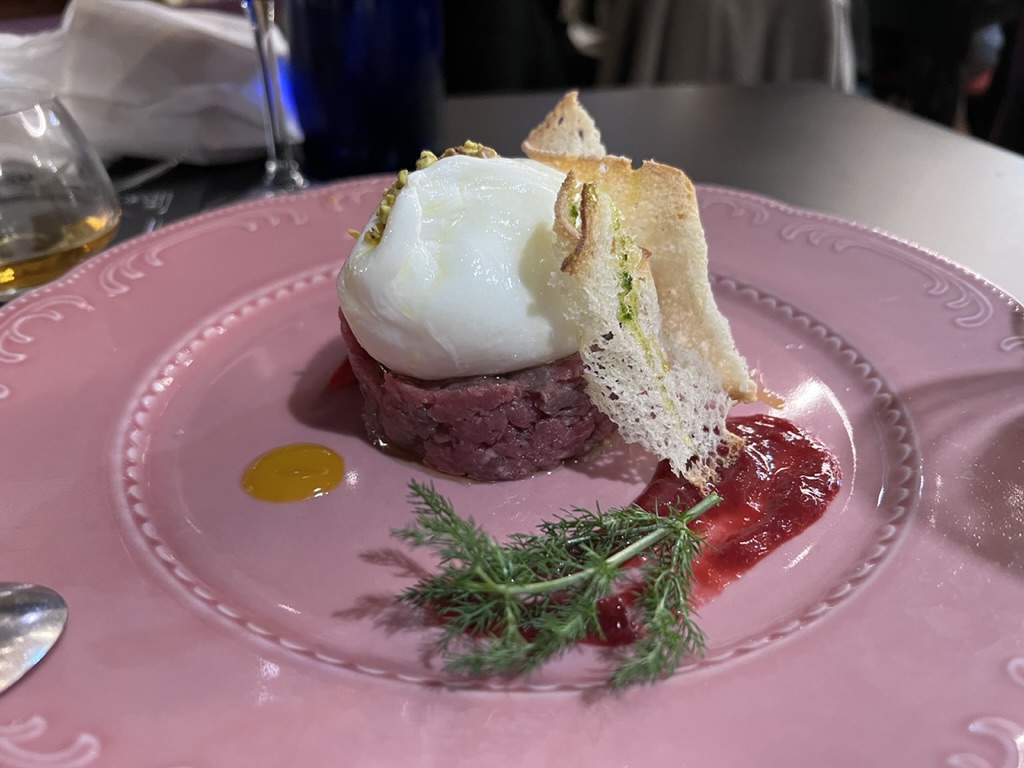
That’s it. Packing time. We leave Todi in the morning and head to Sienna, via Perugia where we’ll stop for a few hours for lunch and to walk around.
Arrivederci Todi.. .We shall return.
Best –
Fern
4. Saluti da Todi. April 14 2023
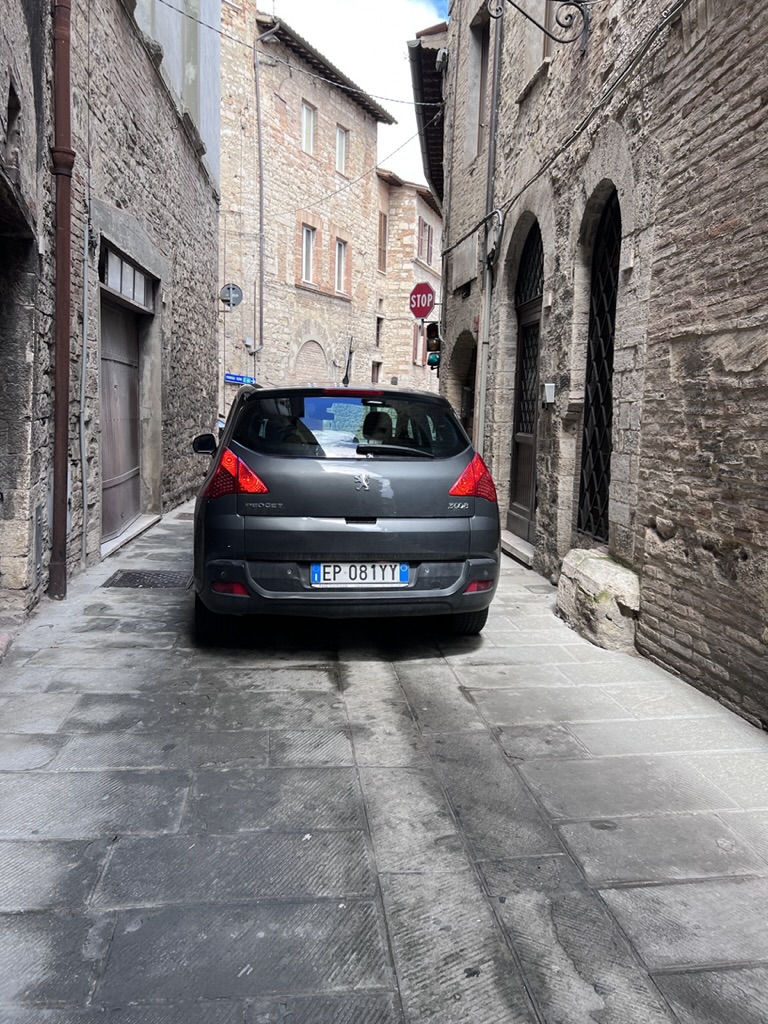

Saluti da Todi-
Got a bit of a late start this morning, partly because we had a whole bottle of wine with dinner… getting oriented and deciding where to begin our exploration of Todi, beyond our walk in the rain and dark last night and our entry into the town in the pouring rain.
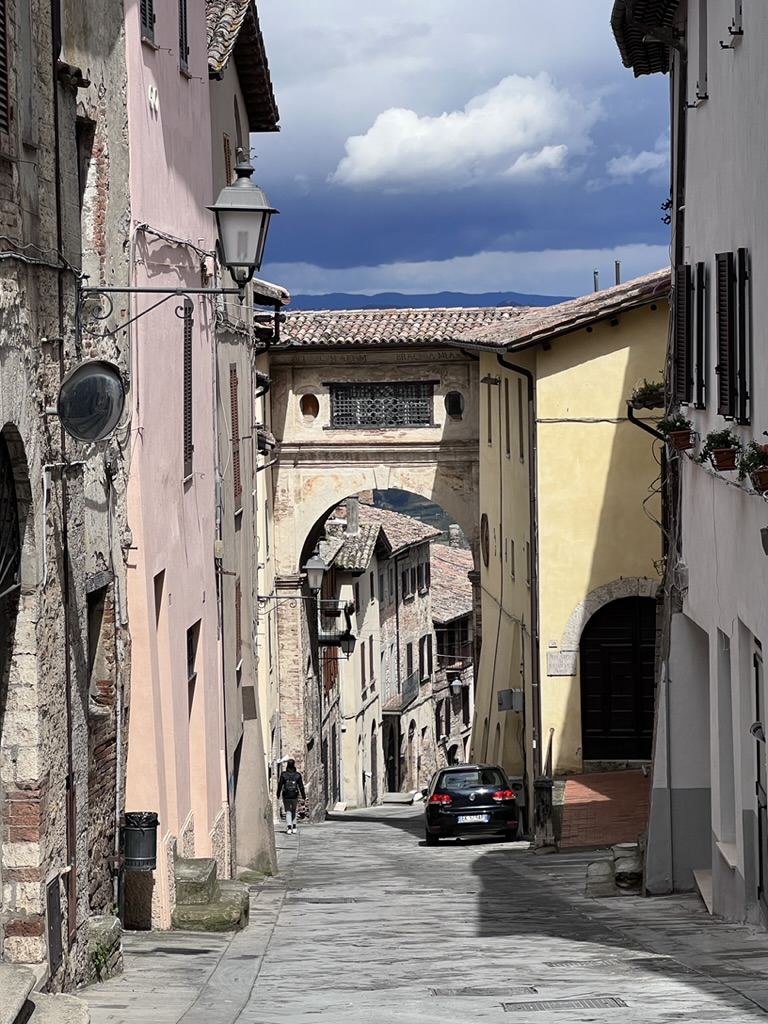
Todi is perched on a two-crested hill overlooking the Tiber River and has great views in all directions (which are a bit obscured for us due to the cloud cover and intermittent rain). It sits at an elevation of nearly 1,500 feet and has a population of 17,000 (about the size of Albany, California). Legend has it that the city was built by Hercules in 1330 BCE. In the 12th Century CE it had 40,000 inhabitants. It’s located in the Umbria region, and was historically a defensive stronghold for the region. It has an exterior medieval wall and a more inner Roman wall, and the most inner wall is said to be Etruscan.
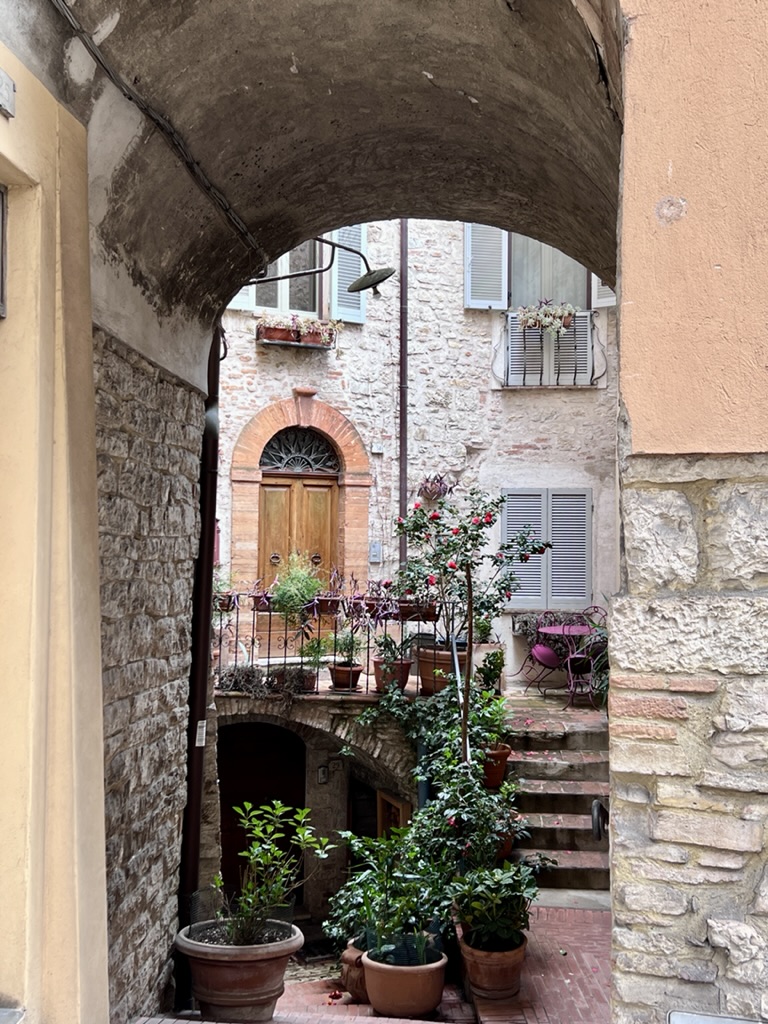
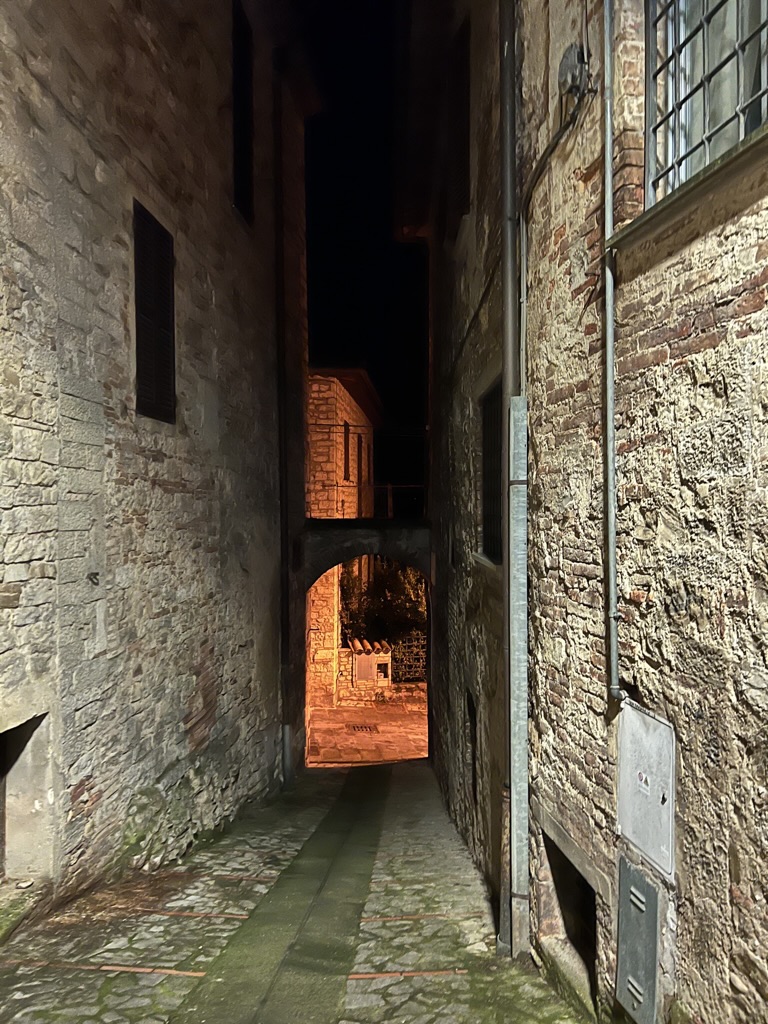
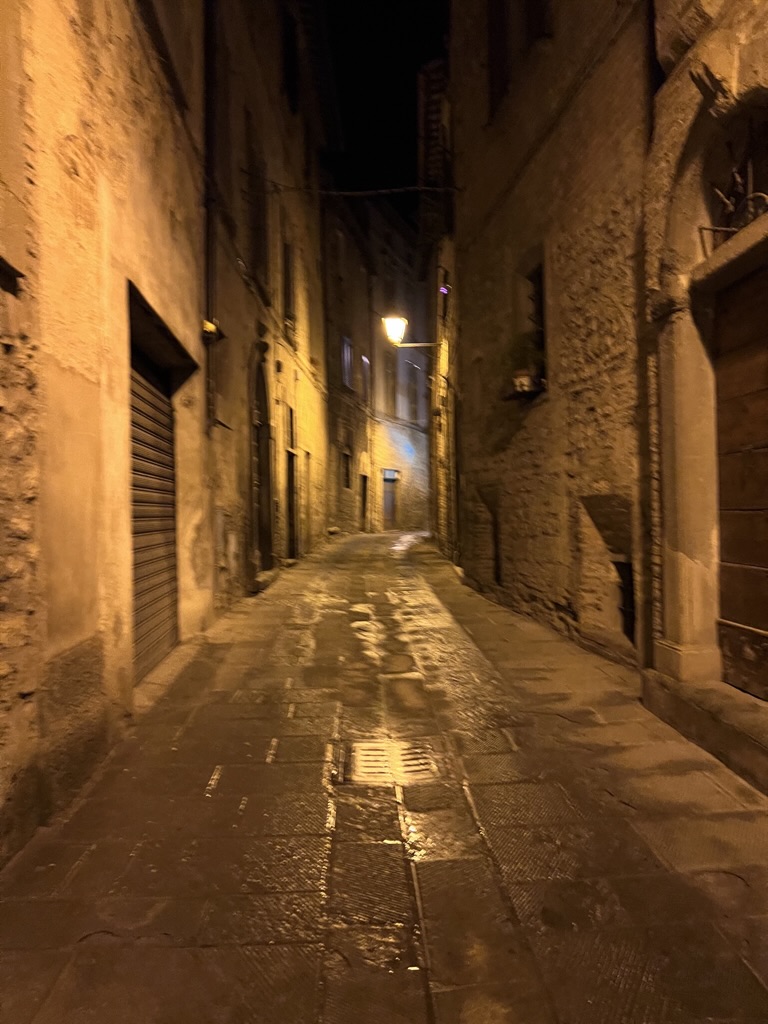
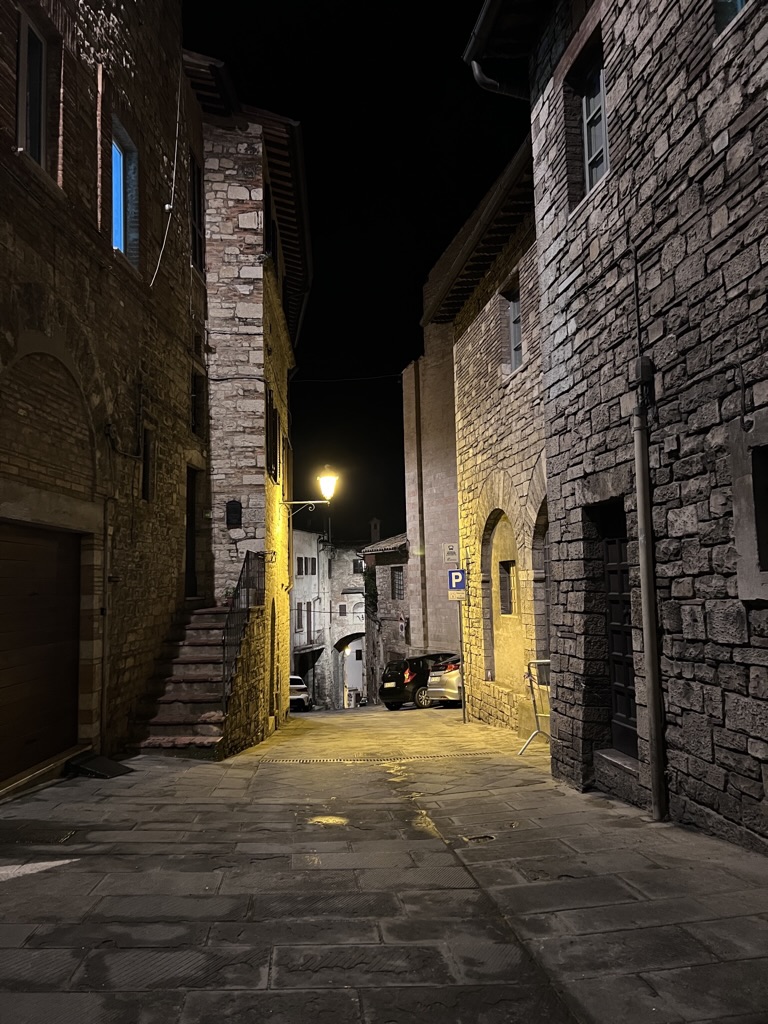
Like many medieval towns and villages, Todi is comprised of stone houses, many palazzi, and several churches. The town is totally connected through a network of steep and very narrow backstreets that meander up, down, and around. It’s one of those towns that is totally photogenic and you feel compelled to stop and shoot every few steps… and so we did, despite the intermittent rain which at times was more than a drizzle. The main square, Piazza del Popolo has the typical arrangement of Italian squares of the period where secular and religious powers face one another. Our house is about a 5-7 minute walk (uphill) to the piazza so we began our walk there and also had lunch at a lovely place, Pizzeria Ristorante Cavour that would normally have a great view. We started—naturally—with an artichoke dish and since the name of the place said “pizzeria” we went whole hog… a great pizza with eggplant, tomatoes herbs and buffalo mozzarella. And some wine.. of course.
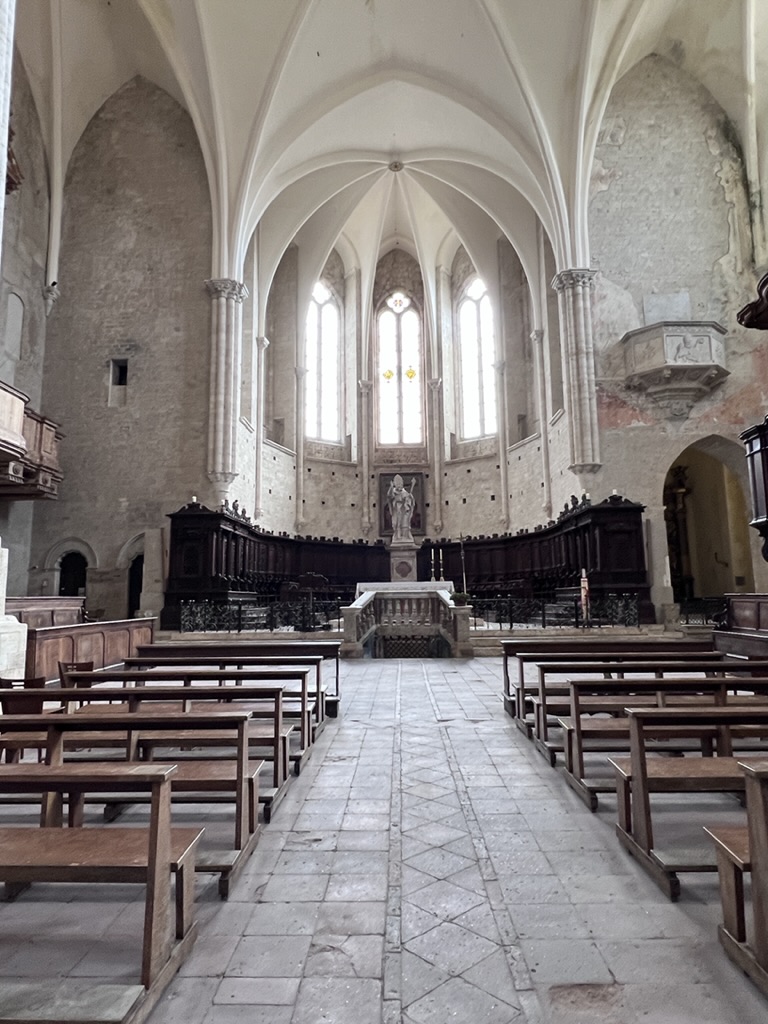
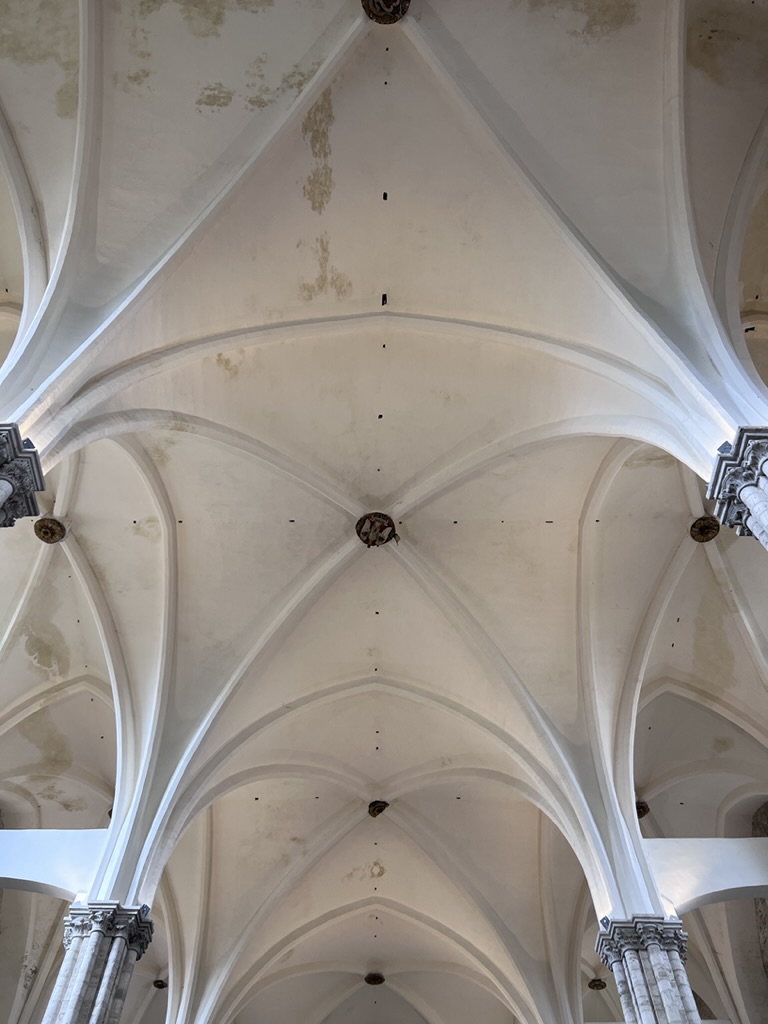
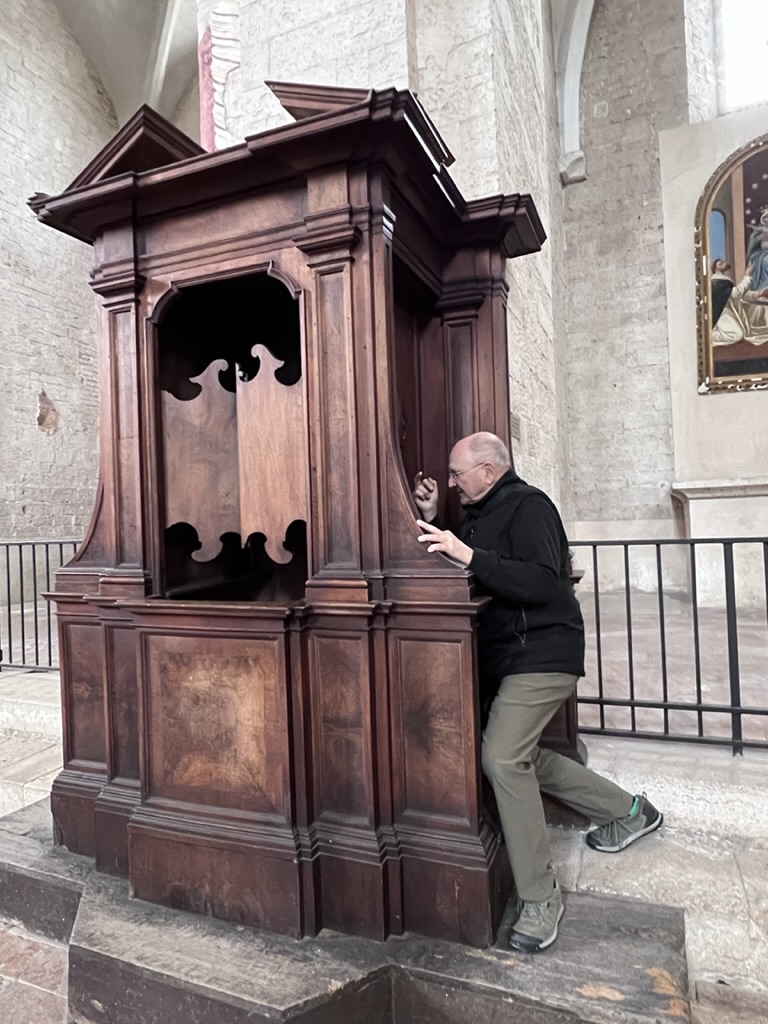

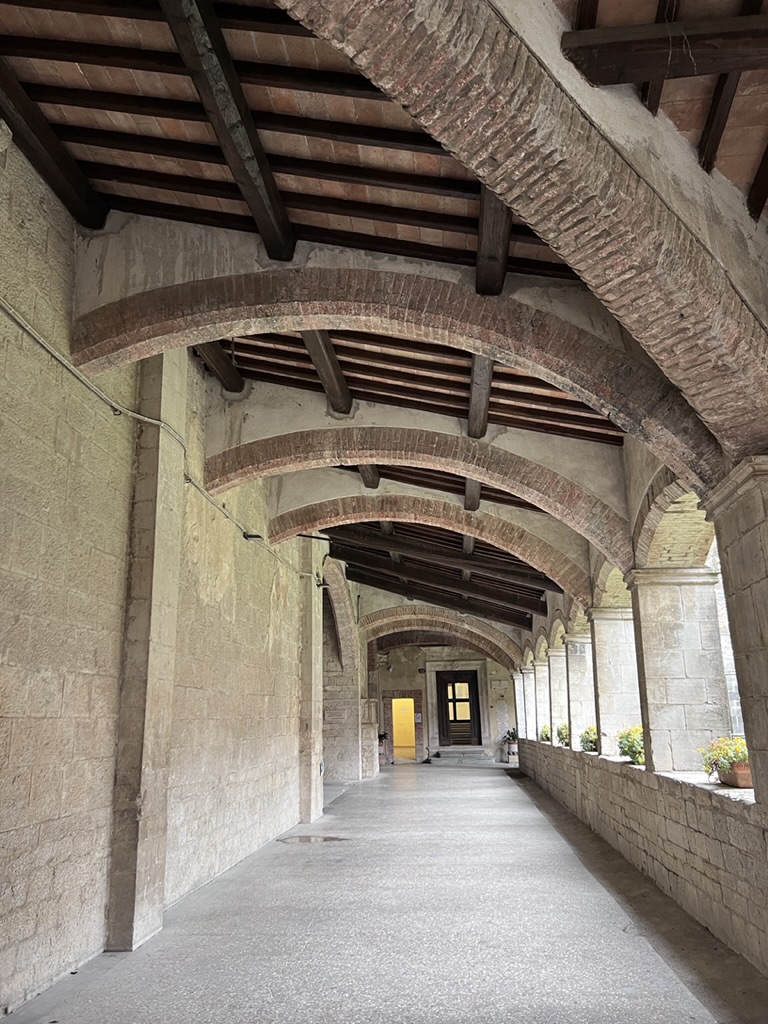
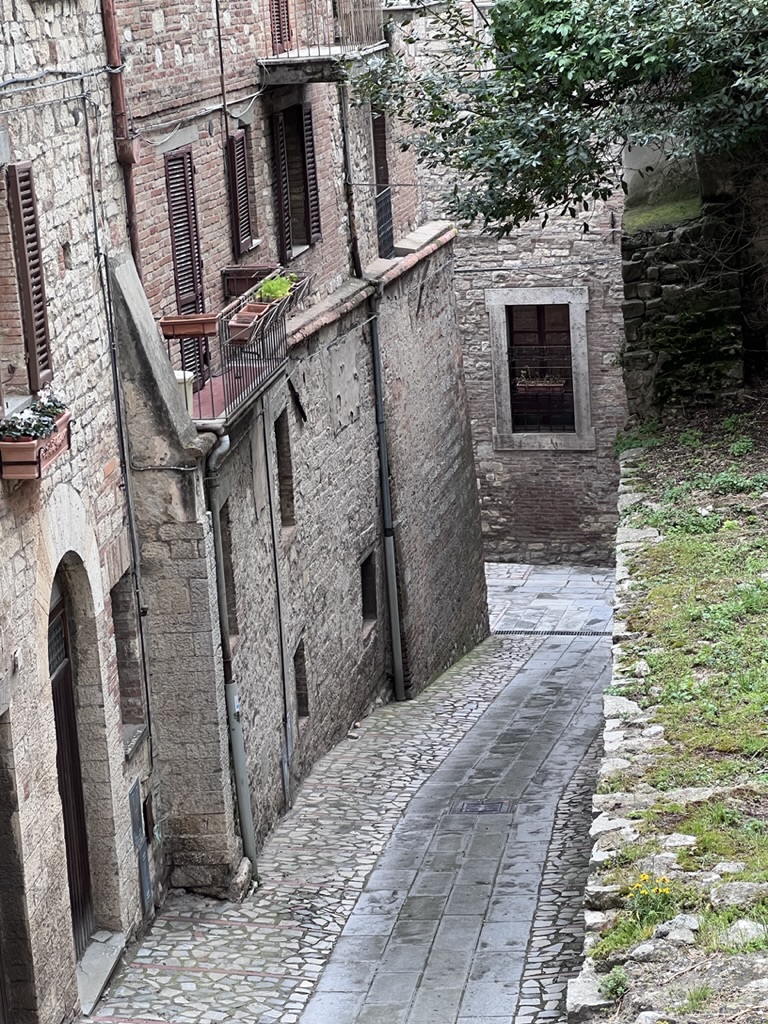
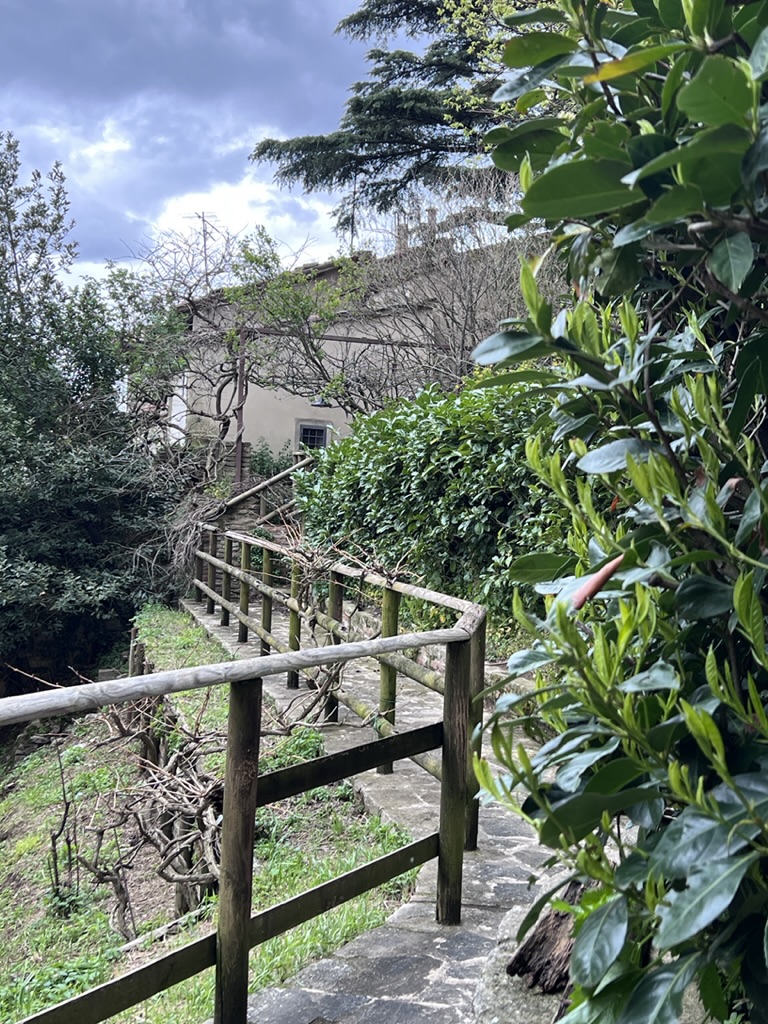
Then we did some serious walking and climbing in an effort to both see the town and also to walk off some calories. Stopped in a few churches, but mostly just took in the beauty of the town and marveled at its condition. And despite the narrow steep streeets, cars seem to meander well and deal with blending in as cars come from the other direction to share the narrow road, by backing up or waiting as one car finds a slightly wider section of the road. Most streets are one way and they loop around the town. We came back to the house for a short time to put on heavier clothes; it’s been chilly here in Todi and without sun it feels even colder.
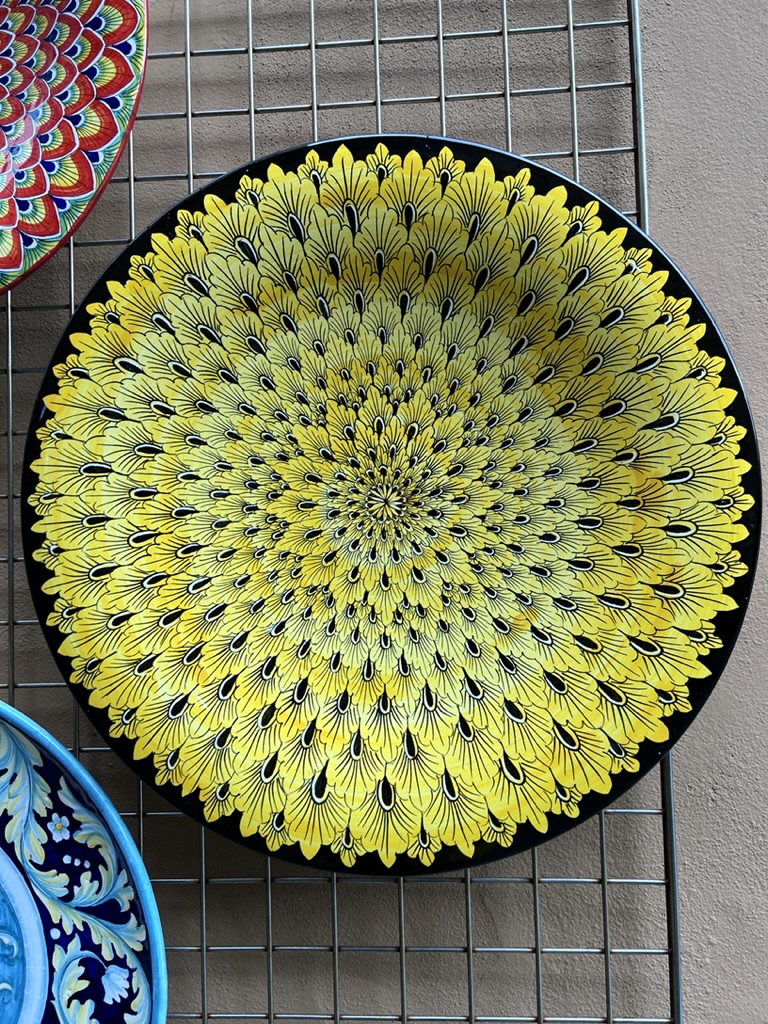
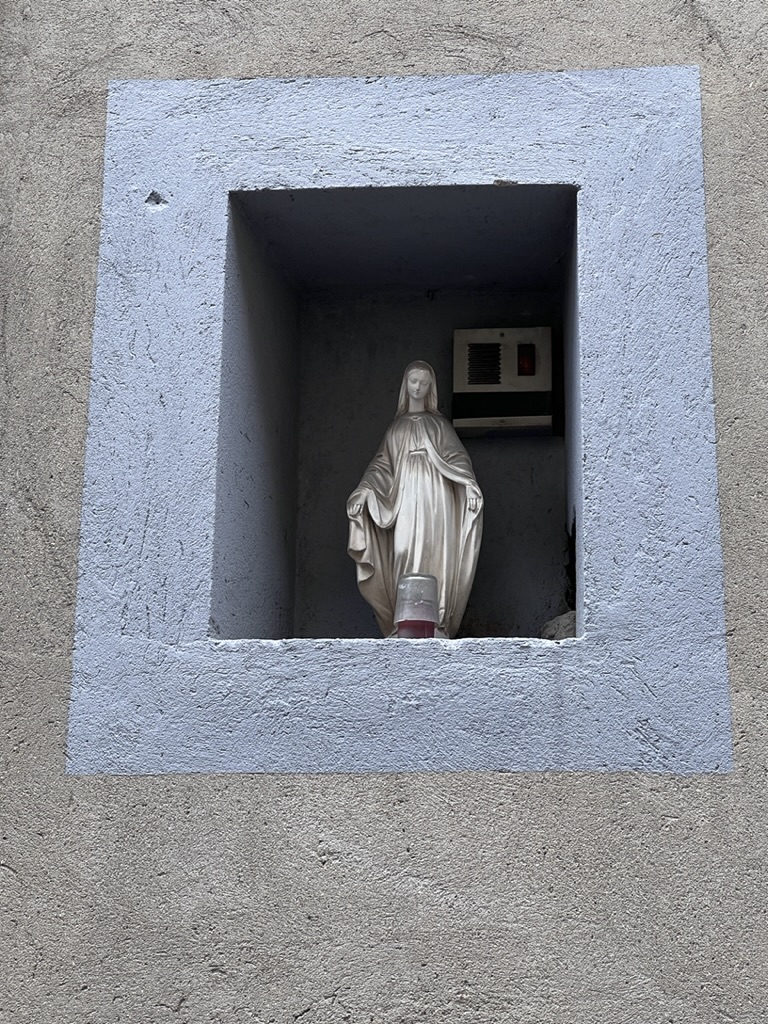
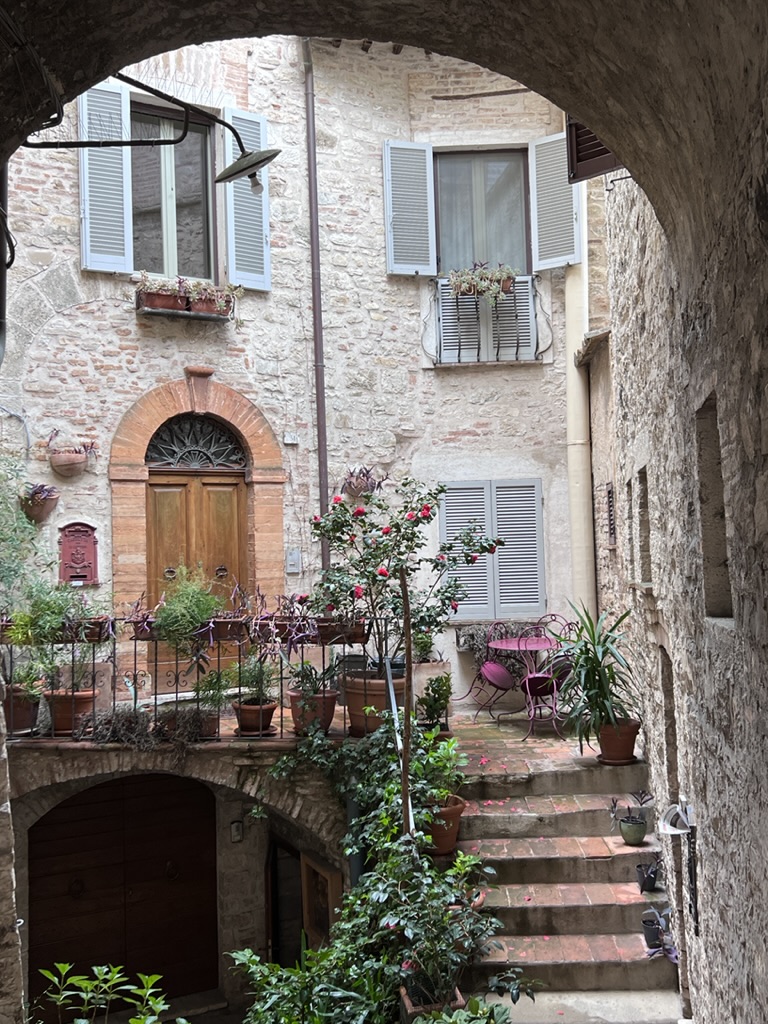
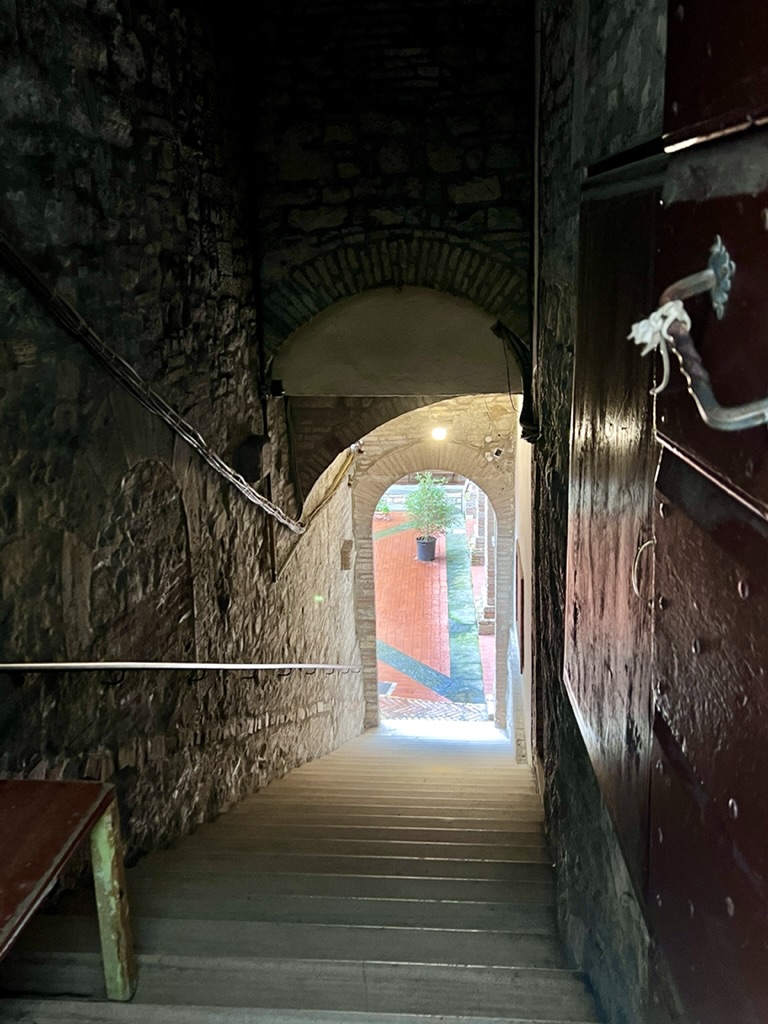
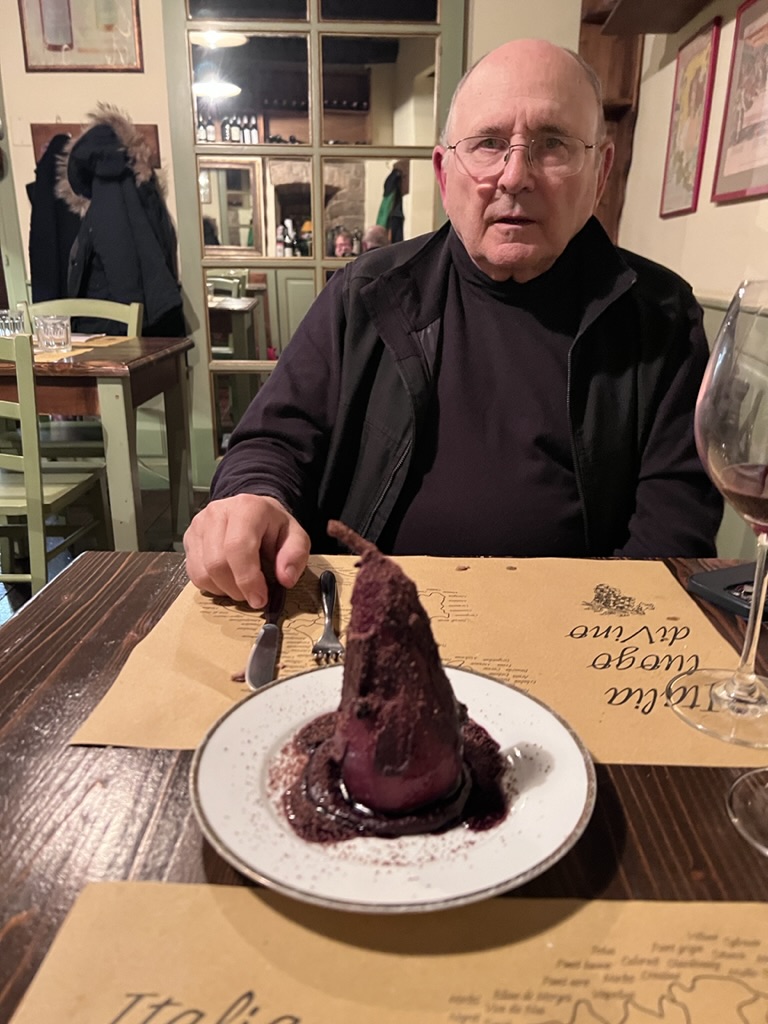
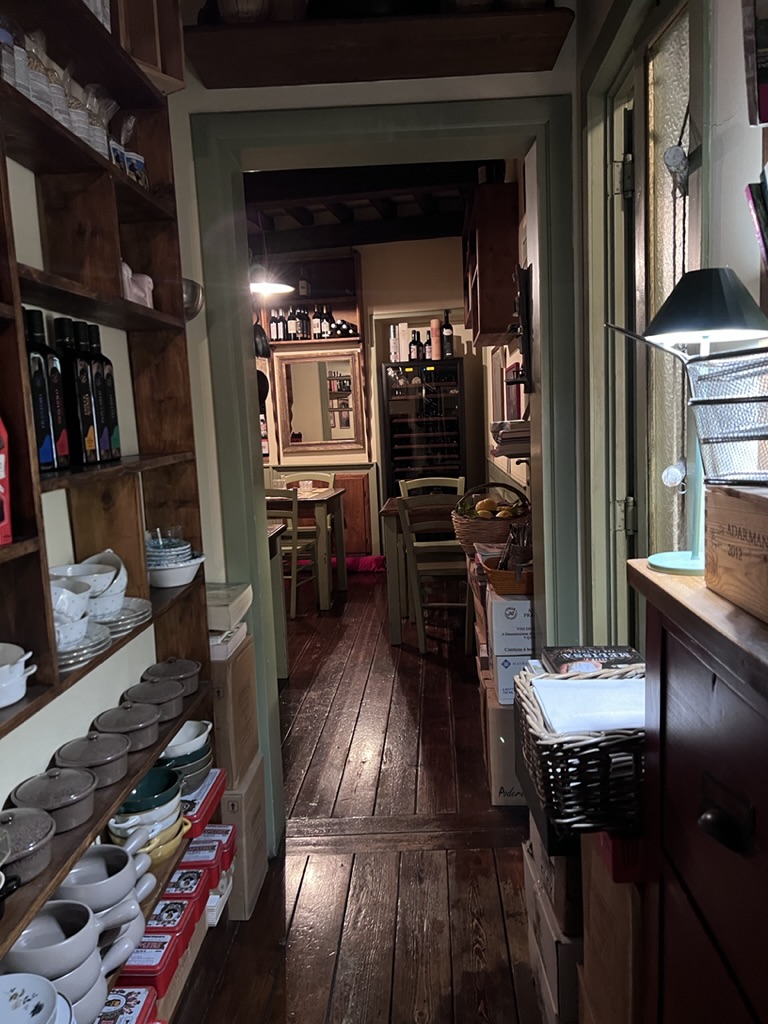
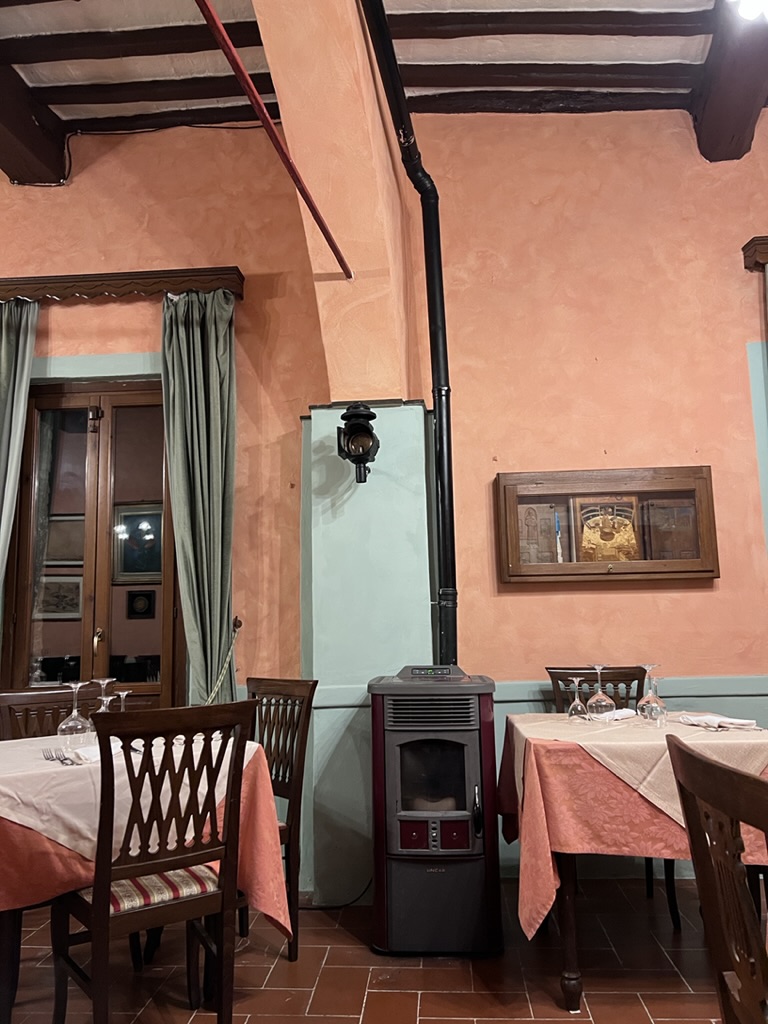
And then we trekked uphill again for dinner at Enoteca Oberdan— a very tiny bar with a teeny backroom that has about 8 tables for two. The chef/owner, whom we met because she spoke some English, grew up in Rome and moved to Todi in 2006. We had a fantastic meal from the daily handwritten menu that is presented on a brown paper bag: a dish with ricotta, artichoke, and mint followed by short pieces of one-inch diameter pasta tubes with tomatoes and pistachios (and I’m sure many other ingredients), followed by a wonderful dish of very tender beef that has been cooked with tomatoes, chopped red peppers, and herbs and I think enoki mushrooms. And ofcourse some local wine which is really good, and yes, the poached pear for dessert (can’t help it). After dinner, we strolled back to the palazzo… this time the walk was all downhill and quite pleasant (but could have used another layer of clothing).


A few things to note, prices for eating in Todi, no matter how high end the restaurant, is about half what it is in Rome. And that’s the same for everything else as well. And, I should note that even Rome was less expensive than the Bay Area. A glass of nice local wine here in Todi is only about $6 or $7; bottles go for about $25-ish. No dish on tonight’s menu was more than $18. So this came as a pleasant surprise. Todi is not inundated with tourists, so you run into locals most of the time at restaurants and about town. I guess no need to gouge anyone since they are your neighbors. I can see that it would be easy to feel comfortable here and use it as a base to visit other towns in the region.
We’re deciding whether to walk more in Todi tomorrow or take a day trip to Orvieto. The verdict is not yet known.
That’s it for today…. All good here in the magical land of Todi.
Fern
PS – for those of you who asked:
– After spending a lifetime working what seemed like 24/7 and in addition commuting for many years to teach and traveling a lot for work, and always having to take our trips in December when most organizations/clients slowed down and when universities were shut down, we felt that (although still working, but less intensely) we could travel during other months of the year. And we sort of made a pact that we’d try to do three big trips in each of 2023 and 2024. So the Middle East trip that stretched from December into January is one; this Italy driving trip is two; and we are hoping to go to Korea and rural Japan in October/November. Our plans for 2024 are more vague, but probably Uruguay and Argentina; possibly Iran, depending on the political situation; and West Africa… But it’s all a long way off, so stay tuned.
– Regarding my book…. It is now about 95% written; just trying to finish the concluding chapter which I have with me and which I worked on on the flight coming here. Hoping to get that done by the time we return. Then I need to do the basic layout and final selection of photos and some graphic elements. I am about to send the 95% part out to a copy editor, in the hopes that a less involved writer can find some places to tighten things up. It’s been a slow trod, but I feel good about it.
3. Rome to Todi via Calcata. April 13 2023
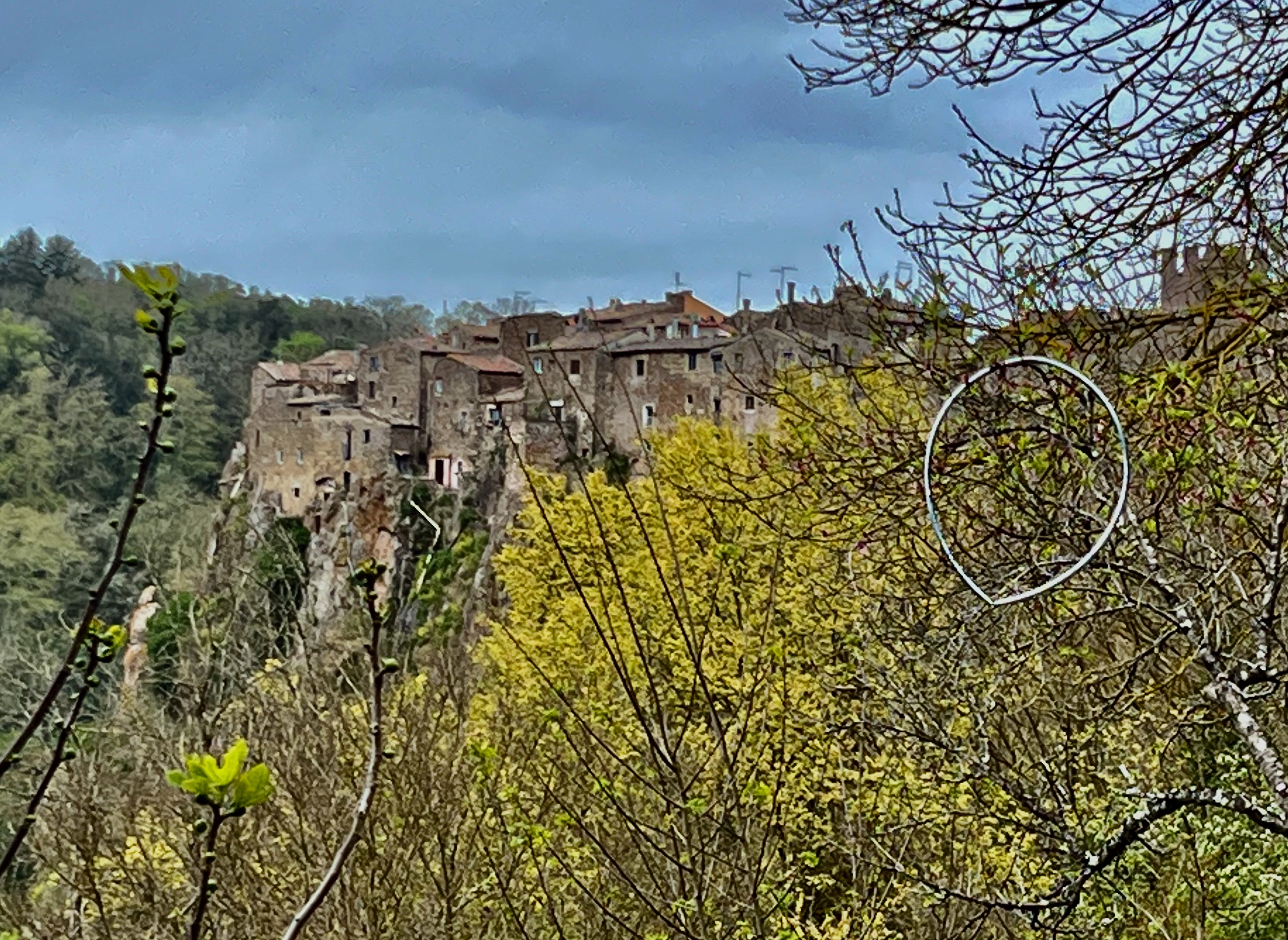

April 13, 2023
Ciao!
We left the Donna Camilla Savelli Hotel right after breakfast, after 2.5 packed days and nights in Rome. Headed for the train station (Termini) to pick up our rental car at Hertz. After a quick check-in despite lines of people trying to rent cars (pays to rent cars a lot as they zip you through) and headed to the garage to pick up the car (we had reserved a small automatic car). When we got there, they handed us the keys to a huge monstrous car with manual transmission that we would call an SUV; remember I drive a mini cooper! The Hertz guy said this was a “standard size car” and that all the auromatic transmission cars were taken. While I drove a stick shift for years (Mike too), it’s been a while. Funny how life changes. Up until 2012, I always drove manual and refused to drive an automatic car. But now, a decade later after having a Prius and then my new Mini, I just couldn’t imagine driving stick again. (Mike drives a Prius which is also much smaller than what they were giving us.) We went back to the little office to say that there clearly was a mistake. They found a smaller car and we put all the luggage in… but then we noticed that it, too, was stick shift. We left our luggage in that car and headed back to the train station to see if we could find something else with another company. We got to Sixt (our least favorite car rental company and where we recently had problems in Amman, Jordan)… But they had a smaller car (BMW) that was automatic; we went back to the car area to check it out and to confirm that our luggage would fit in the trunk (one suitcase—carry on size–for each of us and one computer rollie bag each). Everything checked out, so we had to go back to the Termini office for Sixt to do the paperwork and then back to the garage. In total, walked 7,000 steps only in the train station and garage to rent a car. Three miles? Then we had to go back to Hertz to get our bags out of the trunk of that other car. One funny incident— the Sixt guy who walked with us from the office to the garage to show us the car options said I walked very very fast, not like most Americans; I said I was from NY originally and he laughed saying he now understood. He was also very impressed that we were from Oakland since he’s a big basketball fan (although he cheers for the Lakers). As we walked he also told us that he follows U.S. politics and the U.S. economy because he has been investing in tech stocks and doesn’t trust Italian banks with his money.
Finally, two hours after we arrived at the station, we were off to Calcata enroute to Todi where we will stay for three nights.
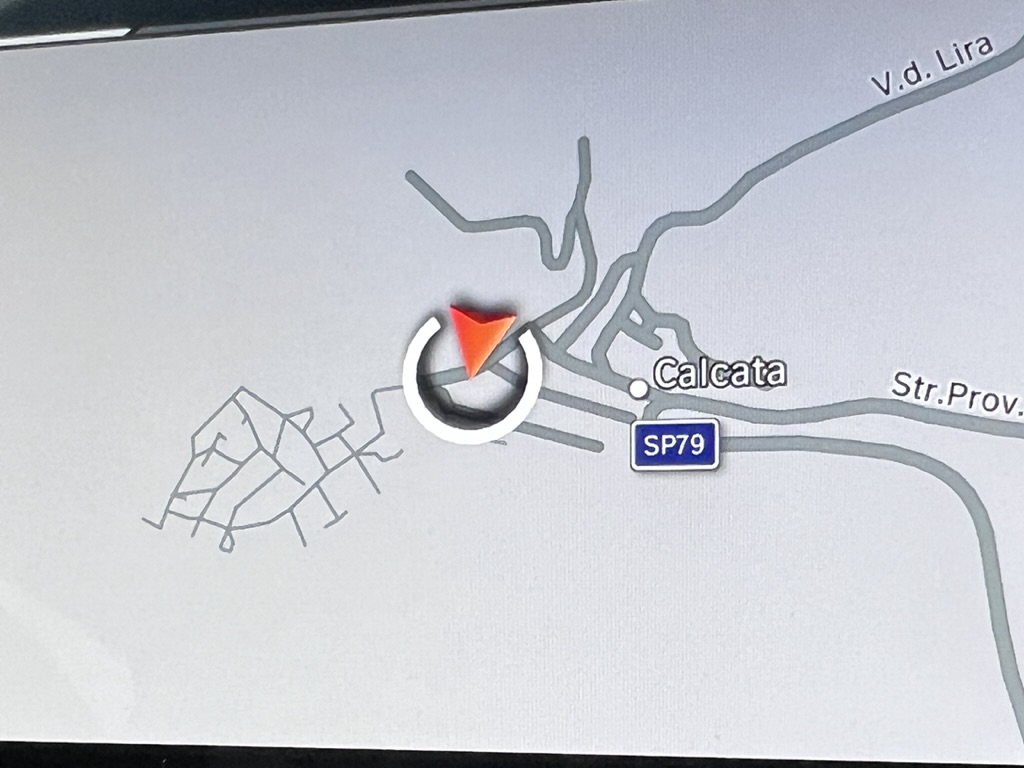

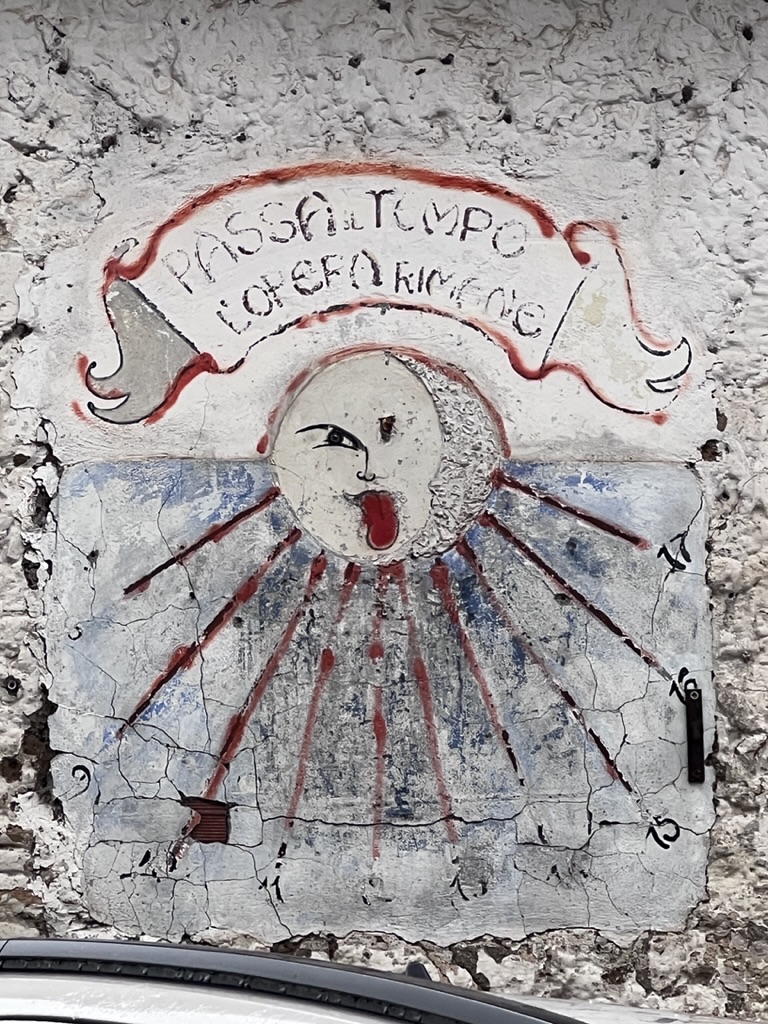
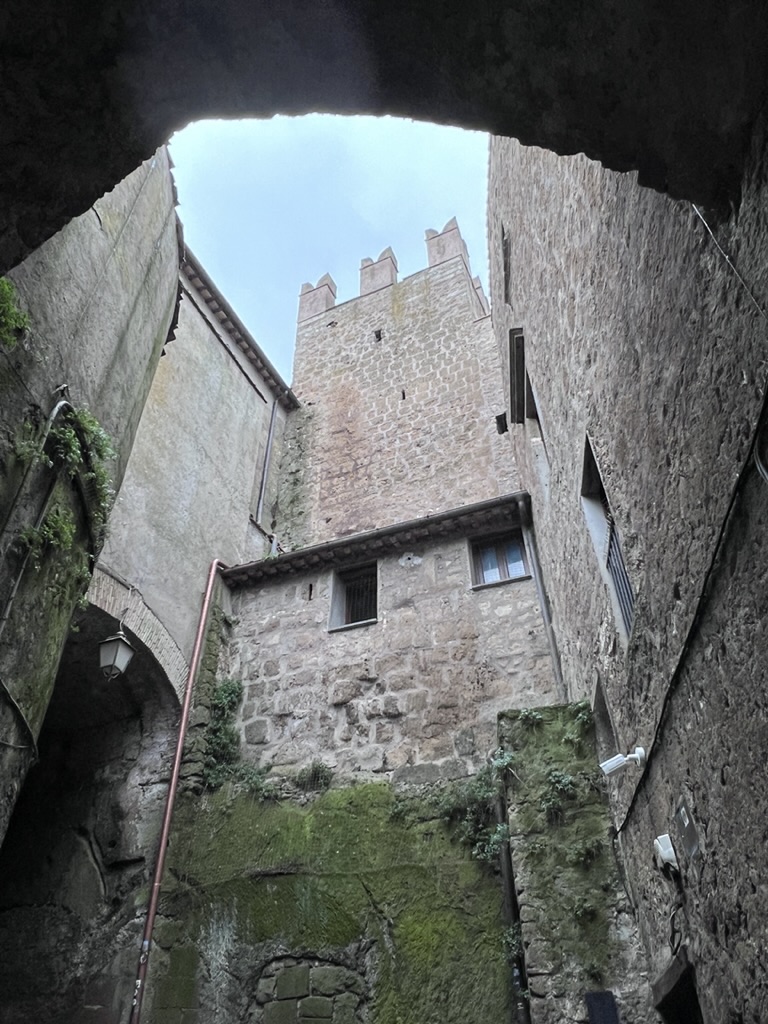
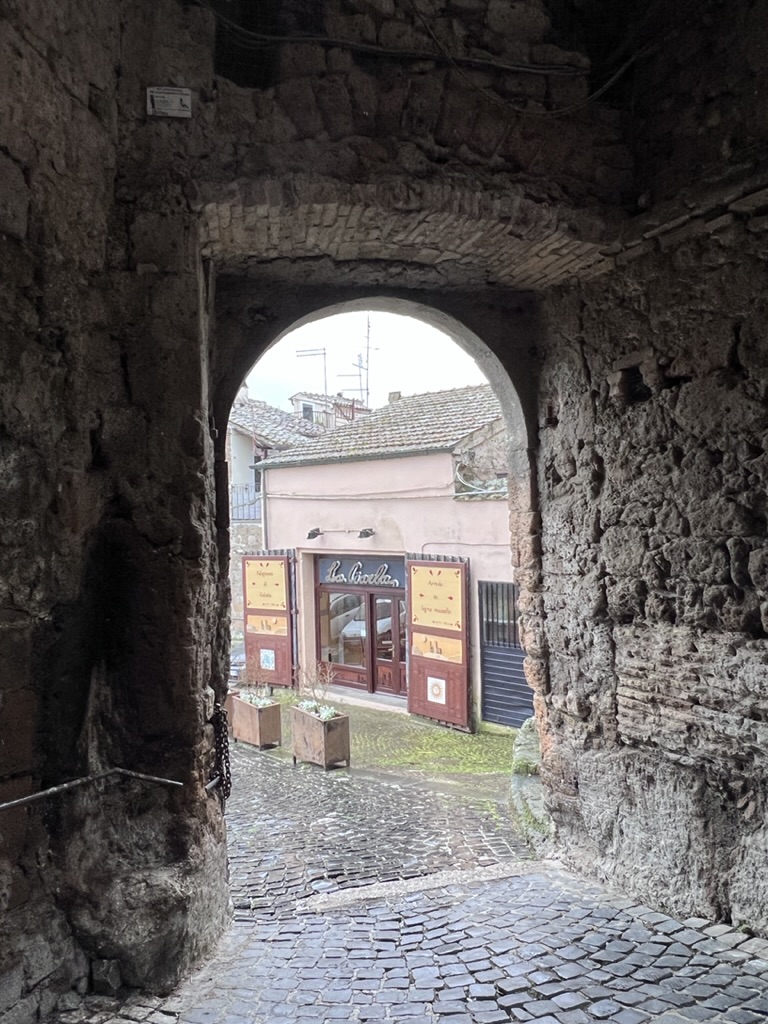
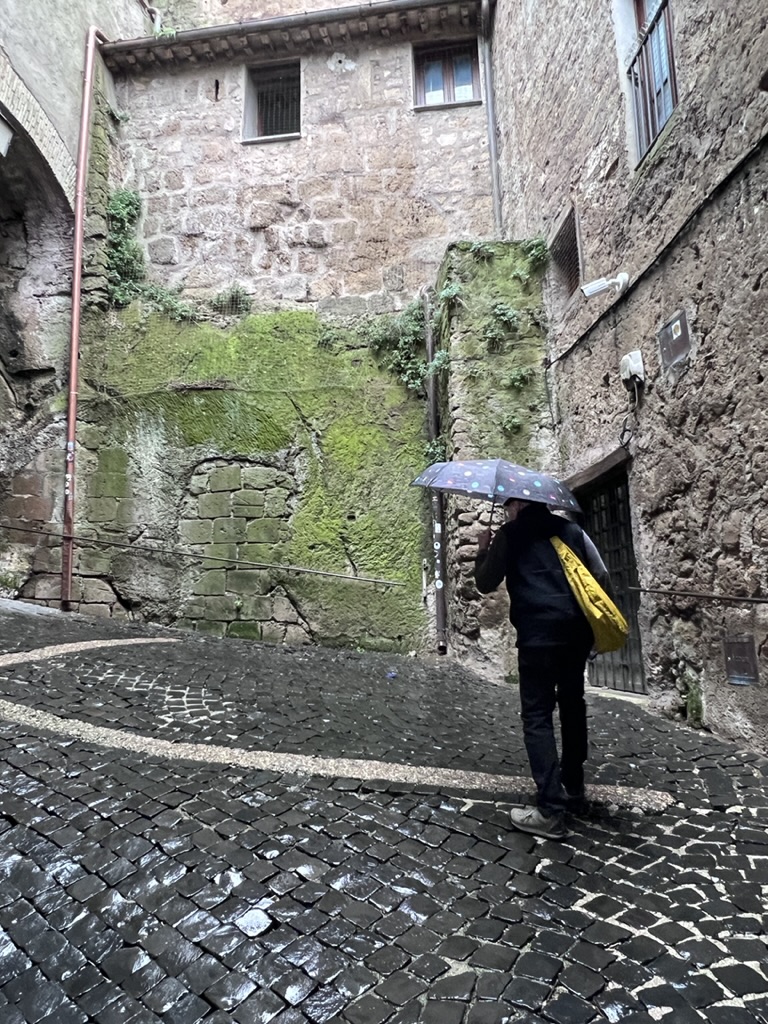
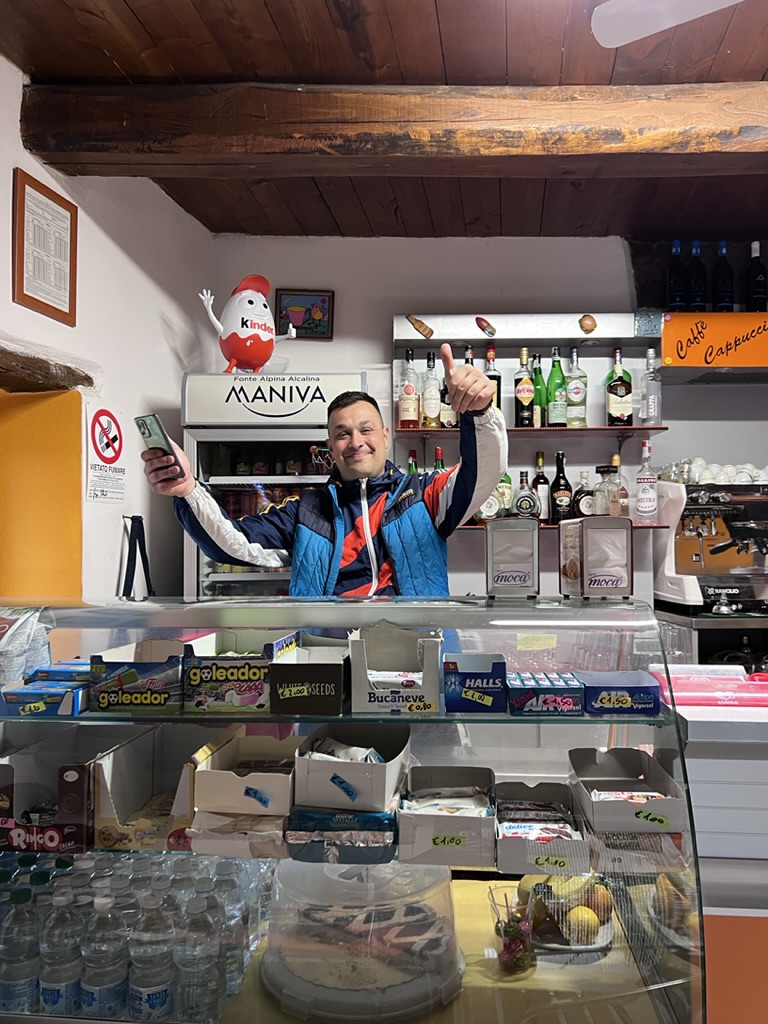
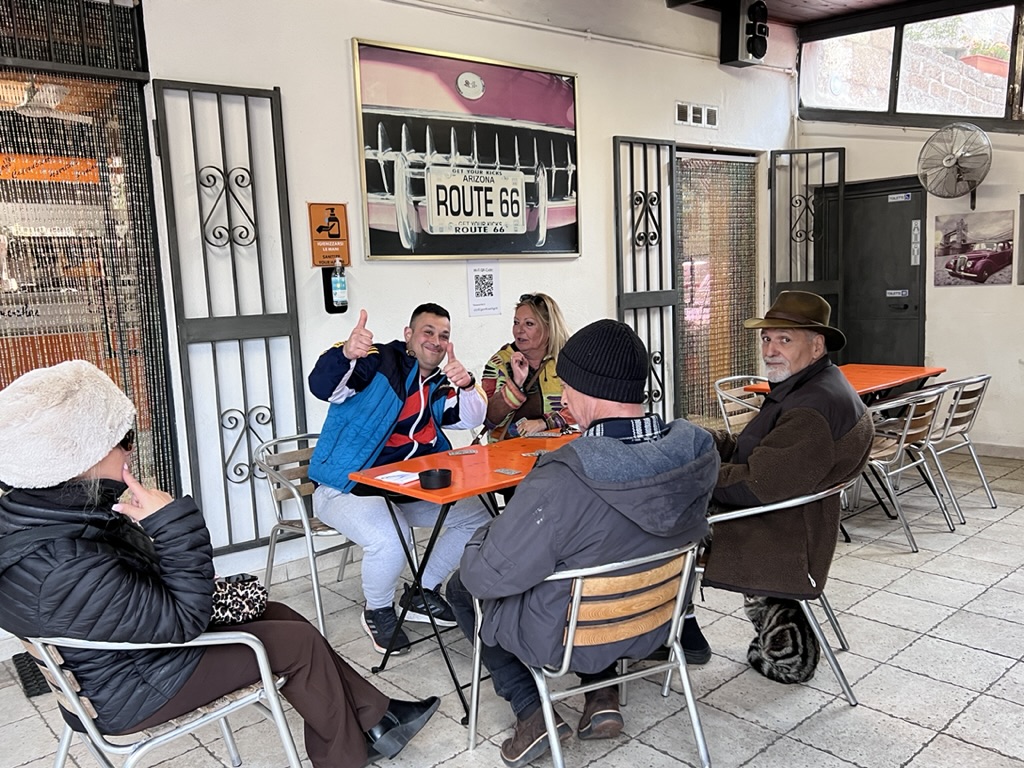
It began to rain as we drove, and got heavier as we climbed the small very curvy single lane (two-way) roads to Calcata. Calcata is tiny… Only 93 people reside in the little village hamlet and a total of about 900 if you include the surrounding area (not sure how many miles that line goes). By then we were totally starving, but the only place open (actually we were pretty amazed there was even a “restaurant” in this tiny village) was the town bar, where a very cheery guy made paninis and served alcohol (we opted for water given that we still had more driving to do). While he spoke no English at all, we did fine ordering and having a fairly simple conversation. He was born and raised in Calcata (!!). There isn’t any school in the village so he had to be bussed somewhere to attend school. He loves Calcata. Once he served us, he went outside to play cards with a bunch of locals—beneath a large, faded poster of Arizona.
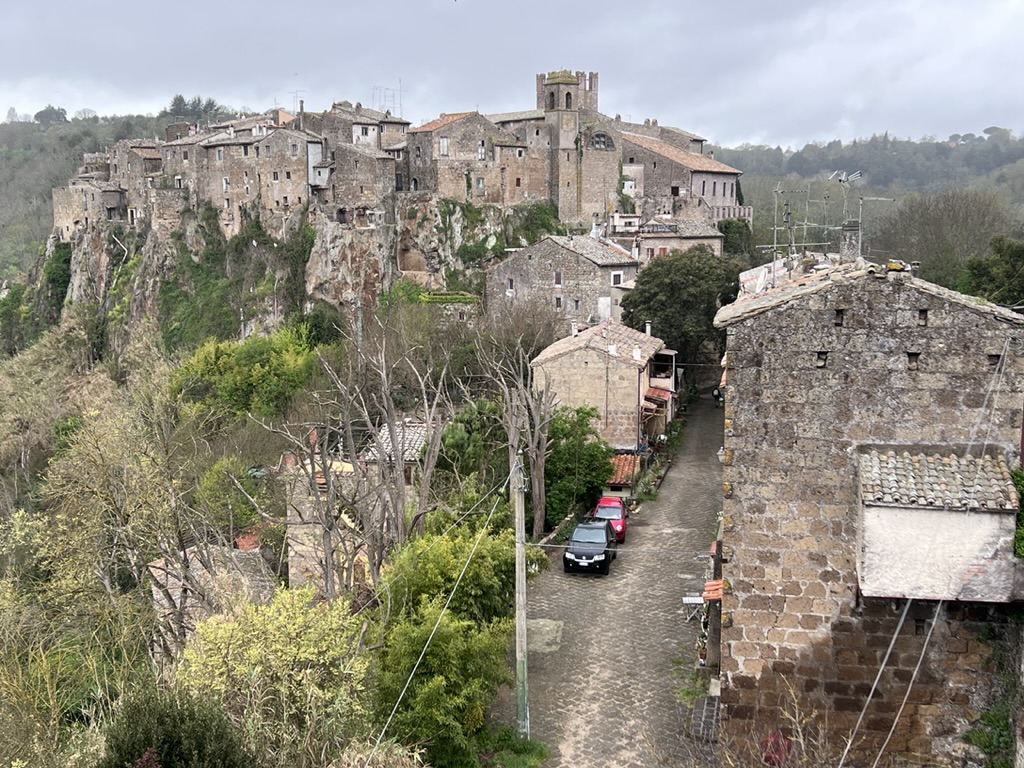
Calcata towers above deep gorges at about 800 feet where torrential water flows or so we are told. The little village covers the entire table top of these shear free-standing cliffs. We just barely walked into the real village because of the pouring rain but did walk around the edges, and we did drive across the bridge above the gorge to the edge of the earthen column on which the village sits. That’s where the little bar was. In the 1801 writings of the executioner of the Papal State (if I understood this correctly as the historical note in town was not written in great English) two guards were reportedly accused of robbery near Calcata and sentenced to execution. The public execution took place in Piazza del Popolo in Rome.
But Calcata’s charm is that it is a medieval village that clings to this volcanic cliff that seems to rise from nowhere in this densely forested area. With steep pathways, the actual historic village is car-free because the passageways are too narrow even for a little Fiat. Cars do get up into that area where the bar was and like in all of Italy, cars are sort of strewn wherever anyone can figure out where they can fit. Some describe it all as a fairytale… The history goes back 3,000 years and they can trace human presence to prehistoric times. In the 1930s the Fascist government condemned the village because they believed its foundations were unstable, and by 1960 the residents had either relocated to the newly-built “Calcata Nuova” which was nearby, or moved to Rome and other areas in Italy. But in the 70s Italian and international artists and hippies began squatting in Calcata’s abandoned houses and caves. Eventually they bought and restored their residences, opened galleries and cafes, and “rescued” this old village… or so the story goes. The story comes full circle because the new residents and “entrepreneurs” convinced the Italian officials to reverse the condemnation plans.
Since we were there on a very rainy Thursday, it looked fairly gloomy, but we were told there’s a lot more activity on weekends and that the villagers like their solitude. I would die within 48 hours here, although they now have internet access, but no mail delivery.
One resident artist does an annual nativity scene with handcrafted statues depicting real people who live in Calcata.
From Calcata we headed to Todi.. We were really tired and the driving was tough in the rain, and it was getting dark. So we pulled over in a little parking lot of a hotel just near the entrance to the autostrada for a little 20-minute nap in the car. The hotel was called the Park Sabina and the sign said “A Hotel for Business and Romance”…. ??? I actually went inside to use the ladies room and expected it to feel sort of kinky, but it was quite nice. Maybe, what happens in the Sabina stays in the Sabina.
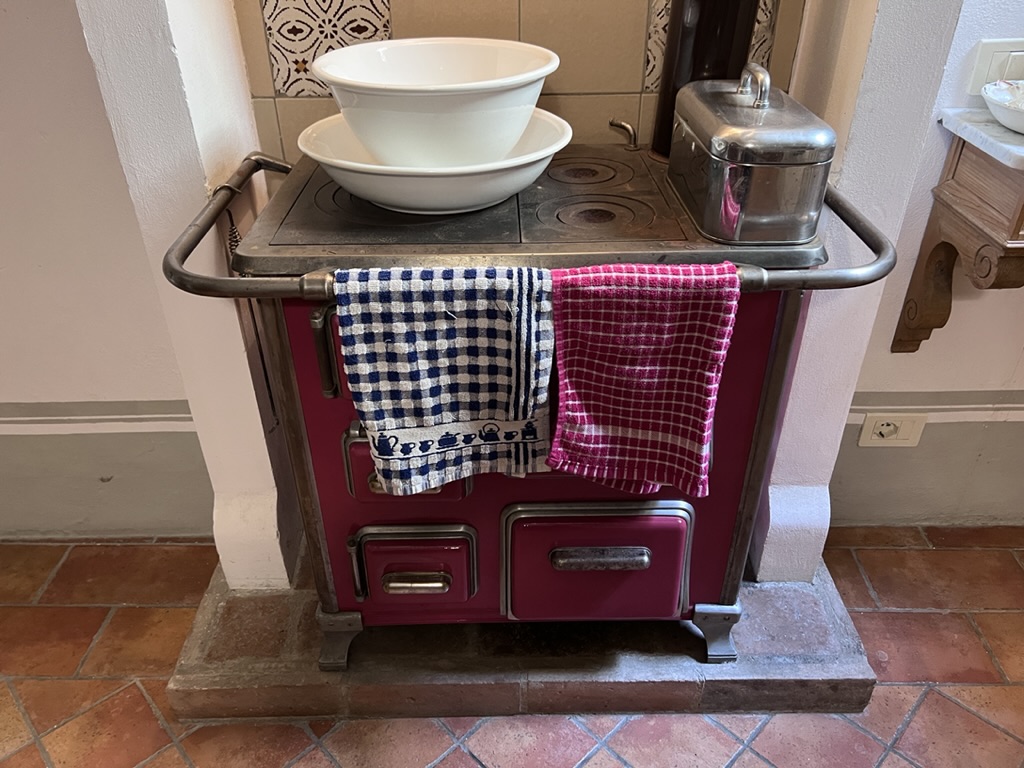
Twenty minutes later, totally rested and restored (!) we headed to Todi. We are staying in a wonderful 600-year old palazzo that was built on top of a Roman amphitheater that was built on top of Etruscan ruins. And to think that we believe our 130-year-old Victorian house in Oakland is old! I’ll tell you all about Todi which is unbelievably breathtaking, in my post later tonight or tomorrow, so as to be able to finish this one now.
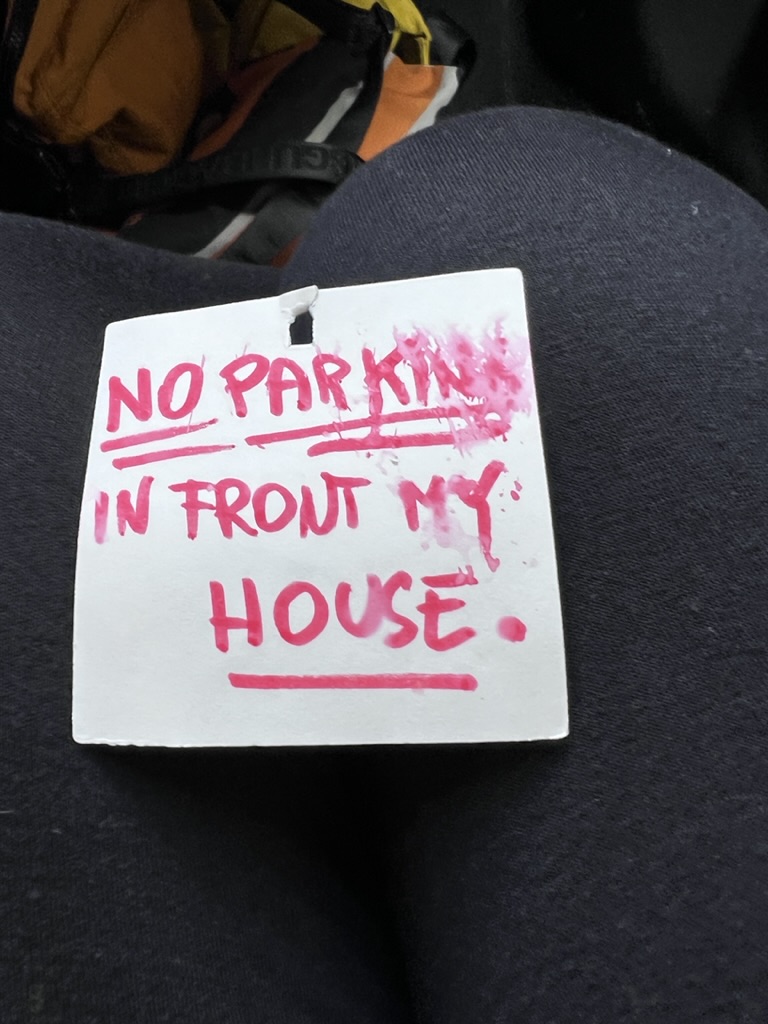
The palazzo we are staying in is currently owned by friends from NY (the parents of our godson’s wife). But before we could get to the palazzo we needed to find the place… and then figure out where to put the car. The streets that wind up through the whole town are–like all medieval towns—narrow and steep. And Todi is no exception. We had a pretty good idea of where to go from notes that were sent to us, but it’s still different in the flesh. Turns out we drove past the place twice even though we were following GPS very closely… and then finally figured it out. By then it was really pouring. Mike stopped the car and I jumped out; we got all the luggage and odds and ends from the car and put them on the side of the street, as two cars waited behind us. Mike then left and I somehow maneuvered an umbrella and the bags across the little cobblestone street, found the keys, opened the door and waited for Mike.. He did pretty well finding parking although we later realized he was parked pretty illegally and partially blocking someone’s door, so we moved the car this morning.
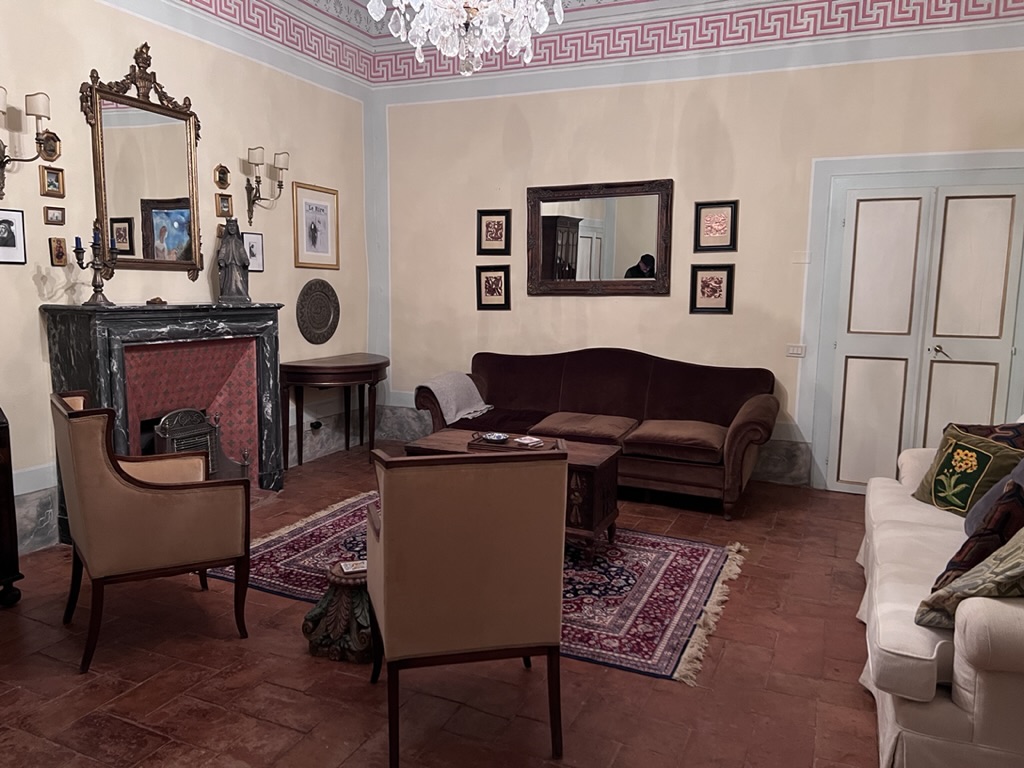
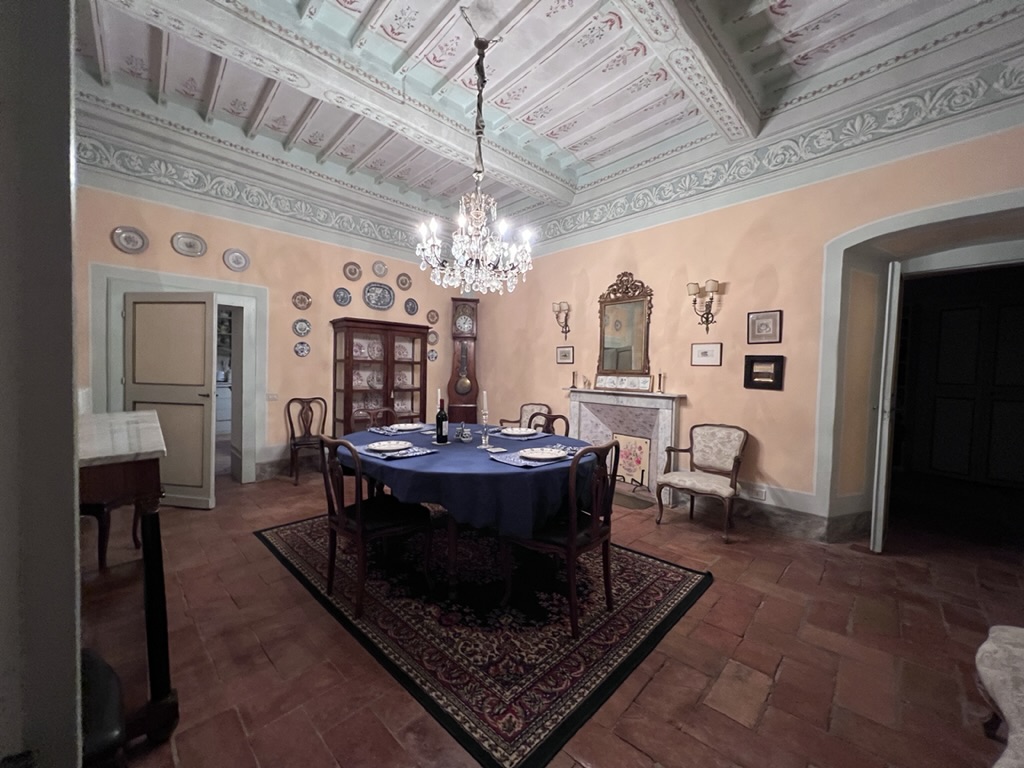
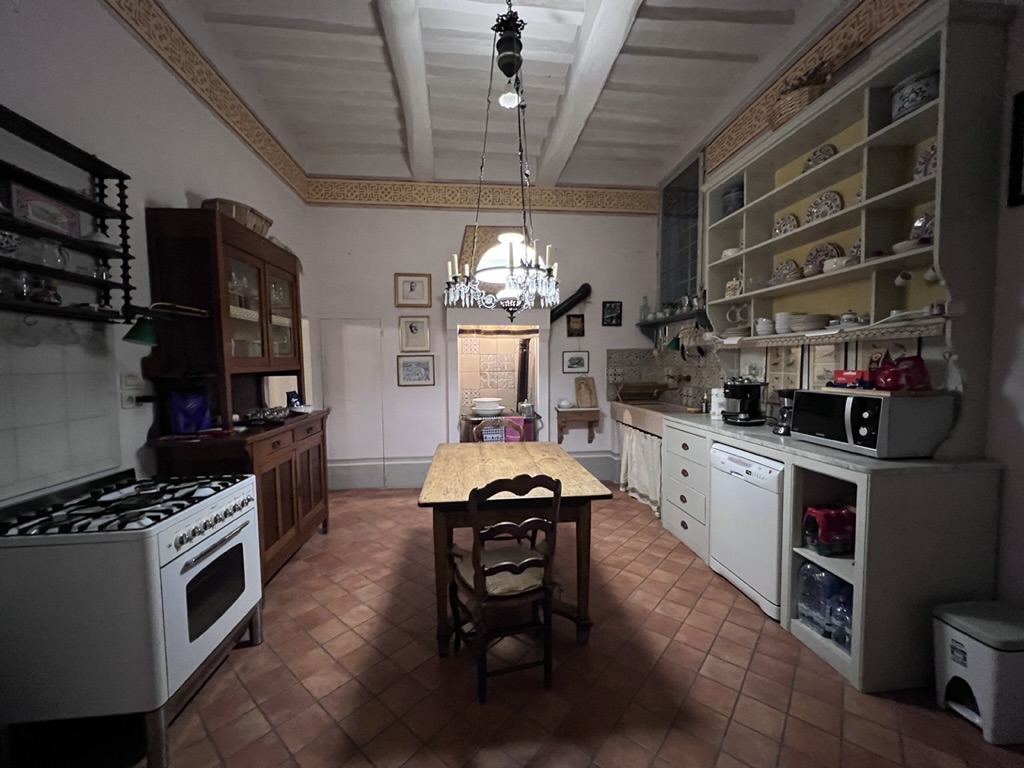
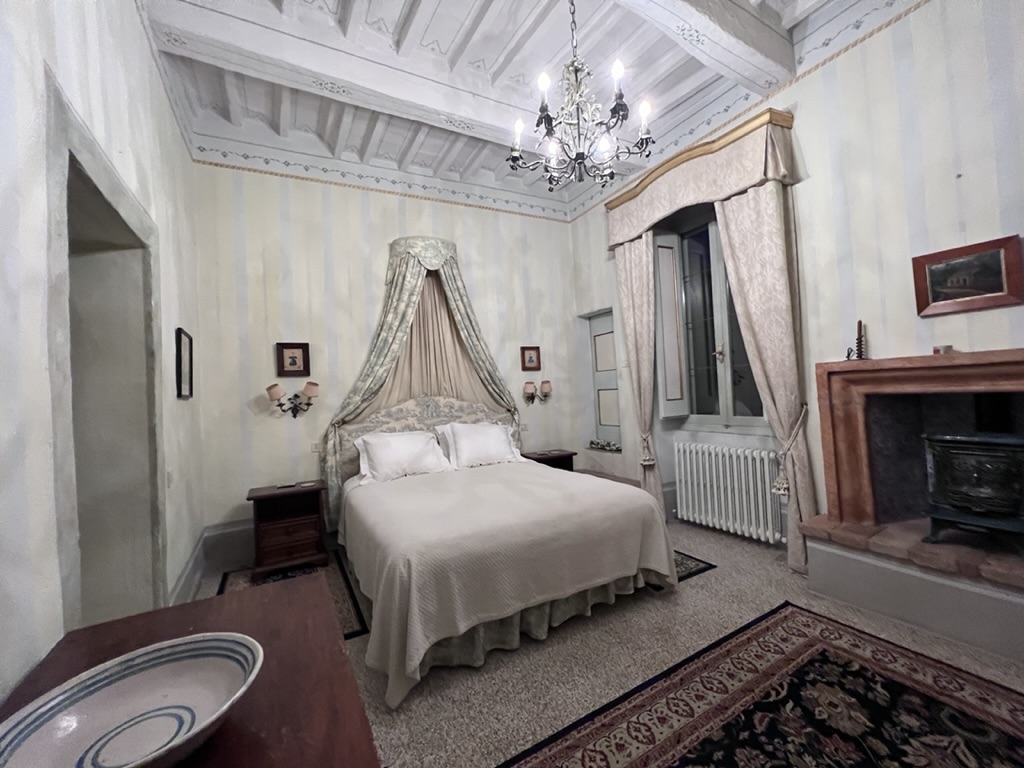
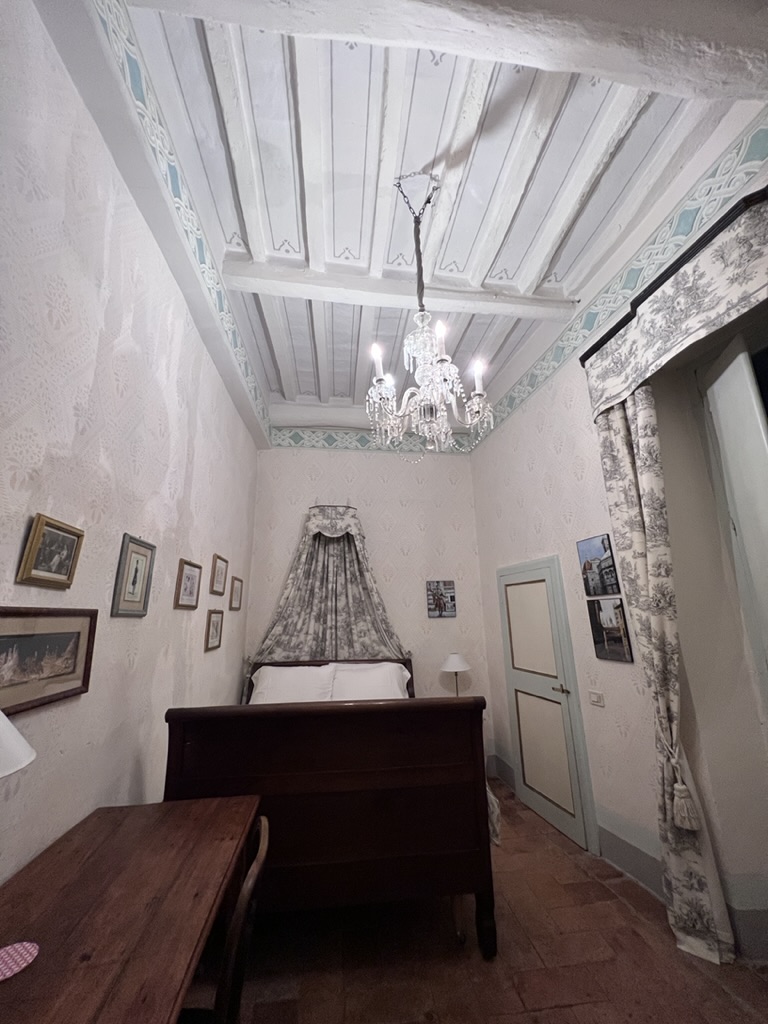
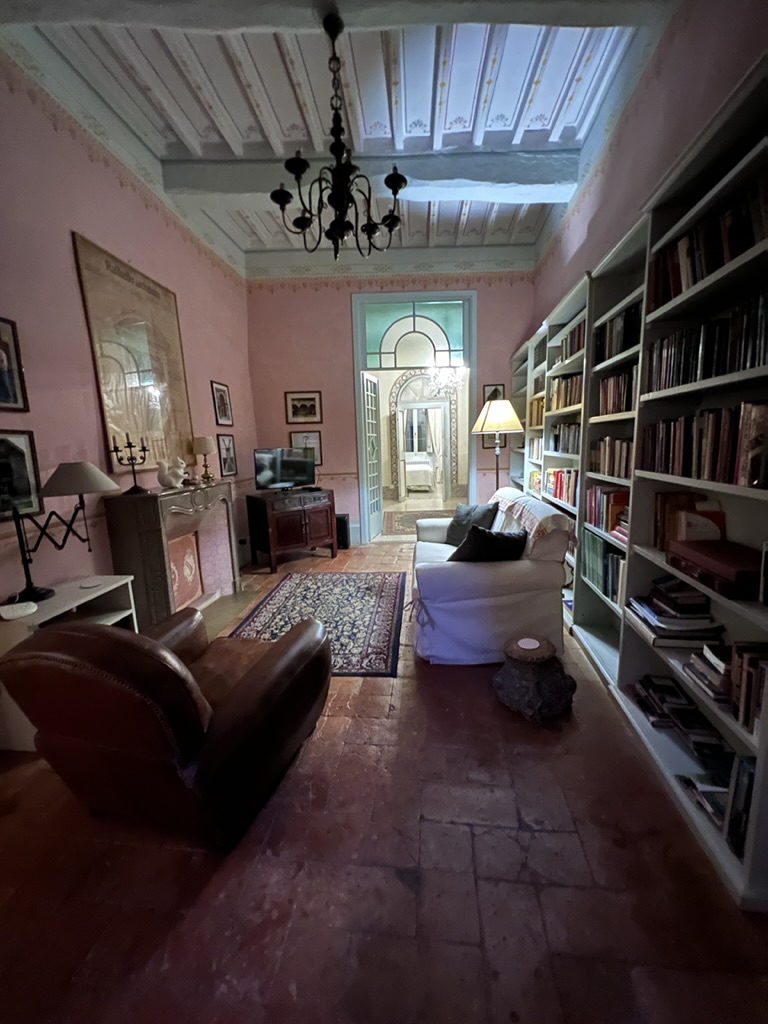
The palazzo is huge—my guess about 2,500 sq feet with ceilings heights at about 11 feet. Mike says my guess is pretty good, but it may be more like 2,100 feet… Anyway, it’s up a flight of stairs (internal stairs once you enter) and has lots of rooms. Indeed this morning we discovered another bathroom we hadn’t even found last night. Officially there are two bedrooms (or let’s say, two rooms with beds), an entry room with grand piano (which I assume was here when they bought the place because I cannot imagine how you could get it out, an eat-in kitchen, a dining room, a very large living room, a library, and three bathrooms (one does not have a shower). The rooms all connect so you feel as if you are constantly going in a circle. More on the house and the town tomorrow.. Lots to explore. We did go for late dinner—climbing I’m not sure how many steep stairs—at Umbria Ristorante where we shared the veal tartare which was delicious and huge, a pasta carbonara that was excellent, a wild boar dish, and a rabbit dish and a bottle of wine… and a “calorie-free” dessert (my words—to assuage the guilt). Had we realized the portions would be so huge, we would have ordered less. But we were famished and it was a trying day. By the time we left the restaurant it was about 11:00pm and we strolled between the raindrops back “home.” Tomorrow we explore.

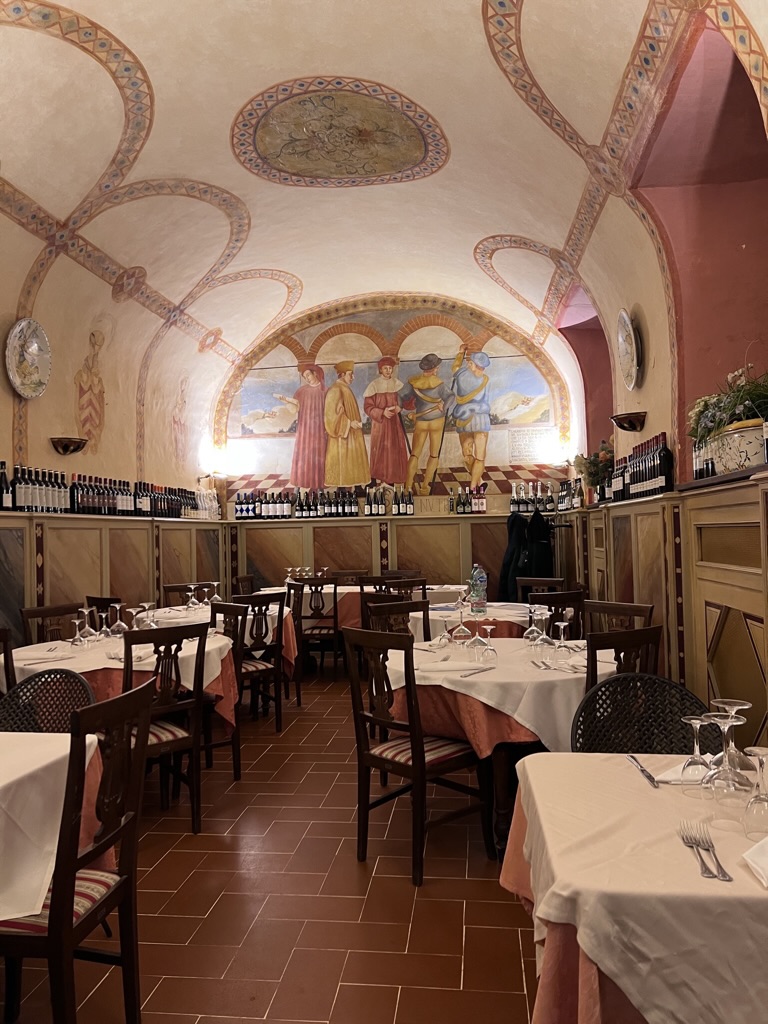
Best to everyone. Tomorrow I’ll also answer some of the questions people have been asking.
For now… Ciao.
Fern
 Fern's Travel Notes