December 29 2023. Vienna!!

Freitag, 29 December 2023
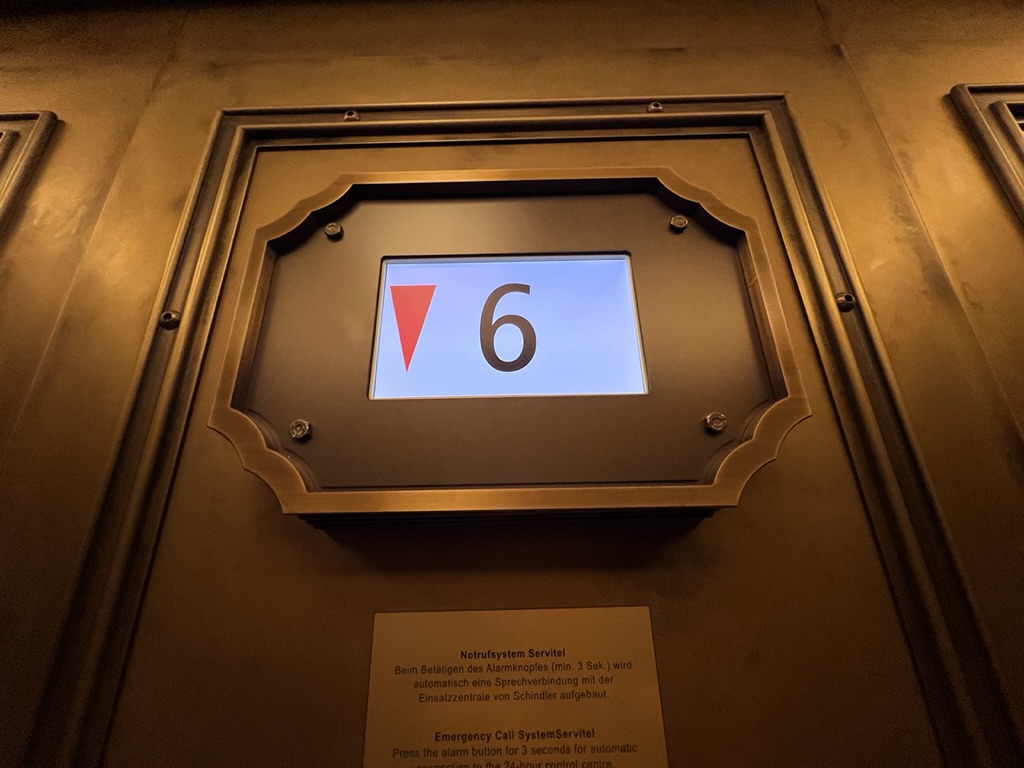
First, a bit more about the problem finding our room in the hotel, last night. Mike decided he should go to a pharmacy to see if they would give him anything to speed up his recovery from the 24-hour stomach flu (which was then in the 48-hour period). He left the room to speak with the front desk folks to find out where there would be an open pharmacy. All of a sudden, I got a call from him saying he was stuck in a stairwell somewhere between the 5th and 6th floors. Apparently, he left the room and turned to the left rather than the right which takes you through a door into a vestibule where the elevator is. At the end of the hall at the right he opened the door, and it was a stairwell rather than the little 6th floor lobby… and when the door slammed shut, it was locked (I suppose that’s for fires). Probably if he went all the way down the seven flights he would have exited outside. But I came to the rescue…
Actually, the hotel is fine and quite popular as a restaurant/bar hangout for young, chic people sporting the latest in European fashion. But they do need some signage!
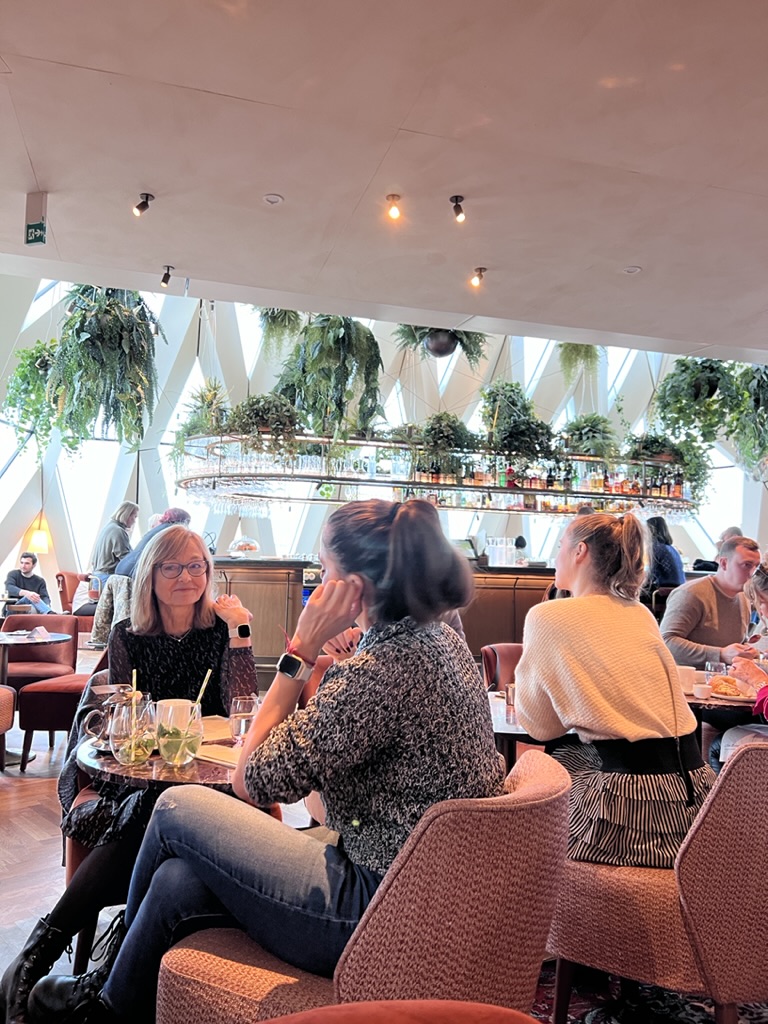
We began our day with breakfast at Chez Bernard which is located on the top floor of our hotel (Hotel Motto). That was after we attempted to switch to a larger room (so I could have a desk in the room). But the hotel is solidly booked. So I had them remove two pink-ish colored easy chairs (1920s vintage, but made to order in recent years for the hotel) so they could put in a desk. Now I’m a happy camper. Chez Bernard is a bustling place so it was amazing we could even get in without a reservation. Food was good, but service was slow. Finally, we set out for the day.
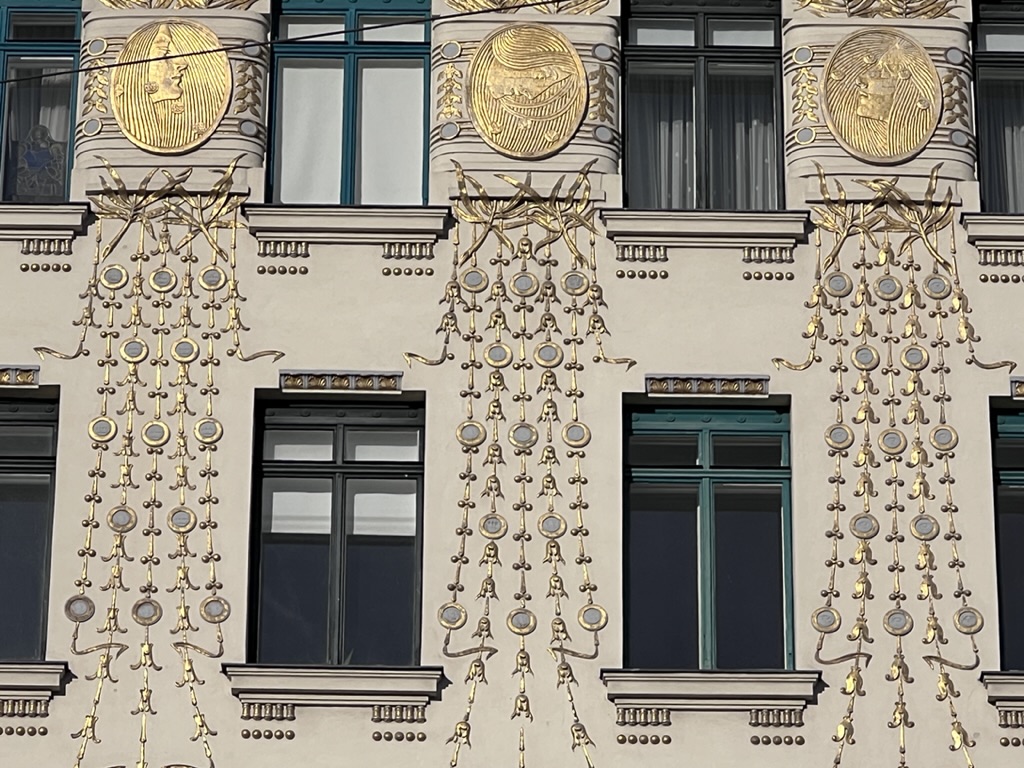
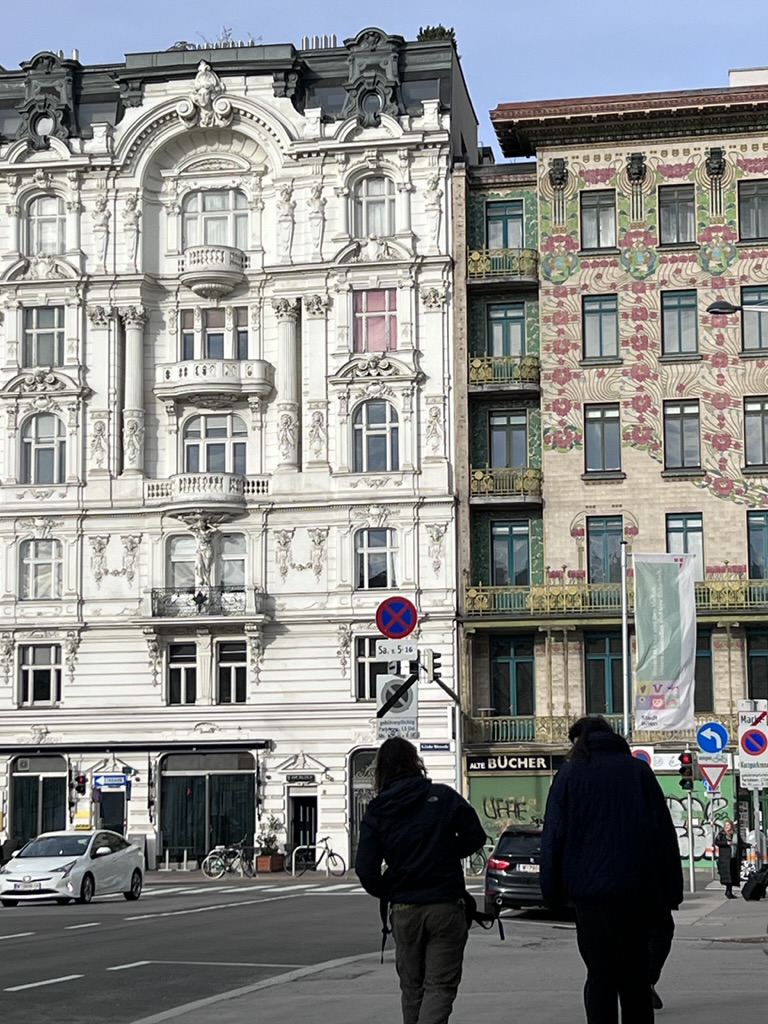
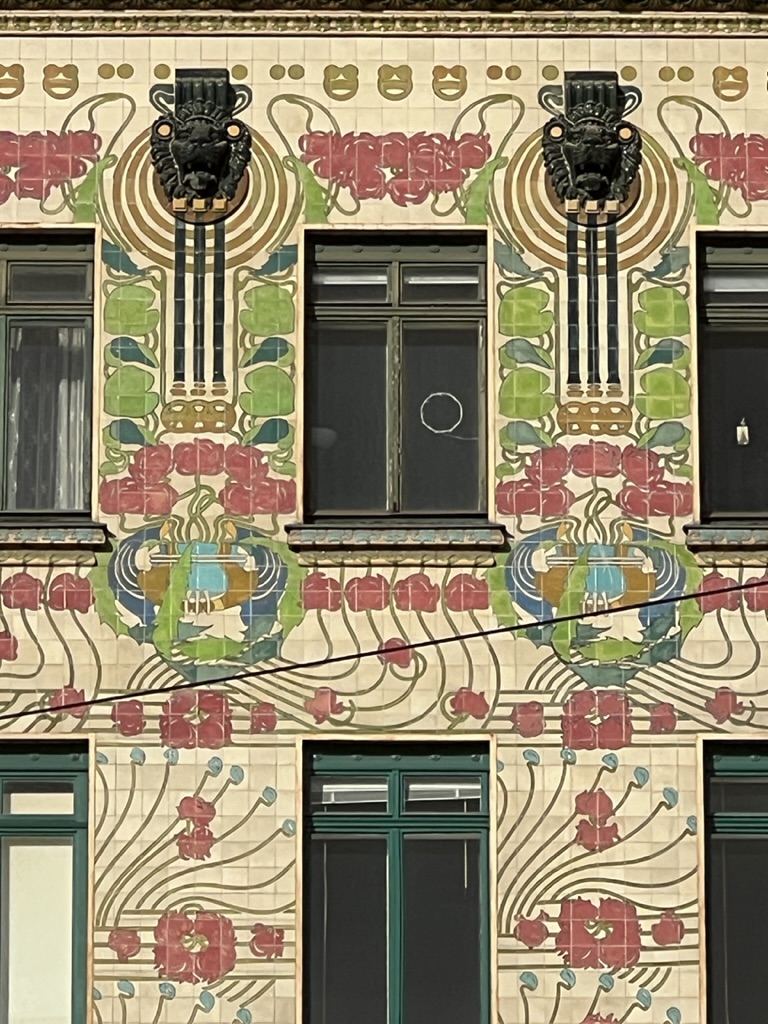
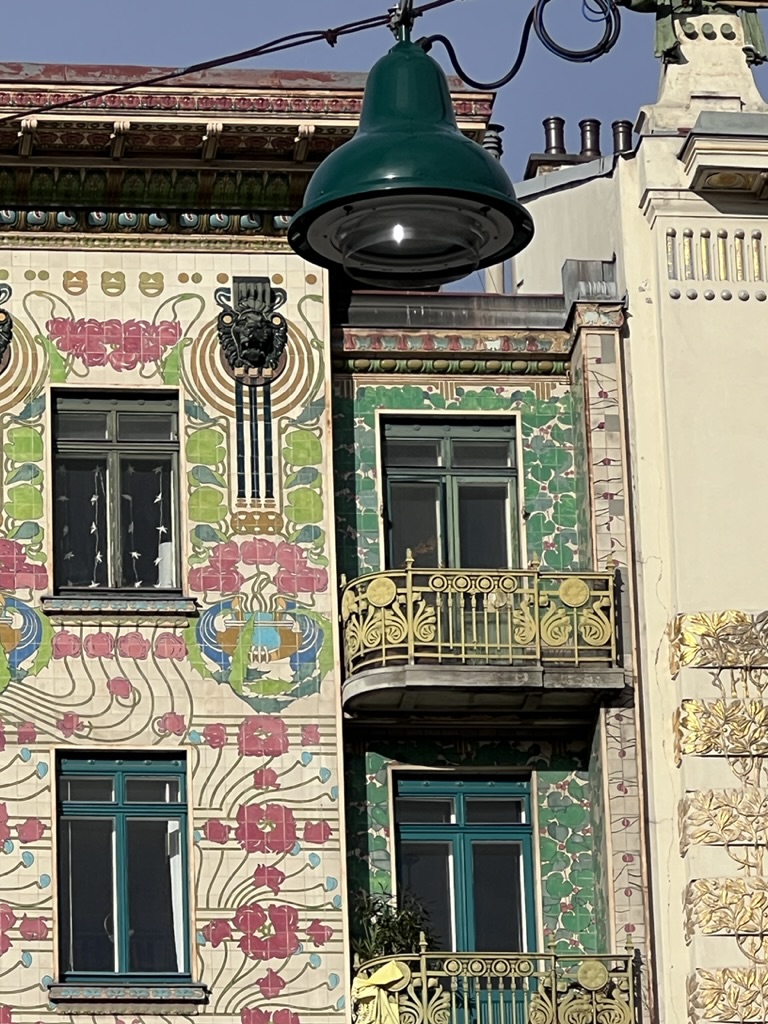

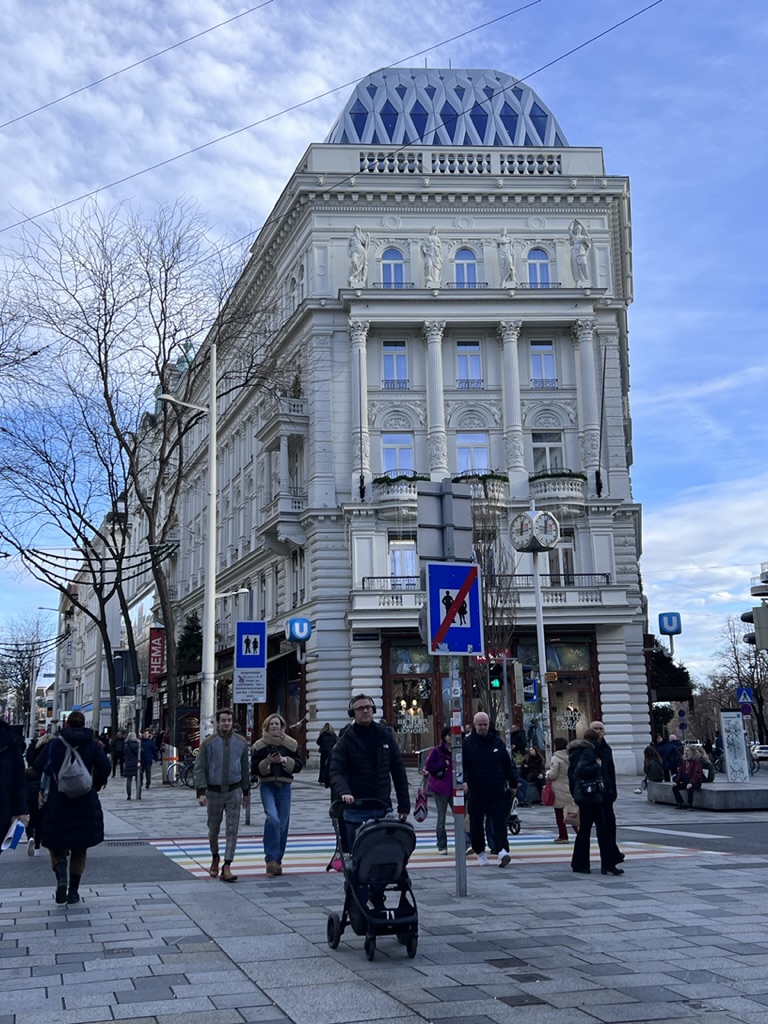
We headed to the Naschsmarkt and on the way stopped to look at some art deco buildings by Otto Wagner, including Majolikahaus which was built in the very late 1890s. It’s covered with tiles decorated with floral motifs of the Art Nouveau period and style. Next door is another building designed by Wagner which is covered with gold and white medallion-like shapes. Both buildings, I believe, were owned by Jewish families who were relocated (one was moved to the ghetto and the other fled to South Africa) during the Aryanization of Vienna. As I understand it, the Majolikahaus was owned by a Jewish developer named Wilhelm Frankl. Austrian officials determined he was “insane” so that they could take over the building which was deemed an architectural treasure. It was sold to a butcher and after WWII the original family (I guess with Wilhelm no longer being insane) sued unsuccessfully to get the property back. The butcher eventually donated the building to the church, which re-sold it fairly quickly.

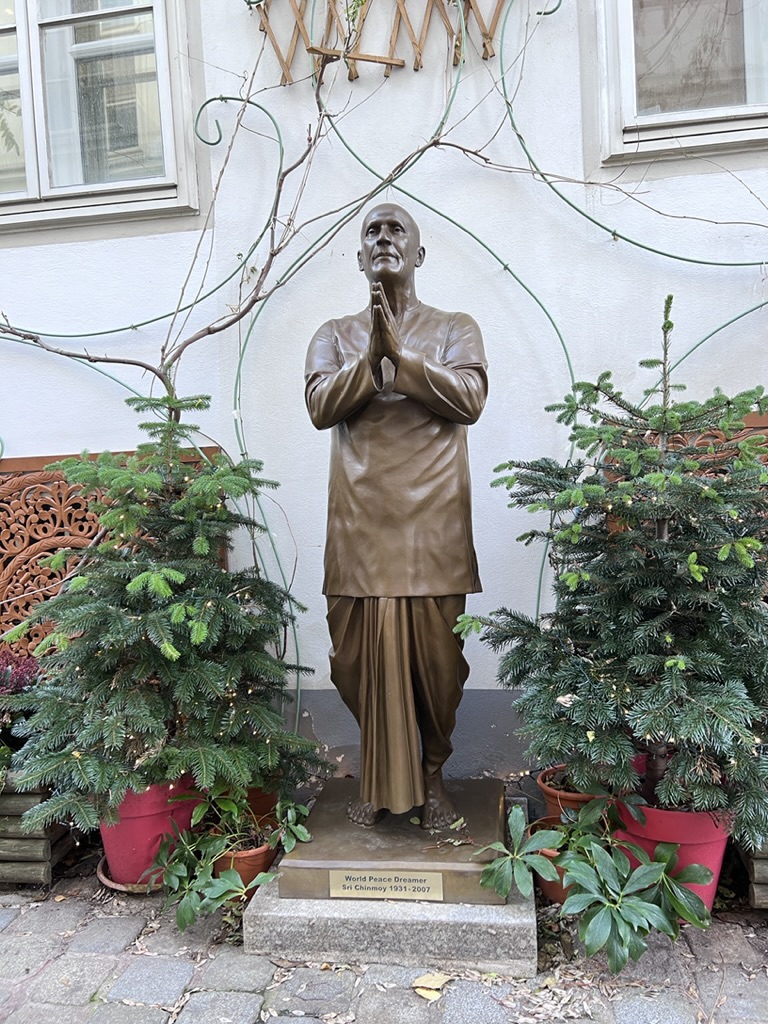
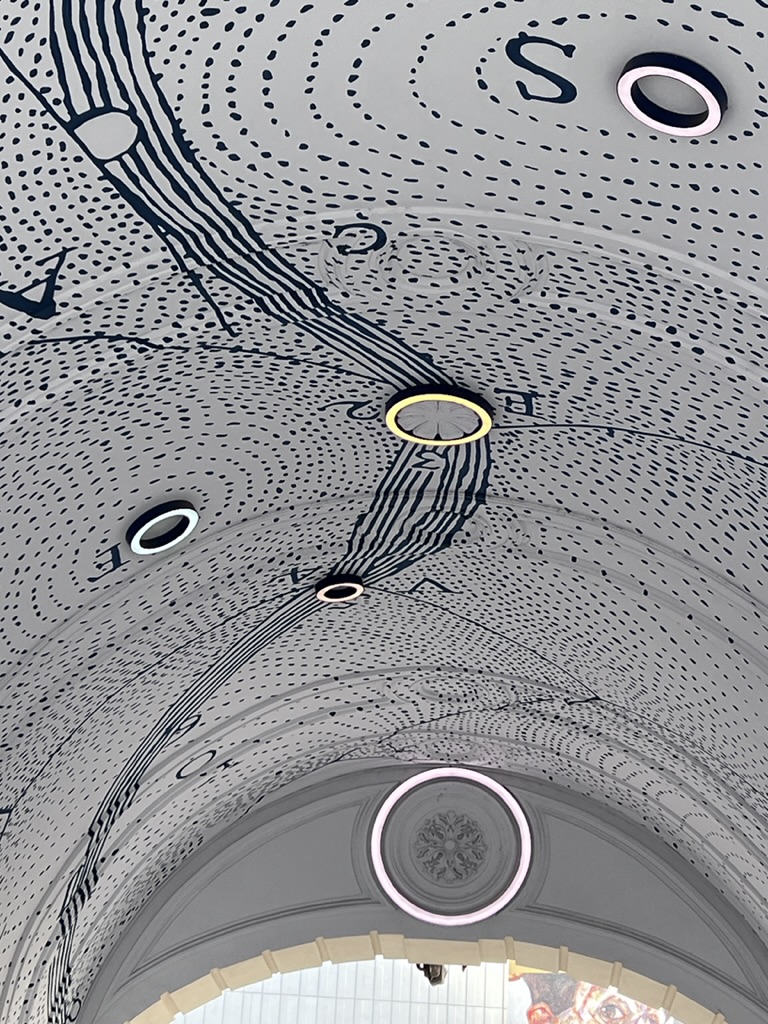

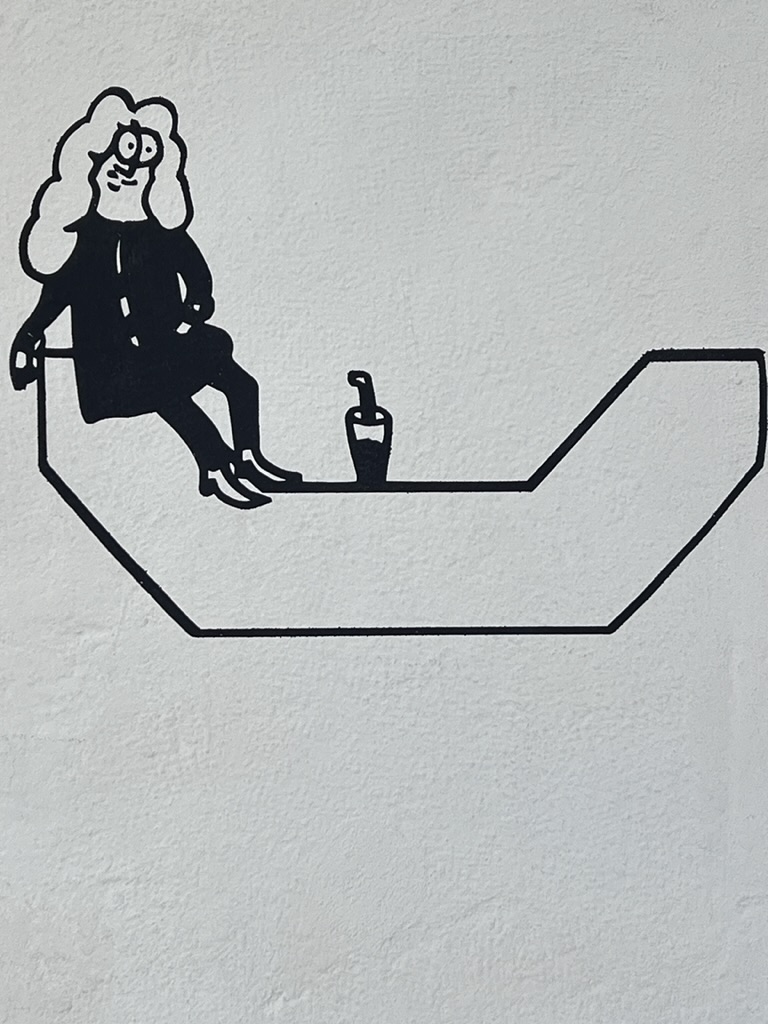
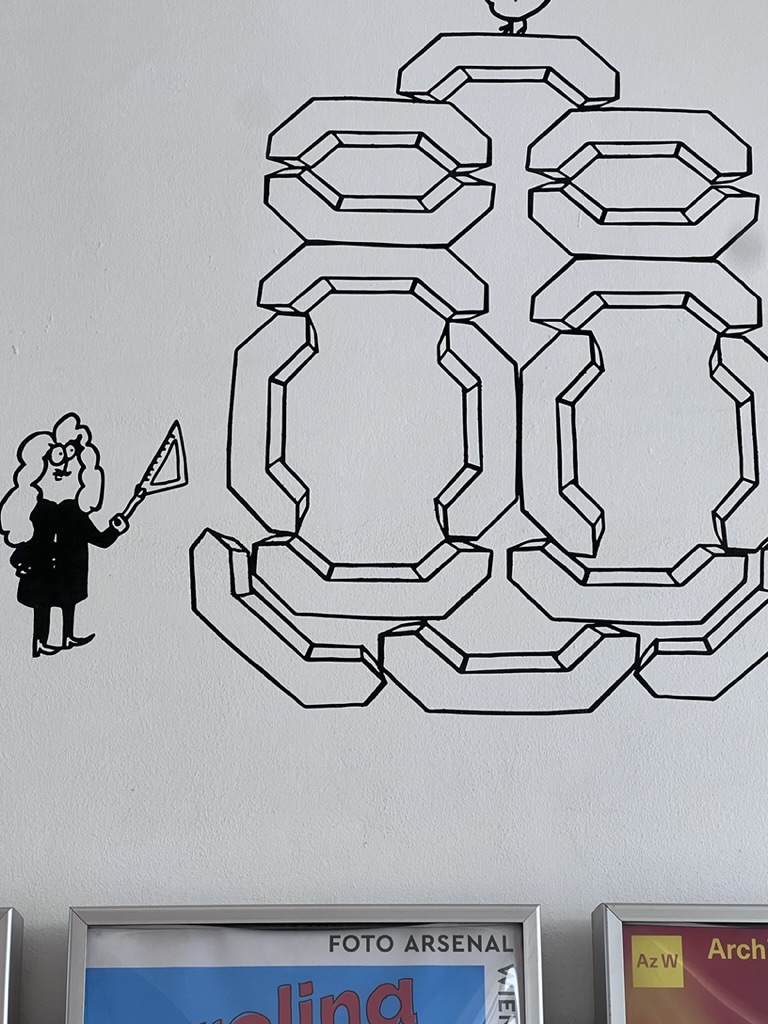
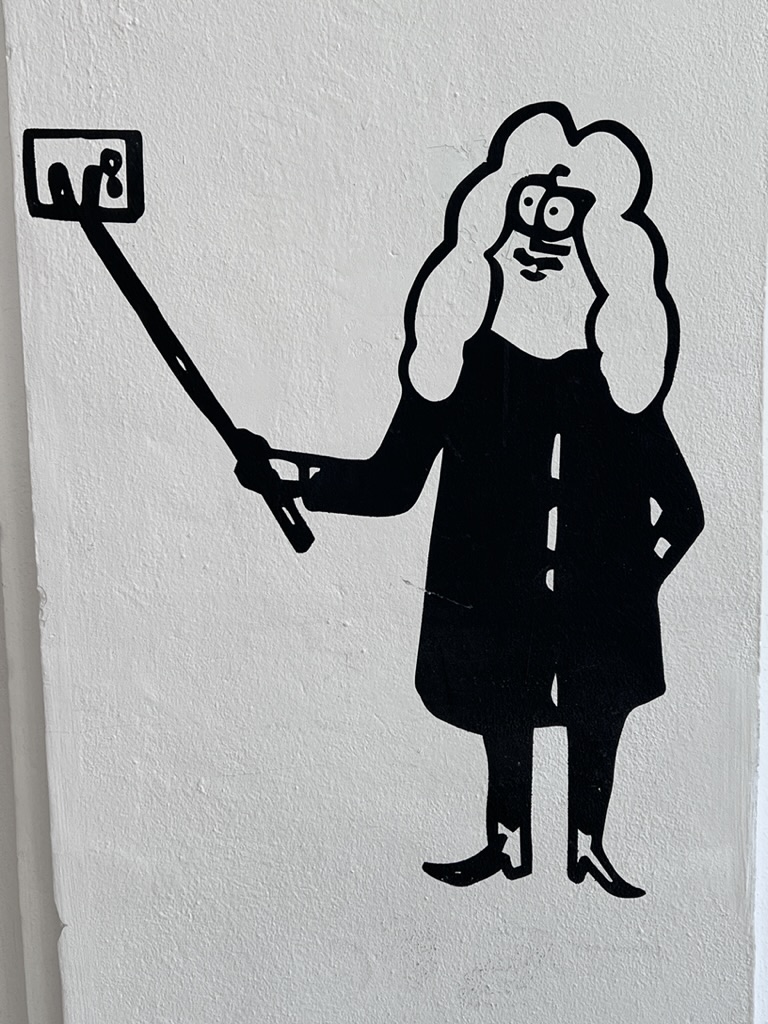
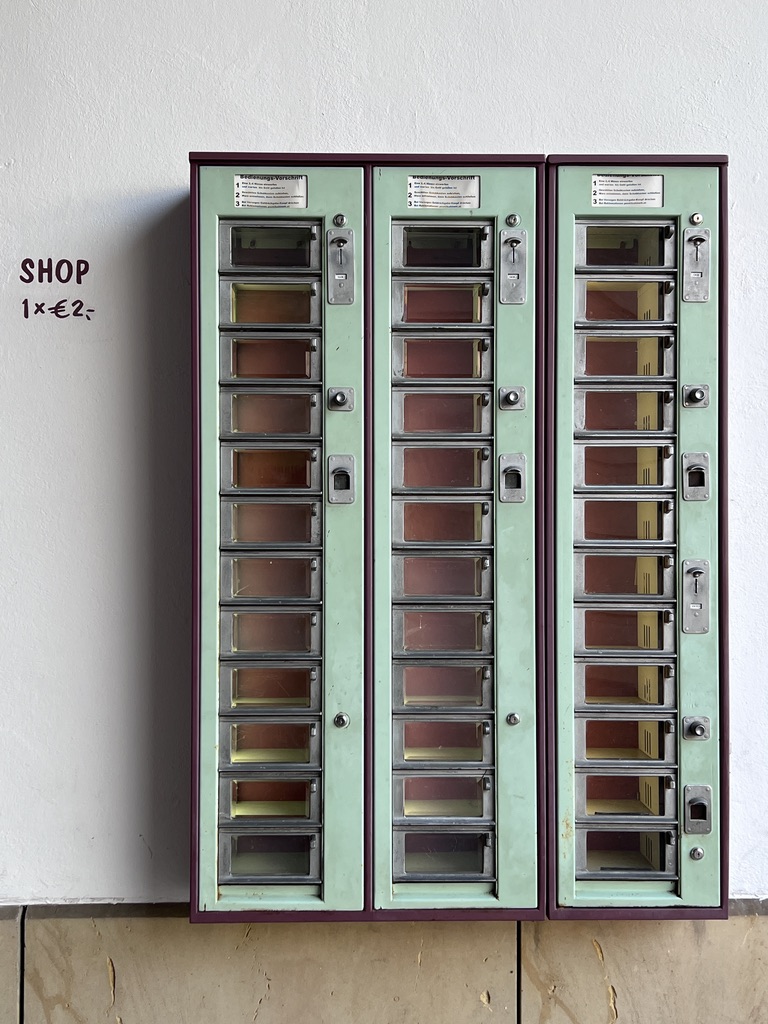
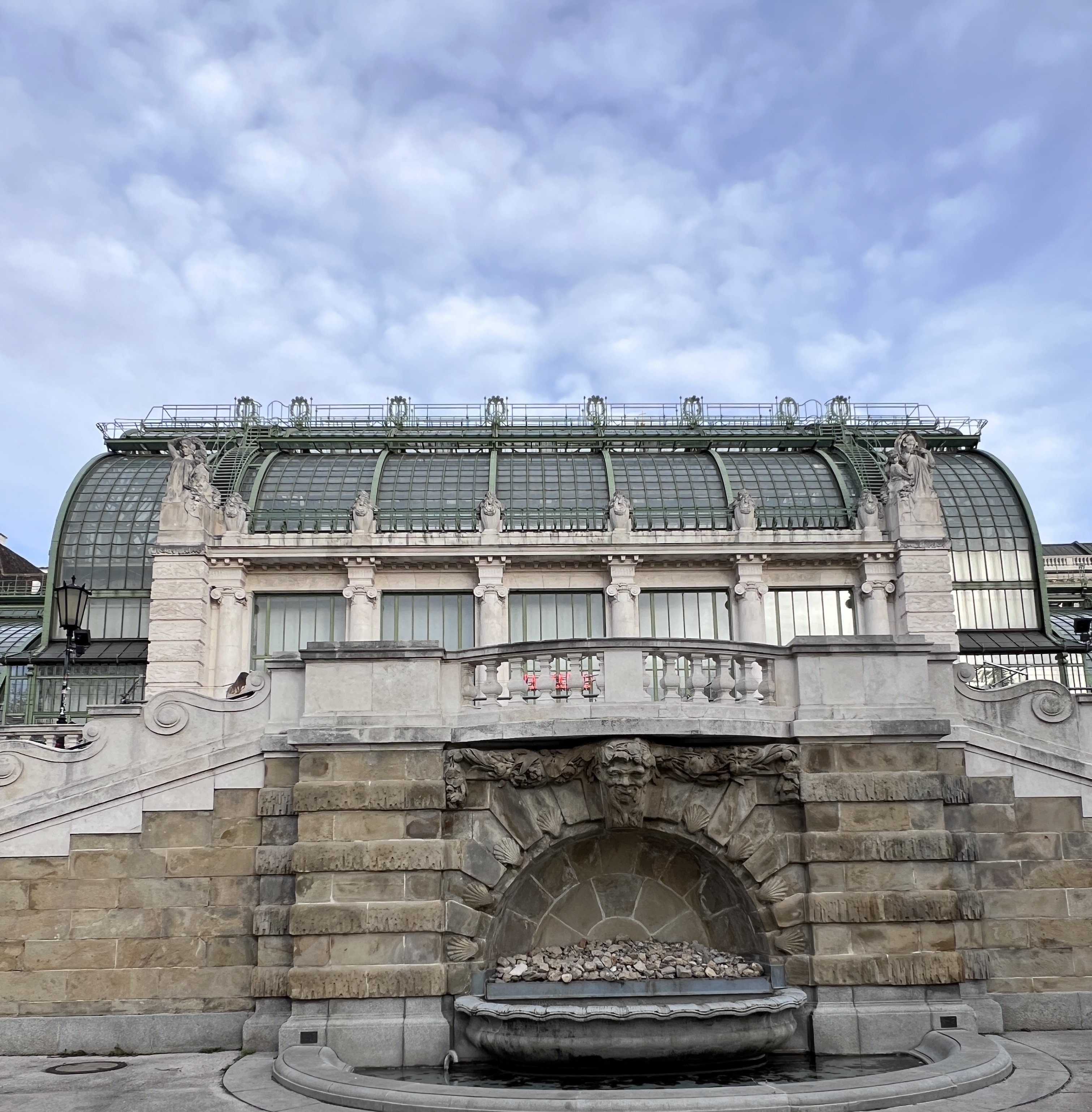
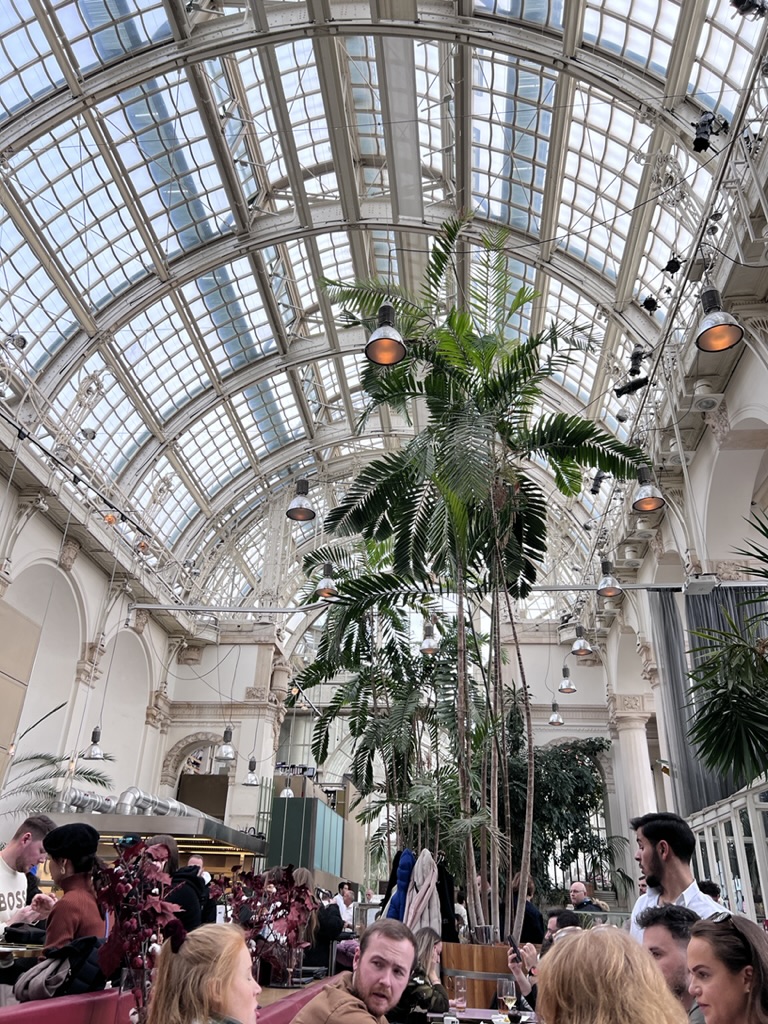
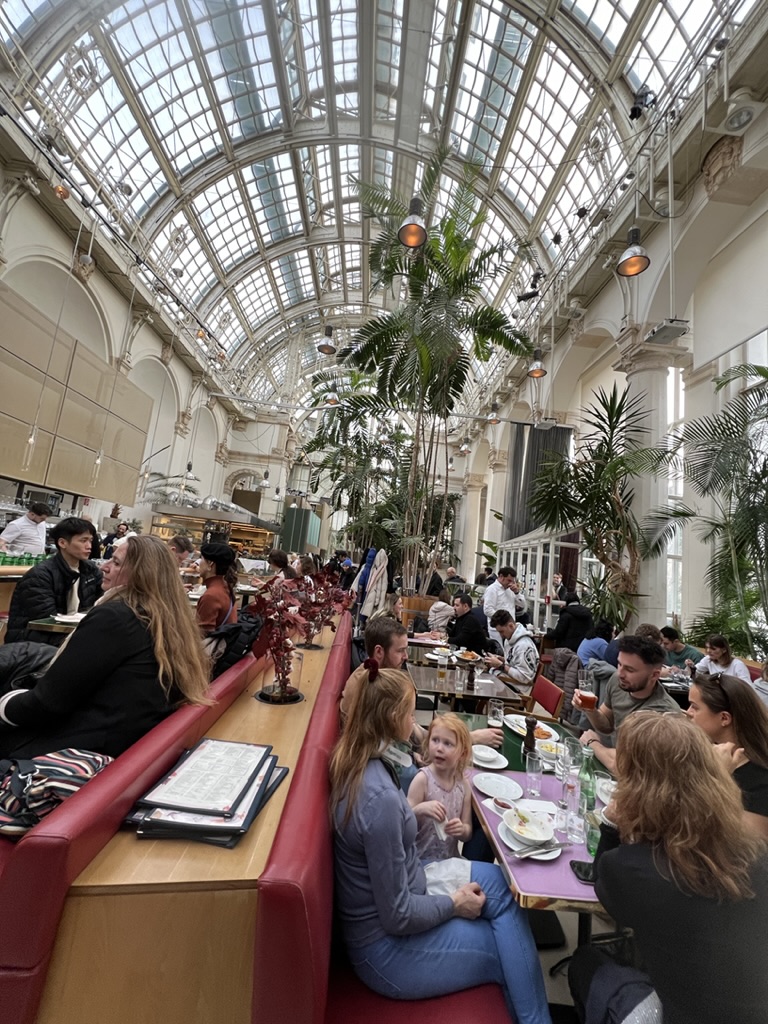
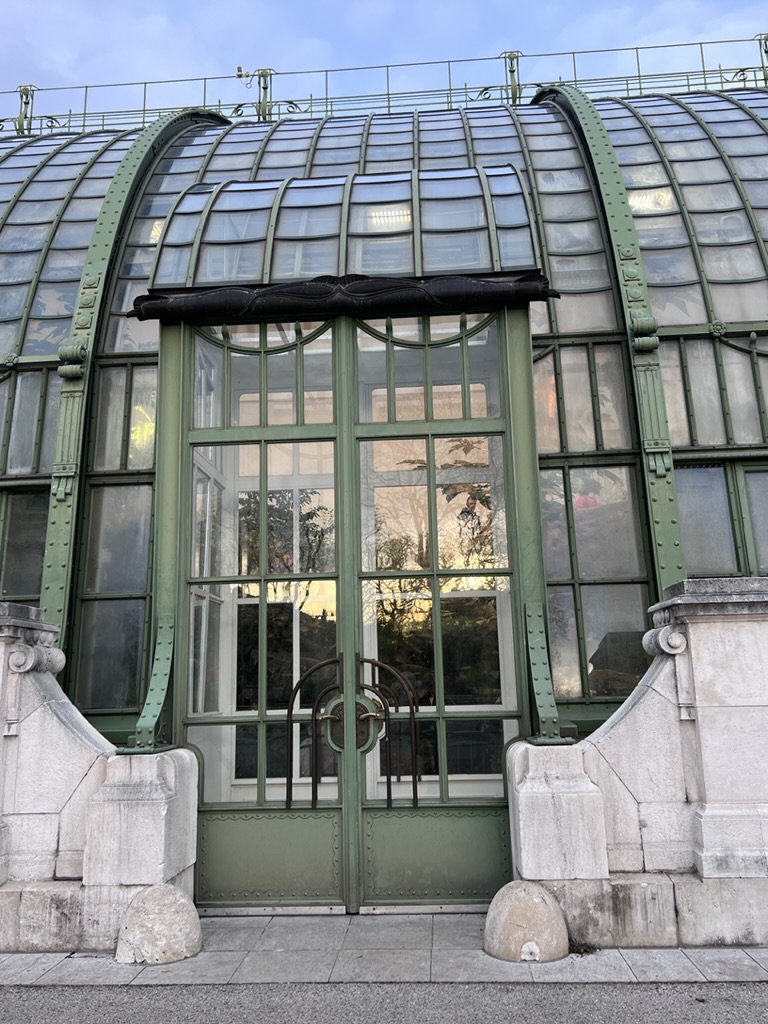
From there we walked through many interesting streets requiring stair climbing and navigating many courtyards…. Until we found ourselves walking through the “Museum Quarter” which meanders through several arched walkways that have been painted in contemporary styles. I think they may repaint those ceilings periodically with different patterns. Then it was time for a late lunch, so we headed to the Palmenhaus and waited a bit, but did get a table. Palmenhaus Restaurant is located within a greenhouse that was originally built in the 1820s. The greenhouse was demolished about 80 years later and then a new building that reflected the new Jugendstil (Art Nouveau) era was built some years later. Palmenhaus was home to important exhibits in the first few decades of the 20th century and then was closed for some time and then restored and reopened in the 1960s. The restaurant sits in the center of the greenhouse.
…Pleasant knock on the hotel door just now—with a very upbeat guy delivering “evening drinks” to the room. I gather this is a nightly occurrence. I opted for champagne—so here I sit, drinking my bubbly and writing to you. Given that this was Mike’s first full day of not being really sick, he is napping and missing the drinks.
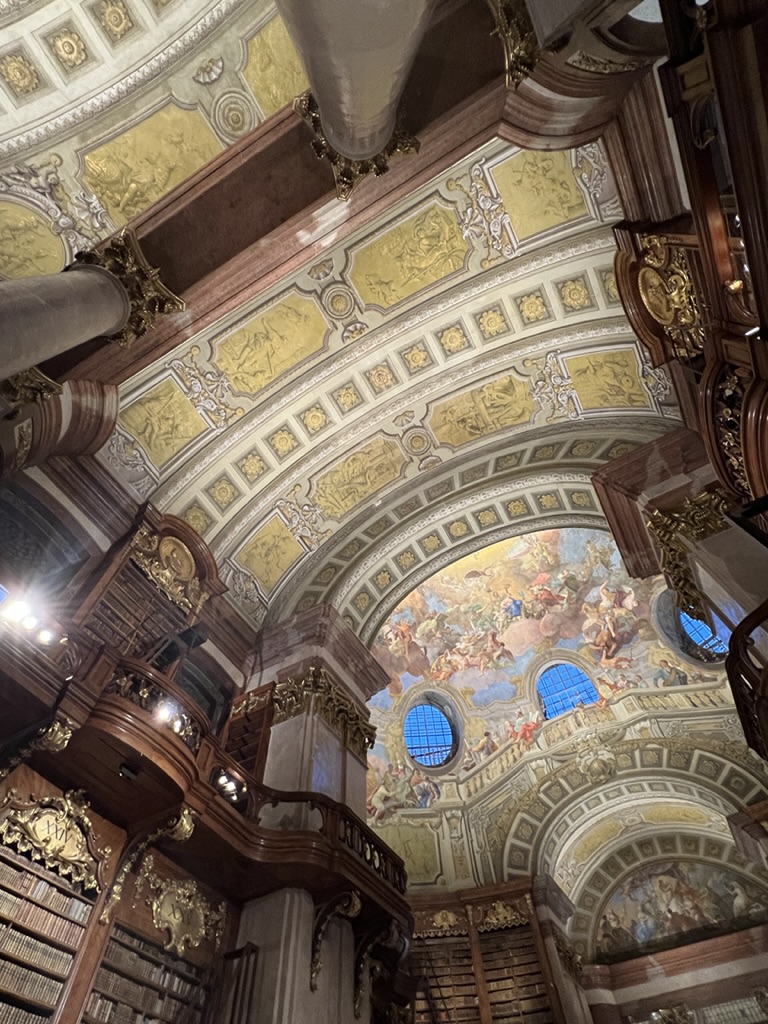
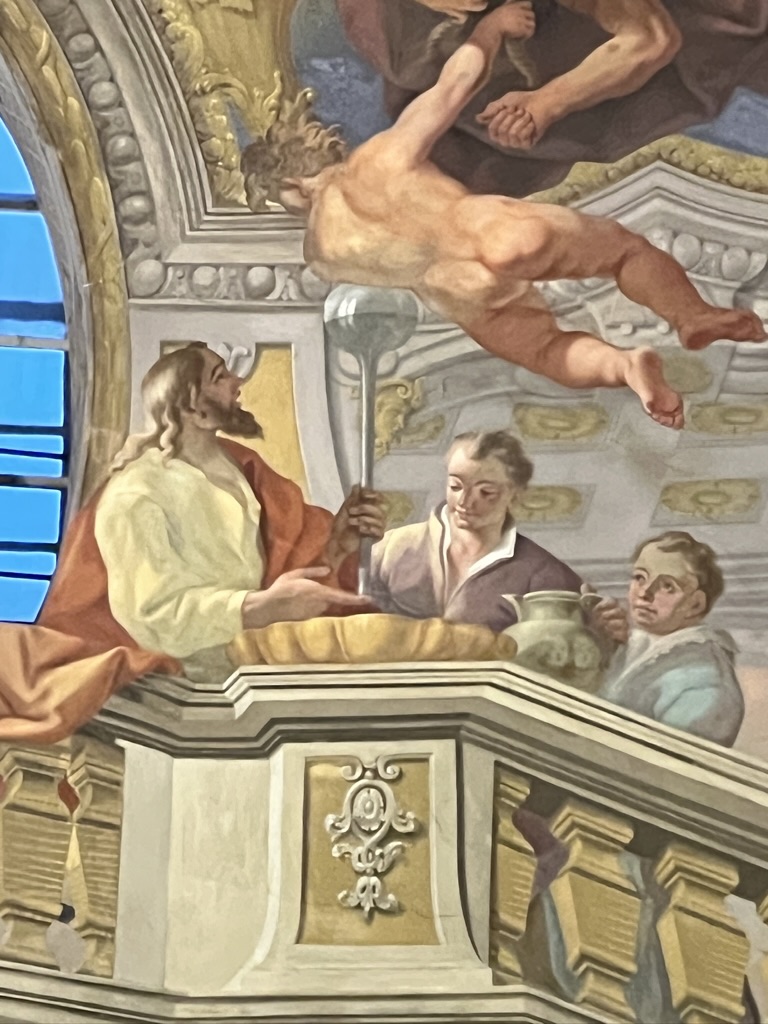
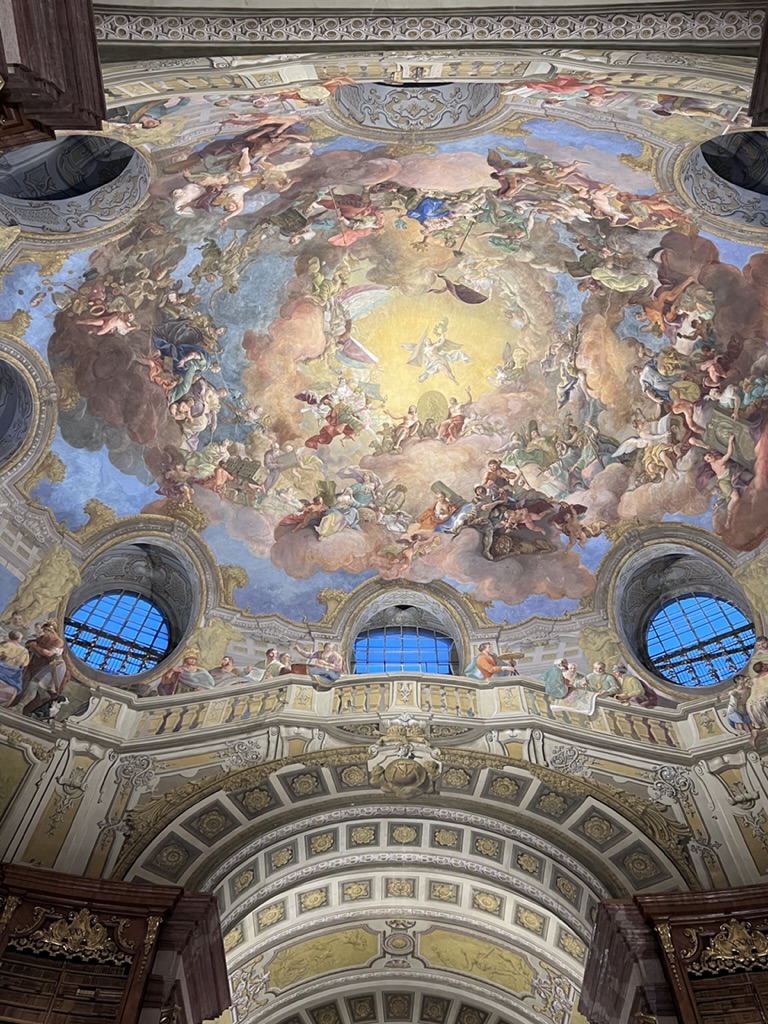
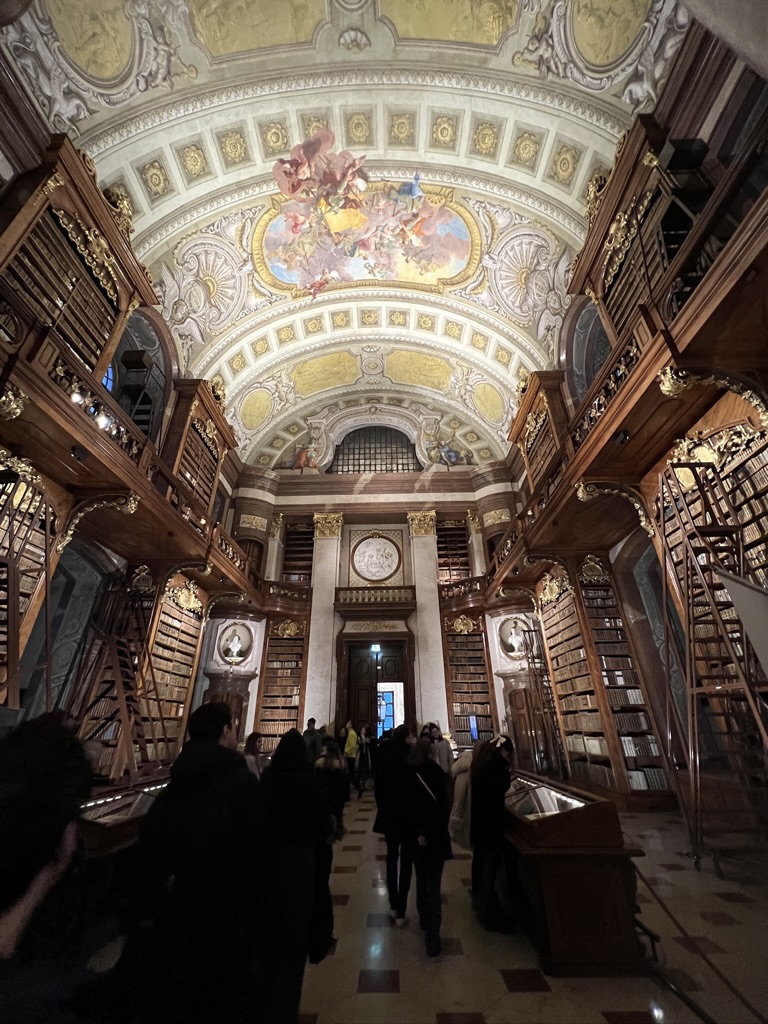
From Palmenhaus, we trekked to the State Library which is quite a site…. Baroque in all its glory, with amazing trompe l’oeil murals on the ceiling and archways. Inside the grand space, there was an interesting exhibit about Yoicho Okamoto, a Japanese American photographer who documented the destruction and also the rebuilding of Vienna after WWII. He later became the first American presidential photographer, documenting LBJ.
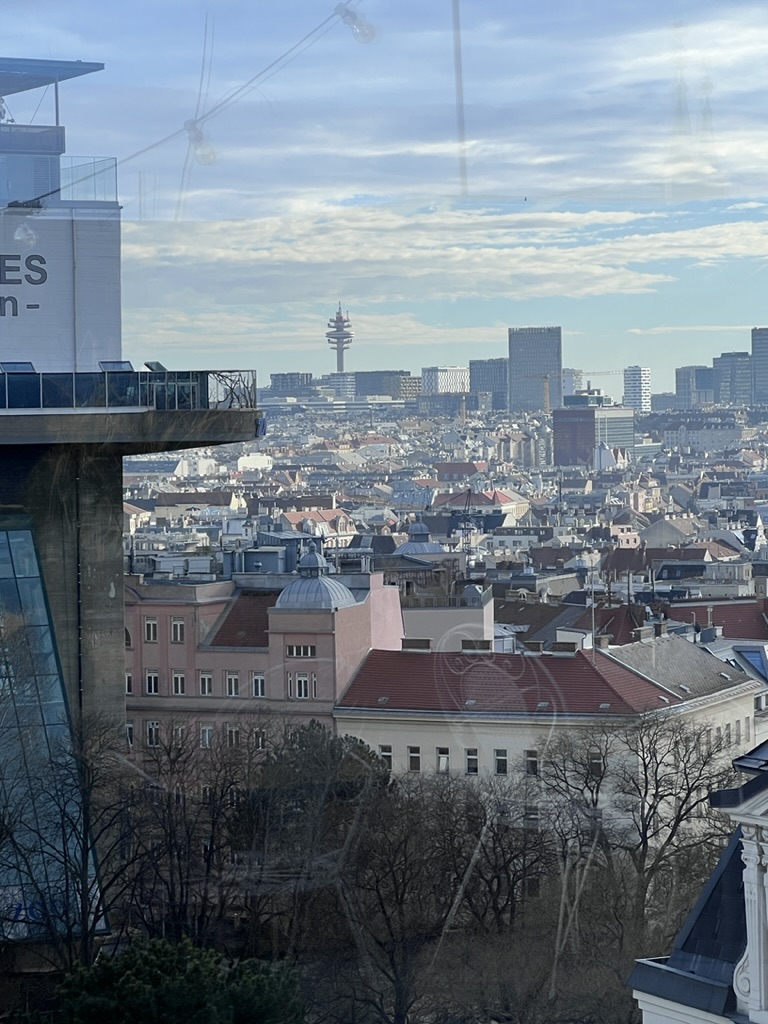
By then, although our little daily itinerary had more places we wanted to check out, we were pretty beat and decided to walk to the U-Bahn (metro) and head back to Hotel Motto, to get ready for dinner (tonight at Vestibul). Actually, I’m signing off now and sending this daily report. I’ll talk about dinner tomorrow if it is really good.
All the best –
Fern
December 28
Greetings from Vienna
On our last day in Geneva, we walked back to Bistrot de Halles Rive to meet most of the clan for lunch. Mike is still a bit under the weather so he’s now an official taster for bouillon at multiple restaurants. The rest of us had oysters and pates and various dishes. I had the local perch.
Then we headed, uneventfully, to the Geneva Airport—entering on the Swiss side this time. The Geneva Airport is officially in both Switzerland and France and it is possible to enter (and depart) from either country. The French side seems smaller, and we often use that because lines seem to move faster. Anyway, we boarded our flight to Vienna and arrived about 90 minutes later. Our hotel is located in what appears to be a hip neighborhood; we are not downtown. More on that tonight after we explore.
Anyway, the hotel is fairly funky with an art deco flair. It’s sort of turn-of-the-century Paris chic: parquet floors, brass, chintz fabrics in pinks and greens and huge chandeliers. There’s a huge red statue /sculpture in the lobby. And among the various free bath items you find in the bathroom (all very branded) is a little box of condoms.
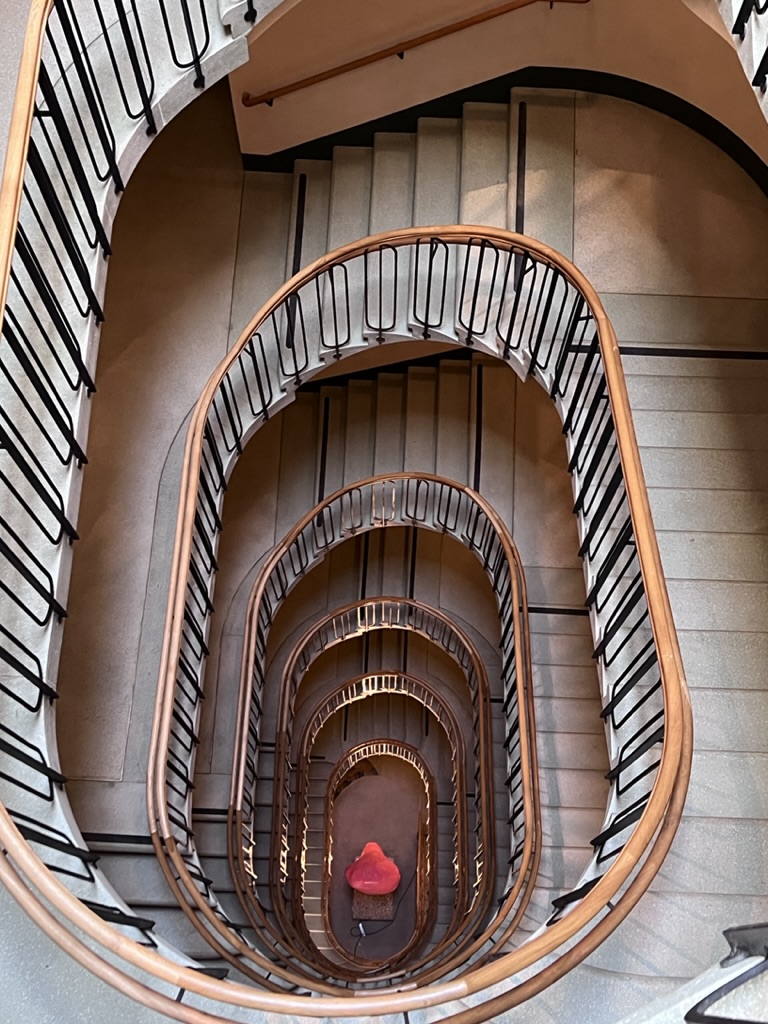
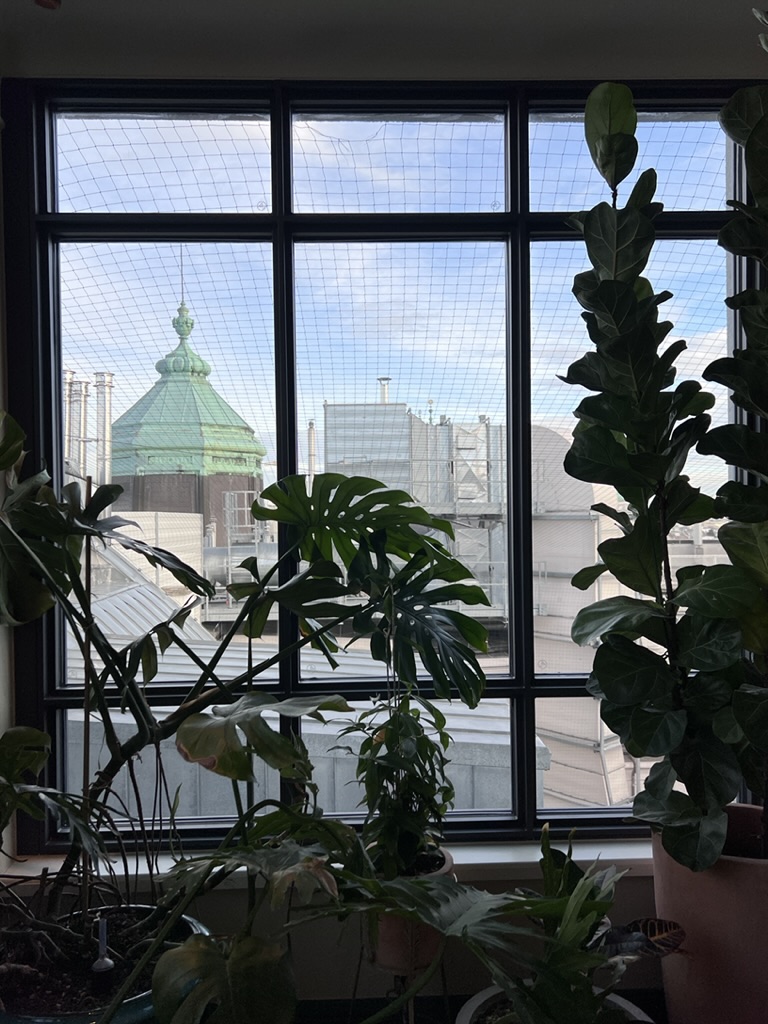
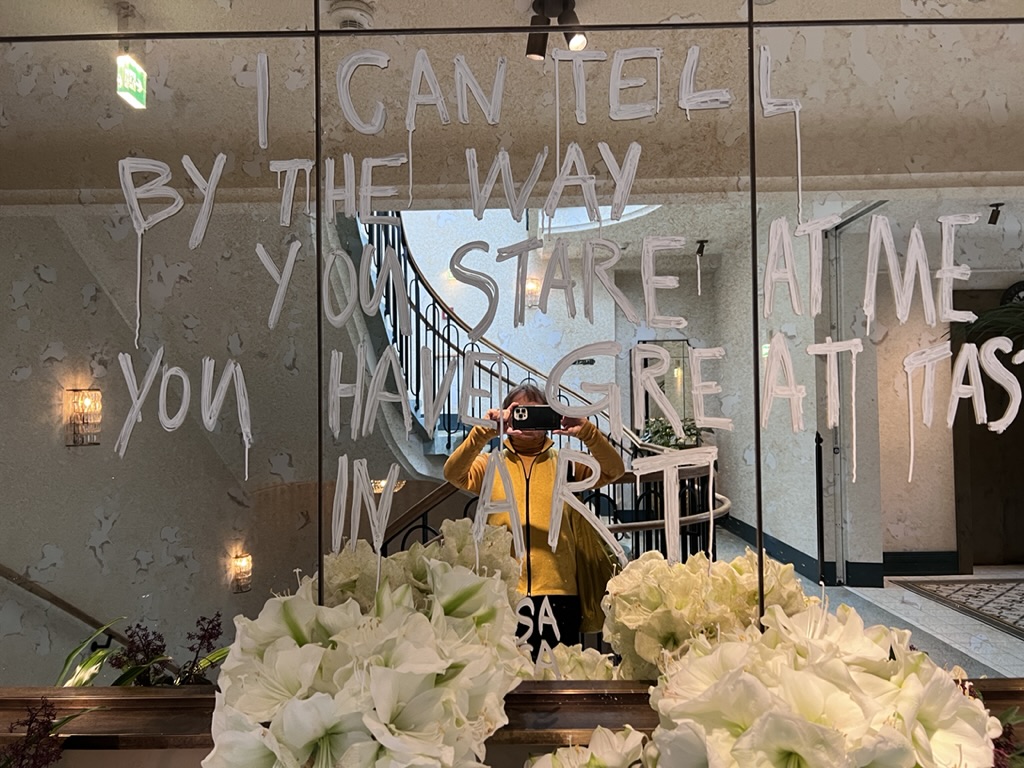
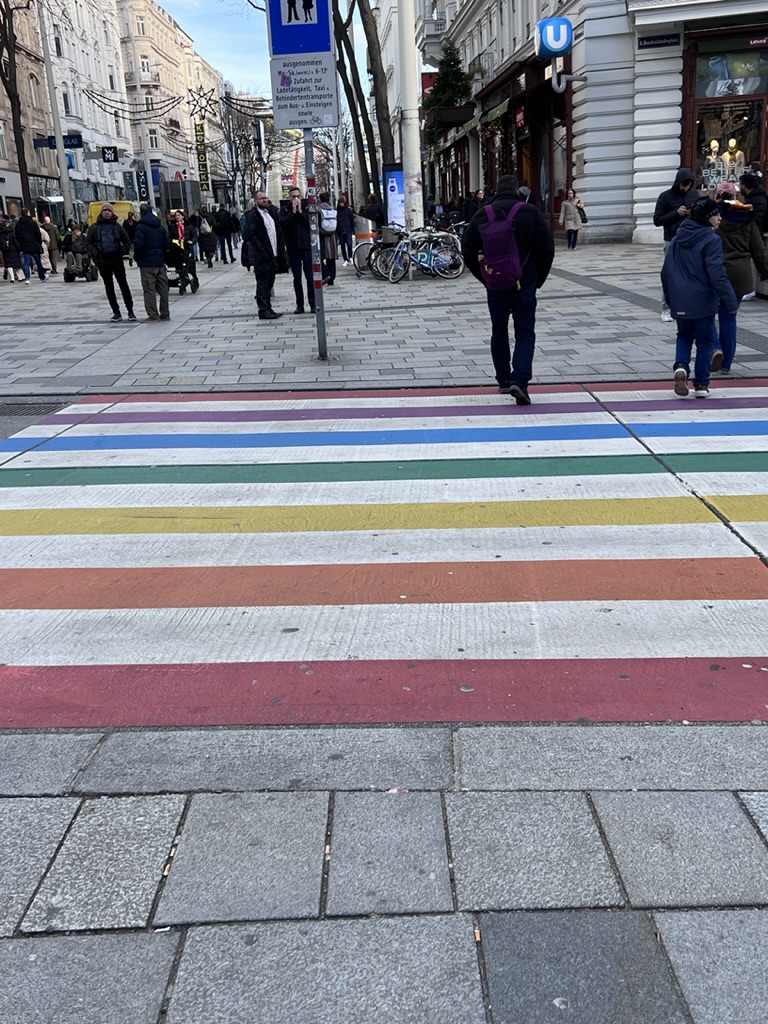
This will either be a favorite hotel or one we hate. The verdict is out until we see more, and in daylight. Our room doesn’t have a desk making it difficult to do this travelogue. We are trying to change rooms, but the place (and the whole city) is totally booked.
I’m off to get dressed and head out to explore Vienna, We haven’t been here in decades.
One funny thing to tell.
The lighting throughout the hotel is very dim… atmosphere, I suppose. The charming elevator which is very art deco and lots of brass. The hotel doesn’t seem to have any bellmen (are there any bell-women?) which is fine. So we got on the elevator and went to floor six. When we got out of the elevator the rooms only went to 613, but we spied an unmarked door (signage here is non-existent) so we went through that door and it took us to a metal grated outdoor walkway. We took that walkway which led to another door and then a small vestibule and another door, and finally there were rooms including 617, our room. We thought it was a very odd way to reach our room…. But oh well. Later I went down to the lobby to ask a question (no room phones, as they just expect everyone will be on their cell phones – very hip), I realized that when I walked out of our room I went directly to a little (actually a rather large) foyer, and there was the elevator. I hadn’t taken that circuitous route on the outdoor walkway.
Turns out it’s one of those elevators that has two 6th floors,. And you need to know which you want (actually its just that the doors open on two sides, but not at the same time.) So now at least we know how to get to our room. Again, no signage.
We had dinner in the restaurant which was packed and again, hip… with lots of people dressed to the nines… and others very sporty. Mike had his bouillon.. I had escargots and steak tartare.
That’s it. Off to see Vienna.
We shall see if they can change our room.
Fern
Greetings from Geneva-
Got a bit of a late start today; Mike still didn’t feel great…but the good news is that whatever he had (probably stomach flu) seems to be on the way out as of now (5:30 pm). It was a bit of a challenge to get some simple food for him at the hotel, as the Longemalle houses a very famous and quite wonderful Lebanese restaurant called Balila, whose menu is not exactly equipped for problematic stomach issues. It took a lot for me to explain that all he wanted from room service was clear bouillon and some rice on the side. They kept offering a wonderful carrot puree and some lentil soup. Finally everyone got it and they were able to do bouillon and rice. Big success and Mike said it was wonderful and medicinal. I also managed to find a pharmacy and got several over-the-counter pills (a few of which he took). During my stroll to the pharmacy, I got some breakfast in a little café located inside a rather chic small department store (that was conveniently just down the street from the pharmacy).
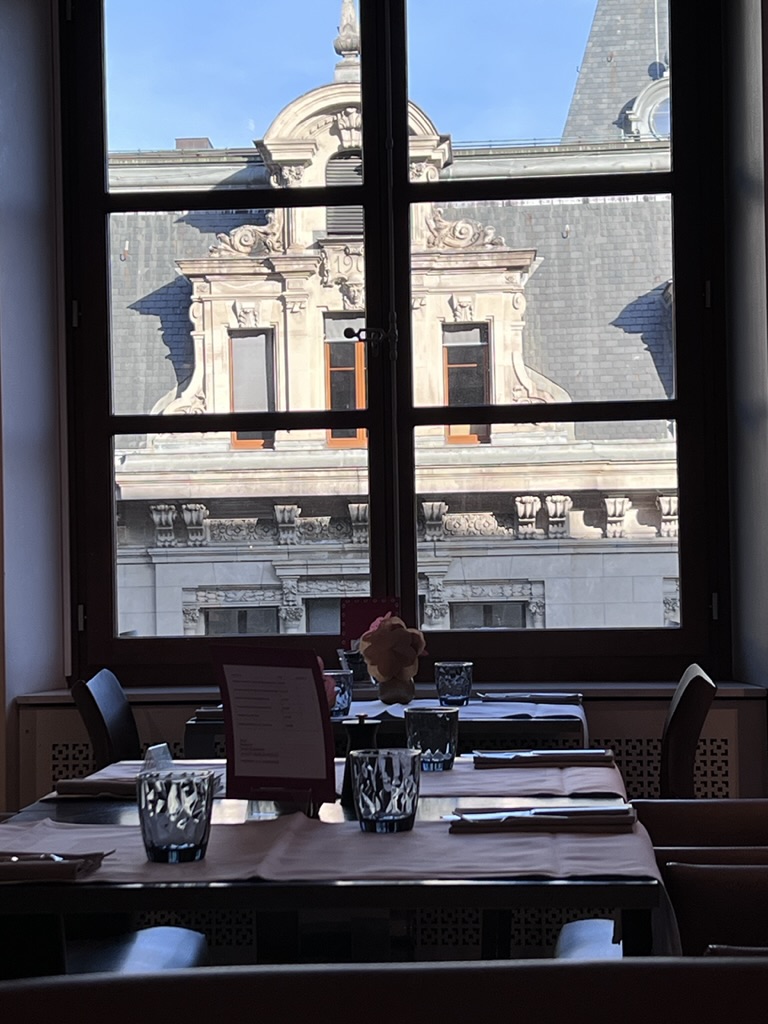
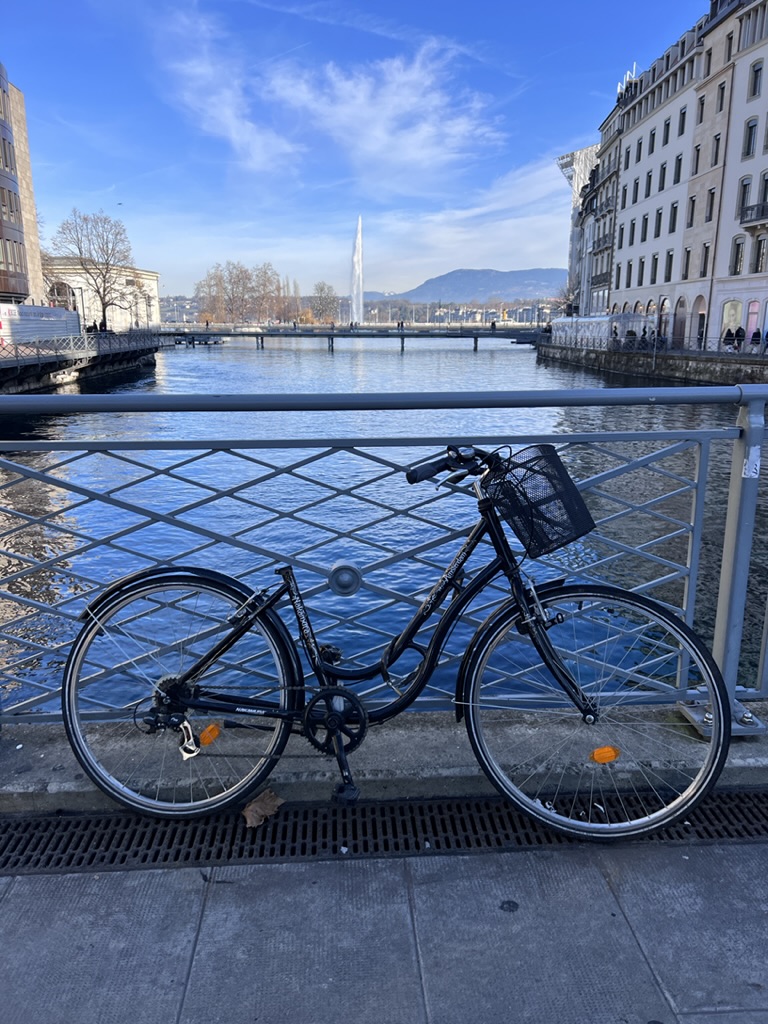
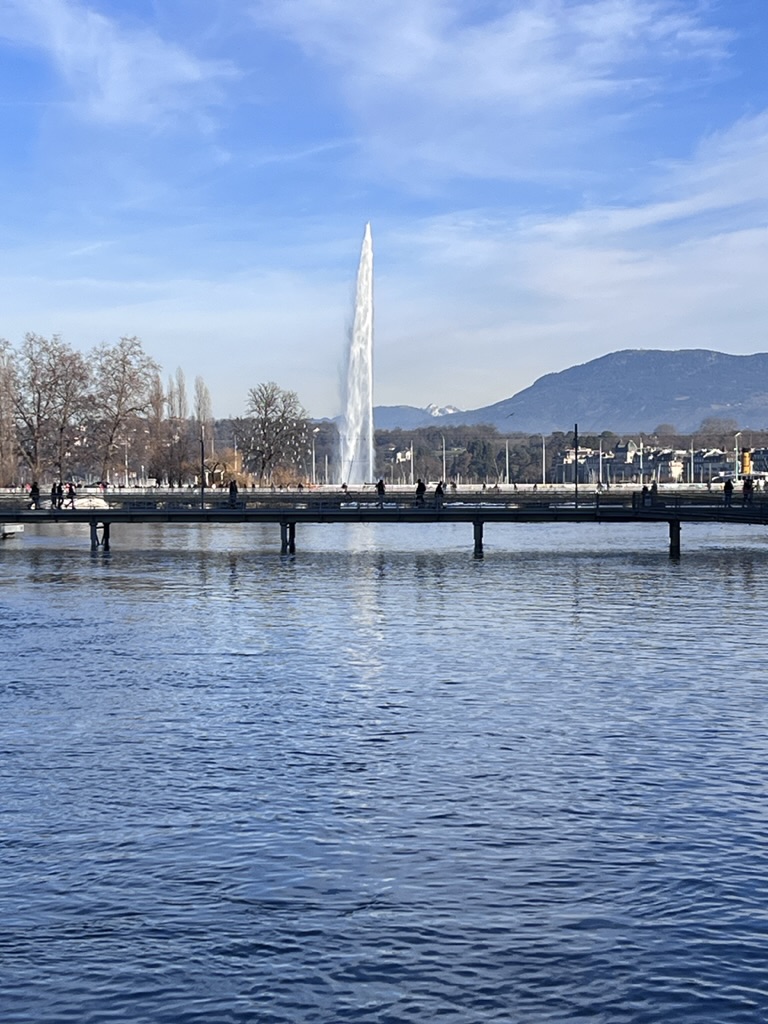
Once Mike was settled and looking forward to sleeping the day away, I headed out to revisit what people here call the “smurf houses” (“Schtroumpf” as they refer to it). Mike and I had visited this housing some years ago but it rained all day so I decided to return given that the weather was on my side today. It was about 1.5 miles, so the walk gave me some of my daily steps. And I learned, a la Wikipedia, that the word “Schtroump” is a French made-up word first uttered by the Smurfs’ Belgian creator, Peyo, when he could not think of the French word for “salt.” So now you know. Anyway, somewhere along the way, the Swiss started calling these rather whimsical houses smurf or schtroumpf houses.
They are truly delightful… and hold your breath… they are subsidized housing units for low-income families in Geneva. The architects were devotees of Gaudi; the houses were built in the early 1980s and they are home to 170 families as rental units, subsidized by the city of Geneva. The rent is based on income. And like in the US, the number of people applying way outnumbers the supply of affordable housing.
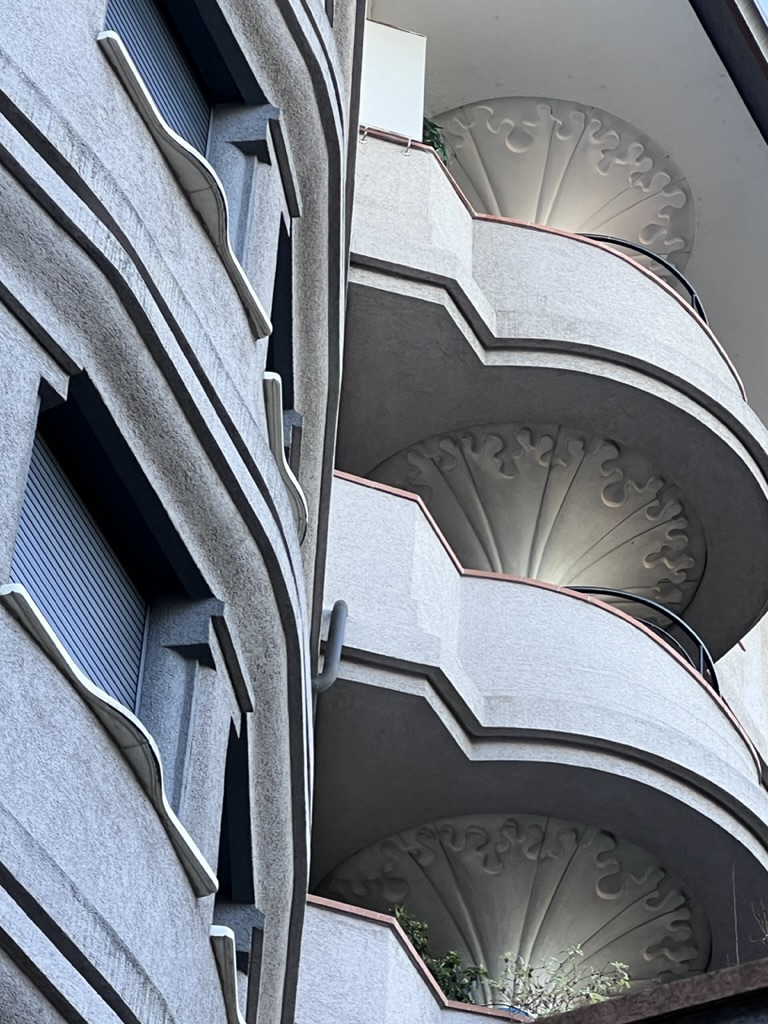
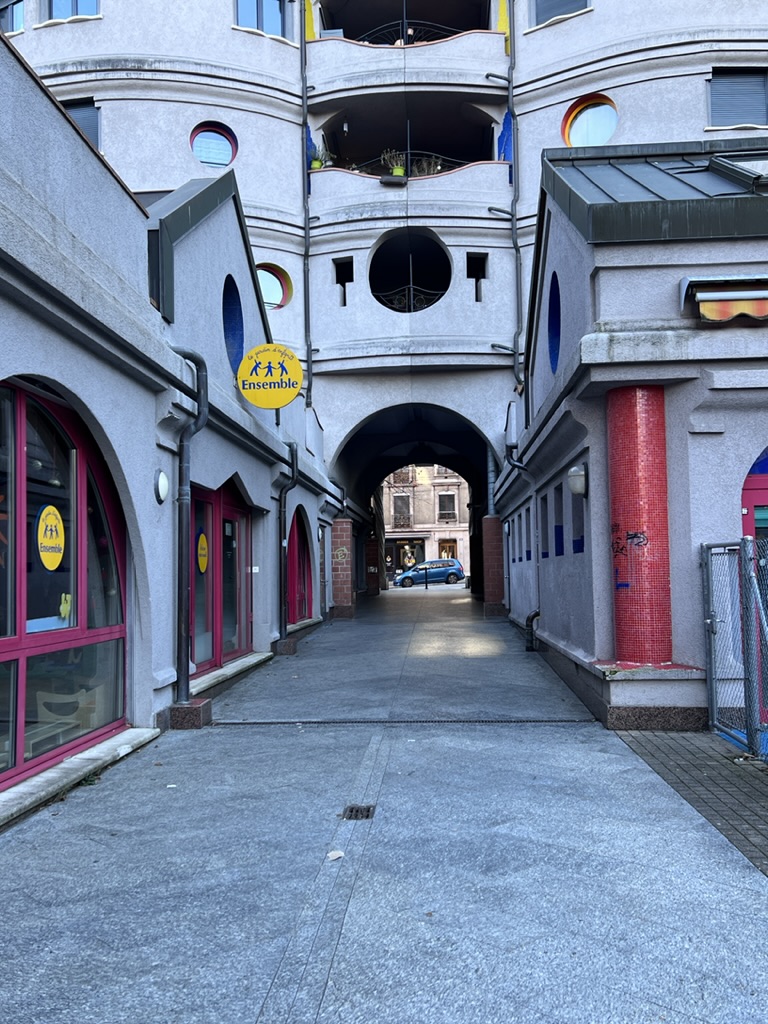
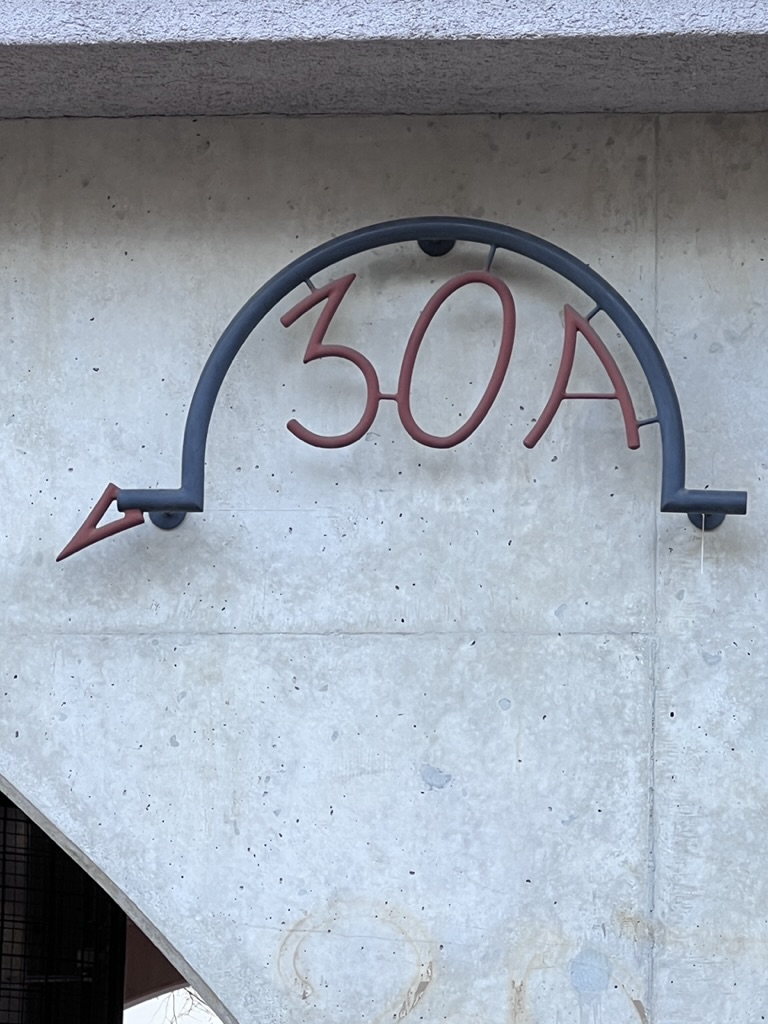
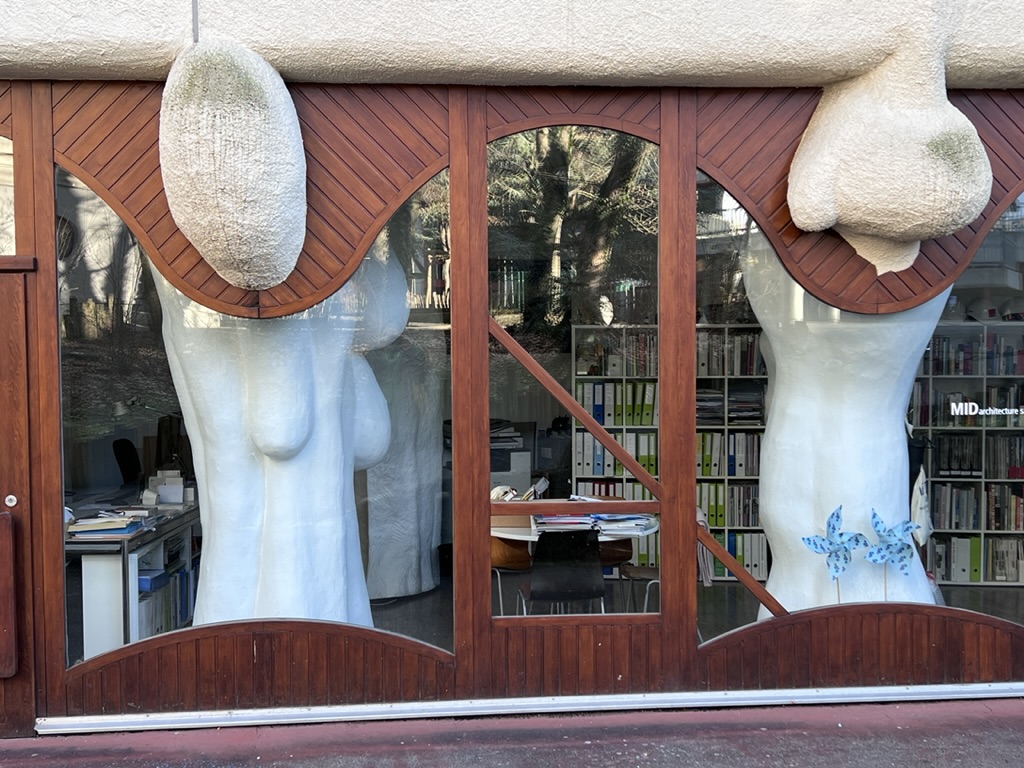
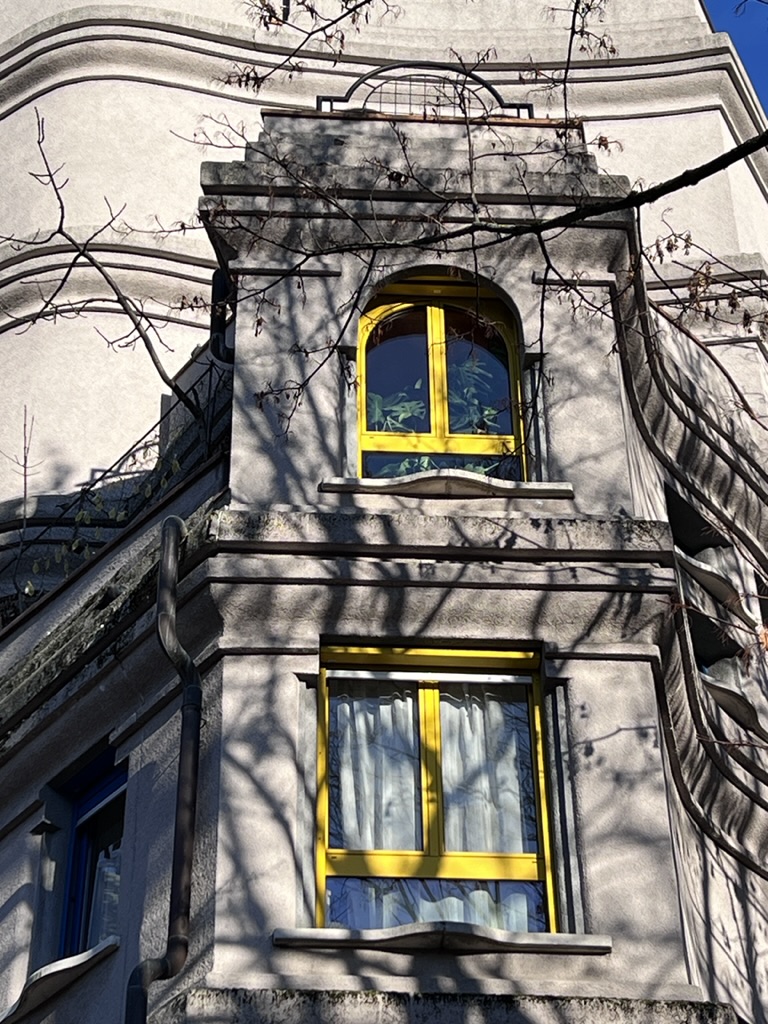
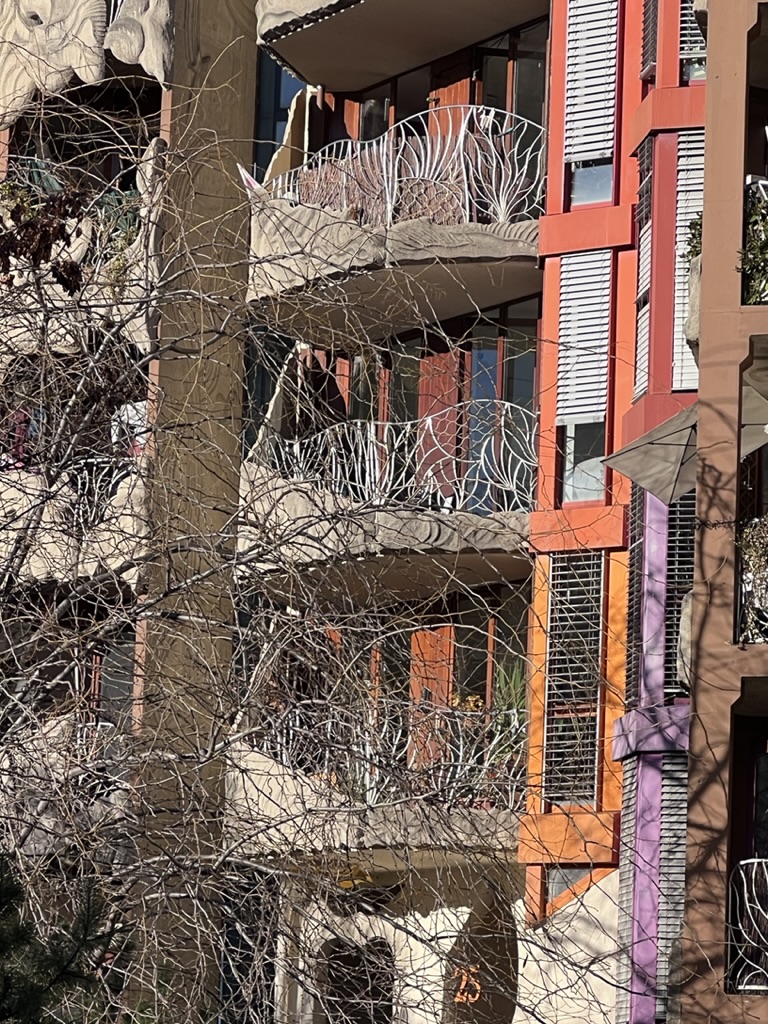
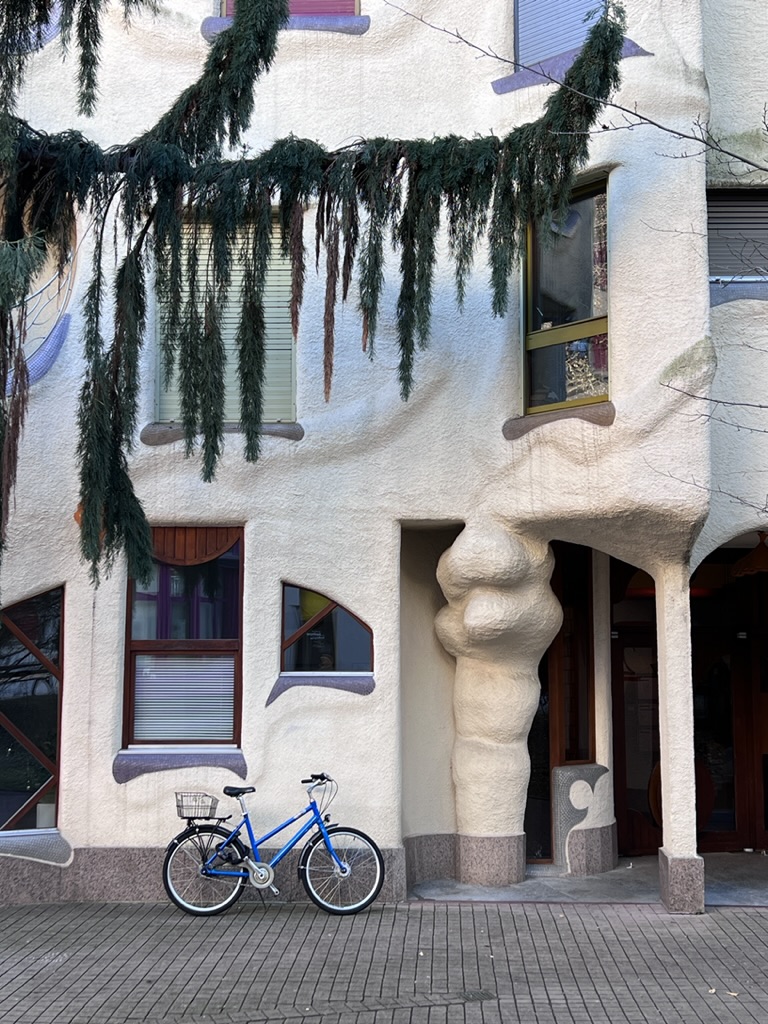
The housing is located in the part of Geneva called Les Grottes Saint Gervais (caves of Saint Gervais) and has an interesting history. The village of Saint-Gervais dates to the Middle Ages and remained fairly rural – with fields, woods, vines, and a scattering of large housing sites — until the end of the 18th century. Then these large plots of land became the sites for small factories and worker housing with small gardens. Later this district was deemed unsanitary and dilapidated and the powers that be intended to raze it.
In 1971 there was a city plan that set to turn the area into a “satellite city” surrounded by roads and highways. But those who lived in the area—low-income people, including many artists and writers and creatives—organized themselves into the “Action Populaire aux Grottes” (APAG) to protest the city’s plans. Apparently, they were successful, and the government abandoned its plans. Instead, there was a renovation project, but the buildings in the area adjacent to Saint Gervais were razed and by the 1930s people said the neighborhood looked like “a peace-time bombing.” Today, I’m told, the Grottes district remains well ahead of other areas in terms of urban participation in Switzerland.
I also lucked out. I wound up chatting with an older gentleman who lives in the project and he offered to show me the inside. Pretty cool.
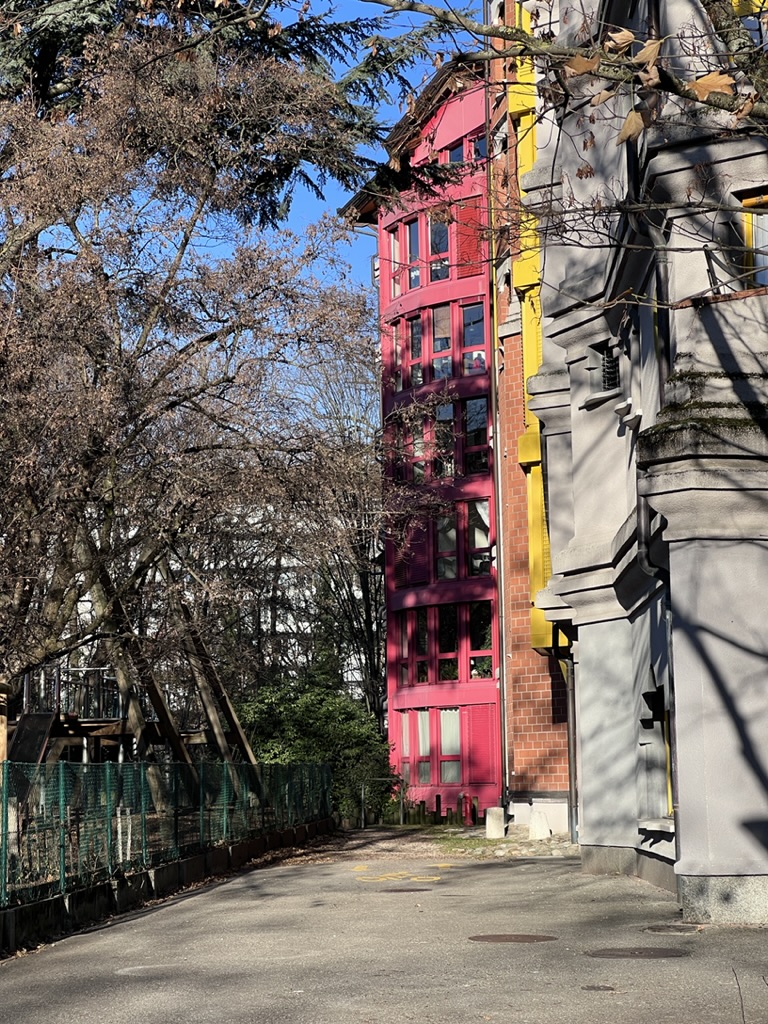

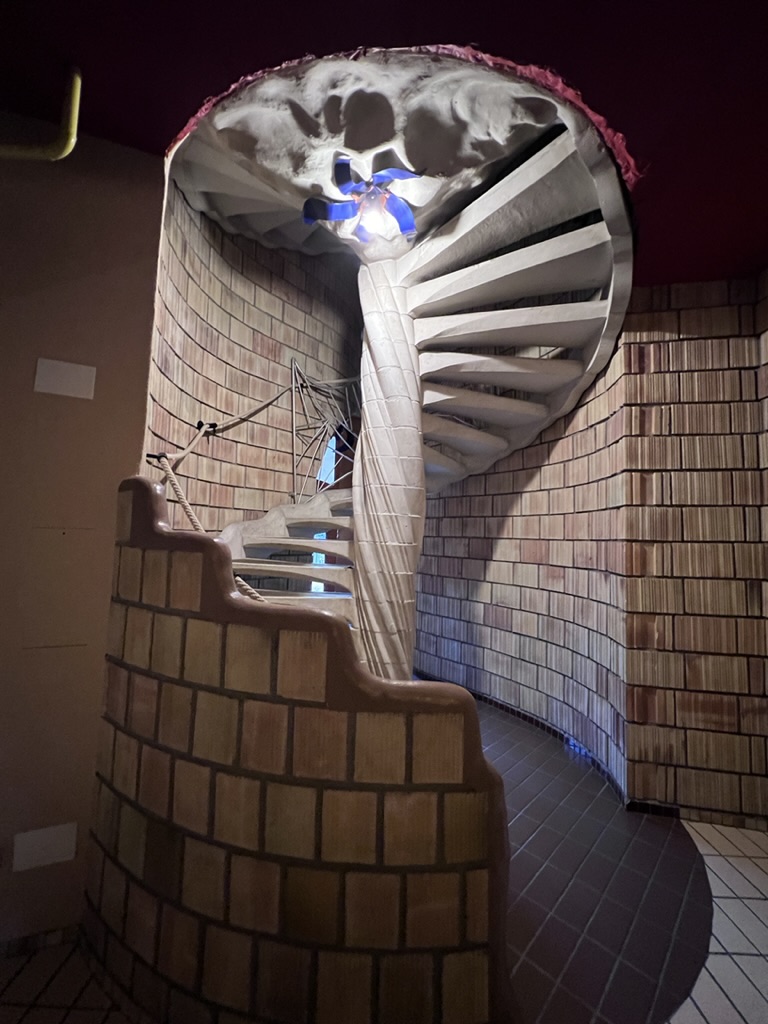
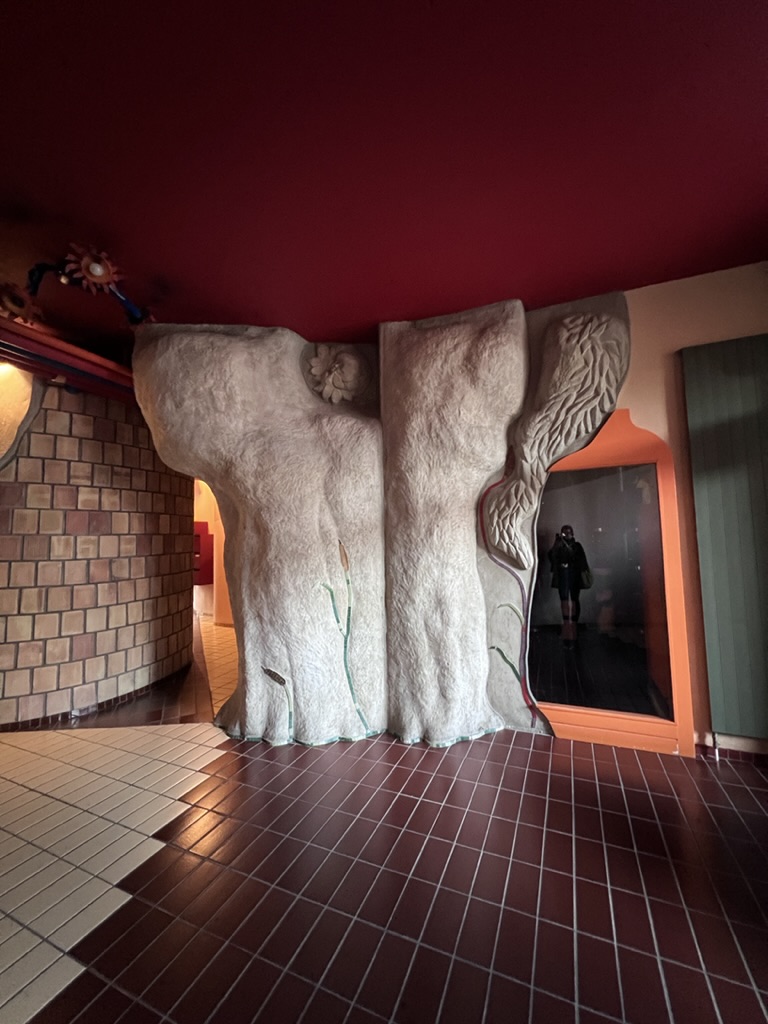

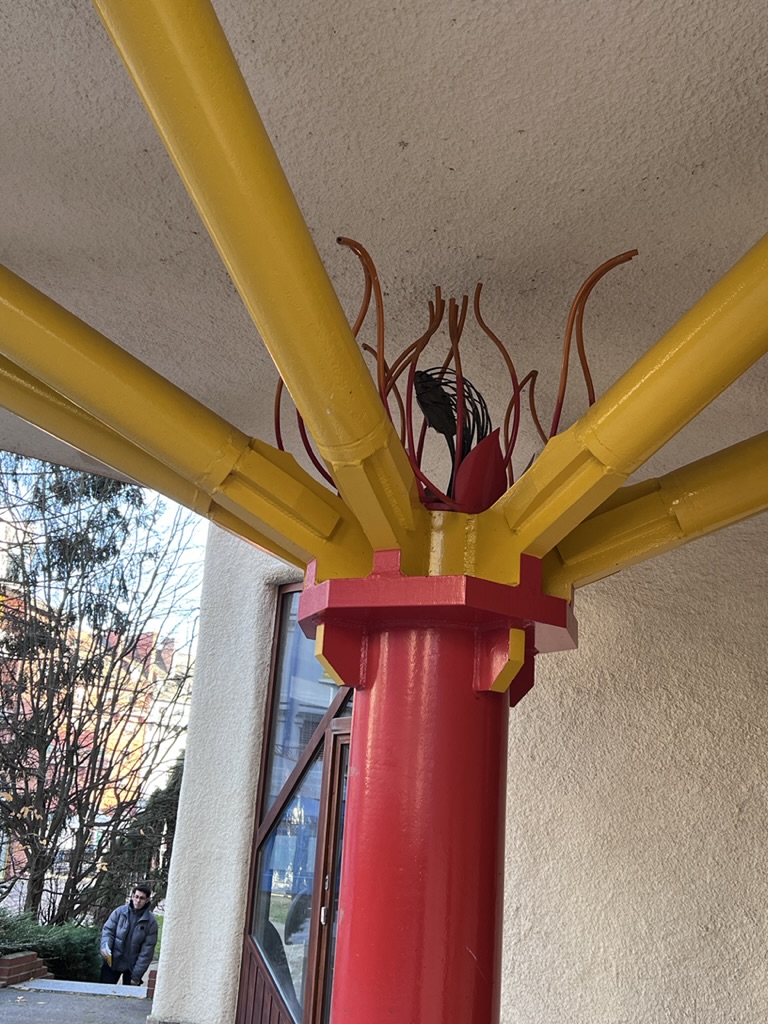
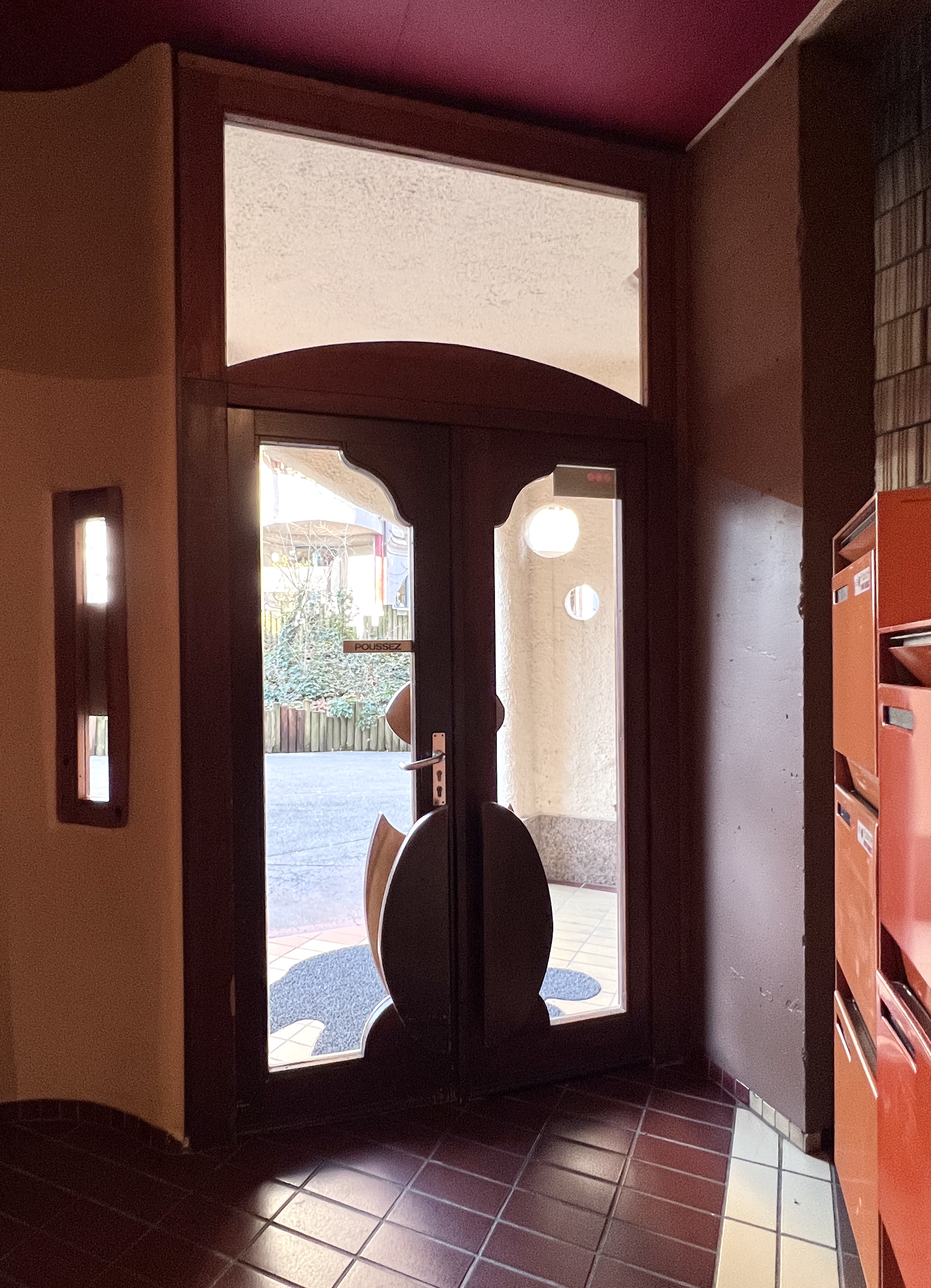
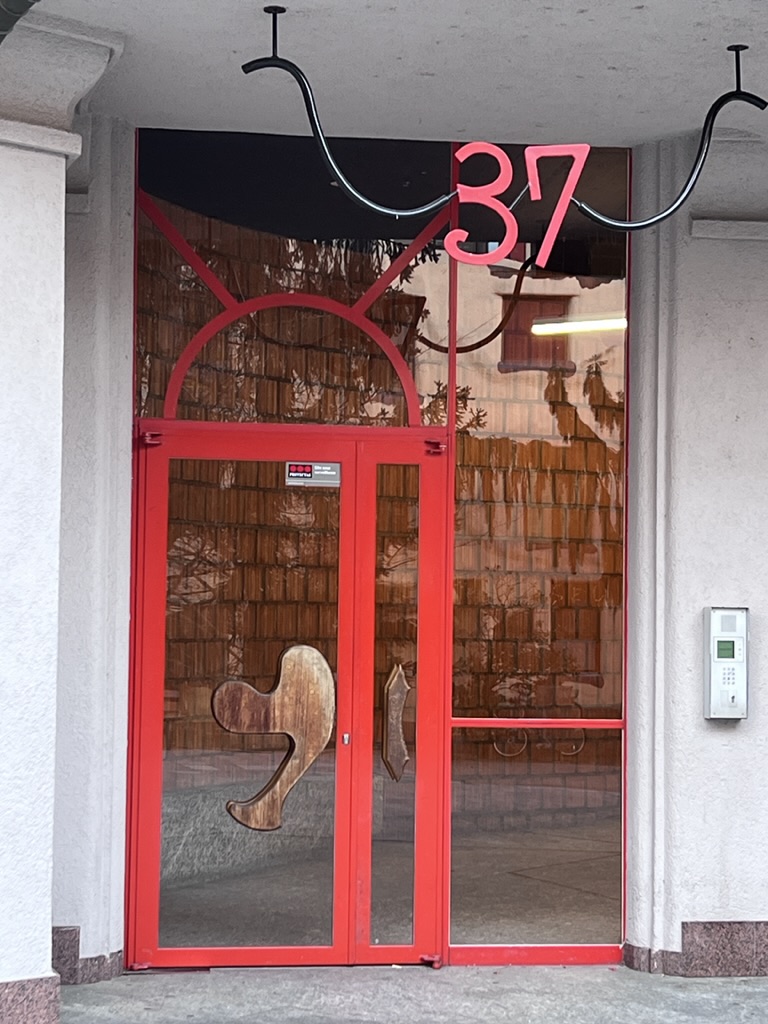
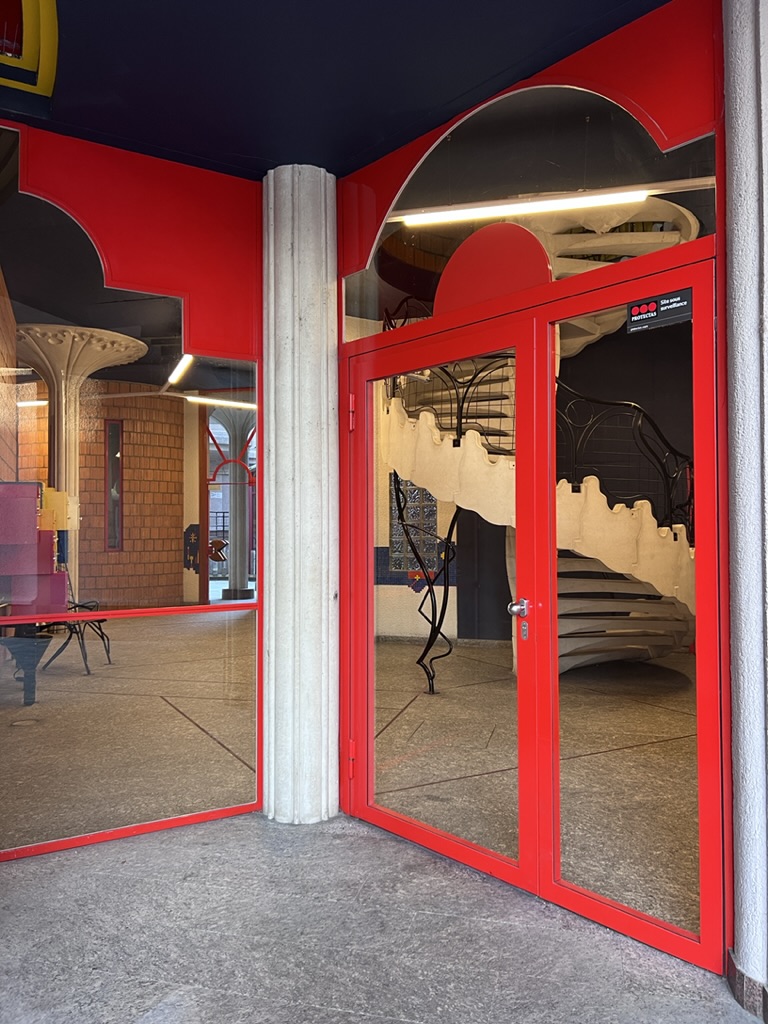
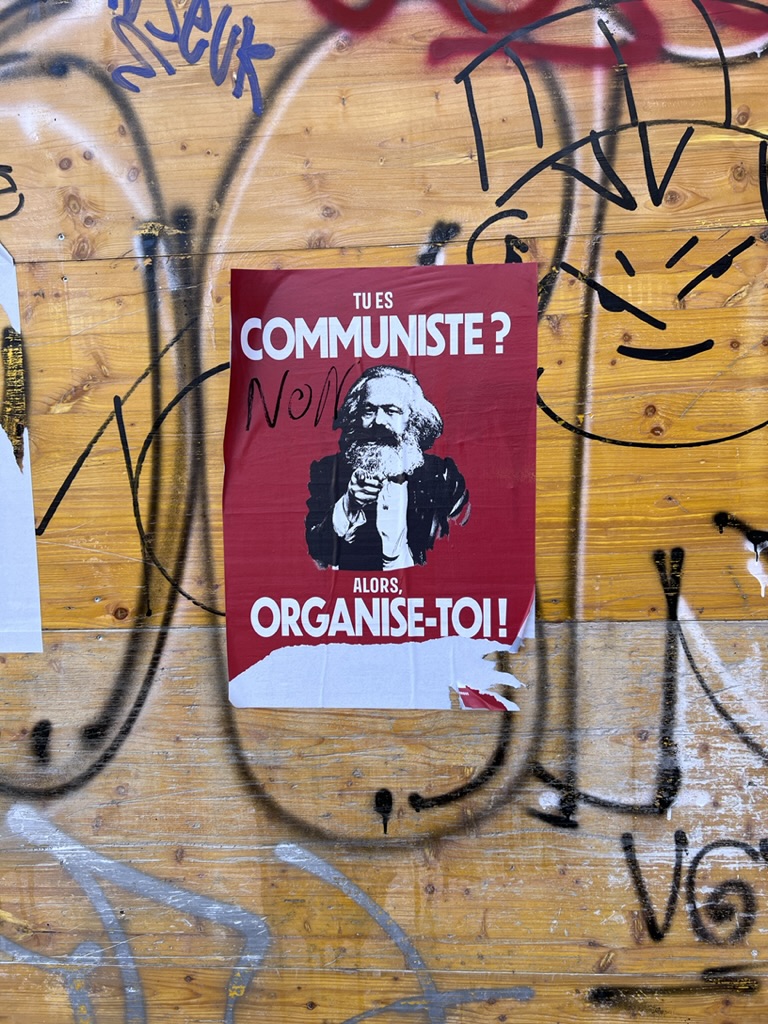
I decided to take the tram back although it’s not super direct, so it required a bit of walking at both ends of the tram ride to the hotel.. more steps for my daily requirement. I do always like to use public transportation when in another country—if only to see how it operates and to see who uses it. The Geneva system is very efficient—and definitely an honor system. In all the times I’ve used it, I’ve never been asked to show a ticket. But I always have one. While Geneva is very White, about 50% of those on the trams I’ve been on are people of color.
I’m off to meet Elizabeth for dinner. It’s supposed to be a good restaurant – Le Jardiniere; few choices as so many restaurants in Geneva are closed from December 23 through January 9. I generally don’t like to eat at hotel restaurants (this one is at the Woodward Hotel), but those are the ones that are open. We shall see. I don’t like eating at hotel restaurants because you’re usually sitting among other tourists. I’d prefer to be with locals.
That’s it for me for today.
Fern
Post-dinner: Le Jardiniere is quite lovely with views onto the Geneva harbor. These post-Xmas days appear to be slow at restaurants; probably everyone is eating their leftovers from Xmas. So, the restaurant was remarkably quiet, sophisticated, and good, I had the artichoke appetizer which came with burrata and some artichoke hummus. I followed that with pumpkin sage gnocchi. Both dishes were very good. There was also an amuse bouche… and a little crisp potato cube on top of which a small piece of roasted kale sat… Tasty and beautiful to look at; almost too precious to eat. Elizabeth wasn’t as impressed with her main course (fish). We chatted until about 11:30 and then taxied back.
Geneva: December 26 2023… On the Day After
Greetings on the day after Christmas…
Geneva takes these holidays seriously, so most shops and restaurants are closed on the 26th as well as the 25th.

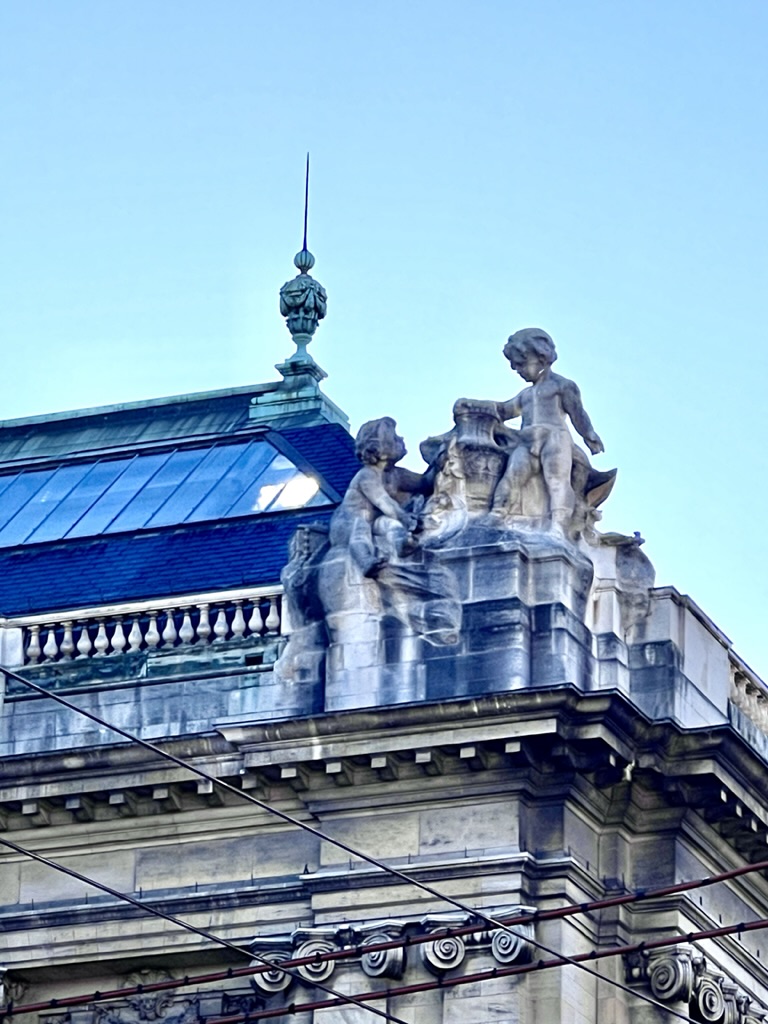
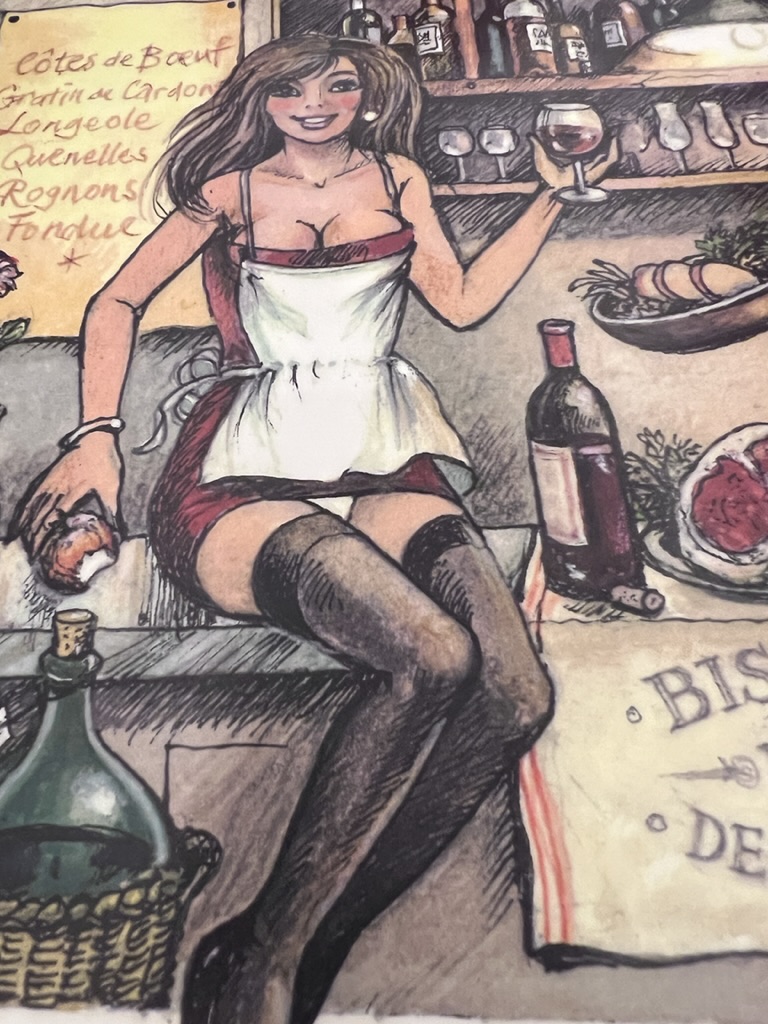
We were to meet everyone for lunch at Bistrot des Halles (which is located inside a wonderful, downtown, upscale, indoor market) at noon. The only place to get anything that resembled breakfast (since we chose not to eat the big buffet breakfast at the hotel) was at Starbucks!! Conveniently located about 100 feet from our hotel. By the time we finished, we got a message that lunch was cancelled. I think that Julia and Julian were just exhausted from yesterday and little Siena was fussy and the nanny was ill. So, Mike and I strolled around town and eventually decided to get lunch at the Halles—just the two of us. The Bistro des Halles is a wonderful little restaurant that sits inside the market and utilizes local and seasonal ingredients. It’s pretty much meat and fish and some very traditional Swiss and French cooking. I had a veal dish and Mike had crayfish ravioli. We opted to stay away from the traditional and ever-present cheese fondue.
Then Mike, still feeling a bit under the weather, decided to skip the circus and head for a nap at the hotel. I headed out on foot to the circus—Cirque du Noel—about a 2-mile walk, I think. I met up with Em and Hem and Finn, and then with Julia and Louis and Ella. Ella promptly noted that I had no one, meaning I suppose, that I was alone. Ella was sporting her own circus outfit: a mermaid dress complete with tail which dragged a bit on the floor and made me nervous that either she or a passerby would step on the tail and get her off-balance. She complemented the mermaid outfit with high-top sneakers that glowed and sparkled and also lit up as she walked. Definitely a little trend-setter who is very aware of her “look.” We had first and second row seats for the big event… and popcorn (and later there was some cotton candy in the mix).
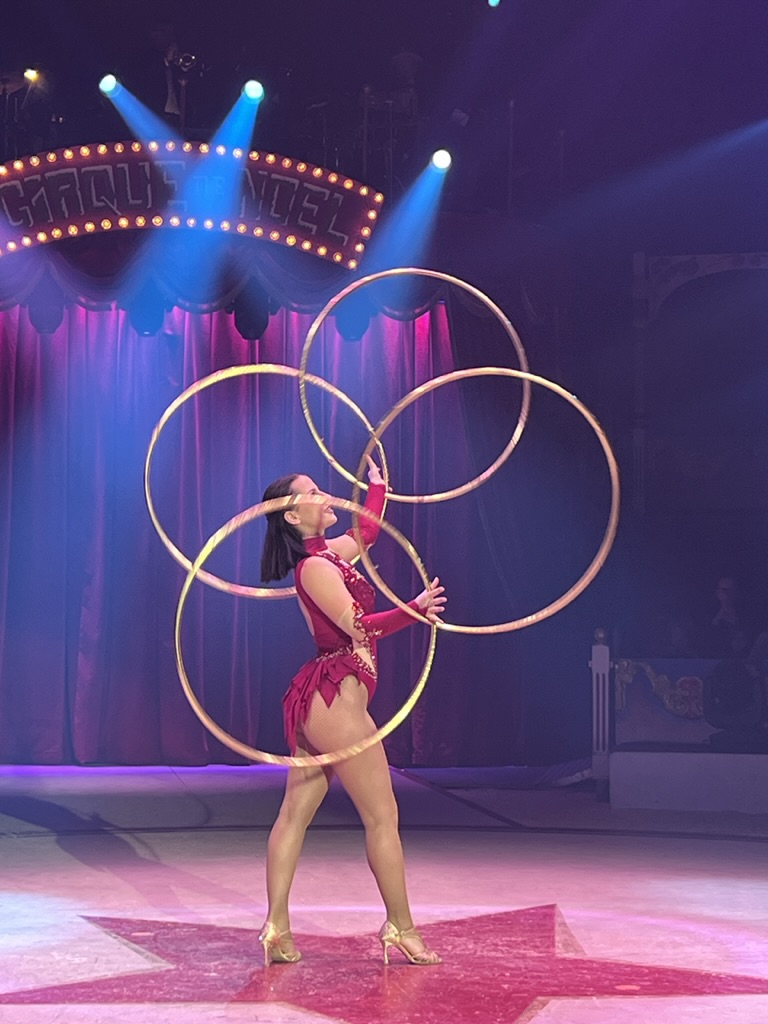
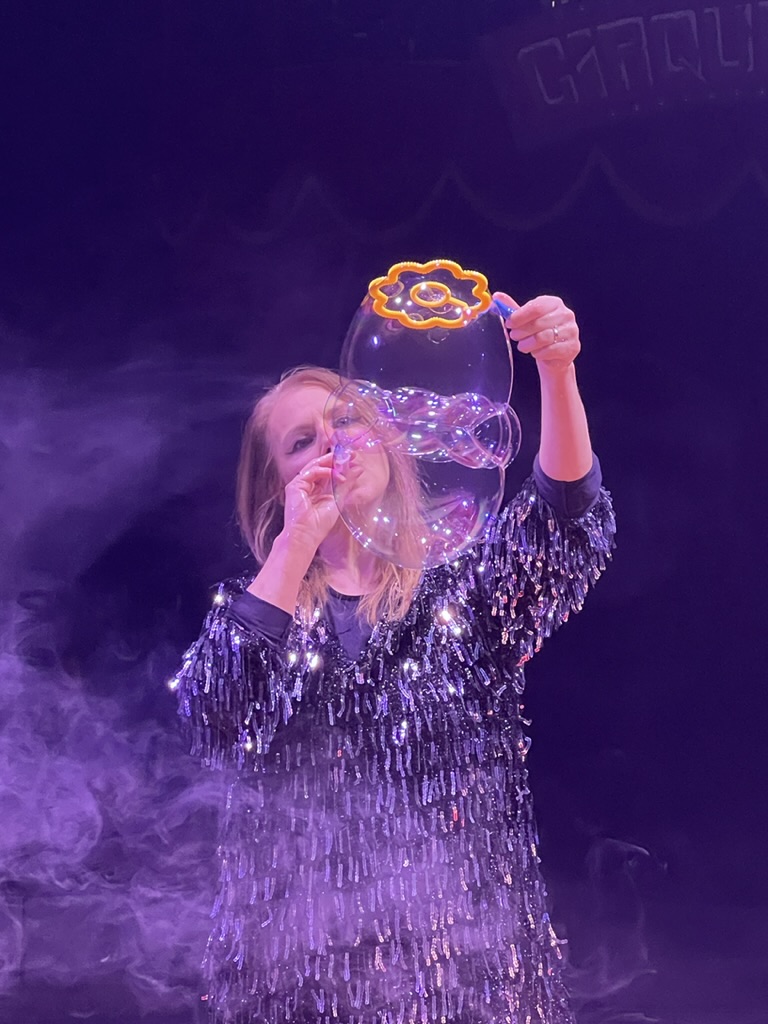
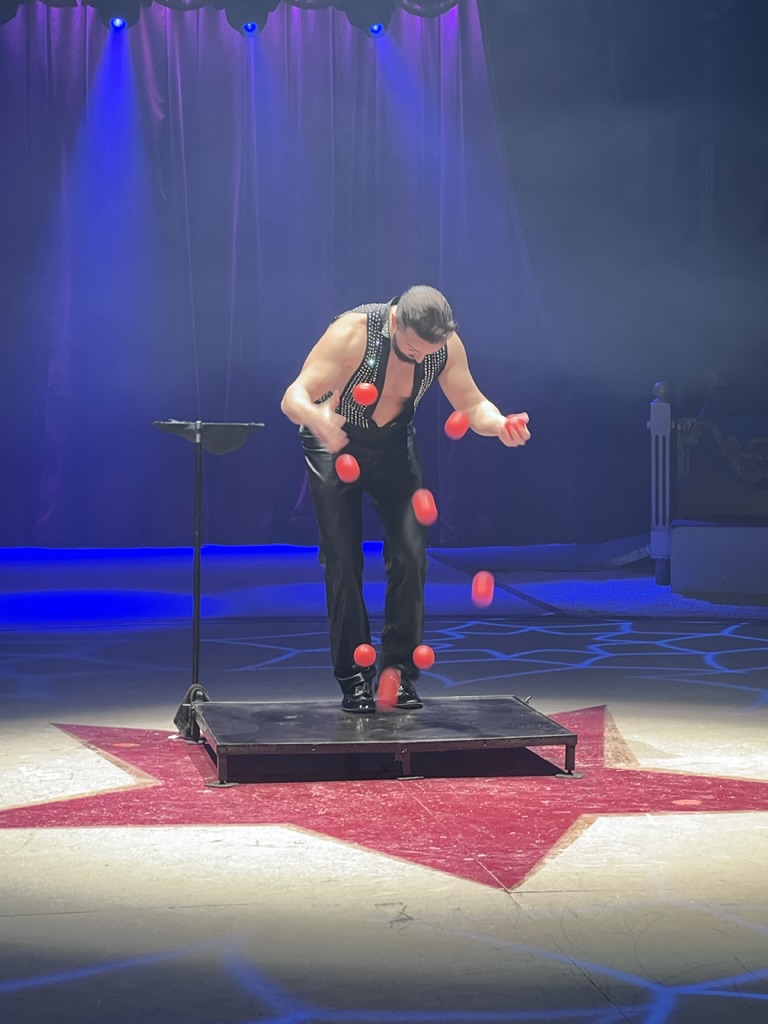
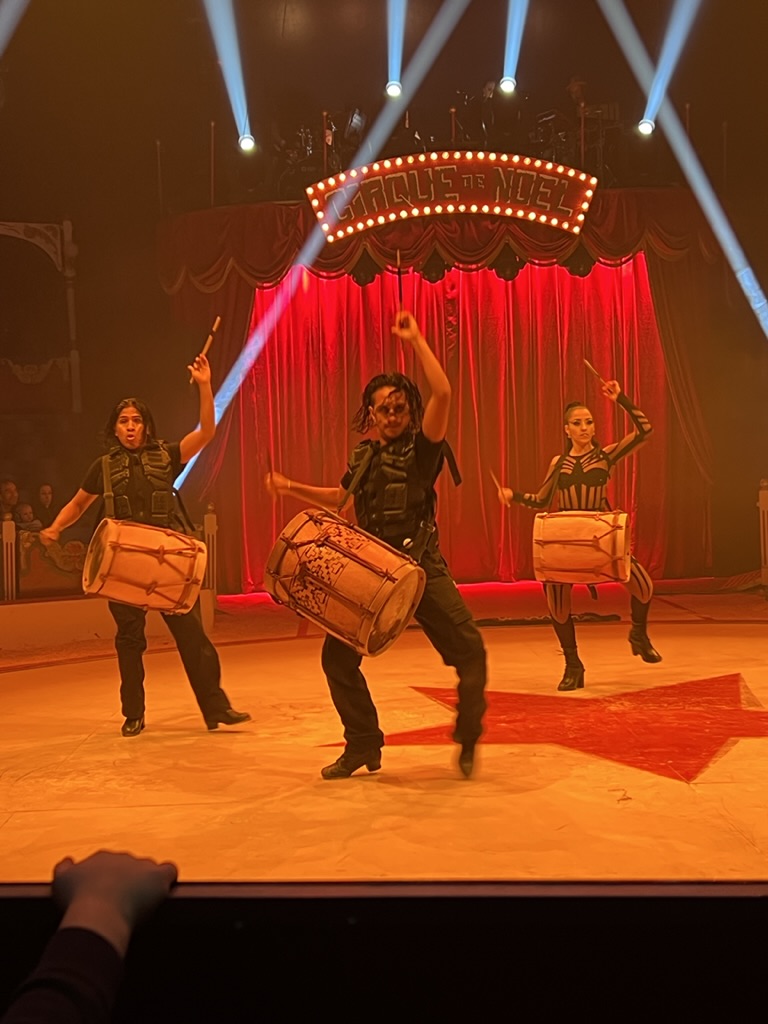
It was a small circus in just one small tent. No large animals and actually no clowns. There were acrobats, jugglers, a ventriloquist, some dancers and singers, and a modified high wire performer. The women performers were dressed in garb that would work well in Las Vegas casinos and bars with pole dancing. The cast all looked like they were from Slovenia or Poland or some former eastern bloc country—quite blond. Louis and Finn managed to get some “high-5s” from the performers because they were sitting so close to the performance area. And at one point, Julia got selected to come to the center of the stage (which she politely declined but it was difficult to say ”no”) so she wound up in one of the acts.
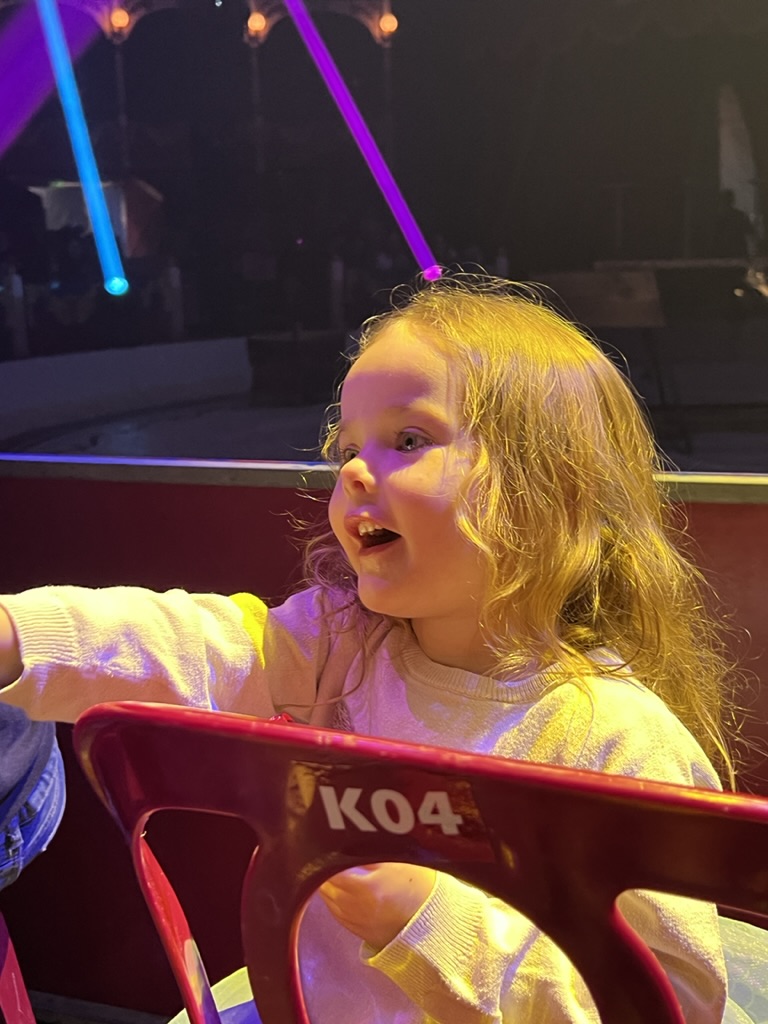

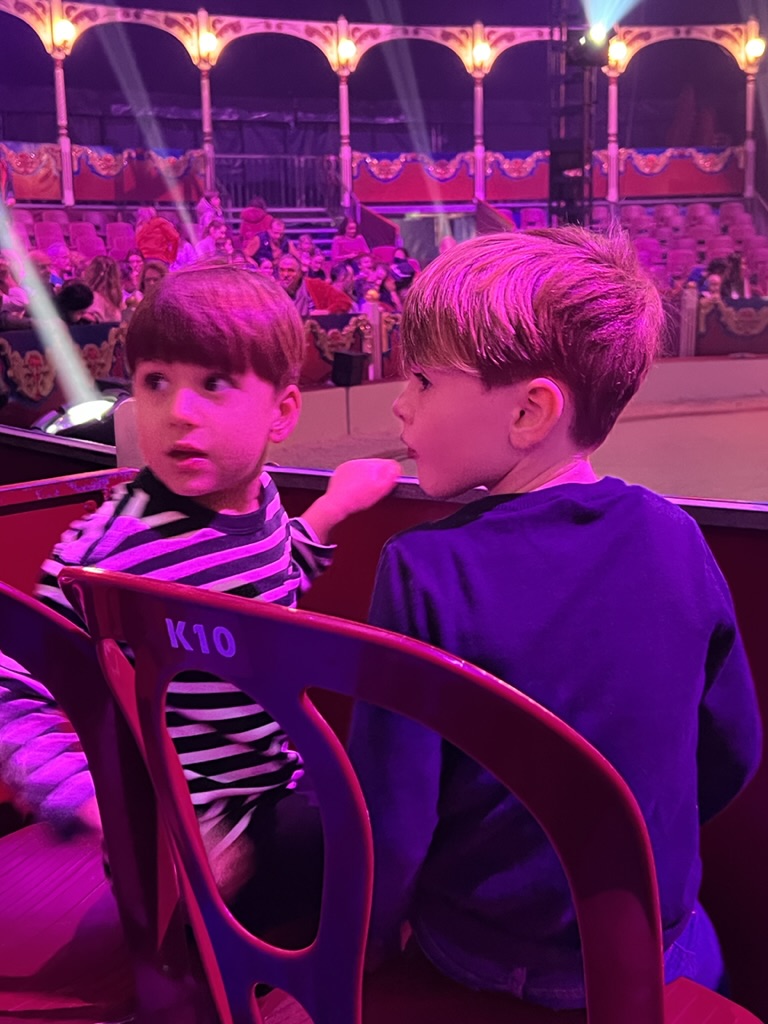
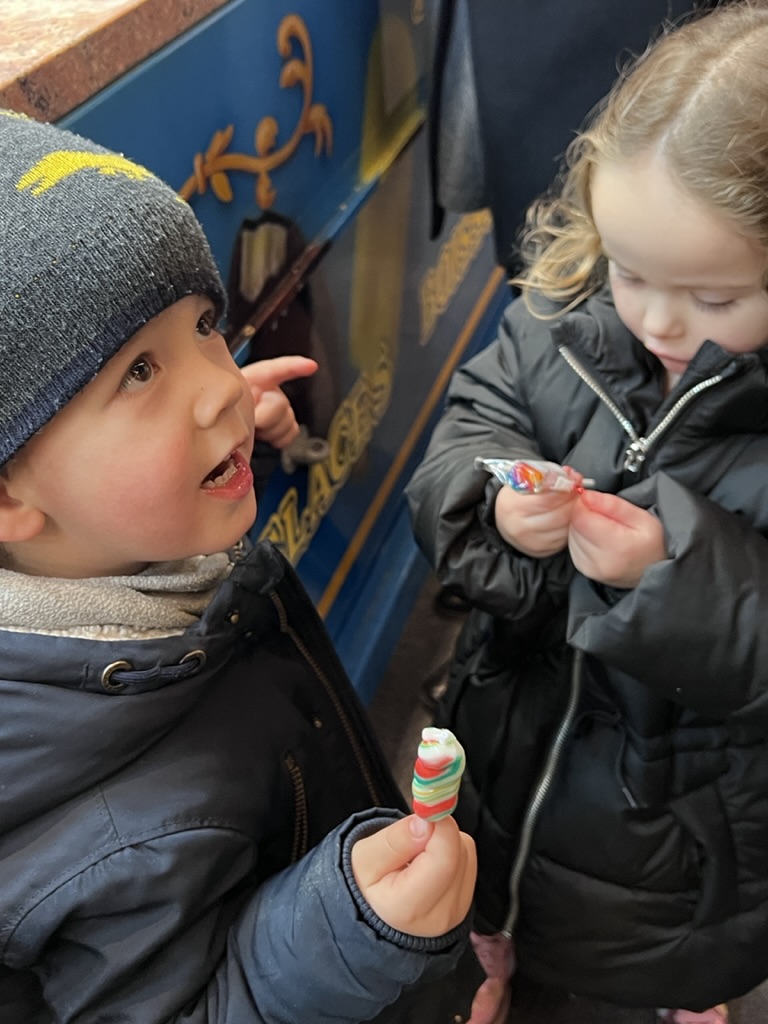
By the time the event was over it was dark, and the kids and parents decided to stay so everyone could go on the rides and probably have a bunch of junk food. As it turned out Ella ran into a little friend, Leo, from her class and the two immediately walked hand in hand—quite adorable.
When I got back, Mike still wasn’t feeling up to par. So he ordered soup from room service, which turned out to be not such a great decision. I decided to stay at the hotel for dinner and am now back in the room. Hopefully all will be better tomorrow. We’re hoping to visit a very special housing development that we saw once before in the rain. The Swiss refer to it as “Smurftown.” If the weather is good, I will probably go, but the plan had been for both of us to see it again.
Take care.
Best for the post Xmas and pre-New Year period.
Fern
Geneva: December 24 2023: Christmas Eve
Merry Christmas (to those who celebrate) –
Warning, for those of you accustomed to our more usual travel to distant places and searching the unknown—this set of travelogues will be very tame. We are in Geneva (via NY) and then on to Vienna. It’s a short trip focused mostly on family. So, no big exotic stories to tell, and unlikely to have too much drama. That said, we are headed to Vienna for about a week after Geneva.
We arrived in Geneva yesterday morning to spend Christmas with Mike’s family — his sister-in-law, two nieces and their spouses, and the combined four children (all under the age of six), and two dogs. It’s a short trip and not quite the usual Tiger/Pyatok travels to developing nations and exotic locations. We left Oakland on December 20th and stopped in NY for about 40 hours to celebrate Mike’s birthday in the old stomping grounds… and then headed directly for Geneva. We’ll be here for 5 nights and then head to Vienna for New Years, and then we are back home.
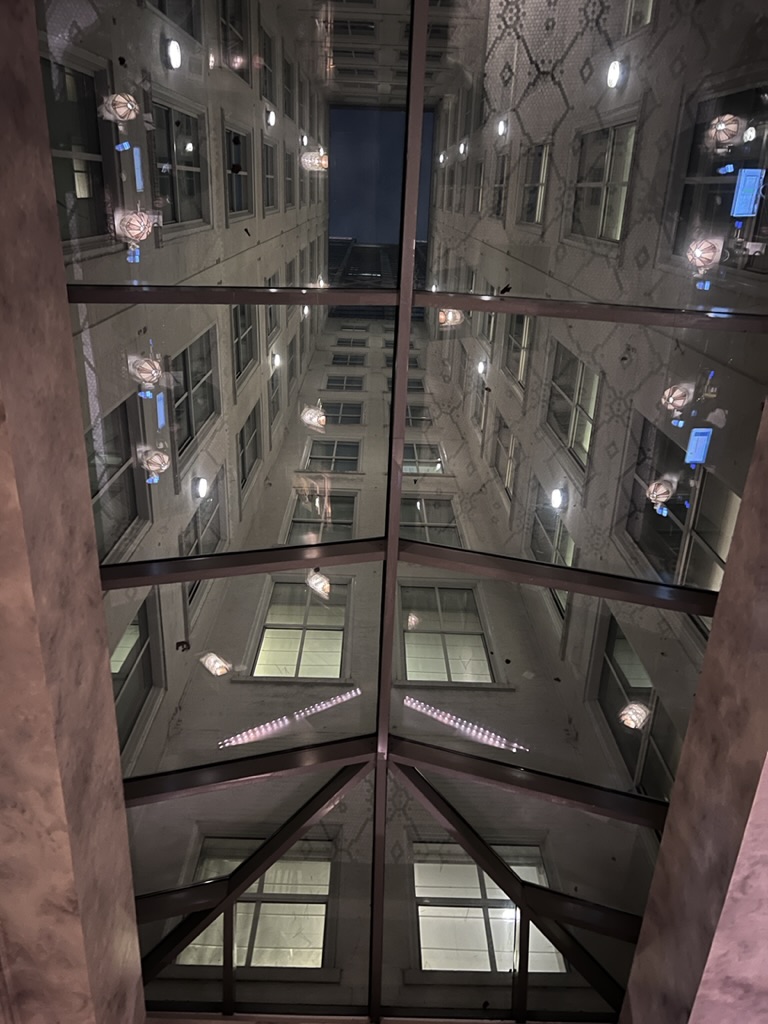
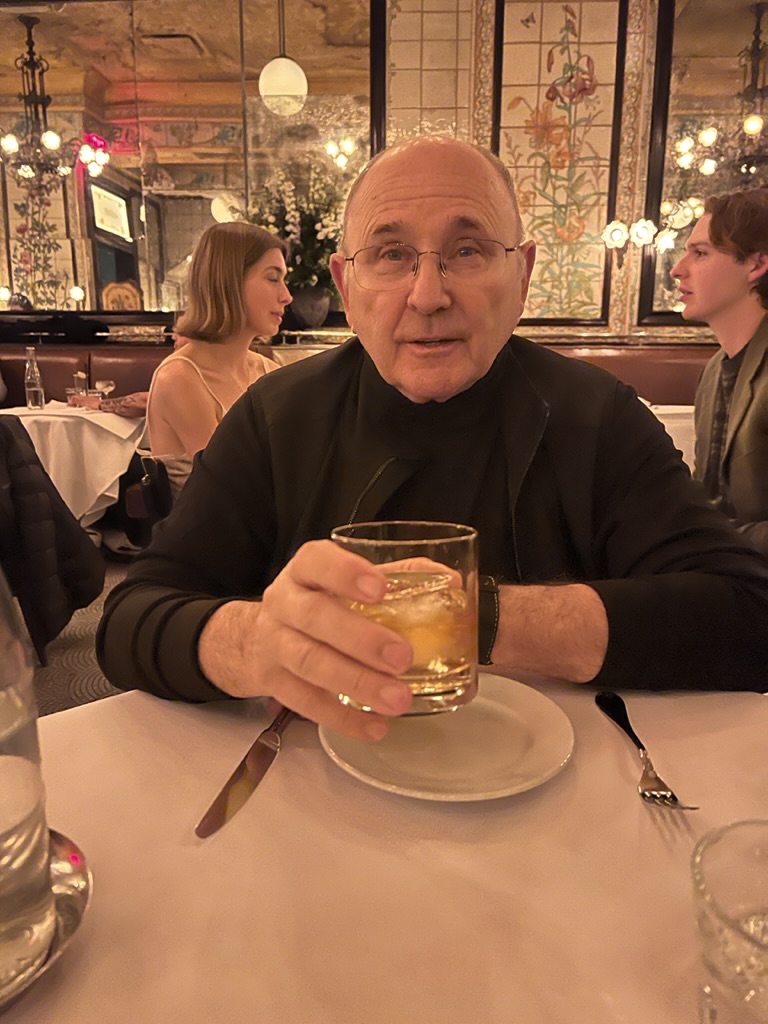
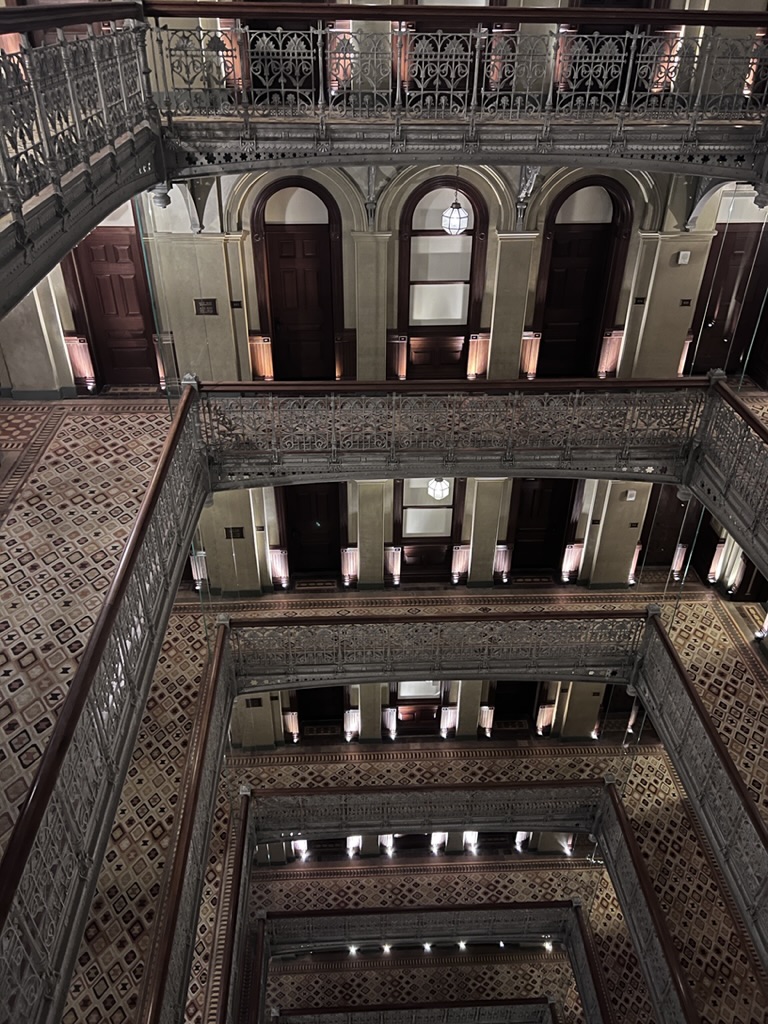
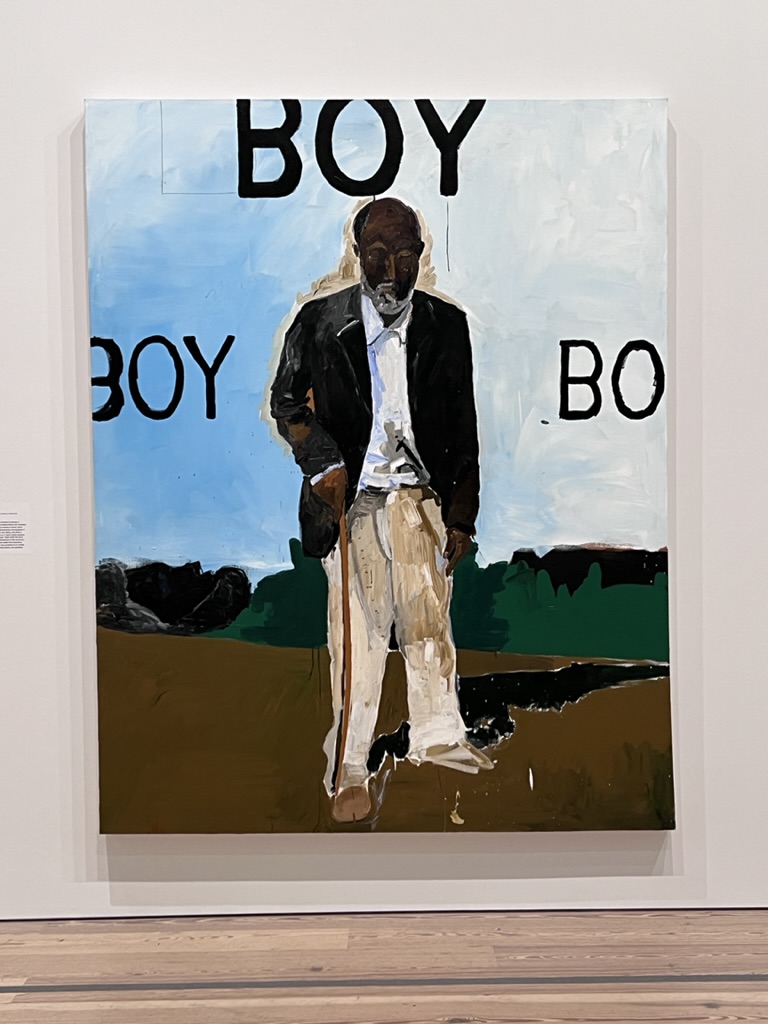
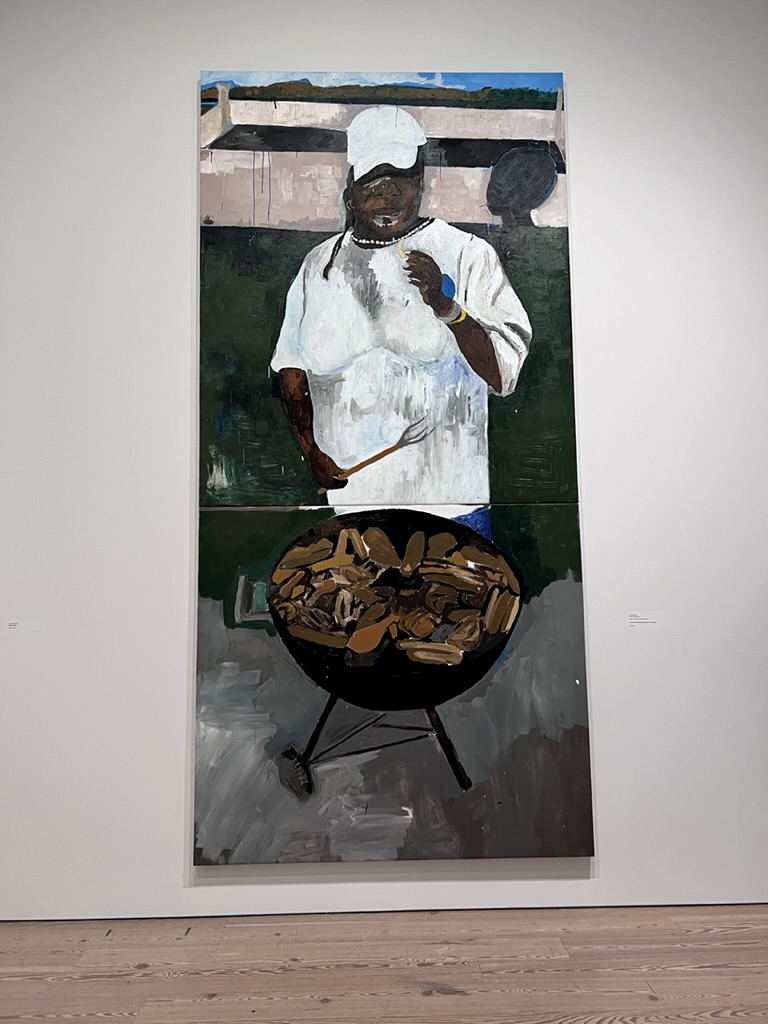
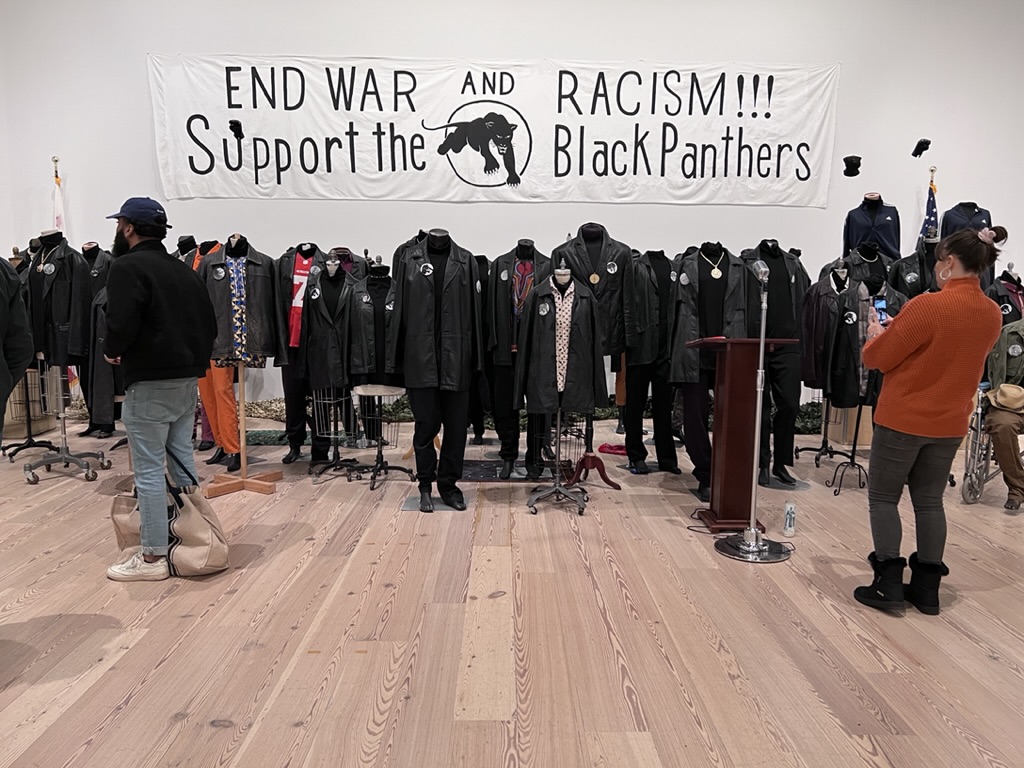
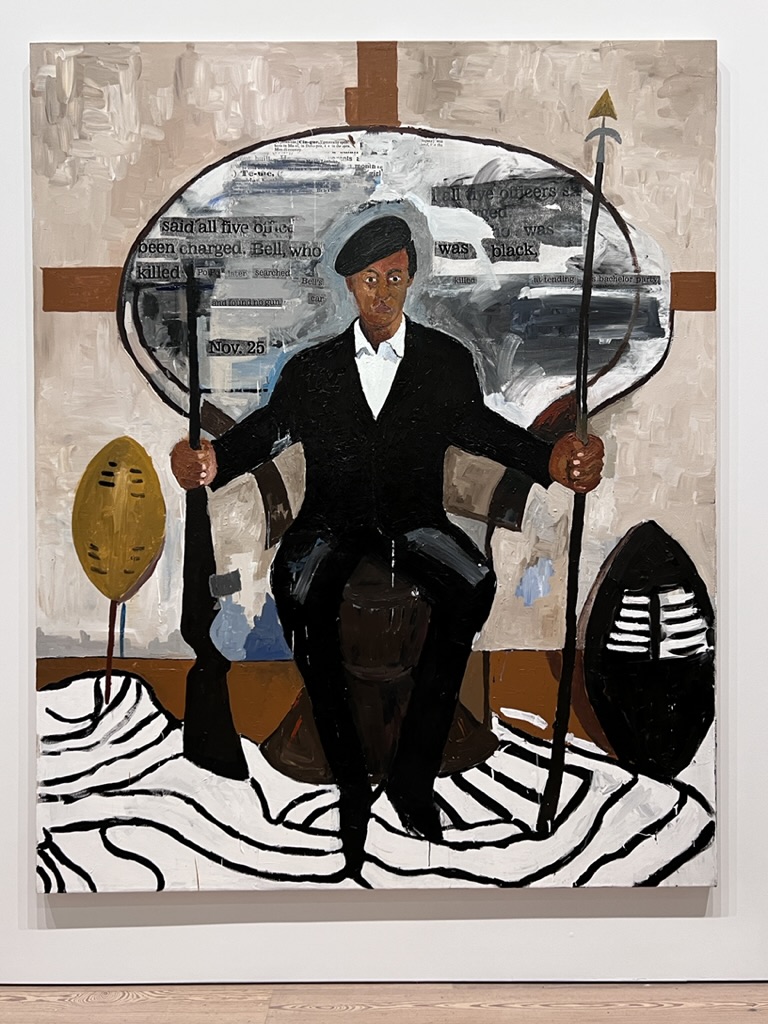
New York was fun, sort of relaxing, and filled with lots of eating—starting at Le Gratin, a new restaurant by Daniel Boulud located on the first floor of The Beekman Hotel (where we stayed). Le Gratin is fashioned as a Lyonnais restaurant; it was perfect for us—the food was good, the atmosphere was casual, and we could just roll out of the room and head for dinner after checking in. And The Beekman is always a delight—a Queen Anne–style building from 1888, built a short walk from the Brooklyn Bridge which was opened I believe in 1883. The Beekman has a magical atrium that soars nine stories high that you really sense when having drinks in the bar (Temple Court). The following day (Dec 21) we set out separately— I headed to the Whitney (not my favorite place, but I wanted to see the Harry Taylor show). Taylor’s work was interesting and also complicated to see the political nature of the work ensconced within an institution frequented primarily by an elite class. Nonetheless, the work is worth seeing although more potent as historical statements (and perhaps a statement overall that history should not be forgotten and that we haven’t moved as far as we think we have).
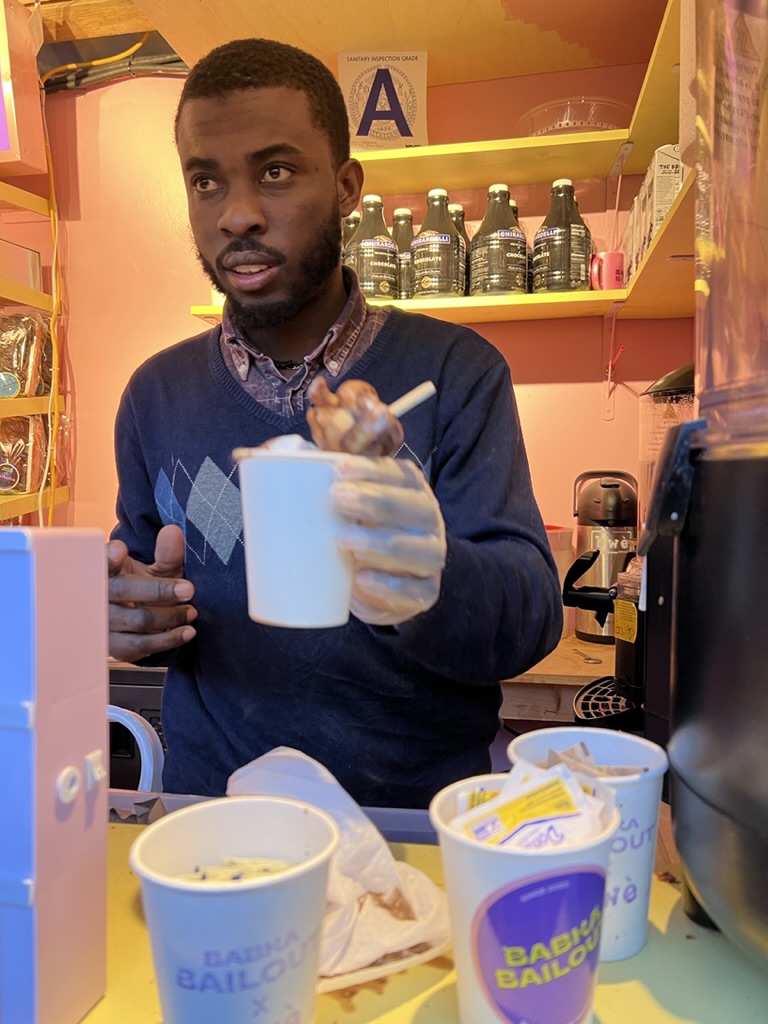
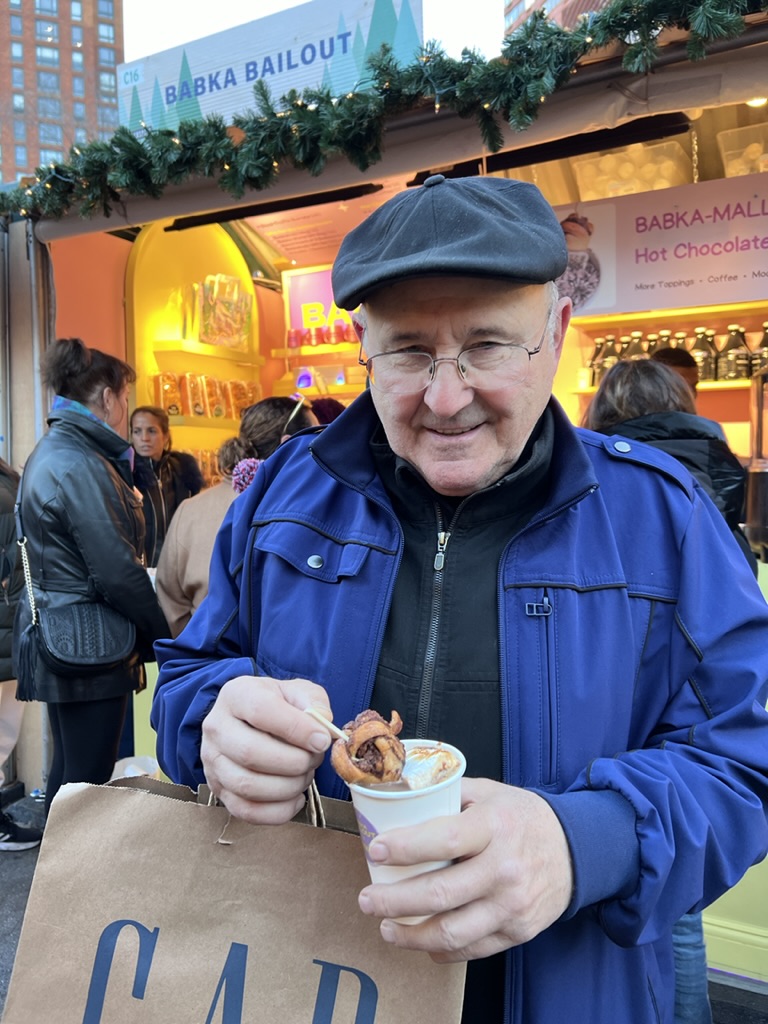
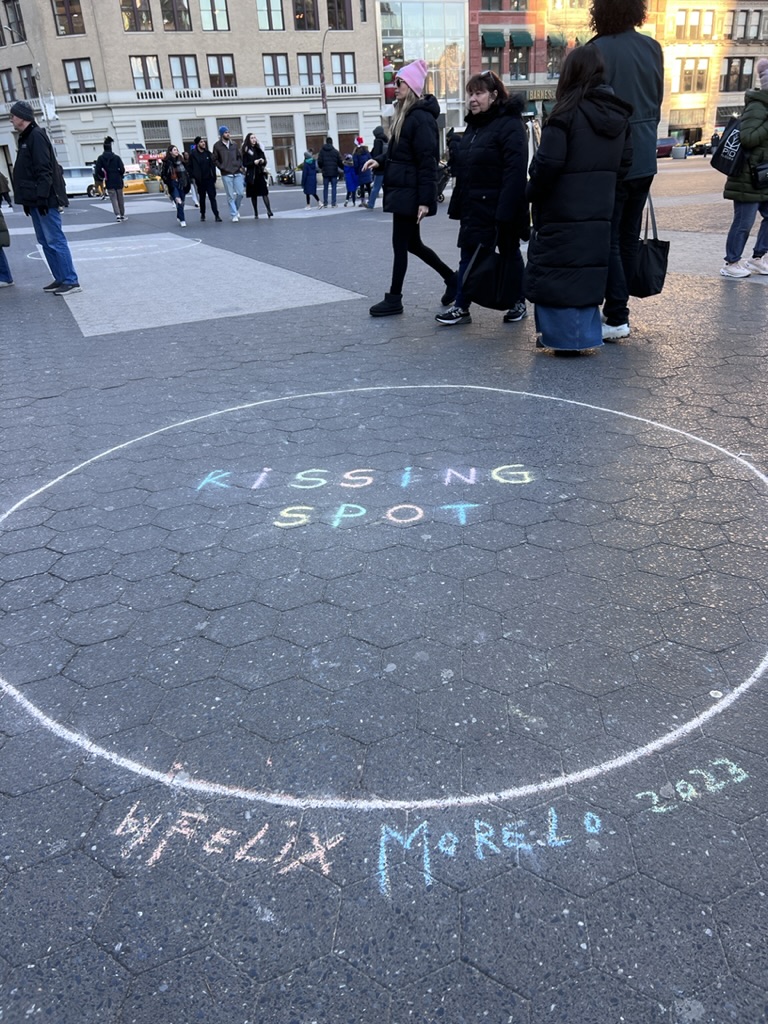
I then met up with Mike at the Union Square Christmas Market which was fun to stroll… and Mike availed himself of a hot chocolate topped with babka and marshmallow! Totally sinful, but it was his birthday.
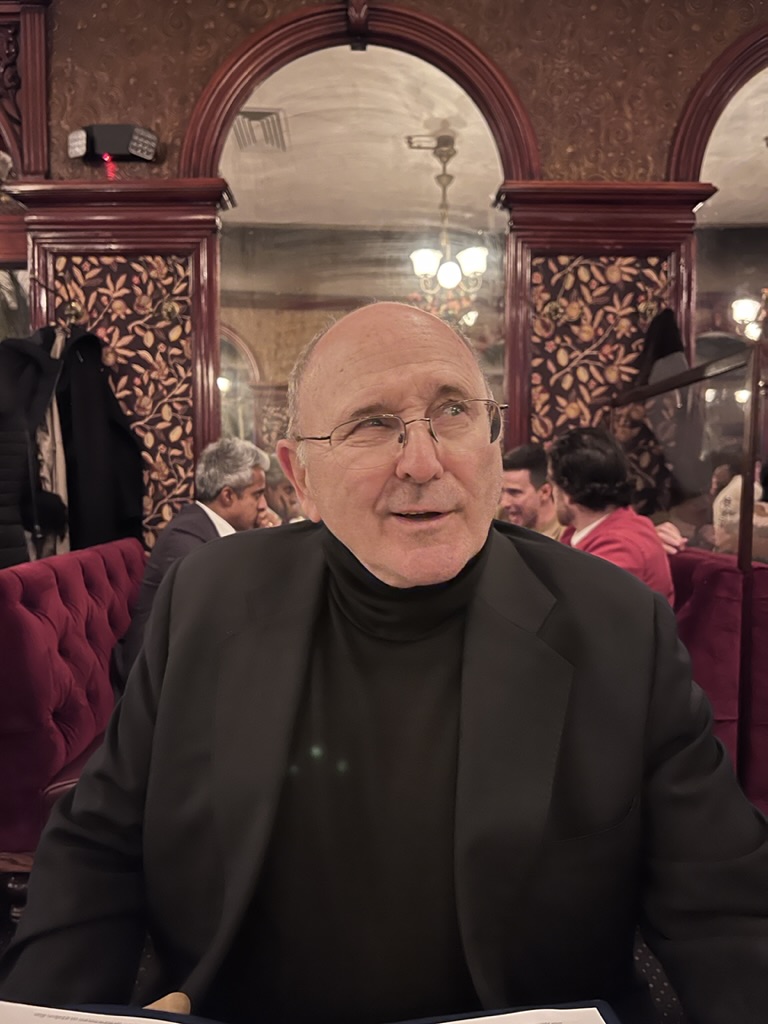
For dinner, Mike had requested a “stately place with history,” so off we went to Gage & Tollner—don’t think you can get much more stately and historic than that. We took the subway two stops to Brooklyn and voila!… there amid the homeless and stores that sell cheap liquor is the more than 130-year-old restaurant—famous over all those years. As a child growing up in Brooklyn, I knew of the restaurant and had passed it many times when strolling downtown Brooklyn, but I had never been inside (nor had Mike).
It’s located on Fulton Street and named for the original owners Charles Gage and Eugene Tollner, and it’s in a converted 1870 four-story brownstone that may still have residences above (not sure). The building is a designated landmark. The restaurant was popular with judges and lawyers and businessmen (yes probably only men in those days) since it is fairly close to the courts and Brooklyn City Hall. It was owned and operated by the same family for seven decades and then sold and closed in 2004. For a period the space was occupied by some retail shops (can’t imagine how they set that up in that space. Then three young-ish foodie entrepreneurs started a crowdfunding campaign in 2018 and re-opened the restaurant in the historic venue (restored) which now boasts a far younger and hip crowd than its history, but it kept many of the famous chop-house items on the somewhat small menu. The space is long and narrow—maybe 100’ by 25 ‘ and has lots of amazing woodwork and arched mirrors and chandeliers. In the old days, I’m told that the waitstaff had the number of years of their employment embroidered on their uniforms because they worked there for many many years. As a kid I was told that many famous (and rich) people frequented Gage & Tollner including Truman Capote, Diamond Jim Brady, Fanny Brice, Mae West, and Jimmy Durante. Anyway, we had great starters including crispy hen-of-the-woods mushrooms in some kind of homemade siracha sauce and Peconic snails… and then classic steak, cooked to perfection.
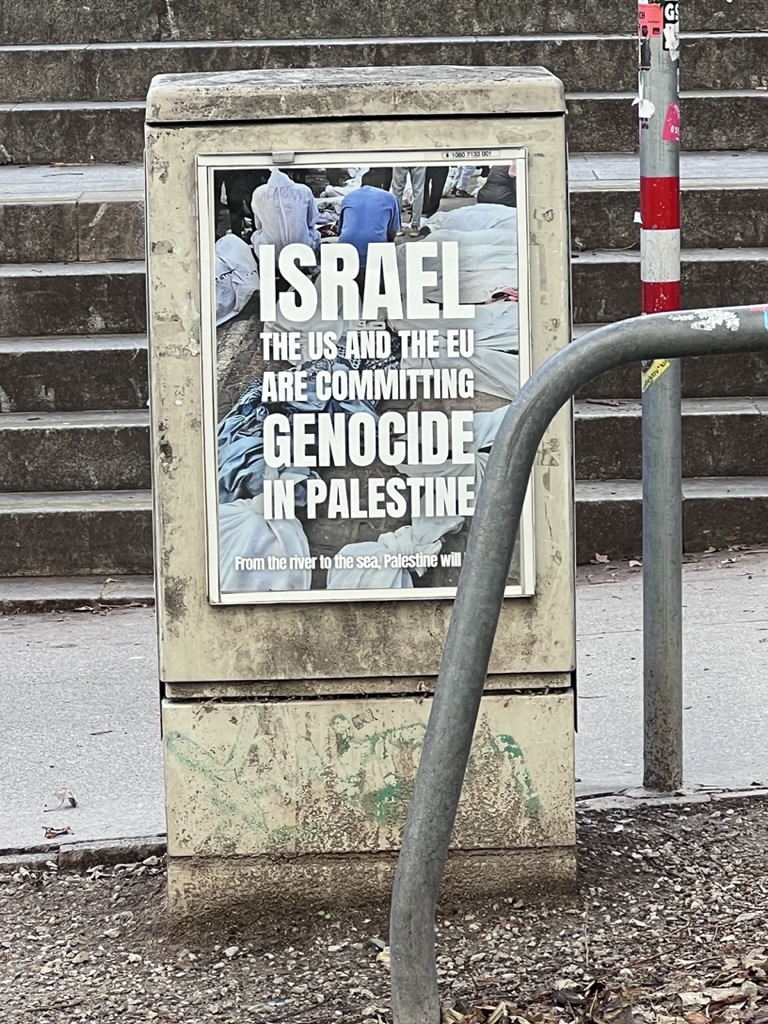
We taxied back to the hotel, and in the morning met up with two of our god-children for brunch at the Beekman. Good to see them and to hear about their protest activities re: the Israel/Palestine situation, and what they are up to.
Then we headed to Newark Airport to fly to Geneva. In many ways the flight from the East Coast to Europe is less comfortable than flying from the West Coast. The NY-Geneva 7.5 hour flight turns out to be more difficult to sleep than the 12 hour flights. Once you’re settled on the plane, the meal arrives and then you’ve only got about 3-3.5 hours to go — not long enough to sleep, but you’re tired. So –at least in my case—I felt more tired arriving in Geneva than usual. And of course you arrive very early (7:30 am) so it’s too early to check into the hotel. We strolled a bit and then settled in the lobby until our room was ready. Then we quickly showered and unpacked and headed to Elizabeth’s to watch the kids trim the tree. Julia and Julien and their three kids (Louis-6, Ella-4, and Siena-1) live in Geneva; Emma, Hem and Finn (almost 5) live in London.
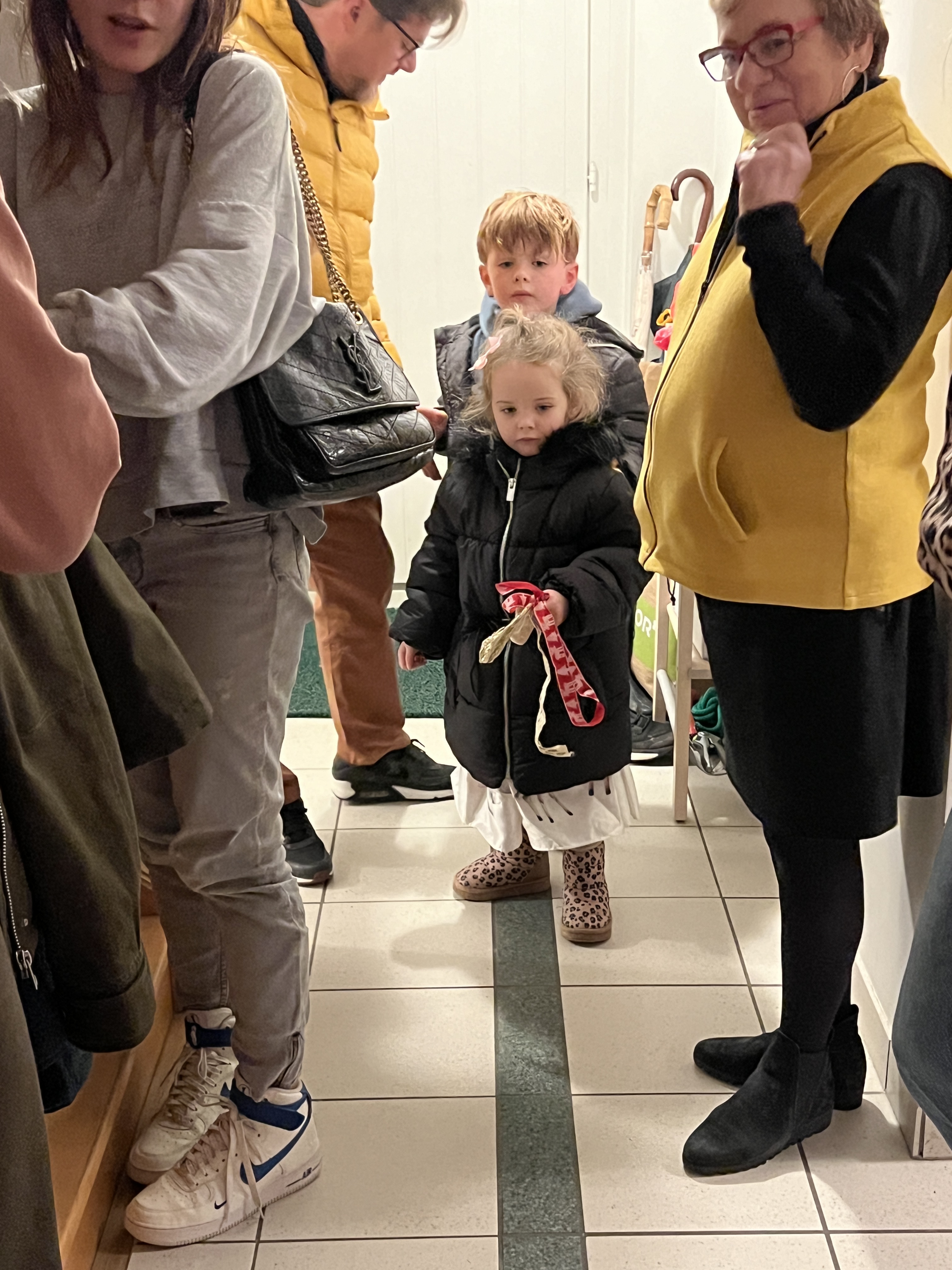
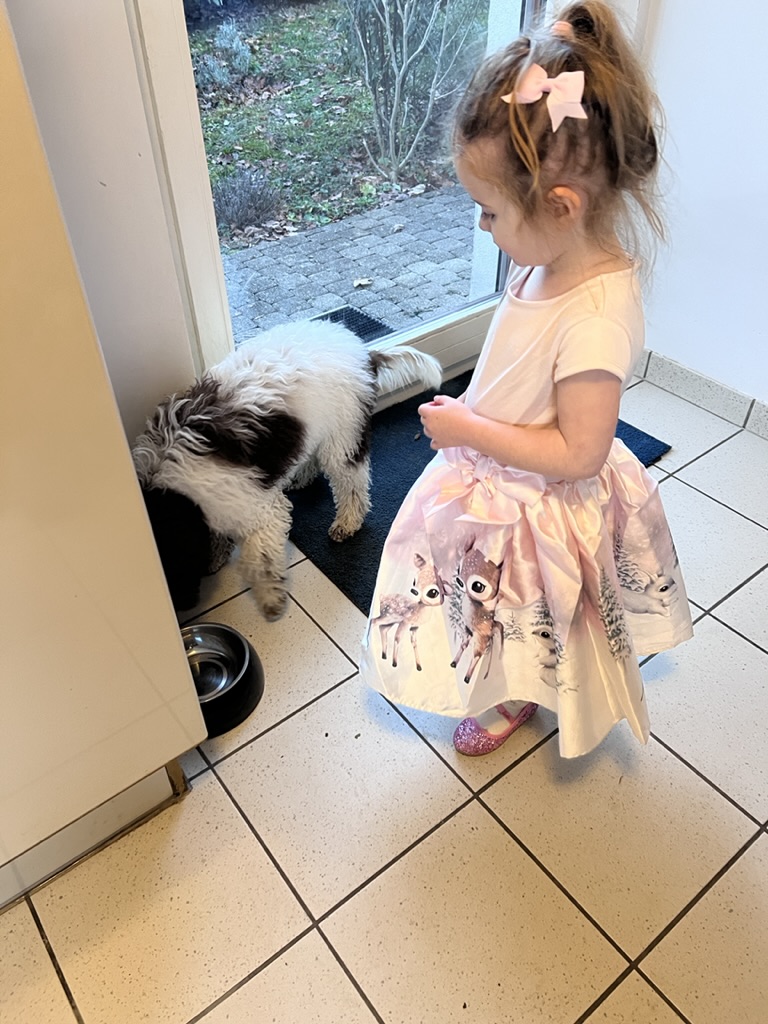
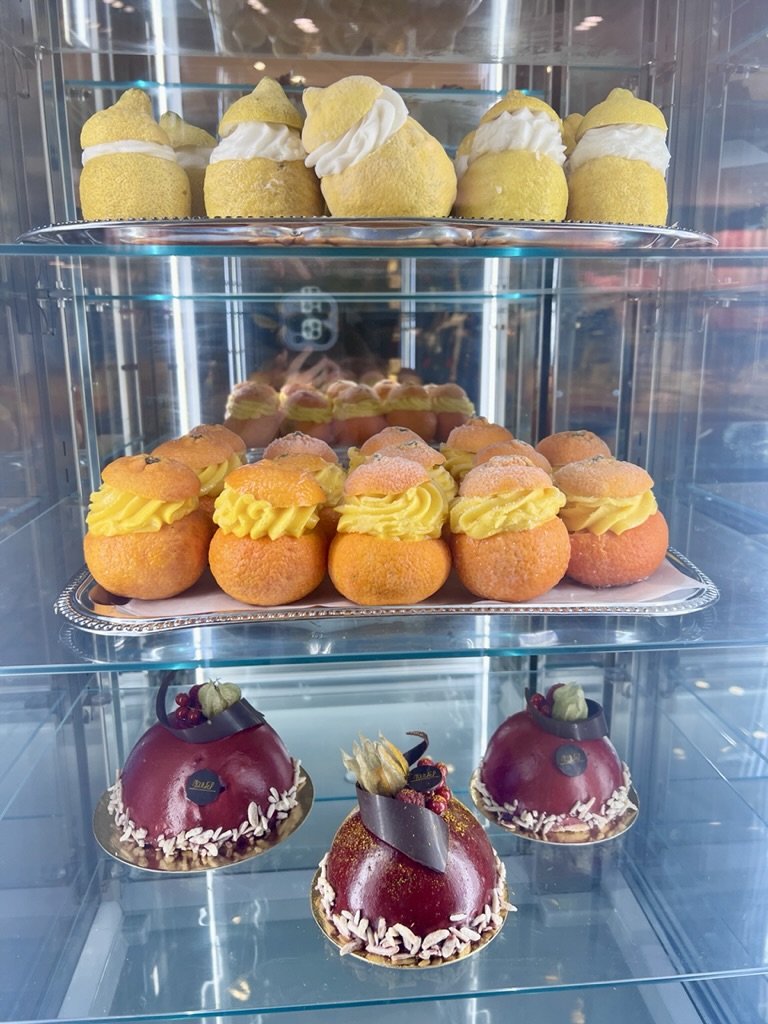
After the little reunion (and meeting the new dog, Tilda), we headed back to the hotel for a quiet dinner at Balila (a wonderful Lebanese restaurant that I’d like to clone for the Bay Area).
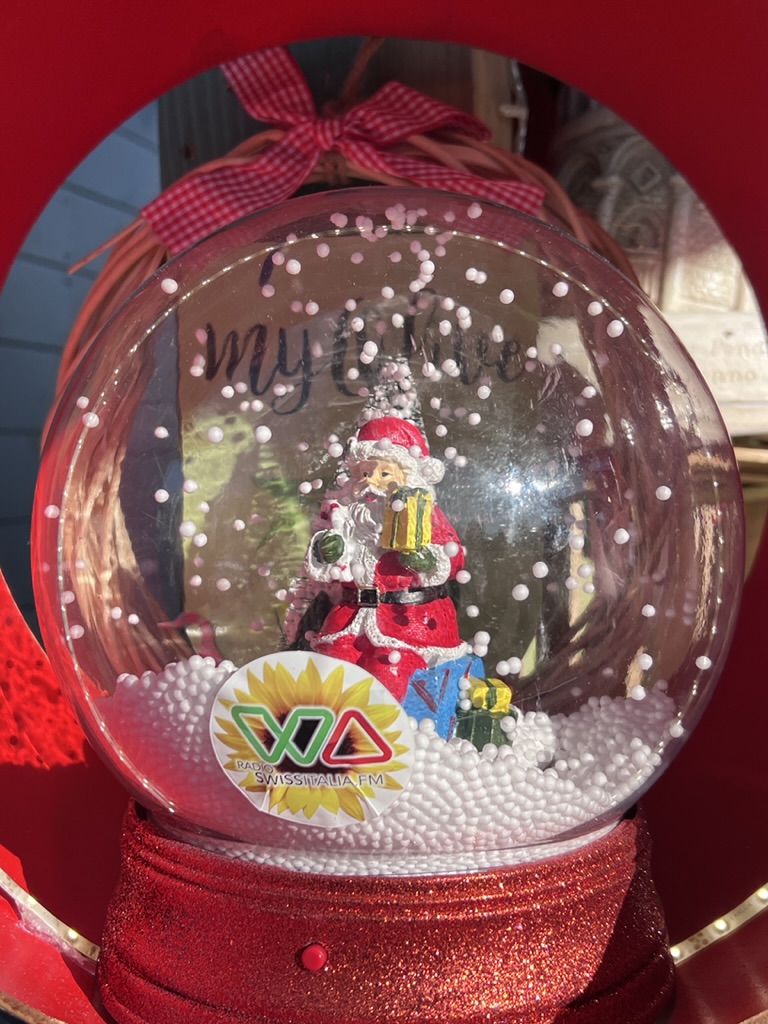
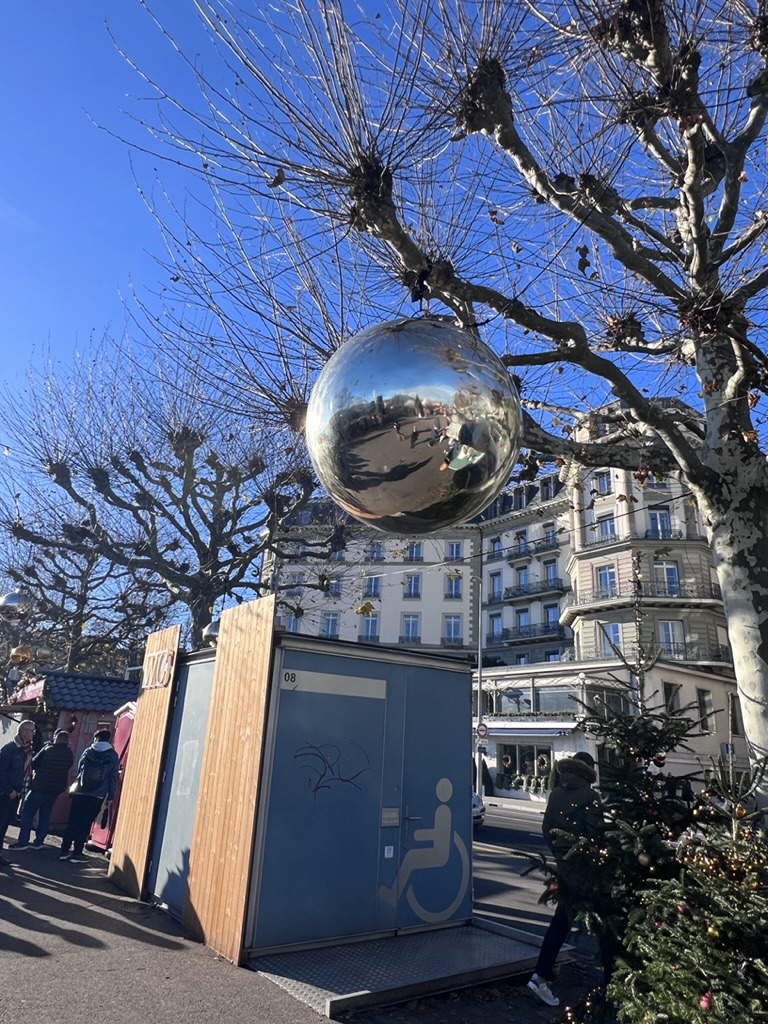
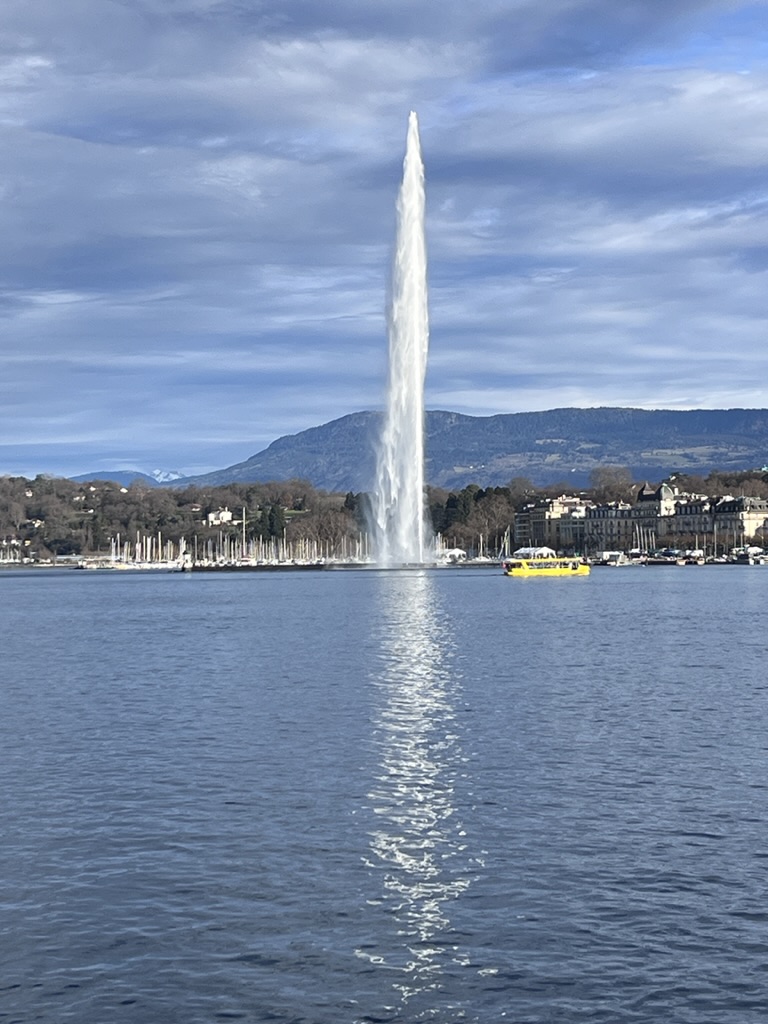
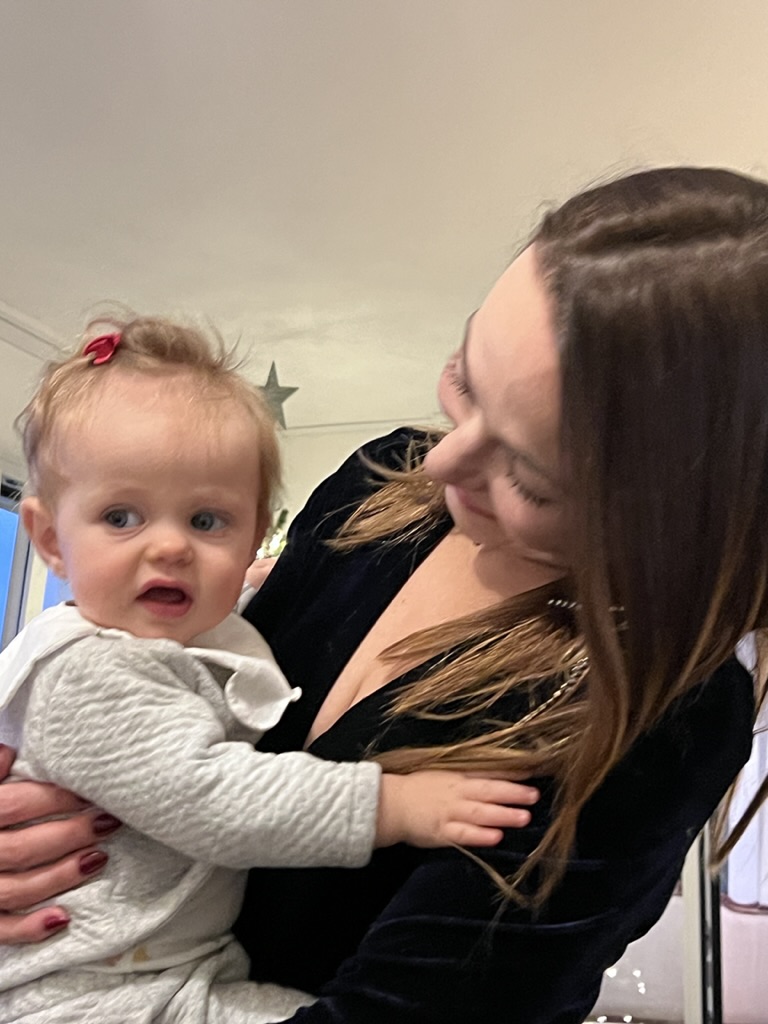
Yesterday, Mike and I strolled to the Geneva Christmas Market (nothing too interesting but a nice walk) and back to the hotel. We are staying at the Longemalle, which we like – smallish, on a pedestrian street in the heart of downtown Geneva. Last night we went to Julia and Julien’s (JuJu’s for short) for Christmas Eve dinner. Julien’s mom and aunt and cousin (from Angouleme—about an hour north of Bordeaux) were there as well. We had met them before at JuJu’s wedding and at previous Christmas events over the years. They are interesting with a long history involving the Mitterrand circle of politicos. So, the conversation was lively. We all moaned the shift to the right throughout our countries and beyond.
JuJu served wonderful foie gras (uh oh—don’t tell anyone in California), and a huge spread of raw fish—with champagne and also great wines. We topped it all off with Buche noel (we brought one we had ordered from a great bakery we had found over the years called Christie’s located just across the street from a hotel we’ve stayed at on previous trips). Turns out at least two other guests had the same idea so they had about 4 buche noels—one will be transported the Xmas Day dinner.
All the best – and merry Christmas.
Fern

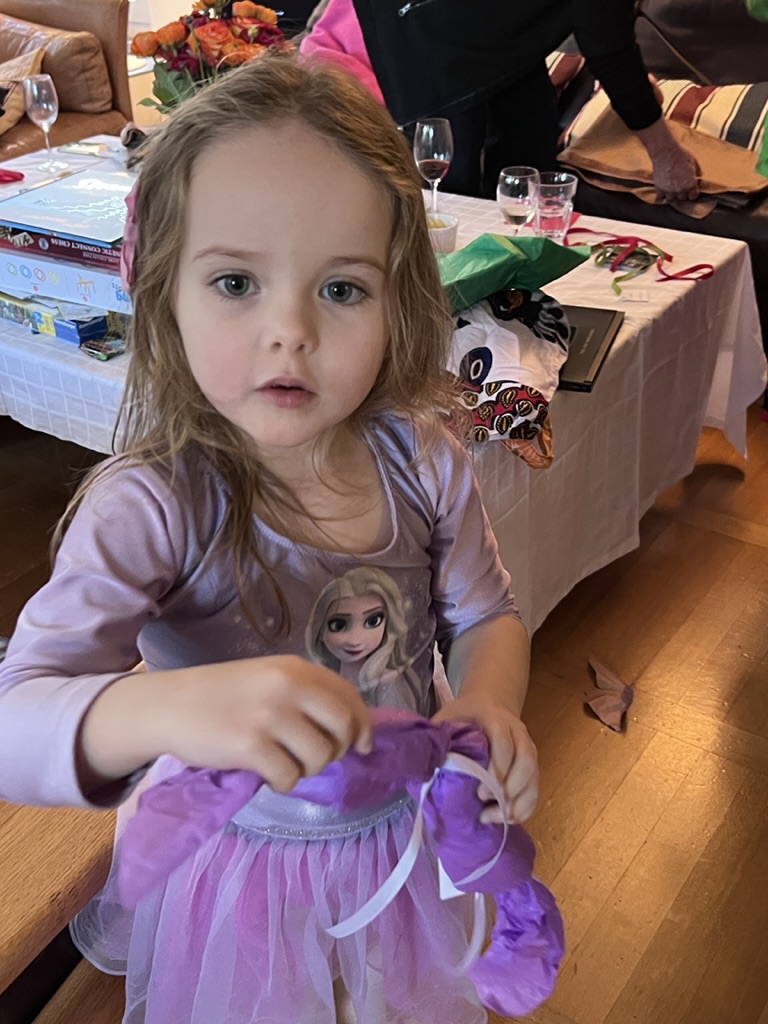
Merry Xmas –
Today we headed to Elizabeth’s house in Carouge for Xmas Dinner. Carouge is about 2 miles from the center of Geneva and easily reached by tram (or you can walk—about 35 or 40 minutes). We’ve often walked but given that we needed to bring all of our gifts, we opted for a taxi. Dinner included all of us, plus Julian’s mother and aunt and cousin and an old friend who lives in Geneva but has lived in many places in the world. His English had a distinct American accent—turns out he lived for three years in Miami. Total was, I think 11 adults and 4 kids; Siena stayed home with the nanny,
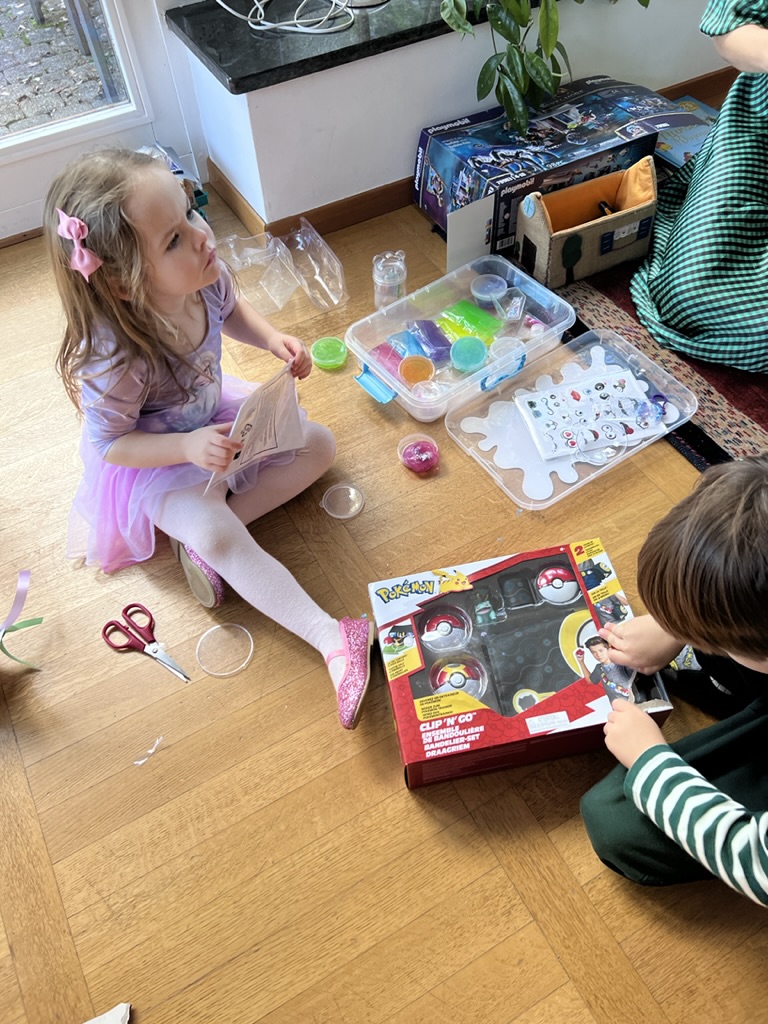
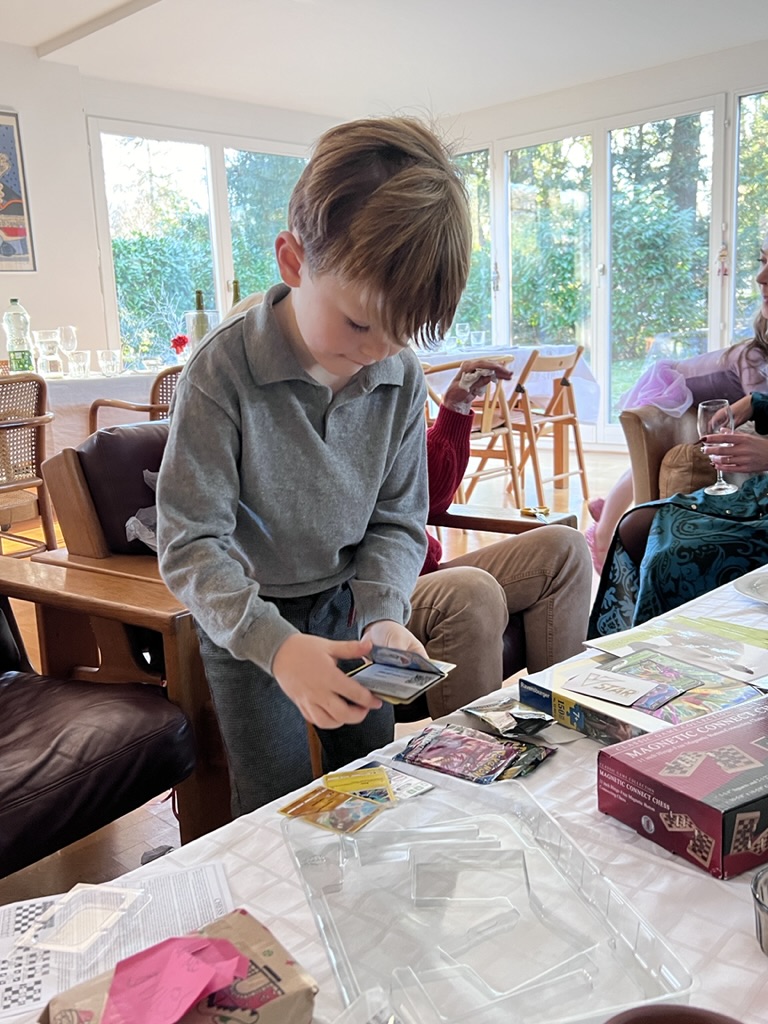
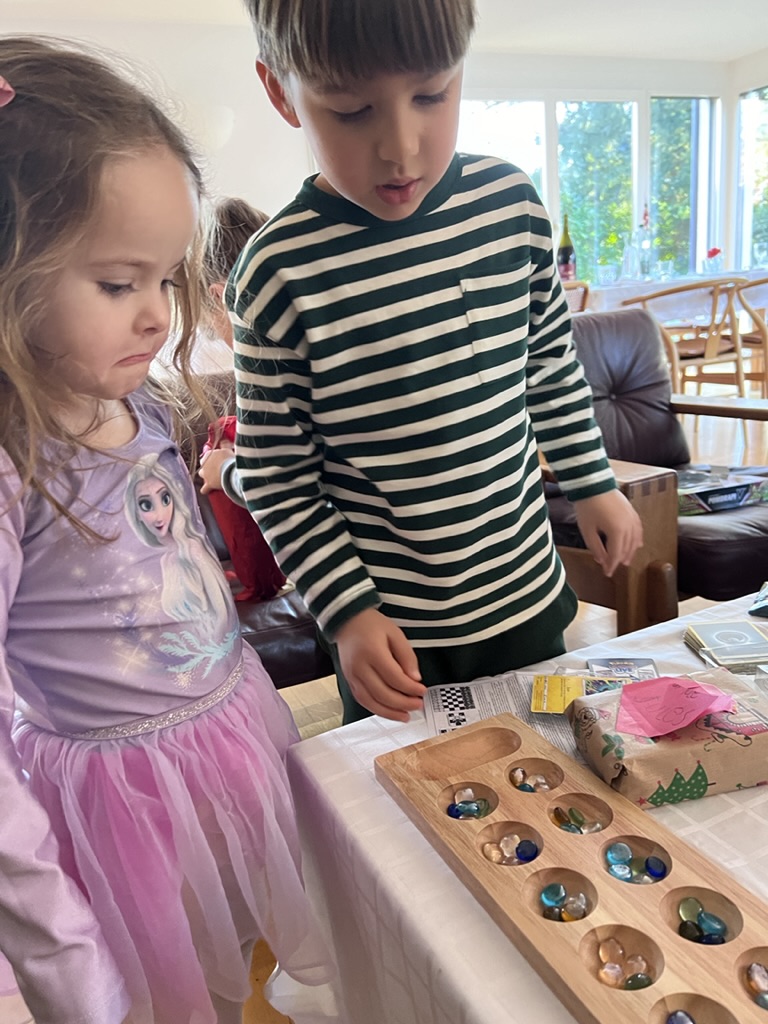
After all the present exchanges and the kids finally settling down to watch a movie, the grown ups had dinner, prepared by Hem and Em and Julian. The present exchanges took a long time what with so many people and kids. We learned that Ella is quite direct and opinionated, and made no secret of presents she liked and those she didn’t. All things pink and purple were clearly the hit with her. For the boys, there was lots of excitement with things that had working components; the lights that you wear on your head to see in the dark and the measuring tapes were a big hit. The dog seemed to have fun with the wrapping paper and general excitement to which she could add her own mischief.
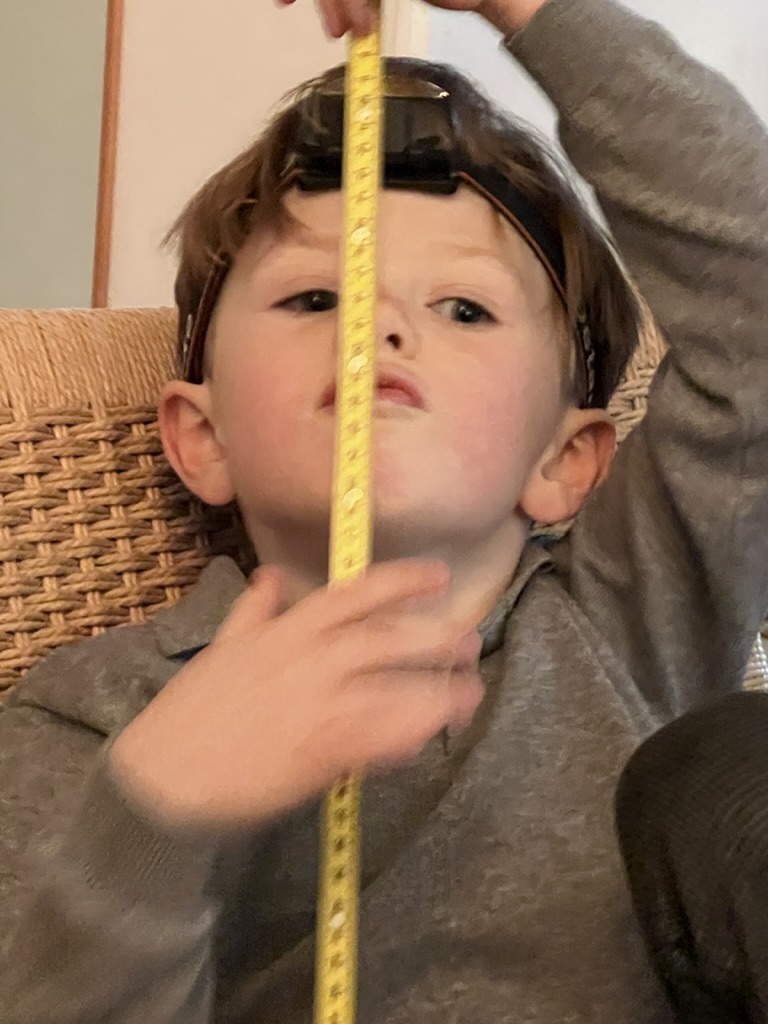
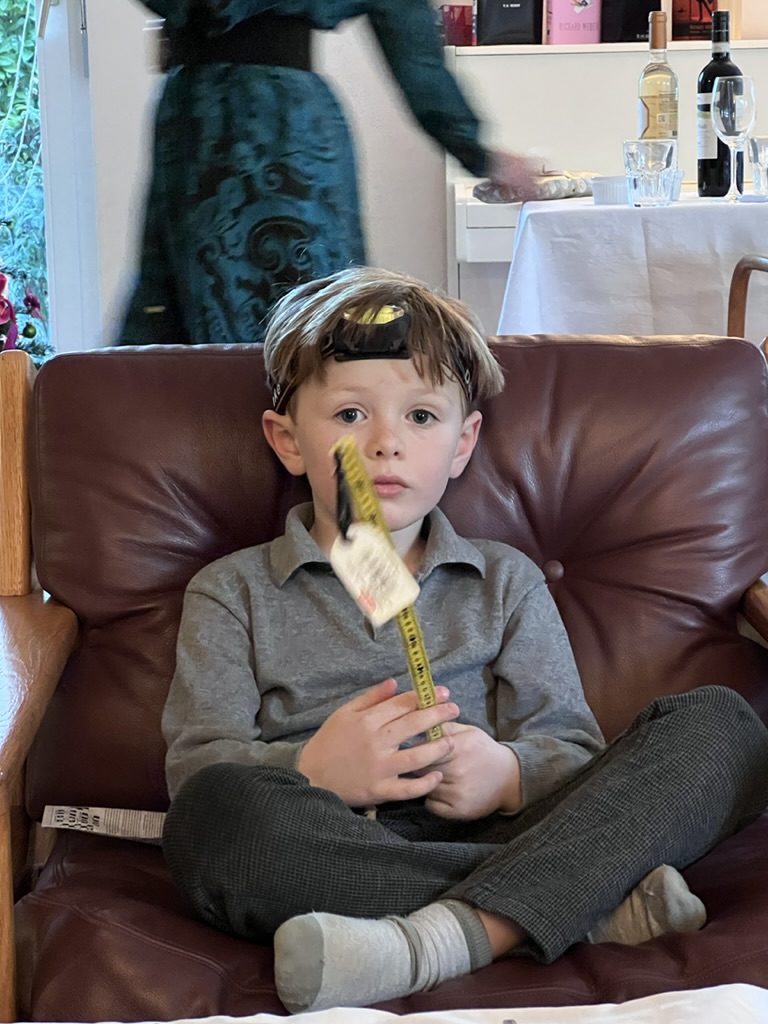
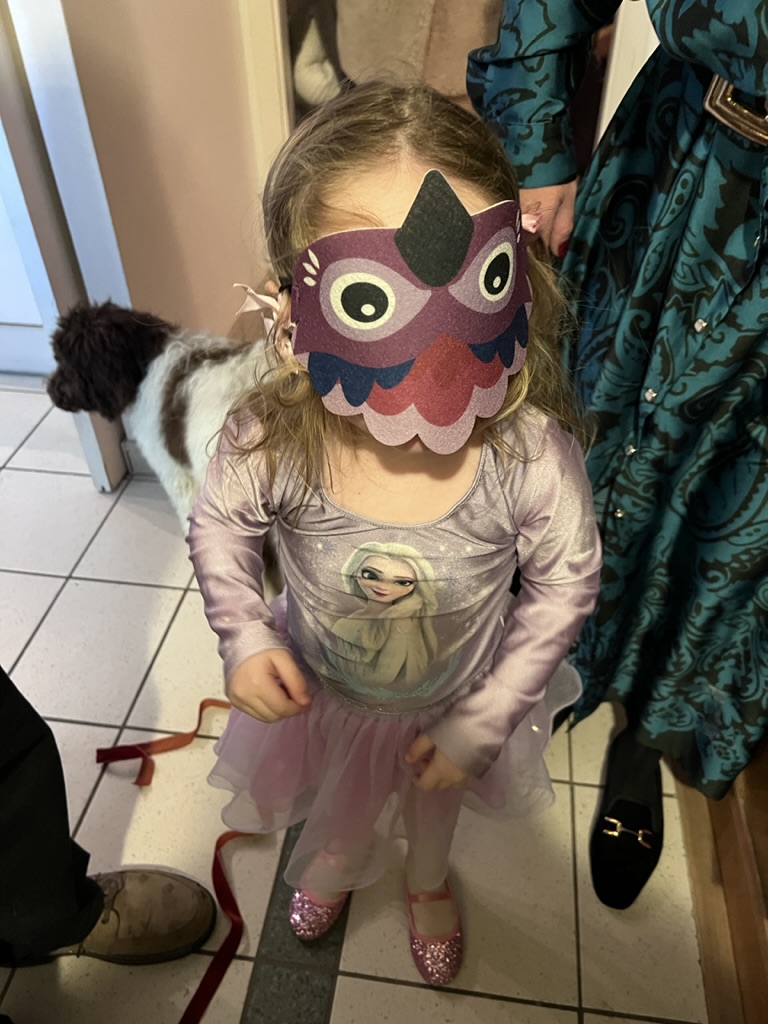
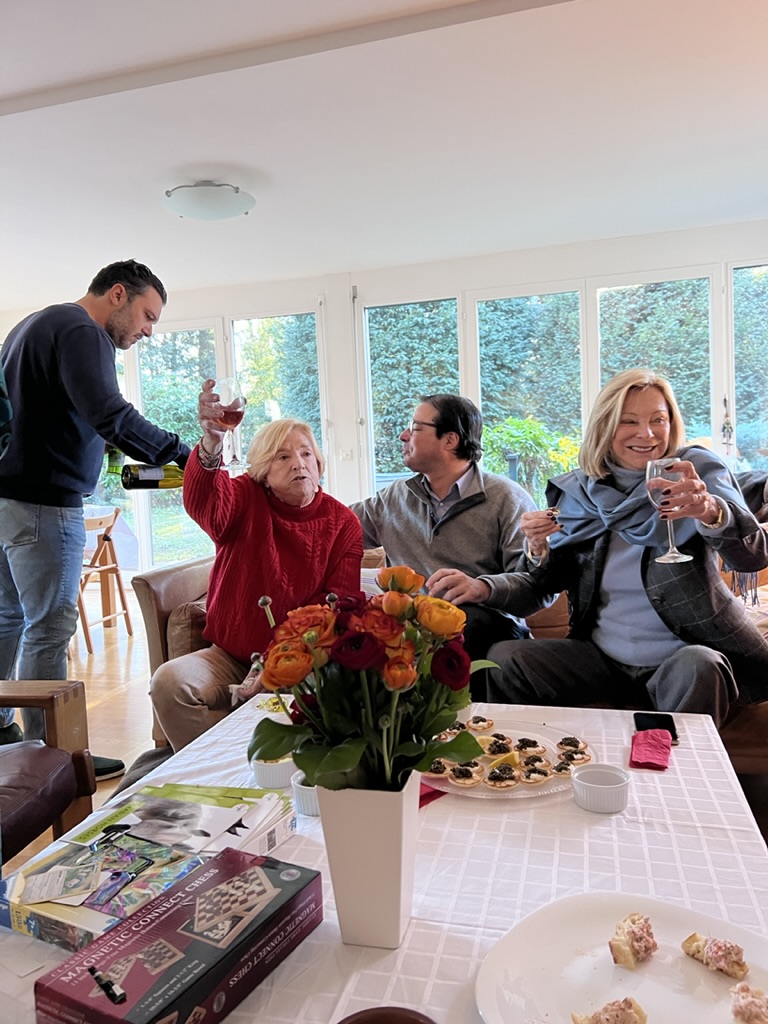
Dinner was pretty traditional and excellent: caviar and blini for starters along with some fish pate; capon and guinea fowl with lyonnaise potatoes, green beans, roasted carrots, and beets; all followed by three different buche noels.. and of course, lots of wine. Before-dinner-conversation centered around the potential of a Trump presidency with the French being totally appalled by the idea and what they felt was an “impossibilité’ and we all anguished over the move to the Right everywhere. We also explained a bit about the electoral college—something noone seems to understand fully.
At dinner, we focused more of the conversation on food, and where to have Xmas next year, with Julian’s mother offering up Angoulême (about 45 minutes from Bordeaux) as the option. Sounds good to me.
That’s it… Tomorrow we will head to Halles de Rive for lunch and then we are supposed to go to a circus with all the kids. Mike is a bit under the weather (cold or sore throat ; fortunately not Covid—he tested) so he may skip the circus. We shall see.
Best to all of you.
Fern
PS – This is, in some ways, the most relaxing trip I’ve taken in decades. My book is done and at the publishers and I’m between projects. So it’s much easier to concentrate on the here and now, rather than everything I left behind. Once I get back to the states, life will return to ‘normal.’
Brno: January 2, 2024: Reconnecting with Old Friends
Greetings on our last morning in Vienna — as we pack and head to the train station …
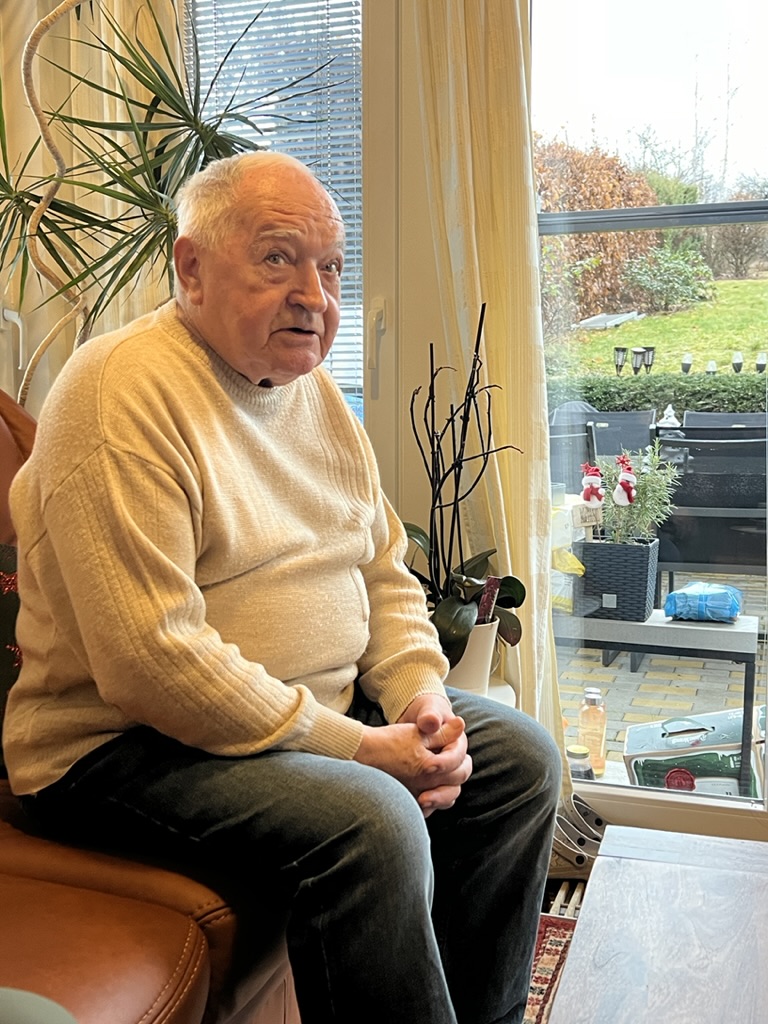
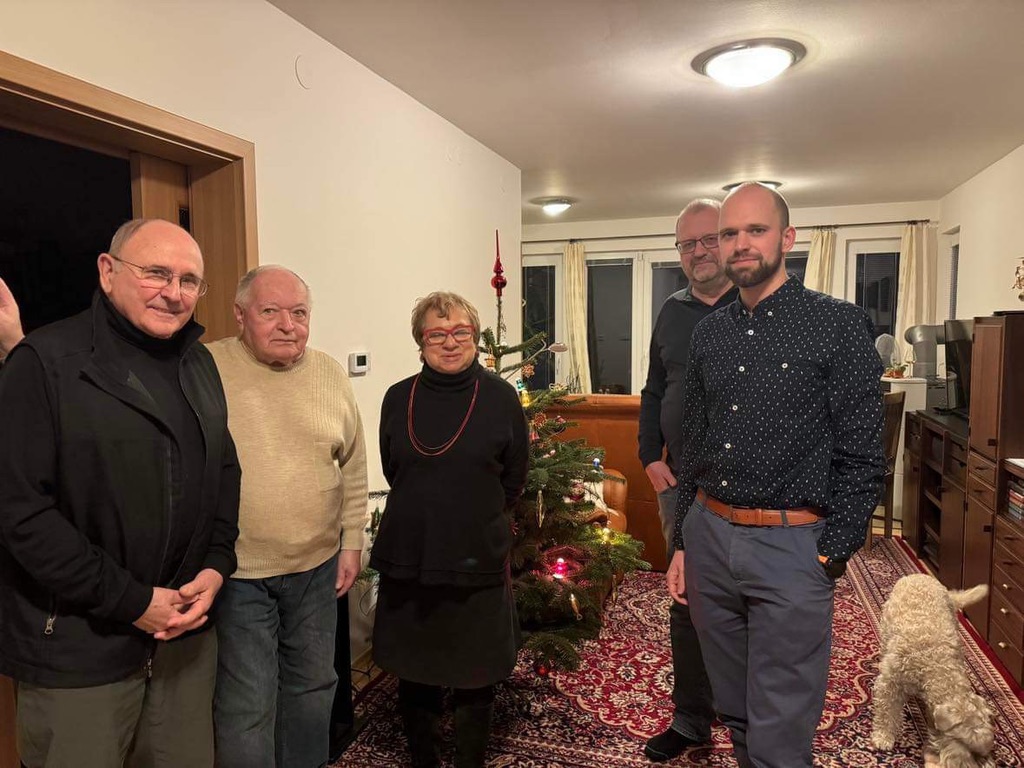

Yesterday morning we made our way to the Vienna Hauptbanh (train station) to catch a train to Brno (Czech Republic) to visit old friends… Jana and Jar, and their son Jan, and the partner of the original base of our friendship—Rudolf. This was probably our 5th or 6th trip to Brno over many years.
When we lived in Finland, we were friends with many young international people who–like us–were living in Finland for a year, mostly on some kind of grant or fellowship (also like us). One of those in this friend group was a guy named Lallin who was an architect/planner, working at the same firm Mike worked at (to supplement his Fulbright stipend and my grant). Over those months we learned a lot about what was then Czechoslovakia and Lallin’s love of his country and his decision to return home in spite of the political difficulties in the 1970s. While he would not yet be home, he encouraged us over and again to visit his country and especially his home Brno, before we headed back to the US. As it was, we were planning to travel (driving) all through what was then “Eastern Europe” (Poland, Yugoslavia, Hungary, etc.) so visiting Brno became part of our trip. That first visit was eye-opening. We were hosted by Lallin’s parents and stayed at their house. His mother and father were both teachers and then high school principals. An aunt also lived at the house along with Lallin’s sister and her two young children (Jana and Michal). We could never figure out where the family slept while we were there because they gave us (what seemed to be the only) bedroom. We arrived late in the evening because we were driving our own car and came through Poland. In those days crossing those borders was complicated and time consuming. By the time we’d wake up each morning everyone was up and the house looked like everything was in place. I think several people in the family slept on the floor of the kitchen and living room while we were there.
Anyway, while we had a great time and they were wonderful hosts, no one really spoke much English, so there were a lot of hand motions and pictures needed. We returned two years later when Lallin was back in Brno and together we did an amazing driving trip through the entire country—lots of stories to tell about that trip; and then we returned again few years before the Velvet Revolution… And then again a few years after that to learn more about the immediate changes brought on by the collapse of Communism and the break-up into the Czech Republic and Slovakia.
Somewhere along the way… I think in 1986, we met his partner, Rudolf (who is a total opera fanatic). Then Lallin got a heart transplant (apparently much easier to get there than in the states, since there is the assumption that everyone donates their organs) and we came to see him again. We had been planning to visit again–a few years later–but Lallin passed away a few days before we got there. We decided to come anyway to see the family which included, at that time, his niece Jana who was, by then a nephrologist, her husband Jaramil who was a professor of geology at the university.
Now we were coming again–just for the day–because it was so close to Vienna. We would see Jana and Jar (who is now the dean of the faculty of science at the university) and their son Jan who is a young 32-year old lawyer (and law clerk to one of the judges in the federal court, and who has just passed the exams to be a judge himself), and of course Rudolf, who is still considered part of the family. During the first years we met Rudolf with Lallin we learned a lot about the difficulties of being gay in Czechoslovakia.

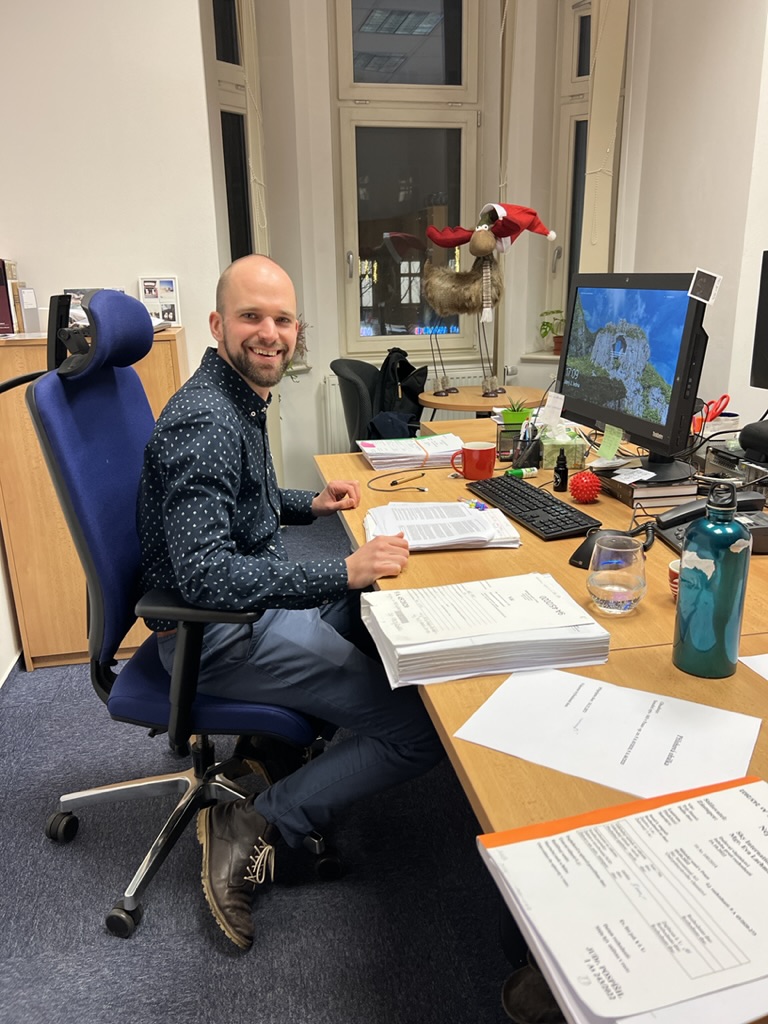
Jana and Jaramil met us at the train station in Brno. It was a rainy, dreary day for a reunion, but the welcomes were warm and it was good to reconnect. Our train ride from Vienna to Brno was not without complications. It turns out that our ticket was on a “private” rail line (go know!!) so they had a little trouble finding our track since the government doesn’t announce the tracks for these trains as quickly as it announces tracks for government trains. The train was pretty low quality… but Jara told us that our train was much better than the government ones (!!) We had purchased “first class” tickets although the trip was pretty short. We figured the seats would be more comfortable, and it wasn’t very expensive. It was definitely a second world train (probably 1960 vintage, old German train). Not quite as bad as trains I’ve taken in Romania, Tibet, and Uzbekistan…. But close.
Nonetheless, we arrived safe and sound… and also learned that there are three classes on these Czech trains: Economy, First, and Business. Turns out that Business class is higher than First Class?
We then all met up with Rudolf and Jan at a restaurant with a view (which we couldn’t see in the rain) and had fairly typical Czech food (meaning lots of heavy meat… and potatoes.. and of course, beer). We talked on and on about politics (theirs, ours, and the world) and the environment (Jan is working to become a legal specialist in the newly emerging field of Czech environmental law), and what we’ve all been doing over the past years. It had been 10 years since we were last in Brno. Fortunately, Jaramil and Jan speak English very well, (and Jana understands but is hesitant to speak), but communication with Rudolf is limited.
Then we headed to their house for coffee and pastries and more conversation. Brno is/has always been an industrial city very overshadowed by Prague. It is the second largest city in the country with about 400,000+ residents. It is now a tech center but having difficulty encouraging young people to study technology at the university. It is home to about 5 large universities (some of which Jar says are very highly rated internationally). While we could see some new construction, Brno still seemed very much a second world city—but much loved by its residents who, like Jan, appear to return after university.
We learned that the amount of funds the US has given to Ukraine is more than the entire Czech budget. The Czechs have donated their old Russian tanks and other equipment to Ukraine in support of their role in the war with Russia because the Ukrainians know how to fix and use those old Soviet-era equipment. Then the Czechs can replace those weapons with new ones… well “newer,” according to Jan, who corrected his father’s description. Father and son were funny because Jaramil’s (Jan’s father) work involves locating minerals that are radioactive and recommends how they can be safely extracted if needed. Jan’s work focuses on regulations regarding such materials and their impact on the environment. Jaramil says jokingly that Jan (his son) will eventually put him out of business.
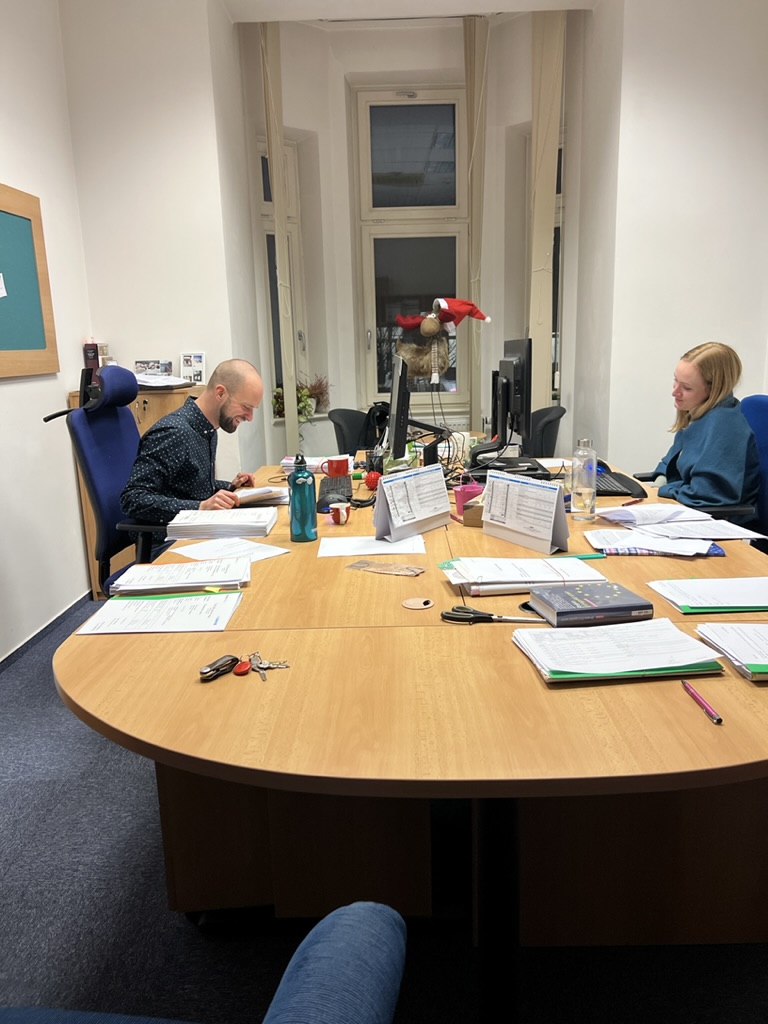
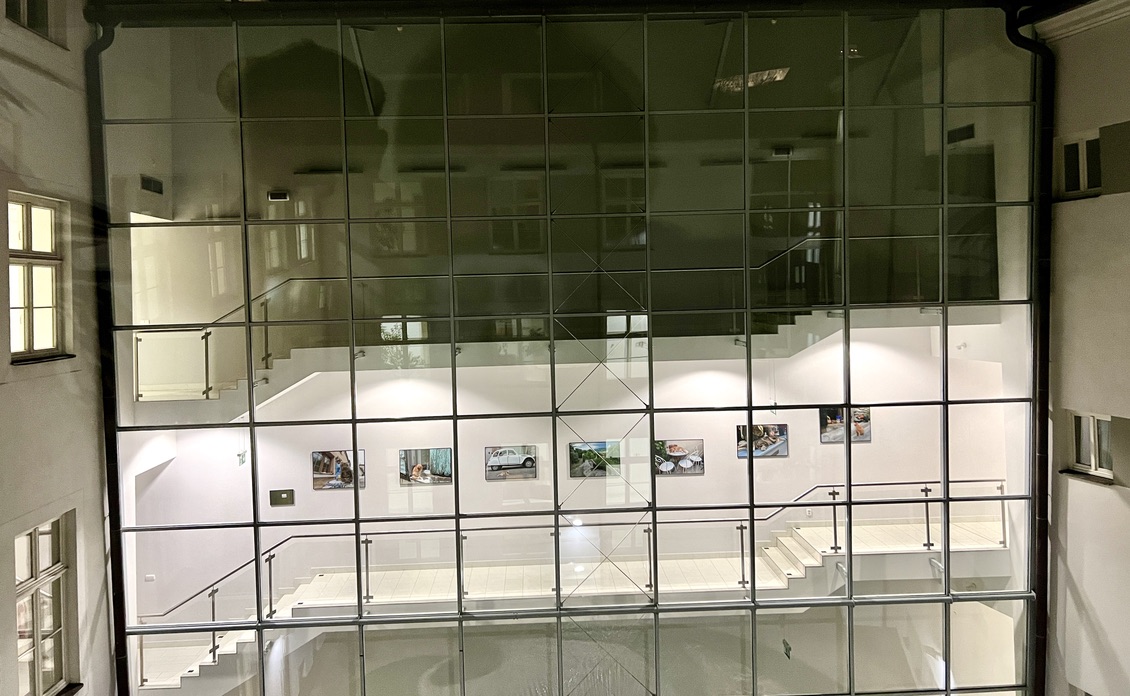
Jan took us on a tour of the newly renovated court building where he works–which was quite impressive. There were really good, large-size documentary-style black and white photographs of all the judges in a gallery-style wall on one floor. First we were surprised to see such “casual” photos rather than official portraits. Then we were also surprised that the majority of judges were female. And it was interesting to learn that one of the judges is interested in photography so she took all of the photos! Nice touch.
The Czechs have grown weary of the war in Ukraine especially because while they overwhelmingly welcomed Ukrainian immigrants at the start of the war, they are now seeing their taxes increase, to help pay for the immigrants. And the Czech Republic seems to back Israel over Palestine because of a general fear of Muslims and dislike of Arabs who are “paying their way” to get degrees at Czech universities. It’s probably also tied to the fact that they fear immigration overall—since they are a fairly homogeneous population.
Then we headed back to the station to catch our “non-first class” seat. Before taking a taxi for a late dinner (restaurants are open until about midnight here in Vienna—my kind of town), we went to the train information counter to check what kind of seats we have for our trip to Munich in a few hours. Turns out that while we thought we had first class seats (it’s a-5 hour train ride and we have our baggage; the “business class seats” are the only ones with room to store baggage) which we do… but again, it is Business Class that is the best seating. We couldn’t upgrade for our train, but we were able to rebook for a later train … We shall see.
We had dinner at a restaurant called Market (in the Naschtmarkt area), which was good… Asian. We had four starter plates and were pretty full at the end. Then back to the hotel to pack.
I’m going to sign off now and end this travelogue series… unless something really interesting happens between now and our flight to SFO. We are staying at an airport hotel so we can just walk to the plane tomorrow morning. Can’t imagine that anything worth writing about can happen between now and our arrival in SF.
Take care.
Fern

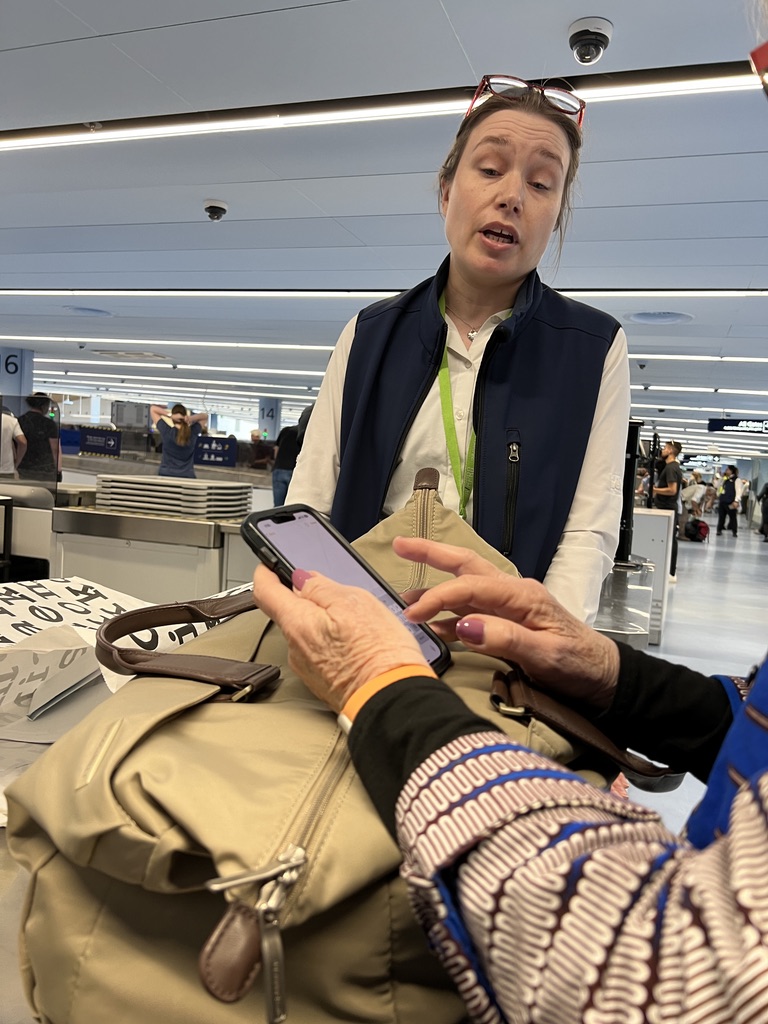
Well I truly thought the travelogue for this journey was complete and we were merely on the way home…. But it didn’t turn out to be uneventful. So here goes.
We left the lovely Hotel Kamp and wonderful Helsinki on an absolutely perfect sunny day with temperatures about 70 degrees. It was going to be a great midsummer eve for the Finns and while we had been invited to a Midsummer Eve Party, we had to decline since we were set to fly to Frankfurt at the end of today (June 21) to avoid having to take a very very early morning flight tomorrow and change planes in Frankfurt and then have a 6-hour layover. We opted to leave Helsinki this afternoon (5:45 pm flight) and spend the night at a hotel at the Frankfurt Airport and then leave tomorrow for SFO at a civil time in the afternoon. It does make for a more relaxing journey. All was good until we hit security at Helsinki. We went through the priority lane so it was a snap, but they pulled out the Marimekko shopping bag that we were carrying —requesting further inspection.
I laughed. The bag was taped with all the “tax-free” information which you are not allowed to remove until after you get the customs stamp, That’s why it was in a shopping bag and not in our luggage. I’ve done the tax free bit literally hundreds of times and I’m a pro at it. The glitch here was that we couldn’t do the tax free/customs actions at the Helsinki Airport since we were only going to Germany and since both countries are in the EU, it is not considered valid for tax-free; thus we had to keep it all wrapped until we leave Germany for the US where we would then be considered “leaving” EU. I knew all of this and had everything prepared. It’s gotten more complicated since EU, but I’ve done it many times. Had we done a connecting flight from Helsinki to US through Germany we could have done this all in Helsinki.
Anyway, when they pulled out the Marimekko bag, they said there was something suspicious in the bag. I said it was all purchased at Marimekko and was all for export tax free, and assured them there was no metal in there. I offered to show the receipt with all the items noted, but they refused to look at it. The manager came by and she was like a TSA Nazi!—so un-Finn-like. Just kept saying there was something wrong inside the bag and they would need to open it. I said if they opened it I could not go through with the customs office and the tax refund. This went back and forth and she finally just took the bag and tore the tax free tape that sealed the bag and cut it… What they were seeing was a ceramic plate that we purchased as a gift for someone. They said it did not x-ray; I told them I had already been through two other FinnAir flights with the same bag and no problems. They said that’s because the other Finnish Airports don’t have as sophisticated machines as they have in Helsinki. Anyway, I now have no idea what will happen when I go to the customs office tomorrow in Frankfurt.
Spent a bit of time in the FinnAir Lounge and then trekked to the very last gate to board our plane to Frankfurt. Flight was fine and even a good meal. Then the real fun began.
We deplaned and saw the sign for baggage— and followed the signs. Normally we do all carry-on, but sometimes at the end of the trip when heading home.. we just say “screw it, let’s check the bags and just carry on our computers and small carry on bag.” You need to know that Mike absolutely hates the Frankfurt airport. We have probably been through this airport changing planes about 50-75 times, and we truly do hate it. It’s huge; there are no moving walkways, and you seem to always have to walk miles to your gate. But somehow because it is so large, it seems like all planes (especially United) go through it. Last January we literally complicated our trip to go through Munich, just to avoid Frankfurt. Munich is a nice airport that works well.
So, we followed the signs to baggage claim and when we got there, there was no Helsinki flight listed on any of the carousels. Went to the info desk and we were told that we were in the wrong baggage area. We were in D and we needed to be in E… We had to go out the exit and I feared we could not get back into the baggage area because those doors lock behind you. Anyway, we walked about ¾ mile to the E section in the lobby area and found E, but we couldn’t get back inside to the baggage area. Went to another information desk and were told to walk all the way down to a “green wall” and then there would be a door; we needed to ring a bell at that door. More walking and we did as told. (It is Germany!) and we got into the E section luggage area. By now they were clearing out all the luggage that had not been claimed. The attendant was just lifting our bags onto a cart. We stopped her and took our bags. OK.. Success.
Then we needed to find the Airport Marriott which we knew was located in Terminal 1; we were now in Terminal 2. More walking and then one stop on the train, and we were in Terminal 1. But while you would normally just walk out and enter the Marriott there was construction, so you needed to walk more and then take an elevator up and walk over a bridge and then walk back into the hotel.
By the time we reached check in we were not only exhausted, but there was a long line to check in to the hotel because they had just one person working the check-in desk! Someone must have complained because they then announced that Bonvoy Members could check in on another floor, which we did.
Hopefully all goes well tomorrow and whatever happened today will be forgotten. We depart from Terminal 1, and the hotel is in Terminal 1 so it should be a piece of cake. Except for the questions I will need to answer at Customs to explain why the special export tape has been cut.
All told, 9,000 steps and 3.8 miles—all in airports.
Ain’t travel great.
See you stateside.
Fern
Greetings from Helsinki: June 20, 2024
It was a positively beautiful sunny day in Helsinki… high 60s, blue sky, simply perfect.
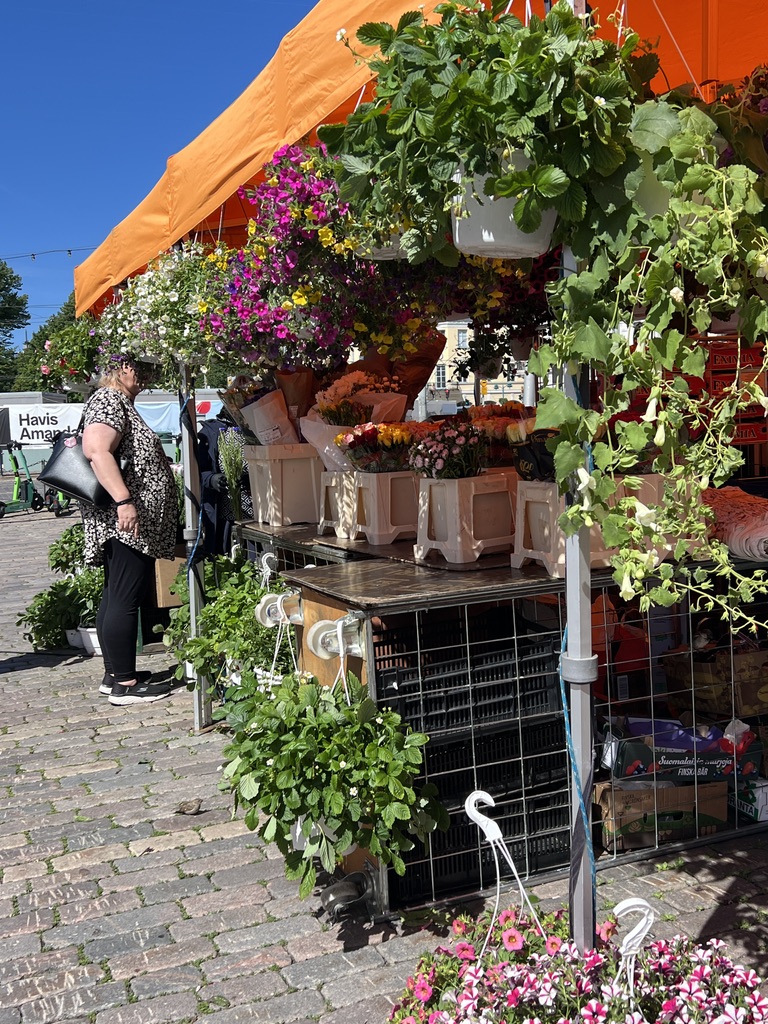
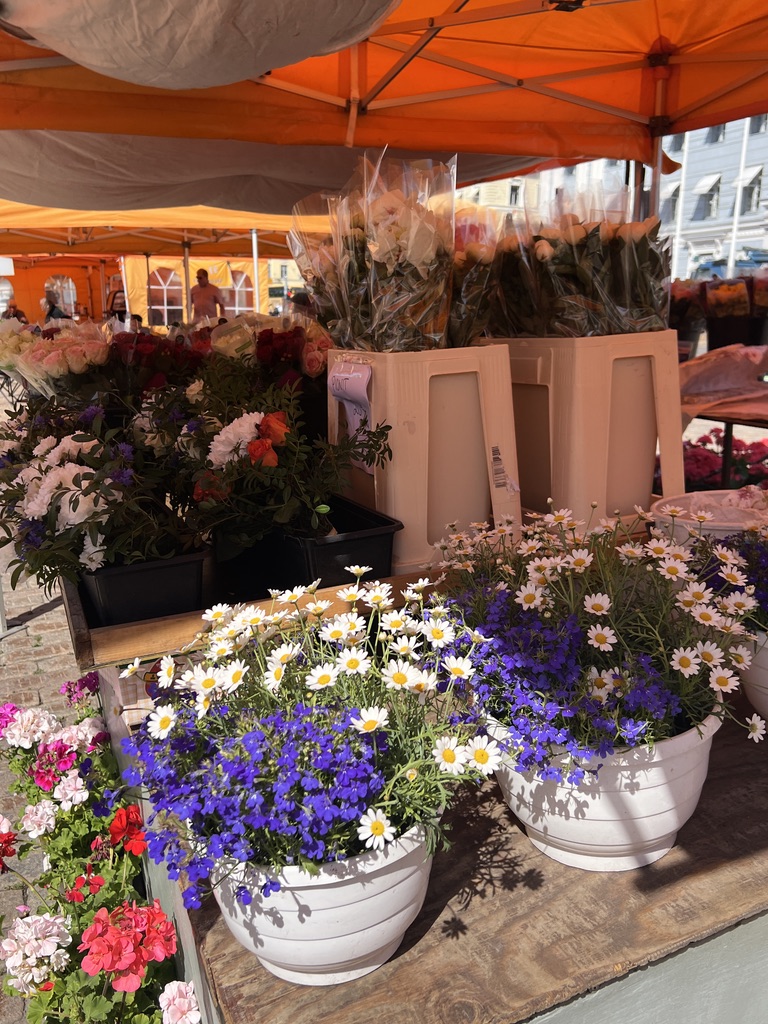
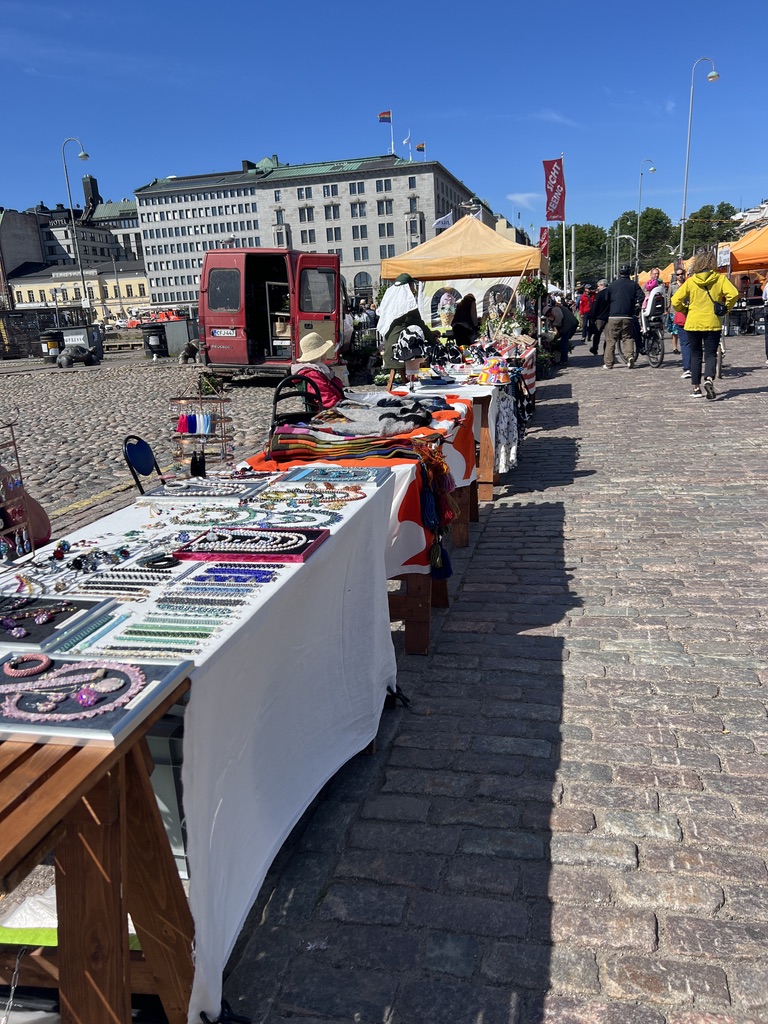
We started out walking down the Esplanade to the “kauppatori” (market hall and outdoor marketplace) which is always delightful—filled with fruits and vegetables, and flower vendors, some crafts, and little places to eat. Inside the actual brick market hall (Vanha Kauppatori — old market hall) which opened in 1889, there are wonderful little places to eat and additional shops for some pretty high-end food.

From there we strolled to revisit the National Memorial to the Winter War, a sculpture that was the result of an international competition that had 258 entries. The winner was Pekka Kauhanen who designed a spherical reflective base on top of which stands a human figure—also in reflective steel. The figure is punctured with numerous ‘’bullet holes” and the base has a series of circular “windows.” Inside the base you can see more than one hundred photographs that highlight the events of the “Winter War” between Finland and the Soviet Union in the 1930s. The photos inside are difficult to see because the sculpture has developed moisture inside that sphere. It’s located in front of the army headquarters in downtown Helsinki and is a memorial to that Winter War.
The Winter War is a major historic event in Finnish history: In 1939 the Soviet Union attacked Finland and believed the invasion would be as easy as their invasions of Estonia, Latvia, and Lithuania. This was the start of what was called the Winter War. Although the Soviet forces vastly outnumbered the Finns, the Finns managed to stop the attack and wound up retaining most of its territory when the Moscow Peace Treaty was signed a year later. When we lived here we heard many stories about the Finnish Army’s skills on skis and the fact that the Finnish soldiers wore white uniforms, so they blended into the snowy countryside and forest where the war was fought. But probably most important was the morale and united purpose of the Finns who understood they were fighting for their national society against a common enemy.
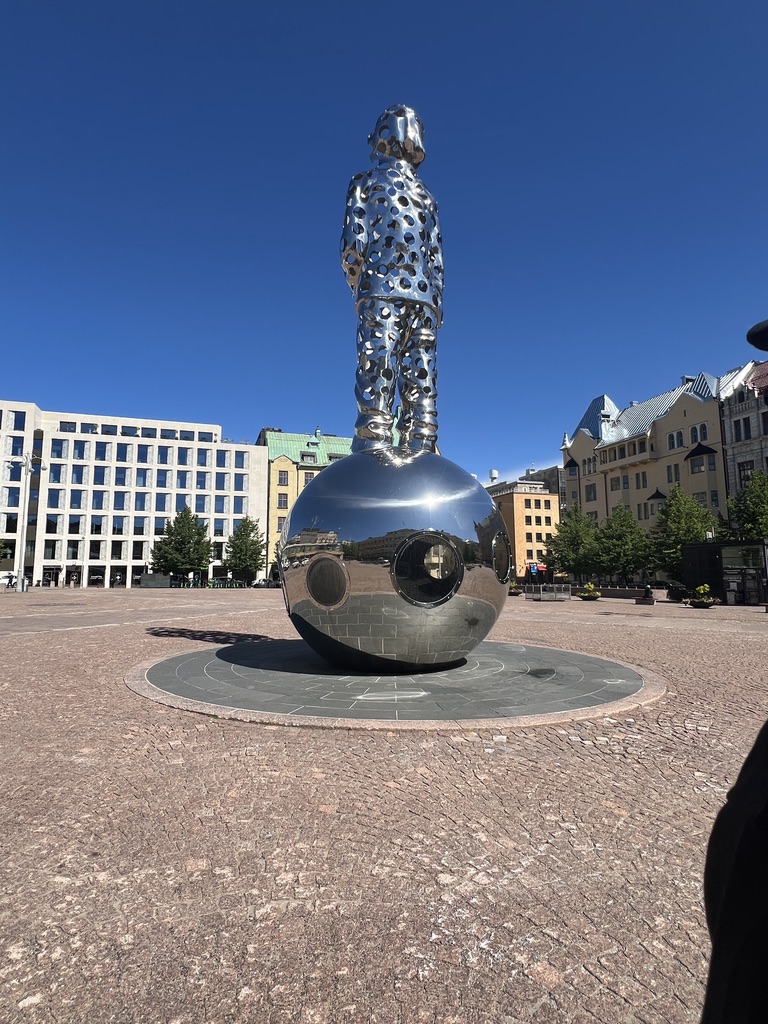
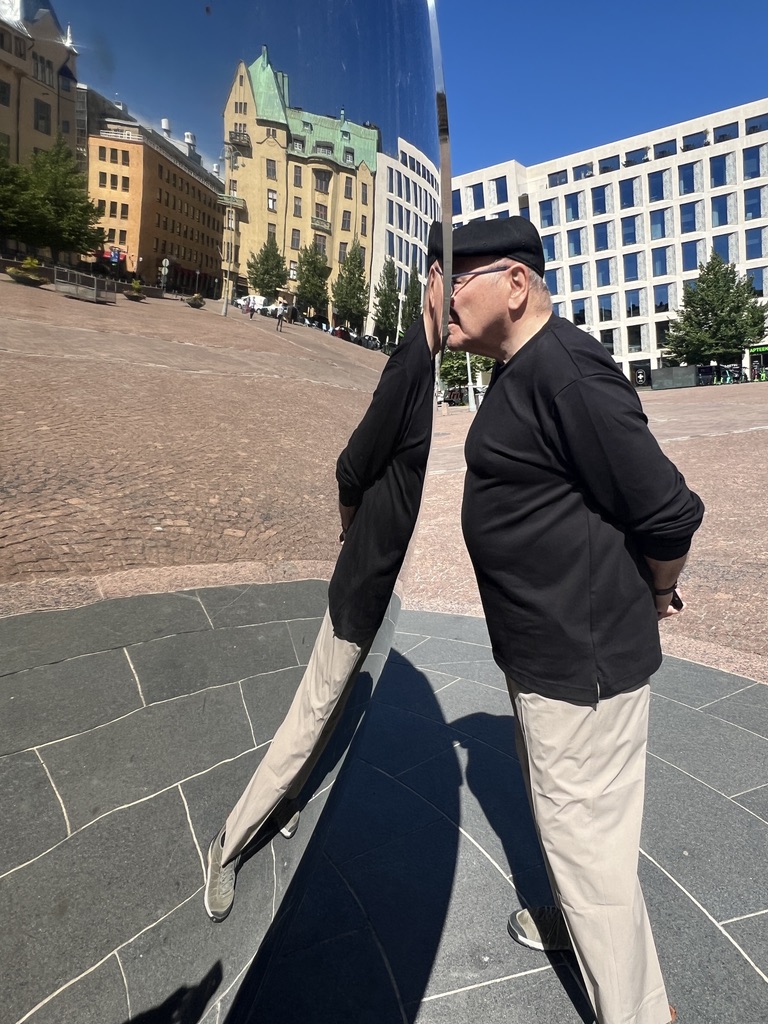
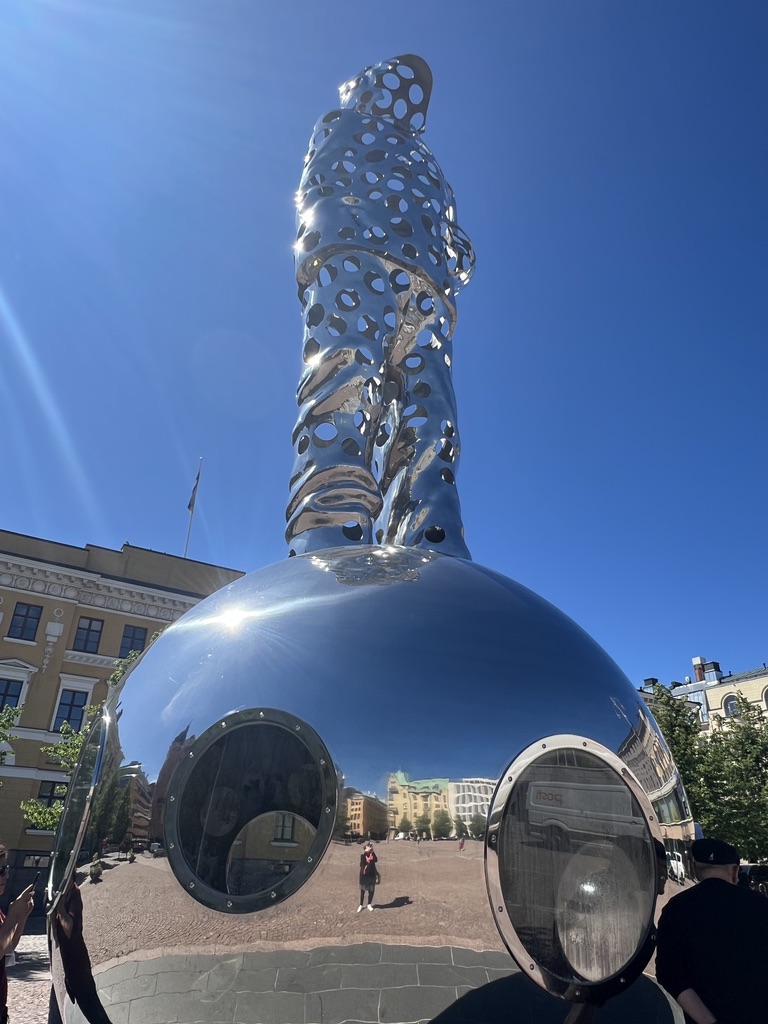
The memorial was designed to commemorate the more than 25,000 Finns who died during that war.
After a brief stop in the park, we hopped on a tram and headed to Hakeniemi to see the renovated Hakaniemi Market Hall. It’s 110 years old and I had visited it many times prior to this renovation. It’s one of three major market halls in Helsinki. But seeing it this time was an eye opener as it is now a very contemporary market inside that 110-year old building.
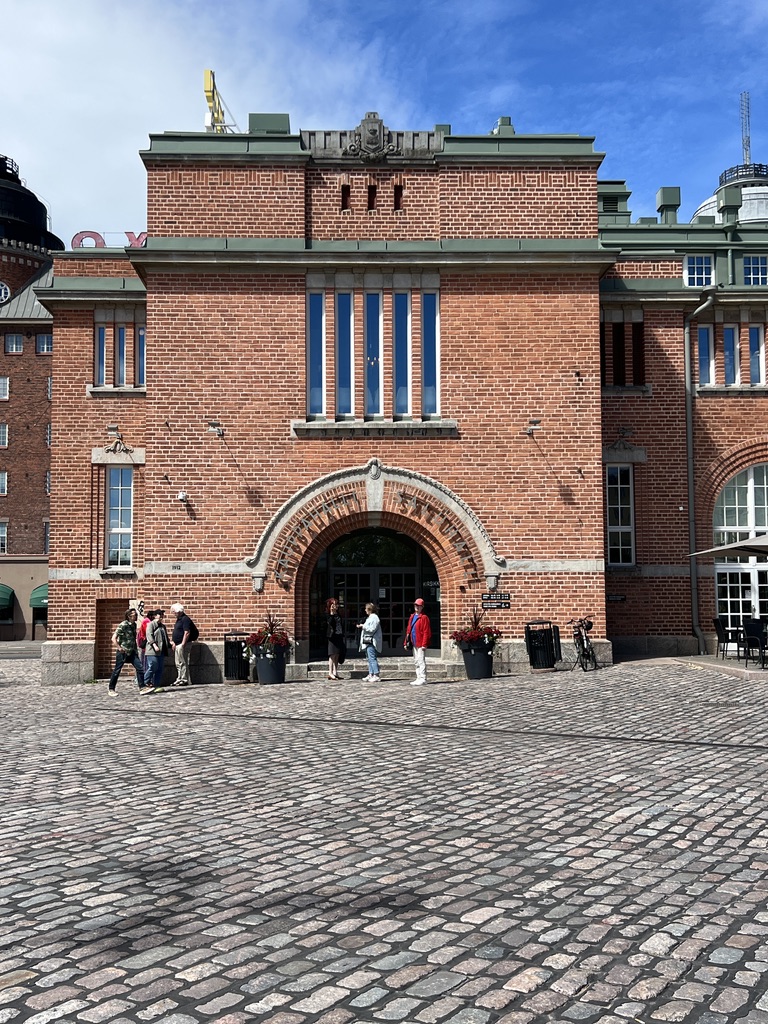
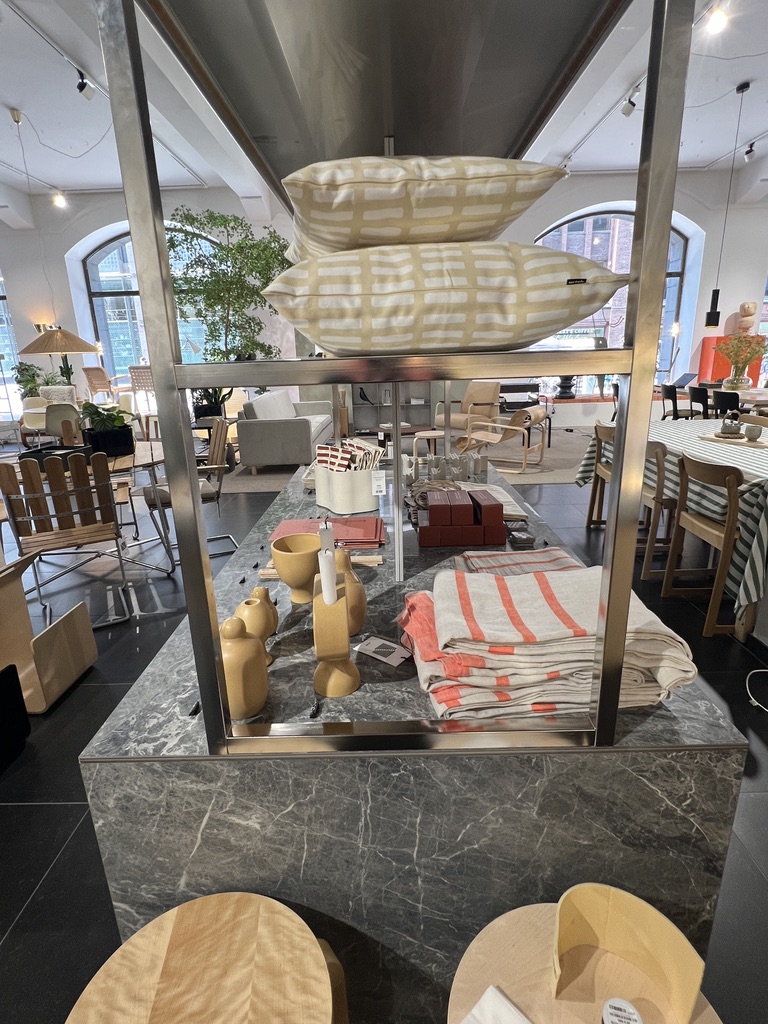
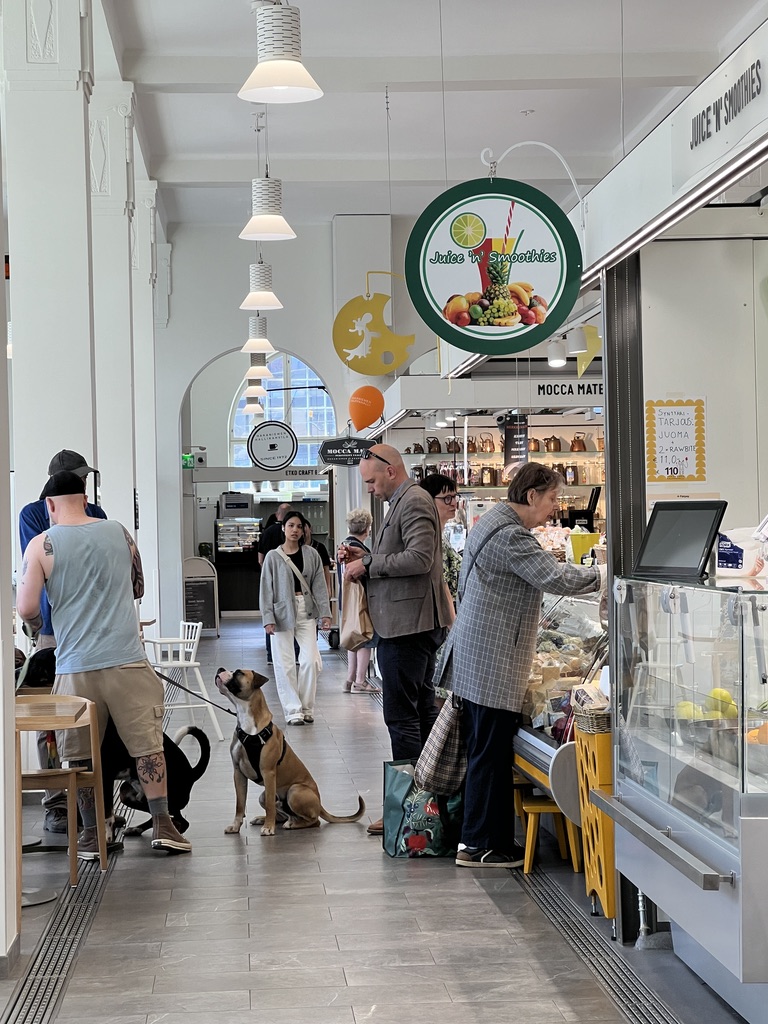
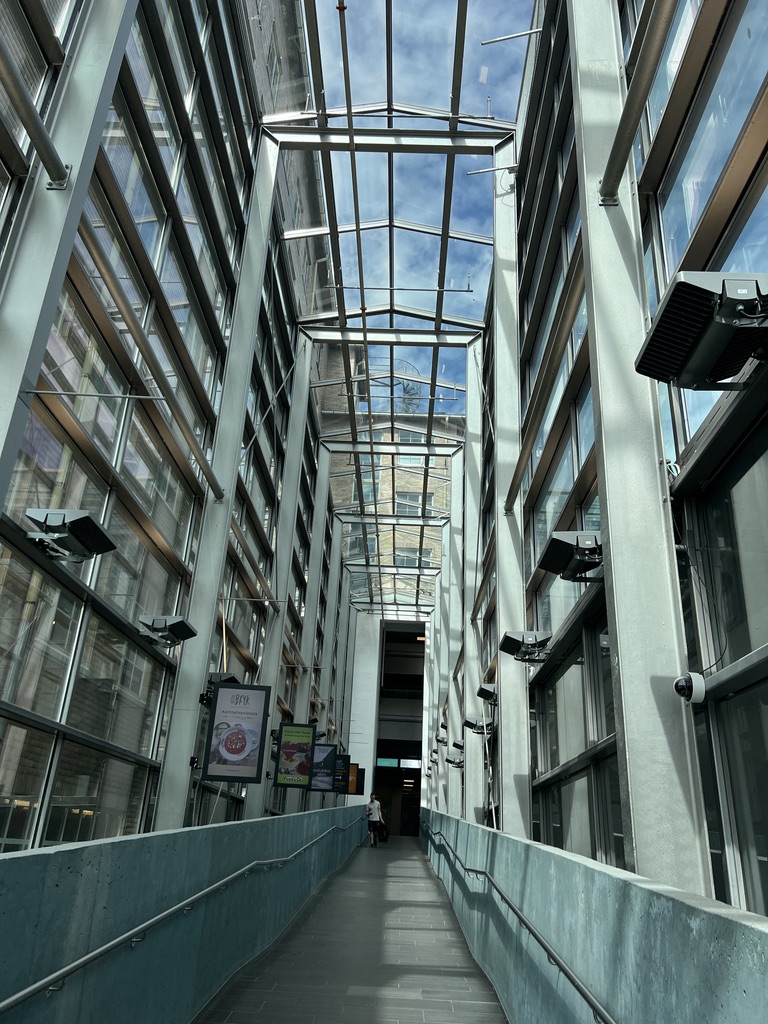
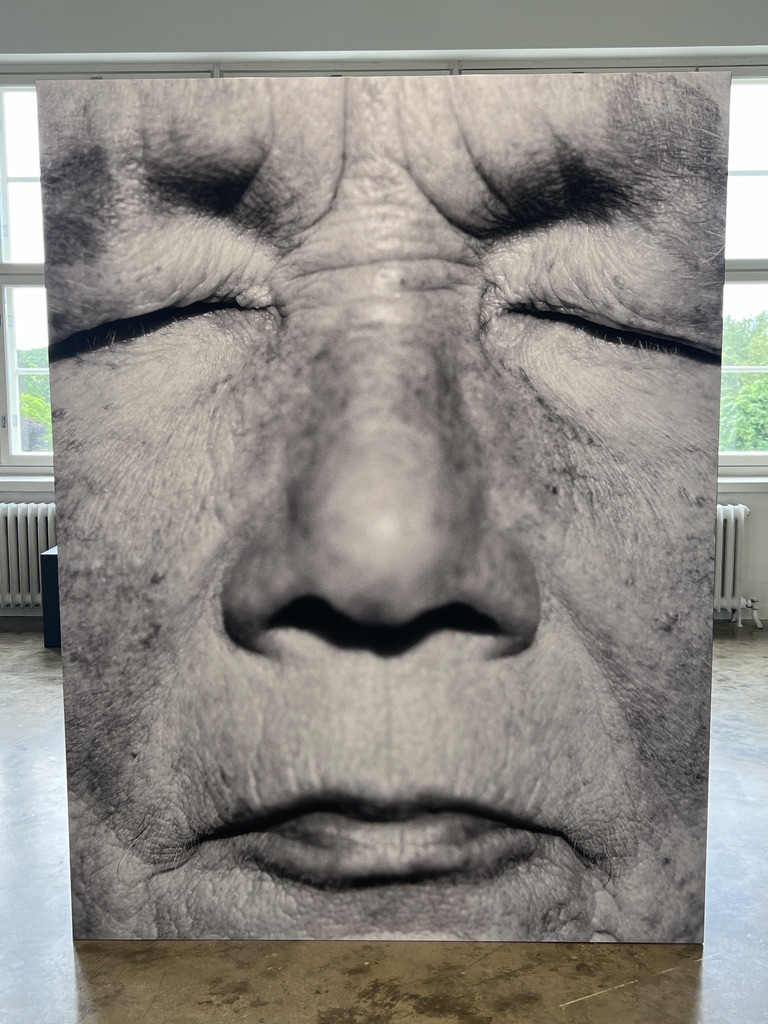
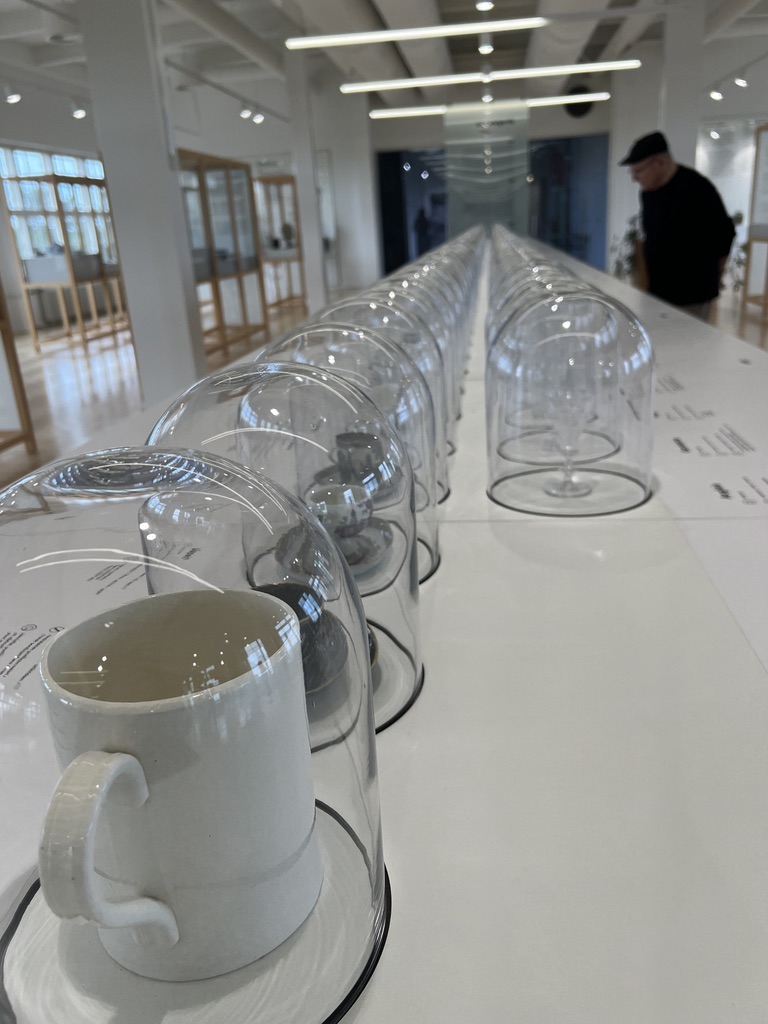
After having a wonderful smoothie, we hopped back on the tram and headed to the Arabia headquarters where we saw an interesting photography show and also stopped into the Iitala museum which houses a nice history of Iitala’s glass and porcelain products over the past 150 years.


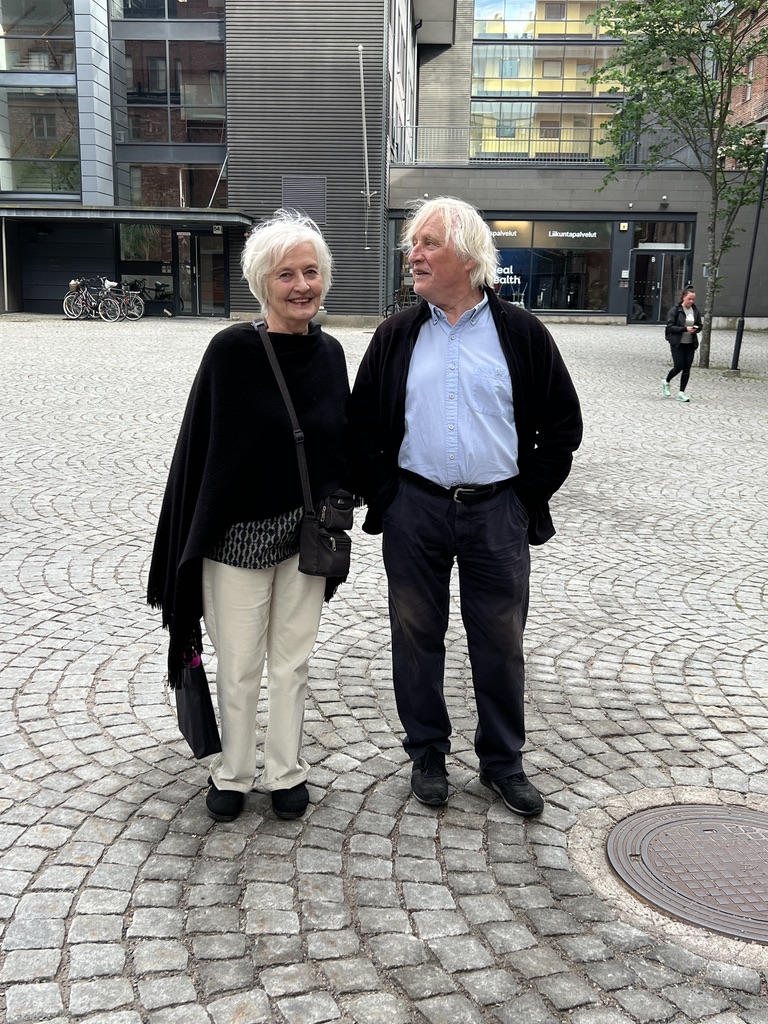
And then we met up with Antti and Heidi again, for our last dinner in Helsinki. We started at a local bar for a bottle of champagne during which time we gave them funny gifts: pins that show Putin holding a miniature Trump in his hand and Trump is pictured as a baby and also a roll of Trump toilet paper. We had a good laugh.

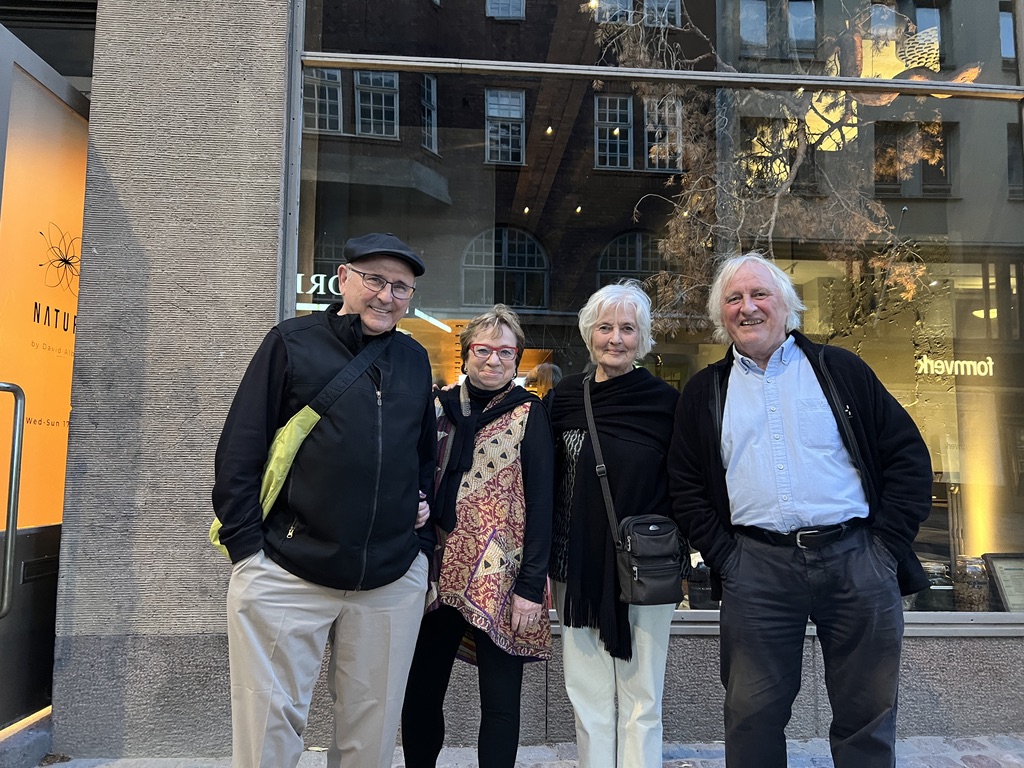
We then walked to Natura, very small family-run restaurant that specializes in “modern, innovative food with a focus on Finnish game, vegetables, and sustainable seafood.” We started with venison tartare that was sitting on a wonderful wedge of bread that had been soaked in something and on top of the tartare there was finely shredded white cheese and some seaweed and herbs. Then we shared a beetroot risotto, and then very delicate fish with sauce and baby vegetables. Finally (again sharing) we had some kind of beef that just melted in your mouth. The portions were small so didn’t feel stuffed. We ended it all with a frozen yogurt dessert that sat on a bed of rhubarb and was topped with something that looked like snow, but was actually shavings of frozen yogurt. After taking a few group photos, we bid farewell to our dear friends and walked to our hotel at about midnight while it was still light out.. passing by that Runeberg statue with.. yes.. a seagull sitting on his head.
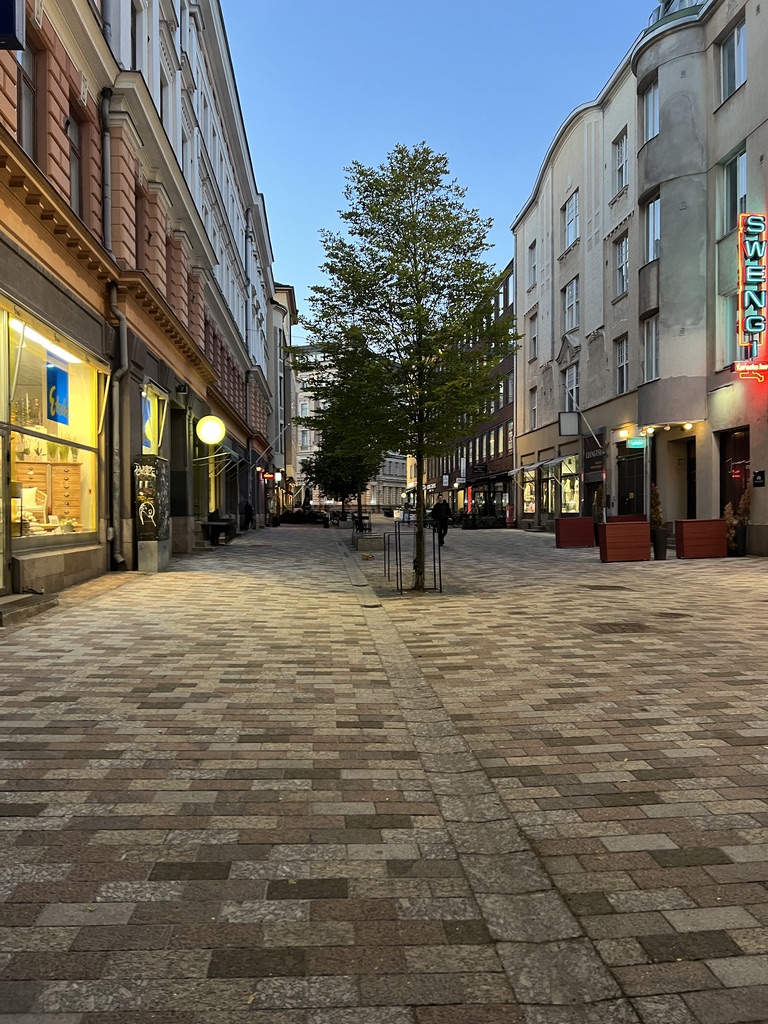
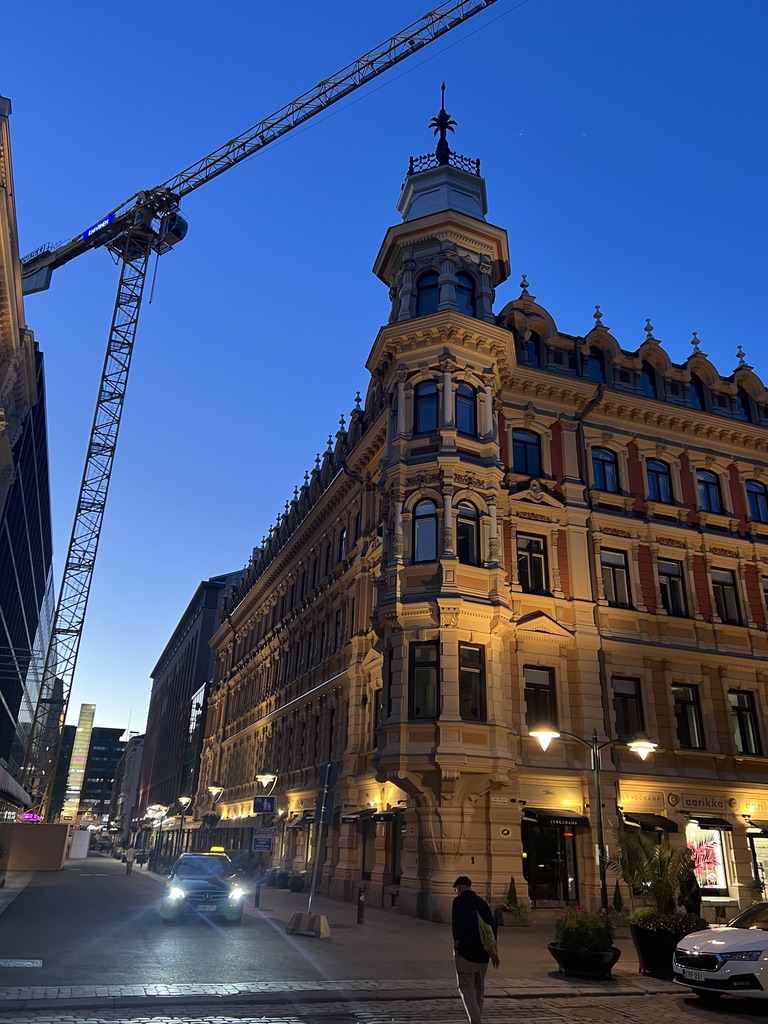
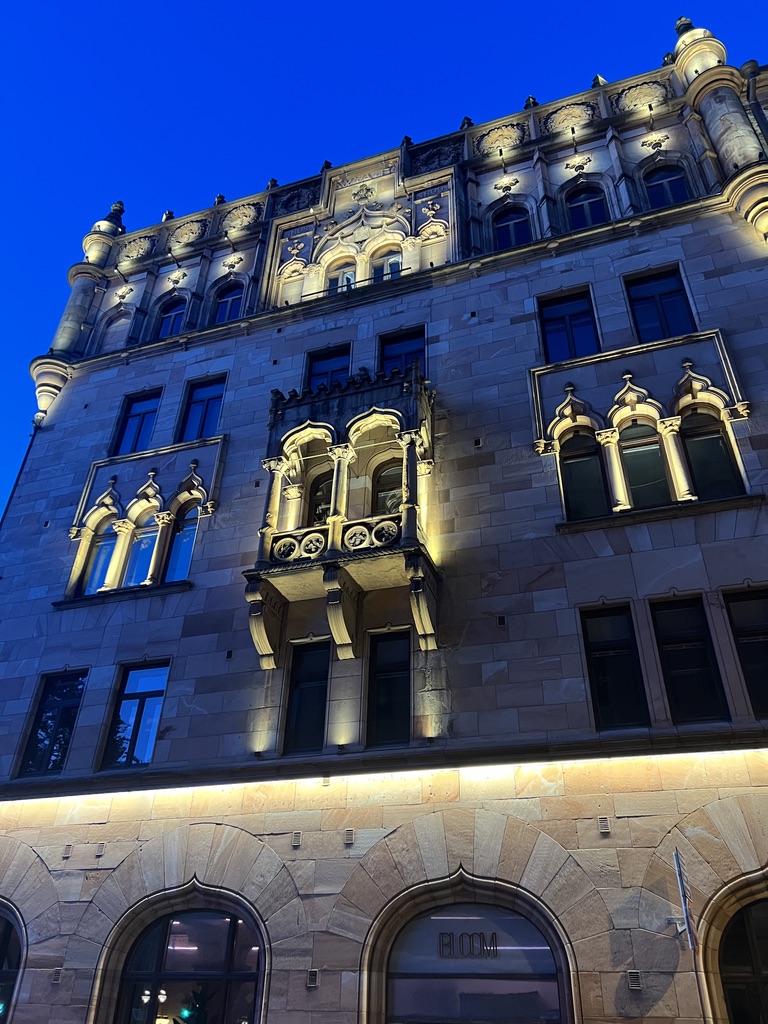
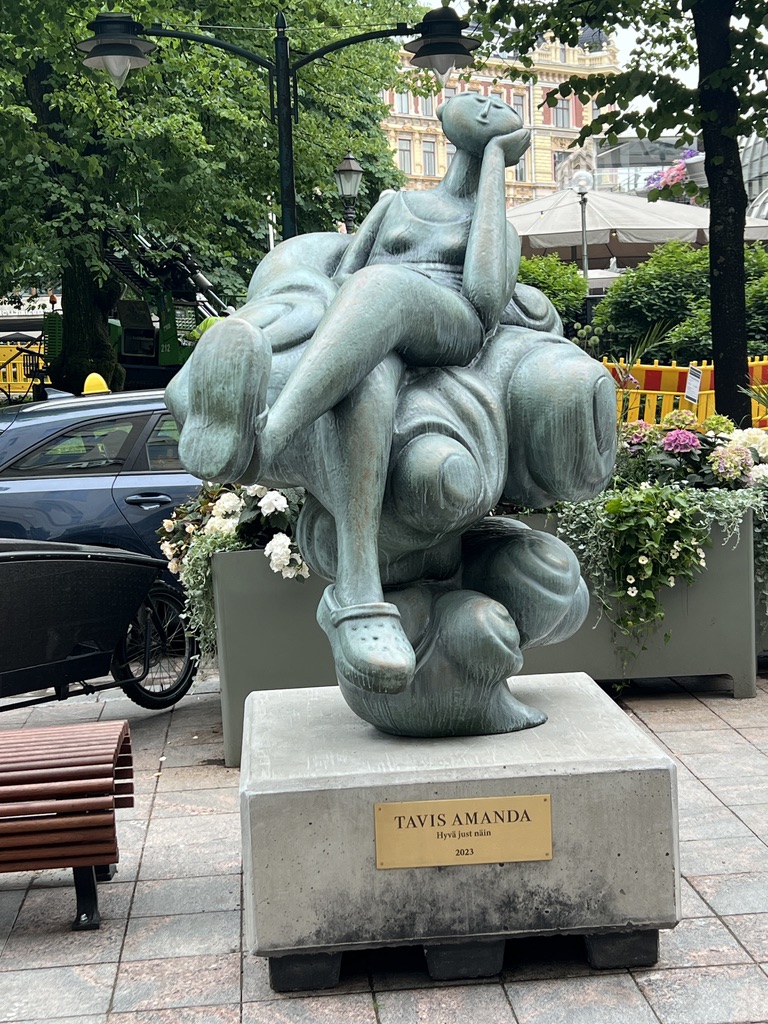
A few comments about statues and Finnish interest and respect for the arts. Many statues throughout Helsinki and the rest of Finland are of artists, poets, musicians. There really aren’t any statues of military people other than Mannerheim (who successfully defended Finland against those Soviet forces during World War II and afterward served as president.) Finland celebrates the arts in interesting ways, including through food. On the anniversary of their national poet’s (Runeberg) birthday, many restaurants and bakeries serve Runeberg-tart, supposedly a dessert that his mother made for him. The largest park in downtown Helsinki (actually in the neighborhood of Töölö) is named after Sibelius and has a huge sculpture honoring him.
Our dinner conversation focused on a lot of political issues—mostly in the US. And we also asked a lot of questions that had lingered from previous conversations—about healthcare and taxes and education and demographics and the rise (by Finnish standards) in the number of immigrants and treatment of the Sami people (Laps) and more.. And of course we also needed to get recent information on their two grown children and four grandchildren. The dinner needed to be a lot longer for us to finish all of these conversations. But there’s always next time (2029 if we keep to our 5-year schedule).
Tomorrow night we head to Frankfurt where we will spend one night and then head home on Saturday.
A good trip that is coming to a close.
Take care-
Fern
10. June 19, 2024: Helsinki Day One
Wednesday, June 19, 2024.
Terve from Helsinki
Walking distance today: 8.2 miles; 23,000 steps !!!
A truly packed day.
Following a wonderful breakfast at Hotel Kämp (we’ve stayed here twice before and really like it; however, they are undergoing a renovation (along with half of Helsinki) so they have blocked off half of the building. It’s a bit strange since when you get off the elevator at each floor you can only go to the right since all the rooms on the left side are in the midst of the renovation. But they have created a wall there, so it looks like the floor ends at the elevator, which it doesn’t.
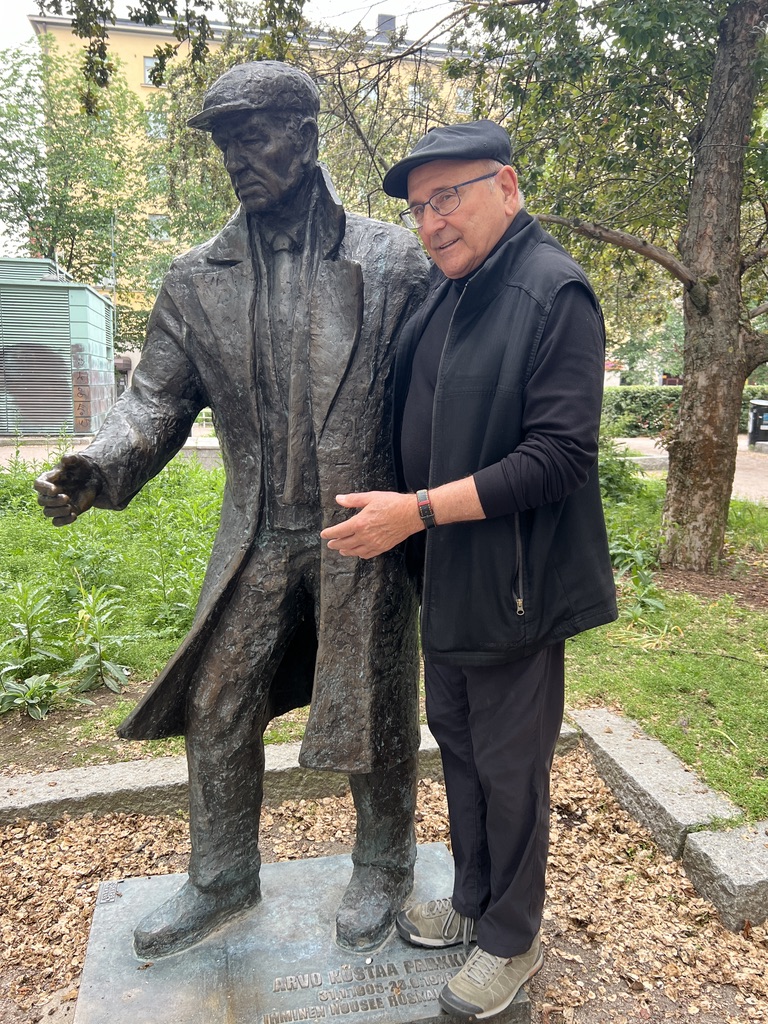

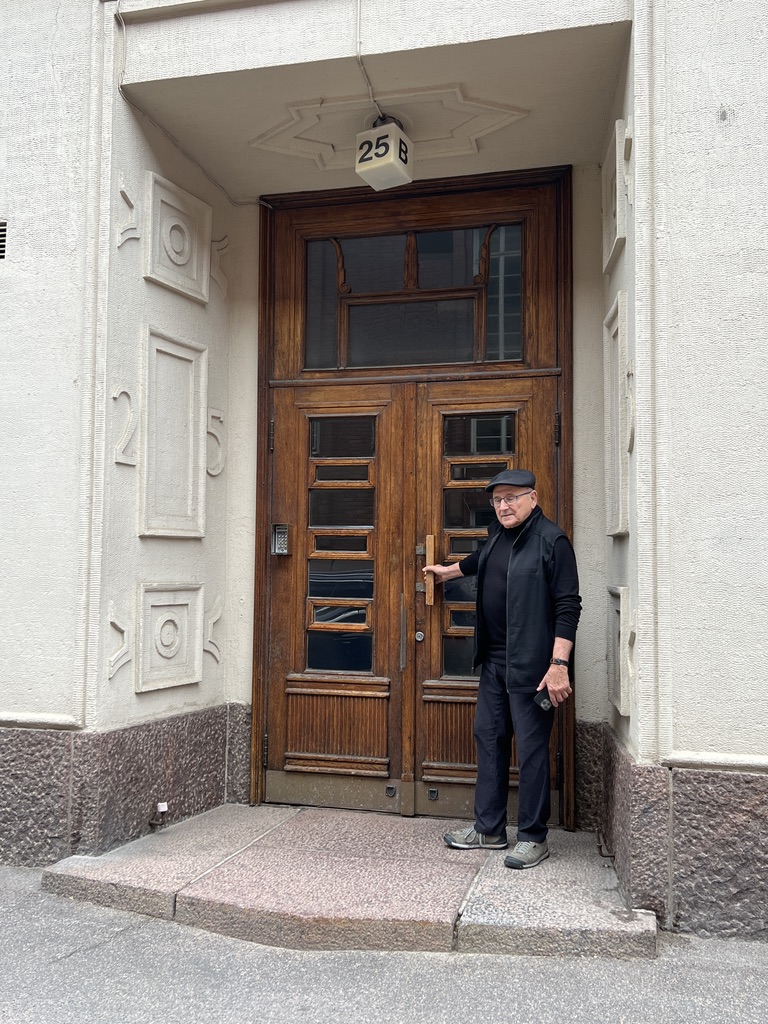
We began our walk (not thinking it would end up being 8 miles) by going to the apartment building where we lived when we spent a year here in Helsinki No changes to the exterior; we took our ritual photos standing in front of the building (we lived on the 5th floor). I think we probably have about 10 of these photos by now. Finally did the count: Mike and I have been here together 10 times; I have been here 2 additional times on my own (once to give a lecture on the “state of art in the U.S.” and once to see a good friend before she passed away. About a block from where we lived there is a statue of Arvo Kustaa Parkkila (1905-1978). The statue wasn’t there when we lived here, as it was unveiled in 2001. The title of the statue is “Man Rises from the Rubbish Bin,” although I think that translation is probably not totally correct. Anyway, Arvo founded a support group for homeless alcoholics in the 1960s. He himself had been an ex-alcoholic. Mike and Arvo seem to be wearing the same hat style. It’s appropriate that the statue is in that little park down the street from where we lived, as —at that time—the neighborhood was not considered a very good place to live (although we liked it a lot) as it was known as the location where many drunkards (“Juovuksissa”) hung out. Usually, they would congregate on our street on Friday nights. They were very harmless, peaceful, and often made “complimentary?” comments to women walking home. I imagine what they were saying was a lot like what construction workers in Brooklyn said to women passerby in those days. Sometimes I’d find a guy passed out at the entry of our building. Once a guy was blocking the entrance and I went to tell the “talonmies” (sort of the janitor) who spoke no English. She took out a broom and sort of “swept” him away.
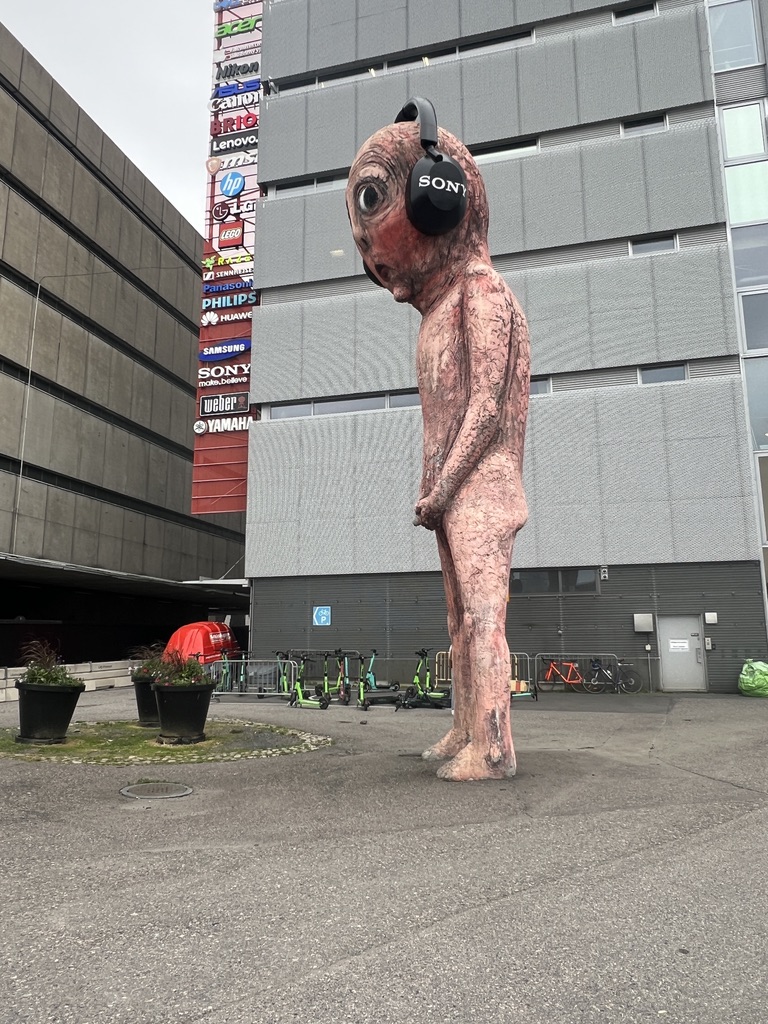
But today, our neighborhood (Kamppi) is quite the ‘in” location. I counted at least 15 restaurants within a block of our apartment: Spanish, Argentinian, Vietnamese, Chinese, Kebabs, Mexican, Finnish, and assorted others. And there is now a Pilates studio just next door, and at least five hair salons. And it is within the new “Design District.” So, we were just ahead of our time.
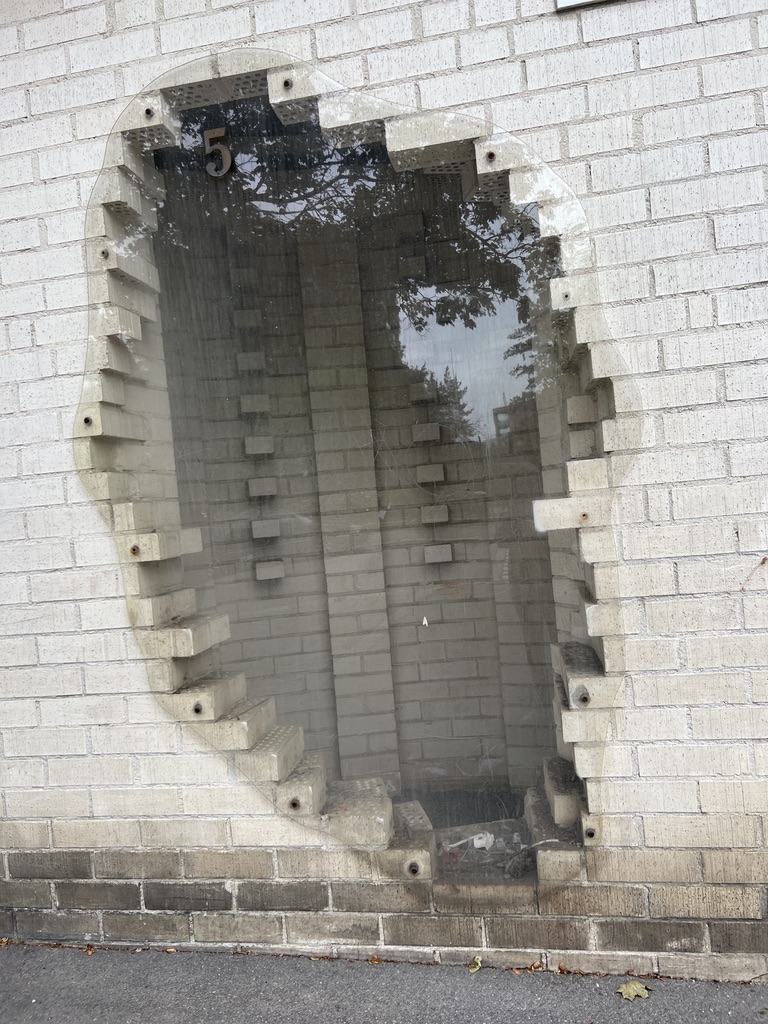
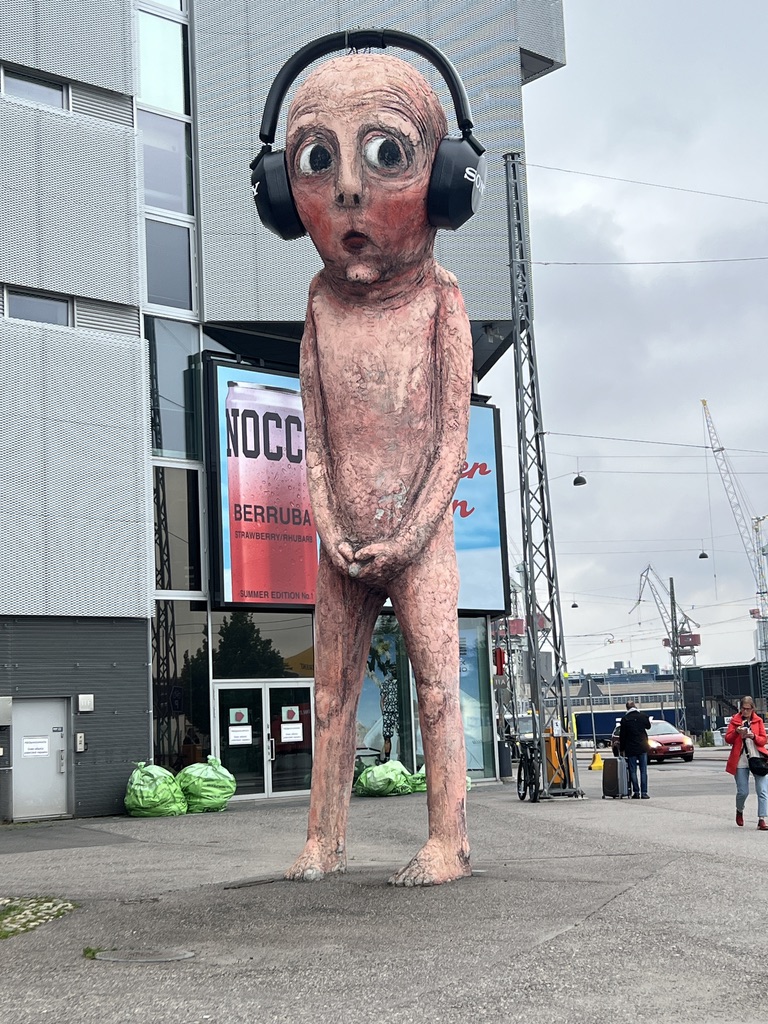
From there we meandered through the Ruoholahti neighborhood and Jätkäsaari which used to be the main container harbor until it was relocated around 2008. The area is undergoing a lot of development, and it is home to the Bad Bad Boy statue—a pink concrete sculpture created by Tommi Toija. It is a naked urinating boy that is about 30 ft tall. The sculpture is heated so that the boy can urinate all year, even in the dead of winter. It was apparently part of a public art festival in Sweden where the statue urinated into a river in a park; later it was installed at the Market Square (Kauppatori) in Helsinki and it urinated into the ocean (not far from the President’s Palace). It became one of the most photographed objects in Helsinki. In 2005 it was moved to Jätkäsaari in front of an electronics store. We also walked to see another public art piece called “The Exception” which blends into the wall of an apartment building. Initially if you even notice it, it looks as if there is a hole in the brick wall. But on closer look, you can see an oval interior through a plexiglass sheet framing the hole; and inside there are some brick reliefs.
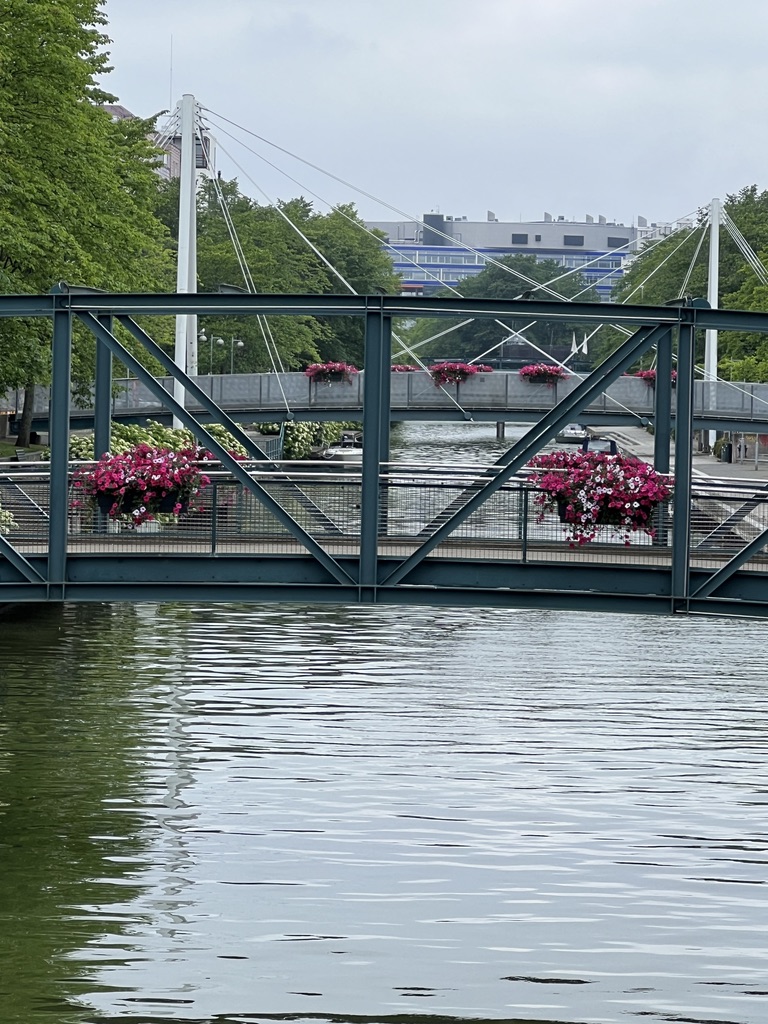
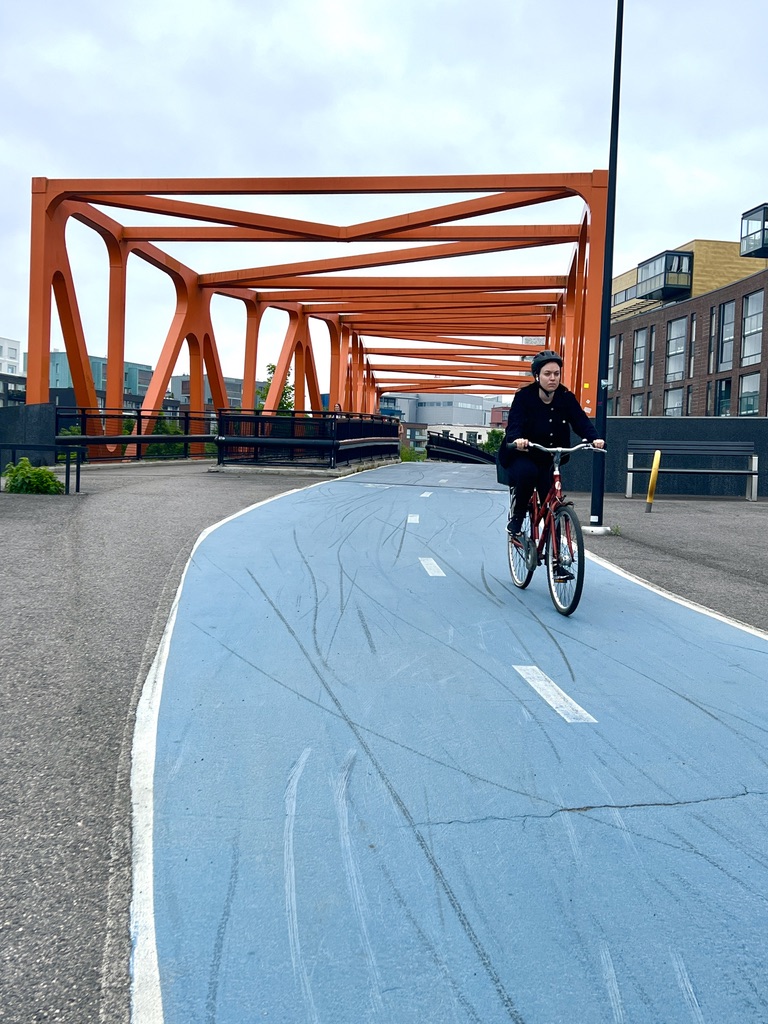
Continuing on our journey, we went through many, many new housing developments—all of which are far superior, design-wise, to what we see in the states. Nearly every unit of every building has a terrace (deck) that is generally glazed in, but the glass is usually operable. The Finns are very big on having access to, and views of, the outside. They often keep infants in carriages outside (maybe to acclimate them to the winter that will come). So families would keep the carriage with the baby on that terrace. Several of the housing developments were on or very close to water and so we walked over several pedestrian bridges. We then trekked back to our hotel in order to meet our very good friends at the local Metro stop. By then we had walked about 7 miles, but more walking was in store.
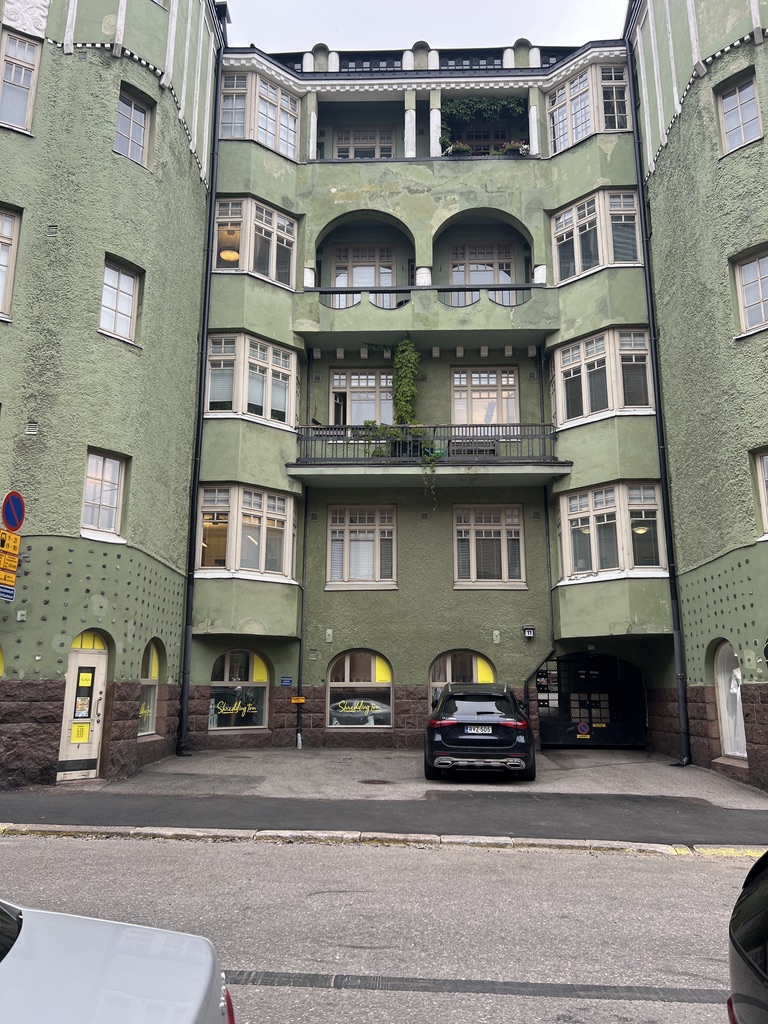
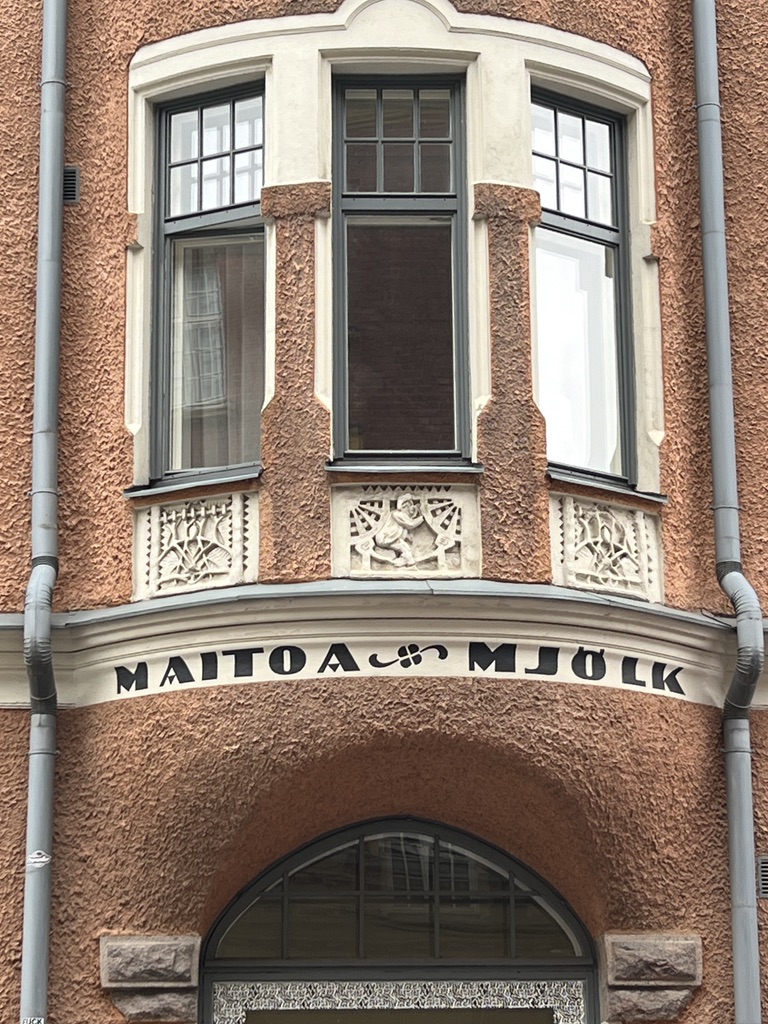
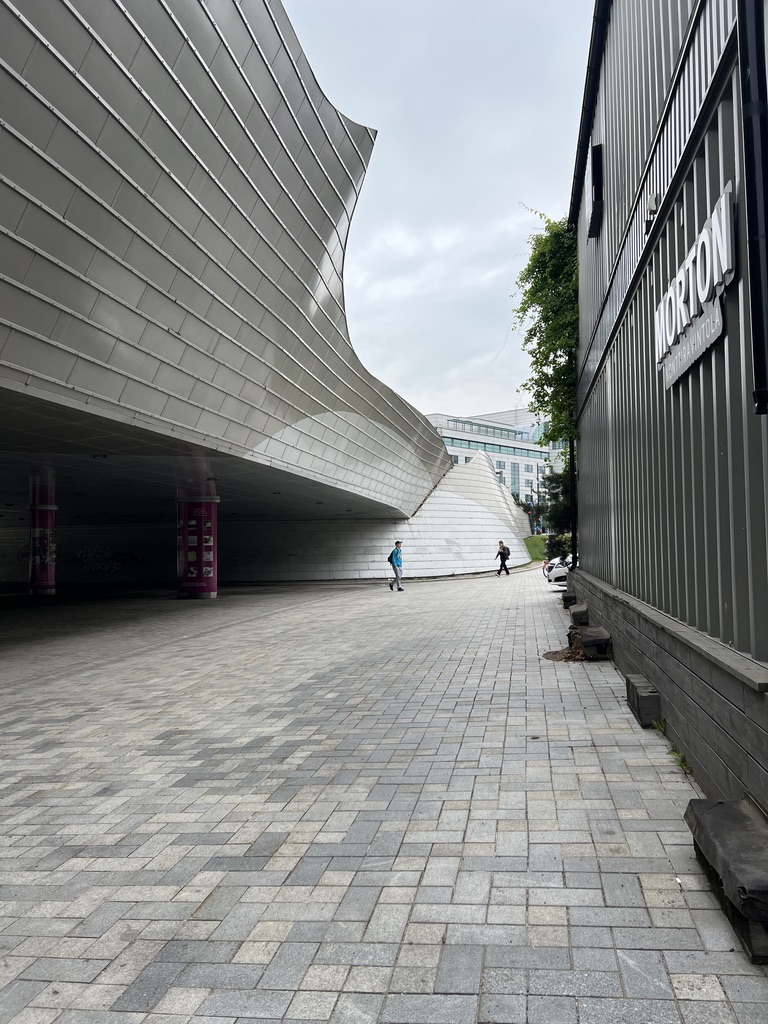
We took the Metro to Tapiola to visit EMMA (the Espoo Museum of Modern Art) which had an exhibit of Finnish concretism and which was organized to celebrate Lars-Gunnar ‘Nubben’ Nordstrom’s work and life (1924-2014). He was considered a pioneer of Finnish “concretism.” The exhibit included the works of more than 50 Finnish artists who are considered to be part of the movement. The works were pretty multidisciplinary and used a lot of different materials. Concretism in Finland is considered to be a movement that is totally abstract/geometric without any representational form.
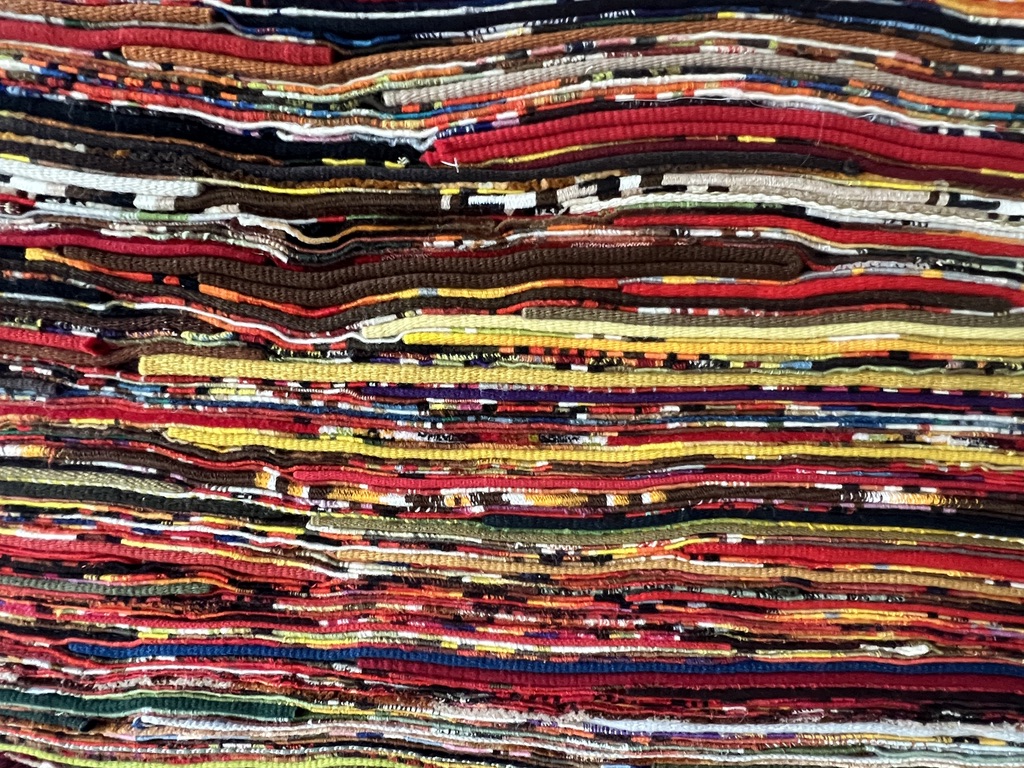
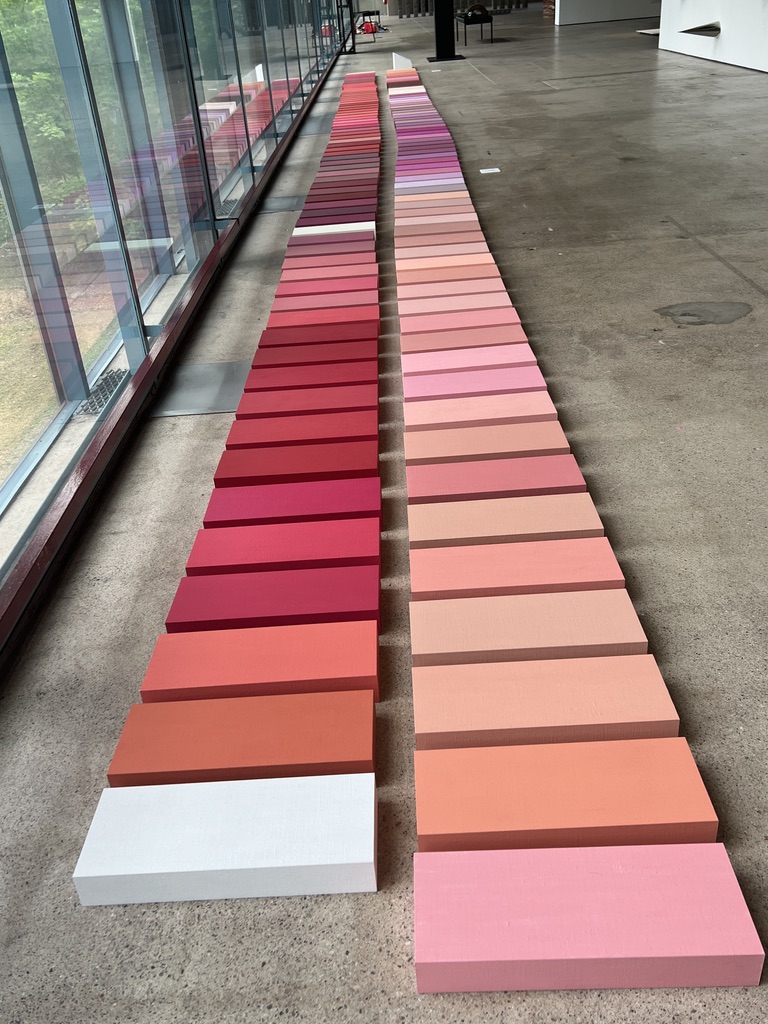
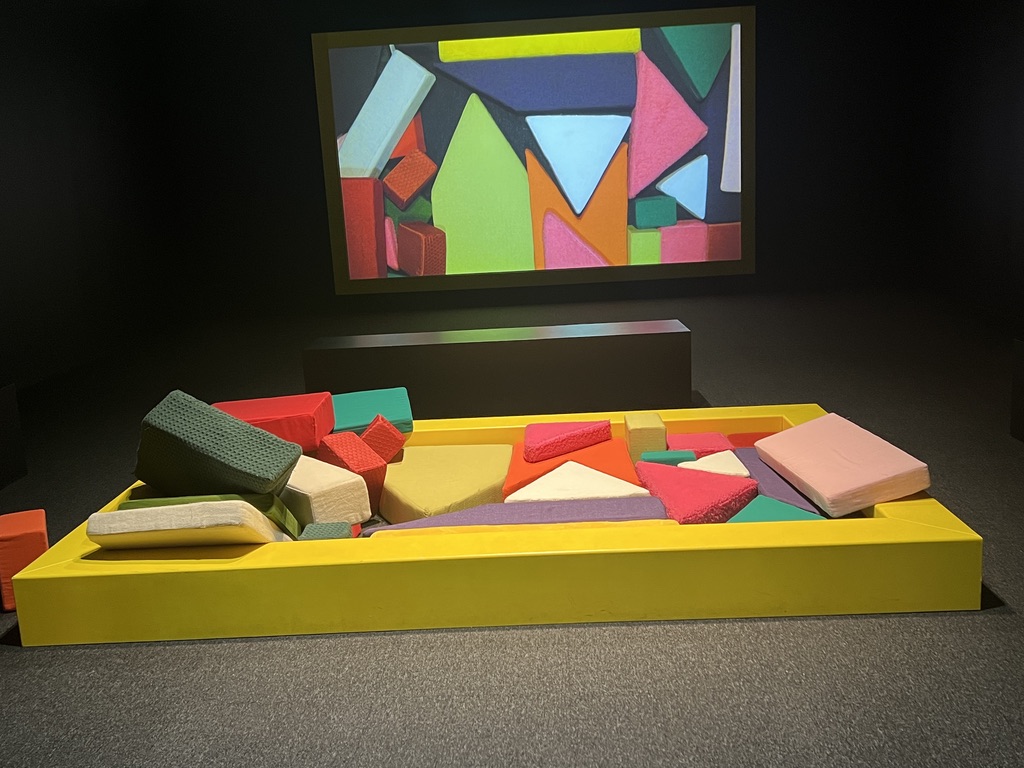
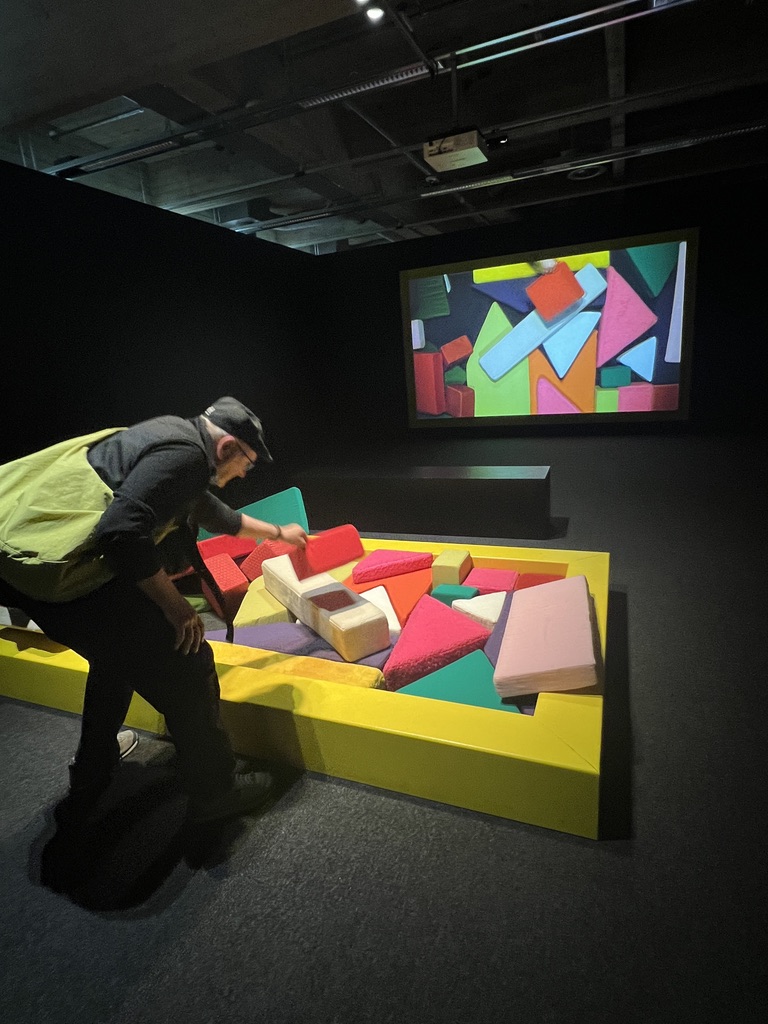
The show presented works from different eras—from the 1950s to the present. The museum building itself was the former home to a printing company and is probably a good example of 1960s concrete brutalism. Outside there are lawns and woods. Tapiola, where it is located is one of the early “garden cities” built around 1960. When we lived in Helsinki, Tapiola was considered a suburb, and it was much smaller than what it is today.
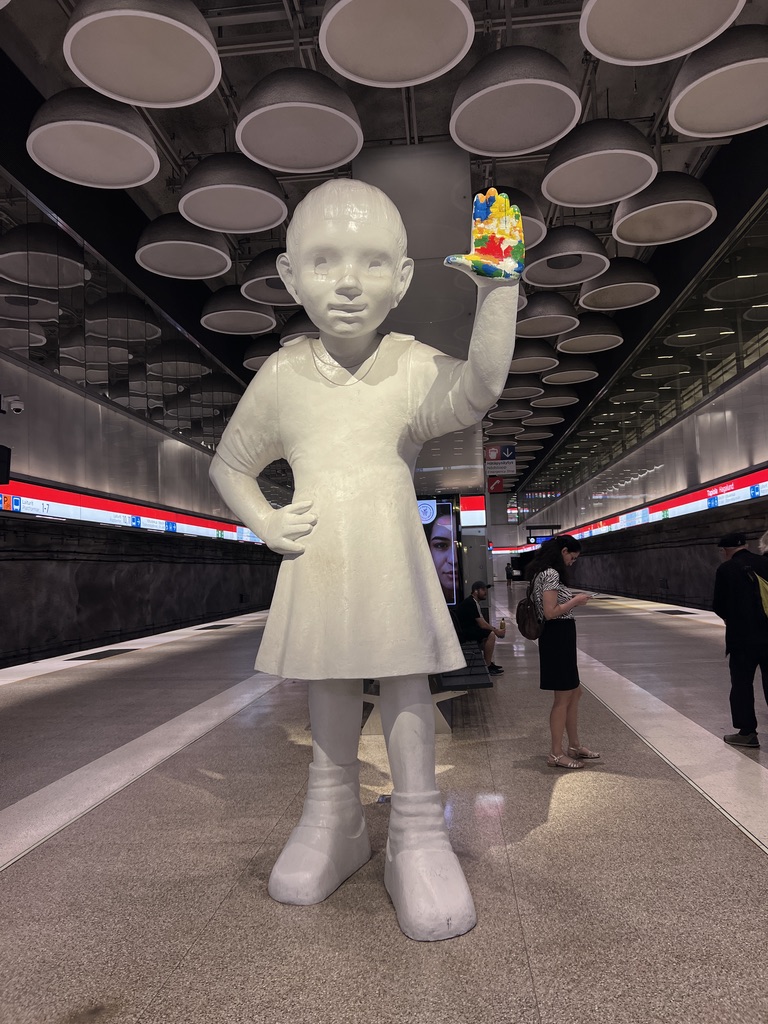
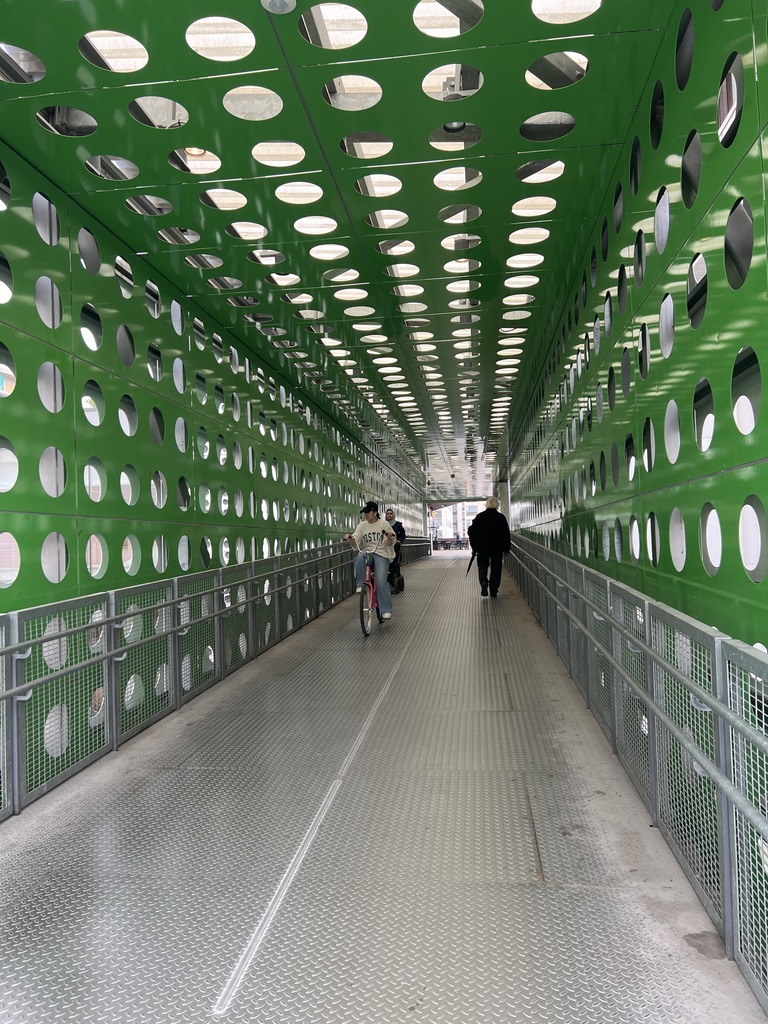
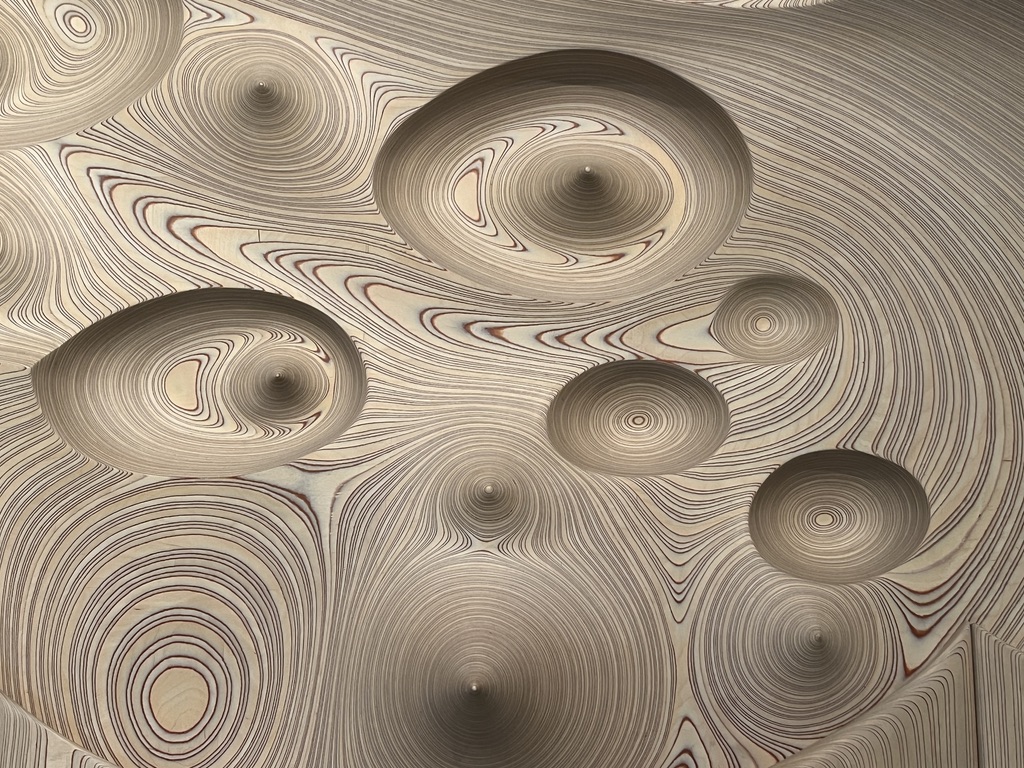
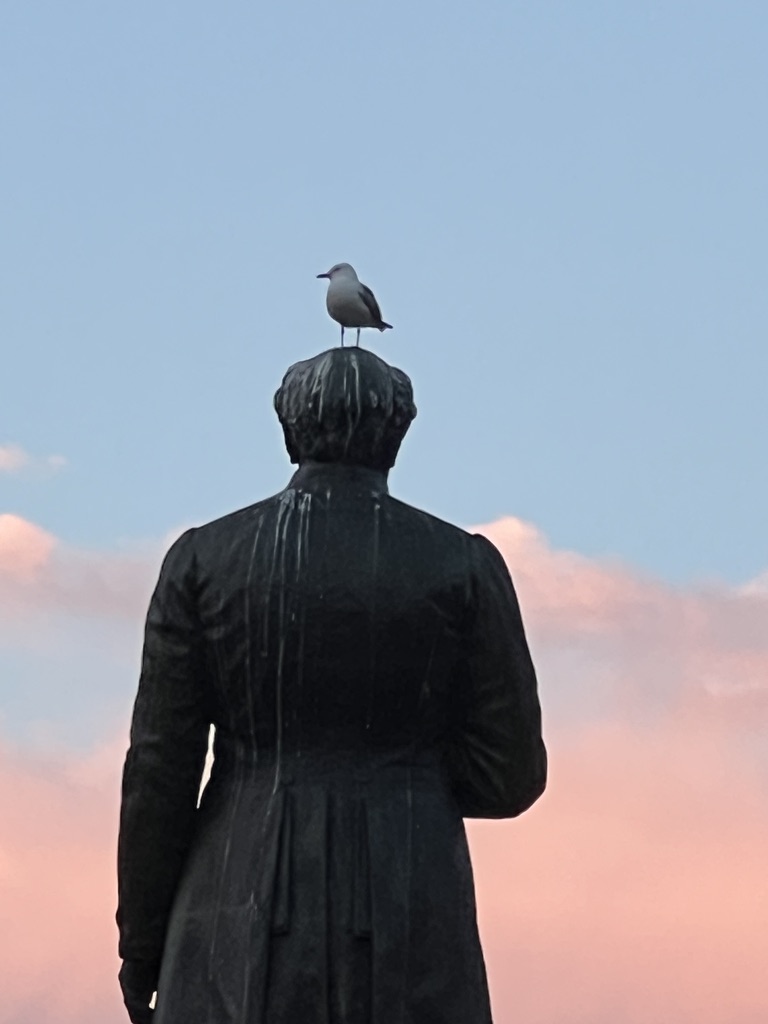
So, as we approached our 8+ miles of walking we hopped on the tram and headed back to the hotel and then to dinner. We chose Ragu which is about a 10-minute walk (adding a few more steps to the day). Ragu (never been there before) turned out to be a really good restaurant. I’ll spare you the details of our meal; just know we liked everything on the menu… and strolled back to the hotel… stopping briefly on the Esplanade to see a famous statue of Johan Ludvig Runeberg, Finland’s national poet, whose head is a regular resting place for sea gulls (one at a time).
Terve Terve –
Until tomorrow – day before the midnight sun.
Fern
 Fern's Travel Notes