Baku. January 13, 2020
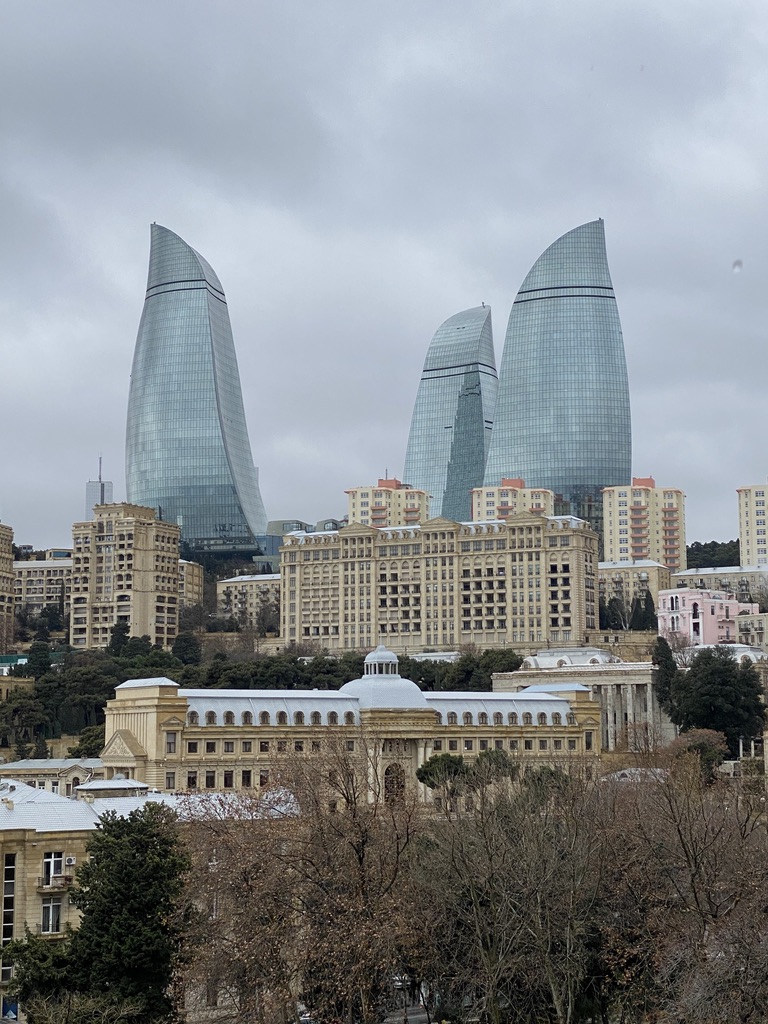
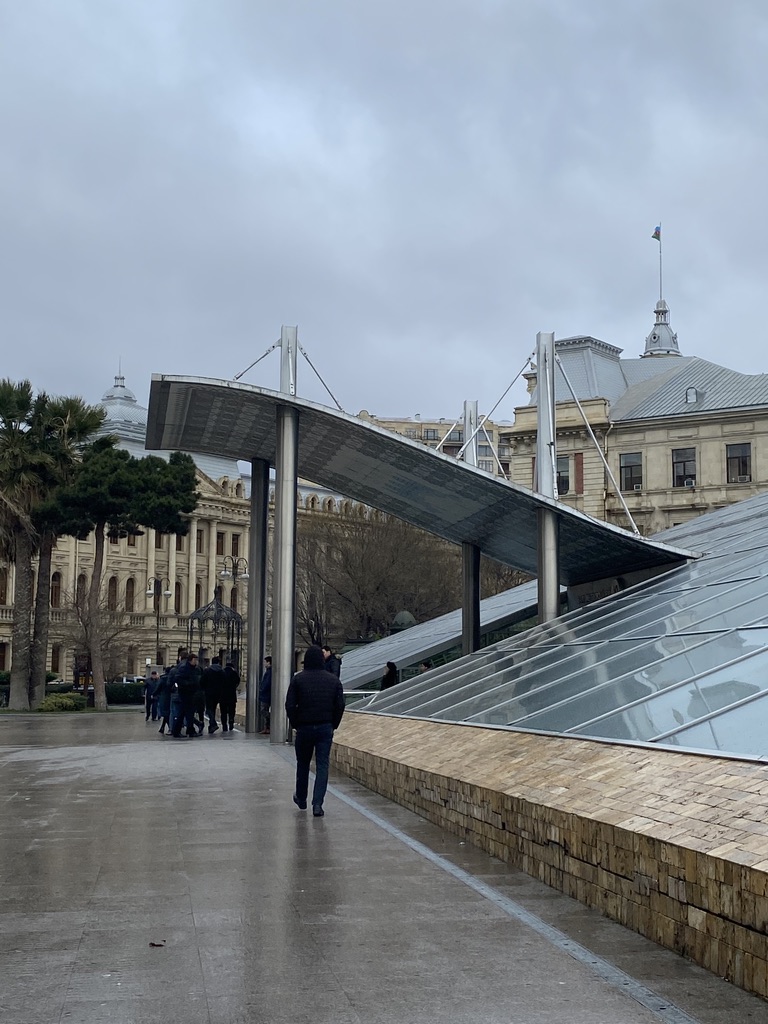
Greetings from Baku –
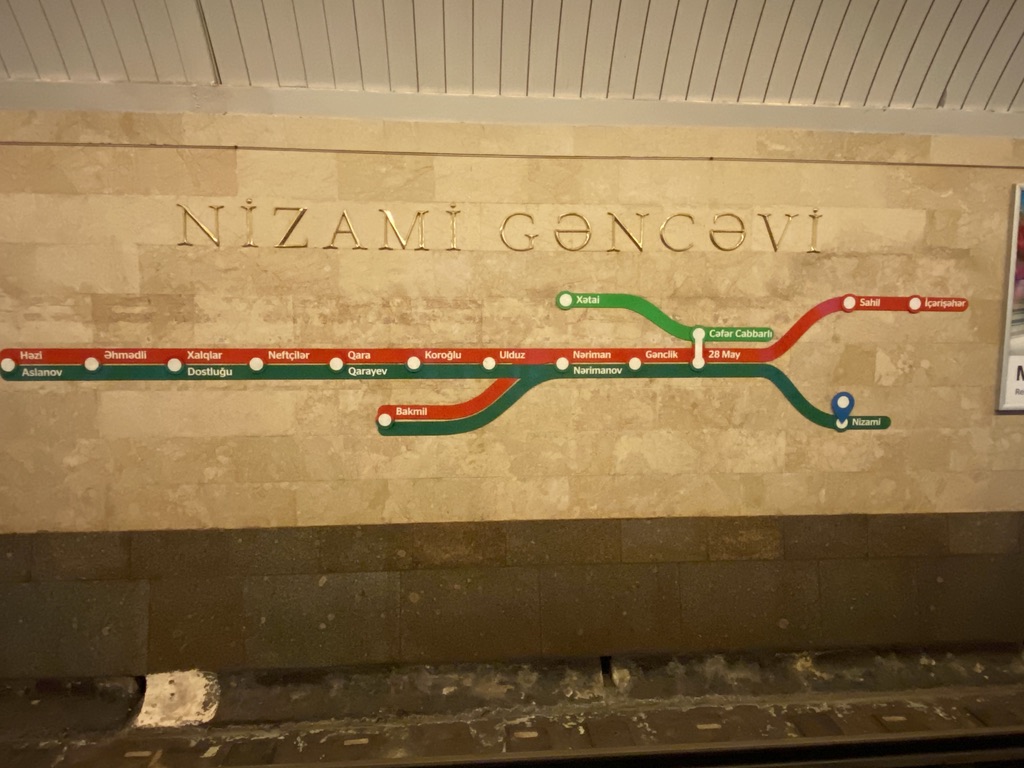
It was a rainy day in Baku so we decided to have breakfast at the hotel before heading out. Our original plan was to walk the old city, but we postponed that until tomorrow (hopeful tomorrow will be a better day, with some sun and at least no rain). So, change of plans.. after breakfast we decided we’d take the metro and get off at random stops to see different neighborhoods – an activity we’ve done in many cities and most recently in Tashkent. Breakfast at the hotel was actually quite wonderful. We shared a great shakshuka (my favorite breakfast dish) and birchermuesli which was also good. Then we headed out.
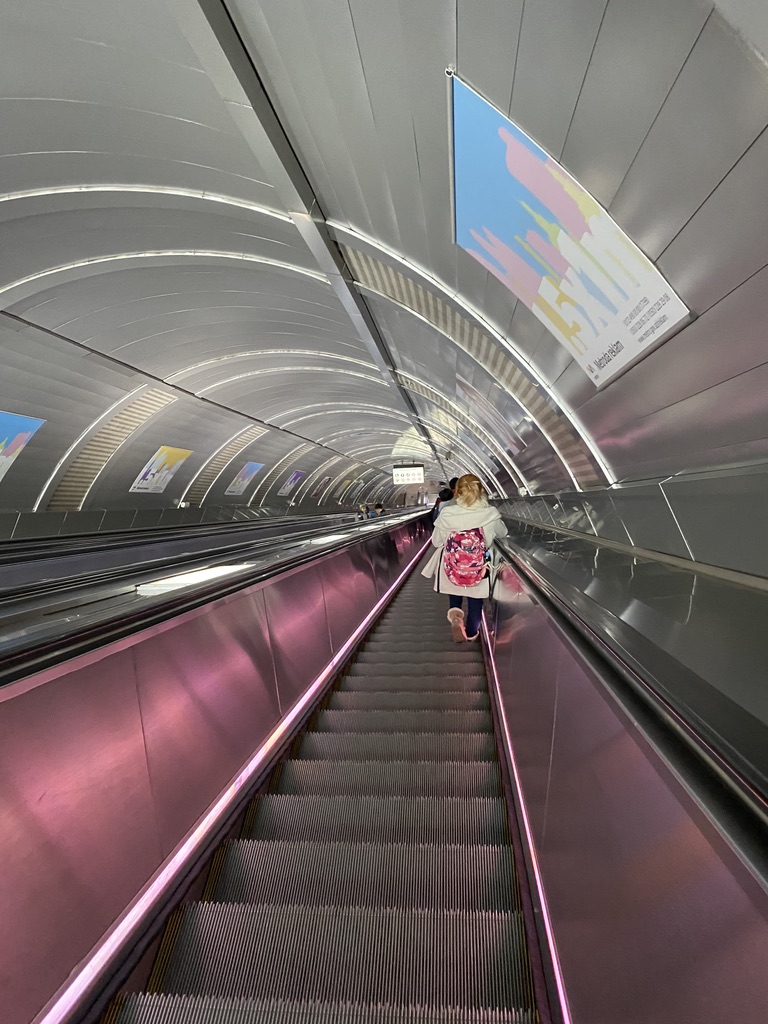
Stopped at the concierge desk to ask a few questions about the metro and it was clear that the hotel staff thought it was really funny that we wanted to take the metro; they were even more surprised when we asked a bit about neighborhoods where wealthy people lived and those where lower income people lived, and which metro station would get us to the different neighborhoods. Anyway, off we went. The walk to the closest metro station to the hotel was uphill and through a really nice park. After about 15 minutes walking in the wind and rain, we arrived at the station. It took us a little time to figure out the system and how to purchase a ticket. You need exact change and the machine instructions were only in Azerbainjani (or at least that’s all we could see on the screen). We finally figured it all out and it turns out that there is an English option, but the button to click to change to English is not very prominent. We got the “cards” and off we went. The system is really very simple – only two lines: the red and the green.
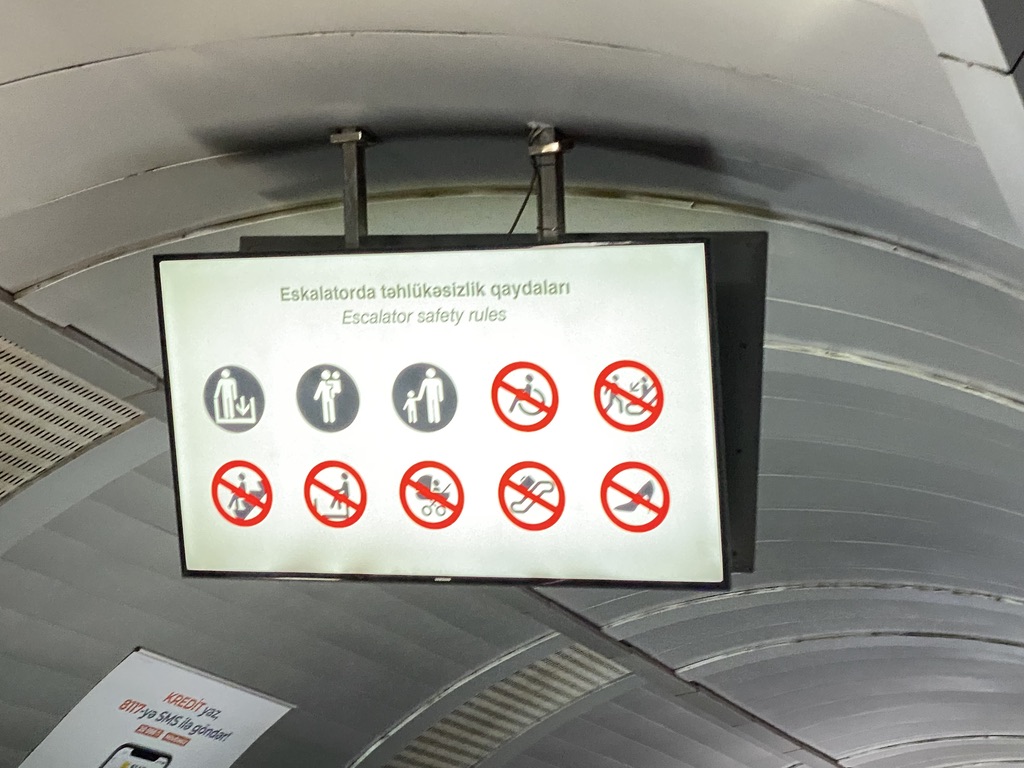
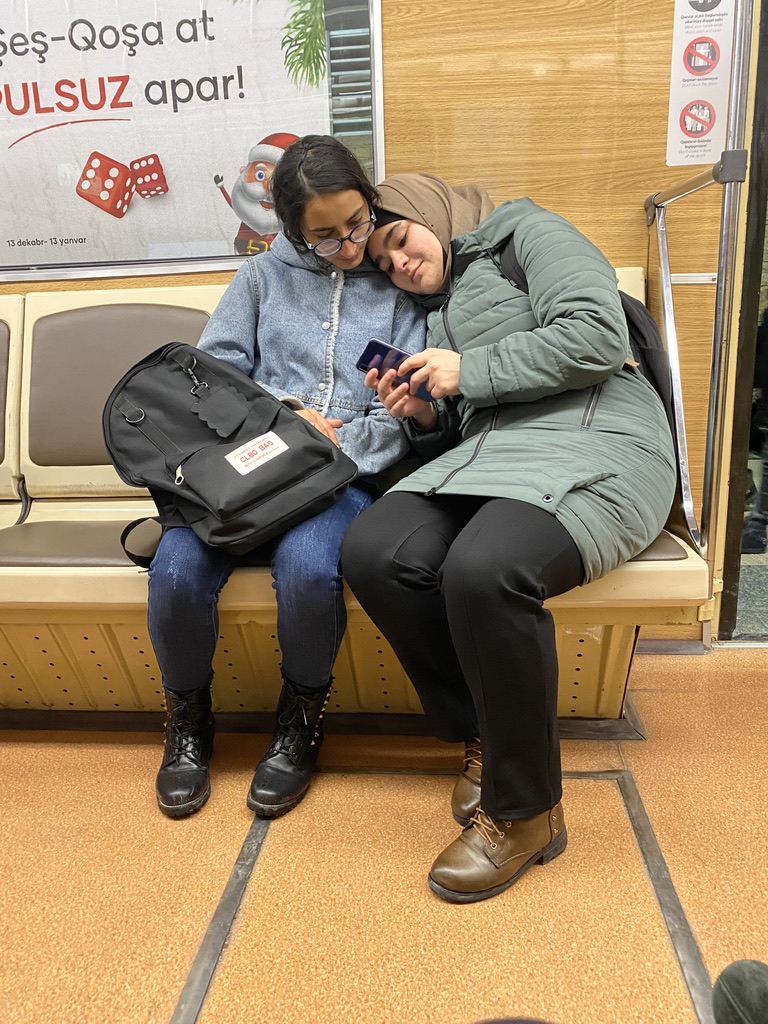
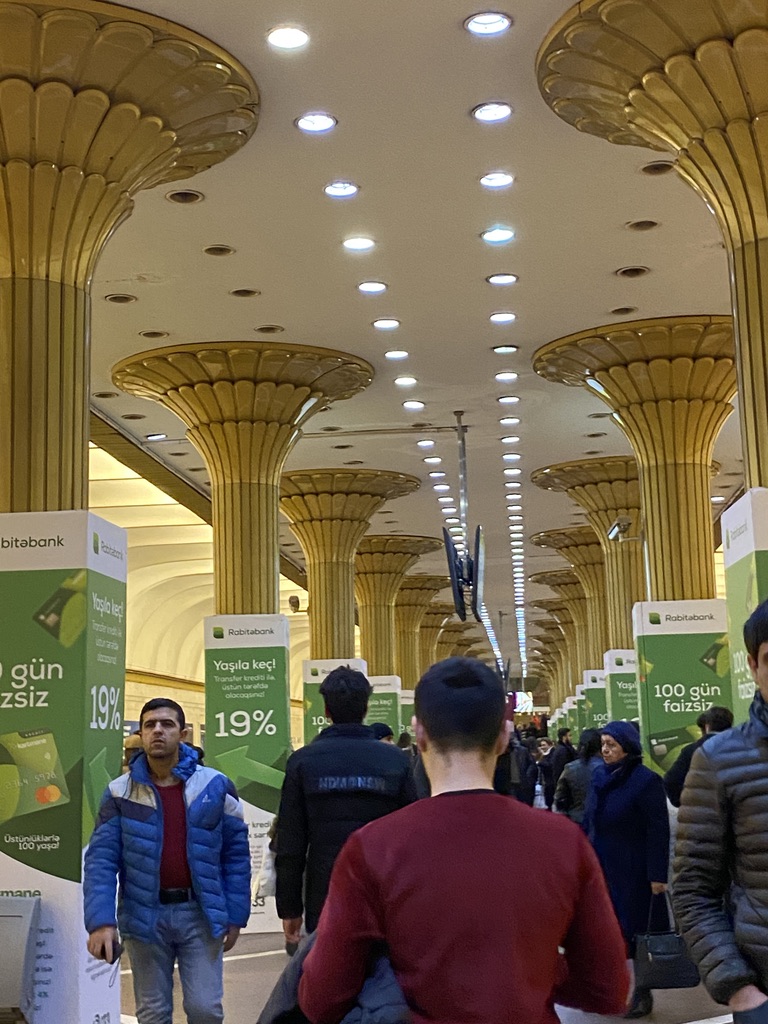

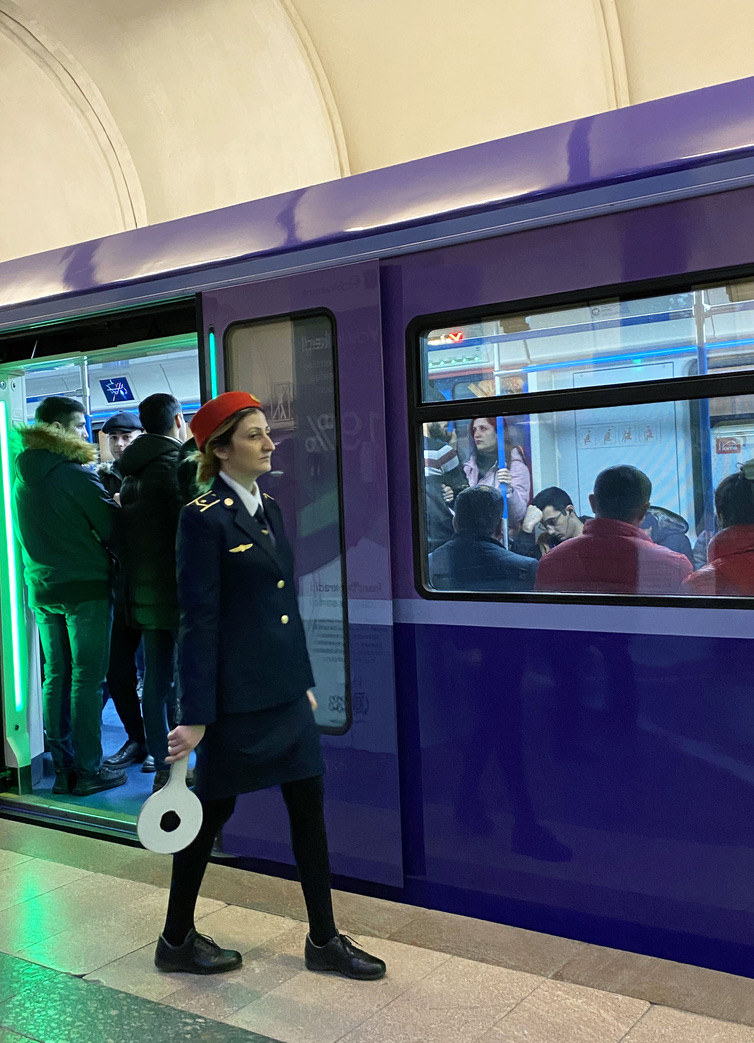
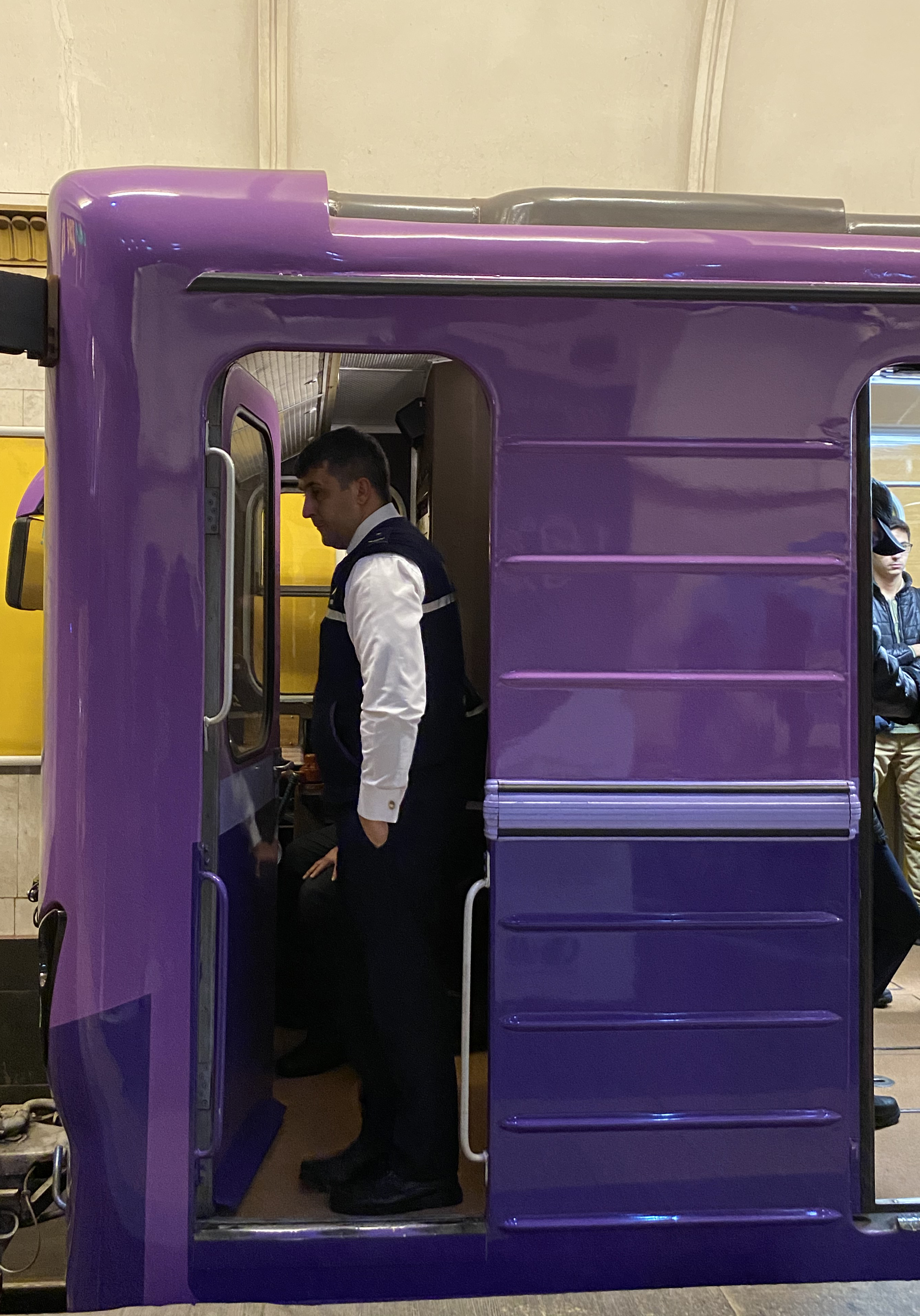
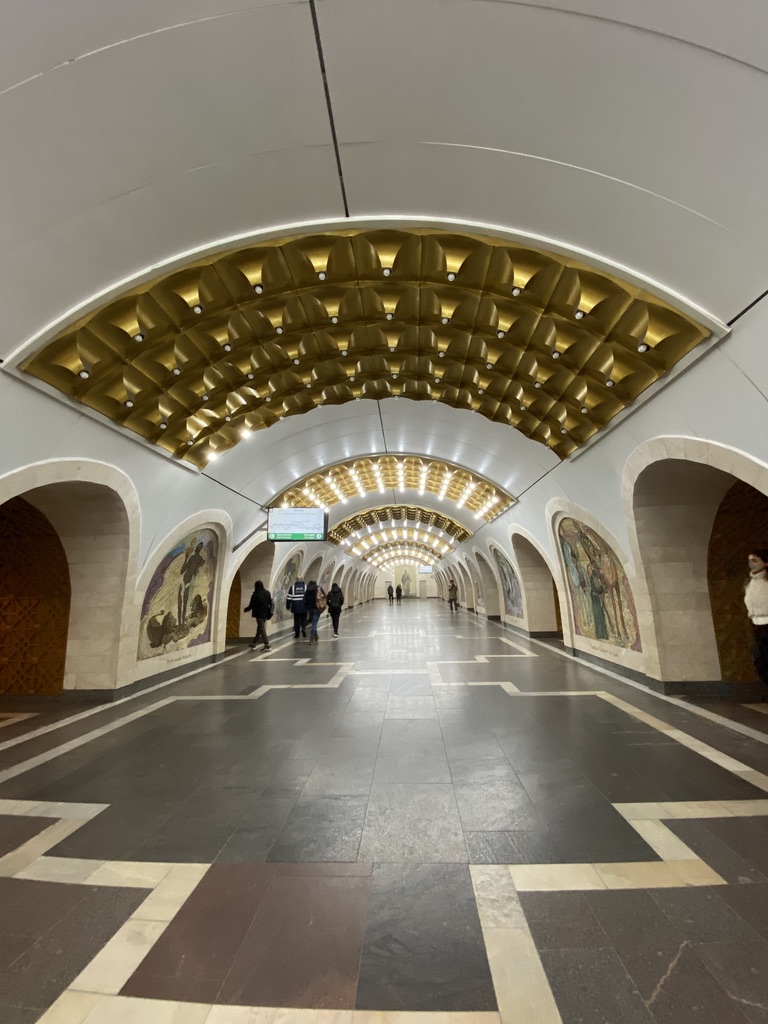
The stations are immaculate; no litter; no gum on the floors; no trash. There is one station monitor who seems to have a ping pong paddle-like thing in her hand – one side is red. We never figured out what she does with it. But once again, she doesn’t look like she likes her job. The trains were quite crowded and looked like 1960s vintage although they have clearly been refurbished and painted. People were polite. One funny thing is that when the train approaches each station, in addition to having an announcement about the name of the station and the next station on the line, classical music plays. Each station has a different classical piece. I suppose this is their way of letting blind people know the station and also a secondary way for all passengers to identify each station. And perhaps it’s also a way to make each station feel very palatial and to have a kind of grandeur to match the stations.??? Oh, as you can see in the photo of the sign—many things are prohibited on the stations and trains, including spike heels/
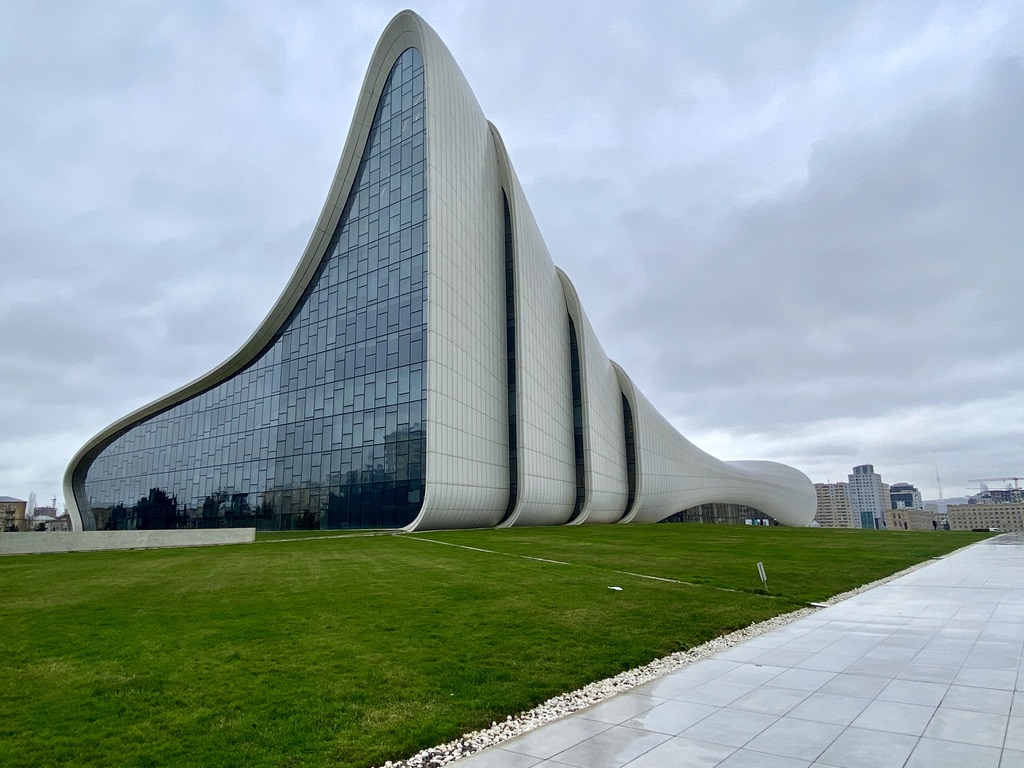
We decided that we should see the Zaha Hadid building (the Heydar Aliyev Center) which houses a museum and convention areas and other spaces. Frankly, visiting it was like a “check-the-box” decision. We only saw the outside since it’s closed on Mondays. Neither of us were impressed. It’s totally out of context – sort of plopped down in the middle of a neighborhood and I’m quite certain that many people living on that site were probably displaced to create this monument to culture. Mike created a new term called “plop architecture” which is quite appropriate. I guess this is Azerbaijani urban renewal.
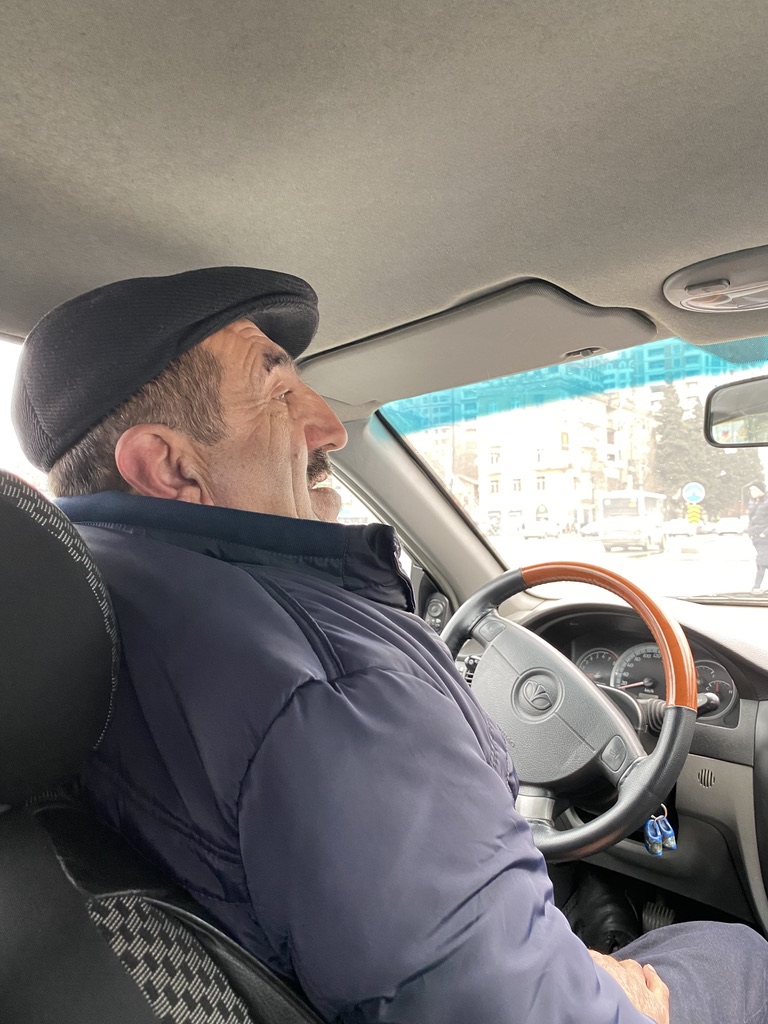
By then it was really raining and we decided to take a taxi back to the metro. The taxi driver didn’t speak any English but was very excited when he found out we were Americans. Turns out his son won the green card lottery and now lives in NY (probably Queens) although the father didn’t have an address, only a cell phone number. We did communicate enough to learn that the son is studying computers and that (ironically) he works as a taxi driver in NYC (perhaps to pay his way through his computer course). At least this is what we think he was trying to convey. When we approached the metro station, the driver refused to take any money from us. He was still so excited to meet an American. Another taxi driver remarked in limited English that Azerbaijan was 10% good and 90% not good; America very good. So what can I say?
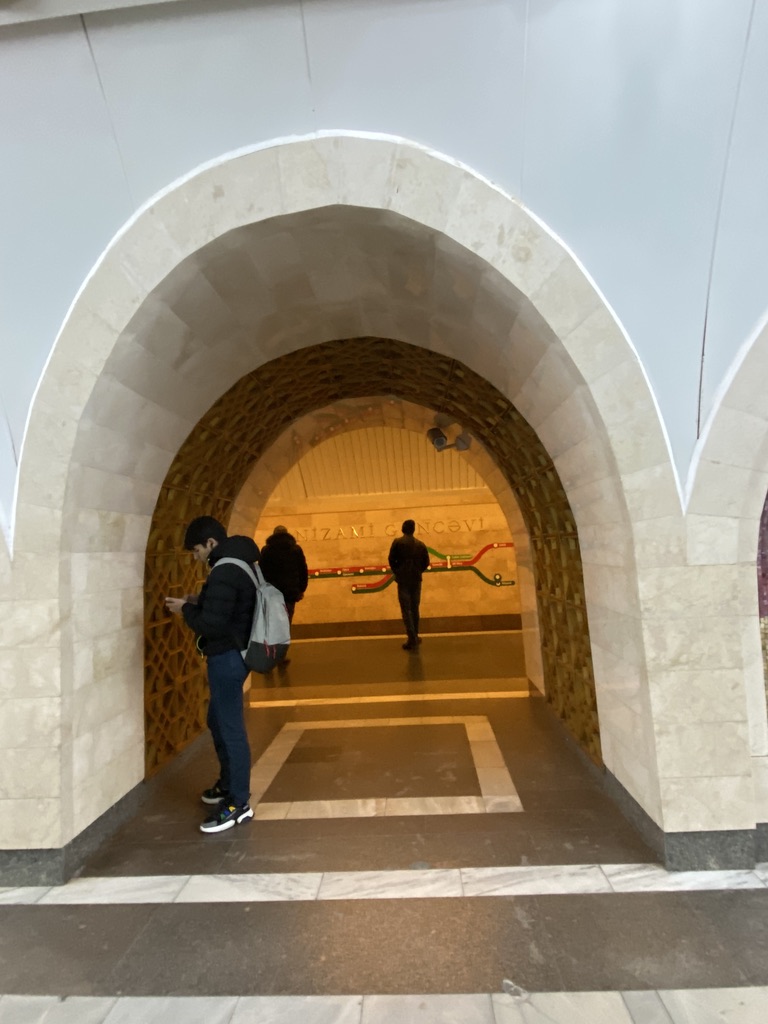
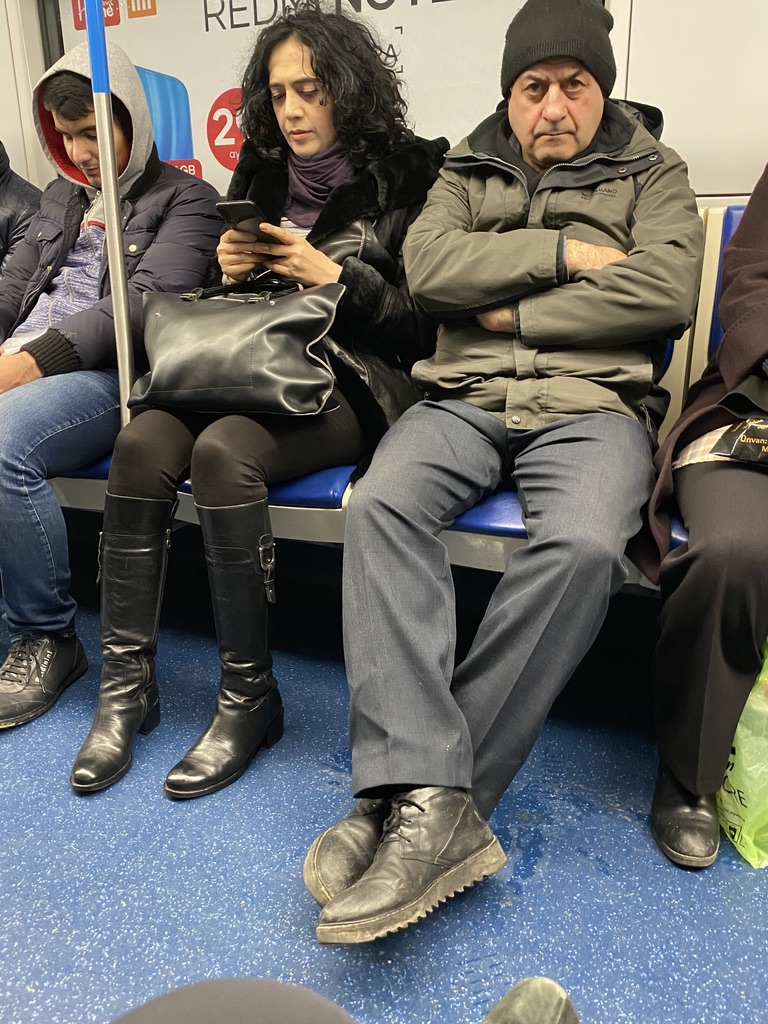
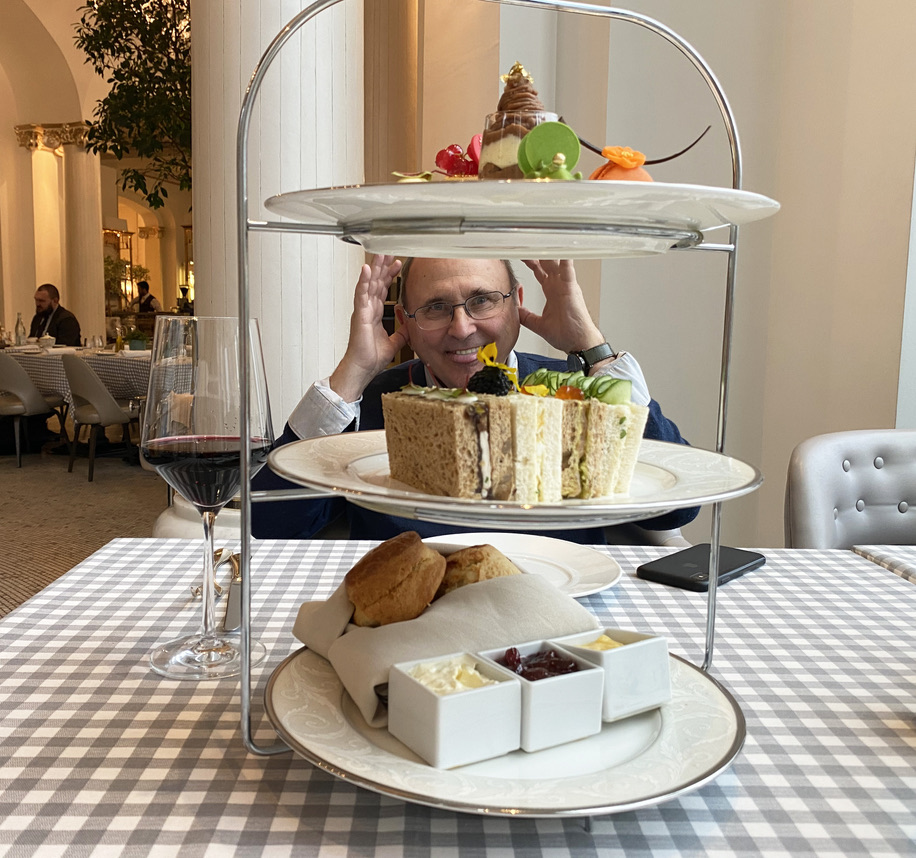
We then went on our way checking out a few neighborhoods near metro stations and eventually the rain got to us and we headed back to the hotel; decided to try the high tea service in the restaurant and sort of pigged out… Then I did some work in the room… and eventually we went out for dinner.
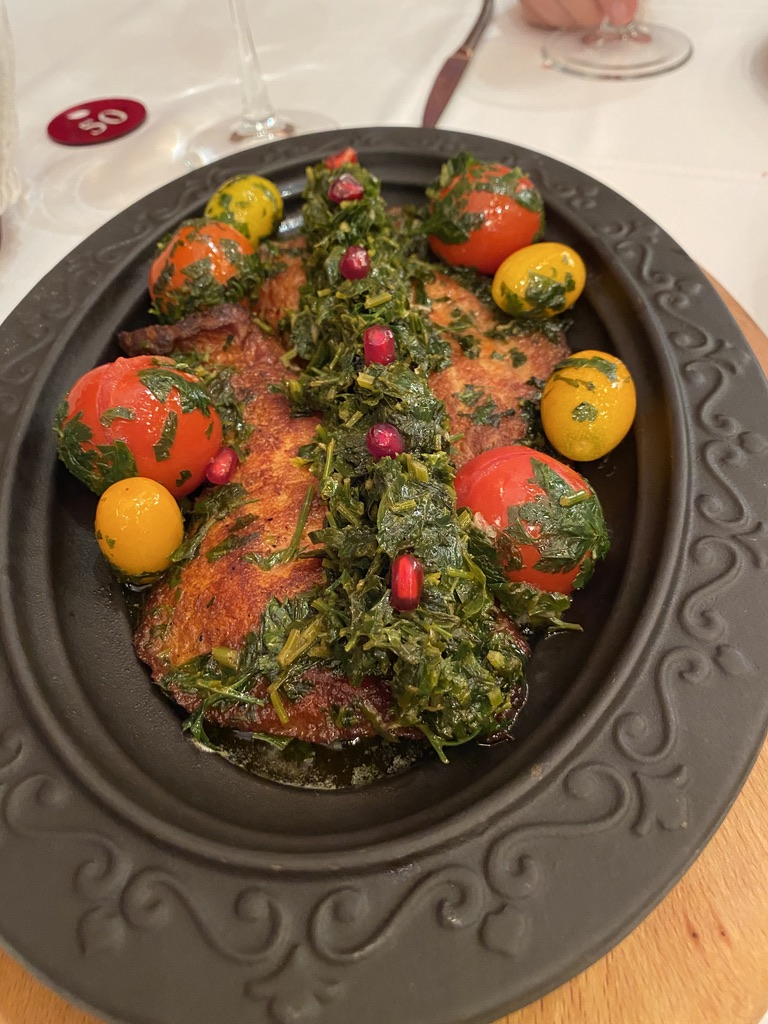
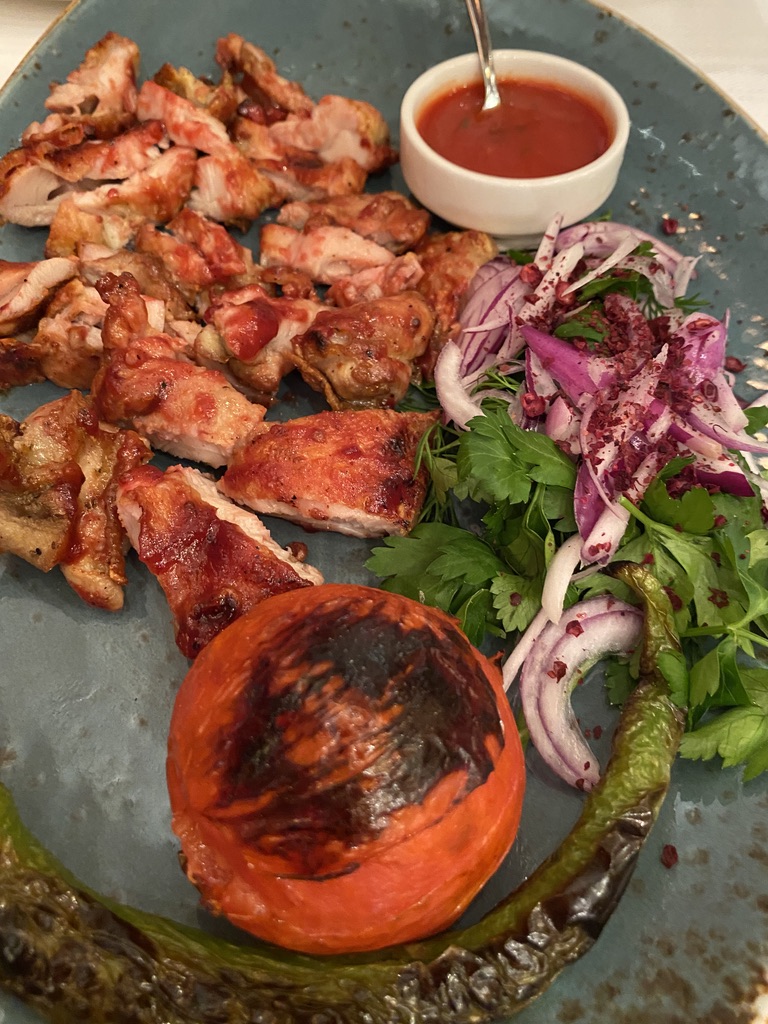
The concierge suggested a place called Sumakh. It was incredibly good. I think we are making up for all the rather boring meals in Uzbekistan. Menu looked so good, we definitely over-ordered. Started with a wonderful eggplant appetizer (char burned and smashed to add tomatoes, peppers, onions, garlic) served with home-baked bread; followed by a pasta (dumplings stuffed with lamb in a pomegranate sauce – yummy); and then two main courses: sturgeon topped with greens and served with three dipping sauces and garnished with cooked cherry tomatoes and kumquats; and chicken and plum sauce. Again we had a bottle of local wine… and tonight NO dessert. Would have had to roll me out.
It’s clear that Baku has a wealthy class and there are amazing streets lined with high end stores in the new section of the city. The driver of the wealth is the oil industry located here.
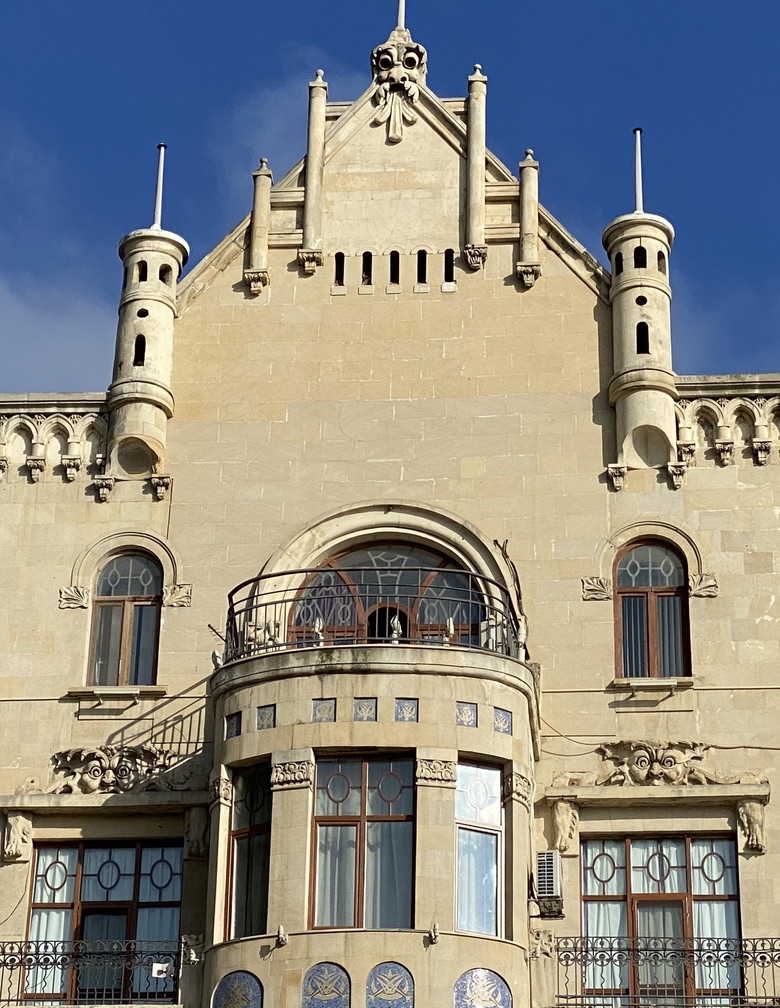

What we did learn (as a result of trying to research May 28 – because that is the name of a major boulevard and also a metro stop) is that the country has a very interesting history, including that the Russian Empire was overthrown after a very short revolution in 1917…. And on May 28, 1918 the Democratic Republic of Azerbaijan (ADR) was created as the first secular, democratic state in the Muslim East. It was founded by Mammad Amin Rasulzadeh who himself has a very very interesting life story, including “saving” Stalin in 1905 when he was hiding in Baku… and later being “saved” by Stalin when he himself (Rasulzadeh) was arrested and brought to Baku. (He had been hiding in the mountains). He was released on Stalin’s orders and sent to Moscow, where he was the press representative at the Commissariat on Nations. Rasulzadeh was a prolific writer and political philosopher/strategist. Eventually, he was sent to St. Petersburg where he escaped to Finland. He ultimately lived in exile in many countries including Poland, Iran, and Turkey. He is credited with saying “The flag once raised will never fall!” and I think this is part of the lingering desire to be independent. During his short reign, the country developed a flag with three color stripes: red, green, and blue. In 1991 when independence was again declared, they returned to the flag, but added the white crescent and 8-point star.
One important accomplishment of the ADR was providing suffrage for women, and granting them equal political rights with men. The Democratic Republic of Azerbaijan only functioned for 23 months – amid a very tumultuous political period. In 1920 the Soviet Union invaded. The idea of independence, however, carried on and in 1991 after the collapse of the Soviet Union, Azerbaijan declared its independence. The country is 89% Muslim but it’s so secular you do not get any sense of a national religion (and there isn’t any; that is made clear in the constitution).
Tomorrow, the old city…
And we are beginning to focus on our return later this week. We’re hoping to be able to watch the Democratic debate tomorrow. We get CNN, but it’s a European version, so not certain we will succeed. And we see from a zillion emails, that Bernie has opened an Oakland campaign office. So we’re trying to keep up. Frankly, it’s been good to be a bit distant.
All the best –
Fern
Goodbye Uzbekistan; Hello Baku! 1/12-1/13/2020
After about a 30-hour day…. January 12/January 13 2020
Final scoping out of Khiva (about 8 hours); One-hour car drive from Khiva to Urgench; two hour wait at Urgench Airport (in CIP Lounge); 1.5 hour flight to Tashkent; taxi from domestic terminal to international terminal (about 15 minute drive); flight from Tashkent to Istanbul (about 6 hours); flight from Istanbul to Baku (about 3 hours); taxi to Baku hotel (45 minutes); plus waits at each airport..
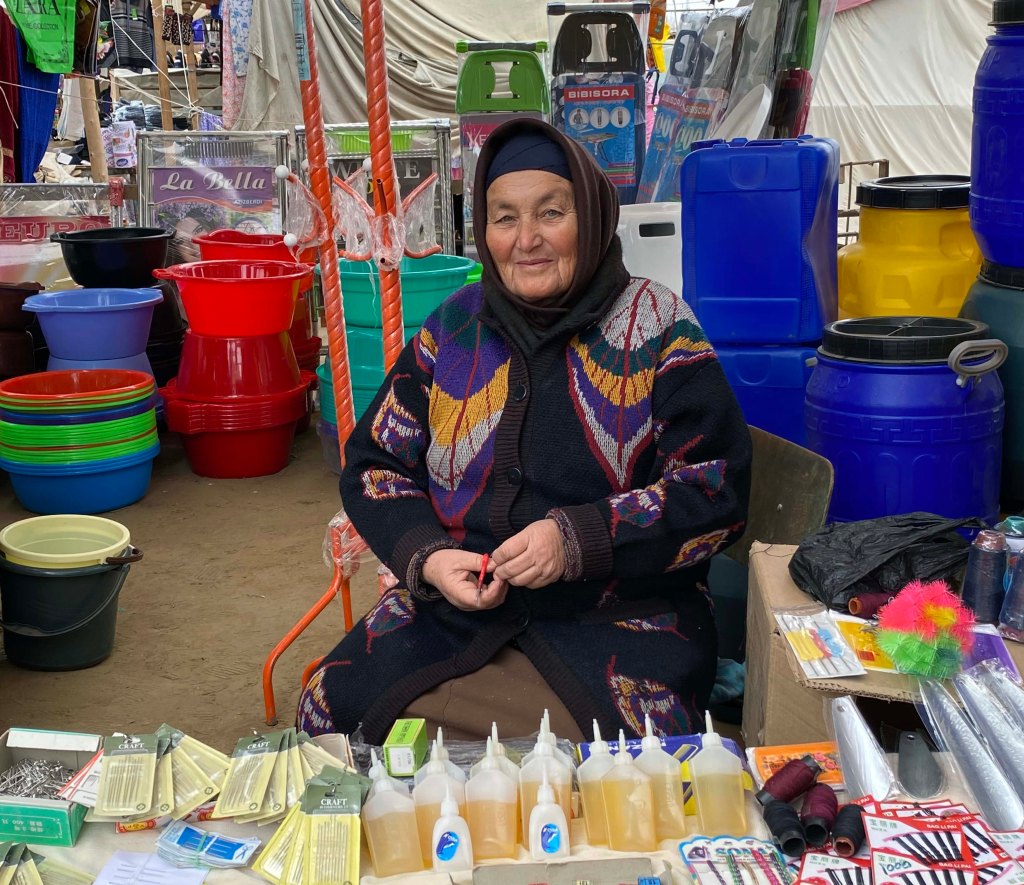
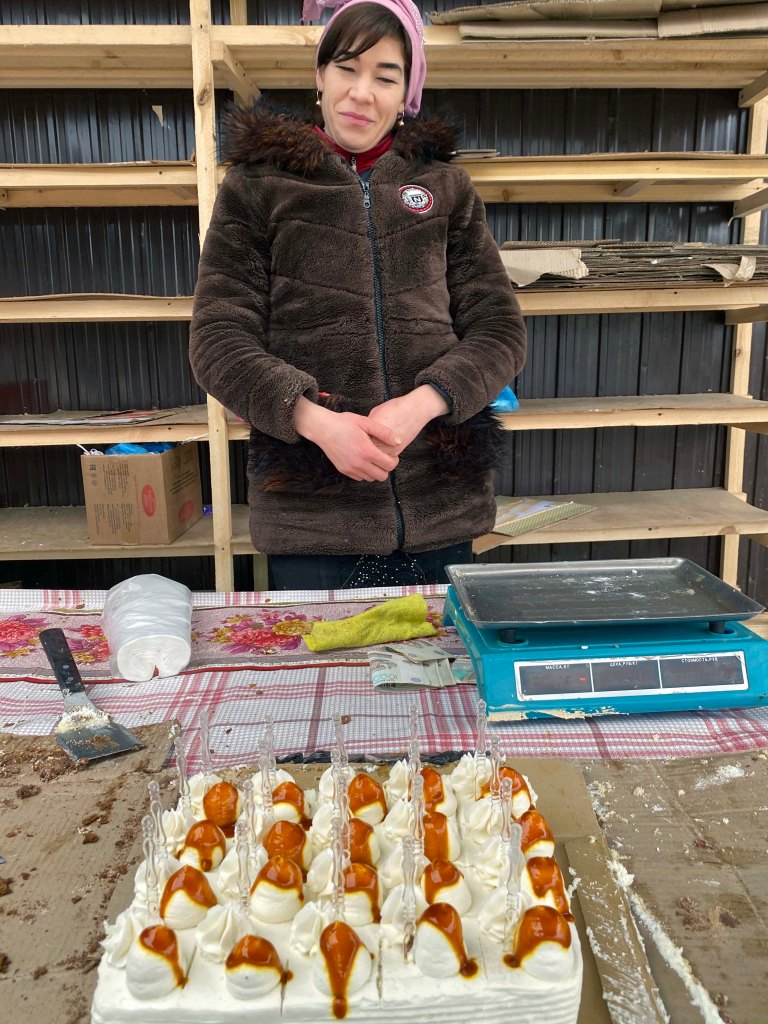
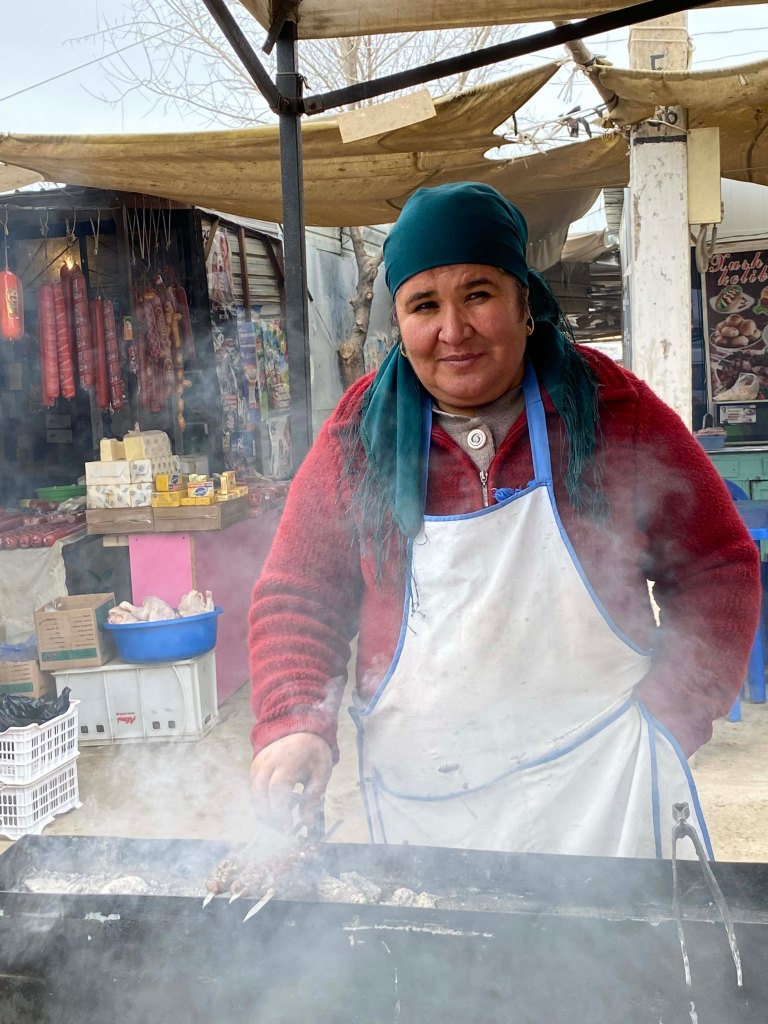
Our last day in Khiva was interesting as we scoped out the town and the market and then headed to the airport. As usual, I asked for some ice for my foot, and I had to “order” it a few hours in advance. When it came, it was always only about 6 ice cubes. Funny because it is below freezing outside, you’d think they could just put out a plate or bowl and make ice…

The guy who manages the hotel and handles the “front desk,” (Matir, I believe is his name) decided to be our taxi driver, which was good because he knows some English and we did want to have a quiet conversation with him to get a better understanding of the country and its politics. Matir knew most about the Khiva region which is part of the Khorezim “state” within Uzbekistan. He and his wife (a French teacher at the secondary school) were born and raised in Khiva (They live outside the Ichan Kala). They have three daughters but he said Uzbek people like large families and they will probably have about 5 children – he indicated that an average family size is 8 people, but not certain if that includes grandparents living at the home. He considers Uzbekistan to be very “free” with total access to television and the Internet – compared with Turkmenistan (which is contiguous to Uzbekistan) where there are many restrictions to free information and where women wear burkas and are held back with regard to education and social life.
Matir is probably about 35 years old; he owns a car (older model) and family income is probably about $15,000/year. He said that there is a push for entrepreneurism and encouragement by the government for the 300 families that live in the Ichan Kala to open their home for bed and breakfast style accommodations and for home style restaurants. Because of this, property values in the Ichan Kala have risen rapidly and now a home inside the old city could sell for about $50,000 or even $100,000. While Matir seems to think he has a good life, plentiful food, etc. he laments that he cannot travel to see the rest of the world because of financial restrictions.
We talked a bit about the role Russia played in Uzbekistan over many decades and the history of slavery (which officially ended during Czar Nicholas’ regime). Many of the slaves were Persians. Cotton has historically been the major national economic driver and as I recall from a visit to the amazing Slave Museum in Zanzibar last year, Uzbekistan is considered today to have one of the largest number of “modern slaves” in the world (forced labor at very low wages working to pick cotton). Matir did not discuss this issue. He feels lucky to live in such a wonderful region. We also learned more about the wedding processions that goes on daily: The bride and groom make the procession down that street in the Ichan Kala to be blessed at one particular mosque and to make a prayer at the well… a prayer to ensure they will have children.
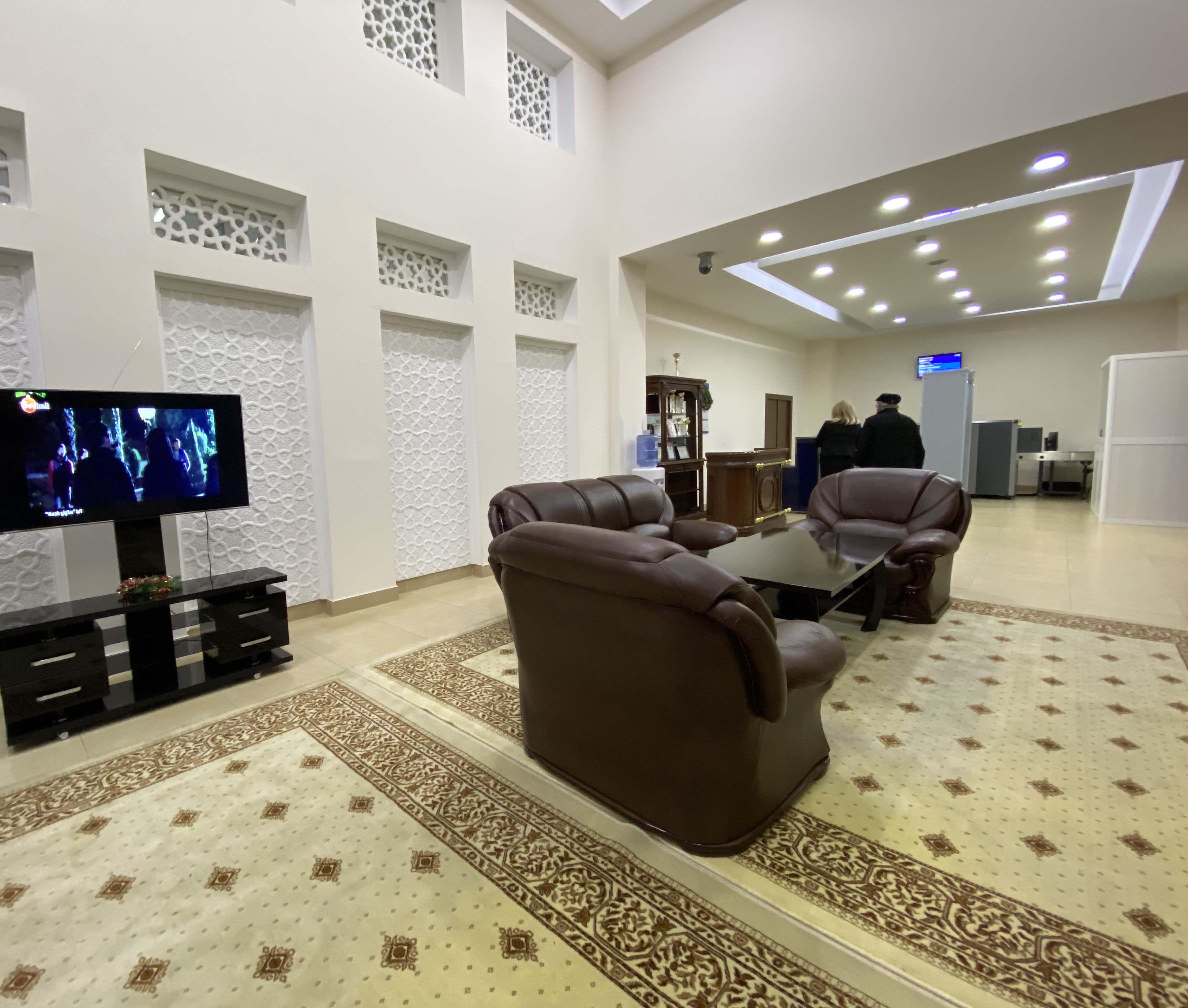
We arrived at Urgench Airport which seemed almost dark as we approached the terminal. Because we had a first class ticket on Uzbek Air (cost was about $20 more than economy) we were told we could go to the CIP Lounge which I suppose is like a VIP lounge. It was a very brightly lit room with oversized couches and a very large table. No food, a flat screen television with only Russian stations, and a woman who tried to be helpful but knew no English. Anyway, we figured out that someone would come to tell us when to board the plane, which they did. I read an article in the Uzbekistan Airways magazine which was interesting with a good deal of very sexist language.
The flight was uneventful, except for being about 45 minutes late.
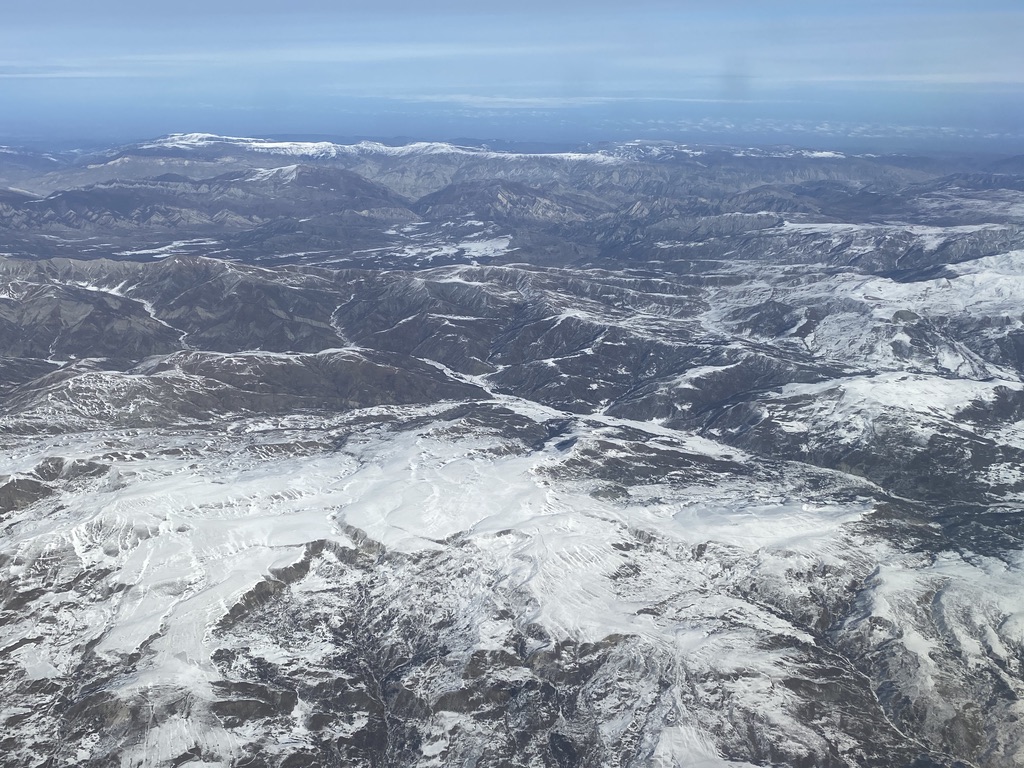
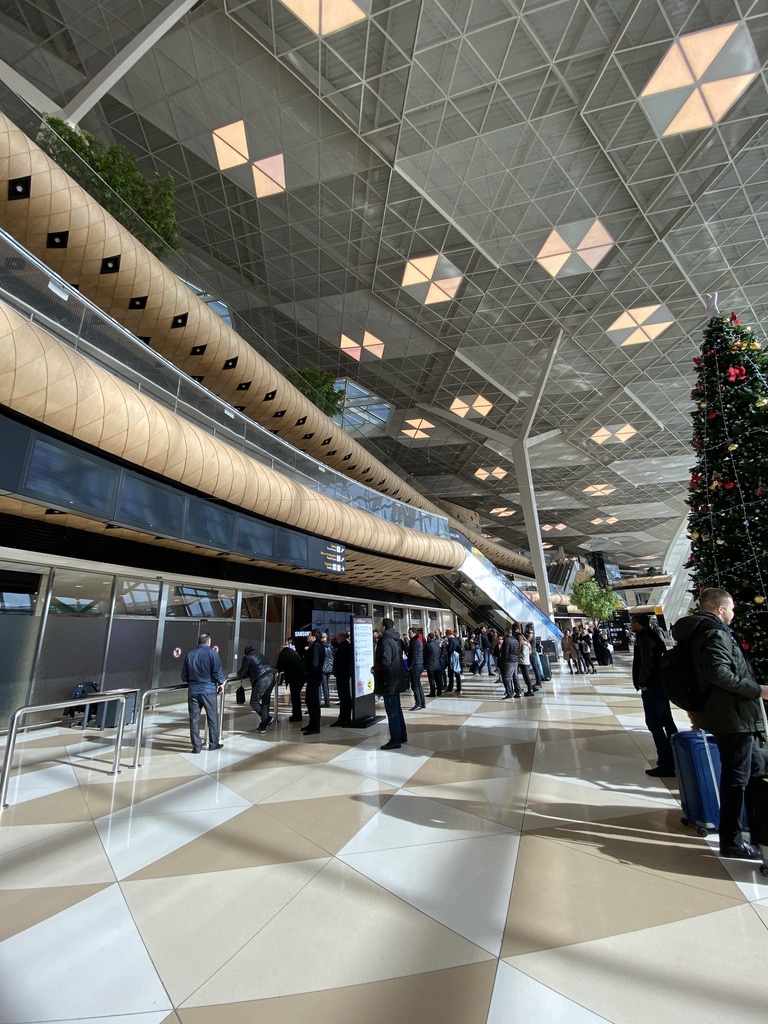

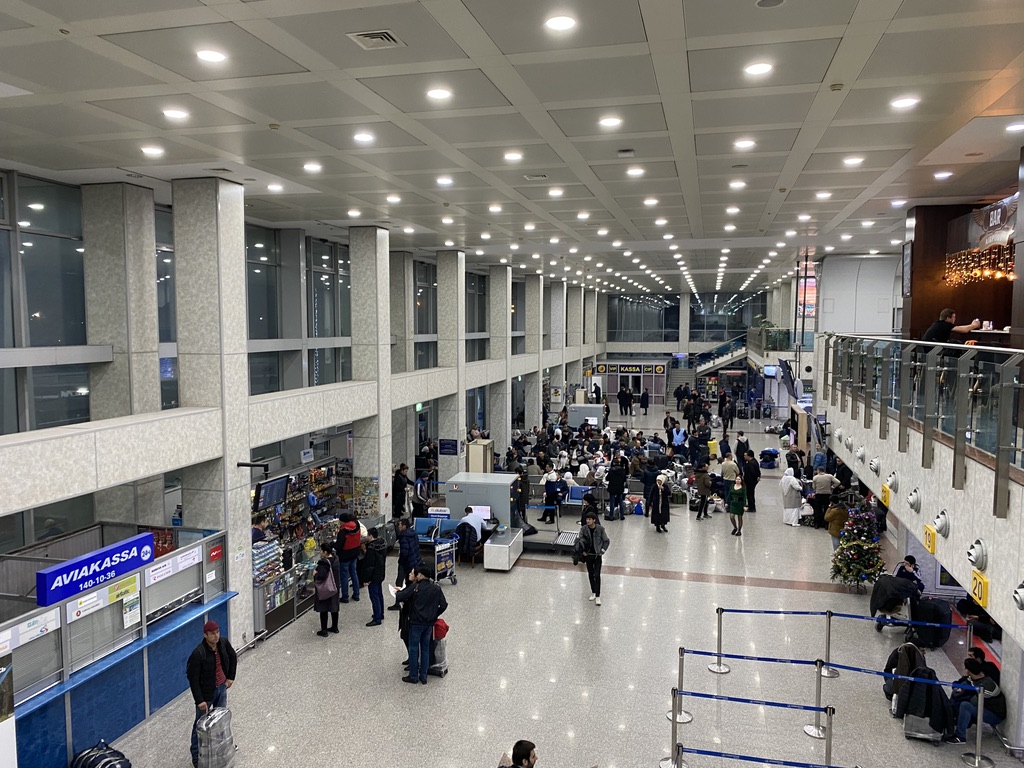
We landed in Tashkent and it was a good thing that we had read about transferring at Tashkent Airport because while the “two” airports share the same name they are miles apart and there is no real way to get from the domestic terminal to the international terminal on foot (even if you wanted to try to walk for about an hour. There supposedly is a bus to take between the two terminals, although even if we knew where to find it it would have been complicated with luggage. So we opted for a taxi which took about 15 or 20 minutes. We trudged into the international terminal and headed to our Turkish Air flight to Istanbul which left at 3:00 am. Landed in Istanbul at 7:30 am (two hour time change)… went through the transfer process and onto another Turkish Air flight to Baku which left at 8:45 am….
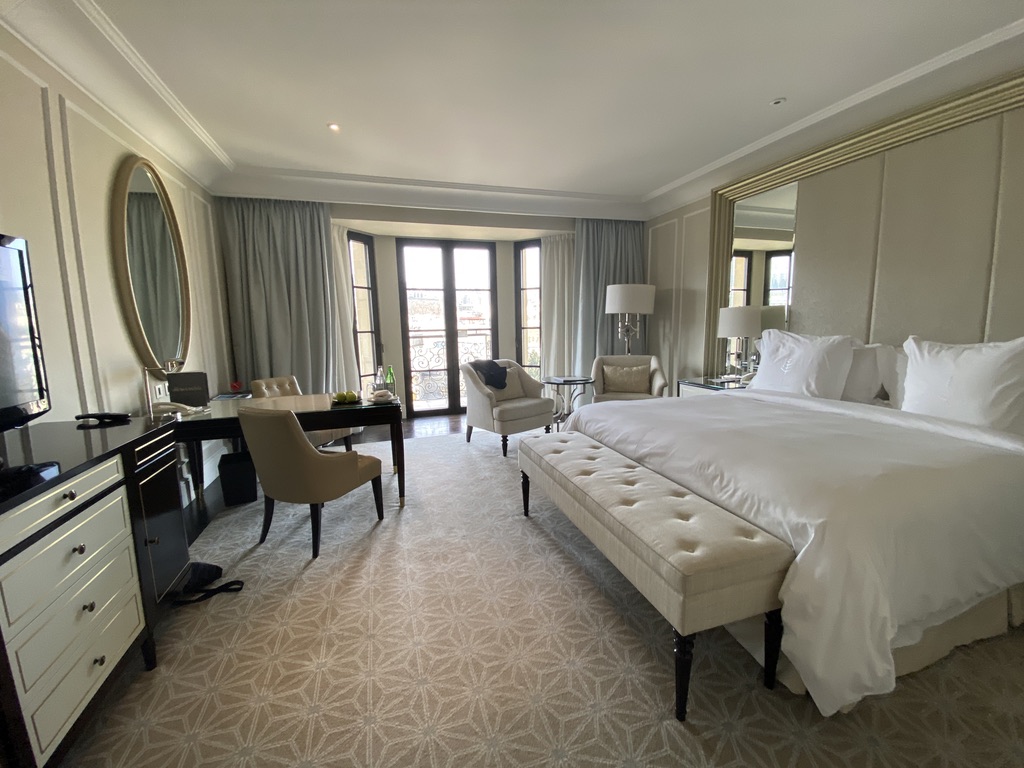
Landed in Baku (another time change in the reverse direction) at noon and then negotiated the taxi scene (their taxis look like they bought out an older fleet of London taxis) and finally arrived at the Four Seasons (!!!) – a wonderfully comfortable hotel located just outside the gate of the UNESCO-designated heritage site of the Old City. It’s a new building (2012) that was designed to fit into the landmark area (sort of pretending to be a late 19th century structure). That said, I’m not complaining.
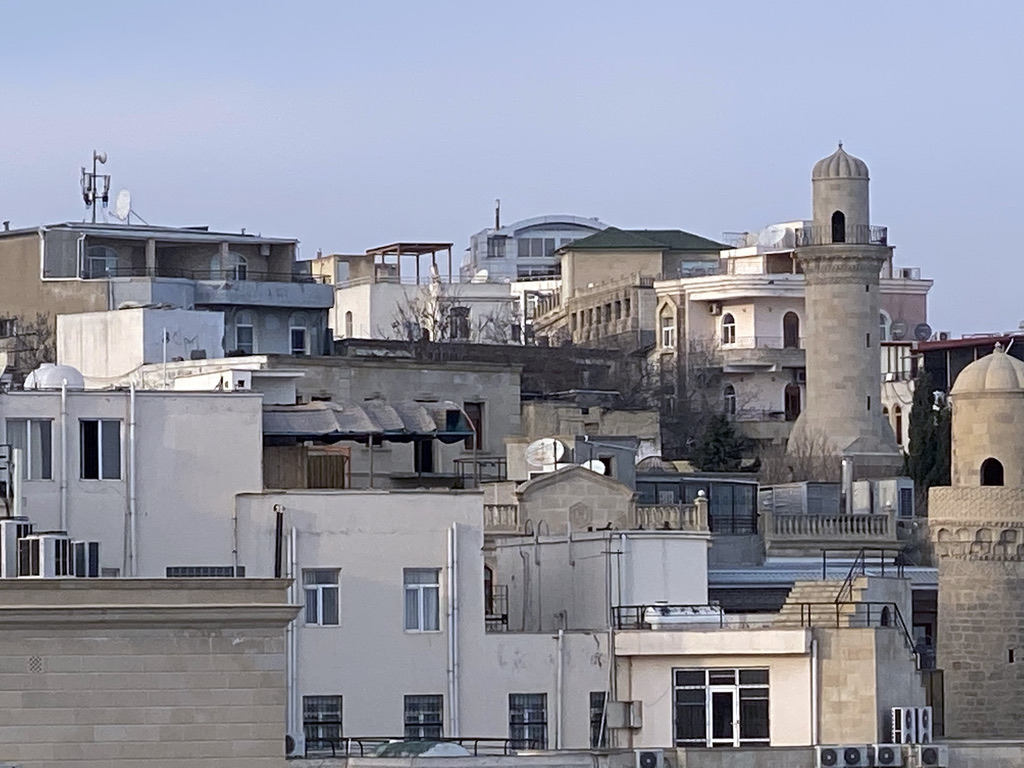
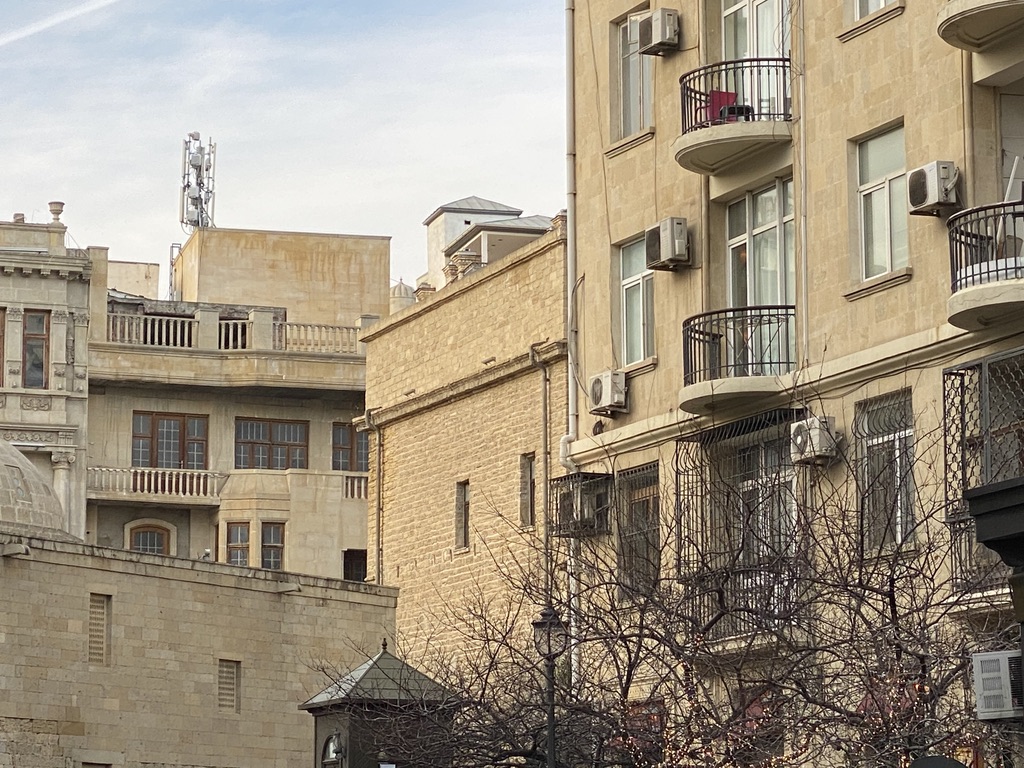
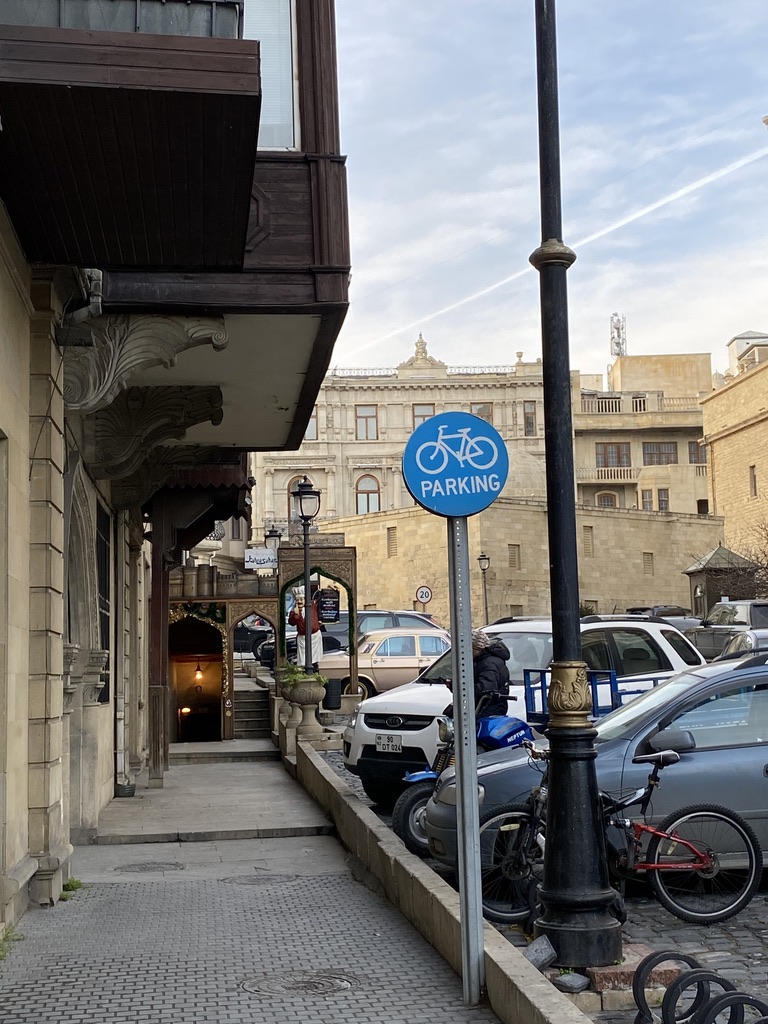
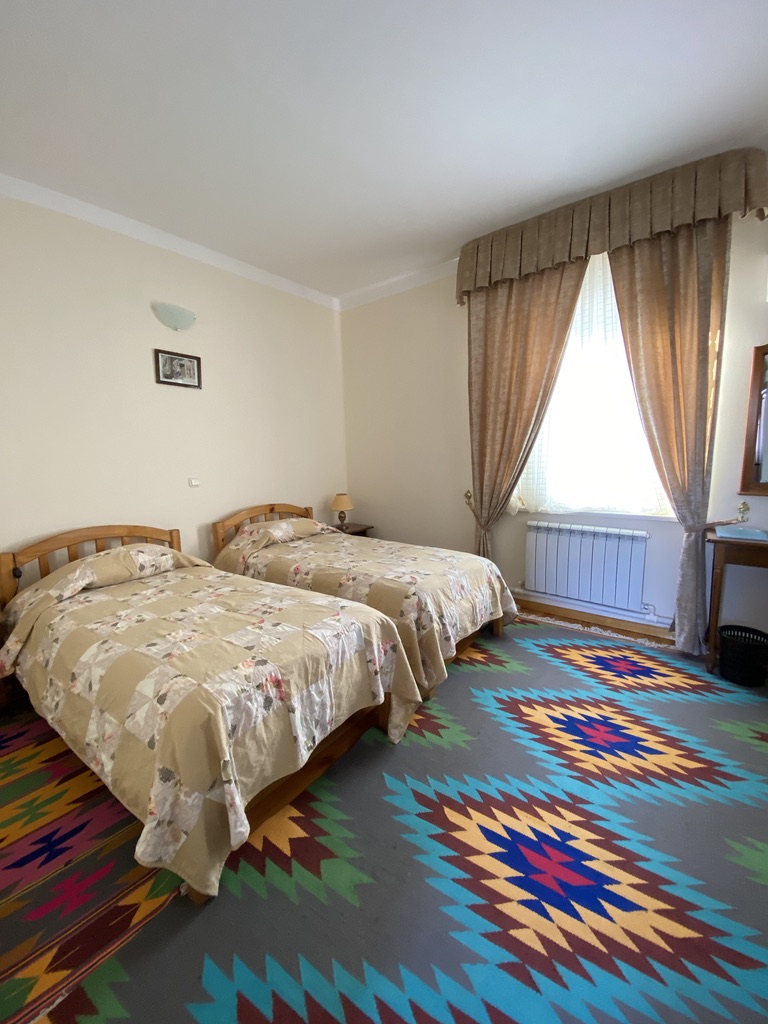
After 12 days of very modest, small Uzbekistan hotels with limited or no service, steep stairs everywhere, menus that repeat at place after place, limited hot water, uncomfortable beds, and somewhat sketchy Internet — (although I’m not complaining and am glad we chose to be in the old section of each city and to support small, independently-run, locally-owned hotels) — it felt wonderful to walk into this spotlessly clean, shiny, tall-ceilinged space. Indeed, it almost felt fairy-tale-like. It was made ever more wonderful when I called to ask for ice and they brought up a huge bucket as opposed to the six or so cubes I was able to get in Khiva, and always needed to give them several hours advance notice in order to get that.
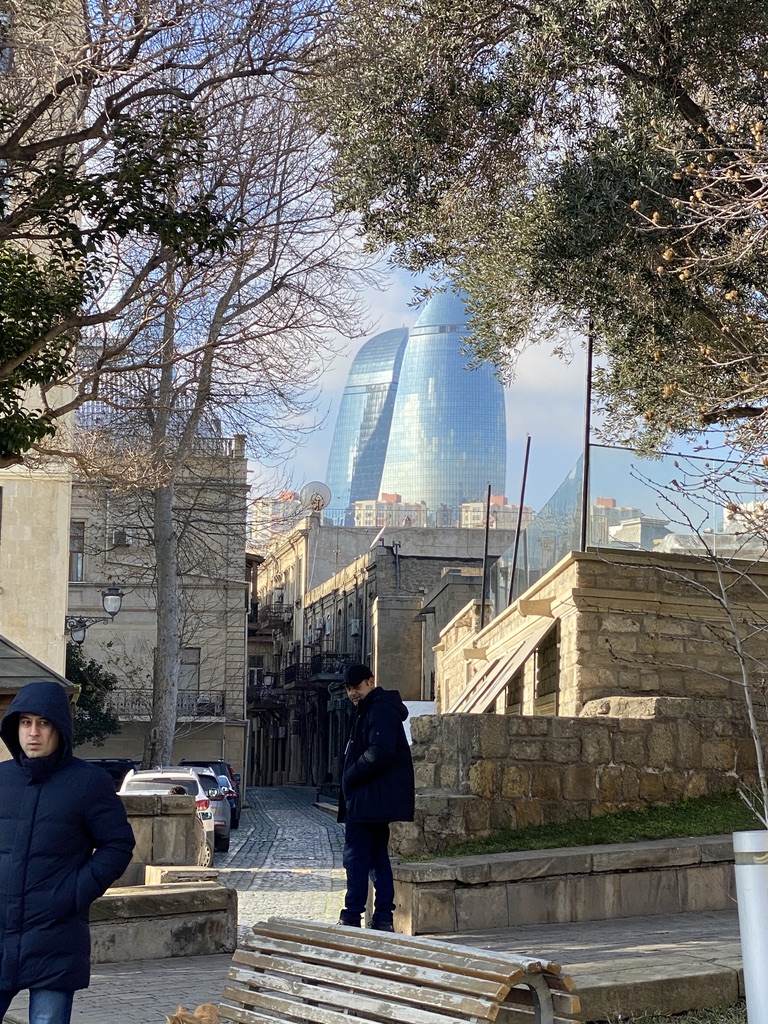
Anyway, we settled into a great room (complete with fresh apples in a bowl and bottles of water) with views of the “flame towers” off our little balcony. We went down to the cafe in the lobby for a snack and then I headed out to see if I could find a pair of shoes so as not to have to use my boots all the time ( a little challenging with the problem foot) and Mike took a nap. After a while I decided to return to the hotel without the shoes…. Long story. I then went up to the spa to get a manicure!! While there, they tried to convince me to get a botox treatment. I declined. We then headed to dinner in the old city — a very complicated walk up many stairs and down many teeny alleyways. I think there was really a direct path (still with some ups and downs) but somehow we kept getting lost.
Had a great dinner at Burc Qala – started with two different eggplant “dips” and the local breads.
Then shared a wonderful lamb with pomegranate and chestnut dish. Best food since we left Geneva. And we had a wine from Azerbaijan which was quite nice. Their wines (like Uzbekistan) are mild, dry, and quite pleasant to drink. The bottle of wine in Uzbekistan cost $6; here in Azerbaijan the bottle of wine was about $11. Waiters couldn’t help coming back to our table with little English comments that we had to decipher — about American basketball, US politics, and more. Basically, they like to watch basketball, don’t really understand US politics, and think America is great. And, they are always shocked to learn we have come from the US, always thinking we are either Germans or Italians.


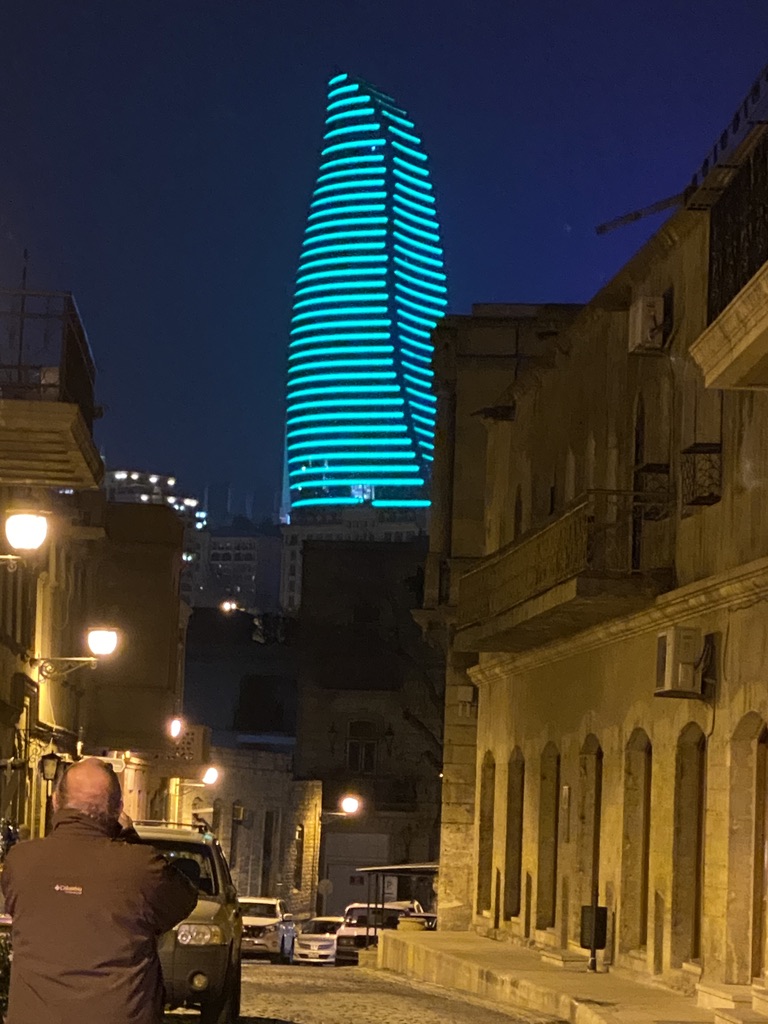
We walked back to the hotel at about midnight, stopping frequently to photograph the Flame Towers which put on quite a light show every night — changing colors through lighting on each of the three buildings.. Blue, then red, then green then what look like people carrying the Azerbaijani flag (which is naturally red, green, blue), then what looks like water flowing on the buildings, then a scene of people with umbrellas, then flames, and then repeat… It is amazing to watch from different vantage points throughout the city and very mesmerizing. We trudged down the cobblestone streets, walking for a while in Kichiqala which seems like restaurant row. We returned to the hotel and Mike decided to try out the whiskey bar located on the lobby level… Finally we reached our room at about 1 am.
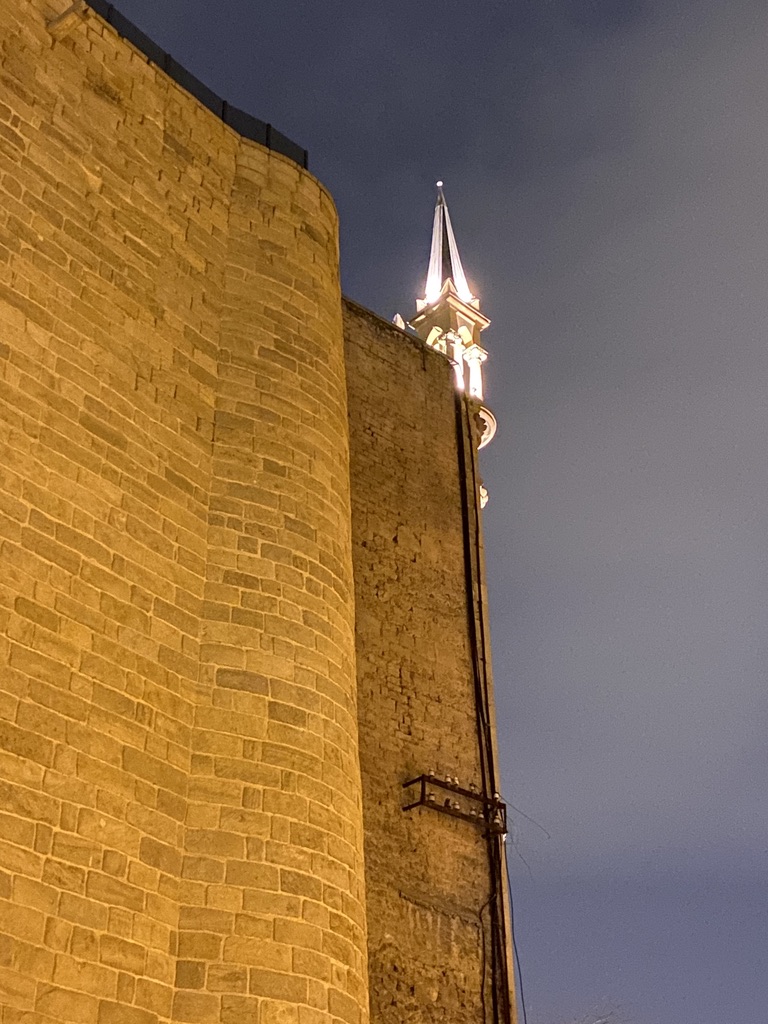
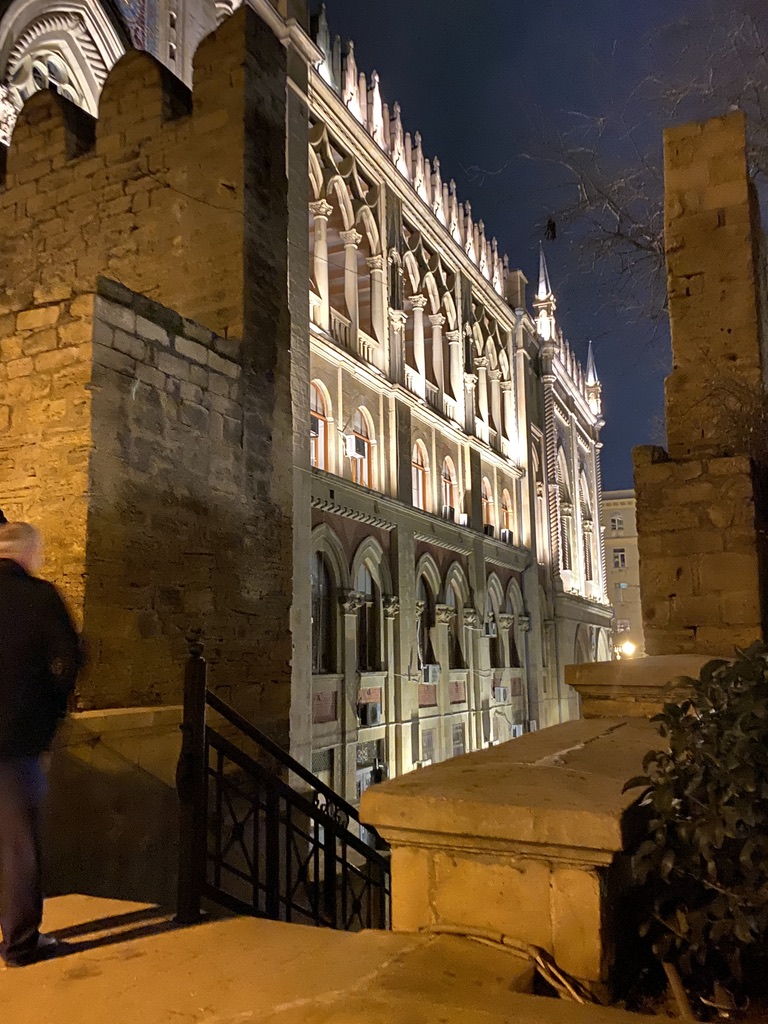
More tomorrow as we discover Baku.
Best –
Fern
Farewell Khiva. January 12, 2020
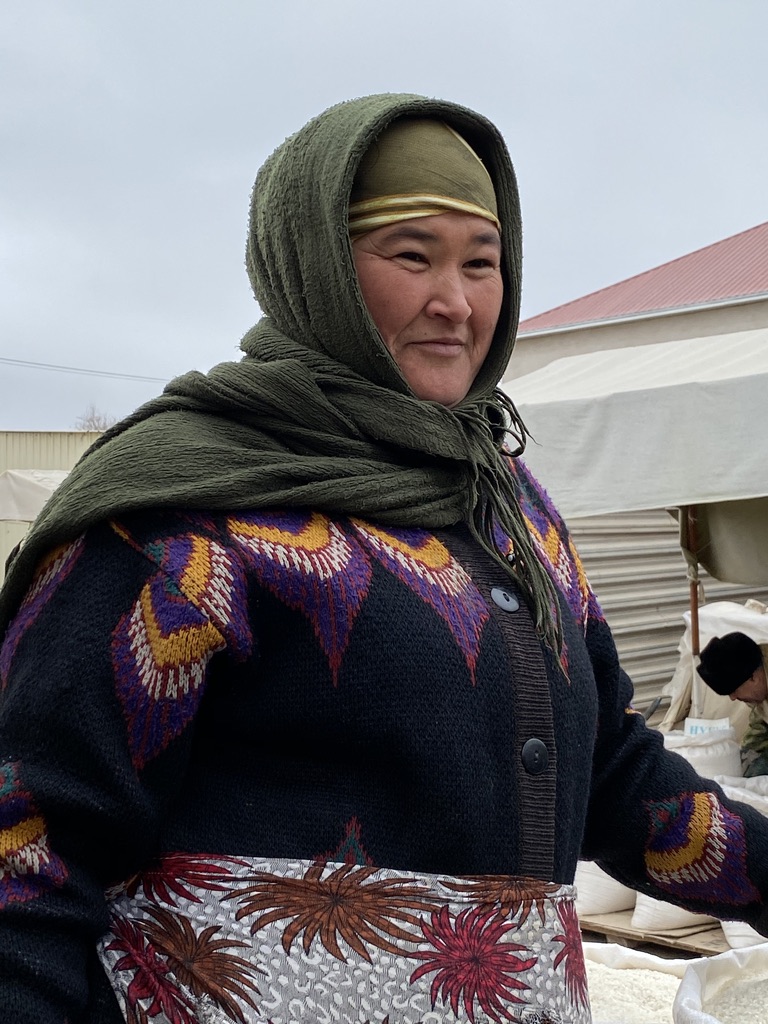
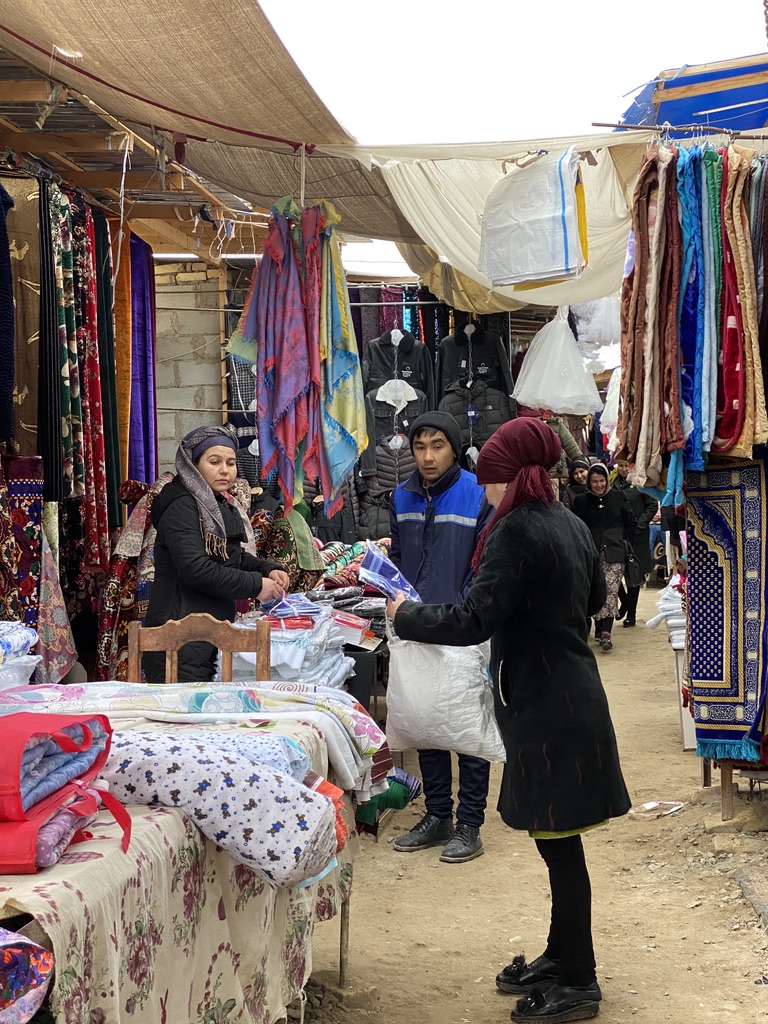
Vidolashuv O’zbekiston — Farewell Uzbekistan…Until next time…
While the prediction was for slightly warmer weather today (low 40s), it seemed colder than the other days because it was overcast and with some wind.
We decided to head for the big bazaar (market) which we thought was just outside the east gates of the Ichan Kala… but apparently the market was moved recently and split into two parts, although no one could explain if the parts were different. What the hotel said was that now there is a big market and one that is a little bit smaller (?) We decided on the big one. They said it was two kilometers from here, but that a taxi would be best as it’s a complicated route. And given the temperatures (30s) and my foot and the road and street conditions, we thought a taxi made sense so we asked the hotel to call a taxi and also to see if the taxi could wait for about an hour while we explored. Then we wouldn’t have to navigate where to find a taxi to get back.
The guy at the front desk who has some English, but peppers every sentence or even ever phrase with “honestly” said “Honestly, that is a good idea… I mean honestly there are taxis but hard to find, honestly” He also told us that he would like to drive us to the airport tonight (about an hour from Khiva, in Urgench). He said he would like to do it, but of course he will charge like a taxi. Honestly! So I suppose he will be our driver to Urgench.
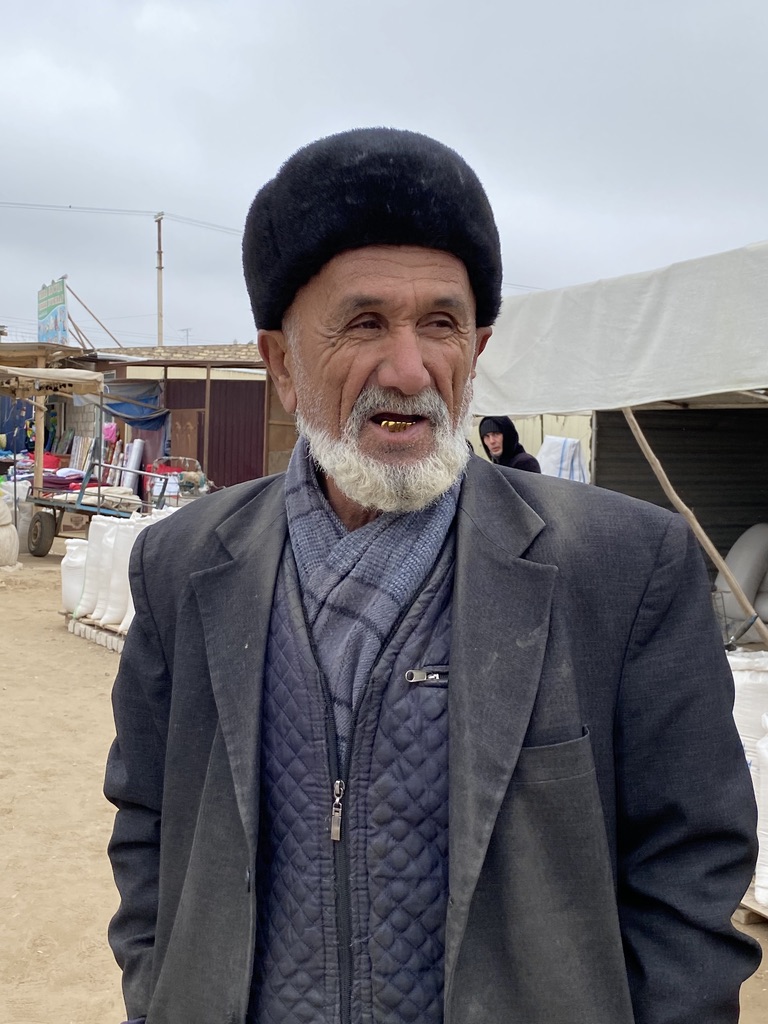
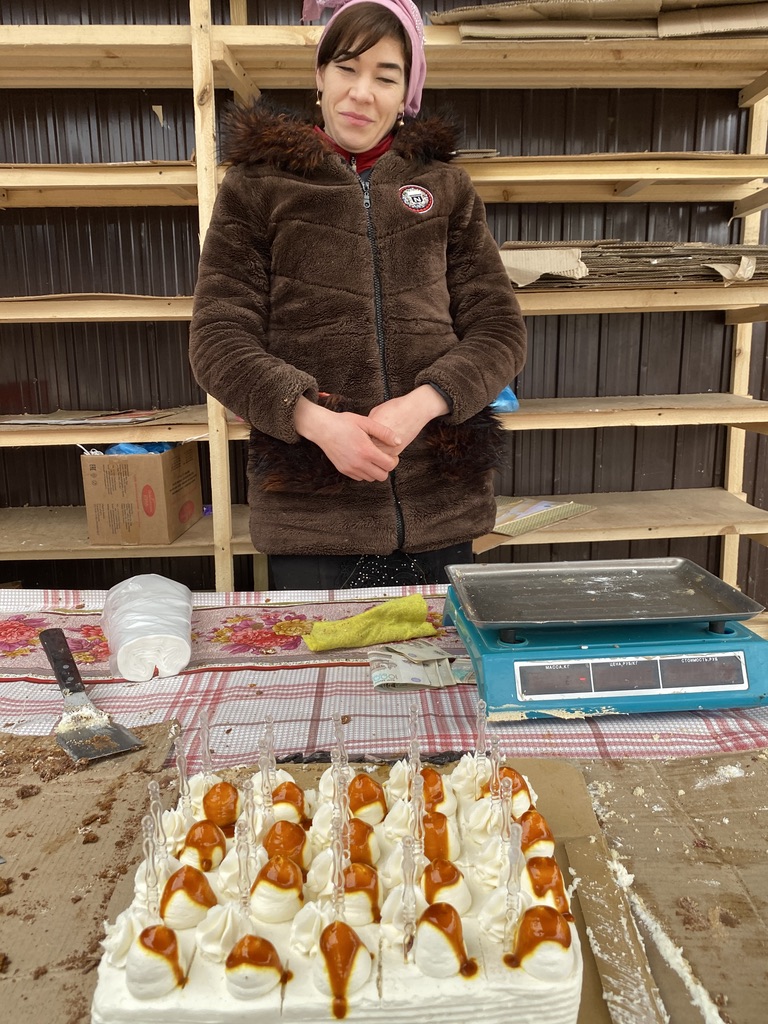

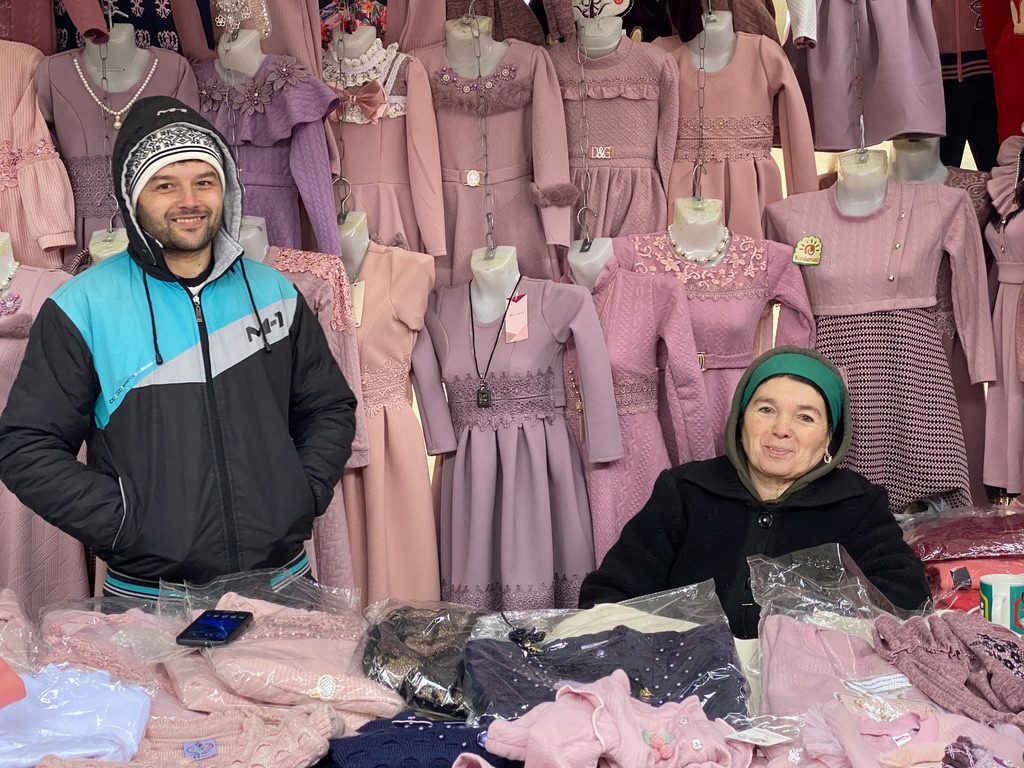
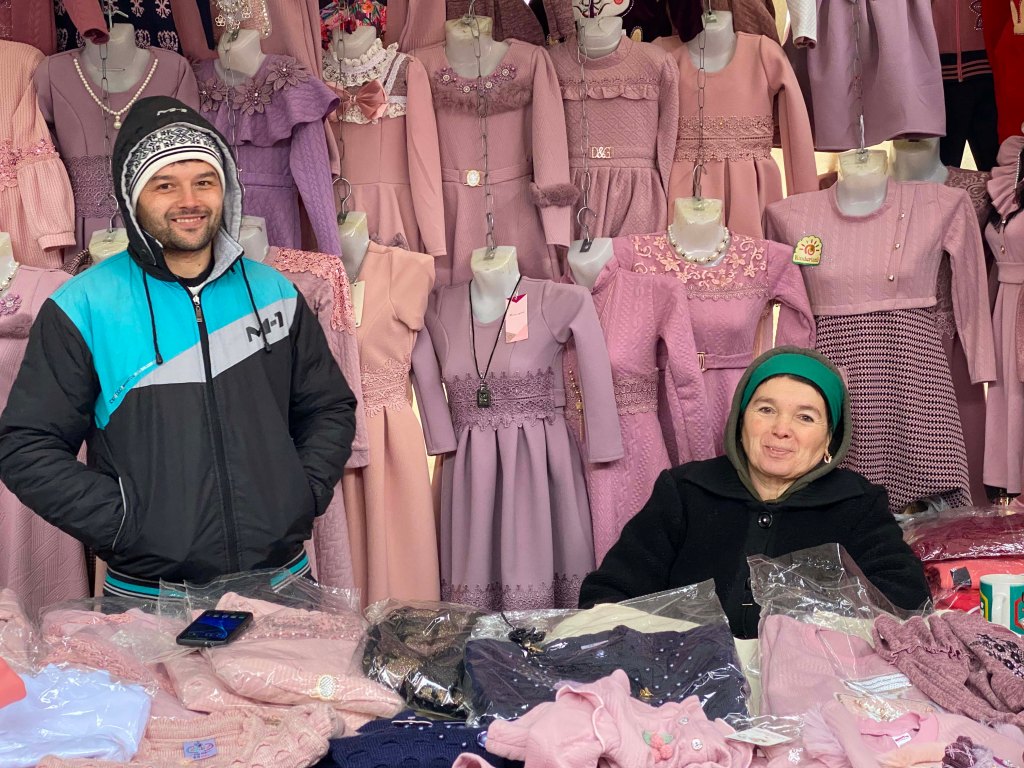
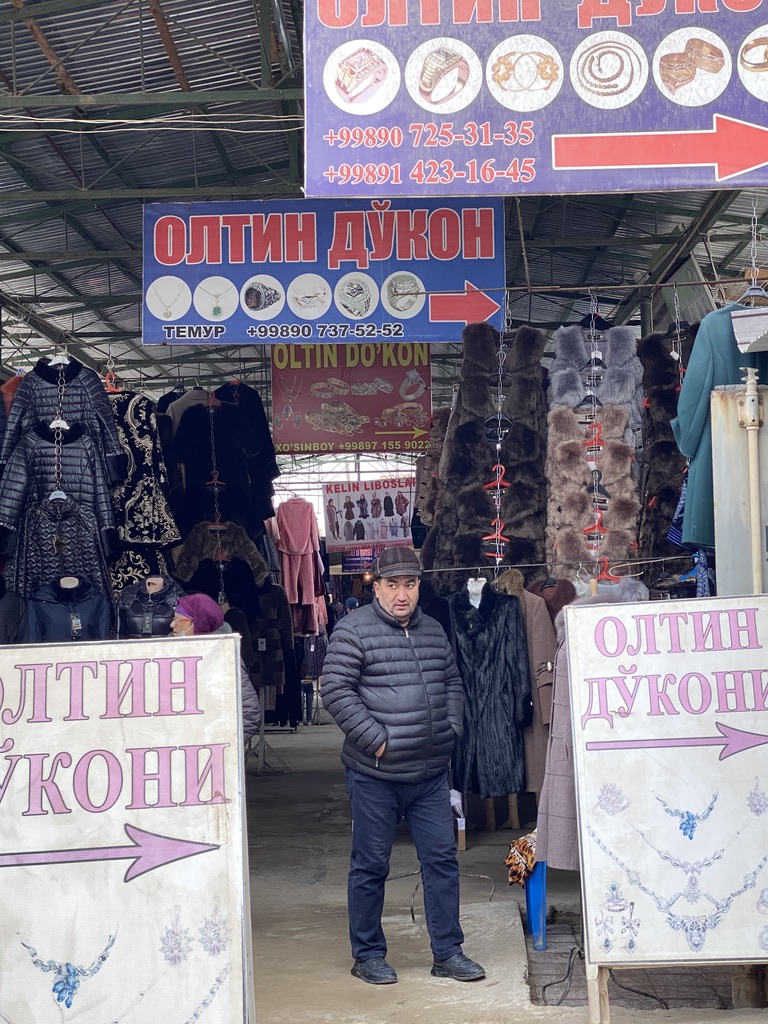
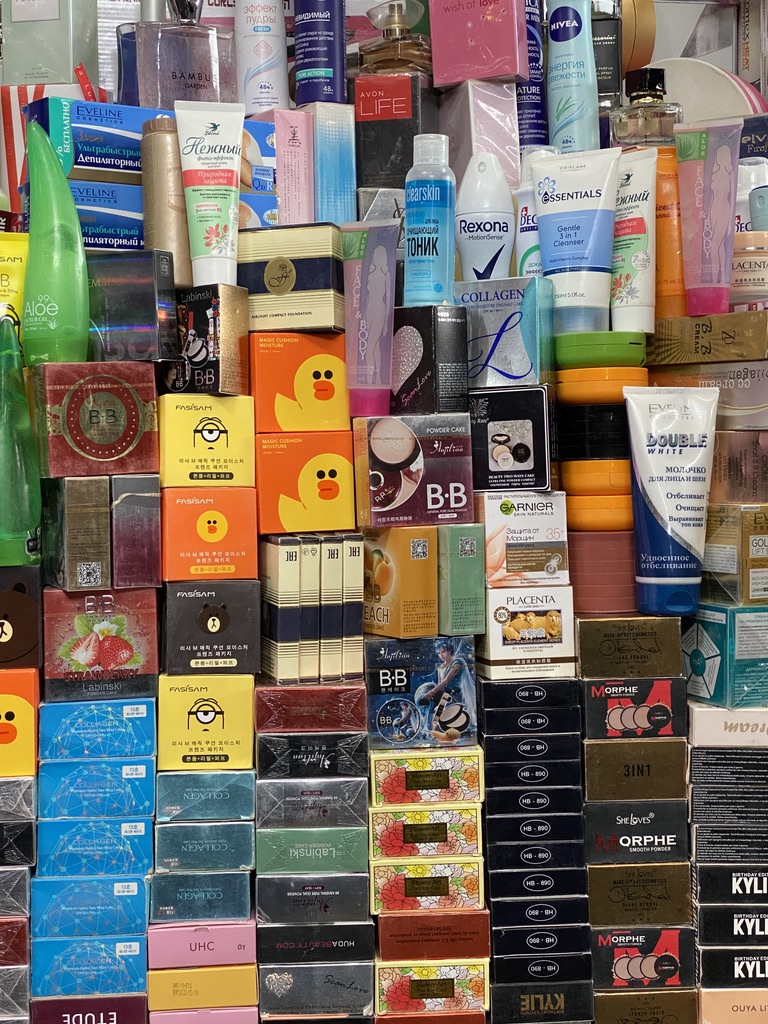
The market is a big sprawling area that is probably the equivalent of 10 city blocks by 12 city blocks… perhaps larger. We were clearly the only foreigners there, with everyone else doing actual shopping. Unlike markets in many other places where vendors try to attract customers, it seemed as if people had regular customers and customers knew where they were headed. It’s an outdoor market so I really felt for the vendors who had to sit in the bitter cold to sell their goods. The clothing and accessories were all factory made… and as we, as Americans move to eliminate plastic — I think the Uzbekis are in the midst of a huge plastic surgence. Finally we reached the meat and produce and baked goods areas and the large area devoted to the many different kinds of rice and tea. We stopped at one rice vendor to ask which rice was used for plov… but either they didn’t understand the question (no one in the market spoke even a word of English) or perhaps they did…. she pointed to each huge bag of rice and said “Plov, Plov, Plov”… so who knows.. Maybe all of their rice options can be used for plov.

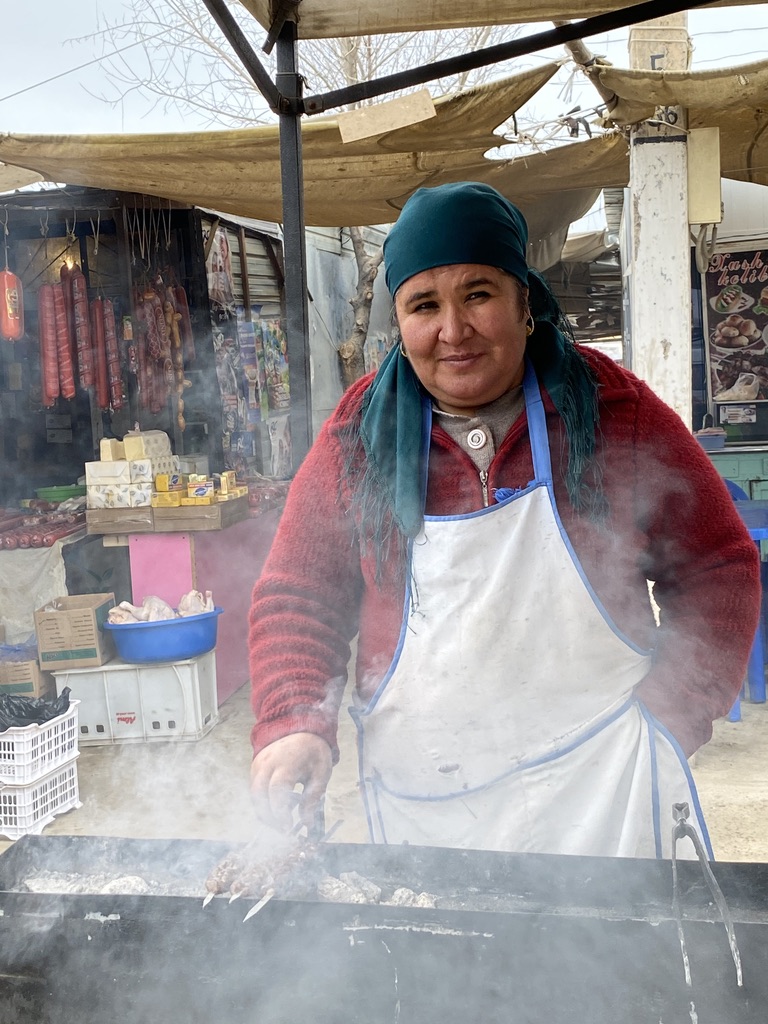
Customers and vendors alike were very friendly and occasionally said “Hello” or “Bye” and sometimes they said “Italy?” or “France”…. But when we answered “American” they often gave a thumbs up or smiled. We generally followed “America” with “California.” Not clear if they really knew but they gave another thumbs up. So, in response to the questions that some of you posed to me, about any reaction to current American international policy… I can say that we can get BBC News on the tiny, outdated TV in our room (not sure that locals can get it), and people remain very friendly to us. My general experience, having traveled in many countries where one might find antagonism toward the US, and possibly Americans, is that somehow people seem to get it that those Americans who travel, especially independently must be curious and interested in their lives. As such we have never encountered any anti American sentiment directed toward us, although we have understood their antagonism against the country we live in. Only once, were we attacked personally — and that was in Helsinki on May Day during the Vietnam War… when a rather drunk Finn said “Why are you killing little yellow people in Vietnam?” Since we had been living in Helsinki for nearly a year by then, we responded quickly with “We’re here in Helsinki celebrating May Day with friends and are not supporting any killing of yellow people in Vietnam…. and by the way, where in the US did you study since your English is excellent and with an American accent!” We then embraced and had a beer together.
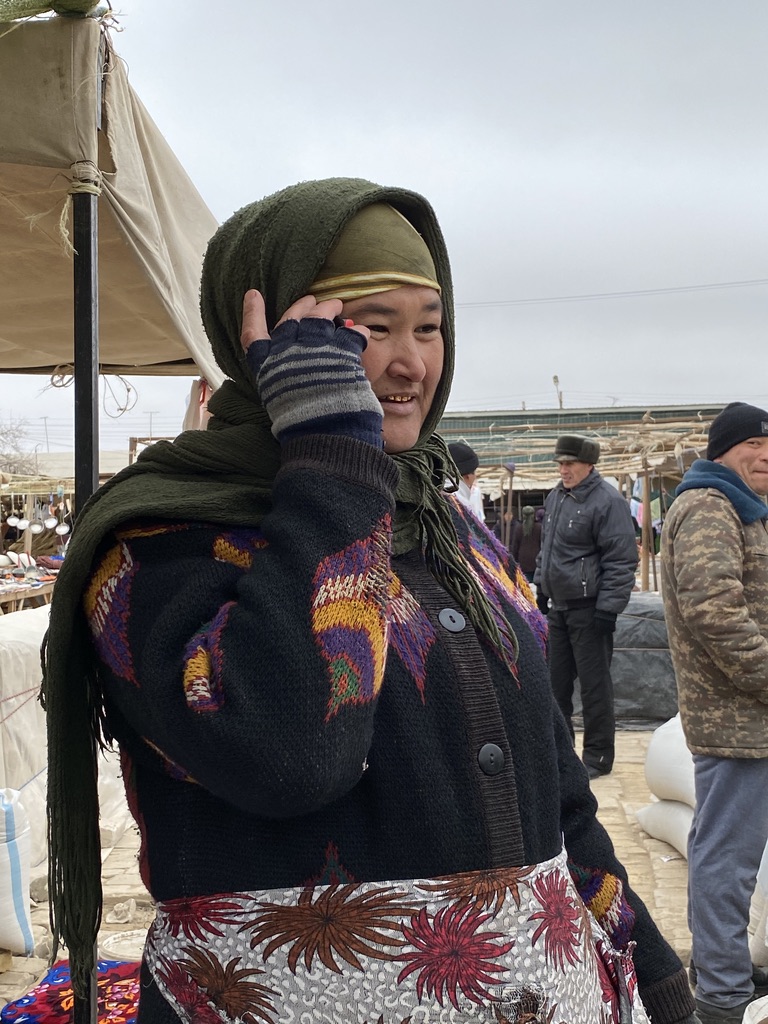


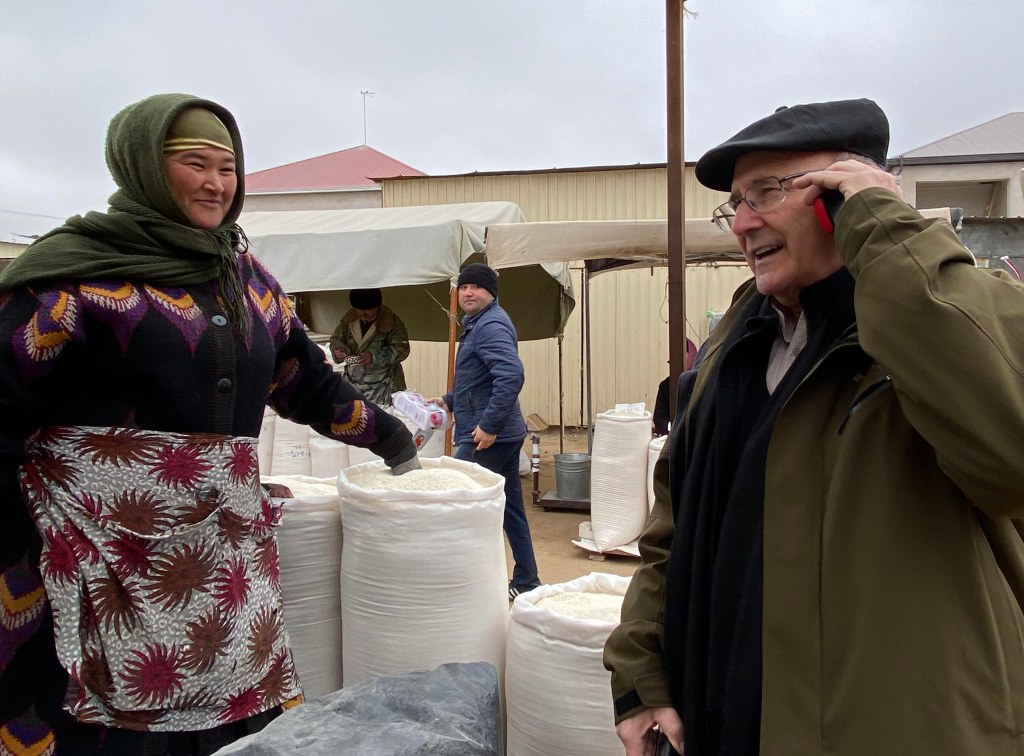
Anyway at one point in the market a woman got very excited when we said we were Americans… she had heard because a lot of vendors were telling others that there were Americans at the market. She was a rice vendor. She leaned over from behind her perch and the bulk bags of rice and grabbed Mike’s coat… and she motioned to her cell phone (everyone has one). She called her daughter to tell her daughter that Americans were at the market. And then she handed Mike her phone. Her daughter was on the line and spoke some English; the mother wanted her to practice her English. From what Mike understood, the daughter was at the university – a psychology major (he thinks). They chatted in simple sentences and the mother was delighted. I think she became a bit of a star in the bazaar for this new friendship.
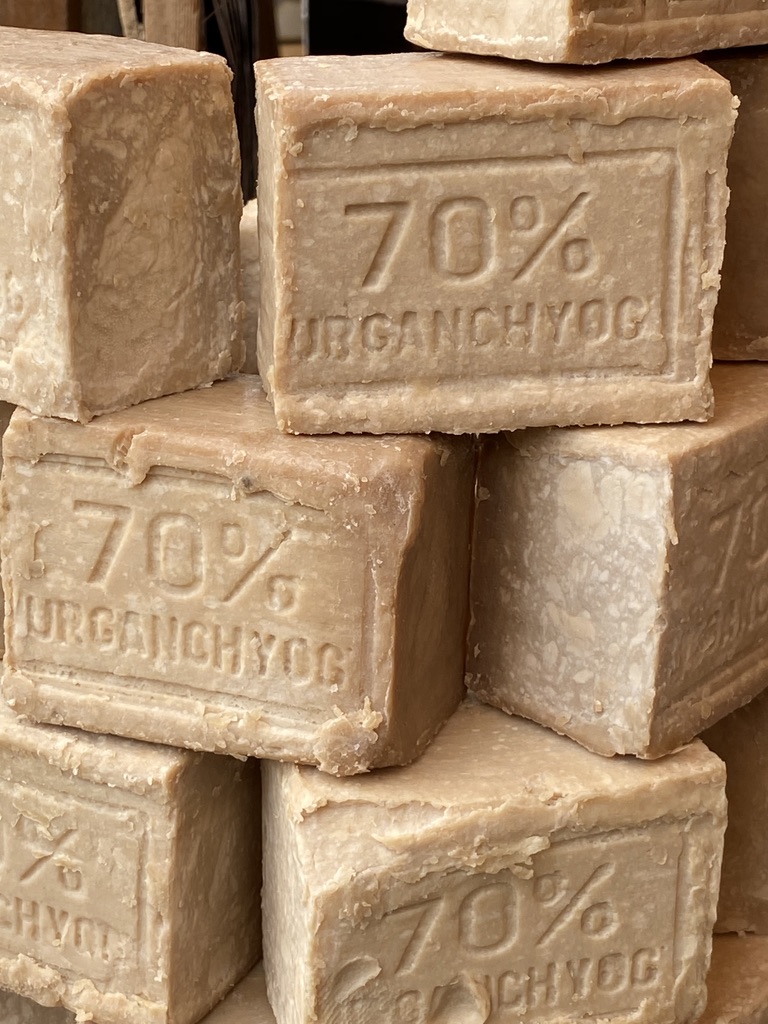
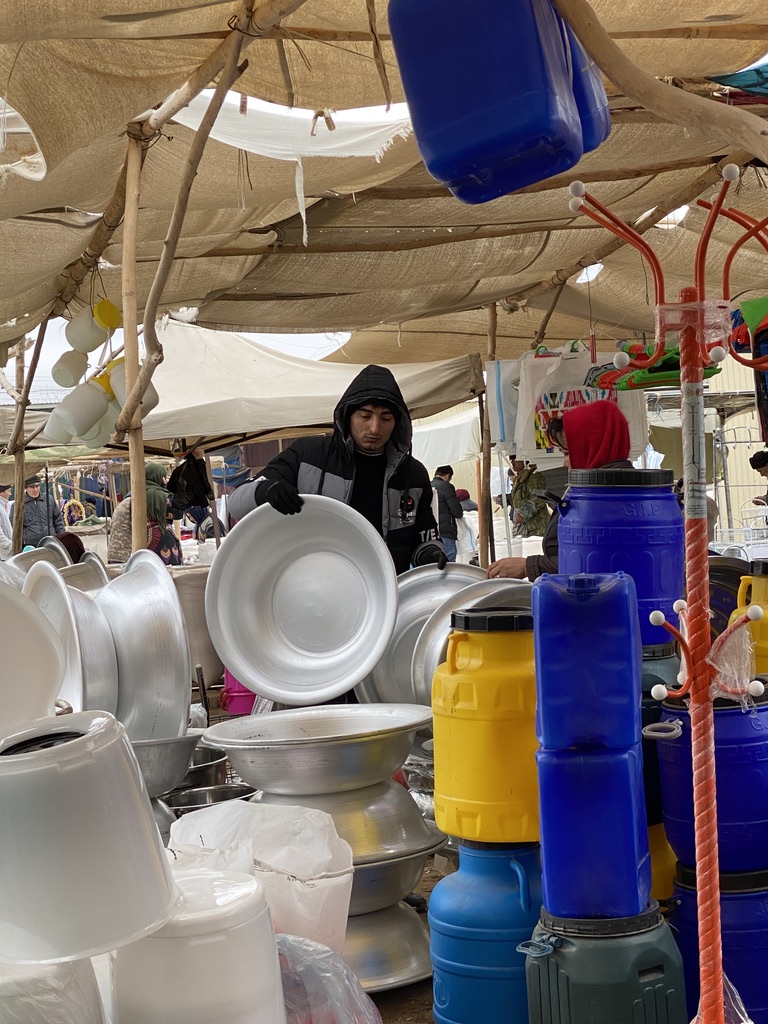
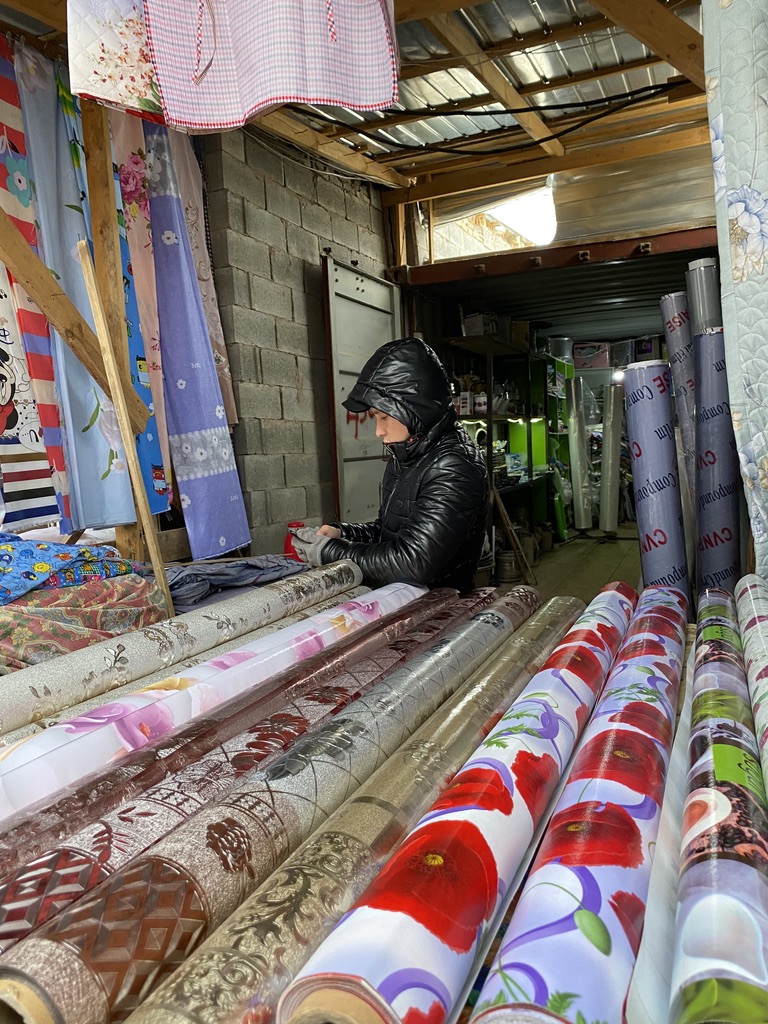
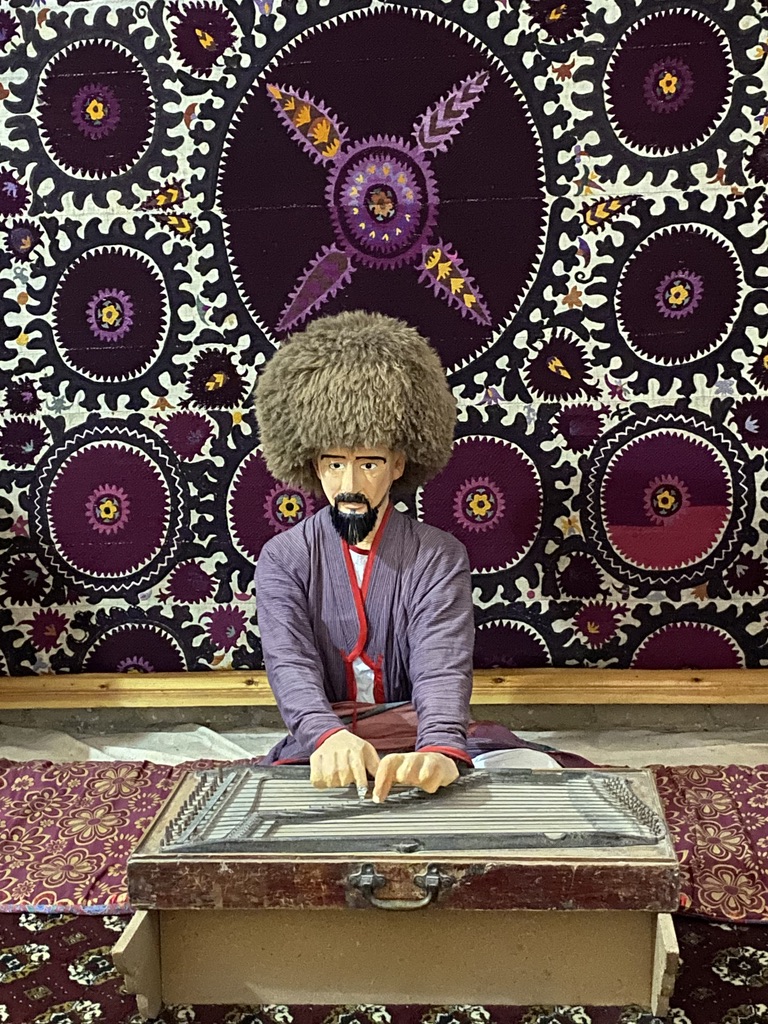
Then of course after meandering rows and rows and aisles and aisles of the somewhat depressing market, we needed to figure out where the taxi had left us. Probably needed to have kept some kind of marked route. But we did it; found the driver and we headed back to pack and ice my foot for a while. But first we walked to a lunch place close to the hotel and also stopped into what they call the “music museum.” It was in an old madrasa. I think the Uzbeks, given the secular nature of the country, have repurposed hundreds of madrasas into museums, shops, restaurants, craft workshops, etc. The museum was – like the others we’ve ventured into – filled with exhibits that were not very well crafted, dimly lit, and thus unfortunate. I think the history of their music is actually quite interesting and the Uzbeks, like many of the other Central Asian countries uses some fascinating instruments that produce sounds that are different from typical European string and wind instruments. Alas, they could use some help in exhibition design.
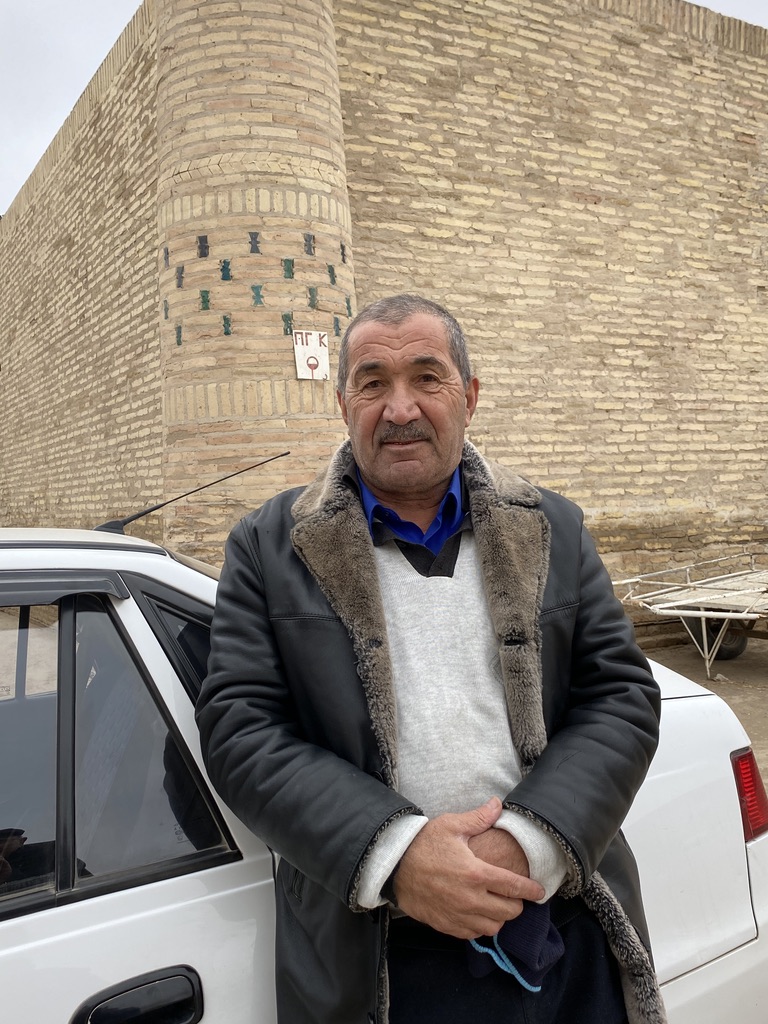
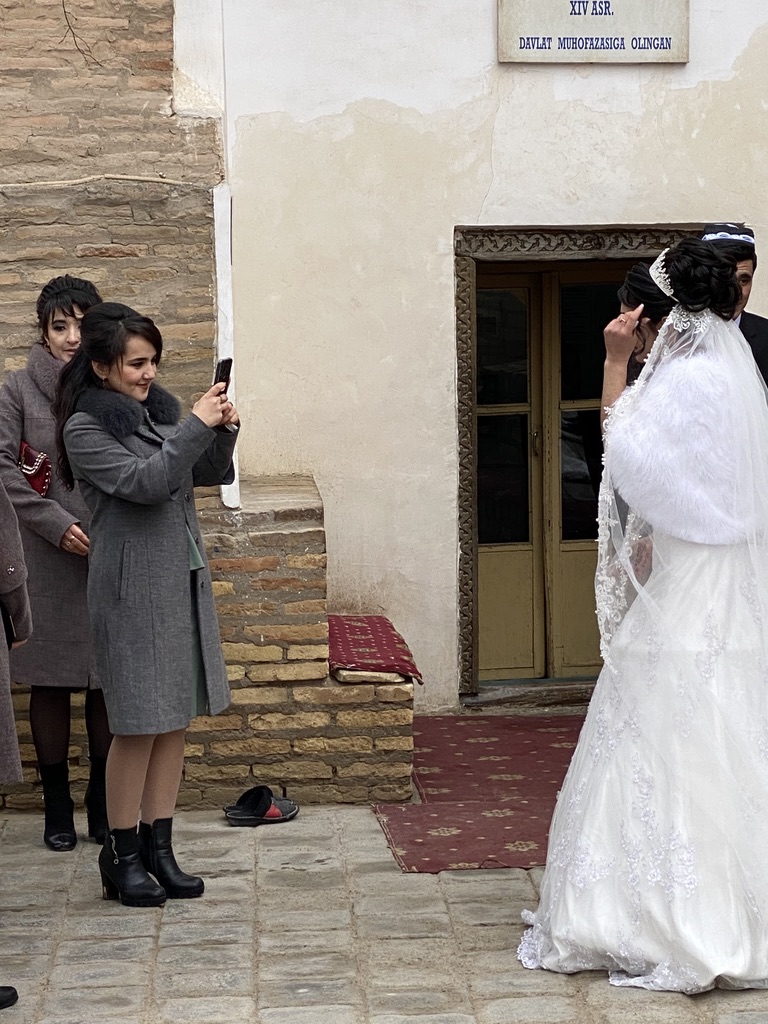
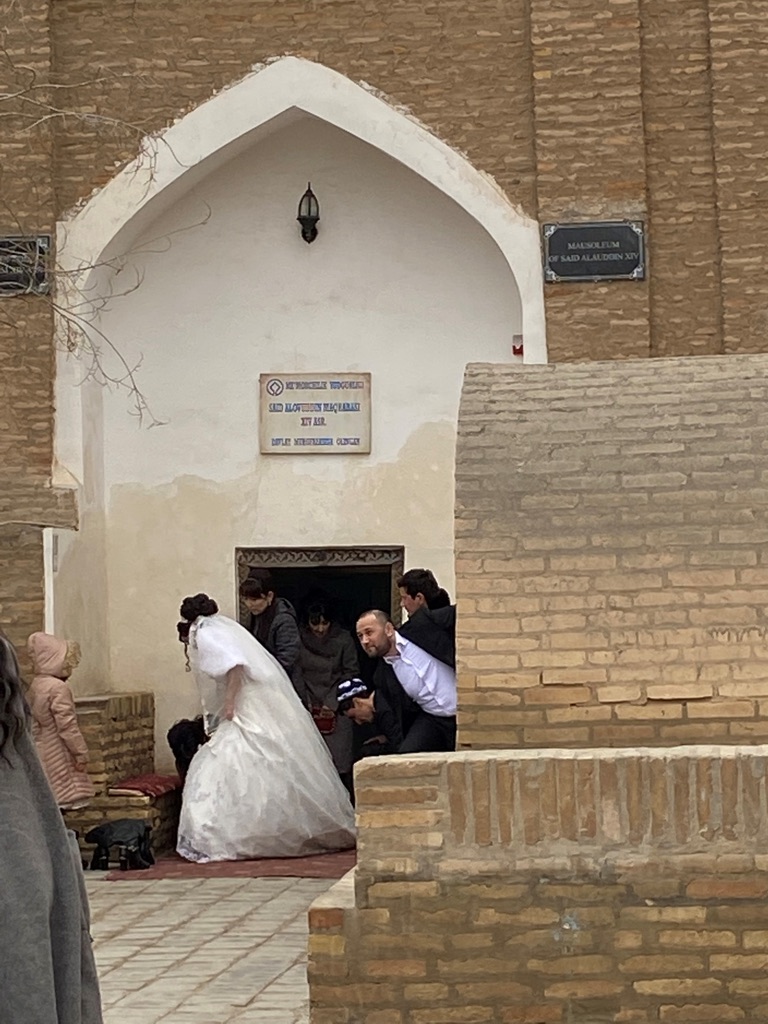
And along the way, we stumbled on two more weddings. I think that it is customary for the bride and groom to walk the east / west length of the Ichan Kala (either before or after the actual rituals). It’s sort of a stone paved walk in the pedestrian district. They sometimes make stops along the way into small mosques or to dance to the music playing at shops along the way. Today, I watched the bride remove her 4” white spike high heels (hidden by the pouffy dress) at the door of a small mosque, and for the groom to don a “kufi” (hat), that he had in his pocket… They were inside the mosque for only a few minutes and then back onto the walk.
We head to Urgench to fly to Tashkent… then somehow get to the International terminal in Tashkent and fly to Istanbul and transfer to Baku… It will be a true miracle if we make it, without a hitch. I’m about to repack and am preparing for the high probability that bags could get lost… so I’m moving several essentials to my computer carry-on bag, along with a few changes of clothing…. just in case. We are only in Baku a very very few days and hope we can get a lot in… Then we head home.
More from Baku.
Fern

Khiva January 11, 2020
Greetings from Khiva –
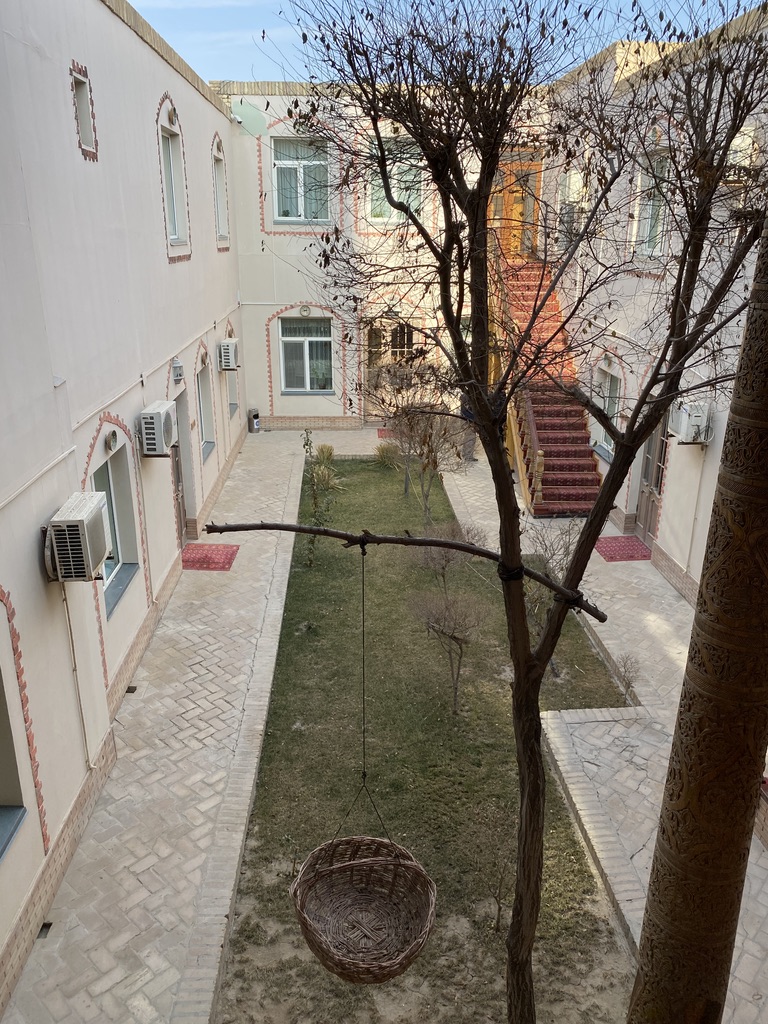
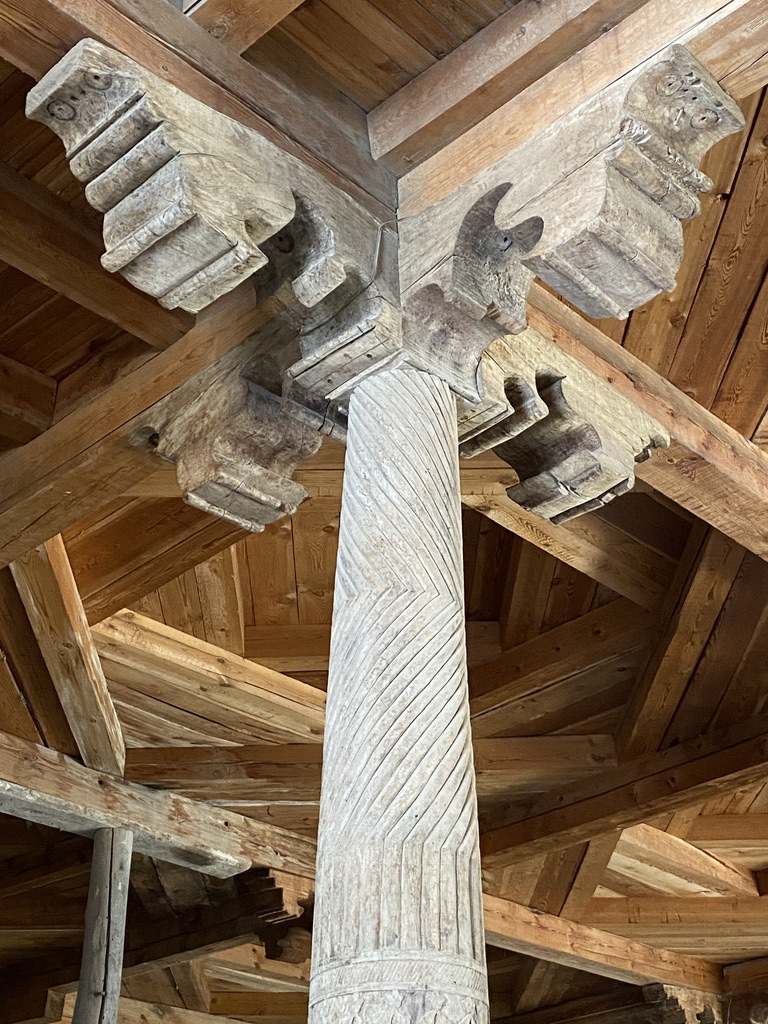
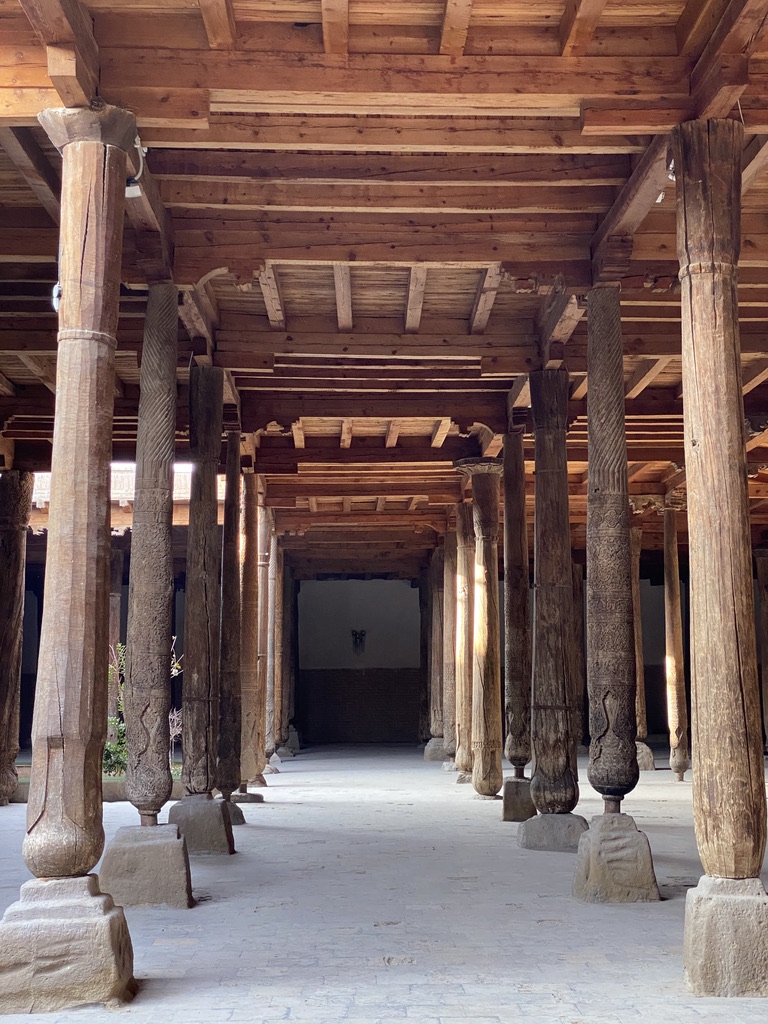
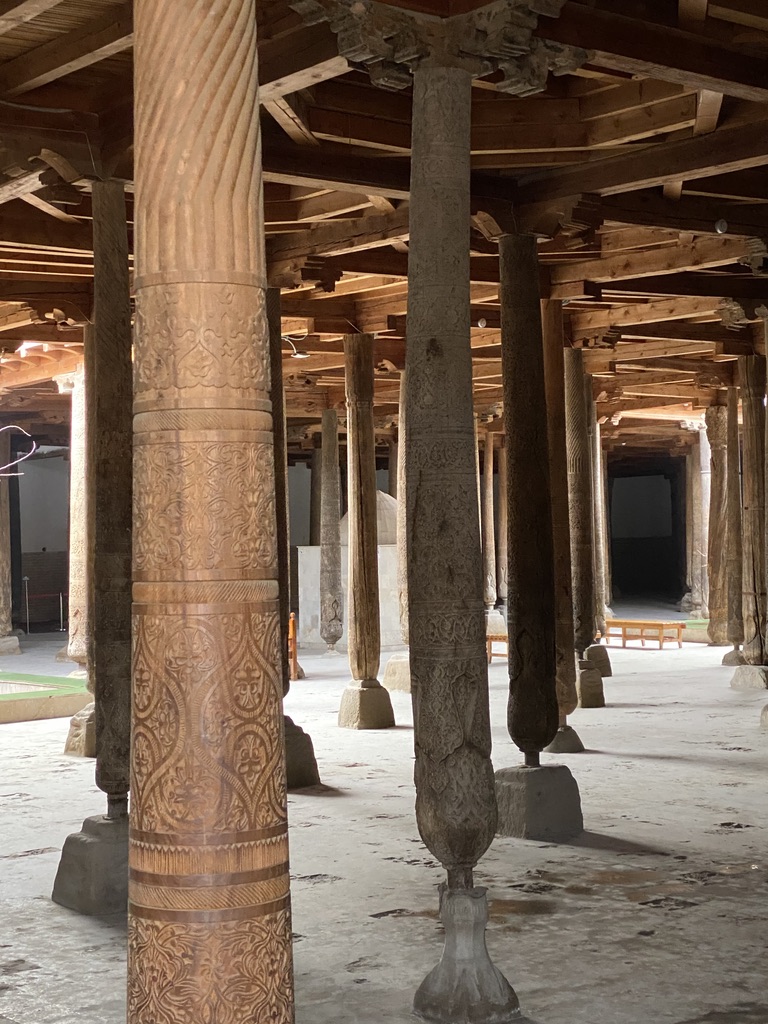
Decided to stay in room for a few hours this morning to do some work, ice my foot, and rest. It was probably a smart move as I felt more confident walking (and going up and down all those steep exterior stairs with uneven risers and some steps being about 12” high compared with our typical US step being 6” high). Anyway, we started at Djuma Mosque which is pretty amazing… with a roof supported by about 112 beautifully carved columns. The original mosque dates back to the 10th century, but the current building was reconstructed on top of that in the 1700s. It’s a wonderful space that gets interesting light and is very different from other mosques we have seen throughout Uzbekistan (and for that matter, in other countries). The space is filled with a huge number of carved columns, some of which came from the earlier structure. It’s super peaceful, dimly lit, and is a great respite from the bustling street on which it sits. Actually, you can imagine that these streets are probably quite busy in warm weather. It’s interesting to travel off season (which started when we were both in academia and the easiest time to be gone was over the Christmas holidays; summers would have been good on academic schedules, but too much was always going on in our offices during those months) because there are very few tourists and you do get a sense of real life activities in the more difficult time of the year, when produce and other goods are generally not too available. Not everyone would like this, but frankly, I really love it.
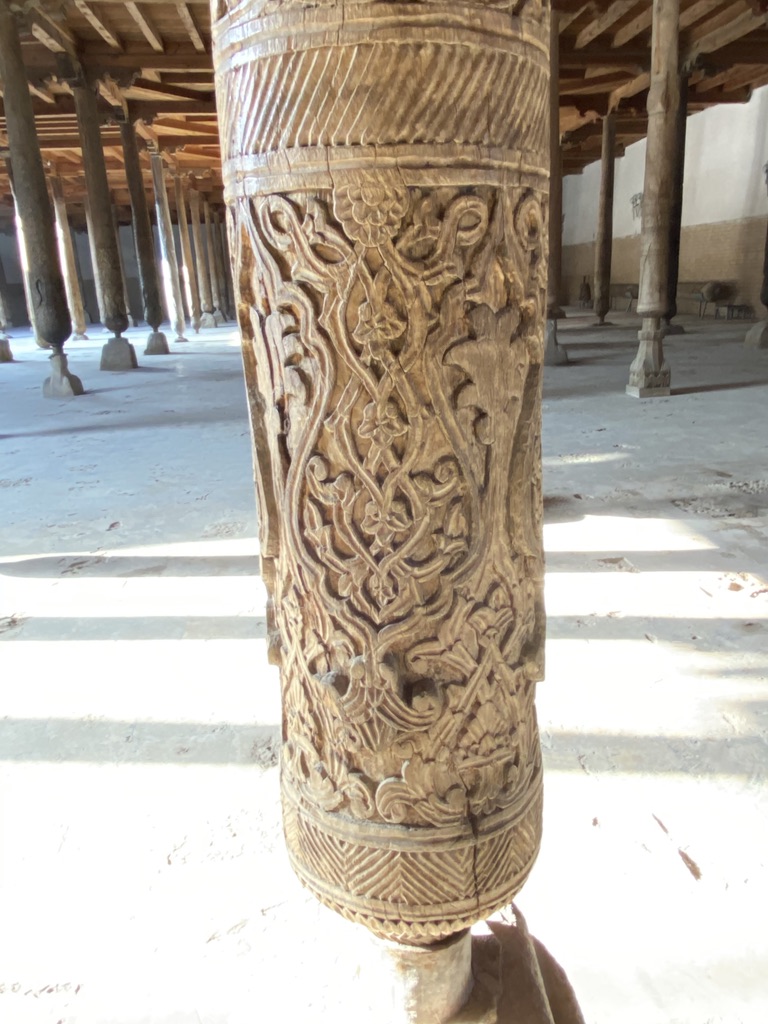
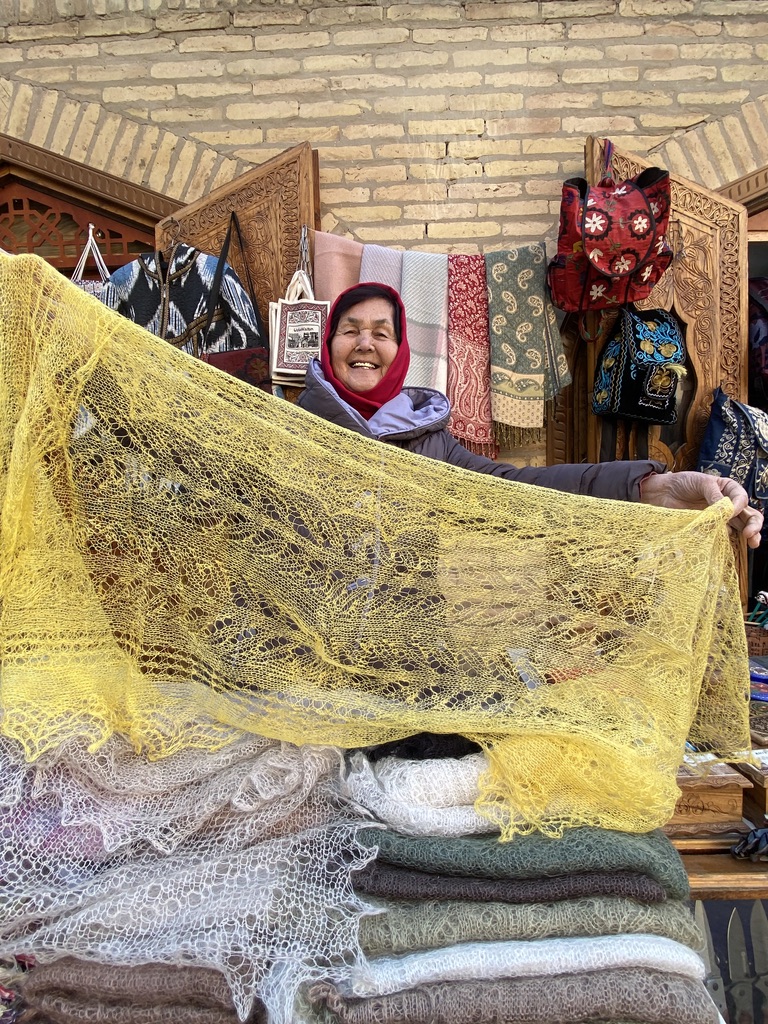
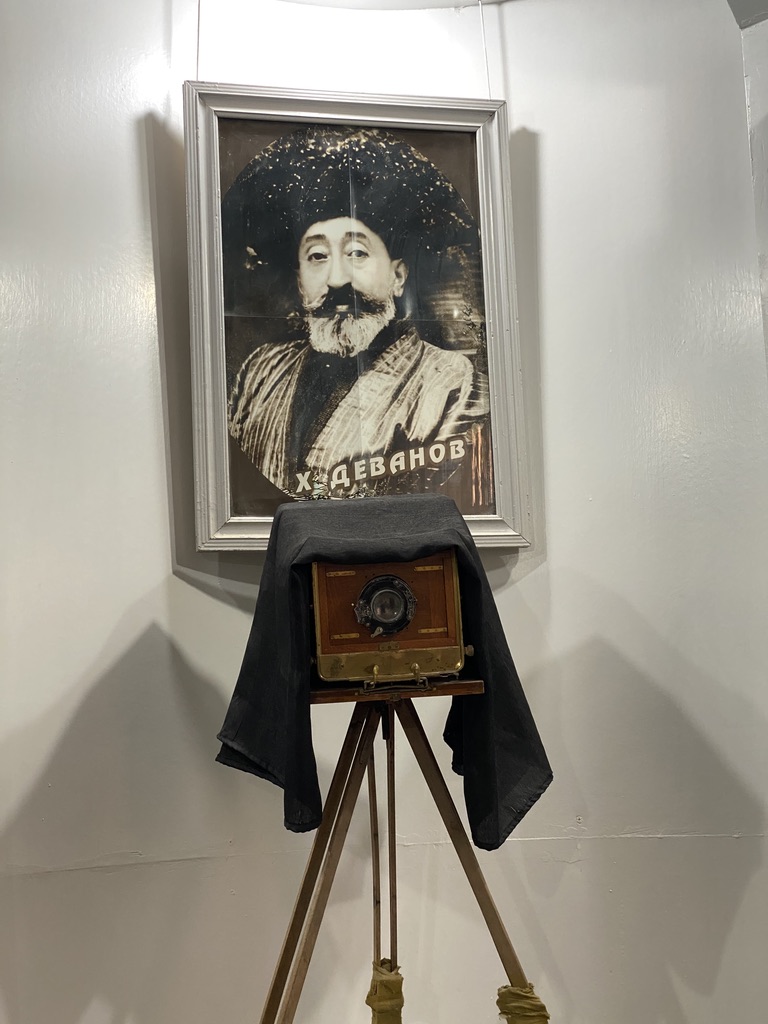
Anyway, we then strolled into a very old building (probably from the 16 or 1700s) that housed a permanent photo exhibit of images from the 1920s and 30s… Unfortunately, not very well exhibited or lit, but the images were interesting including some from the time of the Russian Revolution or shortly after. A great photo of a group was titled “The Intelligentsia” and another was of the Elected Farm Council.
We had a quick (well really nothing is quick here, so I should probably say light) late lunch – soup. Then we walked slowly to the other end of the Itcha Kala, where we will head again tomorrow to see Khiva’s big bazaar on the outside of the Itchan Kala, before we leave for the airport. After a brief stop at the hotel, we left for dinner.
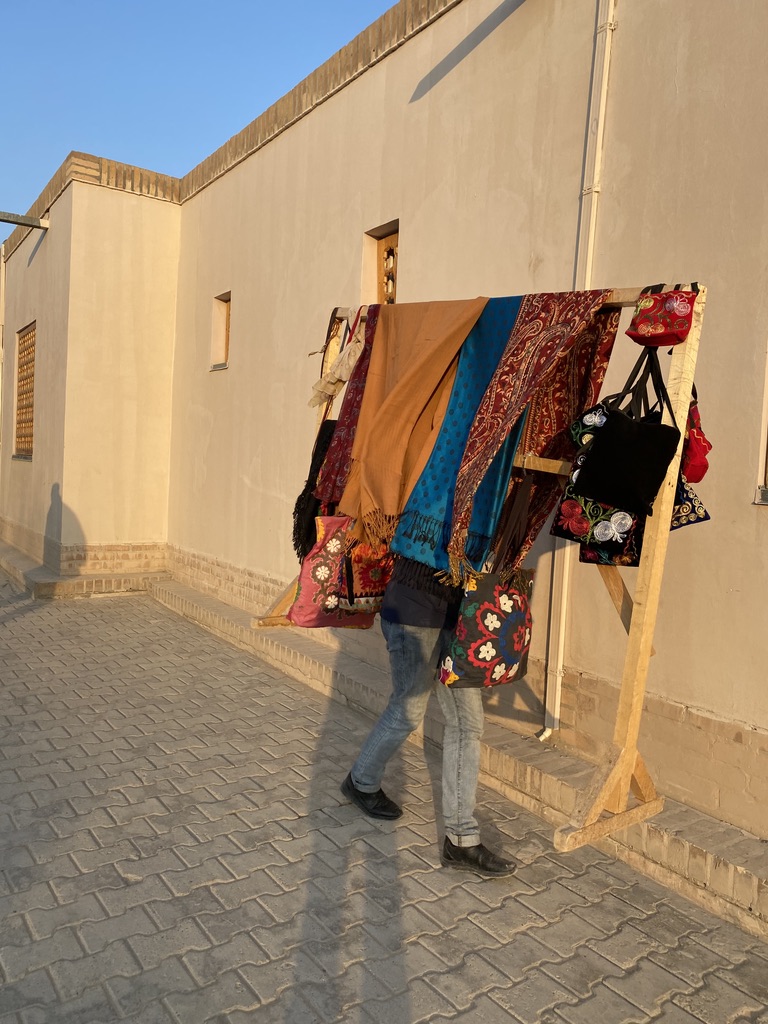
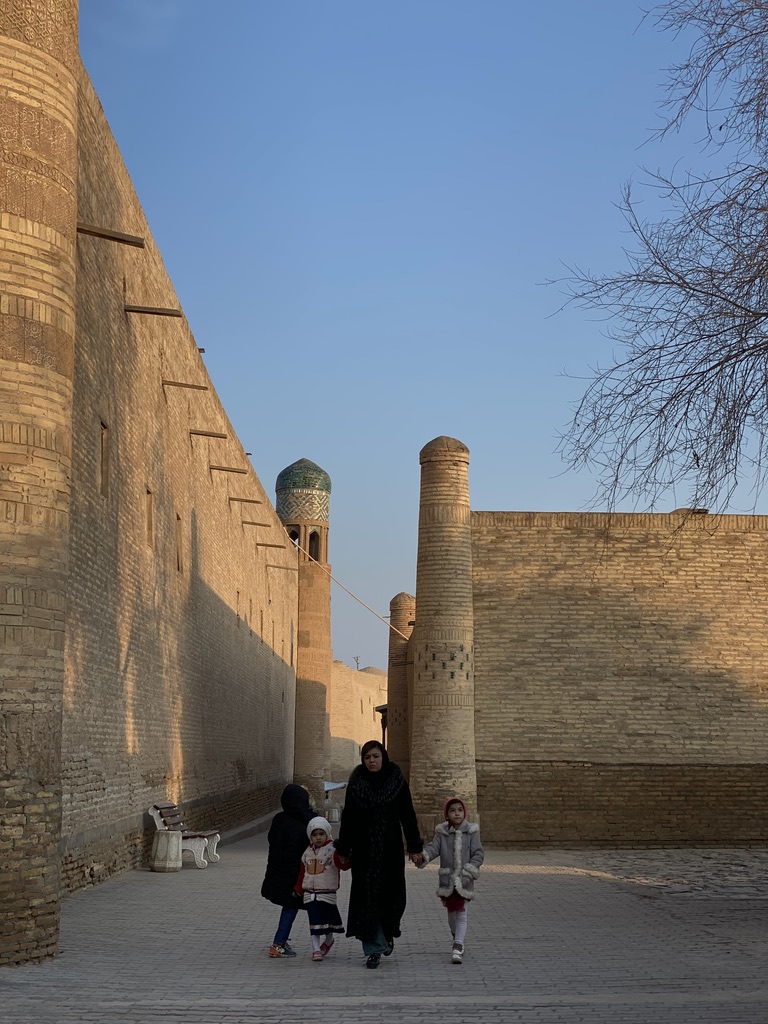
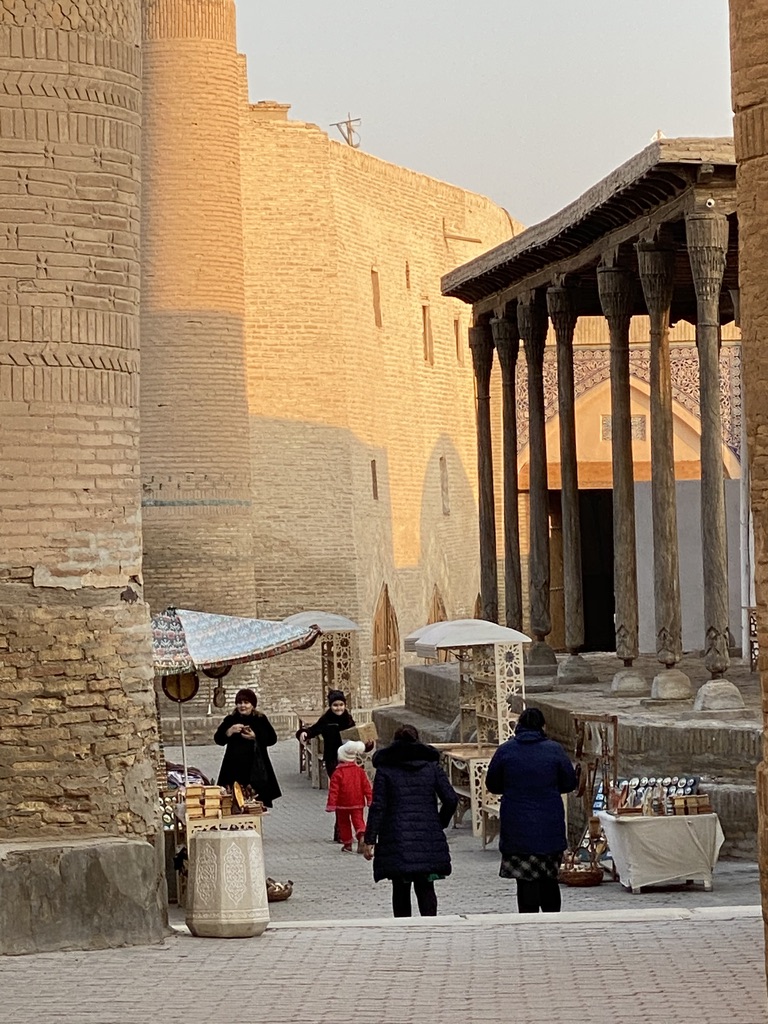
While in the room this morning I did a little research and called a few restaurants. One that sounded good was going to be closed at night because the cook (owner, perhaps) was going to a birthday celebration for her niece. Another was closed for the season; another was closing because they feared there wouldn’t be enough customers. But, I talked to one man whose English wasn’t very good and he turned over the phone to his son (??) I was told that they were not opening their restaurant but they often serve meals in their home which is adjacent to the restaurant (which is actually adjacent to a large mosque). I said we’d love to eat at their home, so the arrangements were made and shortly after that I got a series of WhatsApps asking what we wanted to eat, drink, and what time we’d come. He also described the location, which was very central and off the main walking street (so we knew it wasn’t down little alleyways with rocky paths.
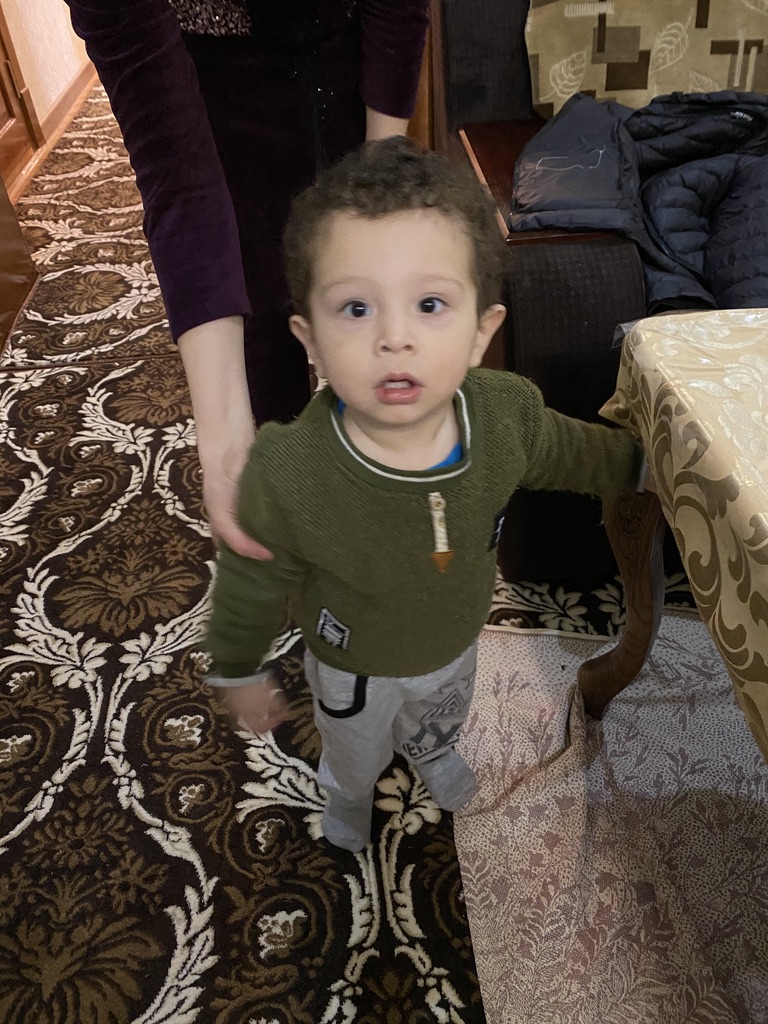
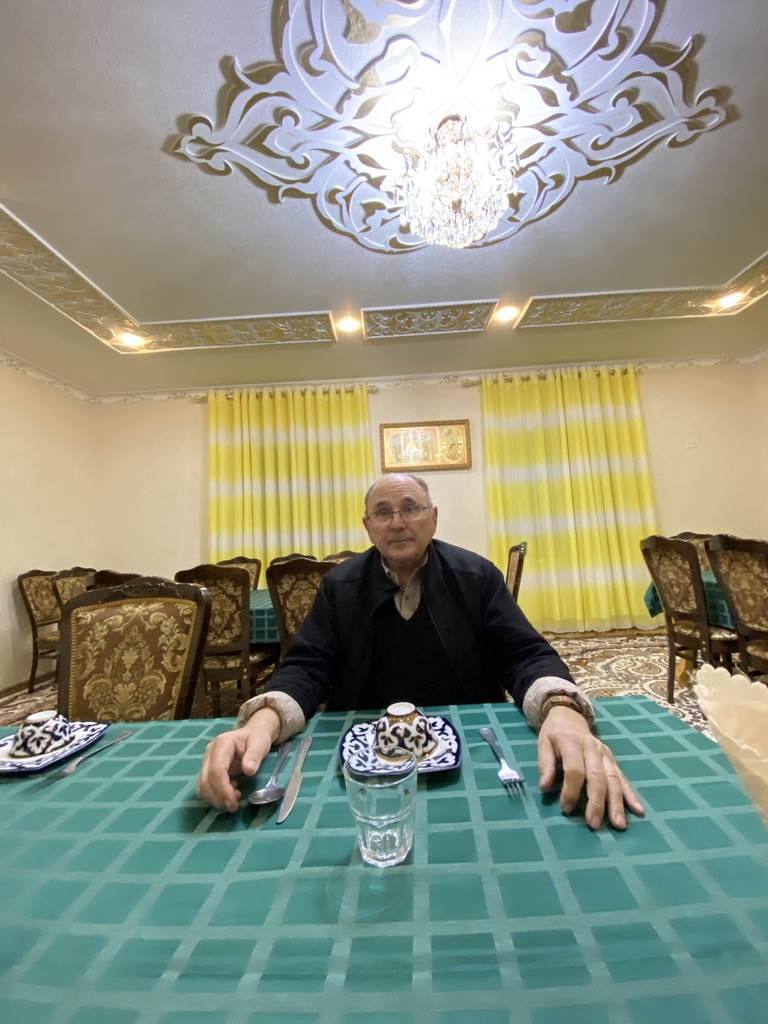
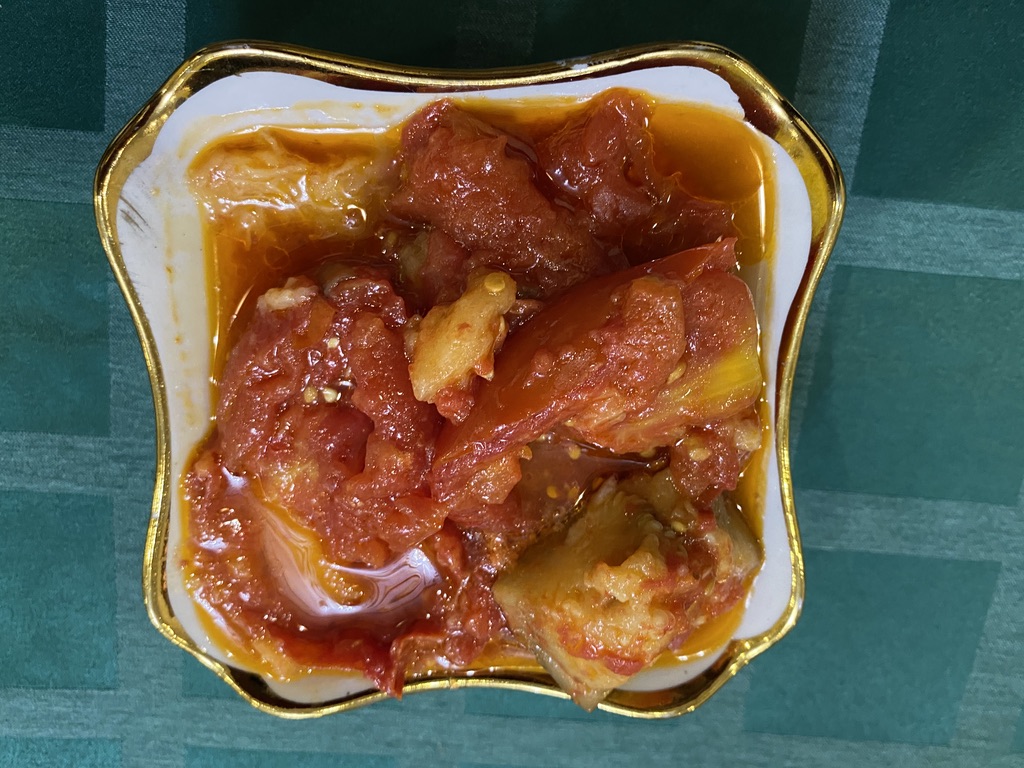
We left the hotel around 7 and arrived at the house. We were greeted by the son (?) and his wife and the restaurant worker.. and also two young children – a two year old rambunctious little boy and a very shy five year old girl. It’s a really big house which they use for a multitude of money-making ventures — quite entrepreneurial (which is apparently encouraged by the current government). They have a shop in front of the restaurant and they use the house as a bit of a hostel and also a small restaurant when the regular restaurant is closed. They can accommodate tour groups inside the house for meals as well.
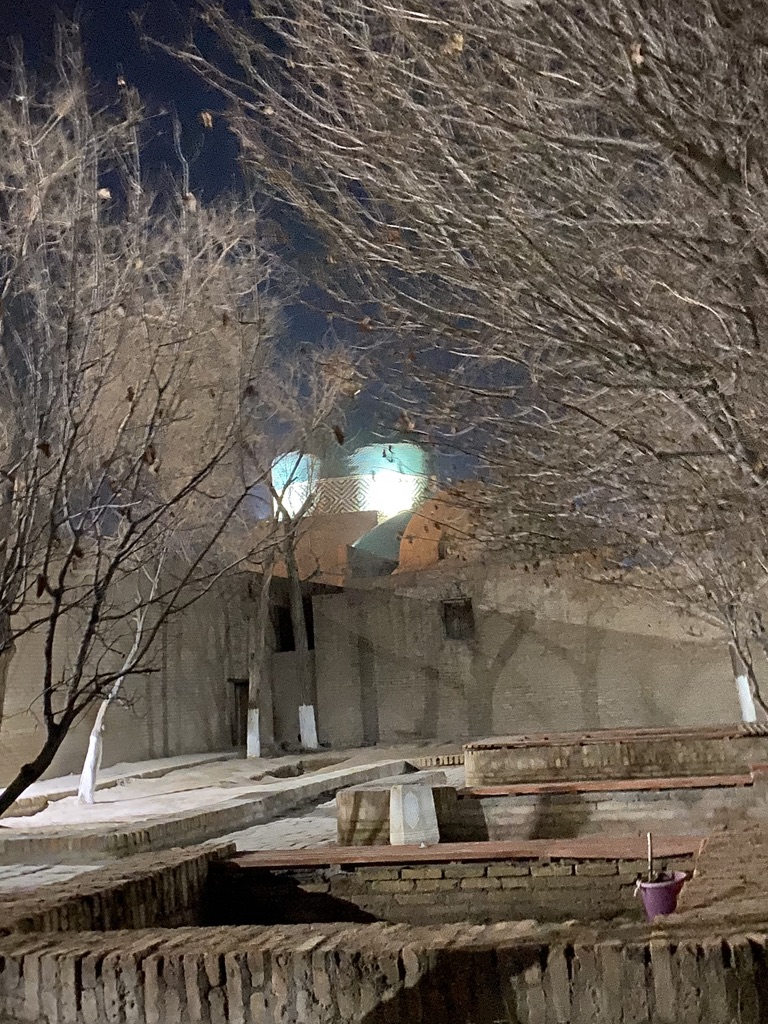
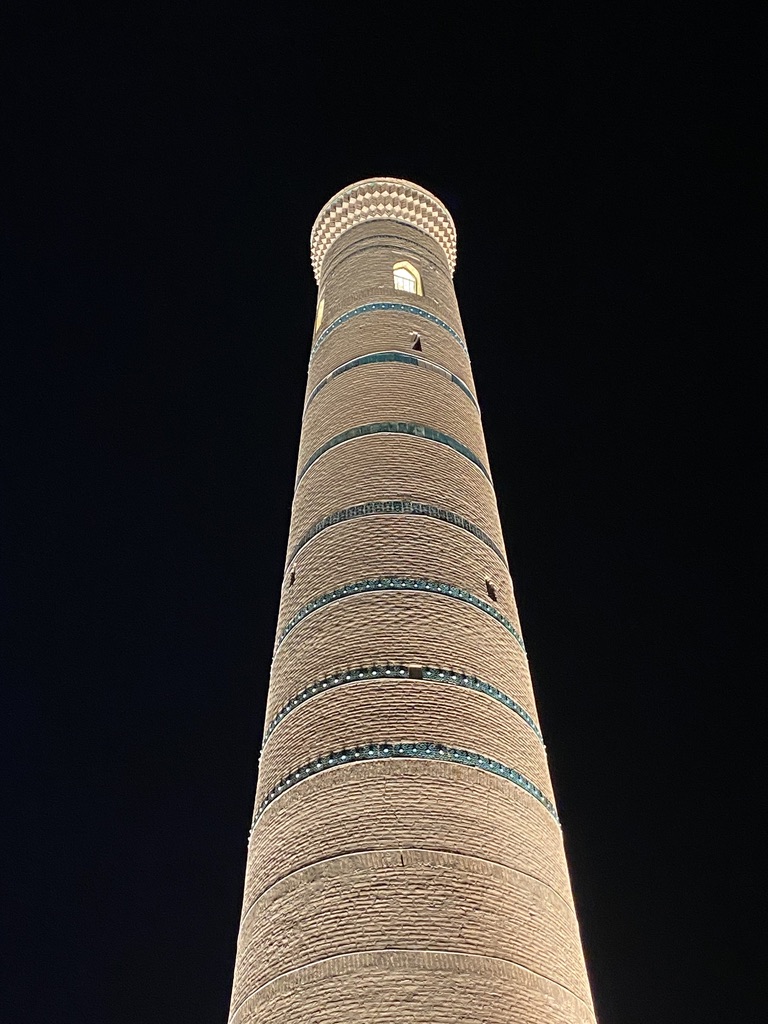
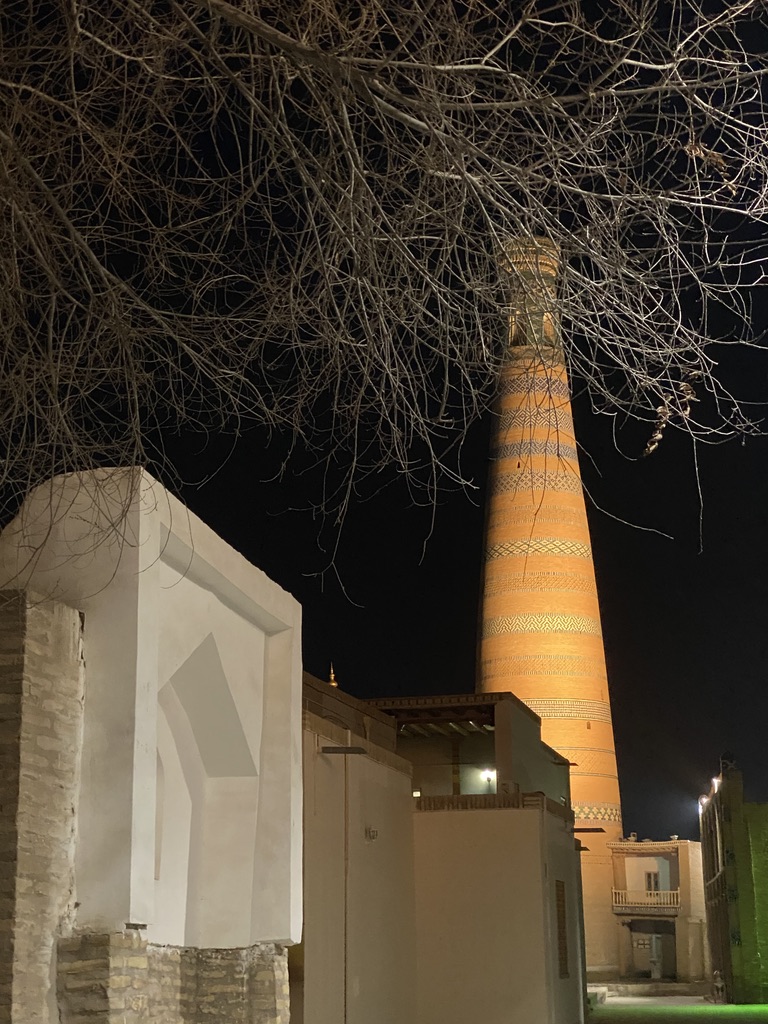
Anyway, I’m going to close down now… Tomorrow (Saturday) after the market we take a one-hour taxi to Urgench (where the airport is) to fly on a domestic flight (1.5 hours) to Tashkent to then navigate how to get to the international terminal to catch Turkish Air flight to Istanbul (5.5 hours) then 3 hour wait at Istanbul airport to get 3 hour Turkish Air flight to Baku, Azerbaijan – about 10.5 hours of flight time plus waiting/transfer time of about 6 additional hours.. for a distance that could be covered in about 2.5 hours if there was a direct flight from Urgench to Baku… But alas.. this will be our route.
More from Baku…
Best –
Fern
Khiva. January 10, 2020
Greetings from Khiva!
Following our very un-luxurious train ride from Bukhara (through the night), we arrived in Khiva yesterday (Thursday, January 9) at about 11 am and taxied to the hotel. After we settled in, showered (after that train ride), we decided to explore the city before it got dark.
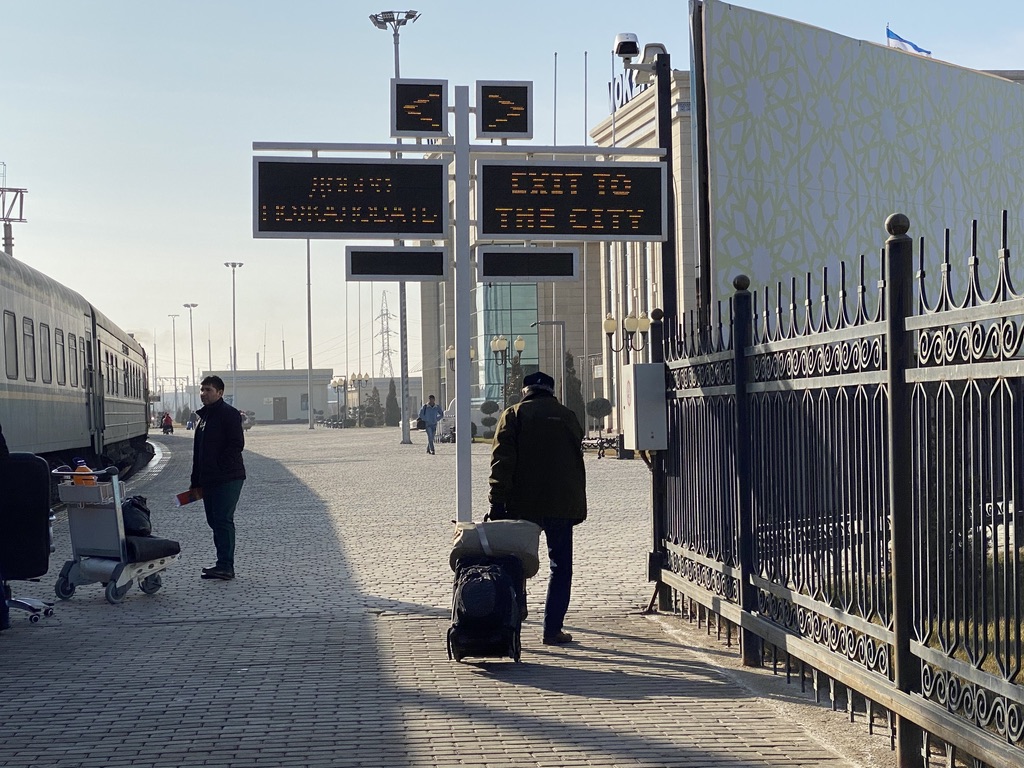
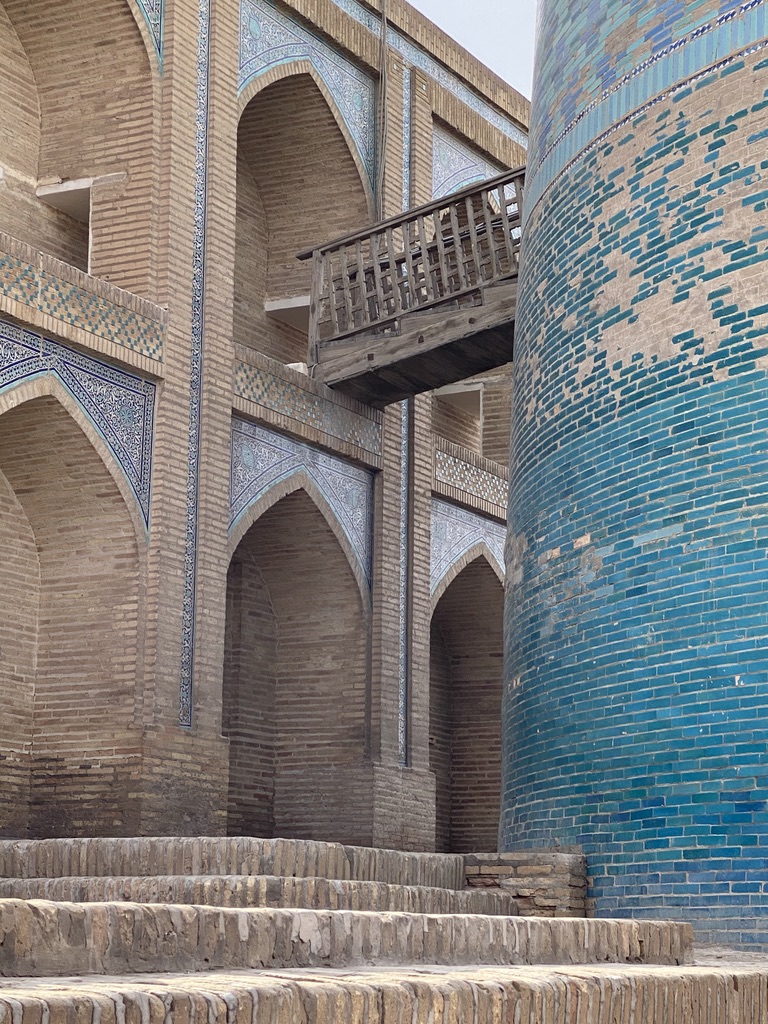
It’s a small city of about 90,000 people located on the western edge (toward the north) of the country… actually right on the border with Turkmenistan. There are really two parts to the city – an “outer town” that is known as Dichan Kala, and an “inner city” called Itchan Kala which is surrounded by ancient fortress walls made of brick, mud, straw, rammed earth… They say the foundations for these walls were laid in the 10th Century. Parts of the wall were redone in the late 1600s and are about 30 feet tall. There are literally scores of “towers” and minarets within the Itchan Kala (which is where we are staying and there is a very tall one that we can almost touch from our window). There is also a very large tower (far more squat than all the others which have a graceful and elegant base and rise to the top), called Kalta Minor – it’s a large blue tower very centrally located. Apparently it was supposed to be a minaret (probably intended to be taller than most of the others, as one can judge from the width of the base. But the Khan who had “commissioned” it died well before it was completed and the next Khan decided to leave it be…
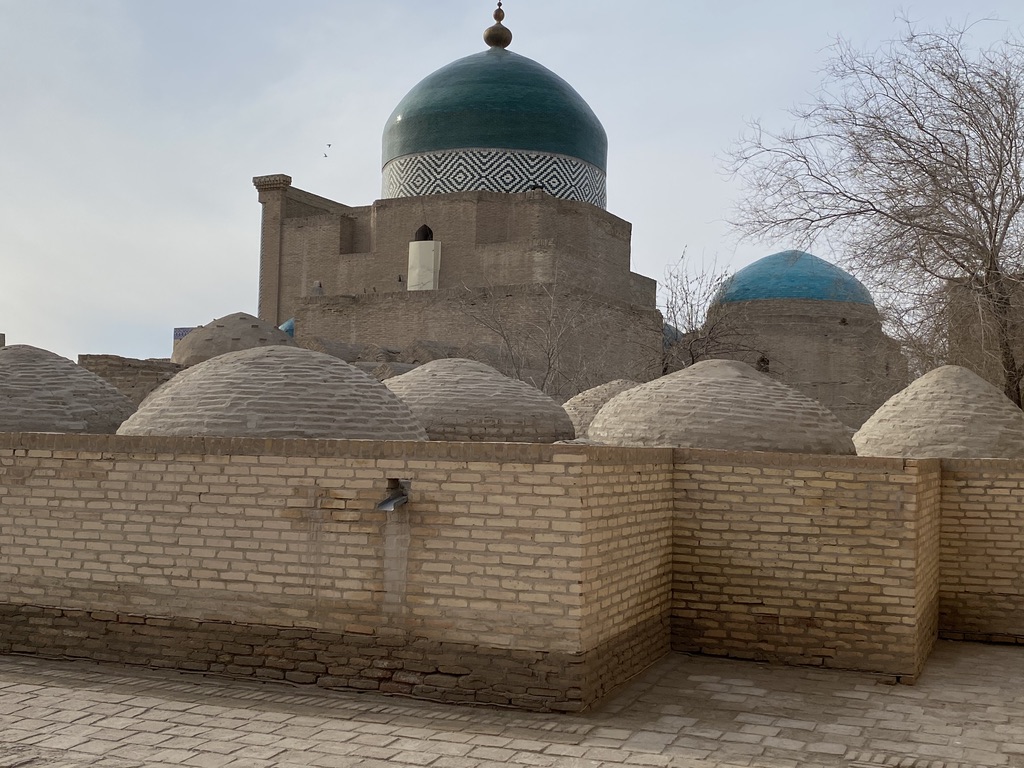
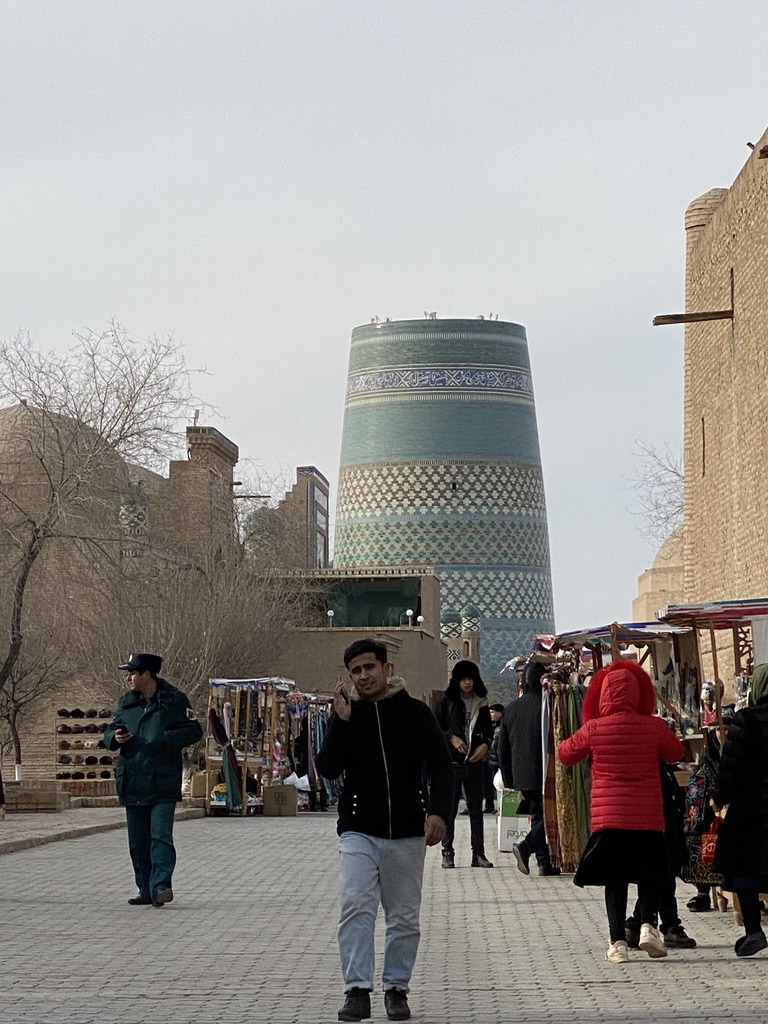
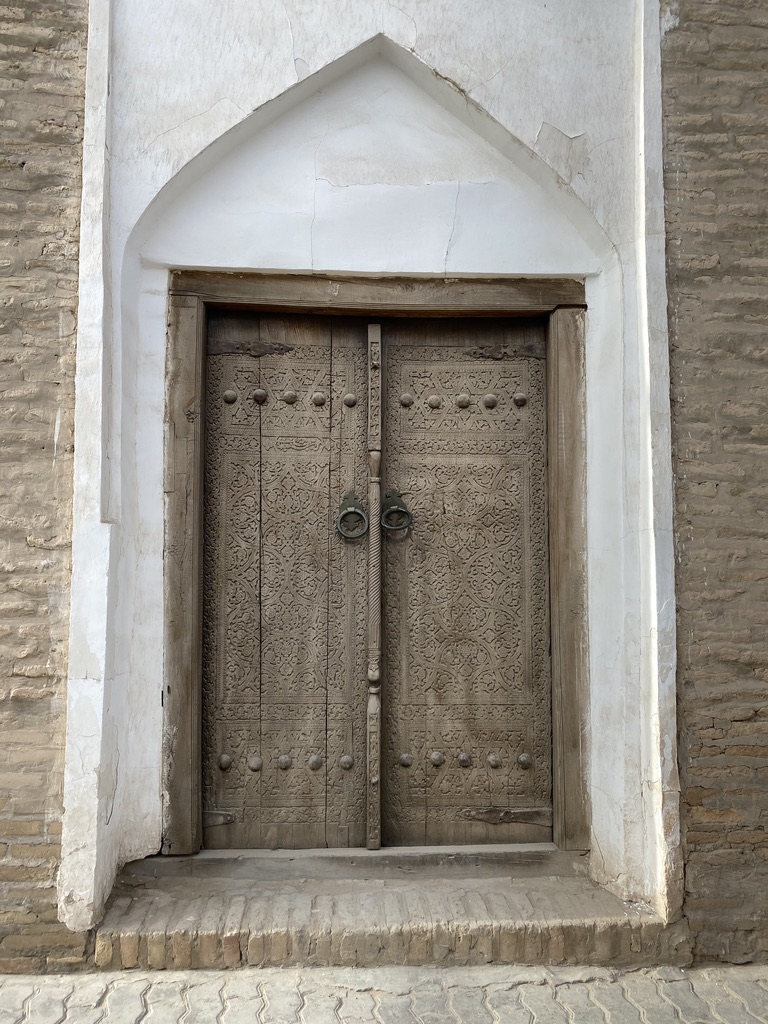
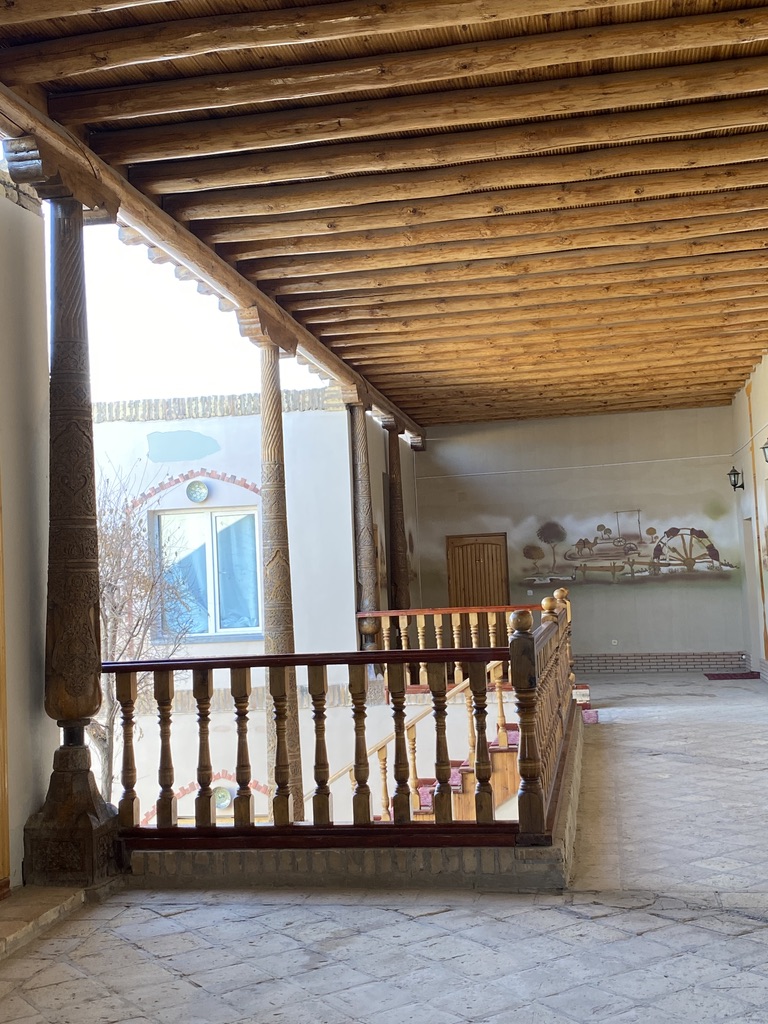
There are about 300 families who live in mostly mud and dry bale type houses throughout the inner part of the city, within the Itchan Kala. One of the most fascinating buildings we encountered in our walk yesterday was the Dhjuma Mosque from the 10th Century (and rebuilt in the 1700s… using 112 columns that were retained from the original structure. All over these ancient cities and towns there is construction and reconstruction going on as efforts are made to shore up existing ancient structures and everywhere you can see settling of the structures with many leaning or bowing. Remember, no rebar or steel in the construction. The techniques to do this are interesting.


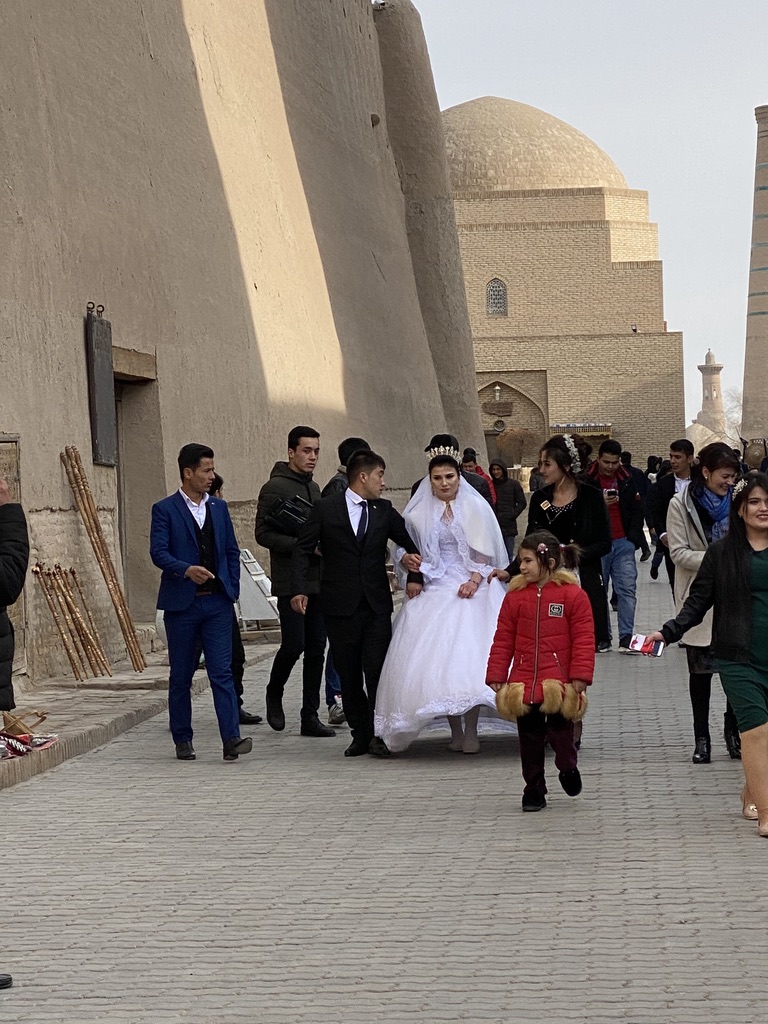
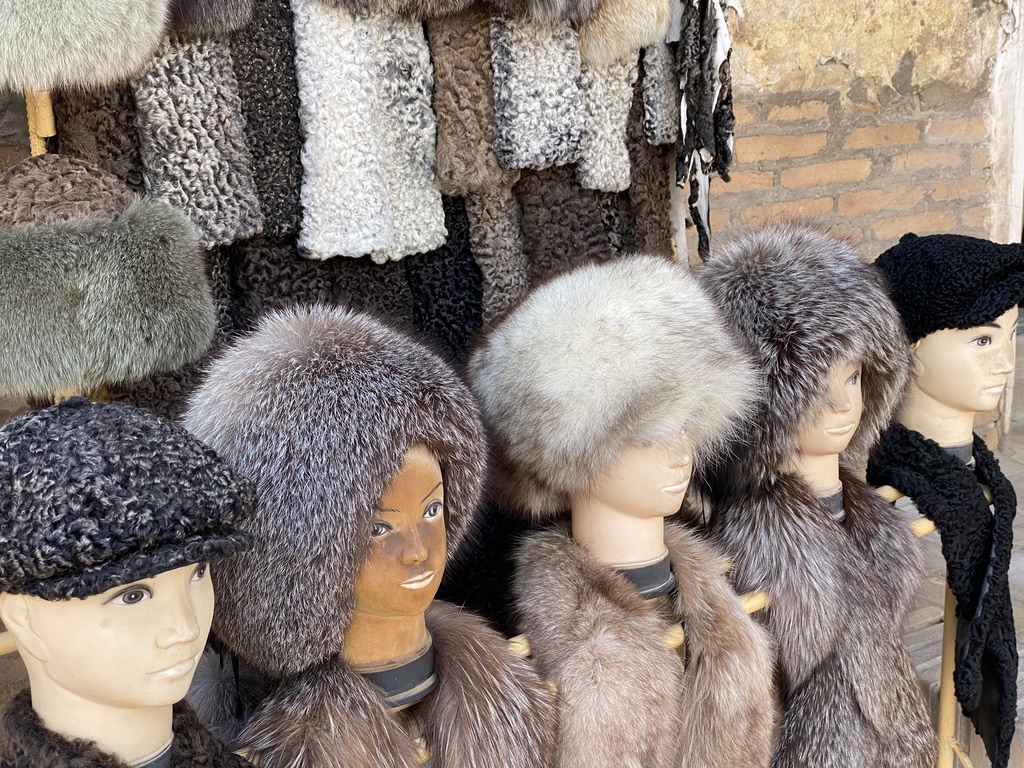
As we strolled we encountered two weddings.. The bride and groom and their entourages seem to take a ceremonial walk through the old city with photographers and family surrounding them. The brides wear totally extravagant full length, white puffy dresses with lots of layers and probably hoops under the skirts. Dresses are modest with high necks and full-length coverings on the arms… The brides are very made up with hair piled high on their heads. Anyway, I chased the two brides to get a few photographs which was not easy. Maybe I’ll see more tomorrow. As they leave the gates of the old city, the bride (maybe with her mother?) gets into a car and drives off – perhaps for a big lunch.
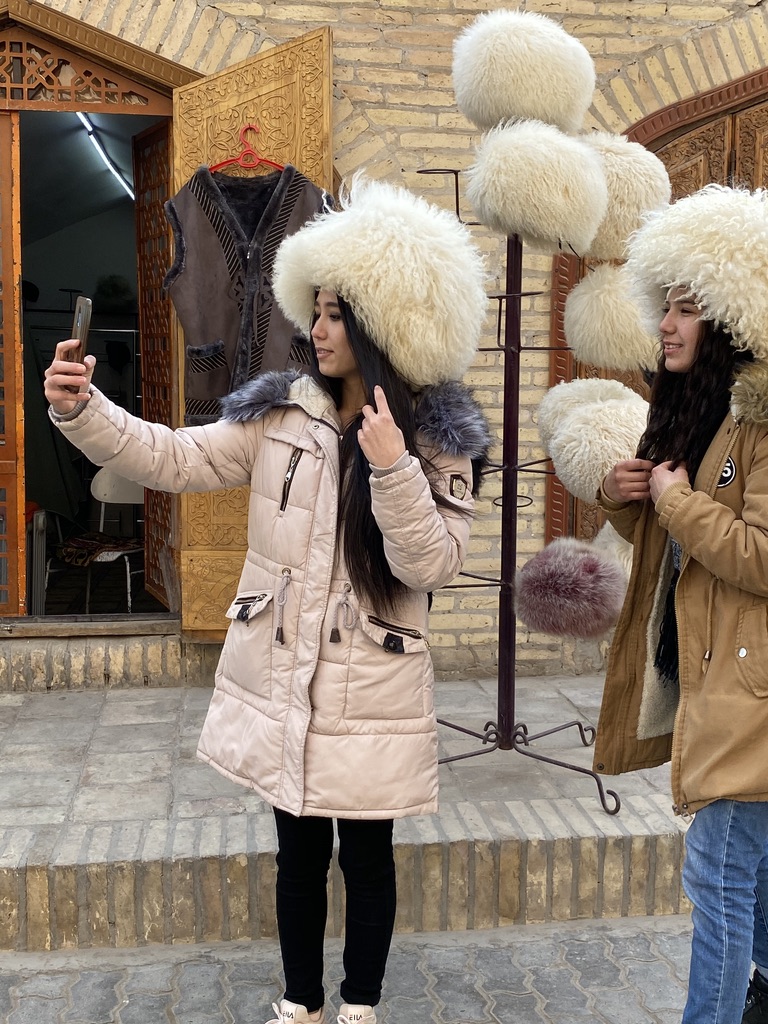
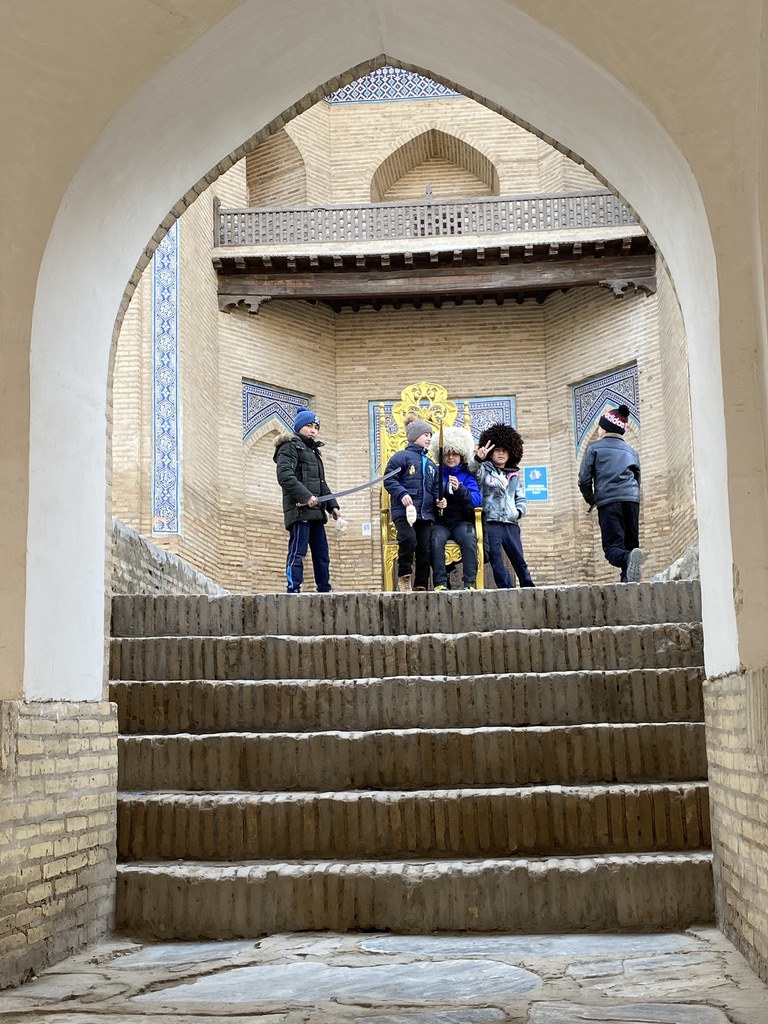

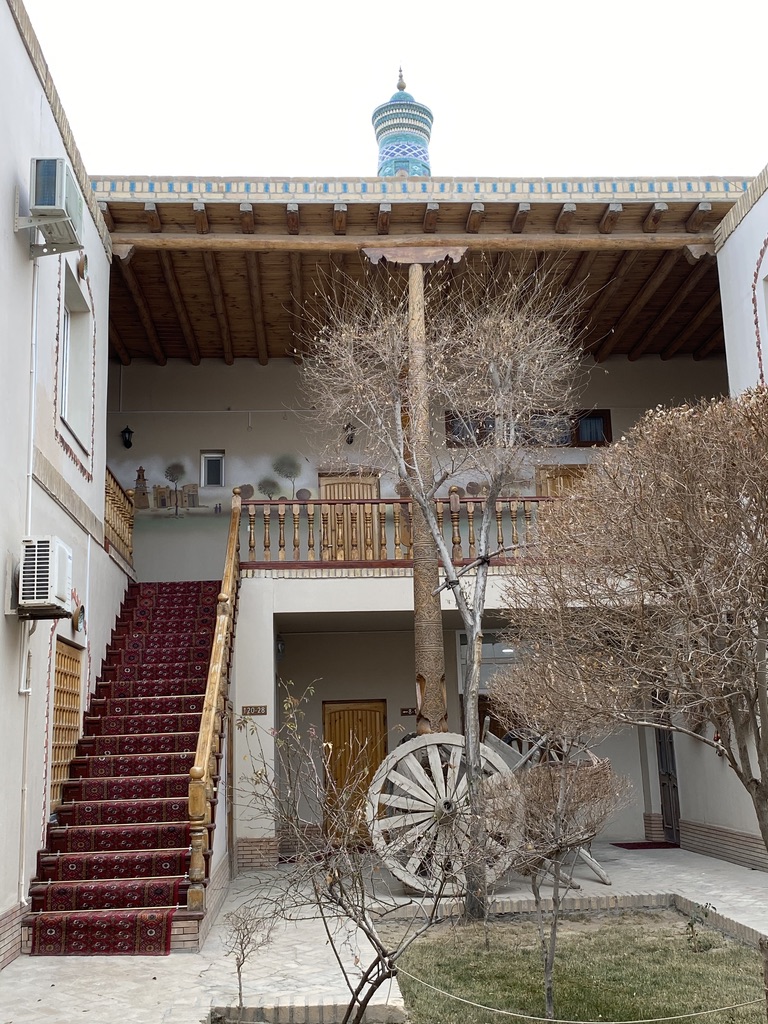
We had had lunch at our hotel, and thus decided quickly not to have dinner there… So, we asked the front desk guy who speaks some English to suggest restaurants. He said many would be closed due to the weather and winter season. But he told us that the “Terrace Restaurant” was open. We trekked in the totally dark “streets” that were very difficult to navigate given the uneven stones, unpaved, mostly dirt that was not level…. Took us about 10 minutes to do the supposed 4-minute walk. Naturally when we got there, the restaurant was closed. So we meandered back to the hotel to have dinner which was not too good. I had the famous Khiva green (dill) noodles which was edible.. Mike had some kind of beef which he likened to shoe leather with limp French fries. So much for that meal.
Anyway, during the night my foot really began to hurt. I must have moved in a funny way that pulled the ankle. The hotel couldn’t make ice for me last night.. I think they forgot and then when I asked for it, the water had not frozen. So it was a tough night, with lots of consideration given to skipping Baku and heading straight home Saturday.. or possibly getting off plane in Istanbul (where we would need to change planes for Baku) and spending a night or two and then getting flight to SFO on Monday, cutting the trip short. The stop in Istanbul would make the flight a little less strenuous. But as morning came and I got up and navigated the stairs down for breakfast.. I decided that I could ice my foot and stay in the room for a few hours while Mike explored… and then I’d be ready to go. So right now the plan is to stick with the original program. I’m just about ready to explore more of Khiva now.
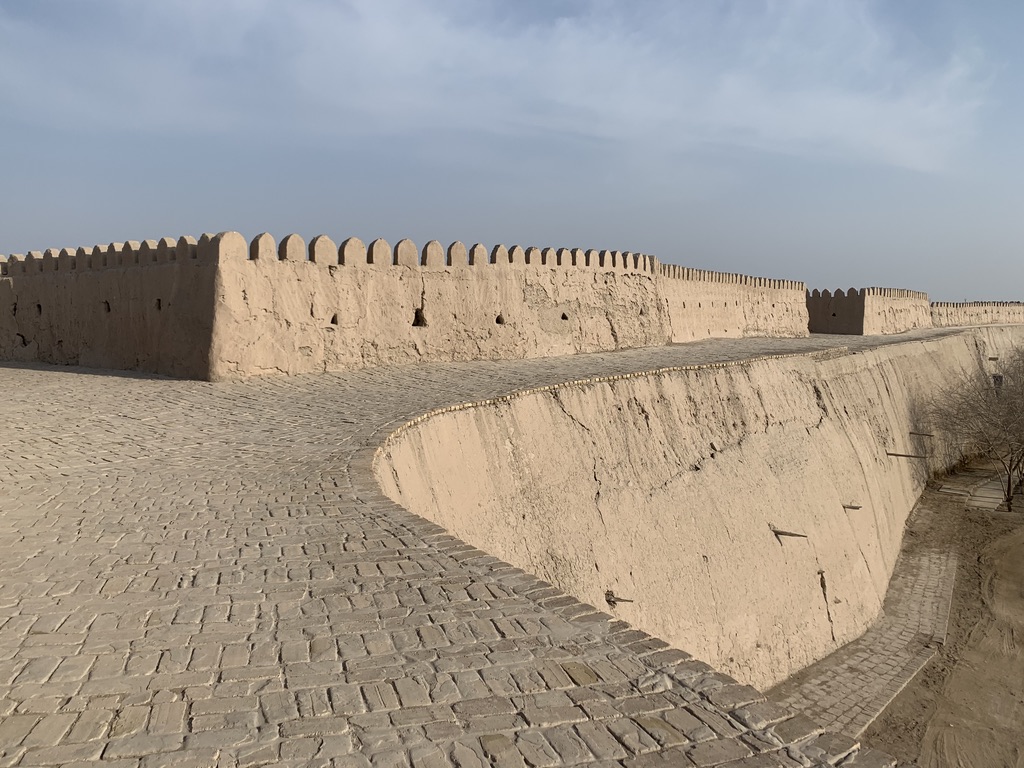

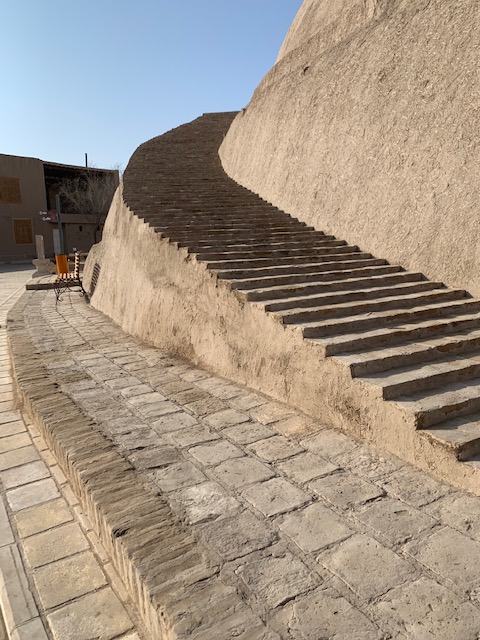
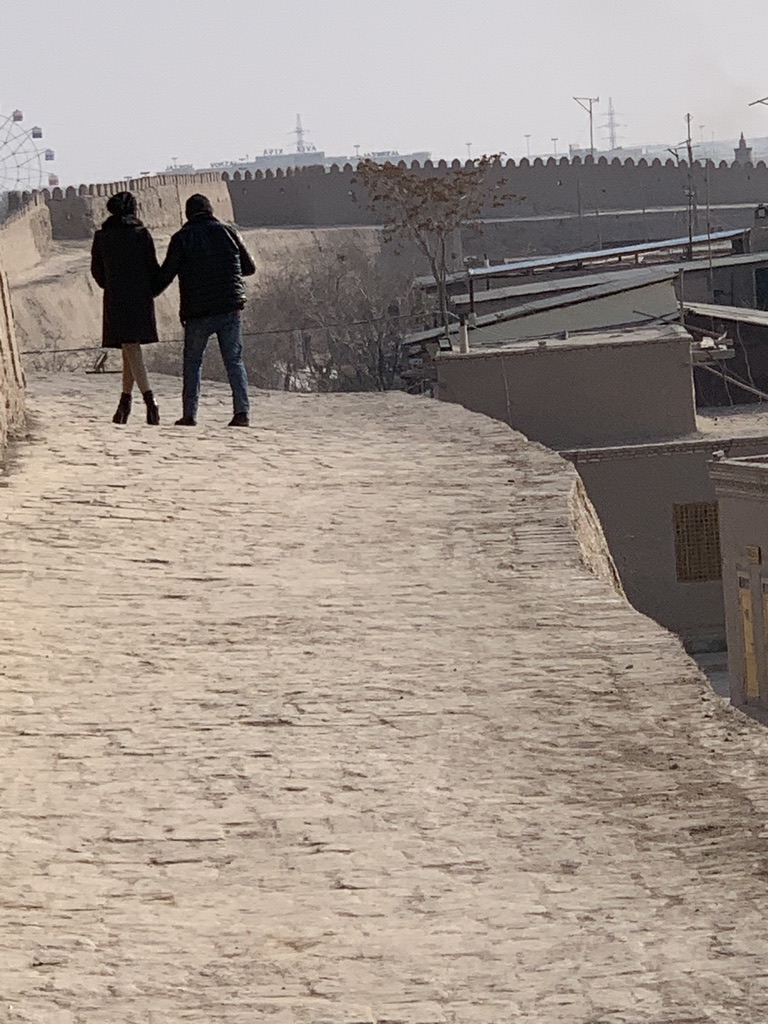
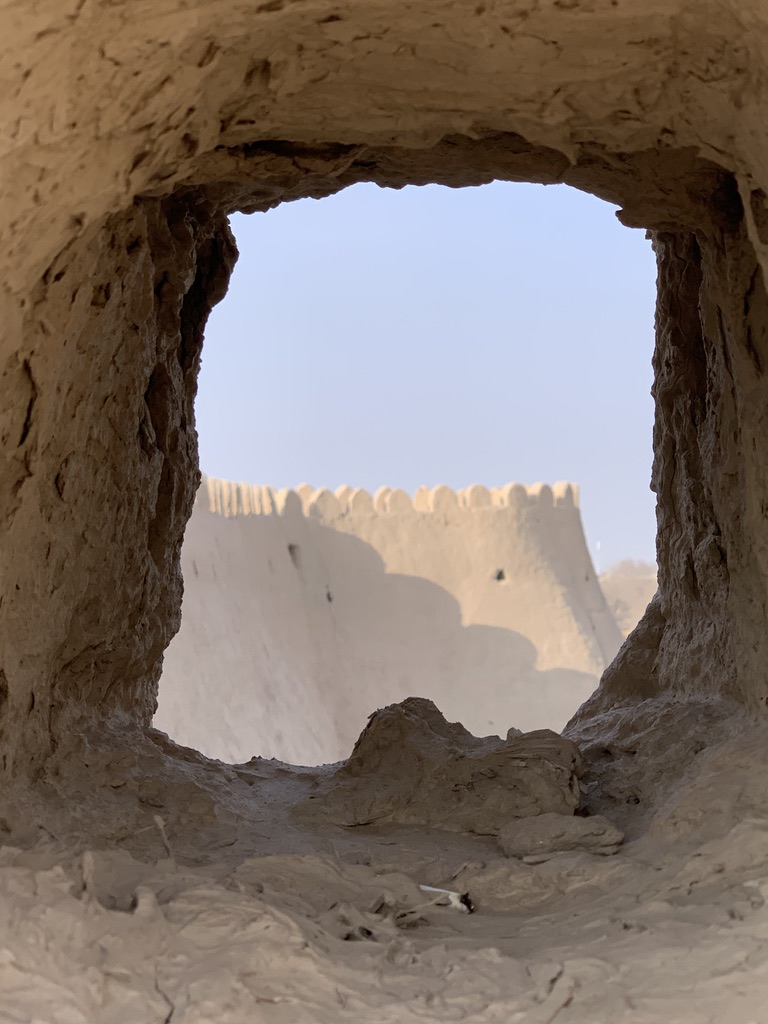
Based on the above… the photos attached that show the wall and the path along the top of the wall of the city are from Mike. Frankly, even with two well-functioning feet, I’m not sure I would have ventured the path along the top that is pretty narrow and without any rail… I have a slight fear of heights. I might have done it, but been uncomfortable.
Cheers.. More later.
Fern
The TRAIN (OMG) from Bukhara to Khiva
First a clarification.. In the previous email I said something about 20% of salaries being above the median… What I meant to say was that 20% of professionals earn considerably more than the median amount. Hope that’s clearer.
Just a very short note to let you know we made it to Khiva….. but what a trip.
First of all, we had to leave the hotel at 2:30 am to get to the station – which turns out to be quite a distance from the old city. The taxi took about 25 minutes. And while it seemed as if our luggage was compact and easy to trolley in typical airport settings, it’s actually been challenging on the very uneven, cobblestone streets with very frequent potholes, mud, and other obstructions. And add to that the fact that the stairs from the second floor of any of these old hotels with dark, unlit exterior stairs (with very uneven and often high risers) would be difficult and challenging at any time, but my bum ankle made it extraordinarily challenging. Anyway we taxied to the station which was expectedly barren. No one spoke any English, but we kept showing our tickets and guards and train personnel pointed to where we needed to go.
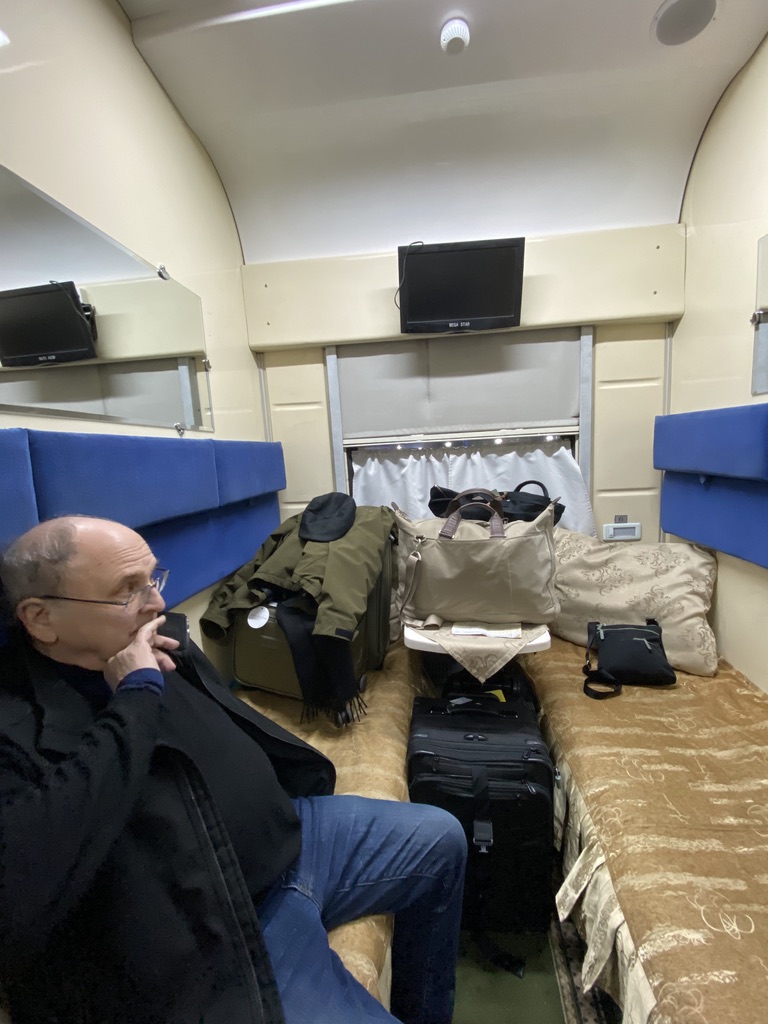
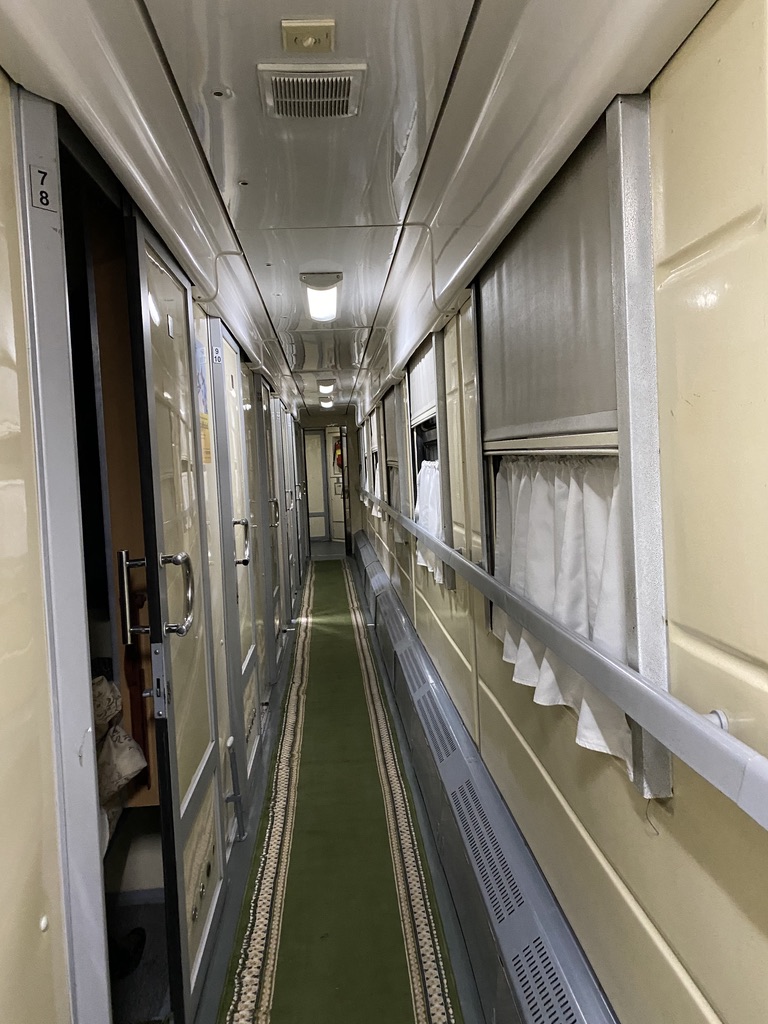
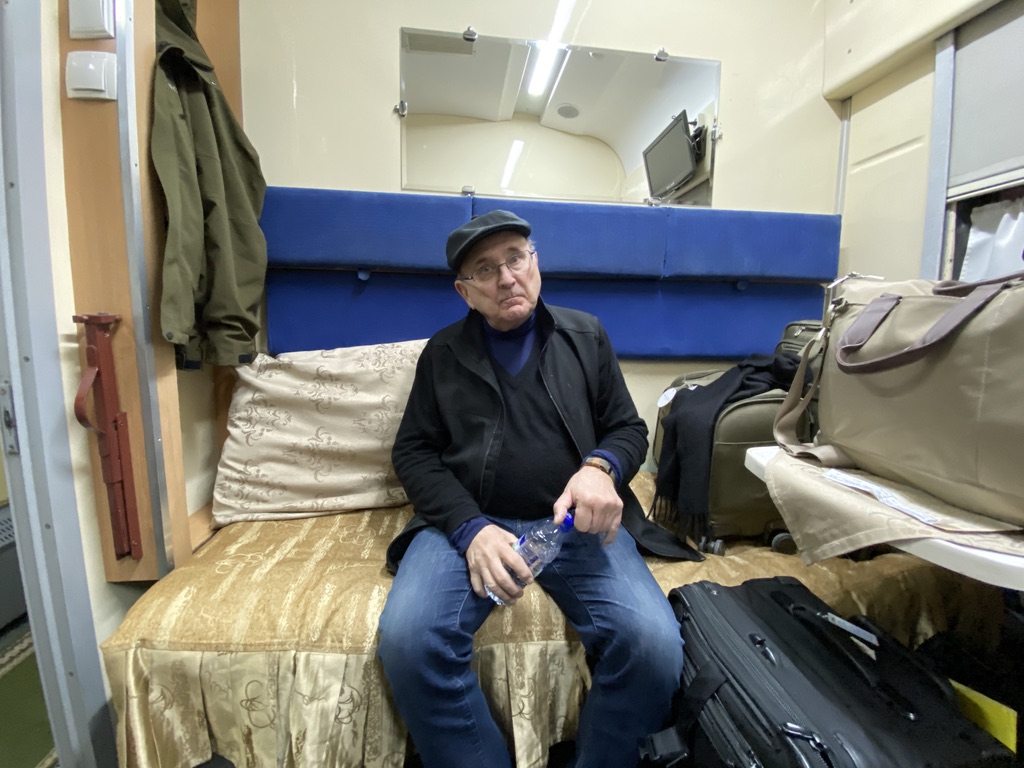
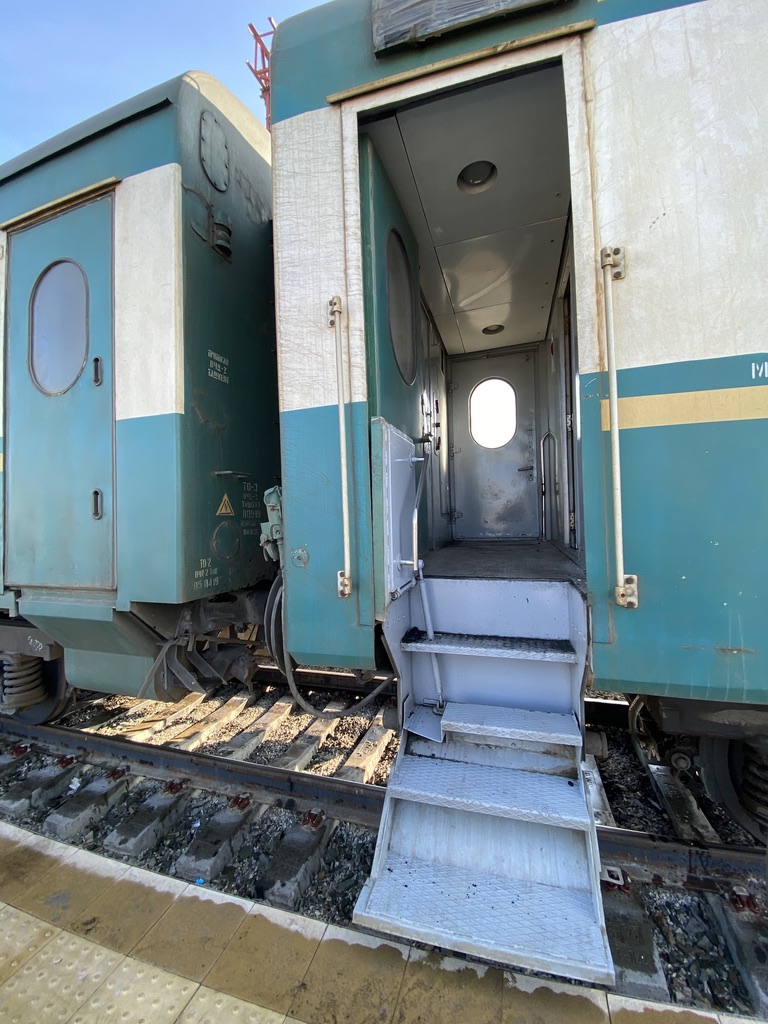
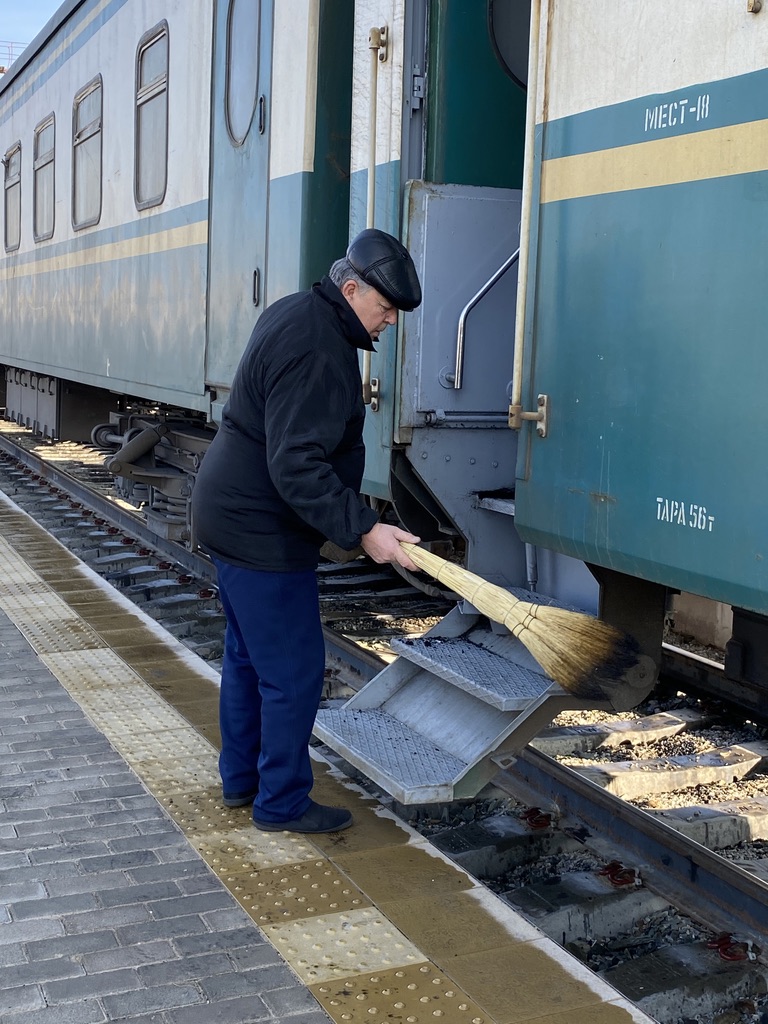
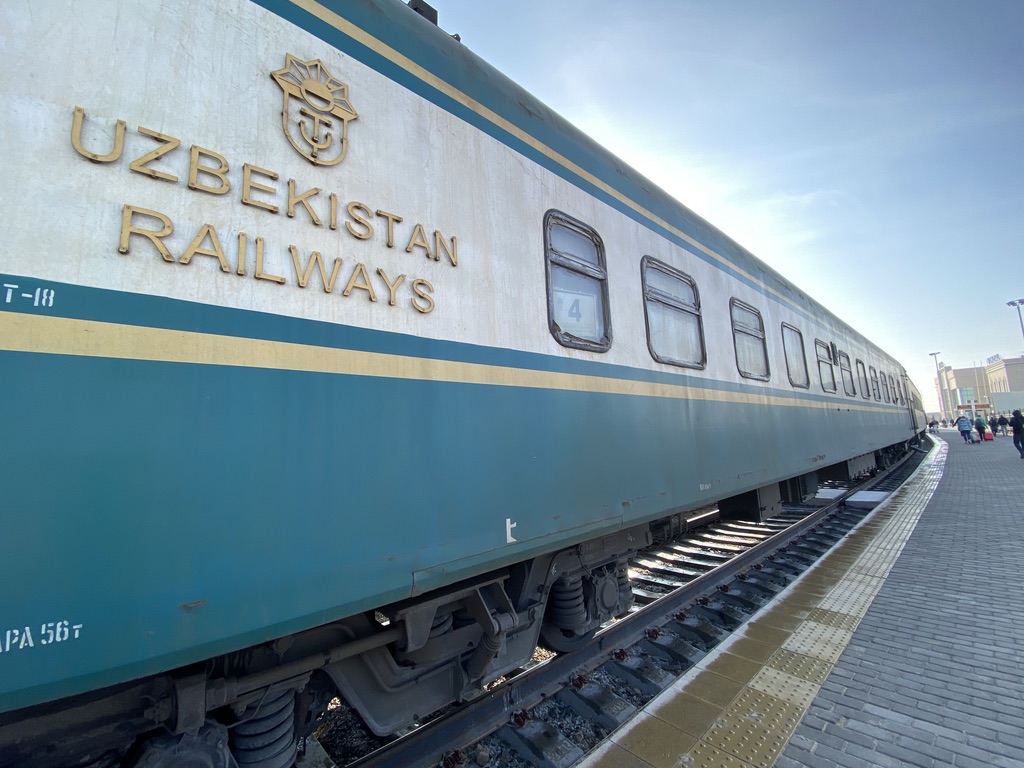
After leaving the waiting area, we trekked along the tracks and then had to cross over the closest track to get to the farther track… which meant going down a very deep step to cross over some wooden slats that covered the tracks temporarily and then climbing up a very high “step” to get to the “back” platform. Then we could see our train… a rather old and dusty train – 1950s vintage, I’d say. We could see a crude sheet of paper taped to the window of one car that said “4” which was what our ticket said – for our first class cabin!! I’ve taken pretty bleak trains in Romania and in Tibet… but this one took the prize. We managed to find our “cabin” which had two beds – more like covered pieces of plywood. Our baggage filled most of the cabin. Unlike the Tibet train, where there were four beds (bunk beds) where we could put the luggage on the upper beds… this just had the two beds so we had to put luggage between these beds. There were several switches on the wall.. but only one worked – turning the overhead light on and off. There appeared to be night lights, but they didn’t work.
While we didn’t sleep, we did lie down keeping our coats on the whole time. There might have been a dining car, but no one told us that (In Tibet they shoved a piece of paper under our door with pictures of food so we figured out there was a dining car). Anyway, it was “only” a 7-hour ride. The train only made about four stops… and the view out the window (which wasn’t too clean) was pretty bleak. I don’t think there were any other foreigners on the train. Most tourists get to Khiva by either flying from Tashkent or by renting a driver.. or else they must be part of tour groups that have vans or buses.
It was an experience.. We were happy to arrive in Khiva which from what we can see is a beautiful small city … and a UNESCO Heritage Site. We found a taxi at the station and it took a bit of maneuvering for him to find our hotel. There are two Malika hotels in Khiva.. One is called Malika Khiva and the other Malika Kheiviat. We are at the latter and the taxi driver seemed to only know the other one. But I was able to find the right one on my phone and the driver called the hotel for directions. Complicated since we are staying inside the Ichan Kala… right in the center of the old city.
Tomorrow I’ll post about Khiva… For now, the experience of the train was sufficient.
Best –
Fern
PLUS
Several people asked for a photo of the inside of the “cabin” on the train. Thought I had included it, but here it is…
Last Day in Bukhara; prep for 4 a.m. train to Khiva
Final Greetings from Bukhara on a positively beautiful blue sky.. cold but wonderful.
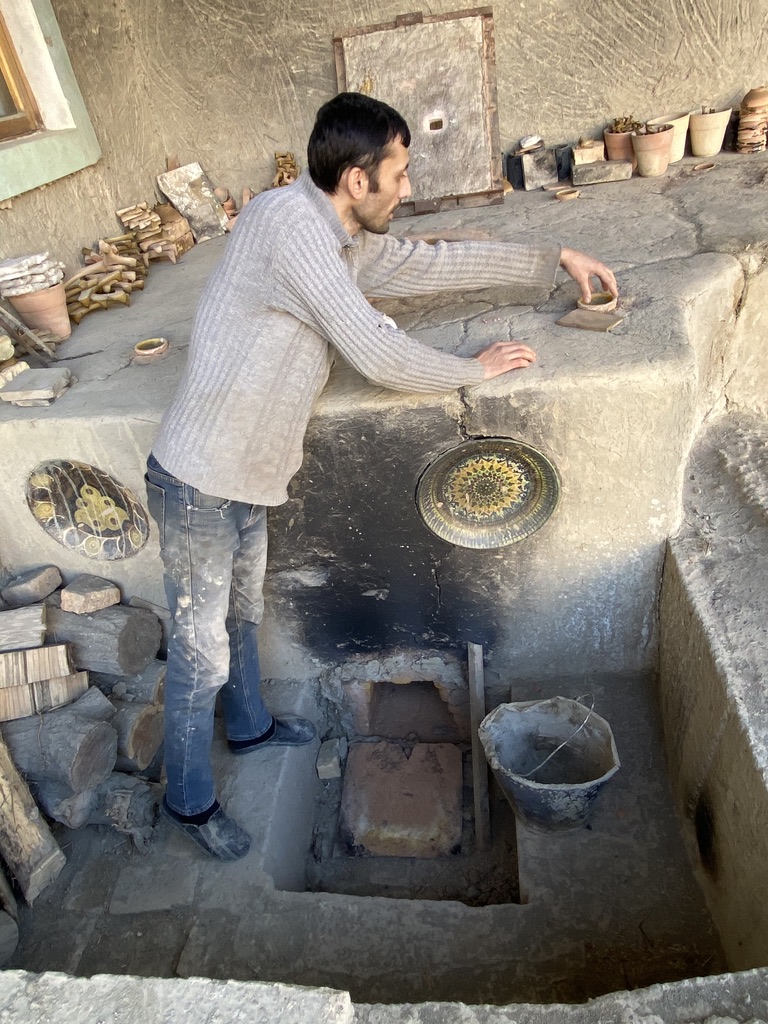
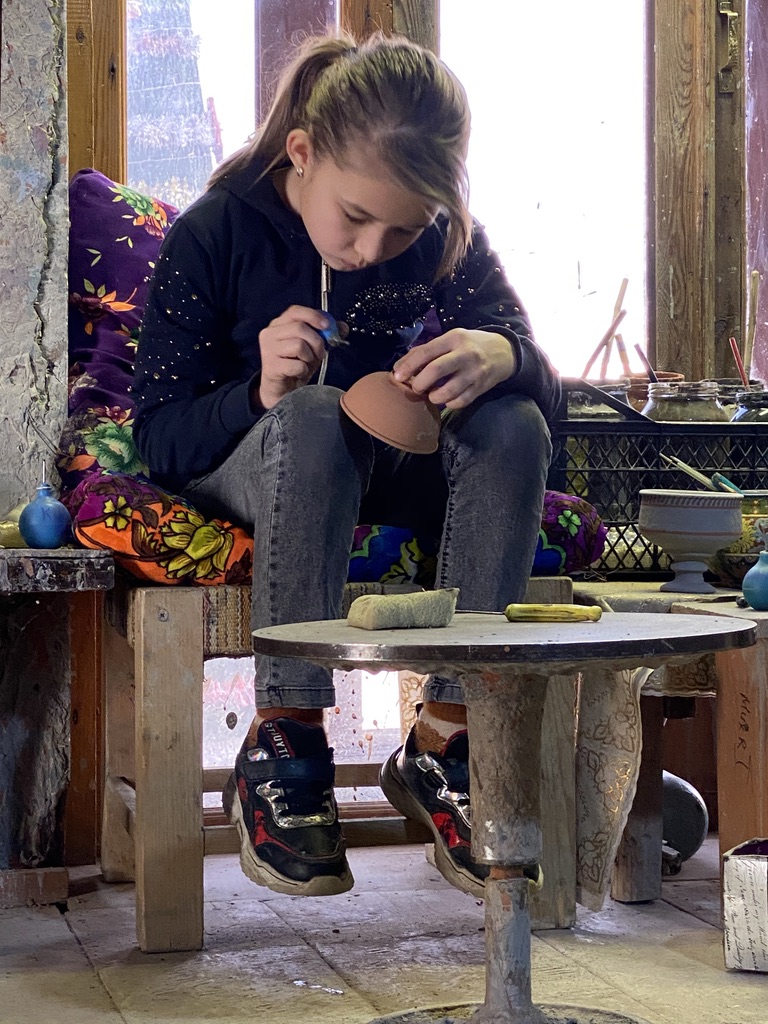
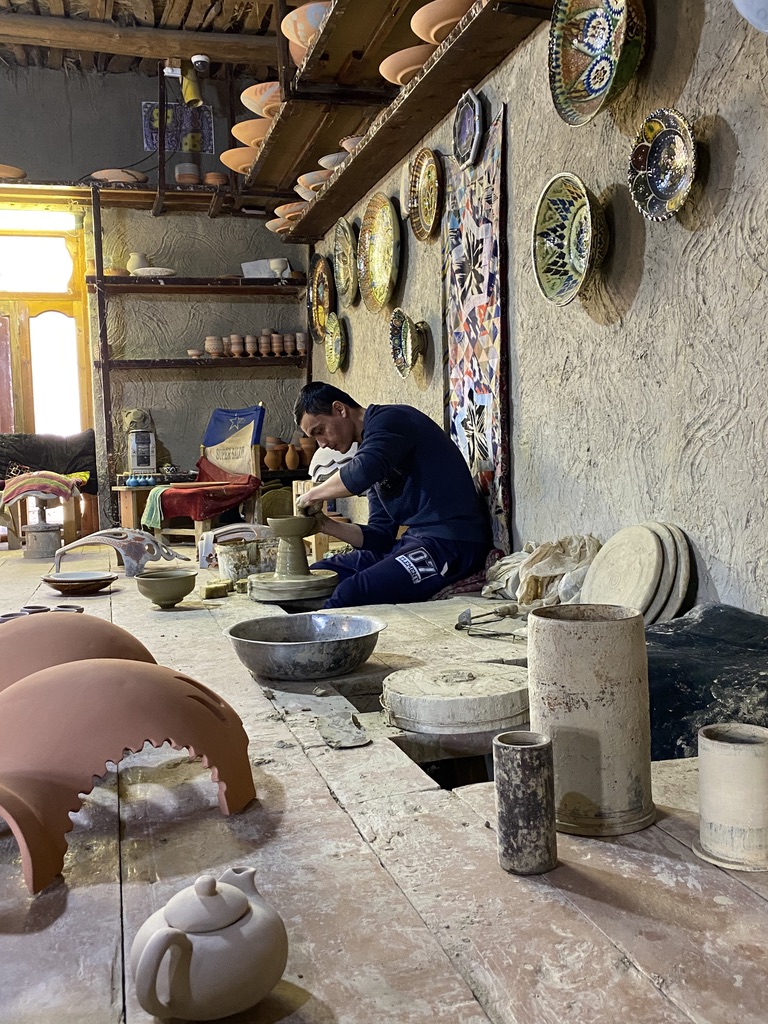
We had already decided that we would take a taxi about 50 kilometers to the town of Gijudan (population about 19,000) to see the ceramic studio of the Narzuelleva (sp?) family’s ceramics studio. They still use methods that are at least 1,000 years old and the family has been doing traditional ceramics for seven generations. The drive to Gijudan was in the direction of Samarkand and was the road we had driven ourselves a few days ago. Anyway, we arrived at the complex which is about 18 years old. Prior to this, the father and uncle worked out of their home. I get the feeling that one of the sons (they are probably in their 40s) is a bit of a marketer and figured out that they could set up a complex to show the ceramics process and also set up a shop.. and have rooms for tour groups to have lunch and to sit through “lectures” on the ceramic process. Anyway, since it was only Mike and me they walked through the process fairly quickly, and we asked a lot of questions (brought back memories of taking a ceramics class at Pratt – not my favorite, but I did understand all the steps involved).
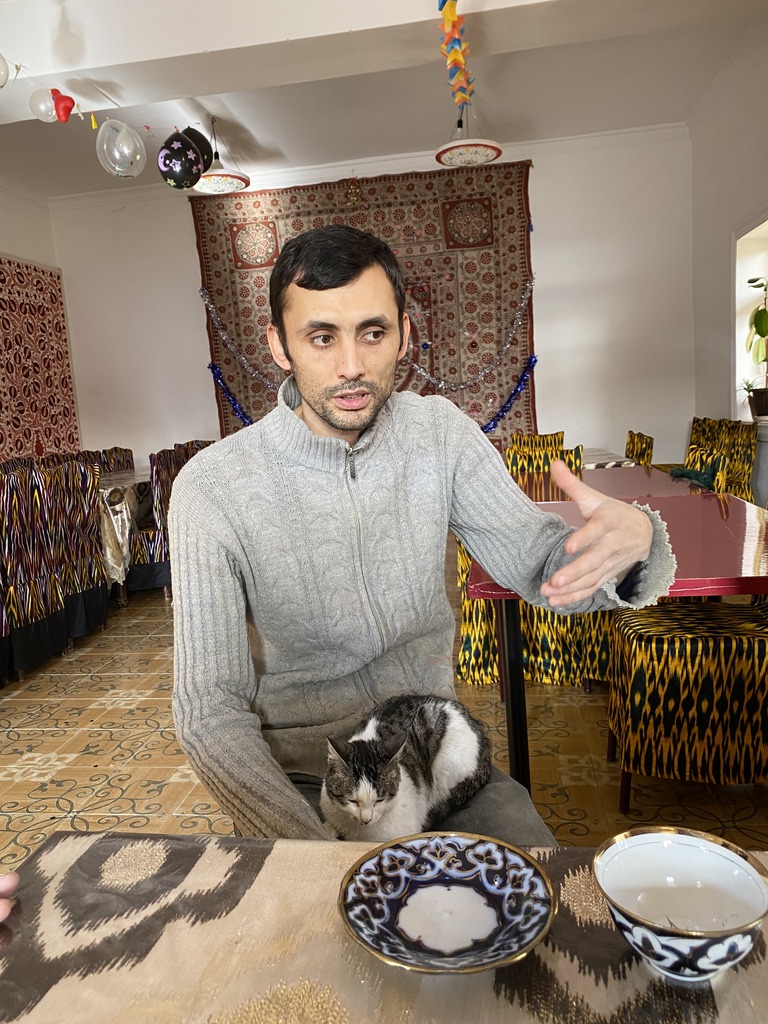
We then had some tea with the son, whose English is halting, but I think we got the whole story. He is the seventh generation and his 10-year old daughter who was actually painting some of the pots is the eighth generation – although she plans to be a doctor and not get involved with the family business. But he has two sons and is hopeful one of them will carry on the family tradition. When it comes to crafts, men do ceramics and women do embroidery, he explained.
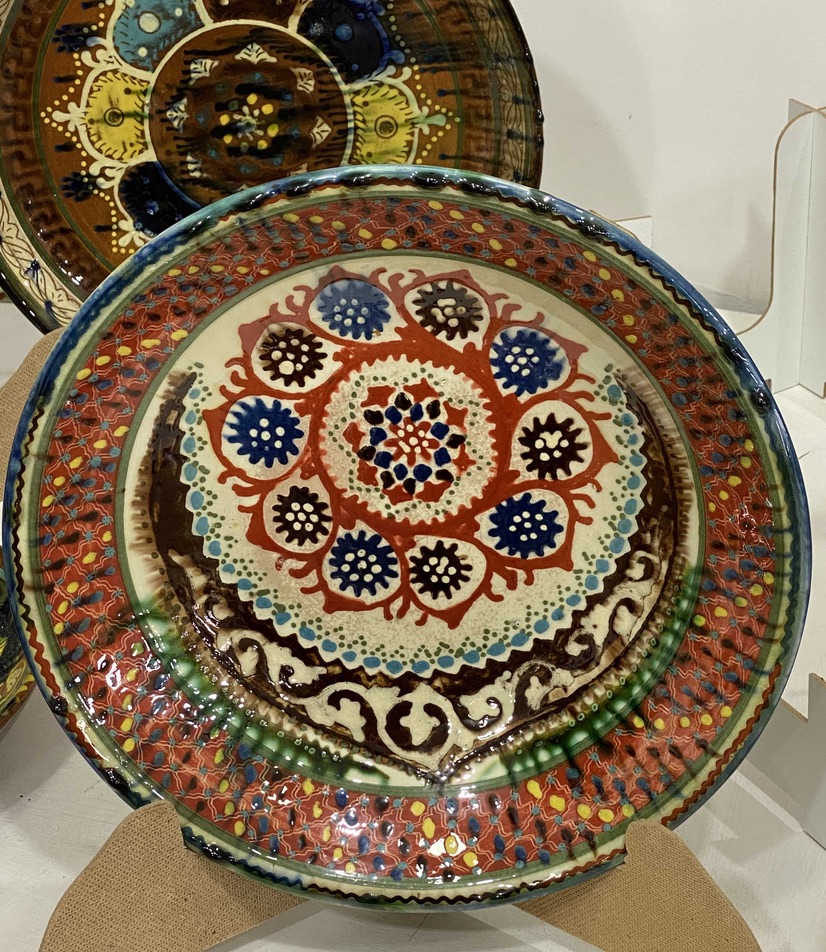
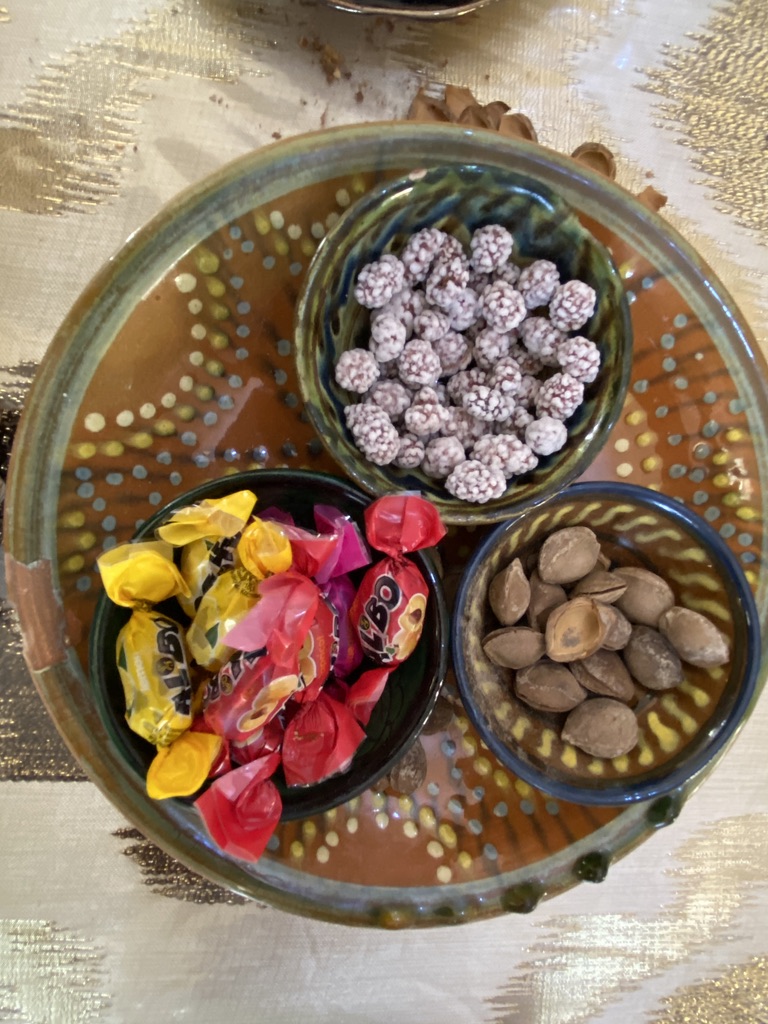
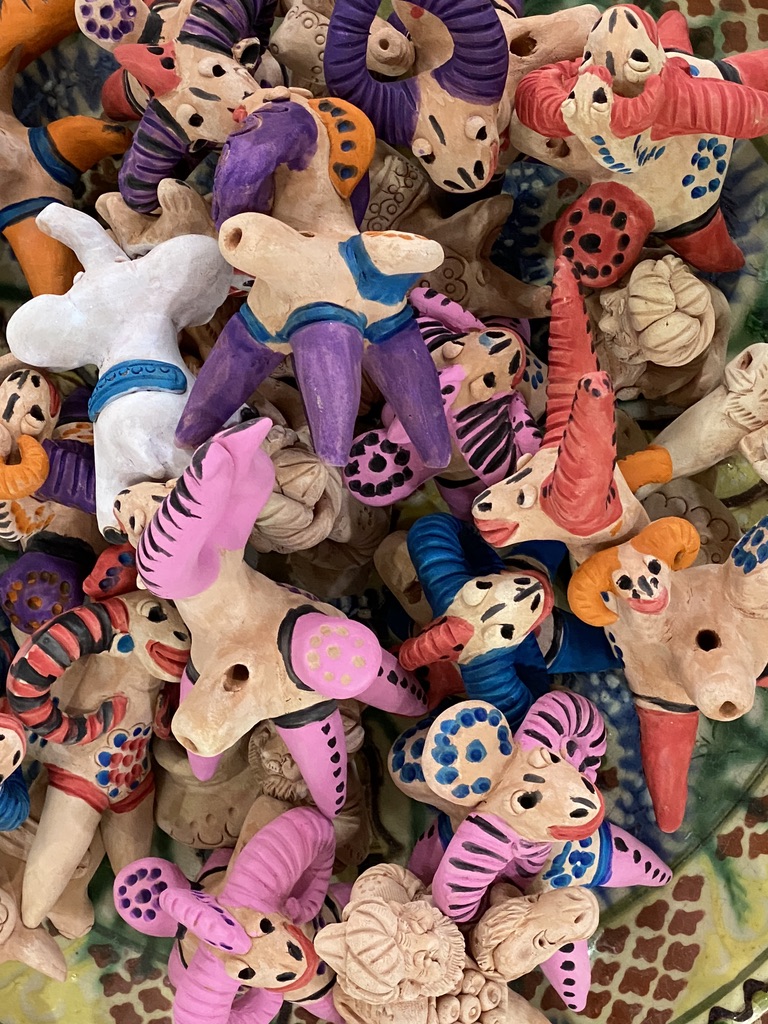
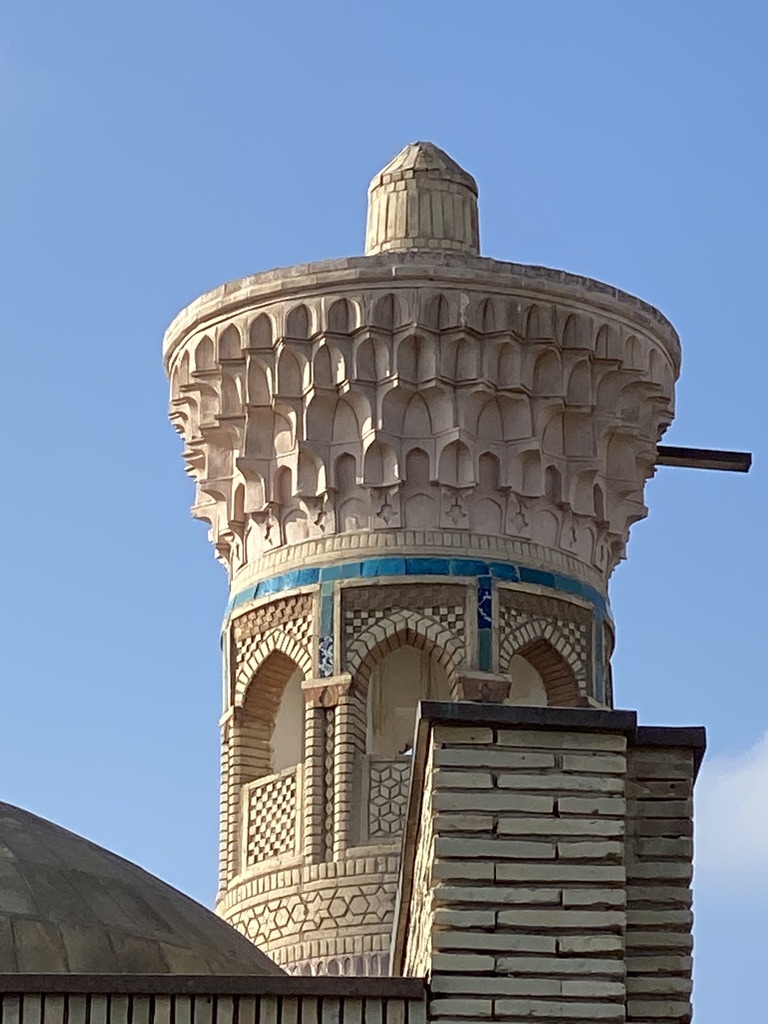
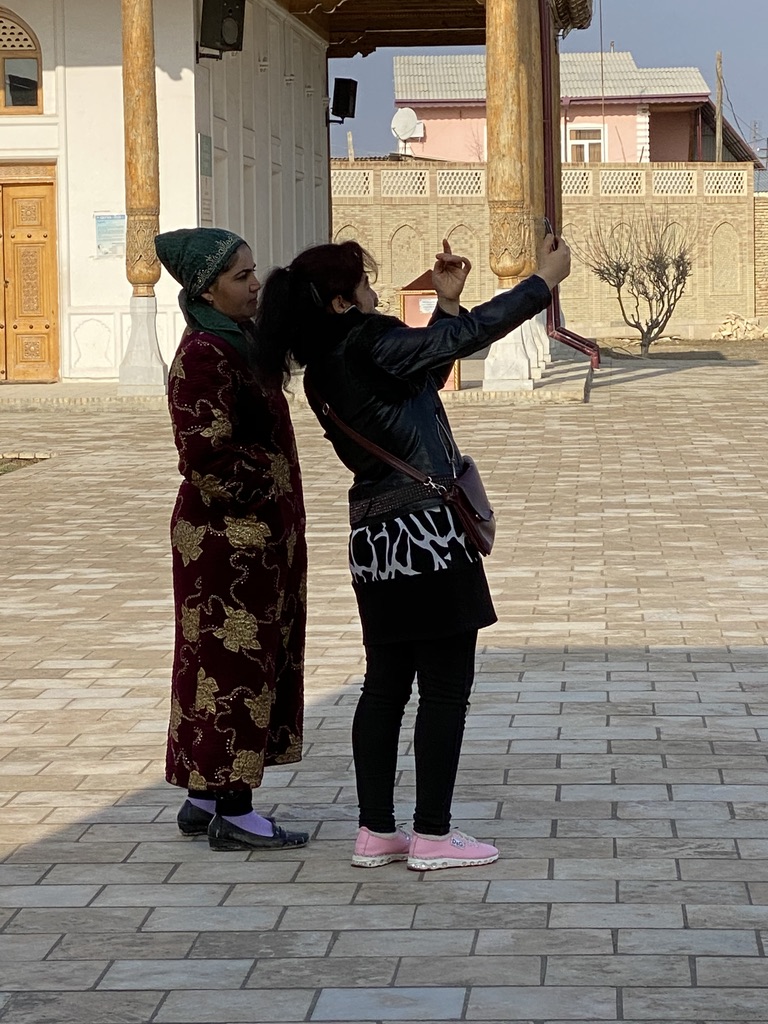
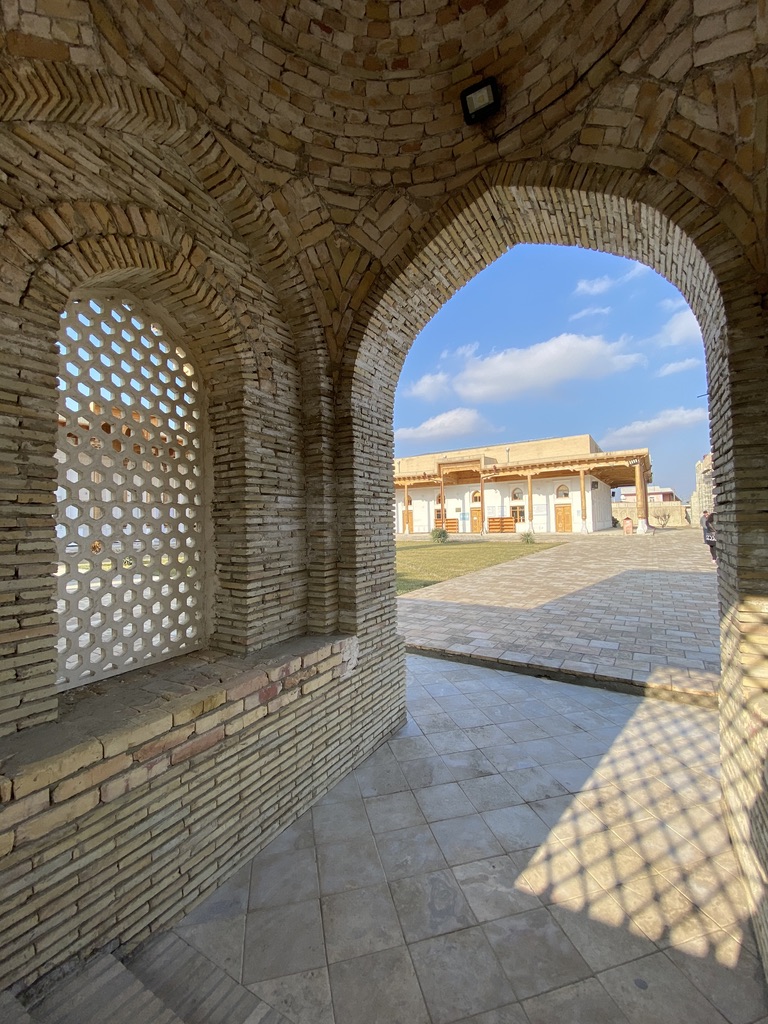
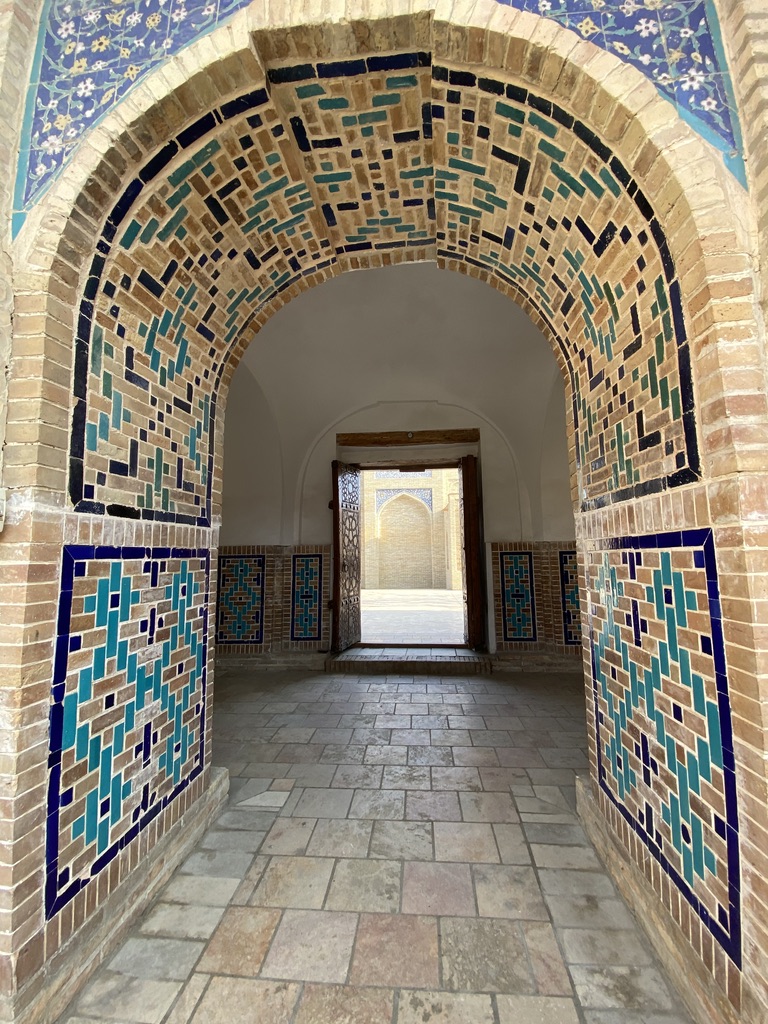
After tea, which was served with a little platter of nuts and candies (their pistachios are quite different from what we know as pistachios in North America), we made a pit stop at the local madrasa and mosque complex. And then we headed back to Bukhara; met up with Feruzi to try on my vest and shirt/jacket which needed a little bit of adjustment… so then we strolled around the old section of town and returned a few hours later to pick up my package. Great job.
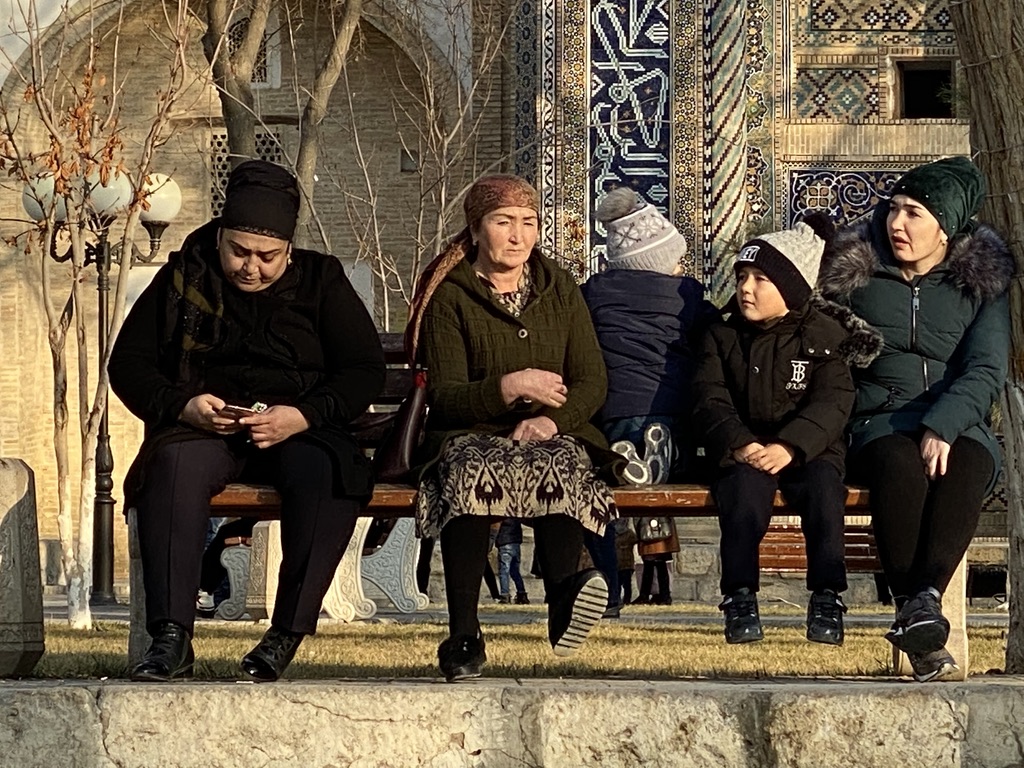
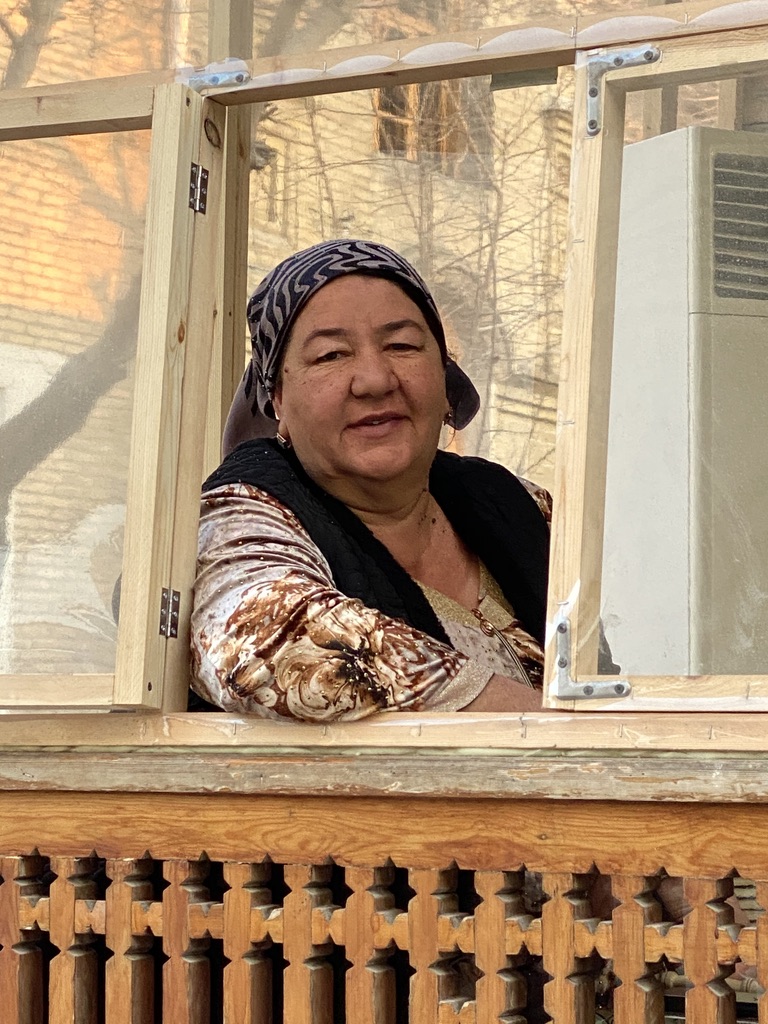

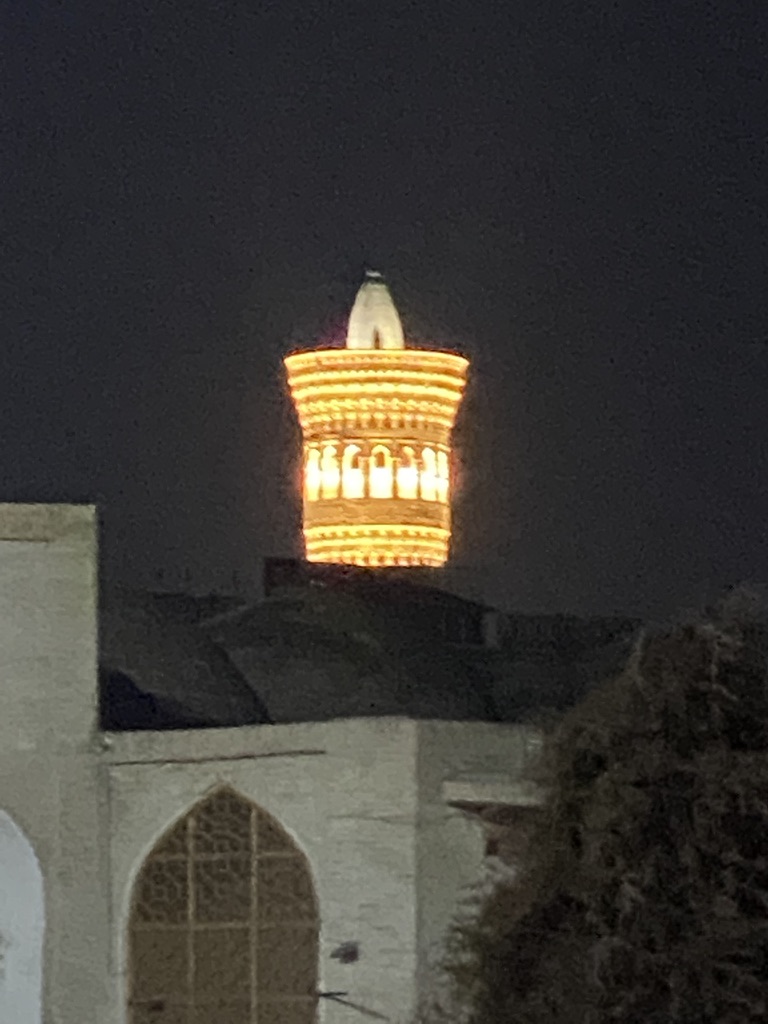
Just finished dinner at Old Bukhara Restaurant (fair to middling — definitely don’t come to Uzbekistan for the food). We sat at a table adjacent to some Uzbek businessmen (or so we think) and they were joined for a while by a local cop. We’re hopeful the culinary options will move up the scale when we get to Azerbaijan. Anyway, we are taking the overnight train to Khiva (leaves at 4:20 am). We are a little concerned about maneuvering our bags (especially with me still a bit incapacitated) into the station, onto the train, into our rail car cabin, and off the train at the end. We’re assuming there will be lots of “men” willing to help for a small fee. Still, I think it will be complicated, especially while we will be half asleep. We had no choice with regard to day or time. The train from Bukhara to Khiva only goes twice a week and it’s just this one ‘night train” at this time of year. Indeed, this reality sort of shaped part of our travel plans. So we get to Khiva at 11 am (half-dead) on Thursday (tomorrow) and we leave Khiva on Saturday through another crazy travel logistic nightmare. More on that later.
One thing we were curious about – especially given how cheap eating is – was salary levels. A bit of research on my part indicates that the annual median wage for particular professions (in Tashkent, the capital) is as follows… physicians: $13,000 (that’s annual!); architects $7,500; lawyers: $6,700…. And so it goes. About 25% of professionals in these fields earn about 20% over that median amount. To give you a sense of costs, beyond the price for dinners that I’ve mentioned already…. Our taxi ride today (50 km in each direction/ 100 km total – 60 miles), including waiting time… resulting in a total of about 3.5 hours, cost the equivalent of $15. But if the driver had just 2.5 times our trip today ($37.00), he’d make an annual salary that is higher than dentists, lawyers, engineers, etc. Of course no guarantee that his taxi will be consistently occupied.
Next post from Khiva..
Best –
Fer
Bukhara, Brrrrrr! January 6, 2020


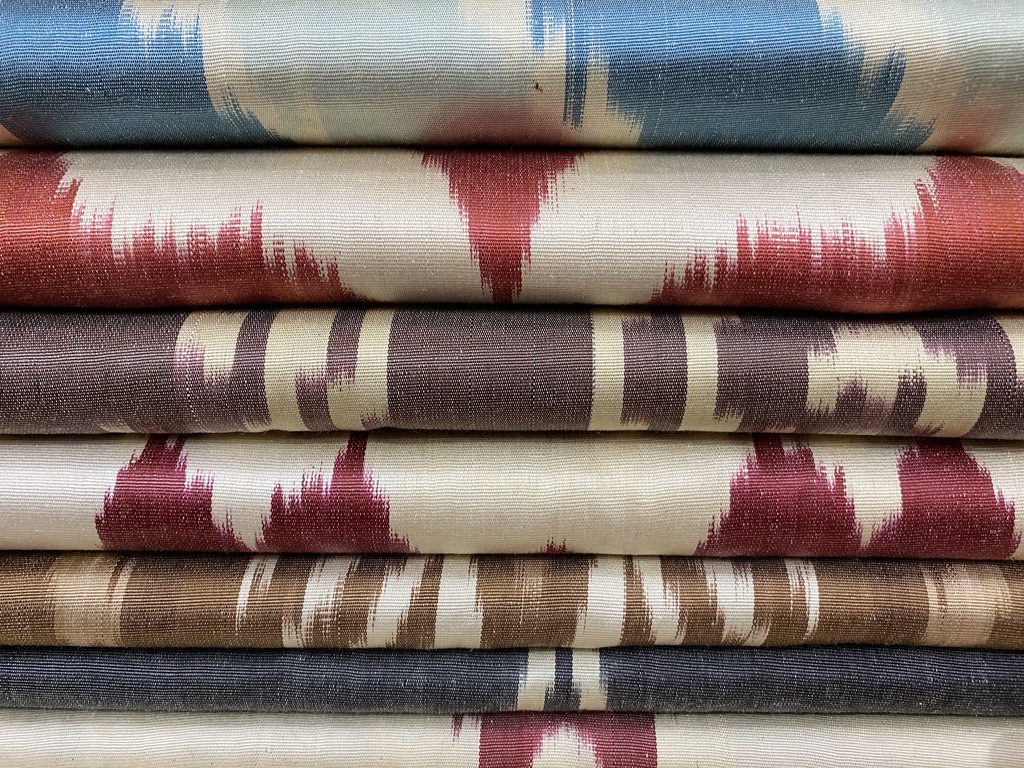
Greetings from icy cold Bukhara (temperature about 34 degrees).
Thanks to everyone for the concern and advice about my ankle. It’s still a little swollen but the nightly icing (last two nights) has helped. It’s black and blue on the opposite side of my foot from where the swelling is/has been. But I’m persevering and today was a bit easier than previous days. I was able to walk about three miles and getting in and ot of my boot was a lot easier. Mostly it’s stairs that are challenging and unfortunately these cities are filled with stairs. Impossible to go anywhere without climbing stairs. I’m hopeful that in another two days I’ll be good as new.
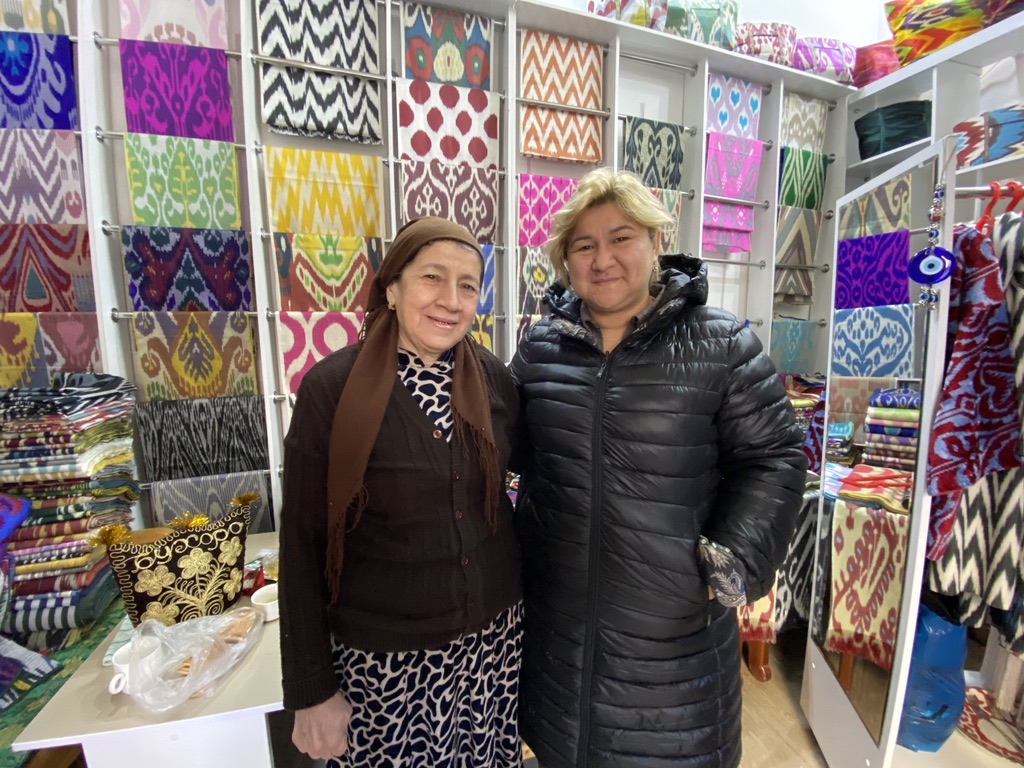
Anyway, our plan for today was to walk in the oldest quarter of Bukhara, to see the work of one of the ikat artists, and to walk through the four dome route to the Poi Kalon Complex. As it turned out, we walked briefly past a very old synagogue which was closed and went on to meet Ferluzi, who has a tiny shop selling ikat fabric that she designs herself – some from traditional patterns and others from designs she has created anew. She’s quite interesting. We got to the shop, which is not too far from our hotel and it was closed, but we phoned the number on the sign. Her English is quite good and she told us she will be there in 15 minutes. So we strolled a bit in the freezing cold and came back a few minutes before she got there. She’s about 50 years old, has three children aged 8 to 18 (the oldest of which is starting medical college). She’s been divorced for four years and now lives with her children and her parents and her brother. Her family has been involved in the fabric business for generations; her parents have a shop nearby that sells antique fabrics. Given that we did not include the Fergan area in our travel plans, I think she’s the next best thing. All of the fabrics are created locally, some sourced from weavers employed by Ferluzi. She’s very knowledgeable about design and also about Bukhara being part of a family living here for generations.
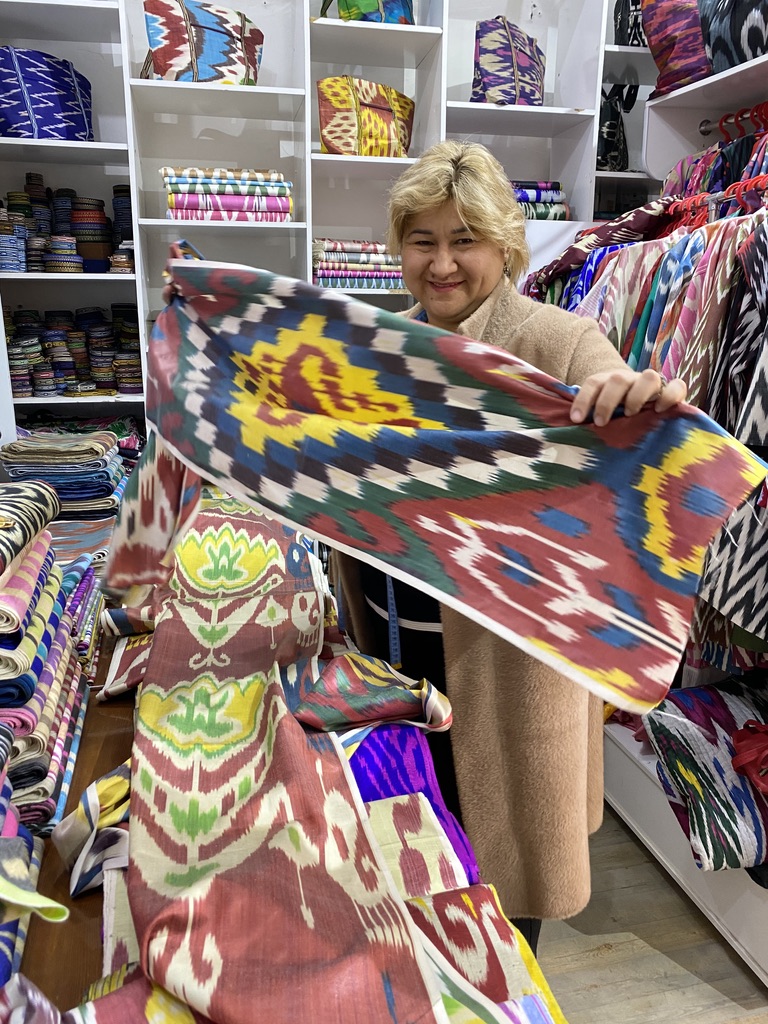
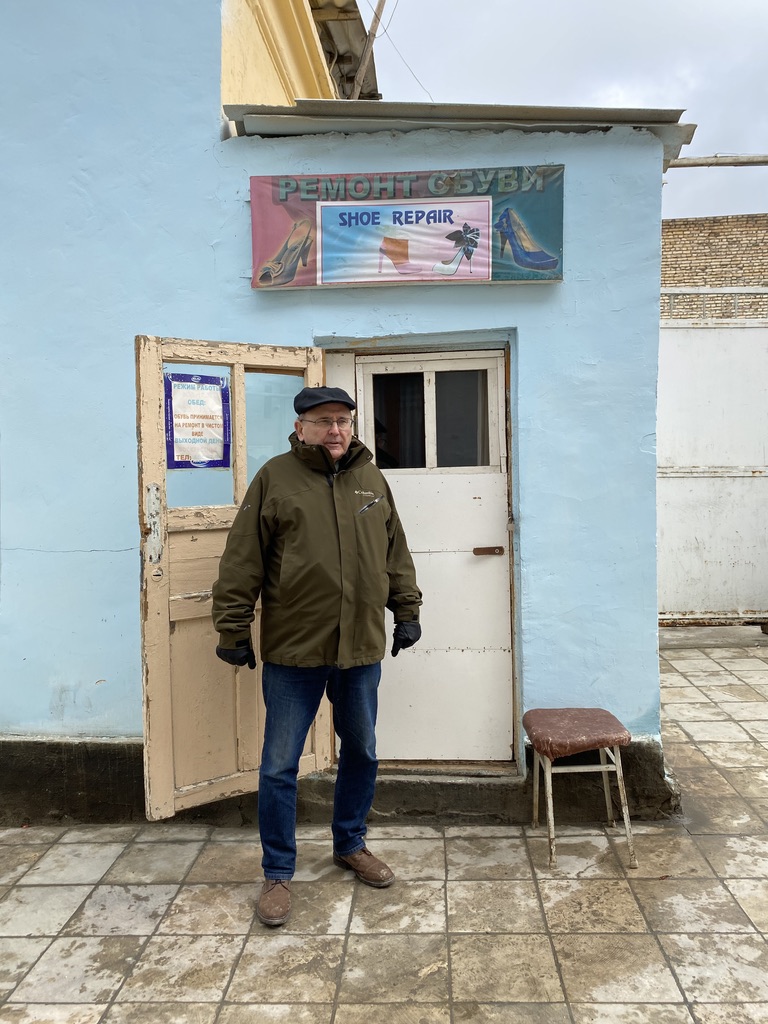
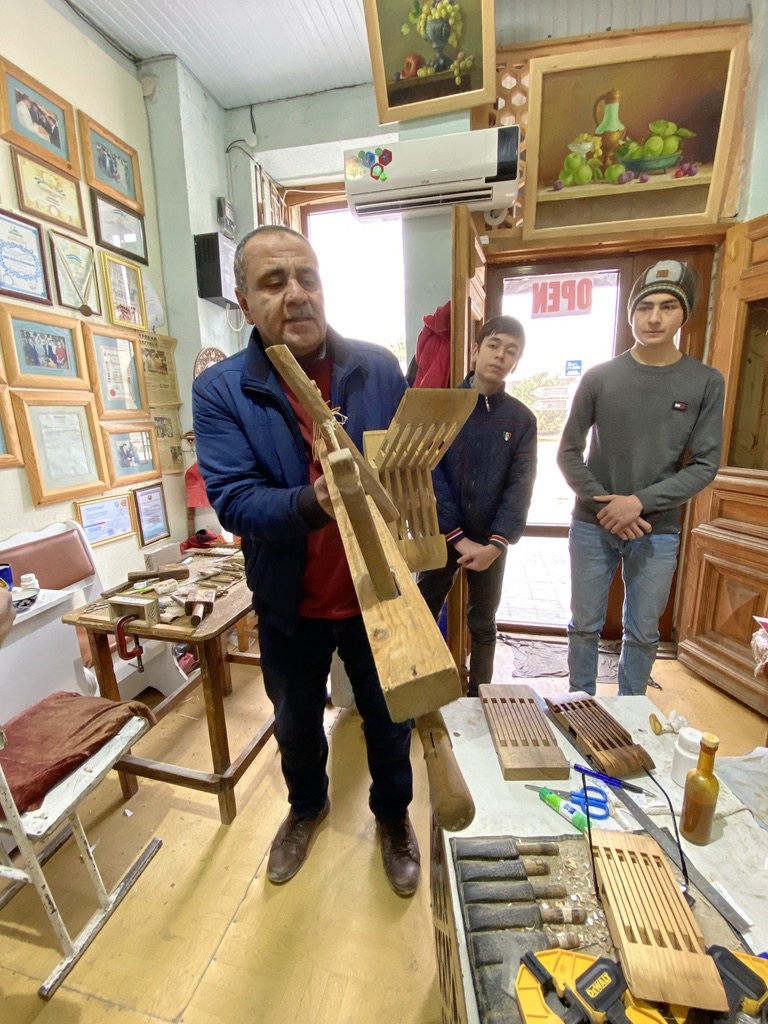
Anyway, she arrived and within 5 minutes she and he assistant had moved tables of fabrics and pillow coverings, and bags, onto the street in front of the shop… so that they could operate and so that we could get into the tiny shop (about 10’ x 15’) which is packed with fabrics. We did a little shopping (surprise, surprise), getting a beautiful table runner, three scarves, and two items that she is sewing for me (will be ready on Wednesday, with me coming in for a fitting tomorrow). I knew to bring something with me that I could have copied – having experienced not doing this when in Vietnam and Laos. Anyway, I selected two great ikat patterns and she’ll sew one copying the shirt/jacket I brought and the other will be a vest based on a vest she had in the shop, but recreated based on my guidance as to length and pocket placement. Very excited.
By then we decided it made sense to grab something for lunch so she suggested we go to Old Bukhara Restaurant which was about two blocks away. We each had a bowl of soup and some fried “ravioli.” Actually quite good. Then we began to get serious about our walk. We strolled through what is referred to by some as the “four trading domes” – a series of domes stretching, somewhat in procession, about ½ mile. From what I understand, the first “dome” complex was considered the money trading area, then came the gold trading area, then the markets, and then the sleeping areas — because after all this was on the Silk Road… This “path” leads to the Poi Kalon complex which is an Islamic religious complex located surrounding the Kalan Minaret. The walk from complex to complex was fine. The preservation and also restoration of important buildings in Bukhara was done well and is predominantly natural-colored brick … tiles are reserved for religious buildings… It was all done with care and sense of history and has a very different style from Samarkand.
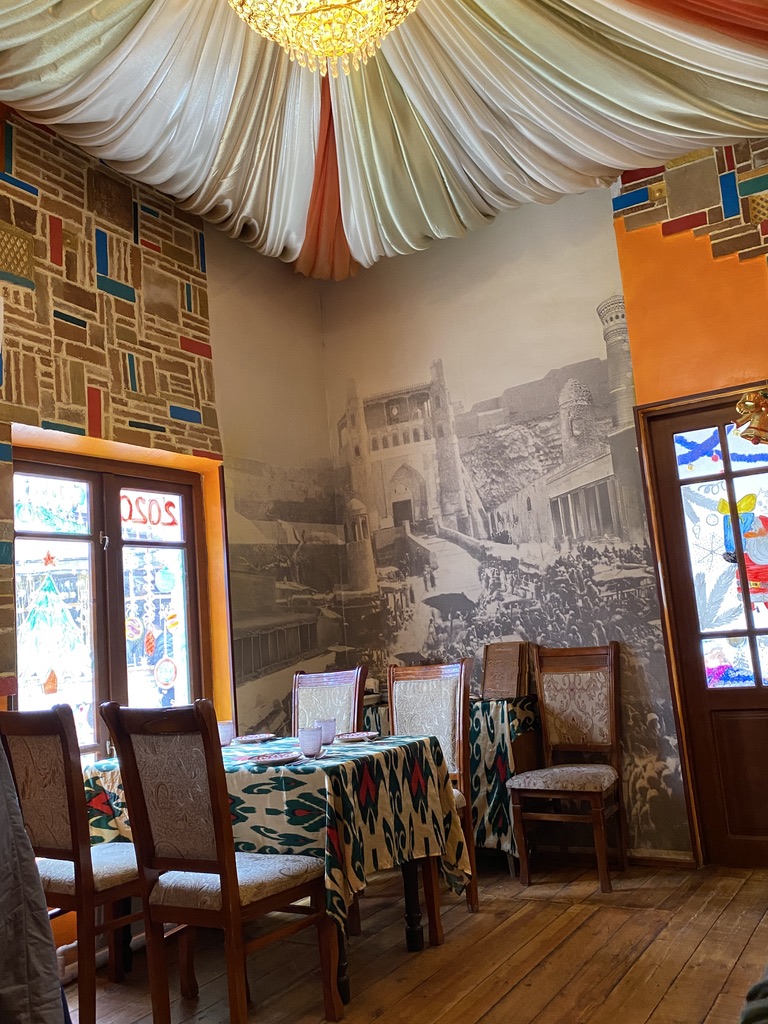
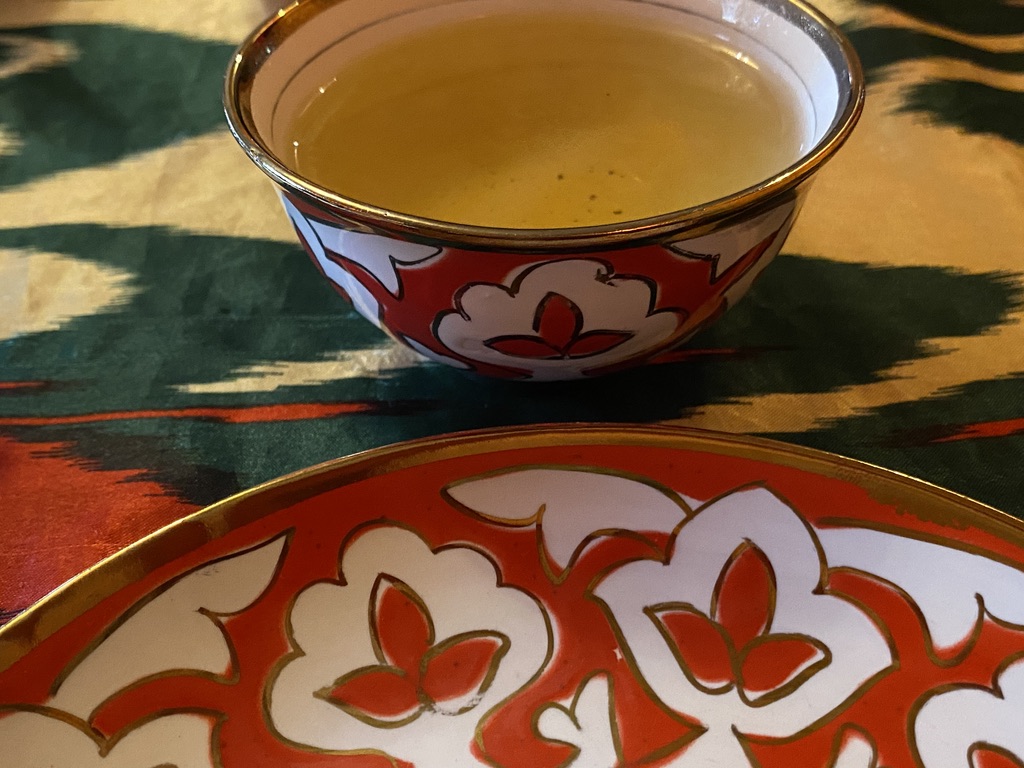
At the edges of every structure and also within the walls of the buildings are many, many tiny and also larger shops selling carpets, fabrics, jewelry, knives, etc. It’s got that touristy sense of trying to capture the attention of visitors, but it’s actually a bit like a contemporary version of what it must have been like to have traders trying to capture attention centuries ago, as they sold their goods.
Eventually we reached Poi Kalon Complex with its prominent minaret. The story goes something like this… When Genghis Khan arrived in what is now called Bukhara, about one hundred years after the minaret was constructed.. it was so tall he leaned back to see the top and leaned back so far that his helmet fell to the ground. He bent down to get his helmet and his army thought he was genuflecting in admiration.. and thus the minaret was spared while the rest of the city was destroyed.
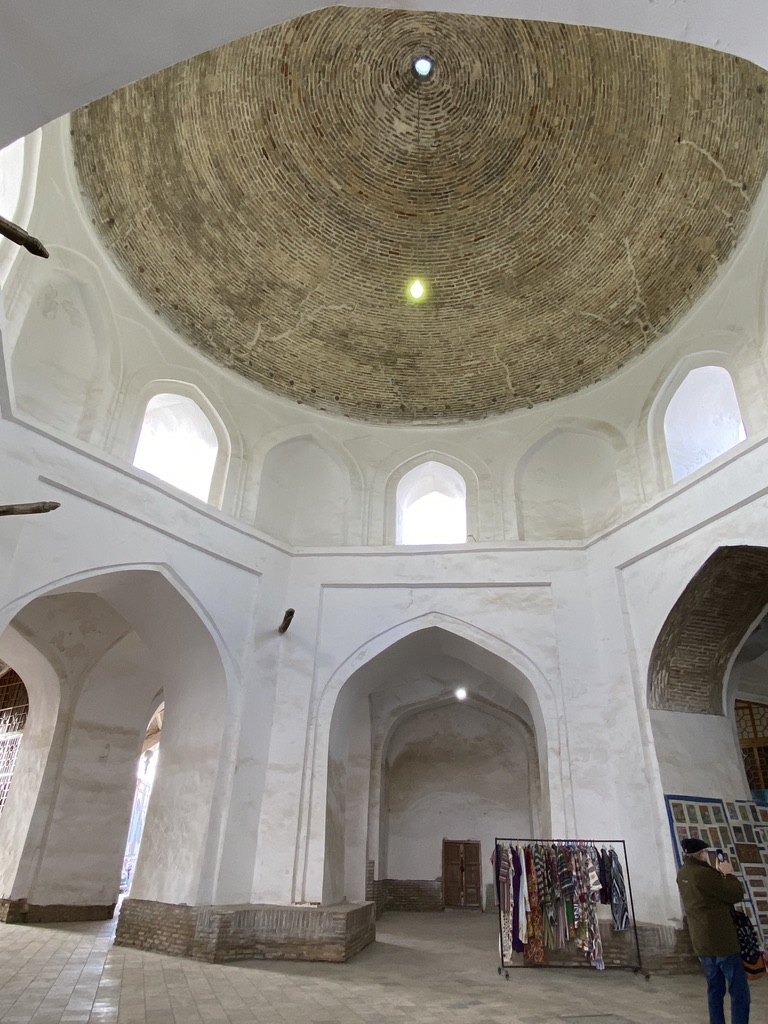
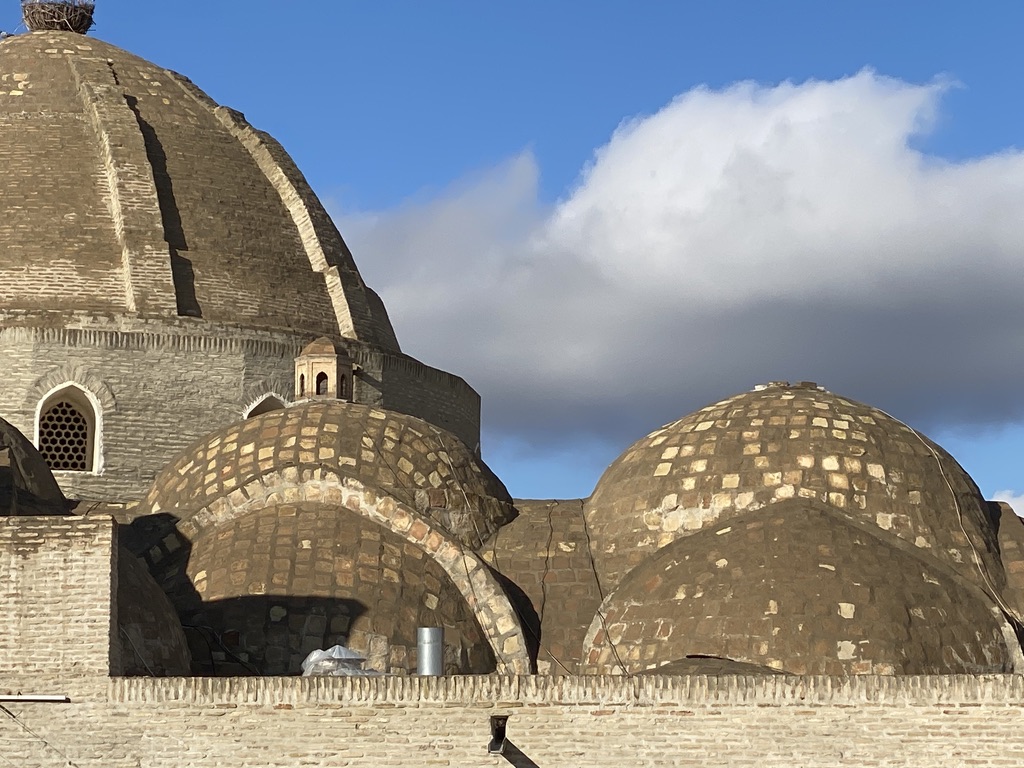
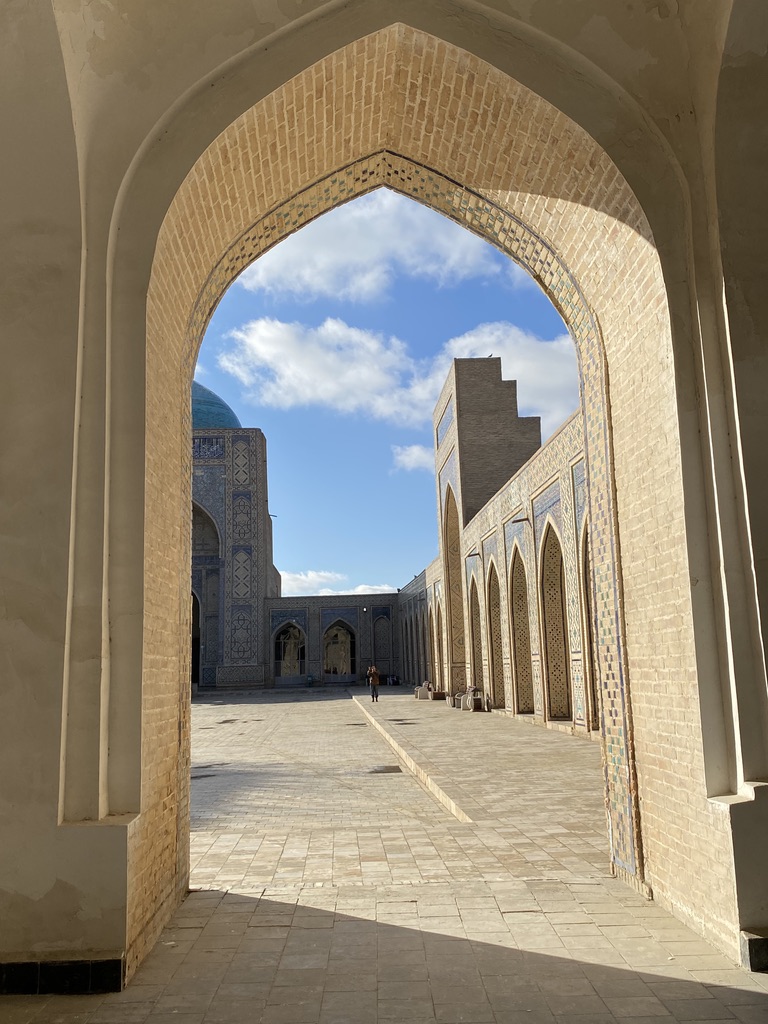
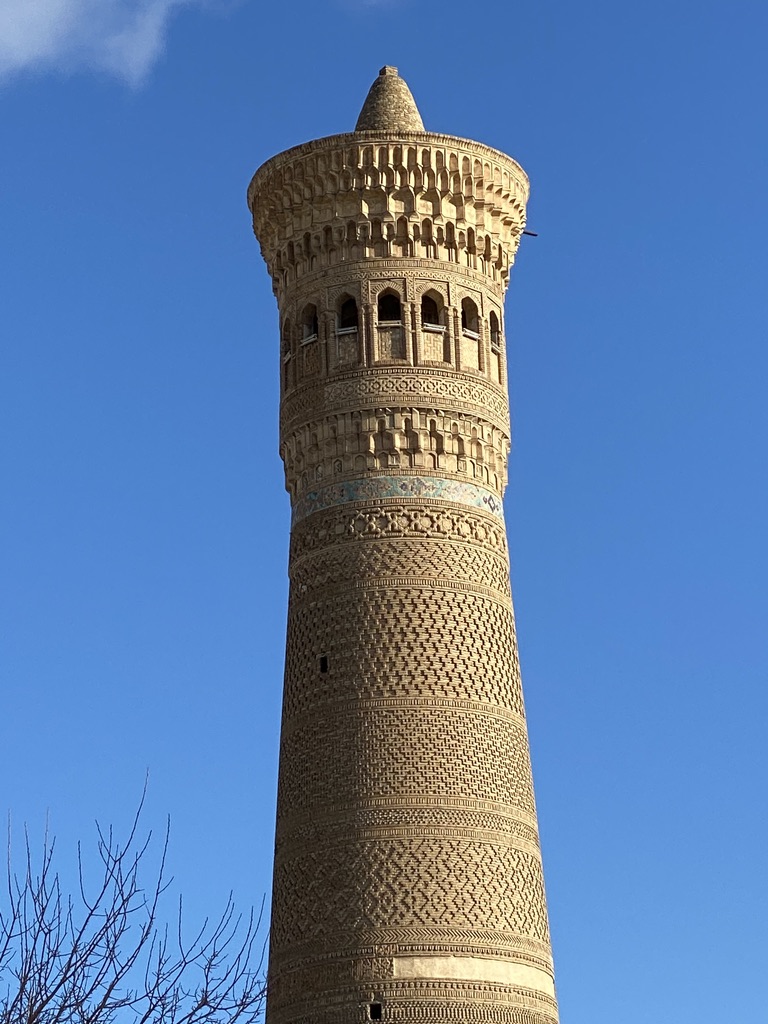
Because it was so cold (32 degrees) we walked toward the hotel and sought some hot tea en route. We stumbled on something called Wishbone Café (??) inside one of these old structures. I actually had a matcha latte and Mike had hot chocolate. Then we made our way back to the hotel until we headed out for dinner.

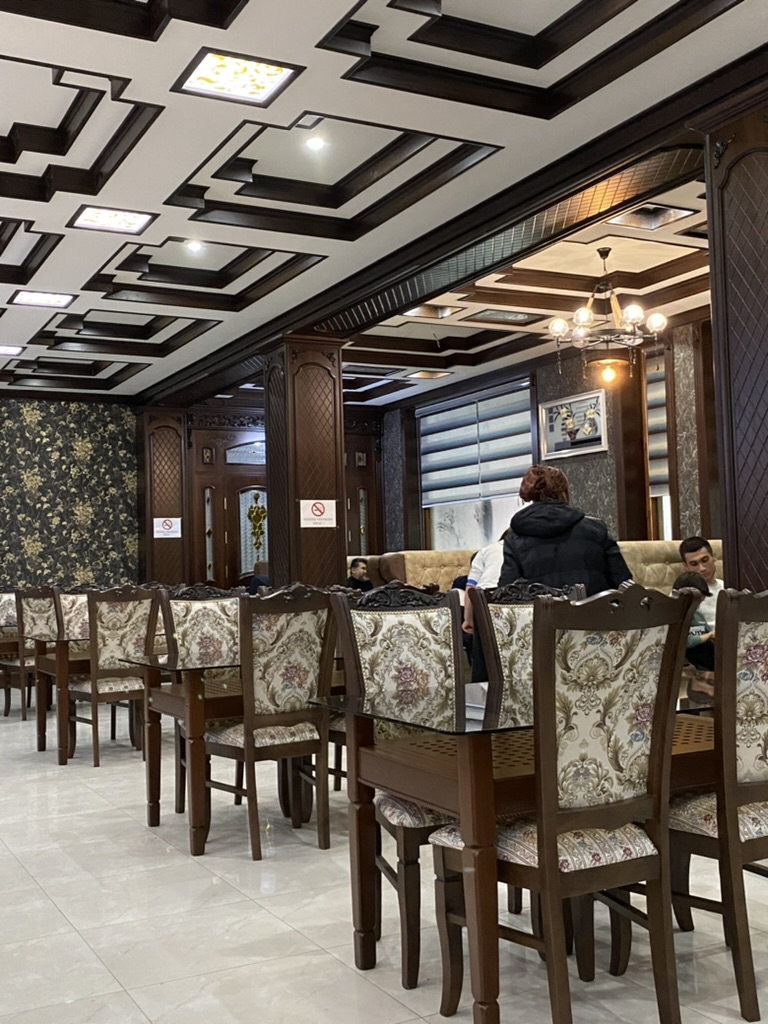
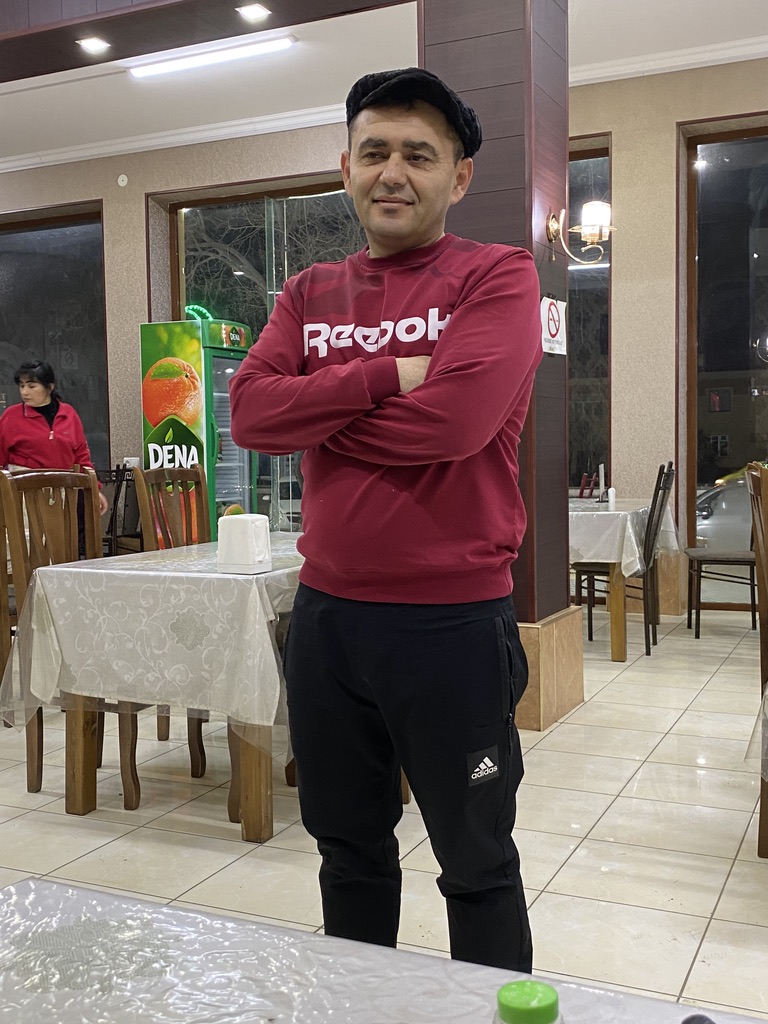

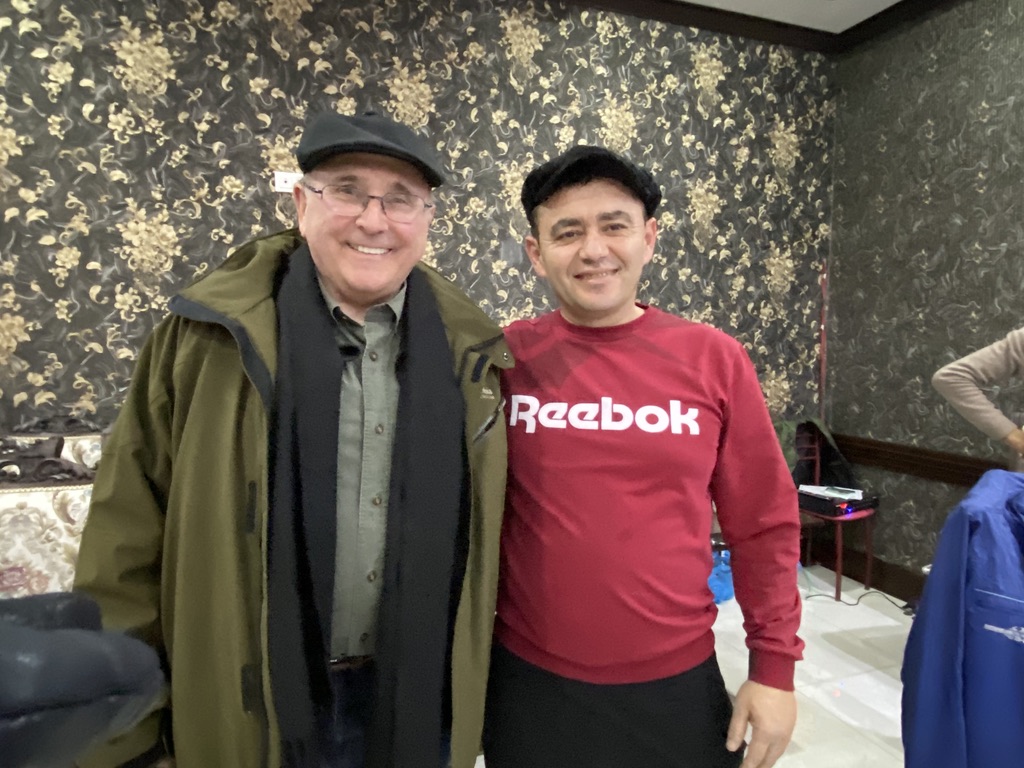
When we ate at Lyabi House last night, we asked the waiter for some dining suggestions. He really thought long and hard and then came back to our table with a little torn piece of paper with two restaurants and some written explanation (all in Russian). He told us that any taxi driver would know these restaurants – one was fish and one meat. So tonight we ventured to the fish restaurant (whose name I don’t know because it was in Russian – but something like Shodlik). Anyway, it turned out to be on the outskirts of Bukhara — about 7 miles out — so we got to see the “modern” part of the city, but in the dark. Eventually we reached this very large, brightly lit place and we took a table. It was about 2/3 empty. Then when they realized we spoke English there was a bit of a scramble to figure out how to take our order. The owner then came (didn’t realize he was the owner at first). He was wearing a Reebok tee shirt so we figured he must be the one who speaks English. But, no, he was the owner. Then, he stood at our table and made a phone call — to his son! He’s 18 and speaks some English. So first the son told us that the father wants us to go upstairs to the better restaurant as we will like it better. We vacated the table and up we went.
The upstairs was definitely more upscale than the barren downstairs… but its decor left a lot to be desired… complete with large paintings on the walls done with palette knife dimensionality. Anyway, the son called again to get our order – he told us they had two kinds of fish: with bones and without bones. We asked what kind of fish, but the response was the same: with bones and without bones. We said without bones, but the son said with bones was tastier. We asked about how the fish would be cooked, but there was only one way. We asked about vegetables and the son said “only salad.” We ordered beer (they don’t have wine). Bread came to the table. And soon the fish came. Intermittently the father would bring his cell phone by the table and call the son.. to find out if we liked the food, if there was anything we needed, etc. Then, the father brought the phone by for the son to chat with us about university education in the staes. The son will be studying business abroad and then wants to get his MBA in the states. We chatted about schools and where we lived in the states. He has a friend who was accepted at Penn on full scholarship. I assume any Uzbeki would need a scholarship to study in the US.
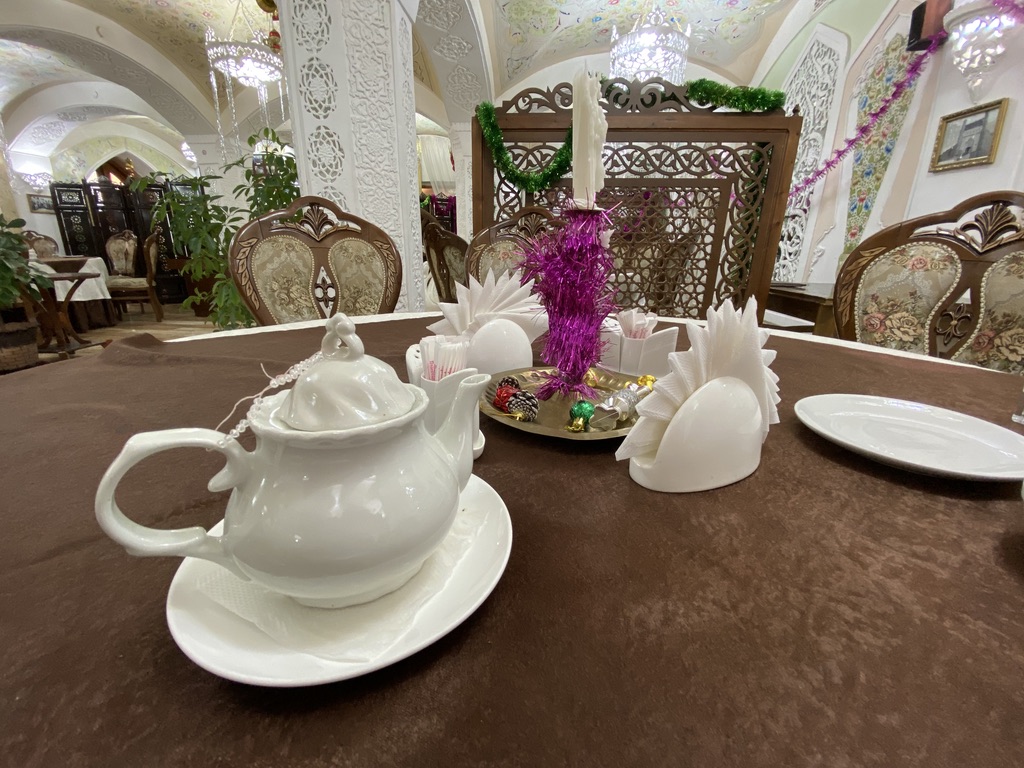
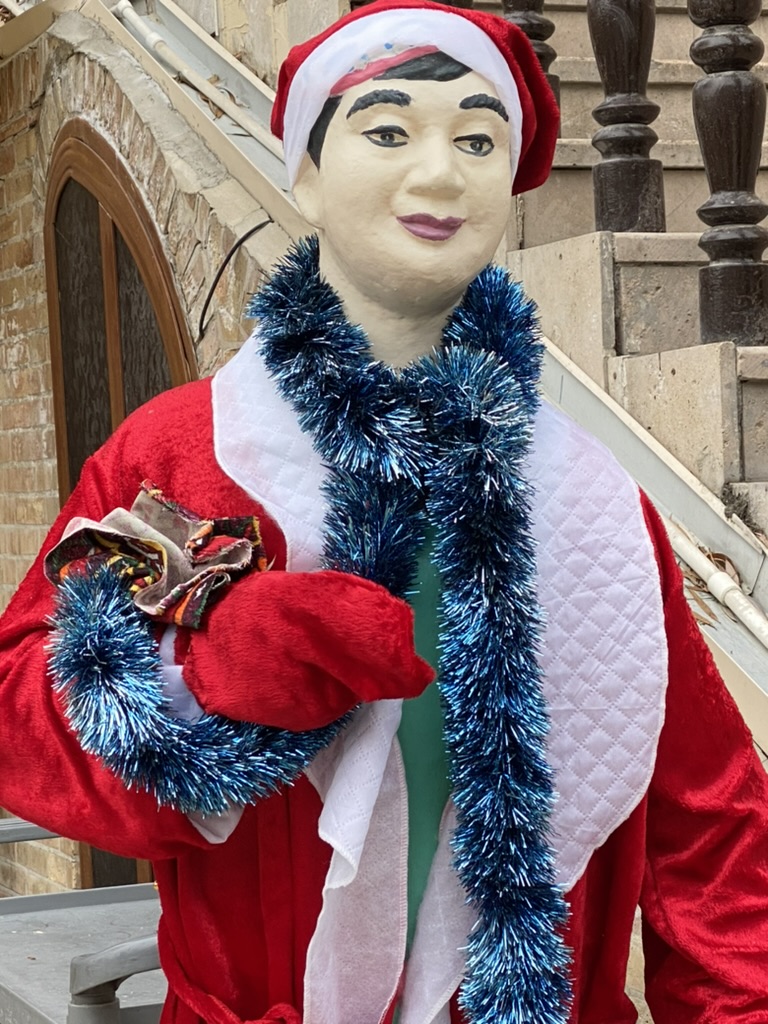
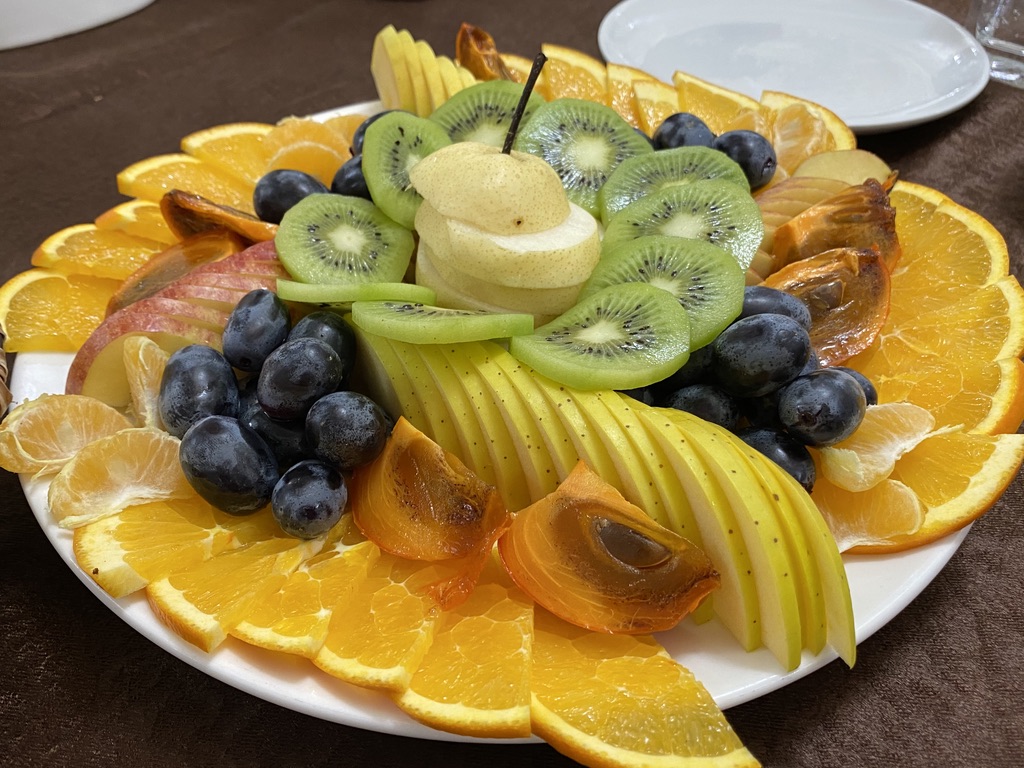
While the fish was fresh and good, it was also a bit boring, although it came with a side dish of some kind of spicy tomato-y sauce for dipping. We taxied back and then headed for a little coffee shop near the hotel for green tea and dessert, before they closed.
Take care –
Fern
From Samarkand to Bukhara — Driving 1/5/2020
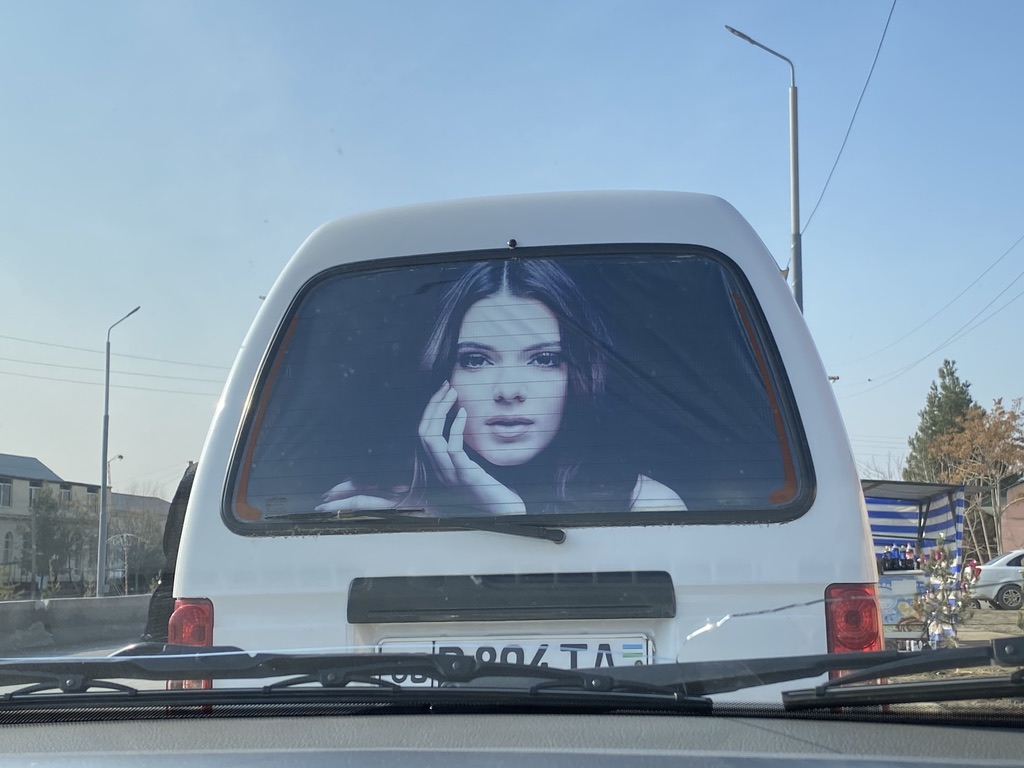
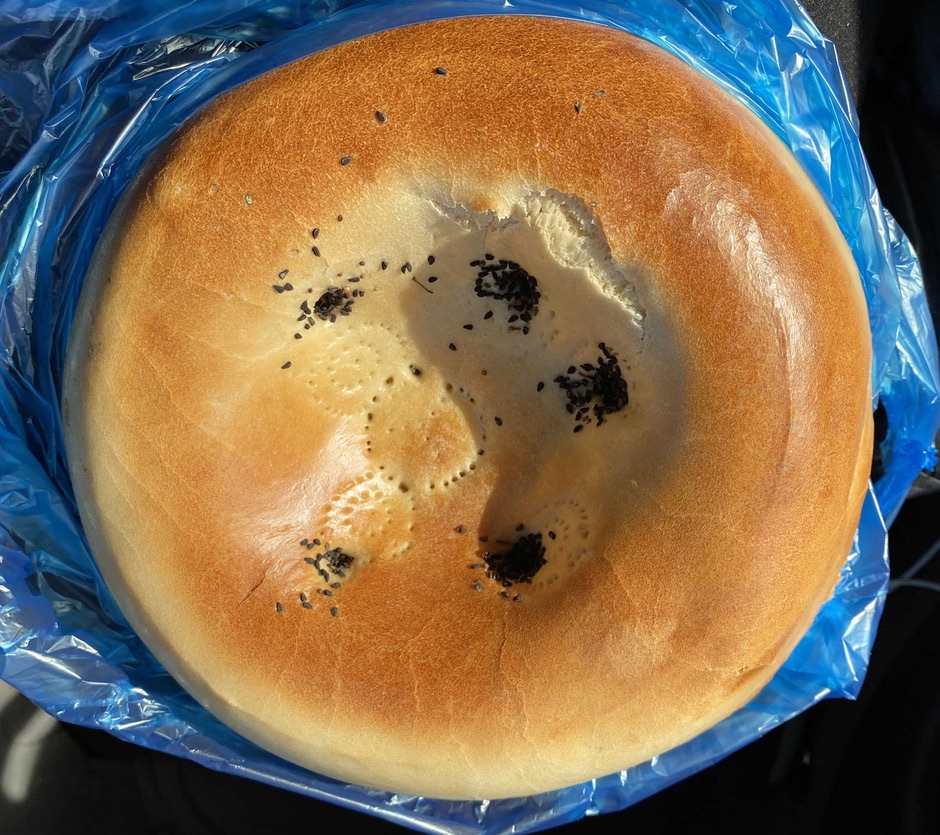
Greetings from Bukhara
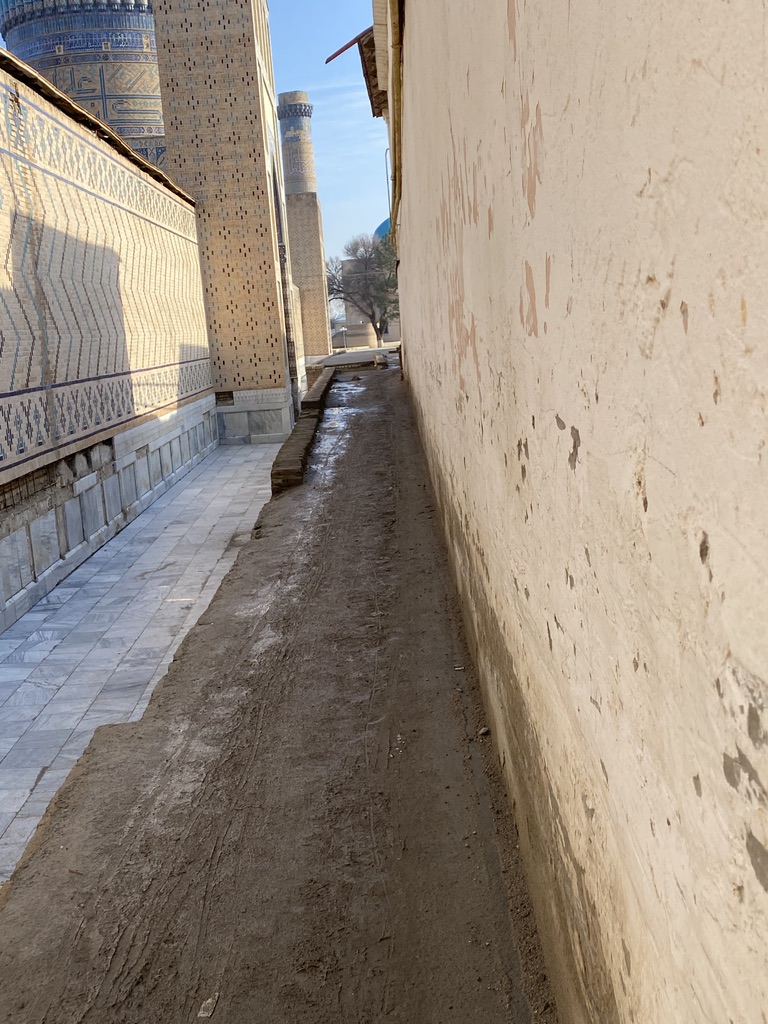
Since we were mostly in the car today—moving from Samarkand to Bukhara, the images are not spectacular like those of the mosques and mausoleums… Rather, let’s say…. they are descriptive of the day.
Finally the sun came out in Samarkand — just in time to bid us farewell as we began our journey driving from Samarkand to Bukhara in our little Nissan Sentra (with a totally packed trunk). We left at about 11 a.m. for the four hour drive, which we figured would really take us about six hours, considering the strong possibility of getting lost and stopping for lunch. We walked along that unbelievable “ledge” from the hotel to where our car was parked. The photo included above attempts to describe the three foot wide “path” (along that wall and the 8 foot drop along the way – with people going in both directions and during the day workers with wheel barrels as well). The hotel guys carried the luggage on that narrow ledge as well. There is a secondary entrance/exit from the hotel which takes you to a walking street leading to the mosque, but it is a pedestrian street so there is no way to park or get a taxi to that entrance. Thus we walked on that ledge every day.. to and from the hotel.. even late at night when a taxi would drop us off there. Along the way, a group of Uzbeks stopped to ask if they could take our picture… We are sort of exotic here. This has happened a few times. So either these are Russian spies assigned to us and taking our picture shows they are doing their job, or we are just different and interesting.
By the way, the taxi driver we had last night when we left the restaurant had a few words of English and we learned that he has been trying for five years to get access to a visa to the US. He’s in the green card lottery and he tried each year. He says there are 30 million applicants and 50,000 get selected. He has a friend who won that lottery a few years ago, so he’s hopeful. His friend lives in Queens – naturally – and is working in a supermarket. The taxi driver seemed to think this was a good job and the friend makes good money.

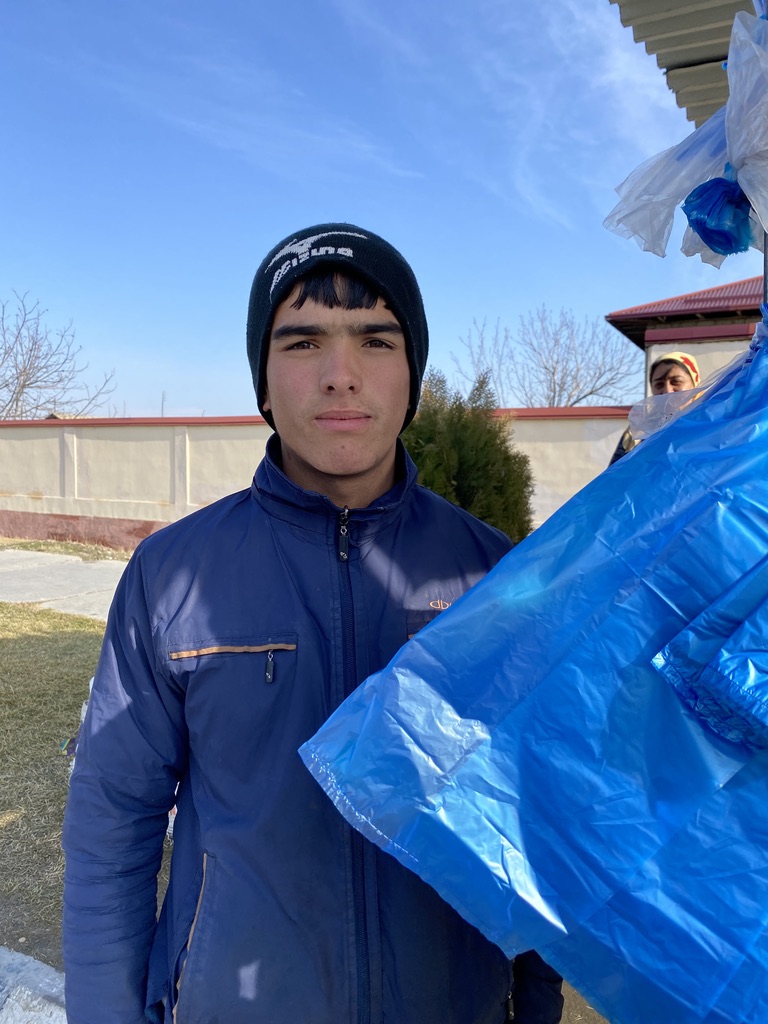
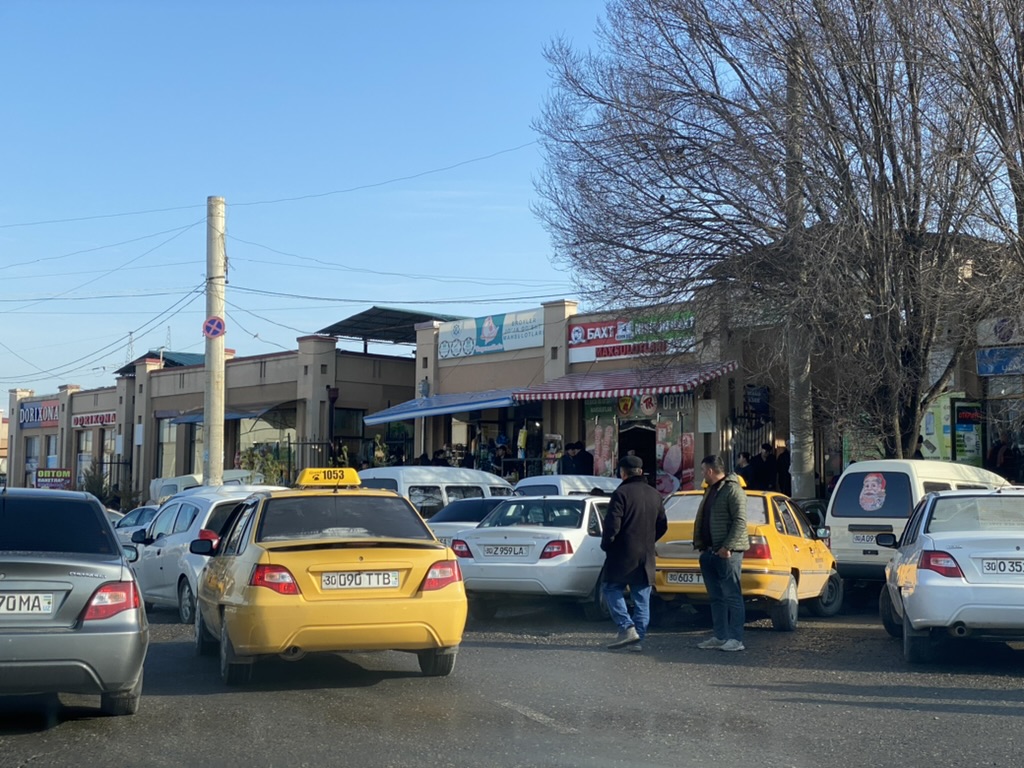
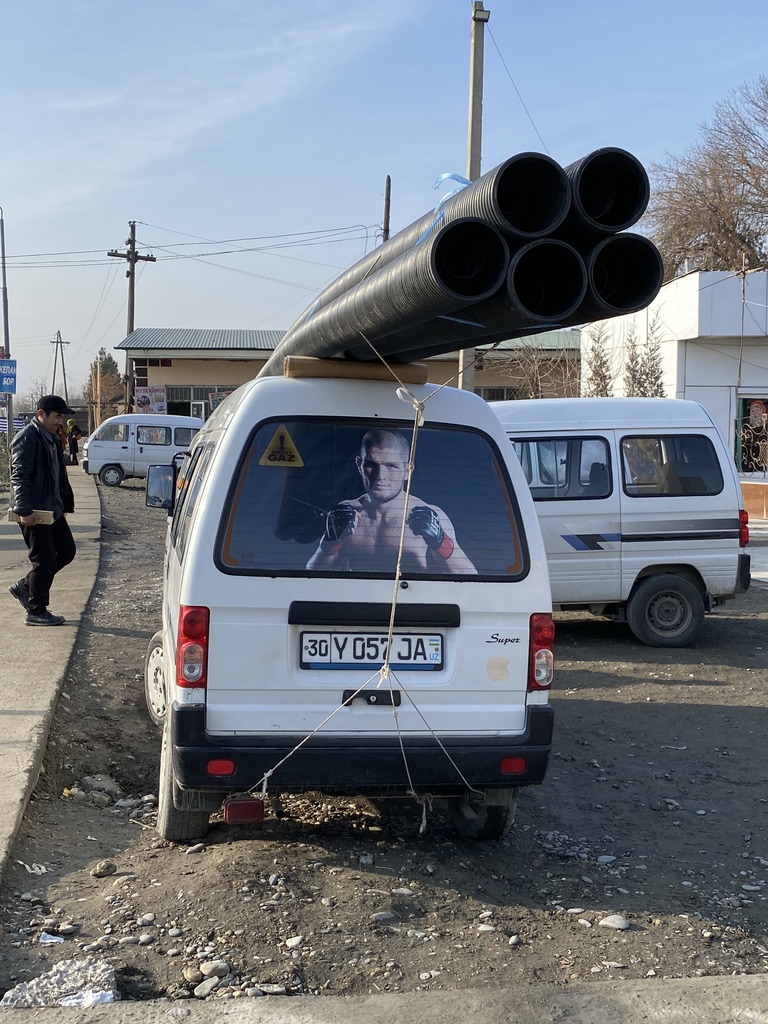
Anyway, we successfully left the hotel, got the car backed out of the narrow street and we were on our way to Bukhara. But first we had to deal with daily traffic, triple parked cars, people crossing the street where there aren’t any walkways, left turns requiring complete u-turns because there aren’t any left turns, and more. We had been told by the rental car company in Tashkent that there weren’t going to be any petrol stations between Samarkand and Bukhara, so we heeded his advice and gassed up on the outskirts of Samarkand. As it turned out there are petrol stations practically lining the road so there wasn’t any need for panic… I think the rental car guy in Tashkent needs to get out of the capital city more often. We stopped also at a roadside cart selling delicious Samarkand bread – a particular round bread that has pepper in the center. It’s really delicious… So for a while we snacked on great bread and water.. (sort of like prisoners but with better bread, I suppose).
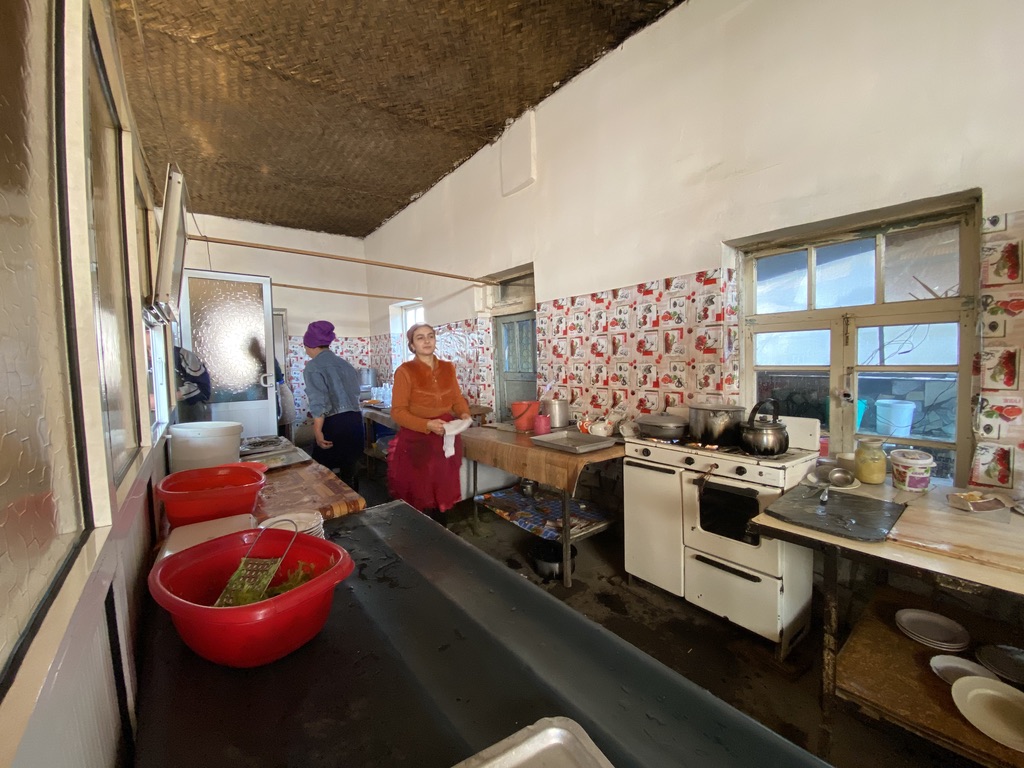
About two hours into the drive we decided to look for a place to have some lunch.. We knew we wouldn’t find much along the road, but figured we would stumble on something.. We finally came to a town (?) – more like a series of shops lining the road – each shop selling some kind of home repair or building supply.. Kind of like a linear Home Depot. We parked the car and walked down the street and found a “restaurant”… tables inside (and two tables outside, but it was about 40 degrees!).
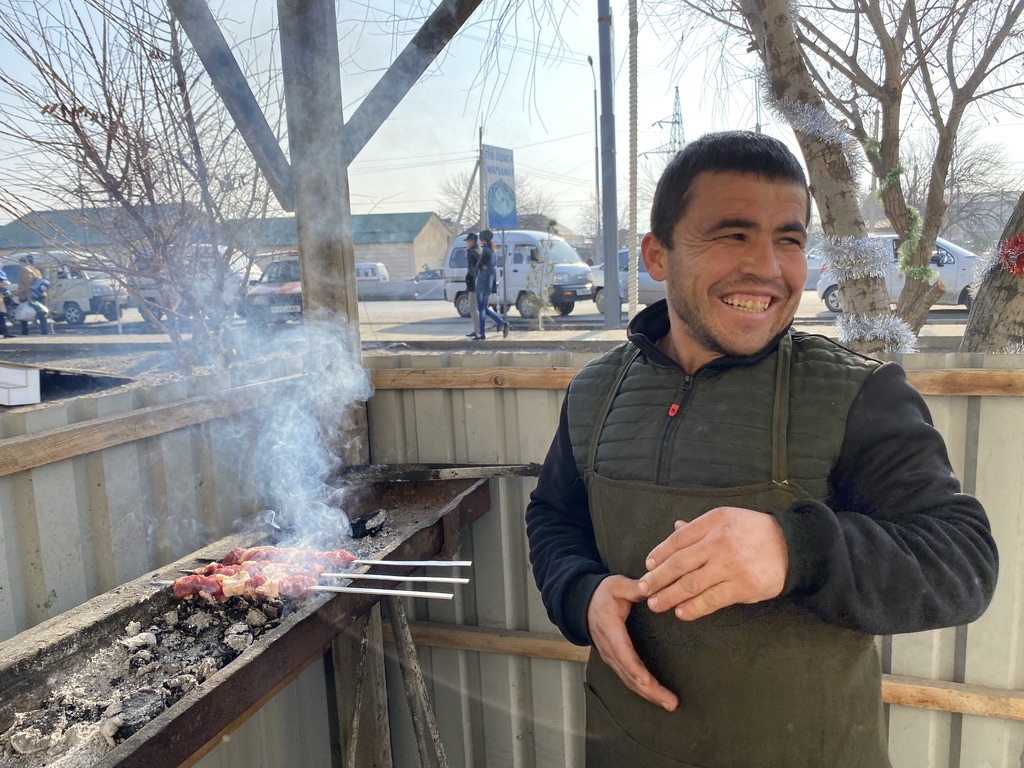

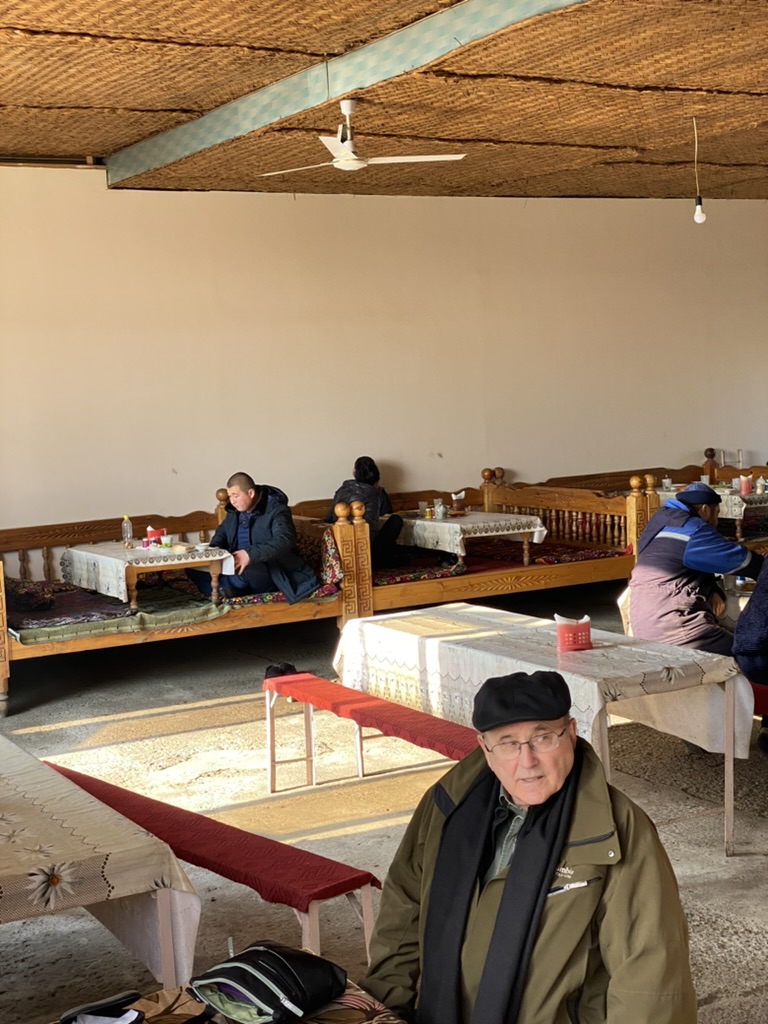
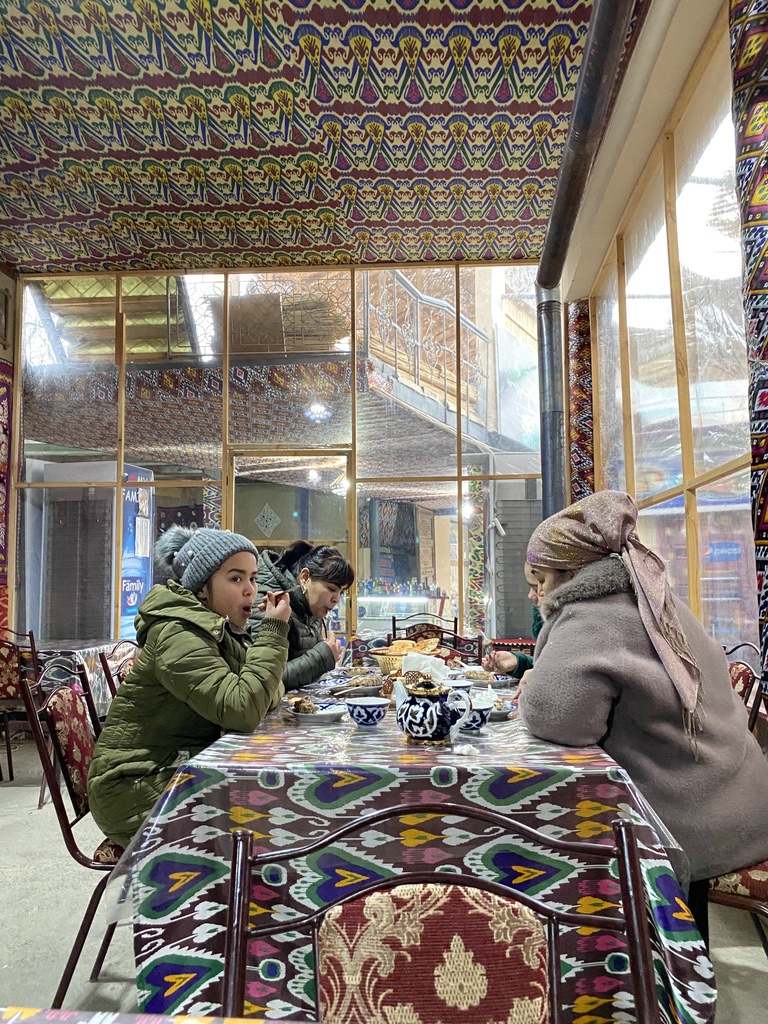
We sat down and clearly this was not a place for foreigners to eat. Many of the 20 or so tables were filled. Some tables had chairs; others required you to take off your shoes and sit cross legged. We opted for chairs. A few minutes passed but no one came to take our order. We weren’t sure we had done it correctly. Anyway, a little while later someone came out with a big platter with pickled cabbage, some kind of shredded green raw vegetable, two bowls of yogurt with dill, bread, tea, and cutlery. At first we weren’t sure this was for us. But we’ve traveled enough to figure out that this is some kind of first course or starter that everyone gets.
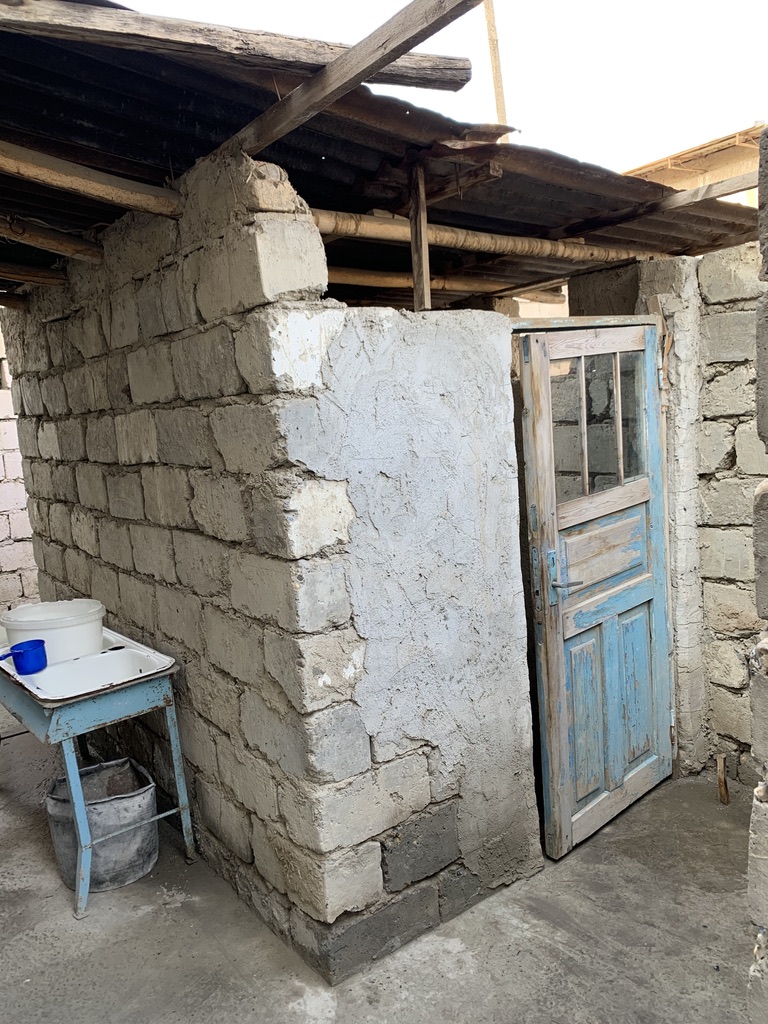
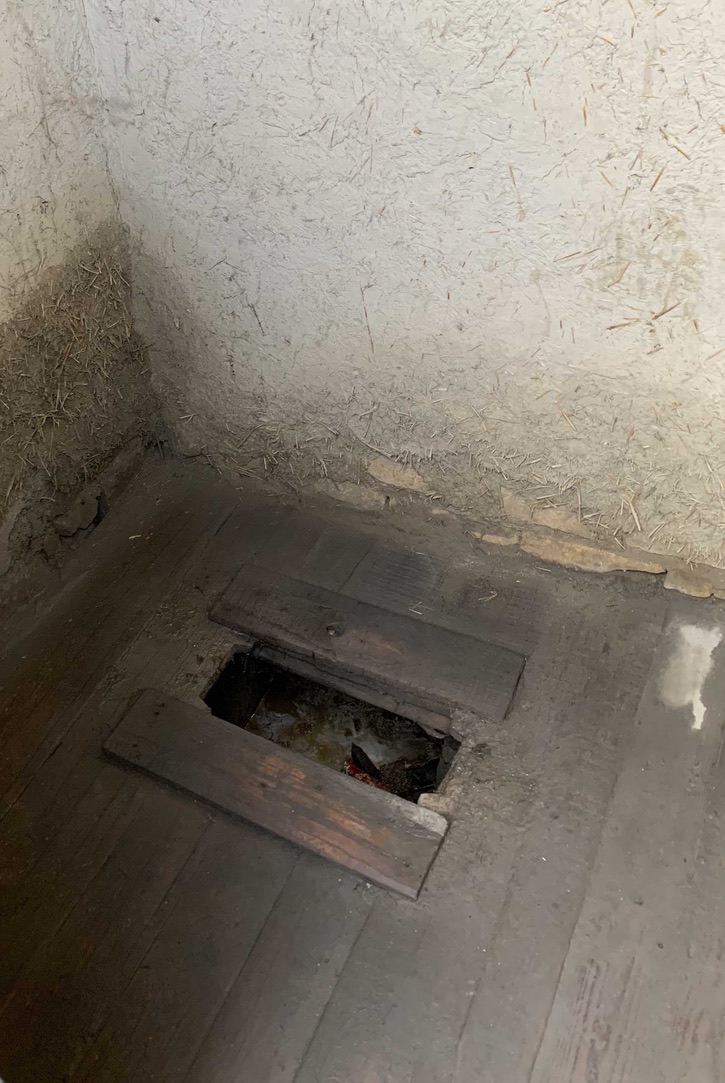
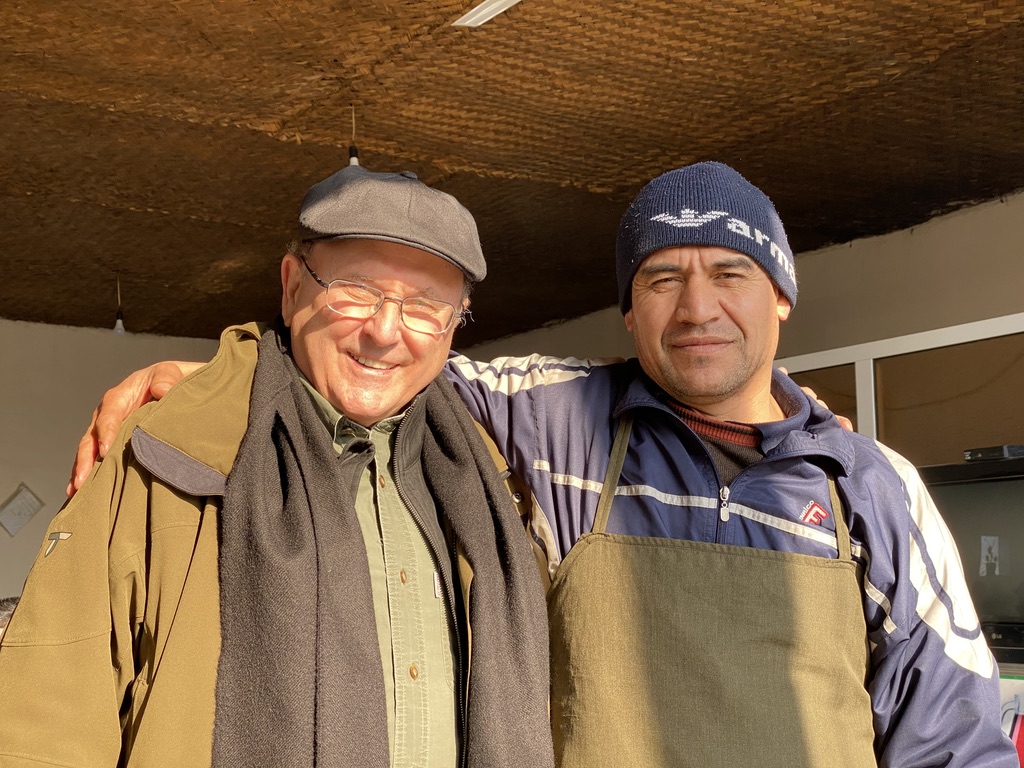
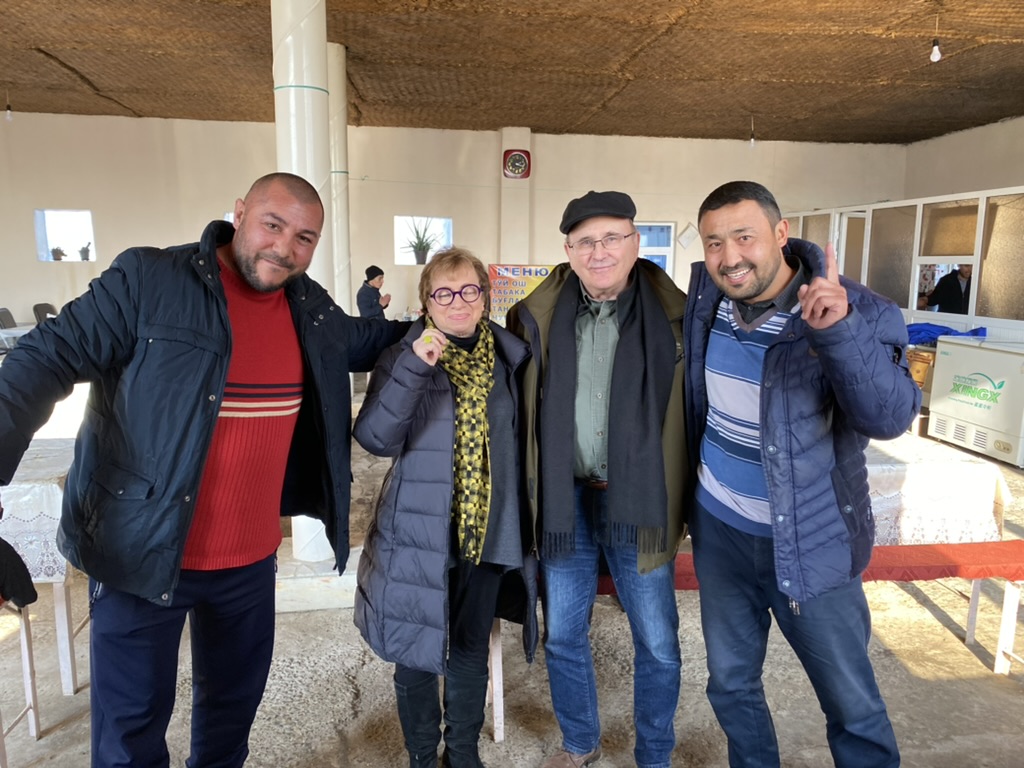
Eventually, a “waiter” came to the table and we ordered – without speaking the language. We pointed to the shashlik and said “lamb”… but we weren’t certain how many skewers came with the order or how big each skewer would be. We showed three fingers to indicate three skewers, but we must have looked a bit confused so the waiter went to a refrigerator and brought out the lamb skewers raw… and he had six skewers… We then pointed to one, two, three… and he smiled and went off to cook them on a little jerry-rigged barbecue outside. Of course I followed him and photographed. About halfway through our meal, another waiter came to the table with an order of “plov,” the national meat dish that is sort of like rice pilaf.. Mike ate that as well as his share of the shashlik. At the end of the meal, a group of guys (Uzbekis) asked to take a picture with us, so once again we are exotic. They seemed excited to learn we were Americans… they thought we were Germans. FYI, the picture of the toilet is compliments of Mike.. I knew better…
Then we were off again for the next two hours of our drive. We were using our own GPS and also a new app that the car rental guy suggested called MapsMe… It can give you directions and location information without being on WiFi which proved helpful when we lost a signal for a while.
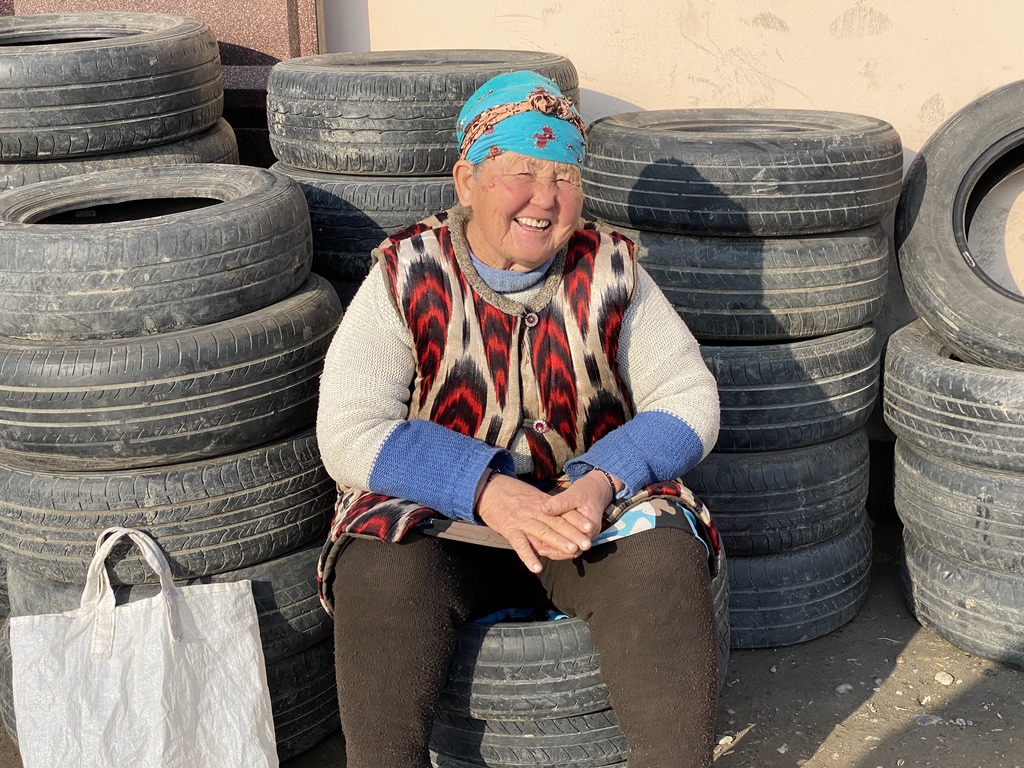
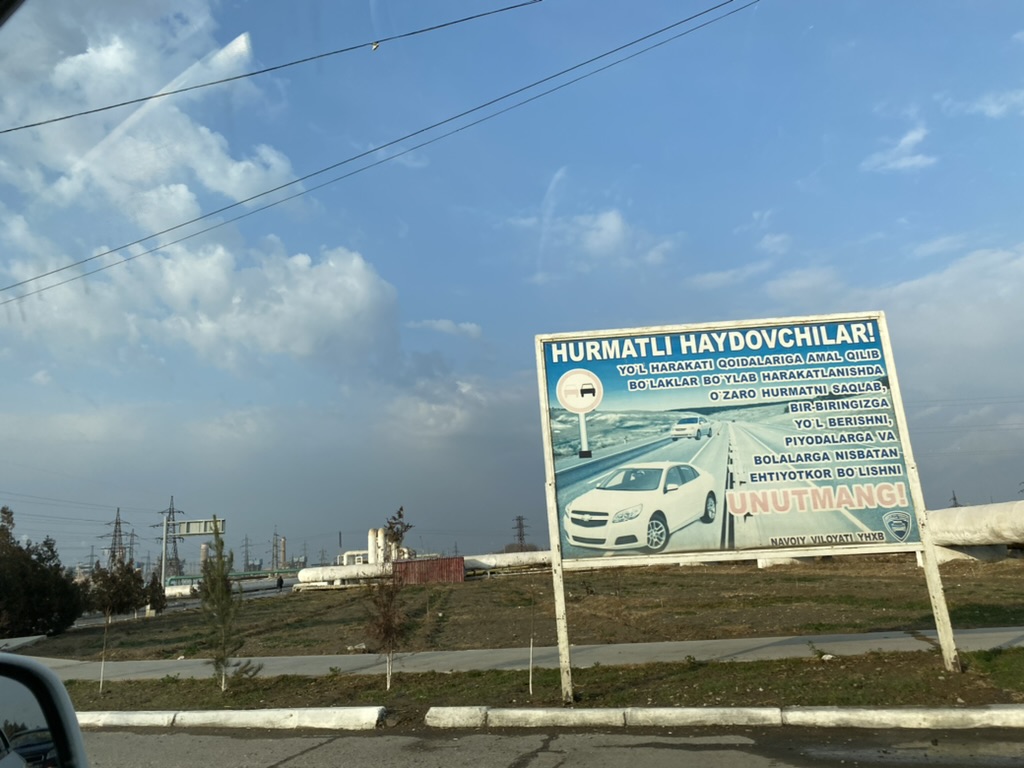
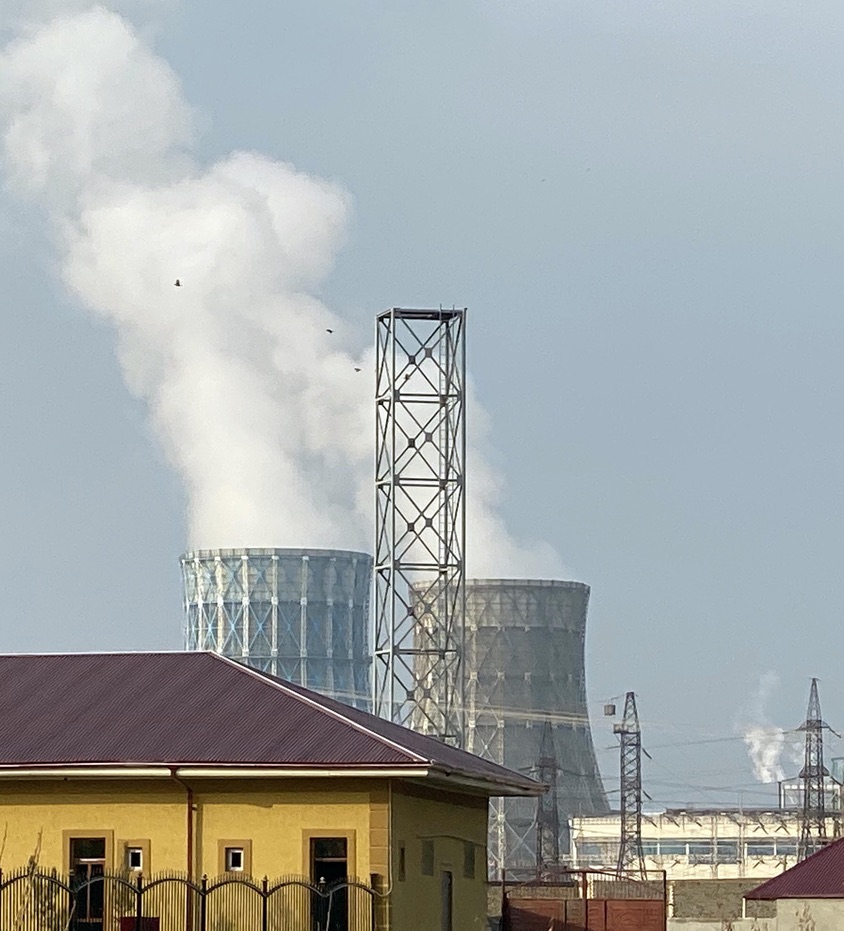
We had reservations at a hotel called Lyabi House Hotel which had looked quite nice on the Internet. But, while we thought we had a reservation we were a bit skeptical since, the hotel never answered any emails we sent regarding our arrival time. And we didn’t have any phone number. So, as we got close to Bukhara we talked about what would be good to have in a hotel for the next few days… especially given that while Bibikhanum was fun and well located, it was actually difficult once I developed my ankle problem. So we said we really needed a good mattress, a place that could bring ice to the room to ice my foot, and that had an interior lobby so that we didn’t always have to walk in the rain when we were actually already inside the hotel. We looked again at Lyabi House and it no longer seemed like the best option.. I searched the internet as Mike drove and a hotel called Malika Bukhara looked good.. and had good reviews. So I called and they had a room which we booked. We have no idea if we paid for Lyabi House or not.. but we decided it didn’t matter. Hotels are very inexpensive so we’d live with the consequences.
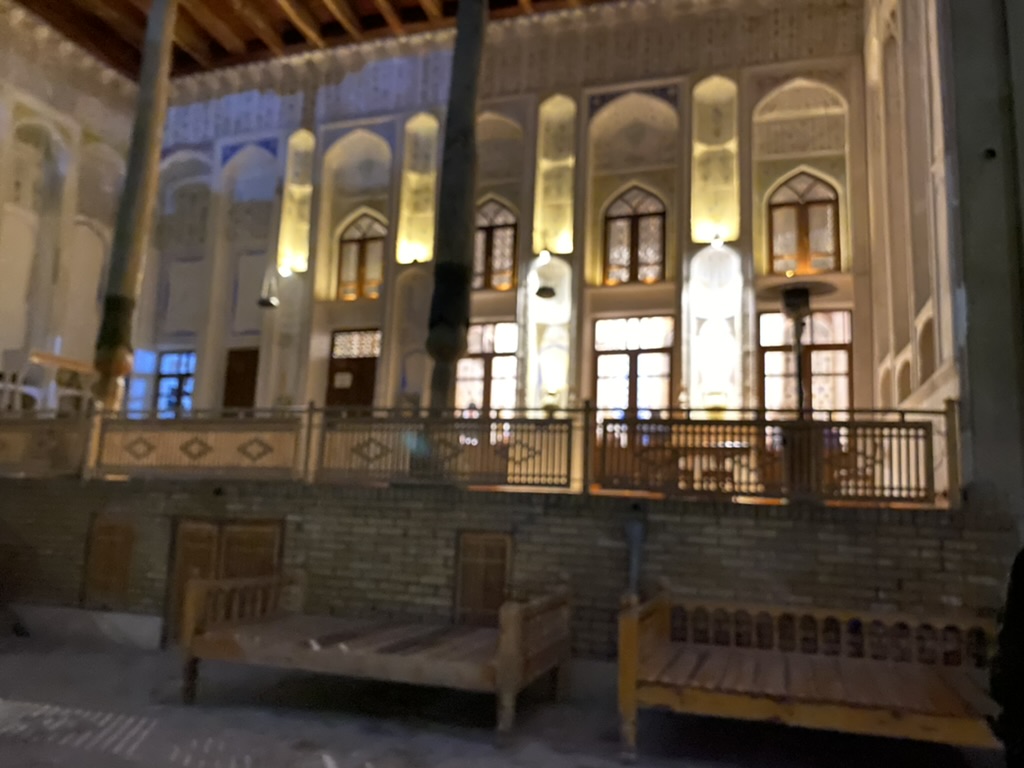
We arrived at Makila Bukhara and checked in… We asked for a really good restaurant recommendation — you guessed it…. Lyabi House.. So we got to our room which is on the second floor.. and guess what.. It’s an interior courtyard and you have to walk upstairs in the rain, just like we did at Bibikhanum.. and as we knew we’d have to do at Lyabi House.
Oh well.. We checked out the room – good mattress and they had ice, and even a plastic bag for the ice. Once we got settled in the room, we ventured out to dinner at Lyabi House.. more on dinner in a minute. The hotel looked really nice, and I think we were both a little sorry that we jumped ship so fast. Probably should have gone to Lyabi House, checked it out… and if we didn’t like it, then we could have moved on to Malika. The only drawback for Lyabi House would have been that it is about two blocks into a central square that is completely pedestrian… so if my foot continued to act up and we needed to use taxis we’d have to walk two blocks to just get to the taxi. We resigned ourselves that we made the right decision.
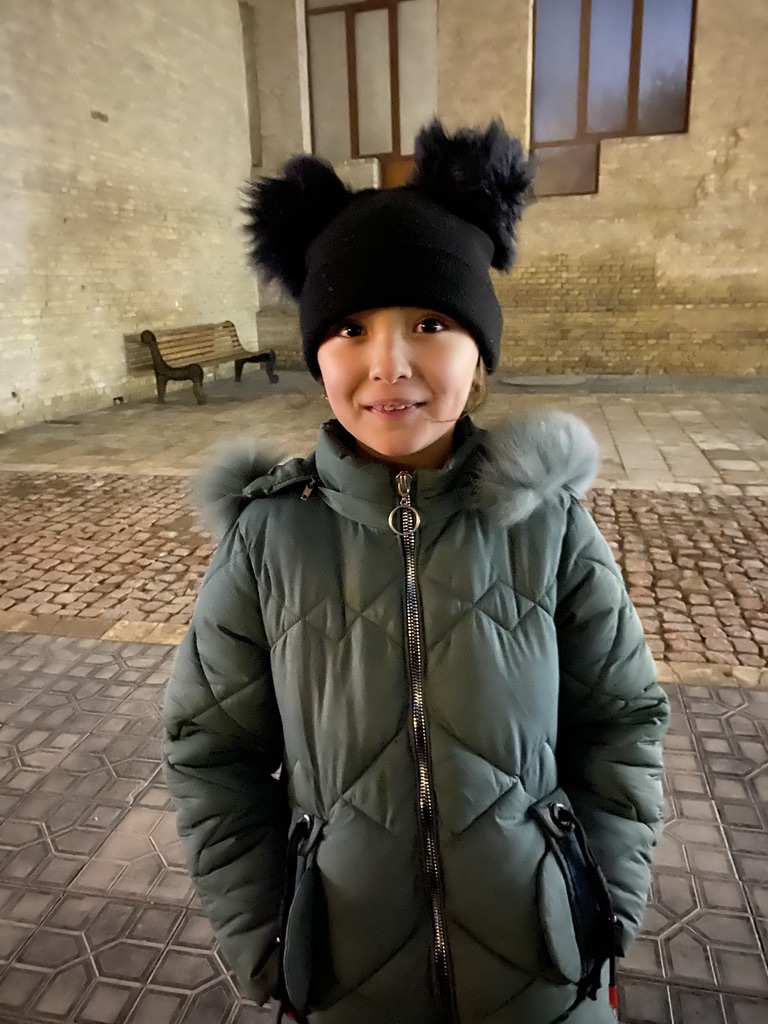
As we walked to Lyabi House for dinner, across the pedestrian square, a little girl approached us and said in perfect English: “Hello, my name is Lucilia (or I think that was the name); I am 10 years old…” We asked her grade but she had a little trouble with that one.. and we asked if she lived in Bukhara. She didn’t; she lived in the Fergana Valley; she was visiting Bukhara with family. As I turned around I could see her beaming mother who was now videoing my conversation with Lucilia who then started over again: “Hello, my name is Lucilia; I am 10 years old.” We did chat a little more as I asked very very simple questions. With each response the mother seemed happier. Then we hugged for the camera and I took a very quick picture of Lucilia. Not sure where all of these pictures and videos that people are taking of us are going. Then again, they don’t know where all the pictures we are taking of them are going either!
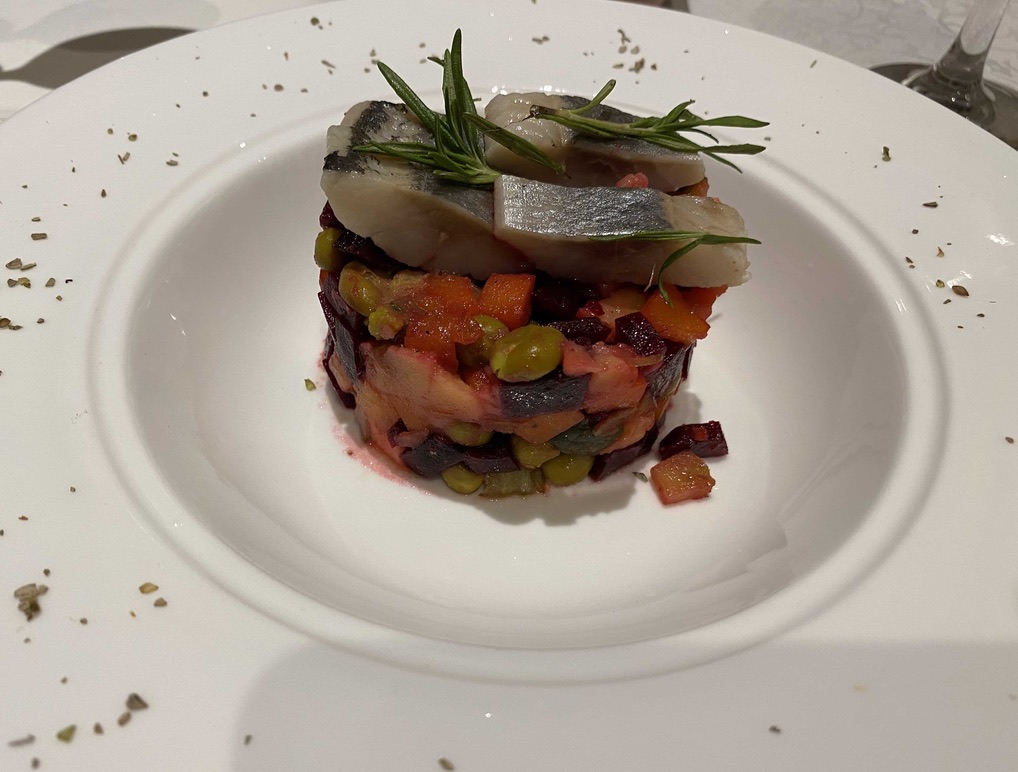
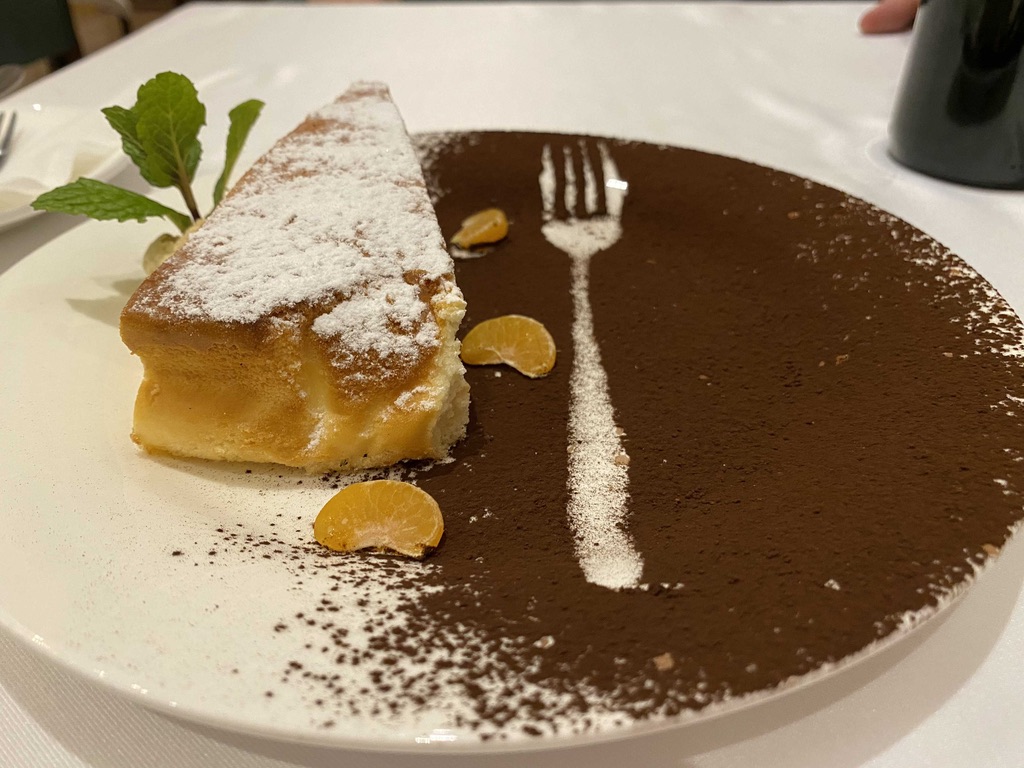
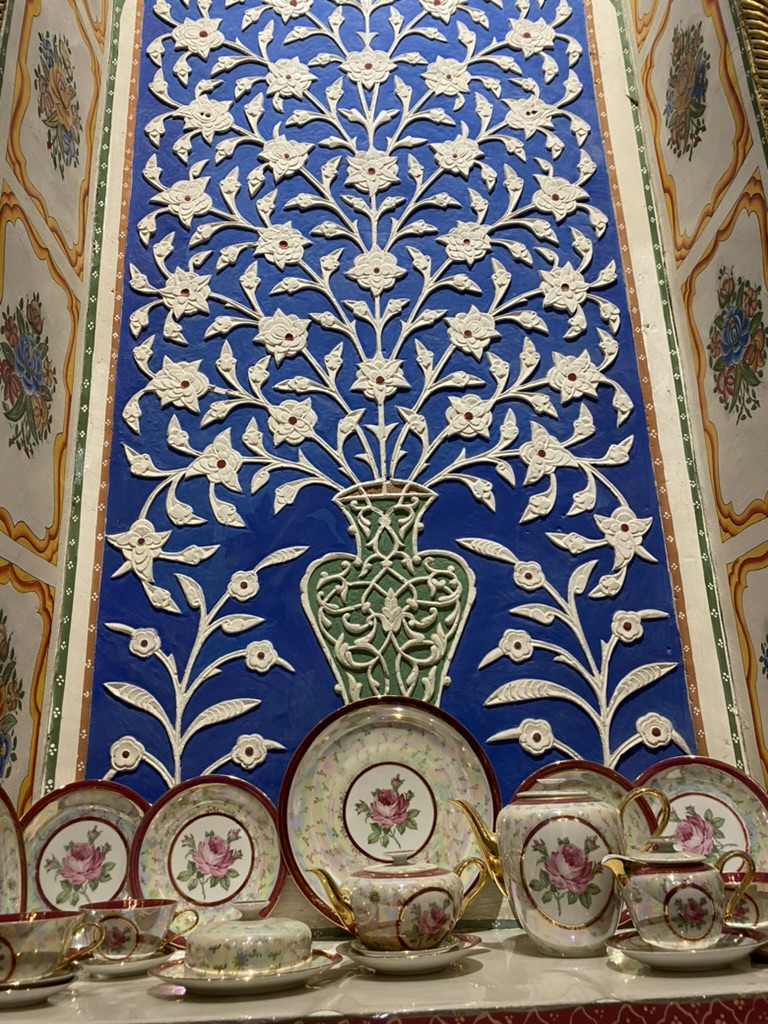
But, dinner at Lyabi House was actually wonderful. First truly good meal we’ve had in Uzbekistan. The restaurant is within a 135-year old building, across the courtyard from the hotel. We had an appetizer of marinated herring in a vegetable salad (really a sort of compote of chopped marinated vegetables on top of which sat the pieces of herring); little raviolis stuffed with lamb served in a very very light pesto sauce; medallions of veal with a simple balsamic sauce (cooked perfectly rare as we requested — first time a restaurant here understood “rare” and first time the meat wasn’t leathery); we ended with a very very wonderful and unbelievably light cheesecake. We had a whole bottle of red wine (from Uzbekistan which was actually good.
The bill for the dinner which could stand up easily to a Bay Area dinner… was $21.00!! Truly amazing. We already made reservations to return on Tuesday night again, for dinner. The waiter was delightful. He was super-excited to practice his English (which wasn’t bad, although he apologized profusely and asked us to correct him if he makes mistakes. He has been trying to take the TOEFL exams although I don’t think he’s planning to study in the US. Since he seemed to like food, we asked for recommendations of other restaurants in Bhukara and now we are set. By the time we left Lyabi House it was raining and very very cold. Supposed to rain all day tomorrow so we will have to figure out a plan..
Best –
Fern
Last Day in Samarkand. January 4, 2020
Last Day in Samarkand – Rainy, muddy, Hobbling a bit (swollen ankle)
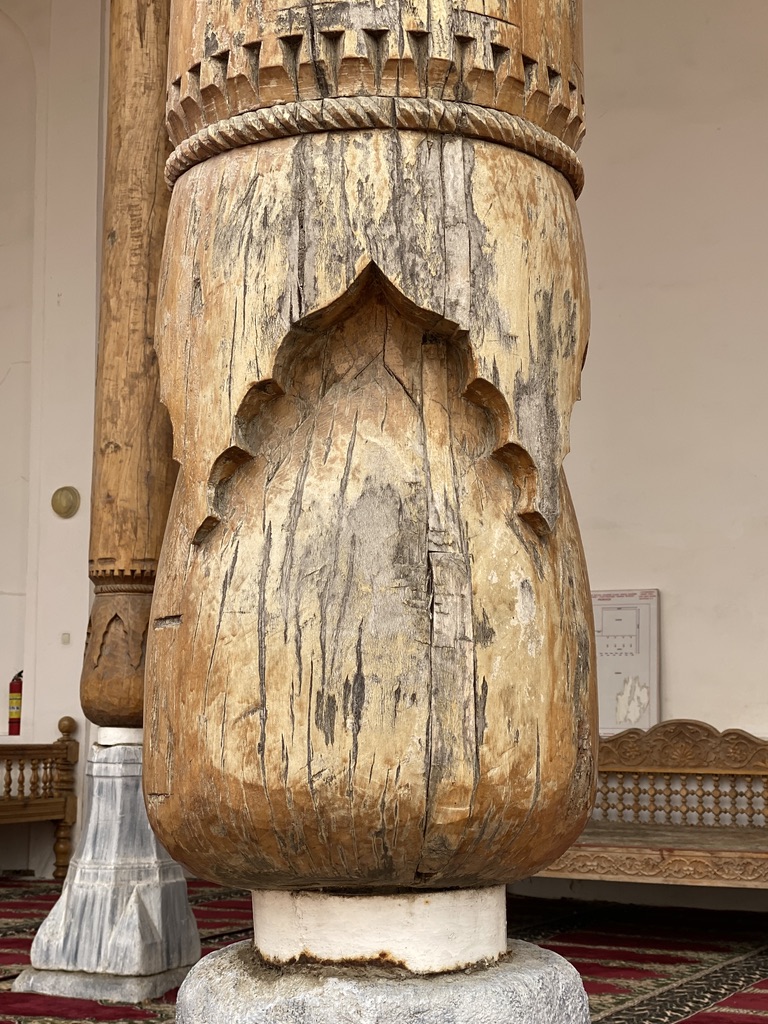
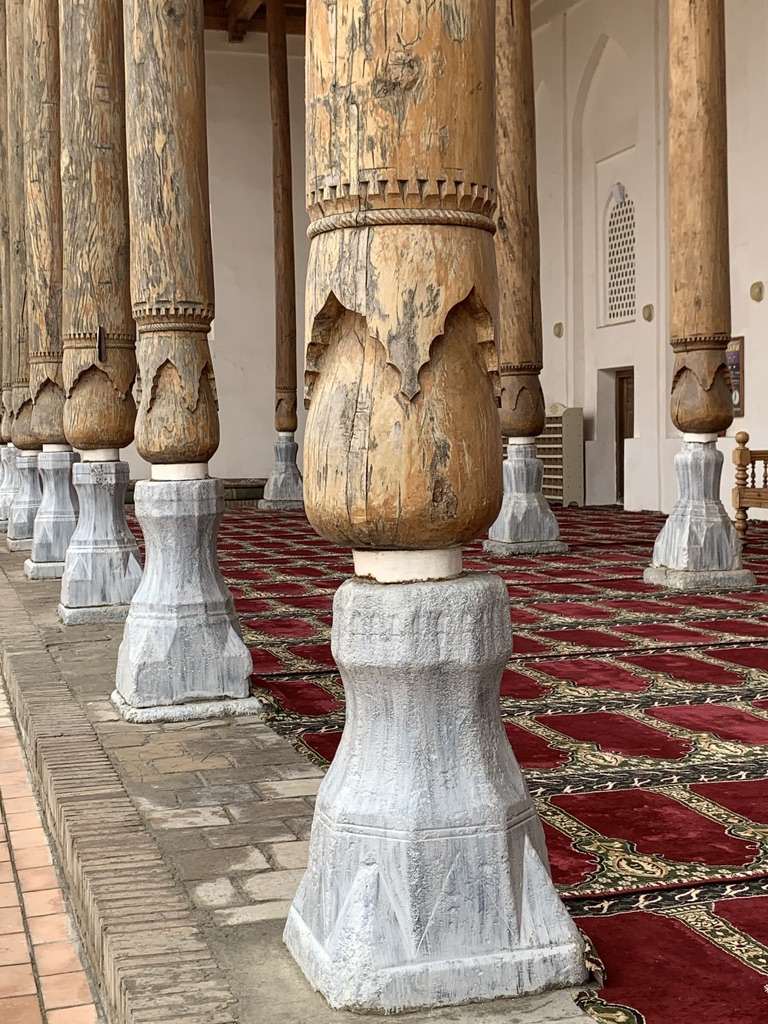
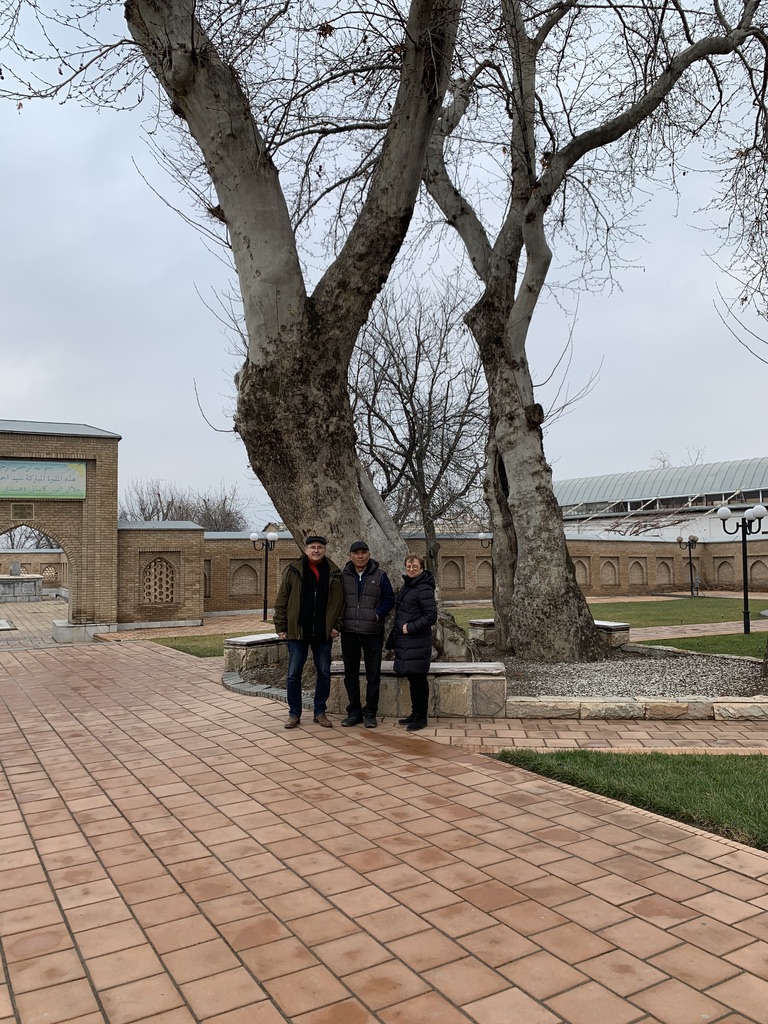
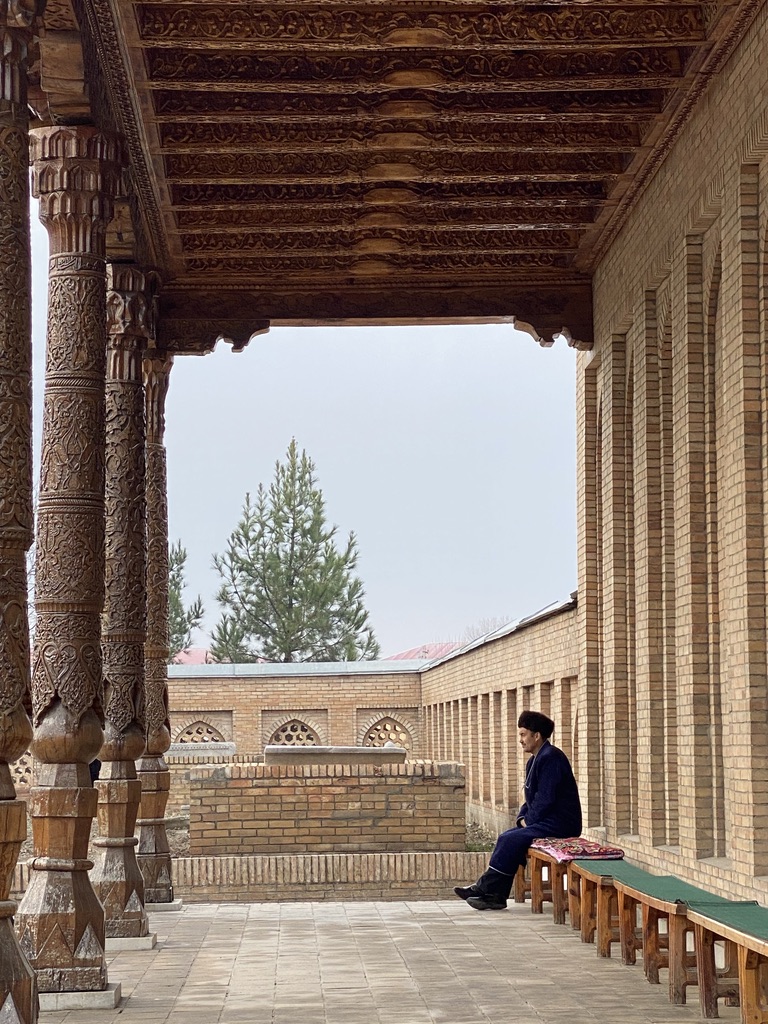
Began our day by meeting up with the same taxi driver we had yesterday.. Figured, given that I’m still walking quite slowly, it would make sense to get driven to a few destinations rather than navigating the very uneven streets and potholes amid the rain. When we got to the taxi, the driver had his grandson in the car as well. He’s a very sweet and bright 8th grader who’s been studying English since 4th grade. I think the grandfather wanted to show him off and also help with communication – and to give the kid some opportunity to practice his English. So we found out a lot about the family – The grandfather is his father’s father. His father is a dentist and his mother is a nurse. He hopes to study aerospace engineering and has dreams of coming to the U.S. where he has an uncle (living in Queens – where I now gather there must be a large Uzbeki population). The family speaks mostly Russian at home, although they all speak Uzbeki with the grandparents. And he clearly said he only speaks Russian to his father. I asked why and he said his father (the dentist) prefer Russian and why his Russian is better than his Uzbeki. I looked surprised so the boy said that his father grew up in the Uzbekistan Soviet Socialist Republic so it was normal to speak Russian.

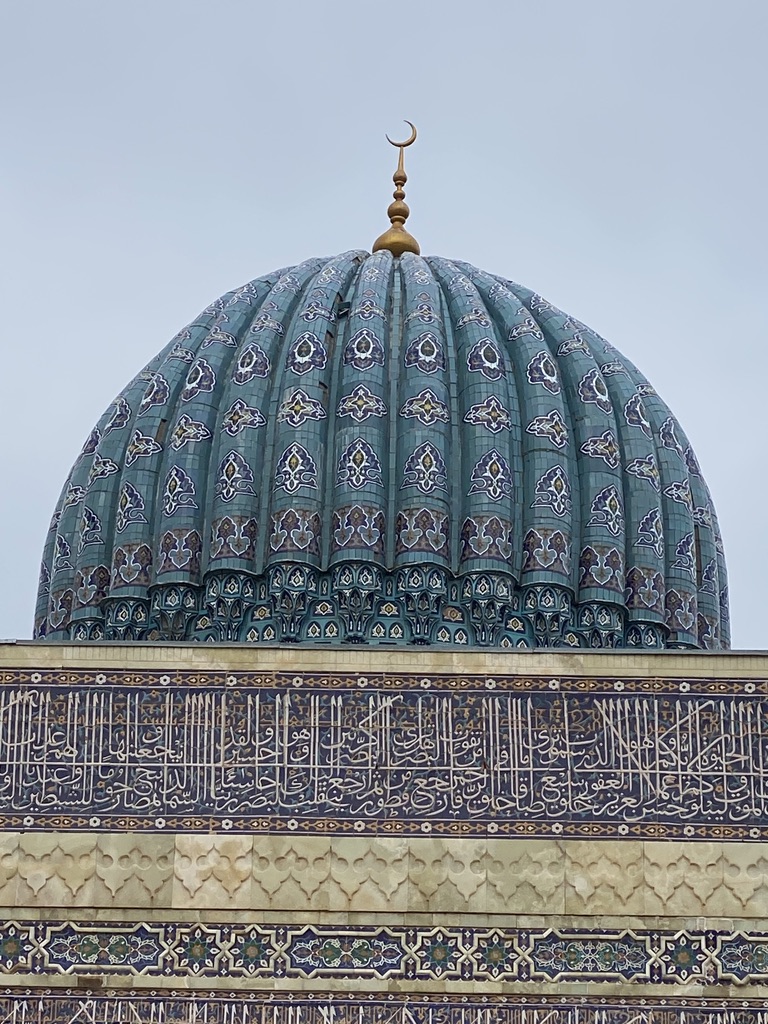
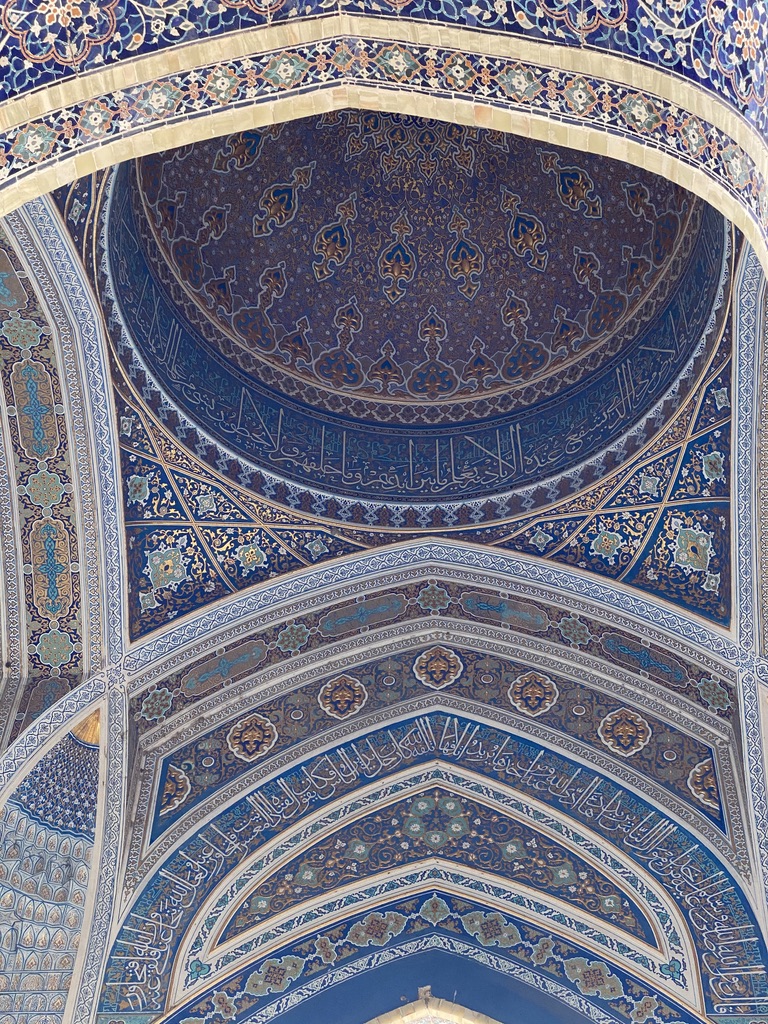
Anyway, as we drove and then walked to our destinations I chatted more with him. It was funny because with adults when we say we are from California, they immediately harken to Arnold Schwartzenegger or Hollywood, but at 14 he immediately said… “California – that’s where Apple is.” And then he said.. “Mark Zuckerberg lives in California… and Steve Jobs lived in California.. and then he listed all the major tech companies and he knew all the founders of these companies! I asked if he had ever traveled out of Uzbekistan and he said he had been to Russia with his family. But NY is the dream. We also learned that kids go to school six days a week (they are off on Saturdays) from 11 am until 6 pm.

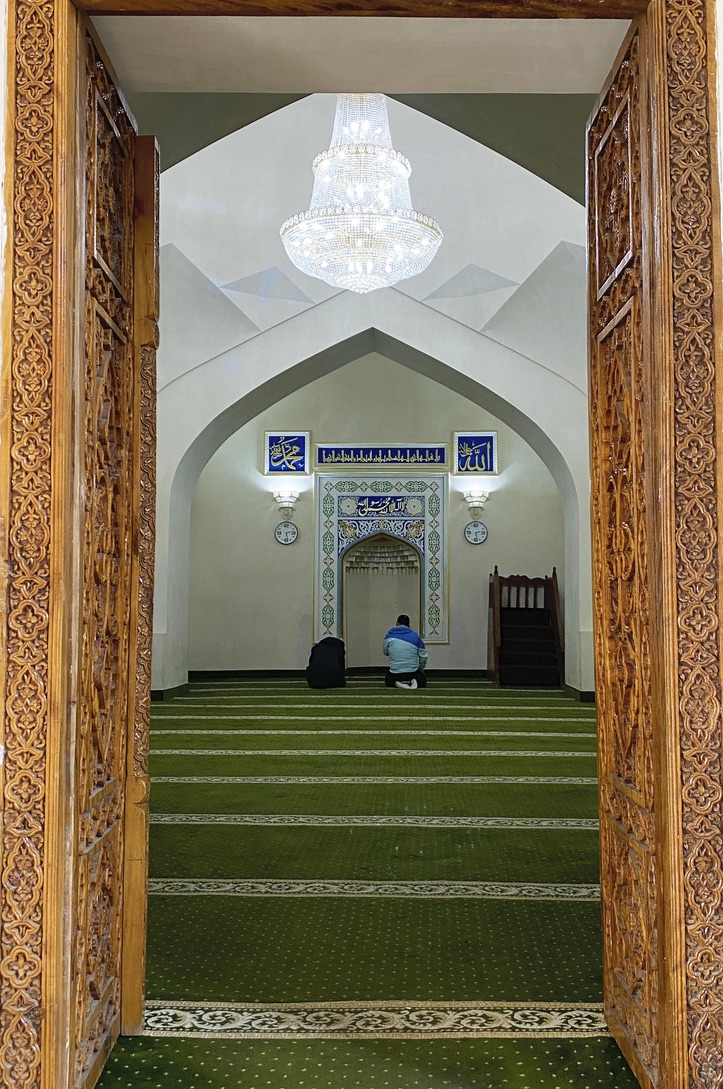


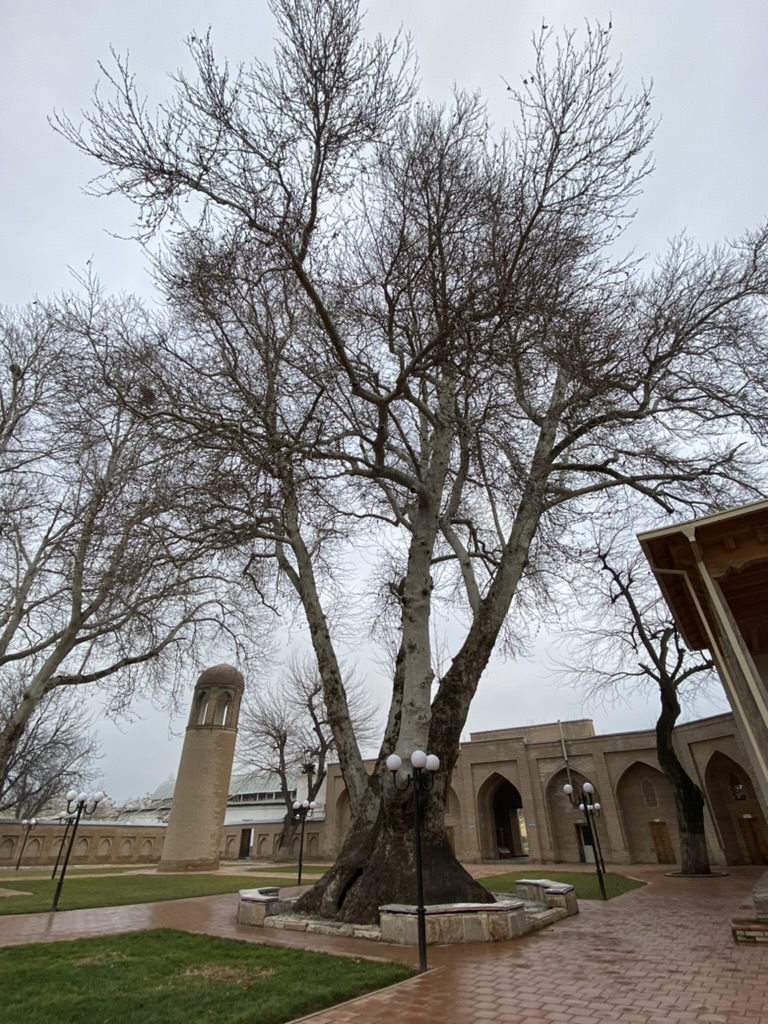
Anyway, we headed first to Maftumi Azam – a small and beautiful place that is both a mosque and a mausoleum – and the architect/builder of Zinda is buried there. The driver seemed to be very partial to this place as he loved the very old trees and the beautiful wood columns (hand carved) that supported all of the roofs of the outdoor prayer pavilions. He especially wanted us to take pictures under one particular tree which he said was 500 years old.


Once we took the pictures we were off to see the mausoleum of Imam al-Bukhari who was a famous Persian Islamic scholar who authored the most famous book of hadith which is said to be the second most important book for Sunnis after the Koran (at least this is what I think is the case). He was born 200 years after Muhammed (in 810). At age 16 he made the pilgrimage to Mecca with his brother and legend has it that he spoke with more than 1,000 men to gather the hadith (wise sayings about life). [Given the work our firm does and how much we rely on one-on-one interviews, I like this guy! ] Anyway, the unbelievable “tombstone” is quite a an impressive site. Many Uzbeks and Russians were visiting. Seemed to be a place for families to gather.

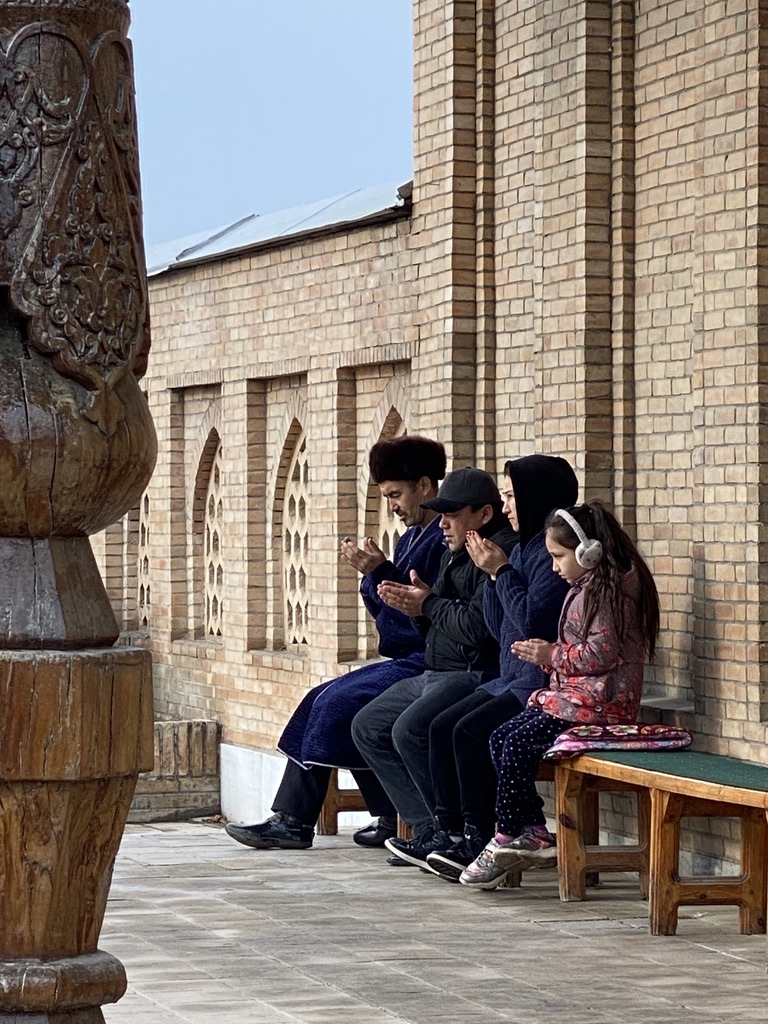
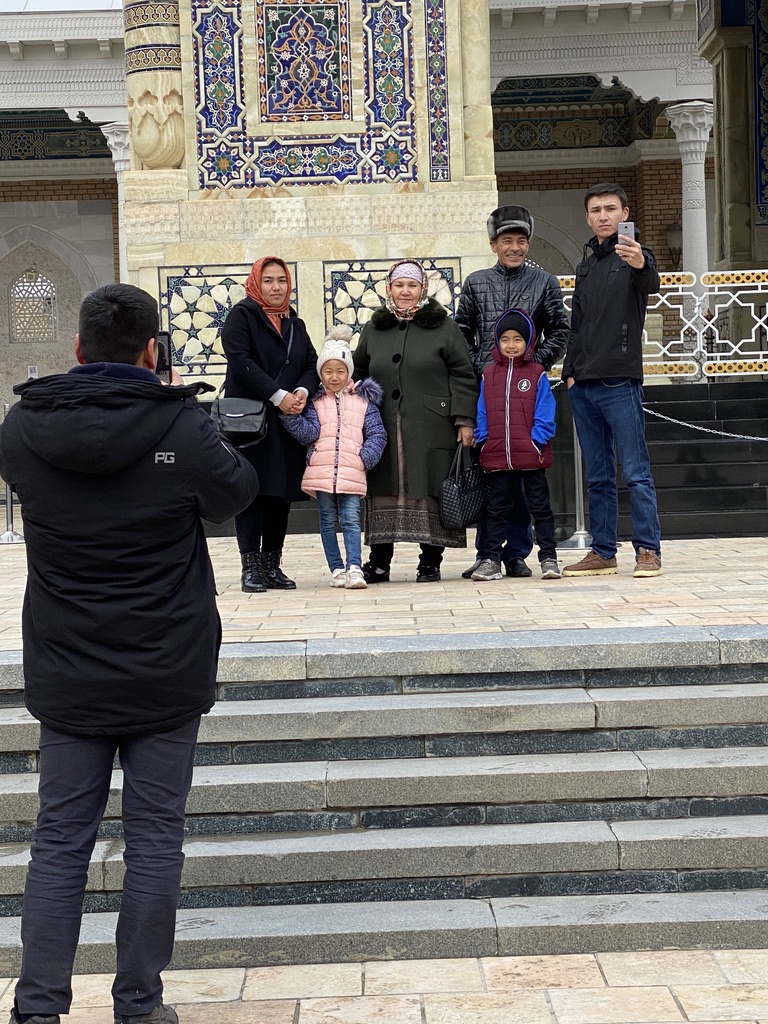

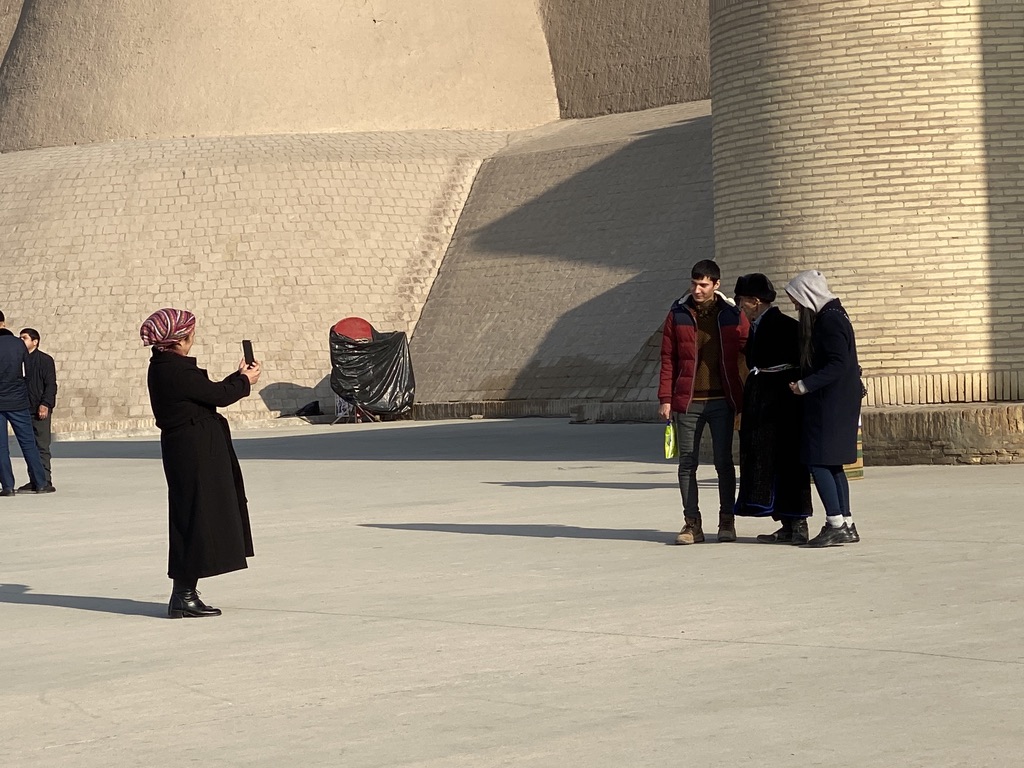
The number of people and families posing in front of the structure was fun to watch as people took photos and selfies over and again. I took a slew of photos of people taking photos to add to my growing collection on this theme.
Then we headed to see a traditional (private) paper-making “factory” located just outside the city. It’s sort of like a park with a babbling brook. While there weren’t any tourist groups visiting when we were there, it’s clear that Meros Paper Factory has plugged into the tourist scene and provides tours and tea and has a shop that sells its products. But it was fine because it was just us and they did walk through their paper making process which was quite interesting. I’ve seen papermaking in the states and this is quite fascinating since it’s all done by hand using ancient methods without benefit of electricity (all powered with water wheels).
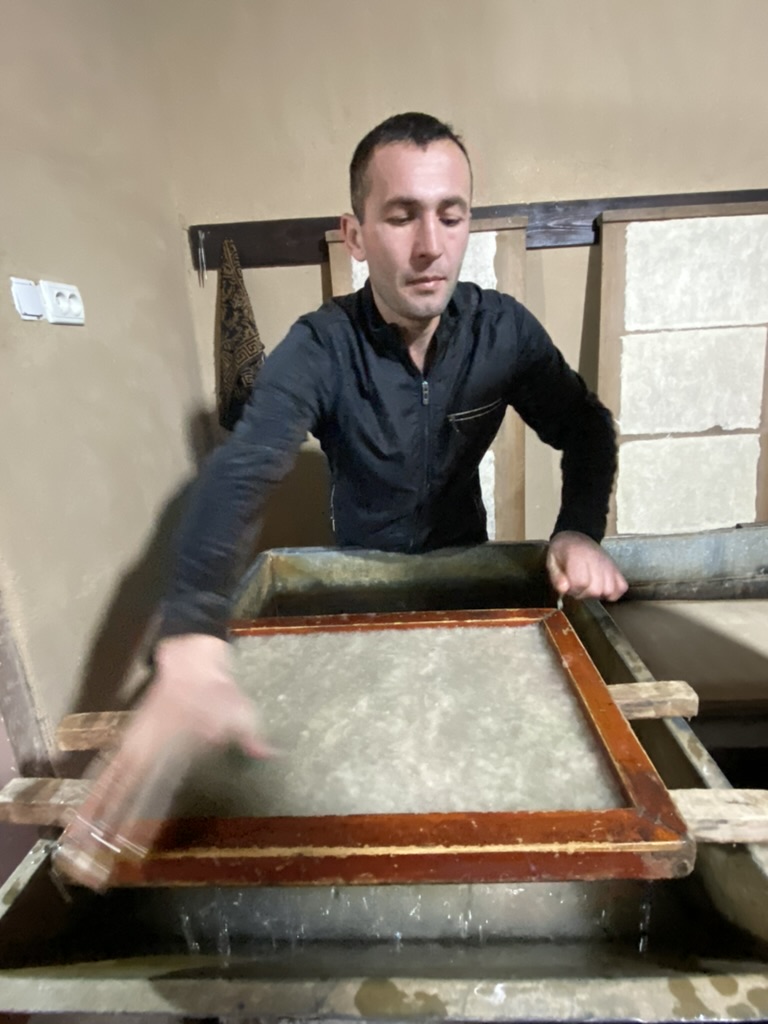

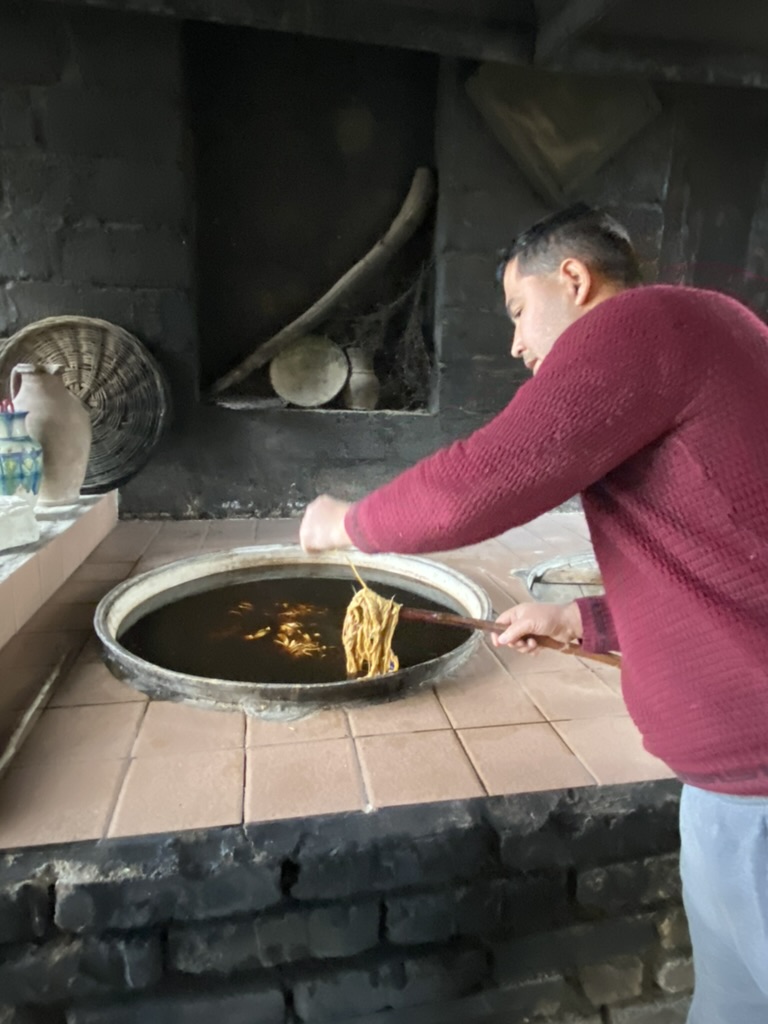
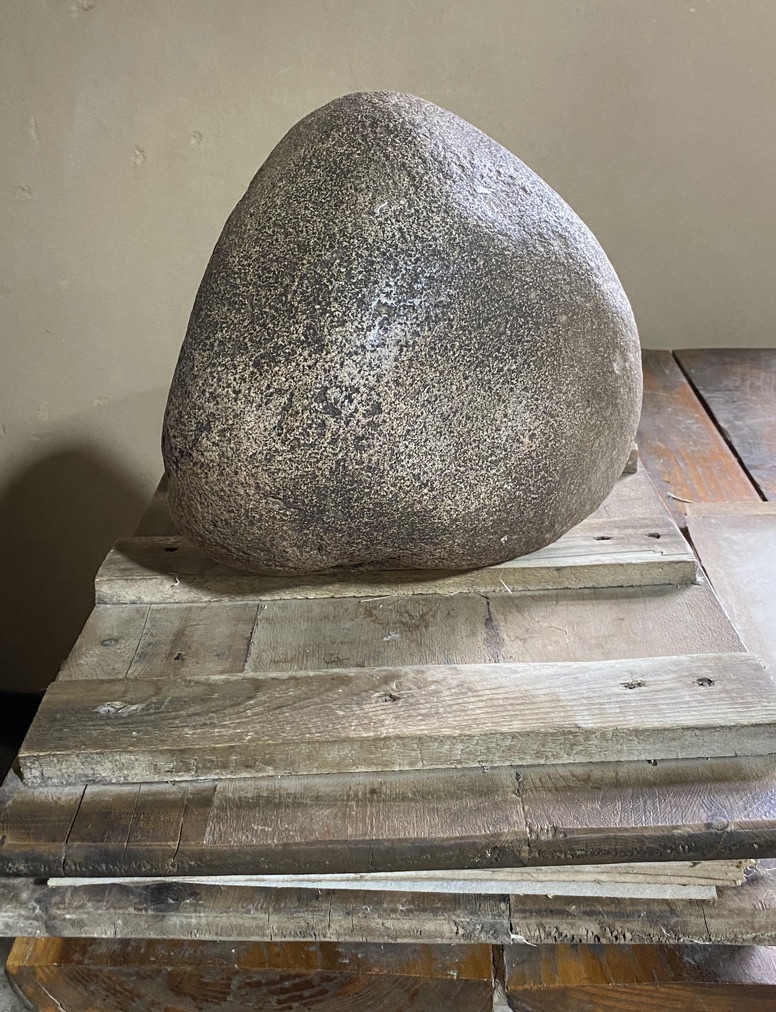

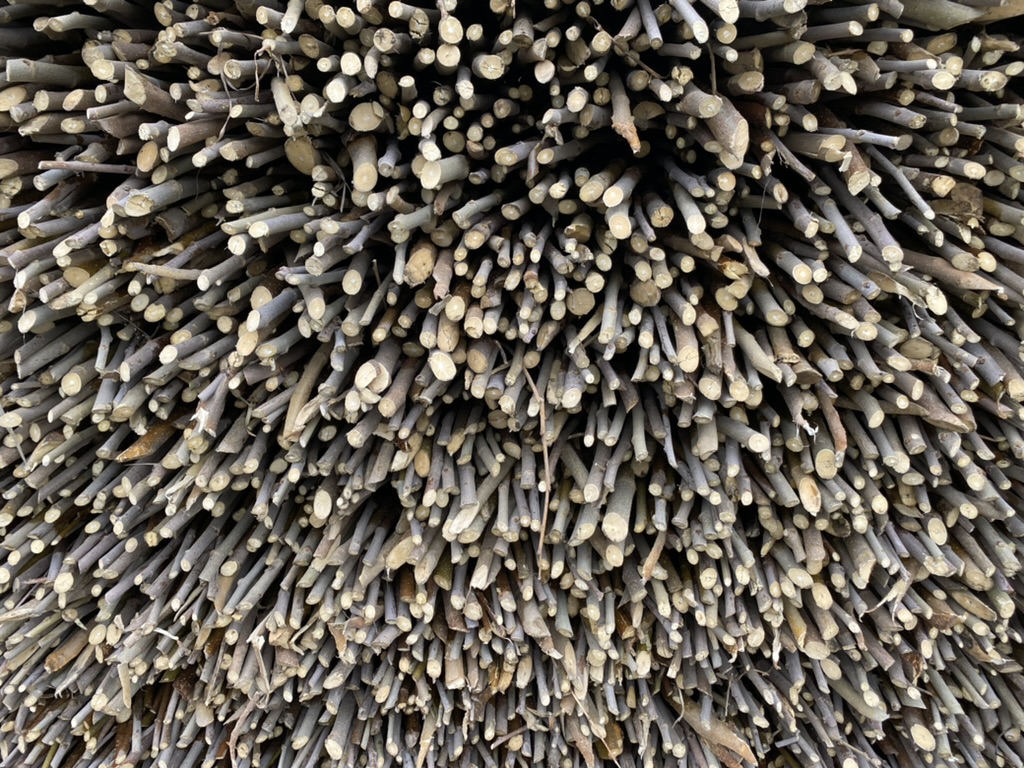
It’s all done manually using water to provide the energy for the factory’s mill wheel. They use “strands” of mulberry bark for the raw material which is cleaned and boiled for many hours and then mashed. Then, when the pulp reaches the right consistency, it’s filtered and spread over screens and set to dry (after the excess water is squeezed out of the raw paper). They make two different kinds of base paper; one is very smooth for writing. To get it smooth, they rub it with sea shells or bones (very smooth objects) for about 15 minutes per side for each sheet (about 11 x 16”). They do this “polishing” on a slab of marble. The other paper is left “rough” and yellowish and is sometimes dyed. The unpolished paper is truly beautiful and a work of art. The mill has a little shop where they sell the paper as well as some paper products like wallets and dolls and calendars… and even some paper clothing. One vest was quite tempting.
Supposedly, this unique process came from China by captured soldiers (after a failed invasion of Kyrgystan in 751) , some of whom were artisans. To avoid being executed, the artisans gave up their paper making techniques to the ruler of Samarkand who passed the art form on to local Samarkand artisans. The paper made in Samarkand was famous and used for Persian and Arab manuscripts in the 9th and 10th centuries. The technique was used for about a thousand years until the factory was destroyed in the 19th century. It was resurrected recently.
Then we headed back to the hotel and strolled briefly in the rain to get a light, late lunch near the hotel.


Tonight the pickings were slim for dinner. Apparently Samarkand is still in New Years mode and many restaurants are closed until January 6. So our choices (according to the hotel) were: the hotel restaurant, Platan where we ate on Thursday night, or Samarkand where we ate last night. We opted for Platan and did a much better job on selections tonight, so I’d say the meal was just fine. Nothing to send to Michelin, but ok. We ordered Uzbeki samosas, s plate of grilled vegetables, a lamb dish (a la Platan), a chicken shishkebab, two glasses of wine (for Fern) and two shots of scotch (for Mike) and followed it all with a shared piece of “traditional cheesecake” and green tea. The bill was $32.00… !!!
Taxied to the hotel – stopping at an ATM (they often don’t work and you can only get the equivalent of $50 – 500,000 som – at any one time. And given that a lot of places don’t take credit cards.. you always need to have a lot of cash. The denominations are generally in 50,000 units so you’ve always got a lot of bills and your wallet is really fat. We made our way along that awful ledge to the hotel and now we have to pack to leave in the morning – we will drive four hours to get to Bukhara. We’ve been warned to get petrol in Samarkand because there aren’t any petrol stations on that four hour drive. Should be interesting.
One last comment… in the old section of town where we are, the pothole situation is pretty awful. We’re always complaining about Oakland potholes, but now maybe that we’ve seen these we’ll be more gracious about Oakland’s lack of attention to this infrastructure situation.
Best –
Fern
 Fern's Travel Notes