Trials and Tribulations of Travel in Africa 12/23/2018


Greetings –
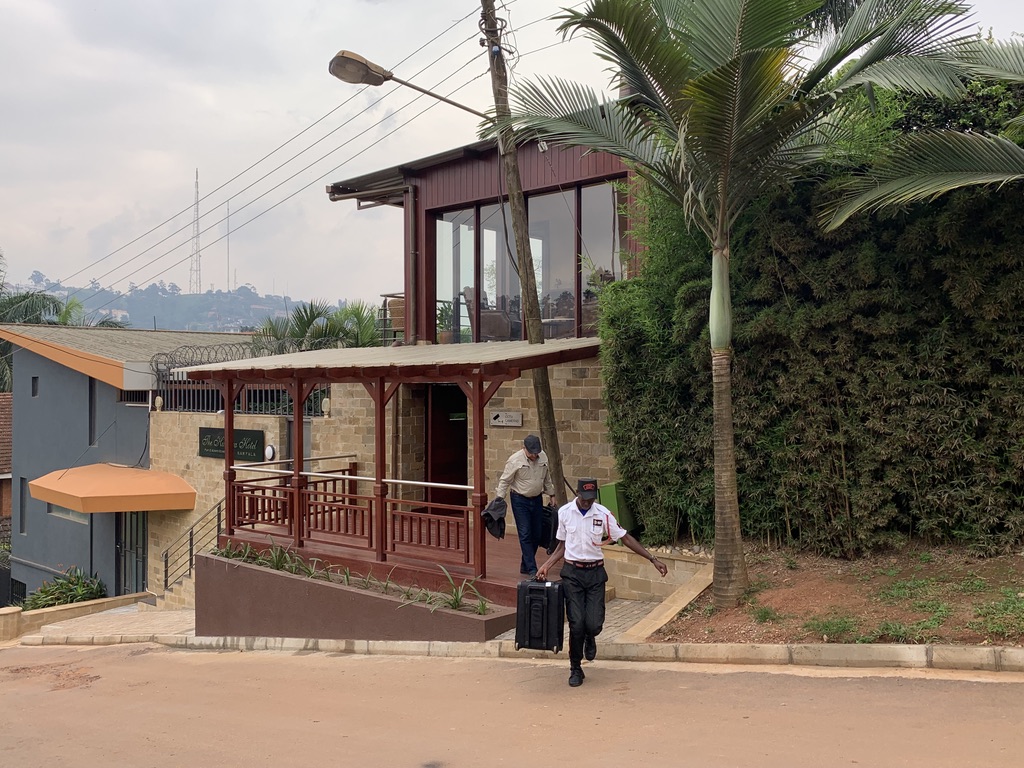
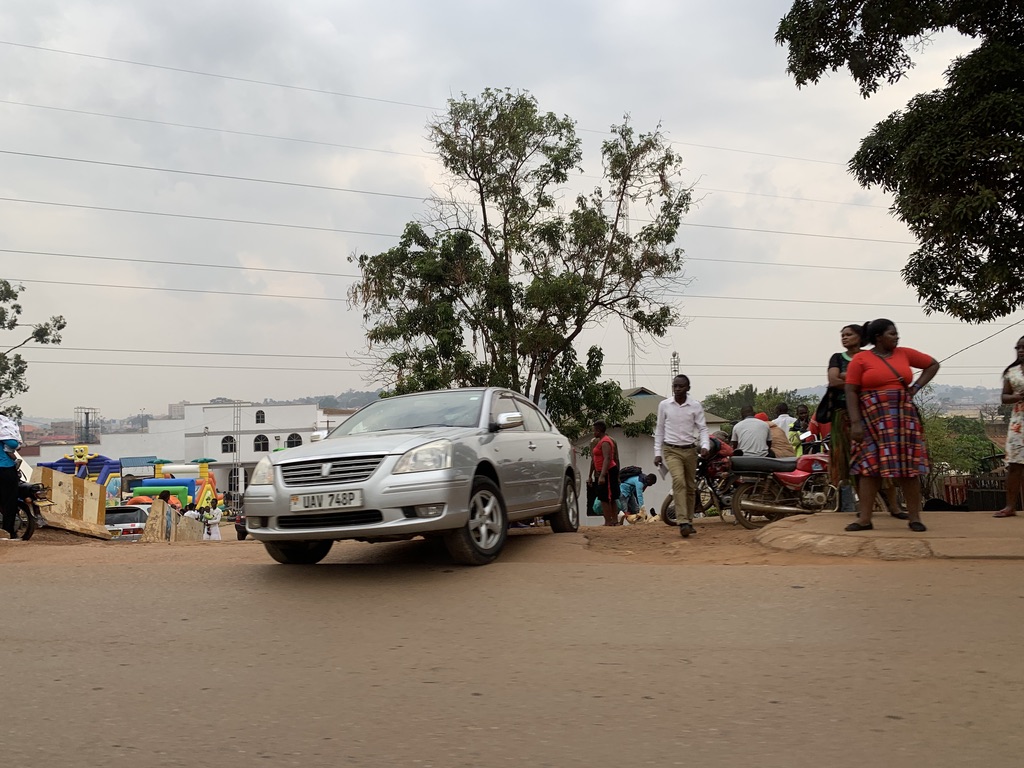
While we had hoped to see yet more of Kampala on our last day in Uganda, we kept being warned that the drive could take anywhere from one hour to three hours to get from our hotel to the airport (although it is technically about a 30 minute drive). So we succumbed and hired a taxi to pick us up four hours before our flight boarding time – the taxi arrived promptly at 11 am (boarding was at 3:00). The drive from our hotel in Kampala to the airport which is actually in Entebbe is a distance of about 40 kilometers (25 miles), so the four-hour timing seemed ridiculous, but we already knew that it took us two hours in the other direction and that we had now experienced waiting at intersections for more than 15 and 20 minutes. There are no traffic lights in Kampala and they have these occasional roundabouts but they just seem to actually cause more jams as so many roads intersect at each roundabouts they become a total mess and create gridlock. So we began our driving adventure with the same taxi driver we had the day before.
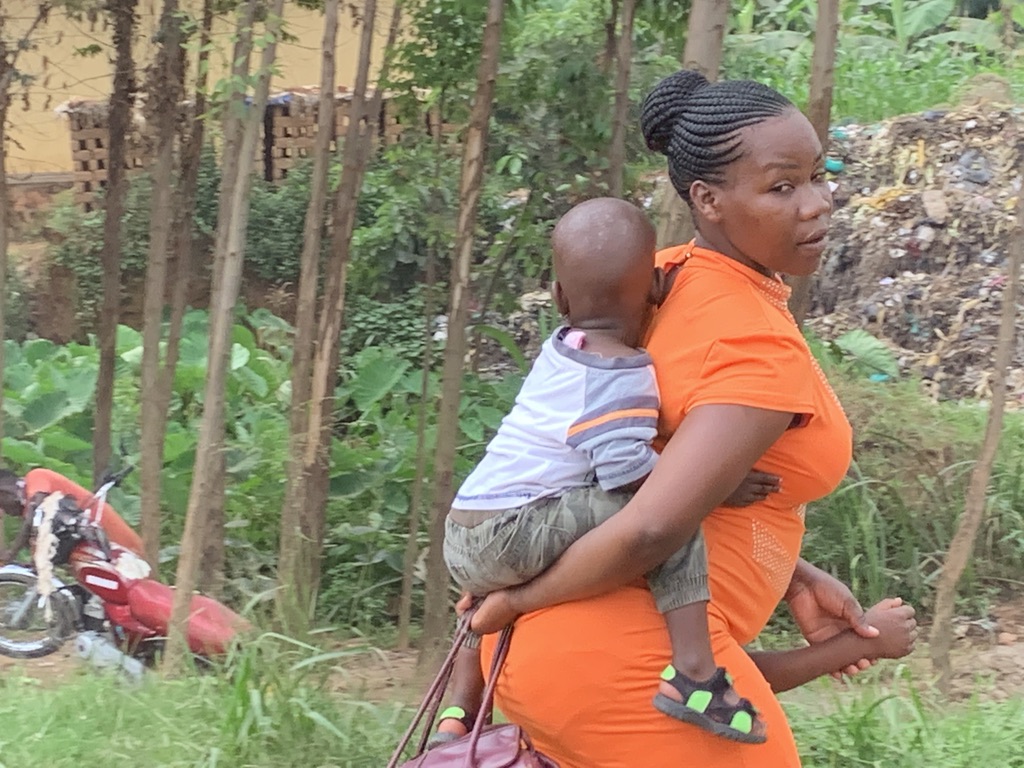
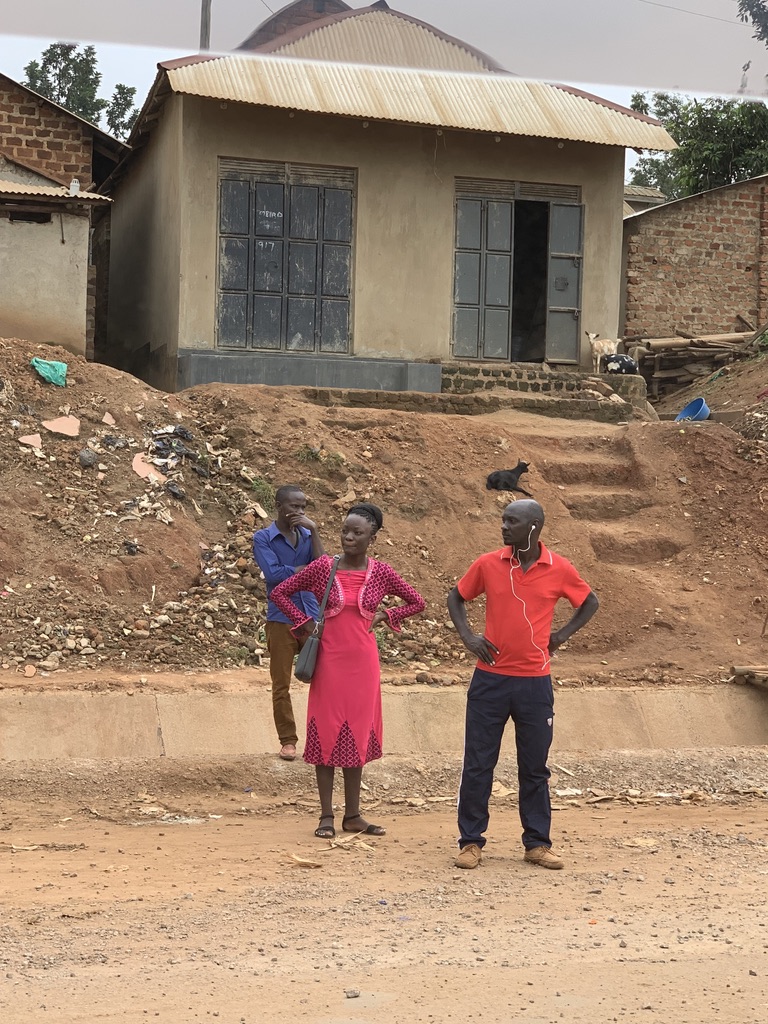

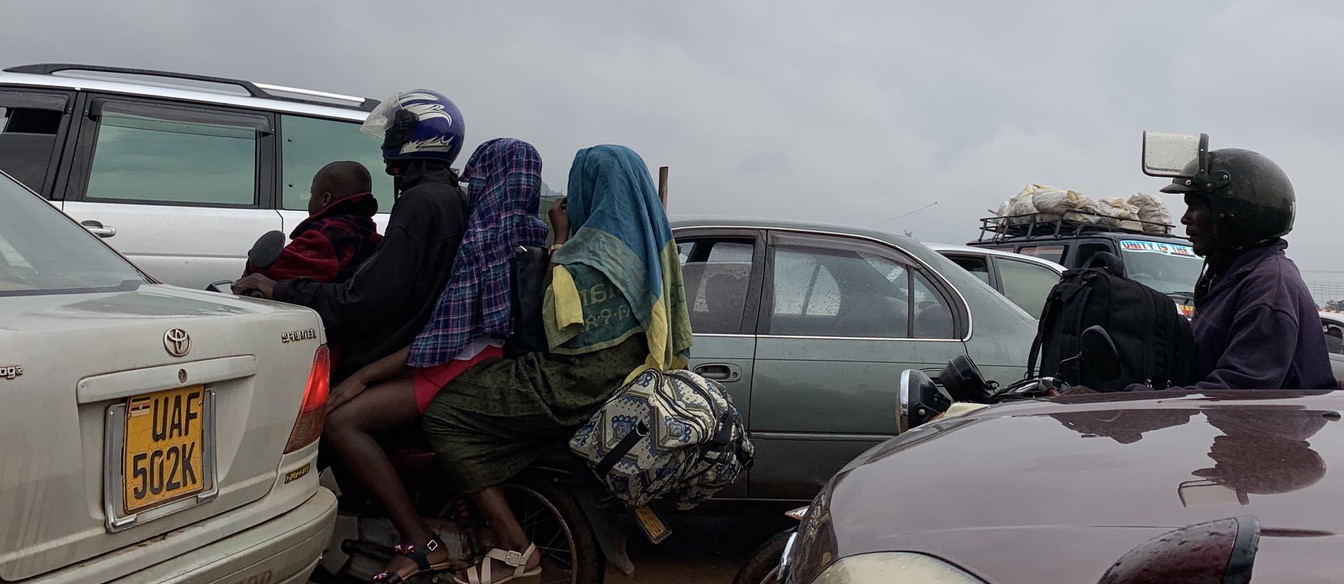
The first five miles took two hours!! Mostly we are just sitting in the car stopped or crawling. We could have walked faster. It was also raining which added to the mess (at times hard rain, but mostly drizzling). Very few roads in Kampala are paved (except for this new super highway – Uganda version – which is only open for a few miles of the trip and once we got onto that it was full speed ahead, but that was only for about 6 miles or so), so there are enormous potholes and much of the time, given the rain, you’re driving in the mud. We used the time to do some car photography out the side of the window (which I detest for numerous reasons, but we didn’t have that much to do). We also became way more familiar with the driver. He is one of 48 children. Yes, you read that correctly – 48 siblings. His father had 8 wives (simultaneously). Six of his siblings have died. His father would have had many more children but he died at the age of 45. He knows all of the siblings but does not see them very often. They gather at the father’s grave once each year. This year 32 of the siblings were there for the annual ceremony.
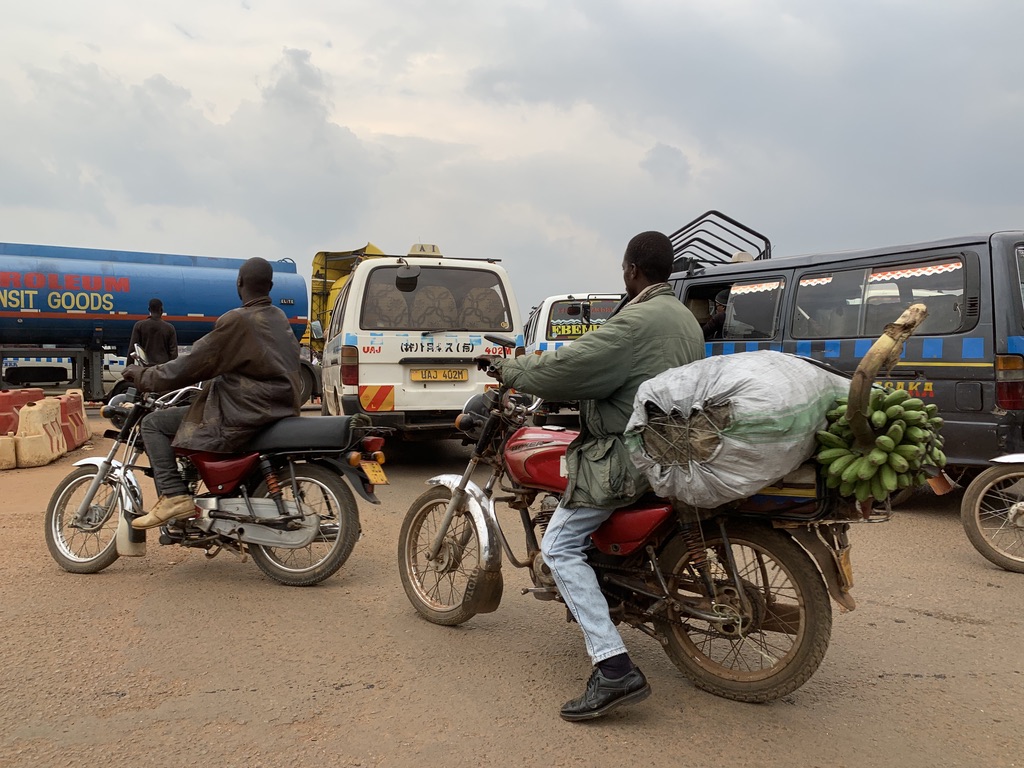
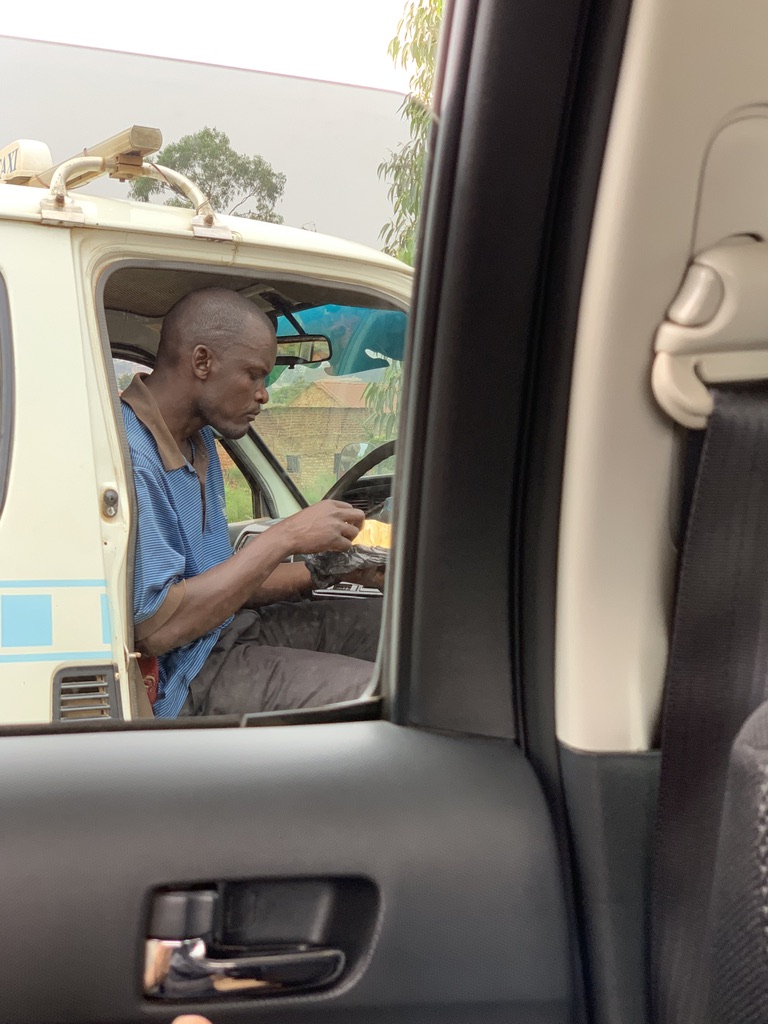
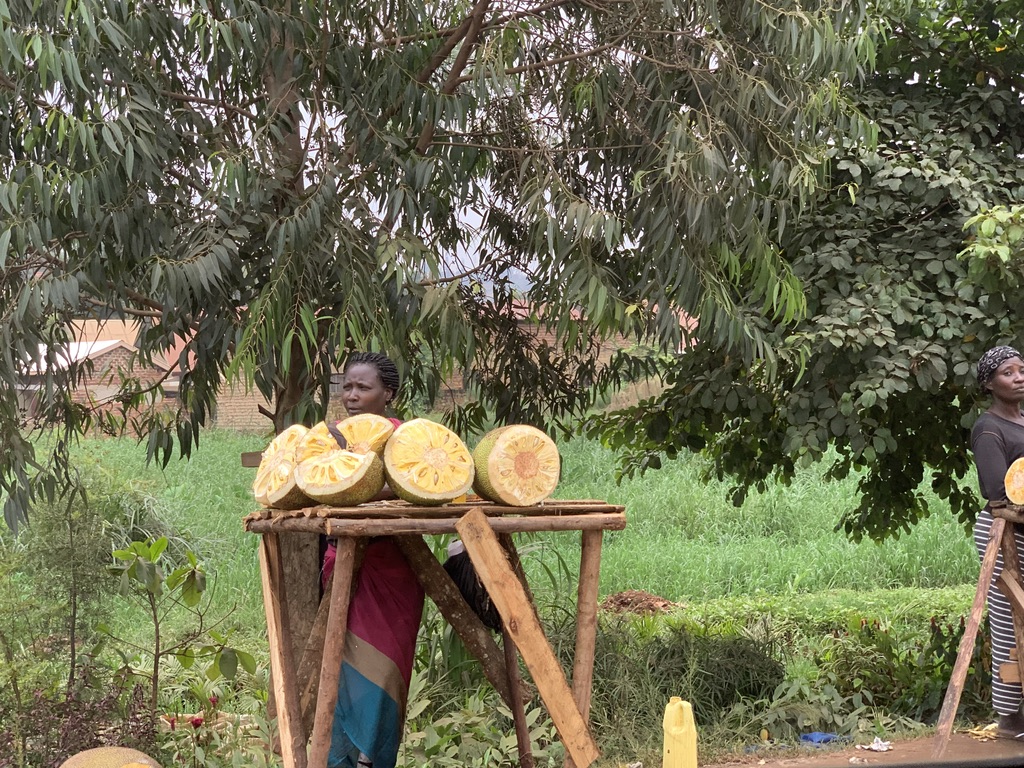
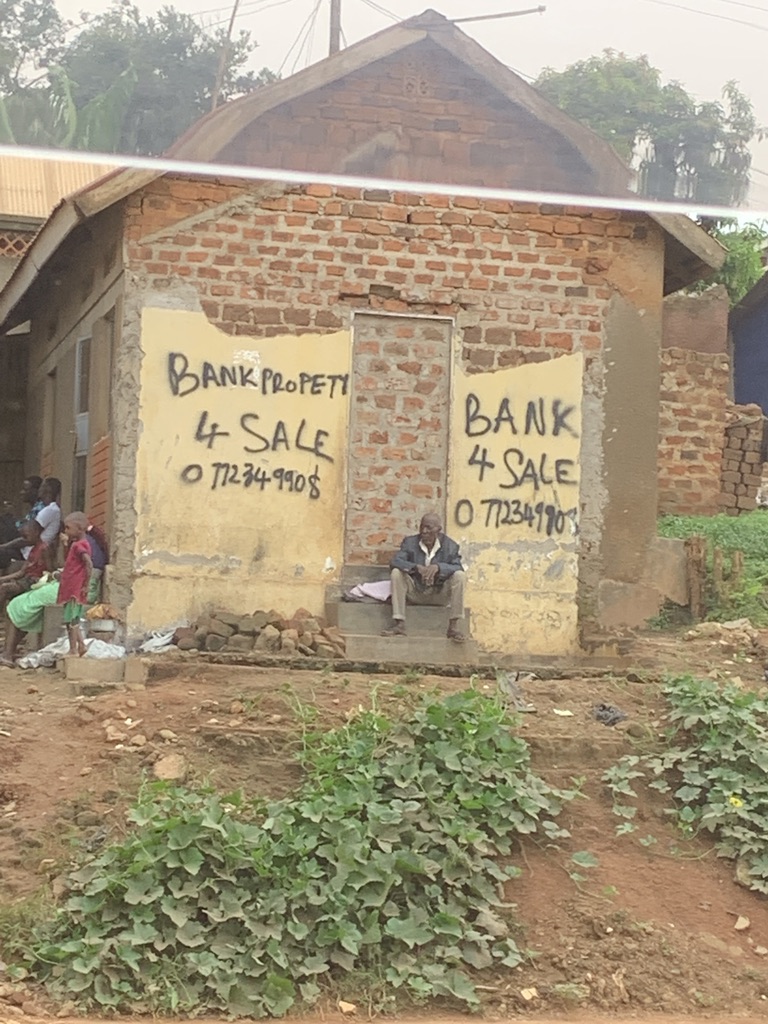
The father would buy a small parcel of land, marry a woman, have children (or at least one child initially) and then the wife would tend to the coffee plantation on that parcel of land, as the father bought another parcel, built another house and set up another coffee plantation for that next wife to tend. So I assume by age 45 he had six coffee plantations. The driver only met his mother when he was 14-years-old. Clearly the children identify with the fathers. (That was true for Martin as well.. His father had 4 wives and there were about 15 siblings; we met and he talked a lot about his father, but never about his mother.) The driver explained that this was his father’s way – the children were raised by the stepmothers not their birth mothers.) Now we know why the vendors in the market think we must be sister and brother and they ask Mike how many wives he has. I guess you don’t hang out much with any of your wives if you are male in Uganda. So basically the father’s strategy was.. get land, build house, find wife, have children, expand coffee business.
Along the very slow drive we were able to catch more glimpses of life in both the city and the surroundings. We saw women in traditional dress heading to a wedding (getting messed up by the mud and wet by the rain), many matatus packed with people who were also getting nowhere in the traffic, and lots of goats. We also saw thousands of mannequins during both our walks in shopping areas and markets and along the road. They are obsessed with showing clothing on mannequins; some with heads, some without; almost all are white bodies.

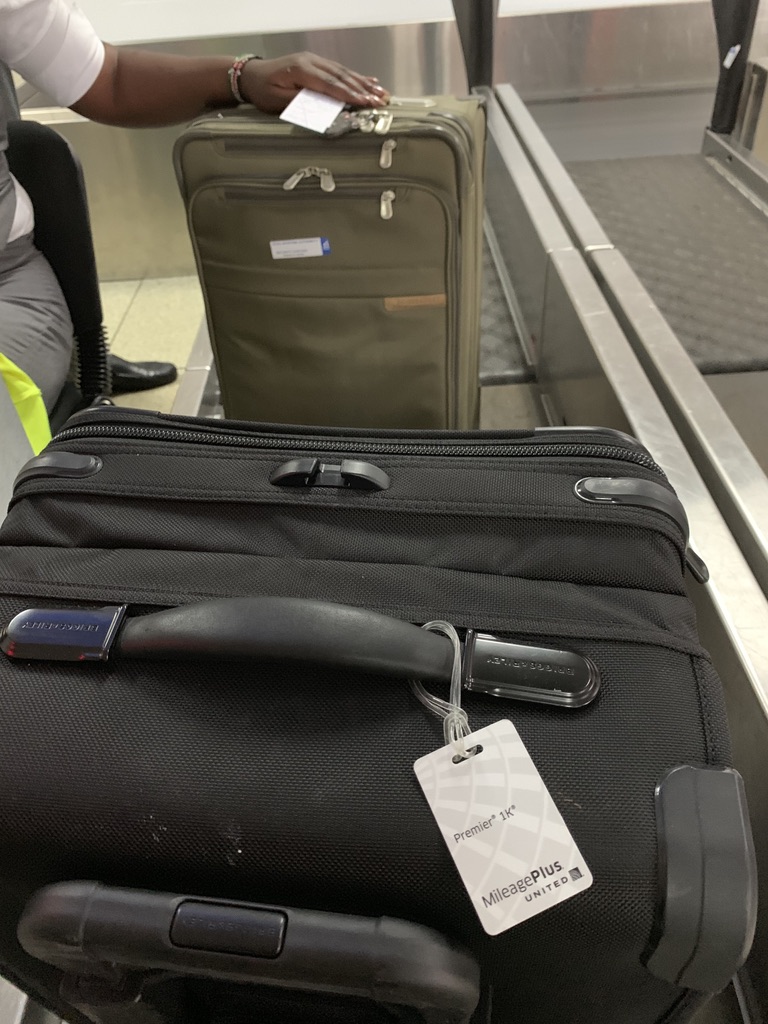
We arrived at the Kampala Airport four hours after we started the 25-mile journey – exactly when our plane would be taking off. And we still had to go through all the layers of security – the car check, the scanning devices, check in luggage since it would be a small prop plane, more security, customs, etc. So were resigned that we would have to take the next and last flight out which would be 6 hours later. And not exactly a great airport with lots of accommodations to sit around and wait. But we got to the counter to see what might be possible.
The women were not too happy but said we could make the plane because it was late (not overly surprised) but they didn’t know if we could board because they might not be able to get the baggage on in time. For some reason this took a while and as we waited, one of the two Rwanda Air employees was rather annoyed that we were late, saying they will only accommodate us this one time. We were quite apologetic, explained the driving time (which she shrugged off) and offered to take the later flight if this was too difficult to manage. Alas, we were escorted through all the security channels and taken to the gate where we waited another 30 minutes before boarding! One note – about a mile before the airport the driver must step out of the car and be hand inspected (a bit demeaning in front of us sitting in the car); most passengers are asked to exit the car and go through metal detectors not hand screening. We were not asked to do this (although we had done it in Nairobi); we were the only Whites in cars headed to the airport.
Finally, we arrived in Kigali… the potholes are gone, the streets are immaculate, there are traffic lights and very orderly movement of vehicles. We took an “airport taxi” which was in a queue that was far calmer than anything at JFK. But before this, we headed to the ATM to get Rwandan Francs. They have a limit on the amount you can retrieve (just about $50) but you can do it multiple times … I did it twice and then the machine was out of cash. We then went to the airport bank and they said the machine was being re-filled. We went back and Mike tried but it was still out of money. We saw a second ATM (they are in little teeny buildings with doors that have advertising, so they are not so easy to spot) and Mike tried that one. It ate his card so back to the little bank who sent over a woman with a key who returned the card and then attempted to restart the machine.. but it was taking too long. So we just hopped in the taxi. The drive was amazing. It’s a very hilly city, located at 5,200 ft (like Denver?) and experienced the smoothest drive, the greenest road edges (all trimmed)… and lots of great views of the city.
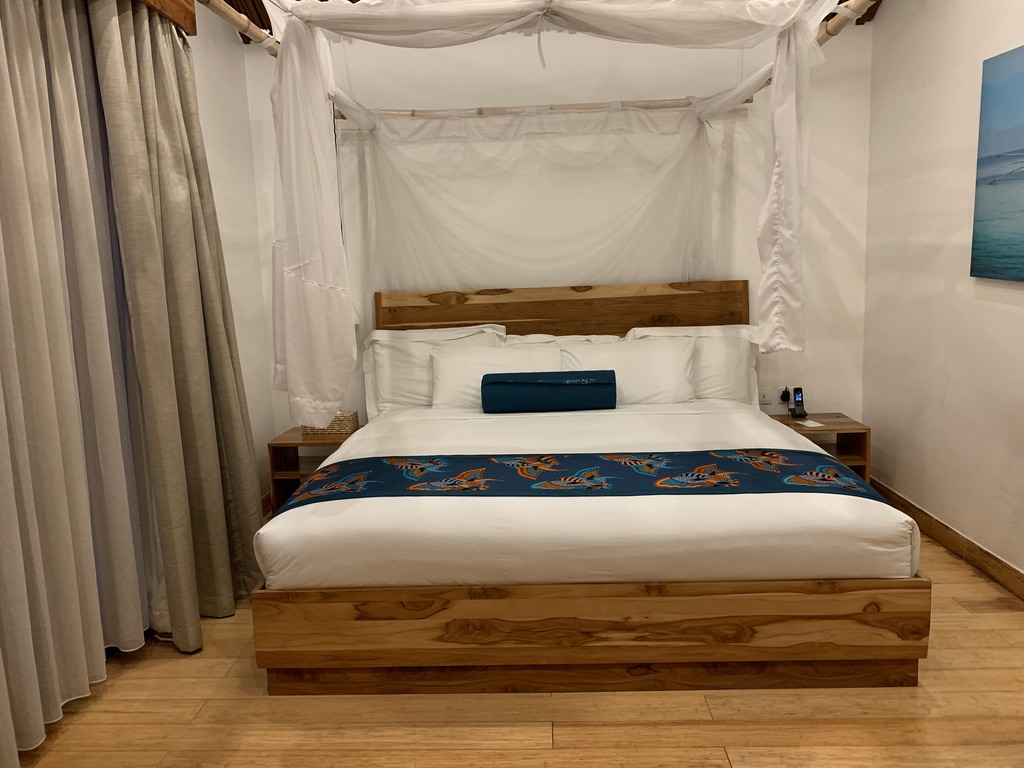
We arrived at Heaven Boutique Hotel… more details on that later.. but it is an exquisite little paradise in the middle of the city… While we had booked the “villa rooms” when we got here we understood the differences between the three room types (villa, chateau, retreat). And so we upgraded to “retreat” – complete with our own outdoor (and indoor) shower, beautifully appointed furnishings… We are here for 4 nights (5 days) and the room is only available for three.. so we will have to move to the chateau room on the last night.. We are praying for a cancellation. I’ll take a better picture of the whole room later today… when the sun is out..
We settled in and then walked (!!!) to a phenomenal Indian restaurant – Khana Khawana – and had a feast. We hadn’t eaten since our basic breakfast at Humura.
In short, Heaven Boutique is owned by two expats (we think from the Bay Area) who hire only locals and are training them to be professionals in the tourist industry. All staff are African (from Rwanda, Burundi, etc.). They appear to be overstaffed (fine by me) and that is probably because they are all “in training”.. They also donate a portion of the rates from what we understand–to local NGOs.
OK.. That’s it…Tomorrow’s note will be about Kigali. We are super excited to see the city and understand more. It’s sort of good and bad that we are here on Christmas as it’s not as typical a moment in time.
On the racial front, Mike and I believe we saw six white people our entire time in Uganda (and that included the two of us); we have already seen more white people in Rwanda – from what little we could see at customs and at the hotel – Australians, Brits, probably some Americans, but we haven’t heard American English yet… )
All the best.. as most of you sit in that government-lite environment known as the US… We’re quite connected with Internet and CNN and Al Jezeera.. so we’re keeping up so as not to be in total shock upon our return.
Fern
Americans in East Africa: Kampala, Uganda 12/20/2018
Greetings –
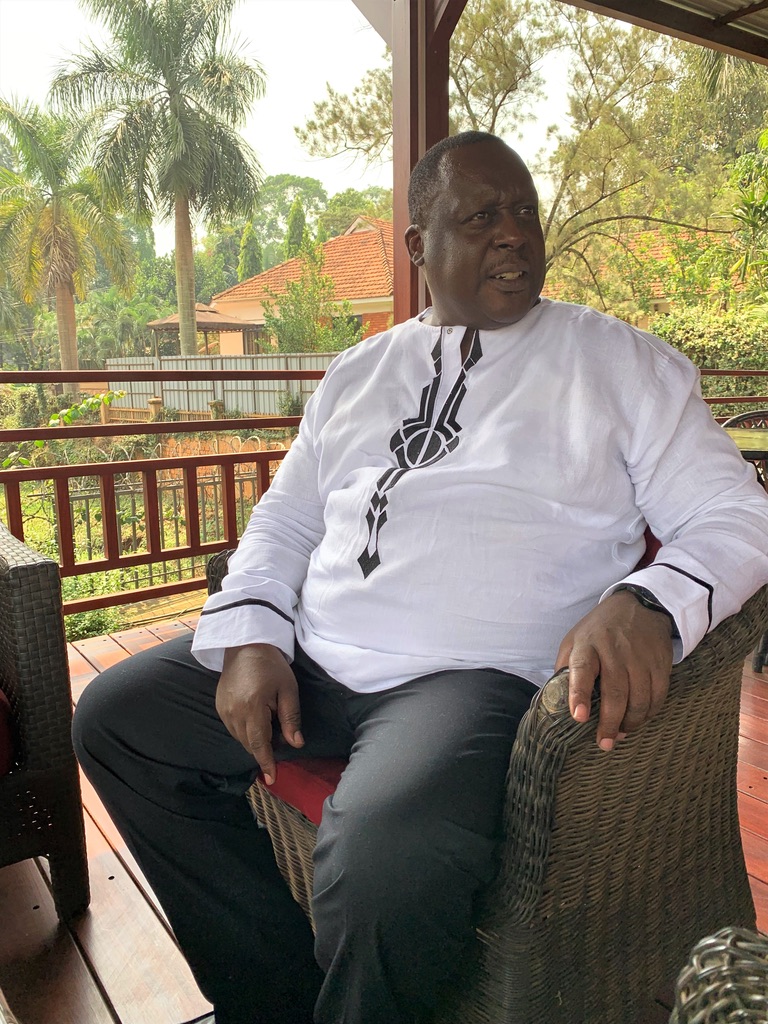
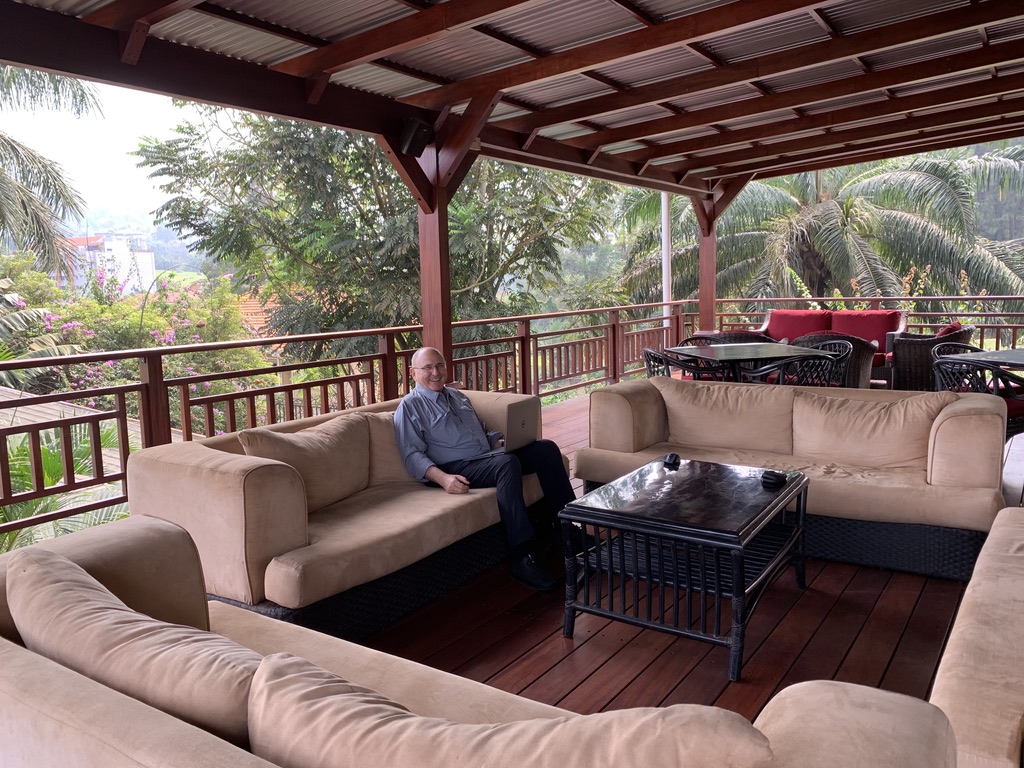
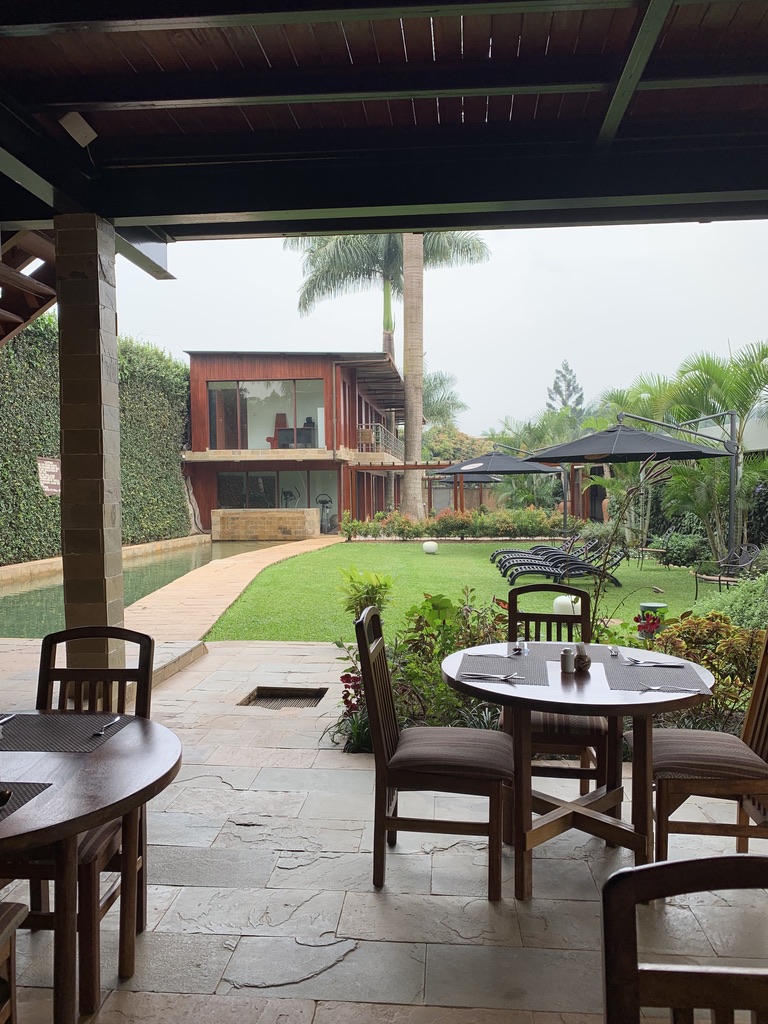
Got a bit of a late start today and had breakfast at our little hotel. Pretty standard fare except for all the local fruits which are wonderful. Then we each did a bit of work (we both brought a lot of work to do and finally got to tackle a little) as we waited for Martin Kamya Muwonge, a local Ugandan architect who was a classmate and friend of our godson and his wife when they were all students at Antioch in Yellow Springs, Ohio, decades ago. We reached out to Martin only a few days ago so plans were a bit iffy.
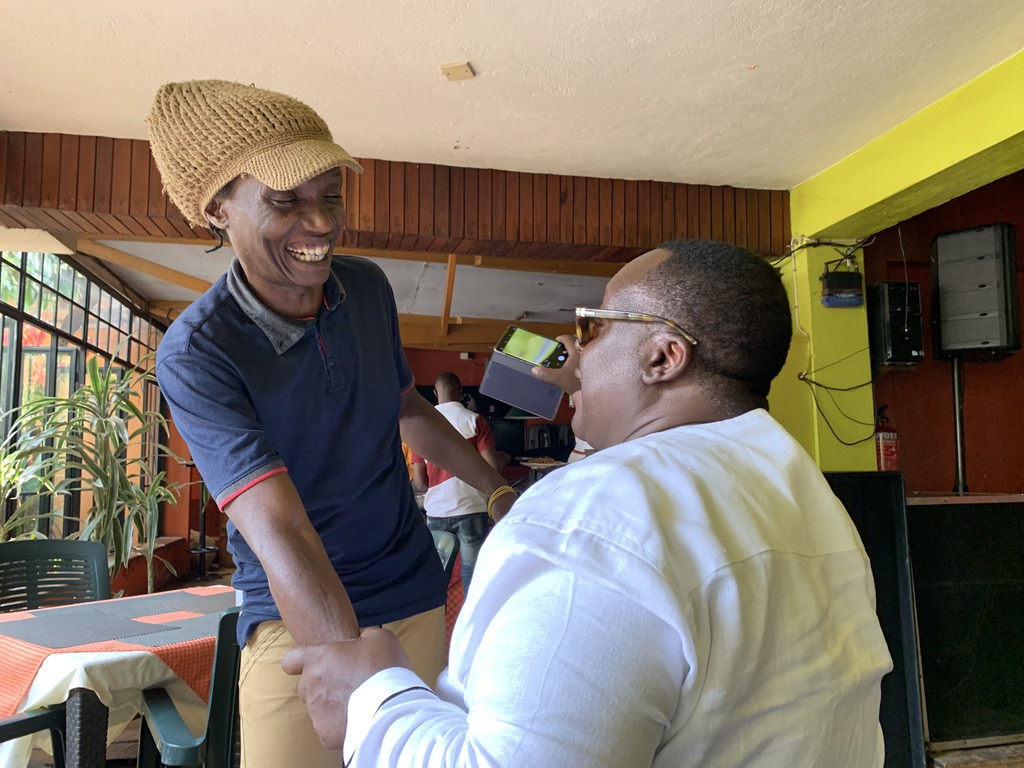
Martin remembered to bring along a photo of himself and our godson at Antioch, which we all laughed about.

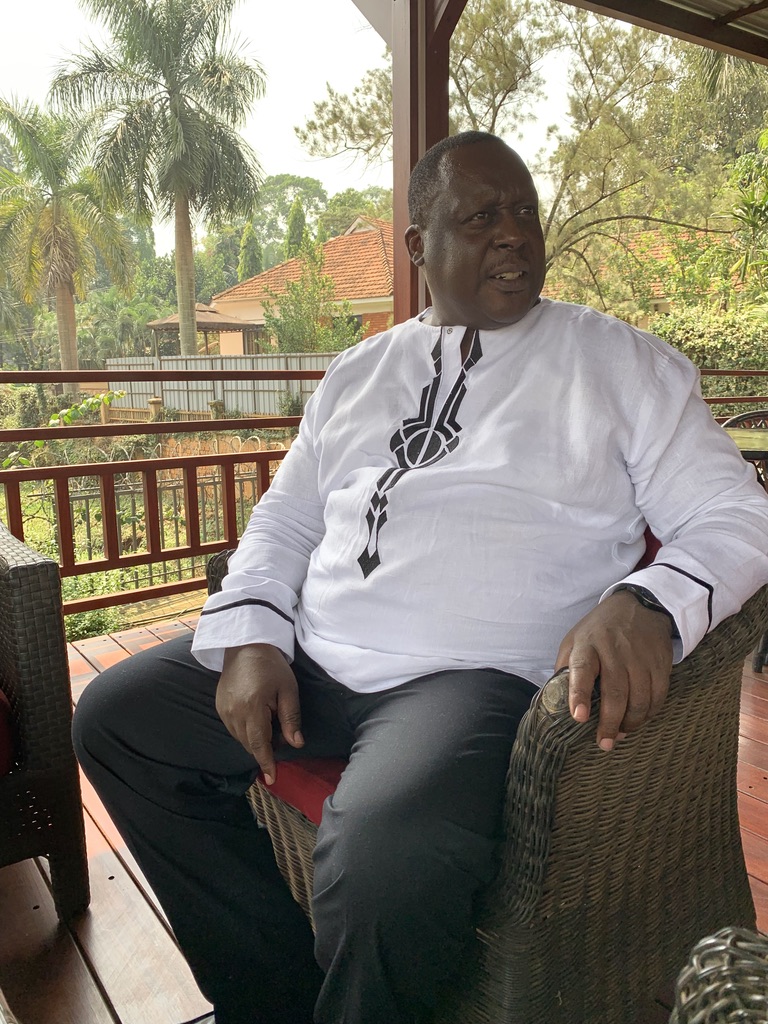
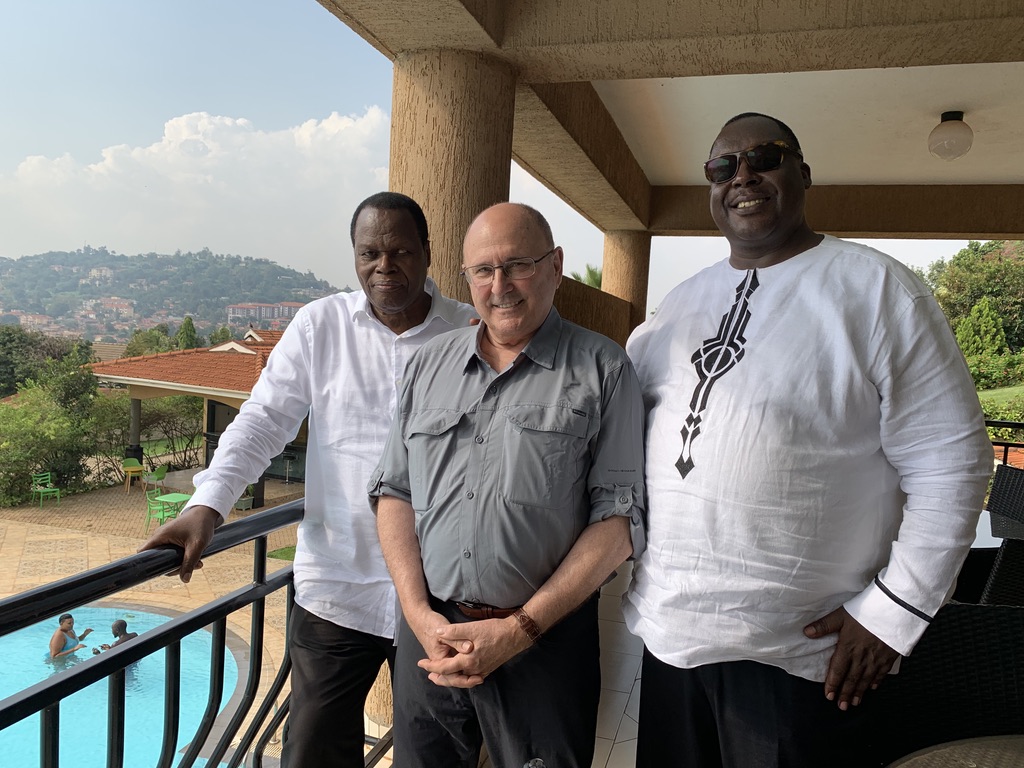
Martin arrived at the hotel (with his driver) at 11:30 and we began a day-long journey winding up and down Kampala’s many hills (some controversy over how many hills there are – Kampala likes to say it has 7 hills like Rome, but in reality there are about 20 or more, which appear to divide up neighborhoods and have some degree of difference as to who lives where. But first we spent time on the terrace at the hotel getting acquainted and providing updates on family. Martin was born in Kampala but his father moved the family to Nairobi (where he had gone to school – he’s an architect too) during Amin’s period and later lived in London – returning to Uganda when the country gained independence and appeared to be more stable. While in London, he worked for the UN. Martin went to school in Nairobi and his father thought he should go to university in America. There are apparently 15 siblings (8 brothers and 7 sisters) – all professionals, living literally all around the world from Albuquerque NM to NY to Alberta, Canada to Nairobi to Kampala and more. Martin is the oldest, I think.
Anyway, somehow he wound up at Antioch, a somewhat unusual university selection, but he clearly has extremely fond memories of school, teachers, friendships, and more. During his years at Antioch (which was based on a co-op program where students were off-campus one semester each year at a variety of work and life experiences), he managed to live and work in numerous parts of the US. But he decided he wanted to be an architect. After graduation he went to live in London for a year and then did the graduate program in architecture at UCLA. He worked in LA for a few years, and then returned to Kampala where he works with his father. Martin provided an interesting look at the city – from the eyes of someone who truly loves his country but who knows he exists as a privileged member of its society.
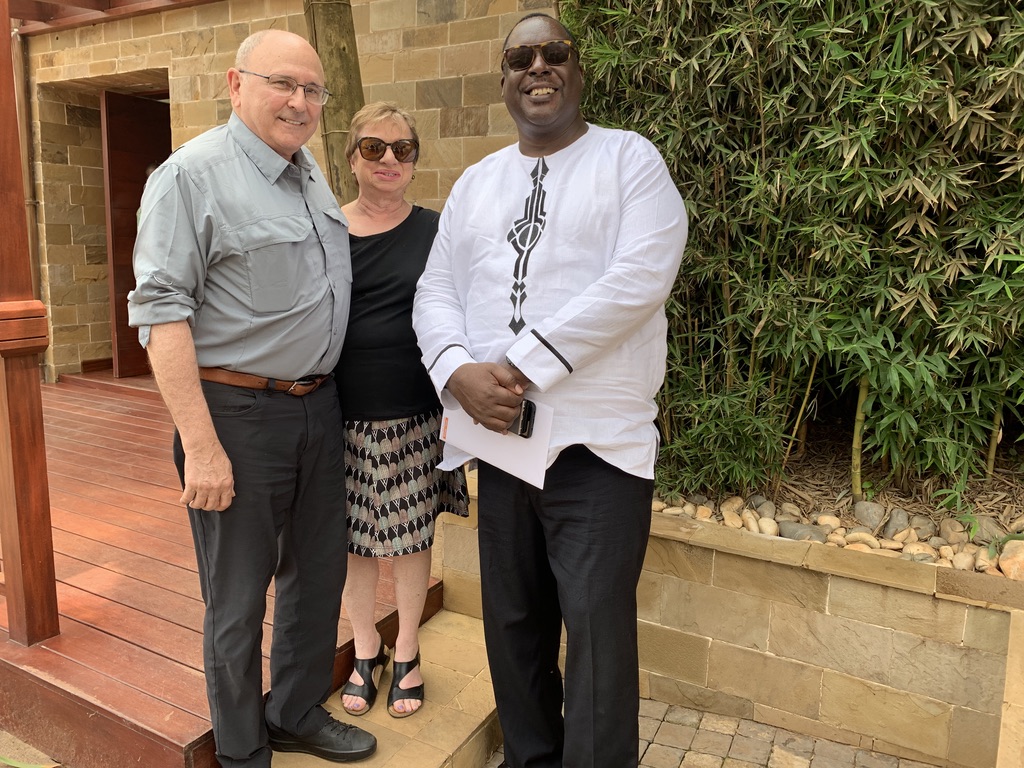
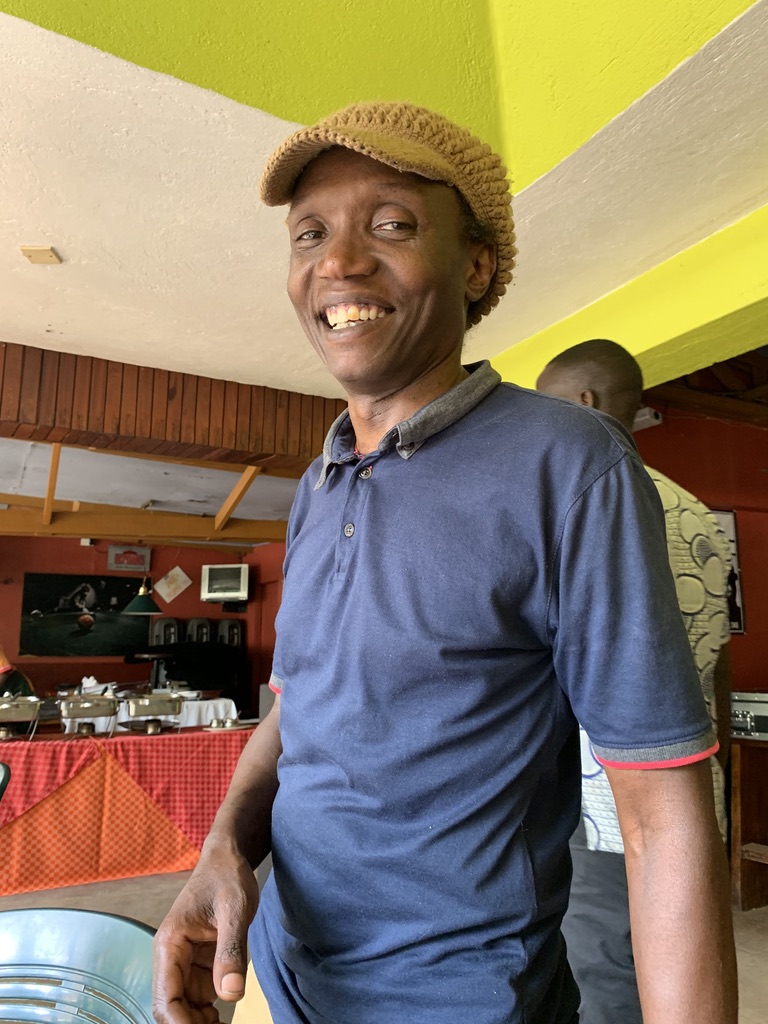
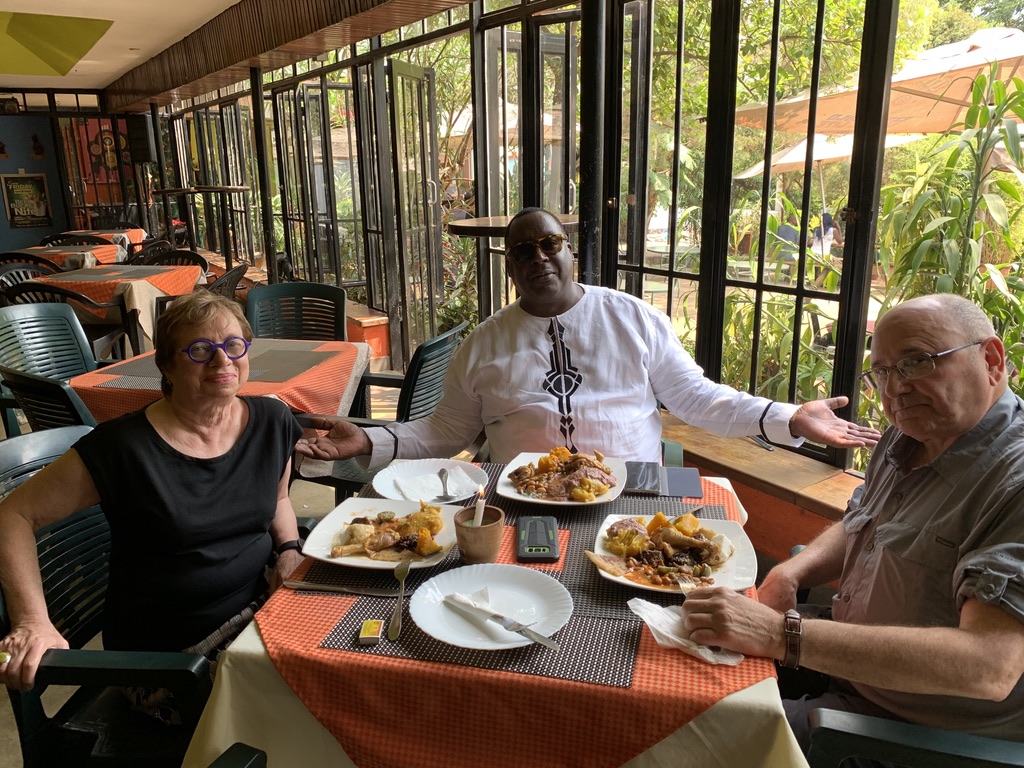
We headed to Zone 7, a local bar/restaurant located in a neighborhood called Mbuya. Naturally, Martin knew everyone. We had a traditional Ugandan meal (although Martin stressed that Ugandan food is not very interesting and pretty bland). It was bland, but quite good – plantains, bitter greens, pumpkin, something that tasted like polenta, beef, chicken, an okra-like eggplant, and chapati (the Indian influence is everywhere in Africa). We then drove around to see more of the Kampala layout, and then went off to meet Martin’s father, whose own story is quite interesting. We also talked a lot about the role of the US in Africa, building construction, planning (or lack thereof) and family. His father is renovating his own house (the one that Martin grew up in during his early years), so he is living at a hotel that he and Martin apparently developed and own.
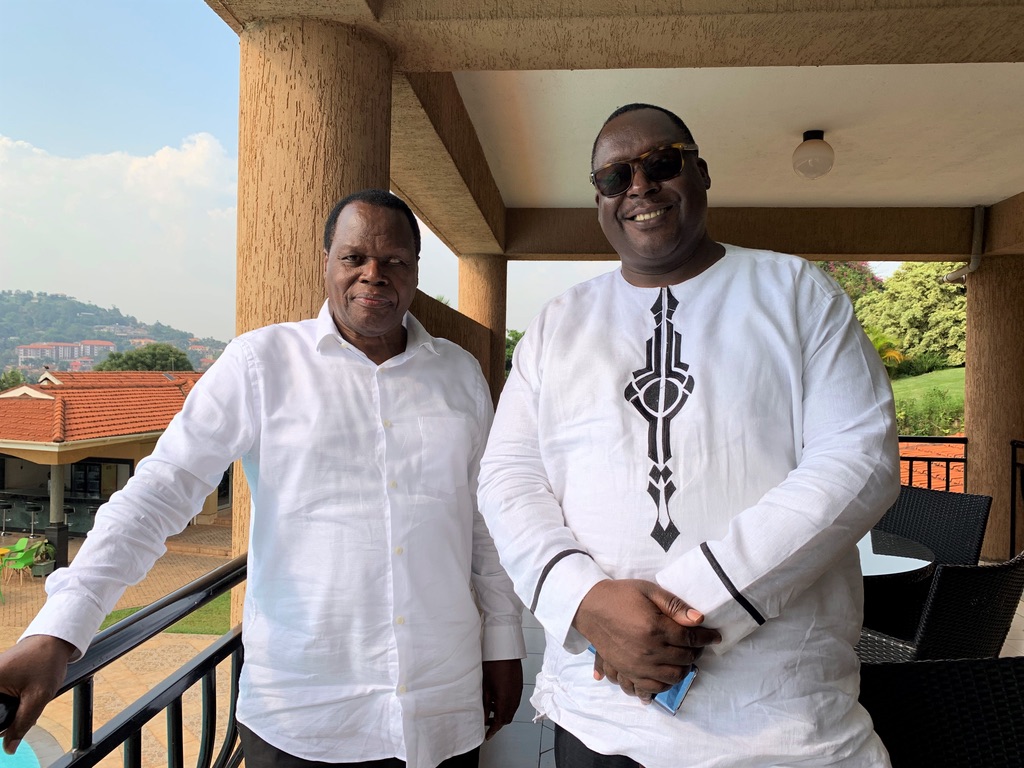
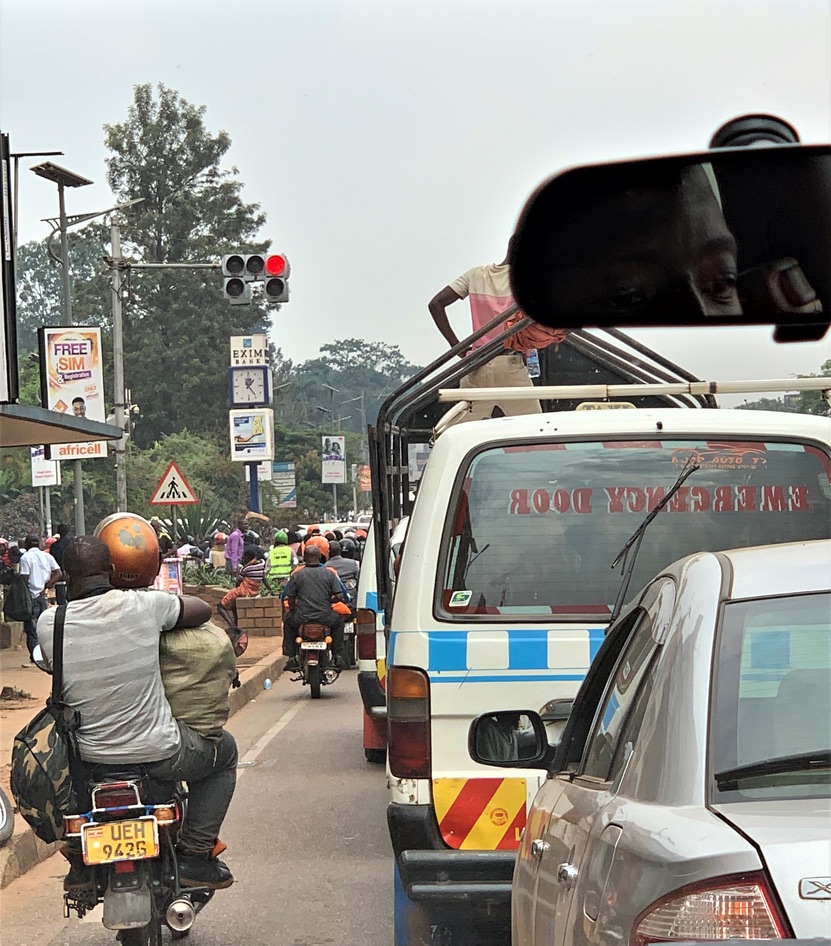
Then we moved on through the unbelievable traffic that is apparently an everyday event. Obviously there are thousands of people on motorcycles which can bypass some of the traffic — especially when they jump onto the sidewalk and make that yet another lane.
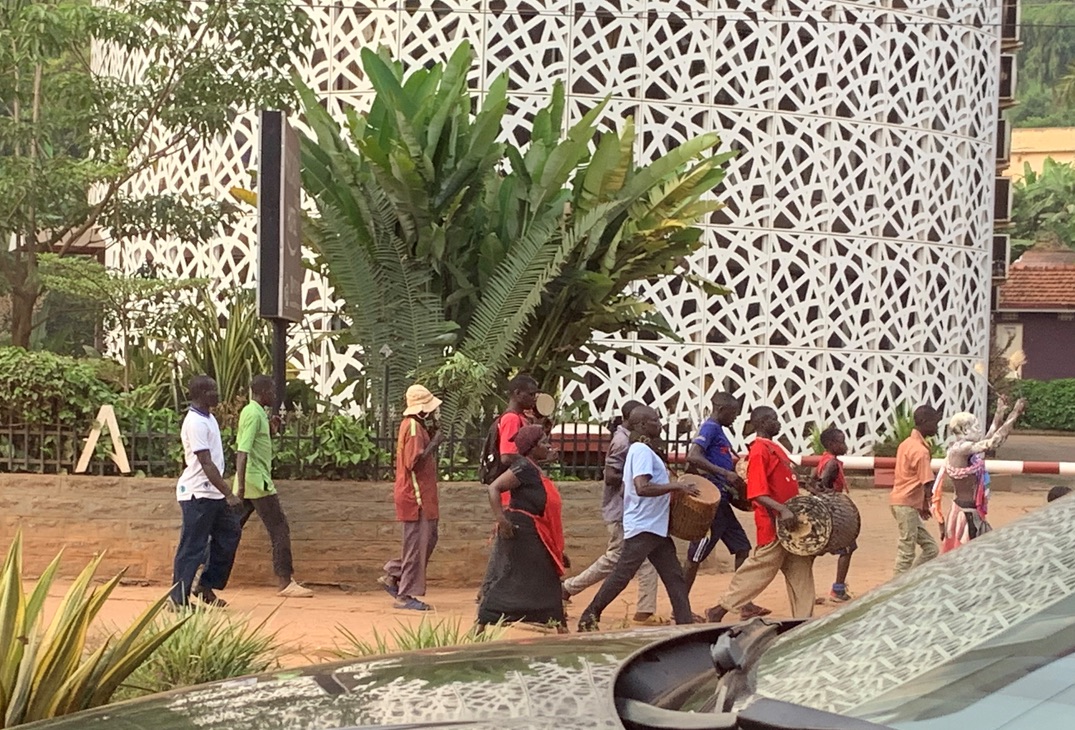
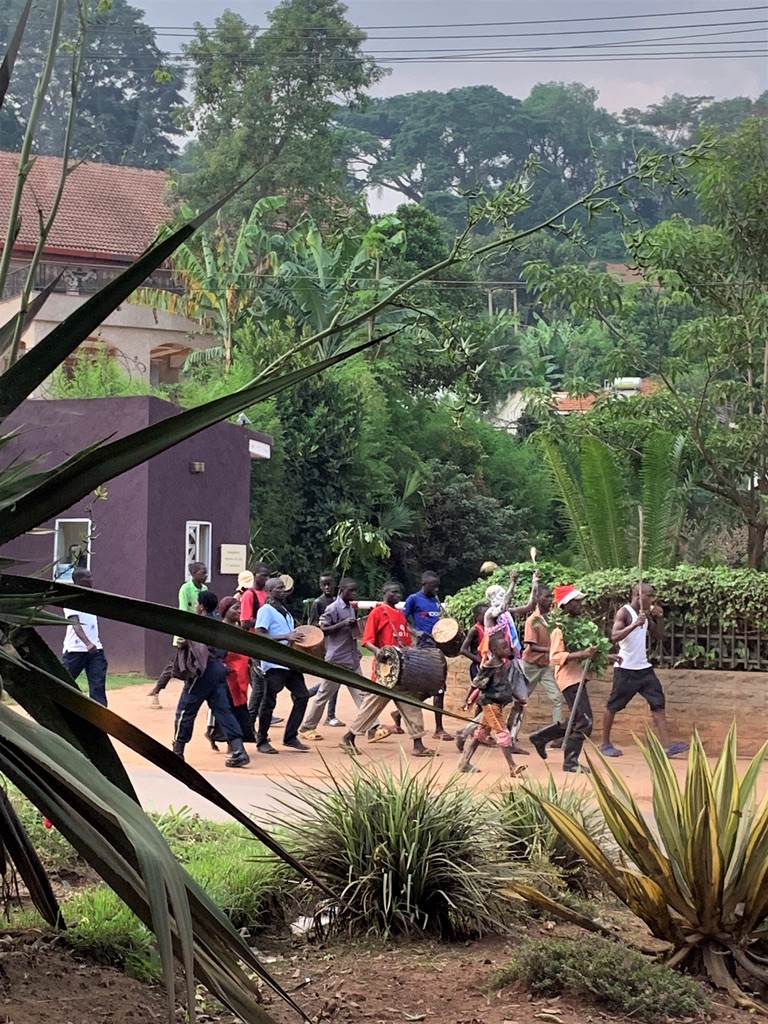
Like in most developing nations, traffic jams are a wonderful opportunity for entrepreneurial poor folks who hawk everything from toilet paper to screw drivers to water to fruit as they pass between the cars (which are actually already very very close to one another). These products are carried in a variety of ways, including on one’s head. We also passed a strange processional of young men with the leader in painted white face and skeleton followed by about 10-20 young men drumming while they marched. Apparently this is a processional for a circumcision (the white painted young man being the subject of the circumcision)….
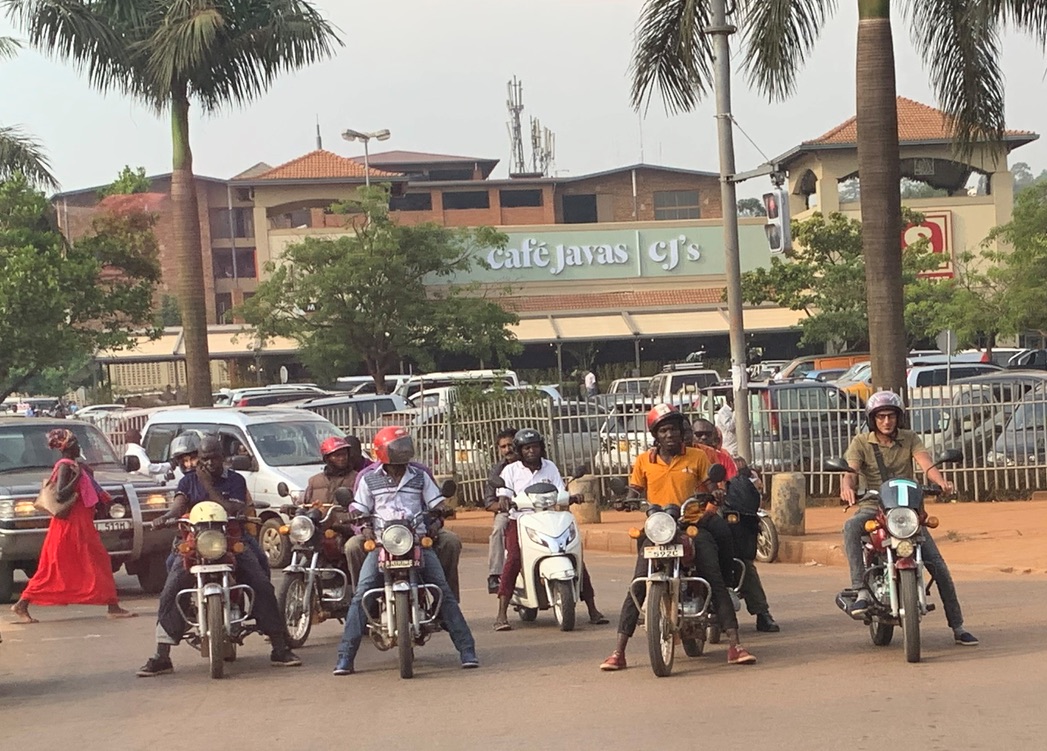
We discussed education (similar issues to South Africa and to what we heard in Kenya), health care, transportation (mostly private), planning, women’s status (making small advances, but still very much in the minority in the professions and in seats of power), and more as we meandered (or rather were stuck in traffic trying to meander) neighborhoods. And no discussion would be complete without the topic of corruption, which is everywhere from the police to the judges to every level of government and about bribes to get projects moving ahead. And we talked about Martin’s love of the L.A. Lakers, and local music. We also discussed the role that China is playing throughout Africa and its decisions about investment in the infrastructure of most cities (smart move).
In conversations with both Martin and his dad, it was interesting to see how knowledgeable and aware they were about American politics and American life. They are avid CNN watchers so we talked about the Mattis resignation, the government shutdown, the stock market, and more.
Tomorrow we are hoping for an early start and will head out on our own to two different markets (one of which they say is so chaotic it is difficult to find your way out). Martin was a bit concerned about our safety but we assured him we’d be fine. Then we are likely to head to the Uganda Museum – which includes a center that houses all NGOs dealing with women’s issues and sells crafts made through local NGOs. The museum is apparently pretty weak in the area of museum design and layout, but we shall see. Hopefully we will meet up with Martin in the early afternoon and drive to Lake Victoria.
All my best –
Fern
Goodbye Nairobi, Hello Kampala. 12/19/2018
Greetings –
Somehow packing and unpacking just ruins travel! But we got it all done and left the hotel to get our flight to Kampala.
Took taxi (by the way, many taxis in Nairobi have wifi – so they ask if you want the password. Amazing. I don’t think we have that in the states.) The drive to the airport was quicker than predicted, but a bit of a mess in that the security system is quite complicated:
About two miles before you approach the airport, all vehicles are stopped; passengers must exit the vehicle; drivers move very slowly and then stand by the vehicle. Everything and everyone is searched. Passengers go through a little building with a scanning device.. Vehicles move through some kind of scanner as well. Drivers meet passengers on the other side. No vehicles (not even taxis or buses) can get within about a half block of the actual terminal. So we said goodbye to the driver and to Nairobi and entered the airport.
There our bags were screened at the entrance; we proceeded to get our boarding passes and yes, to actually check one bag each. We weren’t in any priority section and the plane was small so we decided doing all carry-on wouldn’t make sense; also no jetways. Got boarding passes, checked the bags and then went through screening.. computers out, shoes off, nothing at all in pockets, not even paper. Full screening. Then we headed to the gate. Another screening. And finally we wait for the plane which was naturally late. Boarding was a bit chaotic, but once on the plane it was fine. They didn’t have any air conditioning turned on in terminal, nor on the plane until we actually started going. So it was pretty hot and sticky.
The flight was fine, a little bumpy. Landed in Kampala, bags were searched again; got money from the ATM, picked up the bags, and headed to a taxi stand. Then the fun began. We would be staying at a small (24-room) hotel (Humura Hotel) which is locally owned (we tried to keep the money flowing within each country, but we also knew that meant a bit of a drop in luxury). It is just 25 miles from the airport (which is actually in Entebbe, a totally separate city from Kampala). A quick check on the phone showed traffic and that it would take 55 minutes. Fortunately the taxi was a comfortable four-wheel drive and the air conditioning worked. Only problem was that it had tinted windows so I had my side window open the whole time. It was also clear that rain was imminent. The drive actually took 2.25 hours! And the poor driver had to return to the airport after dropping us off. And wifi in the taxis here too.
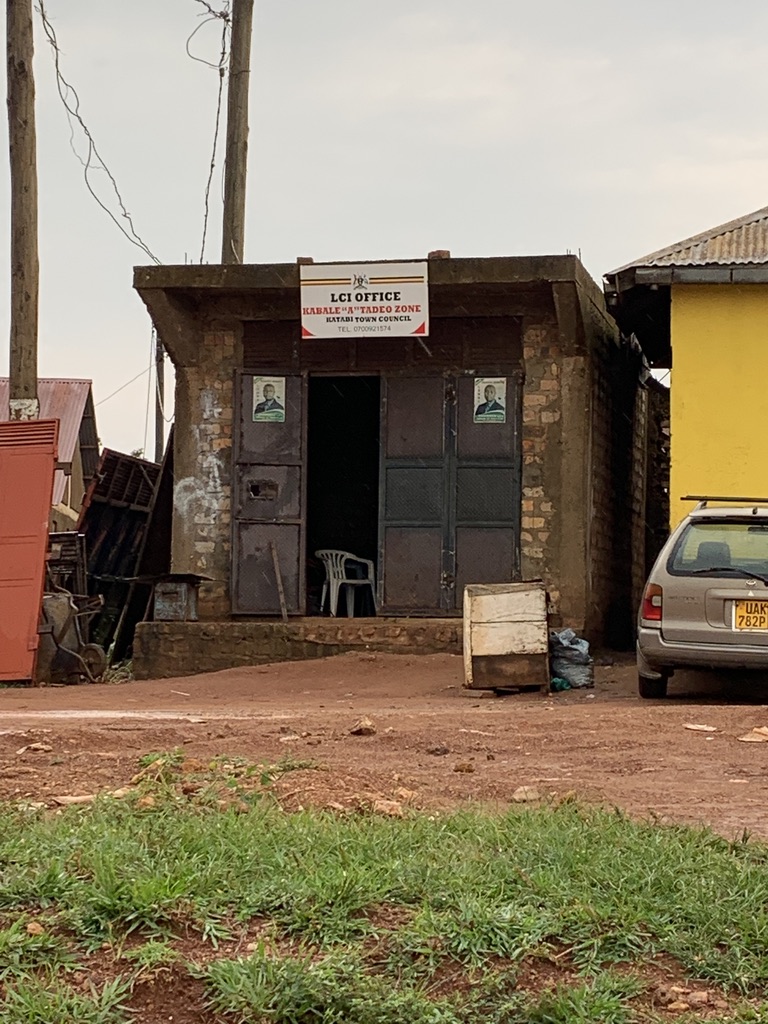
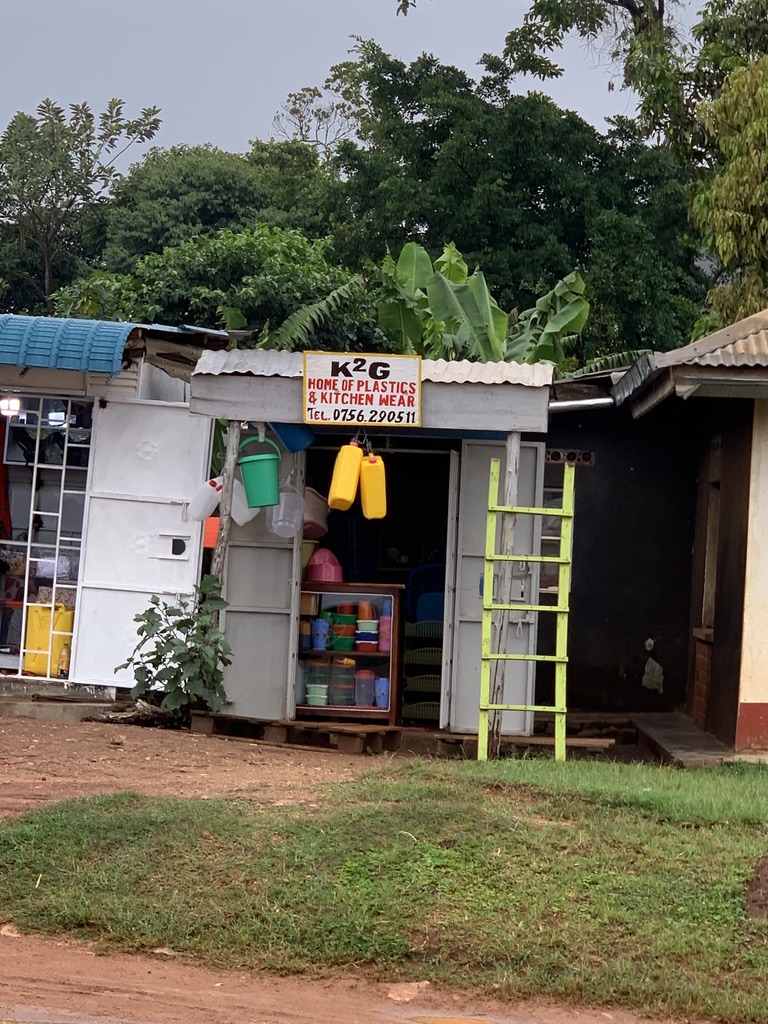
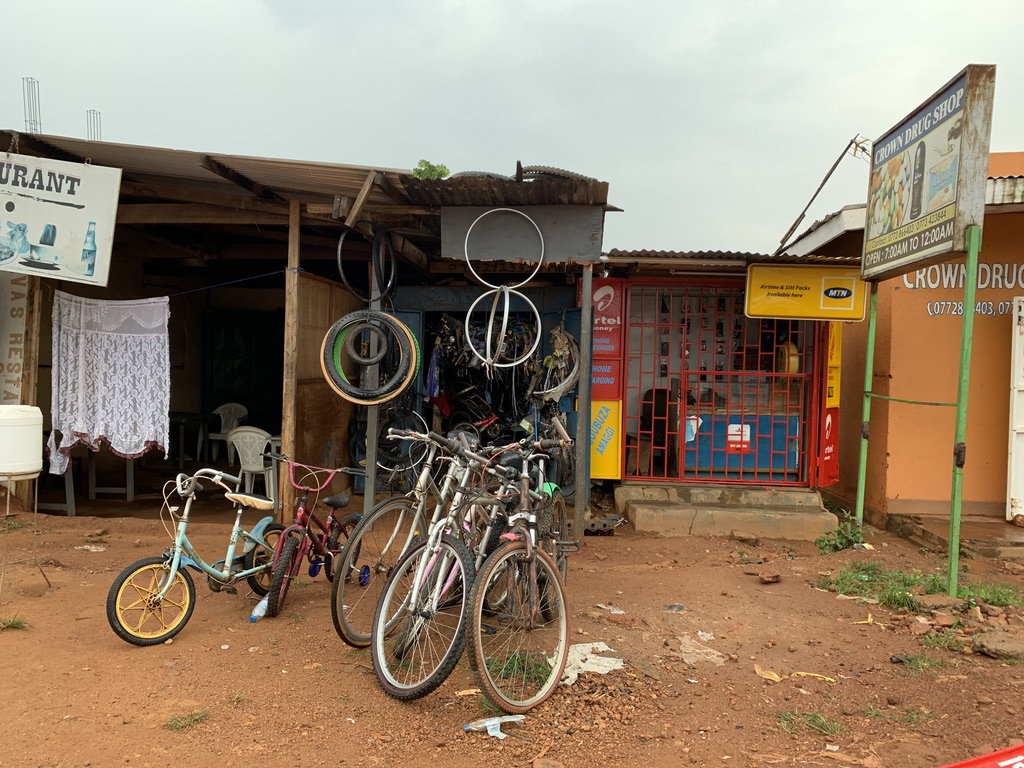
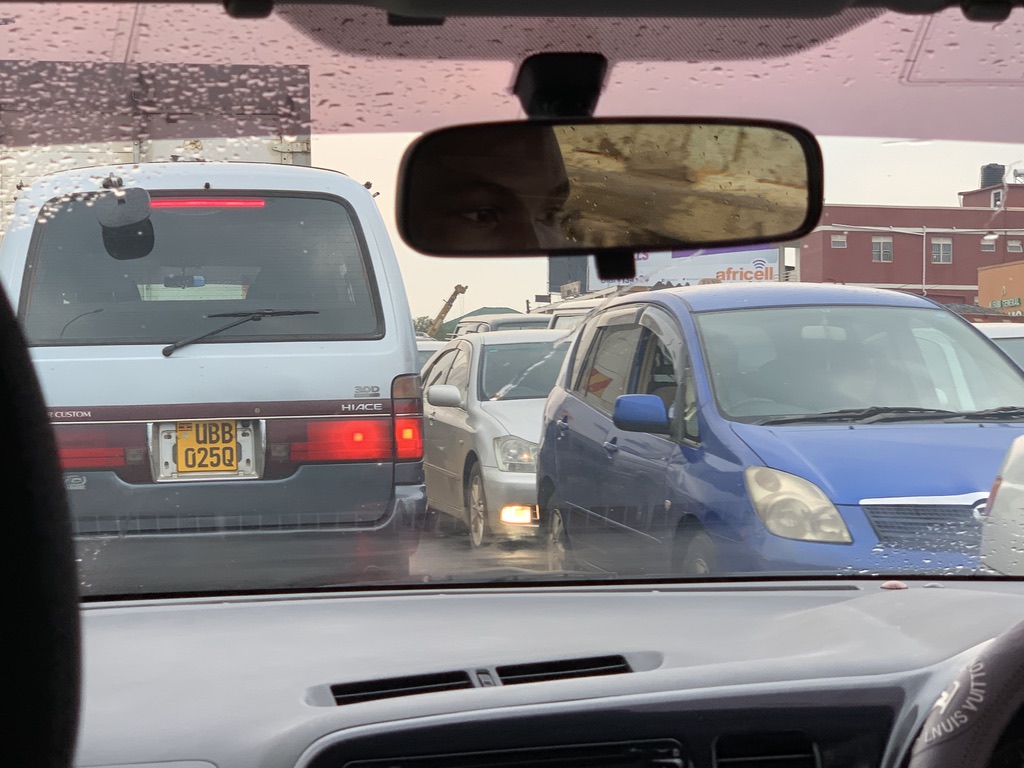
There is a new road that is under construction; a fast highway from Kampala to Entebbe. But it is only about 30% complete. Thus, for most of the drive we were stopped dead in traffic until several enterprising drivers sort of made a new road in the mud – a sort of service road – and our driver opted for that. It brought us closer to the little shops along the roadside, which enabled me to photograph along the very slow and winding drive. It started to rain – a lot – so we were really just coasting on mud that was draining from the other real road. Eventually he had to drive up some mud to join back in with the main road.. Rain just kept coming.. really strong at some points and then more drizzly at other points. And then suddenly we were on the new road/highway which was obviously so new that the toll booths weren’t even installed yet.
We arrived at Humura and were warmly greeted and shown to our room.. It is a small little complex (of course we have our own guard on the property, but he seems pretty low-keyed and hangs out near the parking area. Our room is sweet, a bit basic, and not everything works 100%.
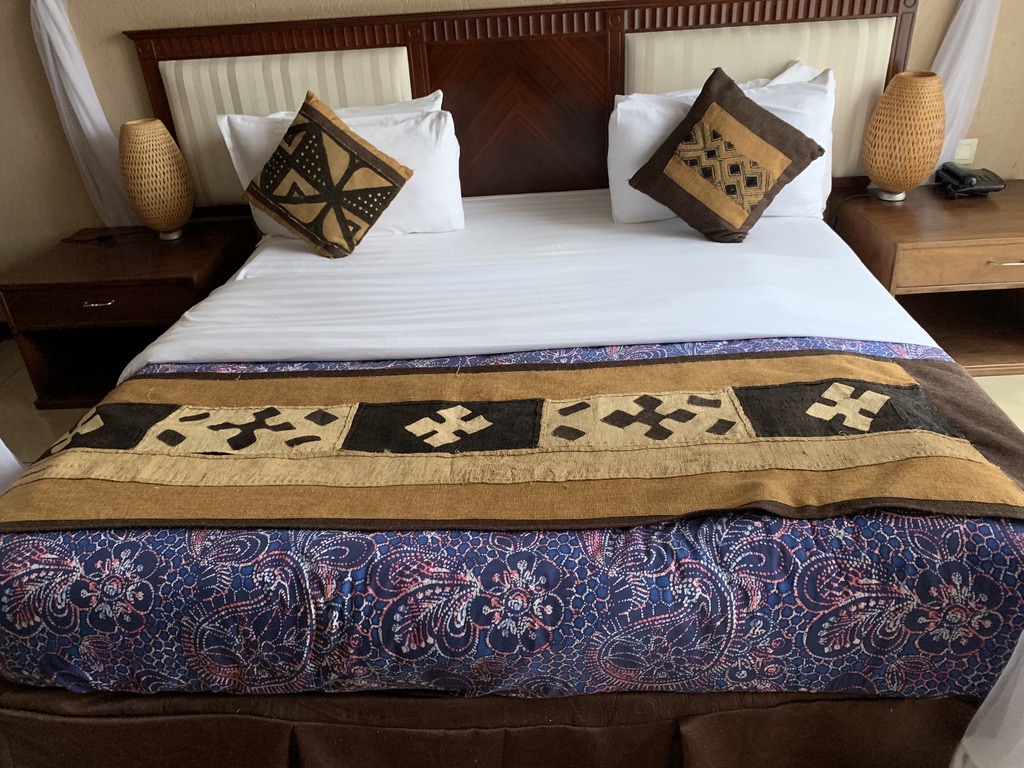
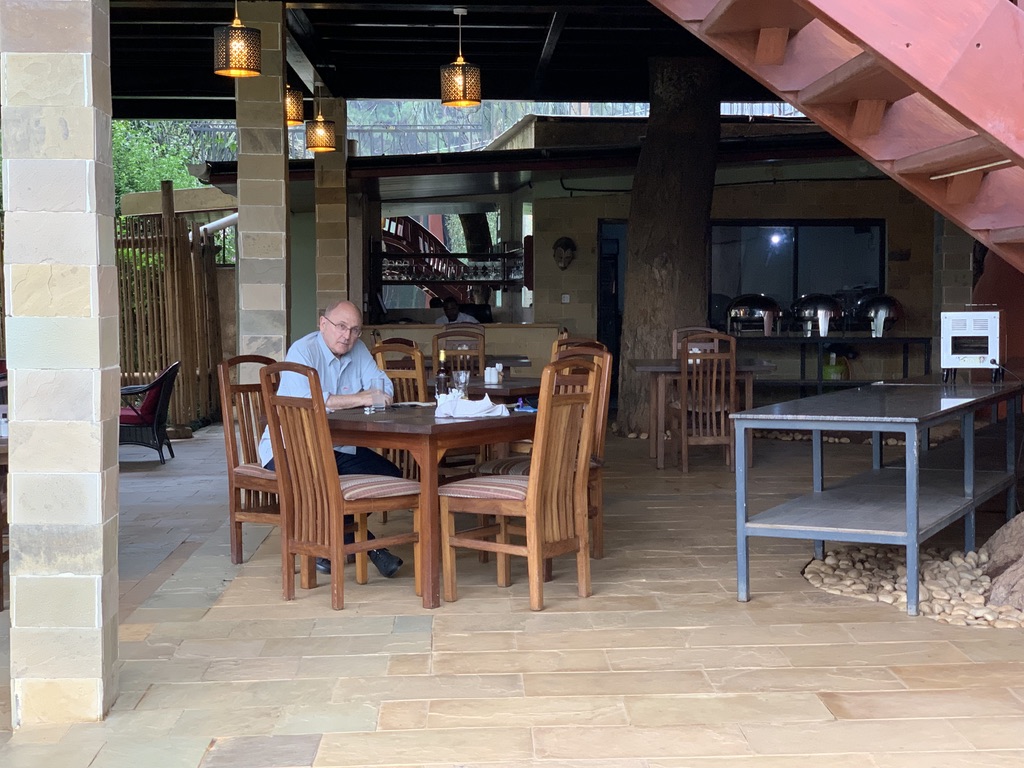
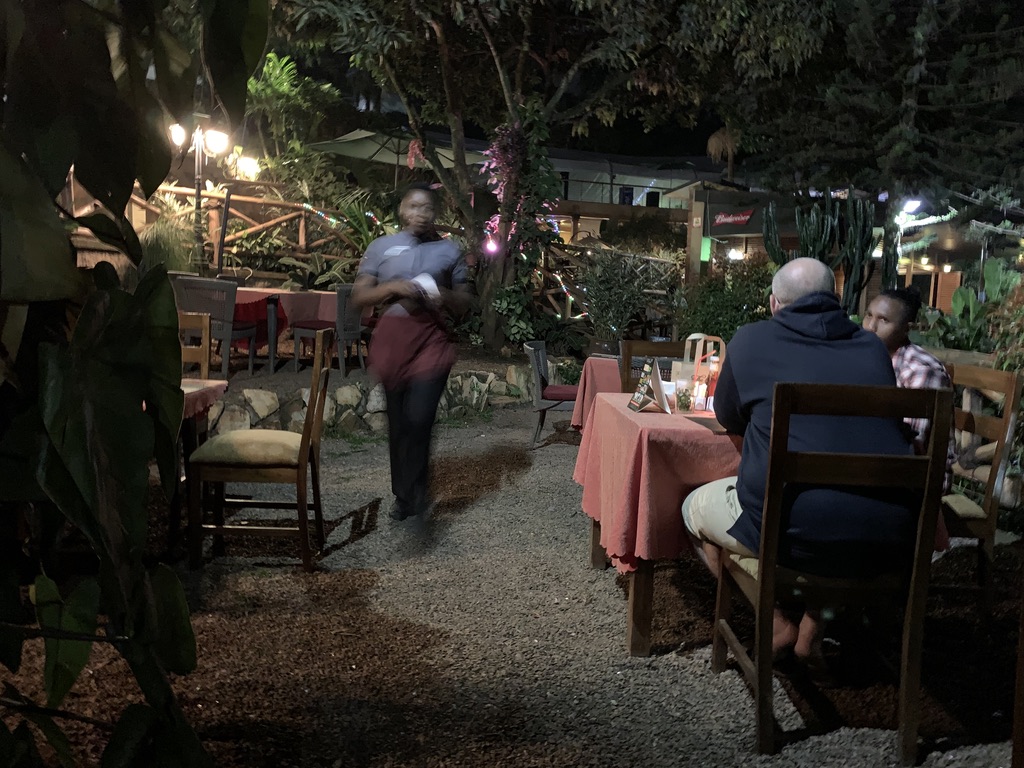
In the first hour or so as we were settling in and deciding where to go for dinner (and hoping the rain would stop), the power went off about three times (fortunately only briefly each time – 15 minutes or so). The wifi connection also went down, but we were told that is because Kampala is laying fiber and it’s not done yet (??). The sliding closet doors are wood so they don’t really move too well and there’s only one hanger… But all is good. I went to the reception area to discuss options for dinner. They kept suggesting Italian restaurants. I said we’d really rather have some African food. They eventually suggested a Ugandan home cooking place in the downtown but suggested we go for lunch rather than dinner for “safety reasons”… We said we’d be fine, but decided to head to a game restaurant last night because it was closer to Humura. I think we may be the only guests. We taxied to The Lawns which would be easily walkable if there were direct roads and if it wasn’t so hilly. The Lawns is a meandering restaurant (not so many tables, but on many levels) – all outside. We opted for a middle level table (only about four tables per level). The menu was a bit eclectic, but we had a great Moroccan stew and an order of assorted game (crocodile, ostrich, wildebeast, kudu). Lots of potatoes come with everything. We had drinks and good Ugandan beer. Taxi returned to get us and we settled in for the night.
One quick impression – the roads actually seem to be in better shape than in Nairobi and lots of traffic lights. But traffic is as horrendous as it was in Nairobi. We’ll know and see more tomorrow. We are meeting up with a local architect who went to college with our godson. Should be interesting.
Fern
Americans in Nairobi 12/18/2018
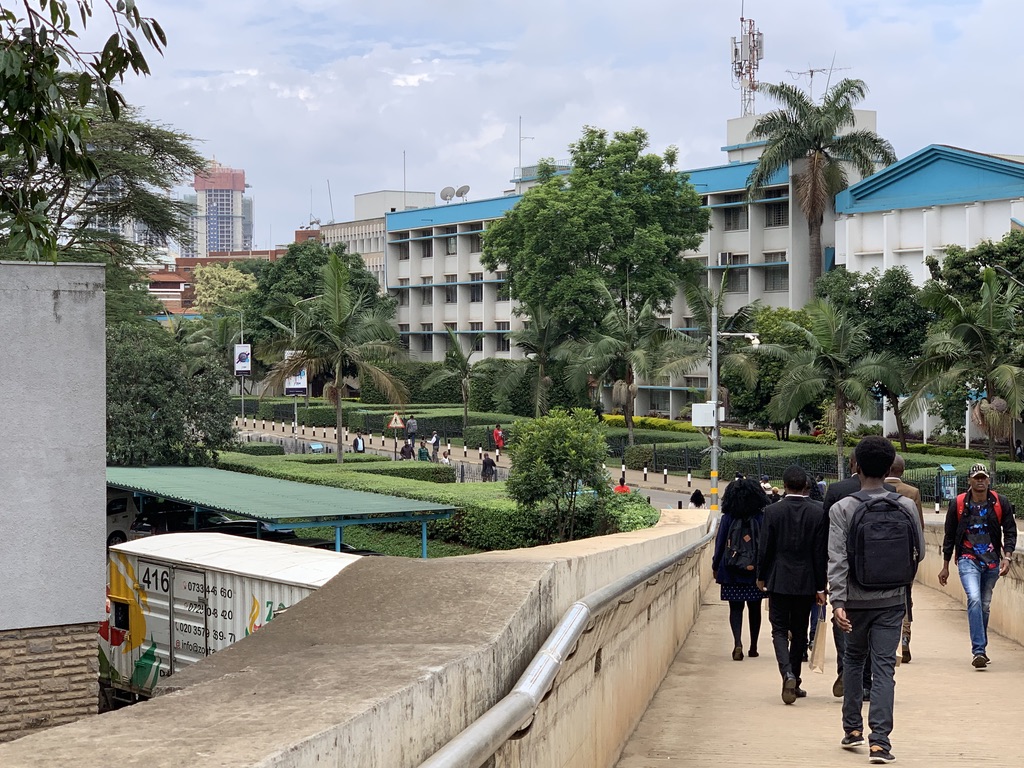
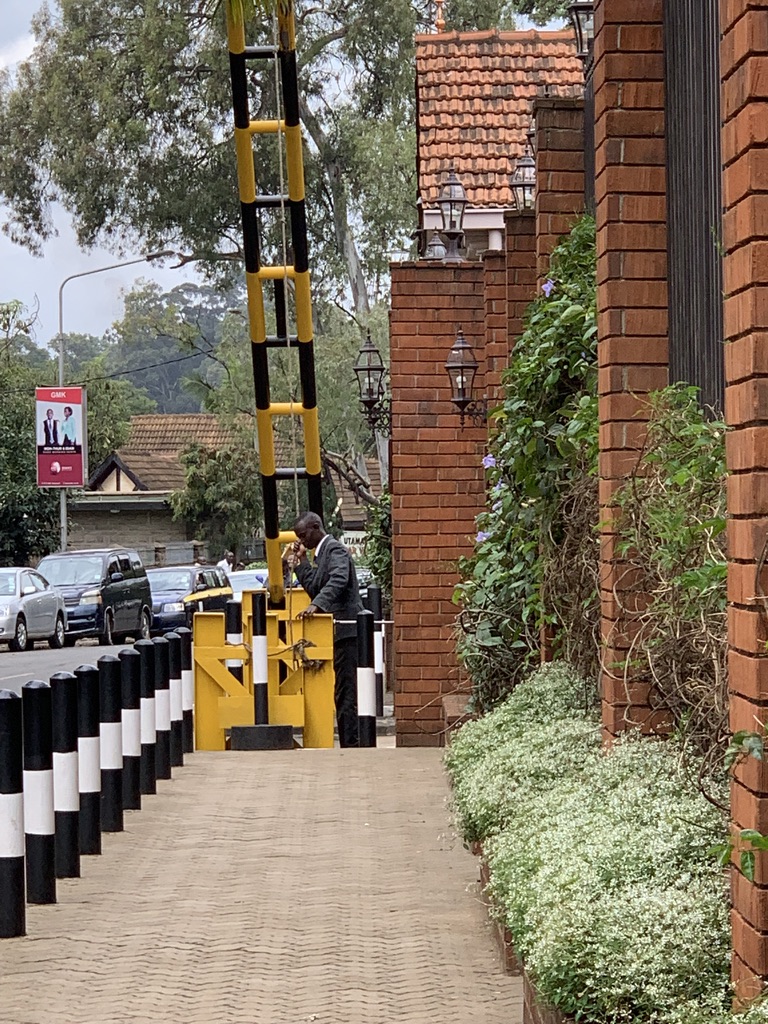
This morning we opted to return to Java House, where we now are familiar faces; two visits and we are regulars!
So after walking back to the hotel to figure out our day, it became obvious that rain would be coming soon. Thus we opted not to walk any where and that maybe we should be real tourists for a day.. or at least a little like real tourists. We decided to rent a driver and head to the neighborhood known as Karen (an upscale area north of the center of town where we were staying). We used a driver from the hotel because we figured we might need the car for at least six or seven hours. The driver (whose name escapes me) was quite knowledgeable and was able to relay a good deal of information and was quite conversant, once he realized our politics. So despite the fact that the drive was long, due to the incredible number of cars, matatus, and buses and trucks choking the air and trying to move from place to place on inadequate roads, we had a good time.
During the drive we discussed local politics (corruption), schools (inadequate unless you can pay to go to private schools of some sort) – 50 students to a classroom, insufficient supply of text books – much like what I witnessed in South Africa last year.
The driver was – in many ways — a typical Nairobi worker – grew up in a rural area focused on farming, with minimal support for schooling but like everyone else saw Nairobi as the dream for a job with potential. We also talked about the role of missionaries in Kenya, historically. He had an interesting line: “The flags follow the crosses…”… meaning that first the missionaries come and then they are followed by the colonizers, with the missionaries making it easier for the colonizers to “set up shop.” We talked about salaries and how one gets by; we discussed the situation in the slums, and we talked about the Kenyan Constitution and the structure of the government. He says they copied the US Constitution.. which actually sounds true.. They have a president and two official houses that make up the legislative branch. One includes one member from each “county” within Kenya; the other is based on many many sub areas within each “county.” He says the problem is that he thinks they copied the constitution and didn’t really tailor it enough to meet local needs.. and we laughed and said that we felt that after more than 200 years it was time for a new constitutional convention and a new constitution for the US that would consider how much things have changed..
We also discussed the land issue which is a complicated and essential topic in African cities. Apparently, the government is beginning to crack down on illegal development on public land. As a result several shopping centers and other buildings have been torn down. Greedy developers just move onto properties and start building. Historically, no one said anything and the buildings got occupied and that was that. Not clear this effort will change things much, but it’s seen as a start.
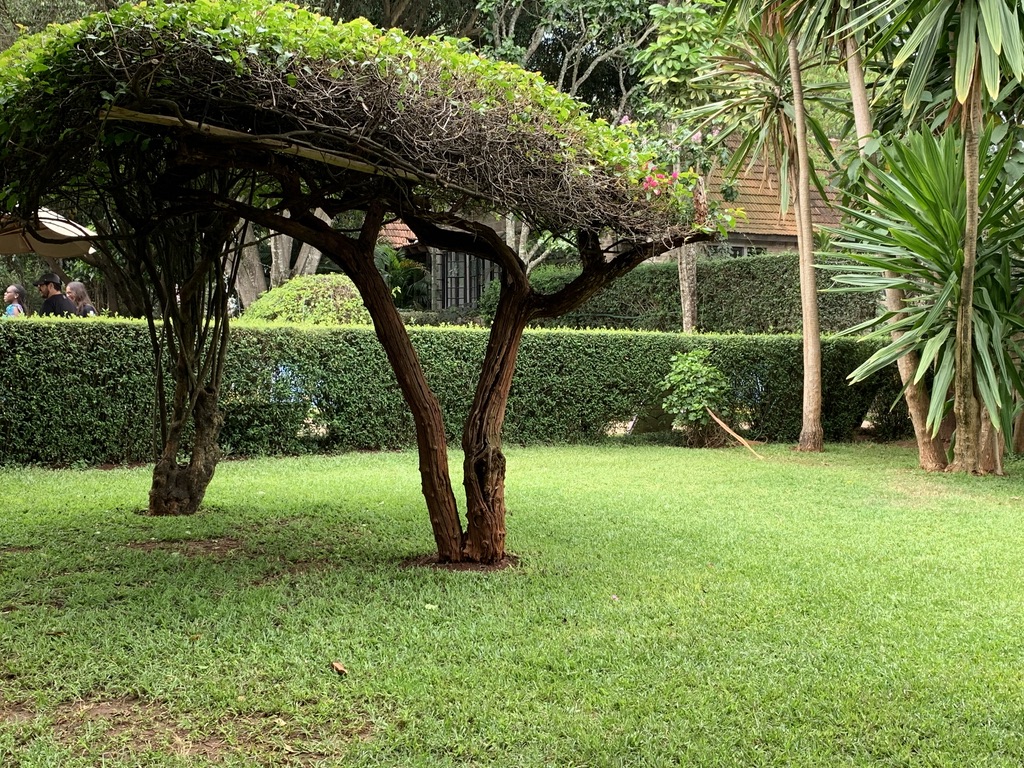
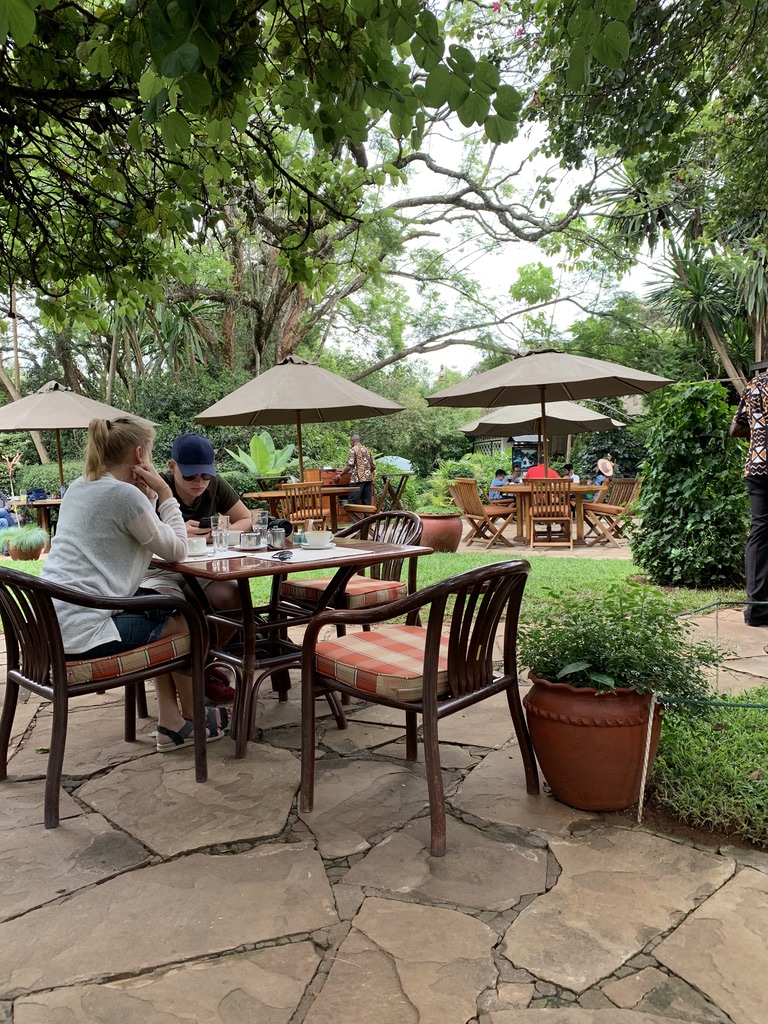
We headed first to Tamambo, a wonderful little café on the coffee grounds of the original Karen Blixen estate (more on that in a bit); service was incredibly slow and we worried it could put a dent into the very long list of things we wanted to see and do. After lunch I headed to the Kazuri bead factory to see the bead-making techniques and check out their on-site shop while Mike got dropped off at the Giraffe Center where he was determined he would “kiss” a giraffe (apparently you get some kind of pellet of food and stick it between your lips and the giraffe comes over and slobbers over you and grabs the food). Did not sound like something I needed to experience.
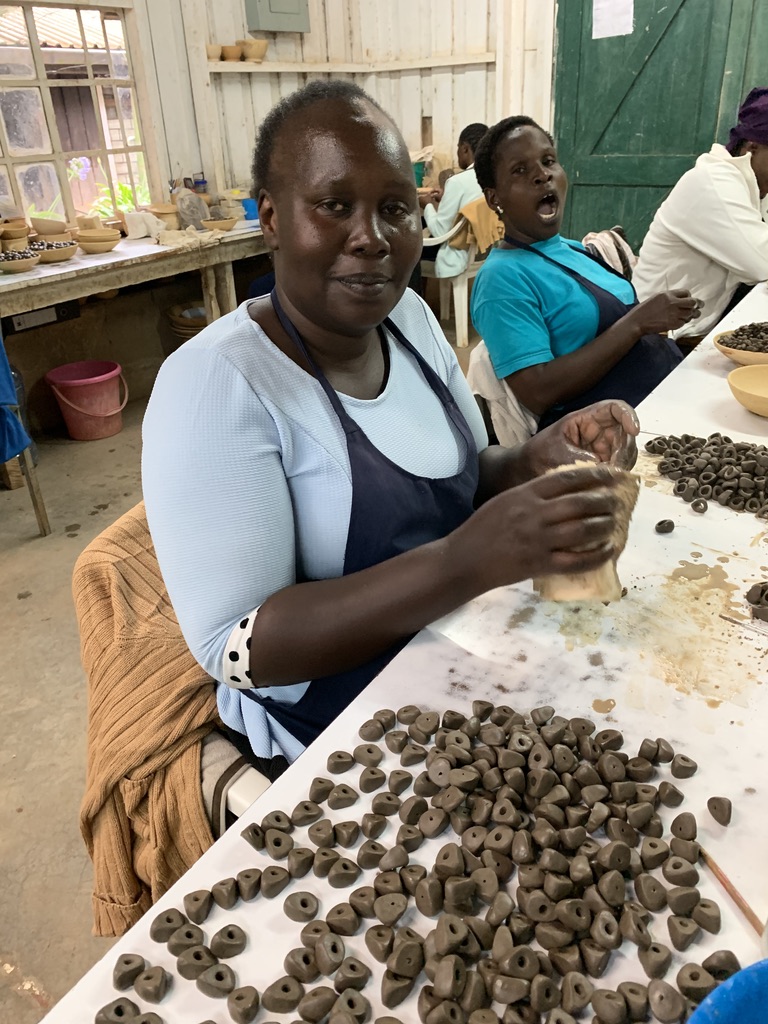
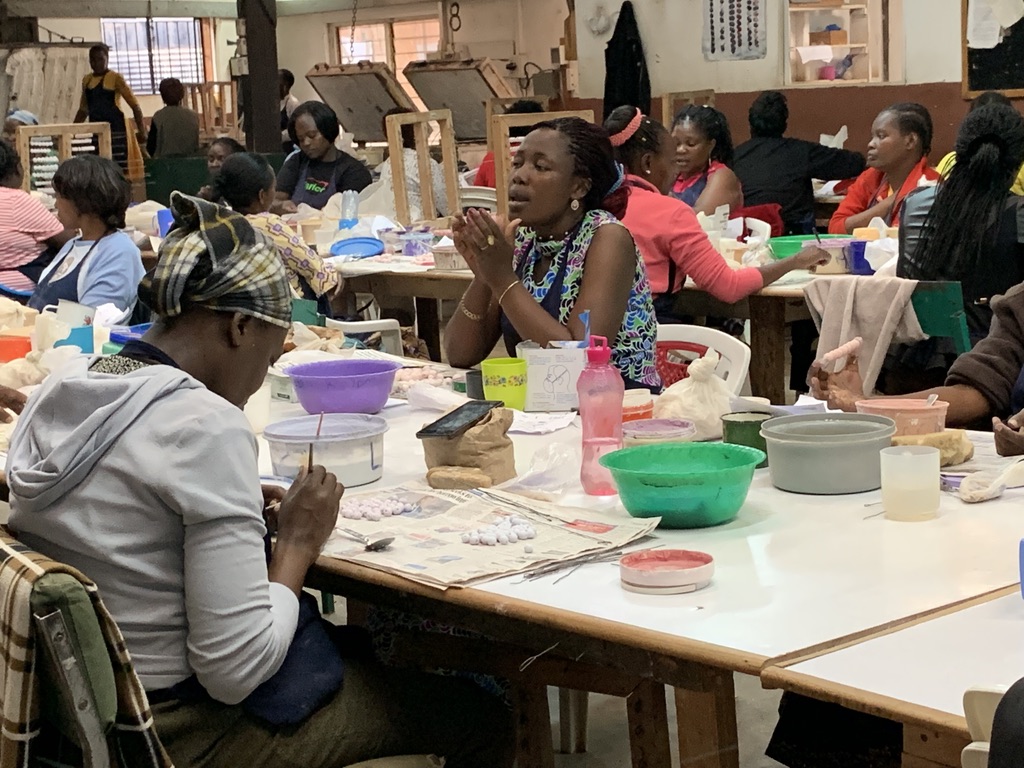
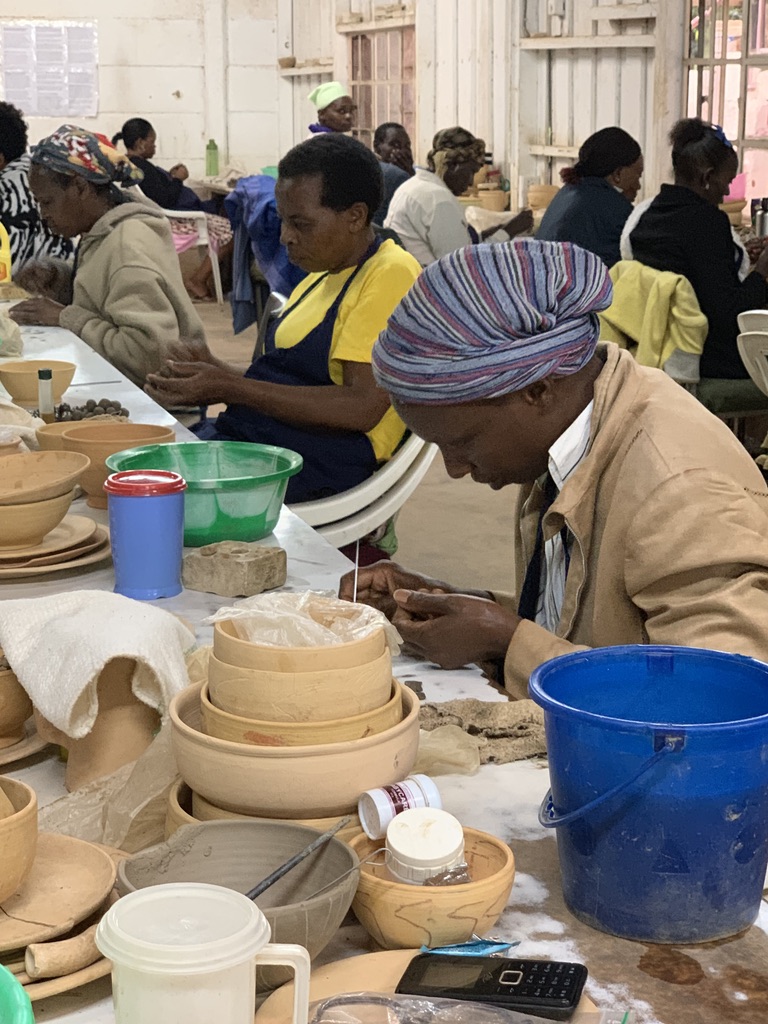
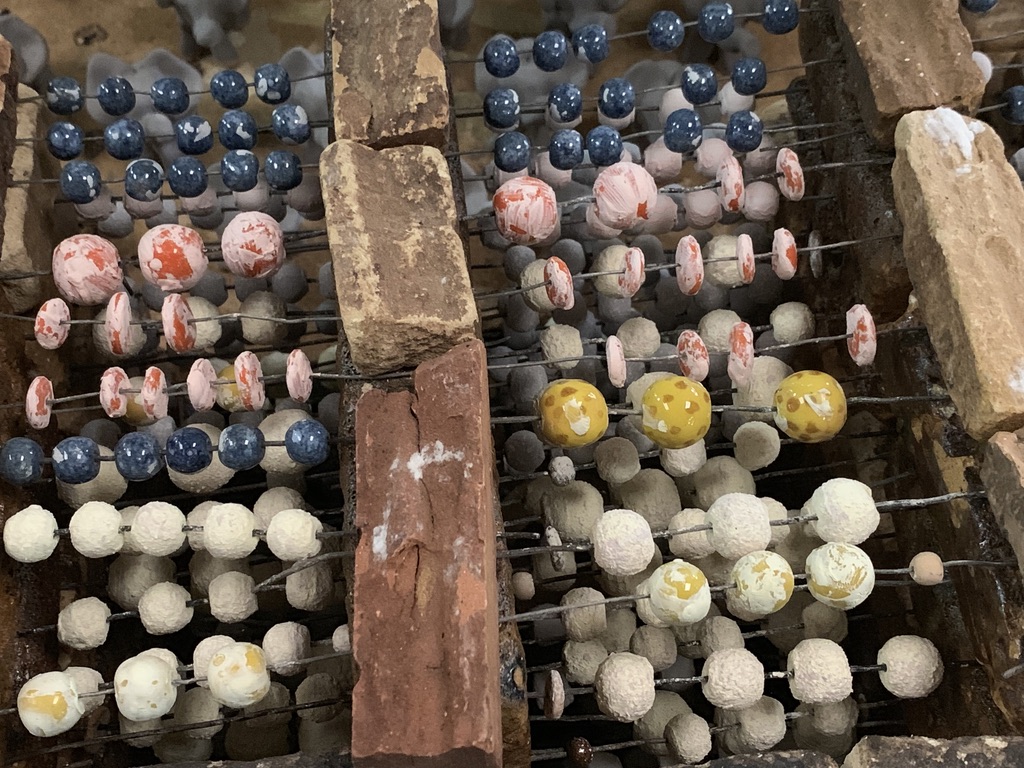
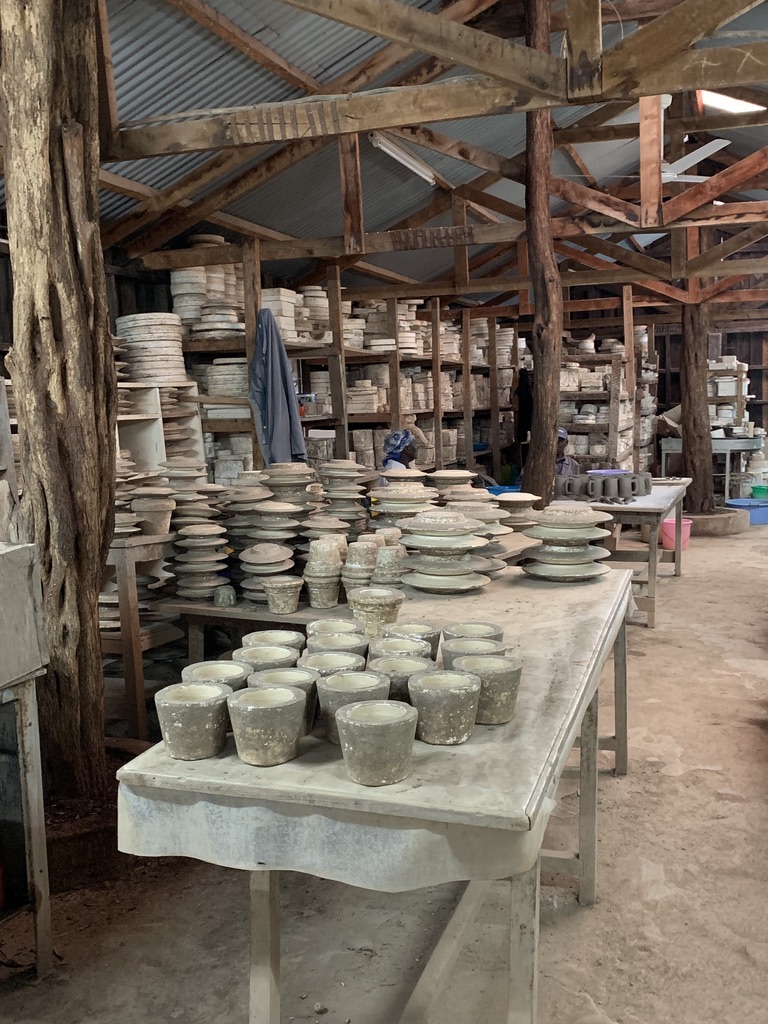
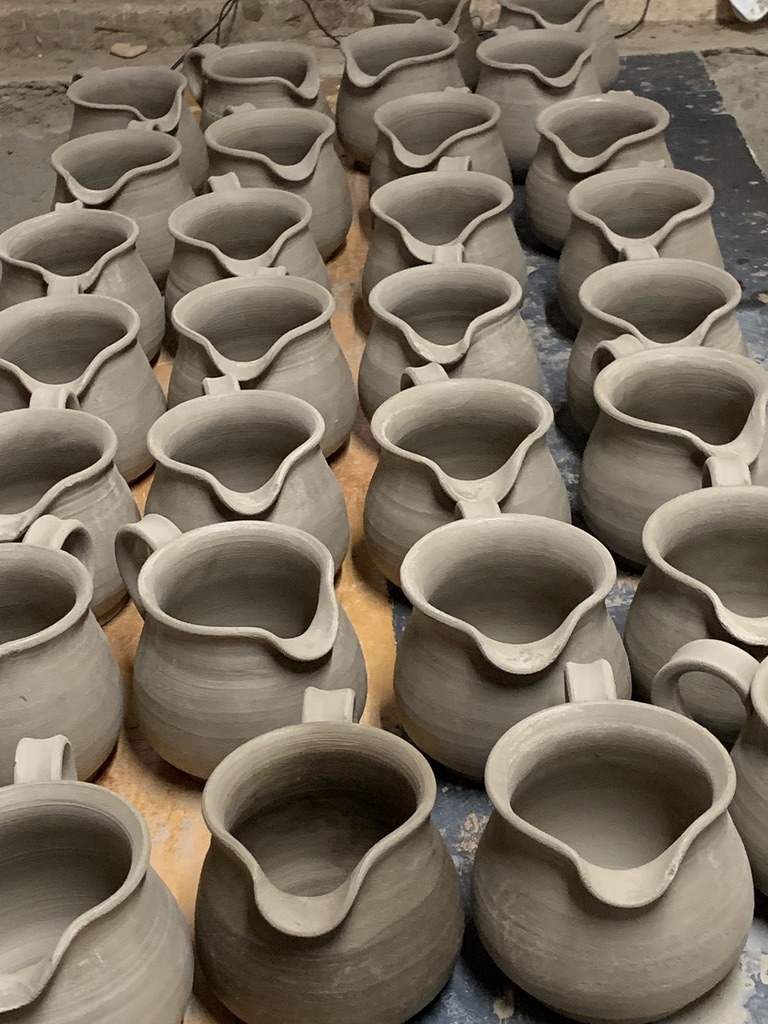
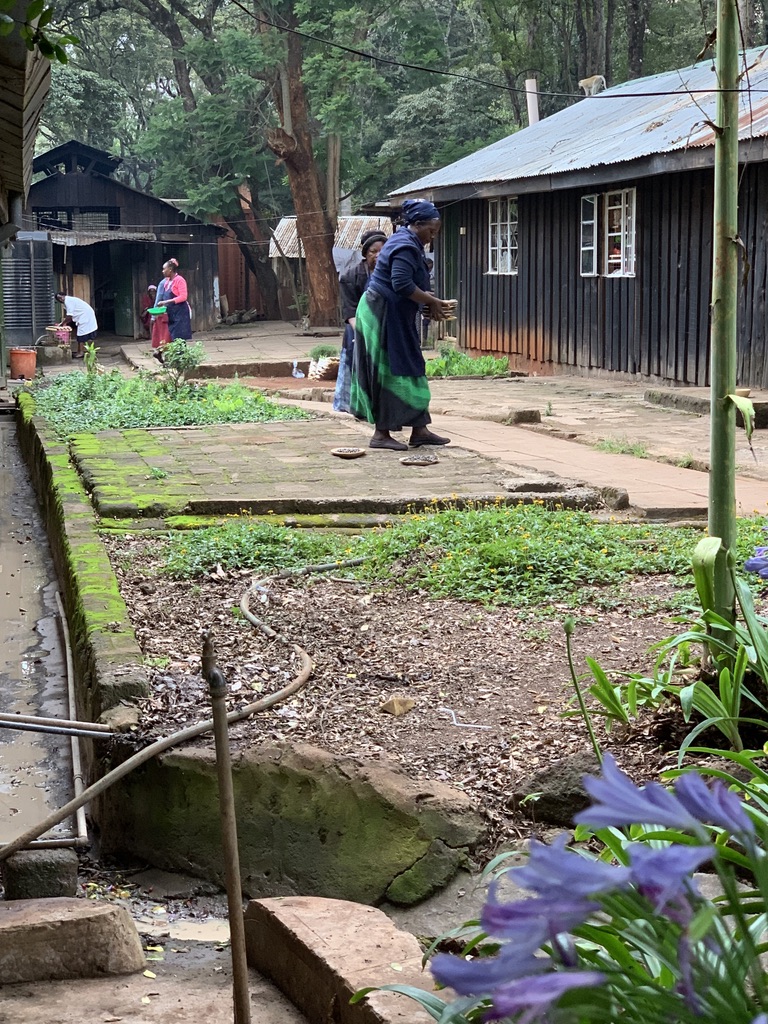
So, back at the bead factory. There was a ‘mandatory’ tour which proved informative and also disturbing. The bead center was started by some religious person who wanted to help unmarried mothers. Now, some years later it’s a thriving enterprise with at least 70 workers (mostly women – and the women make the beads; the few men working there make the mugs and newer items they have added to their portfolio). When I went inside the first building (really a series of huts) everyone was singing a religious song – it was Christian but they were singing in Swahili, and then there was a prayer. Apparently this happens twice a day. The bead-making process is very rote and the women have strict quotas they must meet each day. They do rotate the jobs.. two days you are making the clay beads; two days you might be putting the holes into the beads; two days you’re involved with the firing; two days painting (based on a very strict pattern and color scheme you are given); two days involved with firing once the colors are on the beads; two days stringing the necklaces.. etc. etc. Turns out that Kazuri has established quite an enterprise with orders from around the world.
Meanwhile, Mike got his wish in that he fed the giraffe, but didn’t do the pellet in the mouth deal. (For images of Mike feeding the giraffe, you need to contact him directly)
By now it was pouring and we were glad we hadn’t decided to walk.. From there we went to an amazing craft store to check out the wares… Many really spectacular things, but pricey and too much to carry home.
Then we headed to the Karen Blixen Museum. (This is the “Karen” for whom the whole area is named and nearly everything around is named Karen something.) Karen Blixen is the Danish author of “Out of Africa” – goes mostly by the pen name Isak Dinesin. The museum is actually her house – the one depicted in the film version with Robert Redford and Meryl Streep and the one described in great length in the book. The grounds are quite wonderful and many of the artifacts in the house pointed to an independent woman with big ideas. Apparently she left Kenya after 18 years to return to Denmark, never to come to Africa again even though she lived another 30 years. For some time the house was rented out and then after her death the Danish government bought the property and held onto it, hoping it would become a historic place of interest. When Kenya became independent, the Danish government gave the property with all of its artifacts to the new nation, which has clearly invested in preserving it and promoting it as a destination.

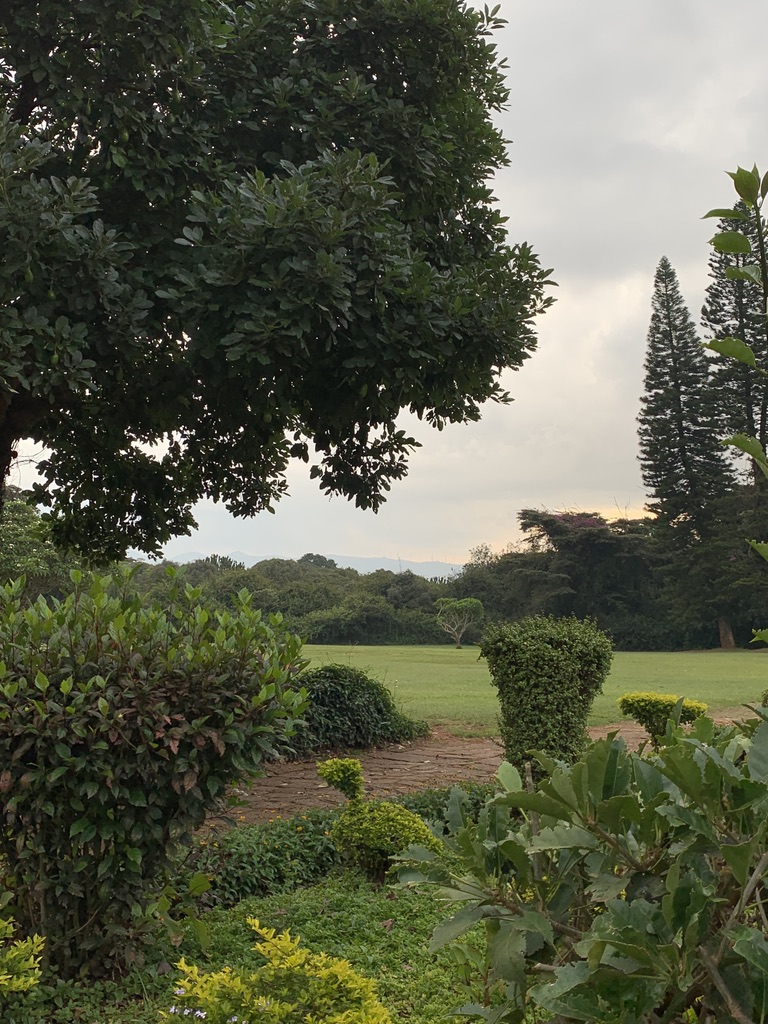

After all of these stops, we headed to Talisman, a much recommended restaurant (in Karen – down a small side path and rocky road). We told the driver to go home to his family (two daughters and a 4-month old son) and that we would find a way back to the hotel. He seemed pleased with the arrangement. And it was now really coming down, with lightning and thunder.
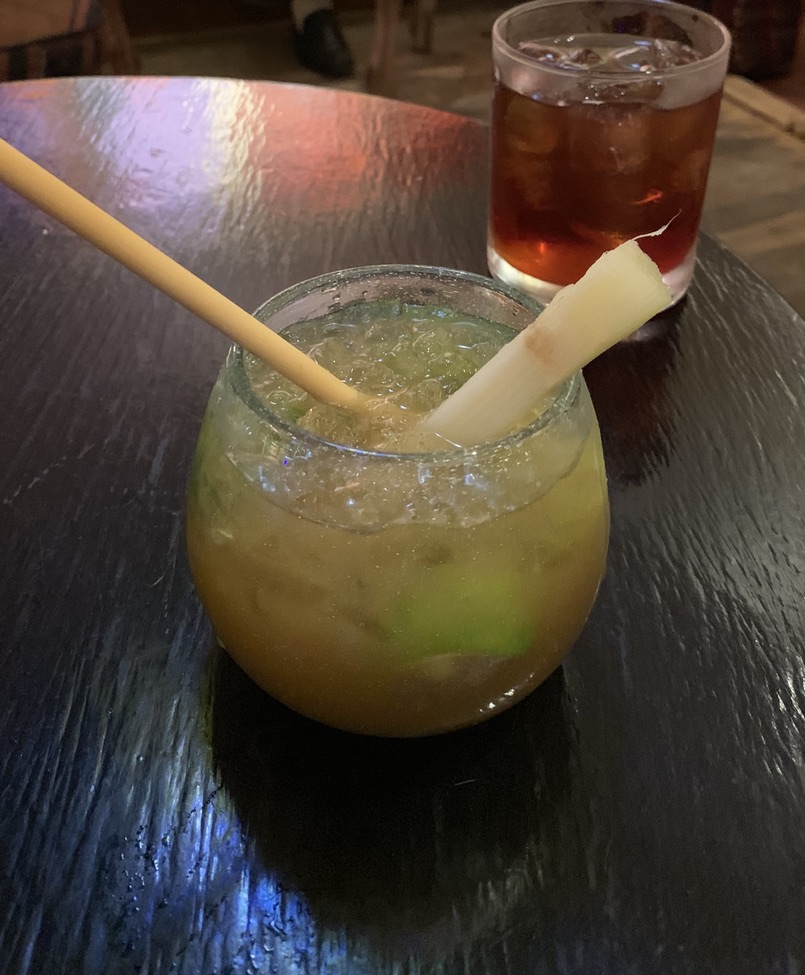
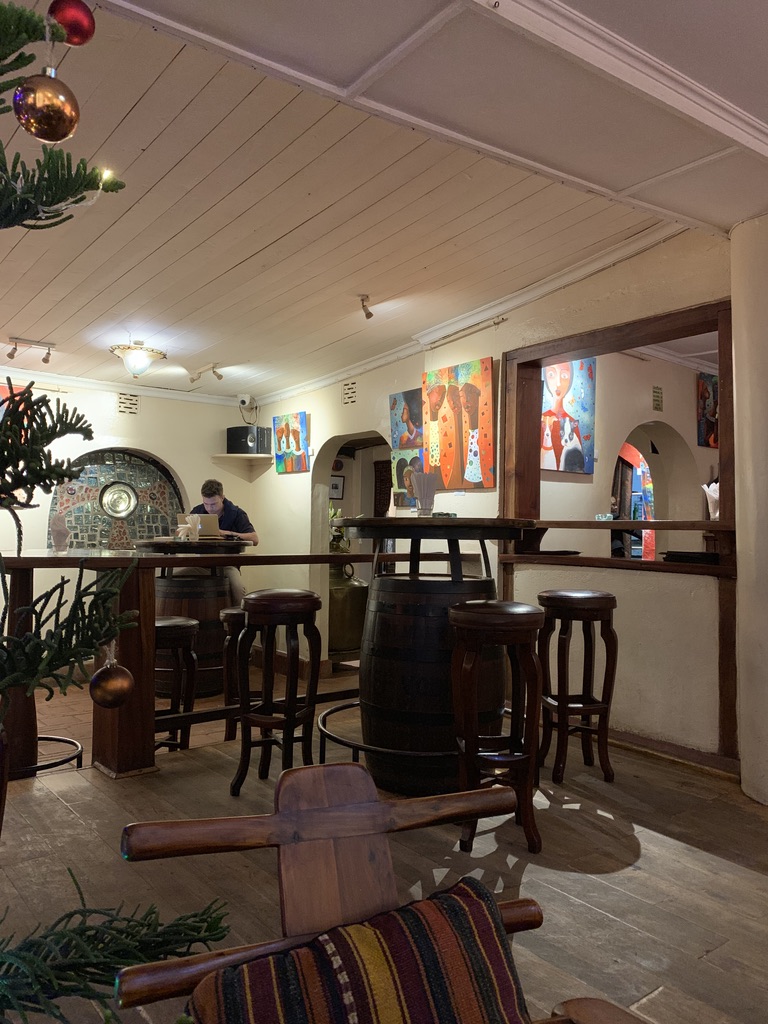
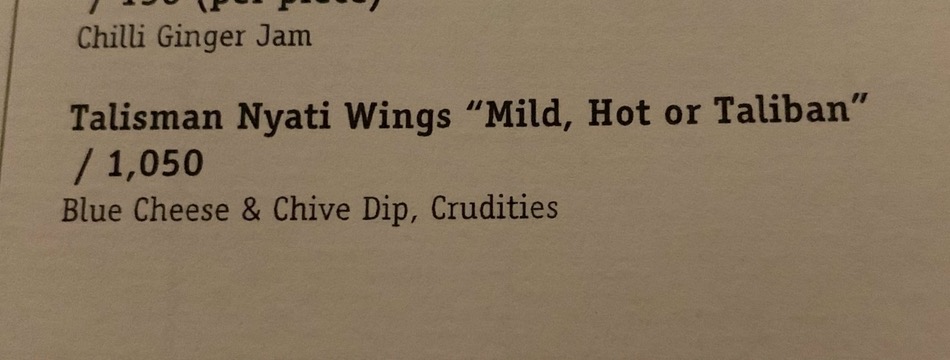
Talisman was a pleasant surprise – a “gastrolounge” in an old farmhouse with meandering rooms for the bar and the restaurant. Crows was a total fusion of Nairobi (albeit, missing poor people). Following drinks (I’m now really into these “dawas” we headed to one of the dinner spaces. The menu was totally eclectic – we opted for samosas, Moroccan spiced beef, and also the ostrich dish (great!) and couldn’t resist dessert – chocolate malva (sort of mousse with a champagne orange curd). The house and each room had several fireplaces, which was good because the rain was unrelenting and the spaces were sort of open… and clearly no heat.
We fetched a taxi back to the hotel to pack… It was an intense 4 nights and 3.5 days. All good. Highly recommend a trip to Nairobi.
Fern
Americans in Nairobi 12/17/2018
Salamu Kutoka Nairobi (Greetings from Nairobi)

Hope you are well.
While it is only the end of our second day here in Nairobi (third night), we are packing so much into each day, it feels as if we’ve been here for at least a week.
So a few observations and comments and then some descriptions of our adventures today.
- Very few people assume we are from the US as it’s clear there aren’t too many Americans coming to Nairobi to stroll the city; true there are probably many Americans here in Kenya – but they just stop off in Nairobi to prepare for safaris. Thus we are a bit of a rarity. Taxi drivers, shop keepers, etc. all ask where we are from. Oakland or San Francisco don’t prompt any real recognition; California prompts some small familiarity, but mostly we are sticking to the big picture – “We’re from the US”
- Being from the US brings an immediate response – “Obama!!” which easily leads to a few fist bumps and smiles and comments like “good president” – which leads to the Trump comments: “bad president!”
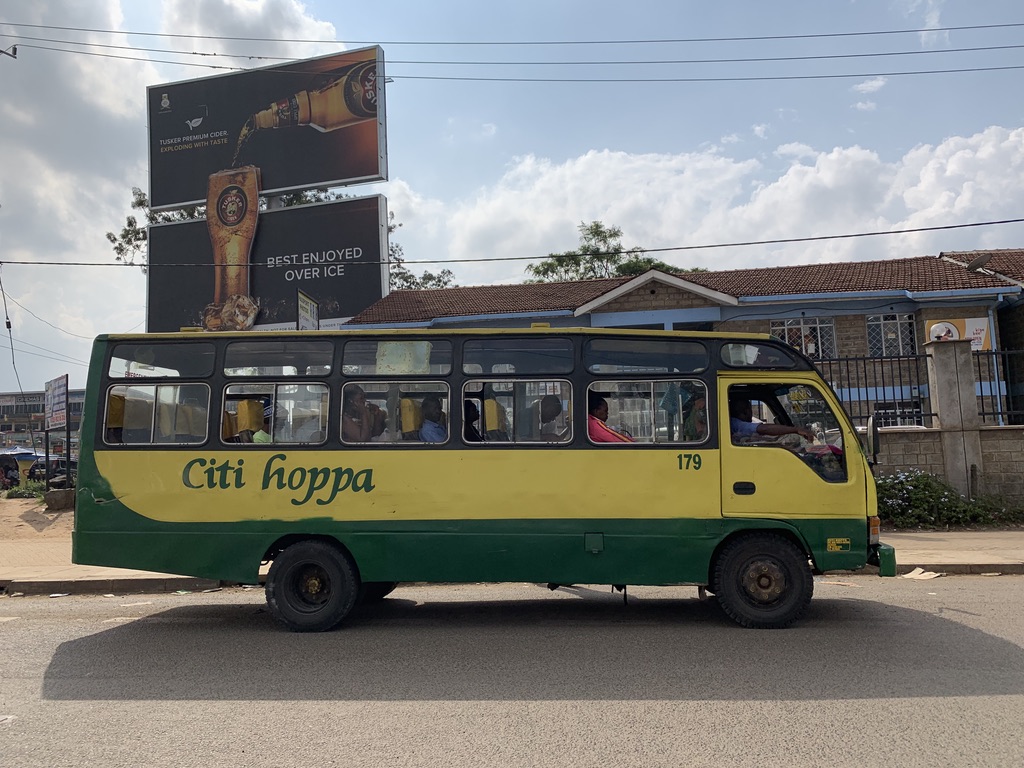
- Workers leave their houses at about 5:30 am every morning in order to be at work by 8 am; they need to avoid the likely traffic jams which would make them late. They travel on “matutus” – little vans or minibuses that take passengers (for low fares) from outlying slums and low income areas into the central area and other destinations. They operate 24 hours a day and have distinct routes. They are very crowded and not in great repair. Until recently these matutus were privately owned but we were told that the government recently took them over because the drivers (owners?) kept threatening to strike which would truly screw up the “functioning” of the city. Some of the matutus boast portraits of famous people; music is generally being played on the vans — I think this attracts passengers.
- Again, because not many Americans seem to be here in Nairobi several people think we are from Iceland – not sure why they chose that country, but they are surprised when we respond in the negative to that question.
- Women are clearly much friendlier than men (although the taxi drivers – all male, I think – are also quite chatty if you engage them).
- We’ve been asked if we’ve been anywhere else in Africa and people are surprised we have traveled in Africa several times before this trip, and perhaps surprised we have returned.
- When we explained to one taxi driver that we were planning to visit a bunch of different neighborhoods and then listed a few, he said “So you are going to see both sides — the poor and the rich..” True.
- Very little evidence of Christmas here; in fact, other than the market selling some handmade little angels one wouldn’t know the holiday is just around the corner.
We bypassed the hotel breakfast this morning and got out into the streets; walked about .75 miles to the Java House which is like a Starbucks with a restaurant menu. There are Java Houses all over the place. We obviously stood out a bit as the only White people in the place, but everyone was either friendly or totally ignored us. Our waitress explained that Java House was started by an American couple in the 1980s and after opening a few stores sold their ownership to locals who have expanded the “chain” – She was quite proud of the operations with 60 shops and more coming, including expansion into Uganda. I guess it is the Starbucks of Africa (by the way, don’t think there are any Starbucks here – so Howard Schultz, watch out. Interesting, since there are Starbucks all over Asia and Latin America).
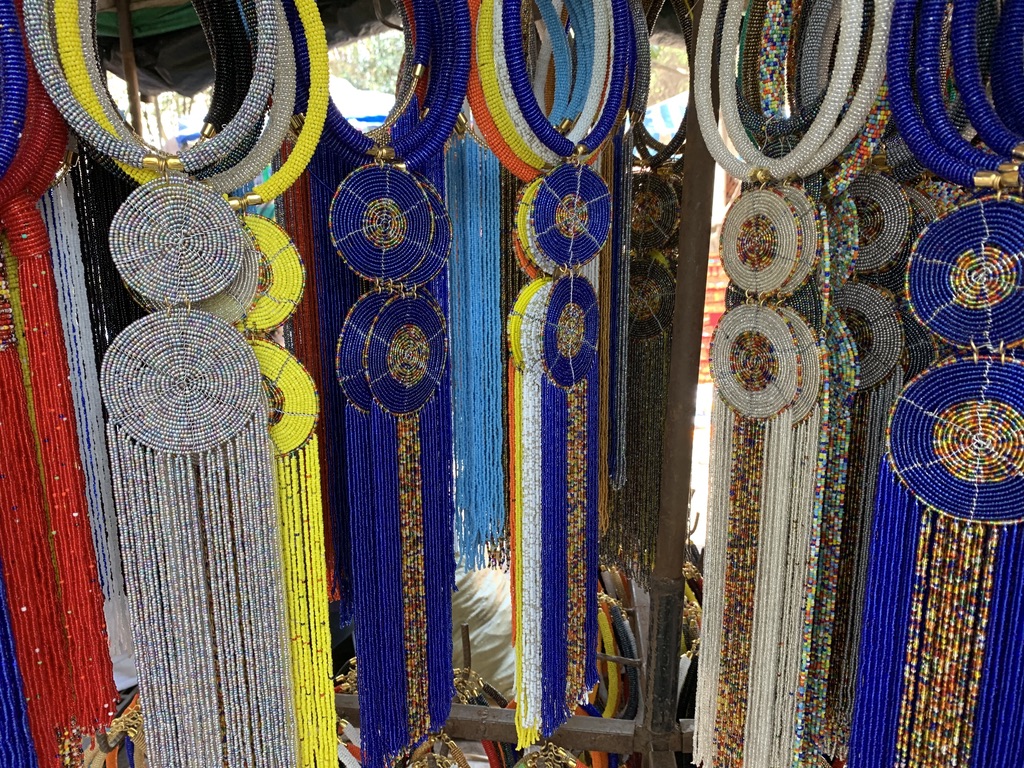

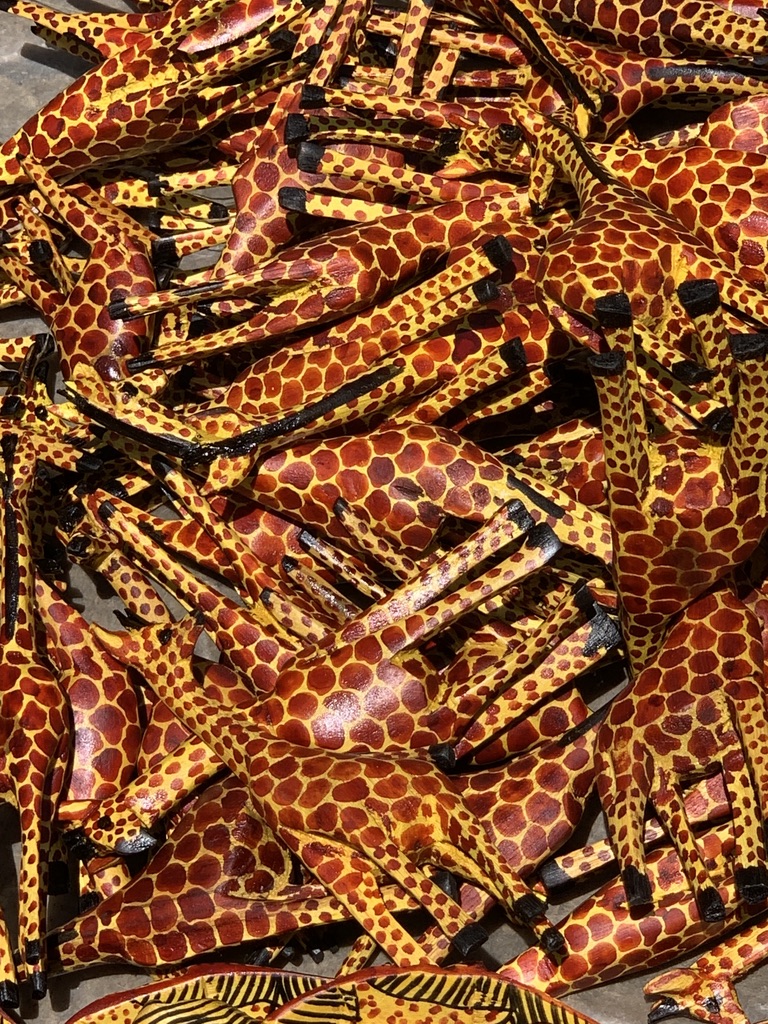
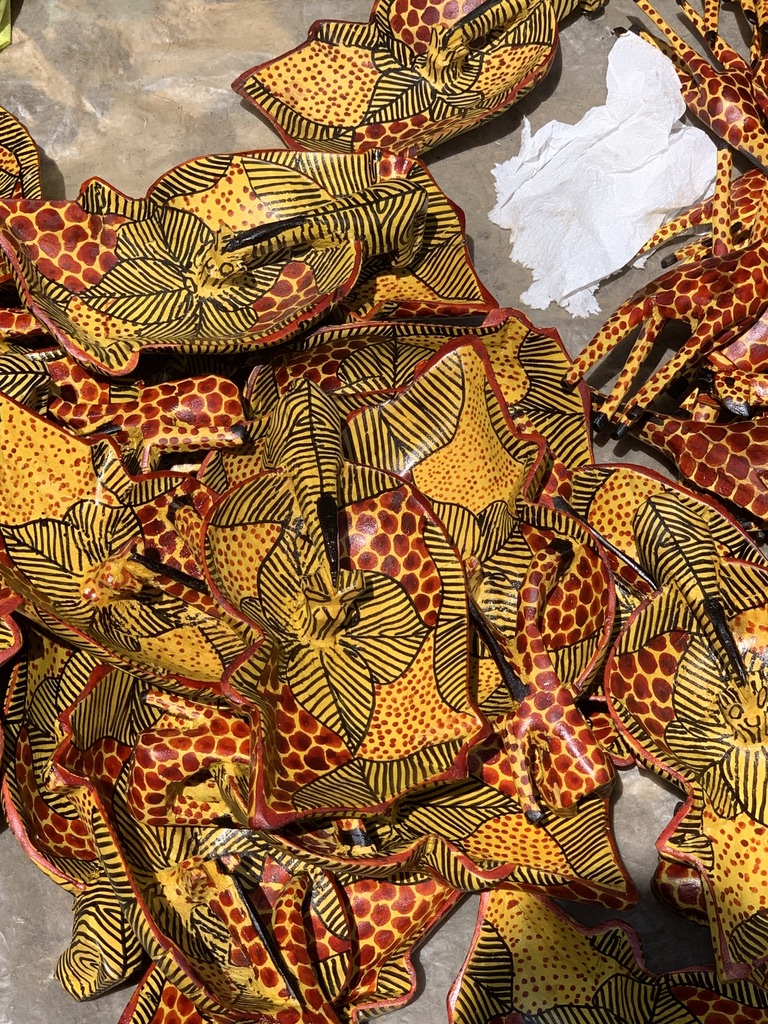
After breakfast, we walked to the Maasai Market which takes place only on Tuesdays. The walk was pretty straight forward, except for crossing multi-lane roads without any pedestrian walkways or traffic lights (there are very very few traffic lights in Nairobi); it’s sort of run for your life. Our trick in these situations here and in other developing nations is always: find a group of locals trying to cross the same street and get in the middle.. when they move, you move!
The Market is filled with craftspeople selling their wares. The sellers probably outnumbered the potential patrons 30 to 1 so there are a lot of men trying to tag along with you as you meander the “stalls” (really just goods on the ground and the seller sitting on a chair nearby).
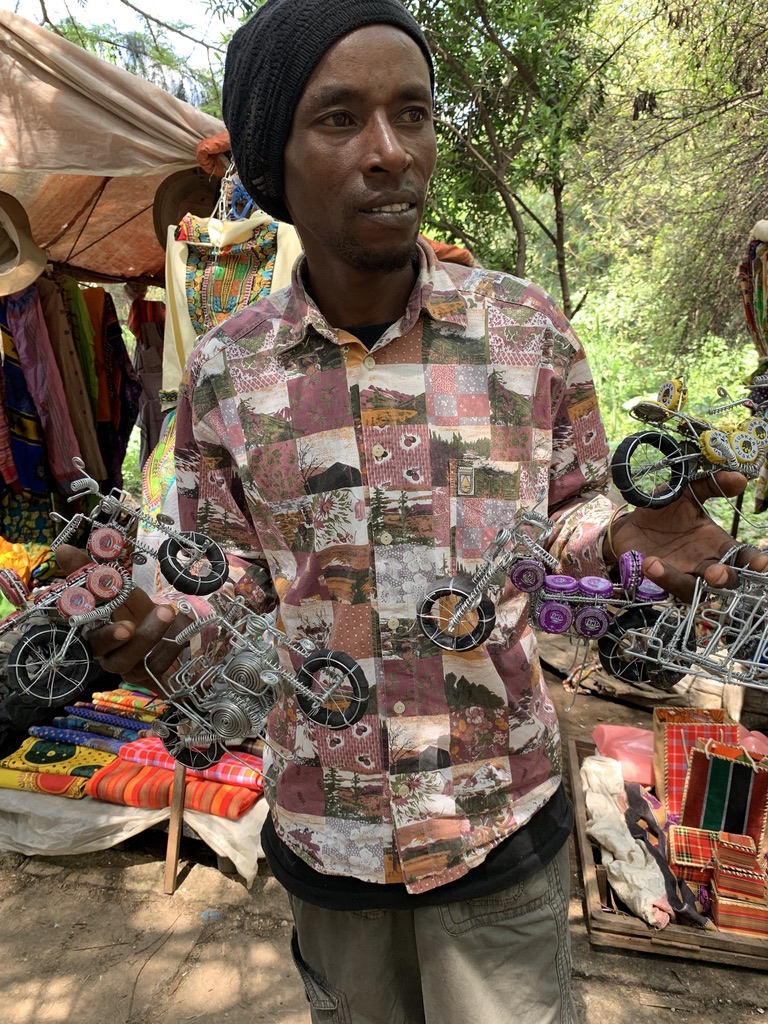
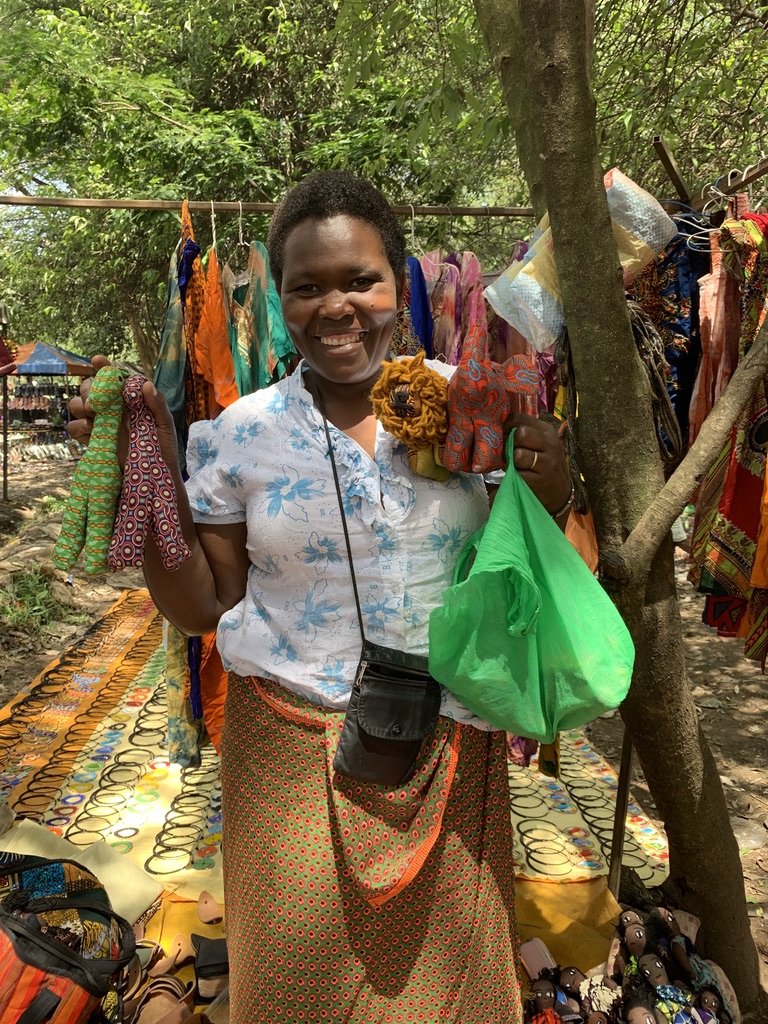
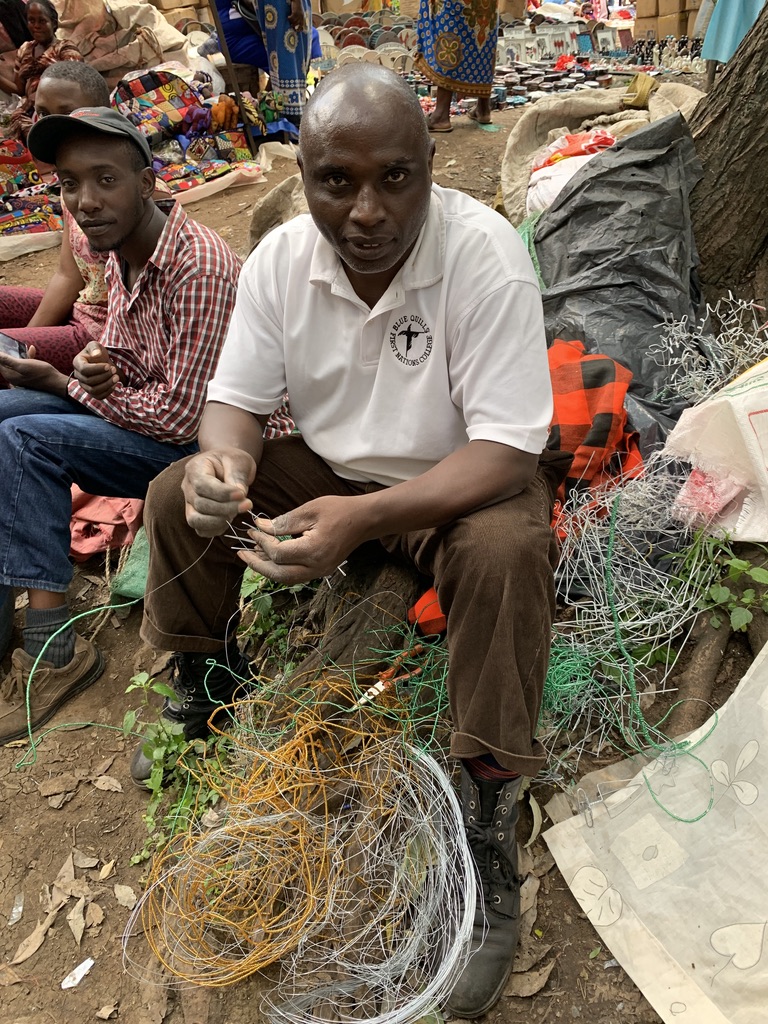
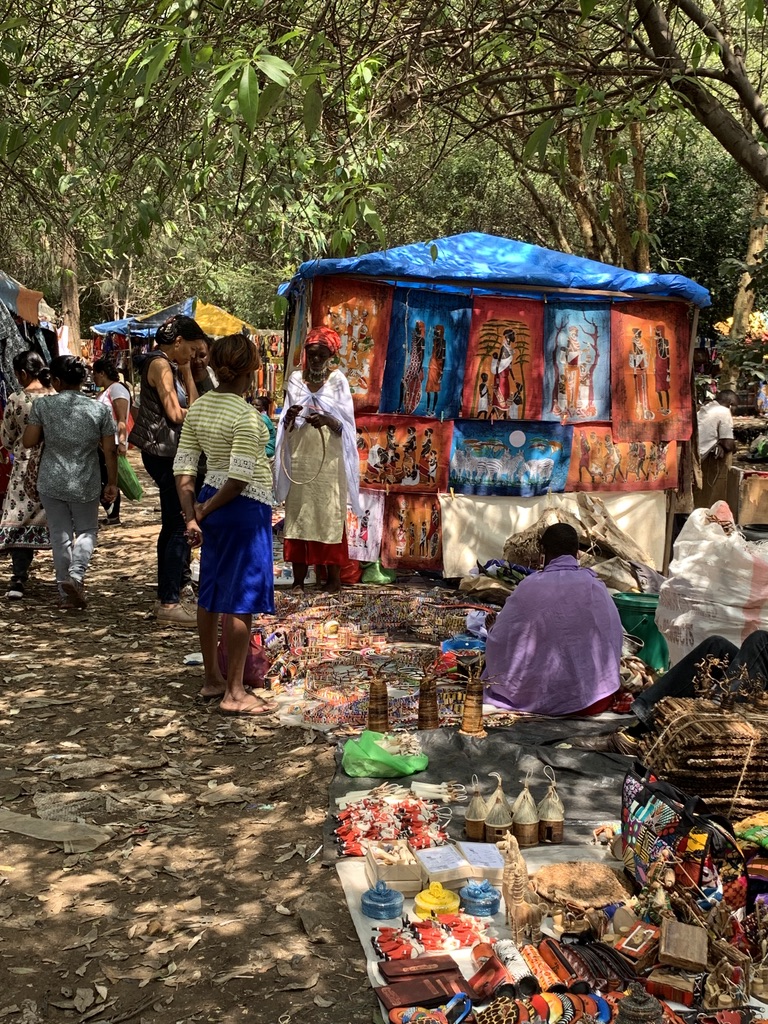
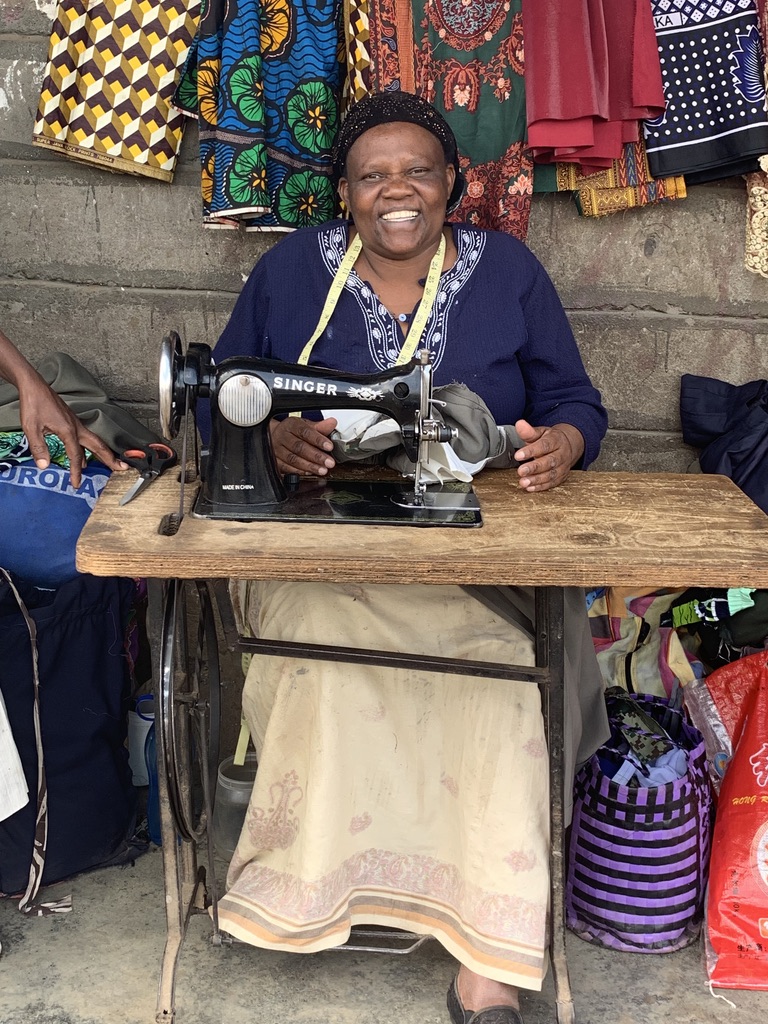
The market had some nice things, but we’re conscious of the fact that we need to think about packing and also we are so early on our journey… bound to find other things. From the market we walked back to the hotel (and into another world)… to just freshen up and head to the “shantytowns” or “slums” where the marginalized population of about 2.5 million live.
Enroute back we stopped into the University of Nairobi, which is located down the street from our hotel. It’s a typical large public university – Getting onto the campus wasn’t so easy; and like all the students we needed to show identification and go through a security check. Mike joined some students on a bench as I checked out the bookstore. By the way, there are signs all around the University that state “University of Nairobi is a corruption-free zone”
We knew we needed a taxi to get to Kibera (the largest of the slums – housing about one million people, although no one really knows the count). I had a conversation with the woman at the desk at the hotel – I explained that we wanted a “street taxi” to drive us to Kibera and then to wait to pick us up; we would walk around for about 90 minutes. We knew it would not be possible to find a taxi in or near Kibera to bring us back into town. And we also knew we didn’t want a hotel taxi.
She was quite sweet and understood, but explained that the hotel could not do this; they are only allowed to call for official taxis, or take us by hotel car. Their “taxis” are fancy cars (including Mercedes), so we opted to walk around the neighborhood to find a taxi and do our own negotiation. We actually only had to walk across the street to find a bunch of cars waiting for passengers. We explained what we wanted and the driver, Julius, was most accommodating, although he was a little nervous about our walking through Kibera on our own. Like all “visits” to areas of this sort, it’s challenging. You stand out as an outsider on more levels than it is possible to describe. But we insisted and Julius said he’d just wait for us in a designated location. We walked and chatted with a few people and realized once again that slum dwellers may be the most entrepreneurial people in the world.
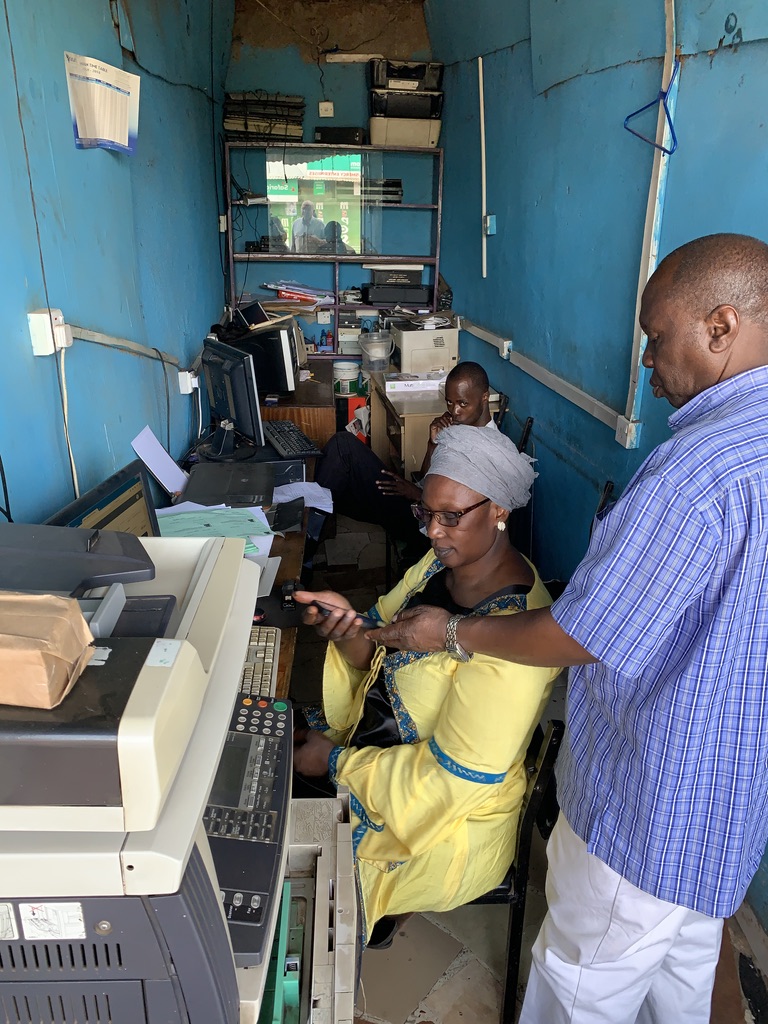

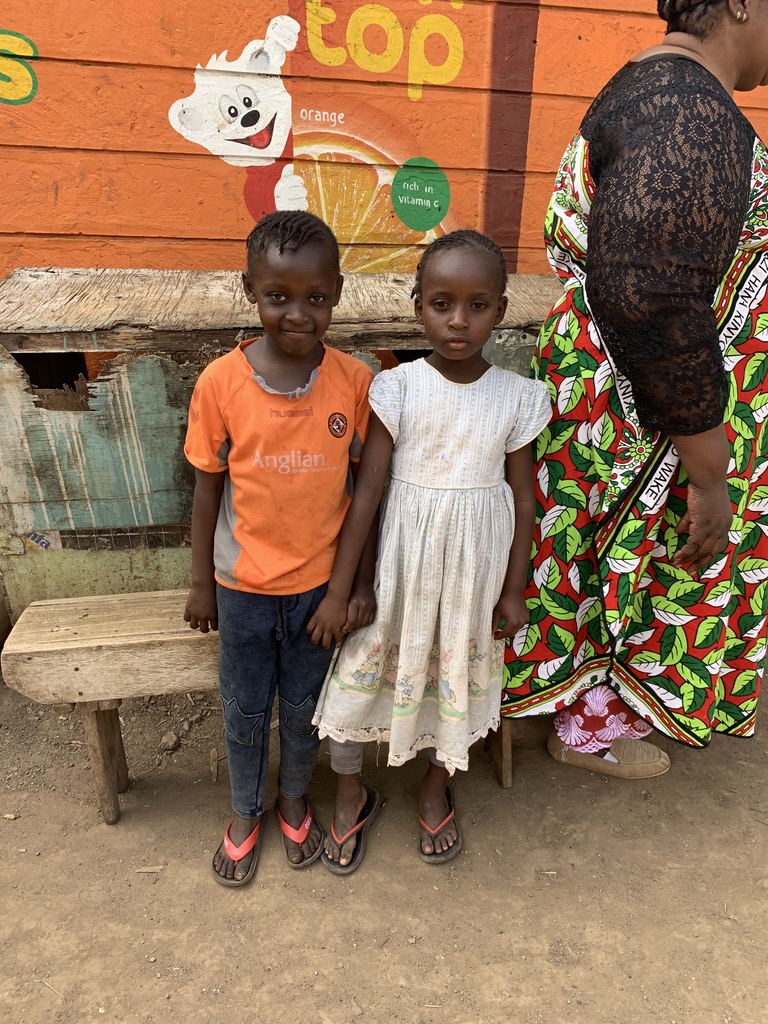
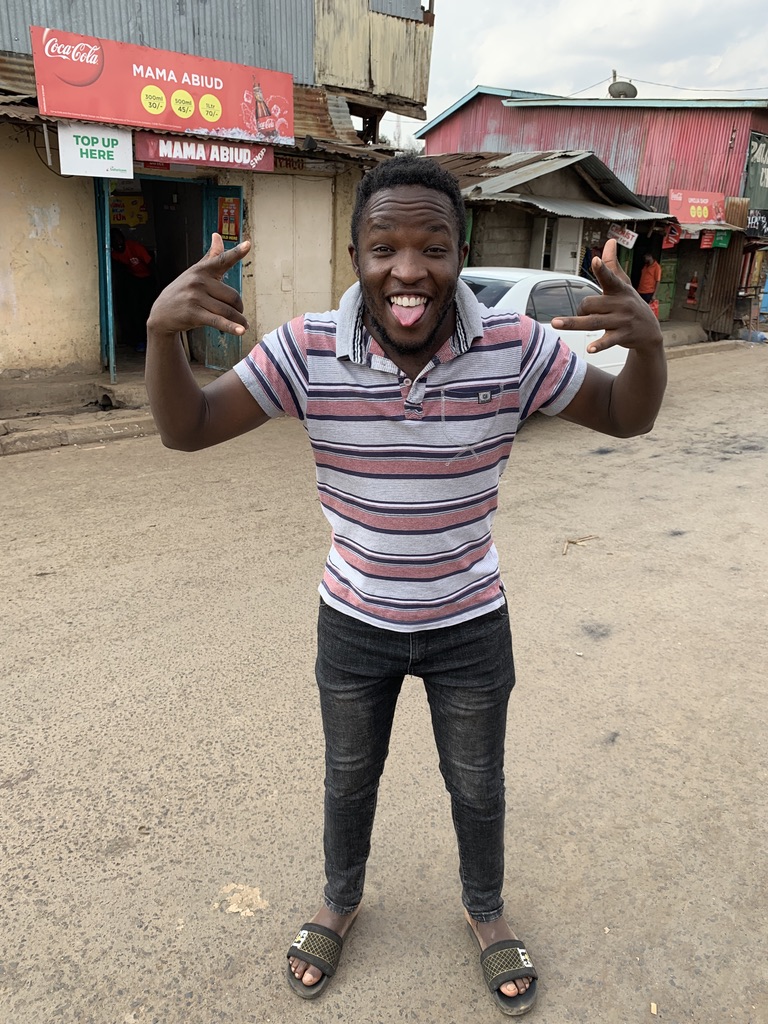
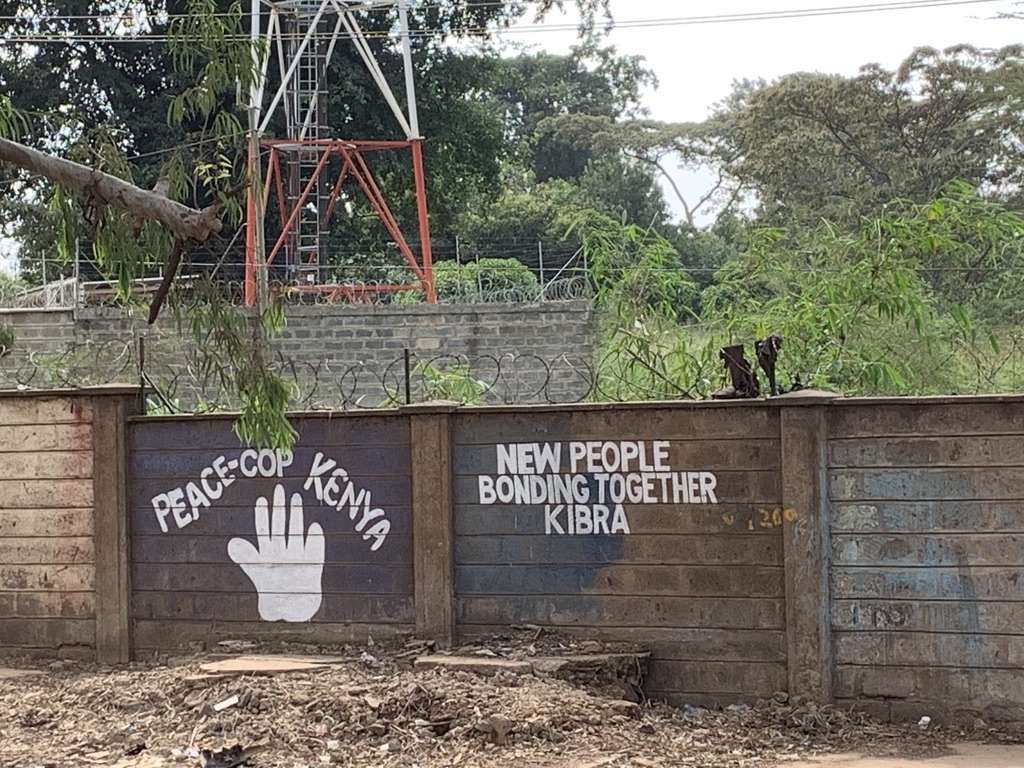
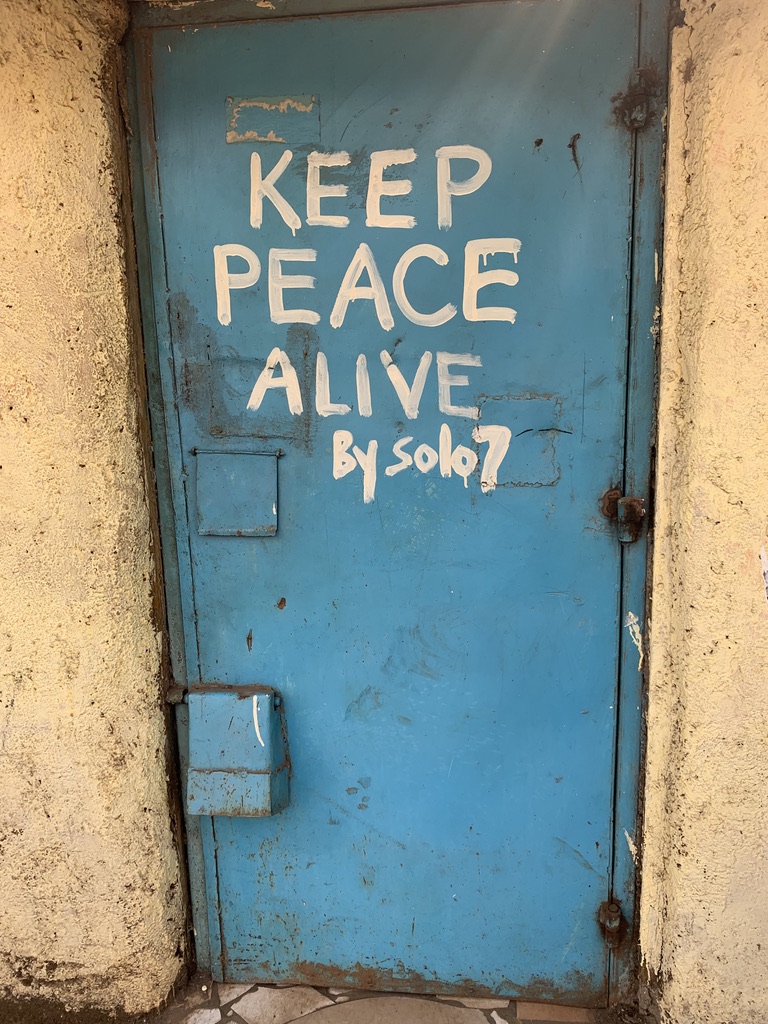
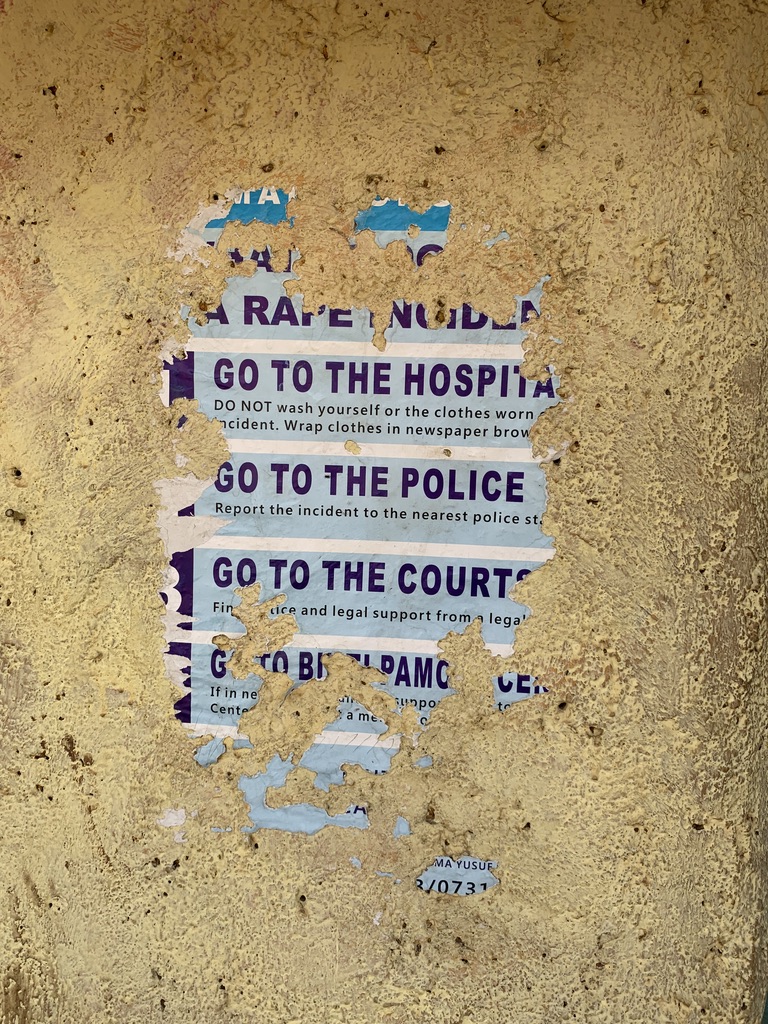
People in Kibera earn just a few dollars a year; there are virtually no services; and education is hard to come by. We did however see that there is a strong movement against violence with campaign-type signs everywhere pushing for “peace” and against all forms of violence. Interestingly this is the only place in Nairobi we didn’t see police or guards or machine guns. We also saw a lot of signs about HIV protection. According to the research we did, Kibera has one of highest rates of HIV in the world.
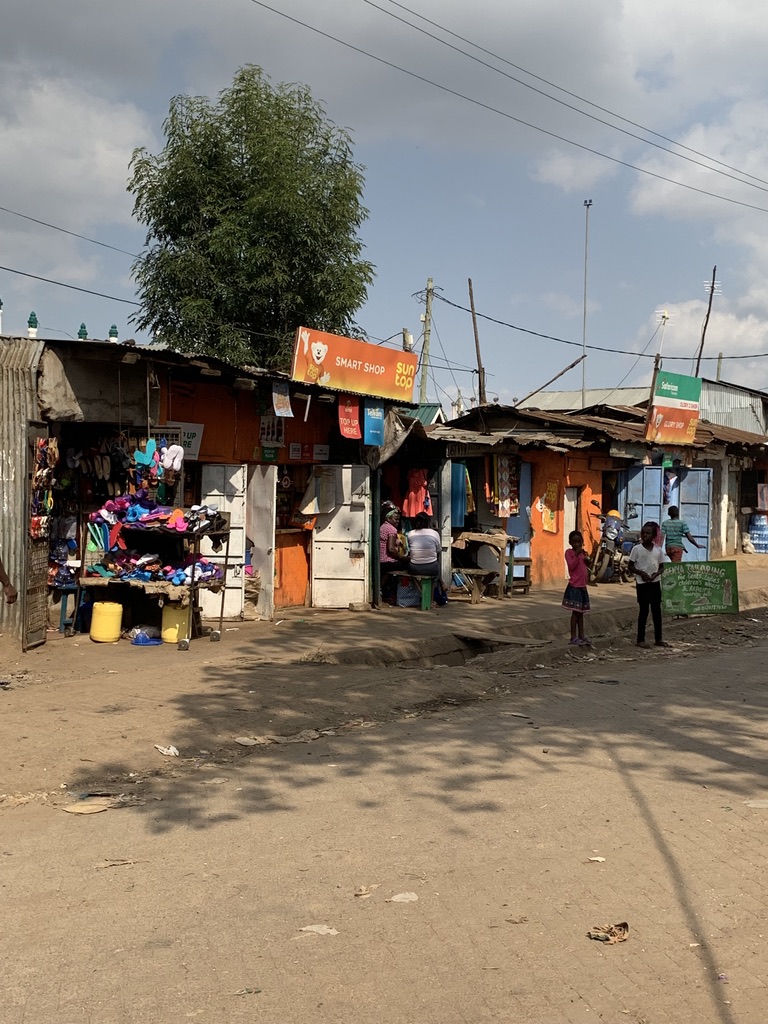
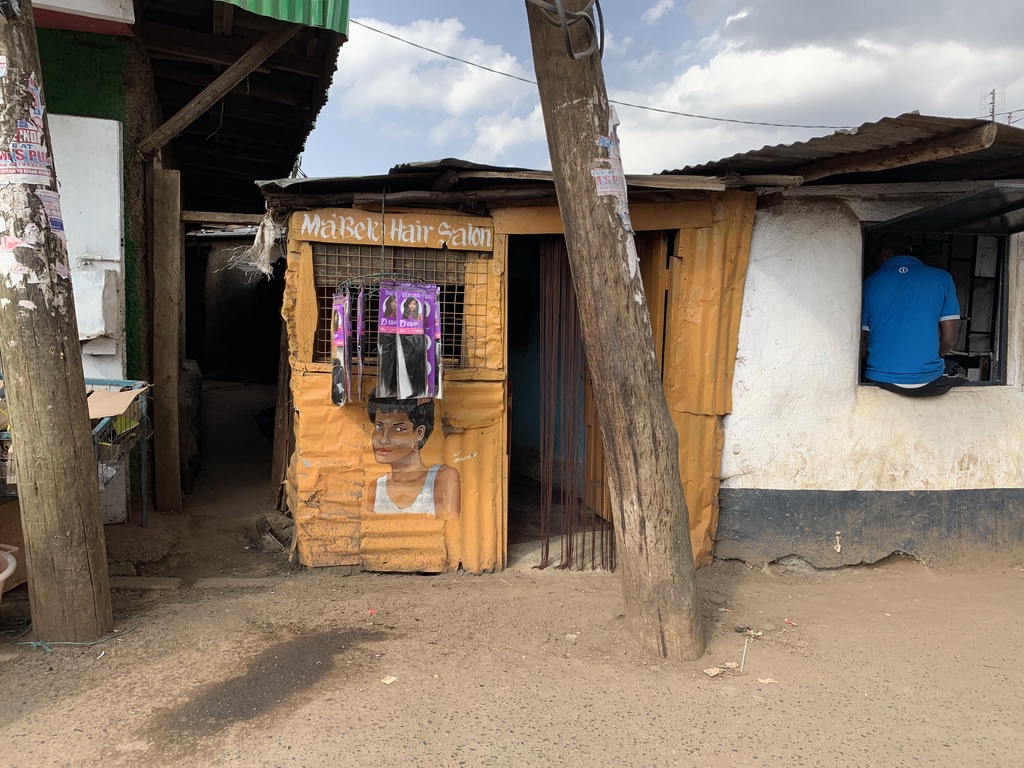
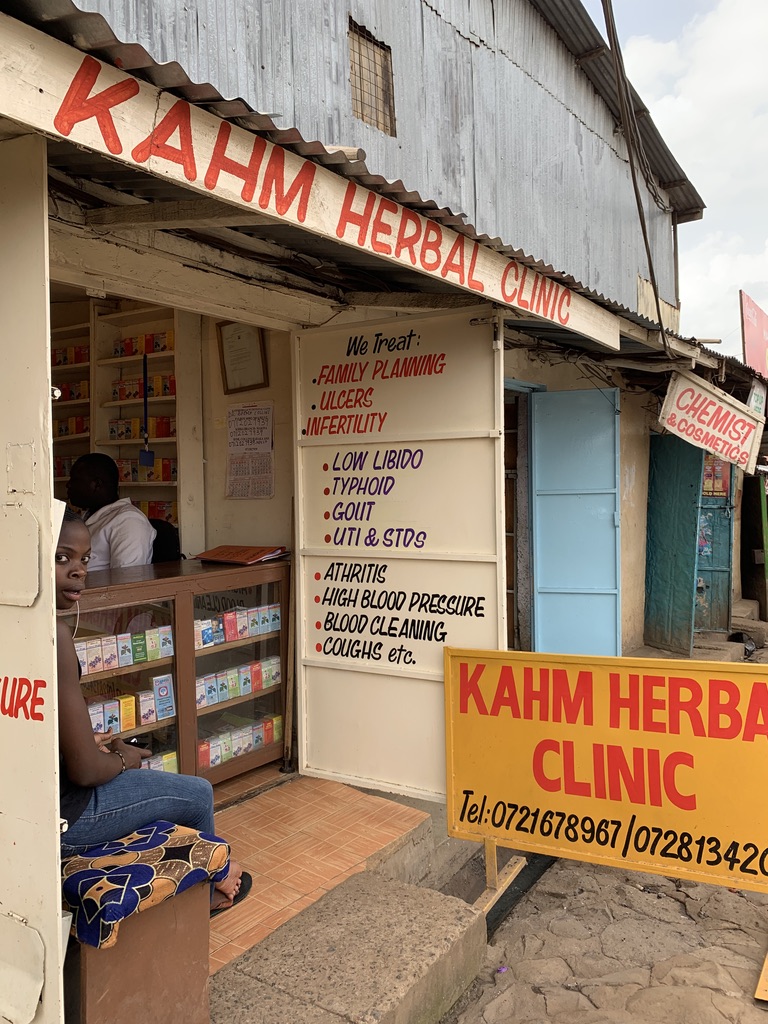
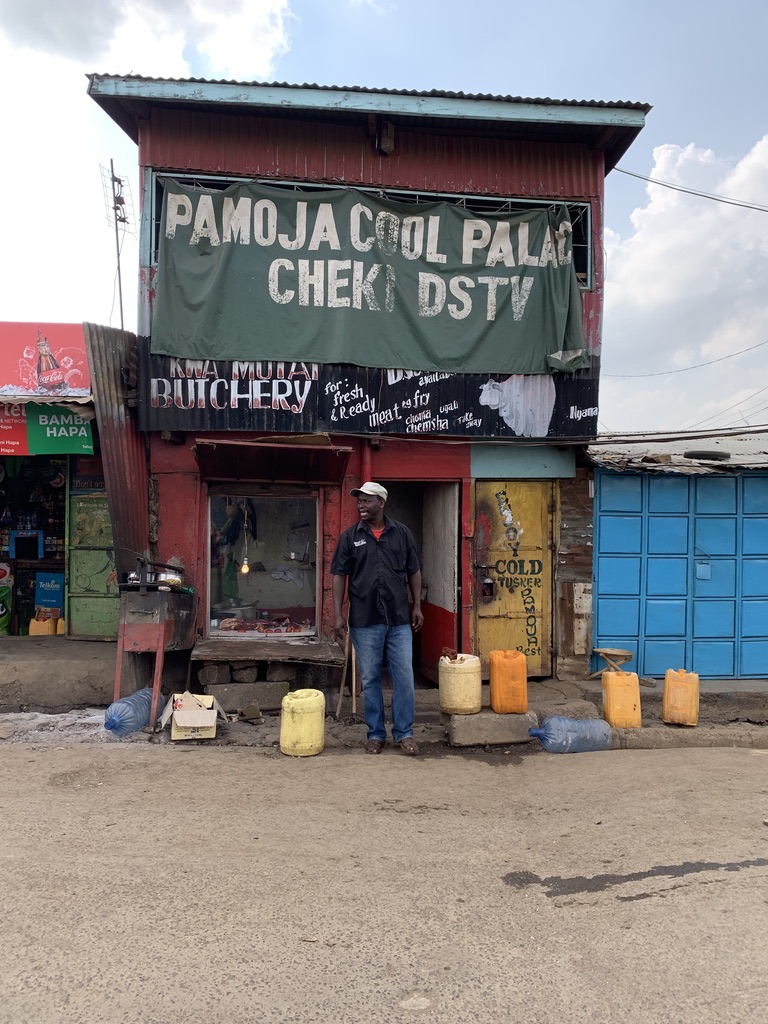
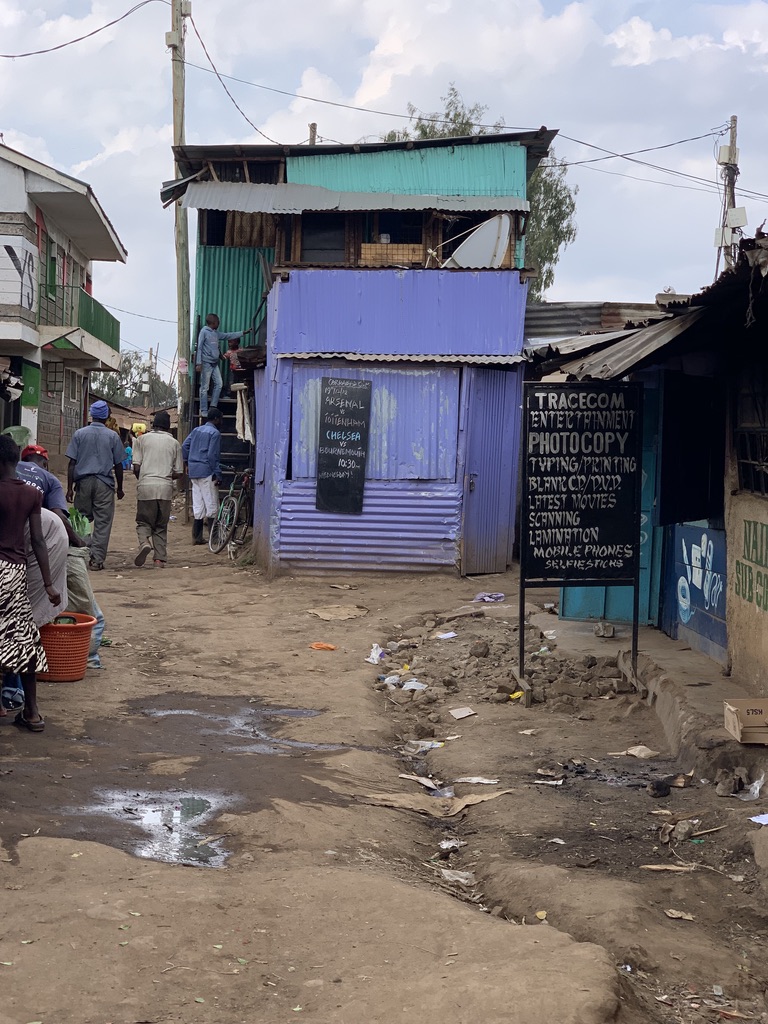
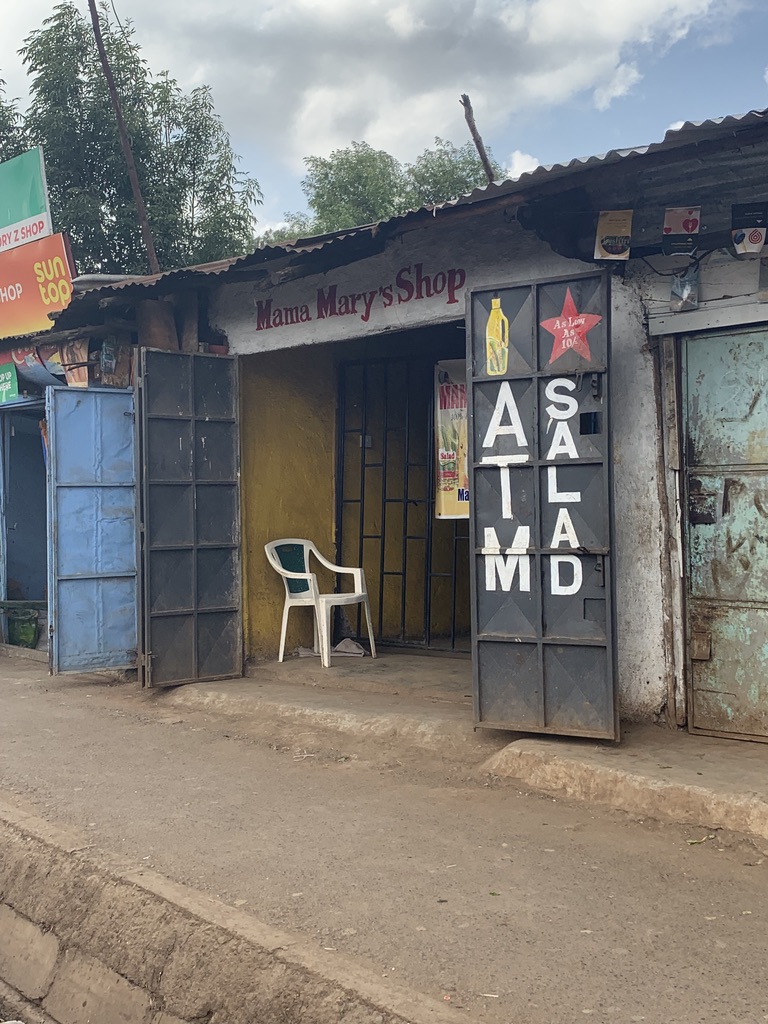
The “shops” in Kibera are about 10’ x 9’ at most; they are built of mud or tin or random pieces of found wood. Electricity is gerry-rigged and water is all but unavailable. Garbage collection is very infrequent, if at all. And raw sewerage is evident as you walk through the town. Supposedly there have been recent reforms and experiments and education in Kibera is supposed to be the best of all the slum areas. Still, we strolled for more than an hour and never saw a school. Kids loved to speak with us and loved having their pictures taken. With the adults, it was once again the Obama connection – once they knew we were from the US. Amazing!
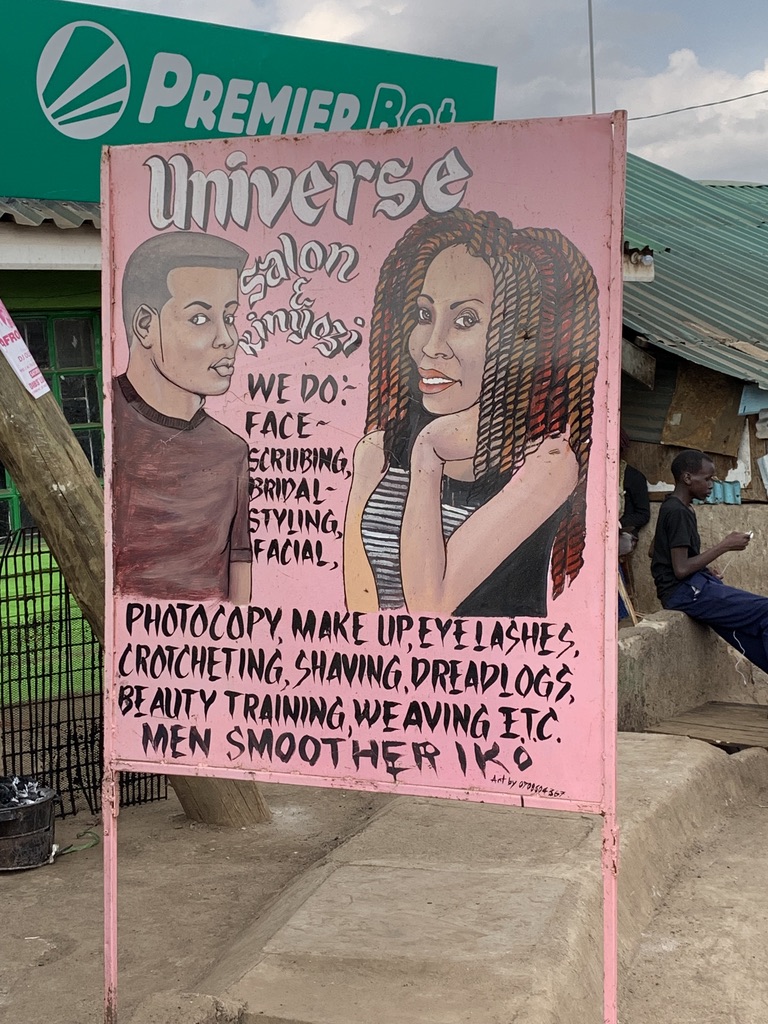
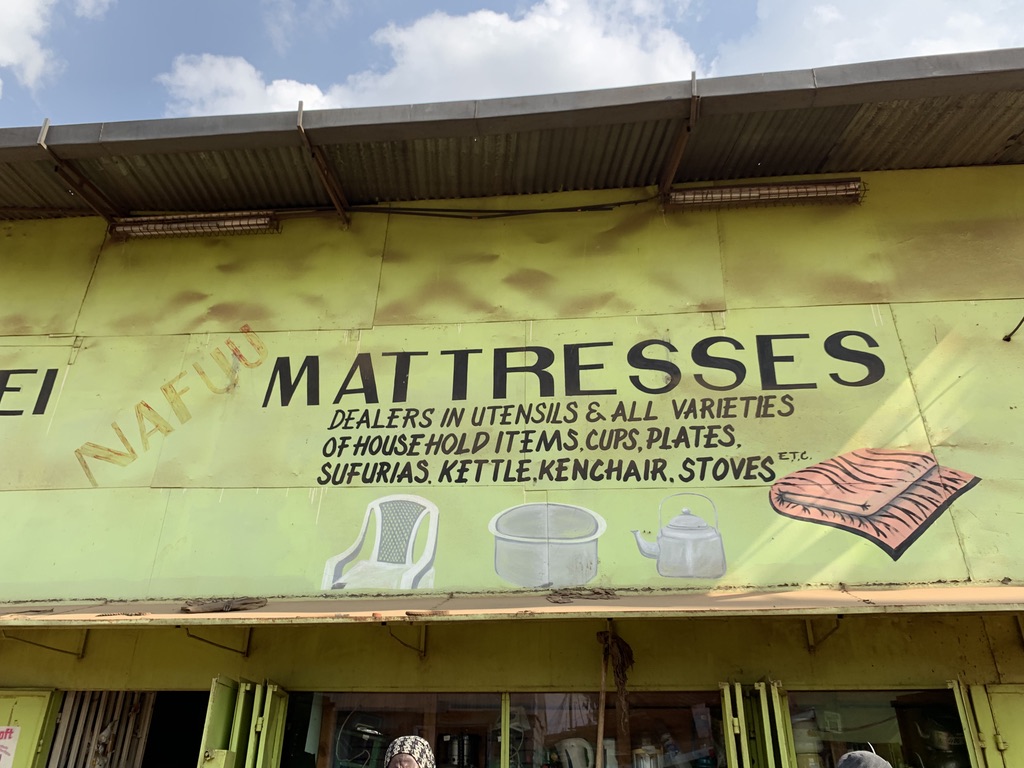
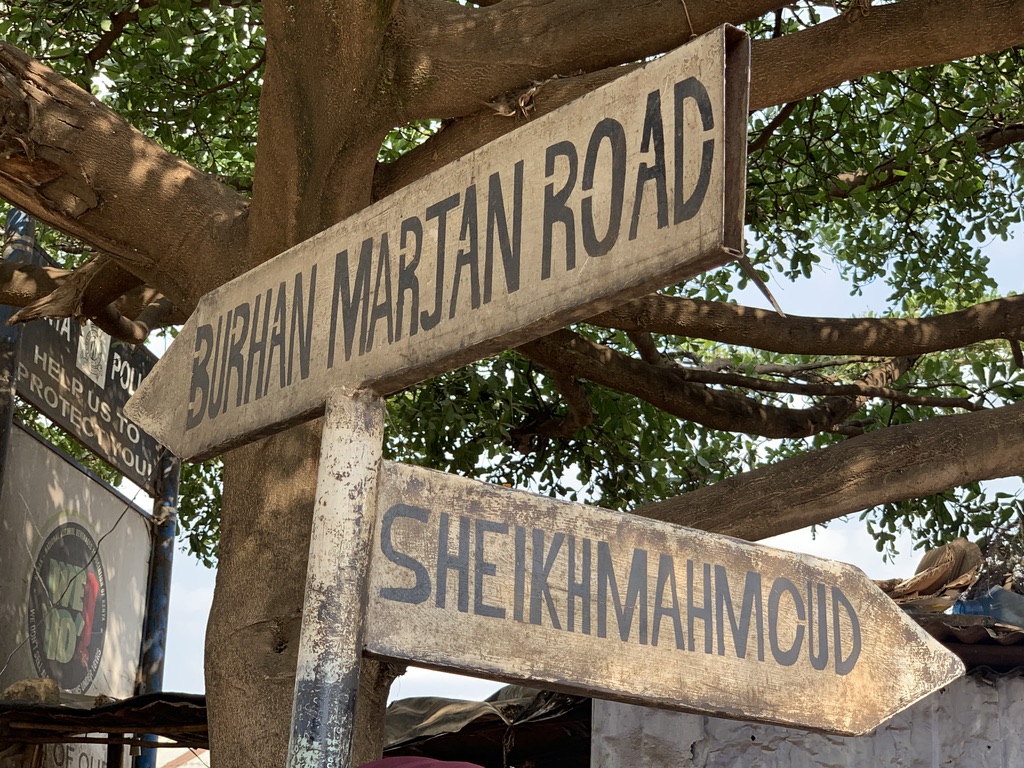

We rejoined Julius at the taxi at the appointed location about two hours later, and headed back to the hotel for a drink.
Tonight we were planning to eat at Amaica, some kind of fusion African restaurant we read about. But we wound up having dinner at Nyama Mama, because Amaica was closed for the holidays (very difficult to find these things out in advance!). Still we were set on eating African food, so this place seemed to make sense. It was fine, but not great. Crowd was very mixed.
Fern
Americans in Nairobi – 12/16/2018
Sawa (Hello in Swahili)
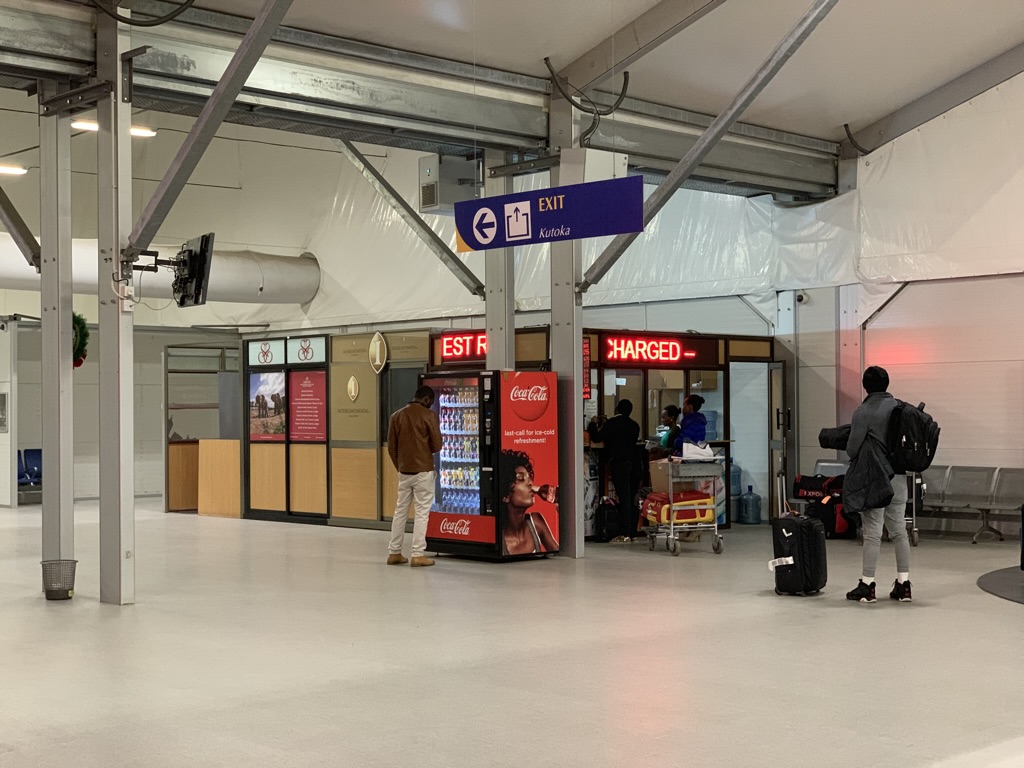
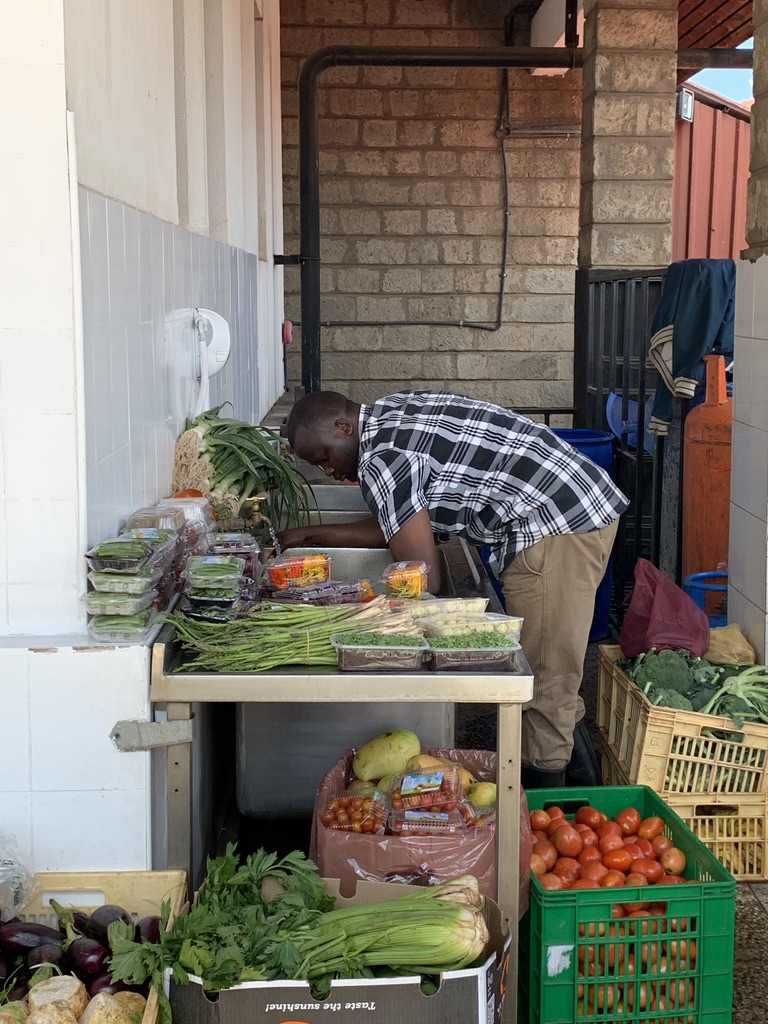
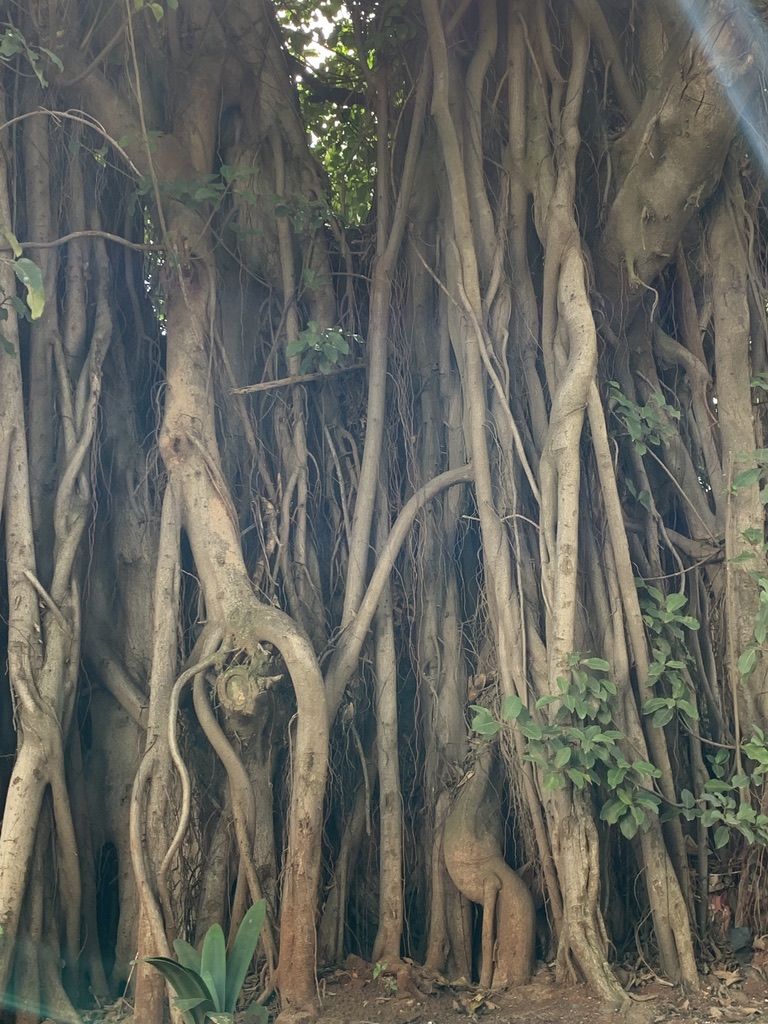
We’re on our annual winter travel trip: Nairobi, Kampala, Kigali, Dar es Salaam, and Zanzibar. … an overview of East Africa’s major cities.. No safari! We saw the Big Five at a reserve in South Africa some 15 years ago. Been there; done that. Only kidding. Still we made a conscious choice to ignore the animals (along with the related cushy accommodations and the great food). That said, Mike is thinking about going to see the gorillas in Uganda. We shall see. If he does, that will be without me.
The trip was tiring. SFO to Frankfurt to Nairobi. We are at the Fairmont Norfolk Hotel. Somehow between October (my last overseas travel, just two months ago) and December, the rules changed. US now photographs each passenger in addition to triple-checking passports. We were both in business class, but somehow not seated together. But it was one of those flat-bed flights and the seat configuration was 1-2-1, so it really didn’t matter much. Service on United was pretty terrible, so we were happy to switch to our Lufthansa flight once we got to Frankfurt.
We had only 60 minutes to change planes, and naturally our gate was .9 miles from where we landed. We had only carry-on bags (yes!) which meant lugging them through the long airport walk. Naturally since it was Frankfurt, we had a 10-minute bus ride within the airport from our plane; the long walk; a train ride to the terminal; had to go through security again (German side) and the lines for that were unbelievable. We ran and then just hoped for the best. But alas, although we got to the gate totally out of breath, but on time, only to discover that our departure was delayed and delayed. We finally took off about two hours late – postponing our arrival in Nairobi from 9:30 pm to 11:30 pm (Sunday).
The Nairobi airport is pretty “basic” without any of the cushiness we find in US and European airports and even in some North African airports. Naturally, the jetway didn’t work so we were left with stairs.
Upon landing, we were greeted immediately by armed guards with machine guns (Hadn’t really seen that since Ecuador – I think); and another photo for the Kenyan Airport folks. I feel like my photo is now everywhere. We headed to an ATM machine and then looked for a “somewhat legitimate” taxi. We arrived at the rather snazzy colonial-style Fairmont Norfolk at about 1 am. The hotel was built in 1904; it’s a sort of hidden gem with its elegance and understated charm. The hotel, just like most restaurants, shops, businesses, public buildings, etc. have tons of security – and lots of men with machine guns; not sure they really work. So to get into the hotel (and all the others) the taxi has to stop at a barrier while we sit in our seats – two guards come to open the car doors to “inspect;” mostly they look at the floors and in the glove compartment and the trunk; then the car moves to another arm that has to be lifted and we get out. Then we go through a screening process (airport-like) and then you’re inside the hotel. Frankly, I don’t think any of it works because today I forgot to take my cell phone out of my pocket and no alarms went off. One of the interesting things is that everyone you talk to or meet – from taxi drivers to front desk hotel staff to shopkeepers – assumes you’re in Nairobi to go on a safari (Guess that’s what foreigners do). So they just ask what day you will leave for your safari or if you liked your safari. I think it’s like assuming that everyone who comes to California goes to Disneyland. So they are all caught off guard when we say we are here to see their city.
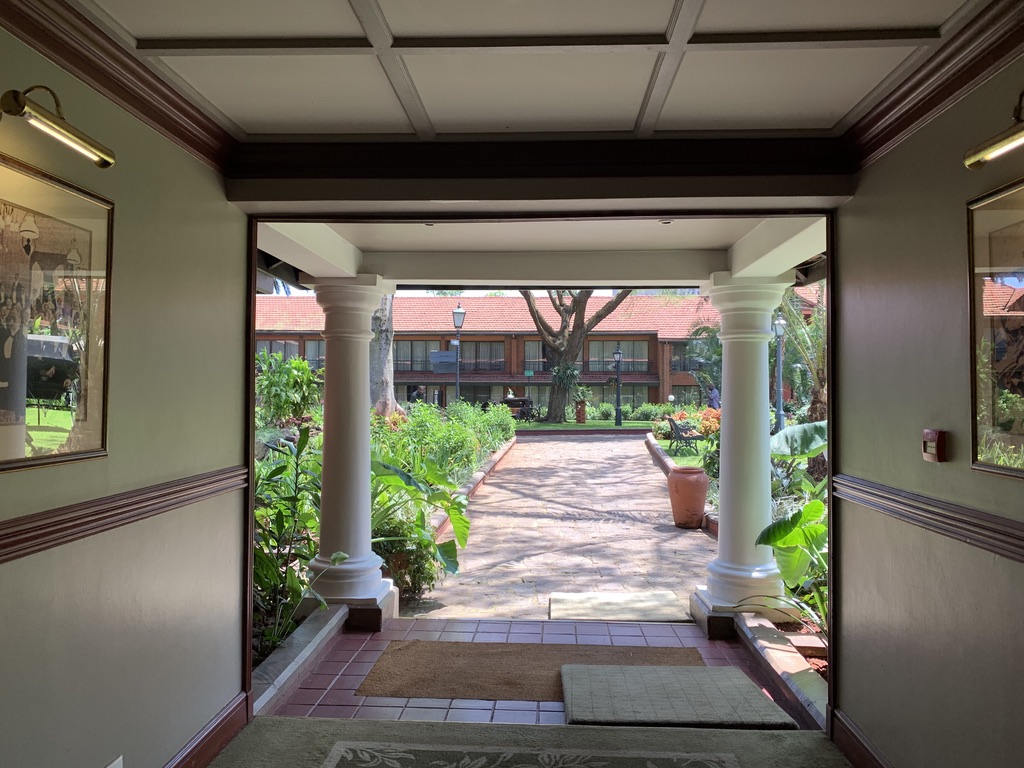
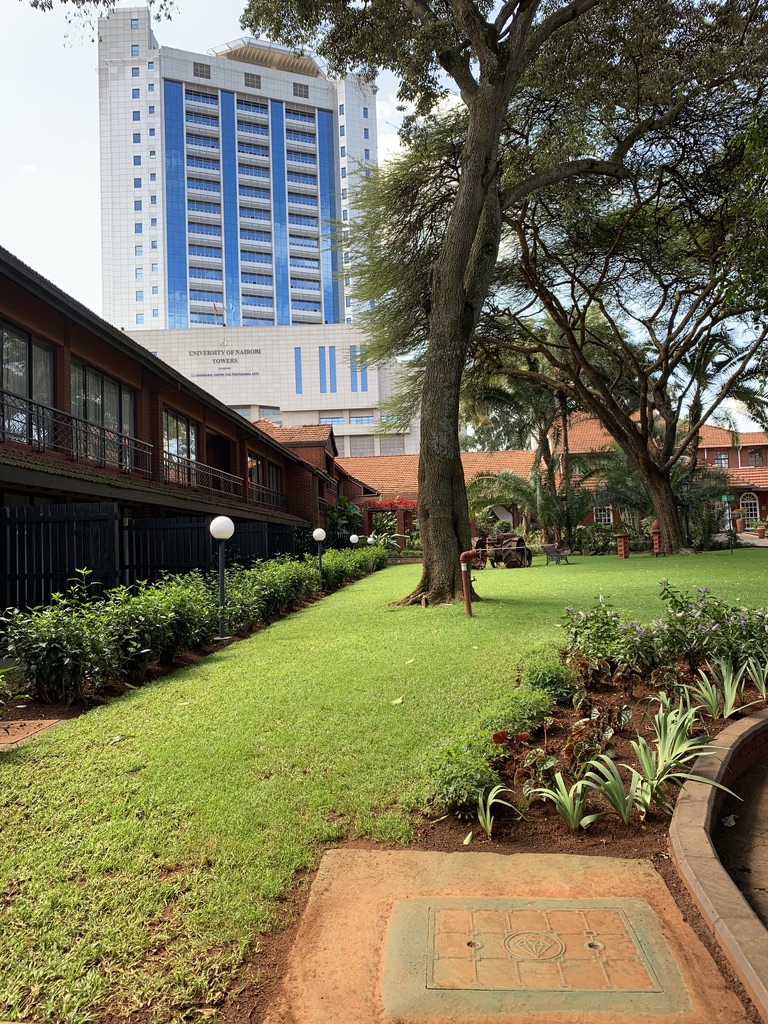
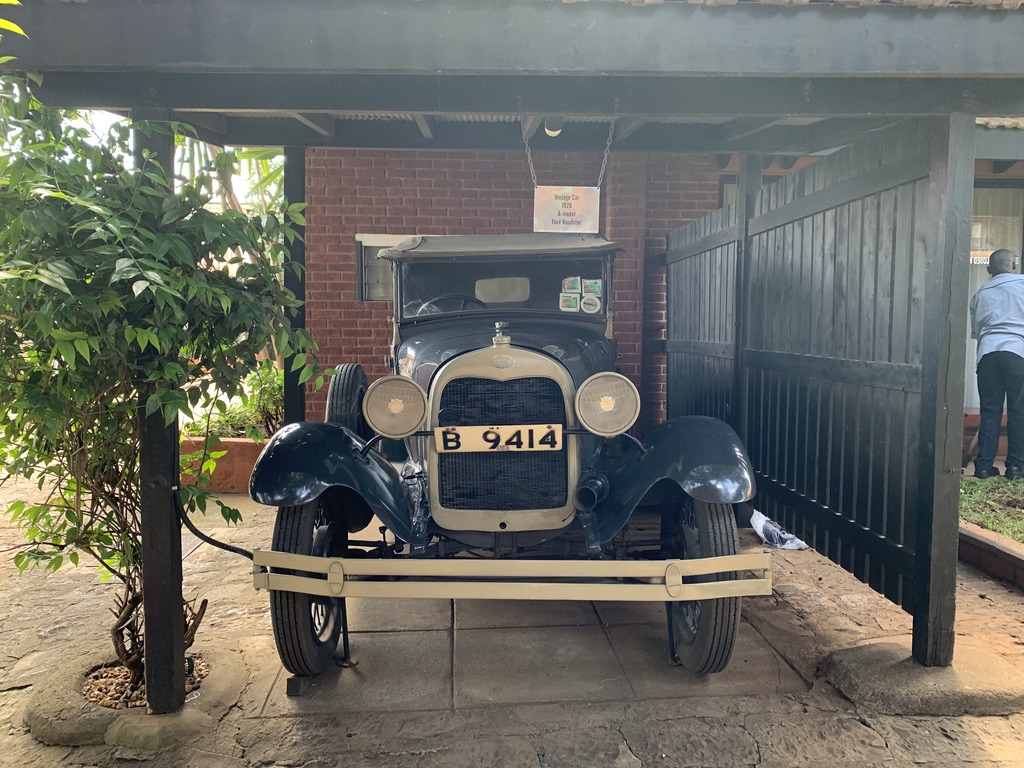
While we were exhausted and wanted to sleep – we opted to unpack and head for the hotel’s delightful bar for night caps. And then we crashed. By then it was 3:30 am. This morning we got to actually see the hotel. The grounds are truly beautiful and the location is great. Lots of gardens…but right in the center of town. We opted to have breakfast at the hotel so that we could get an early start checking out Kenya’s capital city – home to about 6.5 million people. Following a great breakfast, we decided we needed a real street map of the city in order to figure out where we were and where we’d head. This is actually a difficult thing to find. Finally the hotel suggested we go to the “text book center;” the hotel is located just across the way from the University of Nairobi. Naturally, they thought they should take us there; but we assured everyone we were fine walking to the shop. We did get a map (two in fact), although they look used and really worn. But they will work.
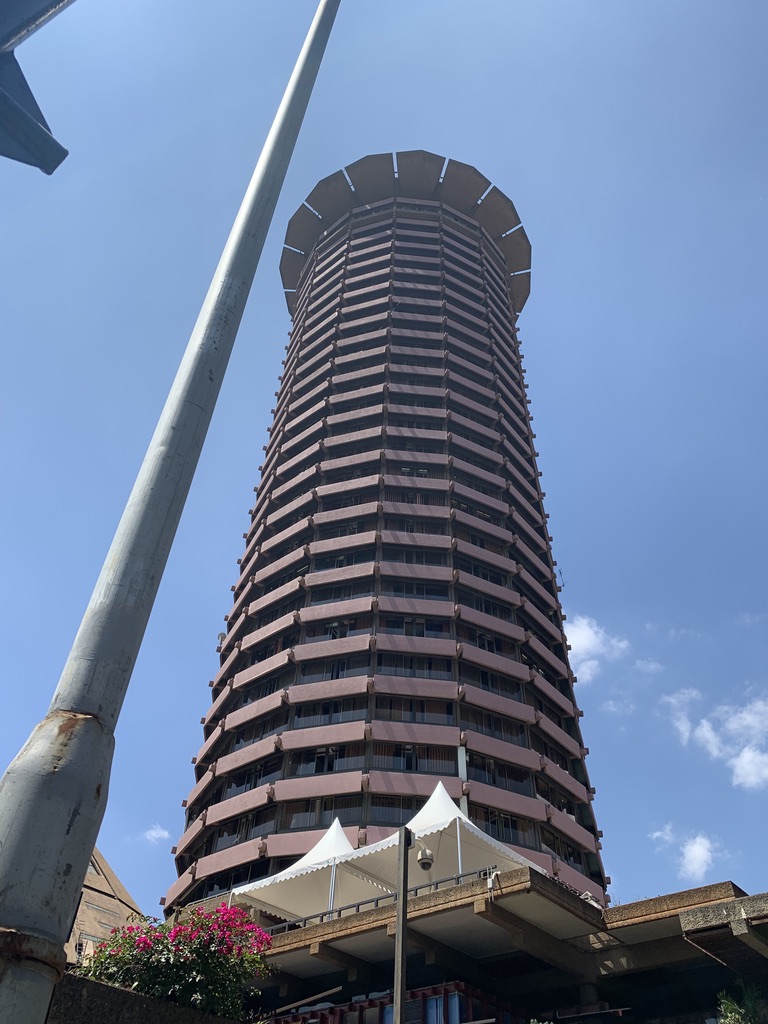
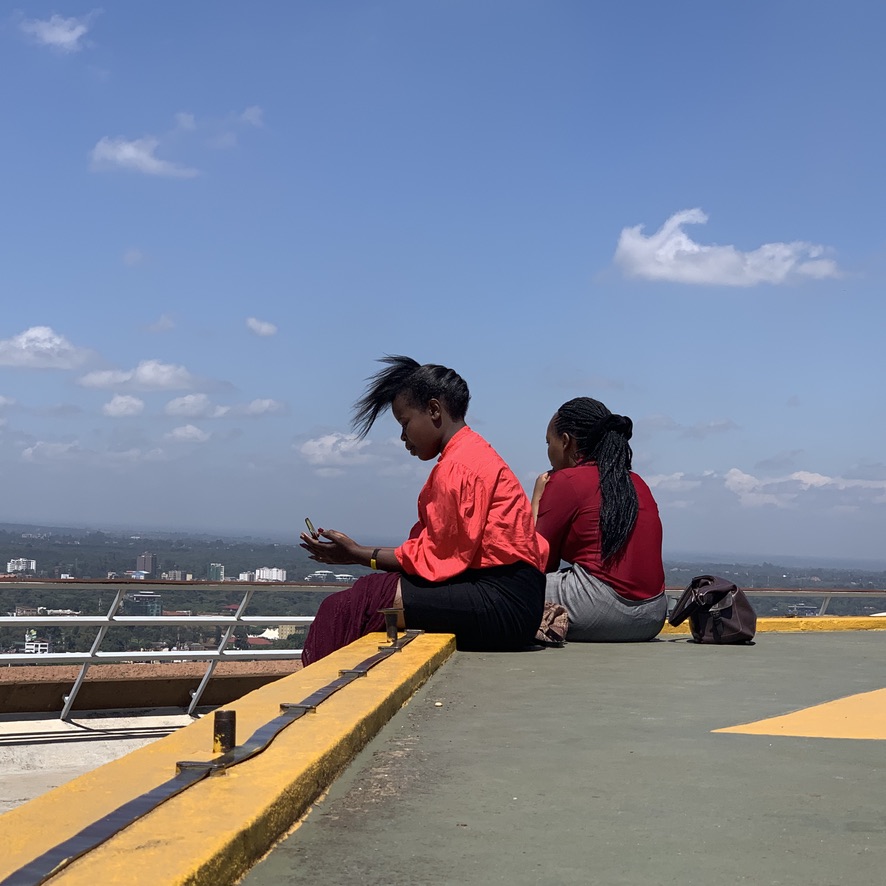
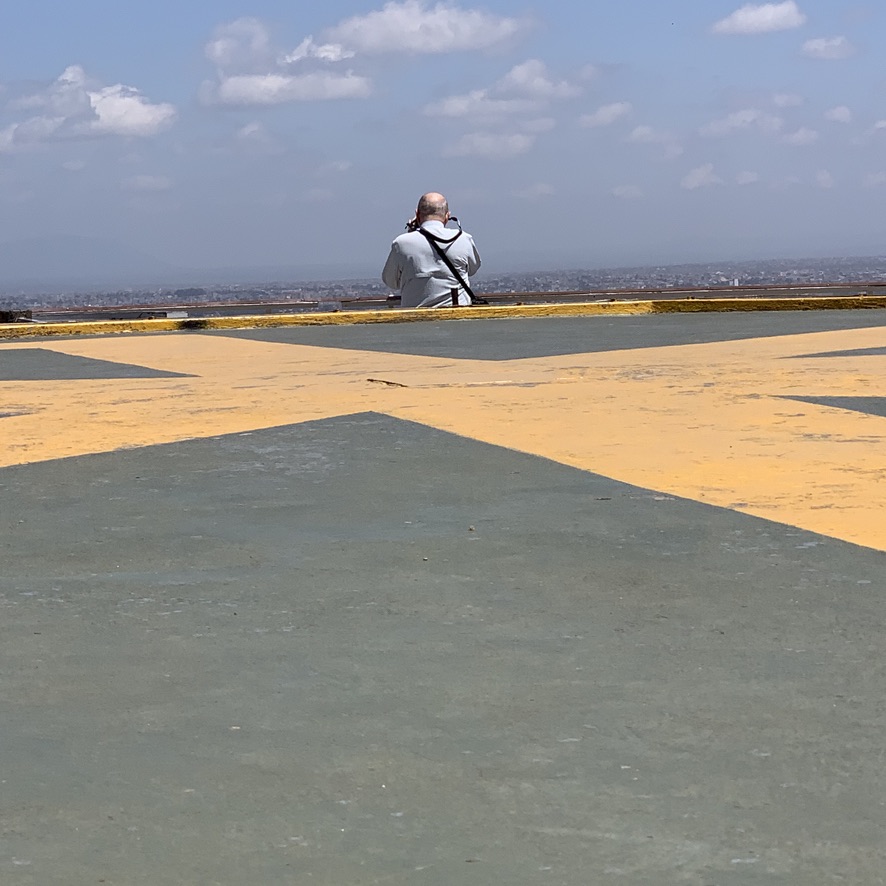
Then off we went for a most interesting day – to the top of the KICC (Kenyatta International Conference Center) – a strange 28-story building built in the early 70s when the country became independent. It is one of the few buildings with a viewing deck where you can get an overview of the city. Of course, lots of security every step of the way, plus signing in and out and giving up your passport while you’re inside the building. The elevator takes you up to the 27th floor and then you climb up the thirtieth floor which is really the roof. The air was not very clear so we didn’t get quite the effect we hoped but we did get a sense of the city’s form, including some very large parks at the outskirts.
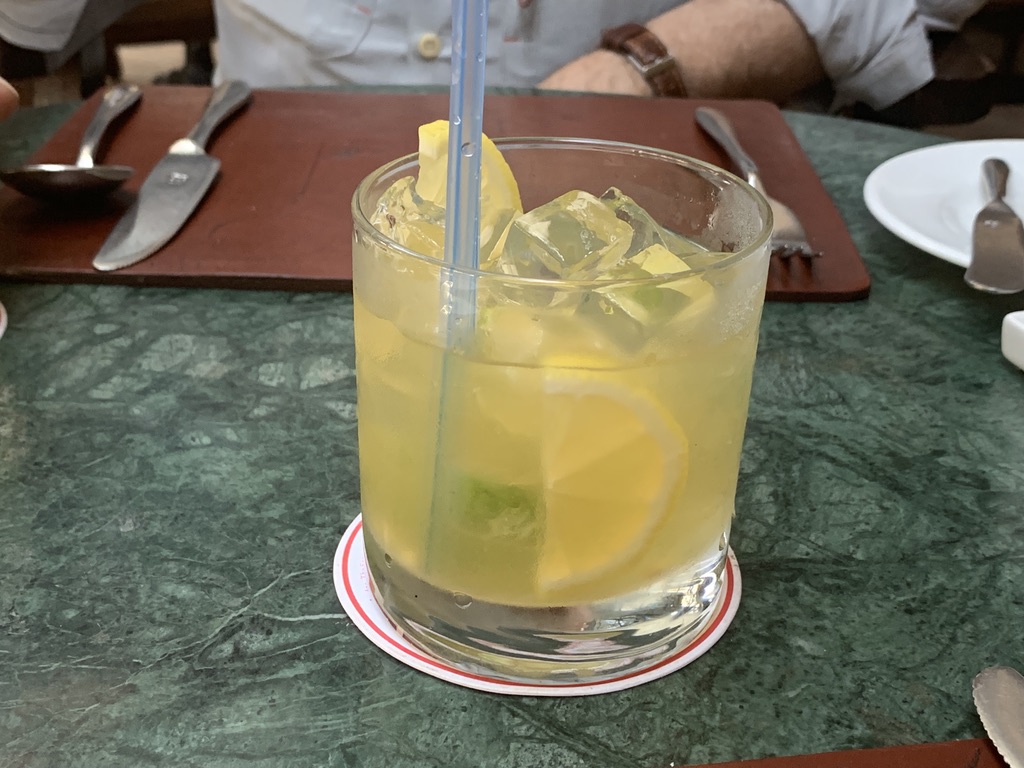
We strolled (a bit of an exaggeration since you’re always watching your every step when you walk in most cities in developing nations because the sidewalks are always chopped up and there are always uneven steps and unexpected barriers) to have lunch at the Thorn Tree Restaurant – a patio café that has fed everyone from Hemingway to Gregory Peck. It’s got an eclectic menu – from Indian to Italian. We opted for the former. Interesting we keep asking about good, local cuisine (Kenyan), and everyone sends us to Nigerian or Ethiopian restaurants. We also tried the restaurant’s famous drink – the dawa – vodka, mint, lemon, and honey. Quite good. No surprise, no one really knows how to tell you how to get anywhere. The Thorn Tree (located in the Stanley Hotel) has been in the same place for well over a century, yet shopkeepers and guards, and others cannot tell you how to get there, even though it’s within a block of where they are standing.
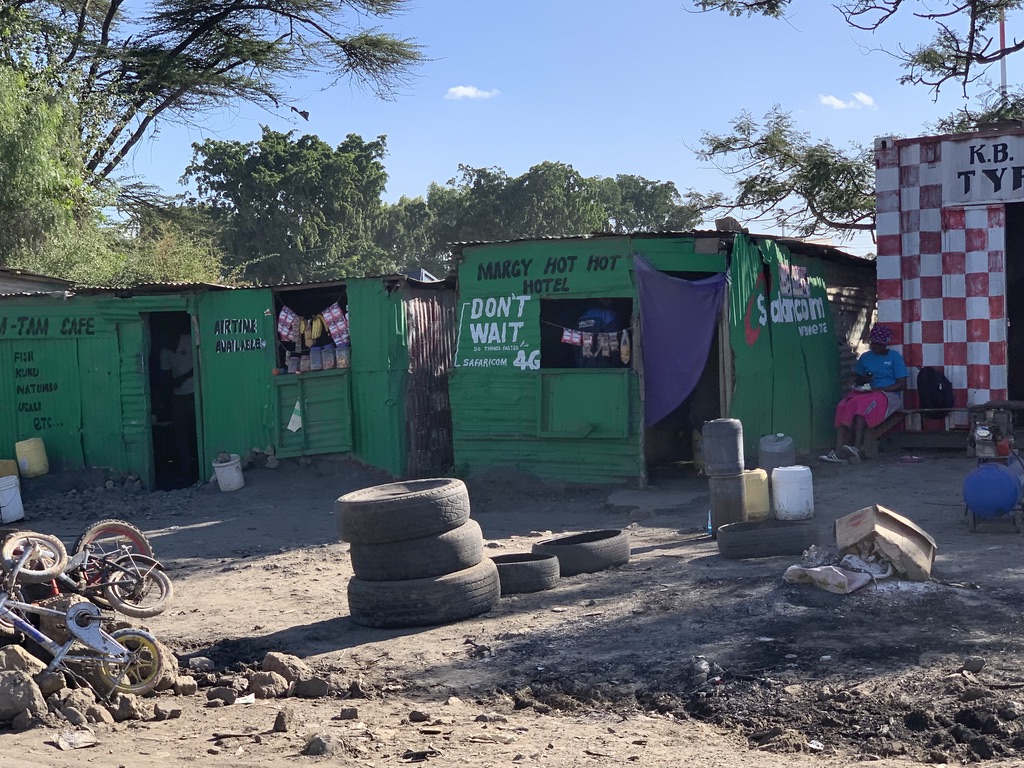
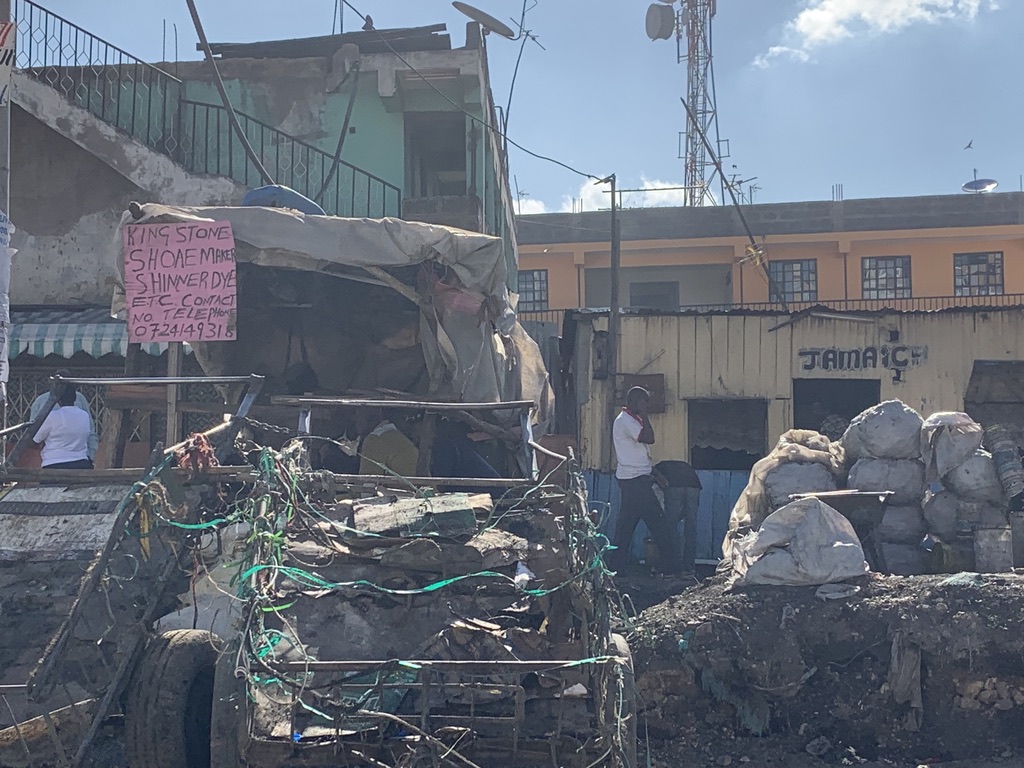
Following lunch, we searched for a taxi (not wanting to use taxis at hotels because they are really spiffy and sterile and I think the drivers are trained on how to answer questions so as not to get into any heavy dialogue). Finally we found a group of drivers with taxi “medallions” on the top of the car and walked up to one – explaining that we wanted to go to the Africa Heritage House (which we had read about) and which is located adjacent to (or perhaps actually within) the Nairobi National Park. We knew it was in Mavoko (or Mlolongo) which was about a 20-minute drive. Got into the car (as the driver removed the “medallion” from atop the car) and off we went. Before this, the driver (in Swahili) was clearly asking the other “drivers” for directions. Traffic was horrendous. In the end it took about 1.5 hours to go 20 kilometers (12 miles), but the drive took us along the edges of several shantytowns so once we left the CBD it was interesting. At one point when we were just stuck sitting in traffic I contemplated heading to Marg’s Hot Hot Hotel.. which was on the route!
We stopped numerous times for the driver to ask for directions again and again. We were a little surprised since we thought this was a major museum. However, as we meandered on the road to Mlilongo we began to wonder why a museum would be so far out of town. We rationalized that they had probably chosen a tranquil location in the national park. But as we approached a dirt road (naturally with a gate and a guard), we figured we were there. We were. But , it turns out, it is not really a museum, although it should be.
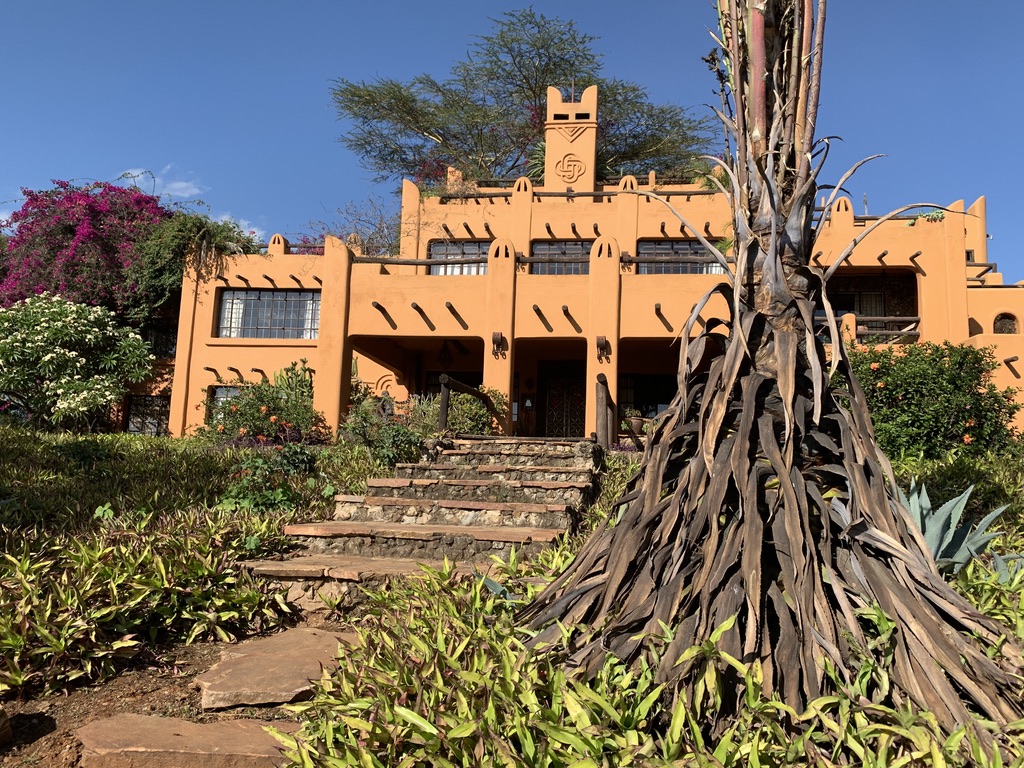
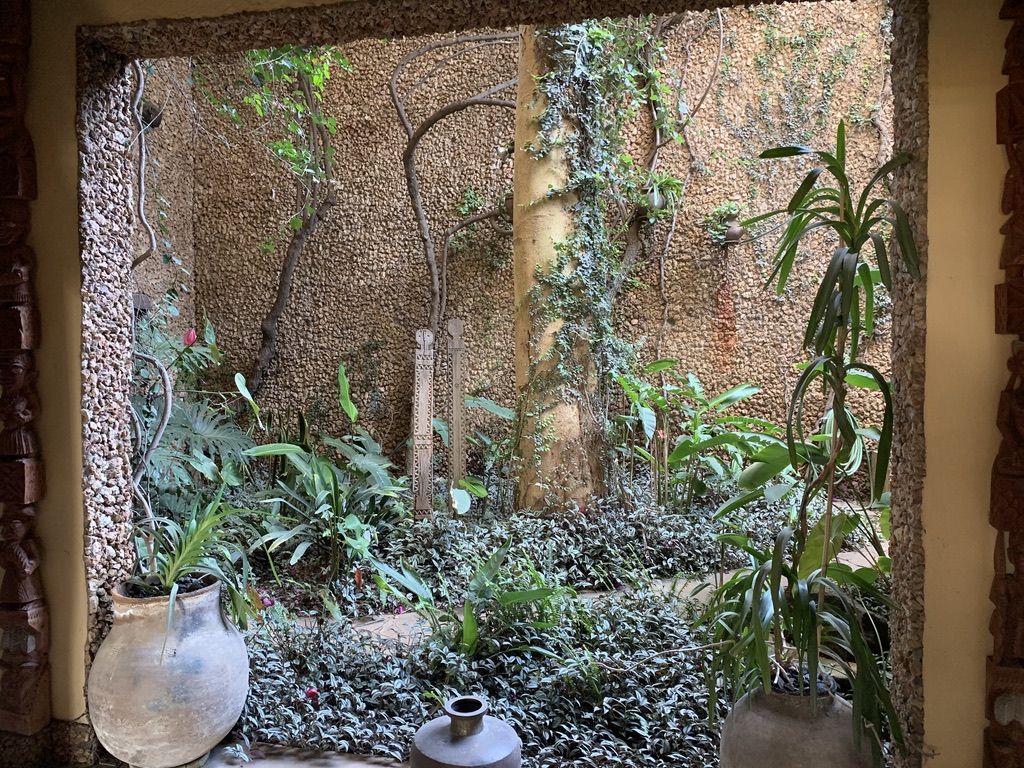


It is the private house of an American (Alan Donovan) who has lived in Kenya for more than 50 years; he came in the 60s with the US State Department, during the Biafra/Nigeria war. He fell in love with Africa (initially Nigeria while on a trip to a small village of craftsmen) and with African art and artifacts; left the State Department, and settled in Kenya where he became best friends with the first Vice President of the country, Murumbi and his wife, Sheila. Anyway, as we approached this spectacular mud-dabbed building designed by Donovan and based on the architecture of three different African cultures, we realized this was a pretty special place. But, they said we could not enter because we had not made the proper arrangements. Indeed, we had not made any arrangements. Apparently you need to book a tour in advance. You can also book lunch at the house. Of course, my NY-style surfaced immediately as I explained what we each do to the man at the house (who was clearly an assistant to, and not, Mr. Donovan), and explained we had made a special trip to see this place. I think he realized that we weren’t leaving, so he told us to wait and he went to speak with Donovan. During the time he went to speak with Donovan, we meandered gently into the house but there was so much to take in. This guy had collected amazing artifacts and also nurtured the careers of scores of then-young African artists to develop profitable careers. He also founded several African bands and Afro-jazz groups.
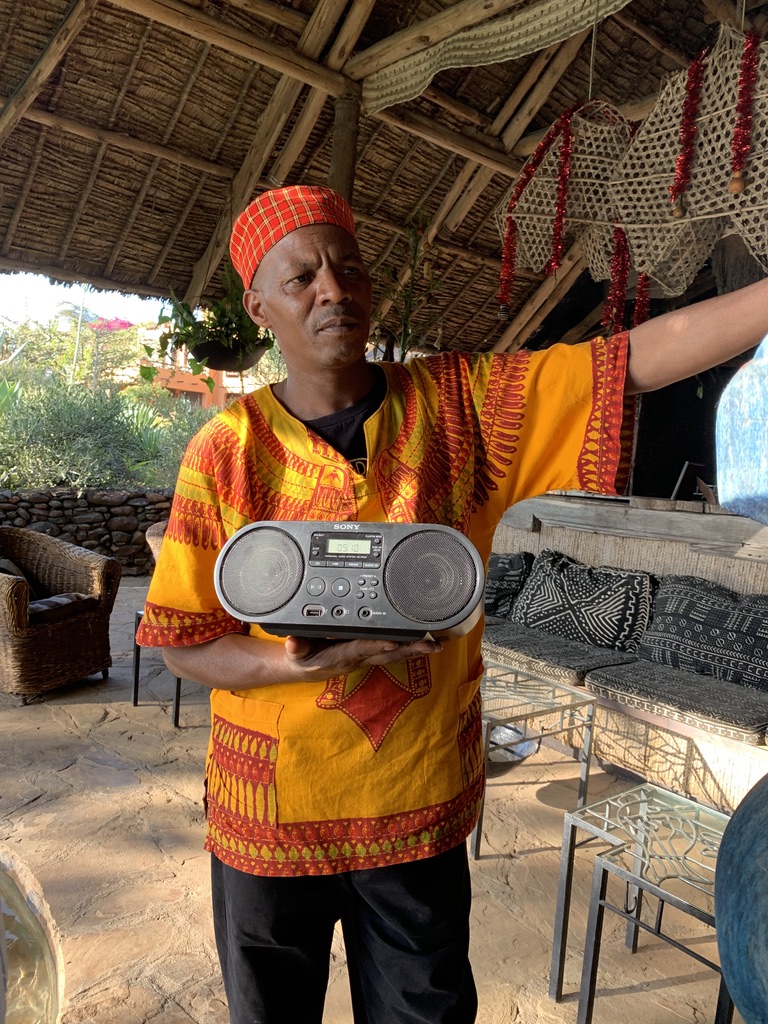
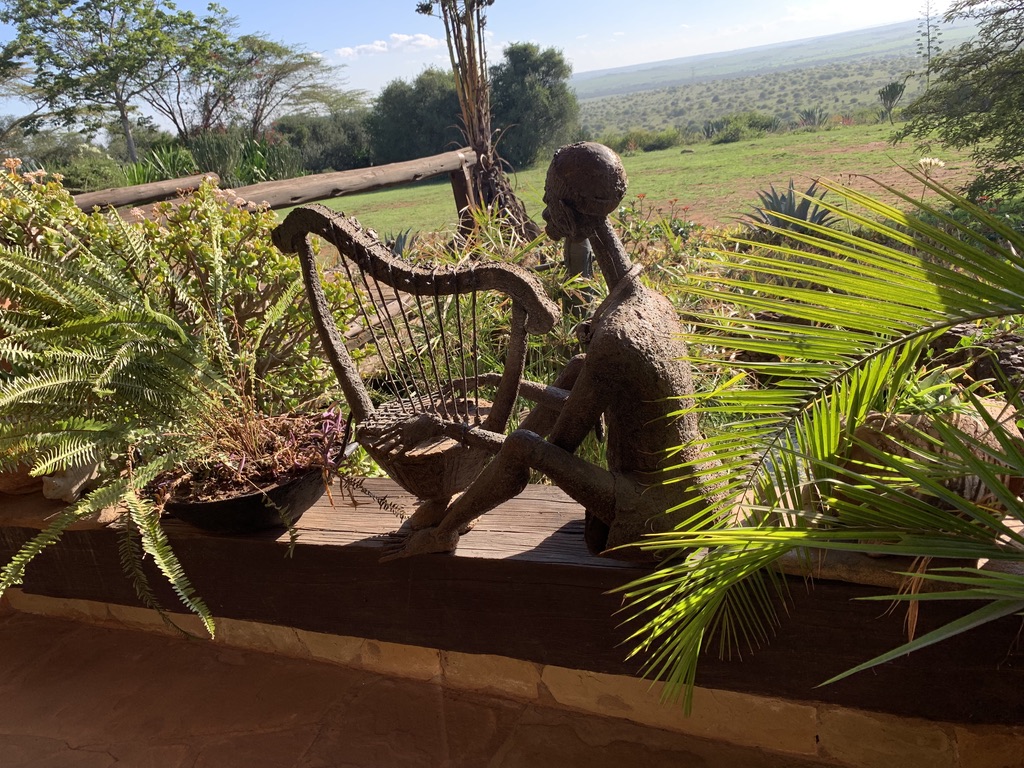
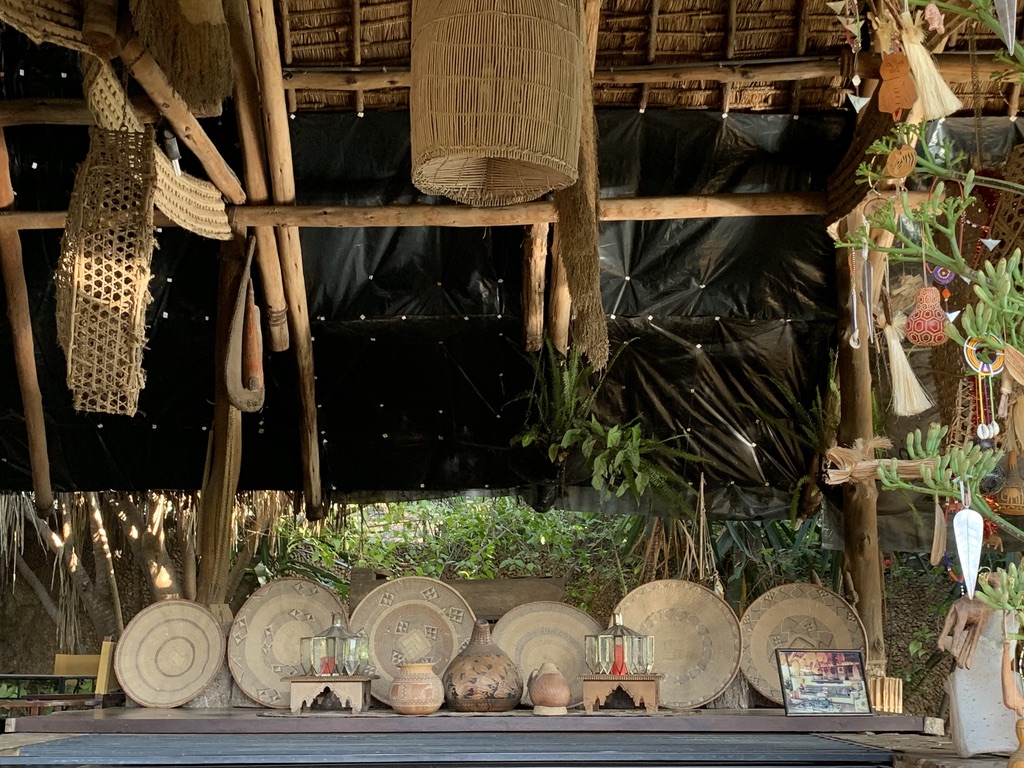

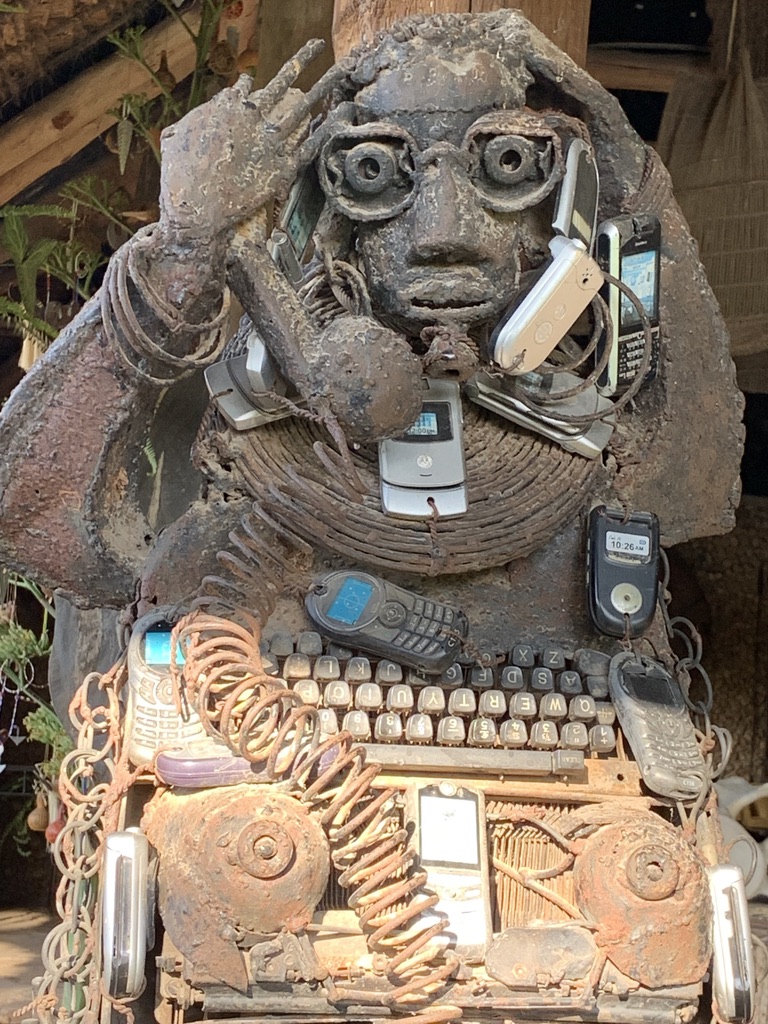
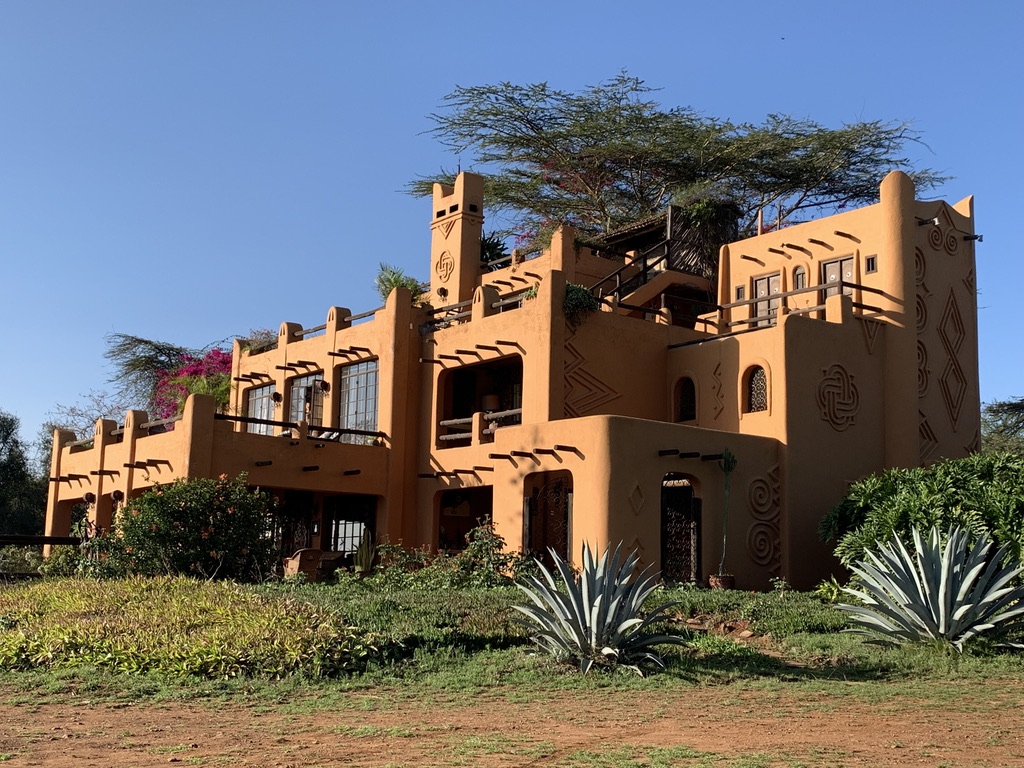
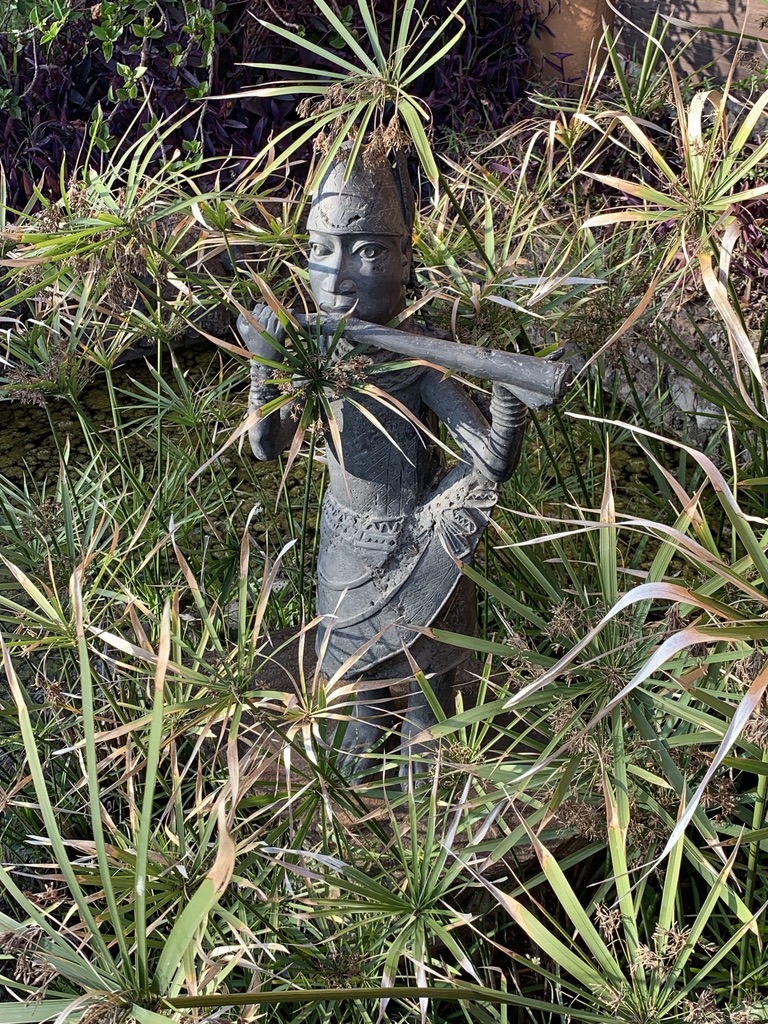
The Kenyan assistant reappeared and said that he would do the tour because Donovan could not, but that we would hear Donovan’s voice on this tape recorder that he carried from room to room and area to area. At the end of the “tour” which began at the railroad tracks (built by India) adjacent to the new tracks built by the Chinese government which defines the edge of the property and from which you get two spectacular views.. one of the house and the other of the vast national park where the major big animals still roam. It’s the area where the wilderbeast migrations took place annually (until recently).
I photographed pretty consistently on the ‘tour”.. (about 285 images in the 90 minutes), but this sample hopefully gives the story.

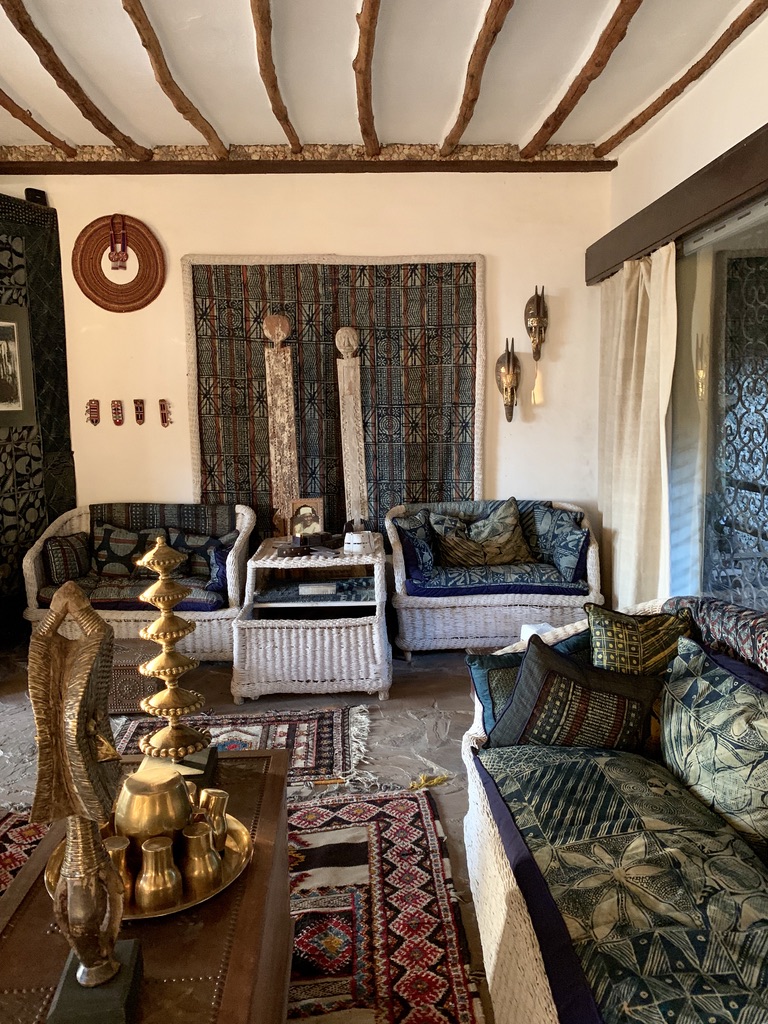
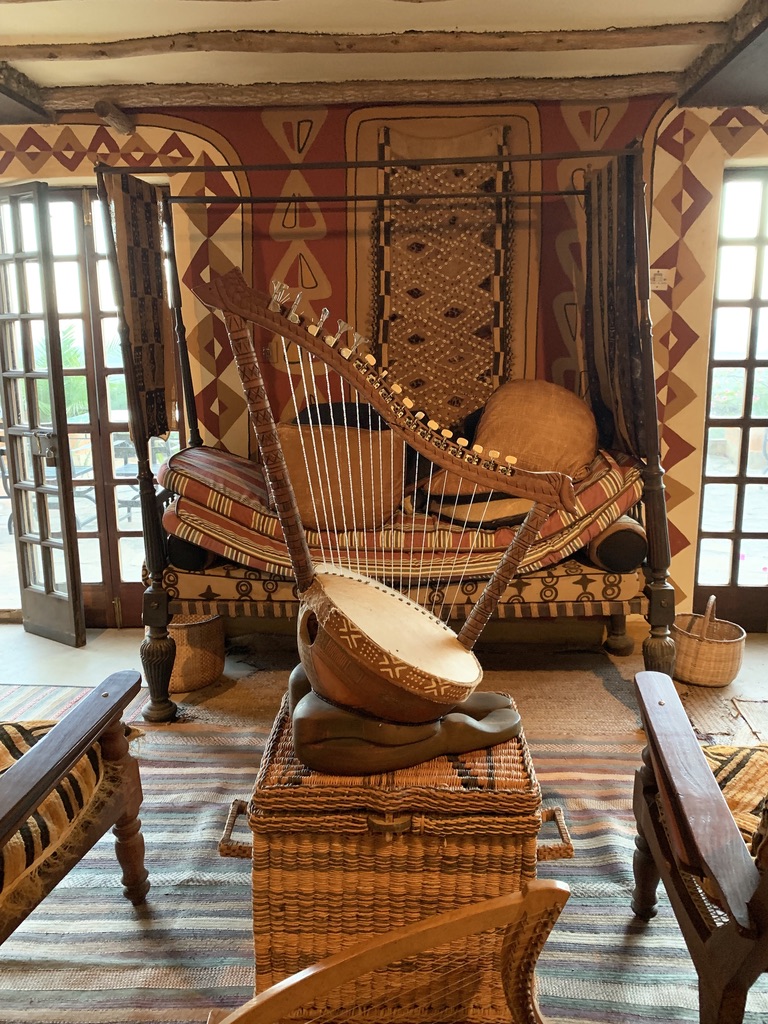
At the end of the tour, we met Alan Donovan who has been ill for the past year. He apologized for not taking us on the tour personally – and we chatted for a time. The house – in all its splendor – and his astute eye for both contemporary and ancient African tribal artifacts brought up old issues for me: the dilemma of making “little ‘a’ art” into “big ‘a’ art;” private ownership and commodification of art; etc. At the same time, it is clear as one traverses Nairobi, that there is little acknowledgement of history and of the amazing contributions of tribal cultures and their forms. So at least someone is protecting these artifacts. The good news is that it appears that Donovan (Murumbi and his wife are deceased and he credits Murumbi with the idea of this kind of preservation and also economic development through craft and art) has plans for the house and its content after his death. He has approached the Obama Foundation!! And offered everything to them – as a total donation, on the terms that they preserve it as a place to retain African culture. He’s also offered that the Obamas can visit and stay at the house as frequently as they’d like. We shall see… Interesting politics there!
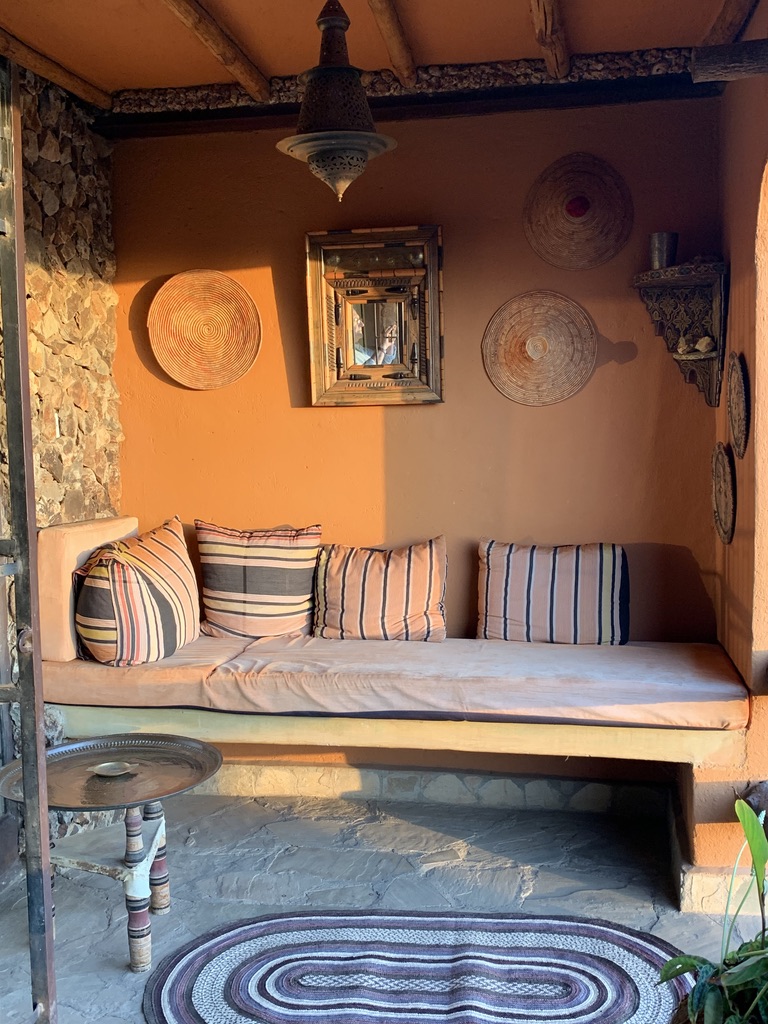
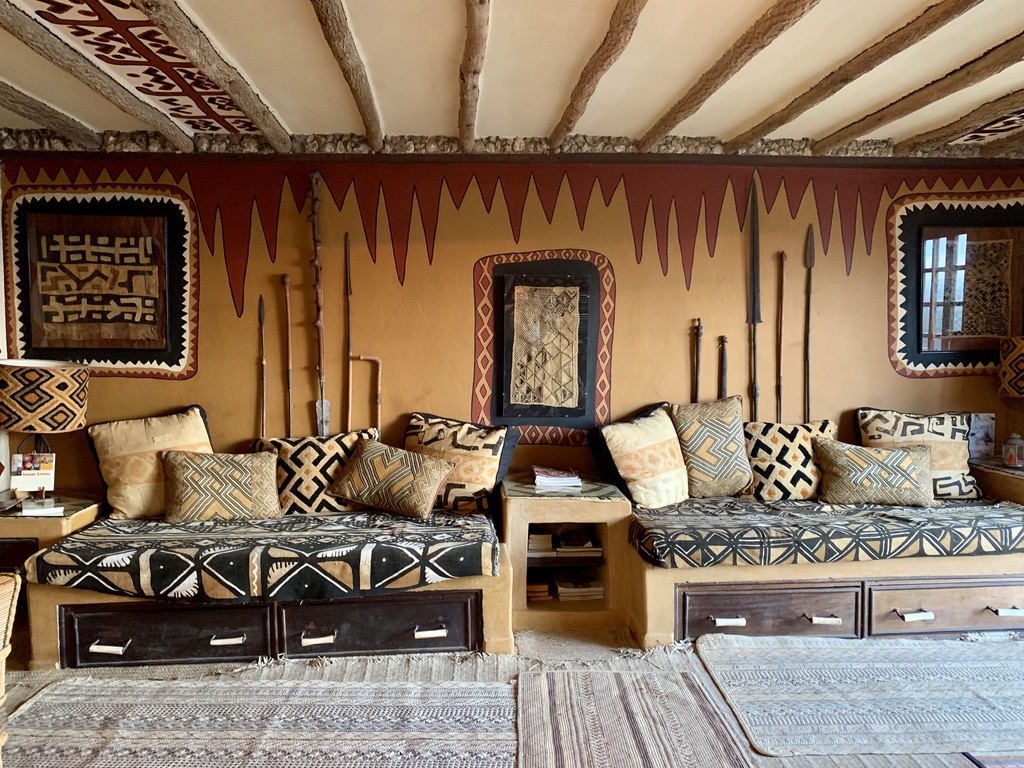
We returned to the hotel.. and again traffic was horrendous. After a very brief time at the hotel, we headed to an Ethiopian restaurant in the Westlands neighborhood. Food was great. Lots of students from Nairobi colleges.. It too, was down a winding dirt path.
We returned home to our little abode at the Norfolk at about 11:00 pm..
Best –
Fern
ALBANIA DAY 7. December 20, 2017. From Berat to Gjyrokaster.
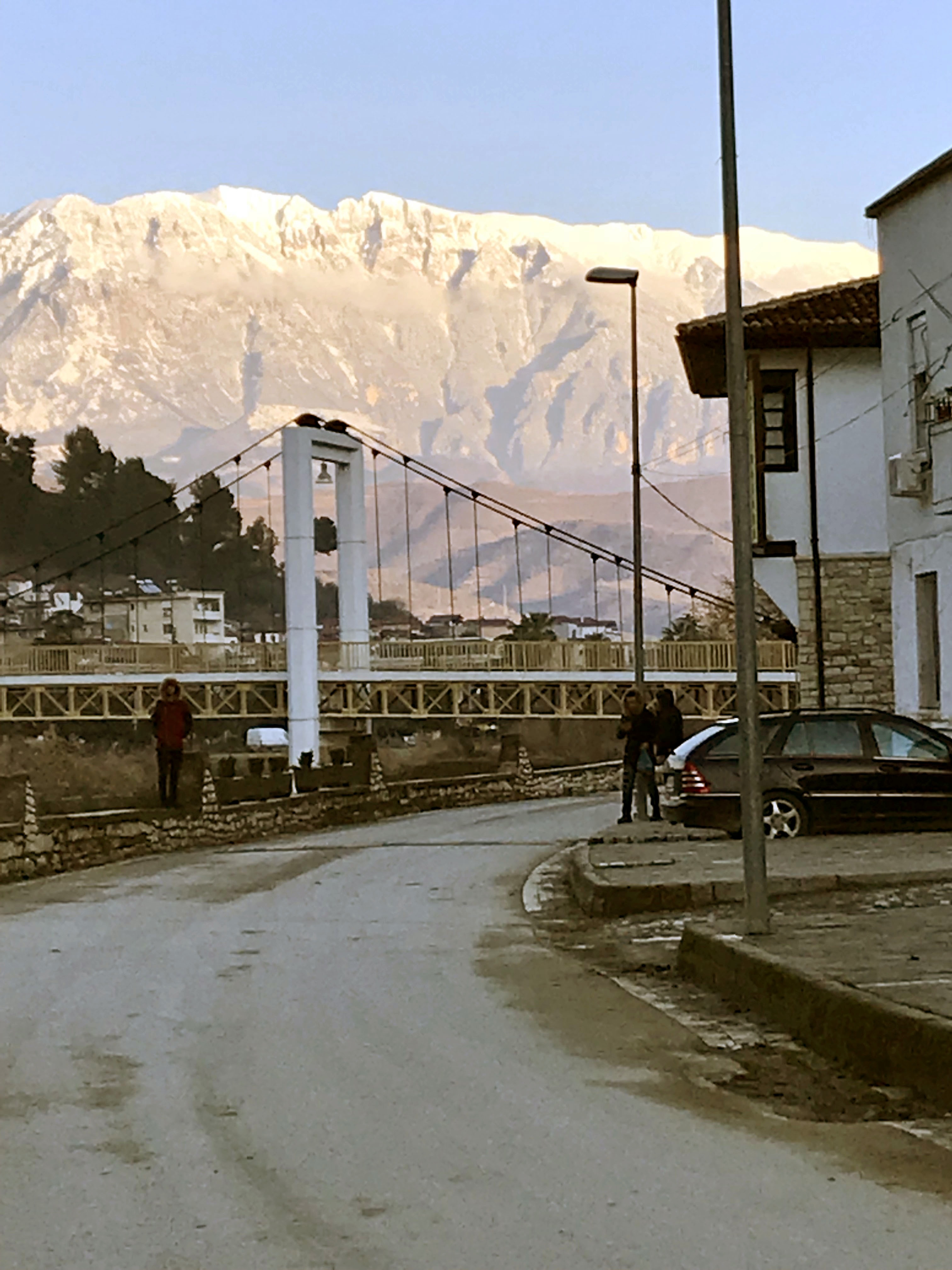
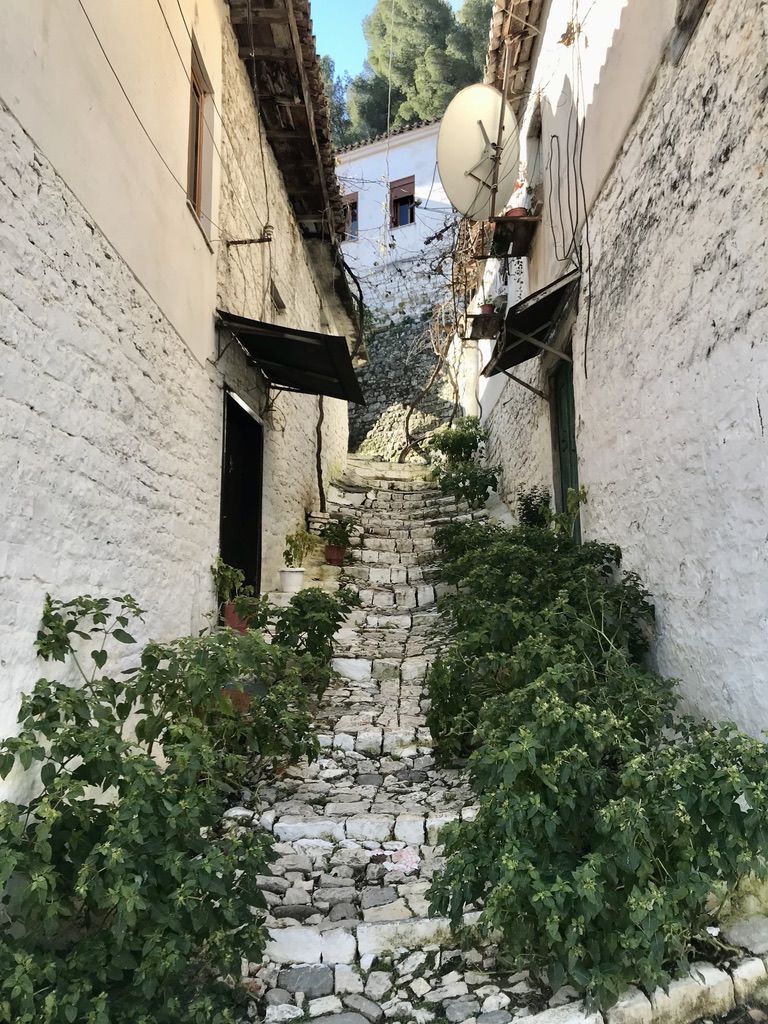
Greetings from cold (but sunny) Berat – and onward to Gjyrokaster
It was 30 degrees last night when we walked downhill from Hotel Desaret to the Mangelimi restaurant on the main street. Once again we were the only patrons of the restaurant – one of the “upscale” (by Berat standards) eating places in town. The waiter even had white gloves!
They had an extensive menu and didn’t note that anything that was listed could not be prepared, which was very surprising. We were actually still a bit full from the huge lunch that Lili’s wife prepared. But we figured — “you gotta eat!” We tried to ask for small portions but that didn’t go too far. So we started with the Albanian version of tzatziki (yogurt, cucumbers, spices) which was good, but with far fewer cucumbers than we are accustomed to.. It was served with great bread (bread is really quite wonderful throughout Albania, so it is difficult to turn it down and to think about any sort of diet here). We then had two main courses which we shared (naturally!) – a veal shish kebab that came as two separate large skewers with fairly large pieces of veal and red peppers; the plate included a good salad with thick juicy slices of tomato; and we had a wonderful eggplant dish that was baked in a casserole. We had a half-liter for red wine (local – which means a blend of many different grapes – but thus far all of these local wines have been very very good) and he tempted us with a simple ice cream dessert. – Total bill: equivalent of $17.00… So once again, Albania is looking like a possible retirement destination! – if and when either of us ever move to that step in our lives.
We head to Gjyrokaster in a few hours and I’ll finish up this note from there tonight – after we celebrate Mike’s birthday at a restaurant recommended by the foodie folks in Tirana (so I’m assuming it will be quite good). They also recommended a second restaurant for our final day in Gjyrokaster.
By the way, for those who were sweet enough to ask about the baby (Mike’s grand-nephew?) – he looks quite adorable and we are anxious to meet him when we get to Geneva.
So, we left Berat at about 10:30 this morning.. after breakfast at Desaret – they did not disappoint; yet again a terrible breakfast, despite the fact that we are the only guests, or perhaps because we are the only guests. They had granola which was fine, but then they brought out crepes – stuffed with what appeared to be an entire jar of Nutella and because I think they thought they were making it special they included a few slides of banana (fine!) and also corn flakes!! And on top of the crepes they poured chocolate syrup. Always embarrassing to leave food on the plate – especially when traveling. So we tried to eat some of it.
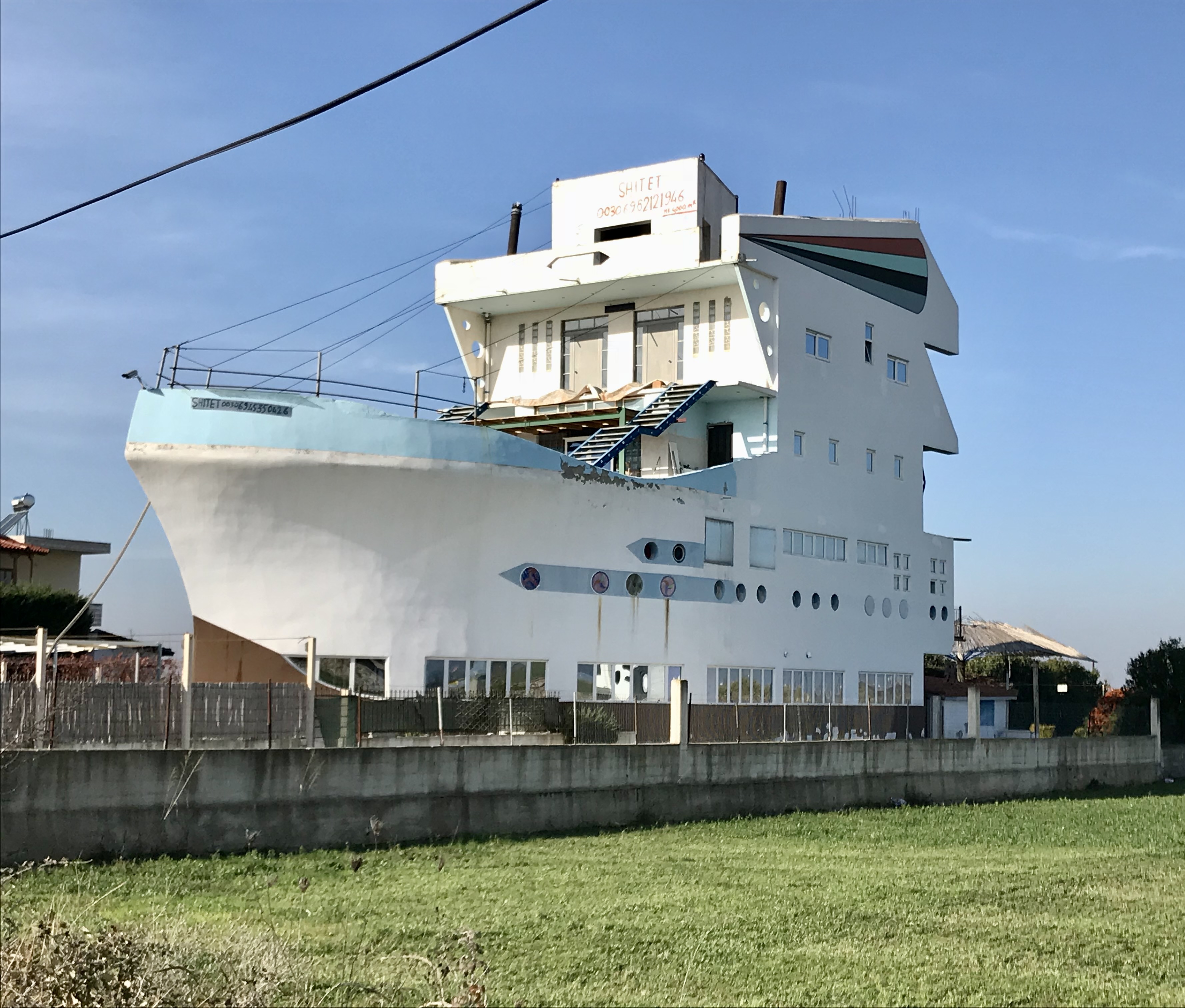
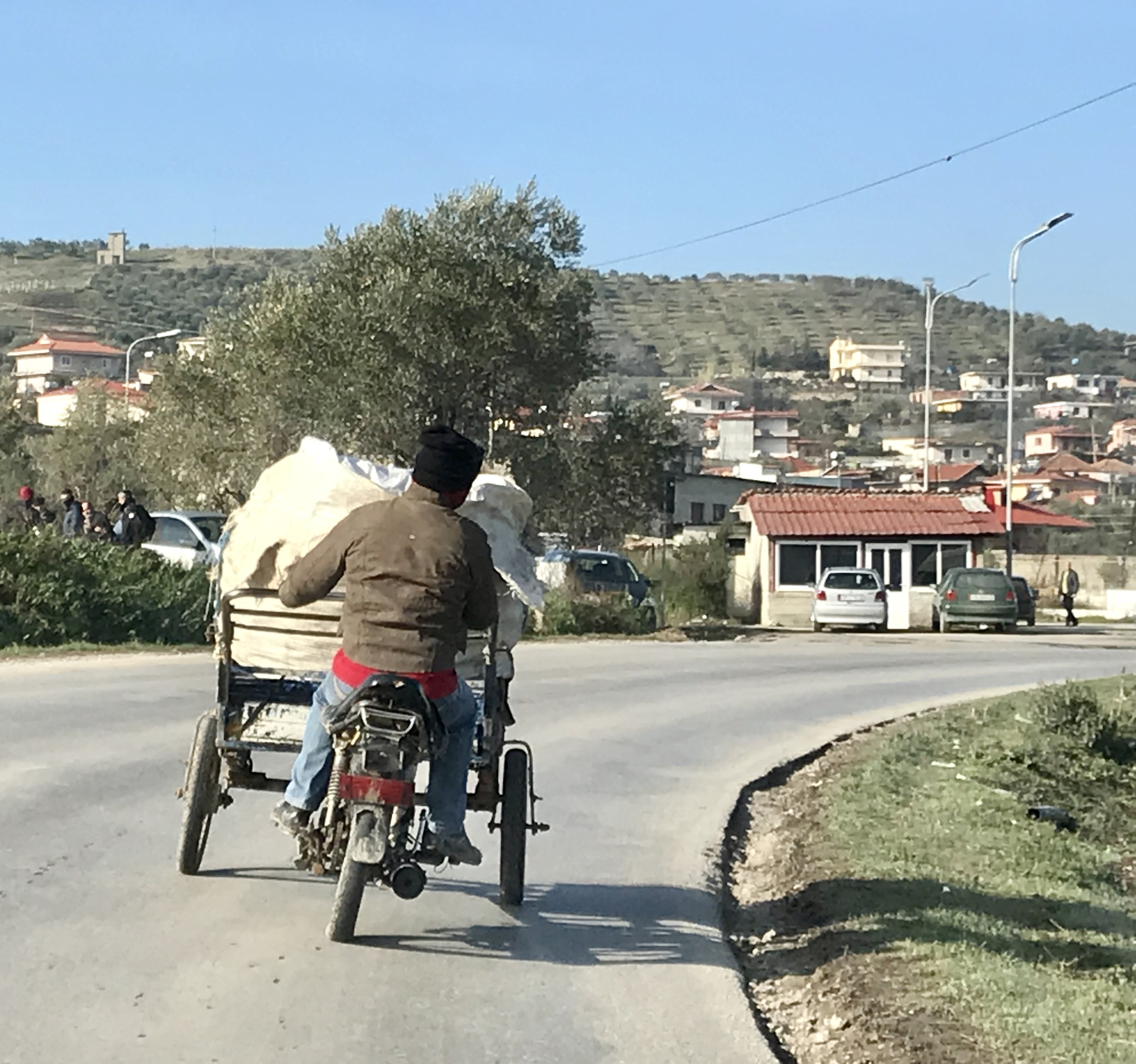
Anyway, we left and headed toward Gjyrokaster. It was pretty cold and no sun, so I guess it felt even colder than the 38 degrees. The first half of the drive was on pretty miserable roads with minimal directions, lots of pot holes, and such… but we managed to make pretty good time, especially once we hit the brand new road which went for the remainder of the drive until we got to Gjyrokaster’s environs. The drive was interesting as we went through many small villages and roadside developments — all along the way we saw men “hanging out” on the roadside .. very much what you see in other Muslim countries. Men smoking, having strong coffee, and talking – sometimes in cafes, sometimes on street corners, and in rural areas, on the road. Women always seem to be bustling and working — walking in and out of shops, waiting for buses, etc. The landscape was truly beautiful – lush, green, and with snow capped mountains in the distance.
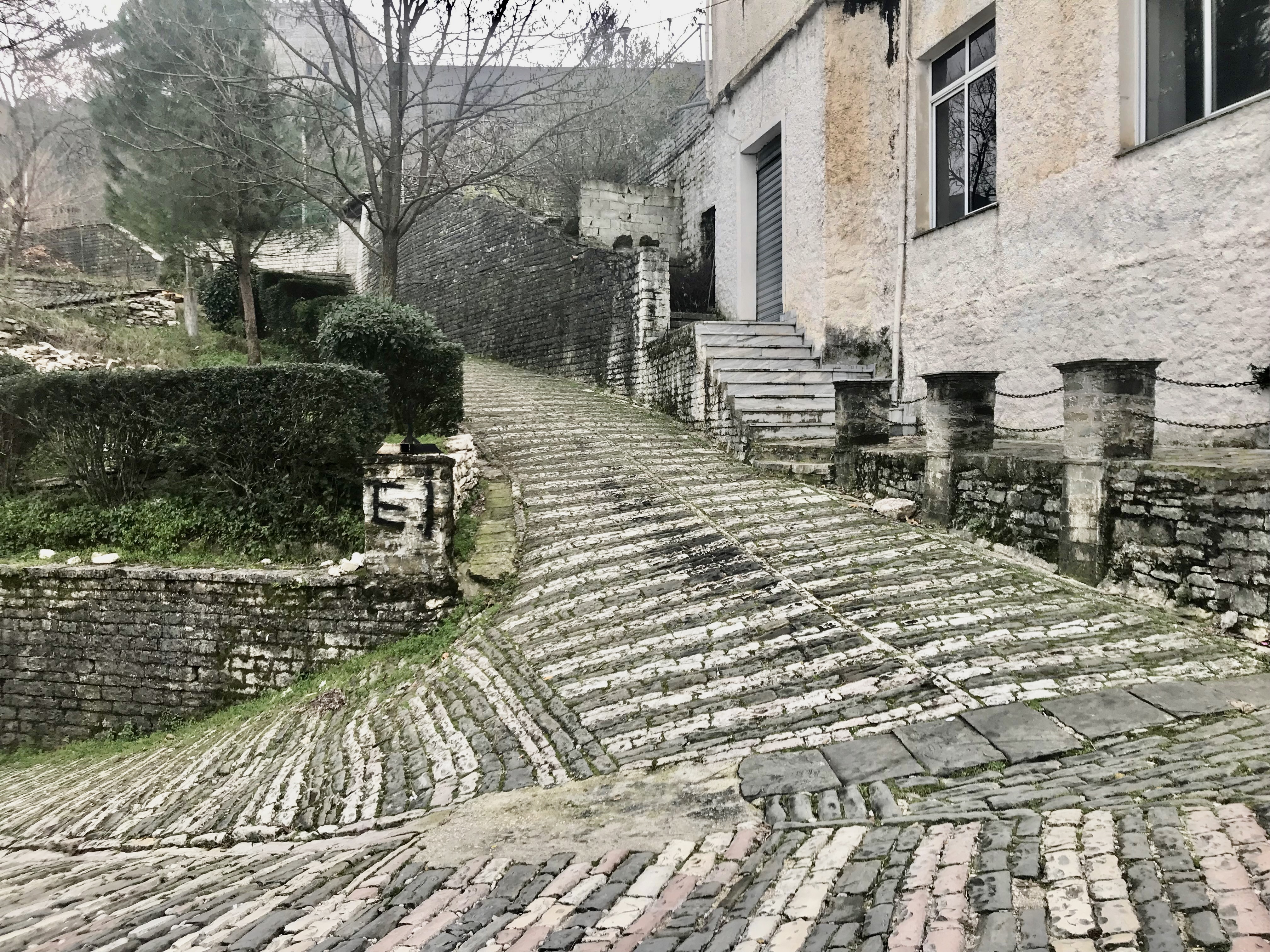
As we approached Gjyrokaster, we needed to rely heavily on GPS – taking us up limestone cobble streets where there was barely enough room for a single lane of cars, but it was two-way and we always seemed to be going in the direction against the rest of the traffic, so we needed to find places where we could step aside to let those cars come down the hill as we went up. This was a slow and tedious process and for a while we thought we were on a one way street in the wrong direction. Alas, we eventually made it to Hotel Argjiro – a recently renovated hotel, originally built in the 1850s. It has 49 rooms and – you guessed it – only one room is occupied – by us!!
We were greeted by a sweet young man whose English was amazingly good. We dropped everything in our room (best in the hotel!) and then headed up those same cobblestone streets for lunch at the top of the hill, next to the city’s large mosque.
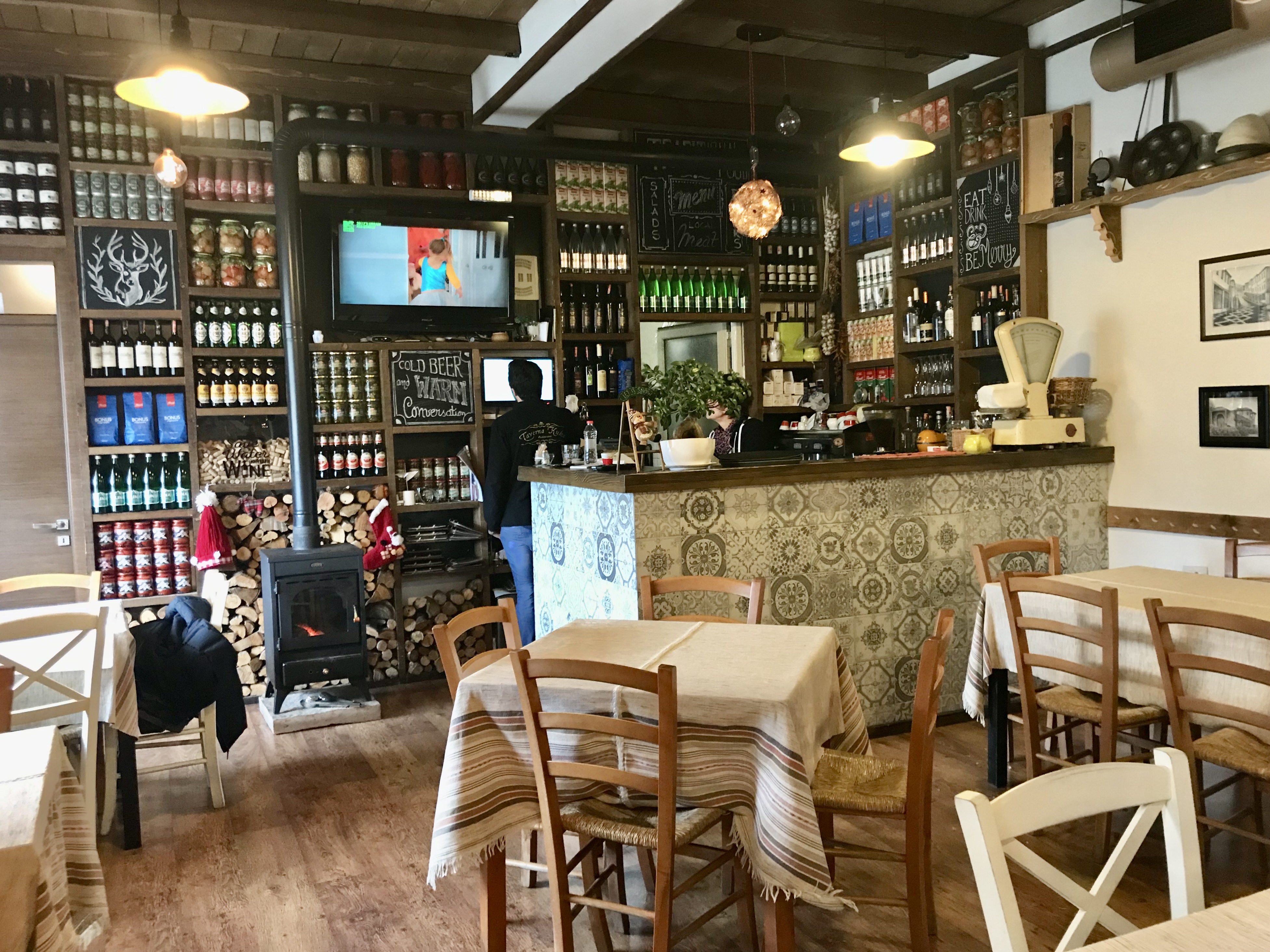
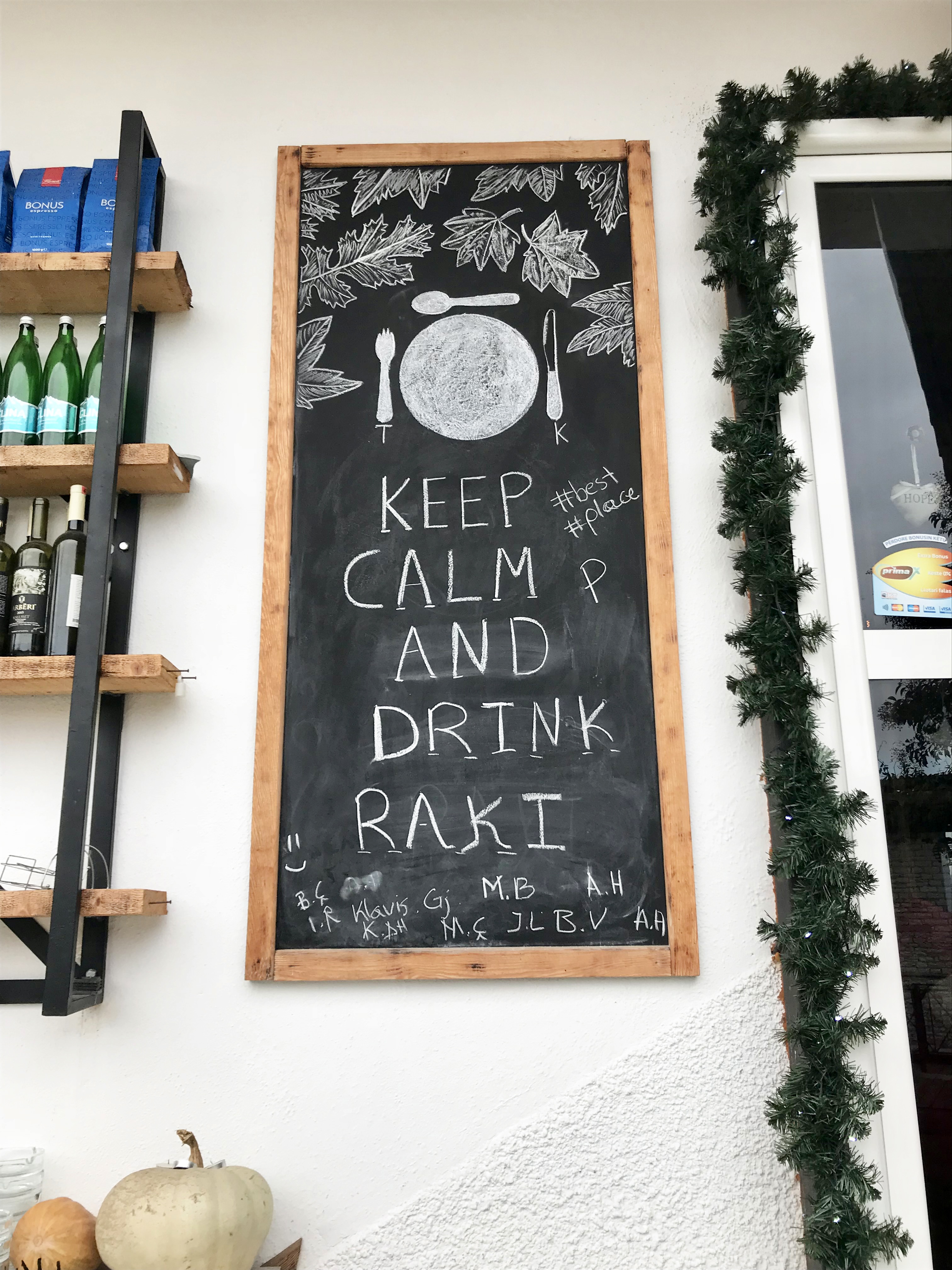
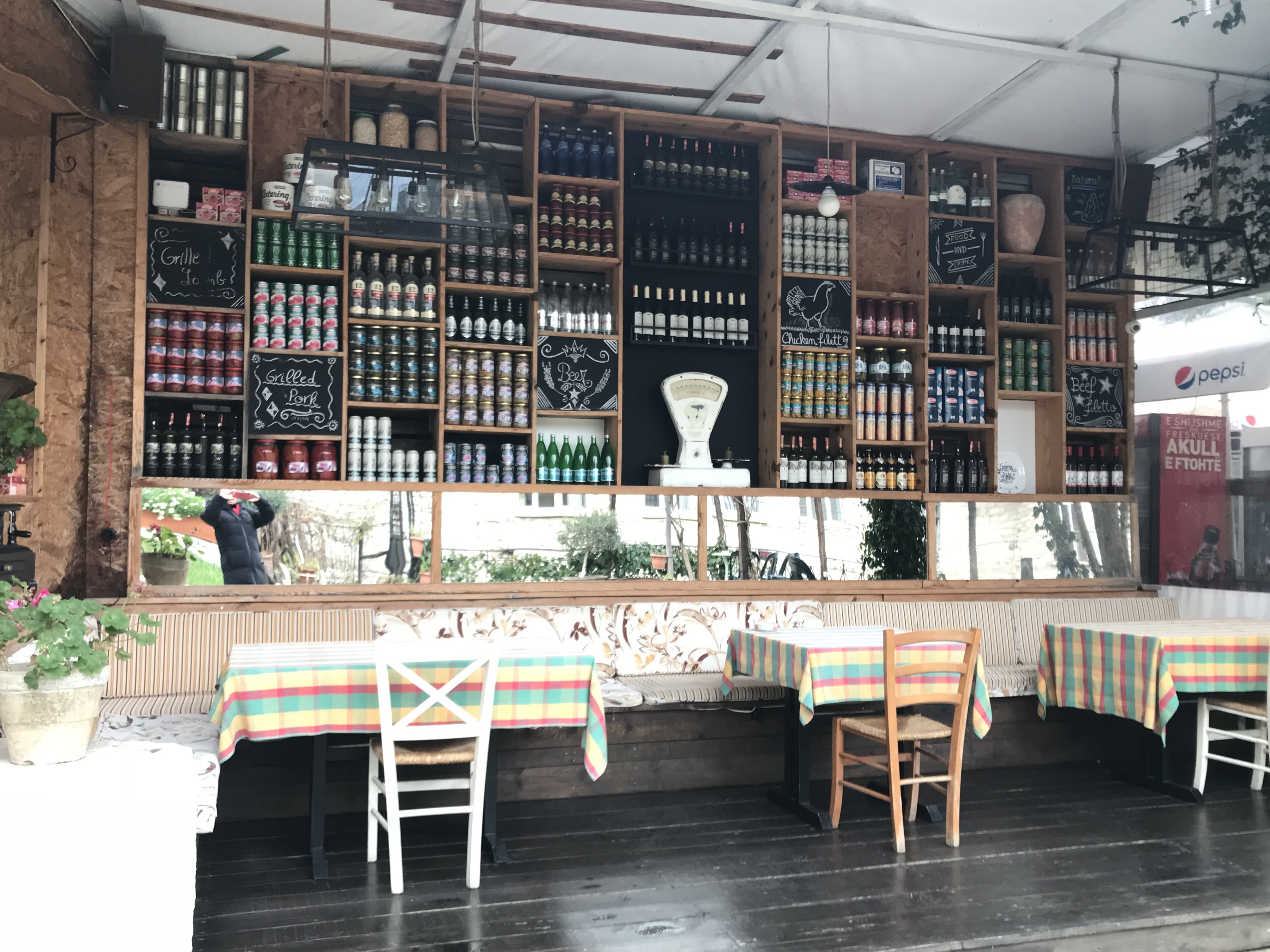

Lunch was great and the place was set up like you are eating in a grocery store with shelves lined with jars of preserved and picked peppers and olives and wine. We had three “traditional Gjirokaster” dishes (a marinated eggplant salad, veal skewers, and a sort of arancini accompanied by wine and sparkling water – food was quite good. Total cost $14.00. From there we roamed the town (which is only partially open given the weather and lack of tourists). Stopped in at a very cute store that sells only products from the region – olive oils, vinegars, jams, etc. Trying to figure out how and if we might bring a few things home. Returned to the hotel, rested a bit, did some work (yup, real life must go on). And then we headed out to dinner. I had arranged a dinner place for tonight (Mike’s birthday), using the newly developed and emerging group of friends here in Albania. So we were to go to Kodra (located in the hotel Kodra). We asked for directions at the front desk (which is operating totally for us). Seemed pretty simple – about a block and a half – we can handle this.
About 15 or 20 minutes into our walk, we realized we were very lost and stopped in a little bar (naturally all men drinking and talking). Very few people speak English except for hotel management once you leave Tirana, so communication is a bit of a struggle – but very interesting as we all use bits and pieces of every language we each know and sign language is always useful (reminds me of traveling in the Soviet Union many decades ago, when Mike and I drew pictures to show what we wanted for dinner). We kept repeating Kodra (K-Oh-Dr-A).. and then one of the men appeared to know where we were headed. His new directions seemed really strange since it put us back on the path we had walked to get to where we were. Well, turned out the restaurant was about a five minute walk from the hotel, and we had already been walking about 20 minutes. Anyway, made it to Kodra for Mike’s birthday dinner.
Kodra was a very informal restaurant inside (with a large outdoor patio that is probably wonderful in the summer). Food was good, not great (but probably good for winter in Gjirokaster. We were the only foreigners (naturally) but there were two or three tables of people – once again men – drinking, smoking, and chatting. Seems like rural Albania is a great place for older men — lots of socializing, hanging out, and “deep discussions?” .. For women, not so sure.. There seemed to be many things on the menu that looked quite interesting, but they were out of a lot of them (I think they pare the menus down in the winter (good thinking), but don’t change the menus. So you get a pretty comprehensive list of options, but they really only have a few of them at this moment in time.
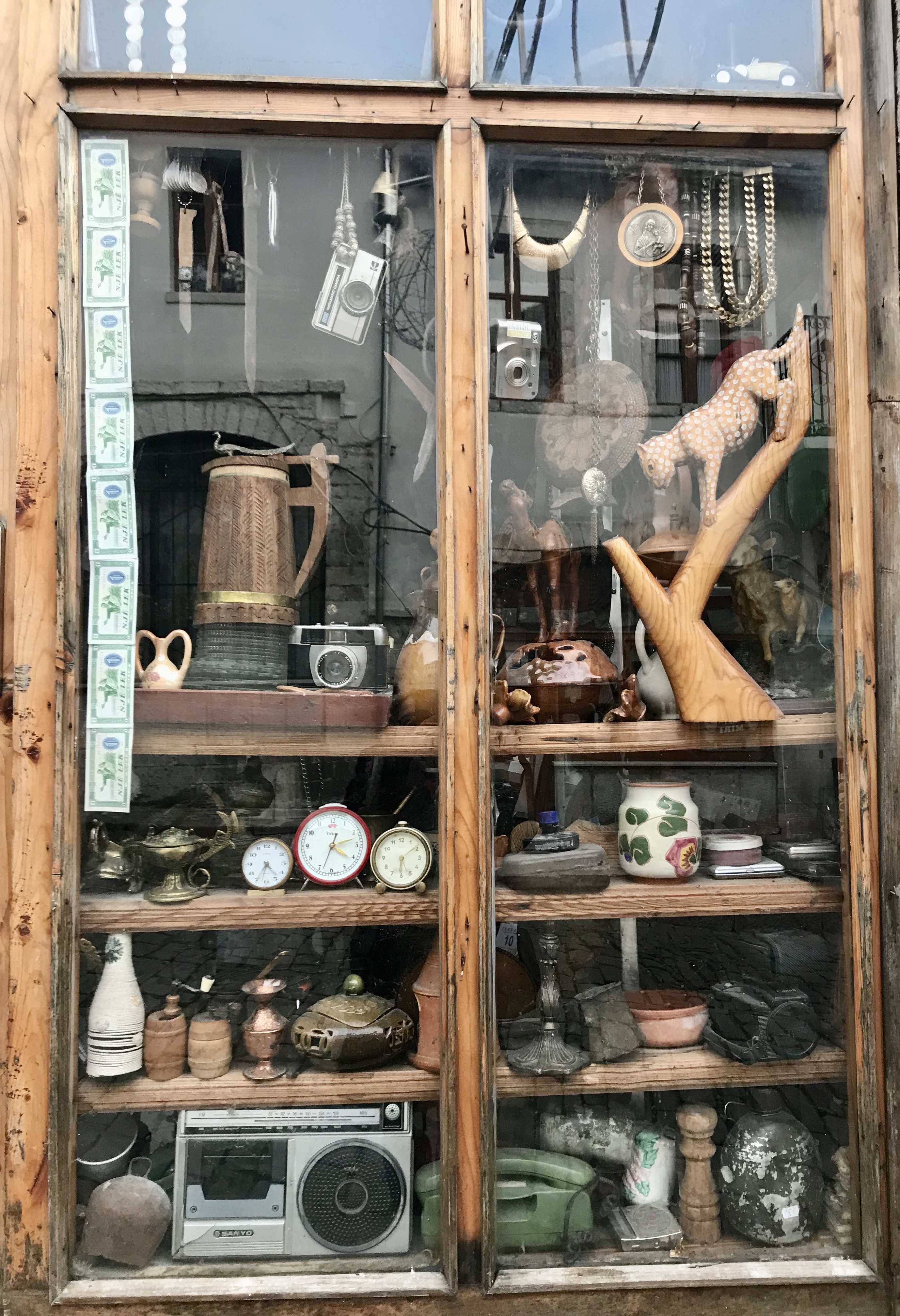
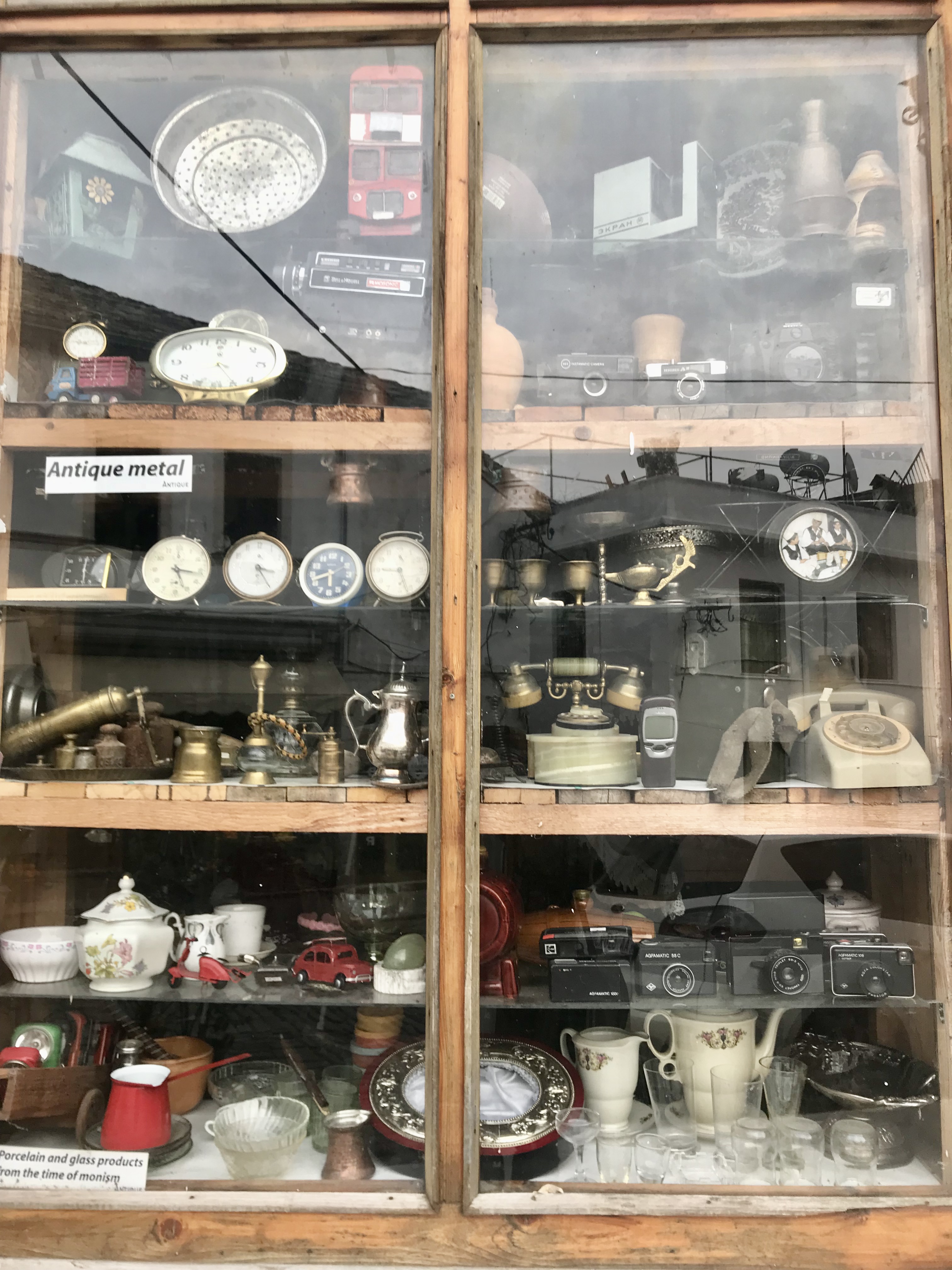
What did we eat? We had spankat (sort of a savory pie with spinach – not flaky like spanakopita – but I think definitely in that family), pasta arabiata (which was ok but not as spicy as what we consider to be arabiata sauce), and pork kebabs which were quite tasty (they use a lot of interesting spices), and Albanian wine (which we are now quite fond of)… and the waiter brought out a dessert – oranges with a very nice sweet cheese with pomegranate (they are very big cheese eaters and every menu has lots of cheese options).
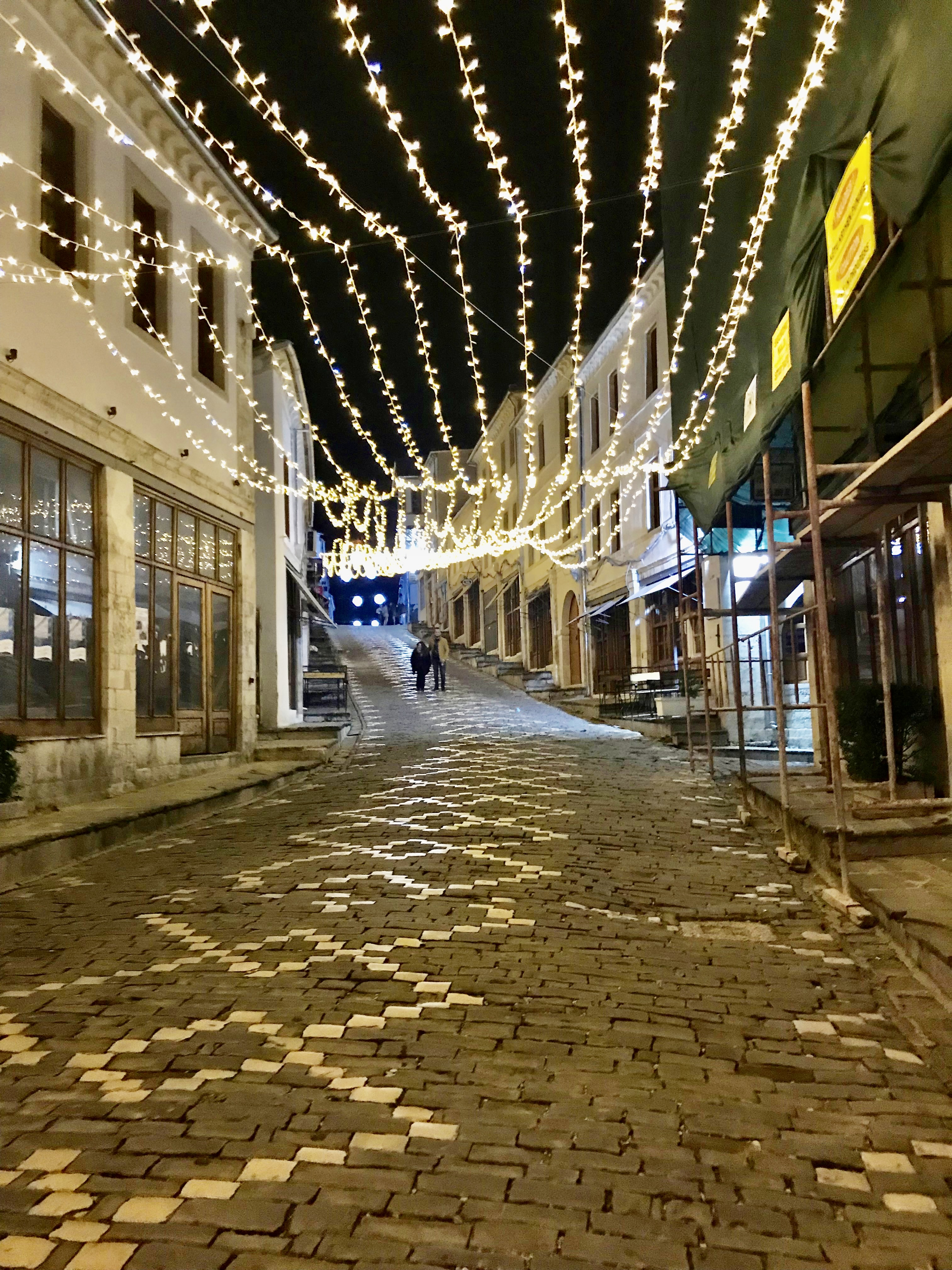
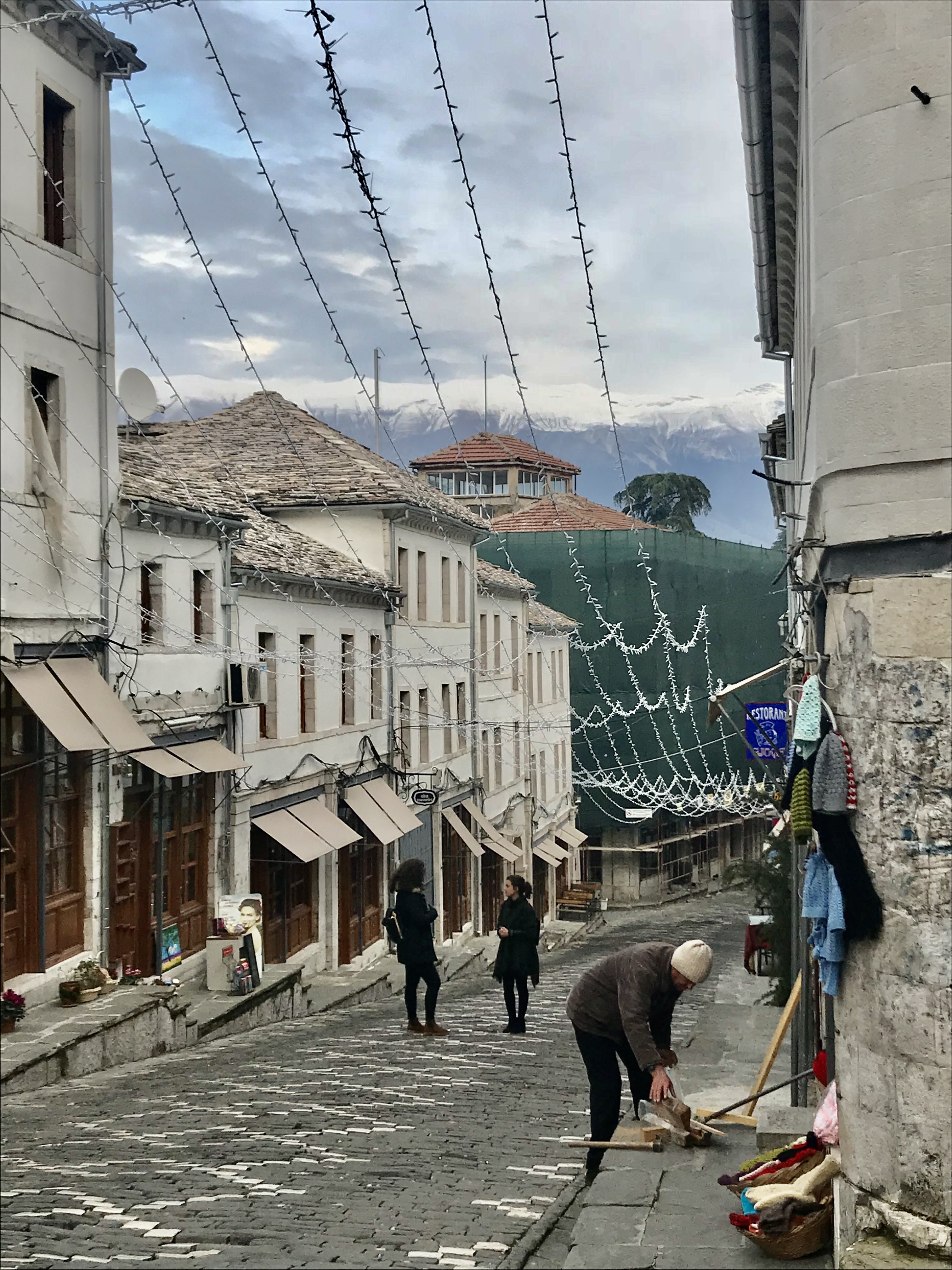
The walk back to the hotel was a breeze since we now really knew the route well… it was also under the twinkle lights that spread across the main street and up the entire two block walk… Made it a bit magical.
All the best — Fern..
More on Gjirokaster tomorrow.
Day Five – Tirana to Berat. December 19, 2017
19 December 2017. Berat, Albania
Greetings from central Albania. We arrived in Berat!
Started the day at the City of Tirana’s Office of Parks and Recreation (an agency just formed two years ago!) I had been asked to give a talk to the department staff, which is led by a delightful, exuberant, and very committed young woman named Erinda. They are advocating for and developing parks within the city, planning bike routes, maintaining existing parks, and managing all recreational facilities throughout the city — and looking for new ways to engage local neighborhoods, to build public/private partnerships to help support their programs, planting street trees, and energetically finding ways for Tirana to be more green. Interestingly, voluntarism to keep public facilities in neighborhoods clean is shunned by many because volunteering wreaks of the old Communist days when “volunteering” was “mandatory.”

Anyway, the department is located in a building adjacent to their large Olympic training facility and both buildings are quite modern. We got a chance to glimpse the facilities of a city department. First, you should know that I don’t think the building has heat. Everyone (except us) seemed accustomed to wearing their coats inside the building. The staff for each section of the department seem to share large rooms without any buffers between staff members… sort of like long tables with computers next to computers. We visited the landscape architects’ office within the department and they had “fairly new” computers but monitors that were quite small for design work. The number of women far outweighed the number of men and most staff were in their late 20s and early 30s.
My talk went over well with lots of questions and then we had some time to chat with Erinda and learn more about the department. She’s very eager to visit the US to see Central Park in NY! But she’s really most interested in learning about partnerships for parks and how to get the private sector involved in funding park development and maintenance. I encouraged her to visit but to go beyond NY (especially since NYC is three times the size of all of Albania – population-wise). I said she should try to get funding to see other cities, especially where there has been strong leadership and community support for parks – and of course offered to help her organize such a trip. Interestingly, Erinda has lived in Japan for 6 years – and is fluent in Japanese! It is amazing how much travel this upcoming generation in Albania has traveled (or lived abroad) since the end of the dictatorship, when no travel in or out was allowed.
Speaking of languages – Albanian children start learning English at age 8, but they are also required to study another language (in addition to Albanian and English) and most learn either French or Italian. Older Albanians (including taxi drivers) speak Italian and people often offer that as a language to converse with us, but alas we know no Italian. That doesn’t stop them from chatting away in Italian.. So we now quite often say Grazie at the end of taxi rides…
The parks department folks drove us back to the hotel (in a work truck) and we quickly packed up and walked to find lunch and to pick up our rental car from Sixt. The drive out of Tirana was pretty hairy – As I said earlier they are very aggressive drivers; there really isn’t any striping on the roads; there are lots of roundabouts (traffic circles) and people seem to just criss cross to get from one lane to the other. It seems also as if many roads are set for three lanes but people create four or roads that are for two lanes become three, etc. We made a few mistakes getting out of Tirana (mostly due to the GPS saying to exit at the third exit of the roundabout but it was really the second – not sure how they count!) People gave us all sorts of calculations as to how long it would take to drive to Berat from Tirana – ranging from 90 minutes to 3 hours. It took us the latter. Once we got out of the city, it was pretty much one lane in each direction, but none of the overhead “highway” lights were working (once we were out of the city). That made it a bit scary. People were crossing the road, dogs were meandering, and buses were stopping to pick up people. Mike did the driving and I navigated. My big take-away about cars in Albania — pedestrians beware!
Given that is was dark for a good part of the drive, we didn’t see much. Then as we approached Berat, we made numerous mistakes (Mike blames the GPS), but eventually found the hotel which is located uphill on the edge of the medieval quarter. The hotel (which costs about $60 per night for the largest room with best view) was recently renovated. I think they took a trip to Italy and found some of the “modern, Italian bougie” decorator stuff and decided that is what guests would like. That said, it’s extremely clean and functional (although we couldn’t get the heat in the room to work for several hours in spite of having staff come up to help). Naturally, when we arrived to check in they didn’t have our reservation… but we had an email saying the reservation was confirmed. But, no problem getting the best room in the place – we are the only guests!
We settled in and then figured we should just eat dinner here because we were tired from the drive and we really didn’t have a sense of the town plan or how far things were.. and it was really dark. So, we were the only ones in the restaurant which was even more bougie than the other spaces.. Food was fair and a far cry from the phenomenal meals we’ve had for the past few days. We shared a pasta (simply prepared) and then I had the chicken (special for the holidays apparently) with bland stuffing and Mike had some kind of breaded veal stuffed with cheese (which he proceeded to scoop out so that he only had a small amount of cheese). The wine (Italian – and very cheap) was quite good. At the end of the meal they gave us dessert even though we didn’t order it… sort of a brownie.
Anyway, it is now morning and we are heading out to climb the steep walkway to the 13th century castle, where there are still people living in a little village in the castle walls… Then we will explore the rest of the city.. and hopefully find a really good country-style restaurant for tonight. We leave Berat tomorrow for Gjyrokaster. By the way, much as it may not sound like it — we are really excited to see Berat in the sunlight.. It’s a UNESCO heritage town, as is Gjyrokaster.
Onward for the adventure.
Fern
PS – I’m caught up now.. so that tonight’s notes will be about today. Whew… Hopefully I will be able to keep up as I also need to complete my syllabus for Winter Quarter which begins a day after we land in California.
driveway of building where the “art” is the wall of hearts.. couples come and write their names on the hearts as high as they can reach… On this day we stumbled on two women who were there on a mission — to cross out their names… I assume love gone bad!
Albania Day Four. December 18, 2017
Përshëndetje nga Shqipëria – Greetings from Albania (writing this on Day 5, but it’s all about Day 4)–
Following breakfast at the hotel (Tirana – Hotel MonarC) — which has been a buffet for the previous days, but today we were told to just order anything we wanted, because we were the only guests in the whole hotel! We then asked for a taxi to take us to Polis University where each of us was to give a talk, to separate classes. The front desk said getting a taxi would be very difficult and she advised we walk… But Polis University is about six miles from the hotel. I told the front desk that we had to give presentations/ lectures at the university and she suddenly figured out a way to get a taxi. Turns out there were demonstrations against the present government (Socialist) and many downtown streets were closed; there was heavy police presence in the downtown area. Somehow giving a lecture seemed very impressive and she was able to find the ride for us. I’m not certain but I think that the taxis in Tirana (they are everywhere) have some kind of app system because the hotel always seems to know how far away the taxi is.
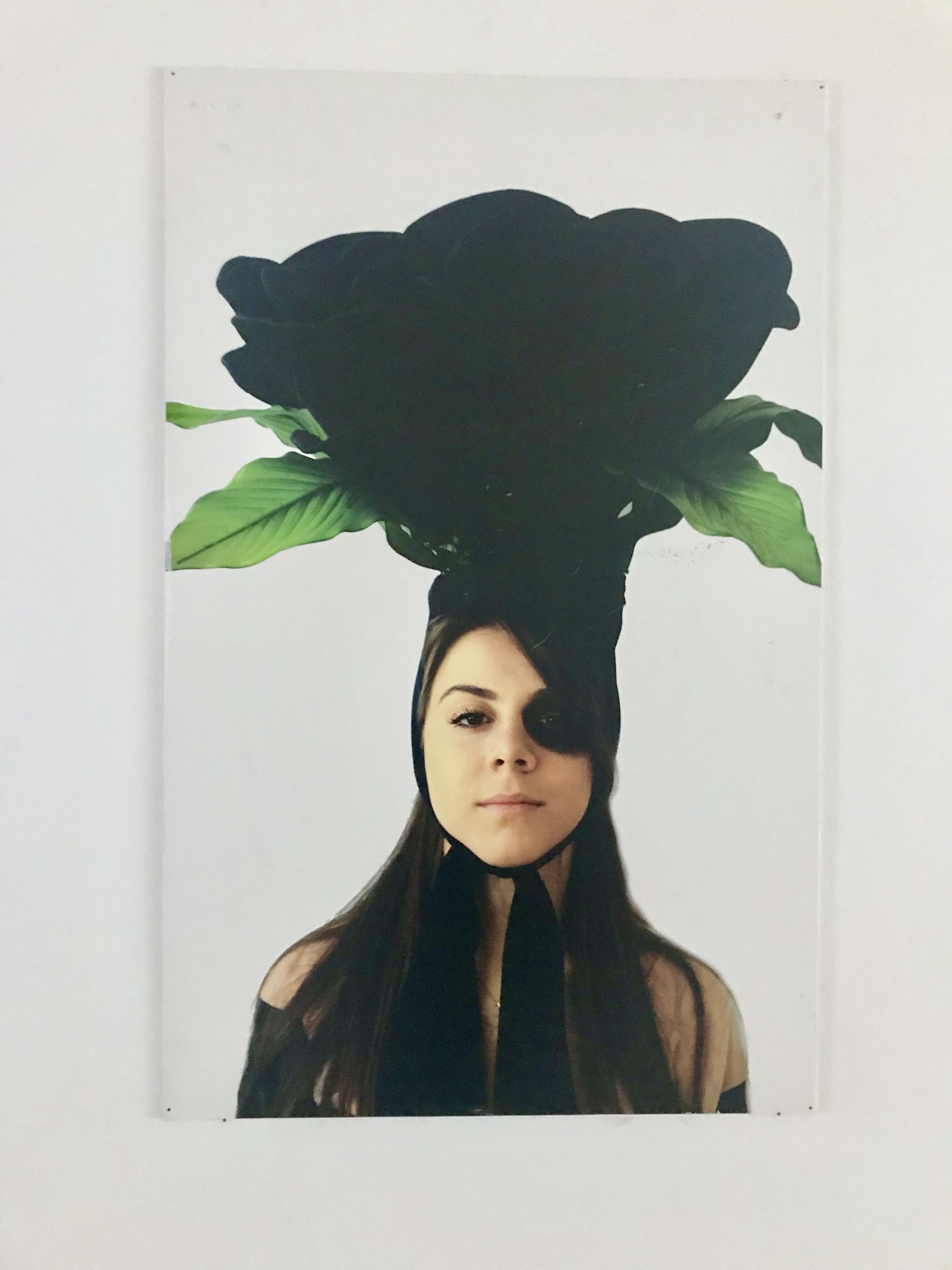
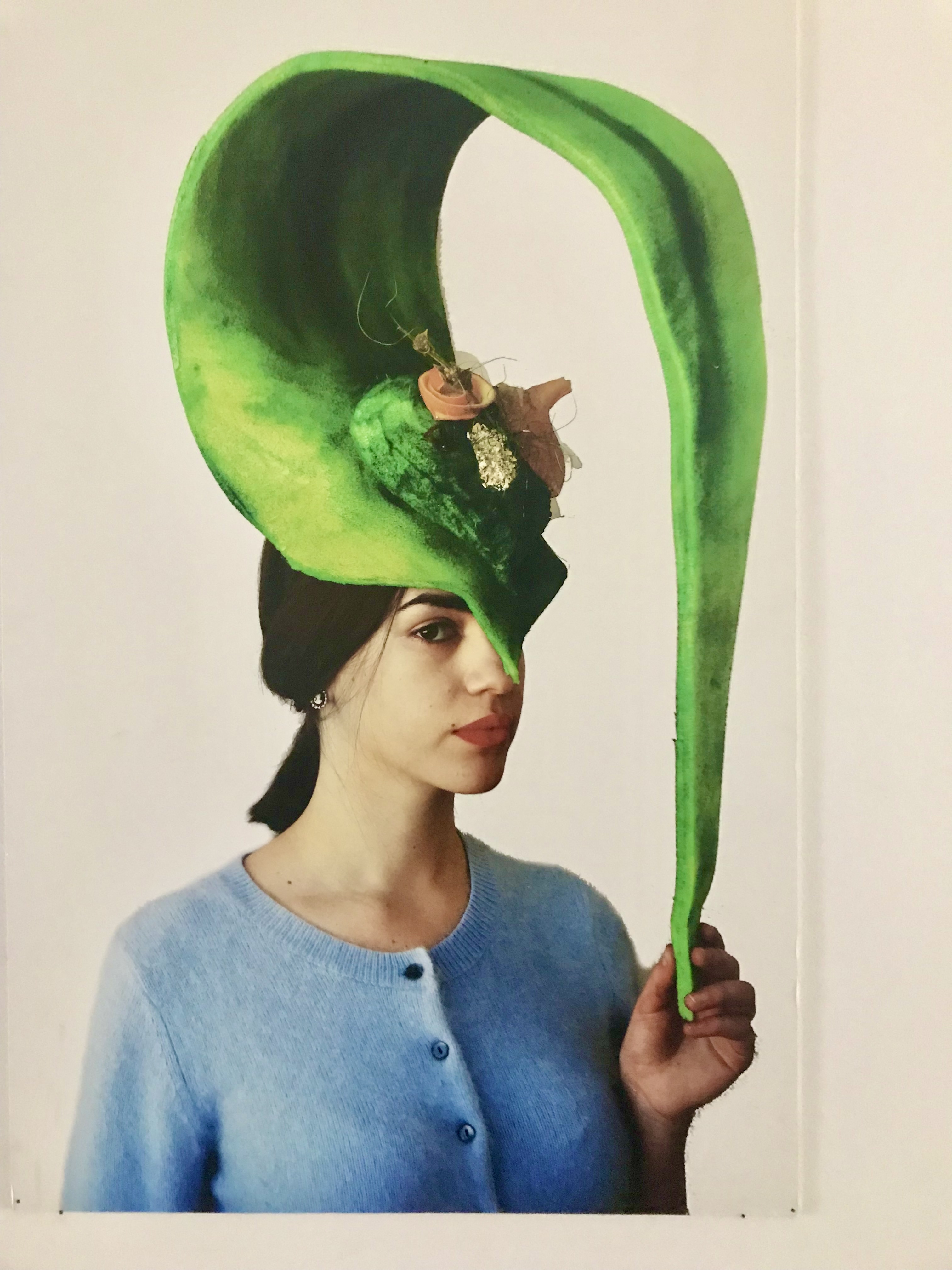
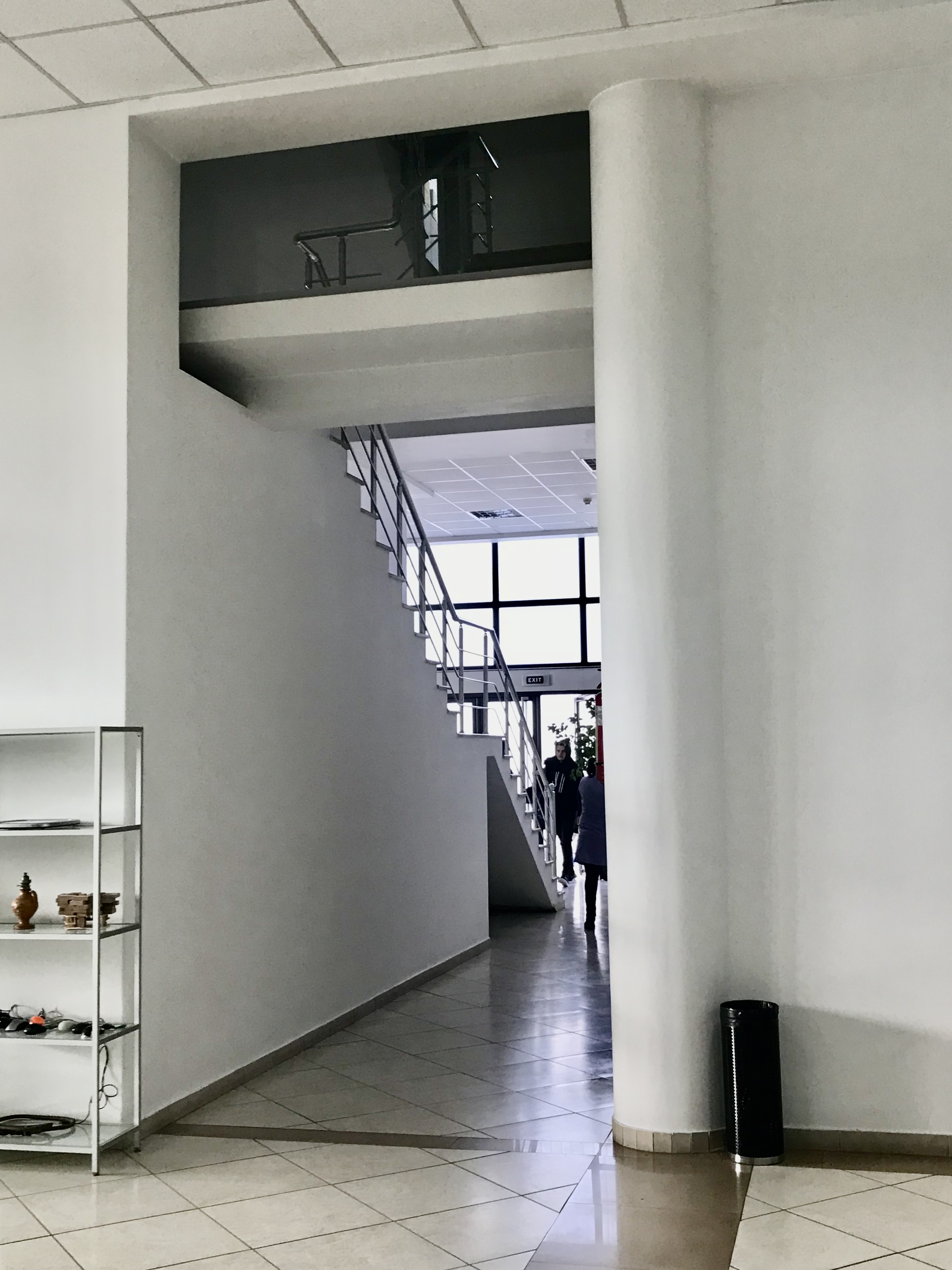
Taxi arrived and we managed to get to Polis University which is located about 5 or 6 miles west(?) of downtown. It’s an interesting educational institution located in a very renovated/ repurposed industrial building that has a whole new 4-story front section. Polis is about 10-years-old and offers bachelors, masters, and doctorates in architecture, urban planning, and design. The doctorates are offered in conjunction with University of Ferrara in Italy (I suppose there is a long explanation for this.) It’s a private university (technically for-profit, but clearly is not a business model set up to make profit). Anyway, it’s a truly exciting place with lots of activity – students milling about, making things.. very reminiscent of Pratt in the years I was there. I have to admit to a bit of nostalgia and realizing how much more exciting that kind of school is than the typical academic institution (like where I teach). Made me think a lot about what I had hoped might be created at UW Tacoma. Students at Polis are very focused and faculty are intense – all engaged with trying to solve real social problems in creative and collaborative ways. The building uses a lot of glass, so as you walk through the halls you’re very aware of what’s going in in classrooms, project rooms, etc.
There are several interesting features and historical notes. The school was created by a few faculty who used to teach at the University of Tirana’s architecture department. These faculty were connected to an NGO called Co-Plan – that worked on planning policies and were advocates for environmental and urban issues. The organization still exists, but now it is inside of Polis and seems to blend in easily. Co-PLAN provides technical assistance to communities, local governments, and national and international organizations in the fields of urban management and community-based developments—sort of like community design centers located at some universities.. but somehow this one seemed more intense, more real, and more creative (at least to me). The mission of Co-PLAN is to enhance the environmental, social, and economic conditions in Albanian cities — promoting self-reliance and civil society development. Basically, Co-PLAN promotes self-reliance and civil, society development (civil society is a term used all the time here in Albania, when talking with professionals).
Inside of Polis is also a small architectural firm, called MetroPolis that is for-profit and does architecture and some urban planning (although this subject had never been at the university). They enter a lot of competitions (some with foreign firms) and also get contracts from local and federal governments, as well as from the private sector. Staff from MetroPolis teach at the University and faculty and students often work on project with the organization.
We got a quick tour of the school and then Mike went to give his talk to the architecture students (“Affordable Housing under Capitalism: A Hopeless Quest”) and I went to give my talk (“Strategy + Design — Community Voices to Create Community Visions”) to the planning students. The urban planning program is fairly new and quite small. Polis is considered a school with heavy requirements and a command of English is a pre-requisite. Tuition is considered high at about $3,000 per year (about 40% of students get some kind of aid). The planning program is five years: 3 to get the bachelors degree and 2 for the masters, but that is only if you do the complete 5 years. I think the talk went well, evidenced by strong thoughtful questions. The curriculum of the school and its teaching philosophy are very compatible with my thinking and politics.
After the talks we had lunch with two faculty, including the one who runs MetroPolis.. Lots of discussion on the transition from a dictatorship under communism into a new democracy, the efforts of the population to not forget the past but to learn from it; the US situation under Trump; life under Hoxha during their primary and teen years; all the work they hope will get done to build change in Albania.
We then headed back downtown in a taxi – with the driver’s radio playing “Sounds of Silence” in Albanian! Lots of traffic.. but eventually got back to the city center. Mike took a nap and I headed to find a new shoulder bag as my strap broke two days earlier – sort of a success; not in love with it, but it will do for the time being.
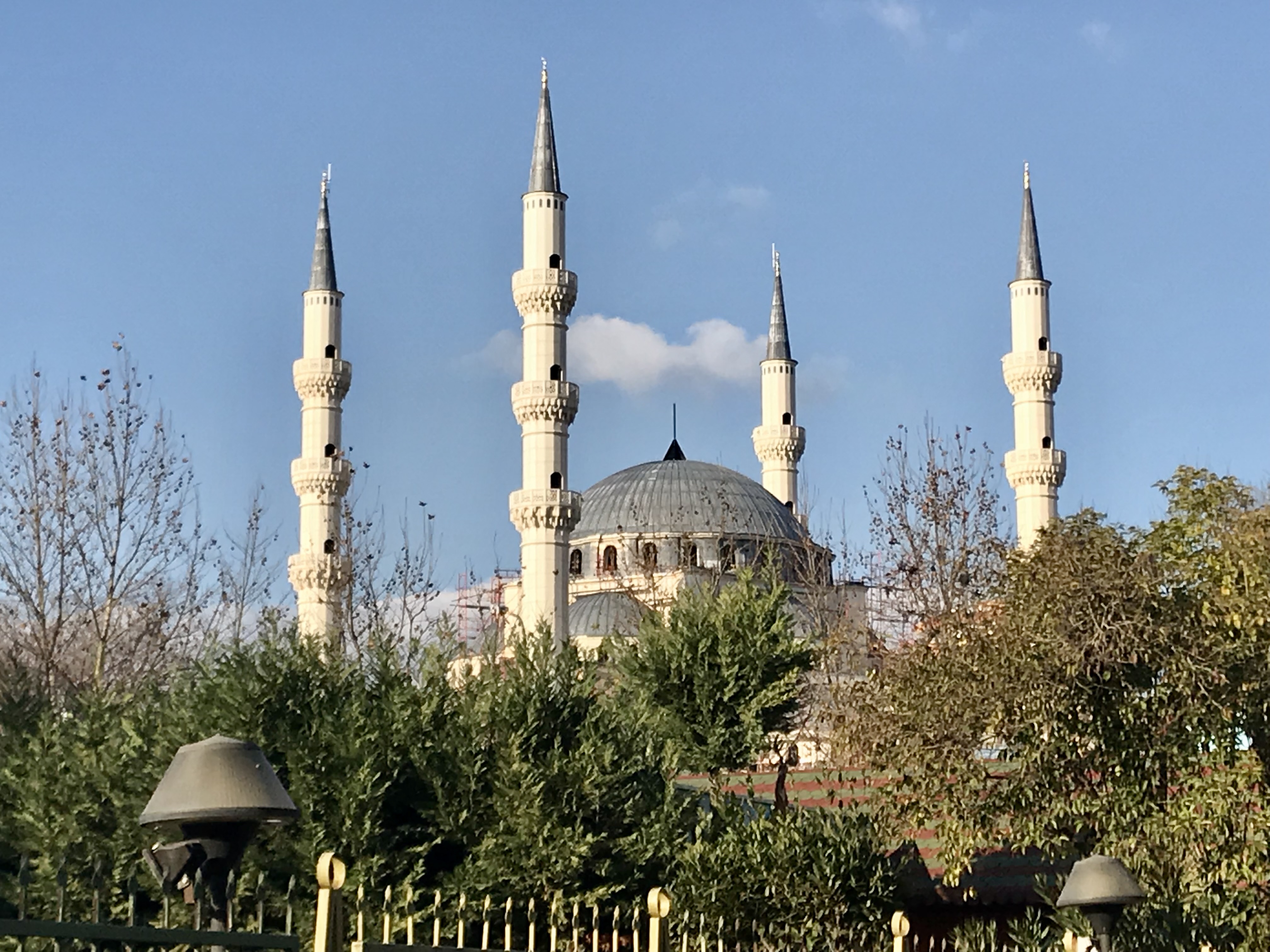
Then we changed clothes and went to dinner with someone Braden connected us with and who happens to be the former wife of the former mayor of Tirana and current prime minister. An extremely interesting woman who is the director of civil society programs at the East West Management Institute, a US-AID funded program. She travels extensively managing programs in the Balkan countries and has an office in NY. She’s also a foodie – so we had not just political sympatico but also gourmet sympatico. It was her restaurant suggestions that we have been using over the past few days. She took us to one, not on her list to us (!!) – Estia – located a few blocks from our hotel – good thing because it was pouring last night.
Started with a pasta with some kind of mushroom thing sitting on top of each pasta piece, followed by a nettle soup with foam and sweetbreads and ginger and vanilla, I think, followed by foie gras with wild figs and toast. The main course was walnut encrusted baby lamb chops with vegetable side. We shared three deserts, but they brought all five to our table. Crème brulee, homemade minty-mint ice scream, poached pear, something that was sort of like deconstructed baklava.
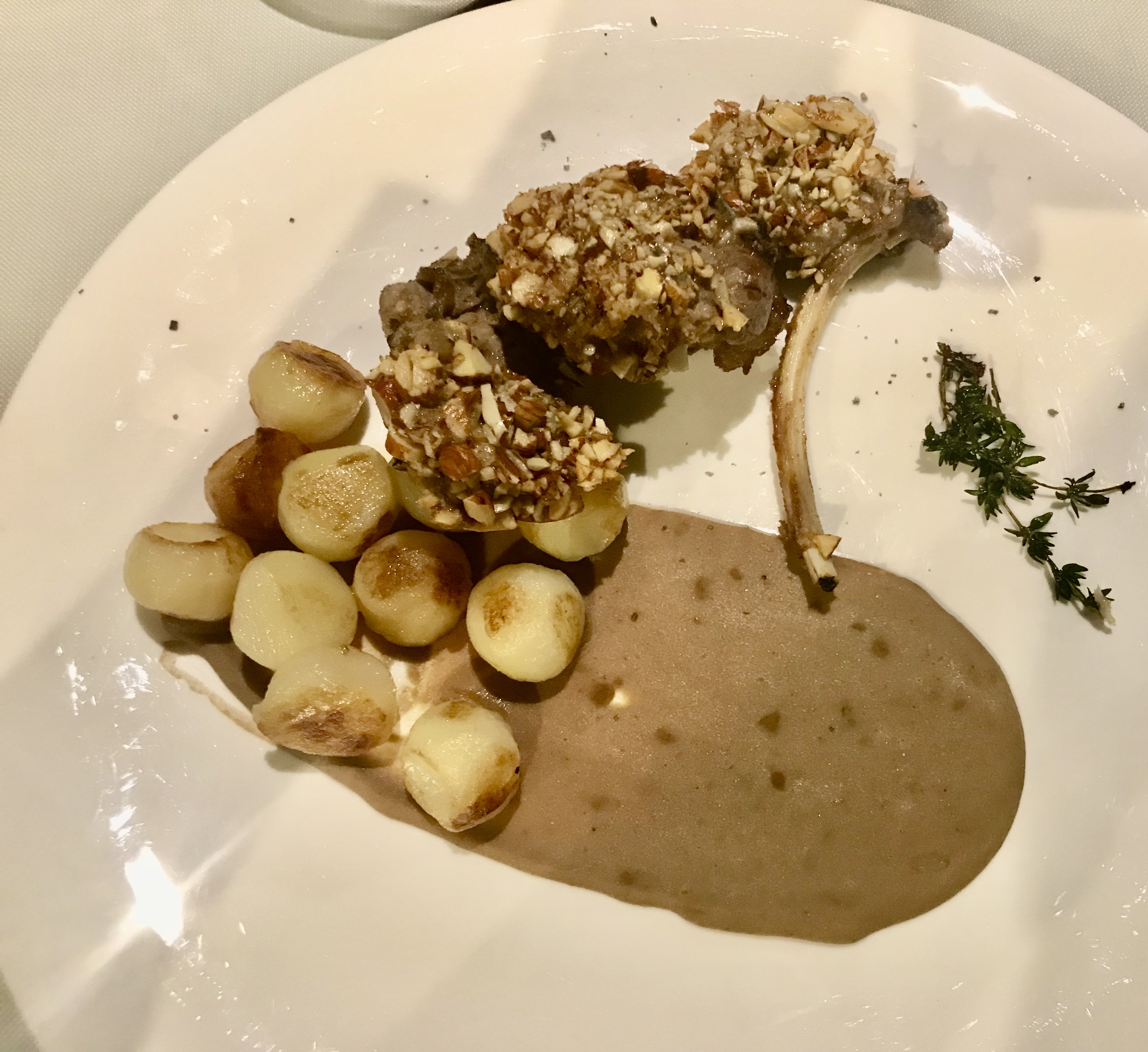
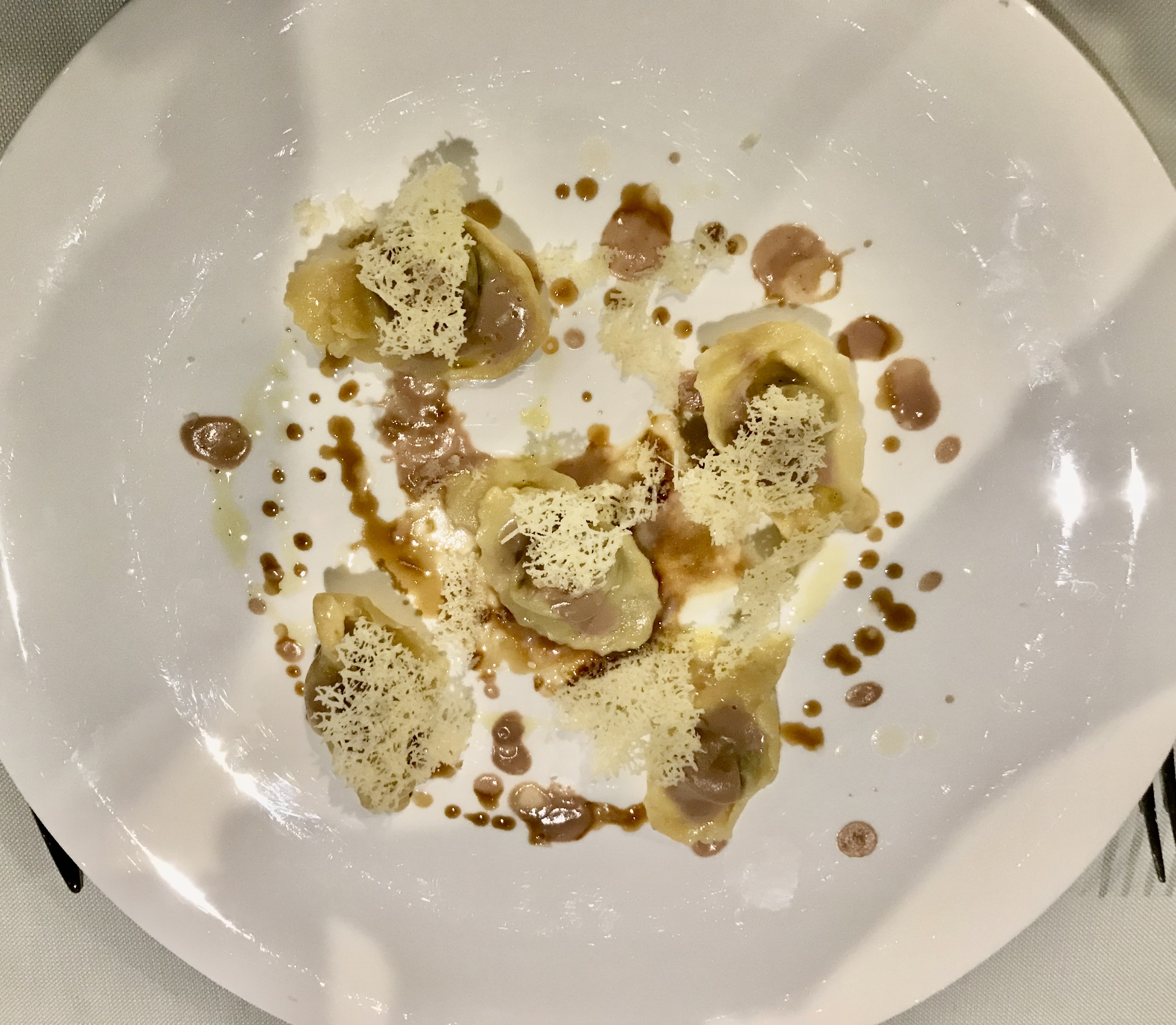
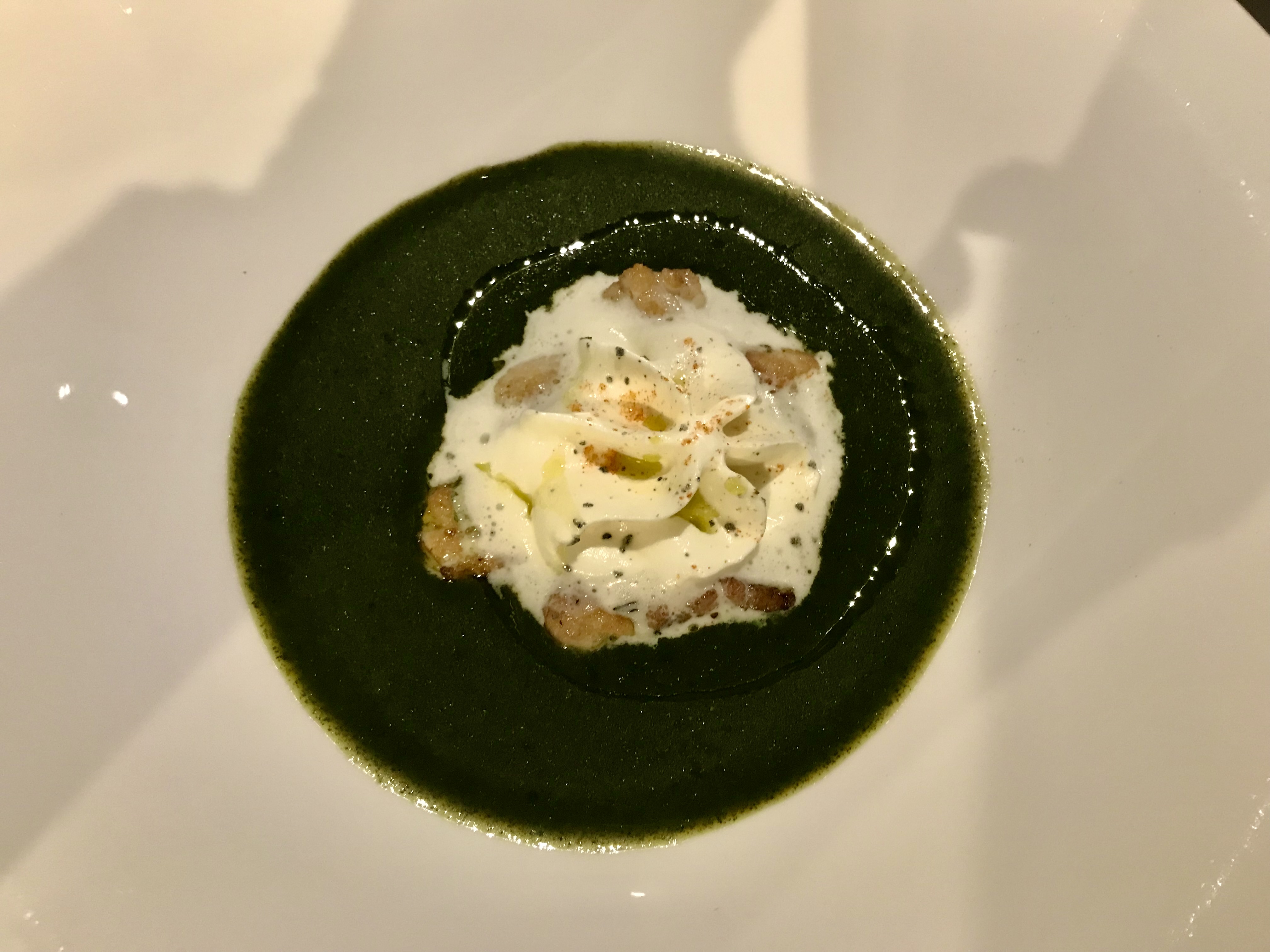
Dinner was fantastic and lots of sharing. We closed the place down at about 11:15 or so, and survived the downpour to our hotel.
I finally finished reading all the term papers and posting grades, so I felt pretty darn good.
A packed Monday with lots of information swirling about, and even more questions — especially about what it must have been like to be at the very start of this new democracy (23 years ago) – living in a house that was assigned to you to suddenly owning that house; not being able to leave the country to having a passport and being able to travel as you wish; not having any religion to suddenly seeing mosques reopened and churches being constructed (although from what people say the majority of residents are atheists); not owning cars to a sudden explosion of automobiles on the streets (with absolutely the most aggressive driving I’ve ever seen – said by me as a New Yorker).
So much more to tell you, but I’m fading… we are now in Berat; more about the drive and Berat tomorrow. It’s about midnight here in Berat.
All the best – Can’t proofread, so hopefully no egregious errors.
Fern
Albania Day Three. December 17, 2017

Greetings from Tirana –
Not really sure where I left off, and I’m already a day behind. There just aren’t enough hours in the day to give these notes their just do. We are going 24/7, and everything is incredibly interesting.
So, while eating breakfast on Sunday the sun popped out and we dashed out to have some set of hours without rain (taking our umbrellas with us – just in case).
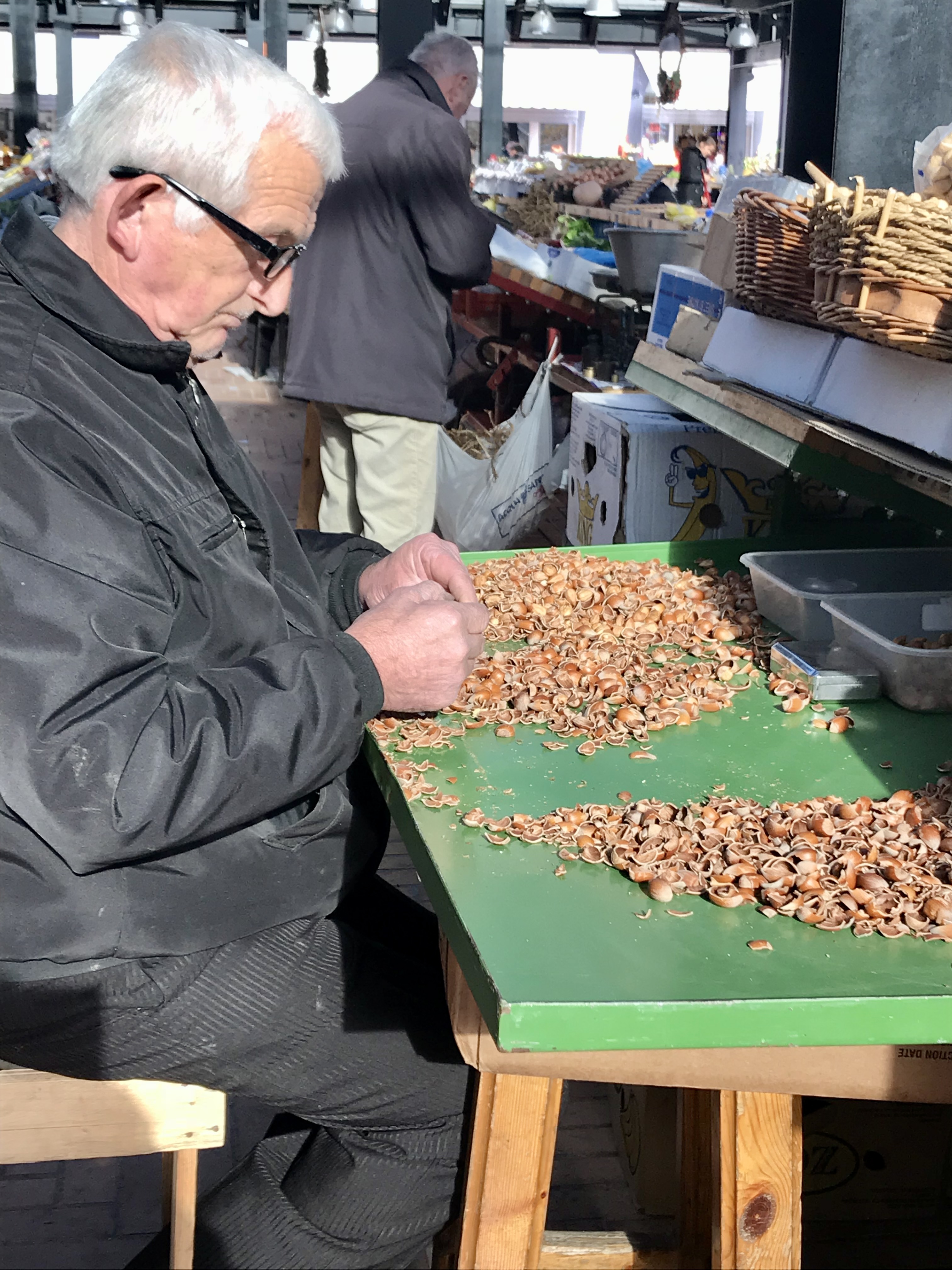
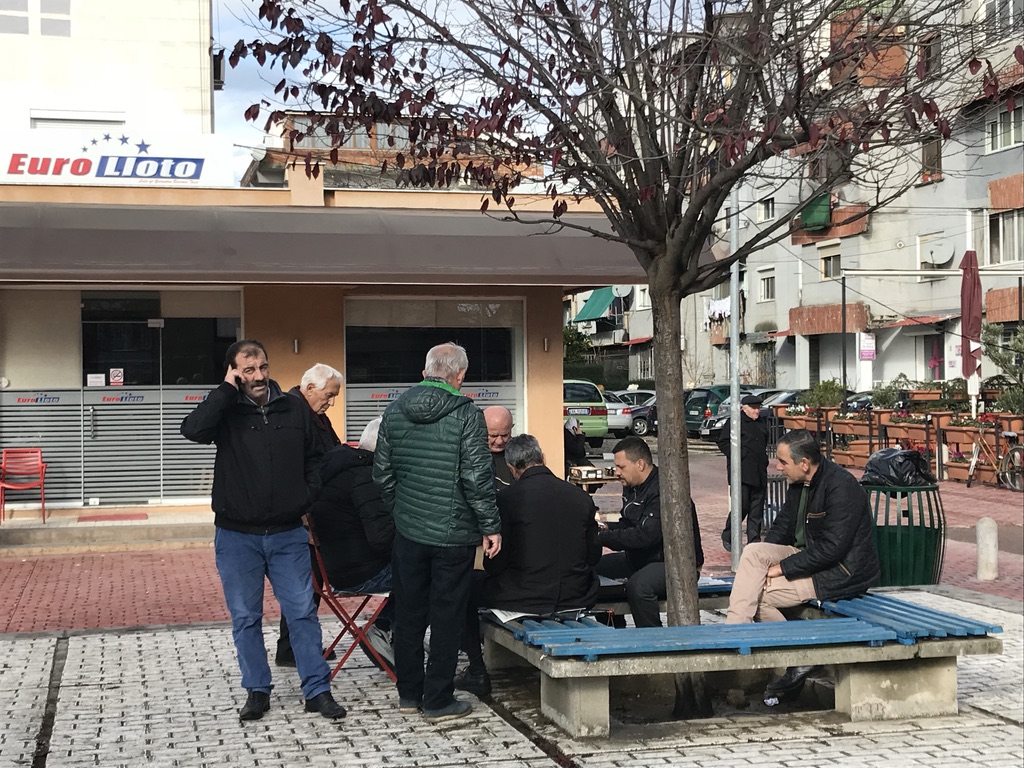
We left the hotel and walked about a mile or so to the “new bazaar” – located in the Pazari i Ri neighborhood – a residential area in the Old Town. It’s a residential area but the market is interesting and in addition to a main farmer’s market has many side streets that are typical of older parts of cities all over the world – narrow, chock full of cars, housing, people, and little stalls offering a variety of single items (old tires or whatever) being sold in shops no larger than a typical closet. From there we strolled into some other neighborhoods – always on the lookout for those painted buildings.
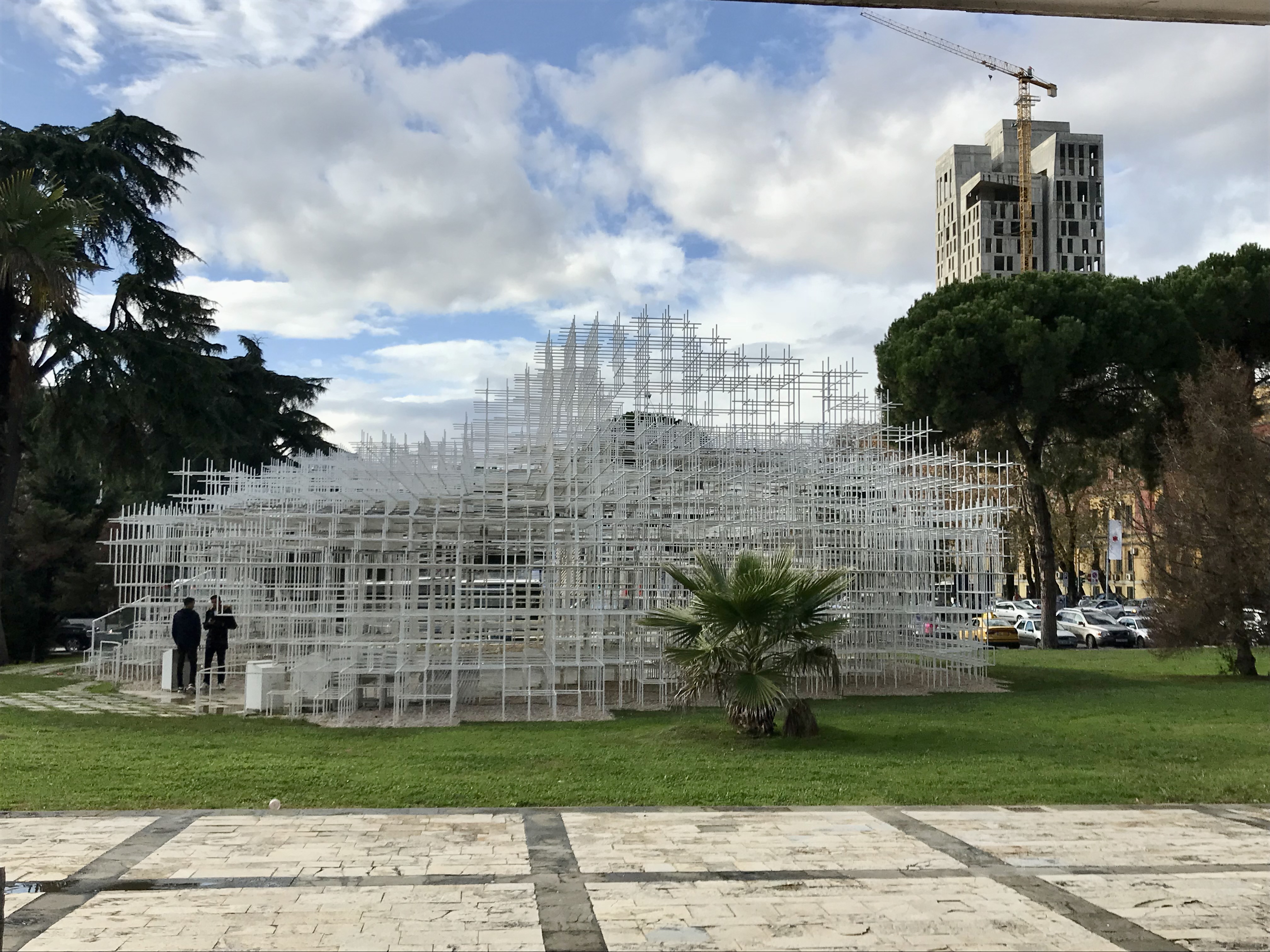
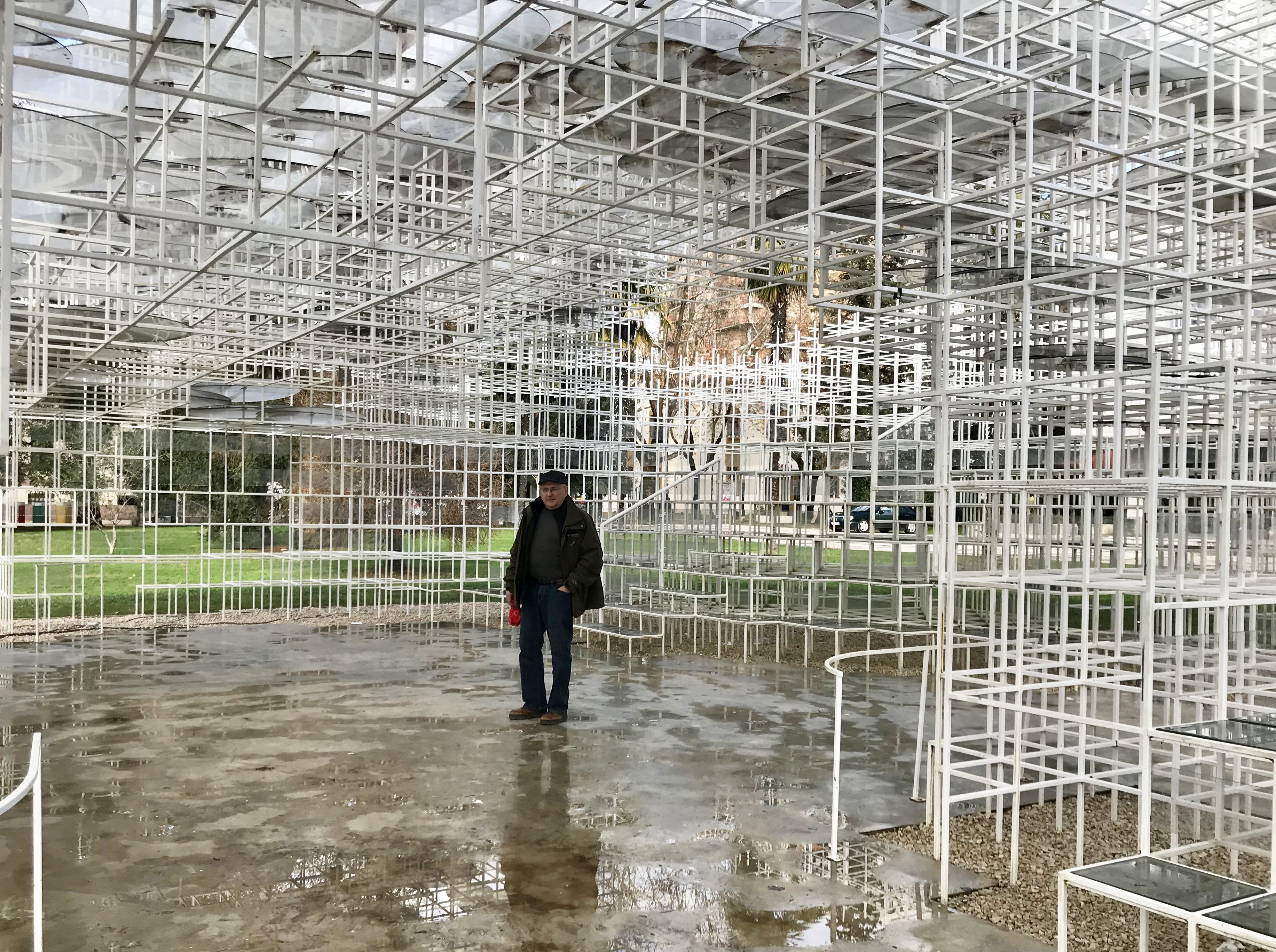
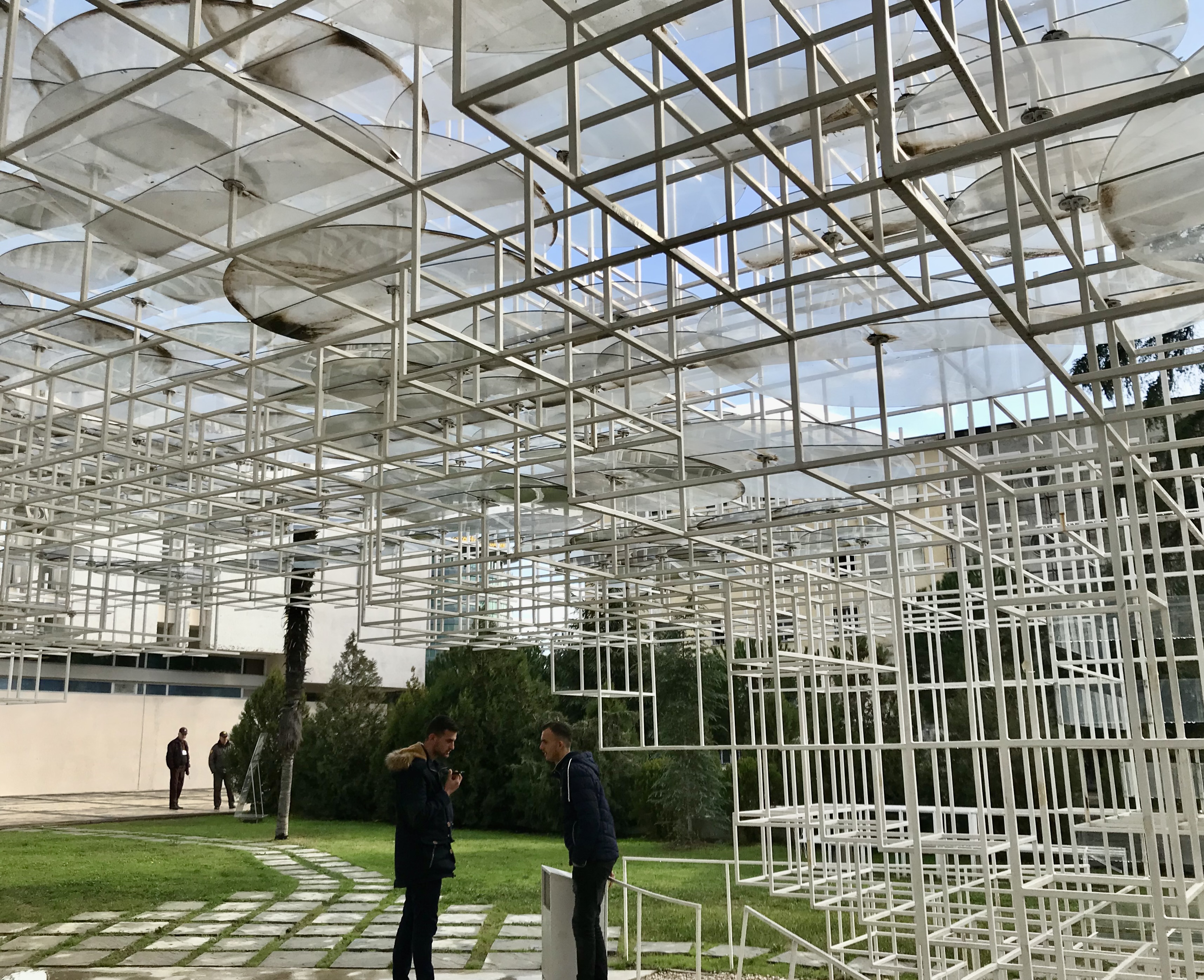
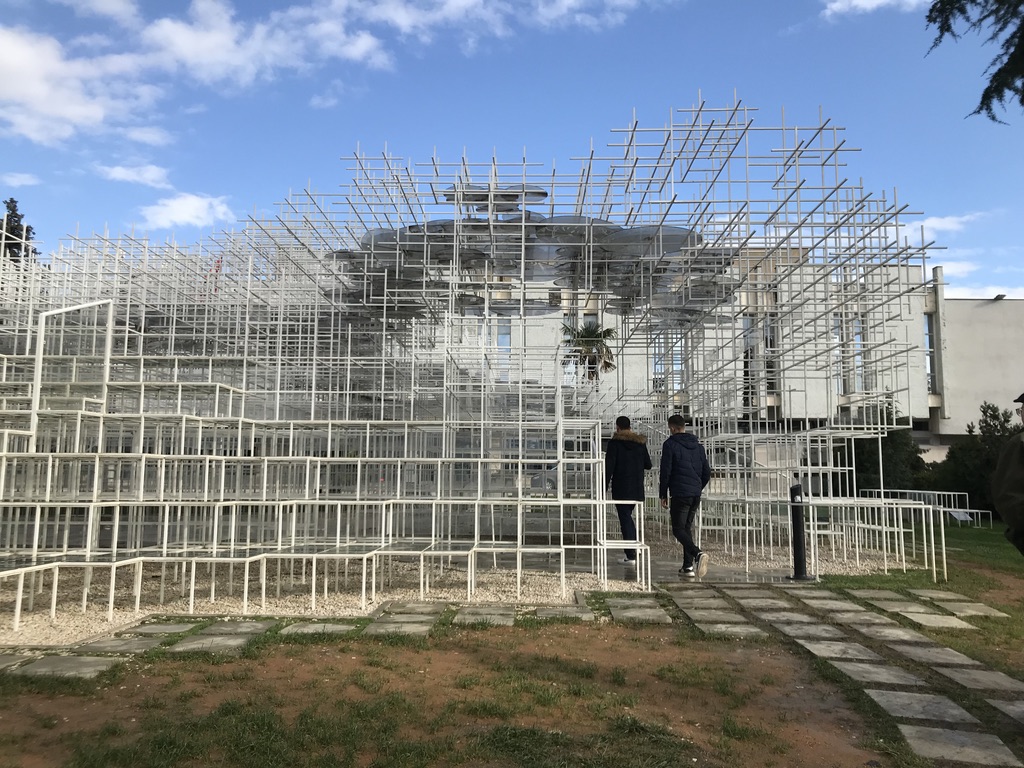

Eventually, we decided to hop a taxi to head to the National Gallery of Art (it looked like rain was about to eliminate the sun, so this seemed like a good place to be). The building itself is pretty bland and built in the 1950s when “bland” was in in the Soviet-linked capital of Albania. The best part is the entrance – the “cloud pavilion” – a three-dimensional structure, made of open cube frames of white steel… it creates a semi-transparent, 3-d façade that enables visitors to walk through and climb through (or walk on platforms that emerge from the cubes.. and sort of voids the bland façade..
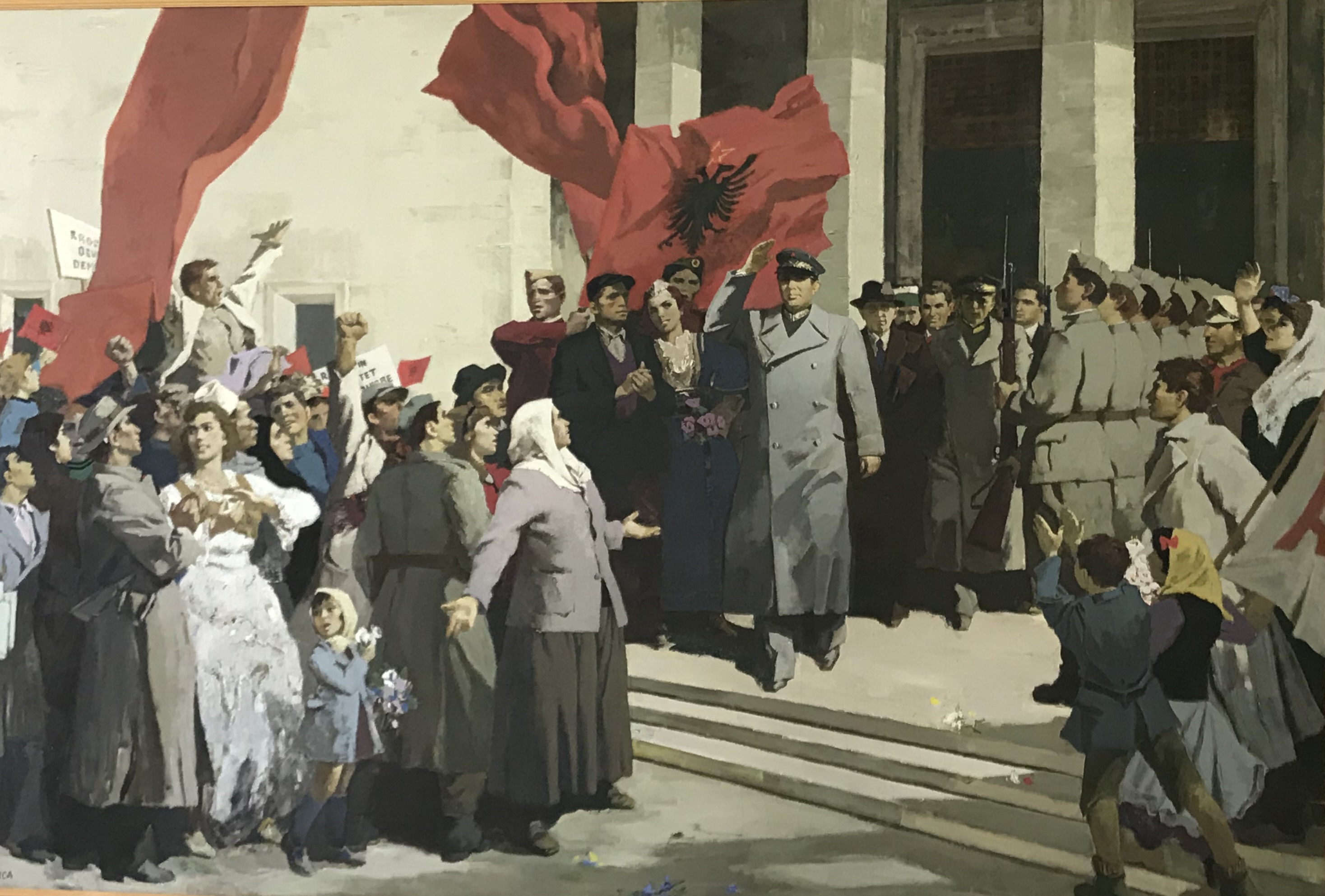
The museum was in the process of installing a new exhibit so we took a few minutes to see some of the permanent collection of social realist art from the 1970s. From the museum we walked a bit more through the central part of the city and had a late lunch at Delicazzo de Mare – another all fish restaurant.. We shared mussels, followed by a pasta with crab (It’s difficult to have a meal without pasta here and it’s all good, always home made and cooked very al dente). We then walked back to the hotel since I needed to finish reading term papers, do grading, and polish up my talk for Monday morning.
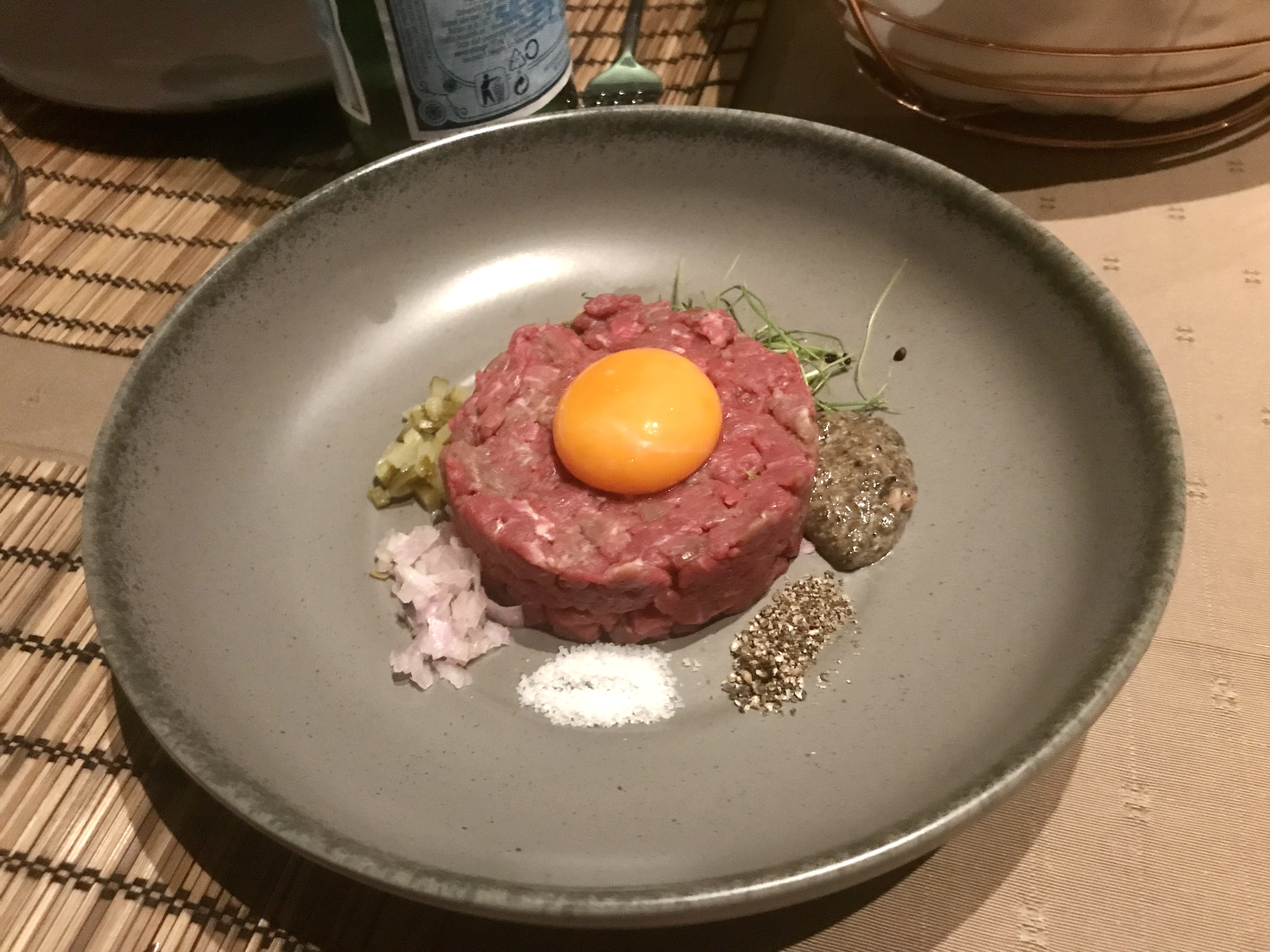
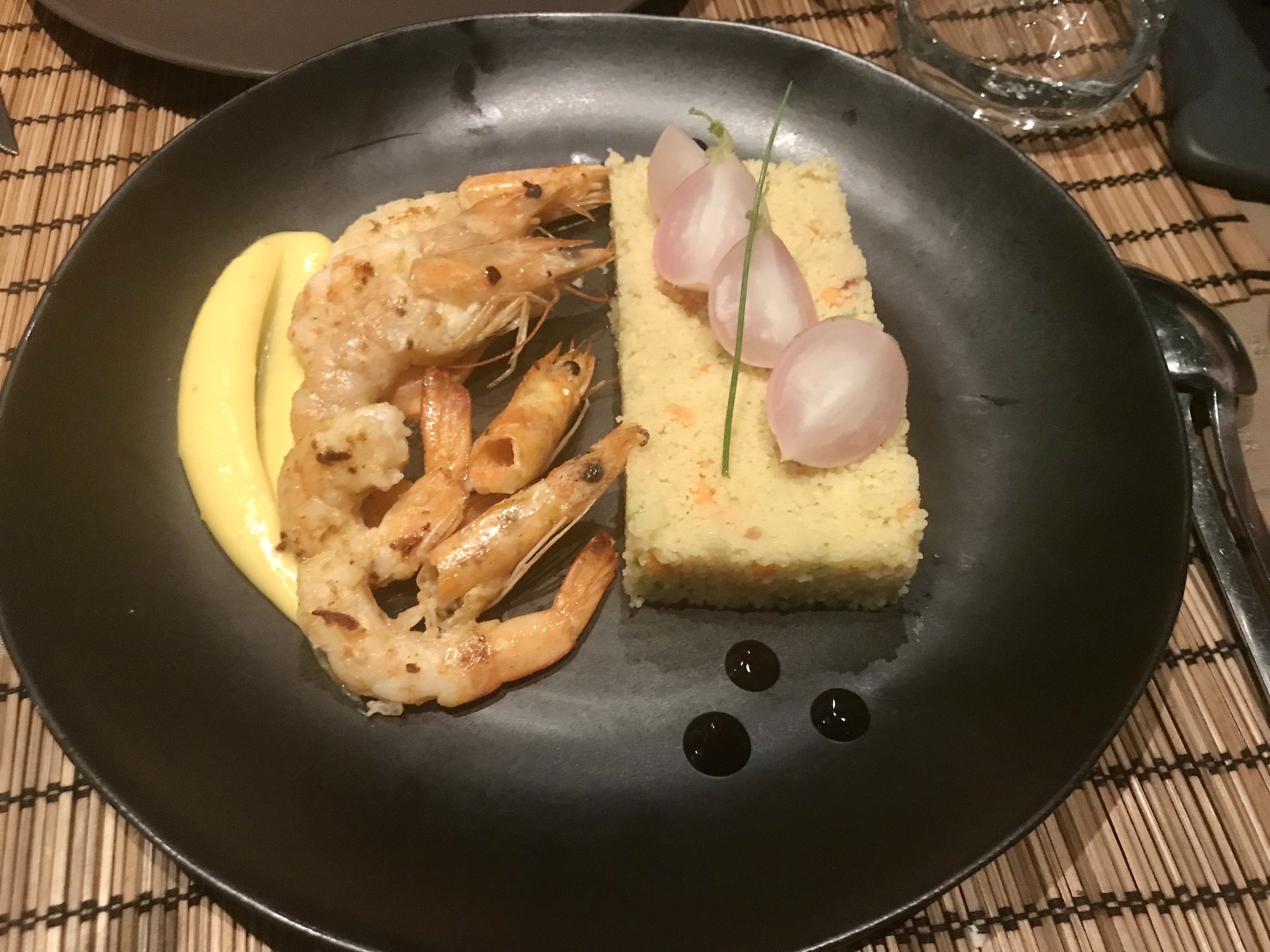
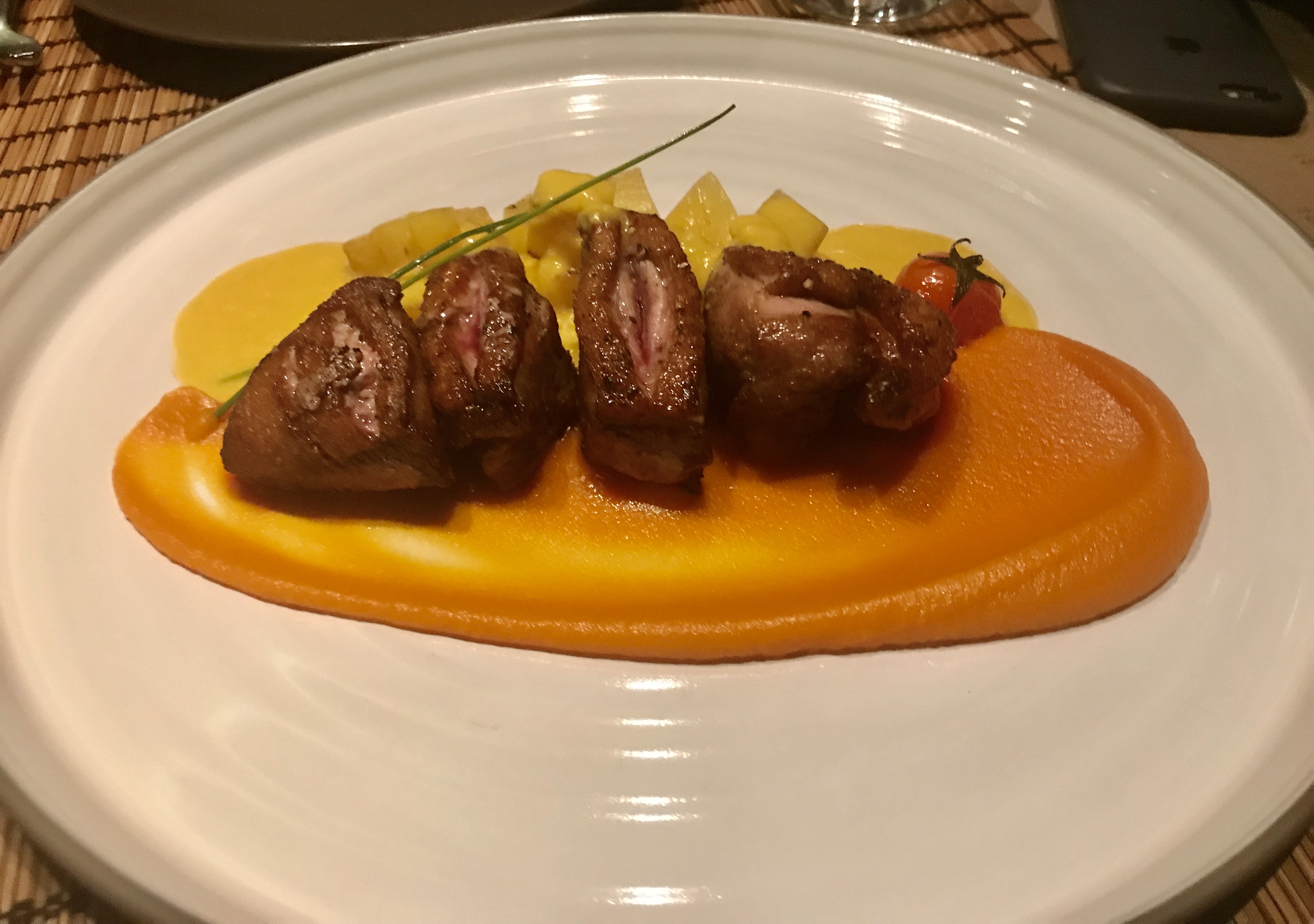
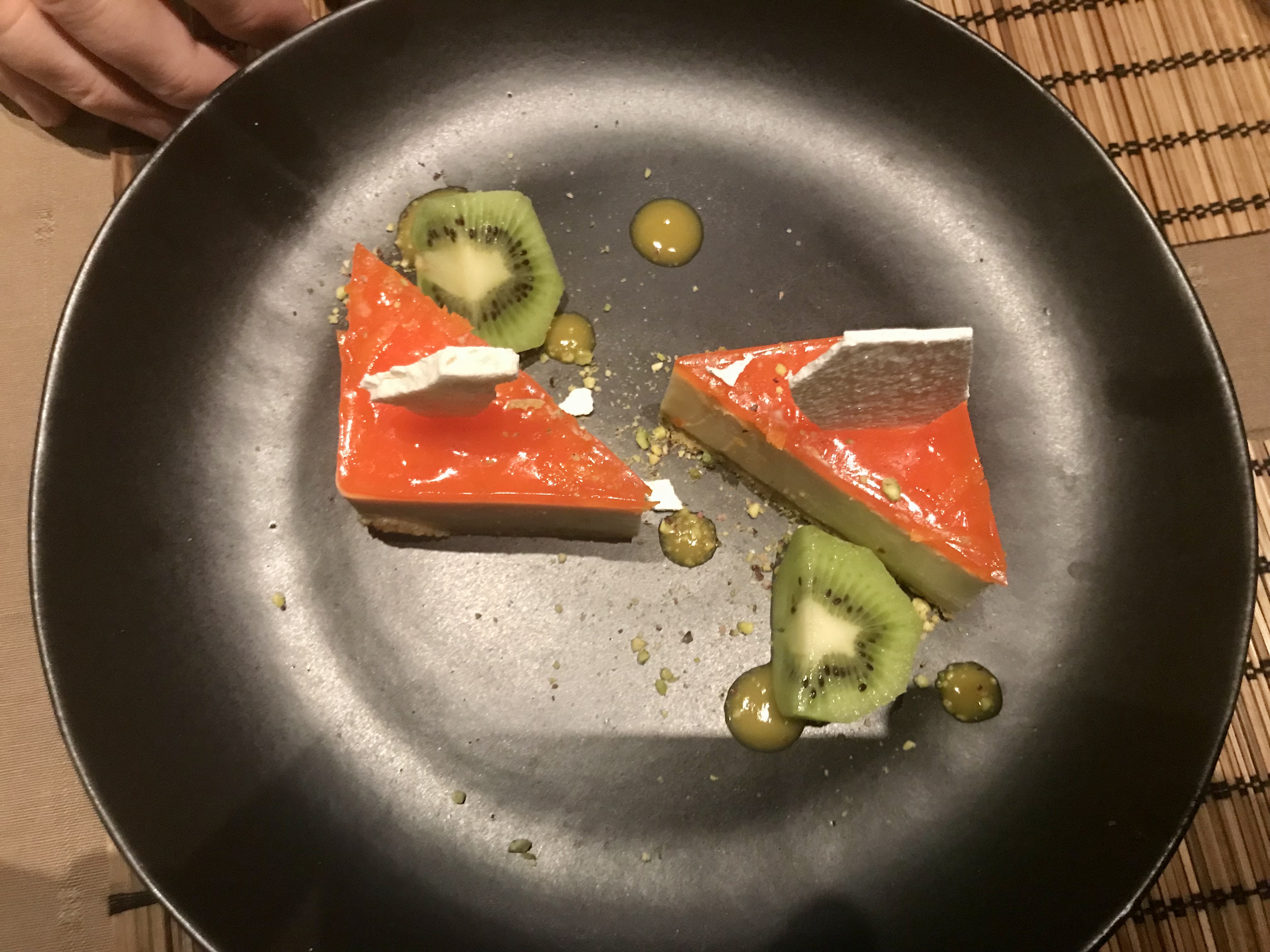
At about 9 pm we headed to dinner at Millenium Gourmet – just a few blocks from the hotel, on the second floor, and on a major walking street. Of course by then it was drizzling (and by the time we left it was pouring!) Dinner was quite wonderful, starting with a veal tartare, followed by a scampi dish, followed by a lamb dish with pumpkin and spicy pineapple – and of course we couldn’t leave without desert – an orange cheesecake. Walked back to the hotel in the rain and finished reading term papers.
Lots to tell about Monday (today), but will try to catch up tomorrow… I have to post grades and tweak my presentation to the city for tomorrow. Hope I remember all the parts of today, since it was chock full.
All the best –
Fern
PS – Am keeping up with the nonsense of the US since we get CNN at the hotel. But would love to totally disconnect as it seems to get weirder by the minute.
PPS — For those that asked. Julia’s baby was born three days ago. Mom and Dad and baby are doing well. The name is Louis (but they are French-speaking, so more like “Louis as in Louis the XV” – Louie..)

