Last Day in Bagan — And.. Last Day of 2016. 12/31/2016
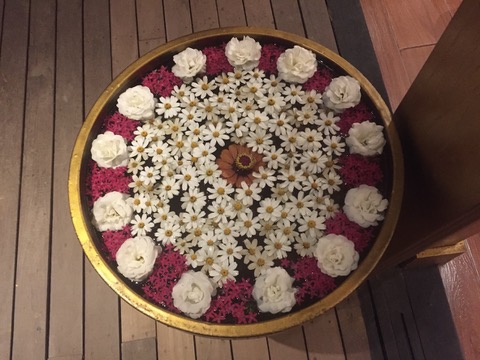

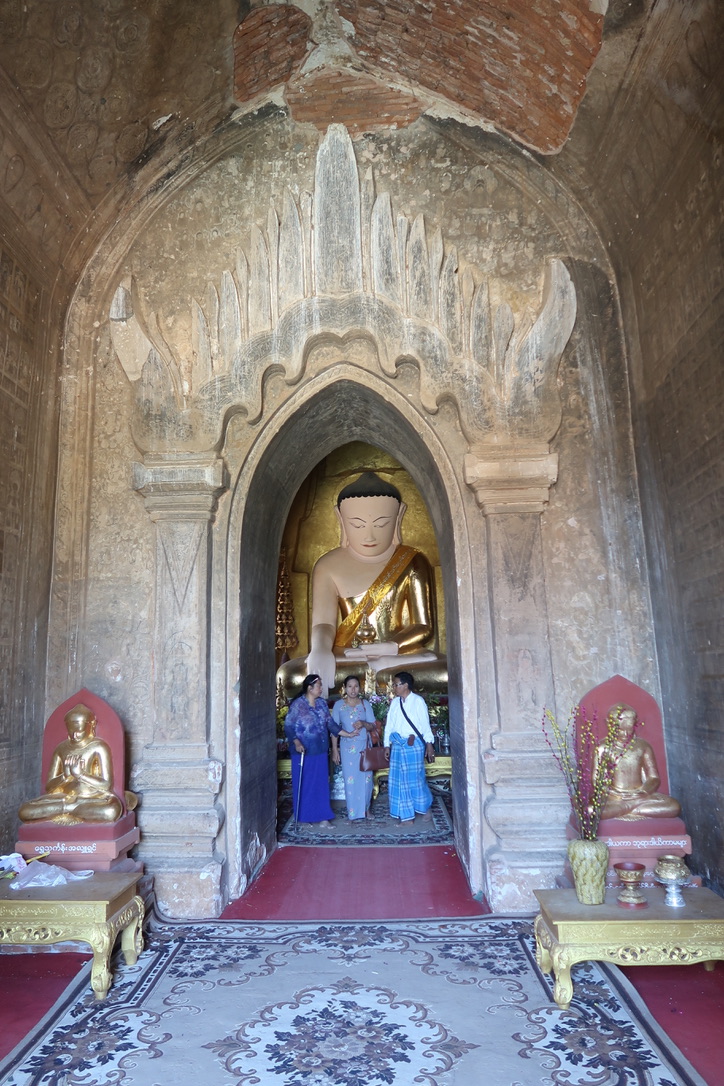
Set out this morning for the main market in Nyaung U (Bagan has three distinct areas — New Bagan (which isn’t very new), Old Bagan (which is where we are staying), and Nyaung U.. Nyaung U is the administrative center of Bagan and where the airport is located, as well as a lot of hustle and bustle. Frankly, the three areas blend seamlessly into one another and I’m not certain I could say what makes each different. We thought Old Bagan would have all the pagodas and temples but the temples are everywhere… You stumble on them as you drive or walk; they are situated far from the roads and also right on the road (sometimes without any demarcation); they are large and they are small. Some are considered very “important” and others less so. We stuck mostly to the “less important” ones since they didn’t have any crowds, no buses, no one there… just us. And we favored the less adorned ones – all brick and covered with cement or gild.


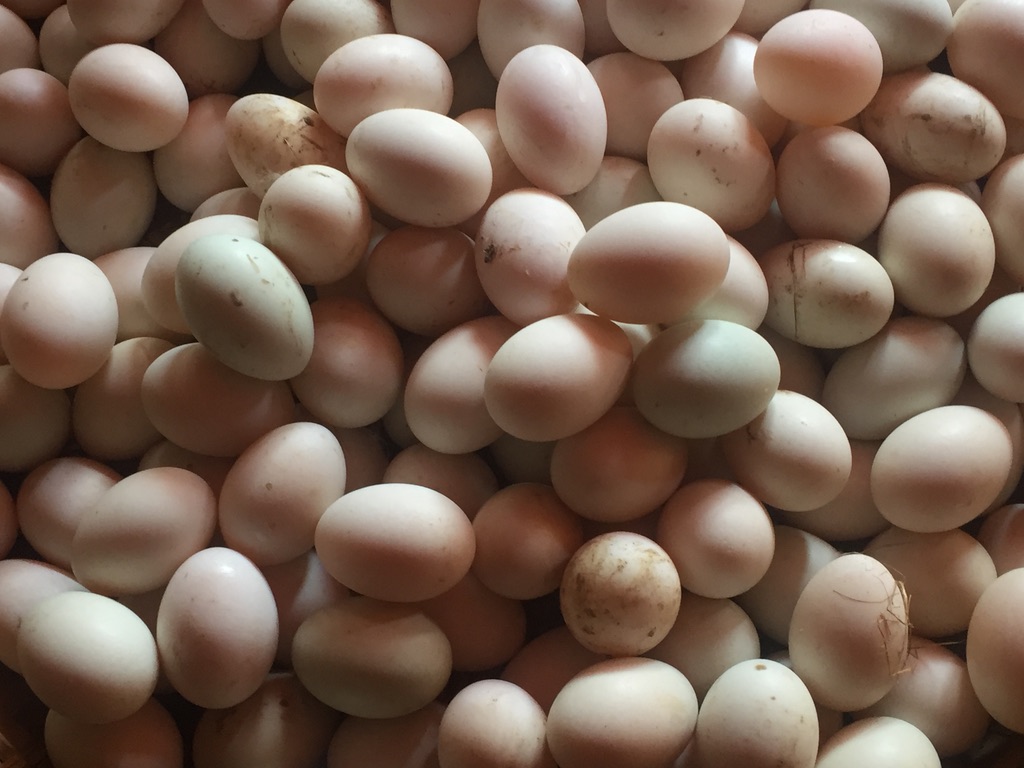
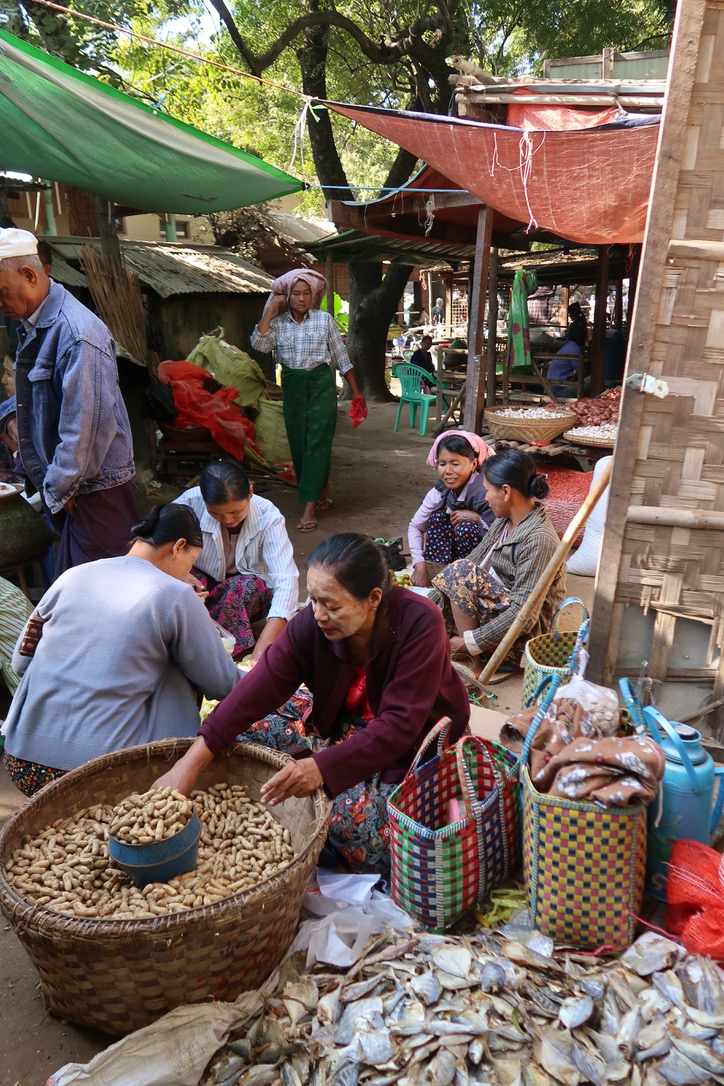
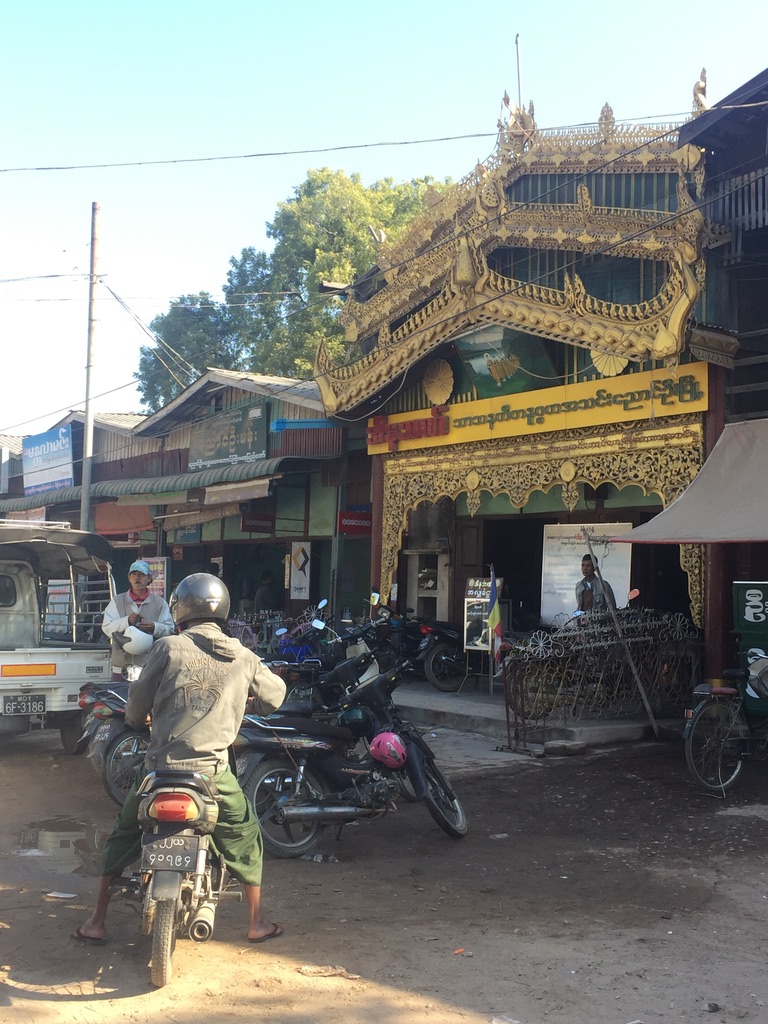
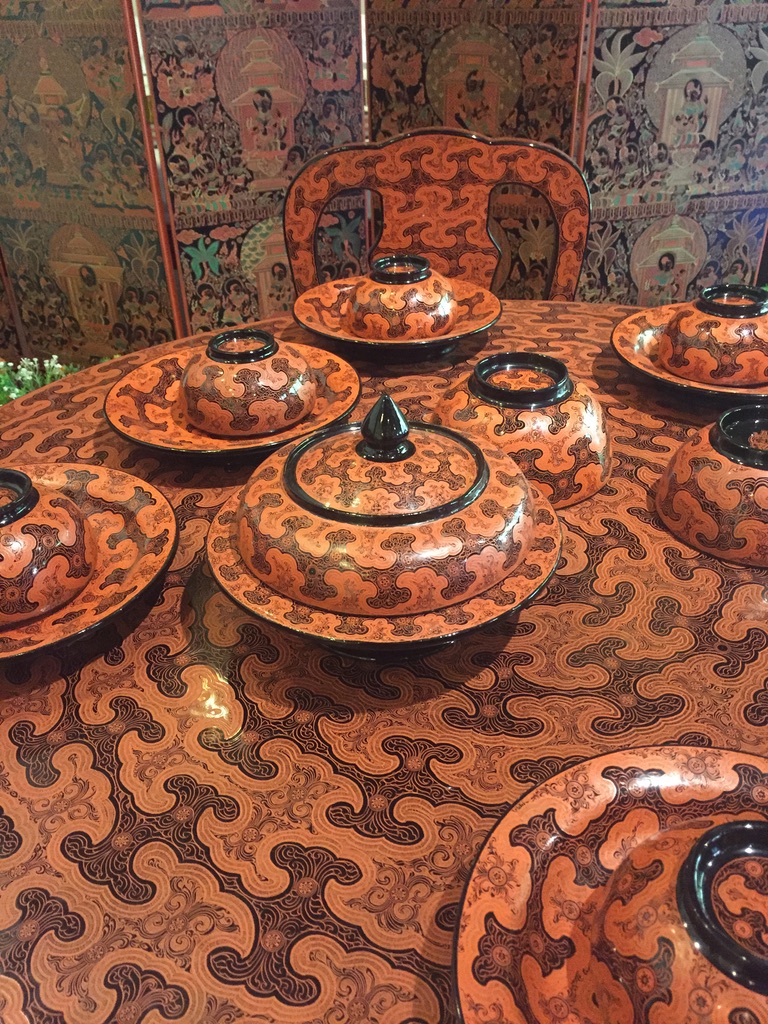
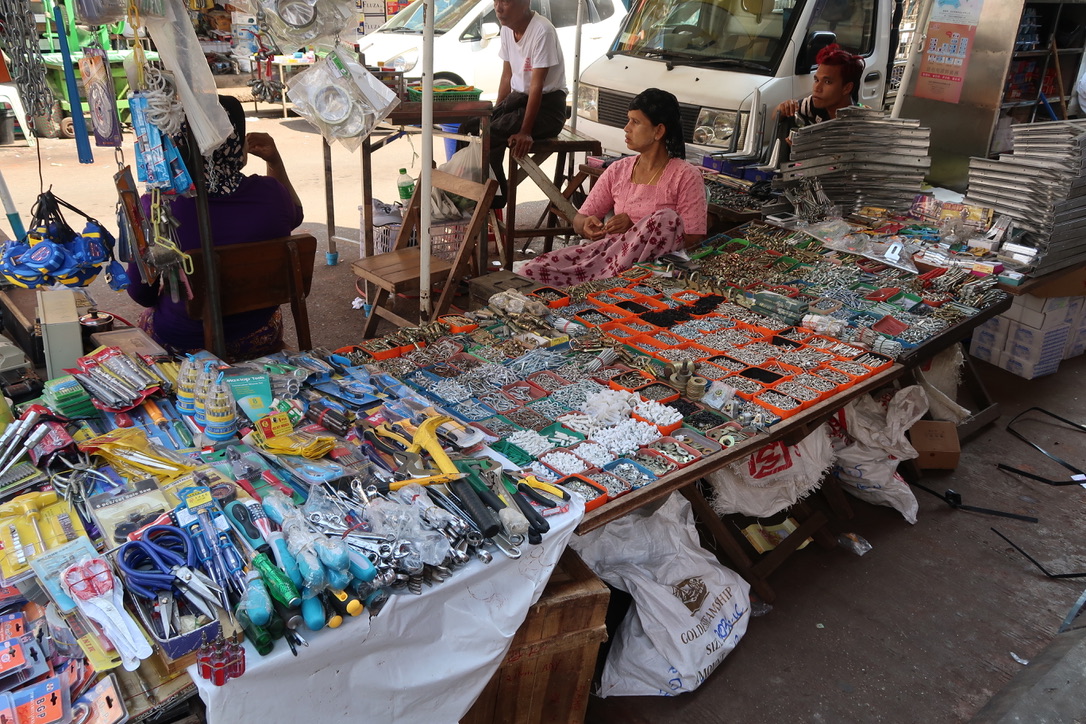
Anyway, the market was right up there with the best of them. Huge, sprawling, teeny stalls – some with tent like covering; others completely open, vendors all sitting cross-legged on the floor. People shopping for every conceivable kind of food and going about their daily chores. Some tourists (all with iPhones snapping away). Lots of vendors selling textiles, longyis, lacquerware… but the majority of the market is fruits, vegetables, flowers, spices, meat, fish. And of course there are little places to sit on tiny stools to have noodles or other fare. (We are trying to stay away from street food, but not totally successful, in an effort to stay clear of stomach issues now and when we return. We are however eating freely at tiny “restaurants” which are probably on par with the street food guys.)
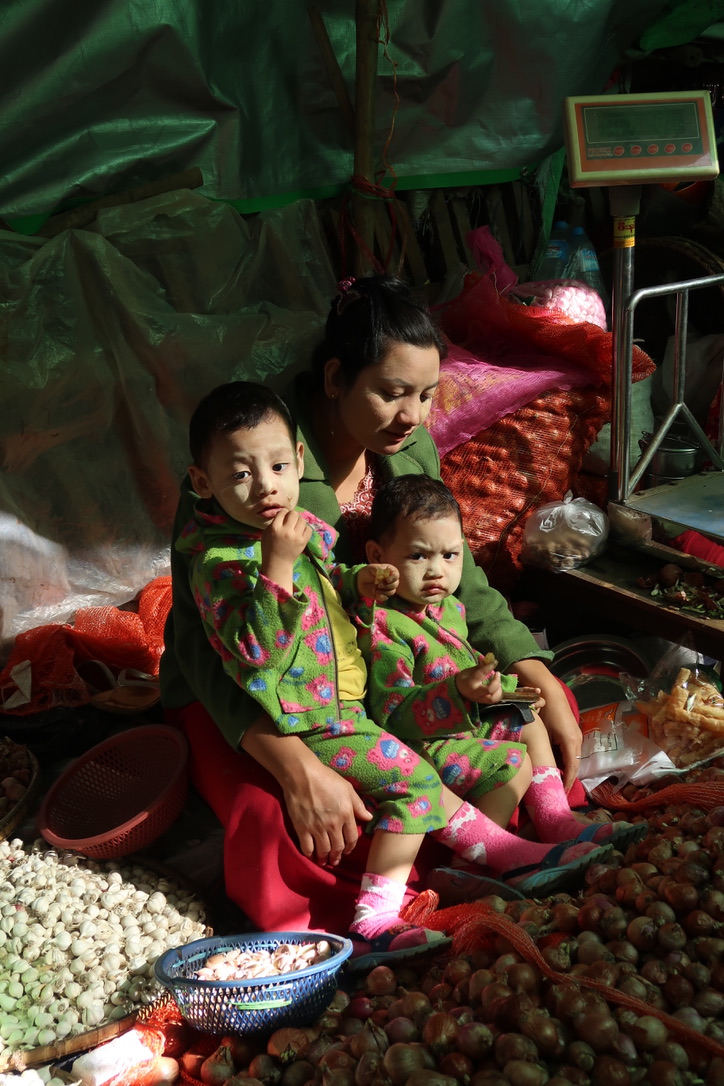
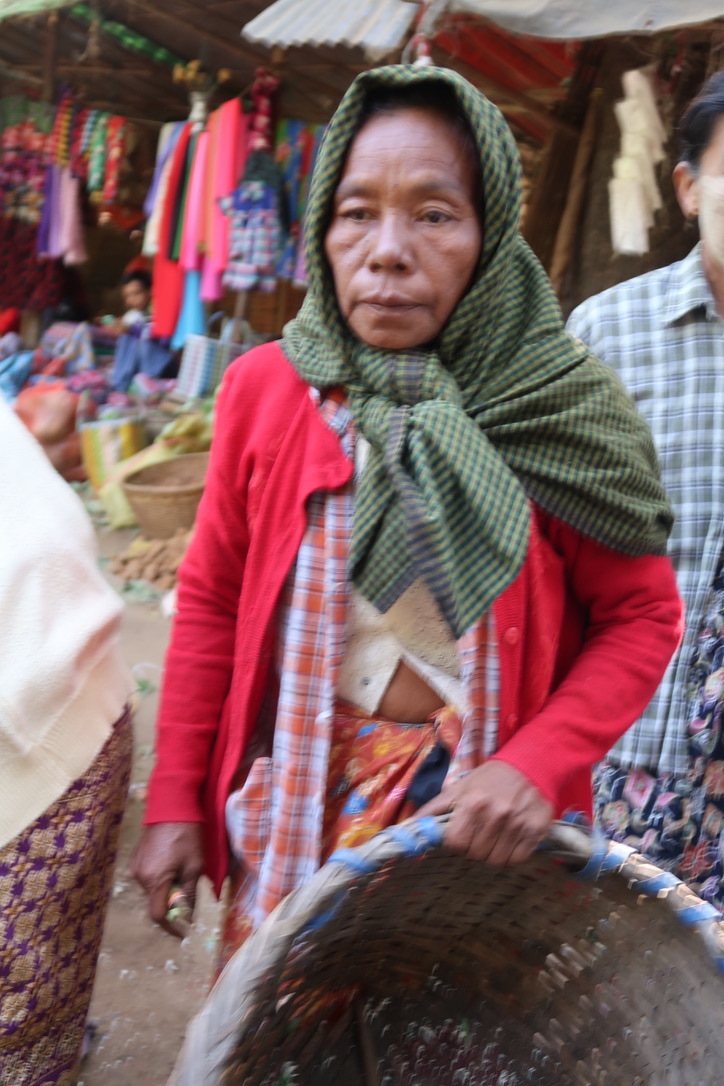


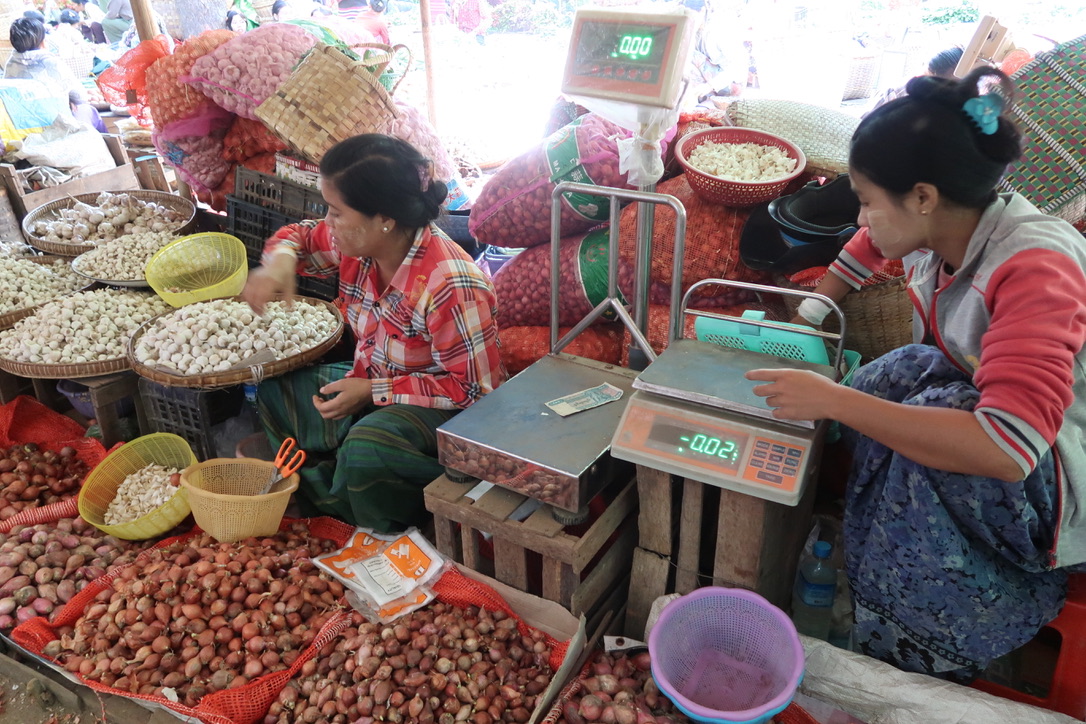
We bought a few small items to bring home, and then headed for more pagodas. Whenever we pay for a purchase they say “Lucky money, lucky money” and then take the bills (kyat) and dust them over all the goods in their little stall, repeating over and again “Lucky money.” I always thought this was done with the money from the first sale of the day… so perhaps in each occasion we were the first sale. Or maybe they just want extra luck for their sales for the day. My grandfather (who immigrated from Romania in the early years of the 20th Century, had a small men’s clothing store in Brooklyn. He, too, as a shopkeeper, was superstitious. Toward the end of each day he would “close out” the register and bundle up the cash from sales, and then sales after that time were considered as sales for the following day. In this way, he always started out the day with a sale already completed. And he had a cash register that kept a running total of his sales, but he kept that covered up with tape – believing that if you watched the totals it would bring bad luck. Different cultures, different customs — same end point.

We were planning to have lunch at a restaurant called Xanadu, but as we drove up to this very high end hotel, we realized that the new (2005) very controversial “tower” (200’) sits right at the edge of, or maybe on, the hotel property. The tower was built by the former military government as they considered increasing and attracting tourists. But it sits amid many sacred temples. It was intended to give visiting dignitaries and well-heeled tourists spectacular views of the temples and all of Bagan. It was commissioned by a Burmese tycoon. Preservationists (and environmentalists) were outraged from the start, but locals could not voice opposition. Some say that because of this tower (and also some shoddy reconstruction work on damaged temples), Bagan will not achieve its much desired UNESCO World Heritage status, but from what we’ve read, it seems as though, despite UNESCO’s harsh words about the tower, the status will be forthcoming soon. Anyway, once we realized the hotel and the tower were connected (or so we think), we decided to have the taxi turn around and we ate lunch elsewhere (excellent Shan noodles with chicken and lots of accompaniments).
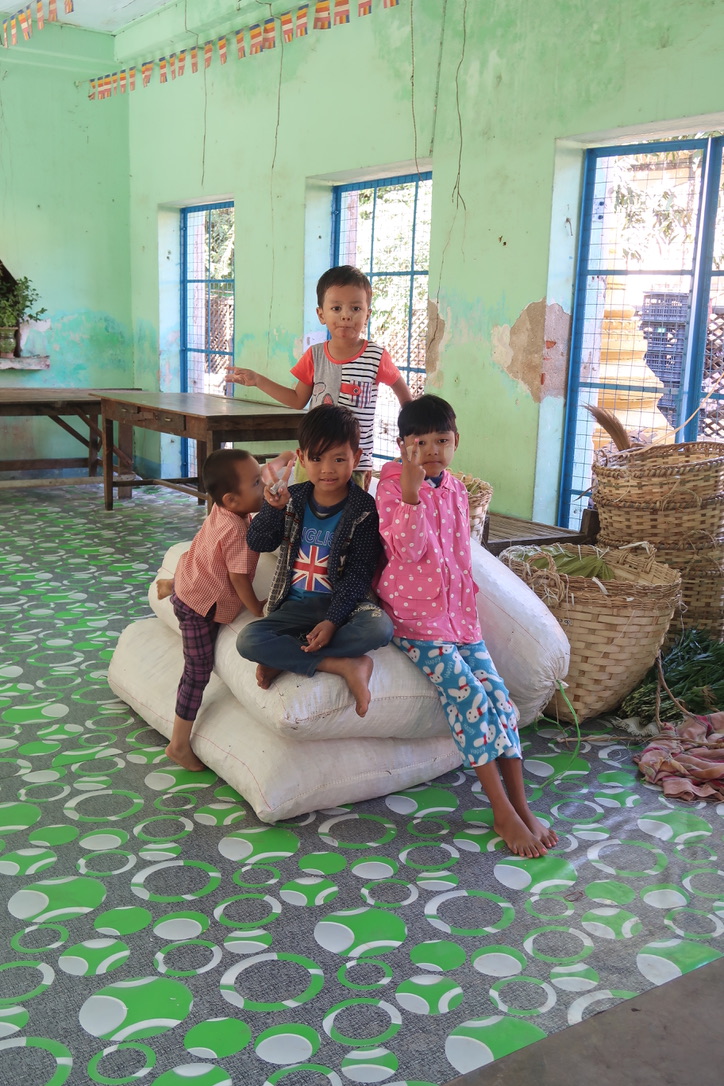
Once again, the majority of tourists appear to be from Germany, France, Spain, Thailand, Singapore, Japan with just a sprinkling of Americans. Kids and even vendors (and taxi drivers) use their very very limited English to ask where we are from. They are surprised when we say “US” to which they always reply “America.” Then if they have a few more words, they always say “Obama” with thumbs up. They also tell you that Obama came to Myanmar (although sometimes in convoluted ways). They also say Trump with thumbs down.

While we have clearly seen a lot and are making some judgements as to what is going on in the country, it’s difficult to really understand the complexities of this place. Without language, we cannot engage in any real conversation, and even if we encountered Burmese people who spoke English well enough to have a conversation, I doubt they’d be open enough to truly say what they know and feel. One thing I will say, is that there is a minimal military presence, unlike Tibet where we encountered police and military (and even security checkpoints) at every turn. As you know, Myanmar was under the rule of an oppressive military junta from 1962 to 2011. The generals suppressed all dissent which was symbolized by the house arrest of Aung San Suu Kyi. The country was condemned by international organizations. A gradual liberalization has been under way over the past six years and the government changed hands earlier this year. There has also been long running rebellions between the dominant ethnic group and the country’s small minority groups.
Htin Kyaw was sworn in as president in March, and this is the first democratically elected government after so many years of military control. The position belonged to Nobel Laureate Aung San Suu Kyi, who has been associated with the pro-democracy movement and who spent decades under house arrest while she led a nonviolent campaign to unseat the military leaders. But she was barred from becoming President, and the new president is supposedly her proxy. Kyaw is the first civilian elected president. Despite all of this, I’m sure the military wields a great deal of power. Still, young people tell us that whatever English they speak they have learned from American movies – with Rambo and Transformers being the ones mentioned over and again! They also watch international news on television and the Internet (which is not blocked, and those with smart phones have access to YouTube and other social media). The country is highly literate (90%) and education (although poorly funded) is compulsory, beginning at age 5. One taxi driver told us that schooling is mandatory through age 18 and that English is now taught beginning at age 5 (but it is mostly reading and not speaking).
We will have New Year’s Eve dinner at the hotel (as there is a “compulsory” charge for the dinner, so we might as well take advantage of it). Not my favorite way to spend New Year’s. I’m sure that there will be staged performances, and probably a buffet. I’ll report on that in the final missive tomorrow or the next day.. We are close to New Years here… and we leave Bagan tomorrow afternoon (fly to Yangon) We spend one night in Yangon (Sunday, January 1) and then have a marathon flying day on Monday (January 2).. We fly from Yangon to Narita (6.5 hours), then have an 8+ hour wait at the Narita Airport and then fly to Los Angeles (9 hours), go through customs and board a short flight to SFO. We are trying to switch to a direct flight to SFO, but even with all of my status thus far we have been unable to make the change. We’ll keep trying.
Happy New Year… We think we will be watching the ball drop as we pack at around 11:30 am here (it will already be January 1 here) – as ex-NYers this is a must!
Best- Let’s hope 2017 isn’t as bad as we are all predicting.
Fern
12/27/2016. Buddhas, Buddhas, and More Buddhas; Monks in Pink, Burgundy, Saffron, Brown
December 27. 6:30 pm. (California Time – 4:20 am)
Mingalaba (Hello). Greetings from Mandalay
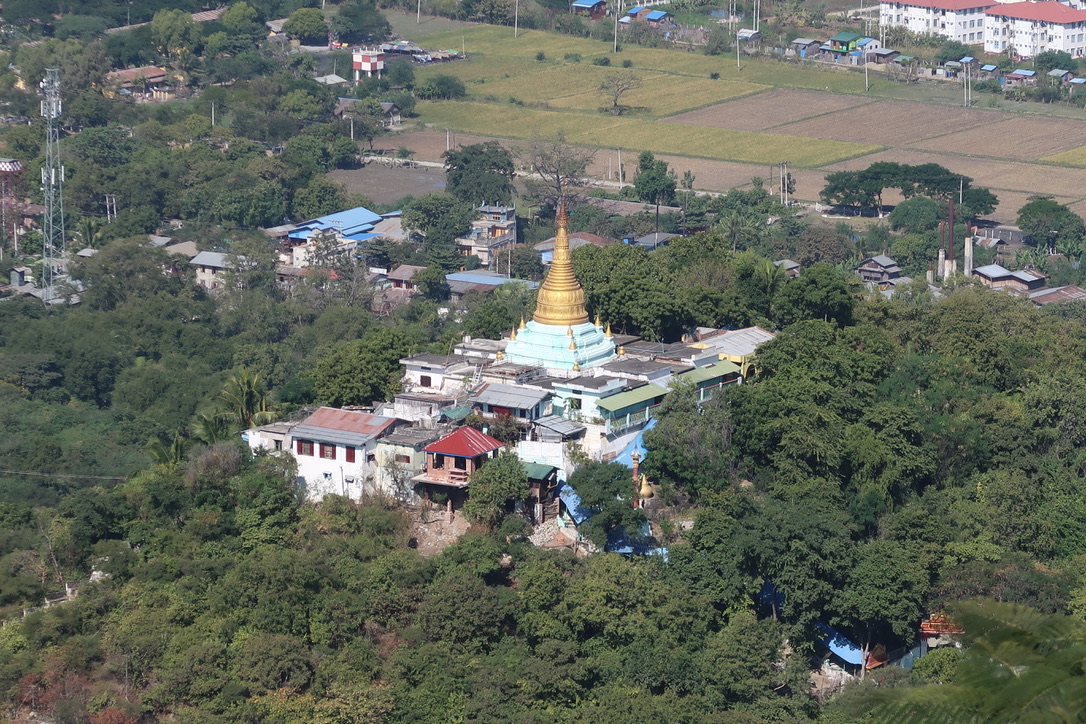
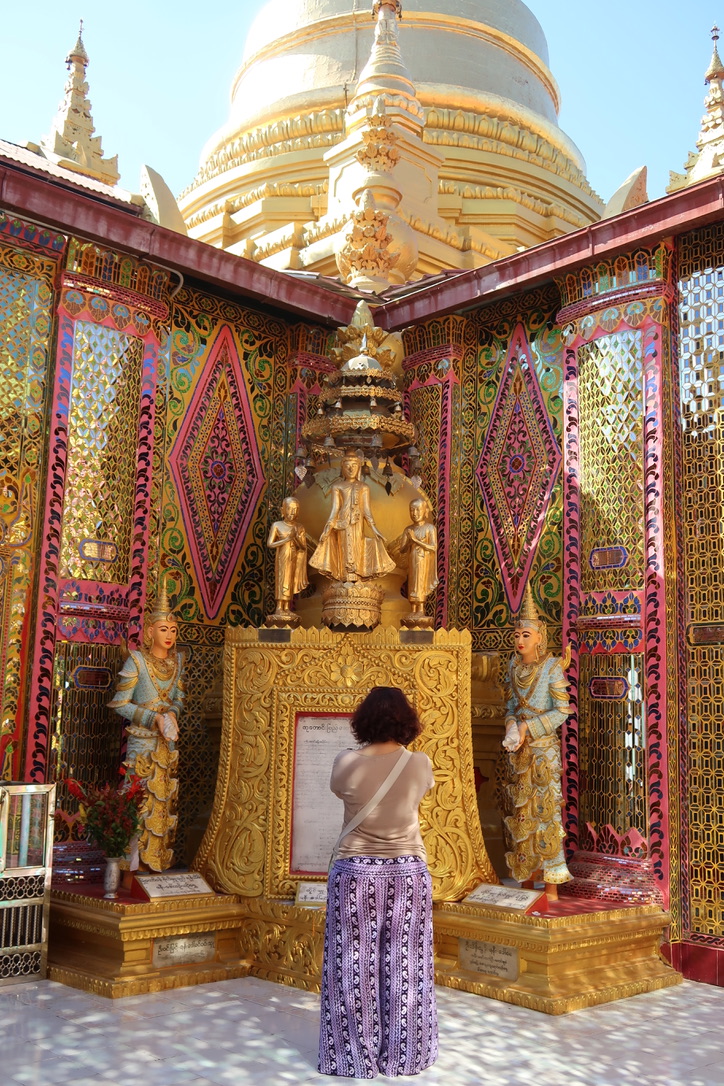
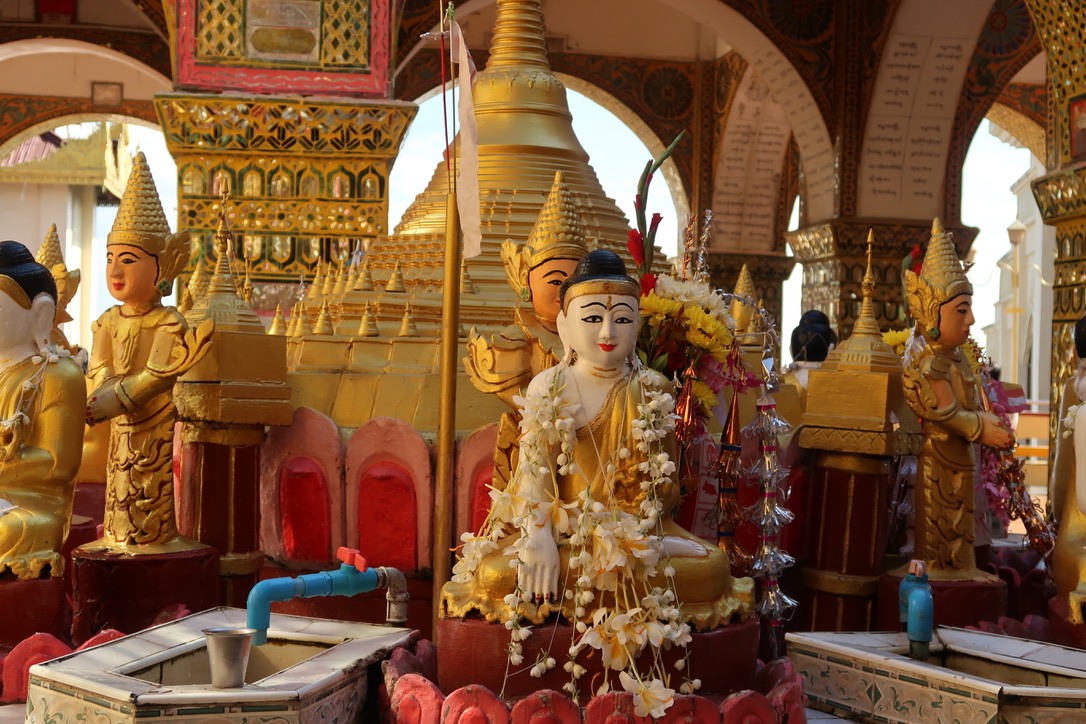
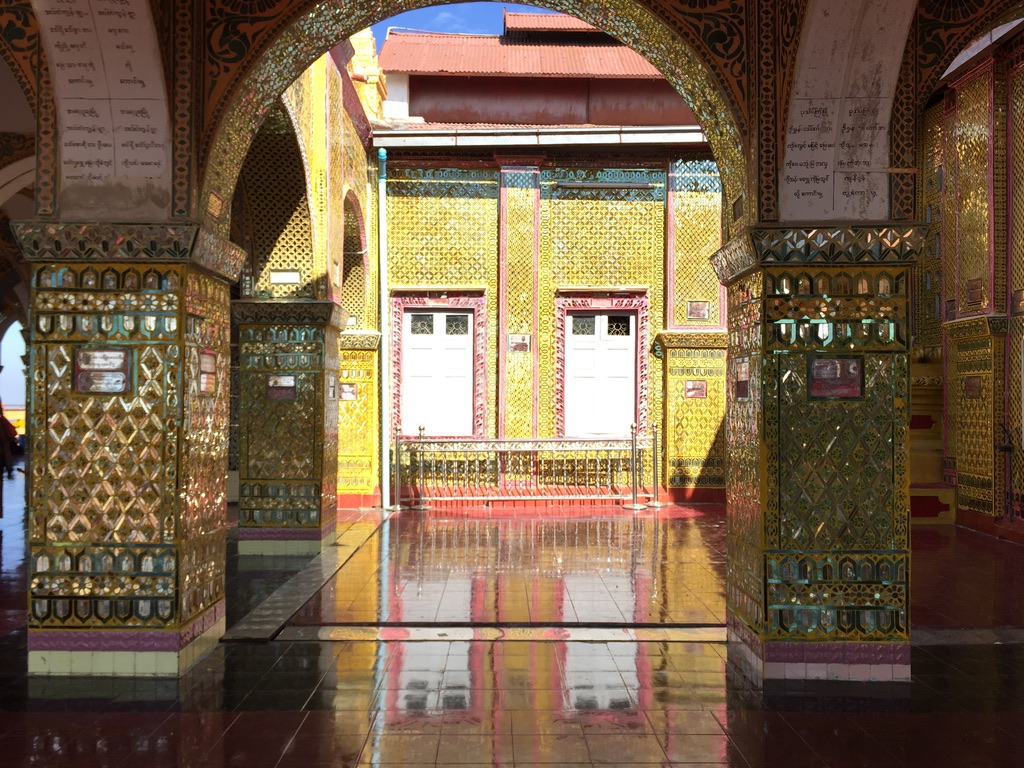
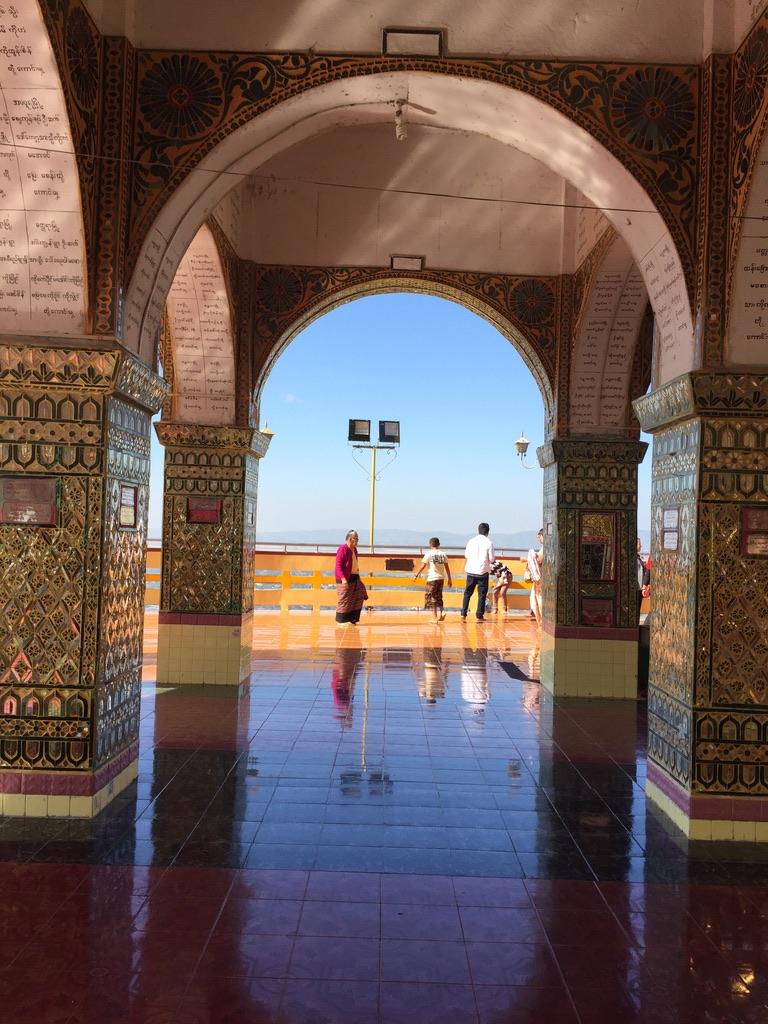
Set out this morning for Mandalay Hill, from which you can get spectacular views of Mandalay, see literally thousands of pagodas and monasteries dotting the city and countryside, and also visit the Sutaungpyei Pagoda. Apparently there are stairs that go up the 750 feet (like climbing a 70’ apartment building?), but frankly we never saw them and everyone was doing what we did – being dropped off at an entry point, coming by trucks and cars, and buses, and taxis… and then going on an escalator to get to the main landing. Anyway, once “inside” the Pagoda, you’re staggered by the plethora of statues and Buddhas and glitter and gold. Everywhere you look there are tiny pieces of reflective mirror set into columns and walls and floors and surrounding nearly all the statues. I suppose that each of the statues – small and large – tell another story, but alas I do not know any. We didn’t see any Americans at all for the entire time we’ve been in Mandalay, although there were tourists at the Pagoda (Taiwanese, Japanese, Chinese, and some Europeans).
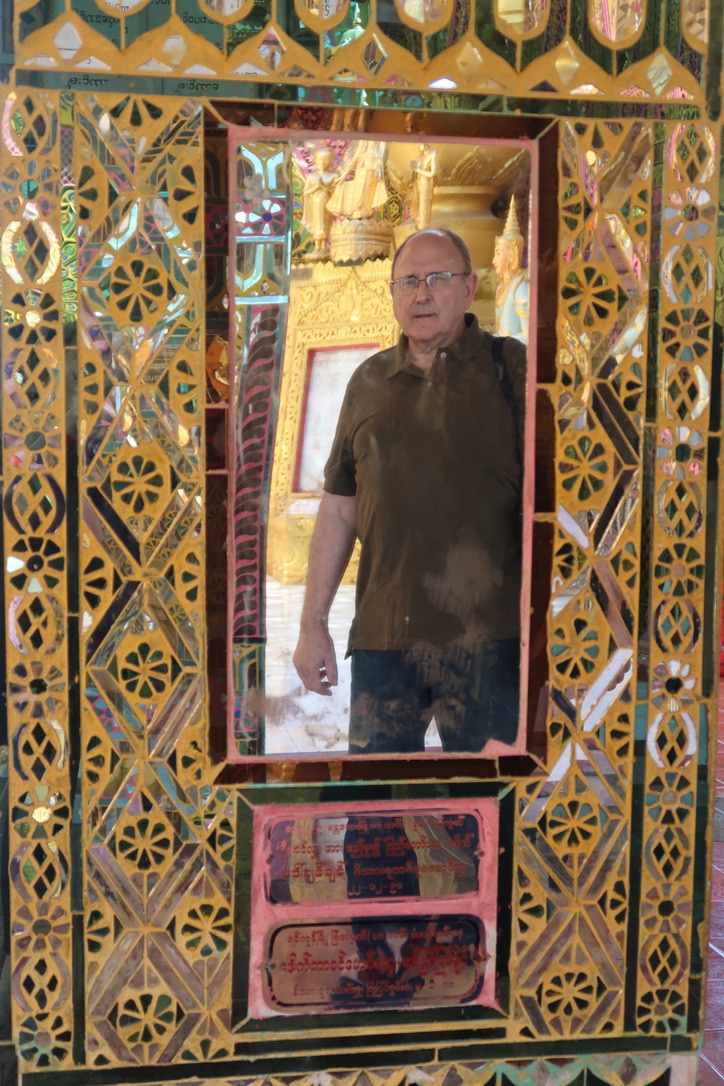
As with most of the pagodas and monasteries – although they are hundreds and thousands of years old, they seem to always be under some kind of construction, reconstruction, repair. For this one, we saw a crew of men (of course on the floor without any tools, breaking mirrored glass with their hands… into small pieces (we later realized to replace some tiny pieces that had fallen out and also to fix a section of a wall that had hundreds of these little mirrored pieces. They had no gloves, no knee pads… Nada! We walked around for about an hour or so (of course barefoot) and then started to head for the stairs, since it was our intention to walk to the bottom of the hill. Somehow we couldn’t find the stairs and realized that the first part of the stair walk was still considered within the pagoda boundaries so you’d have to walk barefoot. We quickly opted to find a taxi, which proved not possible.
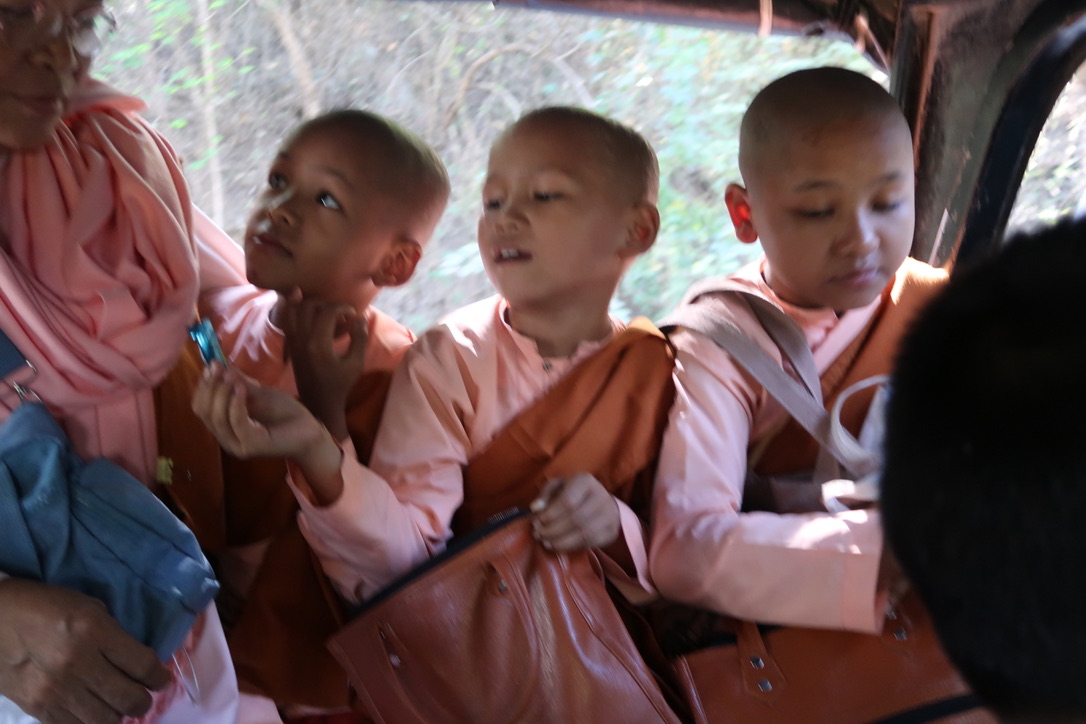
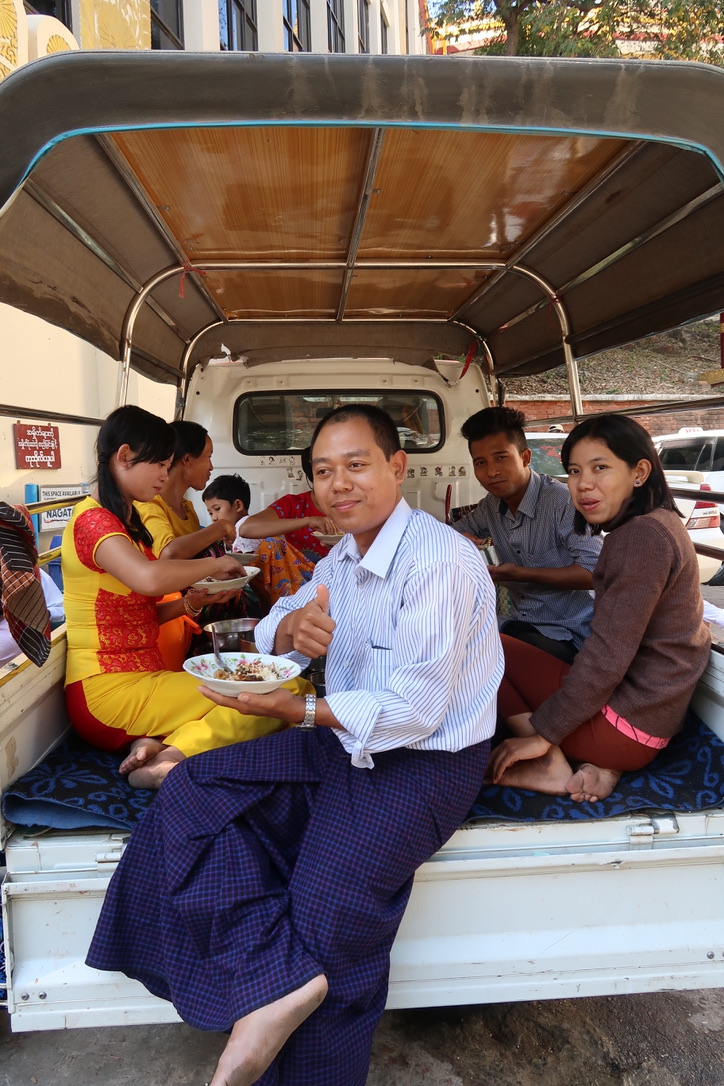
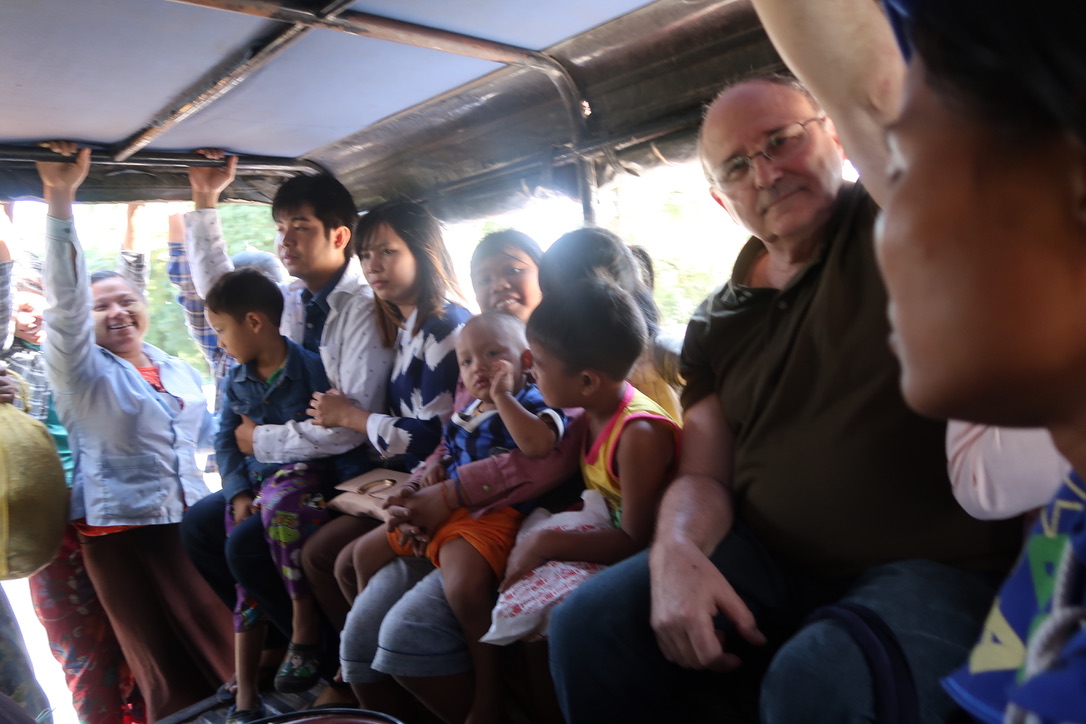
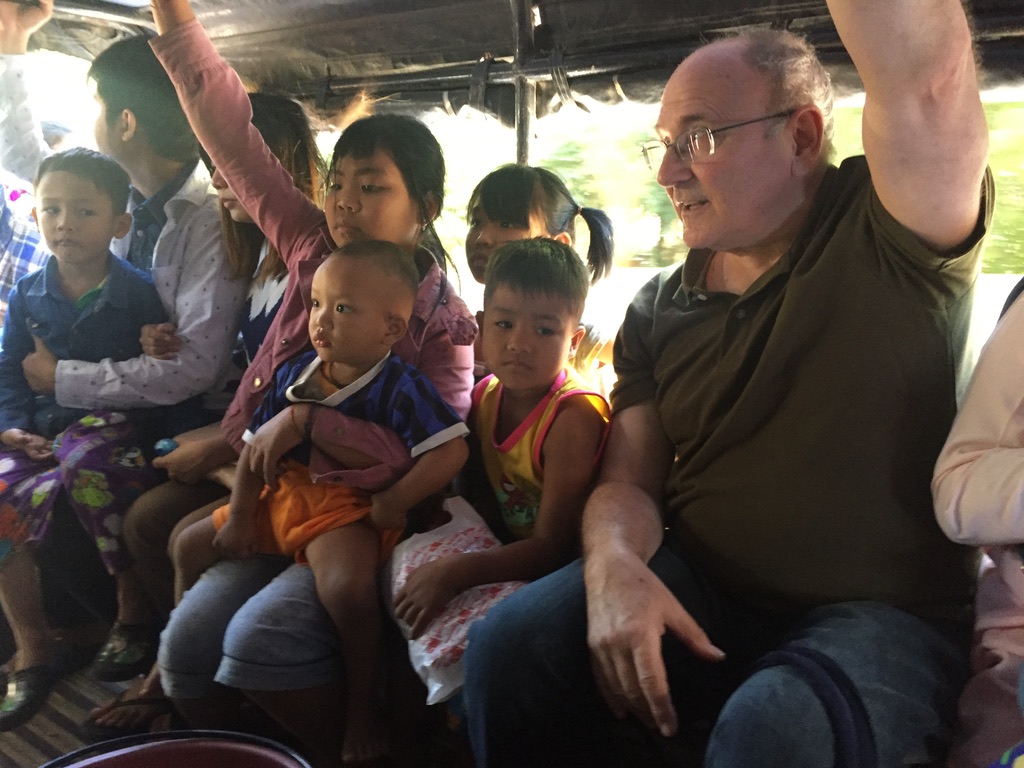
So we spotted a pickup truck outfitted with a metal canopy and housing two benches facing one another inside the truck. There were spaces on the benches, so we hopped on. The truck fit about 8 on each side and 5 people hanging off the back. There were also tiny plastic stools in the middle, between the benches. There was an assortment of passengers – all Burmese, except us – including a Buddhist nun who was caring for three small children – probably under the age of 5. I think the nuns care for orphans and these young children are raised in the monastery. Everyone was very friendly and thought it funny that we were on the truck (can’t imagine what they were saying, but they were laughing). The nun seemed to have lots of goodies with her, and gave us oranges and candy and then some toilet paper to use as a napkin.
The truck went about 35 mph down the steep dirt road with about 20 hairpin turns… Obviously no seat belts… We were all just holding onto the frame of the truck… and as we made the sharp turns we slid into one another. It was a little death defying – made the tuk tuk seem safe and peaceful. Of course, I felt safe because the nun made a prayer before the truck started to go – although I think she was blessing and praying for the children.

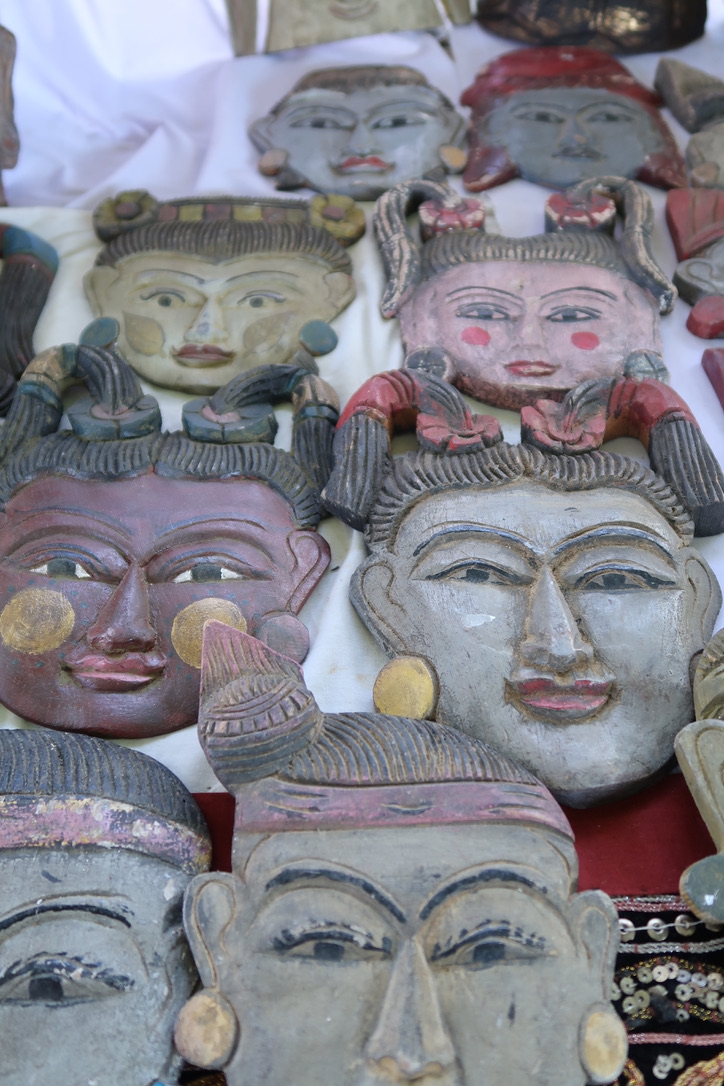
From there we headed to the teak monastery, Shwenandow… with amazing carvings throughout…. As with all the temples, the streets and paths leading to and those around the temple are filled with little makeshift vending stands. We purchased a marionette. Burma is famous for its puppets, and we purchased an old one rather than one crafted recently.
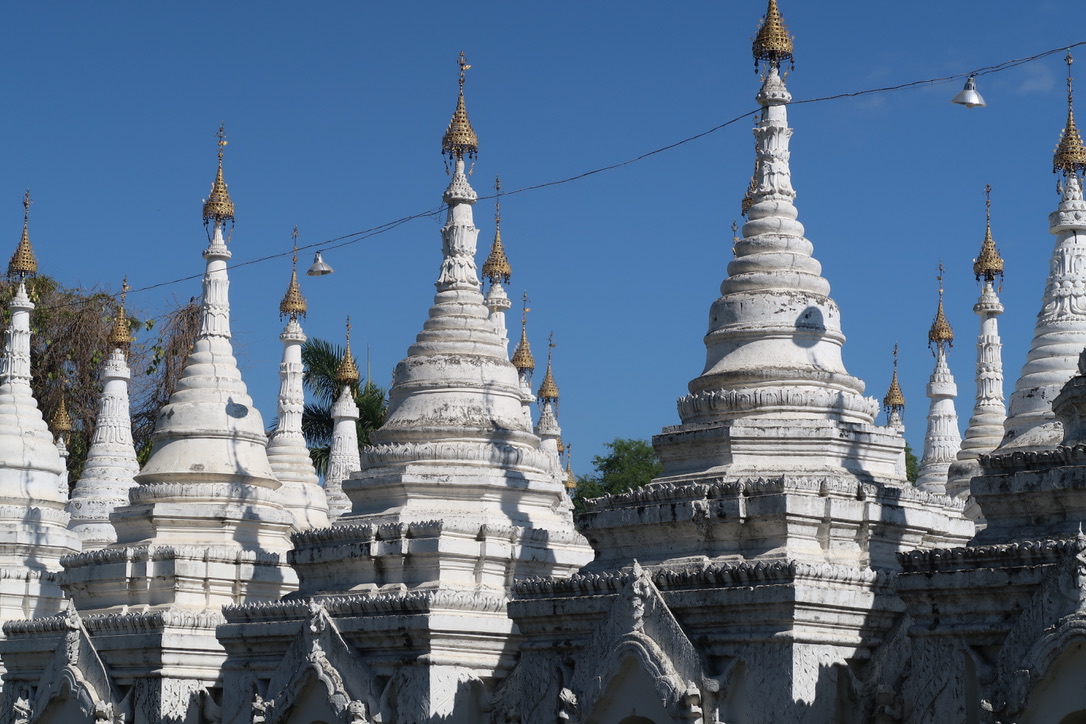
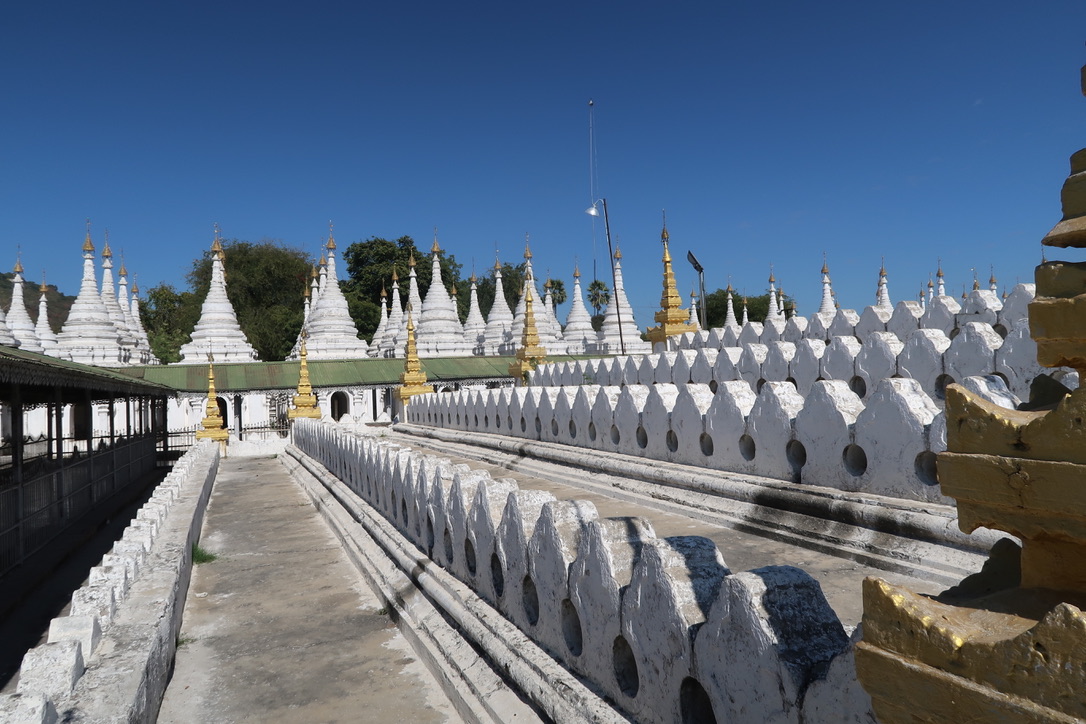
Then we stopped to visit yet another temple — Sandamuni Paya (I think) — this one with 1,774 marble slabs inscribed with important Buddhist text. Some people refer to this temple as “The World’s Largest Book.’ And then we headed to lunch (at the restaurant we wanted to go to last night, but was closed when we got there). We had the traditional Burmese meal, which consists of your selected main courses (we picked a chicken curry, dried beef, and fish cakes; but the meal also includes sour soup, and about 8 different small dishes that might be considered condiments, but which are eaten as separate side dishes – one was fired crickets, we think; others included eggplant, some vegetables, etc. OK.. so we are not giving Burmese food a big five-star rating, and I think after having had their local dishes a few times now, we’ll go back to Indian food while here.
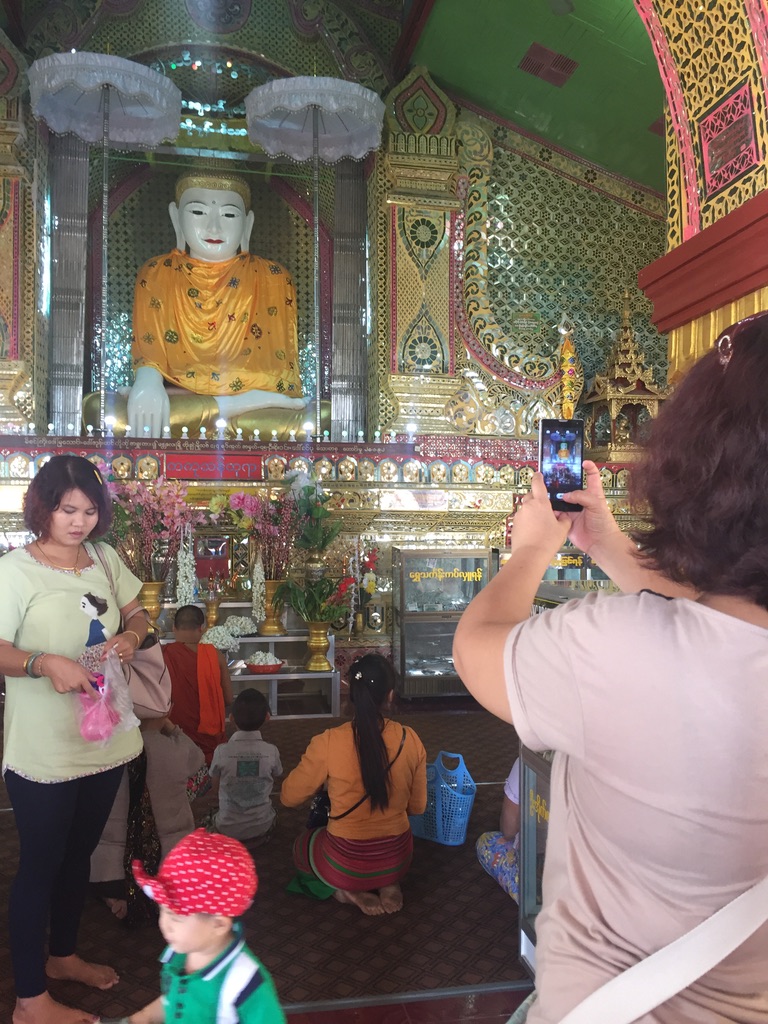
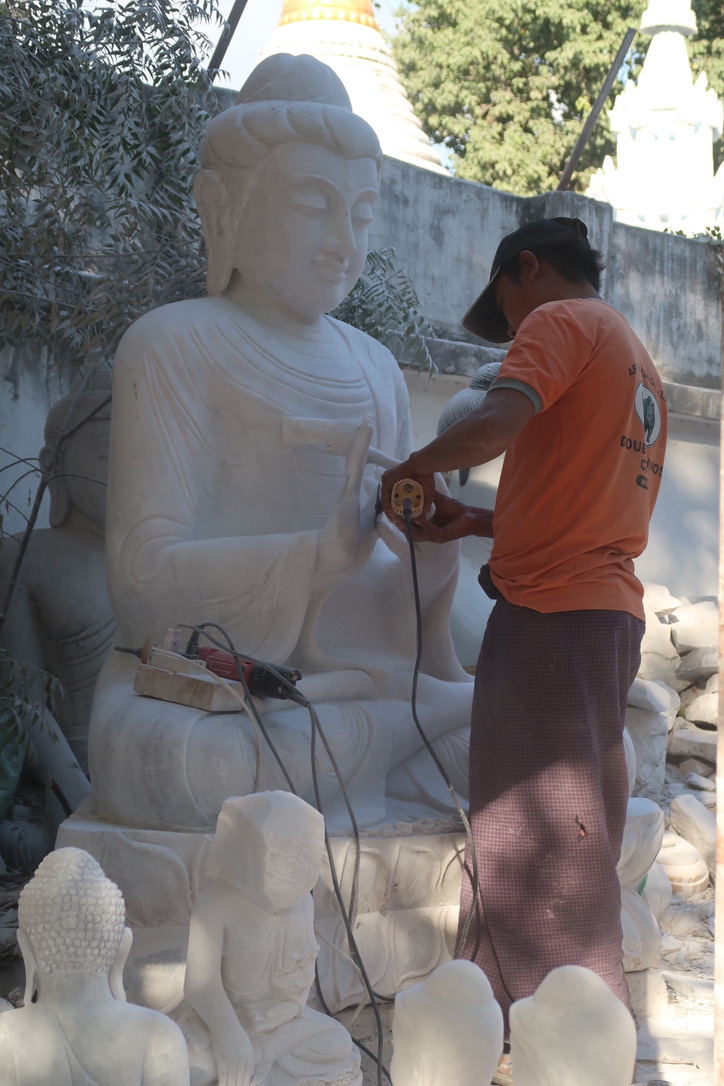

Then we headed to the area in town where they actually carve the Buddhas that wind up in temples and everywhere else. It was a bit odd to see dozens and dozens of half-finished Buddhas – some with totally finished bodies and detail, but a cube shape for the head! They were also carving teak columns and other small pieces. We strolled that area for a while. Seems as if labor is divided by gender.. with men doing the carving and women doing the “polishing” of the marble and limestone. And the teak carvers are all men, who have an interesting style – sitting cross legged on the floor and using their legs as braces for the wood as they do the carving.
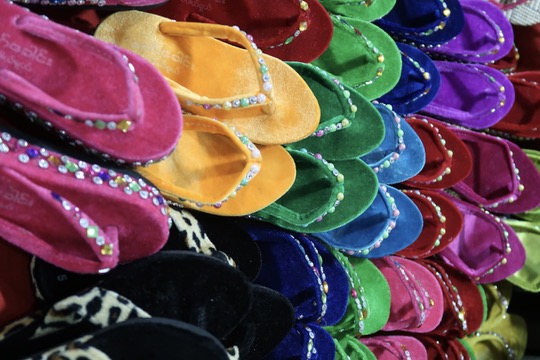
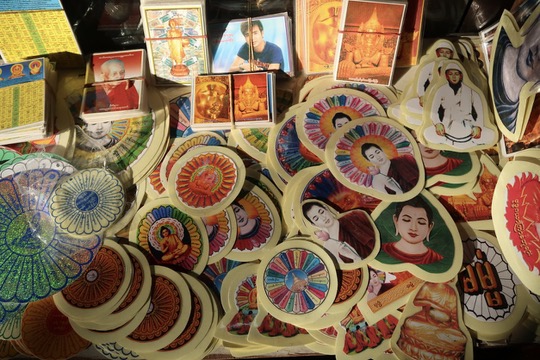
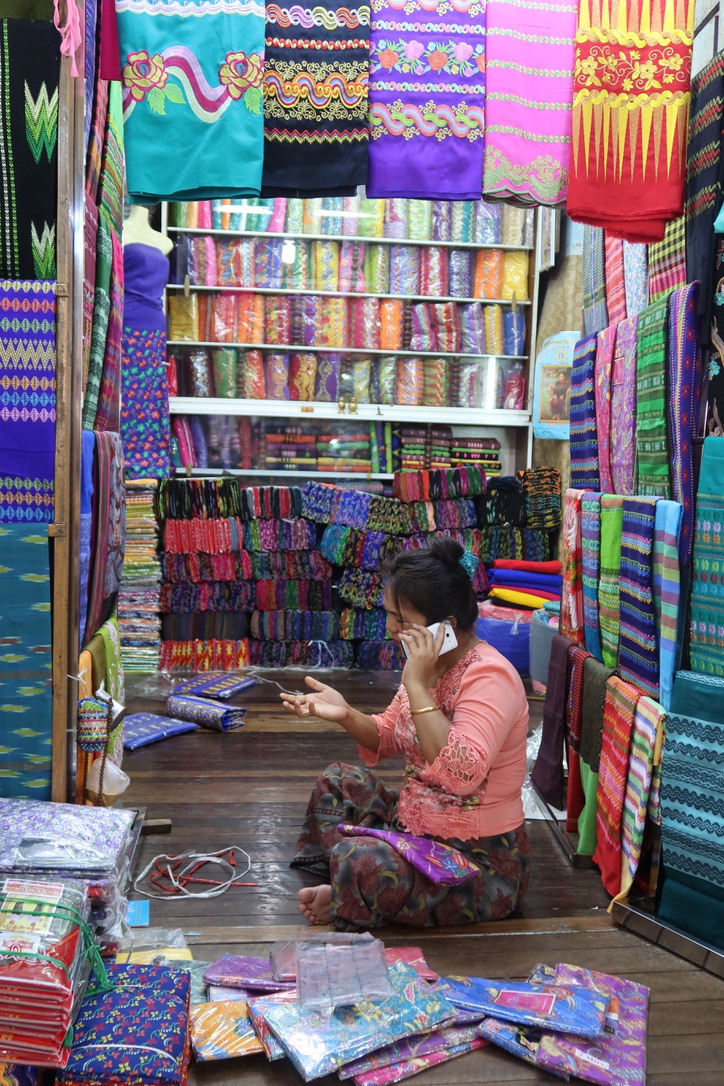
Strolled from there to yet another temple which literally has a huge “mall” with hundreds of vendors in a mall-like set up “inside” the sacred grounds. We needed to take our shoes off to walk the line of shops. Then, enough with temples – we headed to the Chinese Market – a group of about 20 streets within the city grid where Chinese-Burmese vendors sell every imaginable kind of food, including some ingredients that are not found in other Burmese markets. Had a lot of fun watching the vendors cook and make sales. Lots of young, somewhat upscale shoppers coming on motorcycles.
Then we needed to find a taxi, which the hotel kept telling us was very very difficult (and they recommend that you have the taxi driver wait for you and then you are guaranteed a driver and also a safe car). Well we’ve had no problem finding taxis, but this area was a bit chaotic. We saw a parked taxi with a little kid sitting inside (and figured that the parent who must be the driver couldn’t be too far away). As soon as we approached the driver came to the car (he was the grandfather), and off we went to the hotel – with the toddler (probably 3 or 4 years old) coming along for the ride!. I guess that brings up another point. All cars have seat belts but no one uses them. The toddler was standing on the seat for most of the drive. Speaking of driving, they drive US style on the right hand side of the road, but the cars are all British style. I think this is because they get their cars in Thailand.
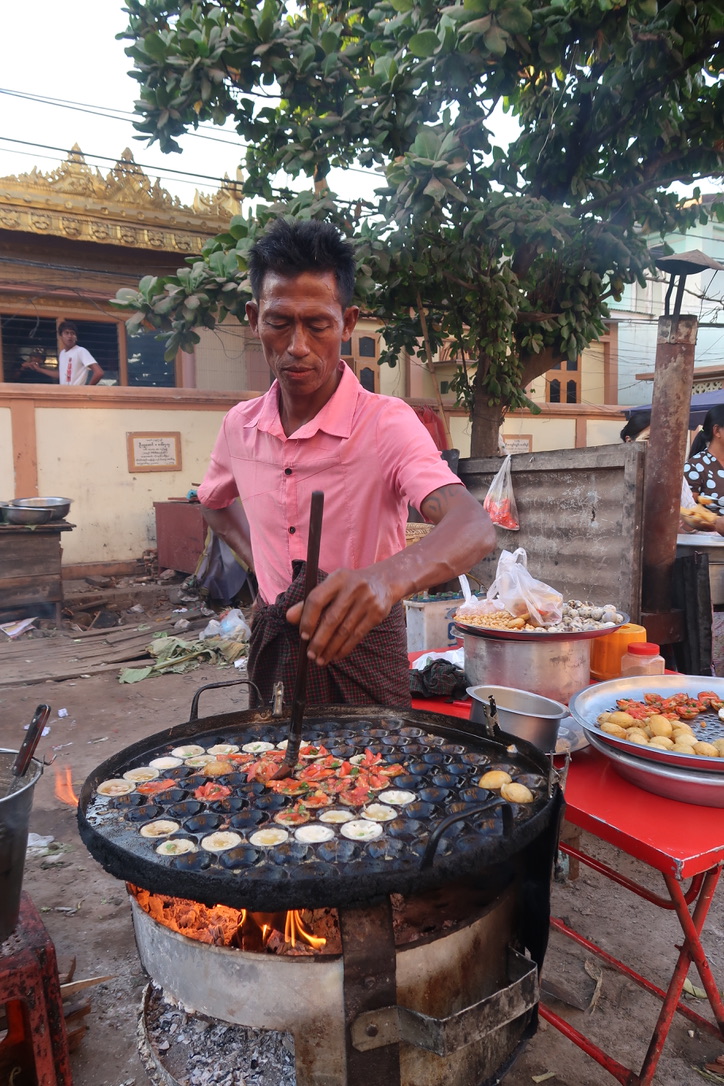


After a brief stop at the hotel – just long enough to get a gin and tonic – we headed for dinner at a restaurant we had read about called “Smart Garden.” The Burmese use English words for a lot of restaurants.. Names like Happy, Taste, Feeling, etc… Anyway, Smart Garden is situated on a large lake about 20 kilometers outside of town.. so the taxi ride was about 35 minutes. We knew that the restaurant had about a dozen little huts that jut out onto the lake and had hoped to be seated in one of them. When we arrived there was a lot of flurry, because absolutely no one speaks English. Anyway they did offer us one of the huts, but we wound up at a table on the “grass” because you had to sit on the floor cross-legged in the hut with the low table… and Mike felt he’d never be able to get up from the floor. Food was actually good; obviously very very cheap. We had a beef dish, a noodle dish, and a great crab dish, and rice, as well as two large beers – for about $15.00. Lots of dogs and cats lingering around for the food that falls on the ground, I suppose.
OK… that’s it for today.
Tomorrow we head to U Bein Bridge, and then I’m not sure (Actually, planning an easy day as I want to get some work done in the afternoon and early evening – we leave Mandalay (by boat) very very early on Thursday for Bagan.
All the best –
Fern
12.24.2016 Christmas, Hanukkah, Buddhist Temples, and White Privilege.
Yangon, Myanmar. Happy Hanukkah, Merry Christmas, Happy Holidays
I’ll try to condense a very long day into a short write up…
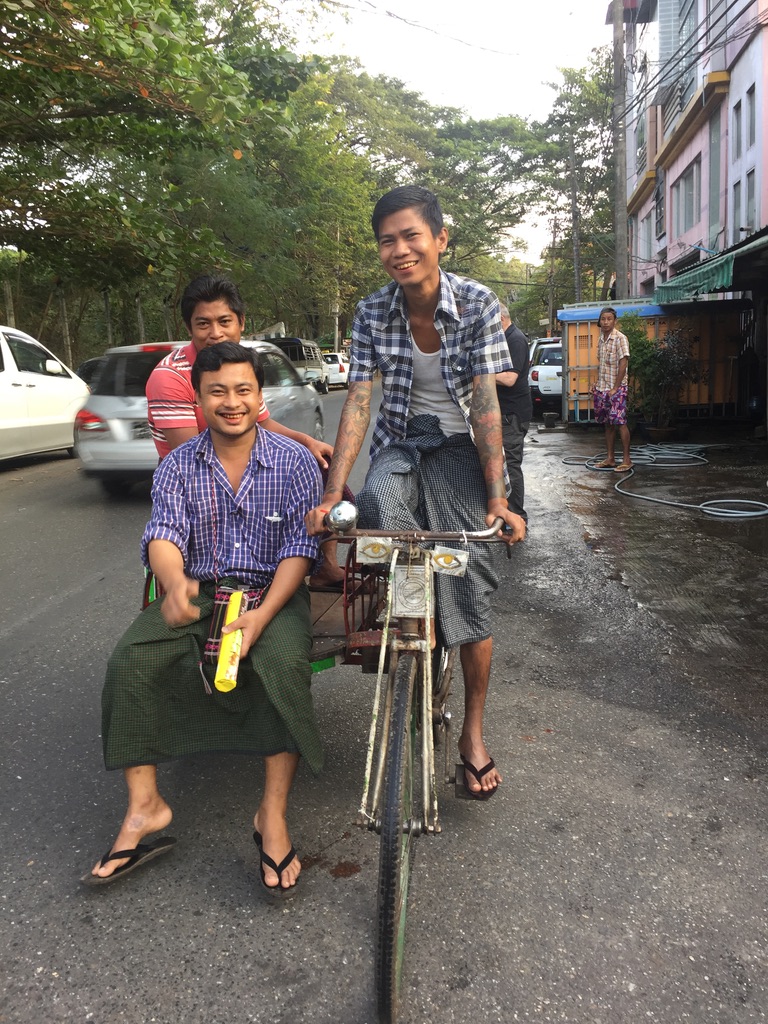
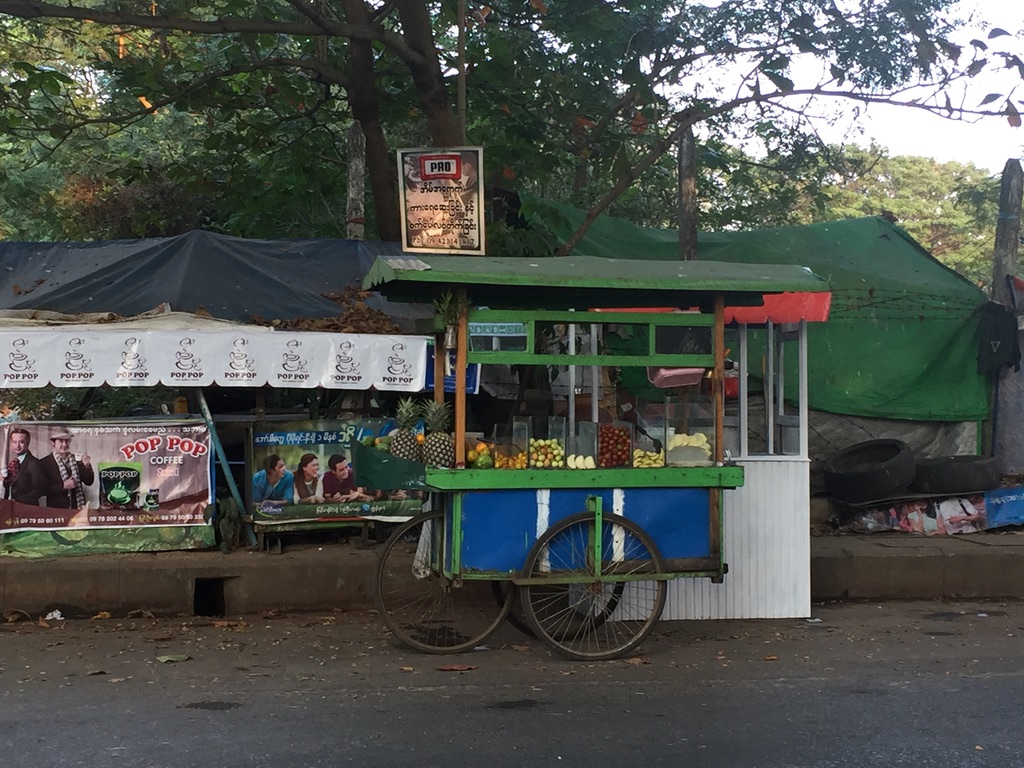
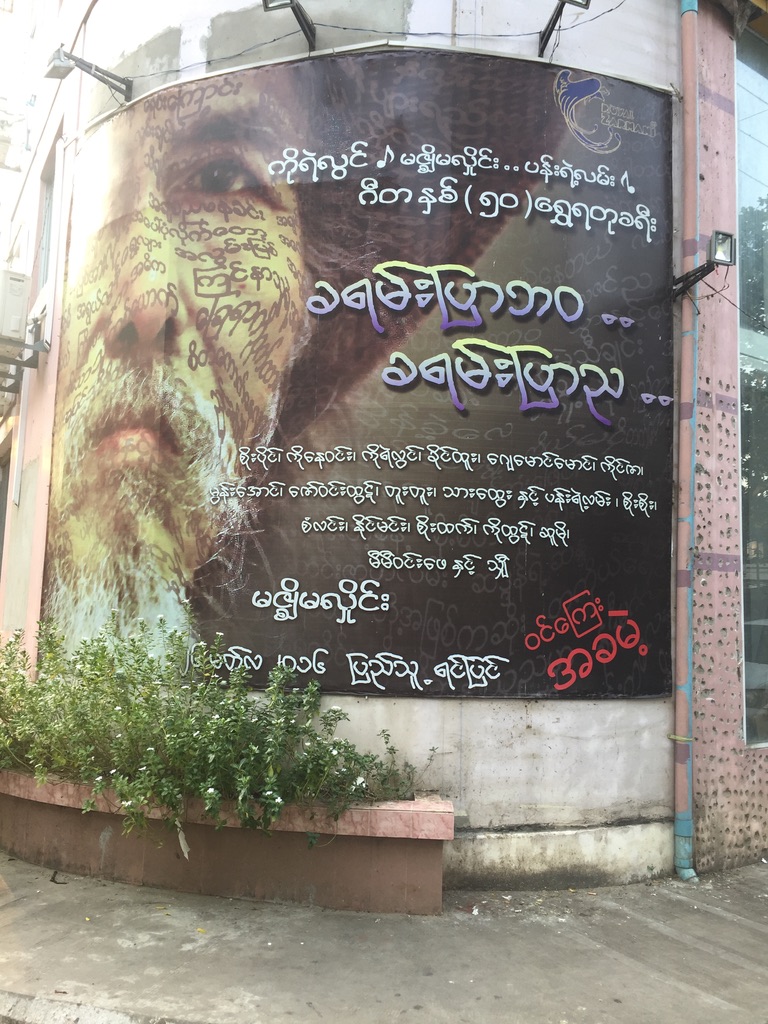
Headed out this morning to the Old Yangon again… but we took a different route and walked on different streets. Things were as chaotic as previously although today was a Saturday. Meandered in and out of alleys; hotter and it seemed more humid than yesterday. I think we were also lagging more because now we knew you just had to keep walking. The area we walked through today seemed older, less tended to, and poorer than what we had seen yesterday (but it could just be my imagination).
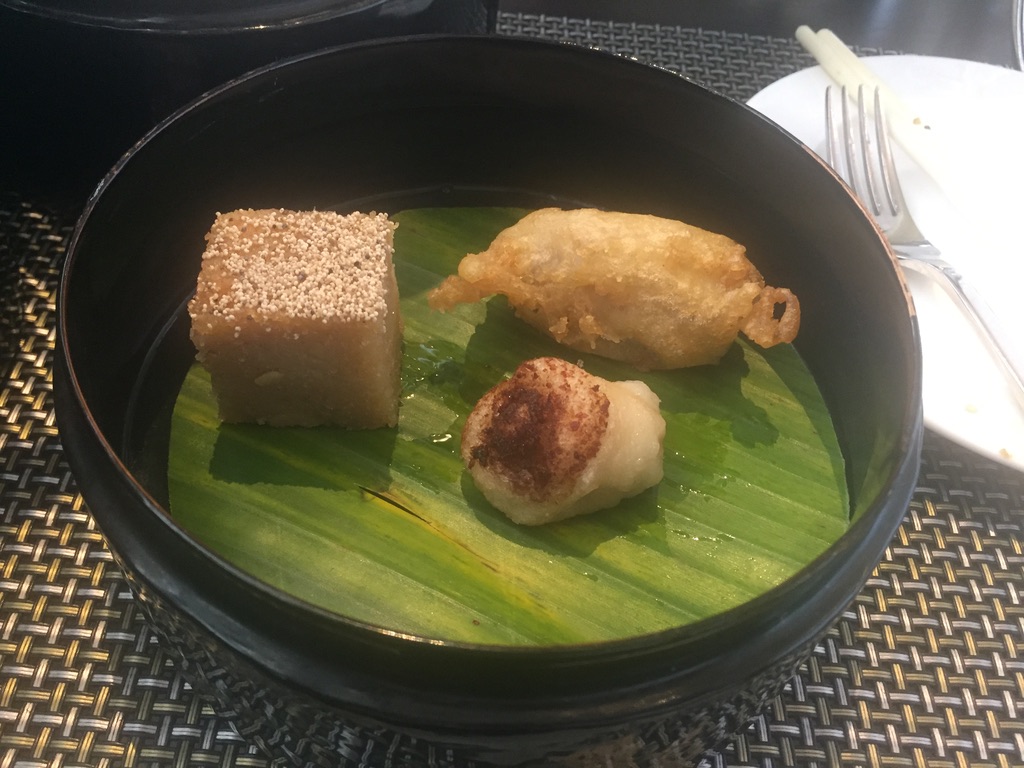
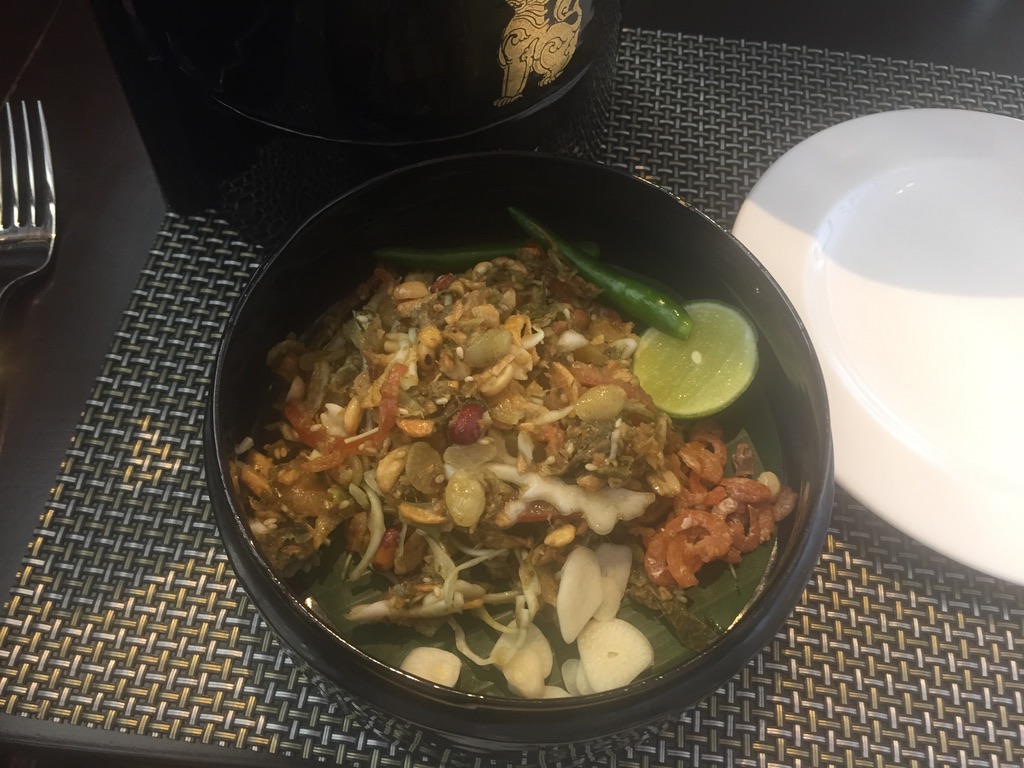
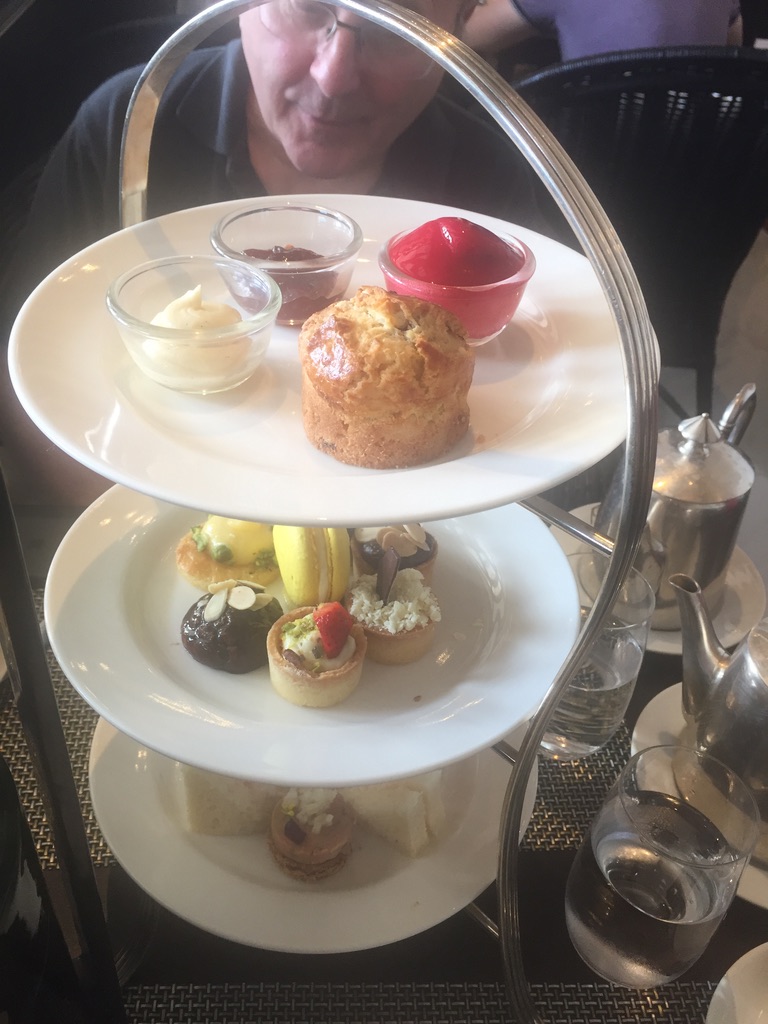
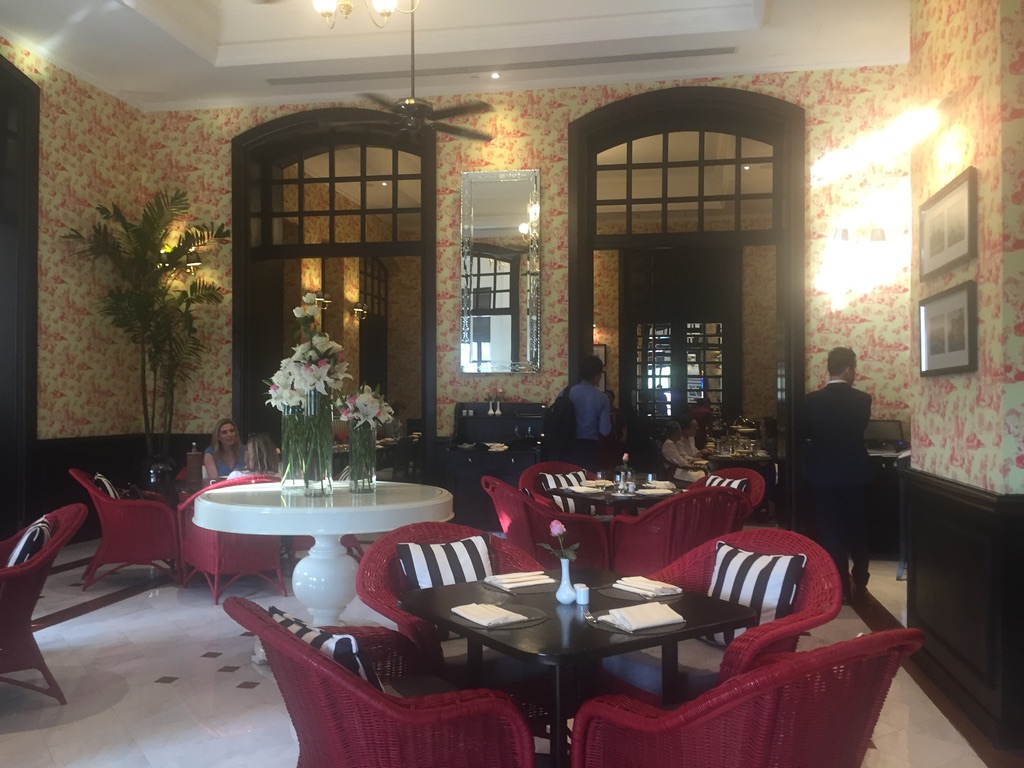
Then we headed to Pomelo a fair trade shop we had heard about – carrying many products made by and through the clients of various NGOs such as ones that work with women with AIDS, etc. Picked up some nice gifts and then headed to the Strand Hotel for an upscale “lunch” (at 2:30) of Burmese High Tea. A bit like the British ones in London at fancy hotels.. but instead of little tiny sandwiches there were various Asian dishes… and lots of sweets. The Strand is an absolutely beautifully-restored hotel (that is actually located about a block or so from the tail end of the Night Market).
During the colonial period, The Strand was one of the most luxurious hotels in the British Empire… and the clientele was all White. It was sold and underwent a major renovation in 1937 and then in 1941, during WWII, following the Japanese occupation of Burma, the hotel housed Japanese troops (pretty nice digs). Then ownership changed to the old Imperial Hotel in Tokyo. In 1945, Burmese became part of the clientele of the hotel, but after Burmese independence the hotel became neglected (by post-colonial governments). After the 1988 coup, the hotel was sold and then underwent a major renovation. It is now a very very high-end hotel with teak and marble floors, mahogany furniture, etc. but unlike the other old hotels that get restored, the restoration stuck to its architectural past, so there isn’t any new addition, no swimming pool , etc. .. just elegant. While we are not staying at the Strand (although I would highly recommend it–but you will be in a White enclave), as you’ll hear in future posts, we used their services as needed!
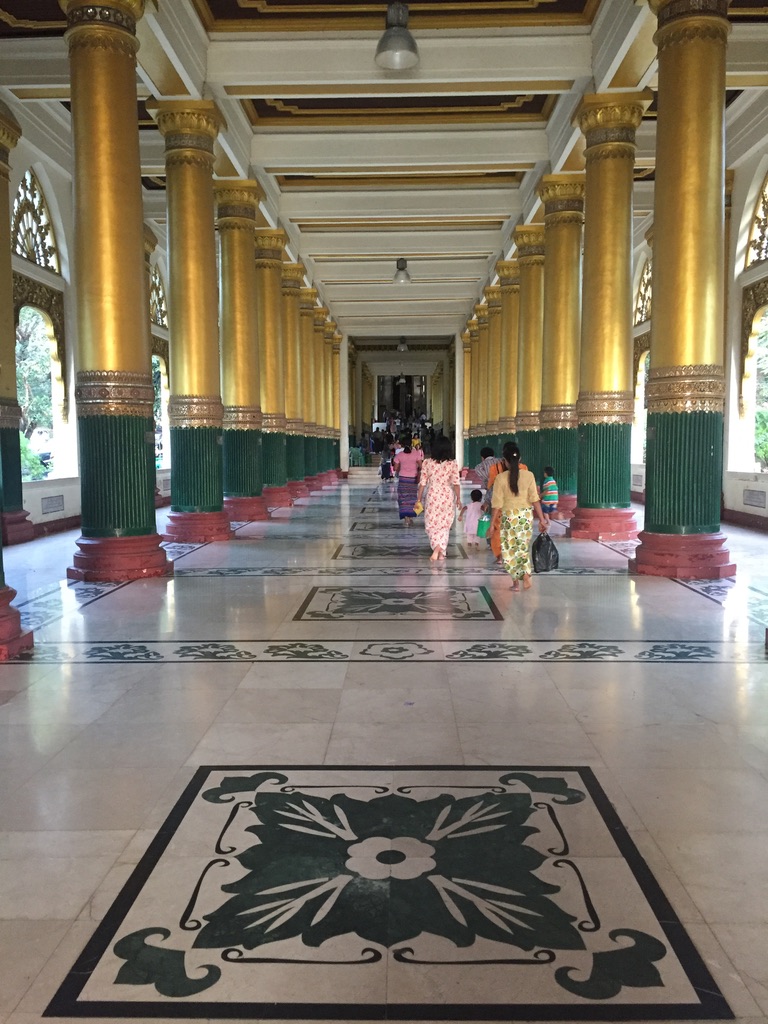
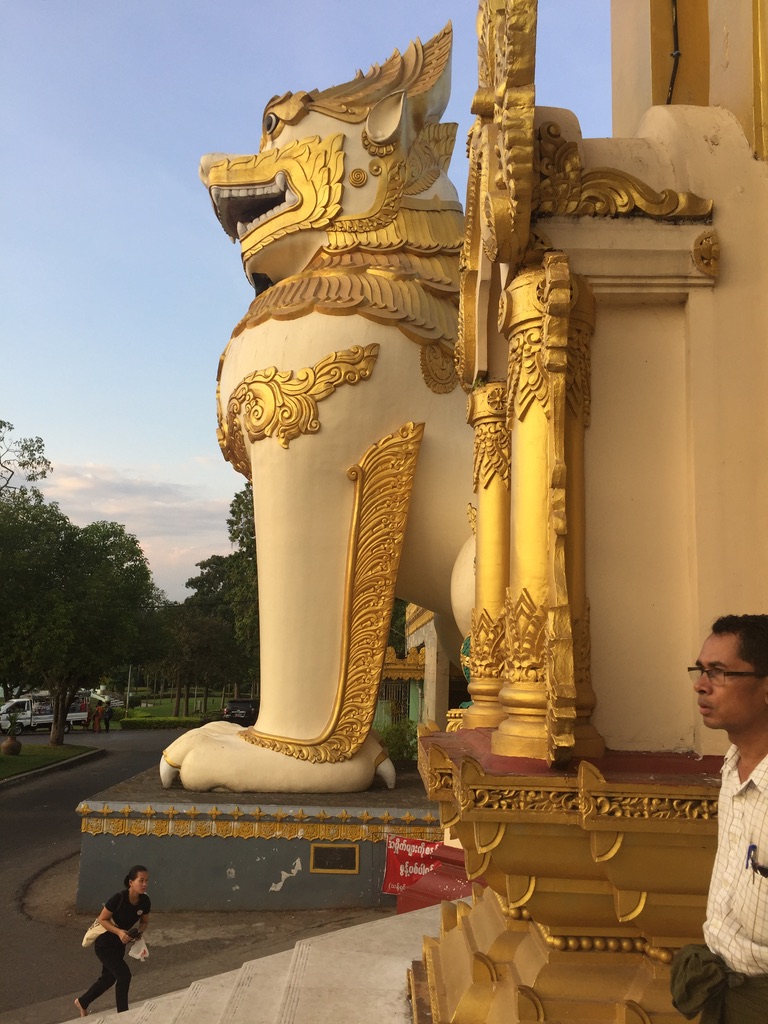
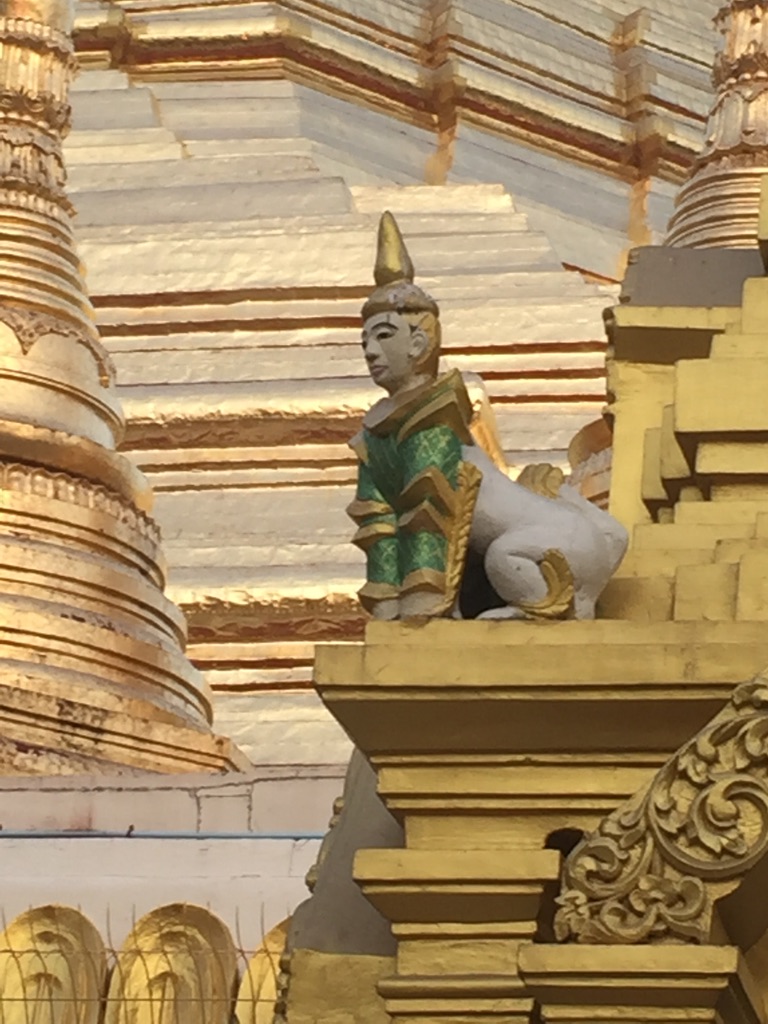
Left High Tea and headed back to the hotel to drop off our bags of purchases from Pomelo and walked to the 2,500 year -old Schwedagon Pagoda – which is totally jaw-dropping… or as awesome as it gets.. It’s located west of the Royal Lake on a 114-acre site and is considered the most sacred and impressive Buddhist site for Myanmar people. It stands at 110 meters and is covered with hundreds of gold plates. The stupa has more than 4,000 diamonds (I’m told the largest is 72 carats). It has to be one of the wonders of the religious world. It is like a little city with hundreds colorful temples, stupas, and statues that reflect the many different eras of its 25 centuries. And the “village” has adapted in funny ways to current times – including the introduction of LEDs that flash around some of the Buddhas! Strolling around the site you see Buddhist monks, and families, and the seriously religious as well as the gawkers.
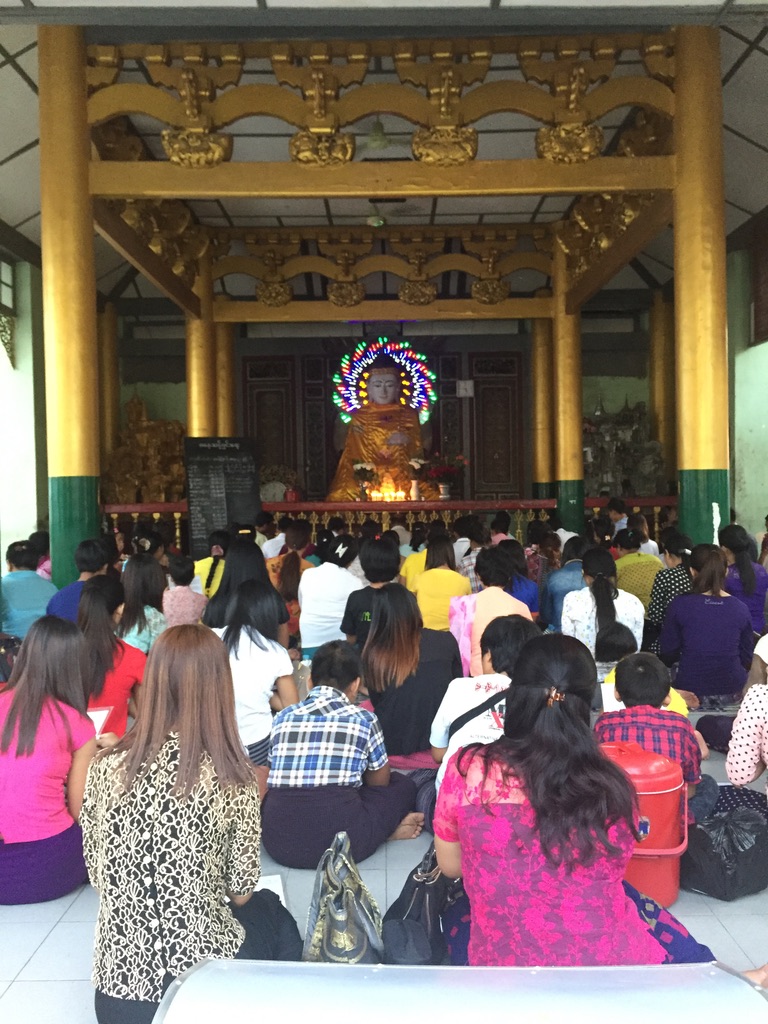
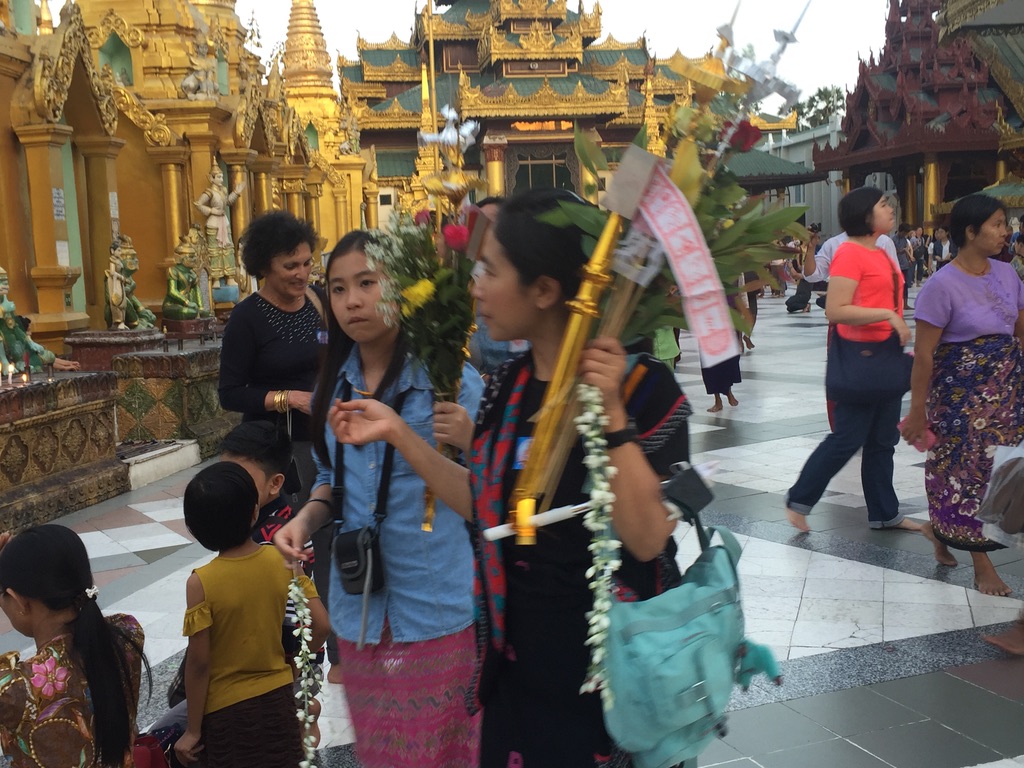
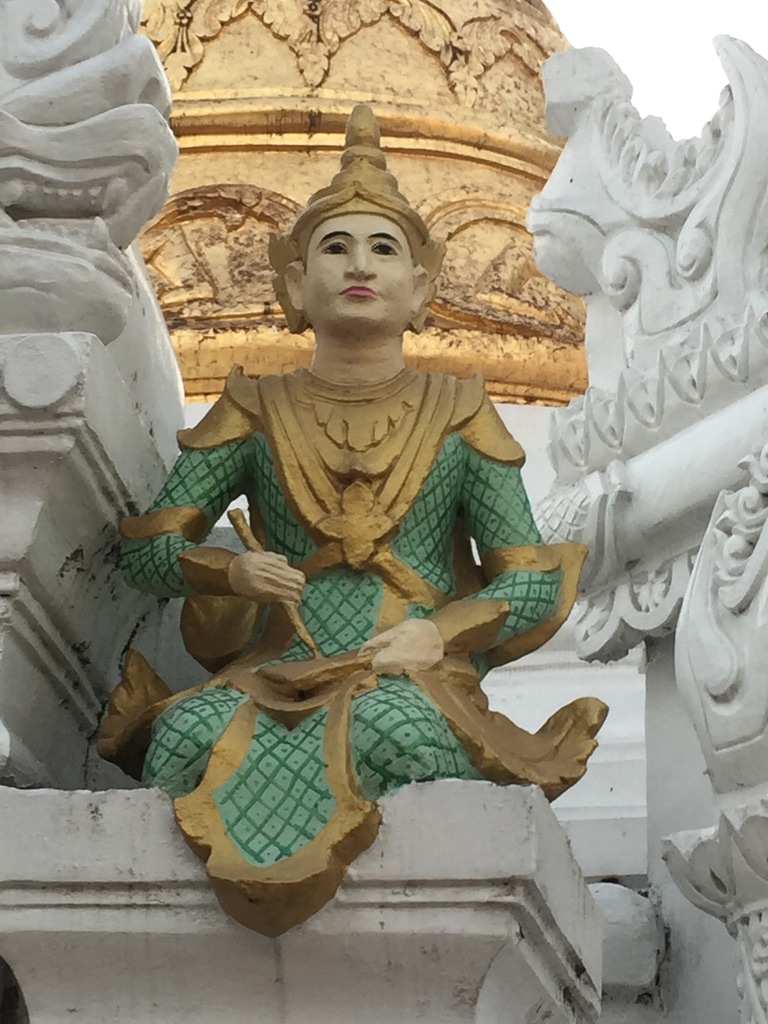
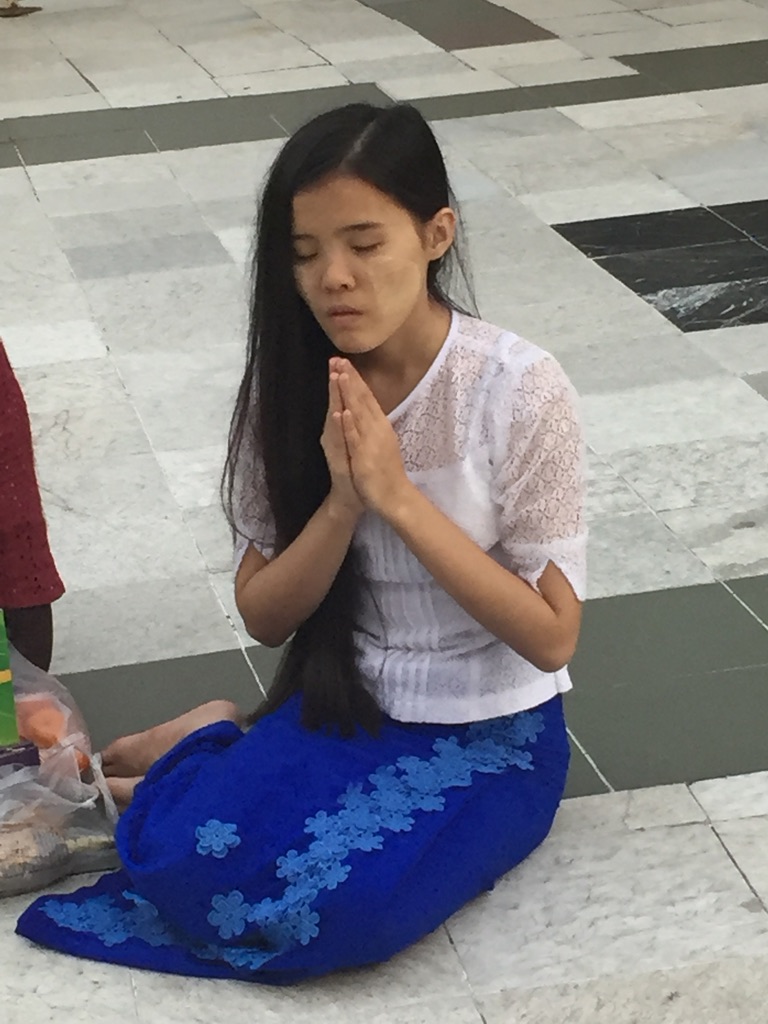
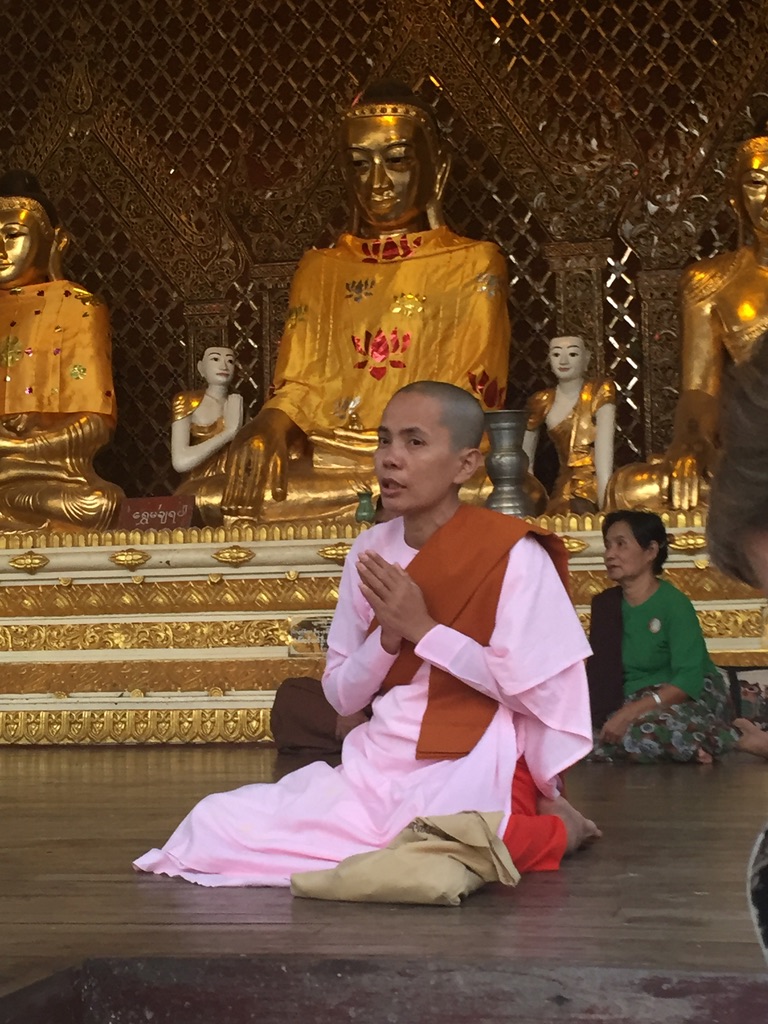
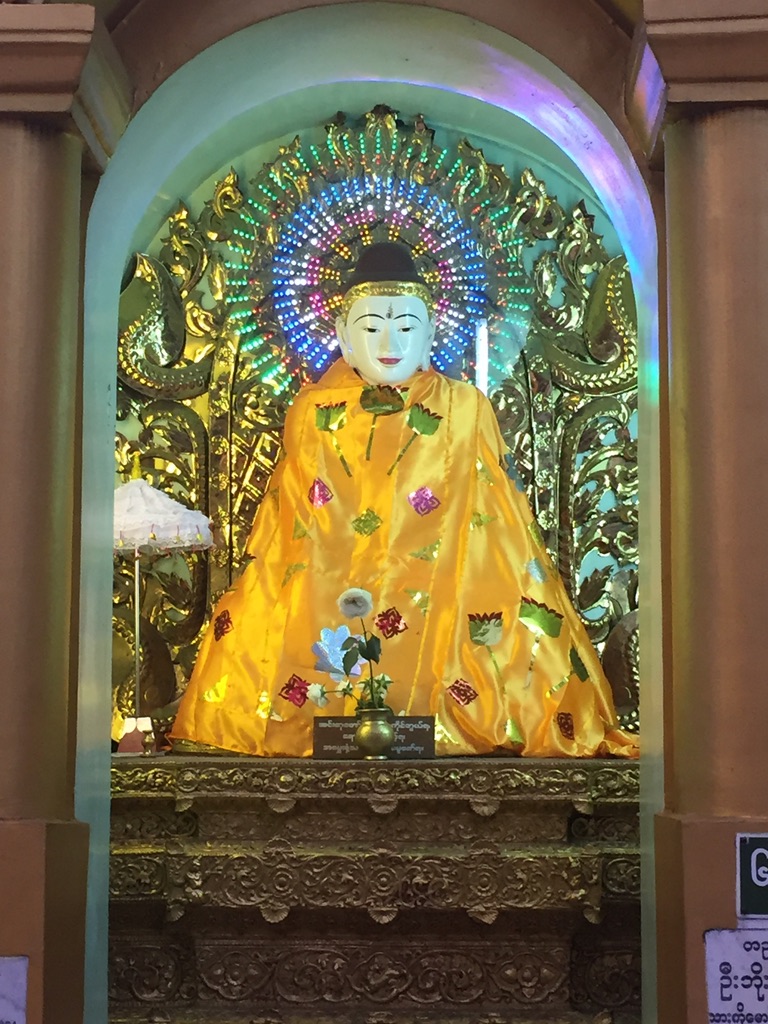

As we entered we needed to pay (about $2 because we are foreigners; this seems to be the norm here; locals can enter free and foreigners cover the tab – which is fine by me); and we checked shoes and socks.. Then we could either use stairs or an escalator to get to the top… which is like walking within a little idyllic village with monstrous size Buddhas and reclining Buddhas and sitting Buddhas and stupas. People are congregated to just chat, to pray, to stroll. Young couples seem to come here to do what young couples do.

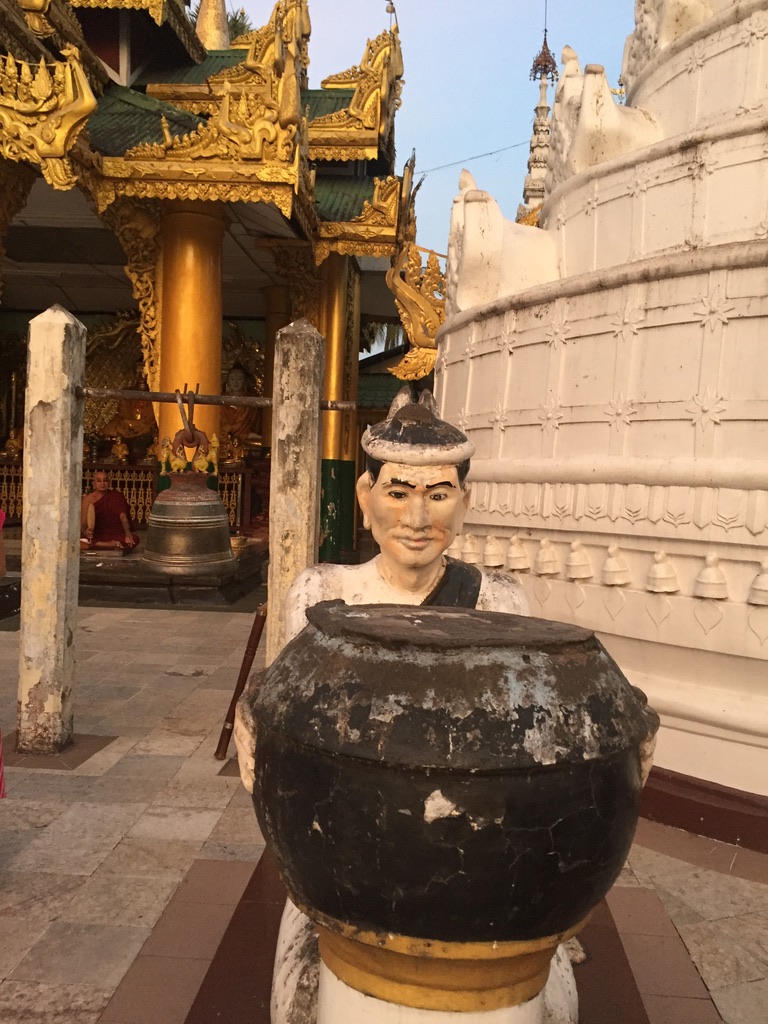
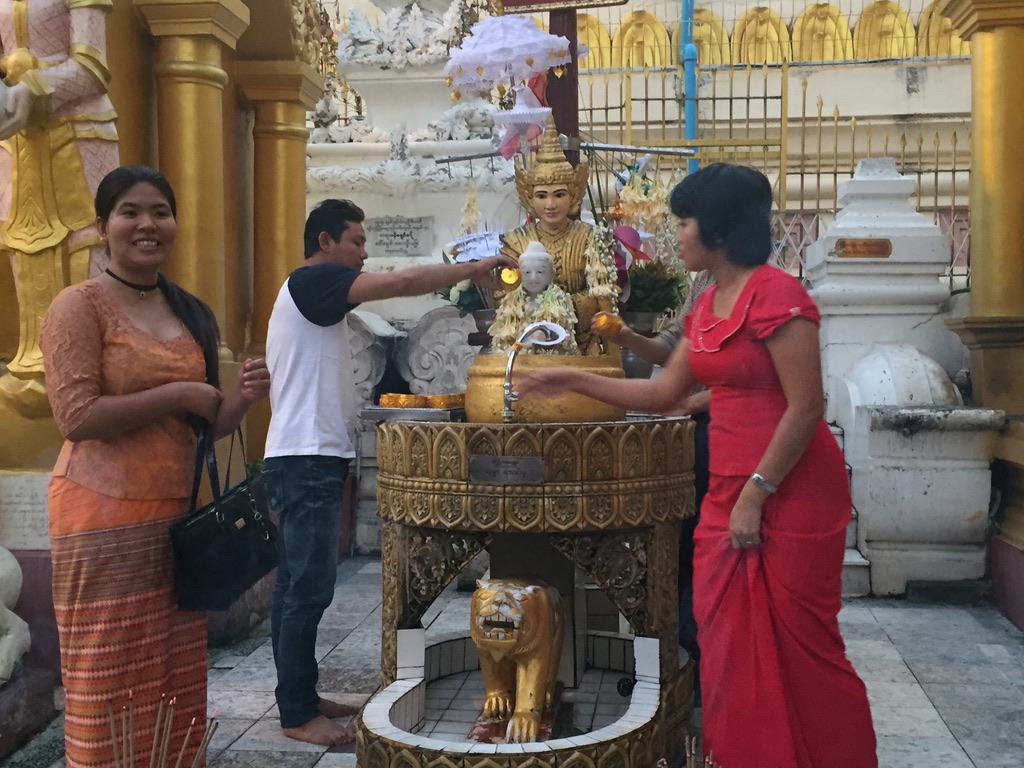

We expected to stay just a short time, but we stayed way longer. We had entered through the West Gate and that was where we checked our shoes, so we needed to leave by that same gate. We split up and then as we each tried to find the West Gate again we both got lost – connected only through texting — but not together. I wound up asking many people, but few spoke any English. Eventually I stumbled on one Burmese man who spoke a few words and was able to point in the direction. He also asked where I was from and when I said California he said “USA” and then said “Obama, Obama!” And I thought, how different travel will be under Trump.
We then headed back to the hotel where there was a pre-planned “Christmas Dinner”… It was sweet, held pool side with flowers and candles floating in the water. Following dinner, we made a quick change and decided to head to the cathedral to see what Midnight Mass would be like. Though not Catholic, as we’ve traveled a lot over the holidays over the years, we’ve gone to observe Midnight Mass in Vietnam, Mexico, Guatemala, Ecuador, and other places. So this seemed like a good idea.
As we approached the cathedral at about 11:15 pm, we were shocked. The church was totally packed; it held about 2,000 people. It was standing room only and people were sitting outside in chairs and on the grass. Catholics represent just 1% of the country’s population. But it was also like a “fair” with food stands outside and huge, bigger-than-life blow ups of Santa Clauses at the entryway of the church.. and LEDs everywhere within the church.. It was like a giant light show. We were part of the standing crowd, but at one point, as they were trying to clear the aisles, a church usher made a beeline to me and began to usher us to seats up front (I assume because we were clearly one of the very very few Whites, non-Burmese visitors). Then he stopped and asked if we were Catholic. When I said “No” he decided we should just stand.
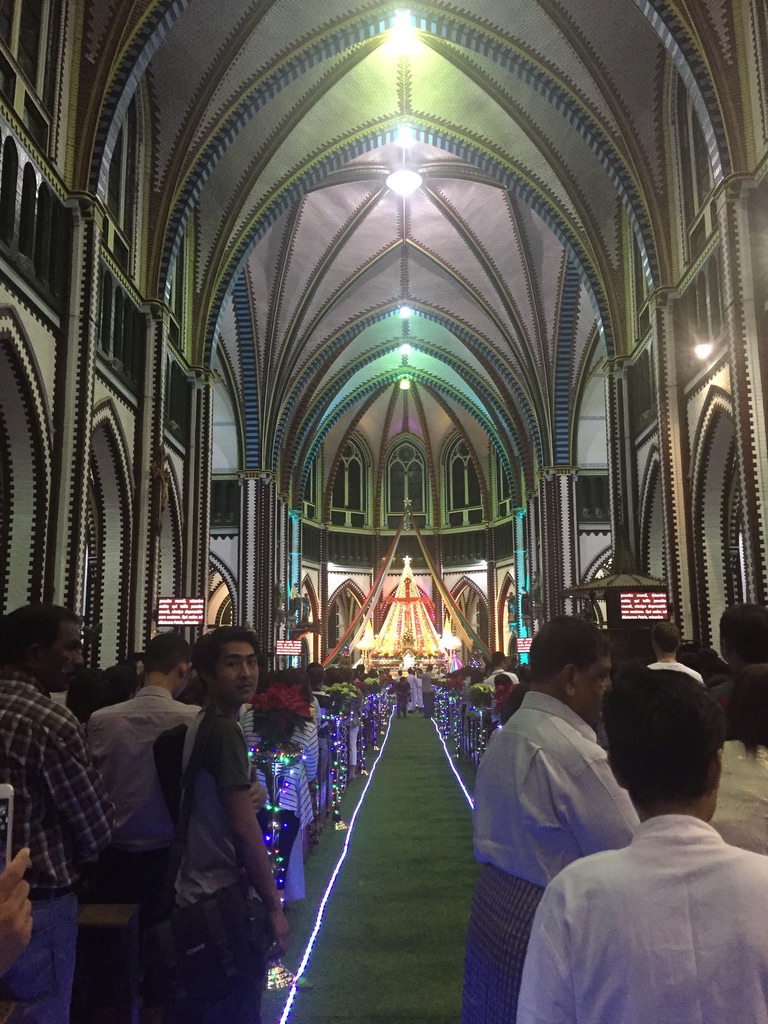
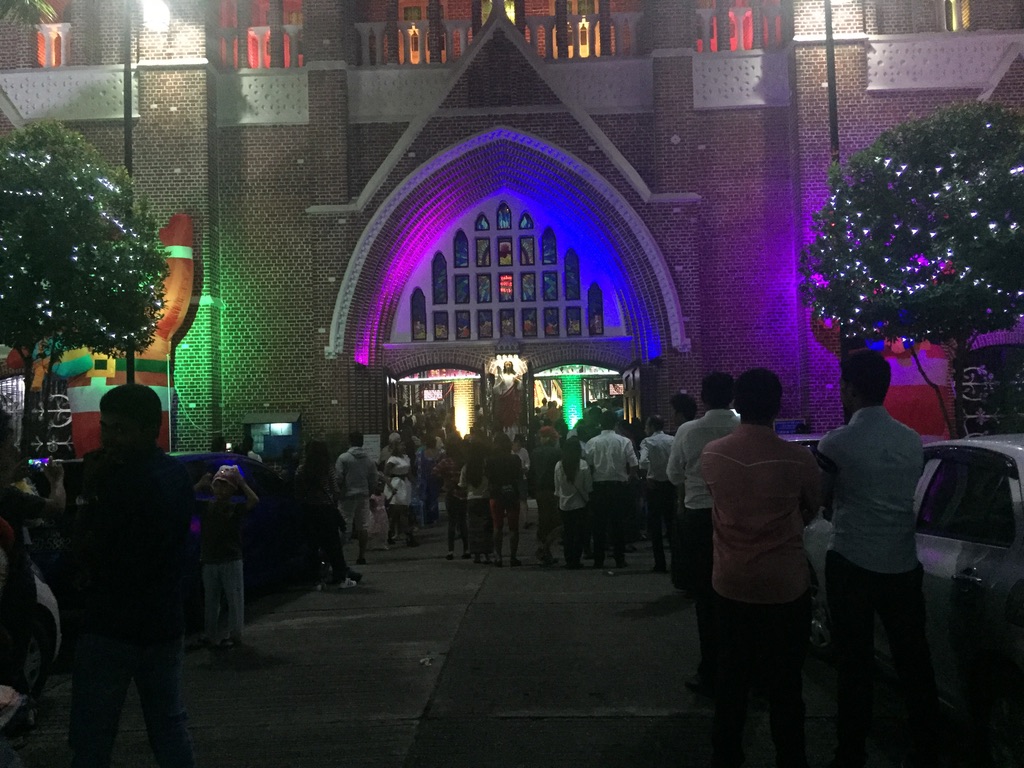
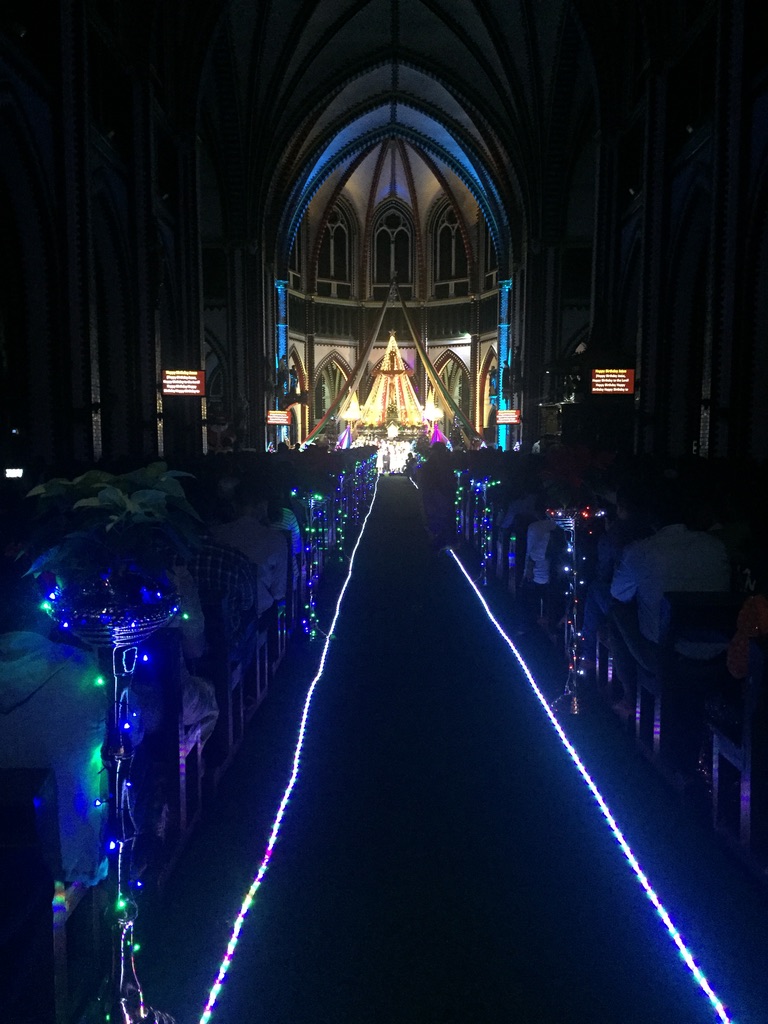
Anyway, from 11 to midnight the choir and a children’s choir sang Christmas carols (in English – which seemed odd, since we know very few people speak English). The church was excruciatingly hot with so many bodies and no air conditioning and only very, very small fans. Anyway, at midnight the bishop (I think it was a bishop as he had a pointy hat and then a red skull cap) began his sermon, which seemed to go on and on and on. We left at about 12:30. It was a bit surprising that there wasn’t any nod to the local ethnicity and culture. Other midnight masses we’ve been to have incorporated a lot of the local flair. After doing some research we learned that there is conflict among Burmese Catholics because the church hierarchy has entertained the junta, has supposedly paid off the government, but mostly because it did not support the monks (who were fighting for the people) during the Saffron Revolution.
We walked through the throngs outside, passed more vendors selling Santa caps and more food.. and headed back to the hotel. Tomorrow is another day.
Happy Hanukah, Merry Christmas…
Fern
Americans in Yangon – Days 1 and 2. December 22 and 23, 2016
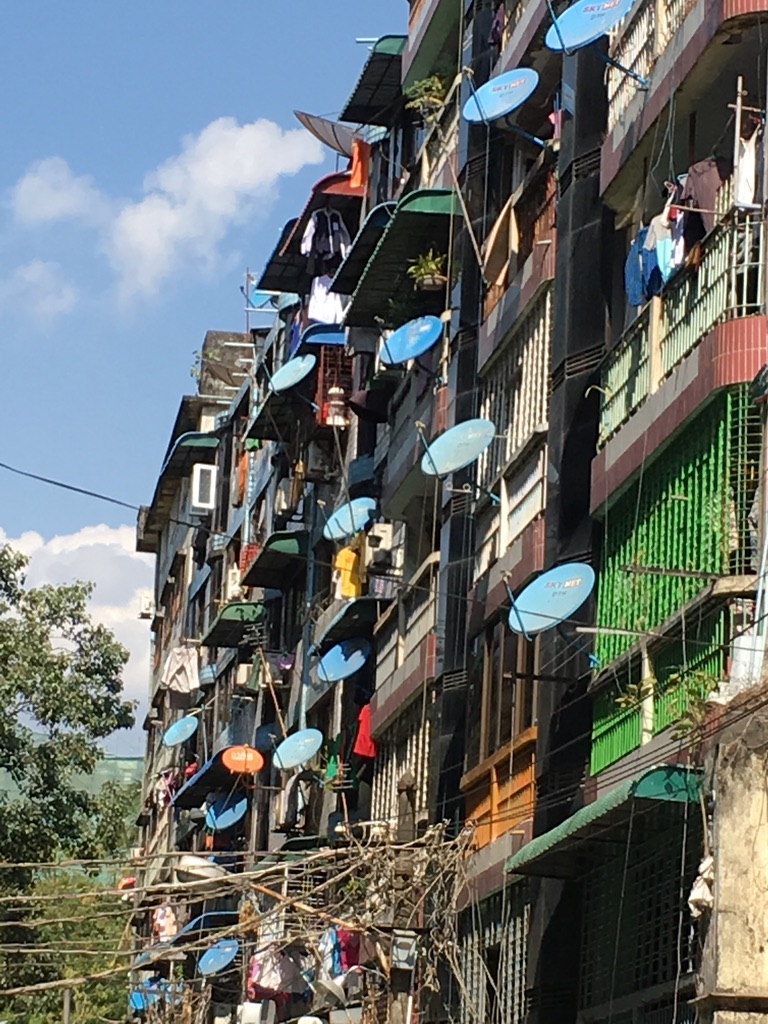

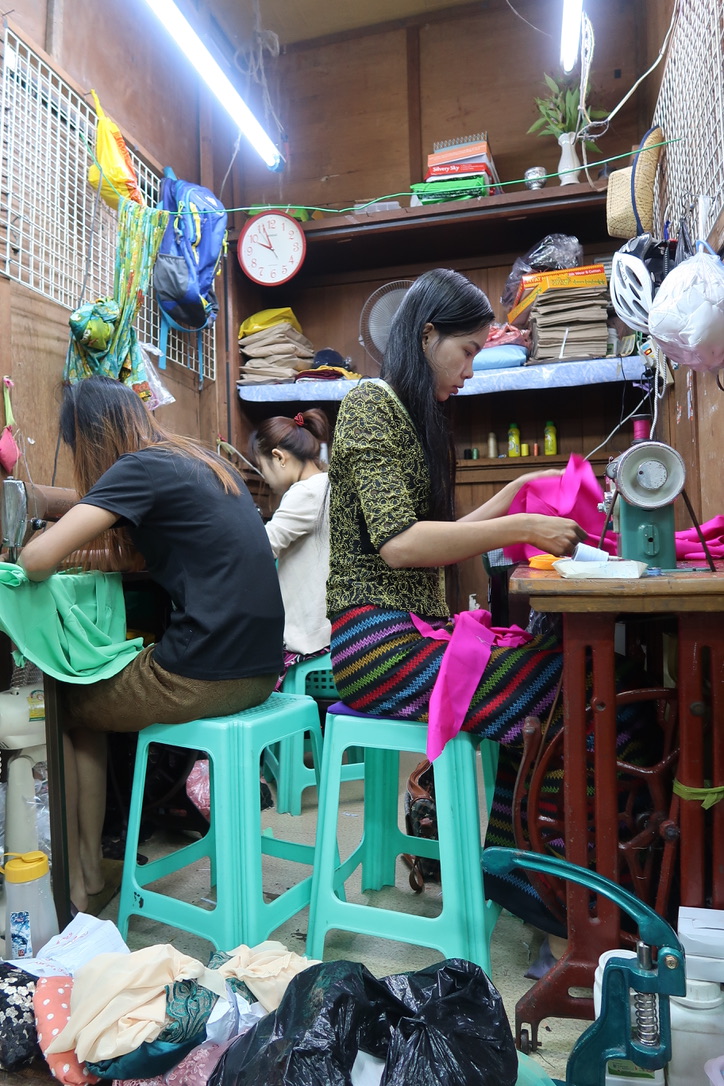
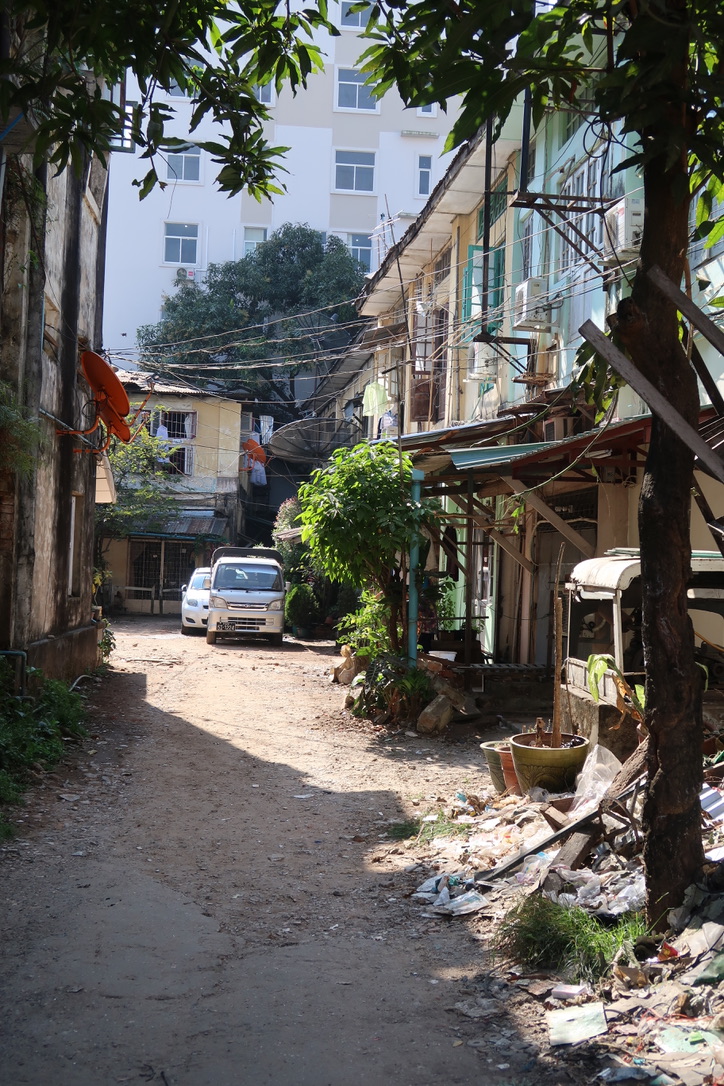
Yangon, Myanmar
Mayttar nhang kyarr litepareat – I think this means “greetings”
Although most people seem to say “Maingalarpar” – which I think is “Hi” .. a sort of informal and friendly greeting. Arrived in Yangon yesterday at about 4:00 pm after an 8-hour flight from Tokyo. Got through customs and immigration fairly quickly… Everything is very organized and people form easily into singular file and wait their turn. Got out bags and then headed to find a taxi which turned out to be very easy and unlike most developing nations where everyone is yelling for you to take their taxi and bargaining for prices. Here there is a taxi desk; you stop there and tell them where you are going; they tell you the price and walk you outside to a waiting (legal) cab. It cost about $5 to get from the airport to the Savoy Hotel. https://www.savoy-myanmar.com/ .. It’s a colonial style building about 15 minutes from the hustle and bustle (and noise and chaos) of “downtown”… We settled in (room is lovely and they have an amazing pool…surprised us that there even was a pool; we don’t have any bathing suits with us, so the fact that it is here is pretty much useless for us)… and then took off to find a place for dinner.
Took a taxi right to the thick of the chaos and ate at Monsoon – an interesting place that from the outside looks abandoned and totally in need of repair, but the inside is fine and food was quite good. It’s an eclectic Asian menu with dishes from Myanmar, Thailand, Vietnam, Cambodia, and Laos. We stuck with Myanmar and had a chicken with yogurt curry and an eggplant dish with some kind of chili peppers. All good; tried Myanmar beer which was not too exciting, but perfectly fine. Decided to taxi back; by then we were pretty exhausted, having started out at about 6 am and it was now about 11 pm and there had been a 2.5 hour time difference. (I hate these places with the 30 minute time difference – like Tibet.. and now Yangon… makes it difficult to figure out time back home.)
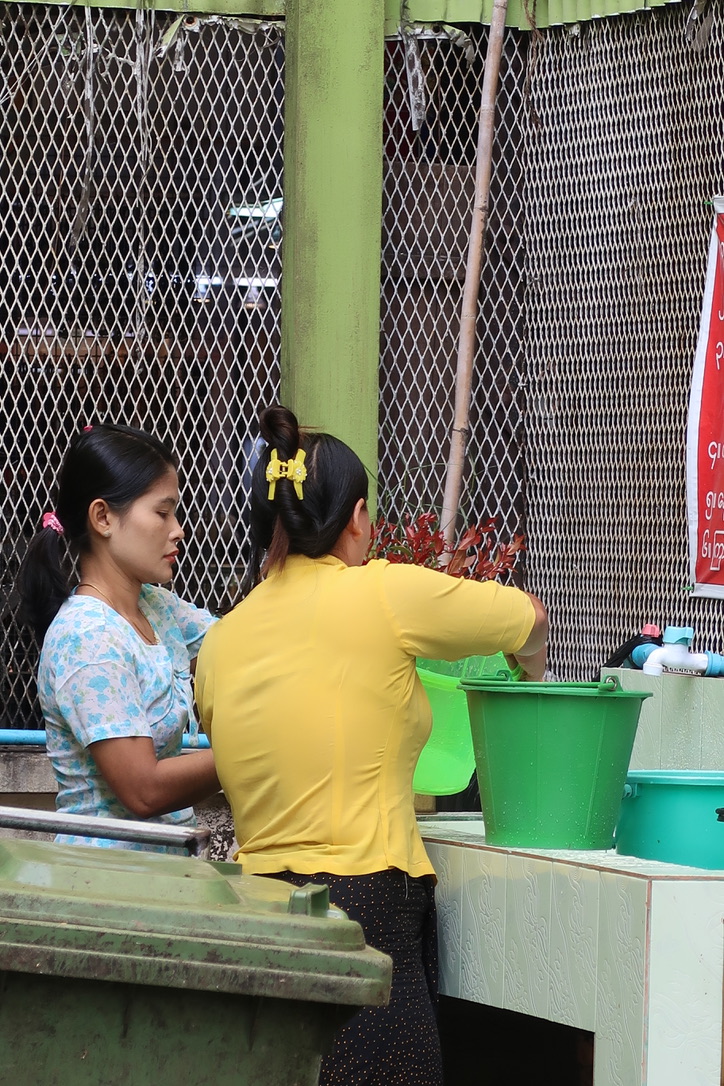
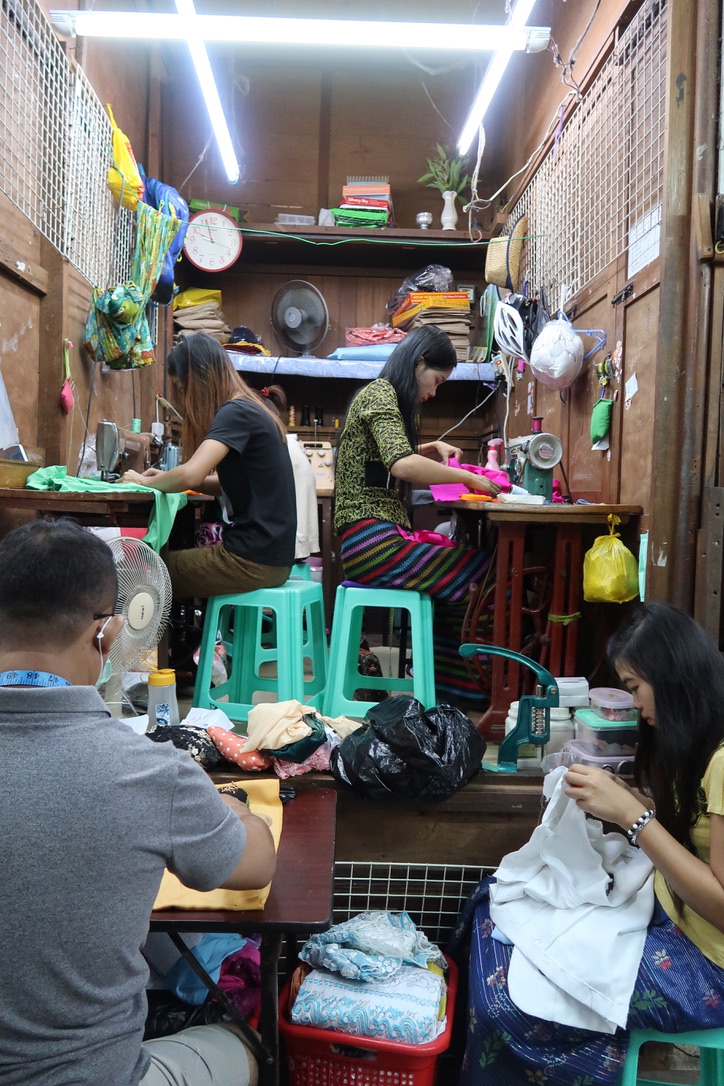
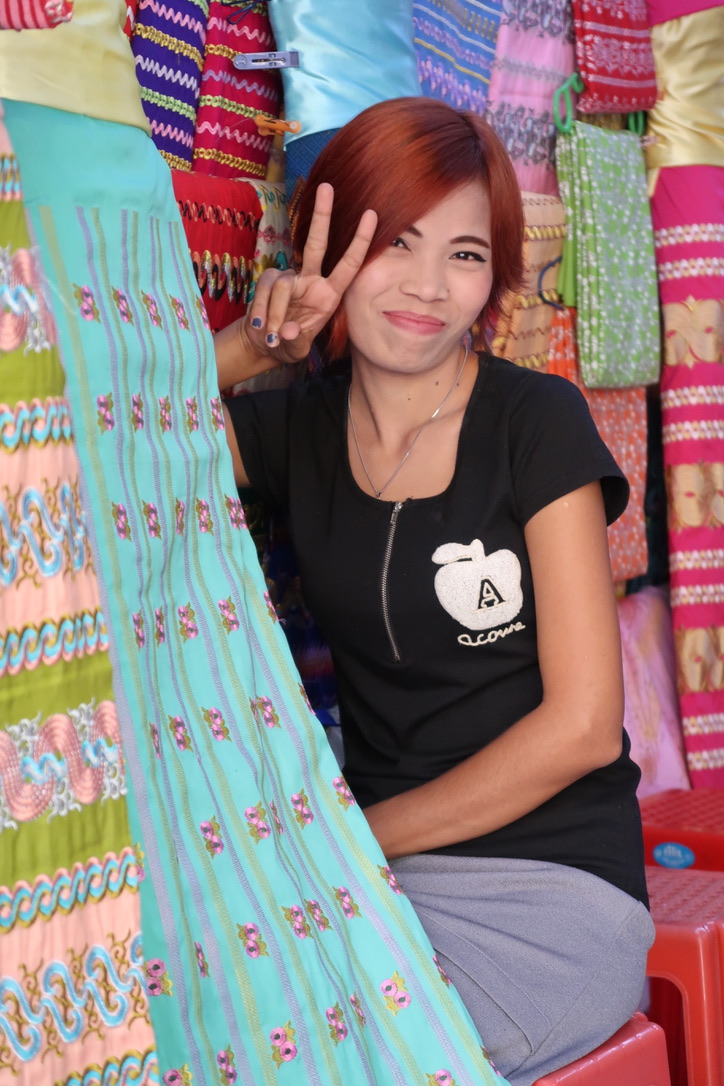
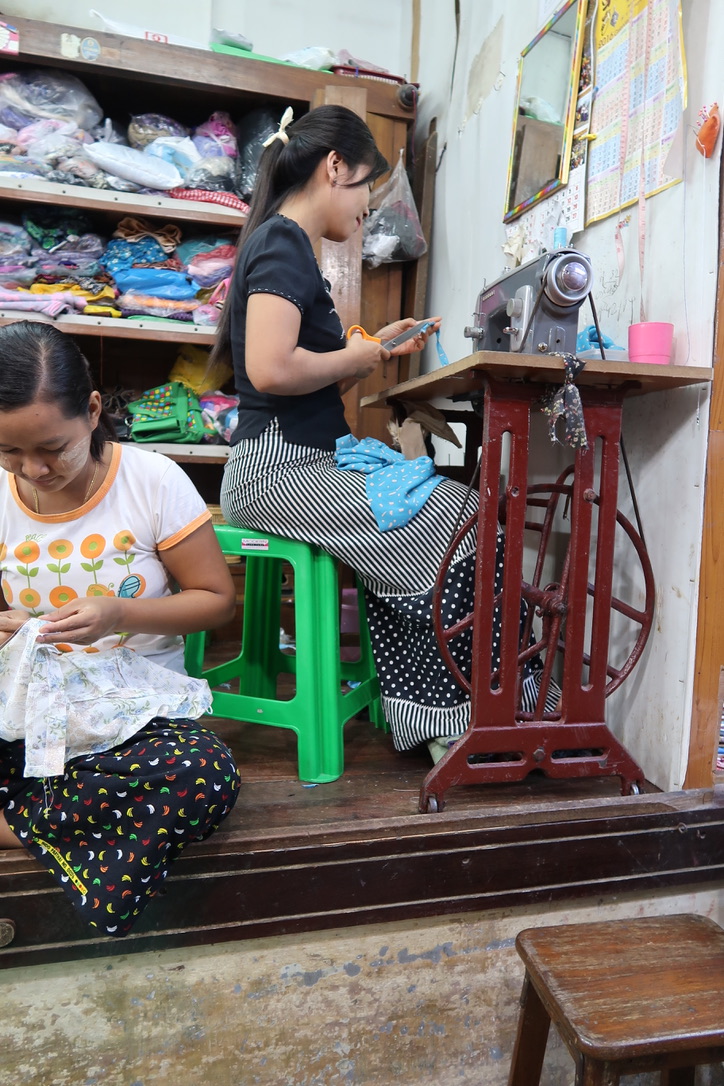
Woke up this morning to tend to some office-related issues, including the construction of the new space which seems to be going well; I get pictures each day so I’m in the loop and my architect checks it all out as well. I seem to be in good hands with Angela and Fanny at the helm. Following breakfast which was a mix of American style eggs and pastries and Asian dishes – we hopped in a taxi again (about $2 each trip) to get to the big market called Bog Yoke Aung San which has more than 2,000 “stalls” – some of which are about 100 sq. ft. and have six people working in them.
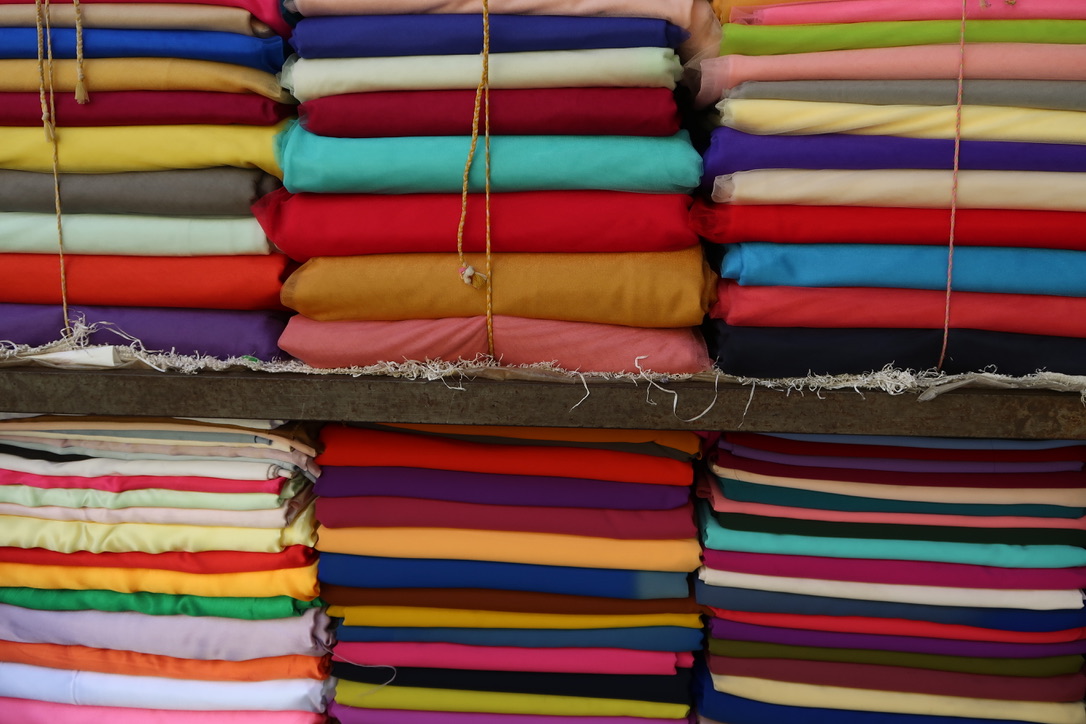
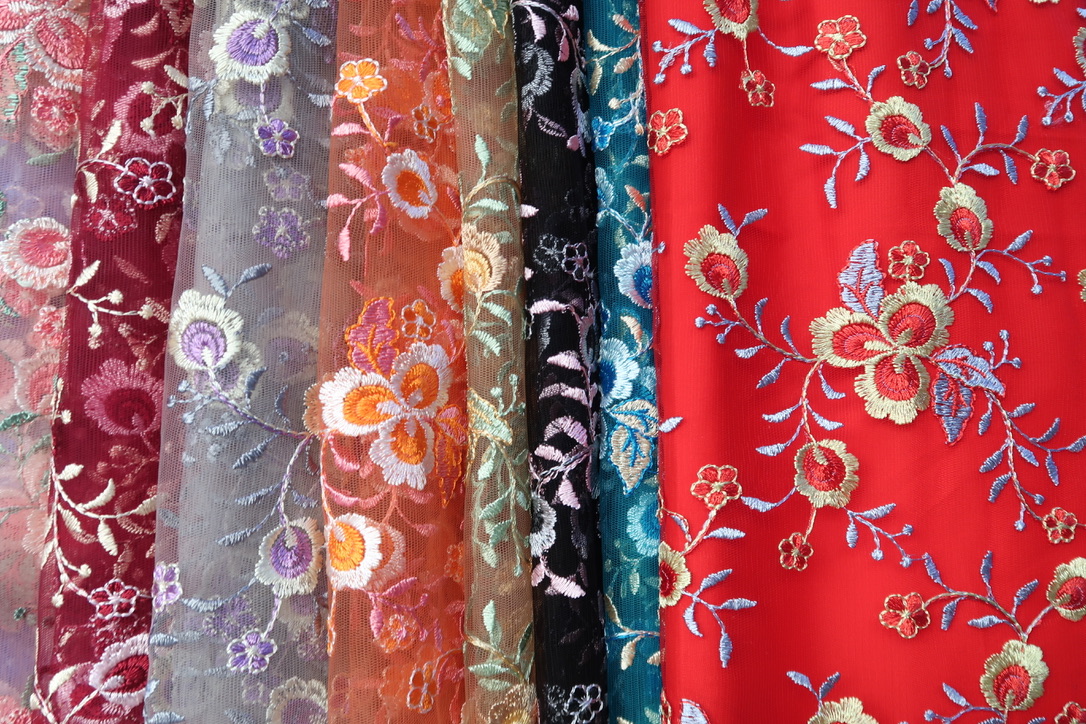
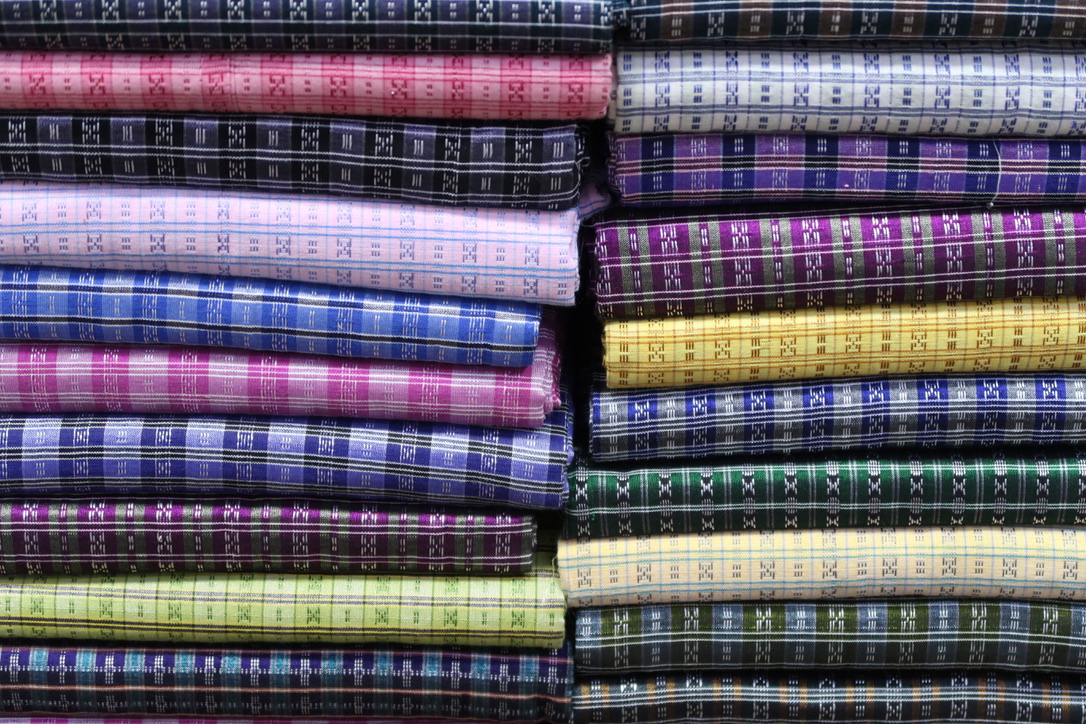
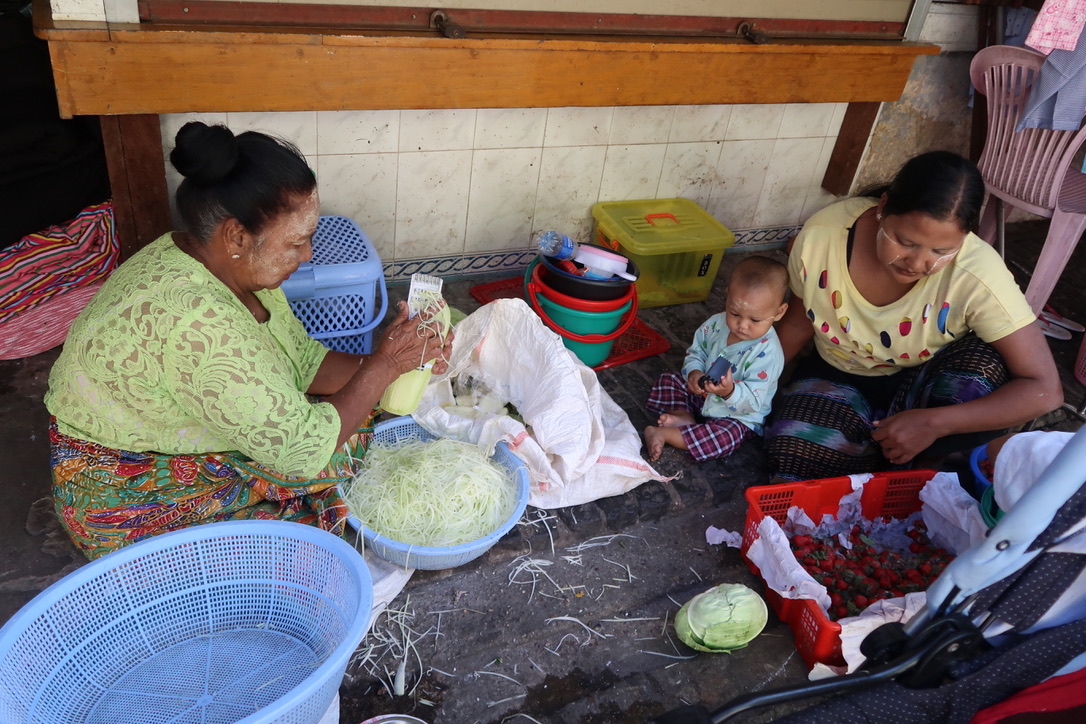
The aisles between the “shops” are about one meter.. You could probably spend a day just drifting through the fabric sections, the jewelry cluster, etc. Eventually we reached the food area and checked out produce and other goodies. We spent about two hours meandering the place and then started to walk the streets which are filled (as they are in most large cities in developing countries) with packed buses that can are puffing out outrageous amounts of fossil fuel, pedestrians trying to get from place to place, cars, taxis and trucks.. and of course the unbelievable amount of construction and construction debris which sort of just sits there without any kind of barricade. And the sidewalks appear to be just concrete coverings of the sewer system, so it’s not so pleasant in the heat. Anyway, the streets are fantastic – packed with people. Everyone seems very friendly although no one speaks any English.. Store signs, however are in English and Burmese and “some” streets are labeled with English as well as Burmese so we can sort of manage to find our way. One interesting thing is that Yangon doesn’t seem to have any “tuk-tuks” like you take in Thailand and India and in most other Asian cities. I think that without the tuk tuks, traffic is much worse.
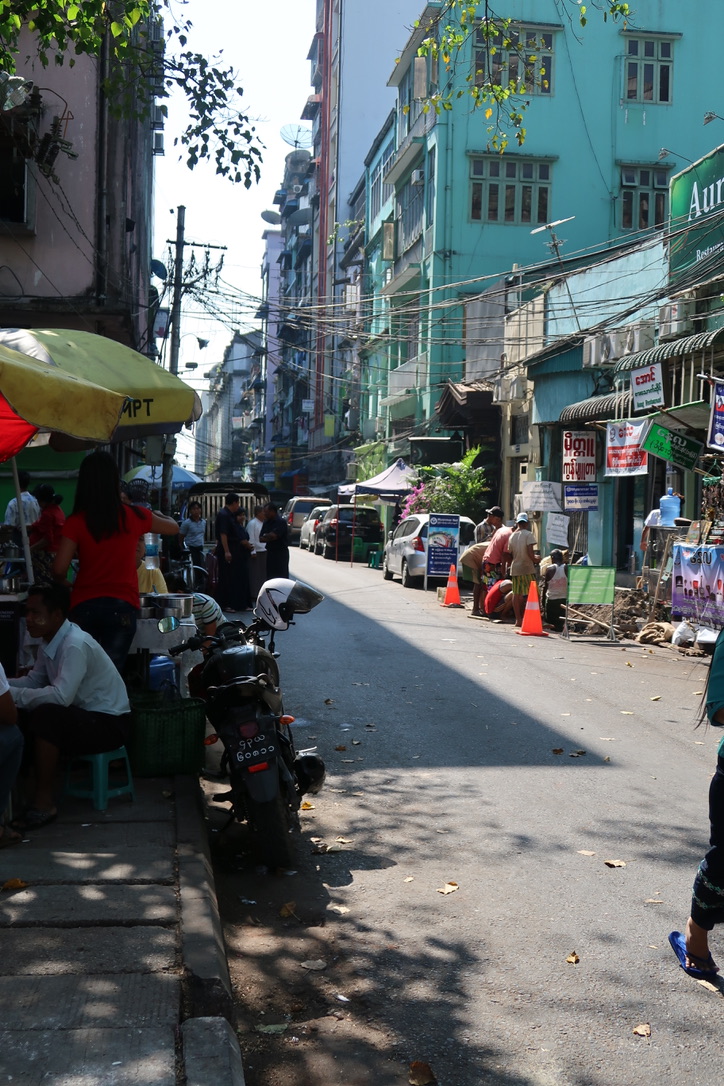
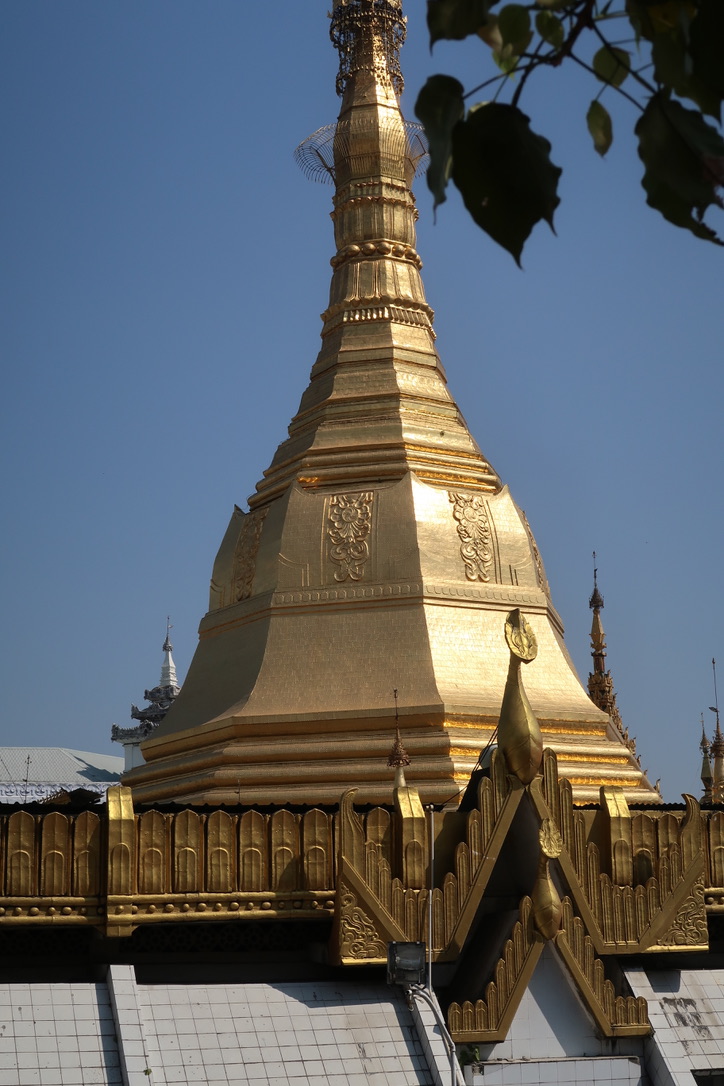
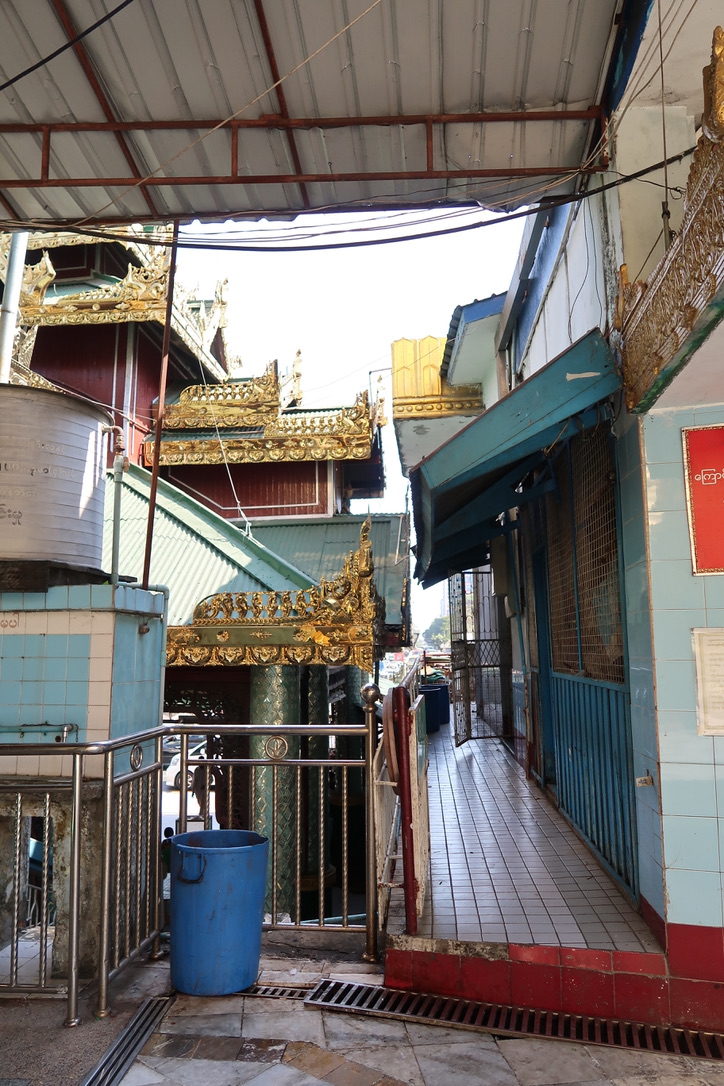
We walked to the Sule Temple – about a mile or so from where we were. Sule Pagoda is one of the largest pagodas in Myanmar and apparently a critical space in recent Burmese politics. Supposedly it was built before the Shwedagon Pagoda (which is the most famous one) about 2,500 years ago. It has been a rallying point in the 1988 uprisings and also in the 2007 Saffron Revolution. The blending of religion, culture, spirituality, politics, and daily life is evident everywhere. Like in Tibet, the temple is completely surrounded by shops on the first level (sort of “under” the pagoda) and has some overpasses (crosswalk bridges that literally connect right into the side of the temple .. clearly after thoughts once cars and buses were blocking entry). As we walked the stairs of one overpass and stopped to photograph, a young guy asked if he could be helpful. His English was pretty good. Turns out he spent one semester at UW studying English! Those Huskies certainly get around.
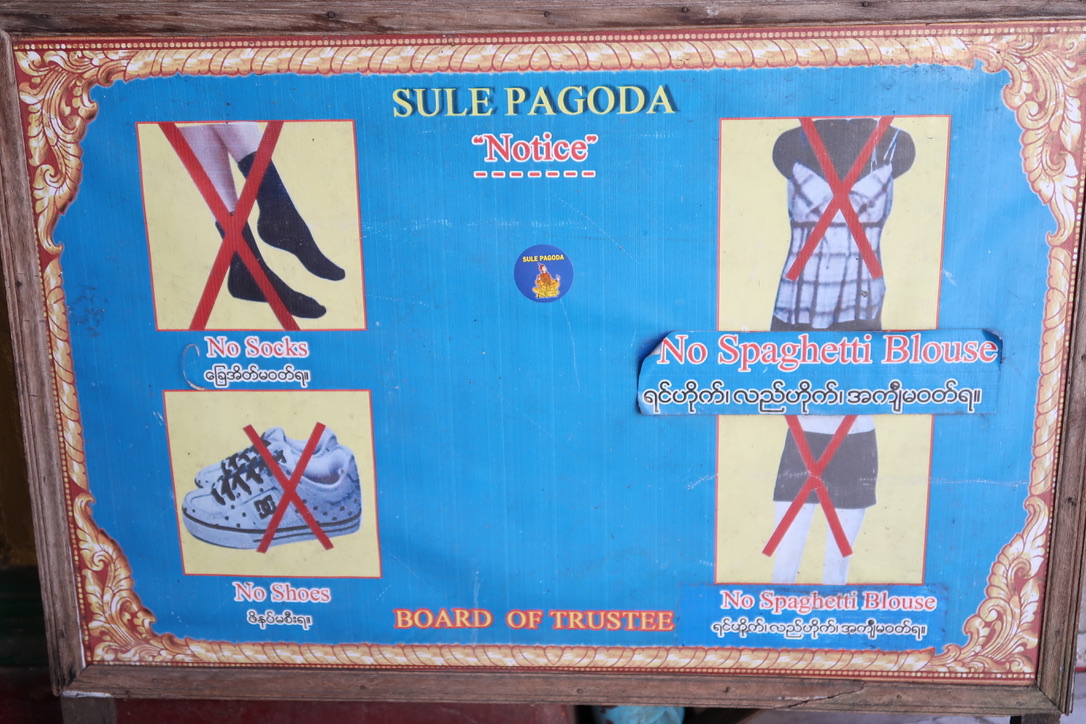
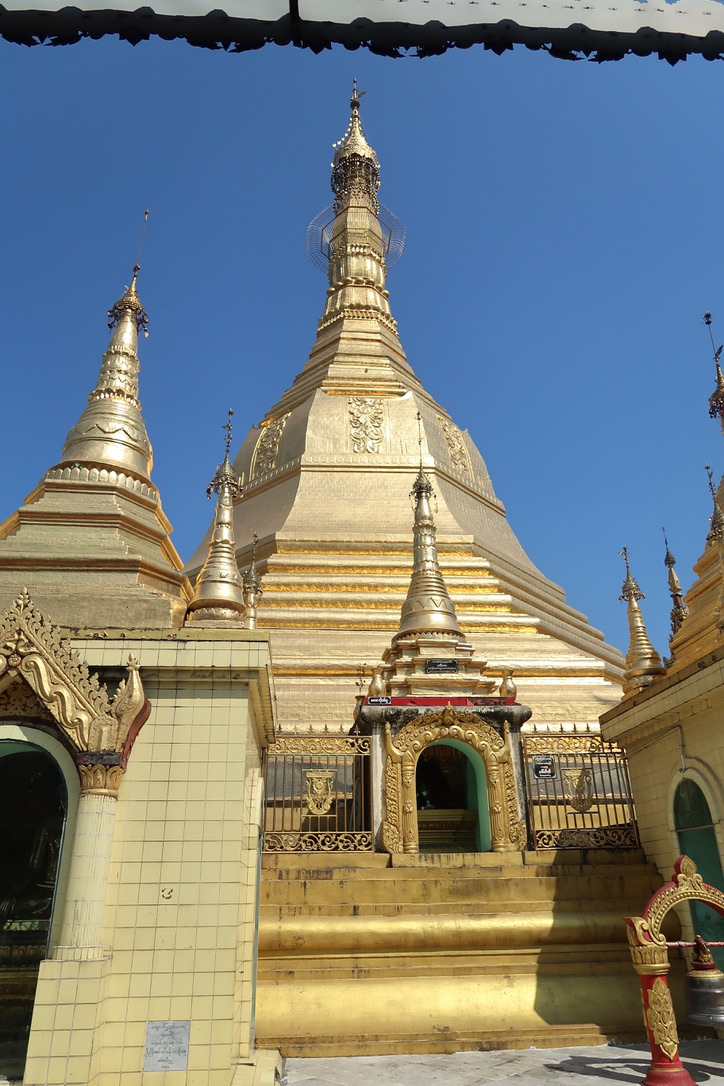
As we approached the entrance (sort of stumbled on it as you emerge from the overpass), the rules were clear.. no shoes and no socks and lots of signs about what you can and cannot be wearing. Mike decided he didn’t want to hassle the socks and shoe deal and was tired and hot and sweaty (it’s about 90 during the day and pretty humid if you are in the sun; in the shade it’s bearable). I gave up my sandals and went barefoot as required, but was stopped at the next entrance because my legs were exposed (I was wearing a simple sleeveless dress). I needed to be in either long pants or in a Longy – a sheet of cloth that is wrapped around the lower part of your body and held in place by tying a knot. It goes from the waist to the floor. It’s worn by both men and women in the streets… Not sure what they wear under the longy, but everyone seems to always be adjusting their knot. Anyway, they loaned me a longy and in I went.. Charming fashion with my little striped dress.

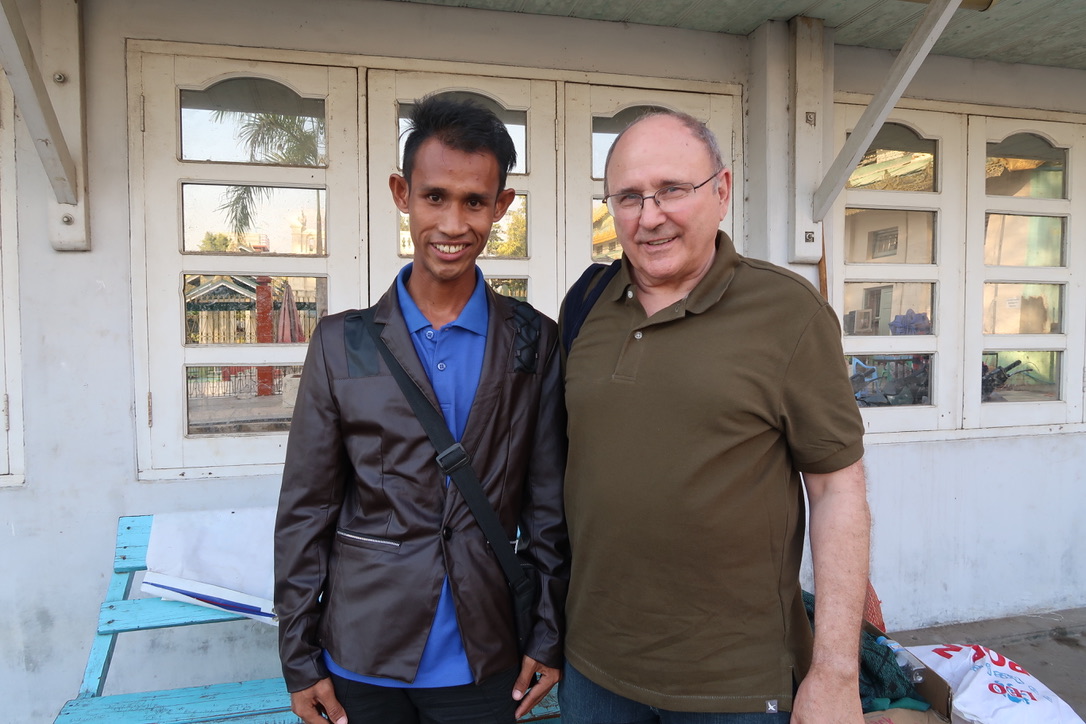
Once inside (which is sort of like a little village with lots of shrines and areas to pray in front of each, so it’s a little like walking between houses), I strolled for a while and then saw a group of girls sitting on the floor taking pictures of themselves. They were trying to take a group picture but naturally one person was always out of the photo being the photographer. I made motions that I could take the picture and then they could all be in the photo, and they giggled and agreed.. So I took the picture and then they each decided they really needed a picture with me … one at a time. So I was at the temple a little longer than planned. Anyway, they were adorable as shown here.. The peace sign is used a lot – sort of like the 60s in the US.. I then retrieved my shoes, returned my longy, and met up with Mike… We then decided to walk (about another mile or so) to the only synagogue in Myanmar. We saw it on the map and decided the walk would be fun (although more sweaty)… and that it could be interesting to see. Along the way, as we kept checking out map to see if we were headed in the right direction, a young man stopped to see if he could help. Turned out he was Japanese; living in Yangon for the past 7 months selling real estate to foreigners. I think he thought we might be good prospects. Anyway, he did lead us to the right street which was helpful.
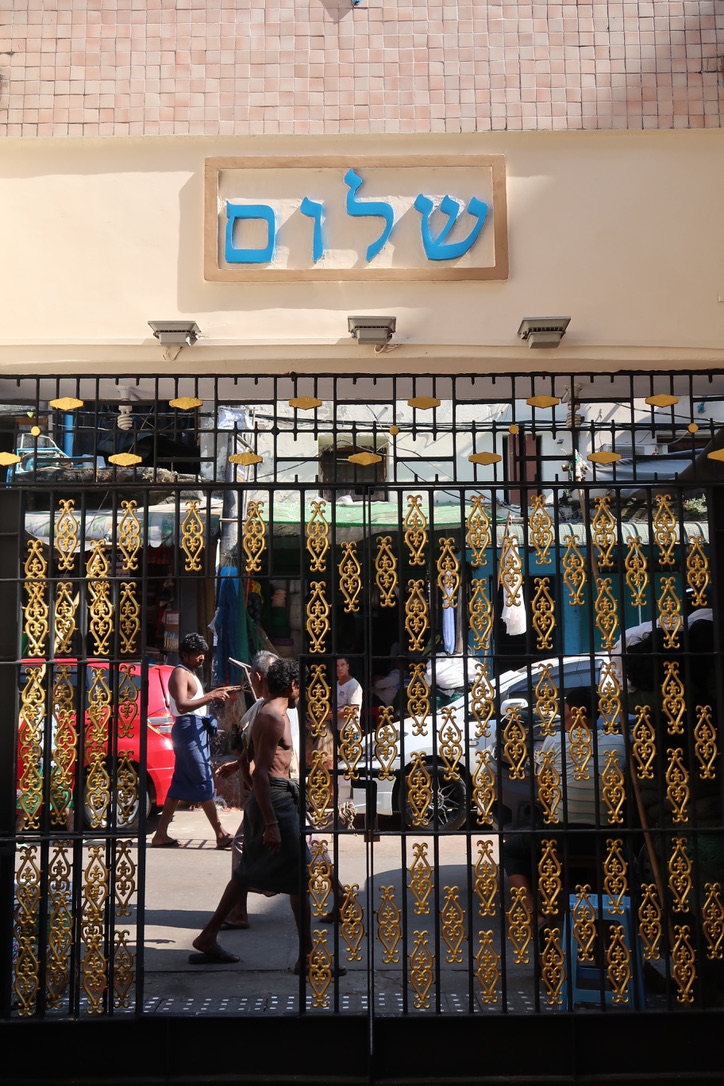
It was a longer and more messy walk than we had contemplated, but we got there… It is smooshed between an Indian-run paint and hardware shops and a Muslim shop. It’s about 120 years old – the Musmeah Yeshua Synagogue. It was open so we went inside. We were the only ones in there. It was cool and had ceiling fans so we sat for a bit. No fee, no security guards, no literature but there was a not too well put together exhibit about the building. They did have a little basket with kippahs.. Mike donned one. I did a little research and learned that Myanmar once had a thriving Sephardic Jewish community that arrived with the British from India, following the teak wood trade. There were about 2,500 Jews.. but most fled during the Japanese occupation and then the others left when the Burmese army took power in 1962.

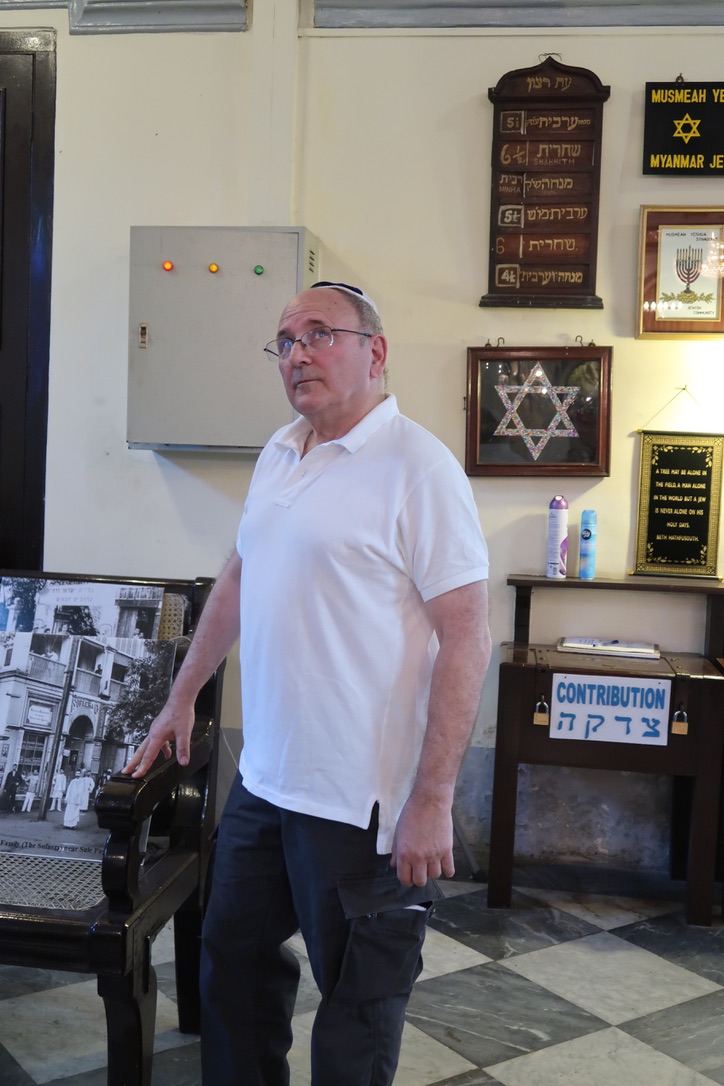
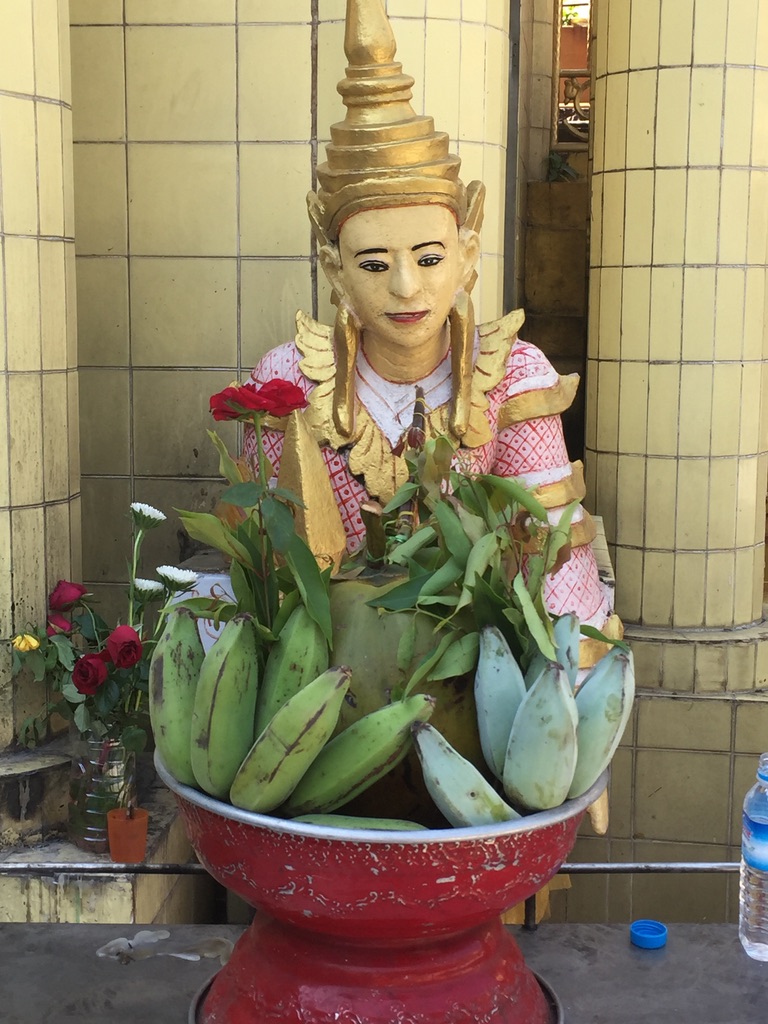
Now there are just 20 Jews spread out across the county…. But, as Samuels says, there is hope for preserving the community and the important role it had played in Myanmar’s history. But according to the article I read, the relationship between Muslims and Jews is good (and that seems to be evident when you sense that the area near the synagogue is populated mostly by Muslims.
Then we were in search for food. – essentially a good noodle shop… We thought we knew where to head, but we were really lost in the cacophony of the street life… Anyway, we were having a good time checking out tiny streets and moving about the narrow alleys and amid all the teeny shops. By the way, I think I know where all the e-waste goes! It’s sold on the streets of Yangon.
Along our “walk” we ran into a guy who asked if we could take his picture on this tiny street with all the shops and good around him. I said “sure” and then we learned (and met) that he is Indian, but his father grew up in Burma (we then met the father and the uncle and took a family picture for them. I’m guessing that maybe they lived on that street. The son, who lives in Mumbai is a banker (worked at JP Morgan for a decade and lived in London and Mumbai). We chatted briefly in the street (messing up traffic even more)… and then we parted.
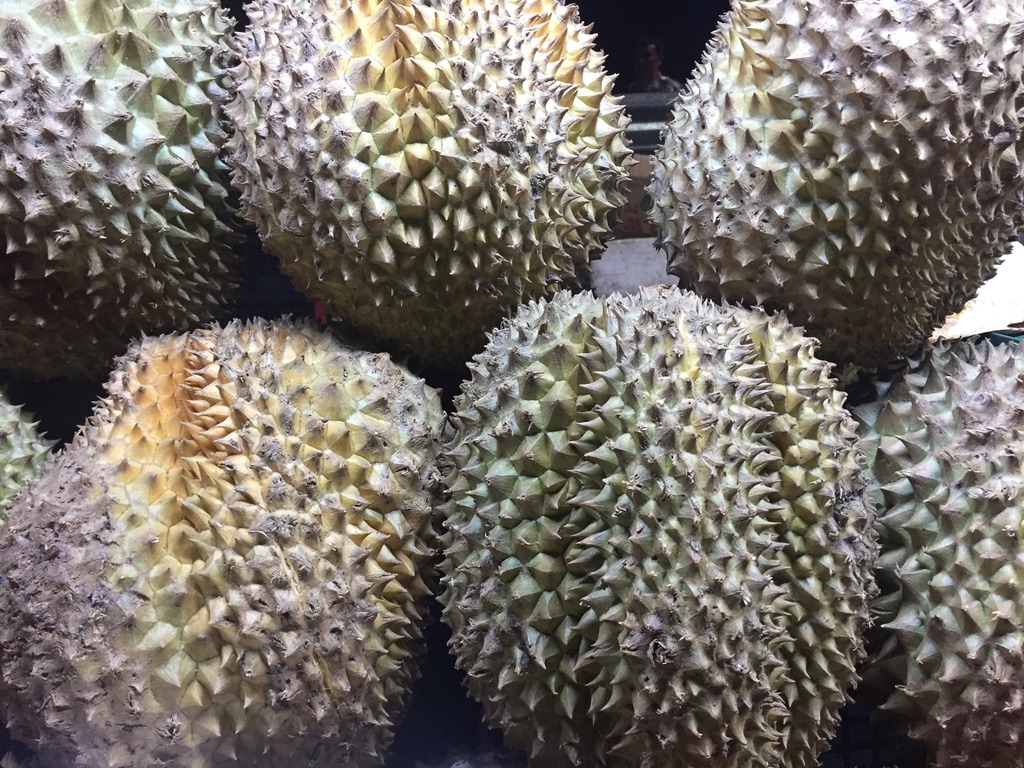

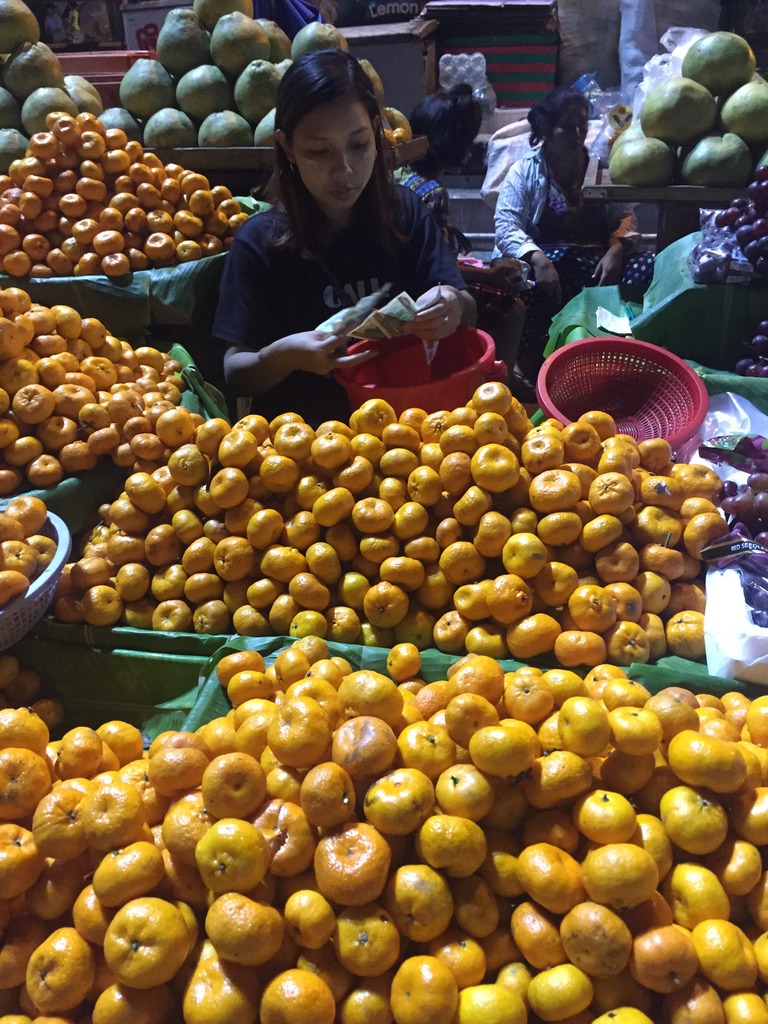
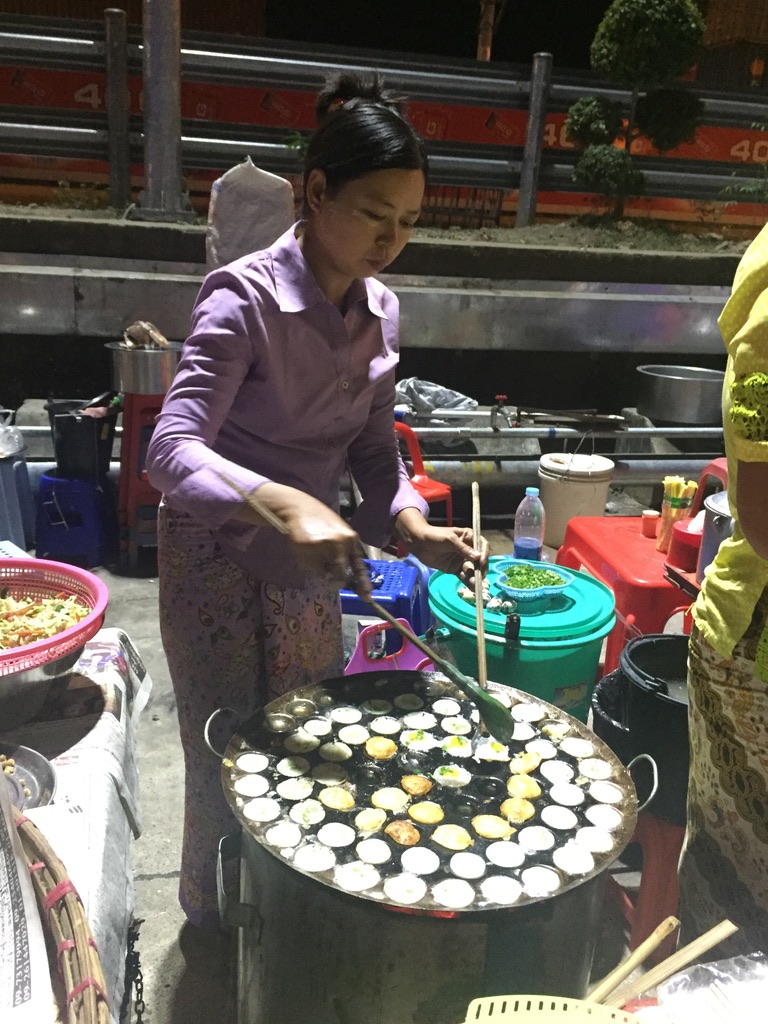
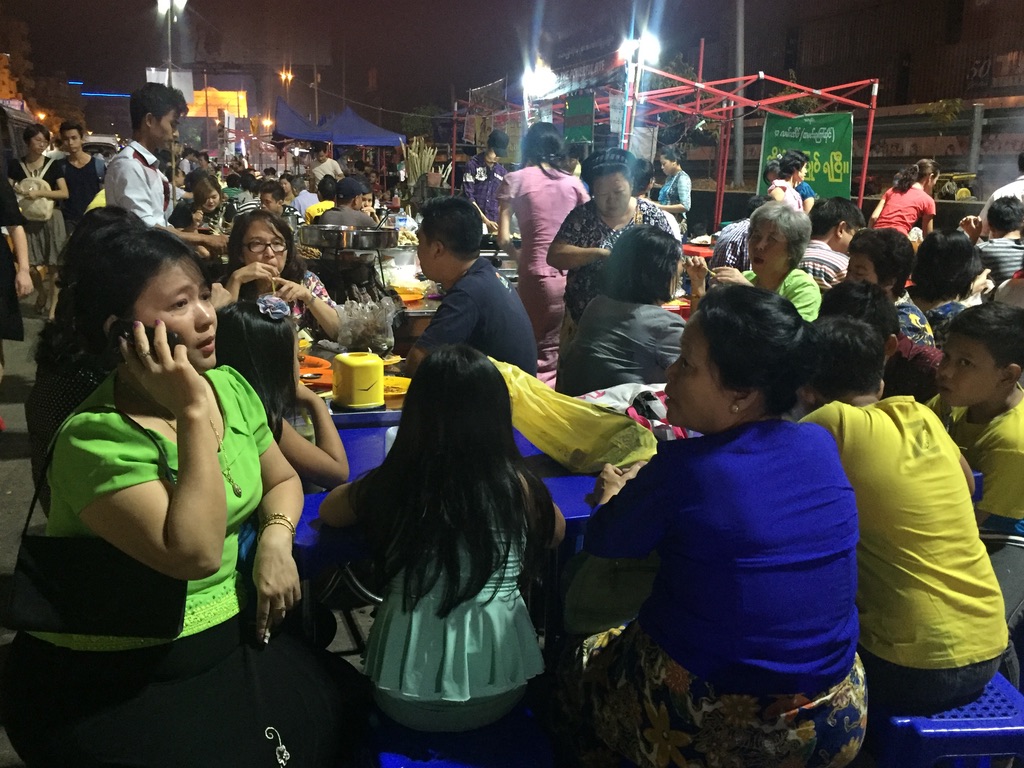
never did find the noodle place and by 3:00 we were hungry, tired, dripping wet, hot, and ready for a taxi. We decided to just eat a late lunch at the hotel.
Mike is resting and I’m writing this and then moving on to deal with purchasing new printers for the new office (the wonders of the Internet), getting my flights for January and February (Oakland – Seattle – Oakland) and working on my syllabus for Winter Quarter. Doubt that I’ll get to all of it today, but I need to start devoting some time to it each day…
Tonight we will go to the Night Market and then find a place for dinner in that area.
Best..
Fern
PS – Sorry for the length. Read or toss!
Final missive from Tokyo. December 21, 2016
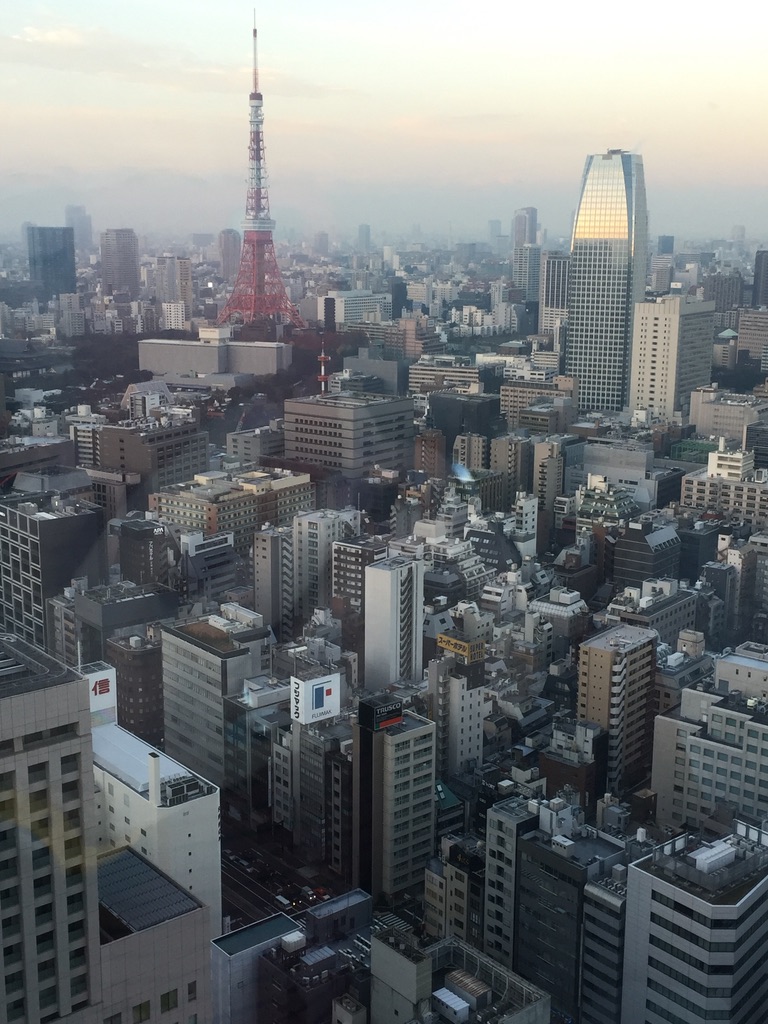

This morning… following breakfast, Mike took the subway to the Train System’s Lost and Found which is located at one of the stations, and as mentioned in the previous post… retrieved his computer bag. While we were completely amazed, no one else seemed to be, although I did detect a bit of relief from the hotel staff who I assumed worried that perhaps it might not have been turned in. OK.. Mike is “whole.” As he went his way, I decided to walk from the hotel to the Ginza – about 15 minutes from the hotel – half of the walk was on pedestrian bridges that connect buildings and enable one to ignore traffic. Once in the Ginza, I strolled around.. sort of 5th Avenue on steroids and a lot more side streets with yet more shops. Must admit I stopped into Yacco Marquand and did a little retail therapeutic work (just a little).
Mike called to say he was now en route back so he decided to meet me in Ginza and then we could start out to explore a few more neighborhoods. I said I’d wait at the shop (or close to that location) so that we’d have a meeting place. When he emerged from the subway he called to get directions to that location. From what I could tell (and what the sales person at the store could tell, using some kind of sign language since English was limited), he was one block away. He said he was in front of the Armani store. The sales person kept saying Alemany was close; took a while for me to figure out that she too was referring to Armani… Anyway, I told Mike to stay put and that I’d walk over there since I had passed the store on my stroll. I got there but no Mike… Called and he said he was still in front of Armani and that the Ginza station was directly in front of him. I too was now in front of Armani and the Ginza station was right in front of me.. OK… many Armani stores in the area and many entrances to Ginza station.
Finally connected and headed to Abazu neighborhood – a posh, quiet area with a nice mix of residential and commercial activities. Lots of local shops, restaurants, and nice scale – feels a little village-like. Must be upscale because we passed a lot of embassies and those guys always settle in the nicest neighborhoods! Apparently, it’s home to a lot of artists and during World War II there was some kind of underground space that sheltered some important people — including Yoko Ono! Stopped for some noodles for lunch and then headed to Aoyama, another neighborhood that again seemed pretty middle class/upper middle – frankly all of the neighborhoods seem solidly middle class or upper middle class. Strolled past many temples and shrines.
Took subway from the Moto Santo station to head back to our high rise area; had a birthday drink in the hotel bar which had a nice view.. and got ready for our dinner at Ginza Kojyu.. and the rest is history. Sorry we couldn’t make Tokyo (and actually Japan) a longer stay. Next time.
A few hours left until we land in Yangon; plane is only about half-full.
Will sign in from Yangon –
Fern
48 Hours in Tokyo — FOODIES ONLY. December 21, 2016
Greetings
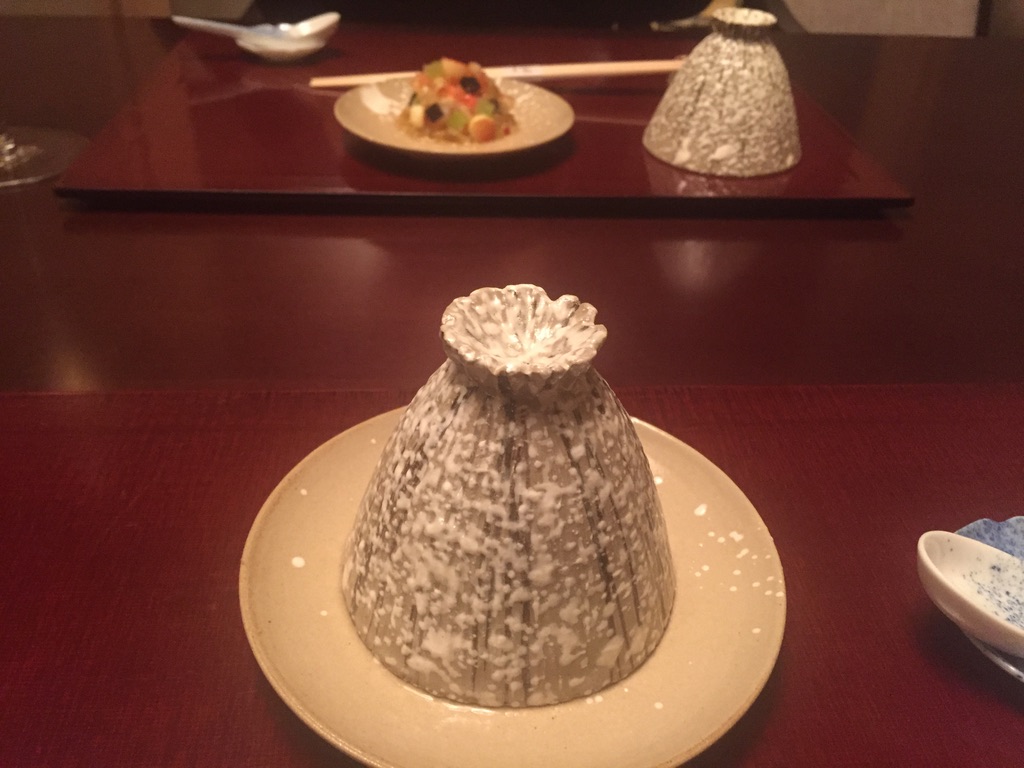
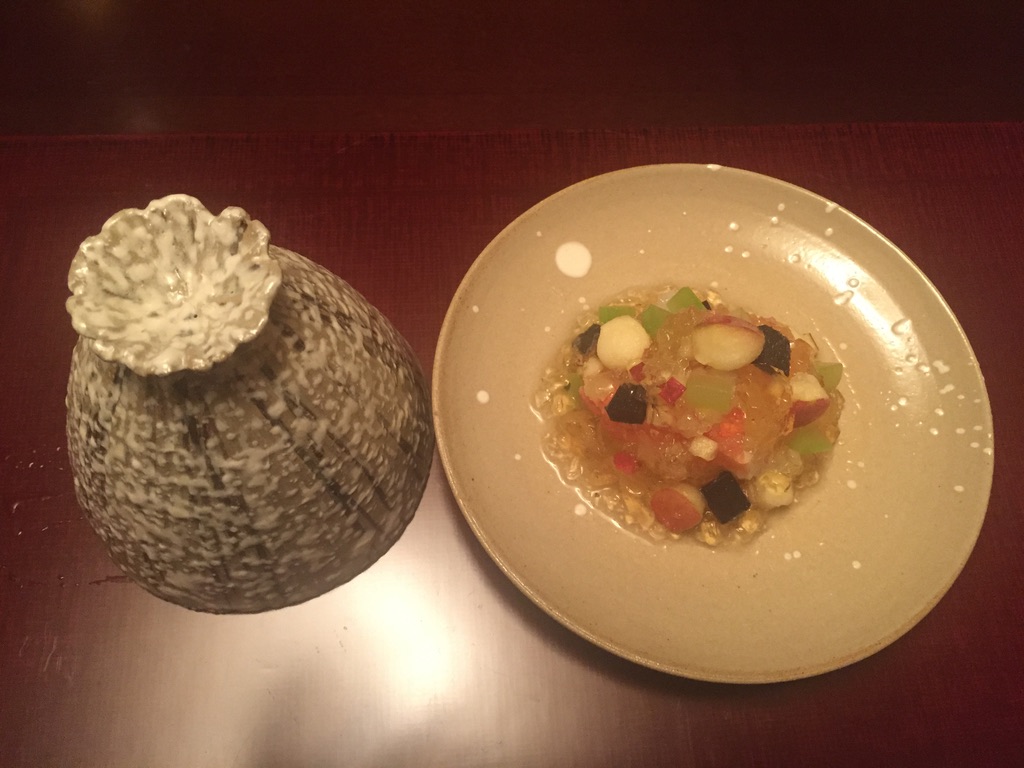
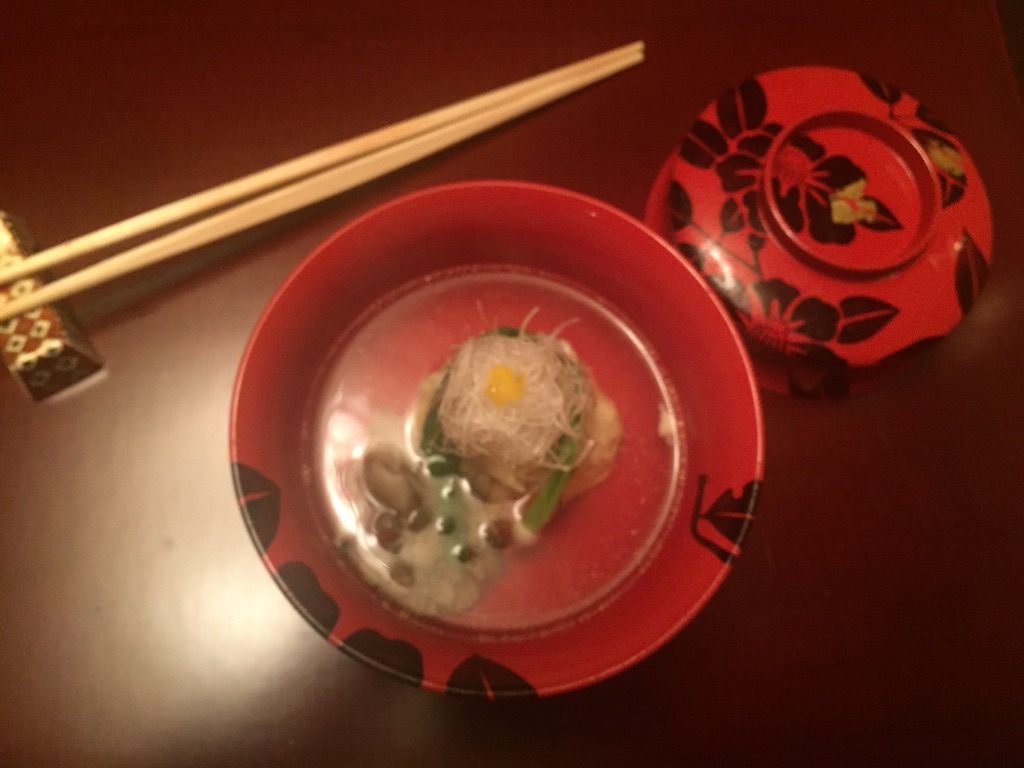

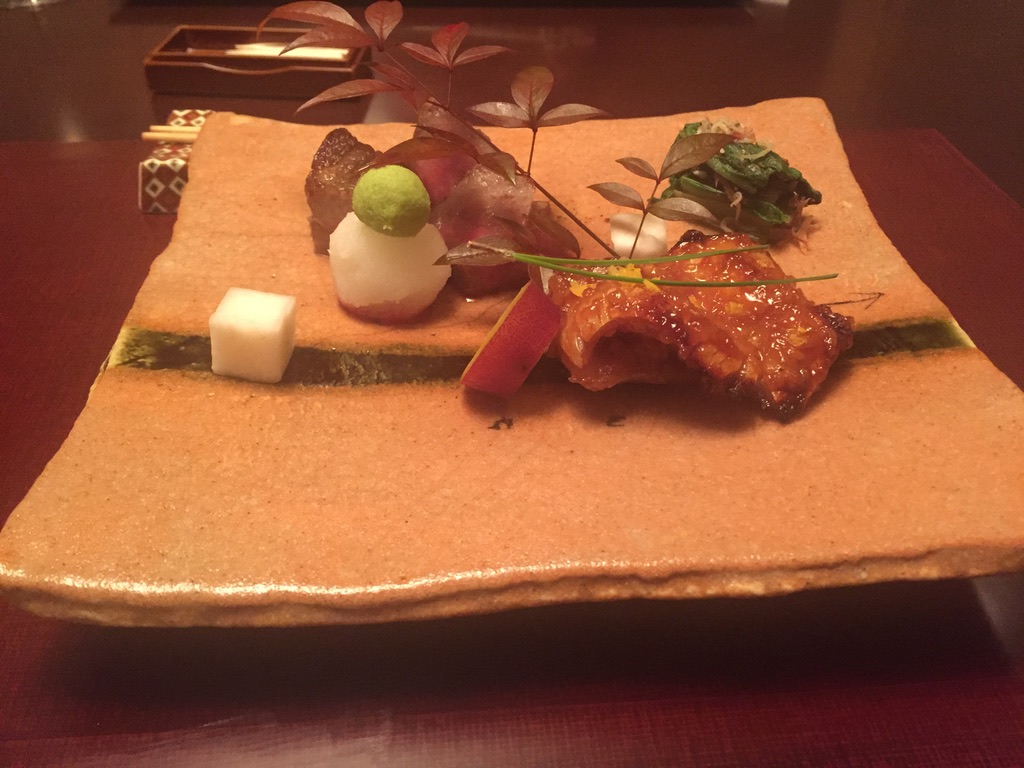
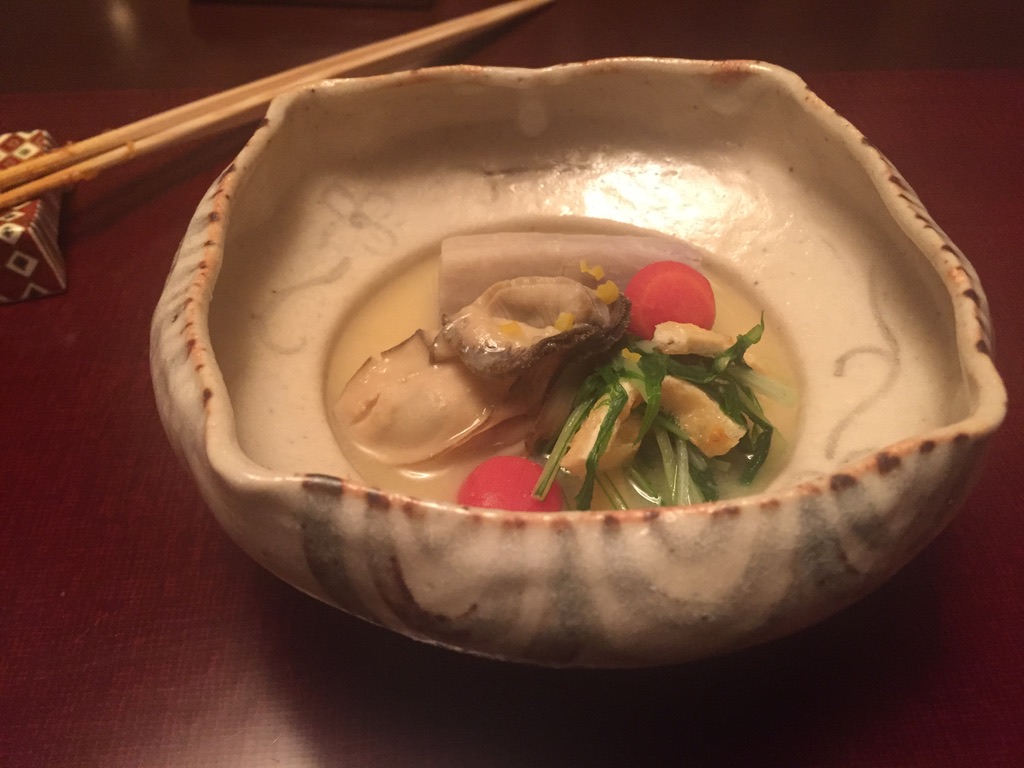
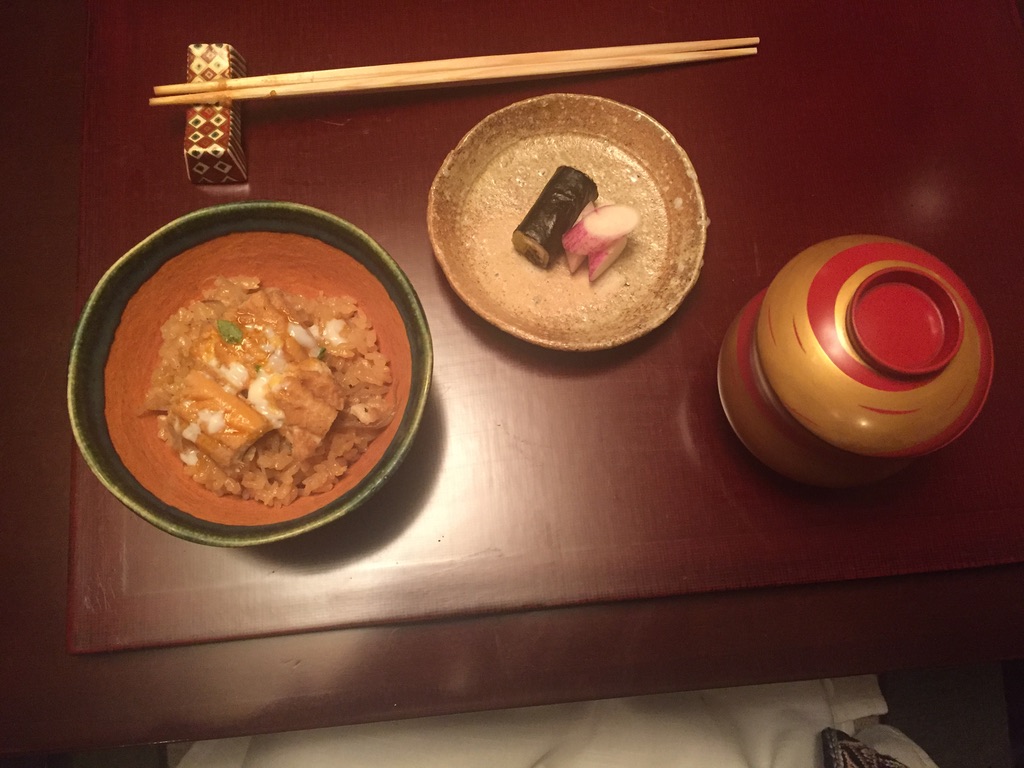
Just got back from Mike’s birthday dinner… This is truly for the foodies only.
We ate at Ginza Kojyu – a three Michelin Star restaurant.. and voted one of the top 50 restaurants in the world. Chef is very well known in Japan.
It’s apparently very difficult to get a reservation, but the hotel secured it. I tried for several other restaurants – rated high but not this high. And was unsuccessful in getting anything. But the hotel said there had been a cancellation and we were able to book… Not much choice for timing, but 9:00 was fine for us (we tend to eat late).
Took a taxi from the hotel, although we had walked to this street earlier… but taxis are quite inexpensive and it seemed easier. The restaurant did not disappoint. We had a little private room and our own server who kept popping in and out to assure that all was well.
The two and a half hour meal:
- Started out with champagne as we had the spiny lobster with tiny diced apple pieces and a few other ingredients including some kind of “gel’…
- Moved on to steamed crab in the shell with crab roe (which is a very dark rich brown color and very very fine granules… at this point we moved on to white wine).
- Then came a clear broth with an amazing scallop dumpling and some kind of chanterelle mushroom
- We stuck with white wine…. As we had the sashimi – melted in your mouth… tuna, “flat fish”, flounder, and mackerel… melted in the mouth… came with soy and wasabi for the tuna and mackerel and lime and sea salt for the white fish
- Next was a fish with miso glaze, a slice of baby yam… and wagyu beef slices (thick) and some green veggie. The beef was served with wasabi and soy… and the fish with the miso. There was also a pureed white radish
- Oyster with vegetables
- Broiled eel with brown rice and baby green
- Ended with a small trio of desserts: strawberry something… green tea flan, and yuzu sorbet – and tea
OK… This food section will not be in the daily report.
As we closed the place down at 11:15pm (on a Wednesday night)… although who would know since everyone is in their little private room…. We were introduced to the chef… Toru Okuda. I meant to get a photo of him with Mike.. but frankly was totally beat and maybe a bit high… Champagne, about 4 glasses of wine… and all that food.
Back at hotel.. packing suitcases and also a box to ship winter clothes back to California… It will be in the mid to high 80s in Myanmar. Don’t need gloves, boots, and sweaters!
Thanks for reading and commenting.
Fern
48 Hours in Tokyo (Part Two). December 20, 2016


Greetings from Tokyo –
At the moment Mike is en route to Ikebukuro (a neighborhood we visited yesterday, before knowing that that is the location of the main office for the train system’s lost and found) to try to reclaim his computer bag (if indeed, the bag the train folks found is really his bag as opposed to another person who lost a computer; couldn’t get information on the phone; Mike had to go in person), and I’m going to be heading soon for a few different neighborhoods so this message is likely to be intermittent.
By the way, if you do like knowing about my travels you can find daily journals to many different countries on my not-quite-published blog site (not fully published because I’m still putting up photos in my “spare” time.. so parts are sort of un-adorned – or at least many trips don’t yet have visuals. I tend to shoot between 500 and 1,000 images on each trip… remember I studied photography!.. so it’s a process of selection that never seems to find its way to my to do list)… Anyway the site is https://fernstravelnotes.wordpress.com
So, following breakfast at the hotel (to save time)… I had the Japanese breakfast; Mike just eggs… we began our day by walking through underpasses (the city has tons of underpasses that link buildings and subway stations.. and naturally it’s like retail heaven under there… with numerous department stores having their lowest floor level at the subway level… and then on bridges that go over freeways and create another set of above-ground street plazas) to get to the Tsukiji Fish Market.


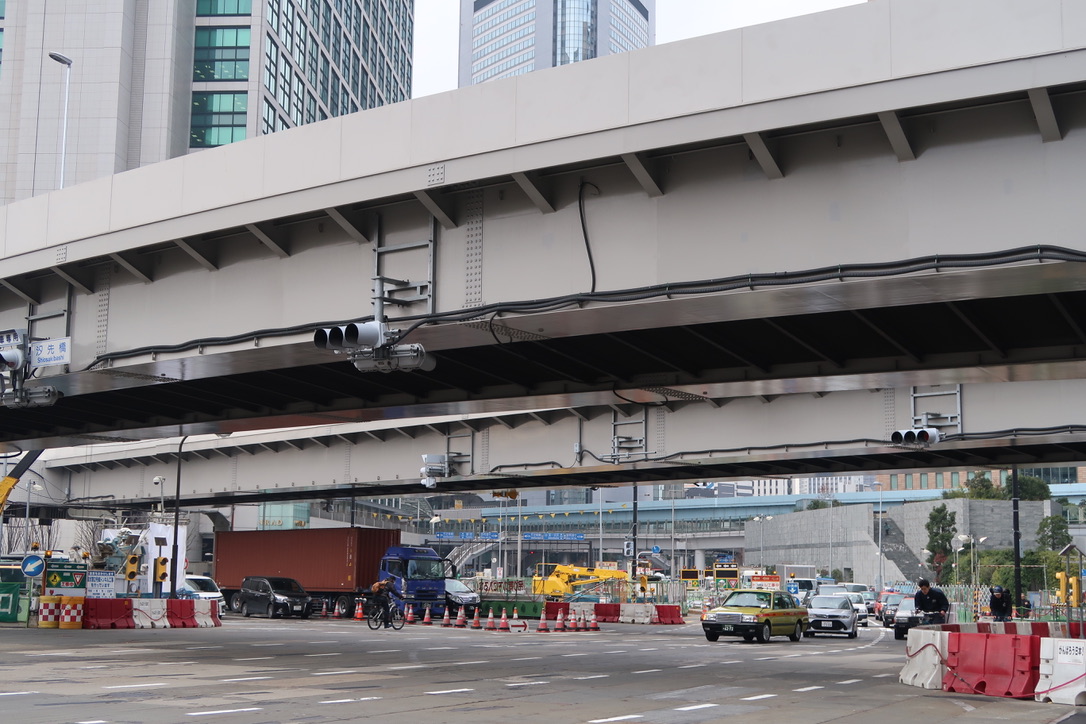
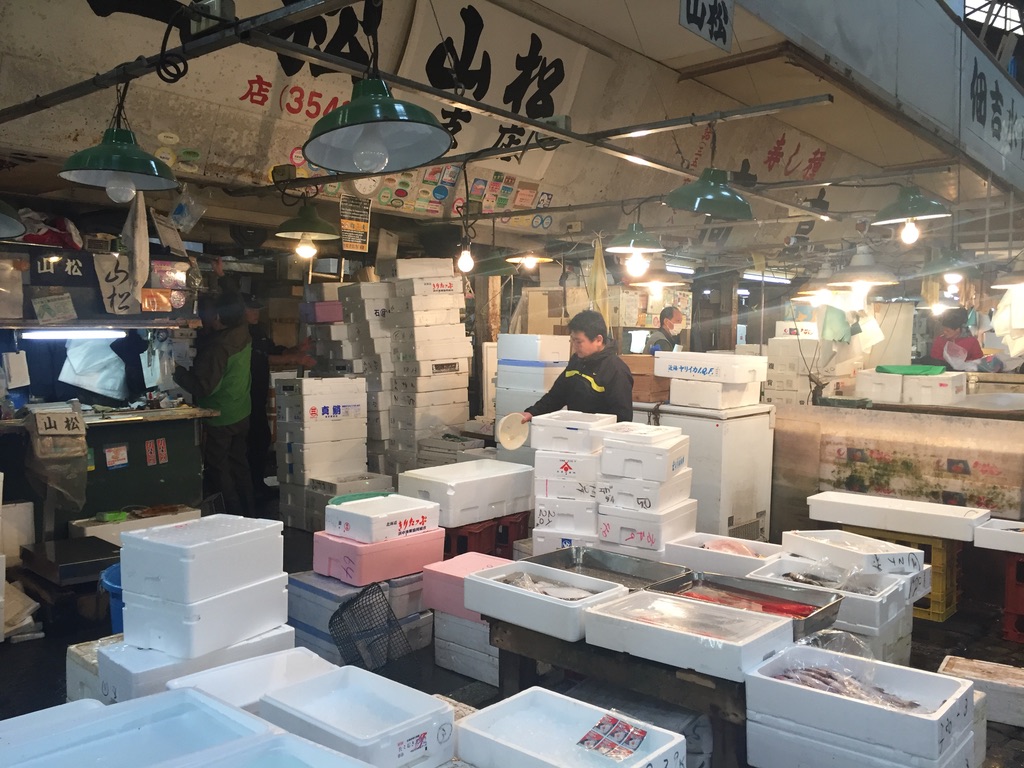
Didn’t quite get there in the wee hours of the morning when things are truly hopping with tuna auctions and the like, but early enough to still see some action. For those of you who know the Fulton Fish Market in NY.. it’s like that but its five times bigger… It’s the largest in the world (and Fulton is second). Strolled around and was tempted to stop in the tiny (4 and 5 seat “restaurants” that serve sushi to waiting lines of young people (and some older folks too), but we were not hungry yet (it was only about 10:30 am)..

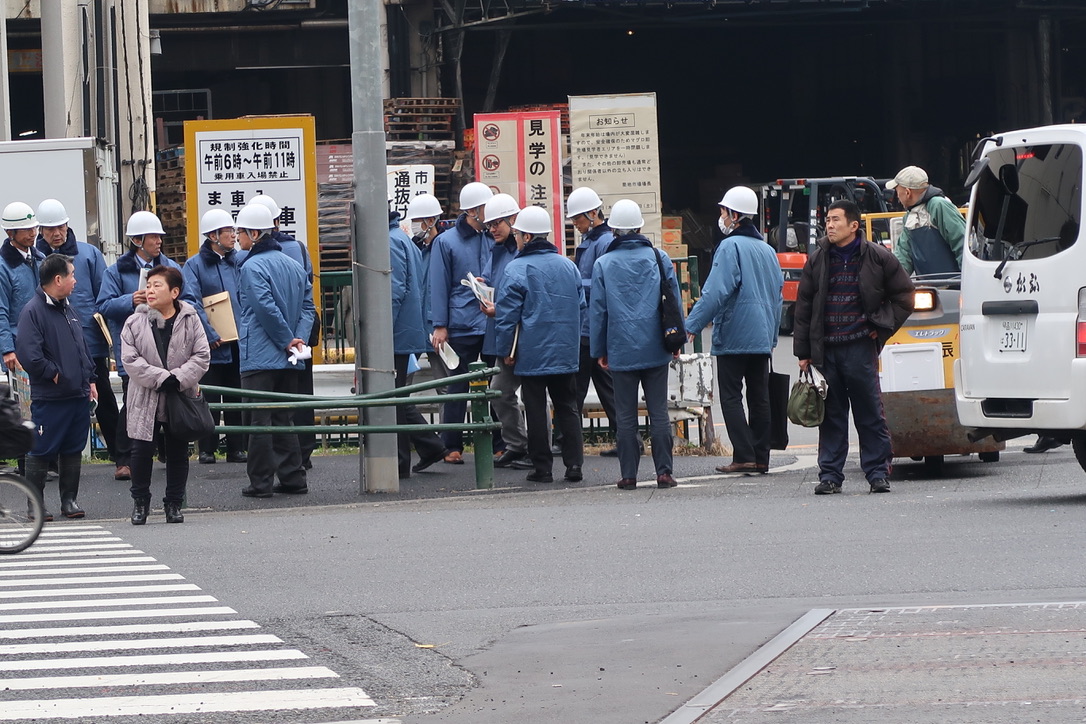
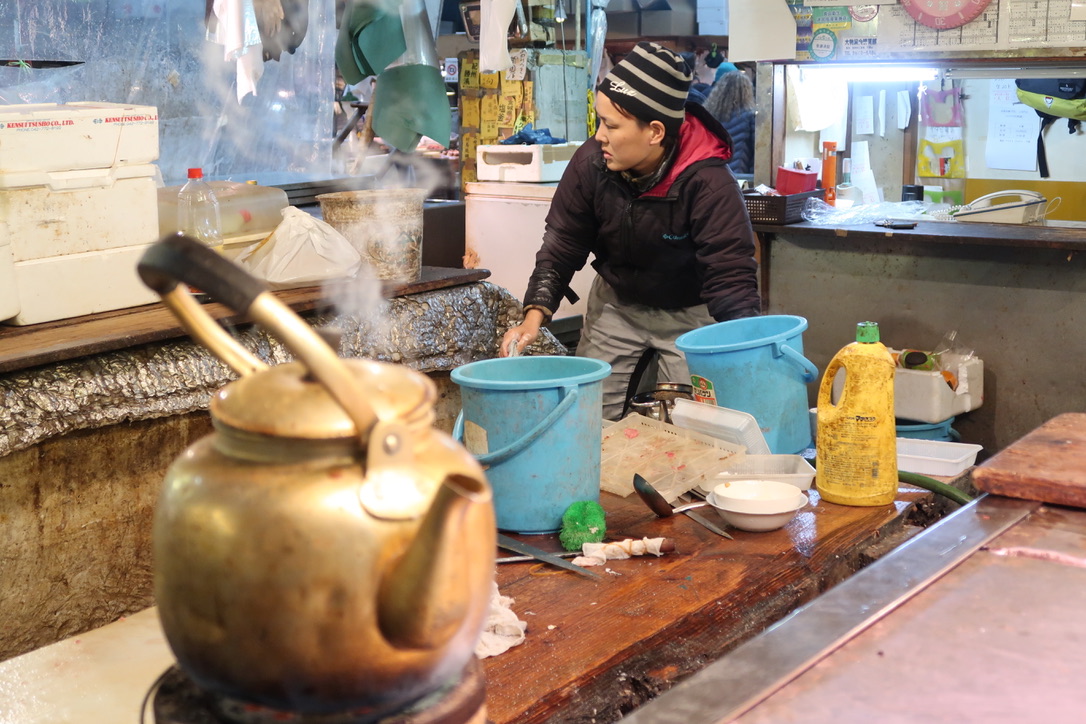
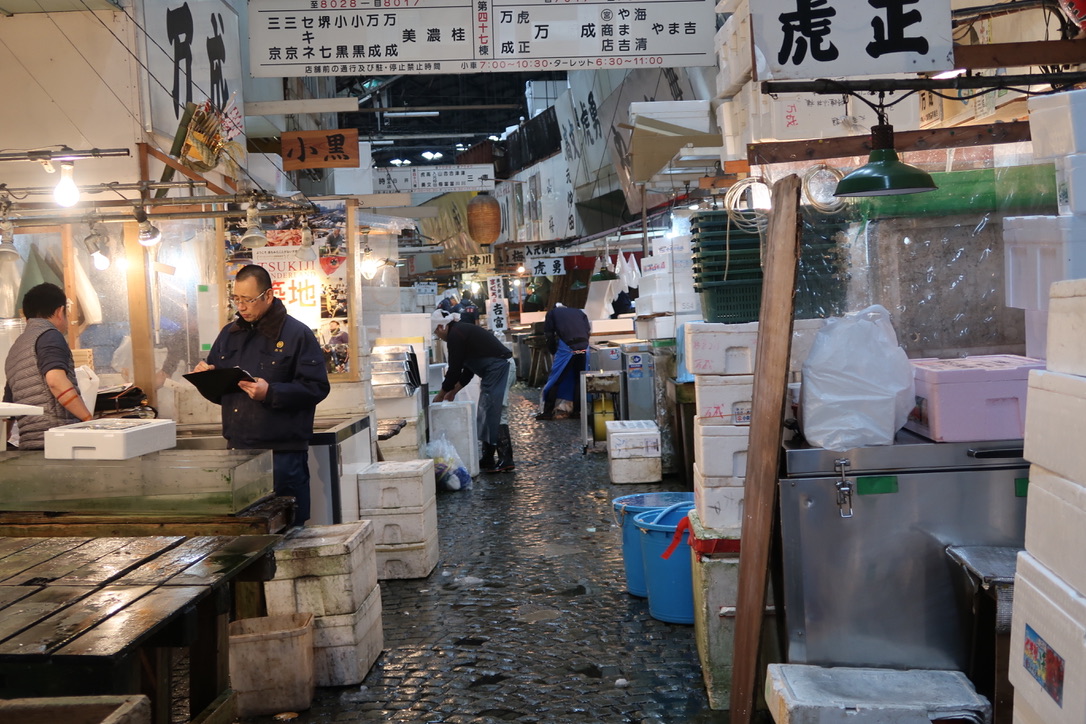
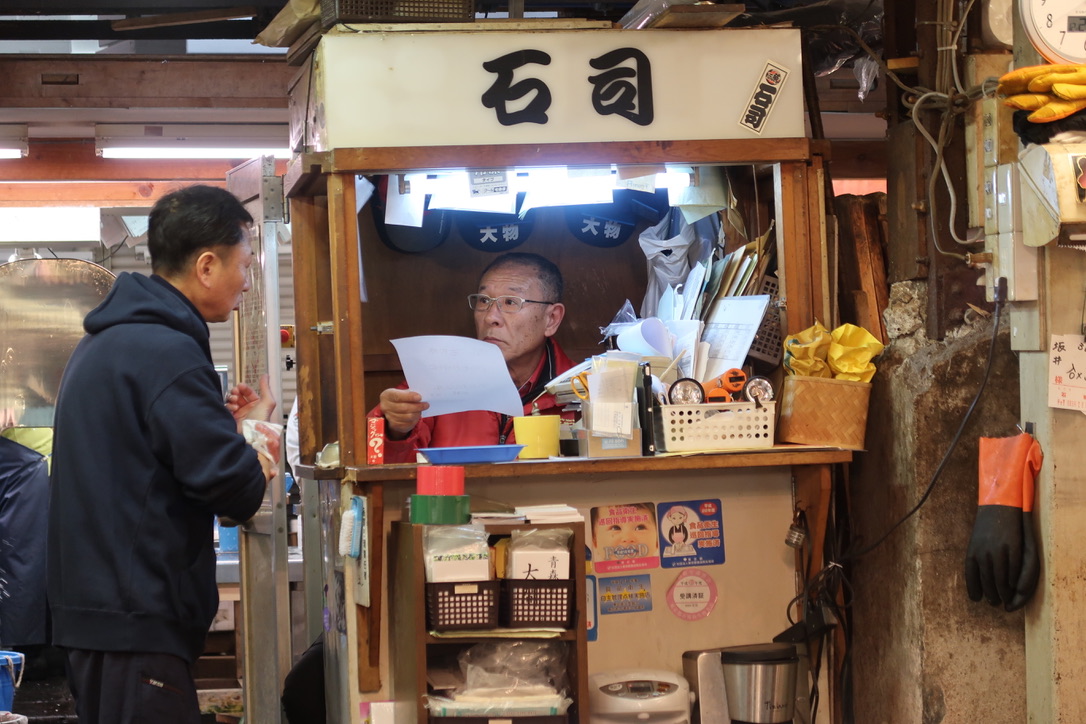
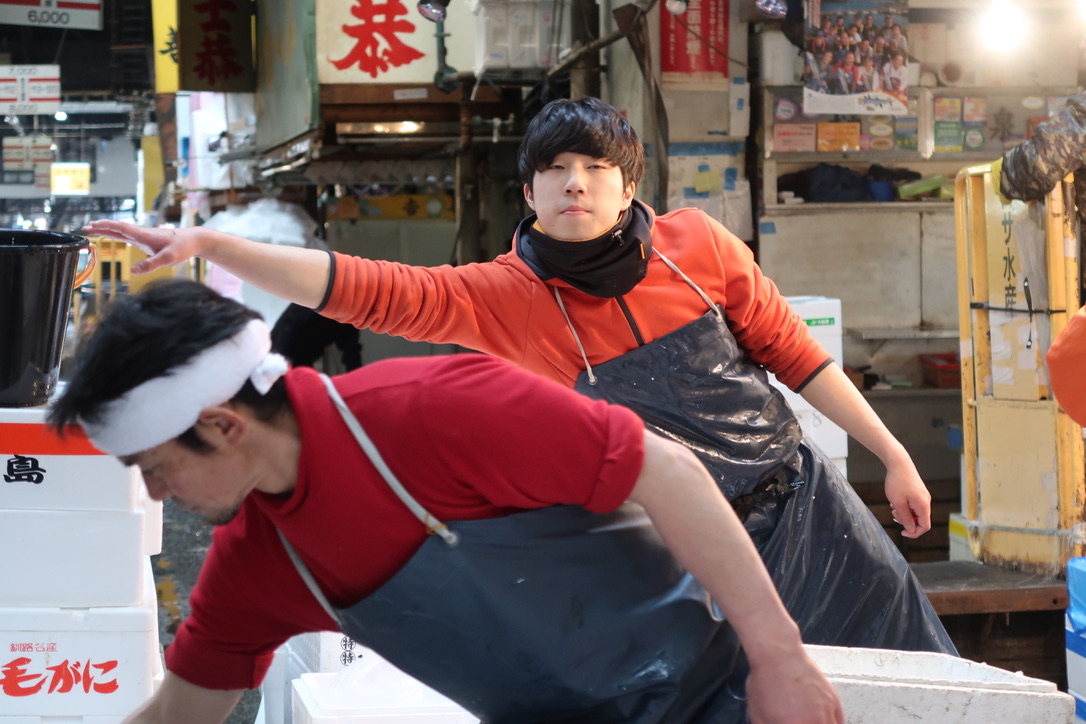
Walked to find the train station at Tsujiki and headed on the Hiibya line to Ueno. Given the short time here we opted to totally ignore museums and other famous sites, unless we stumbled upon them.. and instead to go to a variety of neighborhoods.. some because we heard of them and others quite random by emerging from various subway stops.
First neighborhood – after Tsukiji — we went to was Ueno. Naturally we got a little lost when we emerged from the subway… Asked several people, but English is actually less common than you’d think. I do think that many people know some English but are shy to use it (they learn it in school); but hey, my Japanese is “quite weak” or rather non-existent. Anyway, went into an optometrist’s office and while he didn’t speak English, we showed him where we wanted to go in the neighborhood and he gave us hand directions.
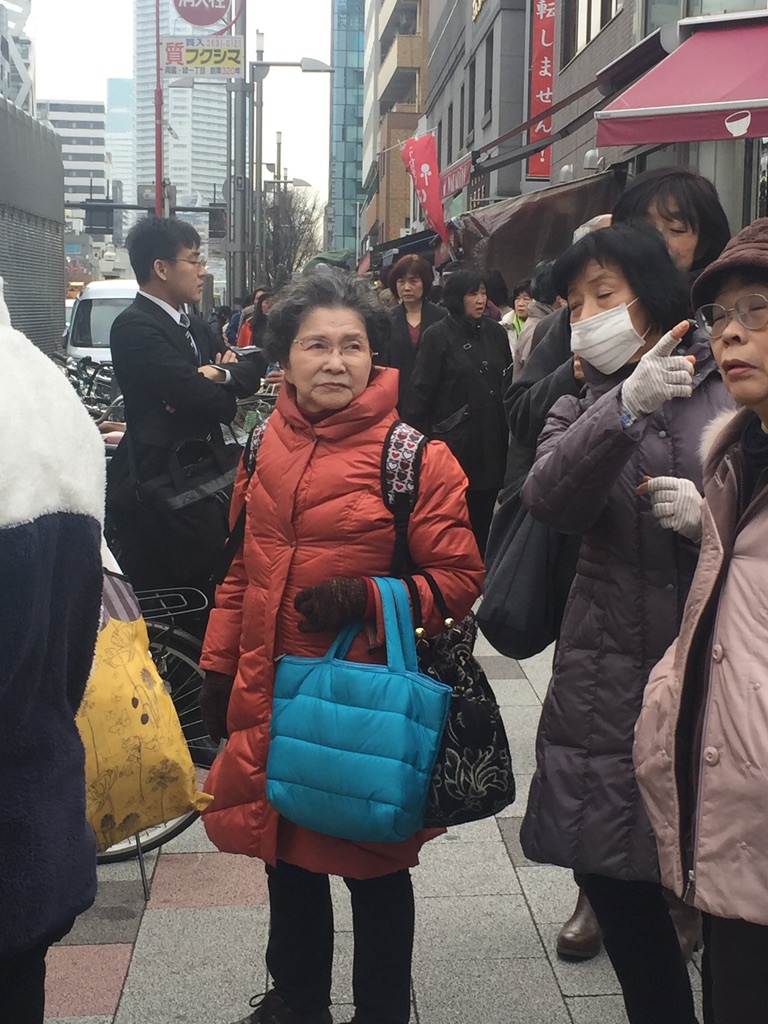
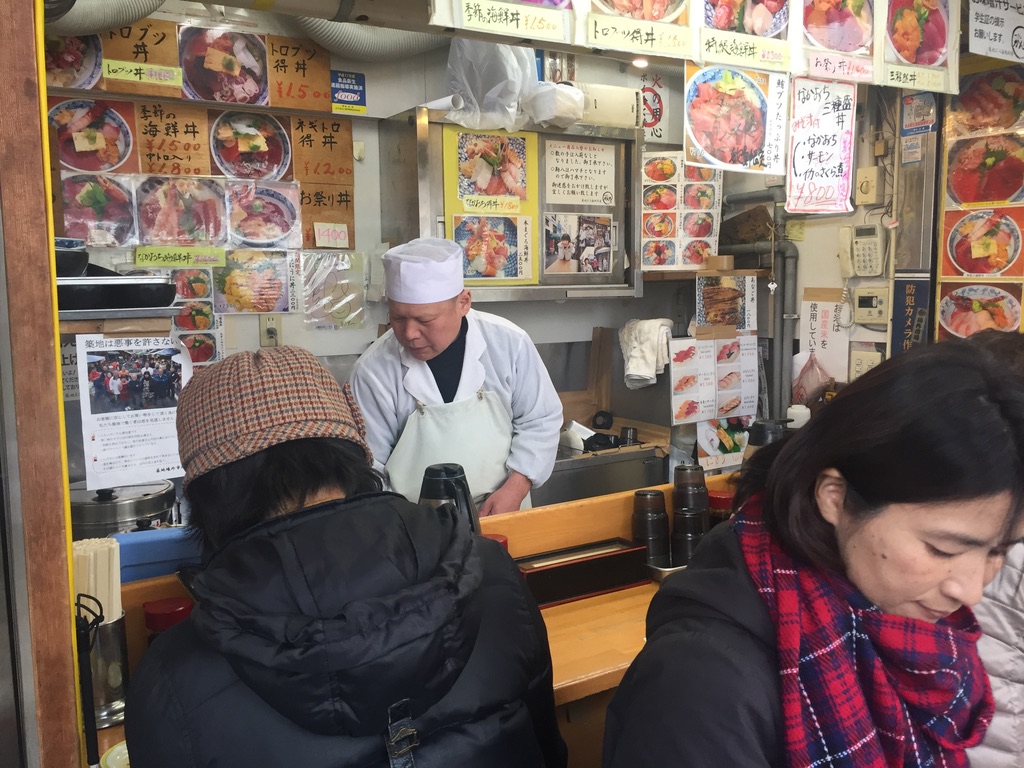
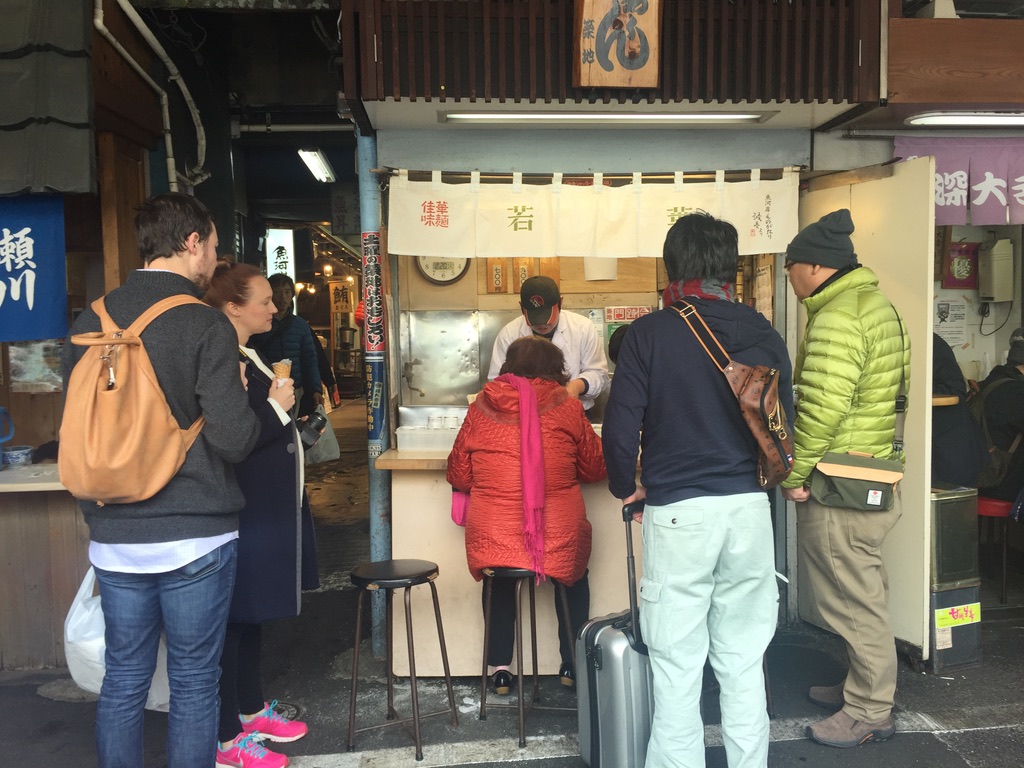

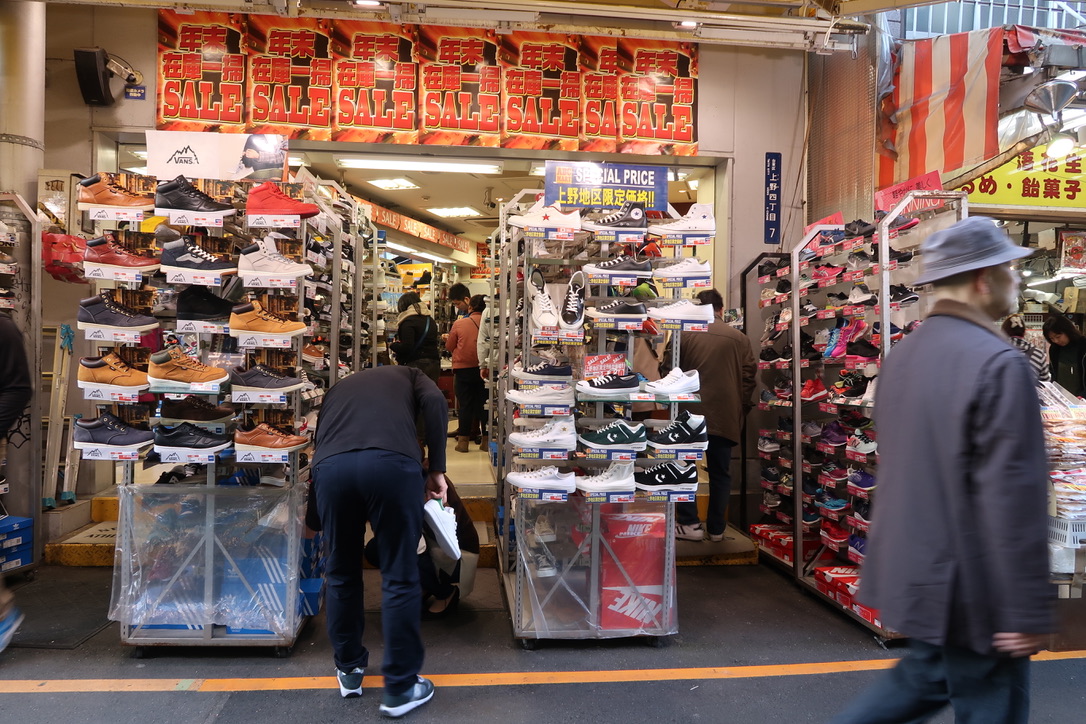

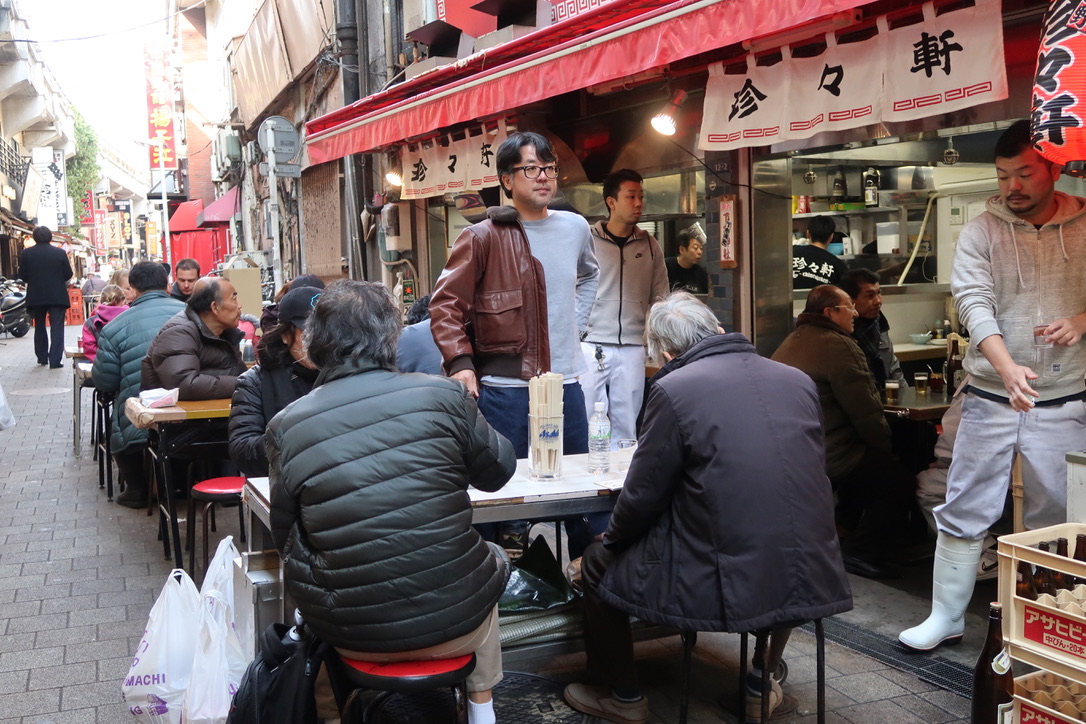
We walked a few blocks and wound up in this cacophony of tiny shops all or most under the overhead train. .. a busy market street that is under the Yamanote Train Line… that stretches from the Okachimachi and the Ueno stations. I think the street is called Ameyoko and it’s quite busy with vendors announcing sales and yelling about specials (or so I think). The area has apparently become known for its many candy shops – one next to the other… and also for lots of teeny noodle restaurants (we frequented one that was a bit larger than others.. our restaurant sat about 18 people. Yummy… Given that it’s so close to the holidays, lots of people were buying candy.
We strolled to the next train station and then headed to Ikebukuro, another neighborhood – this time we took the JR Yamamoto Line.. strolled around what has apparently been considered a very un-trendy neighborhood but is rapidly changing and it’s lower prices has attracted an artsy crowd to create some pretty bizarre cafes and foods and also an 8th floor place where you can watch cats get fed (!!?) We passed.
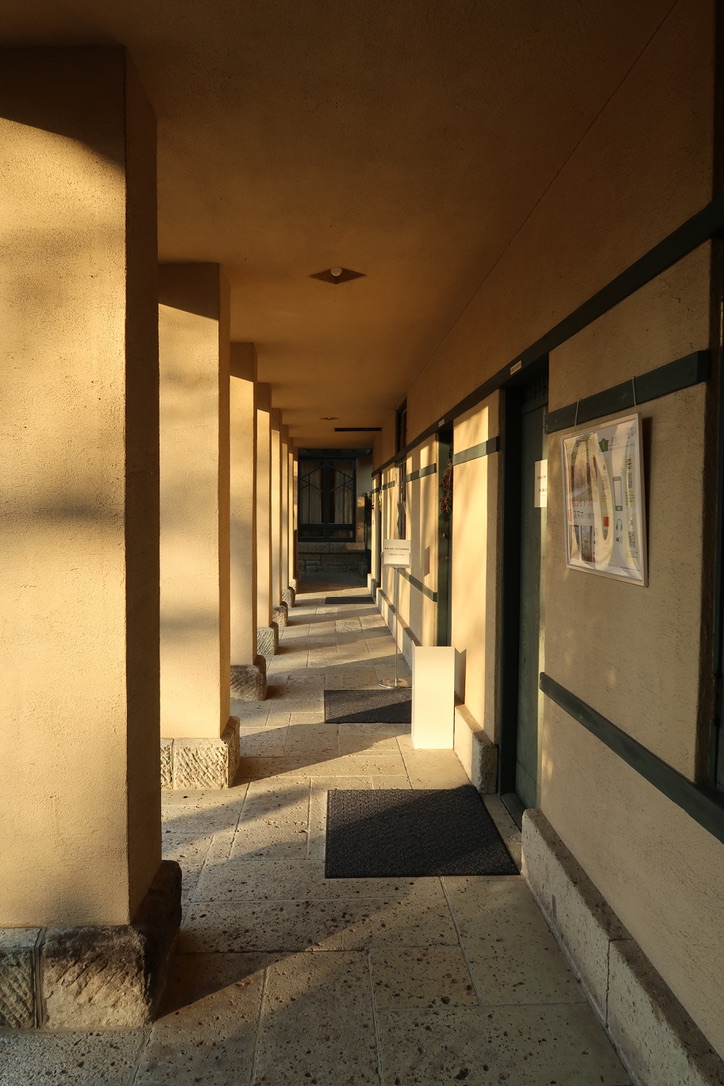
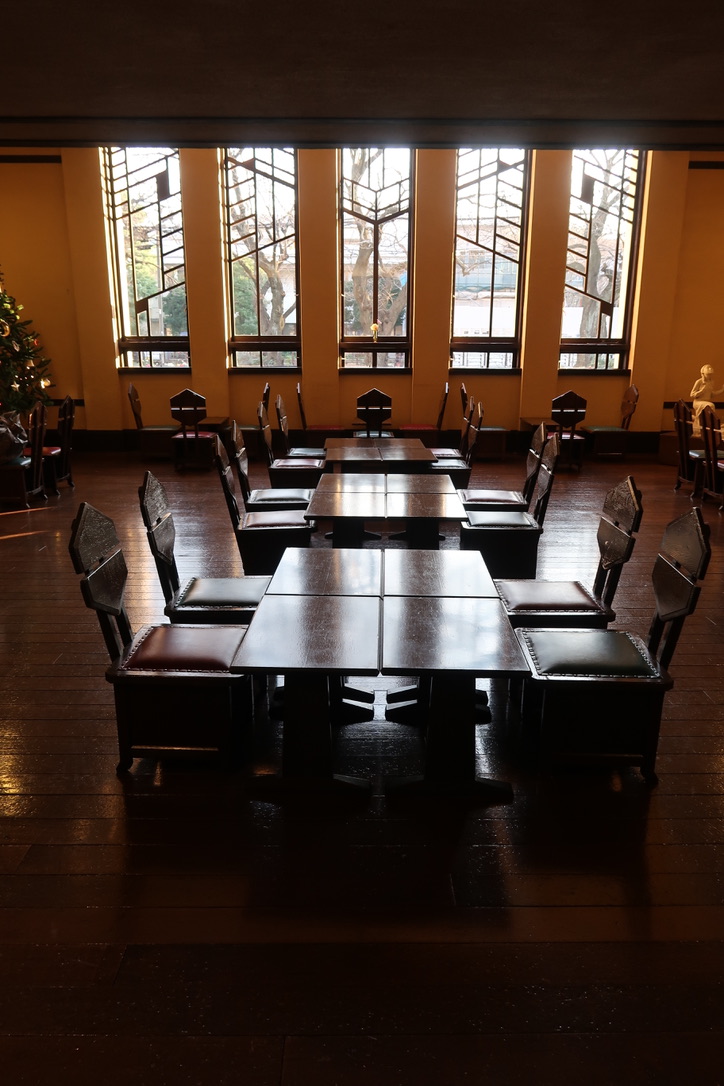

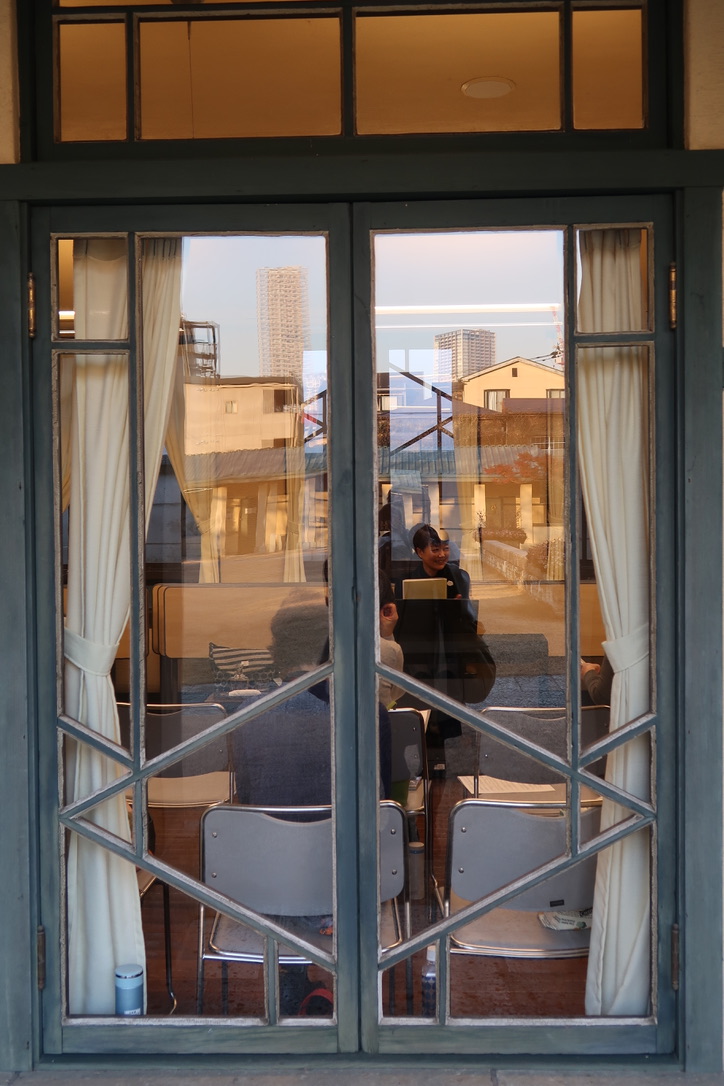
But as we strolled we saw some signs for Jiyu Gakuen Myonichikan – a former girls private school designed by Frank Lloyd Wright in the 1920s. It’s been restored (after having been closed) and is now open to the public and also used for weddings and other events. It’s really a wonderful example of Wright’s work .. there’s a dwindling number of buildings by Wright in Japan, especially the loss of the Imperial Hotel. We strolled the grounds and were able to walk freely within the building. I fell in love with the chairs in the dining room and learned that you could buy one for about $570… and I learned that in the states that chair goes for $1,000. A little above my spending limit, but they were fantastic.. dark wood with a tiny trim of lipstick red.. which was also on the matching tables. Great shape and wonderful proportions…
From there we strolled back to the station and headed to the hotel to be ready for dinner with friends.
We got picked up by Jun and driven to his parent’s house, now occupied by Jun’s sister. Jun’s father was a classmate of Mike’s at Harvard and we stayed friends all these many years. He passed away after a terrible battle with stomach cancer. We had drinks and snacks at the house and then headed to a fantastic sushi restaurant… near the house in the Jiyugokan neighborhood… with about 10 seats at the sushi bar (where we sat).. I was in heaven. We then strolled the small shopping district near the restaurant. The area is a sort of planned development from the 20s with a train station, buses, and pedestrian streets. Then we headed back to the hotel.. and collapsed at about midnight.
Since some of you asked, we are at the Park Hotel in the Shiodome area. The hotel is fine with nice public spaces. Rooms are small but OK… The hotel begins on the 25th floor of the building.
Tomorrow we head to Yangon, Myanmar… On the plane I’ll write the travel notes for Wednesday, December 21 – Mike’s birthday…
But I will tell you the good news… sort of like a birthday present for Mike.. He went this morning to the train’s lost and found at the Ikebukuro Station – they had his computer bag – everything intact. We are still in shock. Left on train, bag and computer traveled through the full line .. apparently several times, and no one touched the bag which was on the floor in front of the seat.. quite visible. That is truly not a NY or London or other city experience. !!
Until tomorrow..
Fern (and I’m told that I should be signing as : ファーン。マイク (which I think is actually Fern and Mike)…
December 19, 2016. 48 Hours in Tokyo en route to Myanmar
Kon’nichiwa. (Hello) from Tokyo

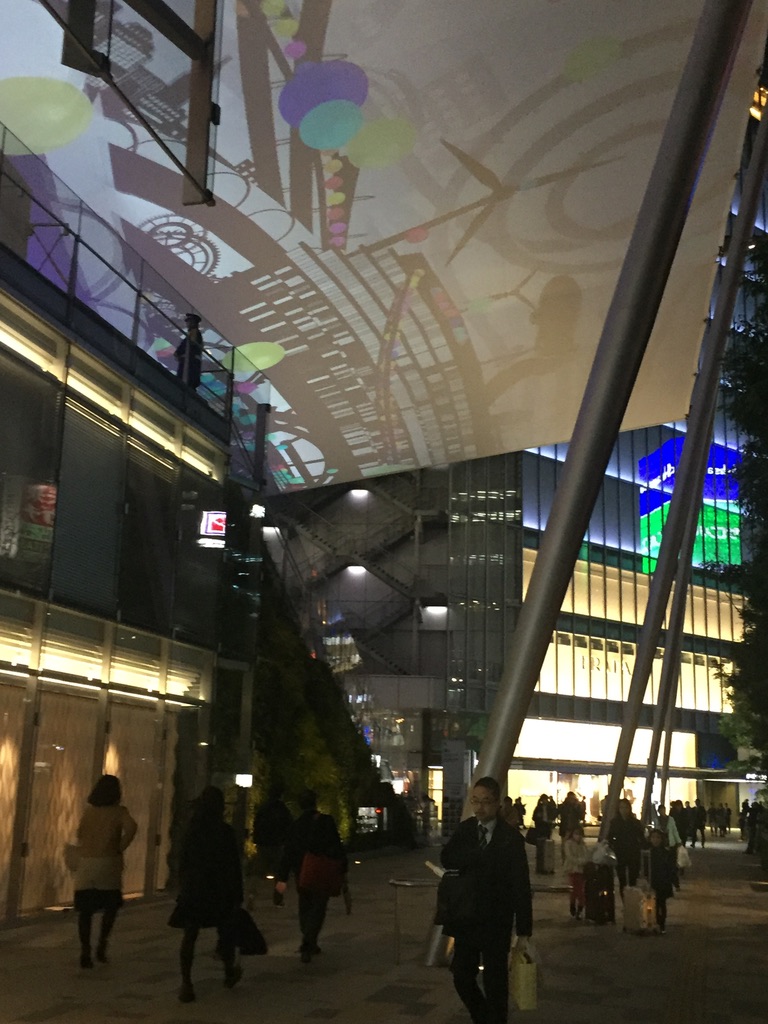
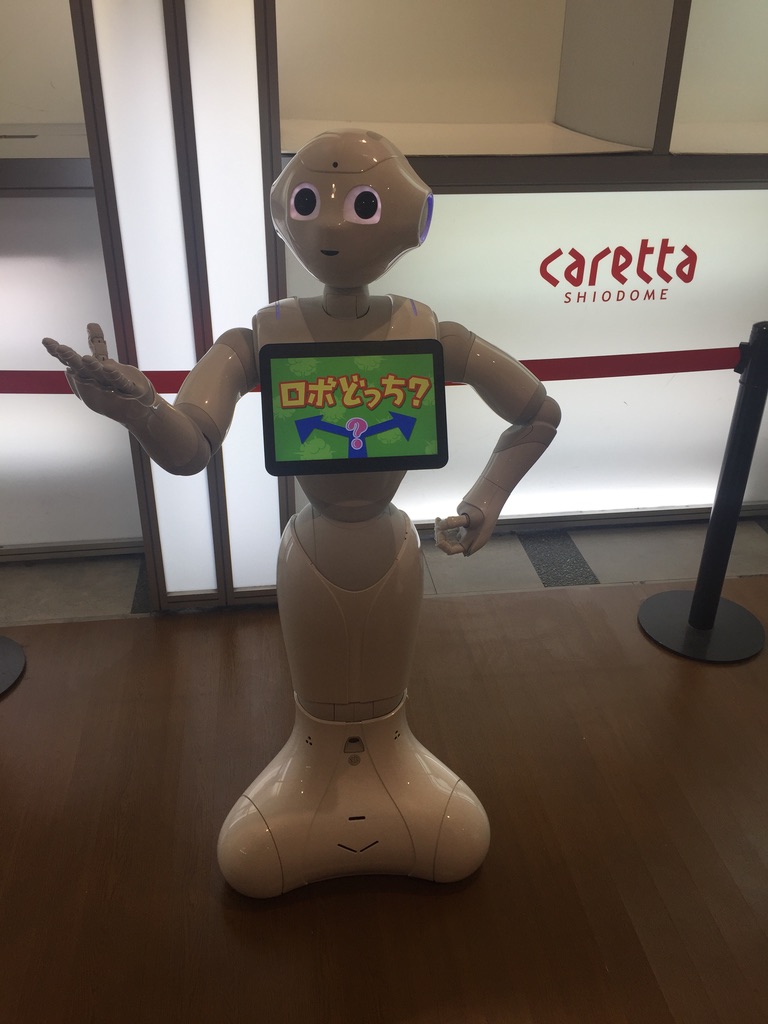
We are in Tokyo for just 48 hours as we head to Myanmar.
Long story – hopefully short version. We had long planned to go to Myanmar this December and decided that since we needed to come through Tokyo we should stop for 5 days or so, visit some friends, and see the city. (Believe it or not, despite having been to more than 55 countries, neither one of us had ever been to Japan (except to change planes and once for just a day between two cities in Asia)– thought about it often, but prices always seemed totally prohibitive. But this time we figured since we had to pass through we should bite the bullet and spend a little bit of time here.) But, as many of you know, a few months ago I decided to move my office in Oakland down the hall (same building) to a smaller space (cost of rent was getting ridiculous). But the date for the move was pretty squishy so I didn’t think much about its impact on travel, until the landlord found a tenant for my space and said they needed to take occupancy on January 1. That set my life into turmoil – projects that needed to be completed before I could travel, grades for my class, new projects to begin early in January… purging 13 years of “stuff” to be able to downsize into a smaller space, packing, moving computers and Internet and books; deciding what to keep and what to toss, etc.; not to mention hosting the annual open house event on December 9!! — the last one in the space we’ve called home for so many years.
So, we shortened the trip by about 5 days and most of that was cut from the Tokyo part of the trip.
The last two weeks have been unbelievable – working, purging, packing; 14-hour days. The Open House went well and the office didn’t even look like we’d actually be moving a few days later. I managed to lock myself in the laundry room on the day of the Open House, but that’s another story for another day. Just know I was locked in (along with my friend from Chicago) for about 2.5 hours.
But, I was packed and ready to leave for Tokyo and on to Myanmar by 3 am on Sunday morning and then after a whole two hours of sleep headed to SFO. The flight was remarkably relaxing. I managed to read all the final papers and do grades, watch a few movies, and work on a project or two.
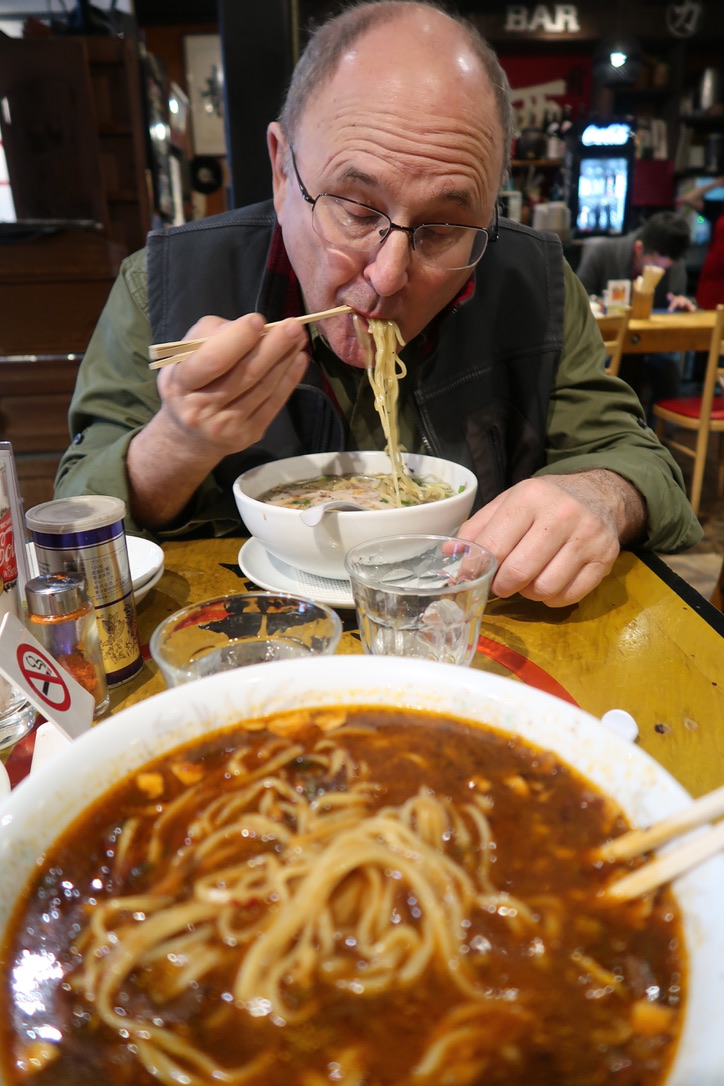
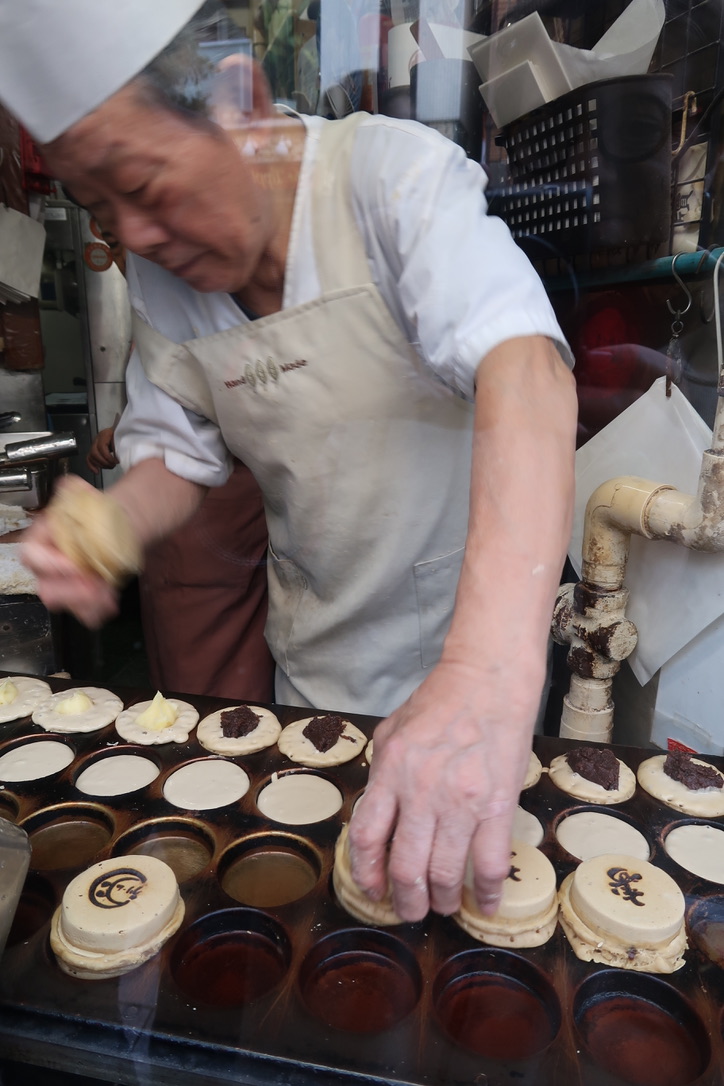
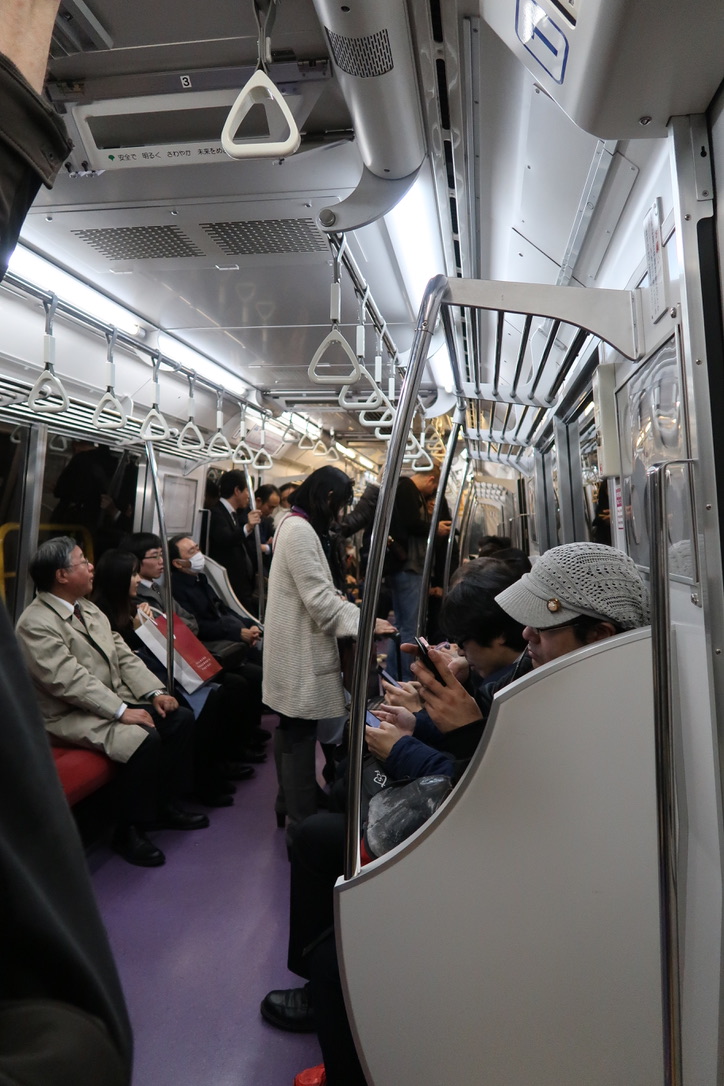
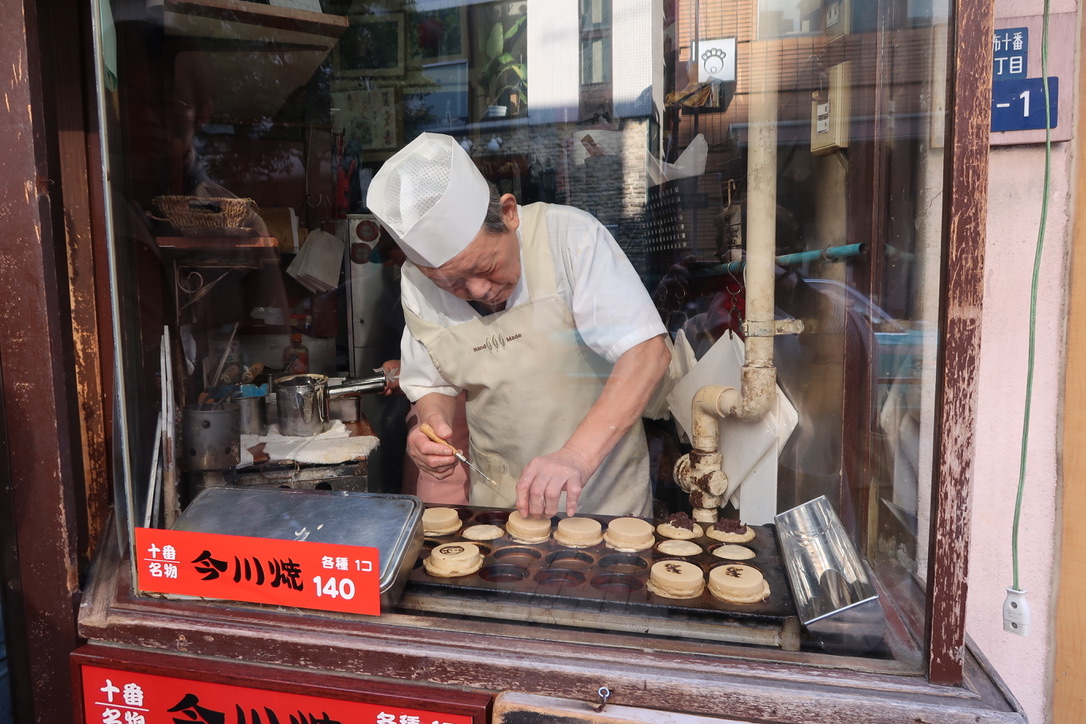
Arrived in Tokyo (Narita) at about 3:30 pm on Monday afternoon (Sept 19) and headed to the Narita Express (train) to Tokyo Station (about an hour). We opted for reserved seats so that we didn’t have to deal with finding empty seats; I think that was a good decision. By then we were pretty exhausted so when we exited at Tokyo Station we opted for a taxi rather than the subway to go the 10 minutes more to the hotel. As soon as we sat in the cab, Mike realized that he didn’t have his computer bag (small canvas bag that pretty much just holds the computer and some cords and a few pieces of paper (in this case, important papers like visas for Myanmar!) Realized we’d have to deal with this once we got to the hotel because the train had clearly left the station!
Checked into the hotel and immediately discussed our “problem” with the reception desk. Hotel called the train company and the station. Nothing would be known until 24 hours (Tuesday afternoon) because of the train route and when it finally pulls into the station to end its run. Had to be patient.
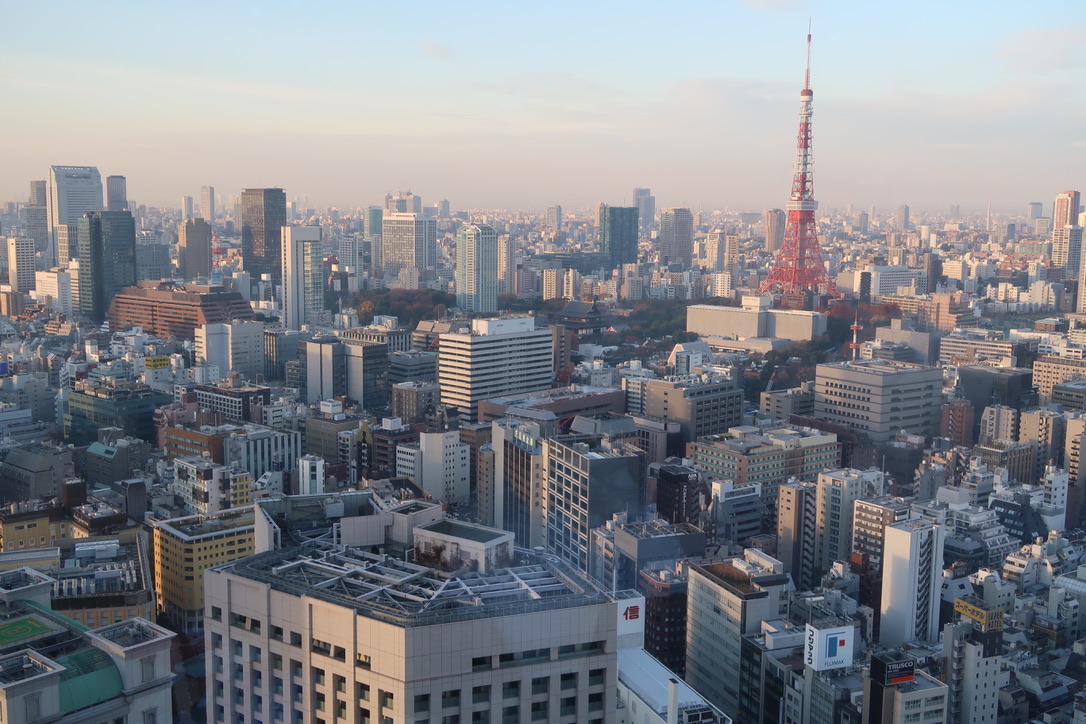

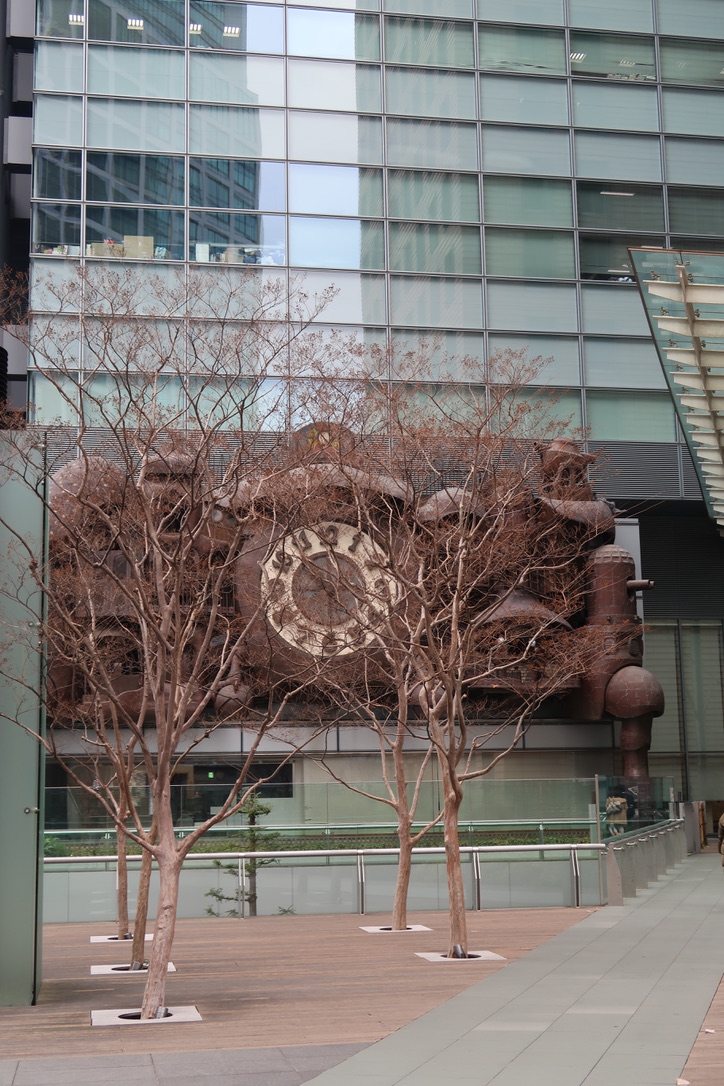
Until tomorrow..
Fern (and I’m told that I should be signing as : ファーン。マイク (which I think is actually Fern and Mike)… planned to tell you what we did today (Tuesday) – our first real day in Tokyo, but I’m beat. It was a truly long day and it’s nearly 1:00 am now. So, tomorrow will begin my tales of our 48 hours in Tokyo.
Send good vibes to Mike for the recovery of his bag and computer.
Oyasumi (good night)
Fern
September 8 and 9, 2016. Dublin; Dublin to London
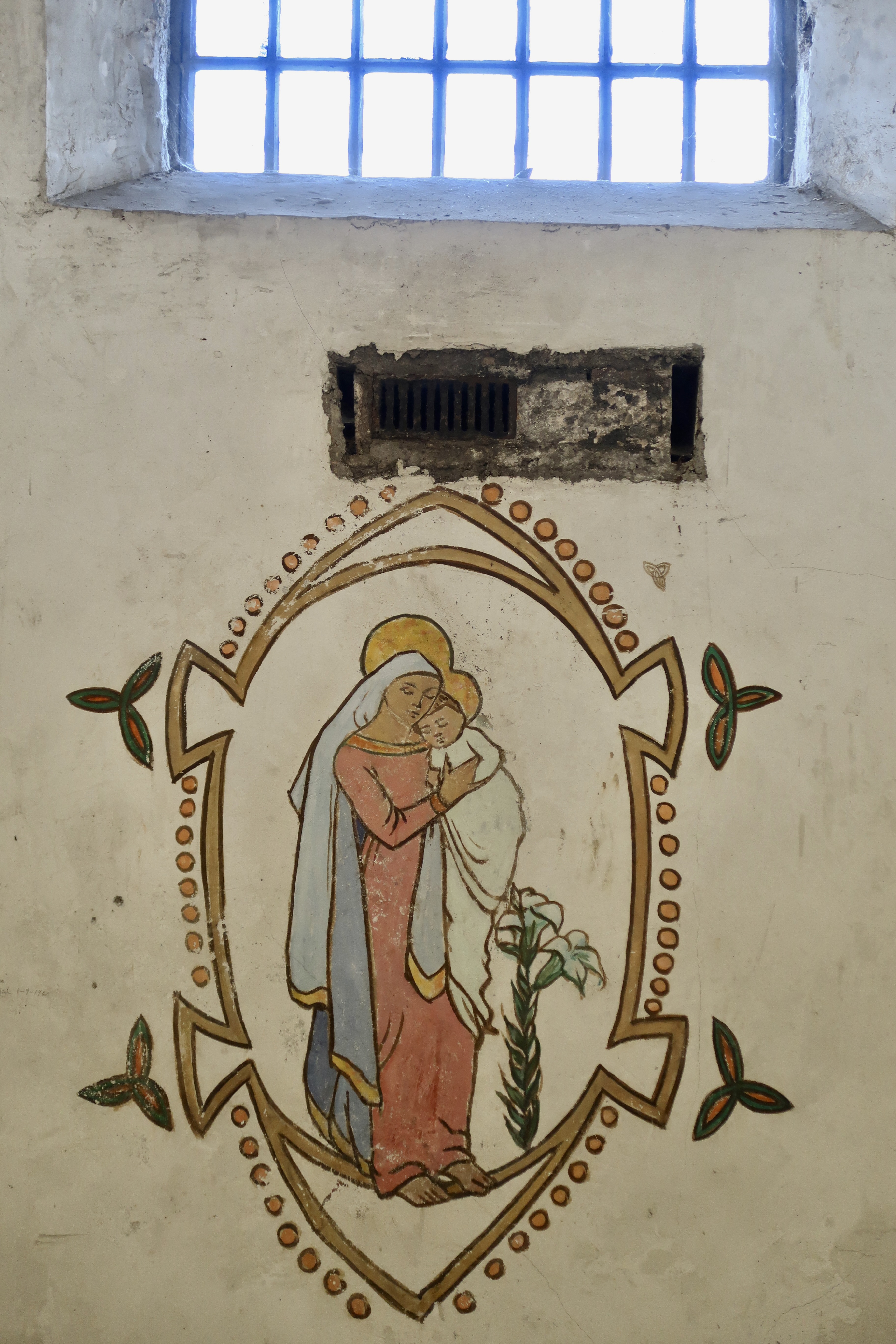
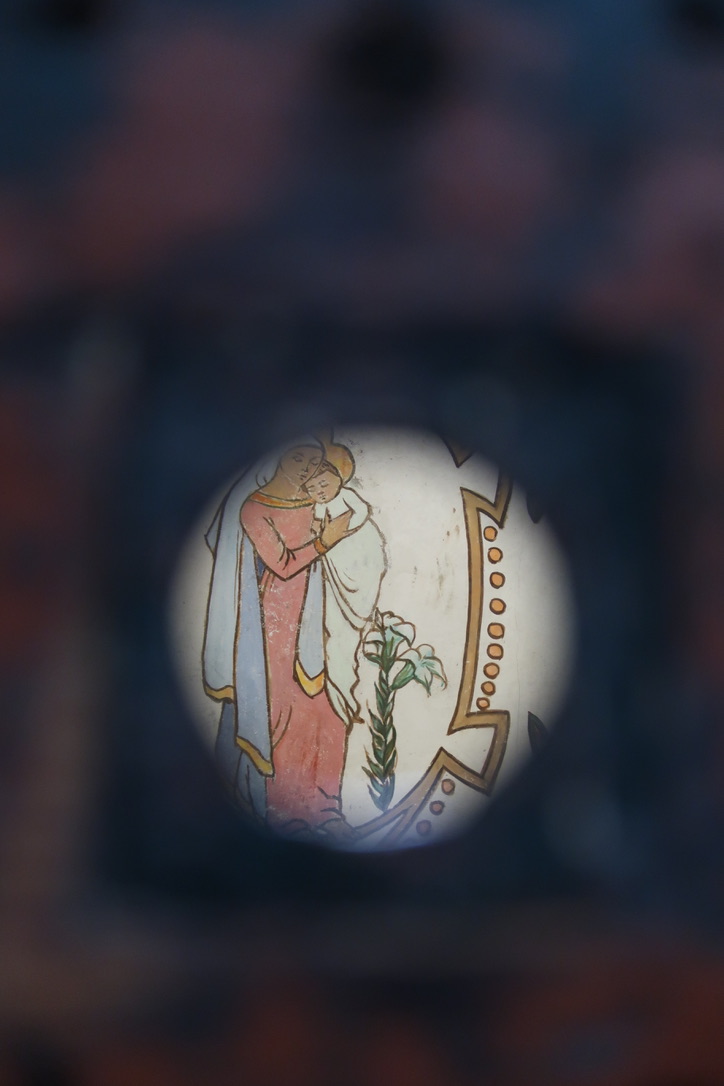
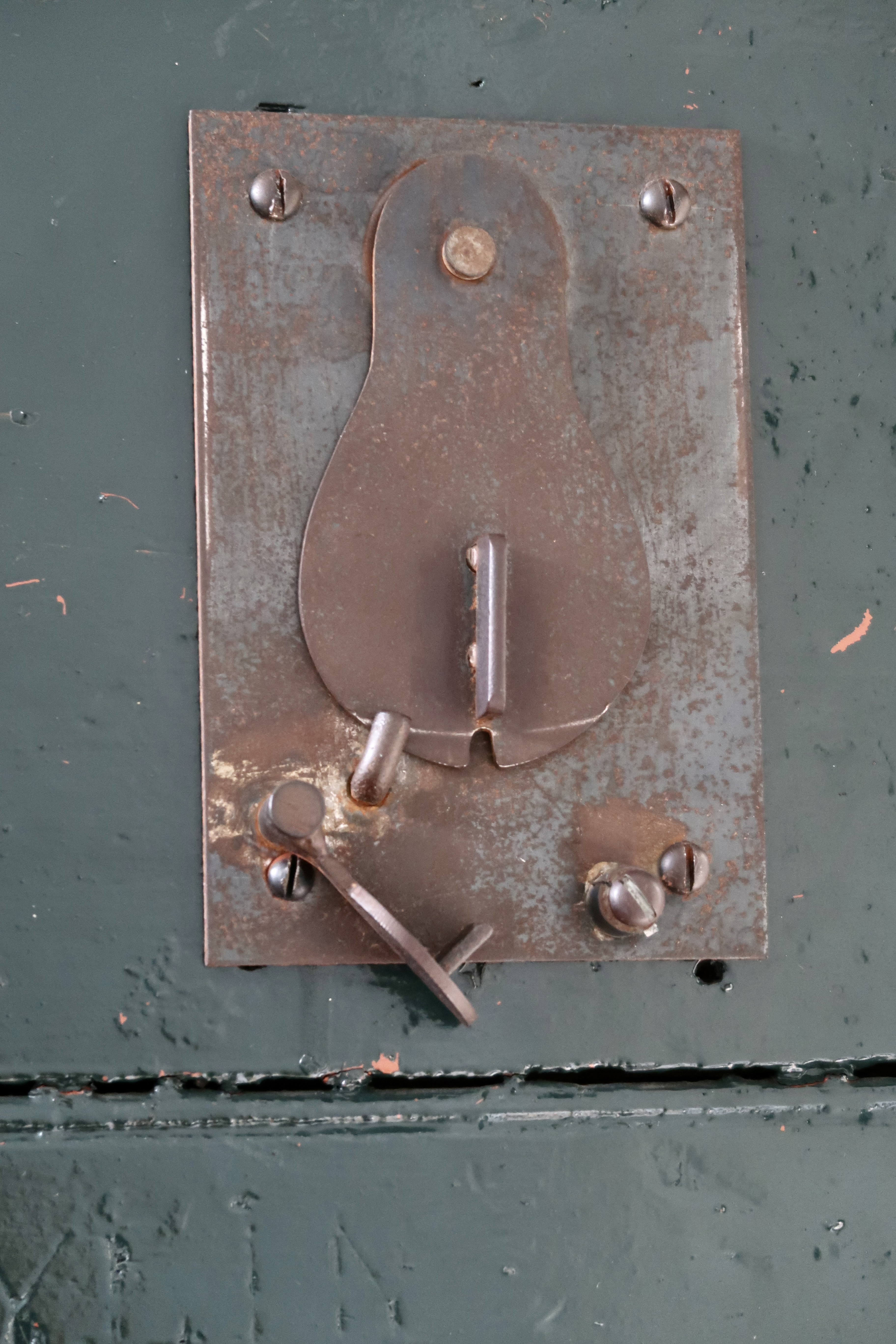
Before getting into Thursday’s events (September 8), I need to give a little more background on the Easter Rebellion (Easter Rising) of 1916 – which I’ve given rather short shrift in previous notes – and which is the backdrop for nearly everything discussed in Ireland – especially now as Ireland celebrates its centennial and reflects on its hundred years as a republic.
The Easter Rising was an armed insurrection that took place during Easter time in 1916 – launched by Irish republicans as an effort to end British rule and establish a republic. It took place while the UK was involved in WWI and was organized by a seven men who formed the Irish Republican Brotherhood… They were joined by the Irish Citizen Army and also several hundred women and together over just 6 days (at least this is what I think the story is) they seized many locations in Dublin and they proclaimed the start of the Irish Republic. The Brits had thousands of soldiers who were deployed to Ireland and lots of armament… Much of the fighting was on the streets and on roads leading into the center of Dublin where the rebels put up a strong resistance (and inflicted casualties on the British). Eventually, the rebels were surrounded and bombarded by the well-armed British and the Rising was squelched. More than 3,000 people were taken prisoner and about half were sent to internment camps. The leaders were executed (hence the Kilmainham Gaol). But popular support for Irish independence continued.
One of the jail’s most famous prisoners was de Valera who was there three times. He was an independence leader who was born in NY to an Irish mother who died and so he went to Ireland and later joined the Irish Volunteers. He was sentenced to death for his role in the Easter Uprising, but his sentence was commuted and he was actually the only leader of the rebellion who was not executed (maybe because he was actually a US citizen?). He wound up in several different jails in England and then released on some kind of amnesty. Eventually he became the last political prisoner to walk out of Kilmainham Jail in the mid-1920s… Ironically, he later became the Prime Minister and then President of Ireland.
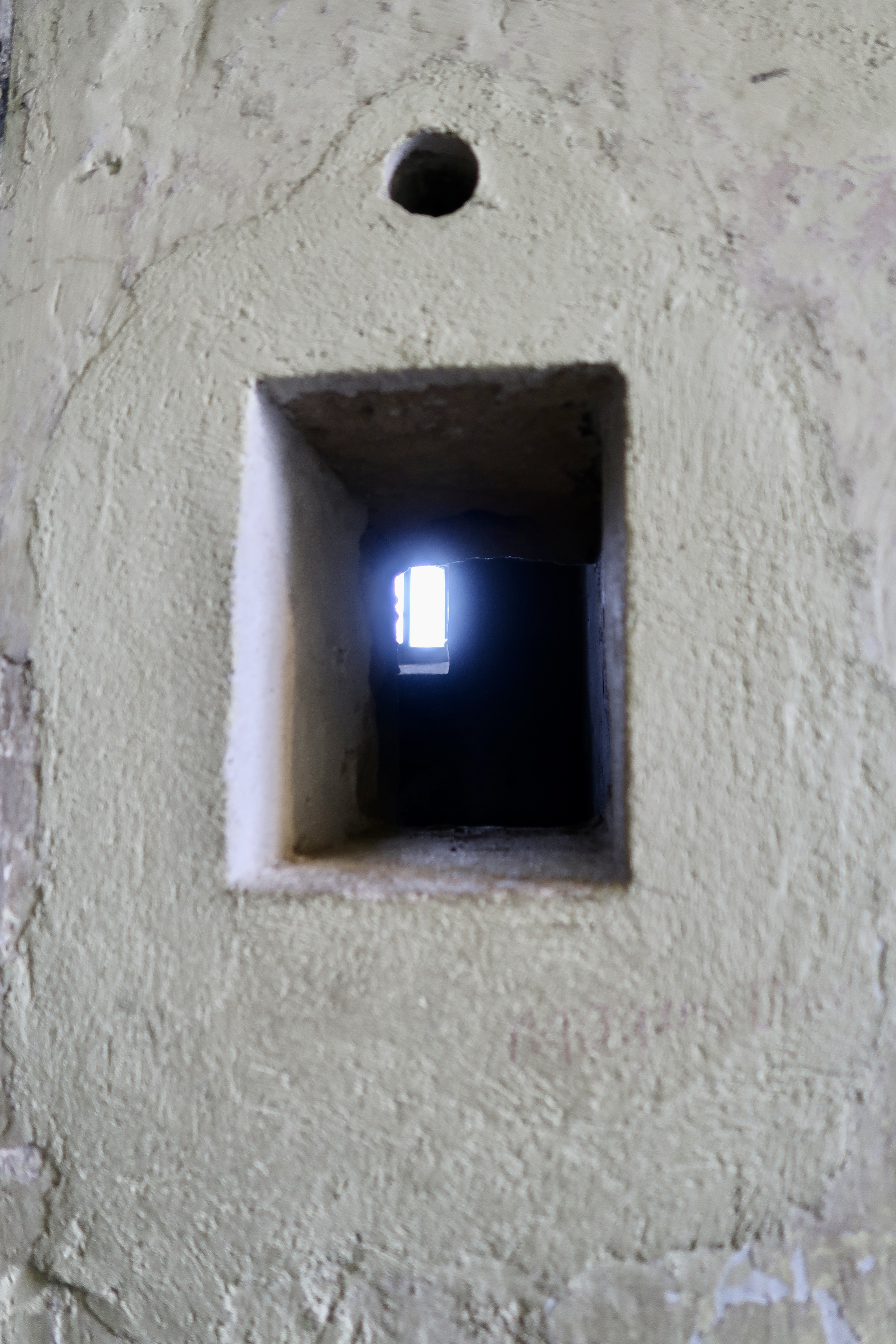
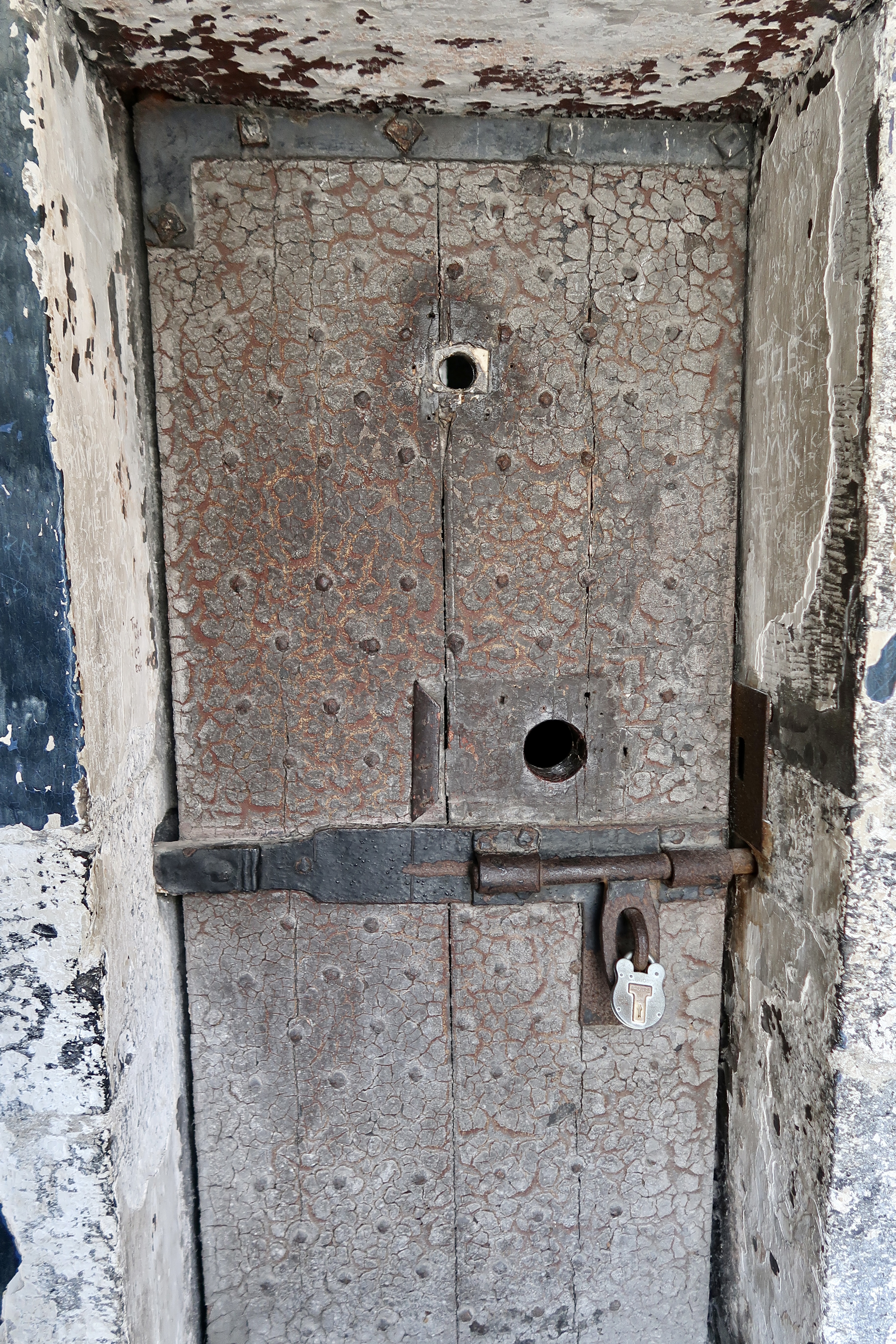
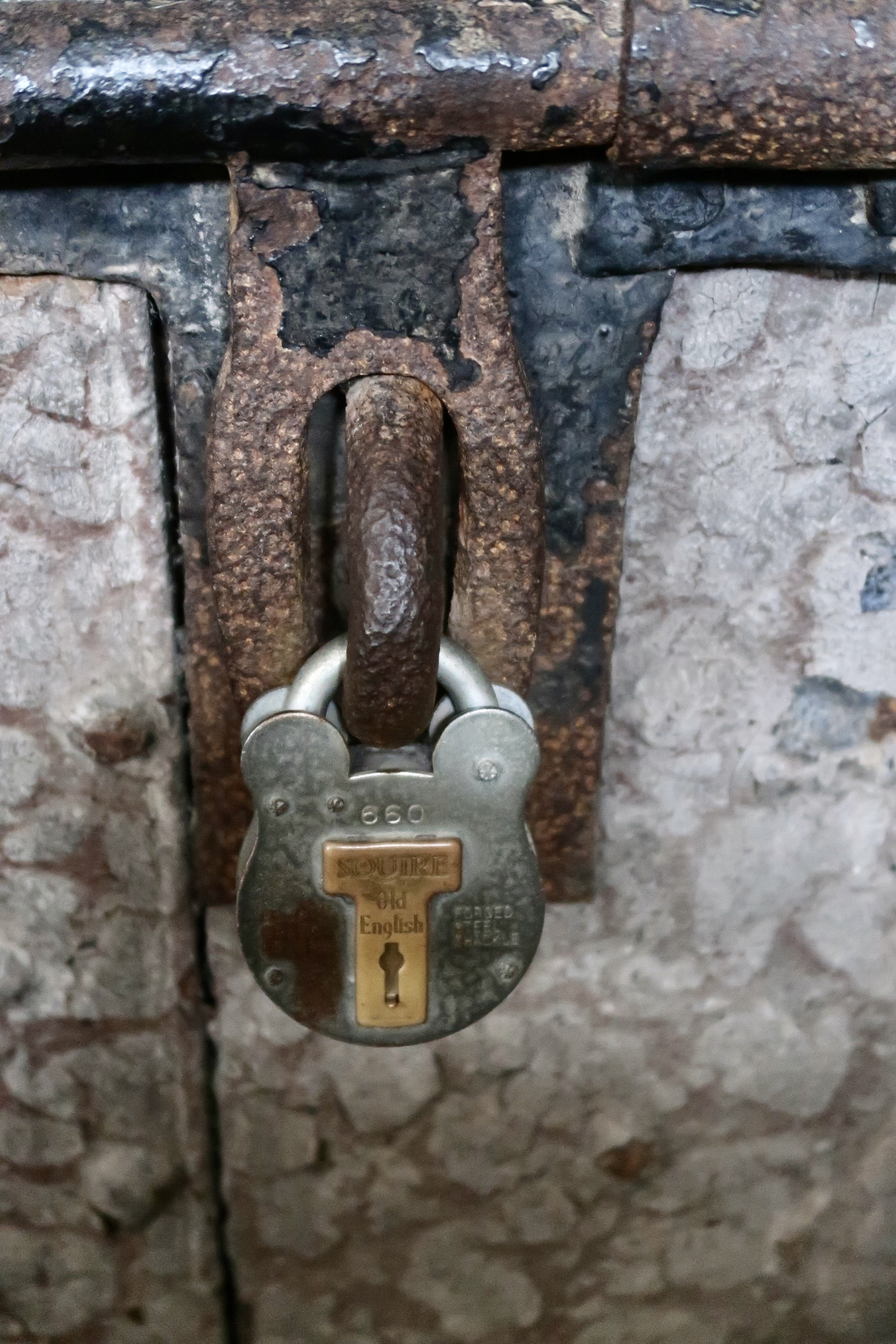
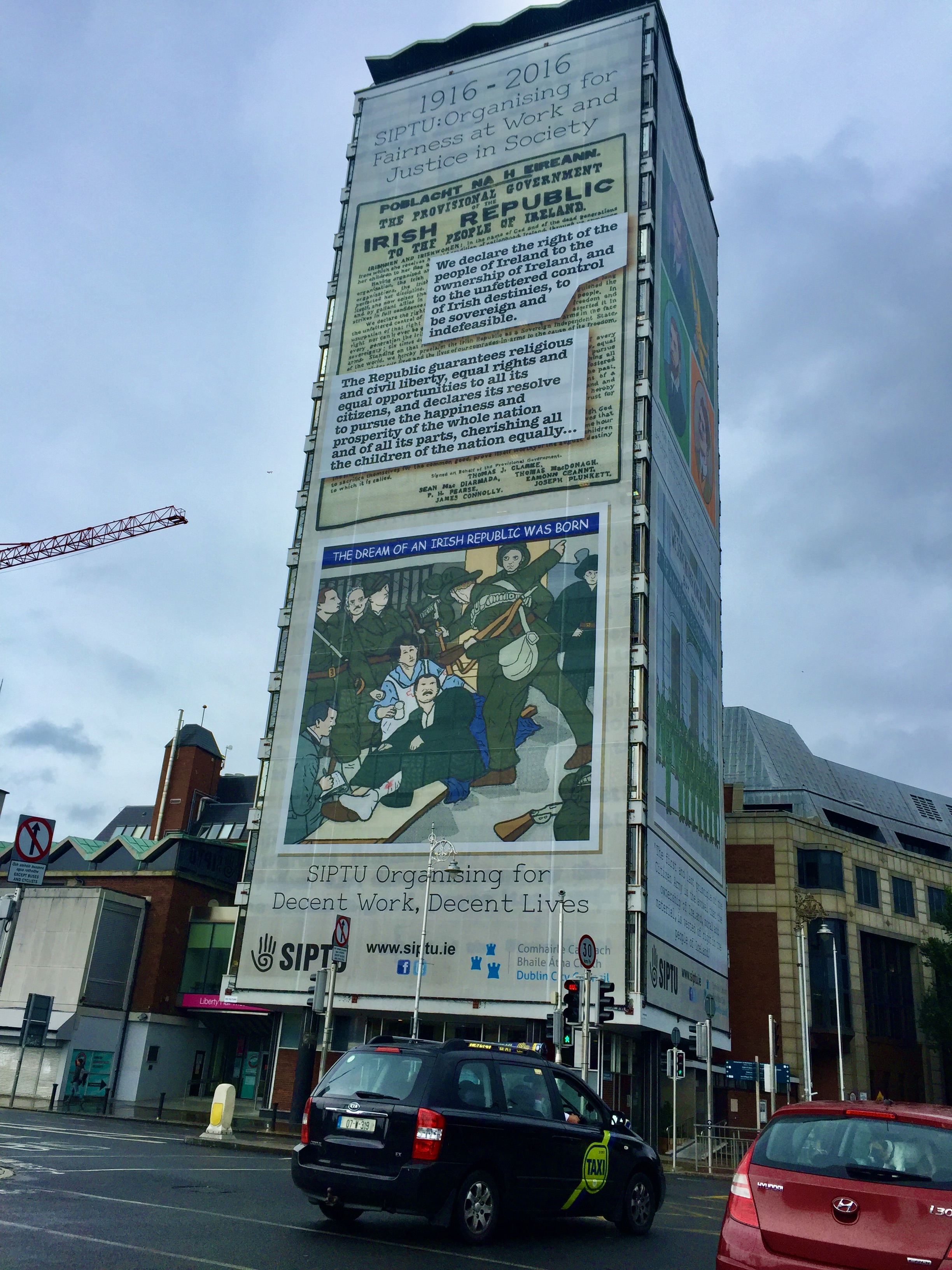
About 500 people were killed in the 6 days of the Easter Rising and of those dead more than half were civilians. About 3,000 were wounded. Many of the civilians were caught in the crossfire of the street fighting. The whole activity left many parts of Dublin in ruins. While we didn’t plan our trip based on this centennial, it’s obviously been a backdrop as we walk the streets. There are great huge photo blow ups of 1916 in several of the parks; last night we attended a concert in the National Concert Hall called “Composing the Island” – a sort of retrospective of the past 100 years of classical Irish music. The first half, which I think covered compositions from 1916 through the end of WWII, was all very heavy. The second half of the concert was a bit more uplifting. (The intention was to head to a pub to hear folk music after the concert, but it ended late and Richard and Elizabeth had an early flight this morning, so we headed to the hotel where there was a not-very-good singer/guitarist and a very noisy bachelor party in the bar.)
OK.. history lesson complete. Apologies.. but the visit to Killmainham was really powerful – seeing the cells where these resistance leaders were held and where they were executed. By the way, “The Italian Job” and several other films were shot at the prison… which offered itself as a location for major films and also for concerts in the years between its closing and the opening of the jail as a tourist venue.
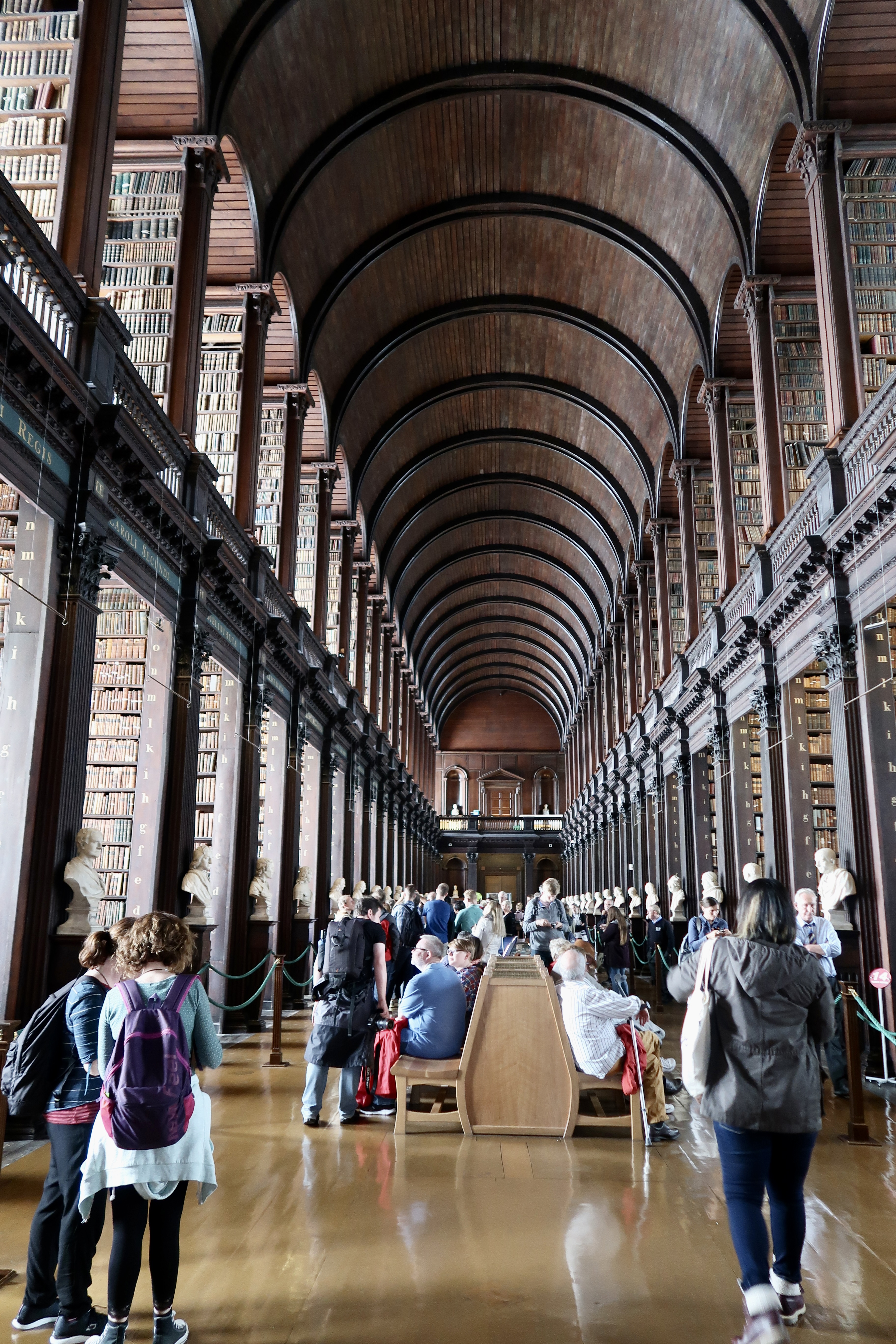
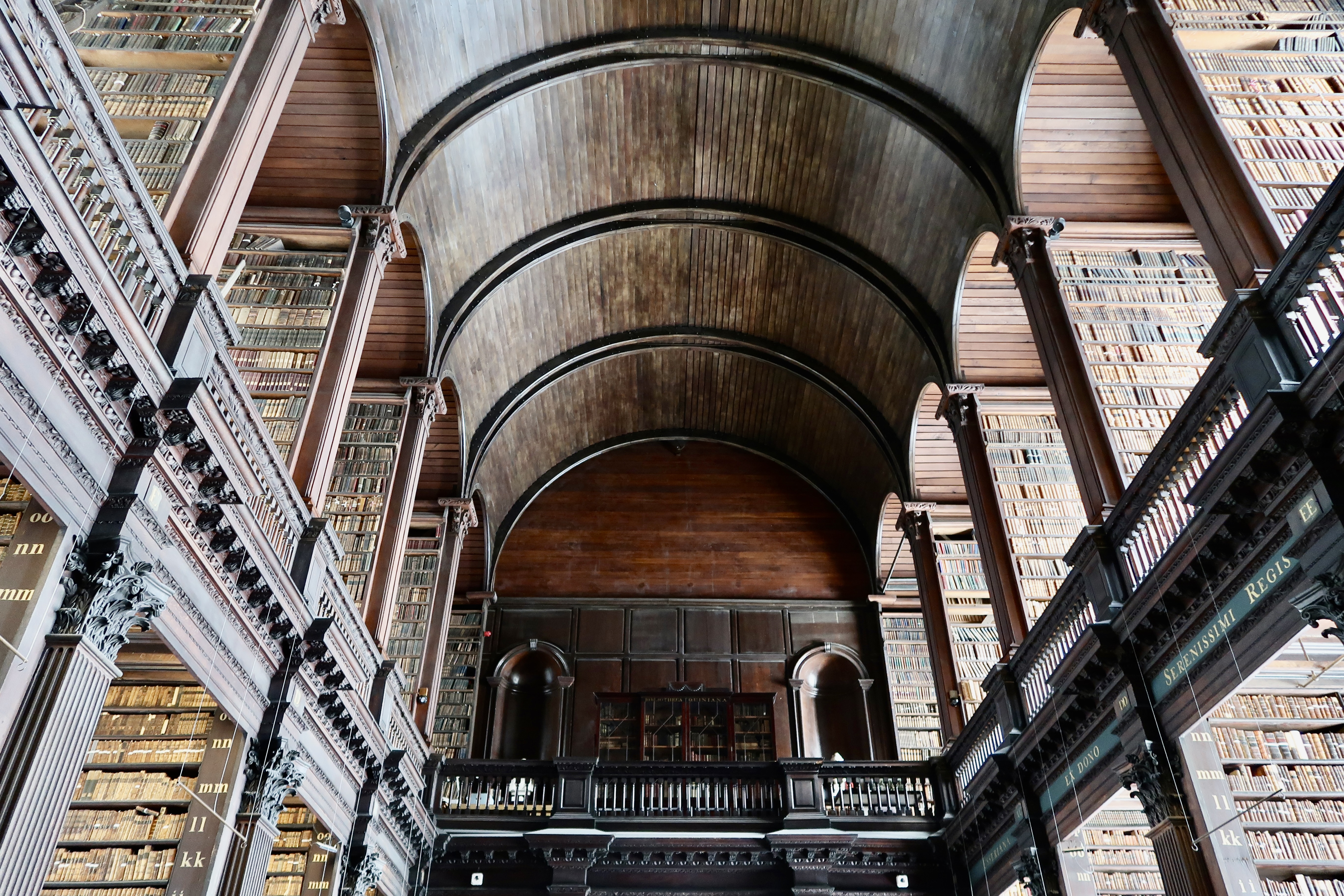
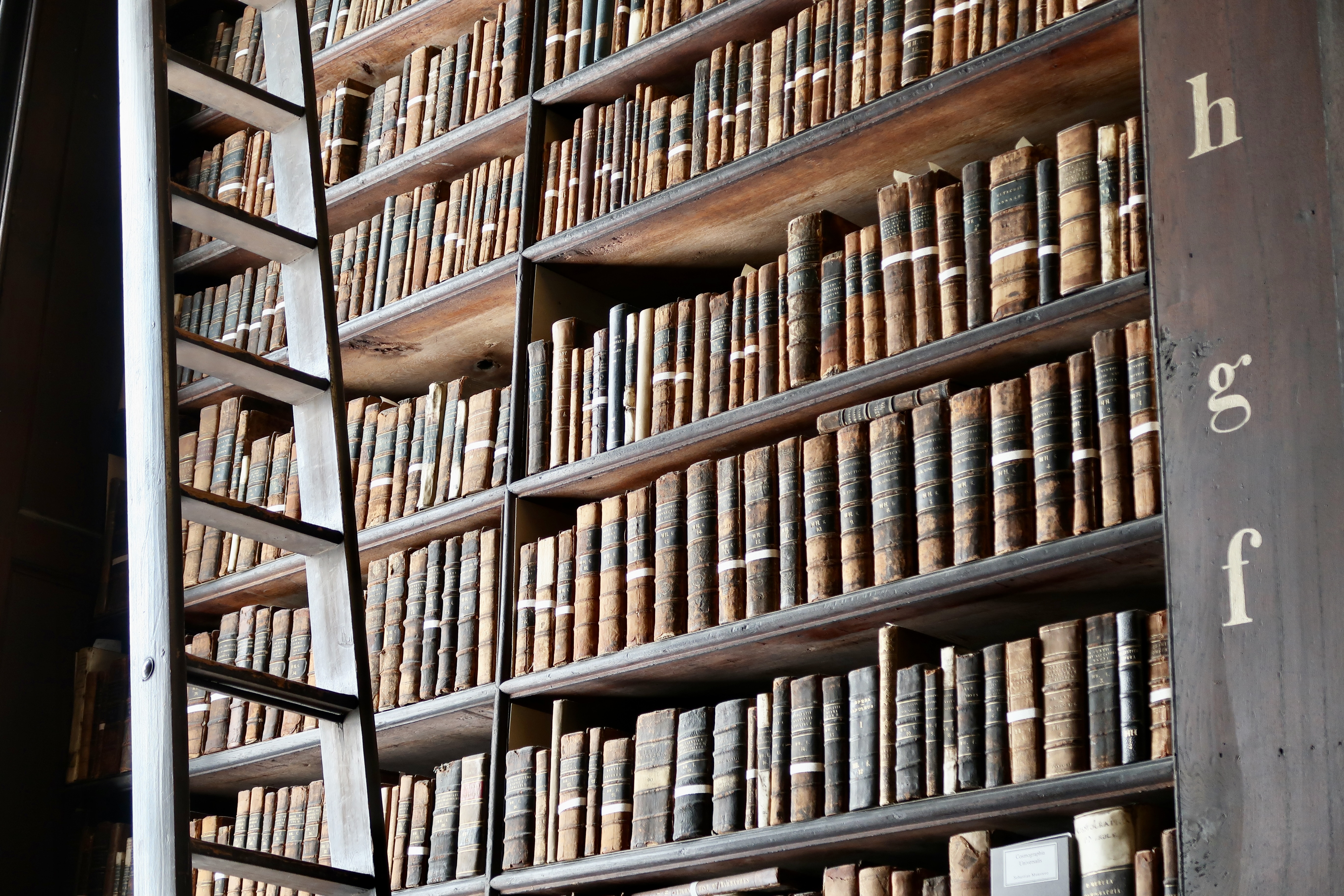
Started out on Thursday walking to Trinity College to see the Book of Kells (an obviously popular tourist attraction with long lines).. Have to be honest, the powerful experience there is seeing the amazing library and the famous Long Room where the Book of Kells is kept. The library and the room are from the 1700s… and expanded in the 1850s. It’s about 200 ft. long… and is filled with shelves holding every book that has ever been published in Ireland and Britain.. It’s lined with marble busts of philosophers, writers, etc.
From Trinity we hiked to the Photographic Archives to get a better look at the images of 1916 (which is remarkably documented), and then a bit to eat in a pub (still a little queasy so focused mostly on soup. Then Mike headed to see the Liebeskind building that we had already seen and Elizabeth and I strolled to check out neighborhoods and also some Irish Design stores and a look at Powerscourt Center (an elegant Georgian house that was home to a viscount in the 1700s.. He and his wife bought the giant townhouse (which is a bit like Downton Abbey in scale) to entertain guests when they were in town during “the season.” It’s huge with a central court that is now glazed over… and the house and space are now home to dozens of shops and restaurants. Also walked by the big tall spire, apparently built for the millennium…
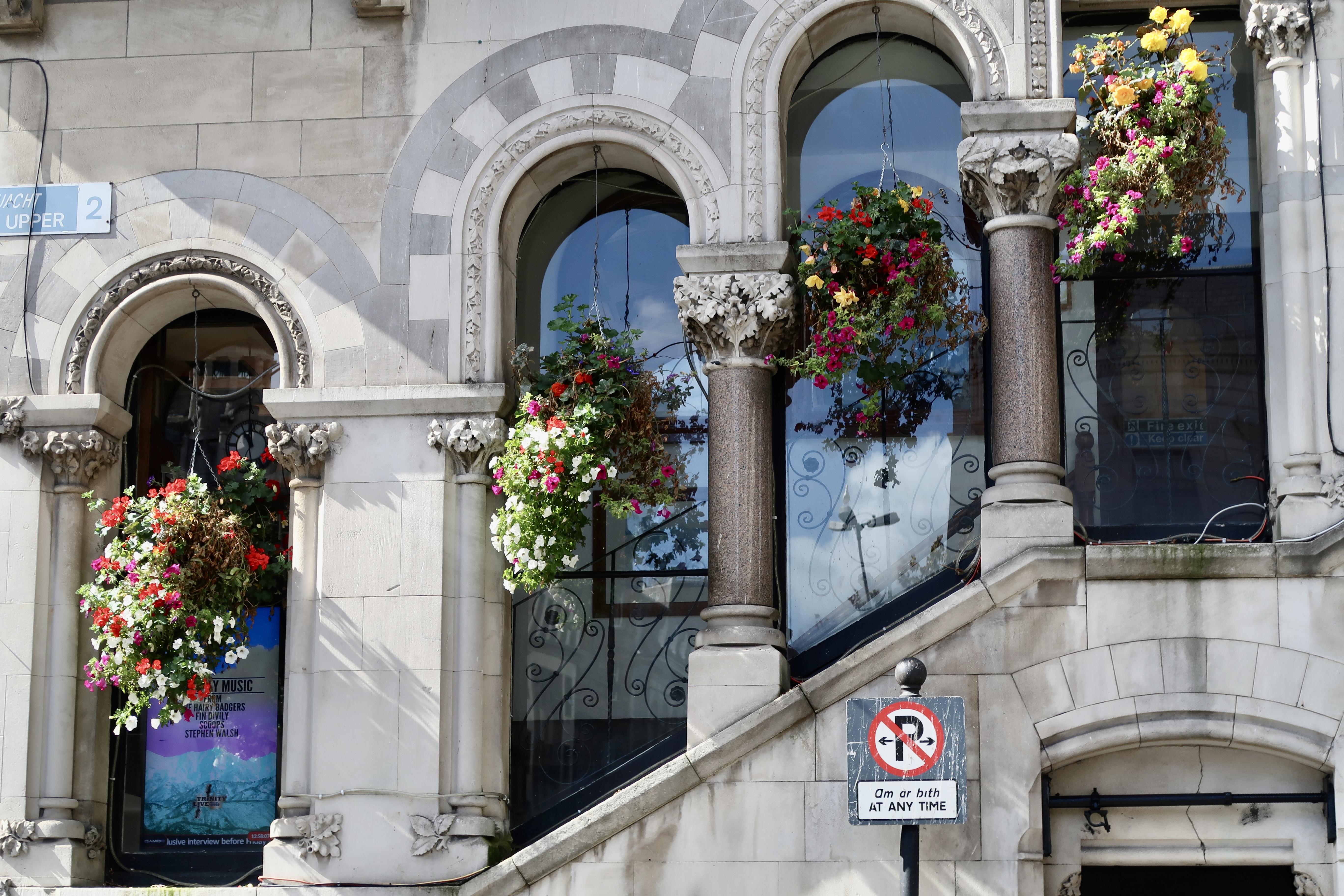
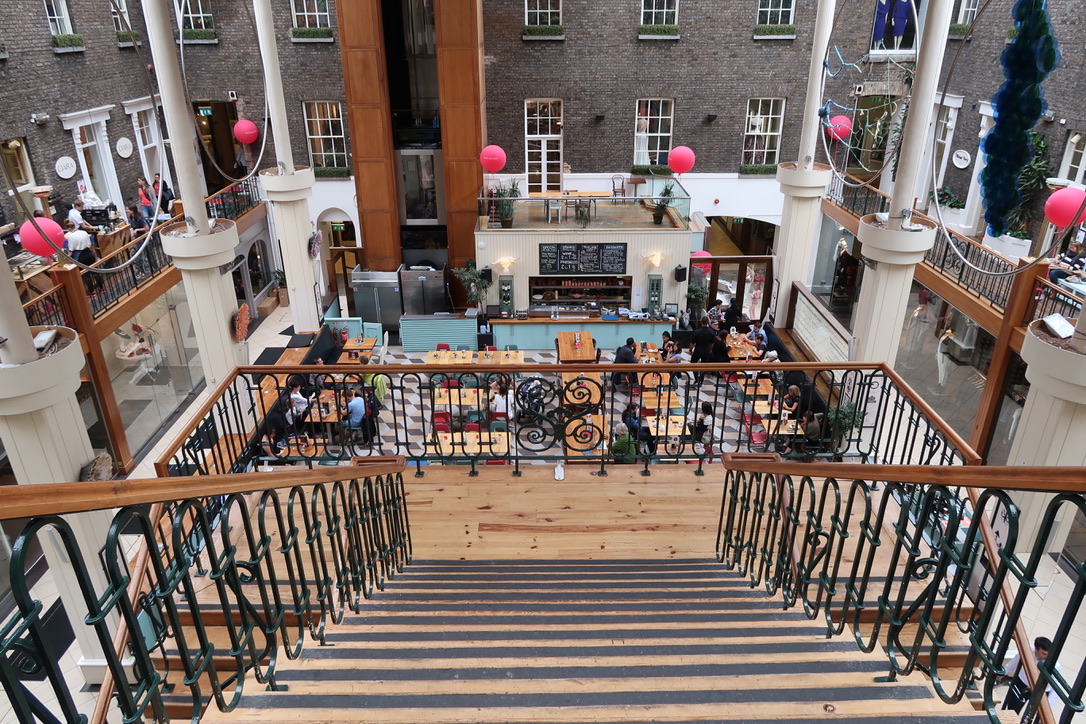
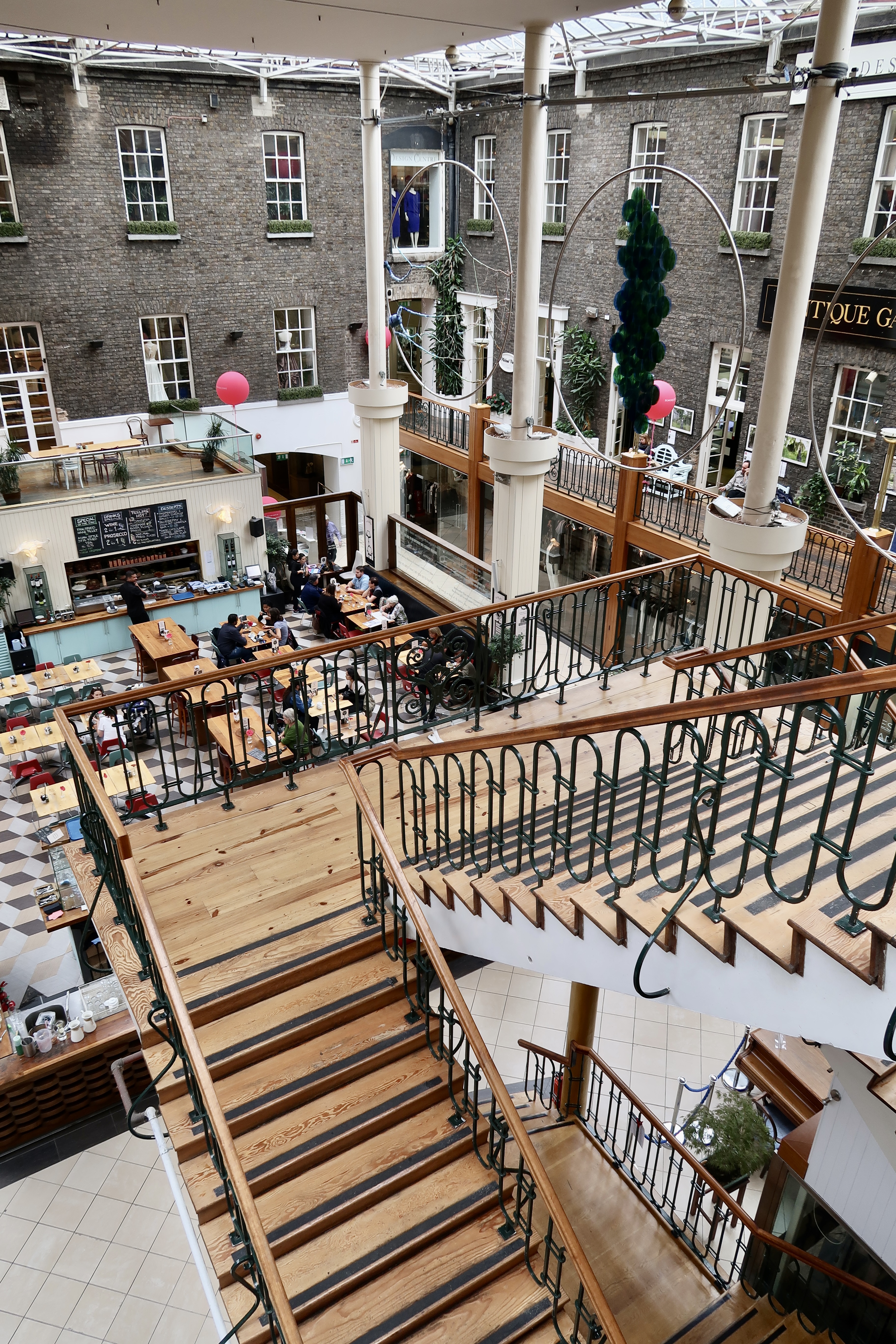
Final interesting points of note:
- Dublin taxi drivers have successfully fended off Uber (good for them!)
- There was a bus strike for the last two days so traffic is totally snarled.
- Unemployment is currently at about 9% in Ireland (or maybe that’s Dublin) which they think is good, given that they had been at 17% a few years ago during the economic crisis.
- People living in Northern Ireland are now actively seeking Irish passports in light of Brexit. (apparently Irish can choose to have a passport from the Republic of Ireland (EU) or from Northern Ireland (UK).
- It’s been raining for the past two days while in Dublin.

Taxied to Dublin Airport—to catch 5:00 pm flight from Dublin to London City Airport (like flying into Burbank instead of LAX)…
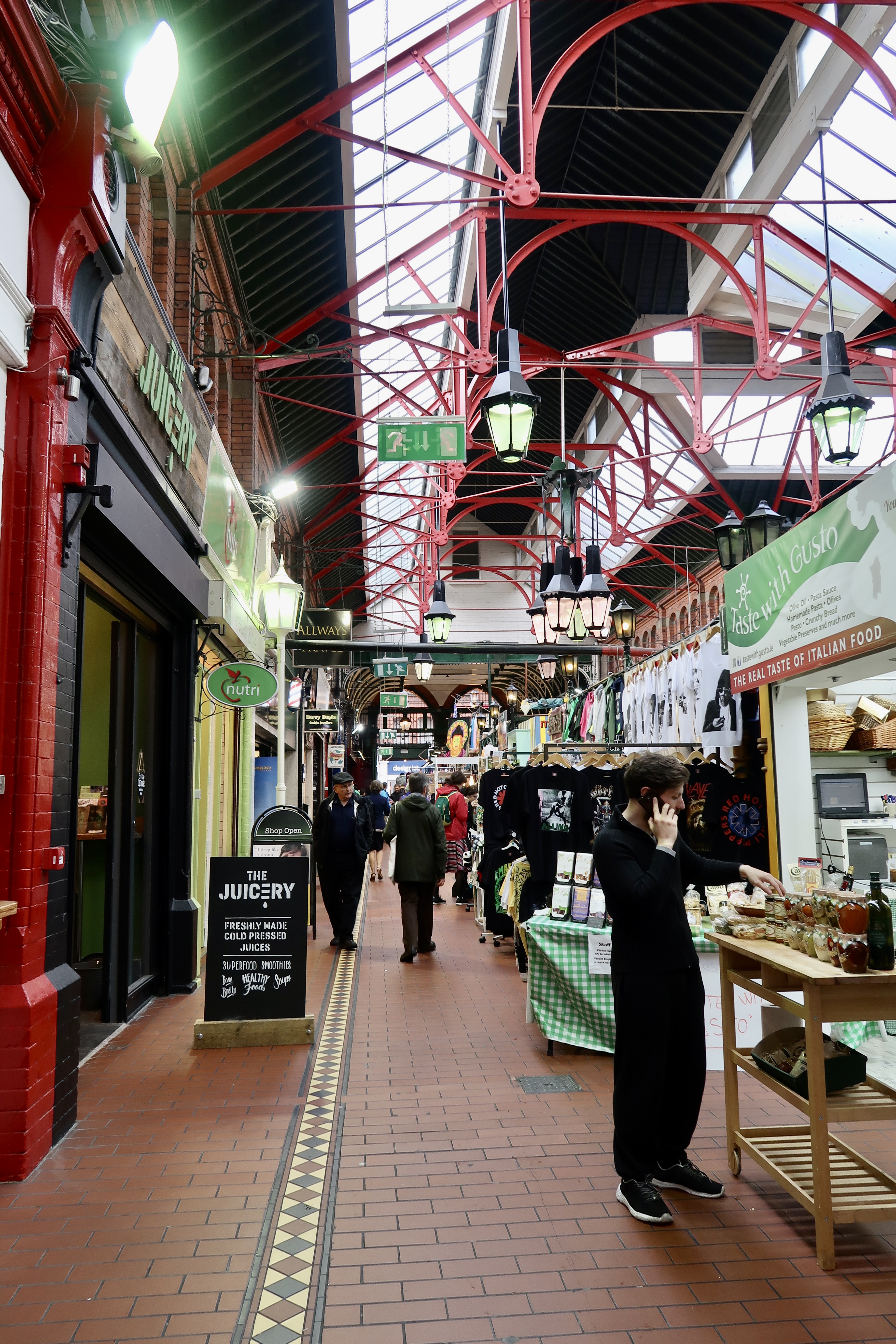
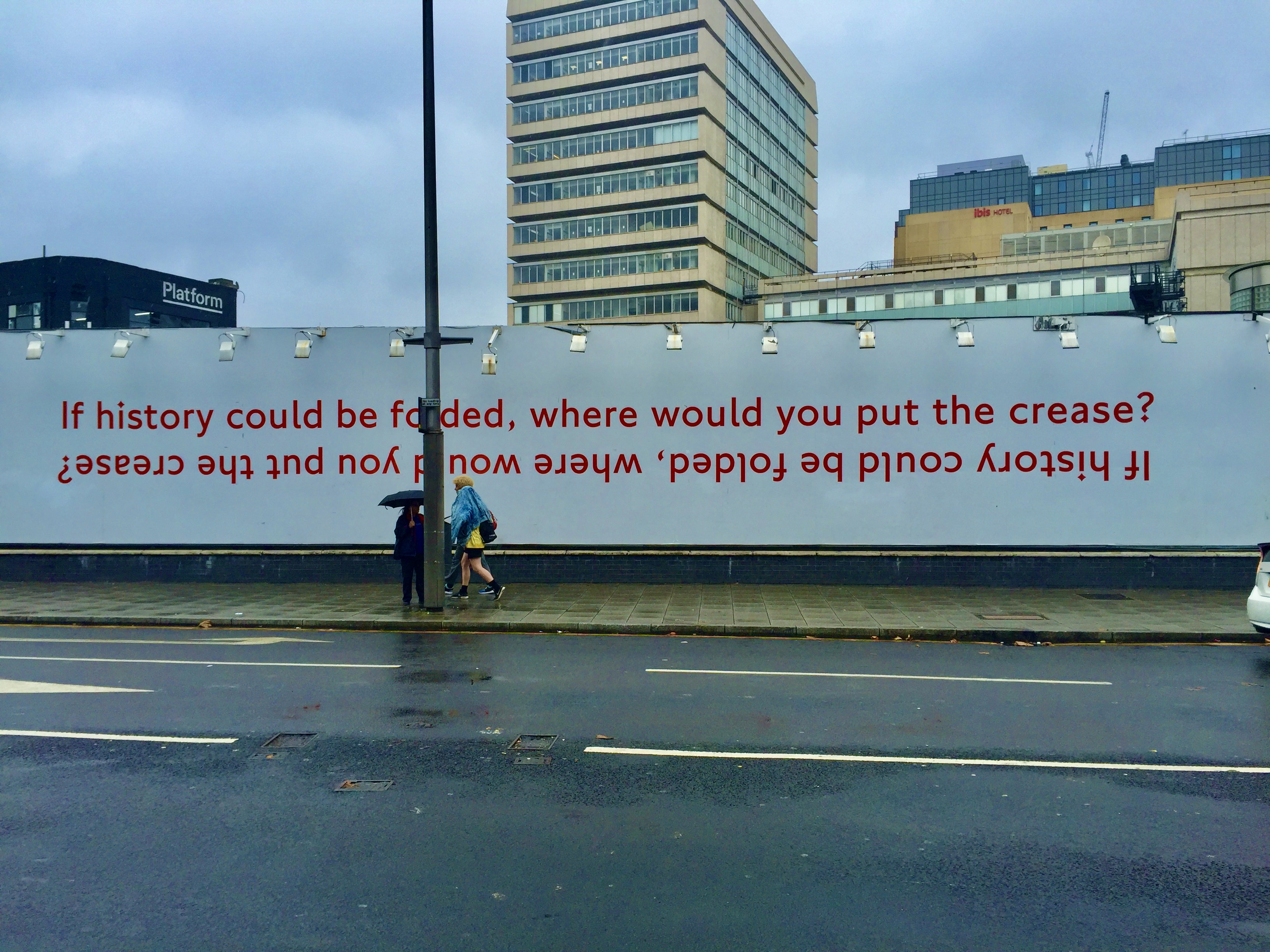
Just finished dinner with god-daughter and her husband; they’ve been living overseas for many years… Went to a little tapas place called Taberna do Mercado – in Spitalfields Market.. Very good, and we closed the place down and then came to our hotel which is nearby for drinks..
It’s about 2 am.. and I’m fading. See you all stateside in about 36 hours.
Fern
Dublin. September 7, 2016. Prisons, Hospitals, and More.
Greetings –
Today was our “tourist day” — but first Elizabeth and I walked with a mission to seek out a really nice Irish sweater for my aunt; but didn’t do so well, although Elizabeth bought a really nice sweater.
Met up with the guys, and headed to the Kilmainham Gaol (the prison) where revolutionaries, including the leaders of the 1916 “Easter Rising” were held and executed by the British. The prison was built in 1796. Originally, public hangings took place at the front of the prison, but there were such large crowds that came to see the hangings (and lots of drinking and violence outside the prison) that they moved the hangings to a central court inside the prison. Men, women and children were incarcerated up to five people in each cell, with only a single candle for light and heat. Most of their time was spent in the cold and the dark, and each candle had to last for two weeks. The cells were about 28 square meters.
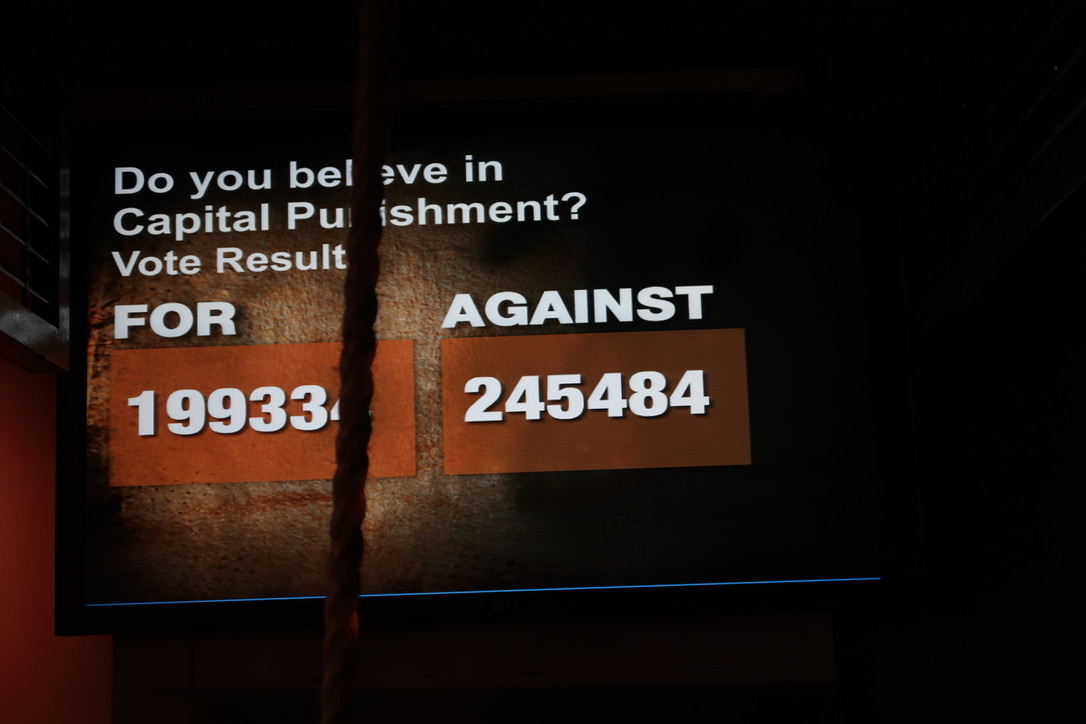
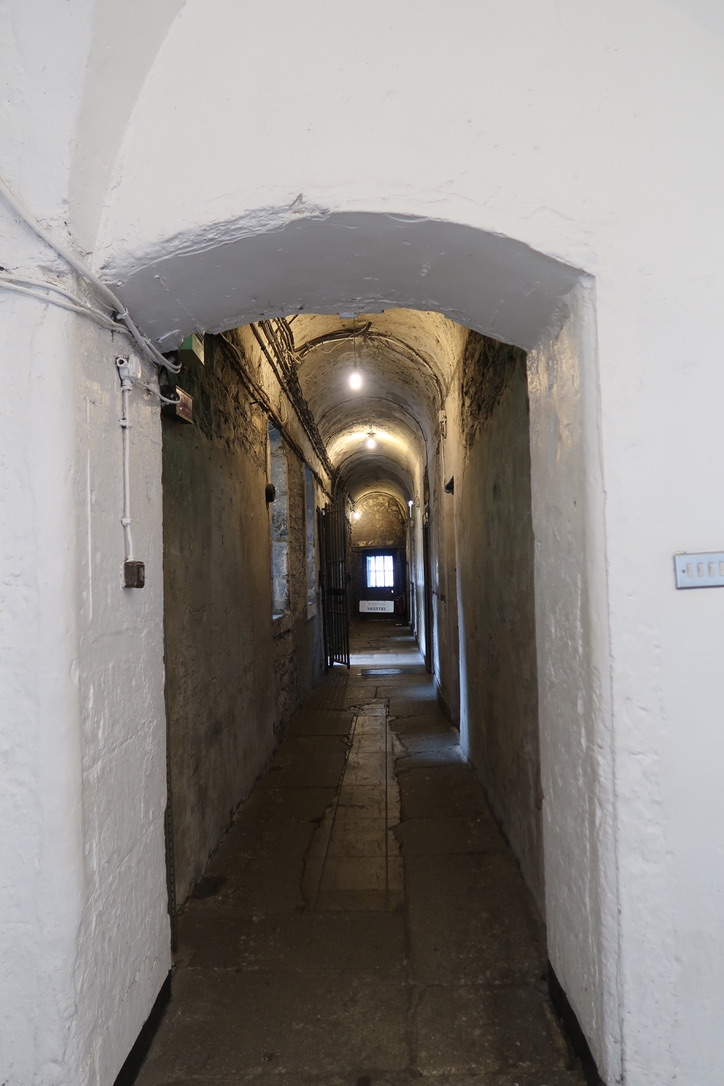
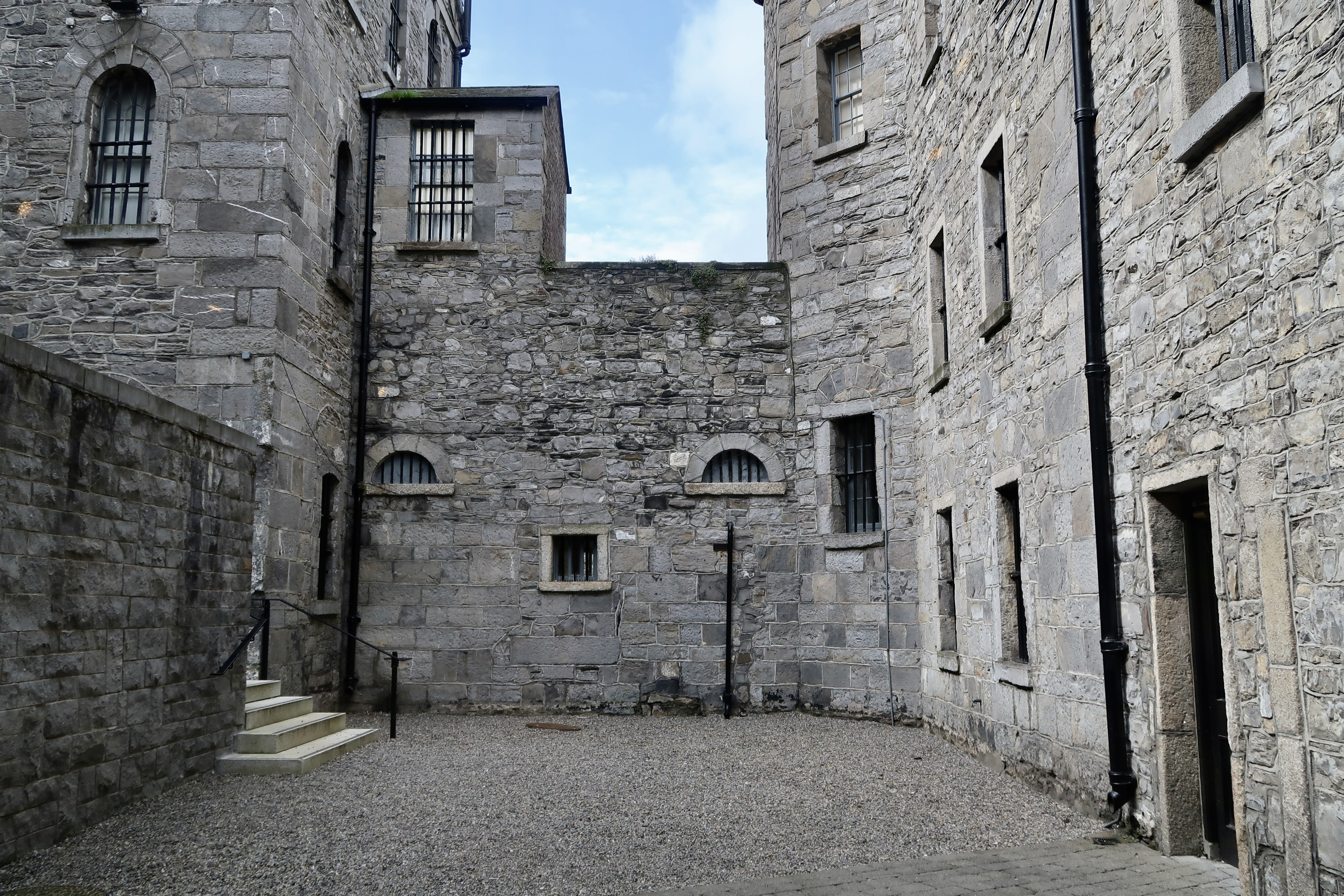
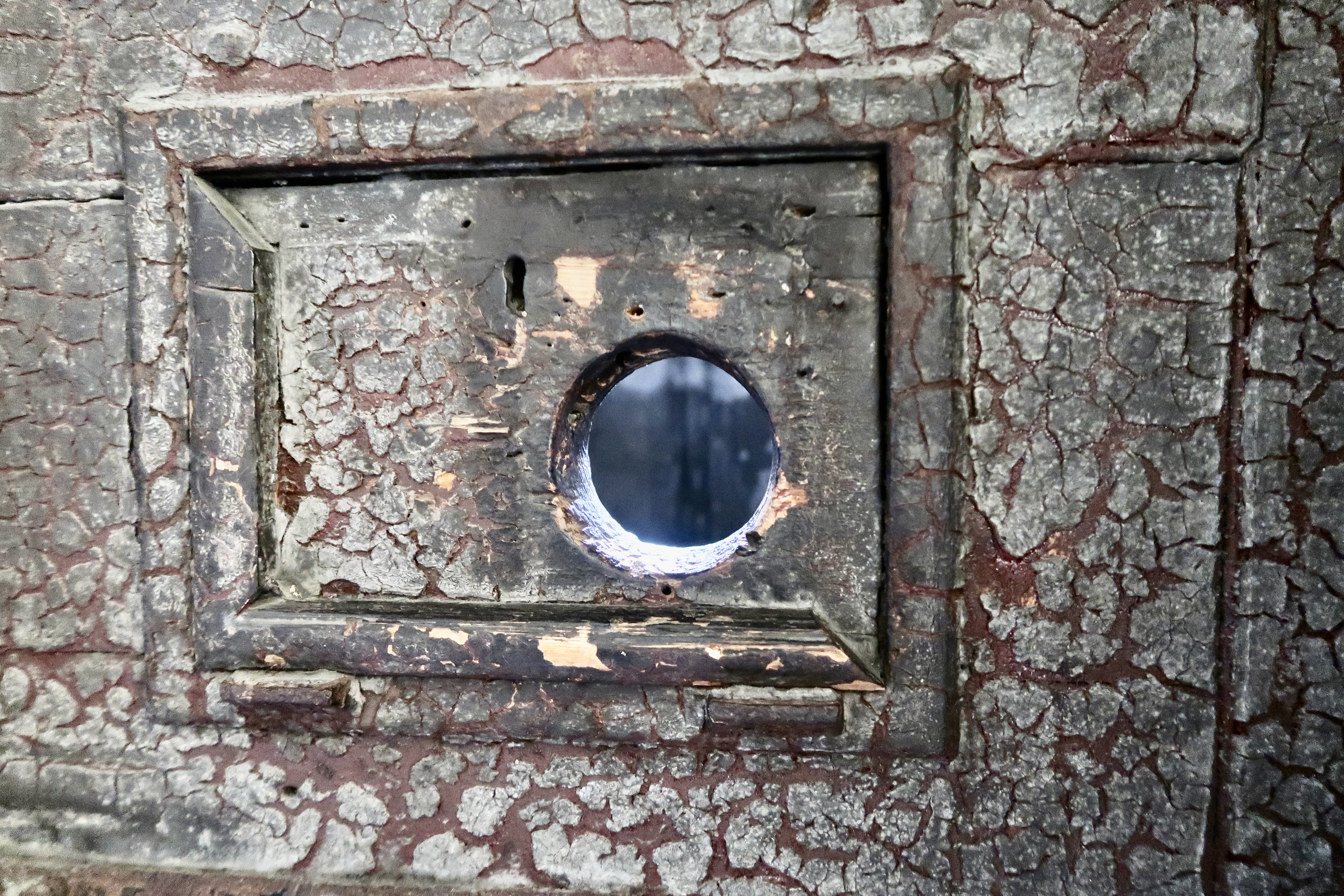
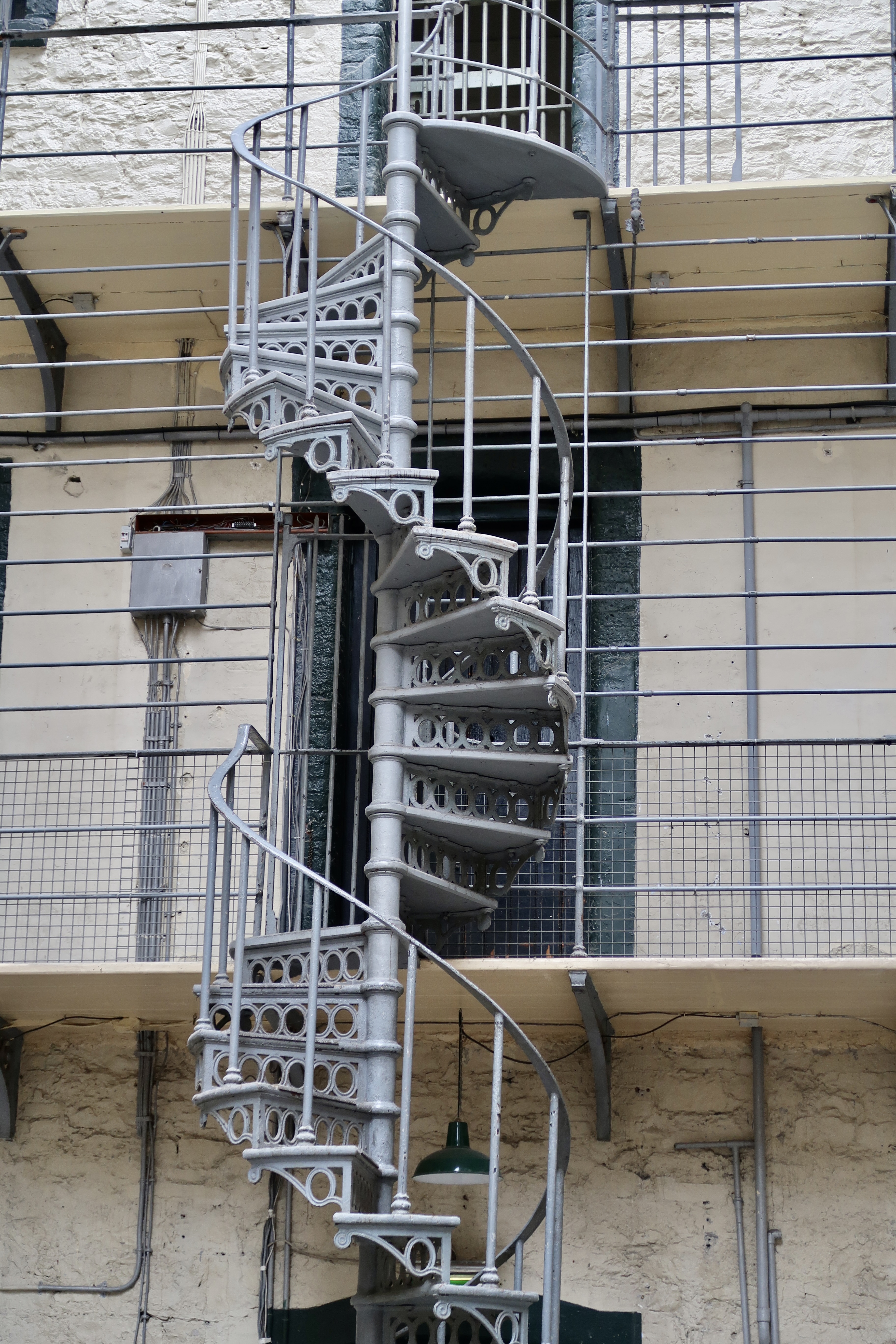
Kilmainham Gaol was closed in 1924. But during the years it was open it had a very sad, embarrassing, and fascinating history. The uprisings of 1798, 1803, 1848, 1867 and 1916 ended with the leaders’ confinement here. National heroes such as Robert Emmet, Thomas Francis Meagher, Charles Stewart Parnell and the 1916 Easter Rising leaders were all residents for some time, but it was the executions in 1916 that really etched the jail’s name into the Irish consciousness.
Here we saw the cells of our friend Plunkett from Cork..


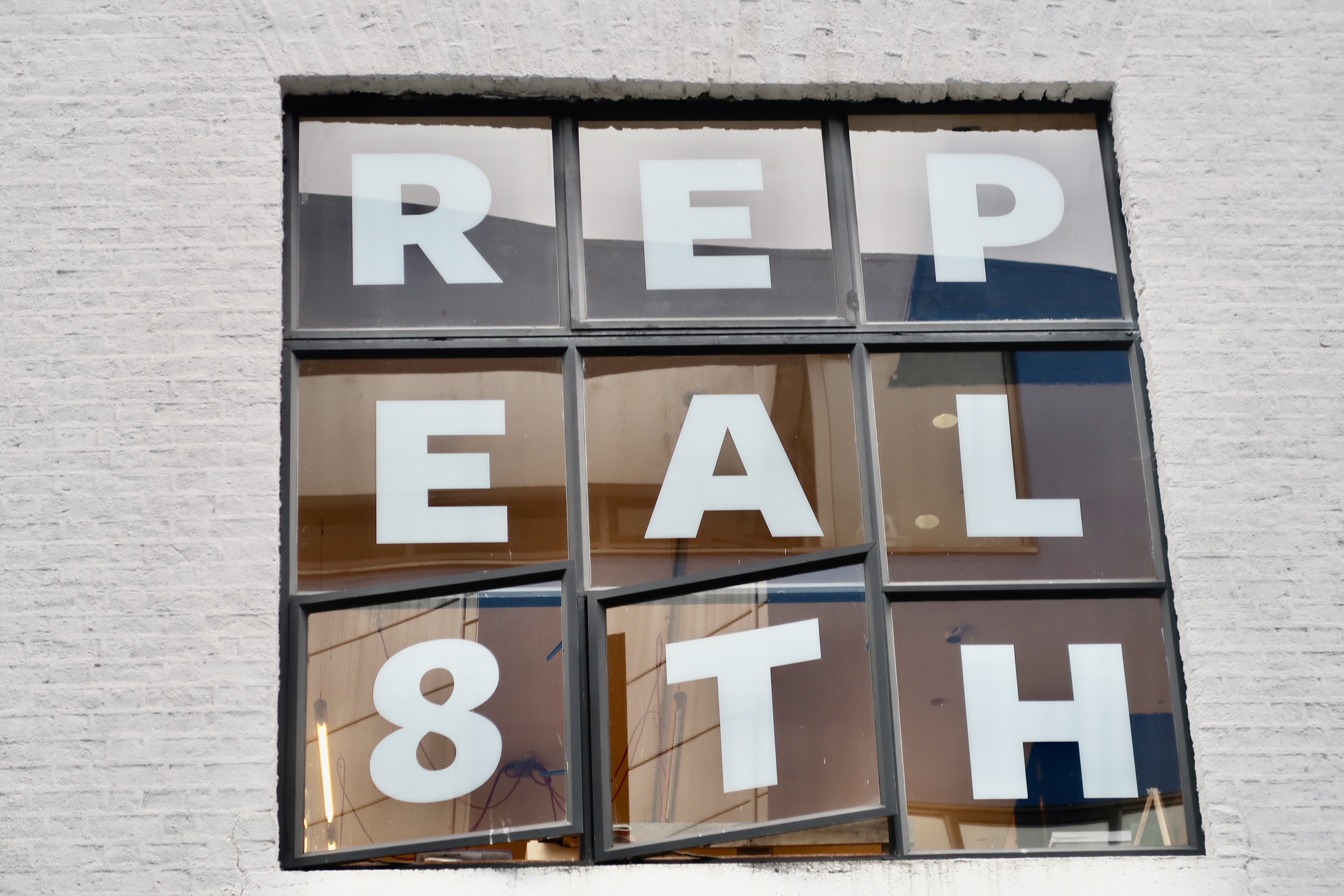
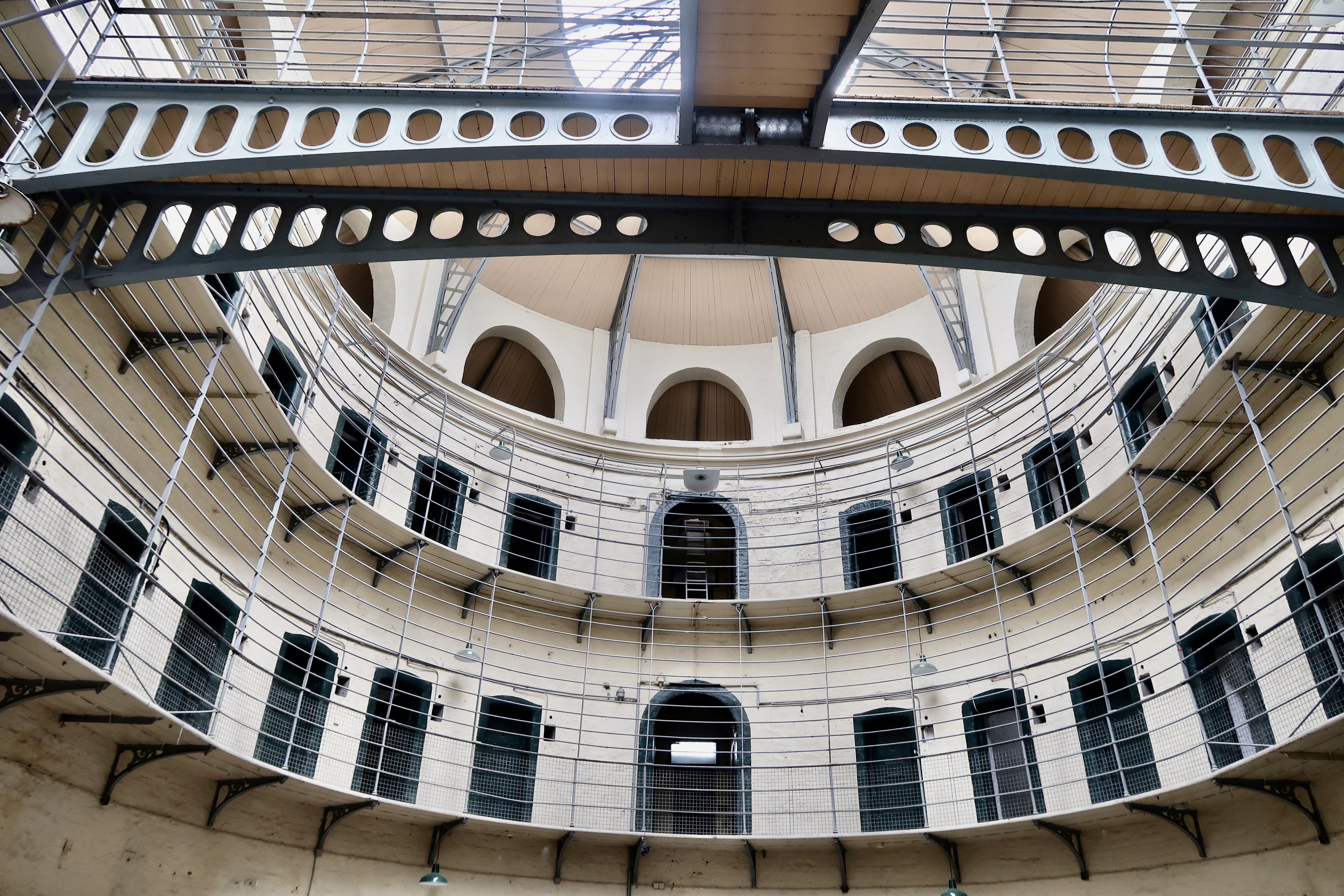
From there we walked to the Kilmainham Hospital which is now the Irish Museum of Modern Art. It was built in 1680 and is the oldest classical building in Ireland, was based on Les Invalides in Paris. The gardens were originally used for medicinal purposes but over time they became private. And then in the 1990s hospital buildings and grounds became the home to the Museum of Modern Art. The current exhibit was uninspiring, but the notion that this beautiful structure with a great courtyard was a hospital was amazing. Don’t see these hospitals in the US.
Began to rain so we hopped a taxi to get to the ‘gallery of photography where we believed they had a special exhibit of photographs of Ireland (Dublin from 1916 to 2016).. but instead we found an exhibit of contemporary Austrian photography (which was rather whimsical). As we were leaving the building, we asked about an exhibit of photos of Dublin in 1916 and 2016… and we learned that was across the courtyard.. but the building was closed. Perhaps tomorrow.
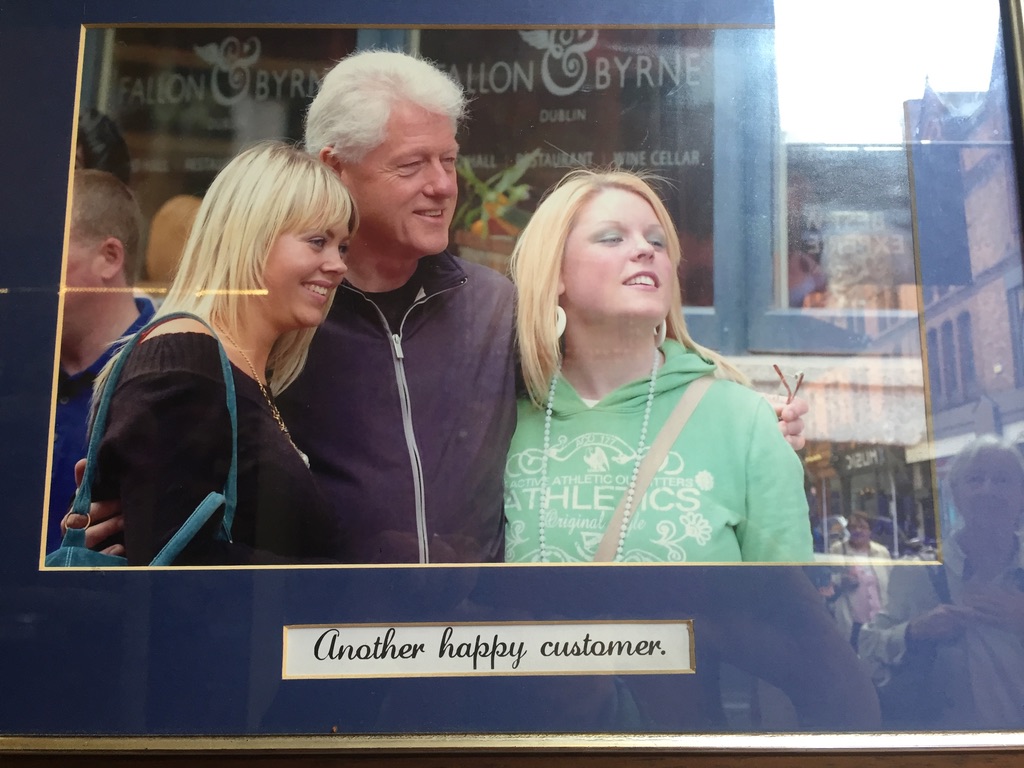
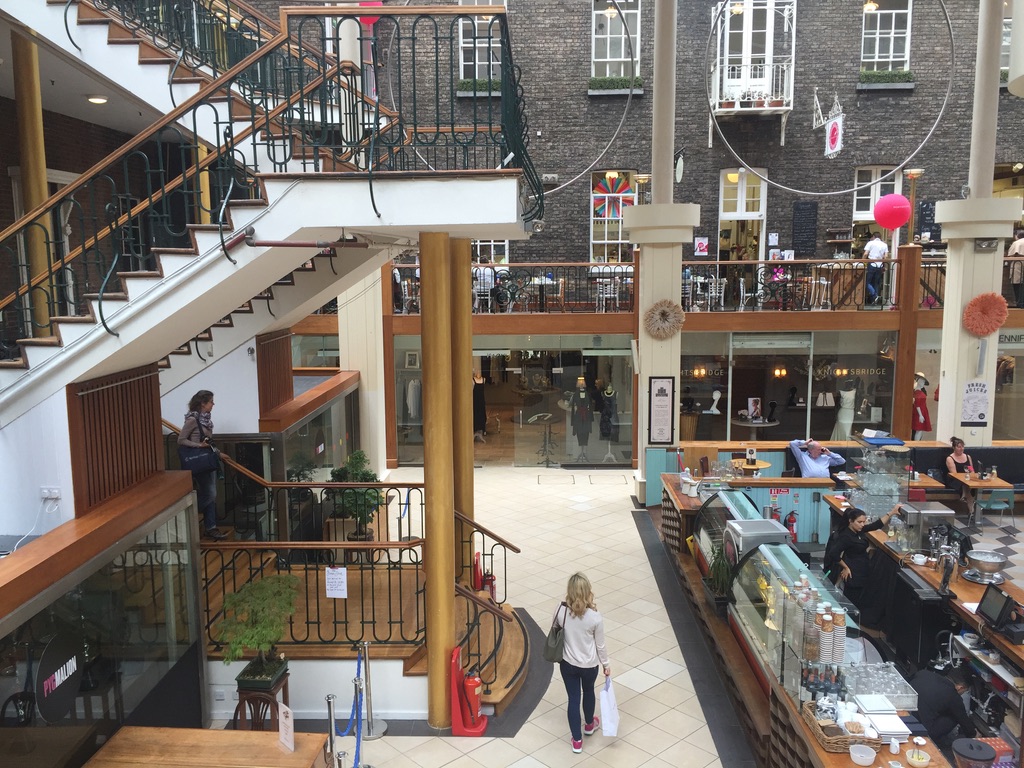

Headed for dinner at Enoteca de le Langhe… which turned out to be quite good, albeit a bit noisy.. Following dinner, headed to the hotel for drinks… and now settling in to get to bed. Another day awaits.
Fern
PS — a few comments about Ireland – lots of bookstores.. what have we done in the US to all of our bookstores; do we really expect everyone to read everything online?

