9B: Luxor to Aswan: Cars, Boats, Feet: 12/26/22
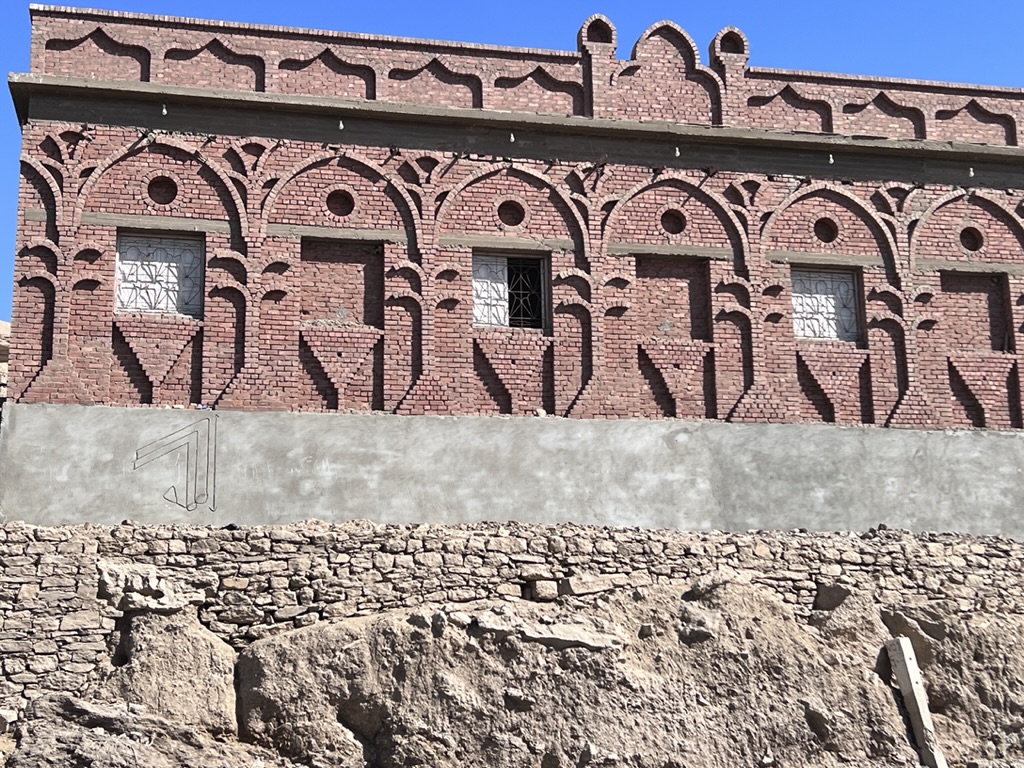
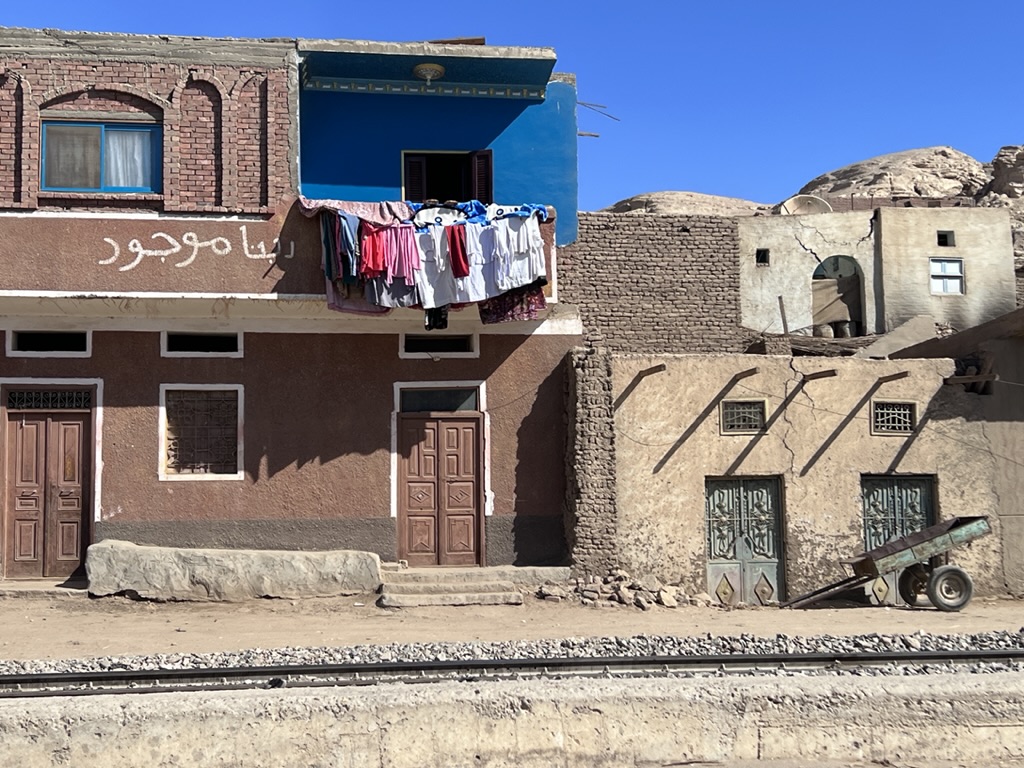
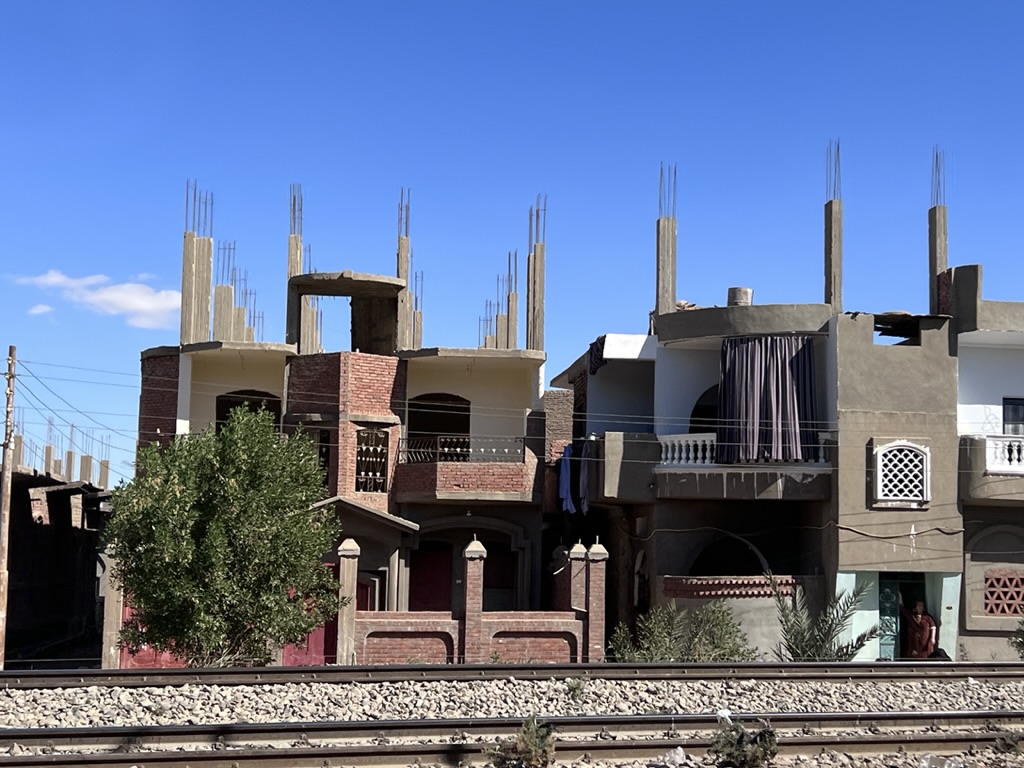
Greetings from Aswan –
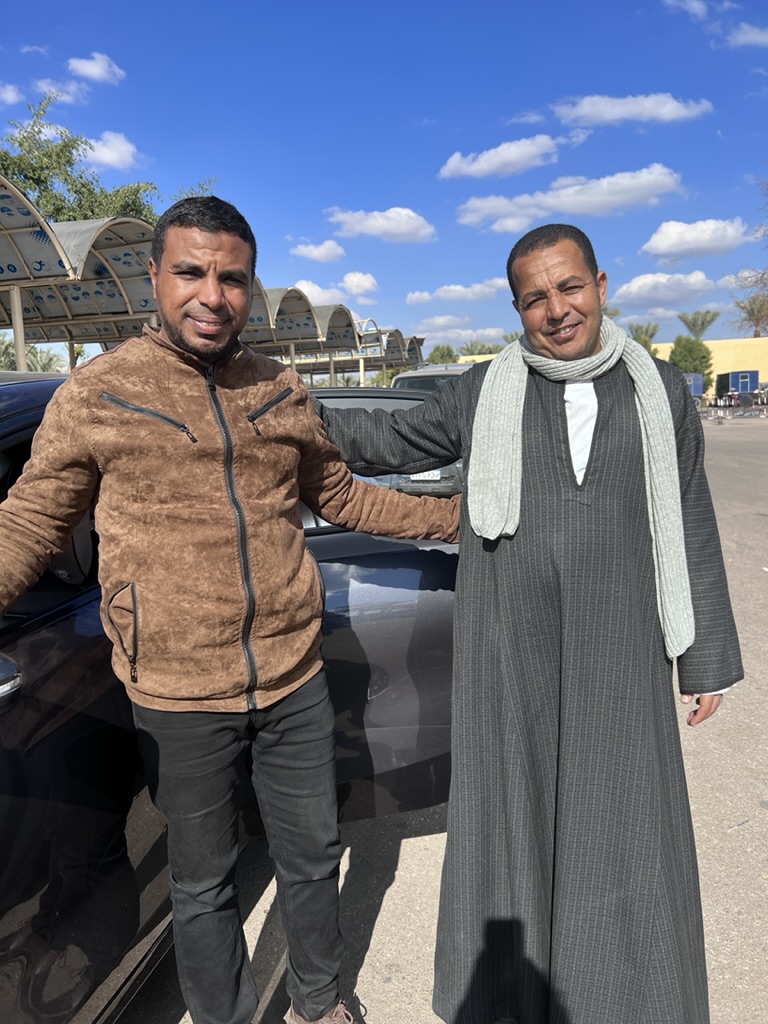
Set out this morning for Aswan — a four-hour drive from Luxor, mostly along a pretty bad road that goes through numerous tiny desert villages and agricultural land. Abdul was there to meet us, with his cousin. Turns out his cousin would be the one to drive us, which is fine. His name is Allah. His father and Abdul’s father are brothers.
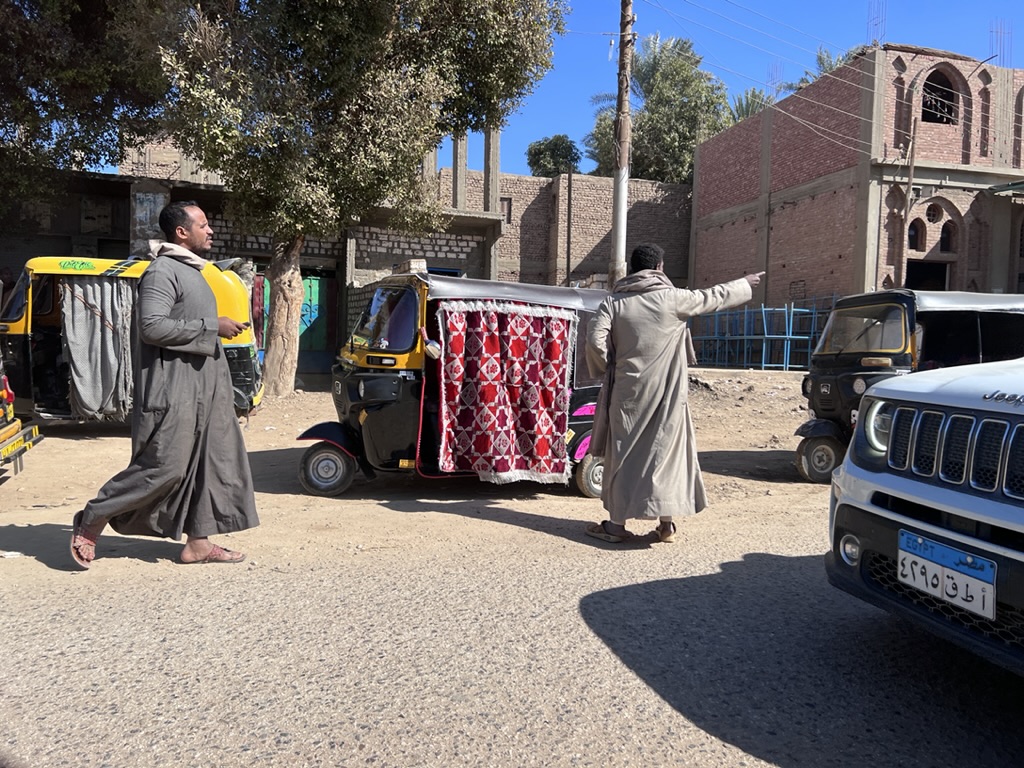
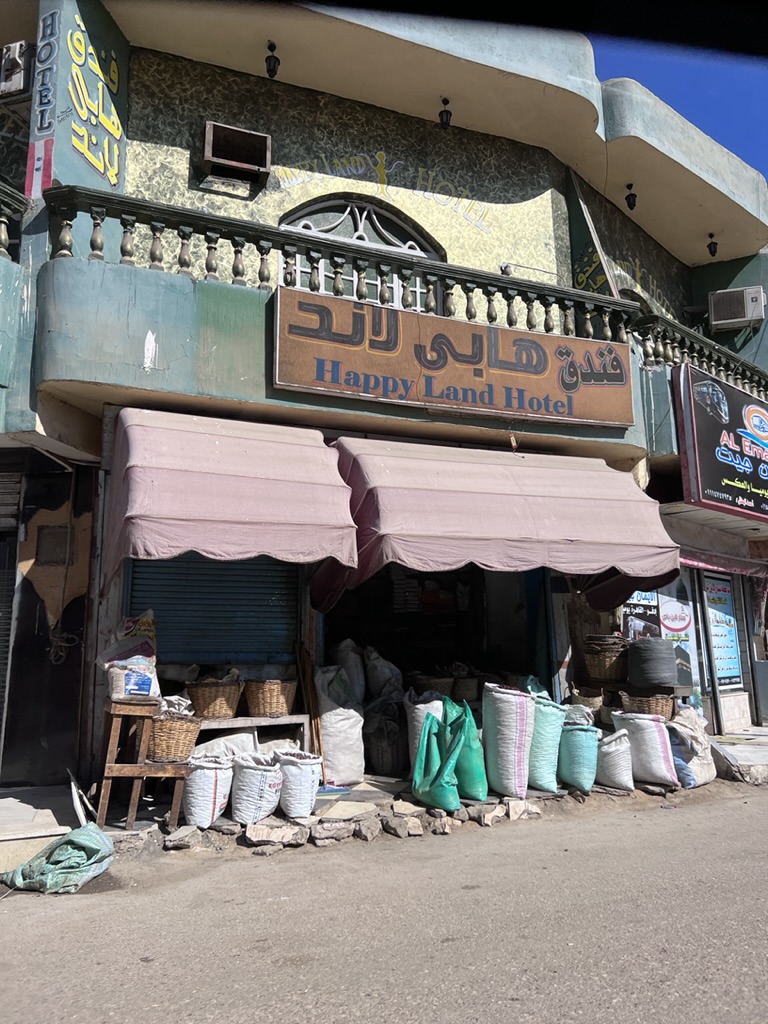
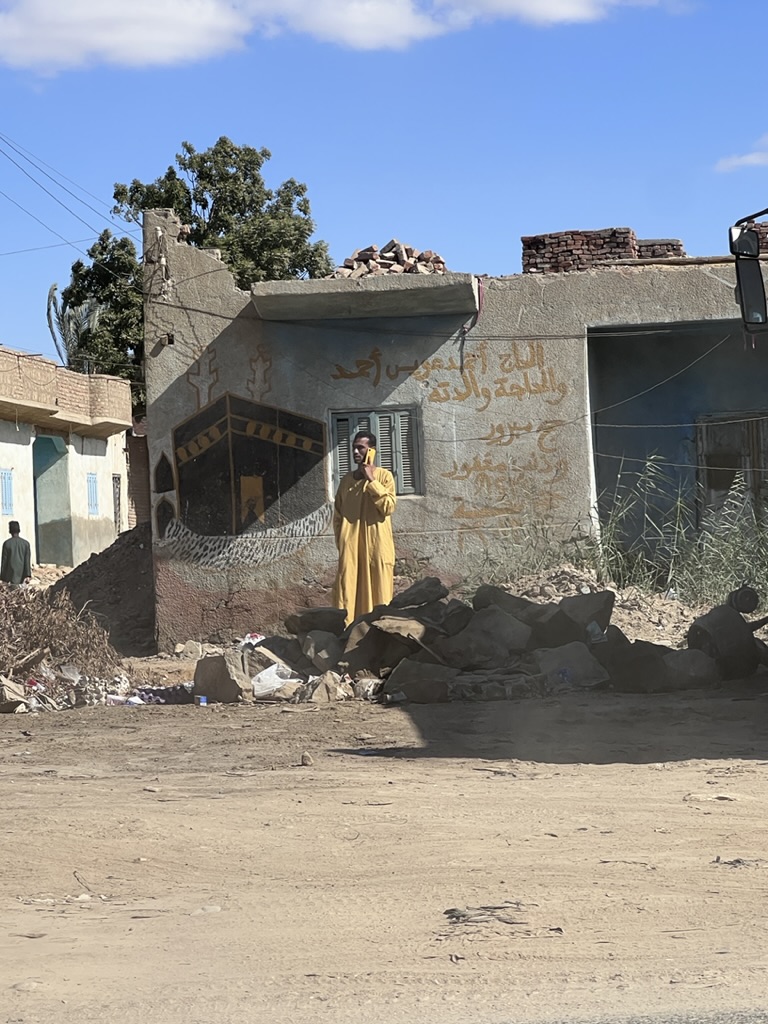
As is the tradition in Egypt, all of Allah’s father’s sons (there are 5) live with their parents, along with wives and children. The married daughters (there are two) live with their respective husband’s families. Allah’s wife works; she is a teacher as is one of his sisters. He has two young children, one of whom is in primary school. The drive is slow because of the road condition and because you are required to stop periodically at police checkpoints (of which there were about a dozen over the 100+-mile drive. Not sure what the police are looking for, but the trunk must get opened and Allah shows some papers.
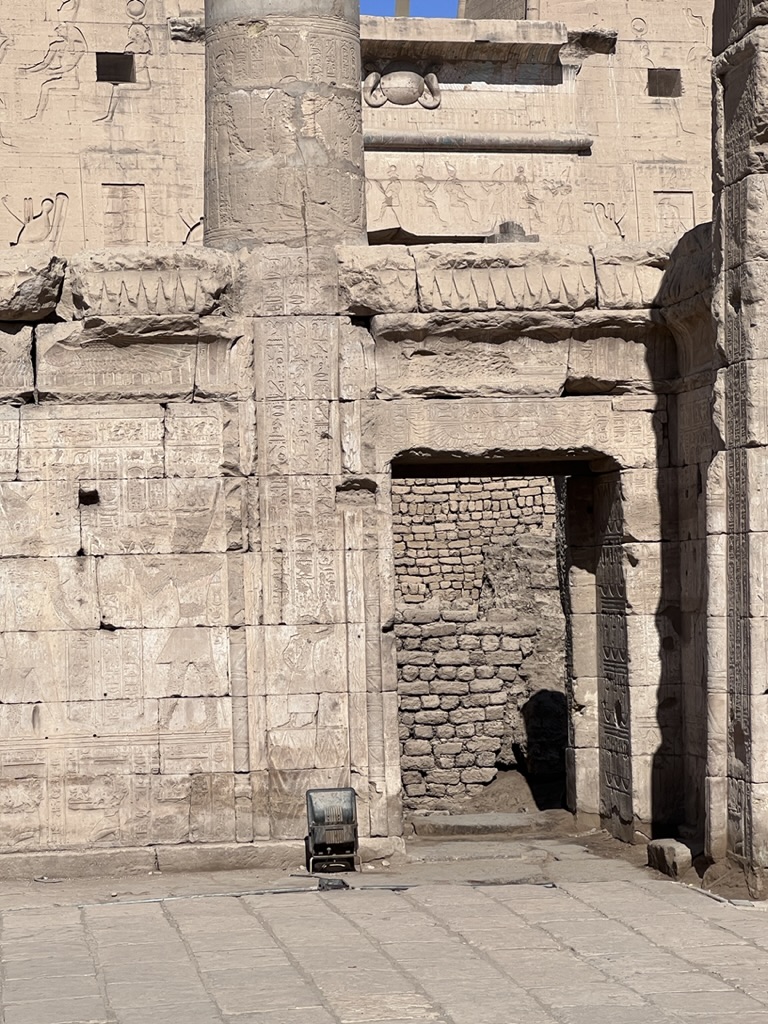
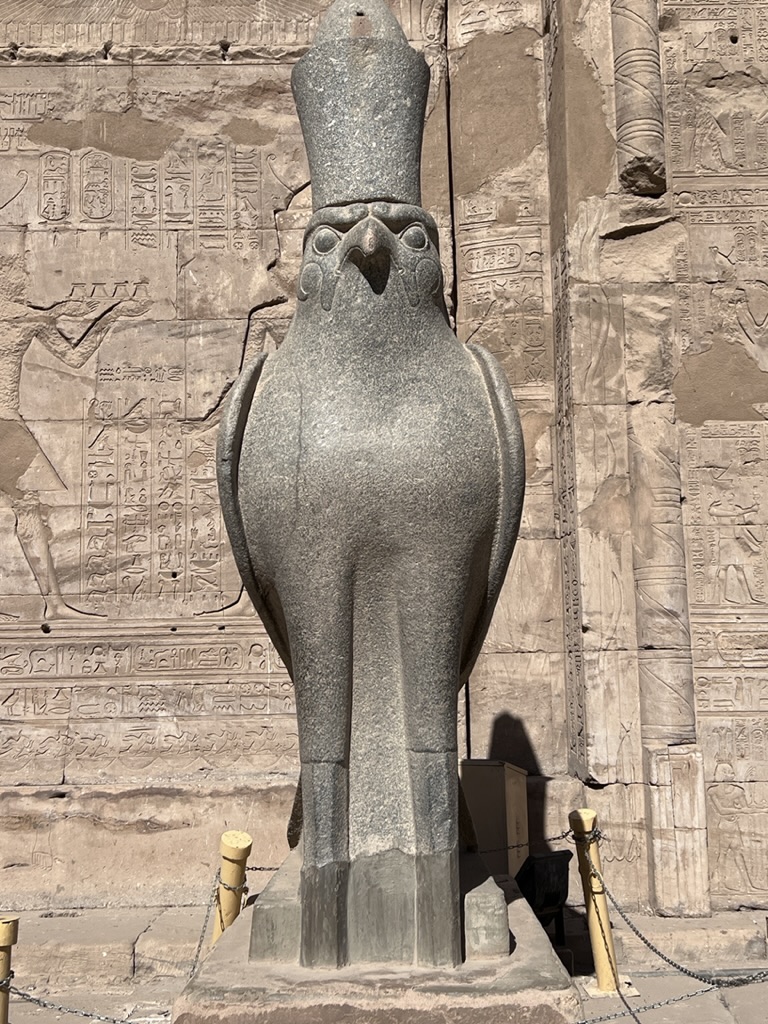
Along the way, we stopped to see Edfu Temple (I’m beginning to get templed out). Edfu is one of the best-preserved temples in all of Egypt. It was built in the Ptolemaic Kingdom between 237 and 57 BC. And then we changed from the smaller road to “the highway” where we could go about 40 MPH. Apparently tourists are not allowed on the highway. Not clear as to why, but Allah explained that he had black curtains on the windows and at a certain time we needed to cover the windows with these black curtains. If he were to get stopped (and he was pretty sure it wouldn’t happen) he would “talk” to the cop (most likely he would know him already) and then everything would be good. I think that meant a little cash would change hands.
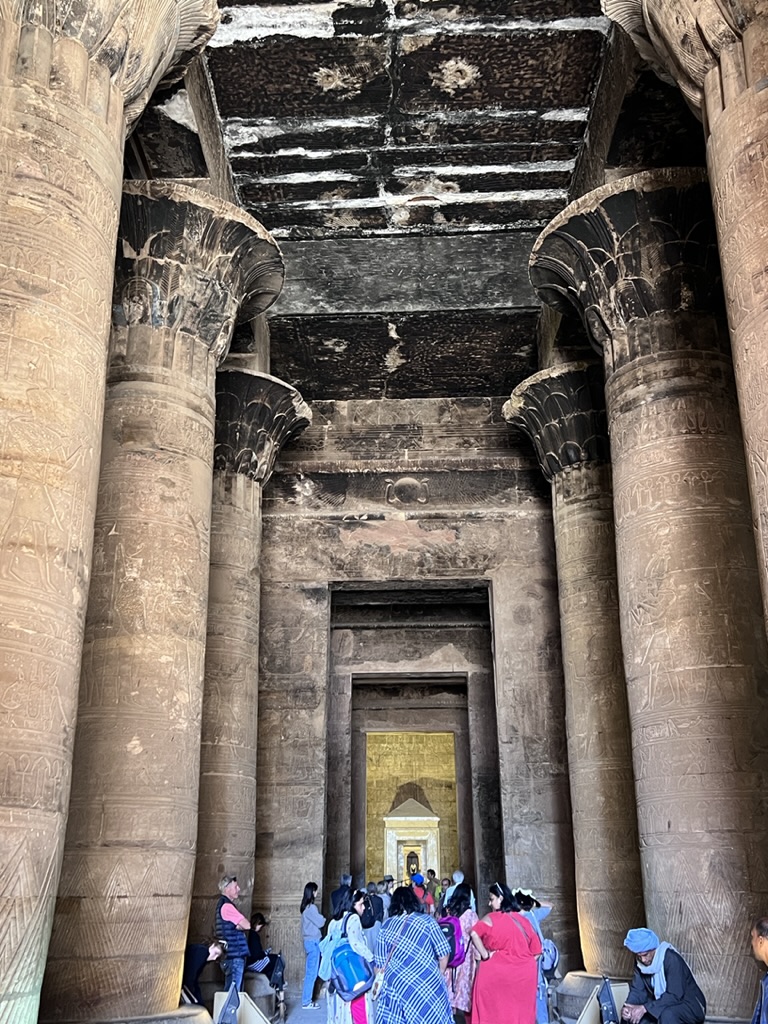
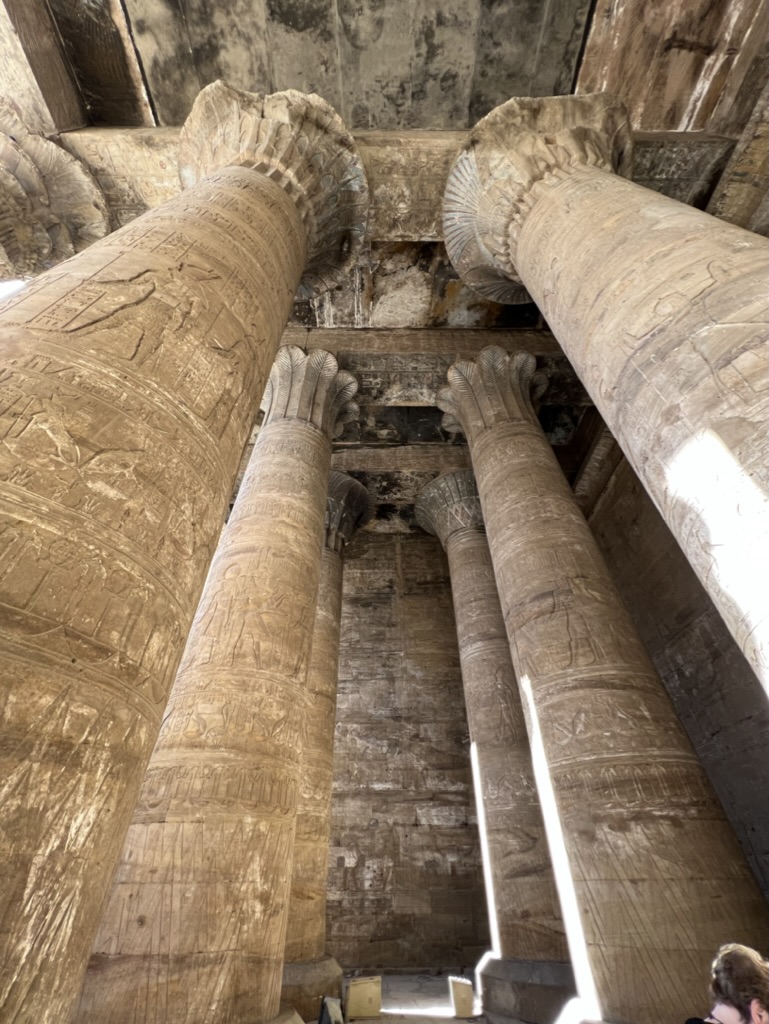
We made it just fine on the highway and none of us are in jail. Along the way, we crossed over the “old dam” that was built by the Brits and could see the much larger Awan Dam in the distance. We had received an email from the hotel BenBen Hotel, telling us to call them 30 minutes before our arrival so that they could send the boat for us?? We had not idea the hotel was located on a small island (so much for being prepared!). Allah took us to the place where the boat would dock.. It was pretty rocky with very very uneven steps down to the “harbor.” Within minutes a boat arrived (open-air motor driven flat boat) and we boarded (rather clumsily as the boat was moving and it took very large steps to get on and off the boat. No life preservers on the boat, as far as we could tell. Really don’t want to end up in the Nile.
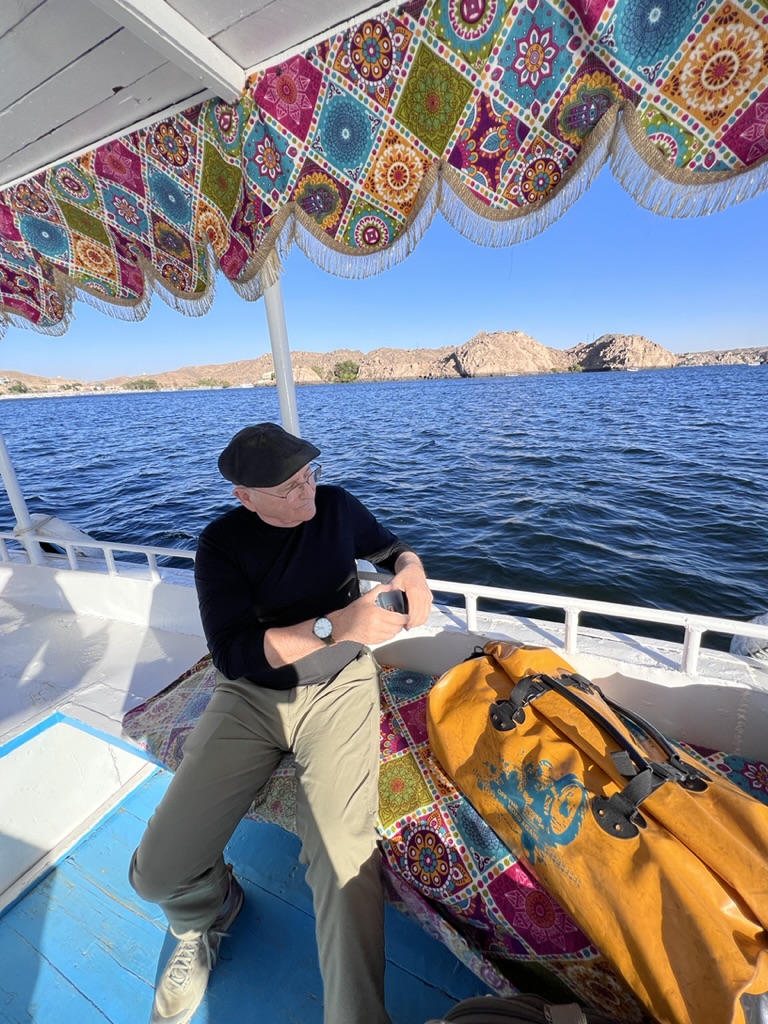
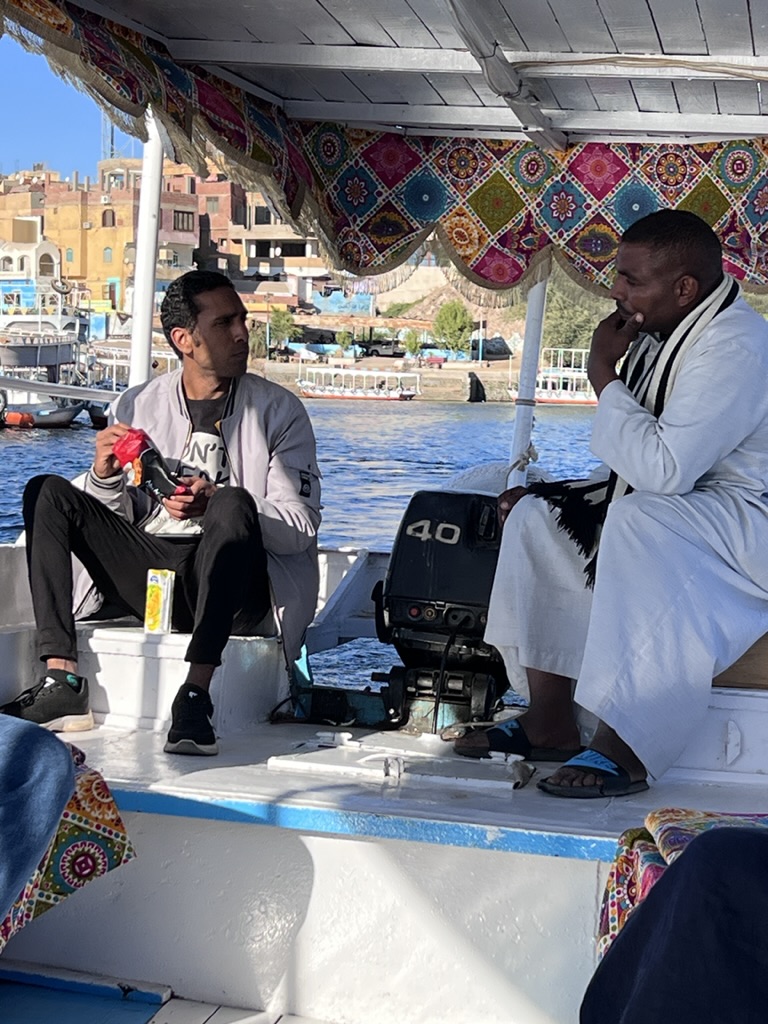
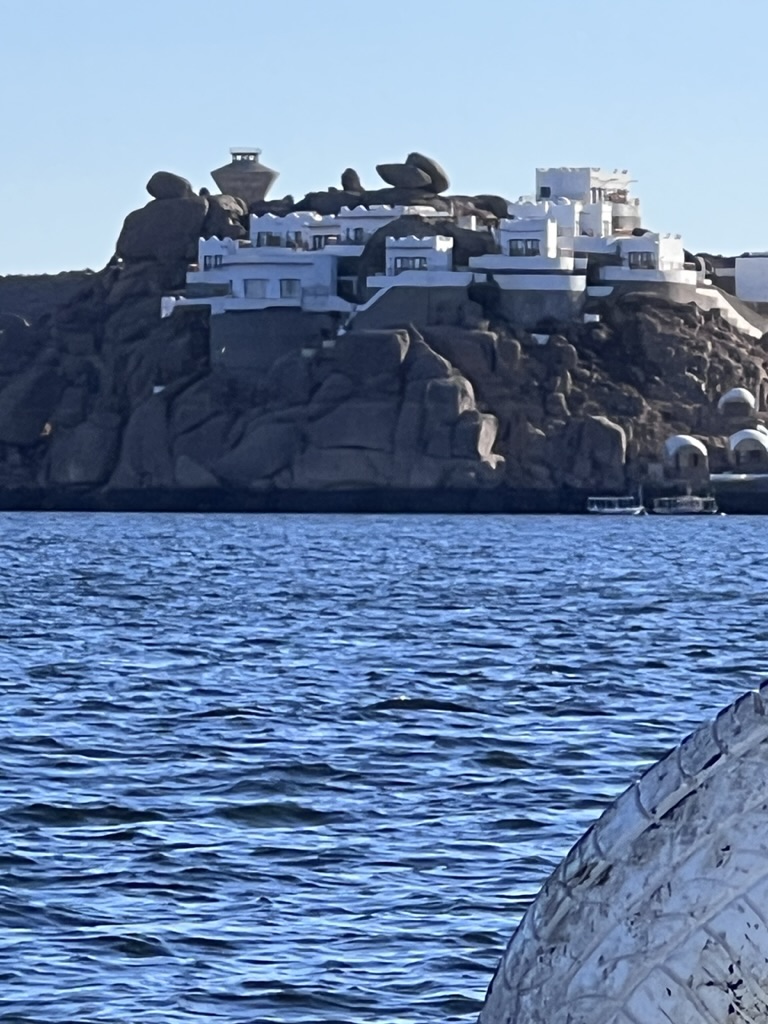
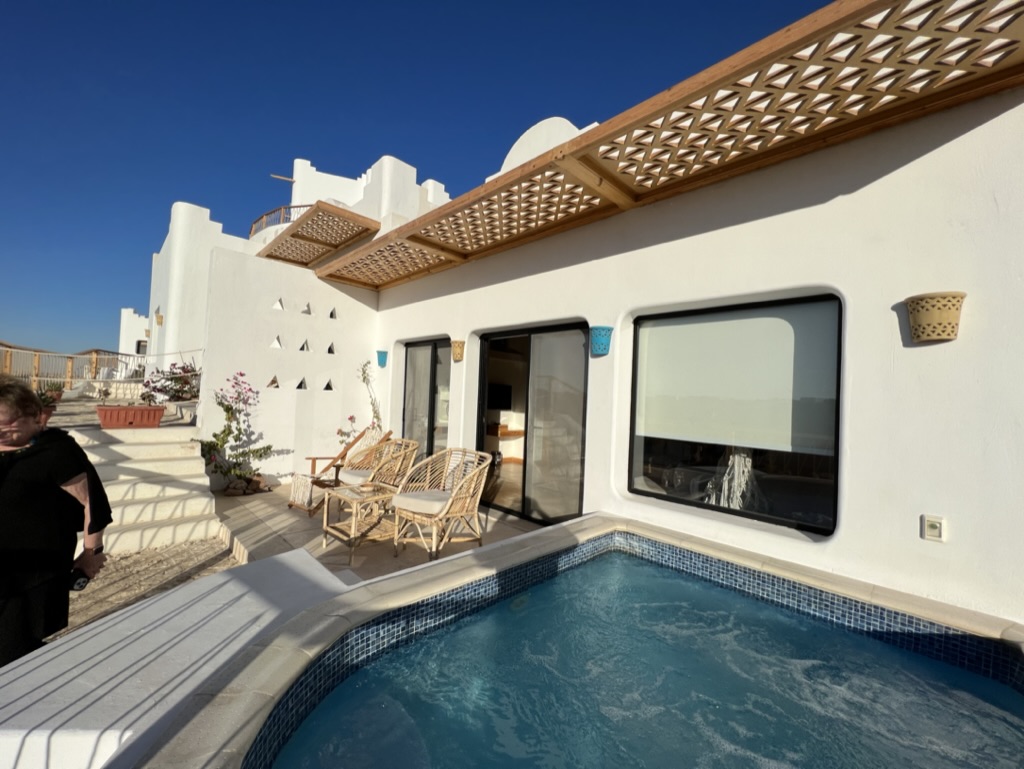
We then took the 15-minute ride to Ben Ben… which is pretty fantastic, from what we’ve seen thus far. It’s only one year old. All the rooms have private Jacuzzis on the decks (too bad we don’t have bathing suits). The hotel sits about 40’ atop what look like boulders and the siting is pretty amazing with commanding views of the Nile. More on the hotel tomorrow and also on our dinner tonight and late night trip by boat in the dark (no lights on the boat) to get into town for dinner.
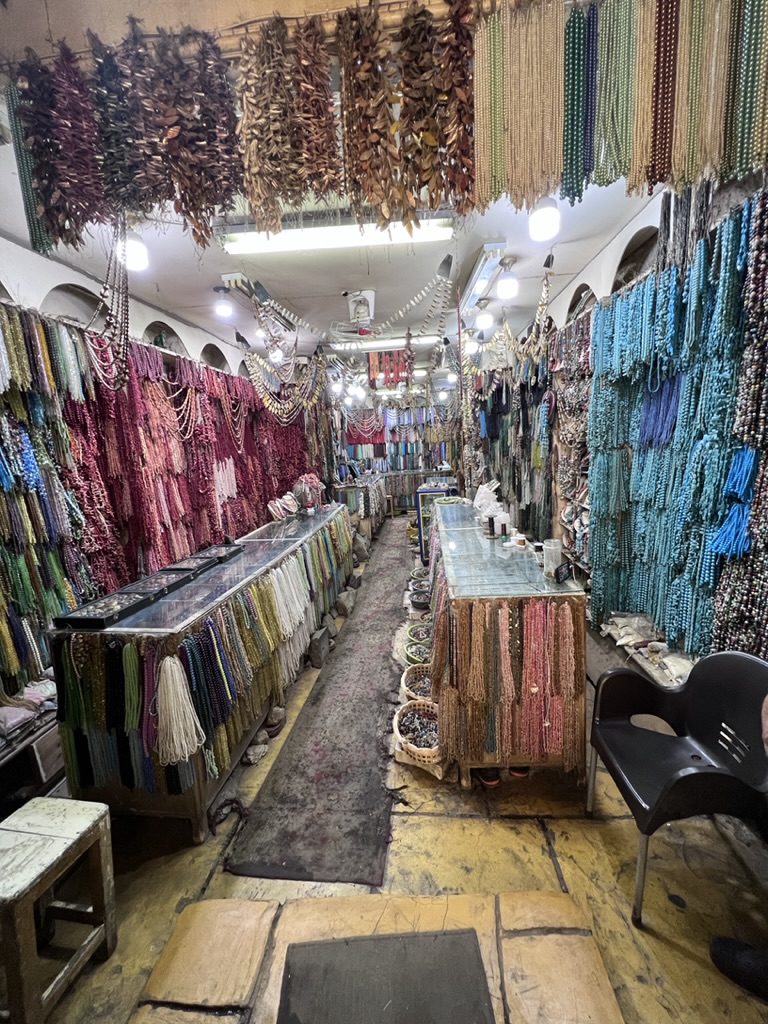
All good. We only have about 40 hours in Aswan, so unfortunately I don’t think we’ll have much time to enjoy BenBen.. Tomorrow we head to a Nubian Village—and to our favorite place.. the souk (market).
Take care
Greetings-
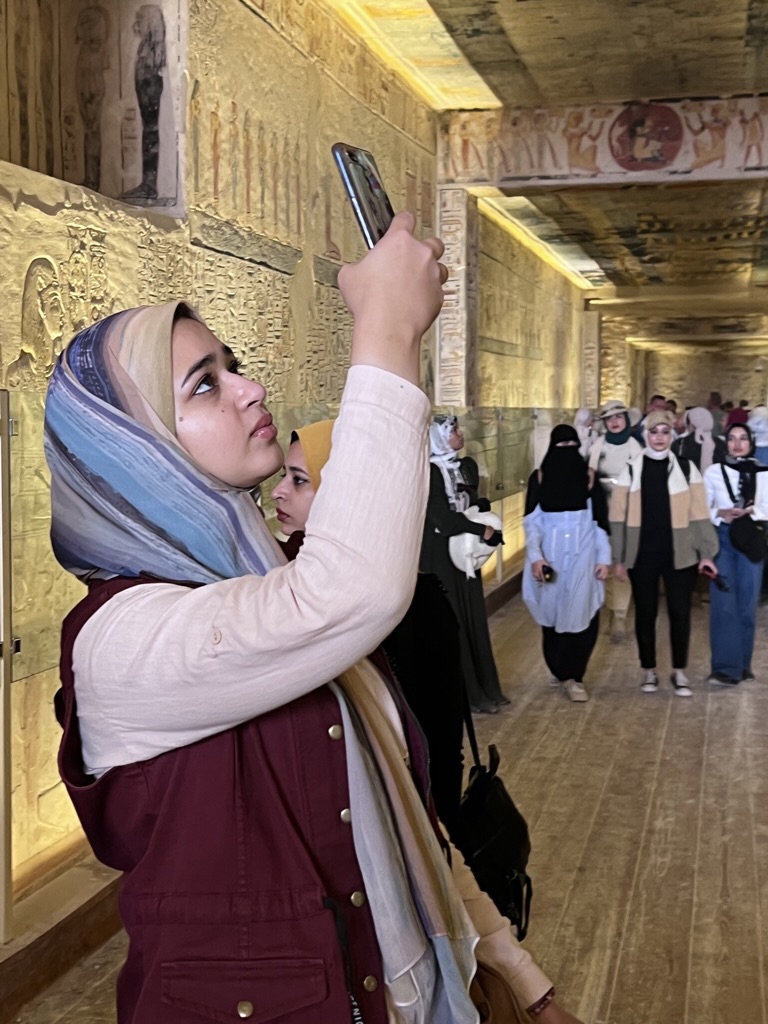
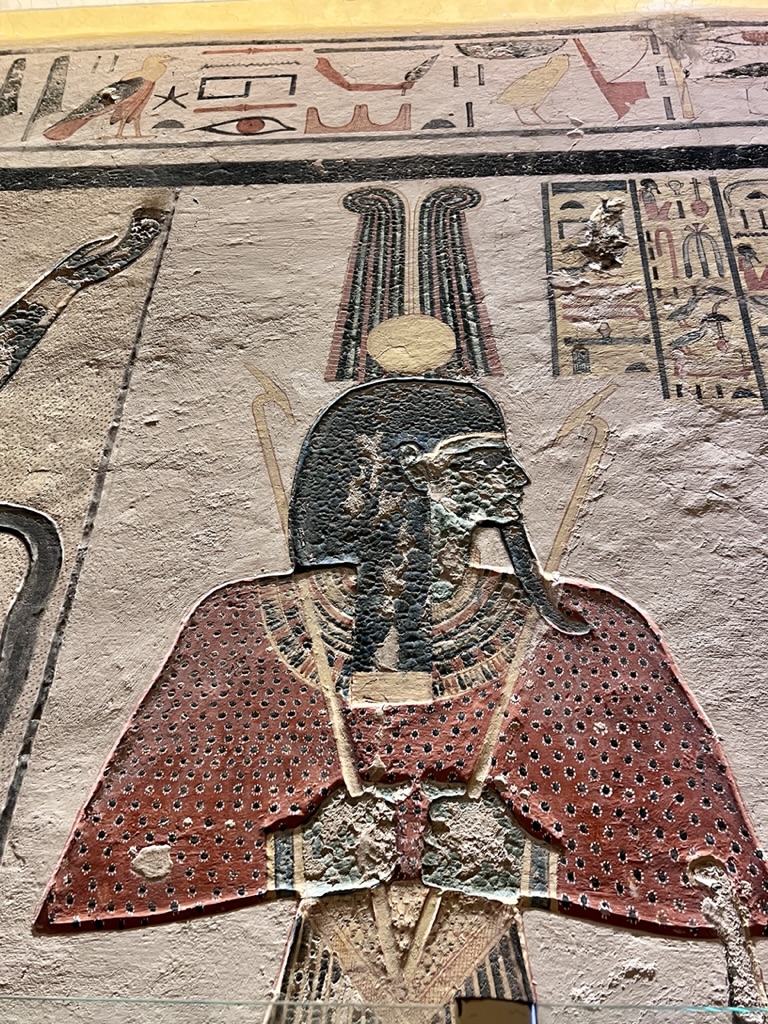
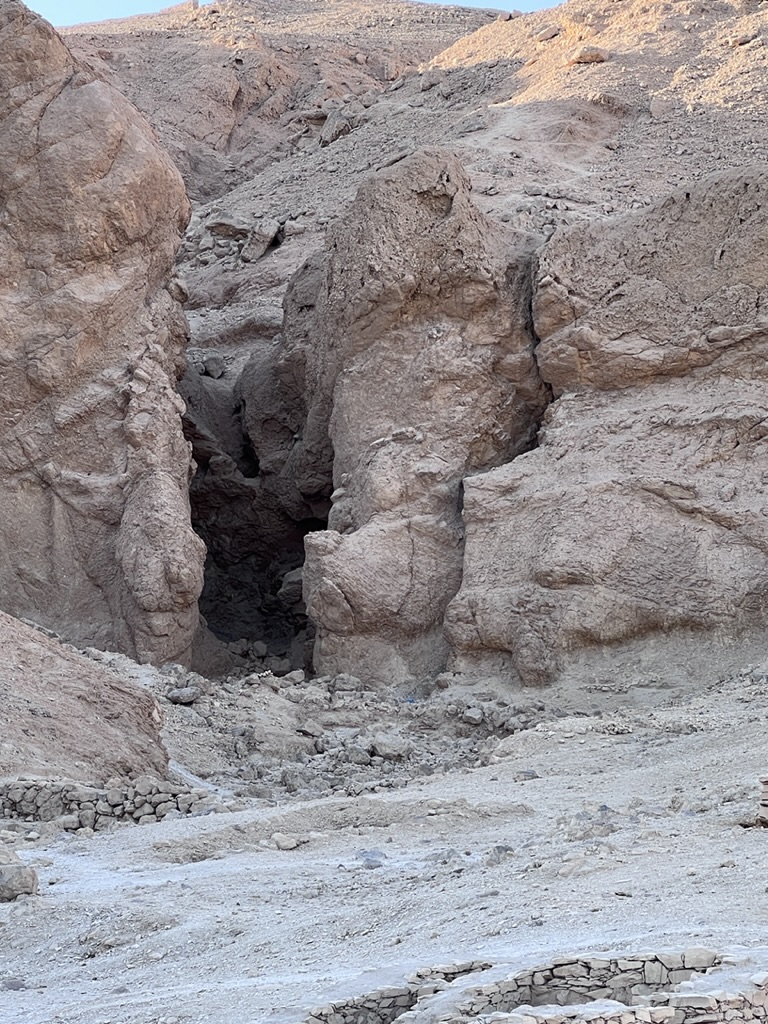
We set out on Sunday for the Valley of the Kings and then the Valley of the Queens – all day, death. Tombs, tombs, and more tombs.
Abdul picked us up and we drove across the bridge over the Nile to the west side… arriving at the Valley of the Kings about 40 minutes later. Roads are pretty worn– mostly dirt and have lots of rocks and bumps. There are also a lot of soldiers (guards) that you pass from time to time along the road. We bought our tickets for the Valley of the Kings (the prices for tickets at all official places of interest have price tiers, with foreigners paying a great deal more than locals—not sure the exact difference because the lists for locals are in Arabic). I’m fine with that, but I will say the prices were not cheap.
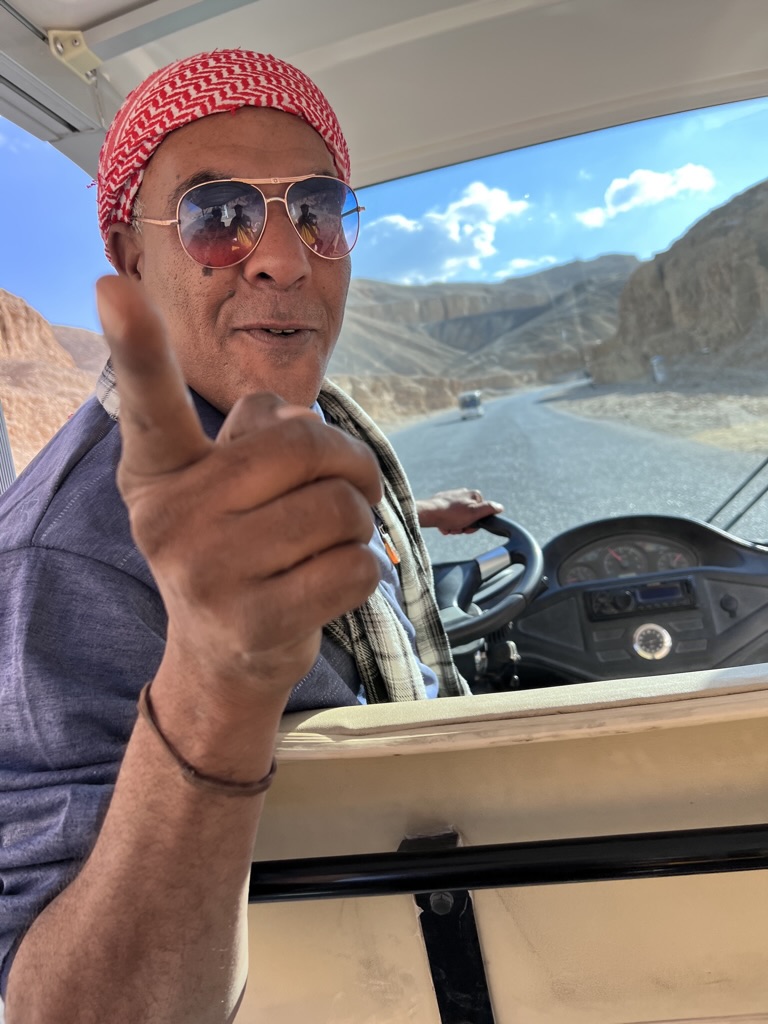
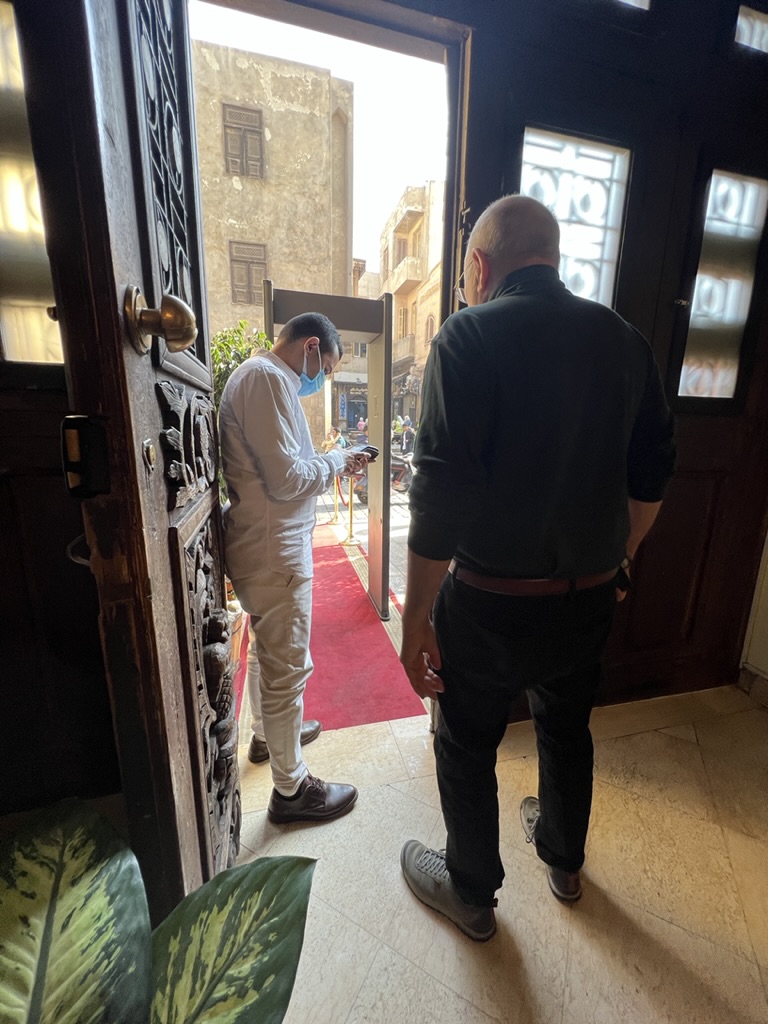
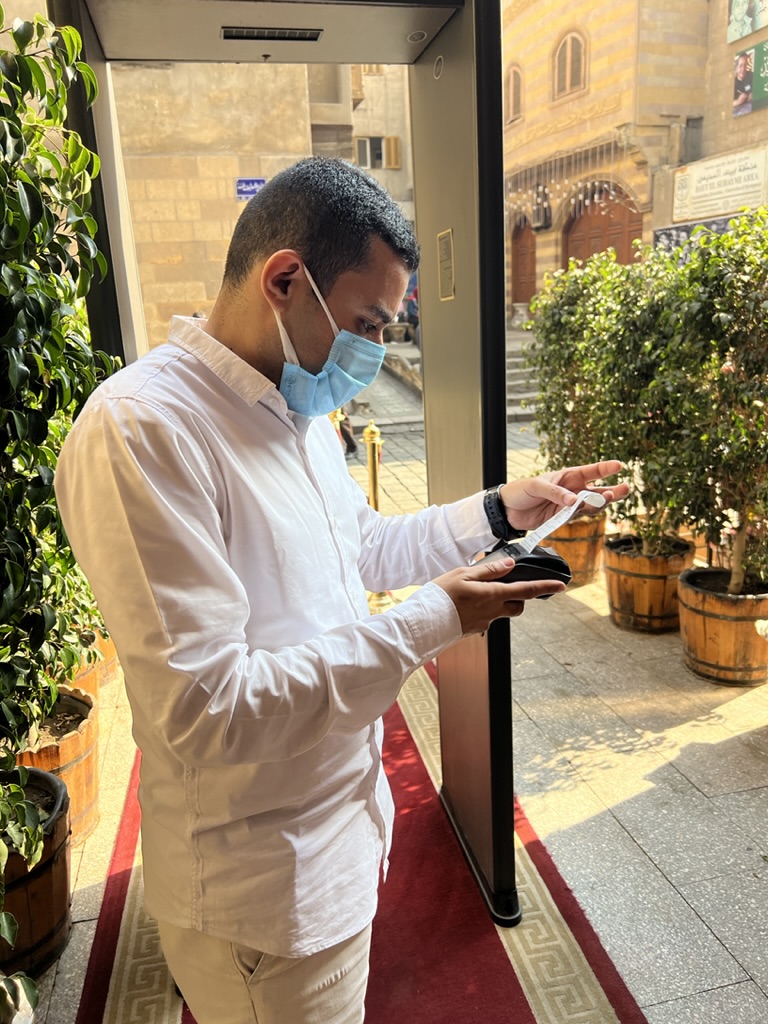
As soon as we got the tickets, we went through the metal detectors; we have become very expert at getting the digital tickets to open the turnstiles—it requires a bit of rubbing and moving your scan code over the reader. We figured out that to get to the area with the tombs you need to hop onto a little open-air electric cart (holds about 12 people) and that we did. We sort of dashed onto one, because it was obvious that most people (maybe nearly everyone) was with a tour group and their “leader” was in front of each of the carts with a big sign noting the tour group. Then it turned out you needed to pay a small fee to use the cart (the tour groups had probably prepaid), so we got off and went to another ticket booth to get our tickets for the cart. Jumped on another one and off we went. They let you out just in front of the area where vendors are trying to sell you all sorts of things that are branded with King Tut and other dead leaders. We passed.

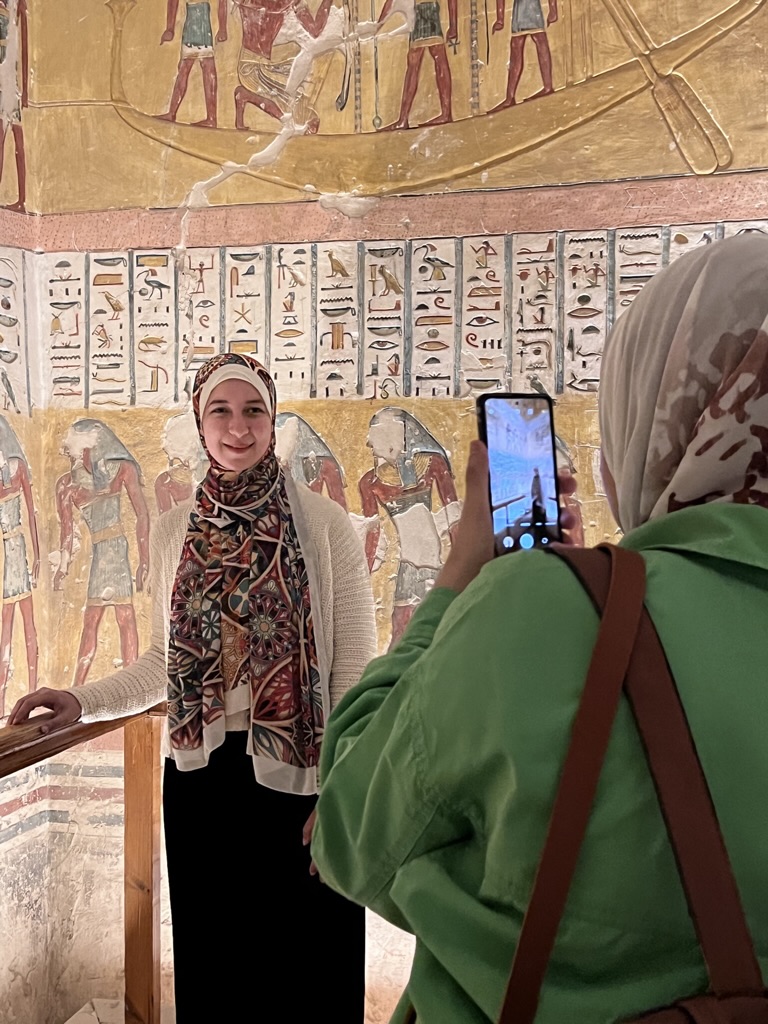
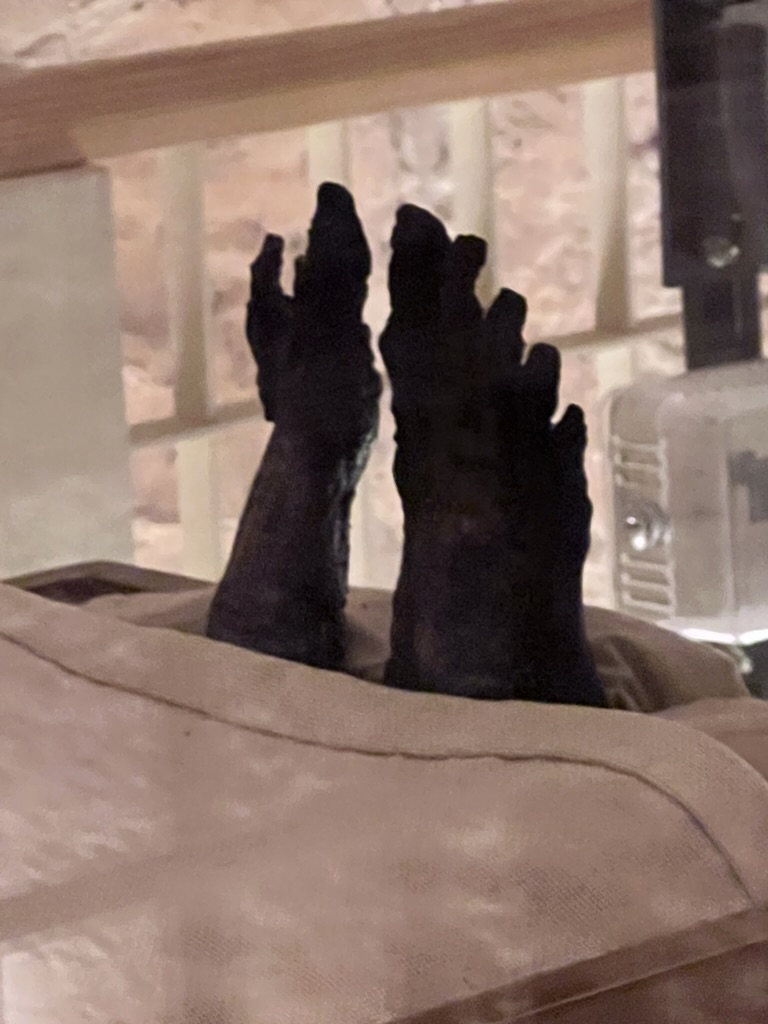
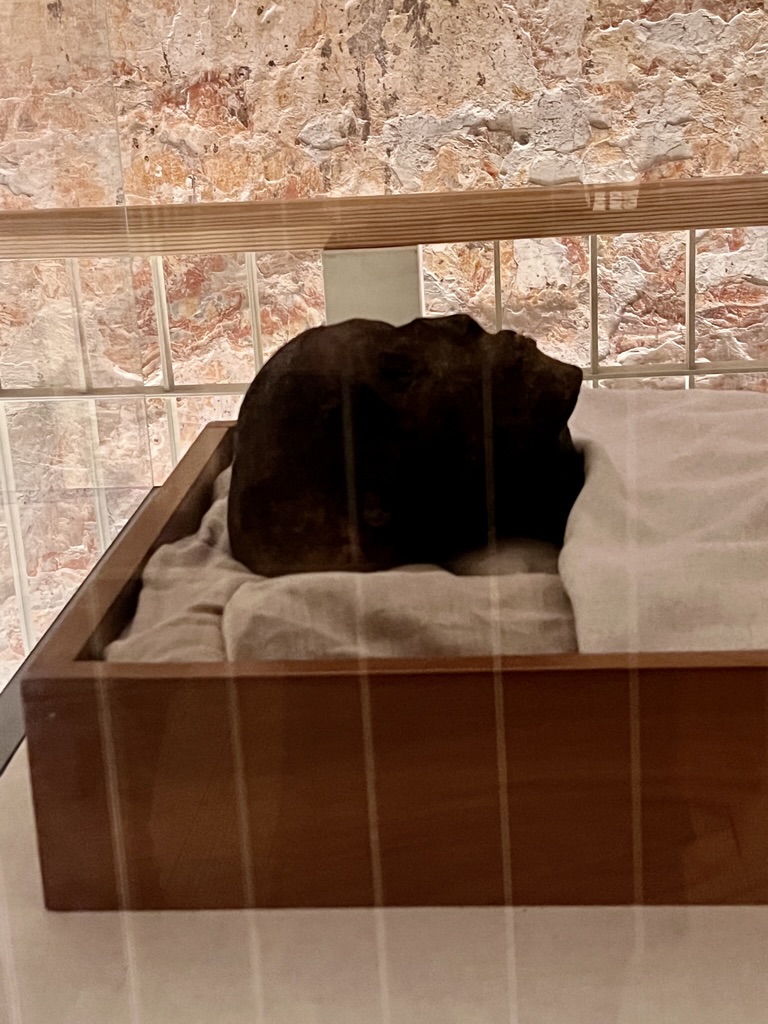
We visited three different tombs and then decided we should see the King Tut tomb, so we walked up to that entrance. At each entrance they punch your ticket. When we got to the King Tut entrance we learned that you needed a different ticket (in addition to the regular ticket), so we walked down and took the little cart again and went back to the ticket booth to get the additional ticket. Costs as much to see King Tut tomb as it did to see all the others combined But, here we were, how could we not visit King Tut?
With the new ticket in hand, we went down about two or three flights ad there he was… short guy… His head is visible and his toes (see photo above of toes of King Tut); the body is in a shroud. His tomb is obviously more decorated than the others, but his tomb was actually pretty barren as most of the decorations were taken away and put into other museums across Egypt (and probably also around the world). He died at 19 (!!) — last pharaoh of his royal family to rule during the end of the Eighteenth Dynasty.
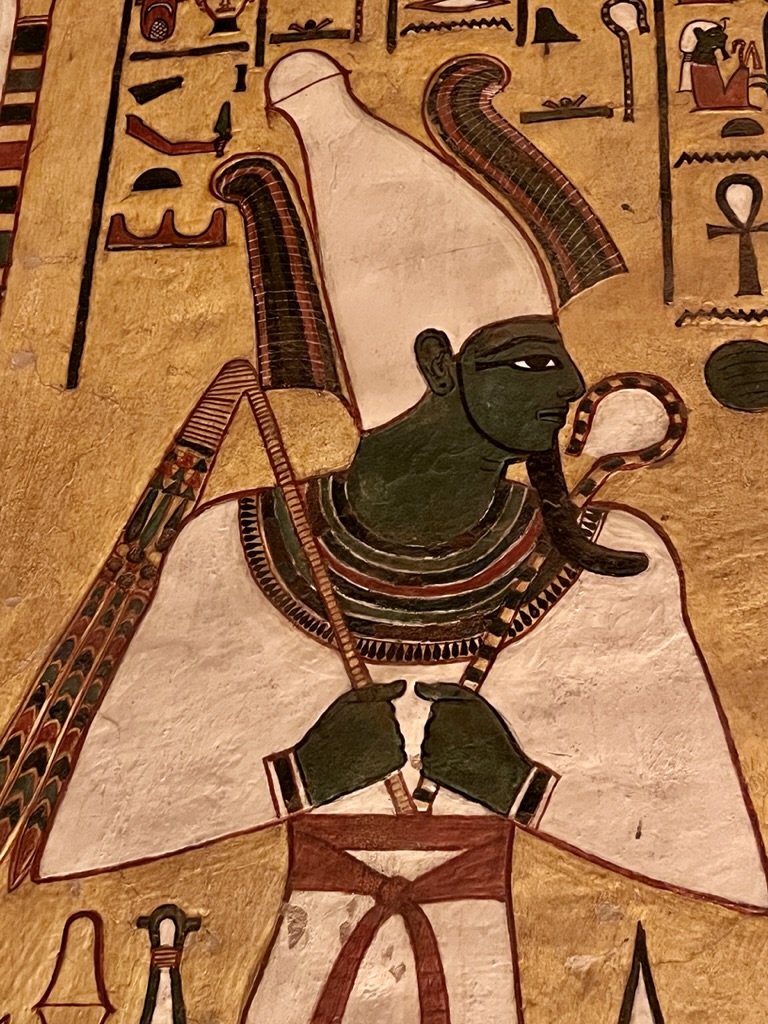
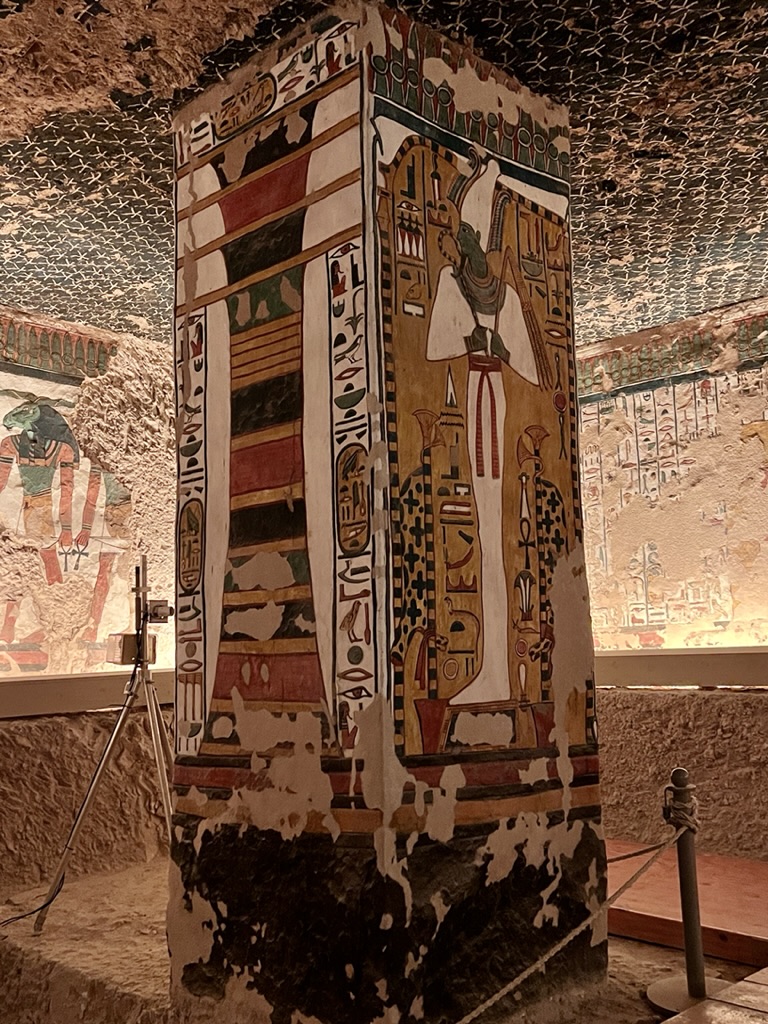
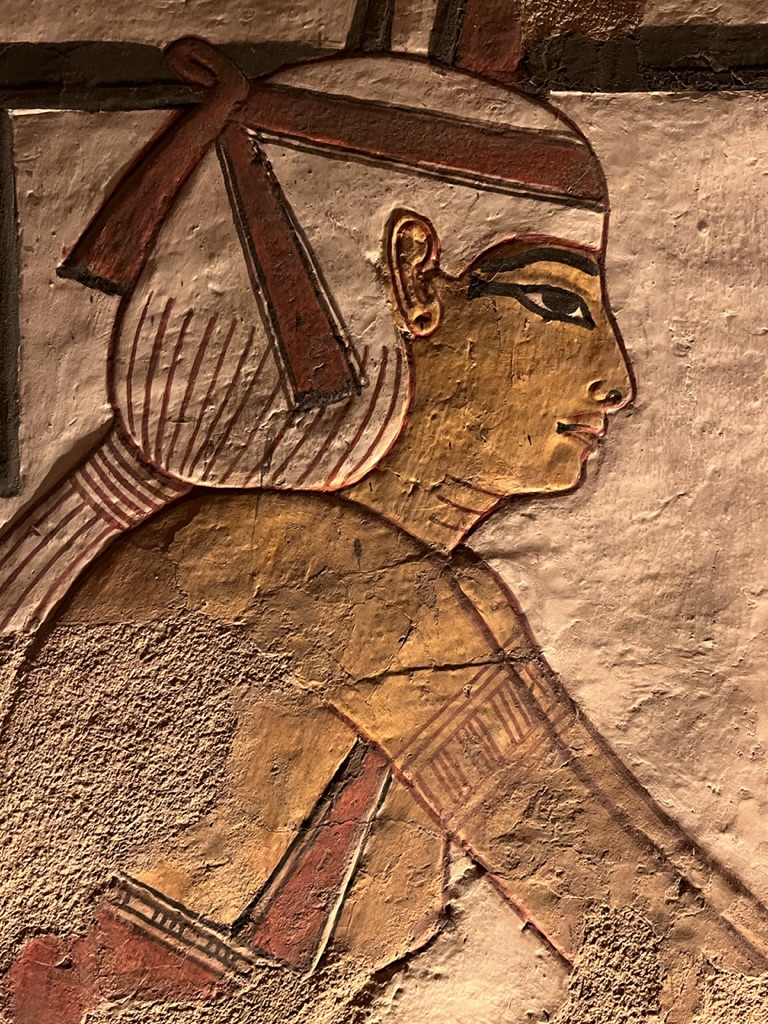

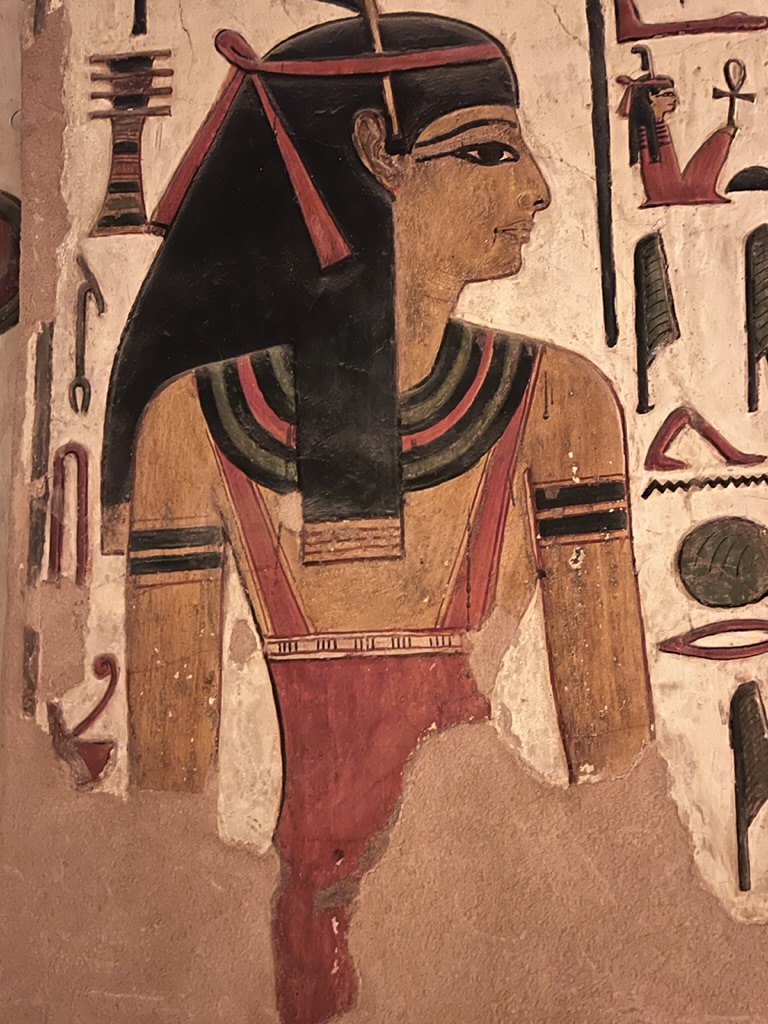
Then we headed to the Valley of the Queens, which is less visited than the Kings (naturally) and also less well preserved. But we decided we needed to see Queen Nefatari (not Nefertiti). Known as “Lady of Grace,” “Lady of All Lands,” “Wife of the Strong Bull,” “Great of Praises” and many other nicknames, Queen Nefatari was clearly one of the most famous Egyptian queens and an iconic woman of Ancient Egypt… obviously a powerhouse, based on her tomb.
Like other kings of Egypt, Rameses II had a large harem of wives, but at any one time only one wife was considered the ‘chief queen.’ Rameses was a busy guy and had 8 queens over his lifetime, but Queen Nefatari was supposedly his first and most beloved. The tomb of Nefatari was the best preserved and most amazing of all of the tombs we visited, with colors still rich and preserved.
Then we made our way back to our hotel and quickly headed out again—for dinner at Al Moudira, a very small, elegant hotel on the West Bank of the Nile within the Al Moudira Hotel. We had tried to book that hotel months ago, but it was impossible; it’s booked many many months in advance. So, we thought we’d visit it and have dinner. As the taxi drove down the remote road to Al Moudira we noticed there weren’t any lights on the streets or buildings. When we approached the hotel, they came out to tell us that dinner was still being served but that all power was out and everything would be by candlelight.
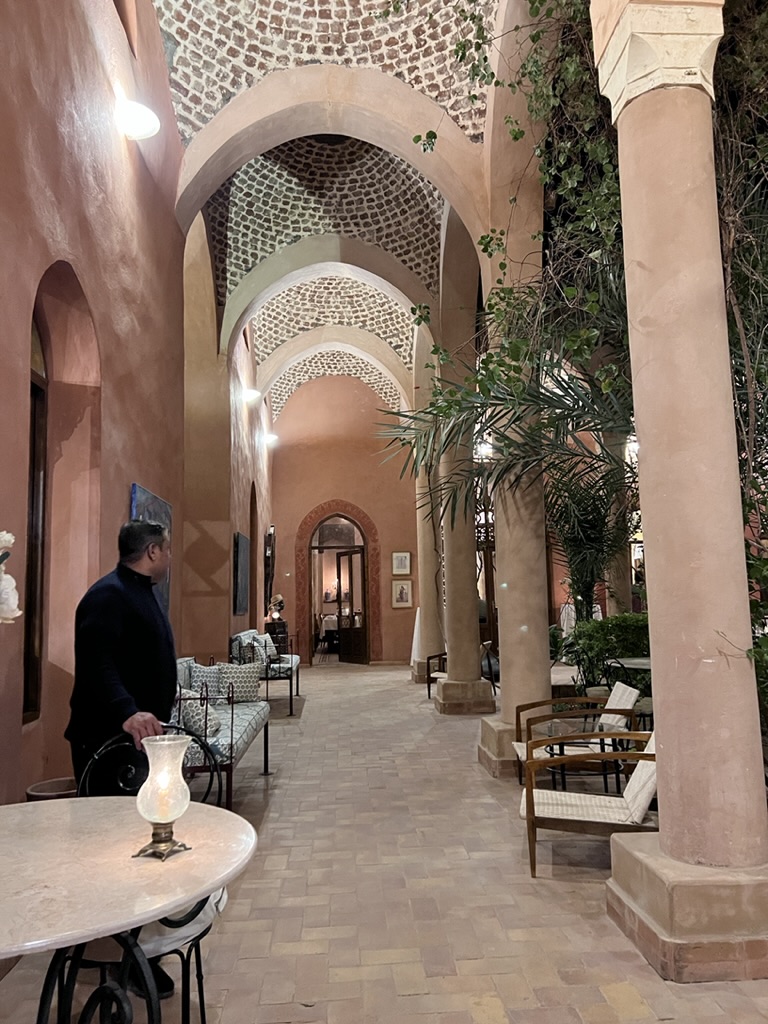
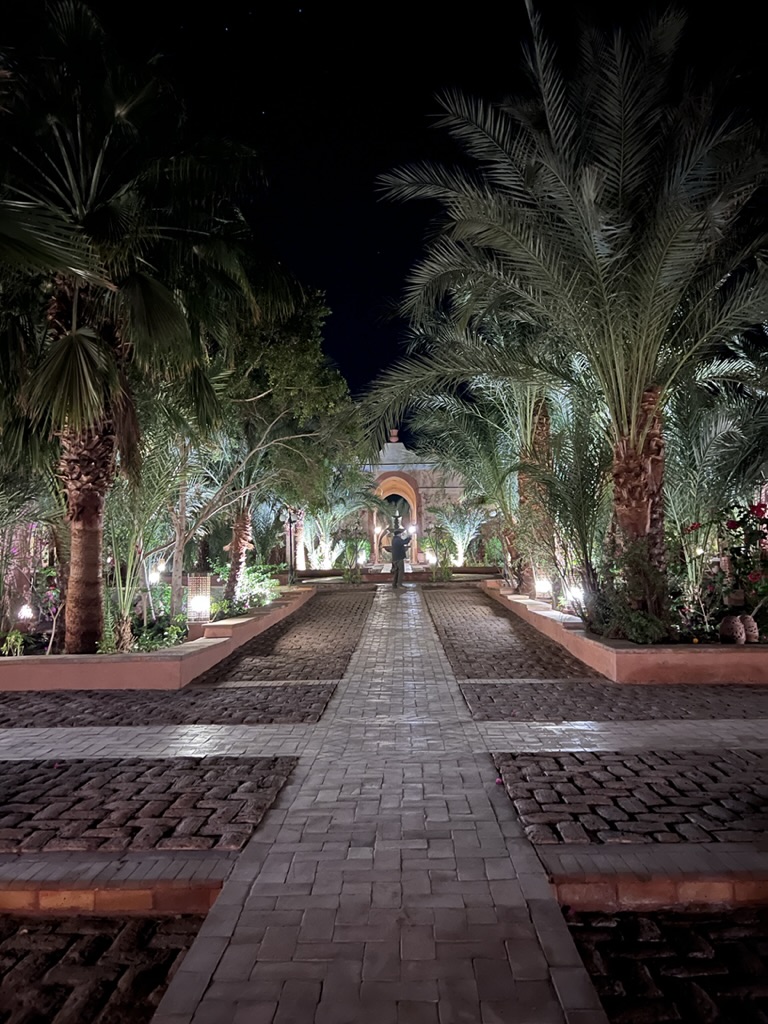
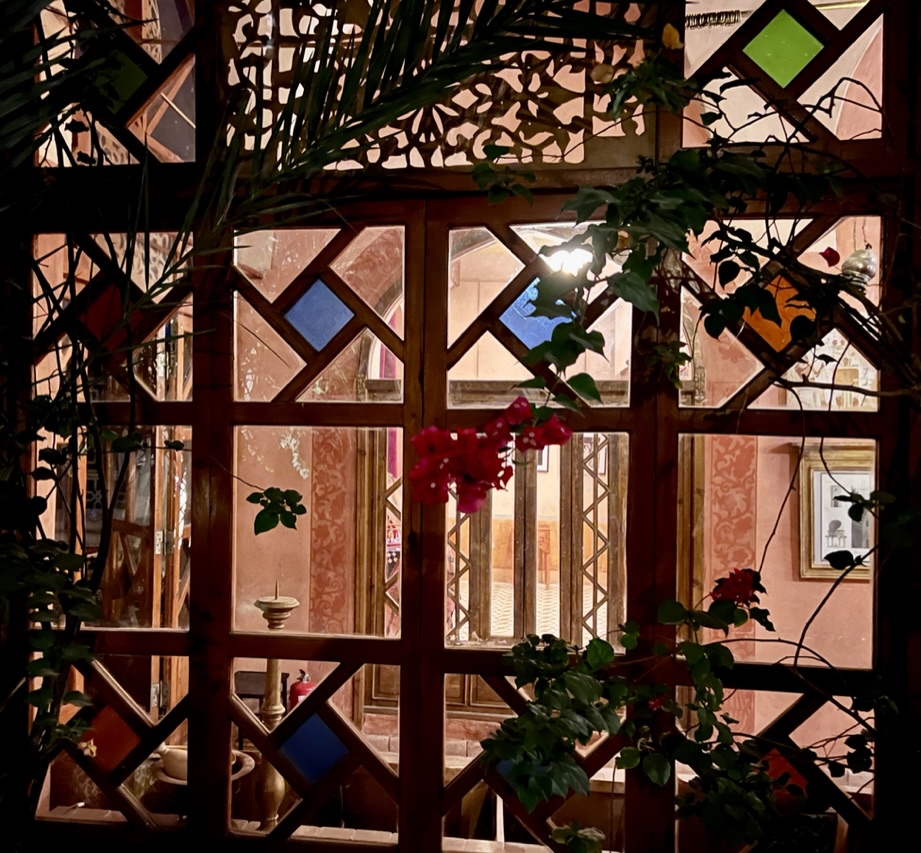
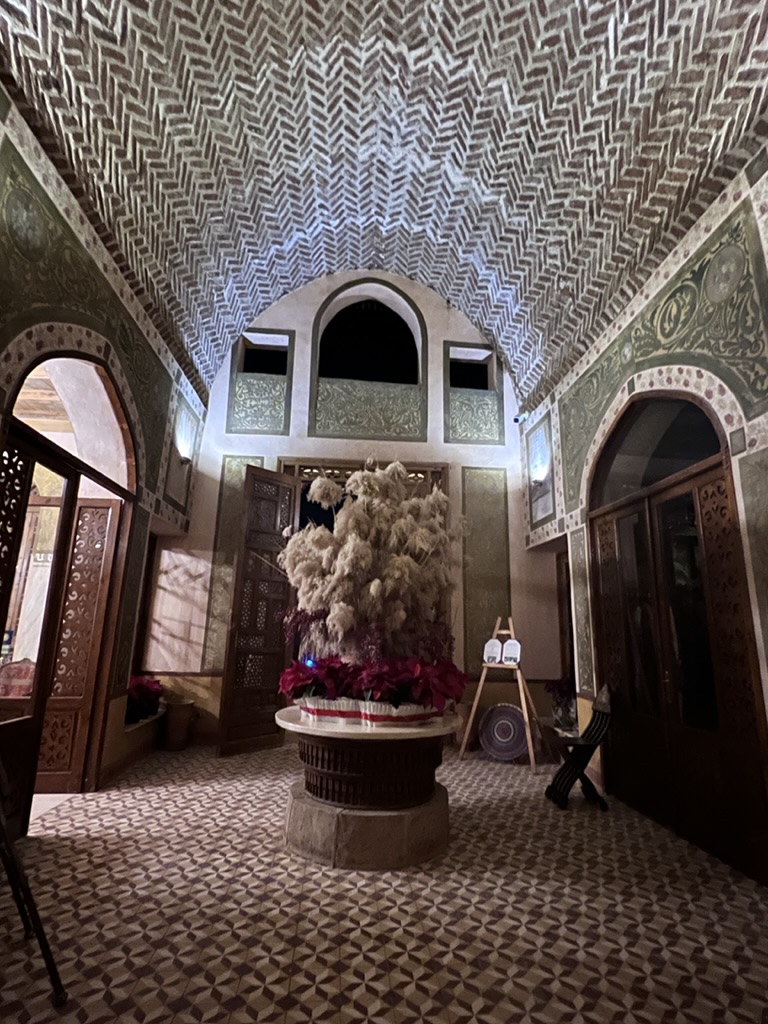
We got settled in the amazing dining room, began to order and voila the lights came back on to quite an applause from the assembled guests.
Dinner was not great, but the setting made it all worthwhile. The story of the hotel is interesting; conceived by a wealthy Lebanese woman who had lived in many places around the world including 10 years in Tuscany. She decided to settle in Luxor on the West bank and hired an architect who specialized in building traditions of a bygone era. Every detail was considered and the frescoes on the walls are superb. We strolled the grounds and then headed back to our hotel to pack and prepare to leave the next morning.
Best –
Fern
8. Luxor Egypt: Cairo to Luxor: Tombs and Taxis; Abdul and Abdul (and Abdul) 12/23/22; 12/24/22


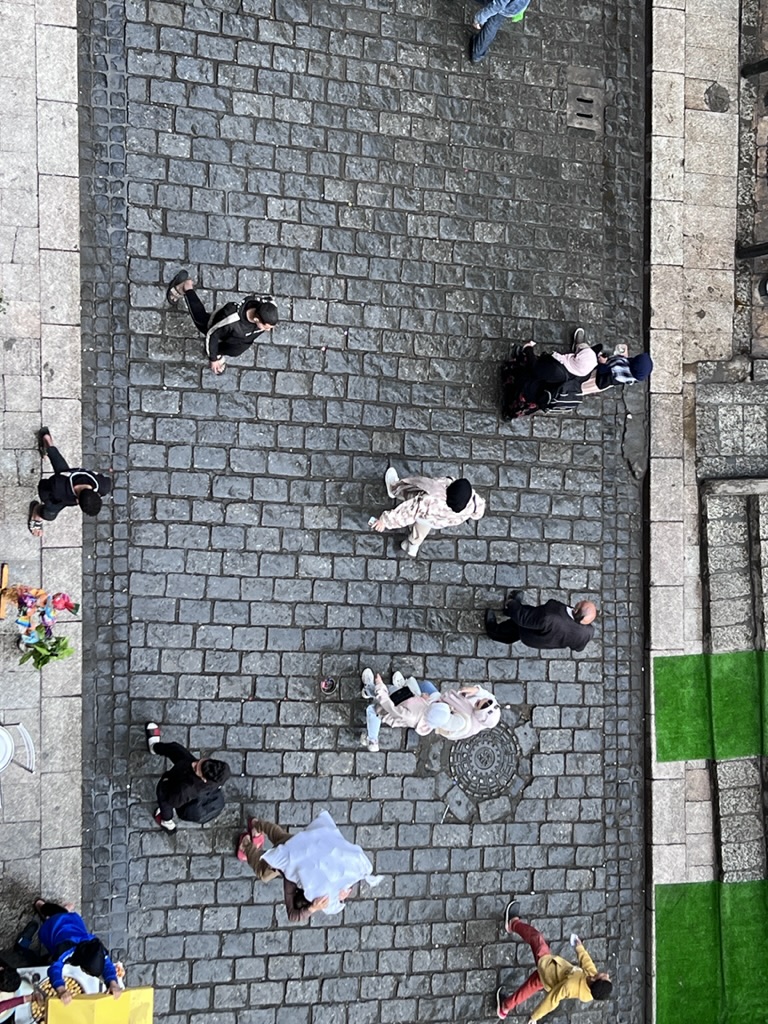

Greetings from Luxor, Egypt
I trust you are well and enjoying the holiday season-
We left Cairo last night for Luxor. The airport was fairly calm, and other than the fact that the flight was about 30 minutes late, all was smooth. Landed in Luxor (population 1.3 million – a tiny village compared to Cairo) and found our way out of the airport and into the taxi world of Luxor—much calmer than the airport taxi world of Cairo. Taxis at the Luxor Airport are yellow; all Cairo taxis are white. We are staying at the Luxor Hilton – not our first choice, but apparently this is a really popular time for families from all over the world to visit the Nile area. By the time we started booking hotels we had very little choice. It’s fine—probably about 17 years old, set back from the street with a long drive. Like the big hotels in Cairo, “city taxis” need to be “screened” before the hotel guards lower the hydraulic barriers to enter the hotel grounds and the drivers need to show their licenses. Very humiliating; no one asks for our identification. I suppose some of this is due to the infamous Luxor Massacre in 1997 that ended with 64 dead, predominantly tourists, including Americans.
But the staff is friendly and accommodating. They were very surprised when we checked in that we were not part of a group and that we were not going to join other guests for the Hilton Christmas Eve Dinner. (We already made a reservation for dinner at a small restaurant, that we hope will be good.)
As soon as we checked into the hotel, we immediately left our room and headed by taxi to some local restaurant we had heard about which turned out to be in a very modest neighborhood (maybe a slum). The restaurant was located inside a 6 story, walk-up hotel, called the Nefertiti Hotel (frequented by lower income Egyptians and maybe back-packers). The restaurant, Al Sahaby, was on the very top floor so we trudged up the uneven stairs. The offerings were sort of street foods and we realized as soon as we got inside that it probably wouldn’t have any wine or spirits. We ate and headed back to the Hilton to get a drink (one very positive feature of the Hilton—they have a bar). The taxi driver who took us to the restaurant and came back to drive us again is named Abdul. He is the fourth Abdul taxi driver we have had since we came to Egypt.
Anyway, Abdul was the perfect driver for us. He’s quiet, doesn’t push to show us places, gets it that we are happy strolling alone and having him wait or return for us, and doesn’t overcharge. In fact we’ve given way more than what he requests because his initial pricing is very low. He’s also very gentlemanly. He has a super cute little daughter in his What’sApp photo – probably about 2 years old; actually, maybe it’s a grandchild.
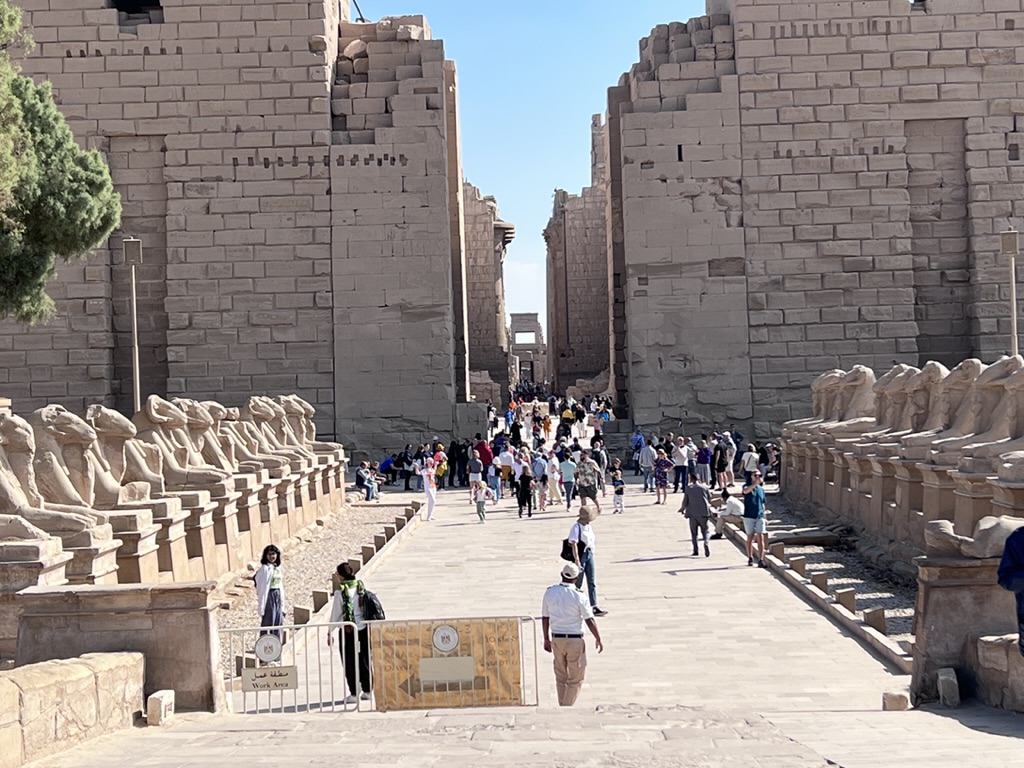
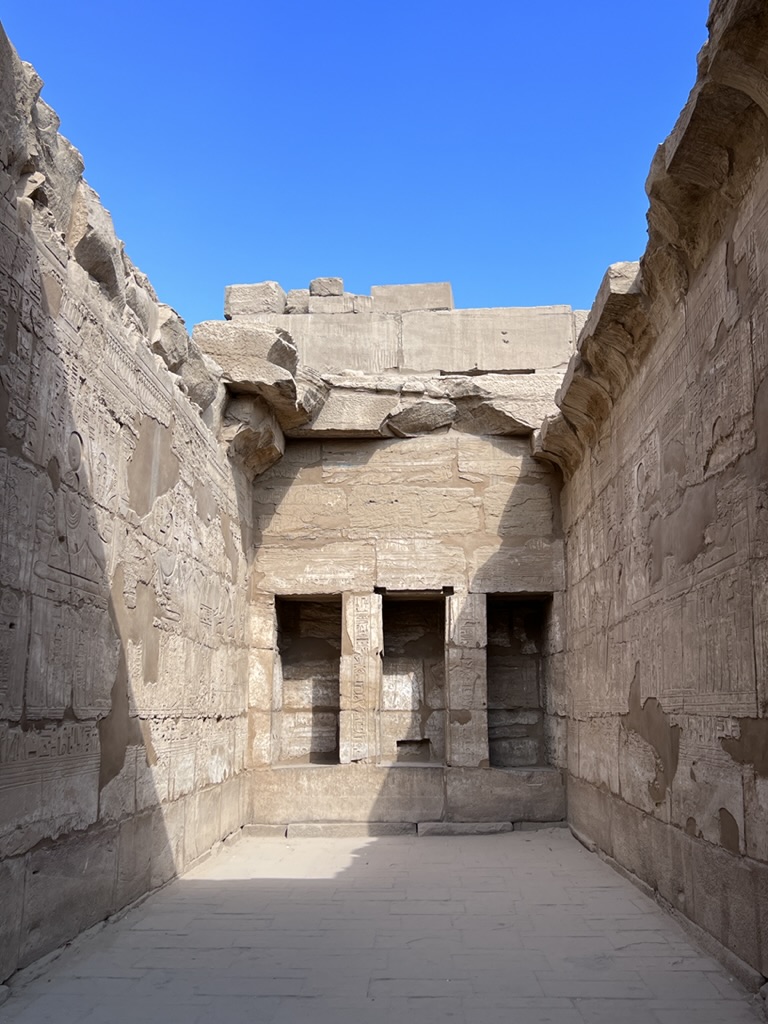

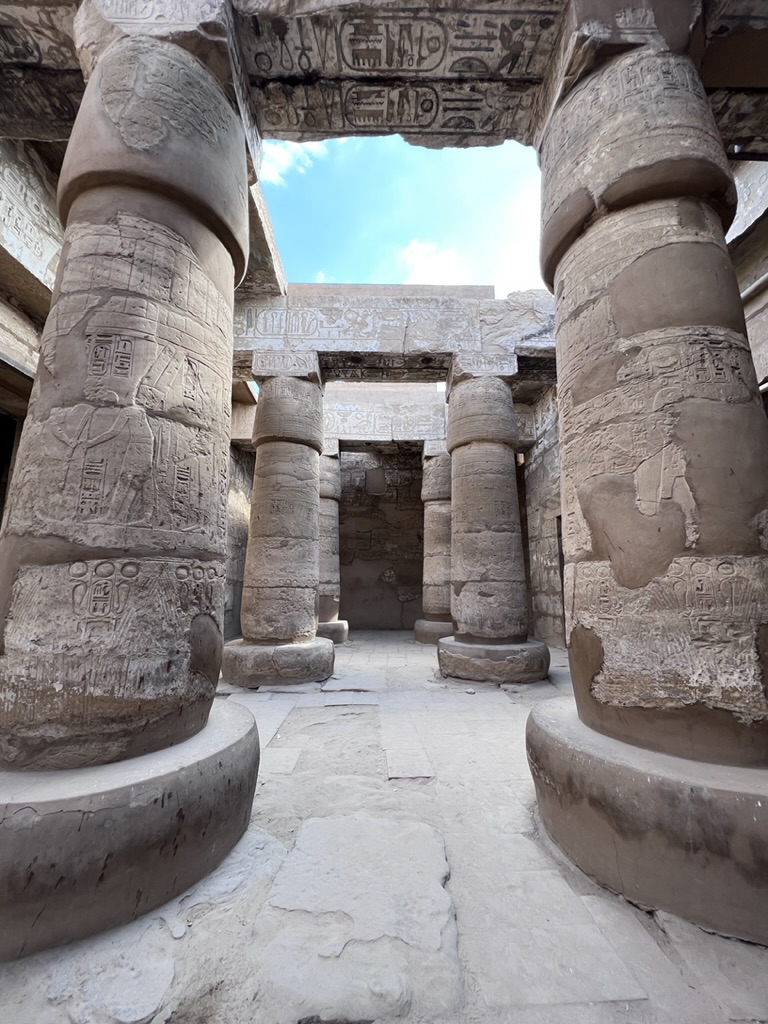
So we asked Abdul to take us to the Karnak Temple this morning and then to Luxor Temple. It’s walkable—about an hour, but mid-day heat is pretty strong and there isn’t any real shade—it is the desert. He was happy to do it and very accommodating. When we emerged from the Karnak Temple complex, Abdul was outside in a very nice car with his “cousin.” He said we would be using that car from now on… but “same price.” It was pretty cushy.
The temple of Karnak is really a city of many temples built over a two-thousand-year period and must have been totally awe-inspiring at its heyday, as it’s pretty spectacular now –even after being weathered and pilfered. It was easy to see how uneducated Egyptians of that era and the workers/slaves who built it for the pharaohs as a place of the gods could be enticed by working for a god or pharaoh with this power. The great temple at the core of Karnak can apparently fit Milan’s St. Peter’s and Paris’ Notre Dame Cathedrals within its walls. Construction at the complex began around 1970 BCE and continued through to 300 BCE. Karnak is actually comprised of four main parts, but only the largest part is open to the general public; some has yet to be excavated and some is too decayed to allow visitors. Construction occurred during the reign of 30 different pharaohs, each of whom added sections to the complex (and of course, statues of themselves and their wives).
From what I read, more than 80,000 servants and slaves were tasked with serving Amon-Ra (the sun god) in Karnak and more than 5,000 statues were erected in his honor… Quite the guy!
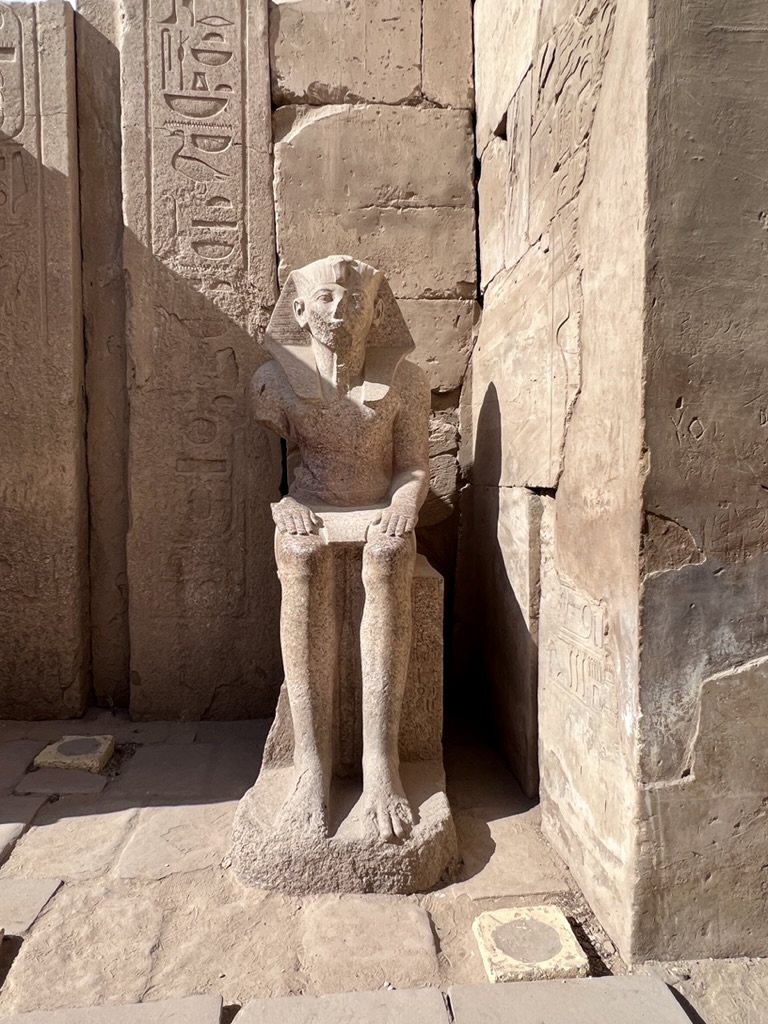
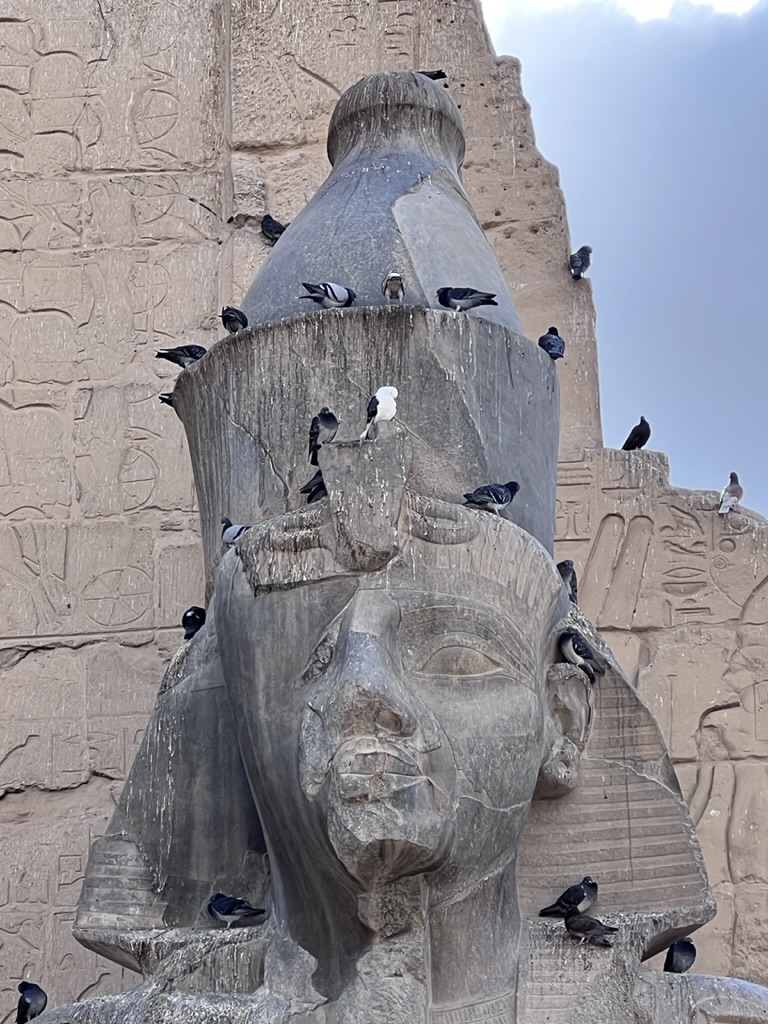
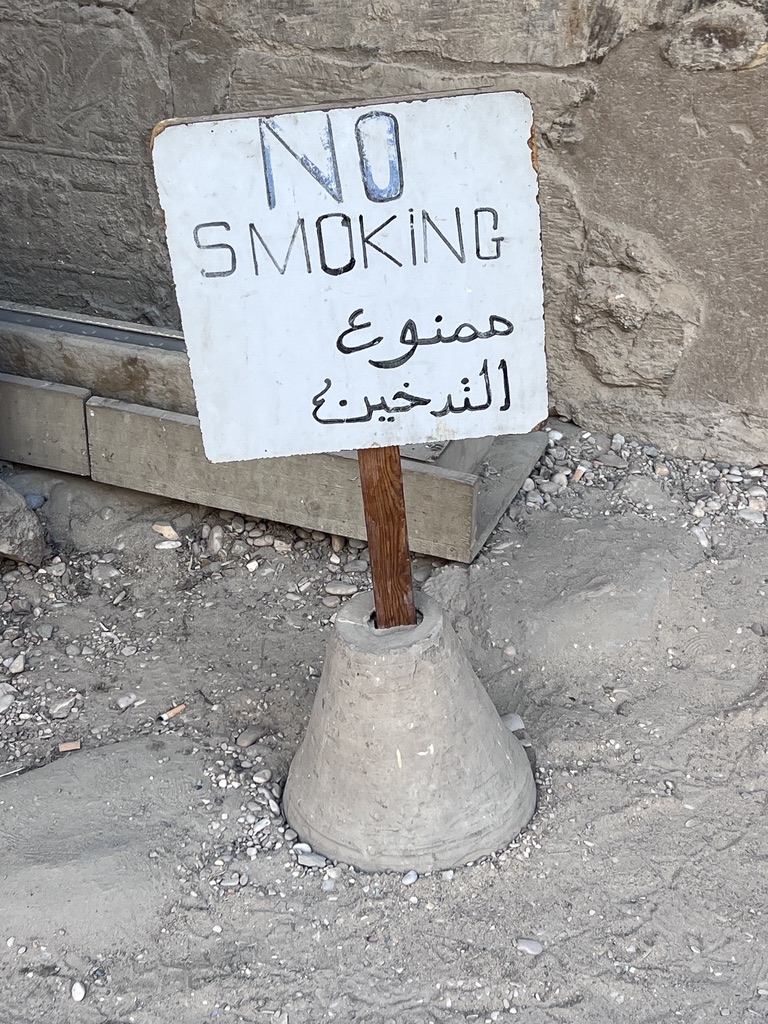
From Karnak Temple we headed to Luxor Temple, also on the east side of the Nile, which was built in 1400 BCE. If I remember my art history correctly, this and other temples of that era were built with a lot of “illusionism” – things were made to look like they were the same height but in reality, they were not of equal height. This was especially true for things like the obelisks at the temples. In the middle ages, the Muslim population of Luxor settled in and around the temple and as the population grew they started building on top of the temple, which was already in ruins. Centuries of rubble was on top of the temples, until excavation began in earnest in the 1880s and continued until the 1960s. Over time, rubble had buried three quarters of the temple which included courts and colonnades. By the 1880s there was not just rubble, but also stores, houses, and other structures which needed to be cleared away in order to do the excavation.
Before leaving Luxor Temple we “strolled” what is known as the Avenue of the Sphynxes (or path of god). Historically it went in a straight line from Luxor Temple to Karnak (close to two miles)–lined with human-headed sphinxes.This incredible area was opened to the public just one year ago—taking 70 years to uncover and restore. Apparently, the first trace of the avenue was discovered around 1950 when an archaeologist discovered 8 statues near the Luxor Temple and then another 17 were uncovered in the late 1950s. And then another group of 55 were located close by and finally the complete route of the walkway was determined and there were 1,057 statues lining the walk. There are lion’s bodies with ram’s heads and there are full ram statues and then there are the ones that are lions’ bodies and human heads.
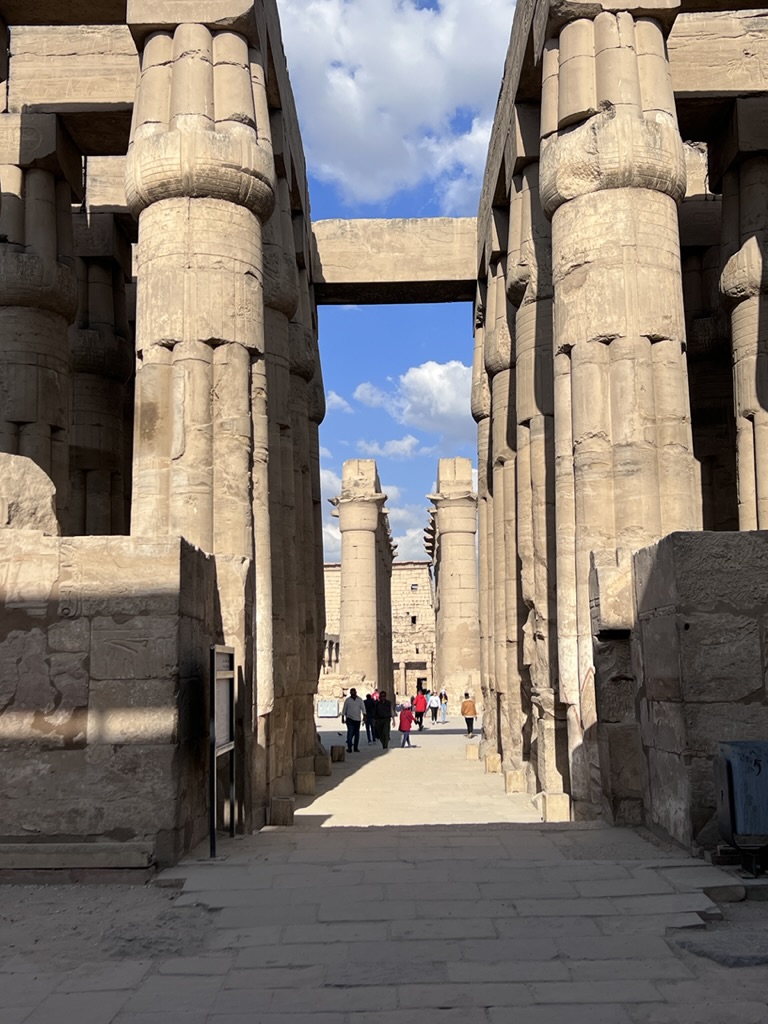
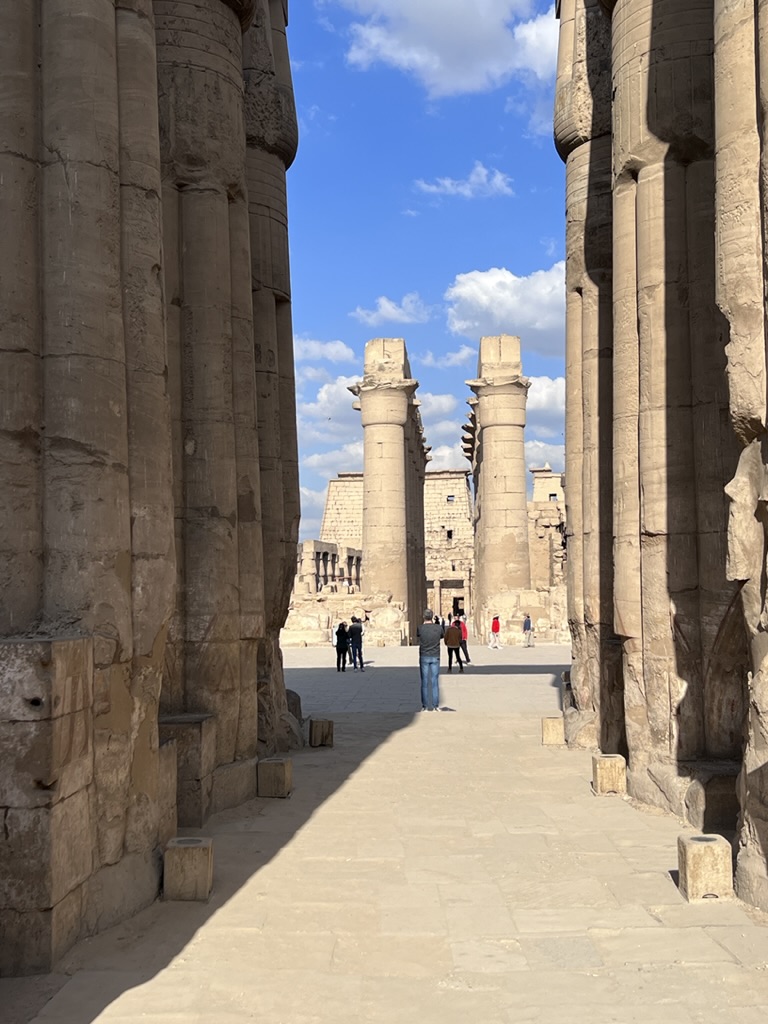
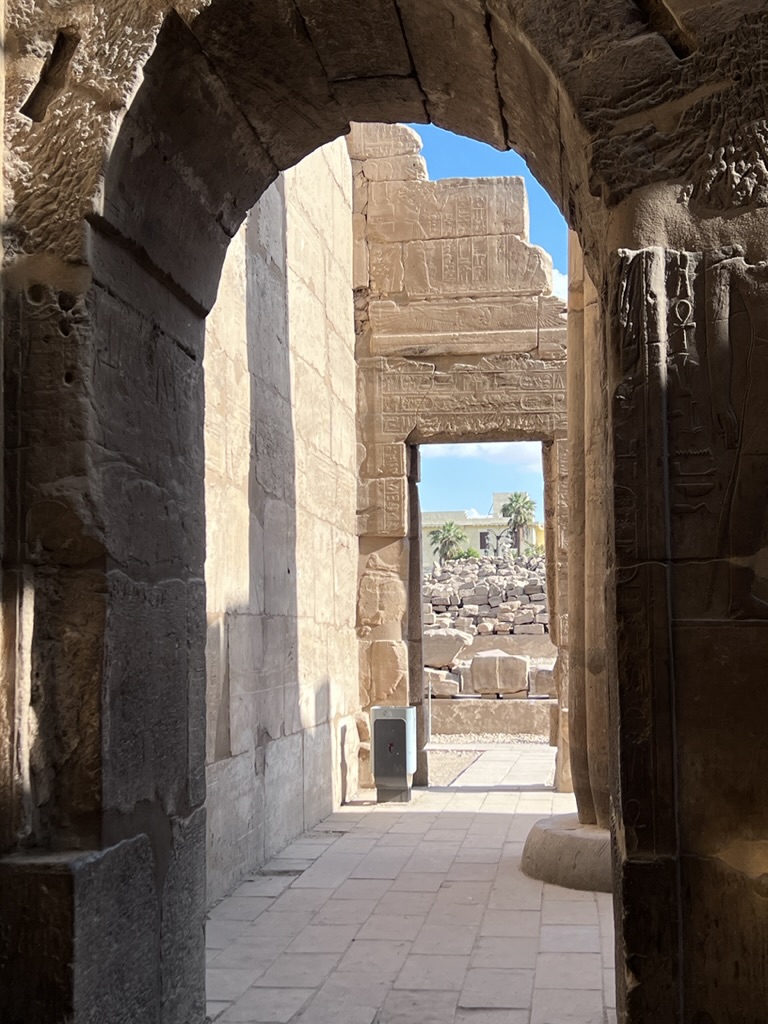
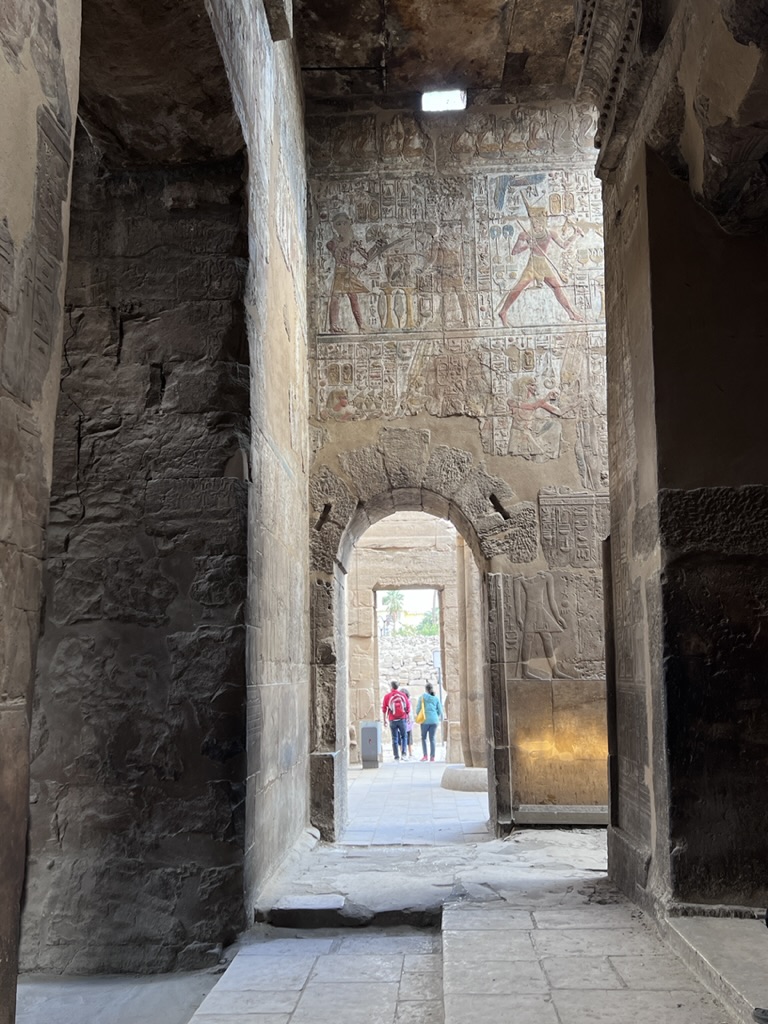
It’s a pretty impressive scene and most difficult to capture on camera! I actually preferred Luxor Temple to Karnak. From Luxor Temple we made a short stop at the Winter Palace (from around 1900) which is now the Sofitel Hotel (we had looked into staying there, but it was booked). We had drinks in the Royal Bar (we were the only ones there) and then checked out the spectacular grounds. In the brochure it notes that Agatha Christie, Jackie Kennedy Onassis, Al Gore, and a host of celebrities have stayed at the hotel (including Richard Gere quite recently).
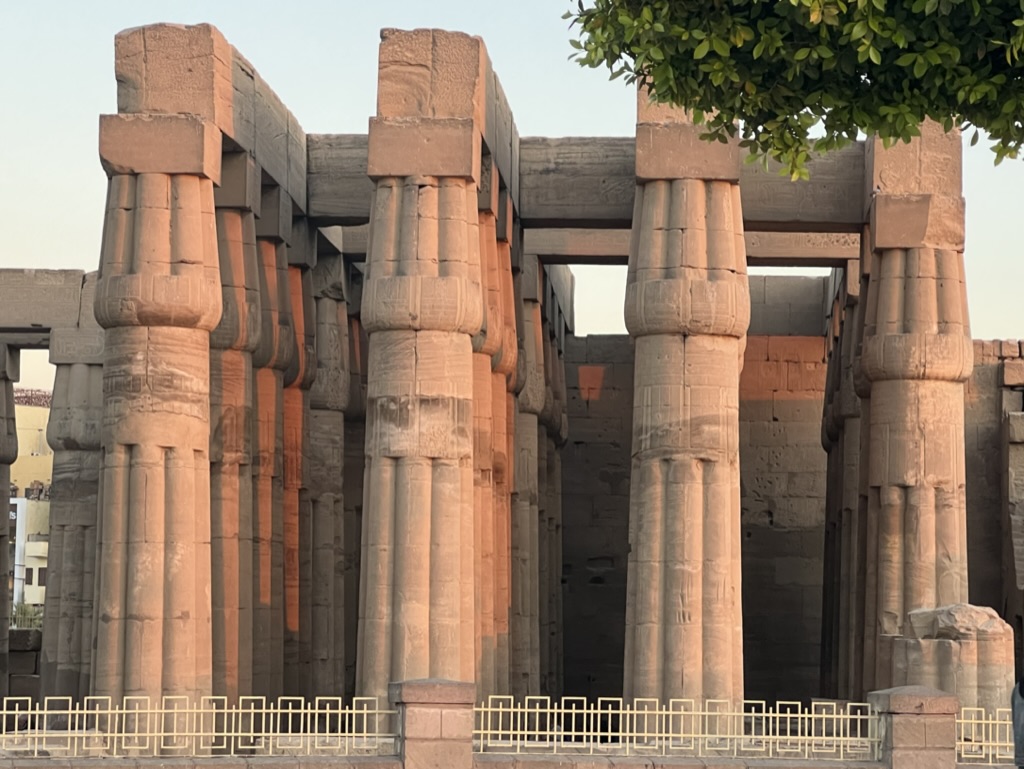

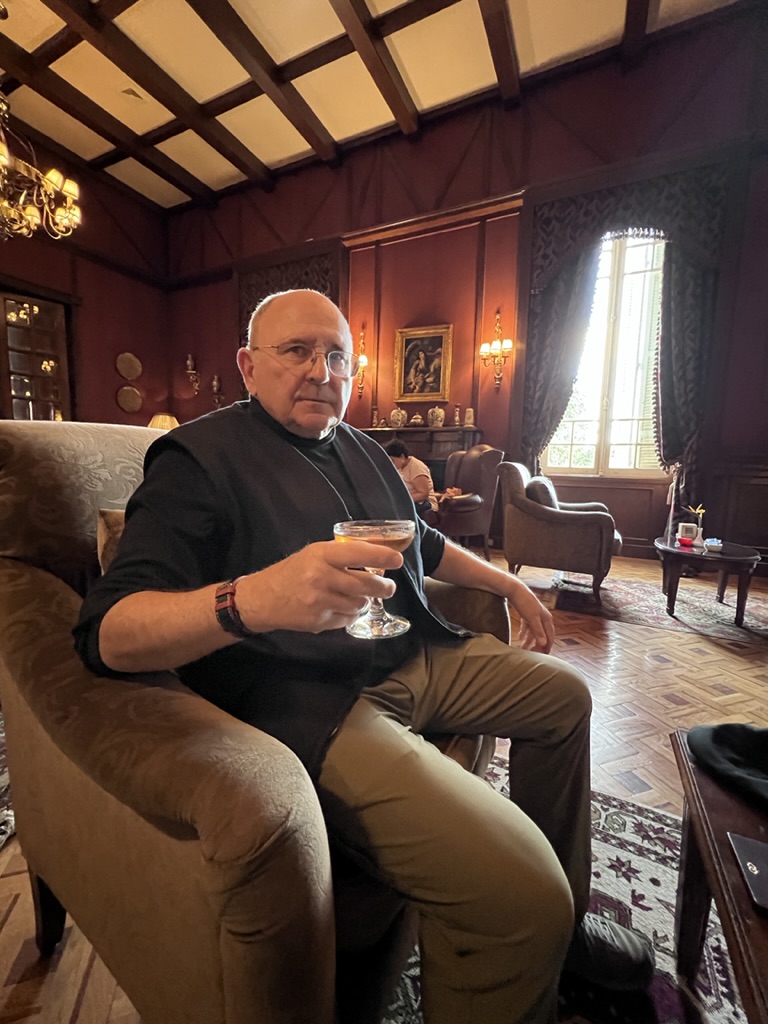
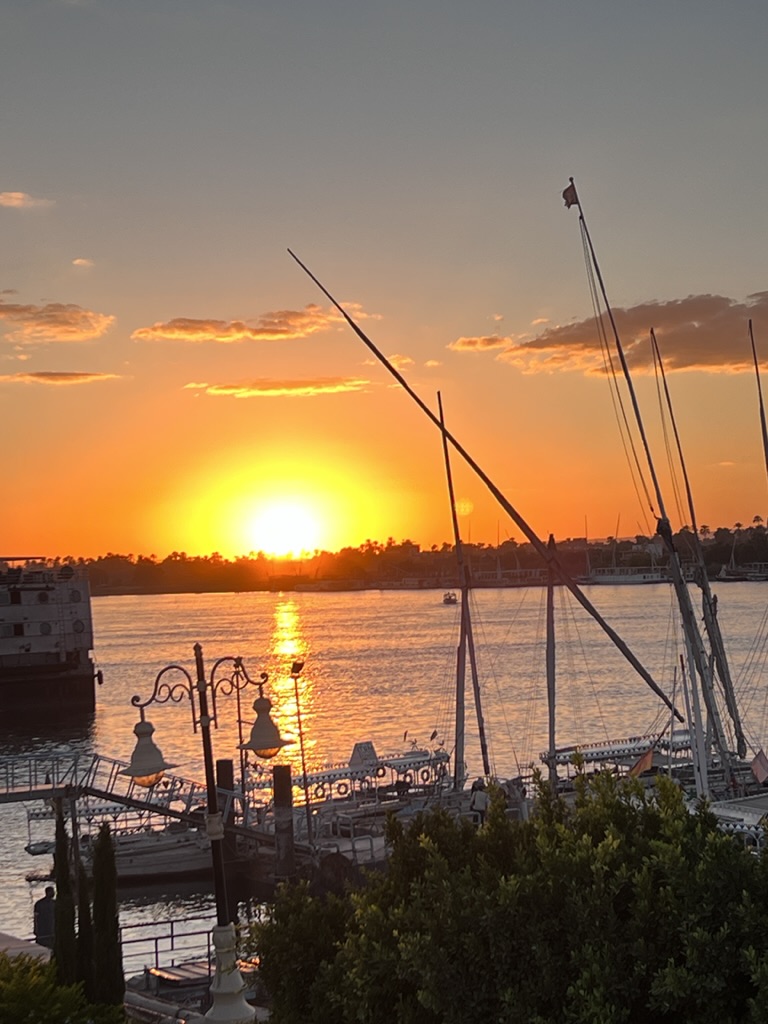
After a stroll along the Nile, we hopped into another taxi where the driver kept asking if he could drive us to a host of other places. When we declined and said we just wanted to get back to the Hilton, he said he needed to make money because he has 7 children (ages 4-26). I remarked that was a big family and then he said his wife “was like a rabbit!” I nearly responded, but kept my cool and just stepped out of the taxi. (The wife is like a rabbit? And what about his role?) We then freshened up for dinner at Sofra (a family-owned restaurant somewhere here in Luxor). See end of this note for comments on Sofra.
Took yet another taxi from the hotel to Sofra Restaurant which is located fairly close to Luxor Temple. Our taxi driver, Hamada, seemed to know his way around and knew of the restaurant. We had two starters (stuffed baby eggplants and sambousas; the sambousas were great) followed by a main course that we shared—a mixed platter of kebabs with a rice that is a mixture of brown rice and what they call vermicelli (in the translated menu), We shared a simple rice pudding for dessert. And no wine. Sofra is a nice little place that is clearly popular with upper class Egyptians and foreigners (who appear to be living in Luxor or Egypt as they knew all the staff when they came in the door.) Food is good, not great. When we arrived they suggested we sit outside, but the evening temperatures here are quite chilly—in the 40s and 50s (despite daytime highs in the low 70s) abd they don’t have heaters. We opted for indoors, but they seemed not to really have a table for us, They gave us a “private room” with a large circular table that could easily seat 6 or 8. We were fine, except that the location of this private room was adjacent to the restaurant reception desk and across from another “private room.” Our views were of the people eating in the other private room and waiters coming and going from the reception desk.
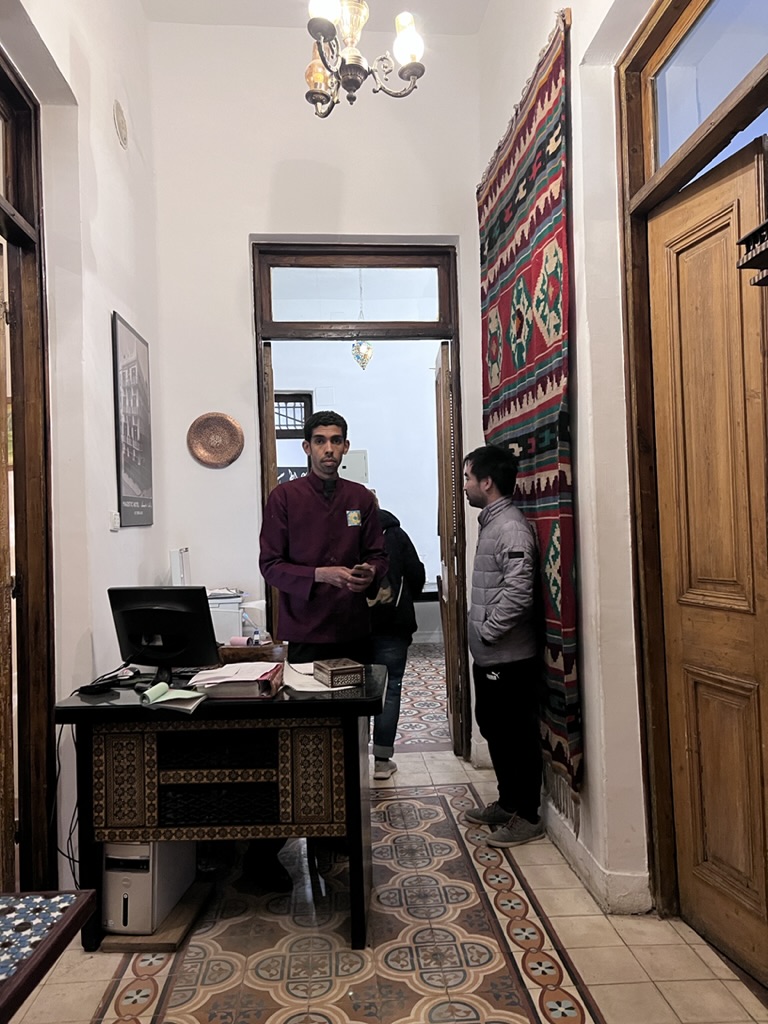
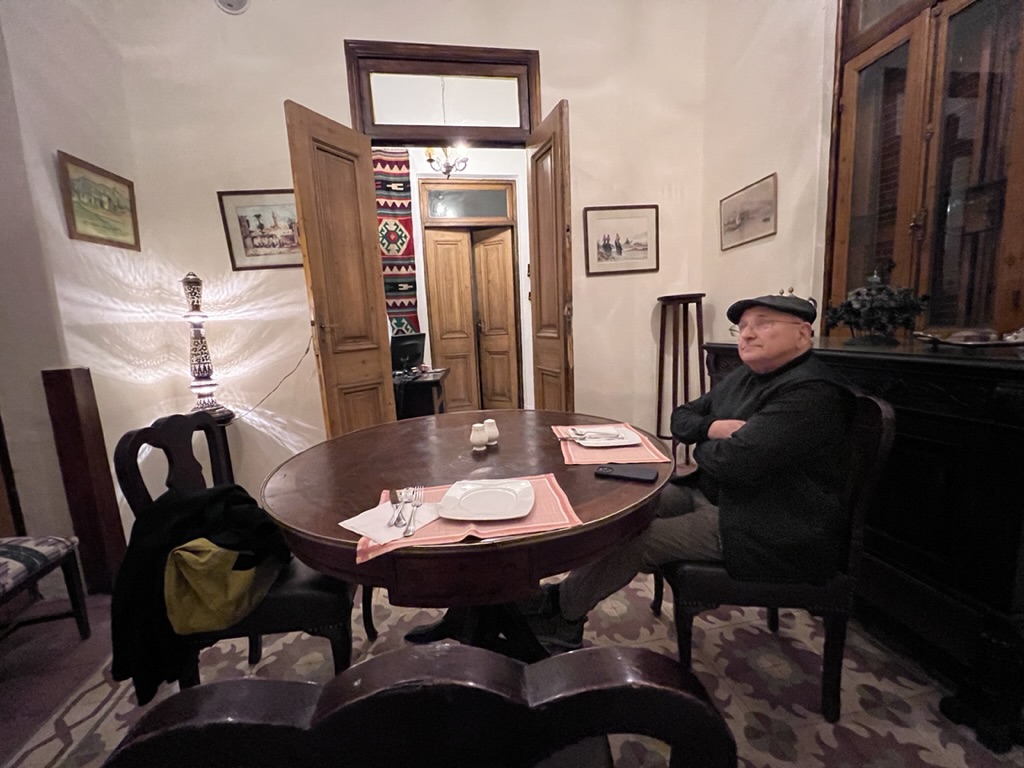
Left the restaurant and now we are calling it a day.
Best Christmas greetings-
Fern
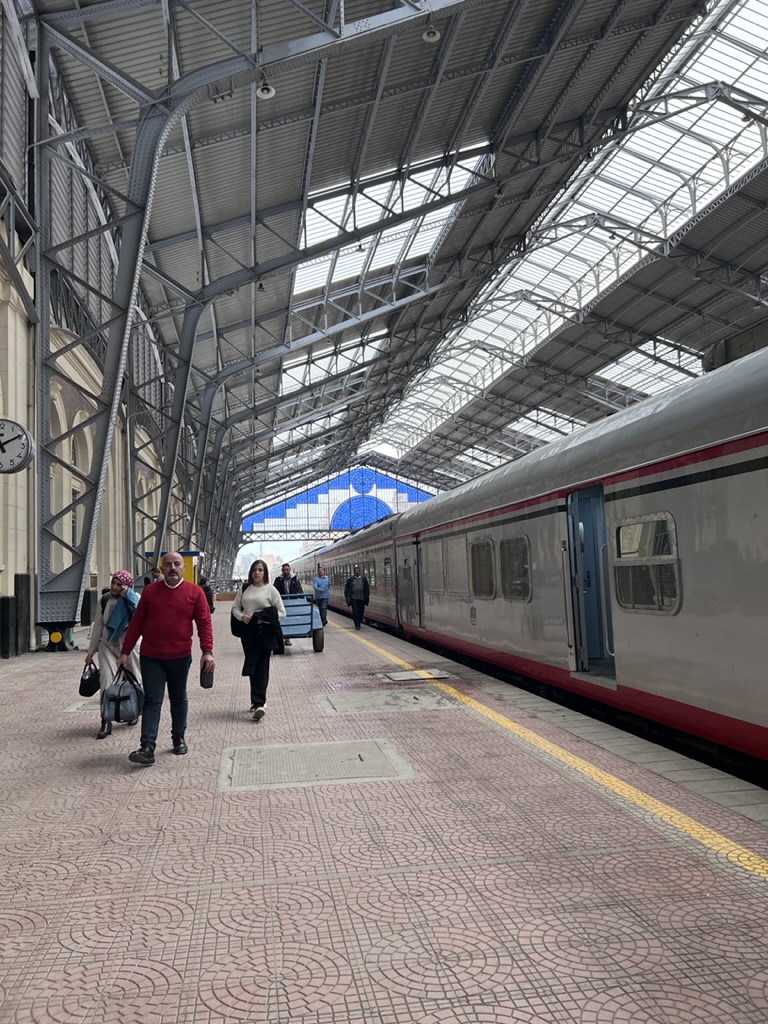
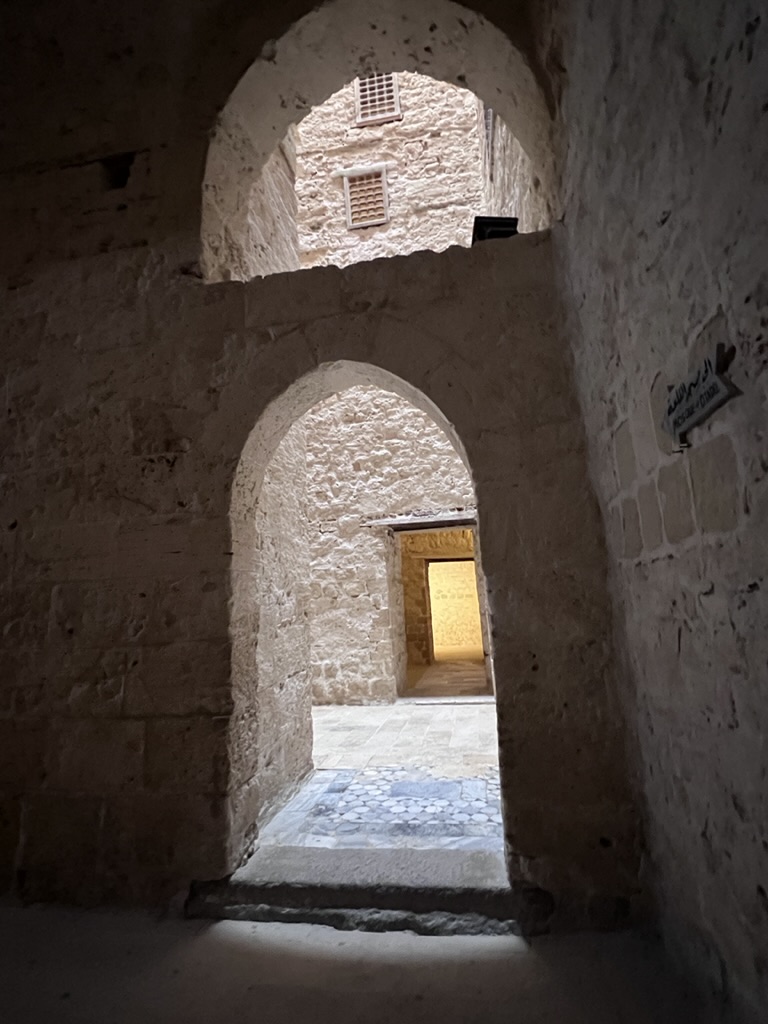

Greetings from Cairo as we pack up to head to Luxor (one hour flight) tomorrow
So, yesterday was Mike’s birthday and we celebrated by going to the Garbage City as described yesterday (a typical birthday celebration); and then last night we went to a very hip restaurant called Sachi in the Heliopolis neighborhood (about 20 minutes by taxi from our area in the Islamic center of Cairo). Getting out of the taxi in Heliopolis and entering Sachi more than highlighted the class differences in Egypt. Sachi is a very upscale restaurant (incredible food that is described as Japanese/Mediterranean fusion) and I’m certain that none of the diners (all 40-something Egyptians) have ever been to the Garbage City, and rarely frequent the Islamic center of old Cairo, where we are staying. Like in all cities, it’s totally possible to live one’s life without knowing what is going on outside of your small geographic location.
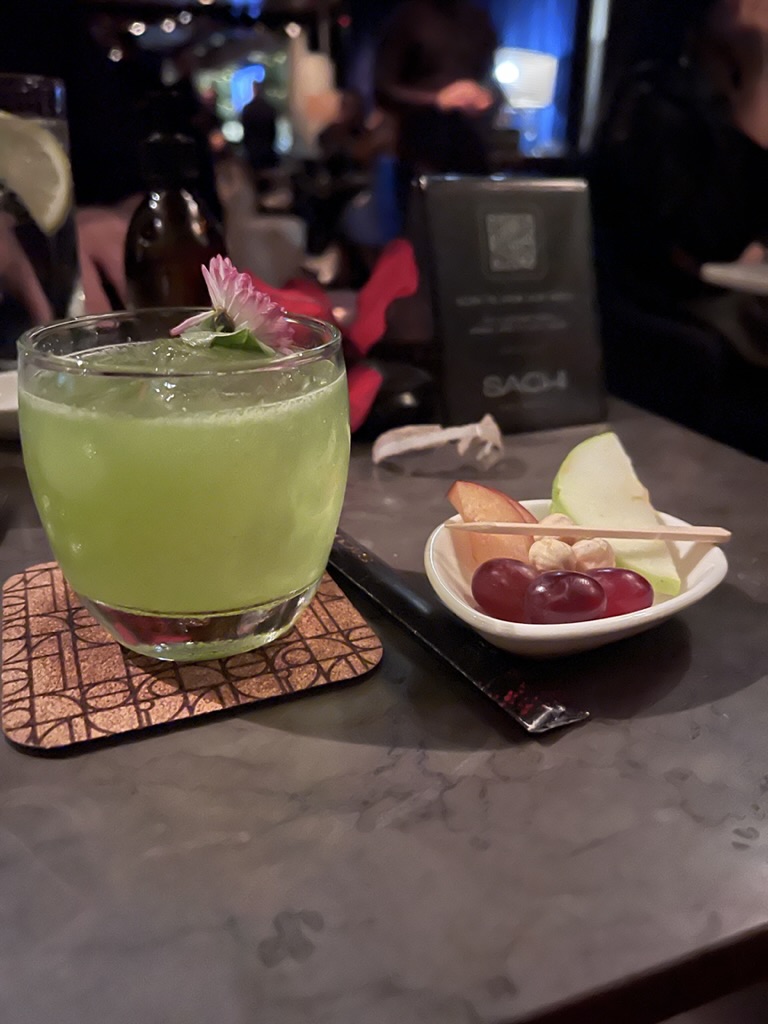
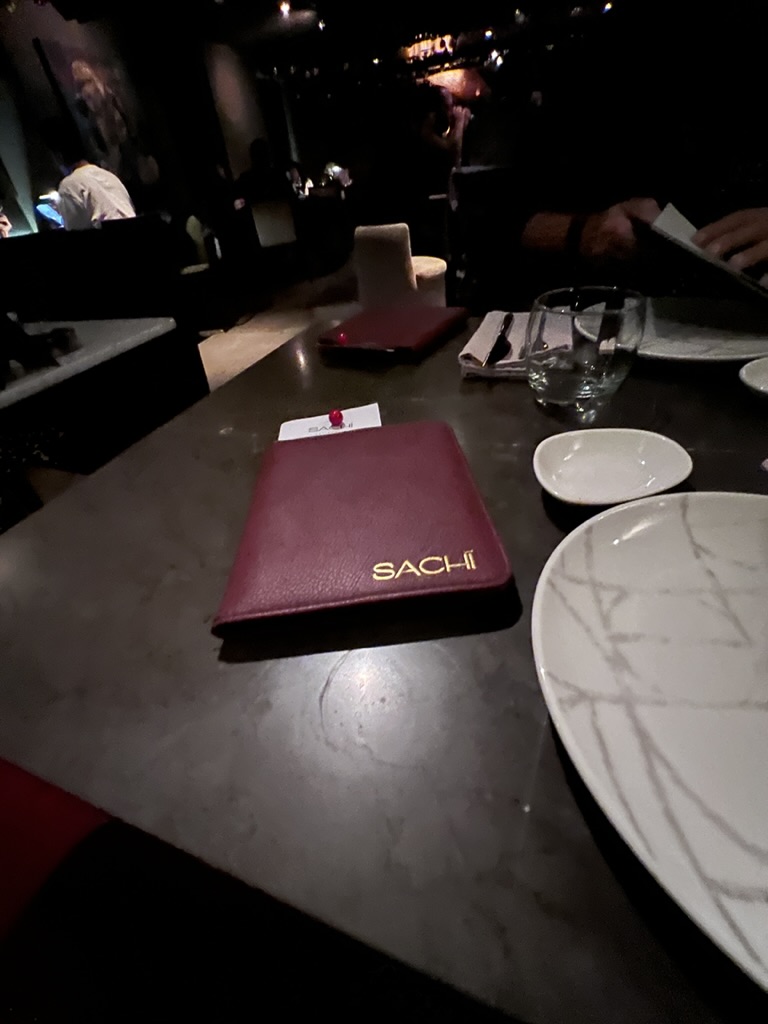
Among other things we had great cocktails (mine was some kind of vodka/basil smash); starters – citrus sea bass tartare with mango and citrus dressing, centered around finely sliced avocado; calamari with a lemon yogurt; for mains we had salmon with Yogurt Tahini Sauce, Walnut and Cherry Tomato Salsa; and a pasta dish with tomato, pine nuts, and caramelized eggplant. We’ve been drinking Egyptian wine which is quite good.
Thus, Mike’s birthday was divided into two parts – Third World and First World.
Today, we got up extremely early (5:30 am) to get to the train, which was at 8:00. We knew we’d have to find a taxi to the train station and fight traffic (since it seems to be a 24/7 thing) and then to navigate the station and finding our train. The Riad packed us little breakfasts, which we ate inside our friendly tourist police office at the train station. One of the cops was asleep when we walked in and the other was also having his breakfast. This one seemed a bit more formal than yesterday’s cop. He did take us to the correct platform and explained the sequence of the cars so that we could wait in the appropriate place to board. The job of the tourist police seems to involve roaming around the station looking for foreigners and offering help if needed. So, the walk from the office to the train platform was slow as the guy stopped every time he saw someone who looked like they were not Egyptian.
Finally got onto the train – this was the VIP fast train and First Class within the VIP train. Frankly cannot imagine what the “standard” train here in Egypt is like. But it was fairly efficient and got us to Alexandria in time (just in time for the rain; first bad weather since we got here). A few funny things about the train: there is a digital display on the wall at the end of the train car that shows weather, time, and date. Nothing was correct. They had the temperature at about 80 degrees F but it was more like 60, the time 20 minutes fast, and the date about two months ago.
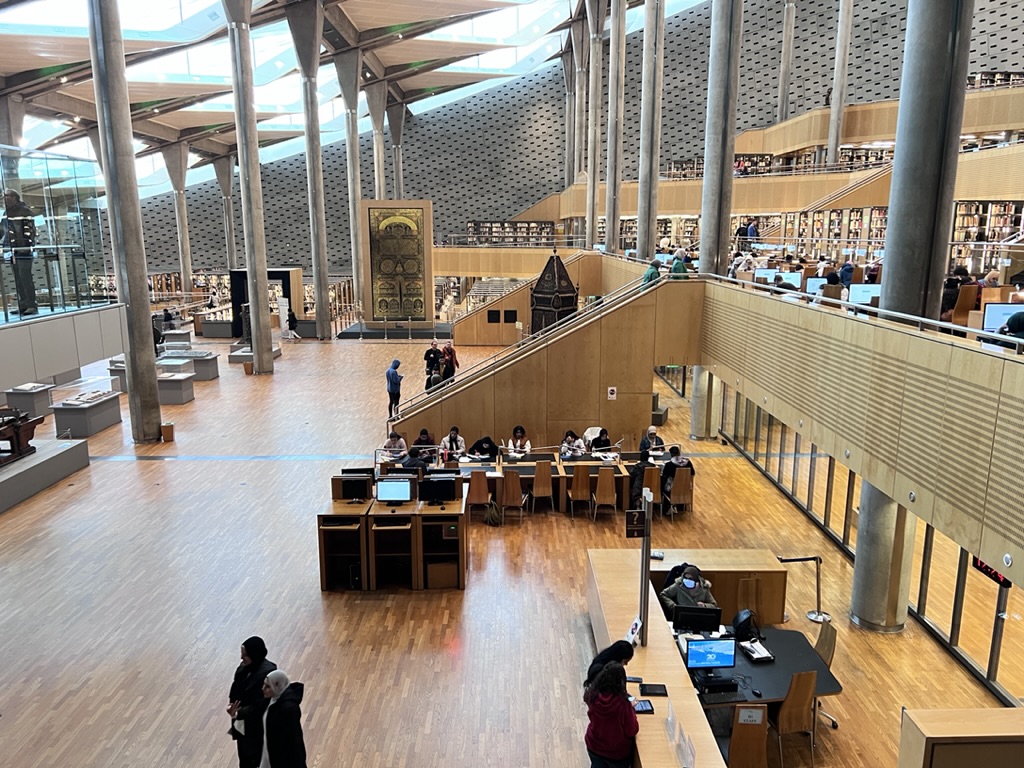
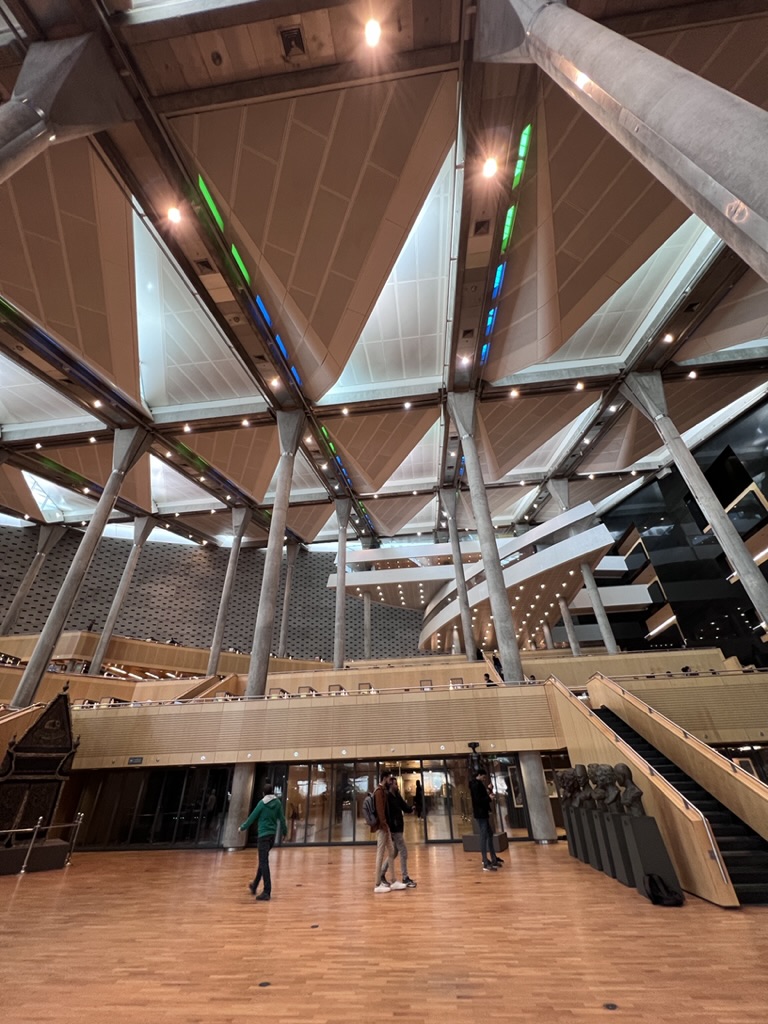
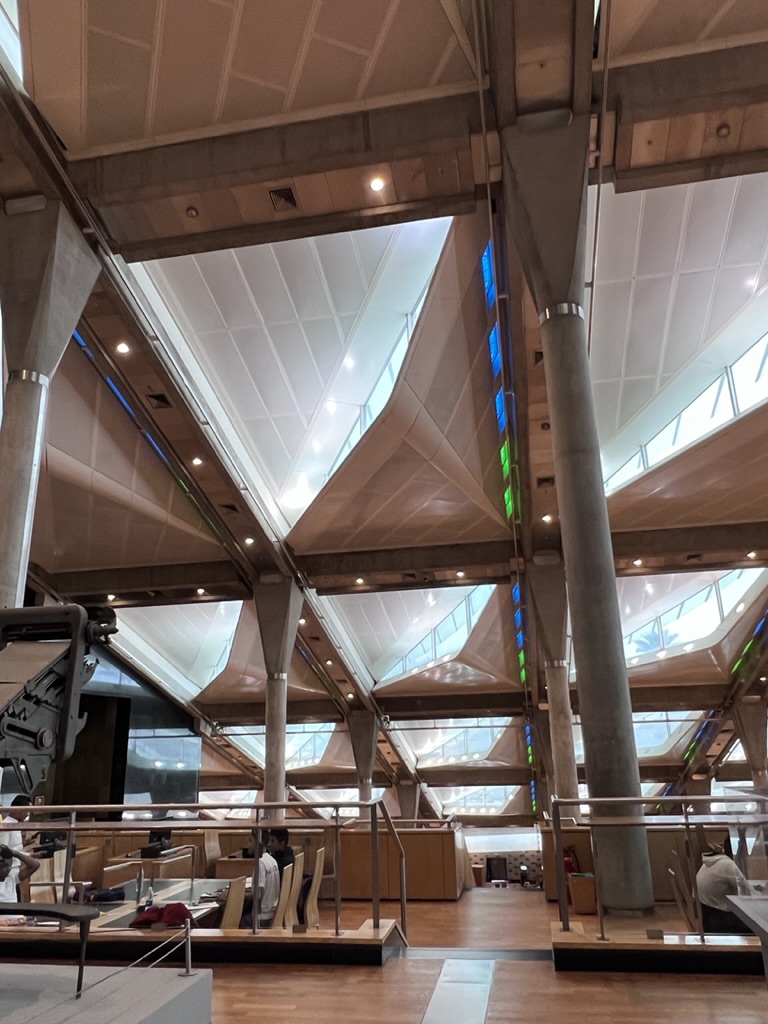
Arrived in Alexandria and headed to the 15th Century Citadel (Citadel of Qaitbay) – built as a defensive fortress on the Mediterranean coast. It was erected at the site of the Lighthouse of Alexandria which was one of the Seven Wonders of the Ancient World. There are some complicated tragedies that occurred including a massive earthquake and now a small mosque sits on the site. From there we hopped a taxi for a quick look inside the Biblioteca of Alexandria – the amazing library. I won’t go into the history of the original library which began around 245 BC and set Alexandria as a city of intellectuals. But in the 1980s there was an international architectural competition for a totally new, modern library. The competition was won by the Norwegian firm Snohetta. And was completed in 2002. It functions as a modern library and cultural center, and also commemorates the original Library of Alexandria. It’s quite a complex building—a beautiful display of modernist thinking; inspirational and functional with everything woven into a shared atrium-like space with cascading shelves of reading and research areas under a single roof that was creatively serrated with solid and glass openings to provide constant daylight without the annoyance of sunlight.
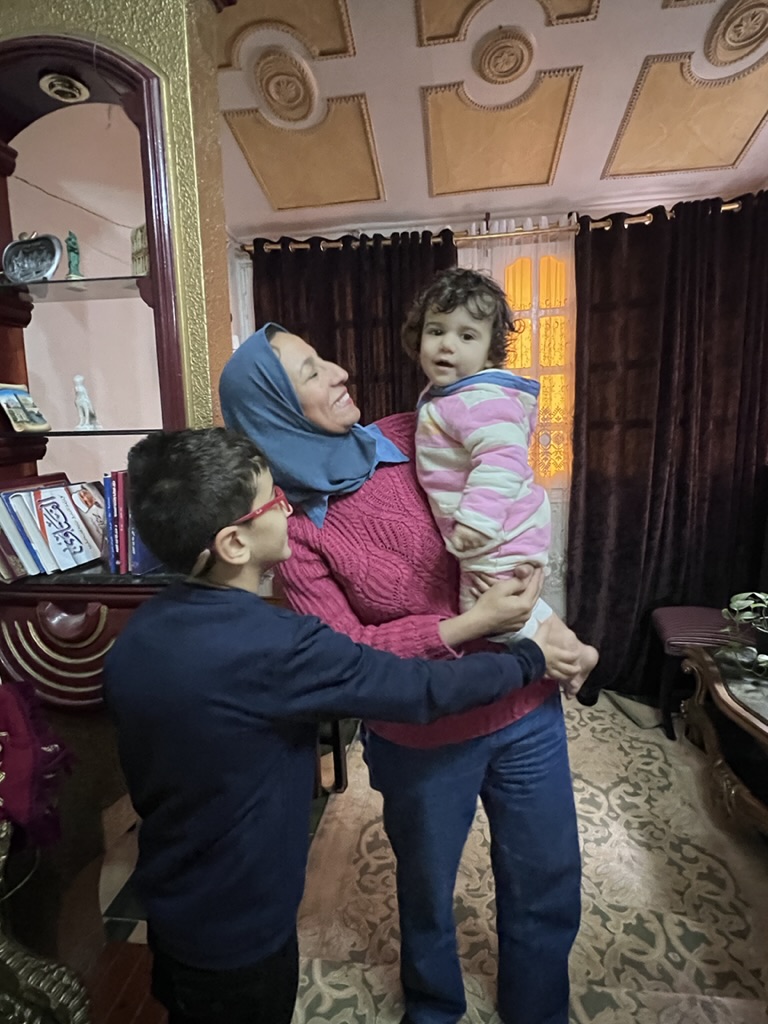
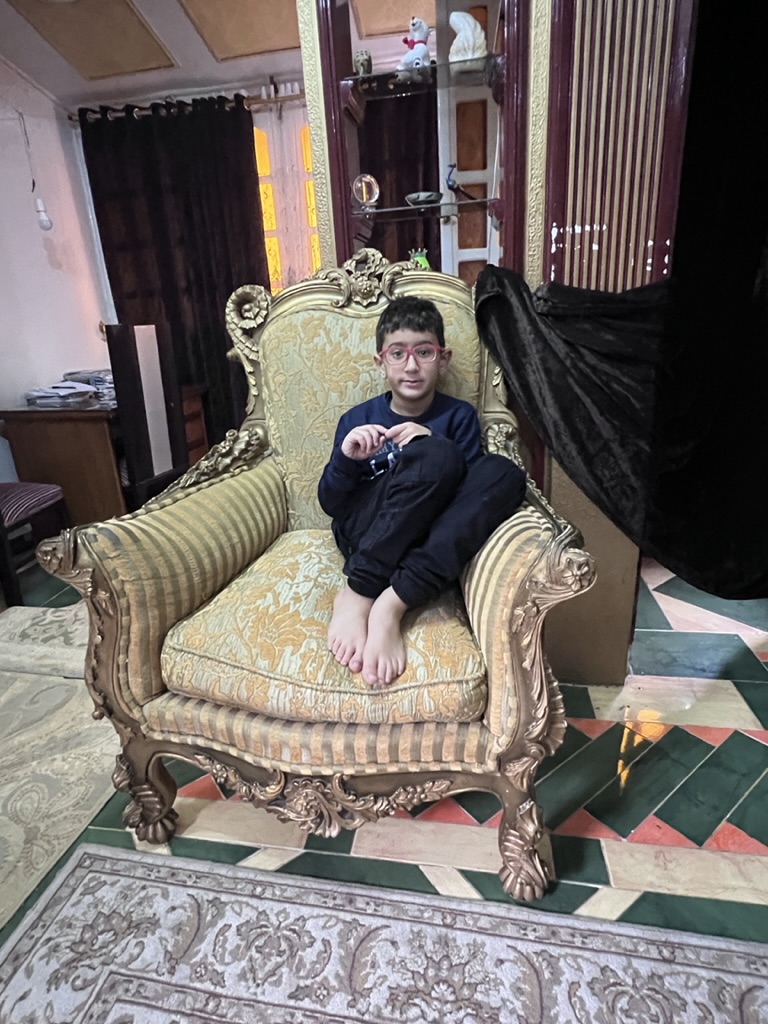
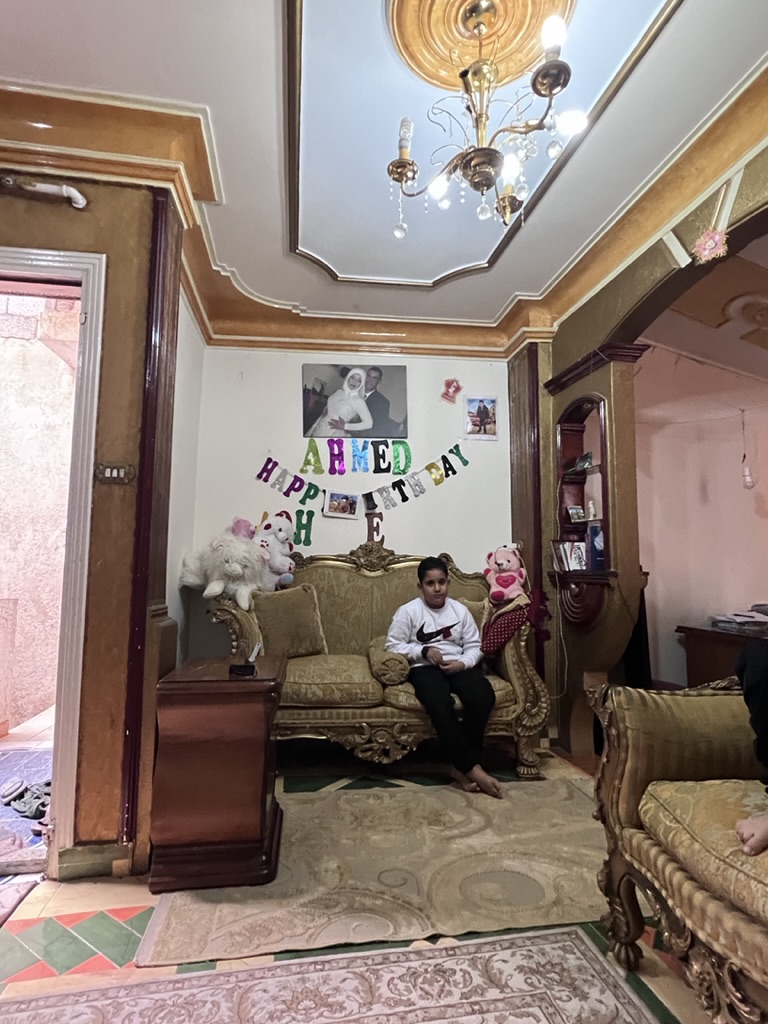
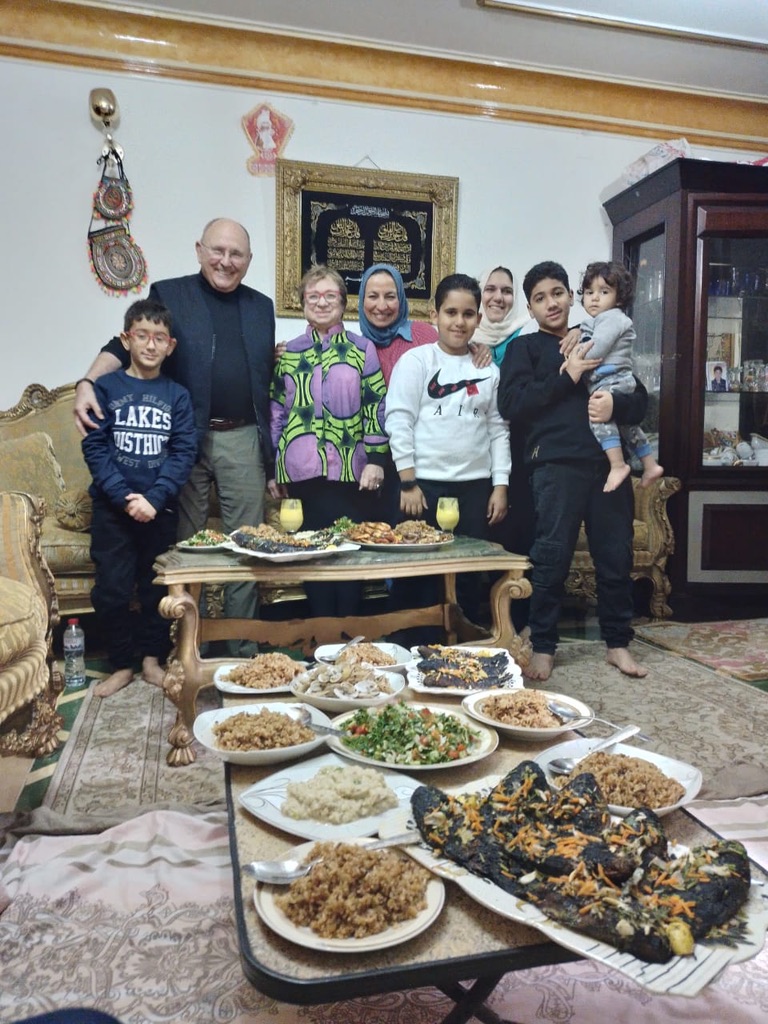
Then we met up with Mona, a former graduate student of mine when I taught at ASU. I only had her in one class but remembered her to be thoughtful, mature, inquisitive, and driven. Together we all taxied to her home which was about 40 minutes from the library. She lives with her husband and his two children in a five-story building in an area we would (and she does) call a “slum area” on the outskirts of Alexandria. Mona is a PhD and her husband is also well educated, along with the rest of the siblings and parents. Mona works for an NGO that provides micro loans to women and encourages women entrepreneurship. Her husband used to be a diving instructor in Sharm al Sheik but now owns two small boats that are used for fishing; his passion is definitely the sea. So, in a way it was interesting to see that these slum areas are inhabited by all kinds of Egyptians.
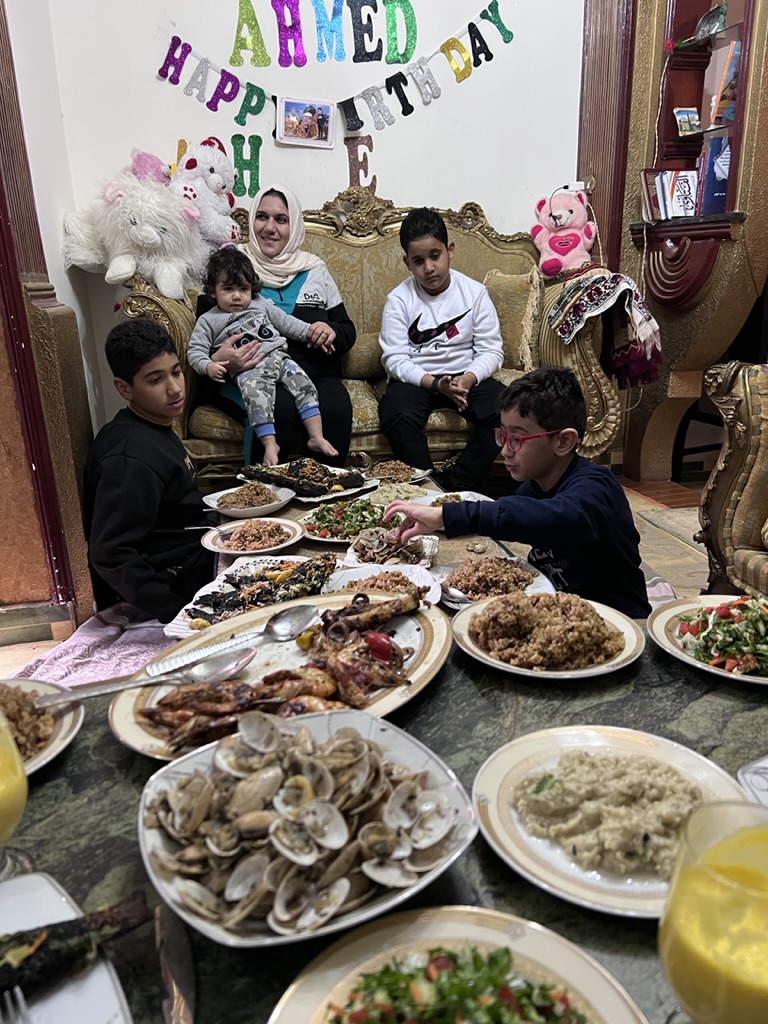
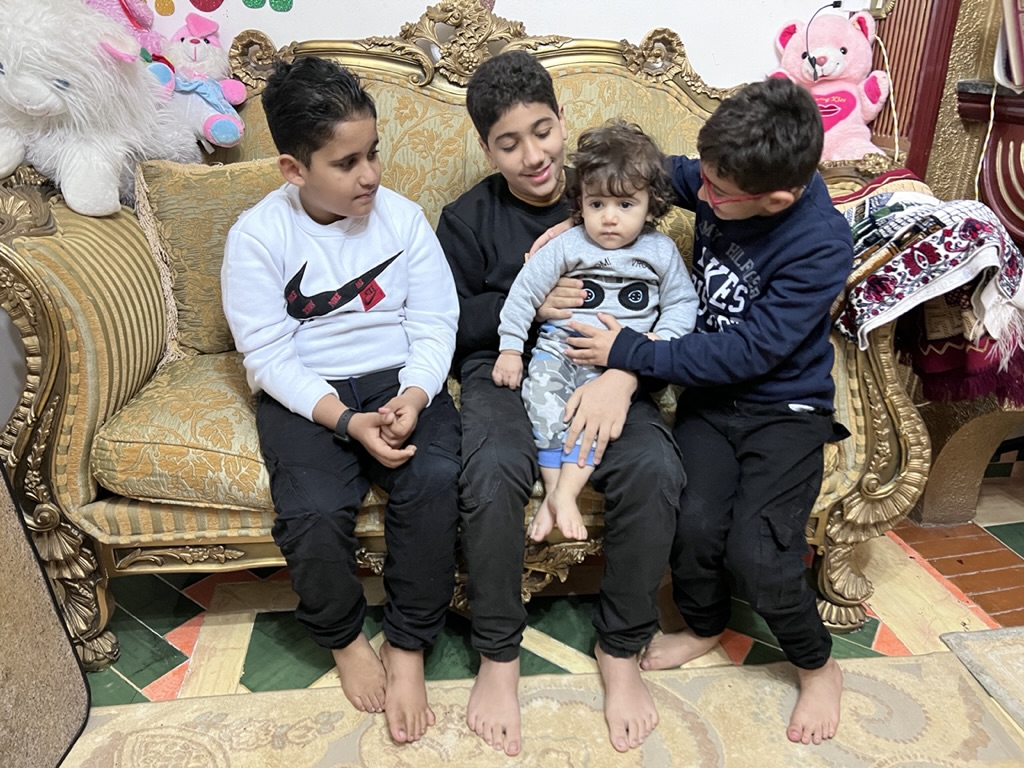
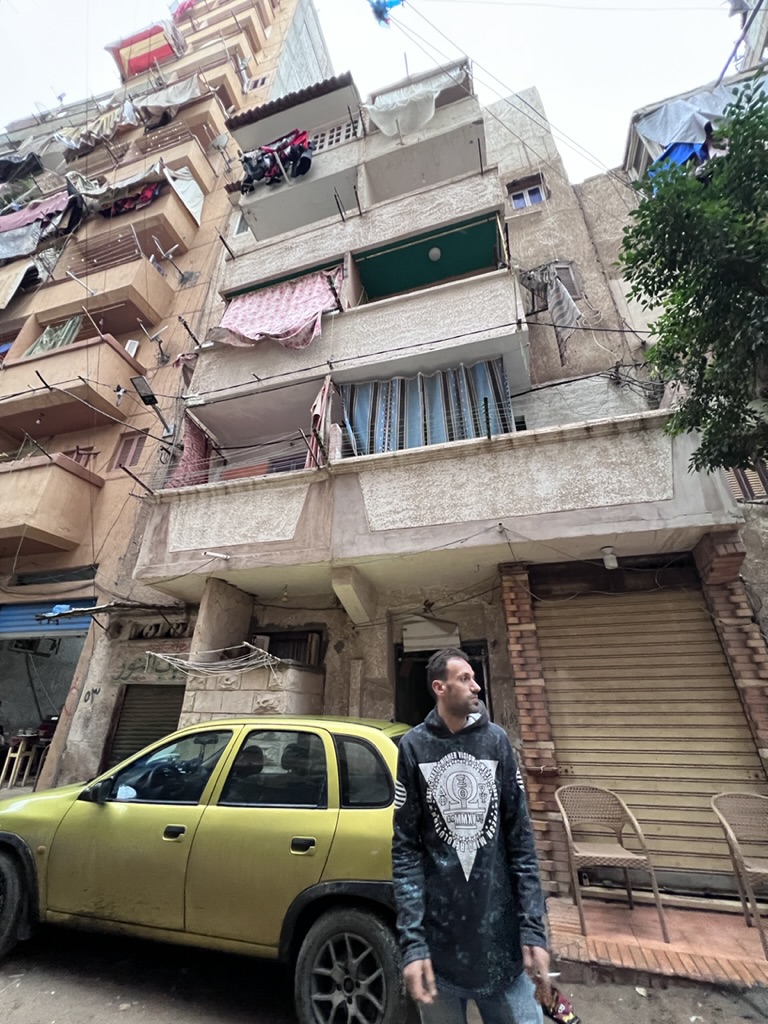
The house contains 10 “apartments” – all of which are occupied by her husband’s family. It was built by his grandfather about 70 years ago, with well-intentioned ideas but limited craftsmanship and using the hand tools of the 1950s. Everything is “approximate,” so every tread and riser on the five story walk up was different. The street (and all the other streets nearby) was lined with similar 5- to 10-story buildings constructed with this “approximate” construction. As we entered the building through an outside stair, it was pitch black inside the stairwell (until we got to the 4th floor where light came from the rooftop). Given the uneven concrete treads and the unfinished nature of the stairs, it felt treacherous to ascend and I began to dread the descent as well. Eventually we used our phone flashlights to at least see how the next step differed from the one before… and we made it to the apartment.
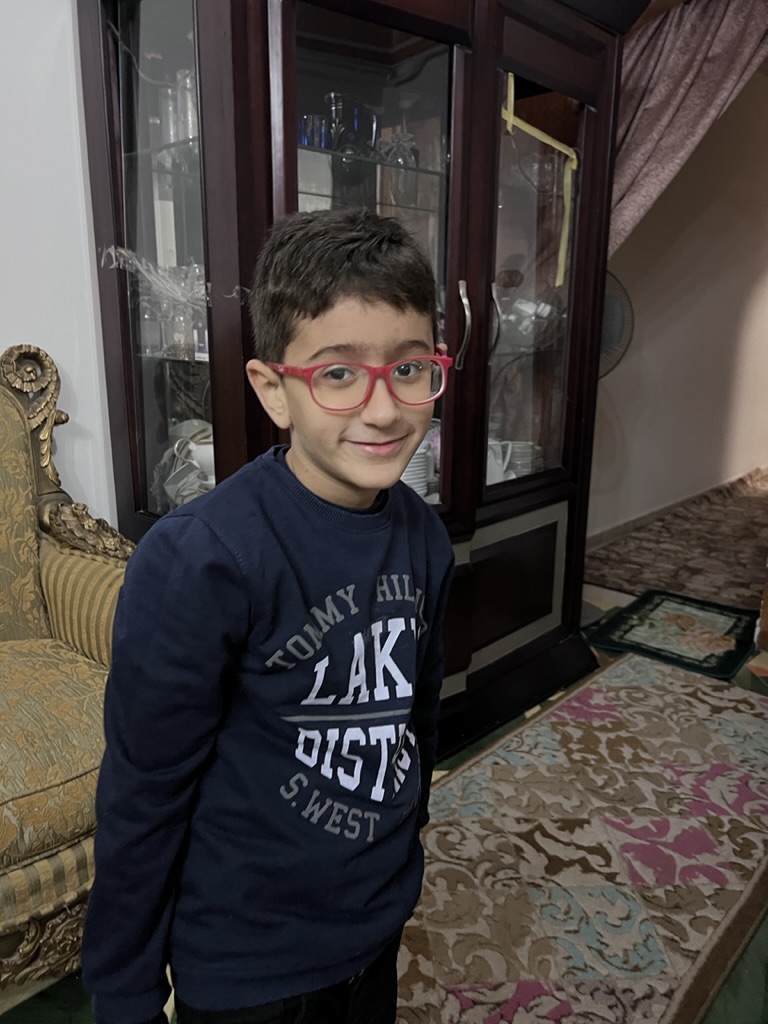
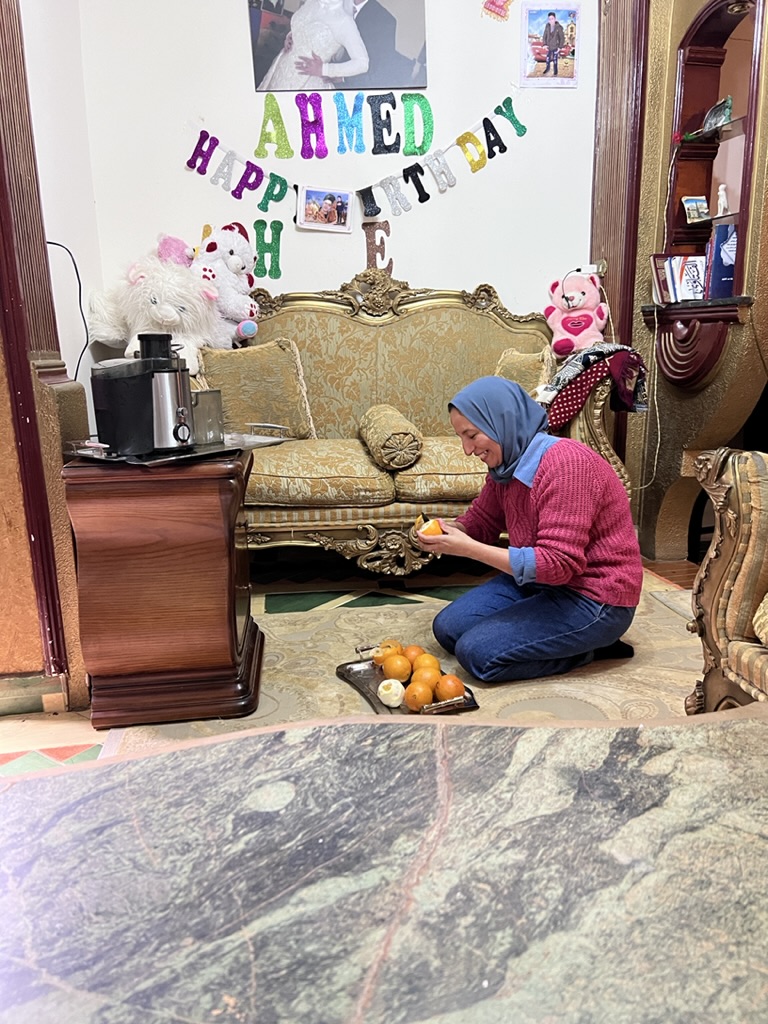
We were immediately greeted by Ahmed, the 7-year-old and later joined by the 12-year-old and two cousins of similar age (all boys), and a baby who belonged to the husband’s sister. Then came the sister-in-law. Everyone lives in this building in separate apartments: siblings and their families; the parents; cousins.. and maybe more. It’s like a big commune with everyone moving fluidly between apartments.
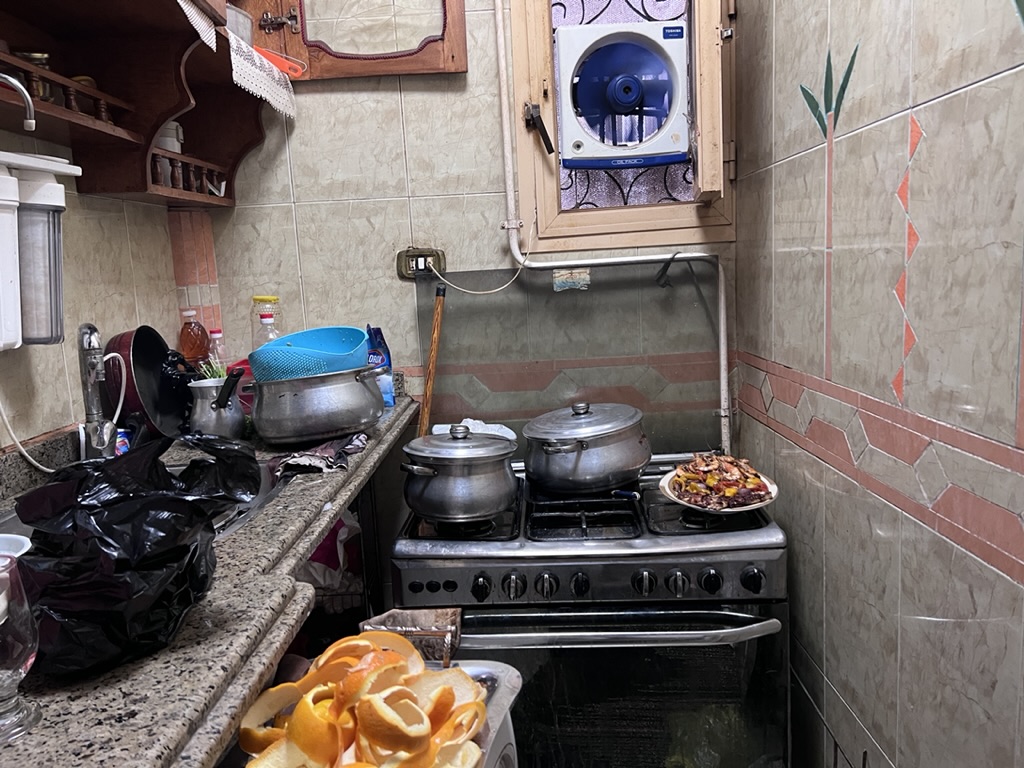
Each apartment is probably about 900 sq ft; the kitchen is about 50 sq ft. Somehow, they have a 6-burner gas stove, a sink, and a washing machine in that tiny kitchen. The refrigerator was in a separate room (bedroom) next door. There is a living/dining room, two bedrooms, a bath, and some alcove areas used as study areas for the kids. Mona’s husband was busy preparing our feast from well before we arrived until about an hour later – hustling about that tiny kitchen to ultimately emerge with two different fish platters (one with fish from the sea and one with fish that was “farmed”), octopus, tiny clams, shrimp, rice, tabouli, roasted vegetables, and fresh-squeezed orange juice. They are Muslims and don’t drink. We all squeezed into the living room to eat (they were seated on the floor, and we were on a couch—fearful that Mike wouldn’t be able to get up if he tried to sit on the floor). The food was fabulous; simple but perfect.
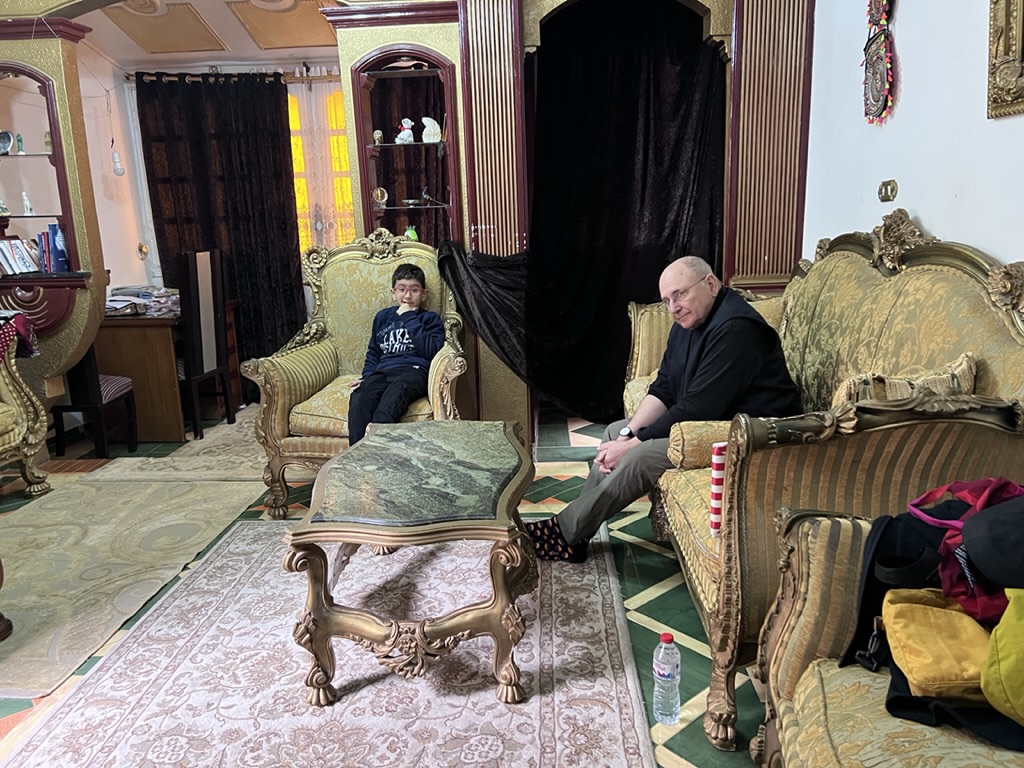
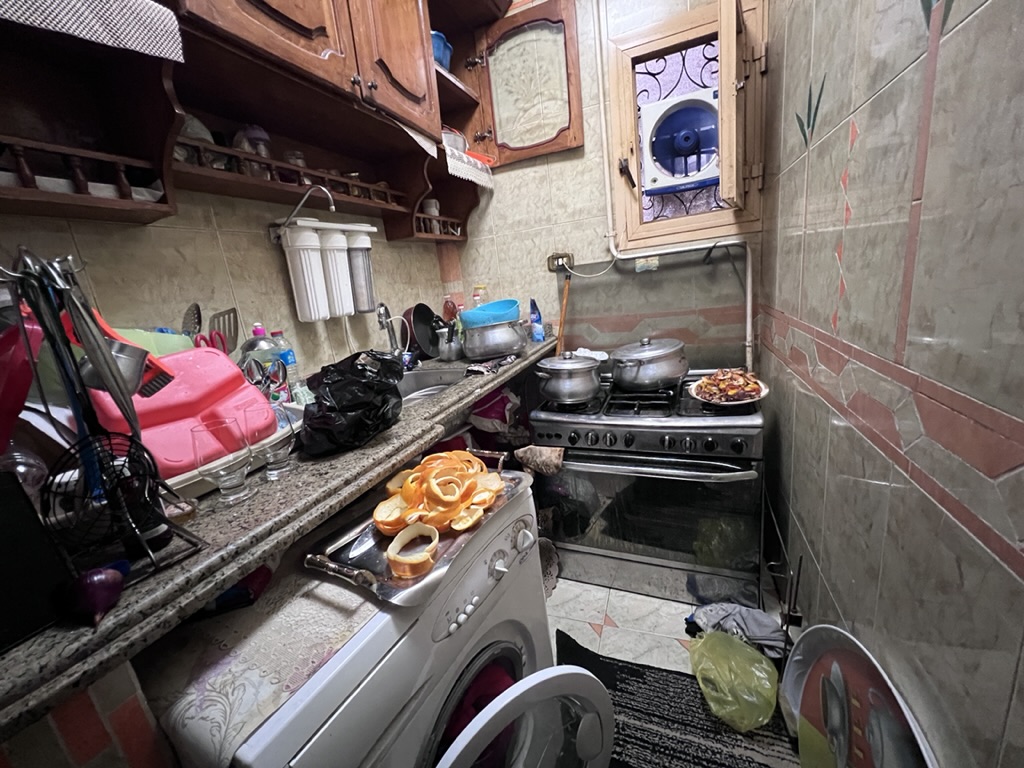
We chatted about politics (theirs and ours), tried to understand the reason for the total collapse of the Egyptian Pound, and the history of the building they lived in. They were totally gracious and warm. Mona seemed genuinely happy we visited. I was the first American from her ASU days (a decade ago) to come to Egypt and look her up.
At about 4:00 we began to get antsy about making our 6 pm train. The original plan was for us to take a “toc-toc” to a local train station and then travel to the main station. But as time got tight the plans kept changing and eventually Mona’s husband borrowed a car from one of his brothers (he has 4 brothers) and he drove us to the station. We were a little confused because he took us to a different station from the one we arrived at. We got to this different station with about 10 minutes to spare, but were a little lost and kept asking where to go. As we waited on the appointed platform, three different trains heading to Cairo arrived—fortunately, a young woman who spoke English (quite well) helped us and explained that these were all trains to Cairo but not ours. Ours arrived next and we boarded. Arrived in Cairo at about 9:00 pm and trekked into the center area where our hotel is located (15-minute walk).
A great final day in Alexandria. Now we pack to head to Luxor tomorrow,
All the best –
Fern
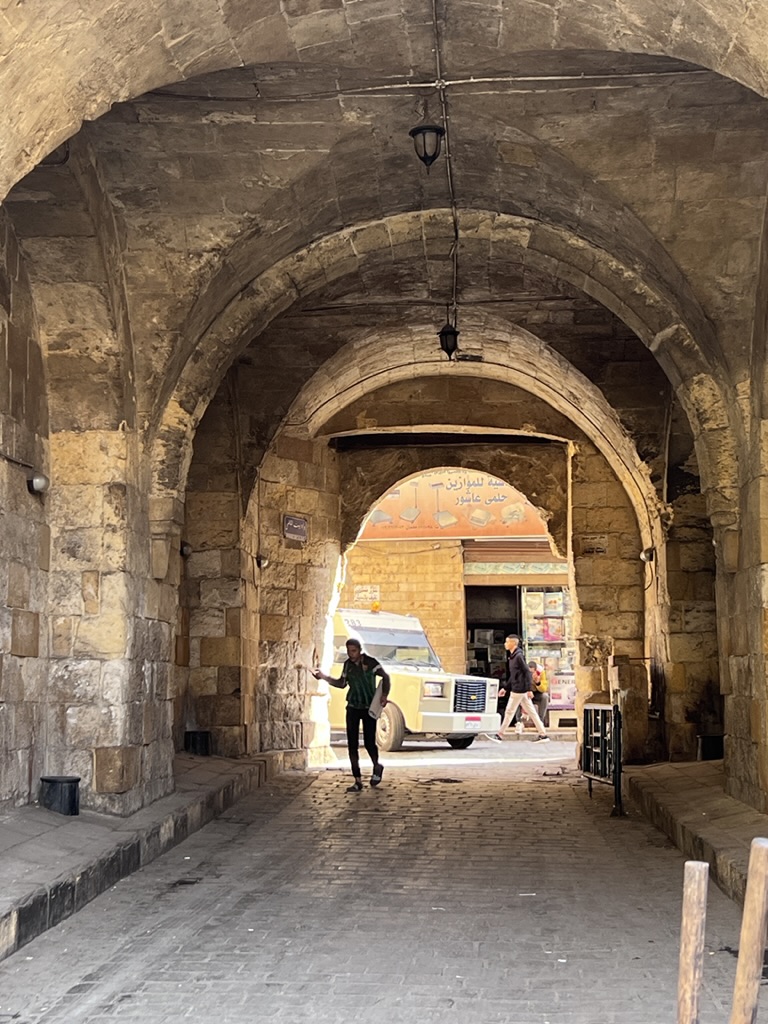
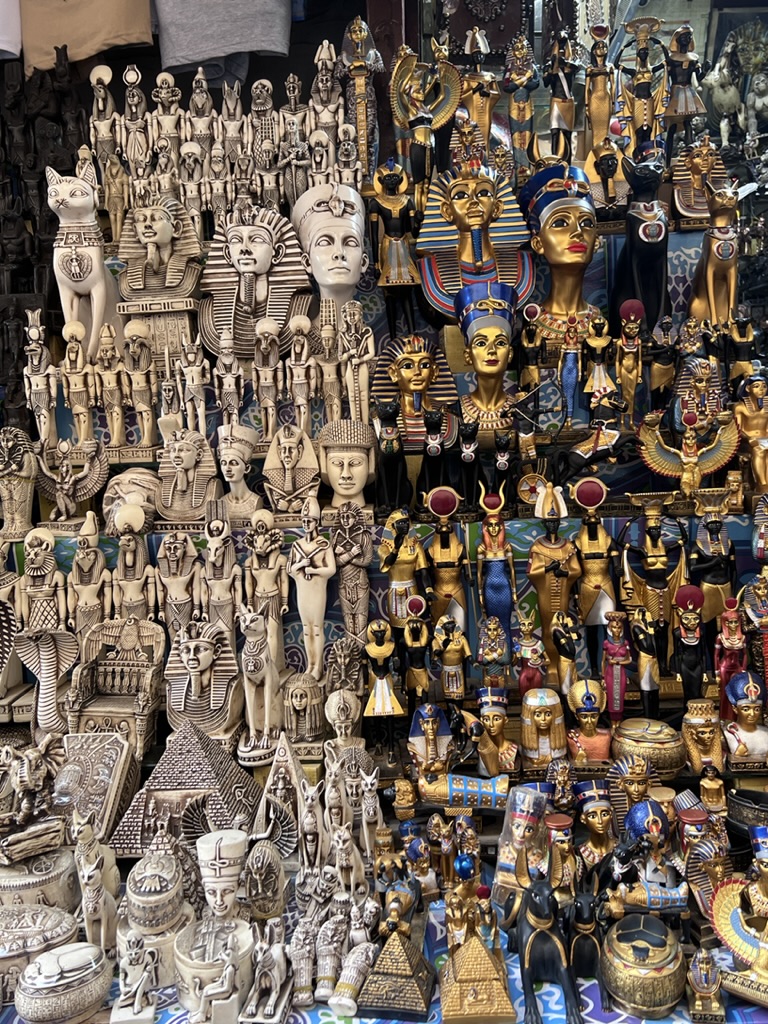
Greetings from Cairo — ending soon as we need to go to Alexandria tomorrow really early.
We left the hotel and headed for the train station because every article we read said that it was best to purchase train tickets the day before your travels. And boy were they right. We took a taxi to the train station; stuck in traffic most of the time so it took about 45 minutes to go about 3 miles. Probably should have walked (not really since it’s difficult to walk distances because of all the chaos on the streets). Anyway, once we got to the station it was next to impossible to figure out where you go to buy a ticket. It’s a really large station (Ramses Station) with no signage in English and frankly I didn’t see many signs in Arabis either (not that that would have helped us). And I may have mentioned earlier that wherever you go you need to walk through metal detectors that have police or operators standing by. But these detection machines don’t seem to work. We often walk through with our phones and my purse and it doesn’t seem to matter.
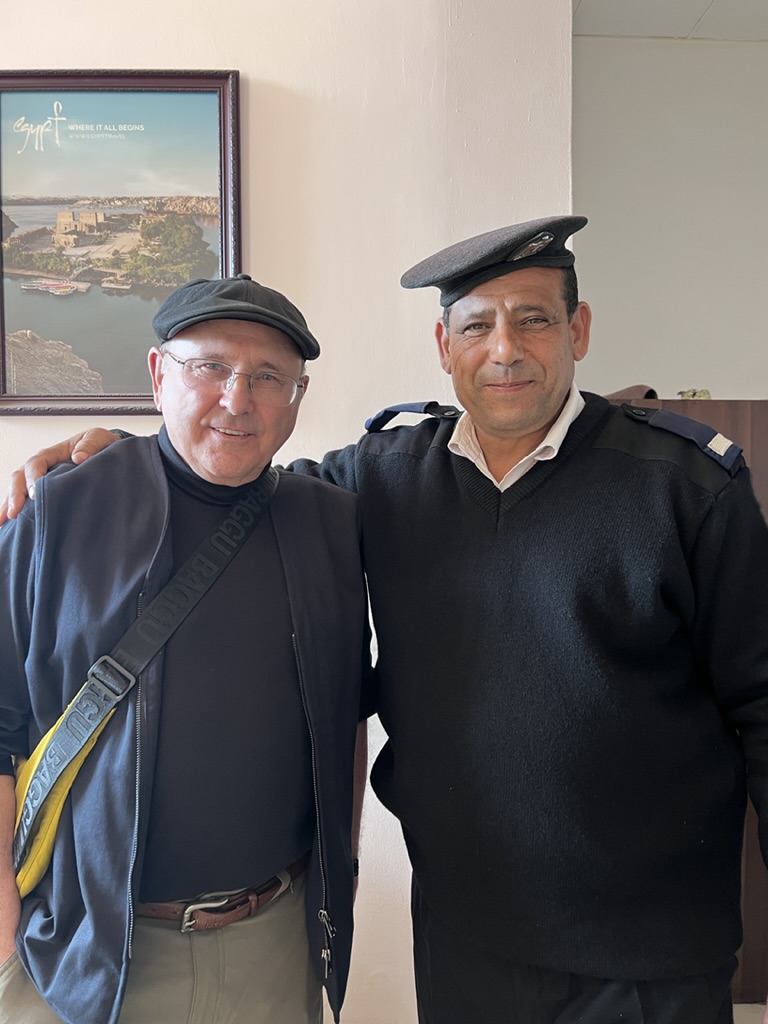
Anyway, we went through the supposed metal detector and then asked the guard about tickets; he pointed somewhere and we headed that way and then asked a policeman. He pointed that we should turn back and go through the detector again in the other direction (totally messing up the process). Then one other cop motioned us to follow him and then we wound up in a little room with the “tourist police.” The cop in that room knew some English so he became our designated “helper.” We explained that we needed round trip train tickets for tomorrow to go to Alexandria. He then looked at what I guess was a schedule (which is impossible to get hold of) and asked what time we wanted to leave; we responded by asking what time the trains go—what are our choices. We did know that there are many different kinds of trains and they each take a different amount of time to reach the location. Some take 2.5 hours; some take up to 6 hours! The “standard” train takes about 4 hours. The VIP train takes 2.5 hours; the express takes about 3 hours. I guess the comfort level of each differs as well as the price. We said we wanted the fastest one which is the VIP. We then said we wanted to leave “around” 9 am. But that is not the VIP train so we’d get there too late. Finally we all understood one another and we said the VIP train at 8 am!
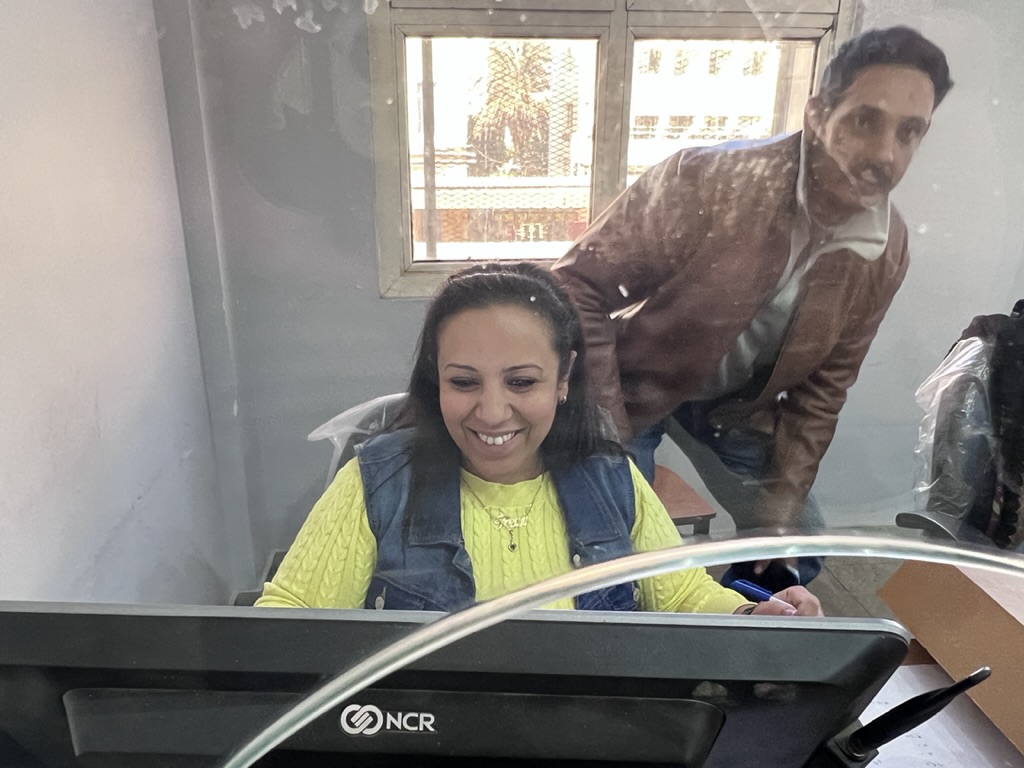
OK.. he then says we must pay in US dollars; and the cost will be $30 per person each way; totaling $120 and it must be cash. We were a bit confused as to why the cop is selling us tickets. Then he says Mike should go with him and I should wait in this little police room. I said I’ll go with them to wherever… Then he calls for a guy who is standing around in the station. He suggests that instead of the train we should have this guy drive us tomorrow and it will be faster and cheaper. The guy will do it for 50% of what the train charges. We said we didn’t want to go by car (can’t even fathom what it would be like to deal with cars and traffic and crazy drivers for several hours); we wanted the train.
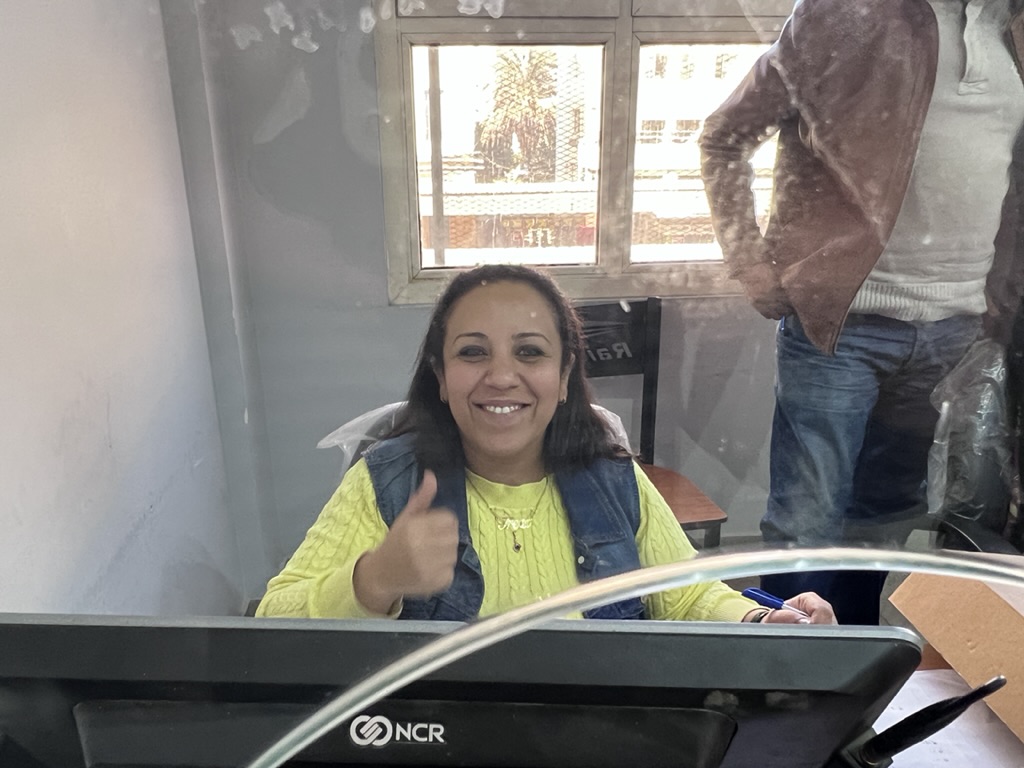
OK.. we make some progress and follow him upstairs into another little office which is supposedly the ticket office but the only ones buying tickets are Mike and me and an Indian guy who was shocked at the prices when he was told that the fares had gone up on December 15; he said he should have bought his ticket on December 14. Us too! Anyway, the cop stays with us and we talk with one of the three women who are the ticket sellers (I think this little room is for foreigners to buy tickets and the prices vary based on where you are from). The woman spoke fairly good English; turns out she had lived in the US as a child and her parents now live in Long Beach CA. She discussed the options and then we choose the first class car on the VIP train (roomier she says and better seats). The cop concurs. She tells us the price is $25 per person each way ($5 less per ticket than the cop told us and which the cop was ready to sell to us! Obviously pocketing $20) We agree to the $100 cost and then learn they don’t have any seats on that train! We are shocked; she says she will call her manager and then miraculously two seats appear. So next step is paying for the tickets. Fortunately, I had American money with me, since I figured we might have to pay cash.
Then the fun began. They didn’t like the “condition” of our money. It was too old; they like crisp new bills, preferably unfolded, and definitely not having any kind of “marking.” One of my $20 bills had a pen mark. I dug deep and found two $10 bills that looked better than one of the 20s. She scrutinized the bills; then her manager scrutinized them and finally we had tickets (hand written). While they were inspecting our money, the cop tells us that we need to “tip” the ticket woman. He tells us to give her 20 EP which is about 80 cents. We didn’t exactly know how to do this.. so we gave him the money and then he gave it to her. She didn’t really want to take it but he said something and she took it.
We then went back into the little police room with him so he could explain where to get the train tomorrow. I whispered to Mike that I suppose we need to “tip” him as well. Mike then said “I’m not sure this is appropriate, but you were very helpful…” And he took the money and said “That’s fine.” He got 50 EP (about $2). Unbelievable, but that’s how the economy rolls here in Egypt.

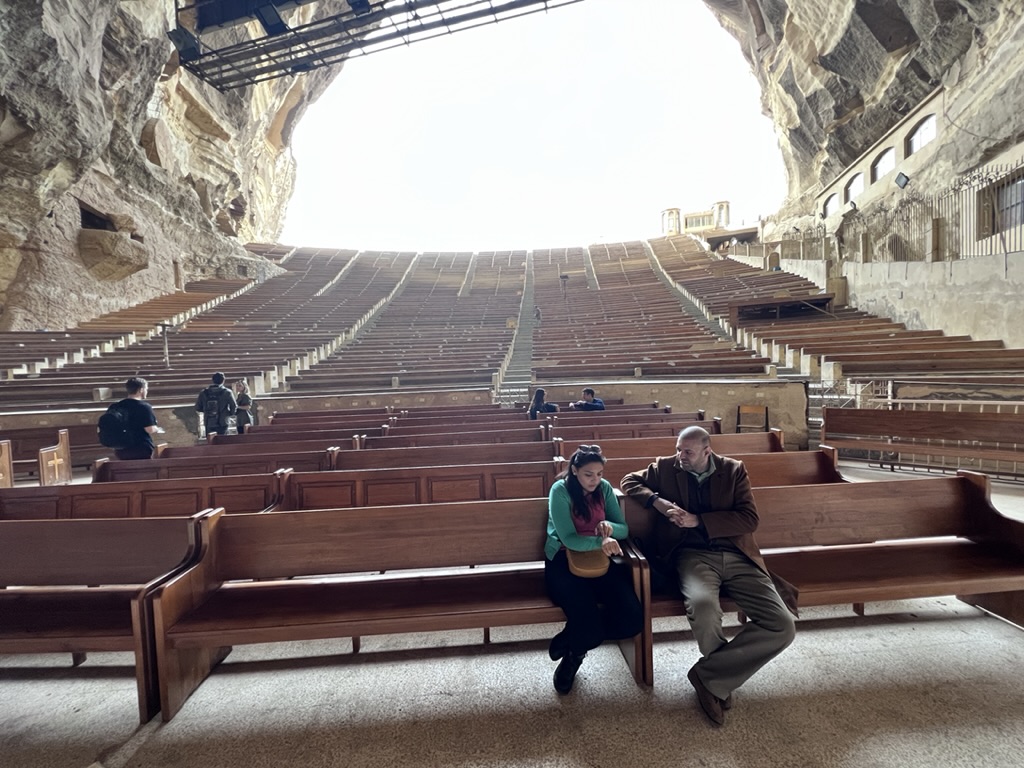
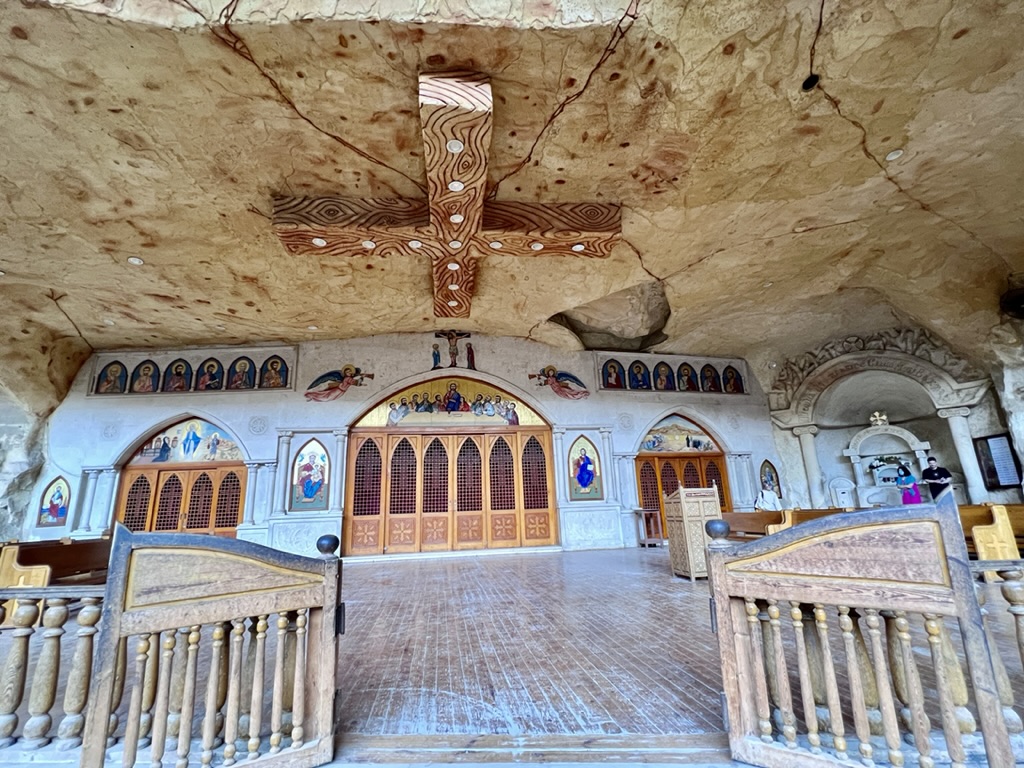
From the station, we took a taxi to head to Manshiyat Naser – commonly called the “Garbage City” – a predominantly Coptic Christian district in Cairo where a very large percent of all of the garbage in Cairo is dropped so that people who live there can sort the garbage and then sell it for new uses—metal scraps, rope, cardboard, plastic, etc. Not exactly a tourist destination, but we always visit “marginal communities” and informal settlements when traveling in developing nations. The driver thought we wanted to see the Cave Church, which is located in the area of the ‘garbage city’ which is inhabited by Zabbaleen who are descendants of farmers who migrated from Upper Egypt to Cairo in the 1940s. We did see the church, but our real destination was the actual community of the Zabbaleens. They came to Cairo looking for work and set-up makeshift settlements around the city. Initially, they continued raising pigs, goats, chickens, etc. within the city, like their ancestors, but eventually found collecting and sorting waste produced by the city residents was a more profitable enterprise. To this day, the Zabbaleen sort through household garbage, salvaging and selling things of value, and use the organic waste to feed their animals.
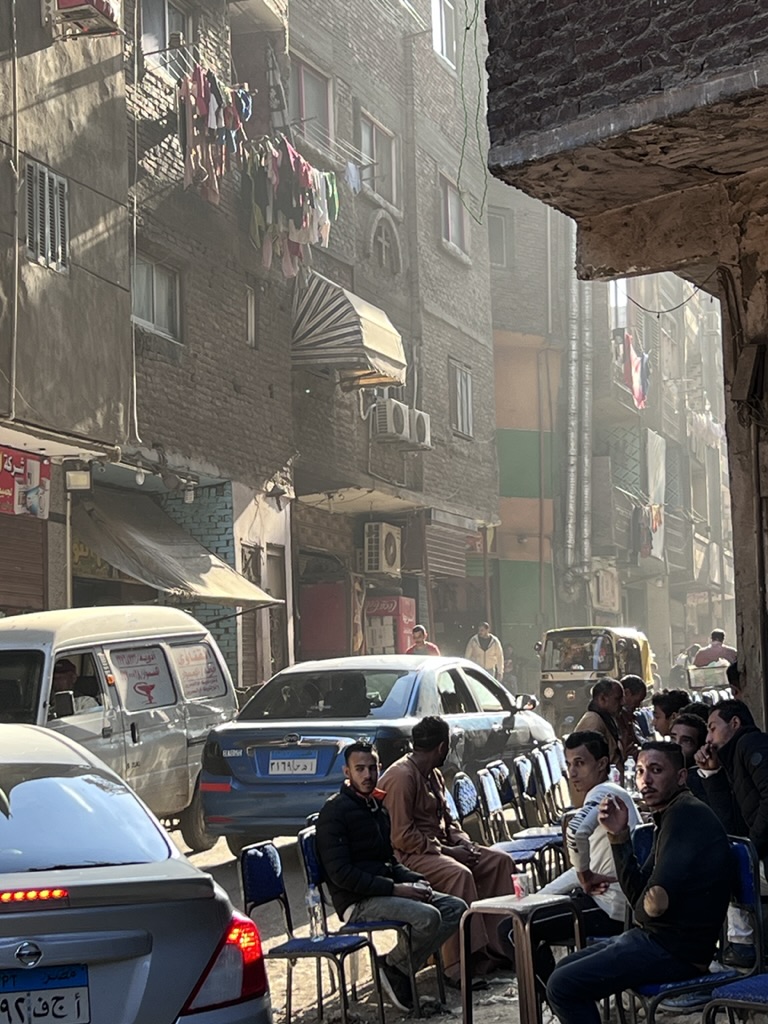
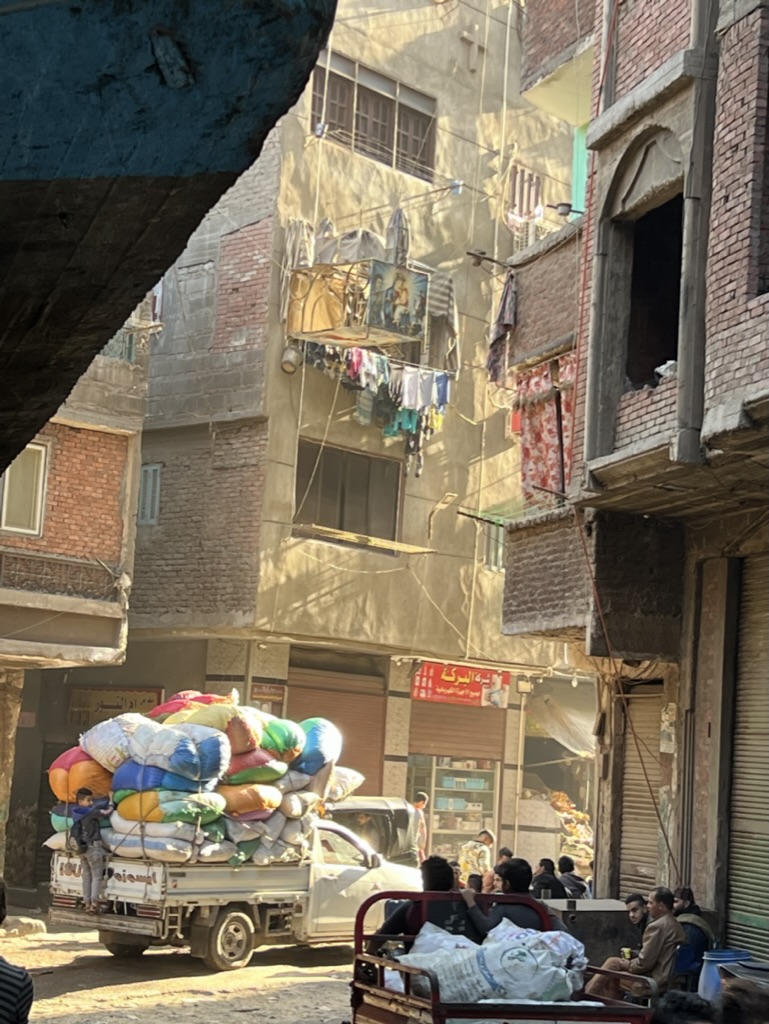
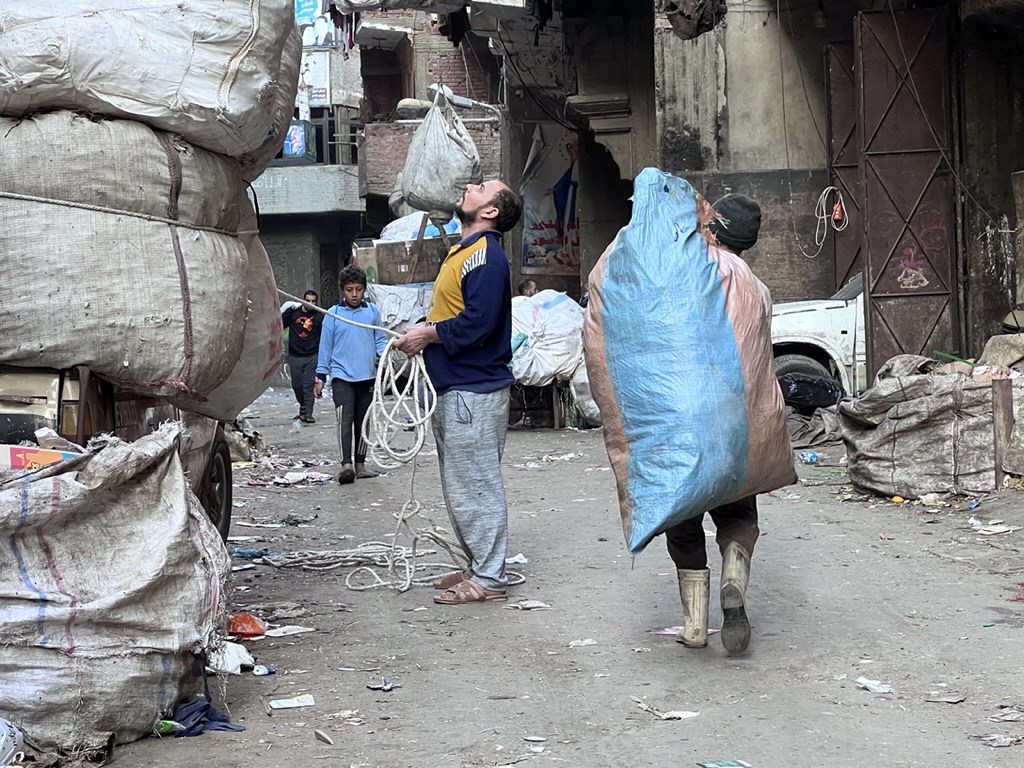
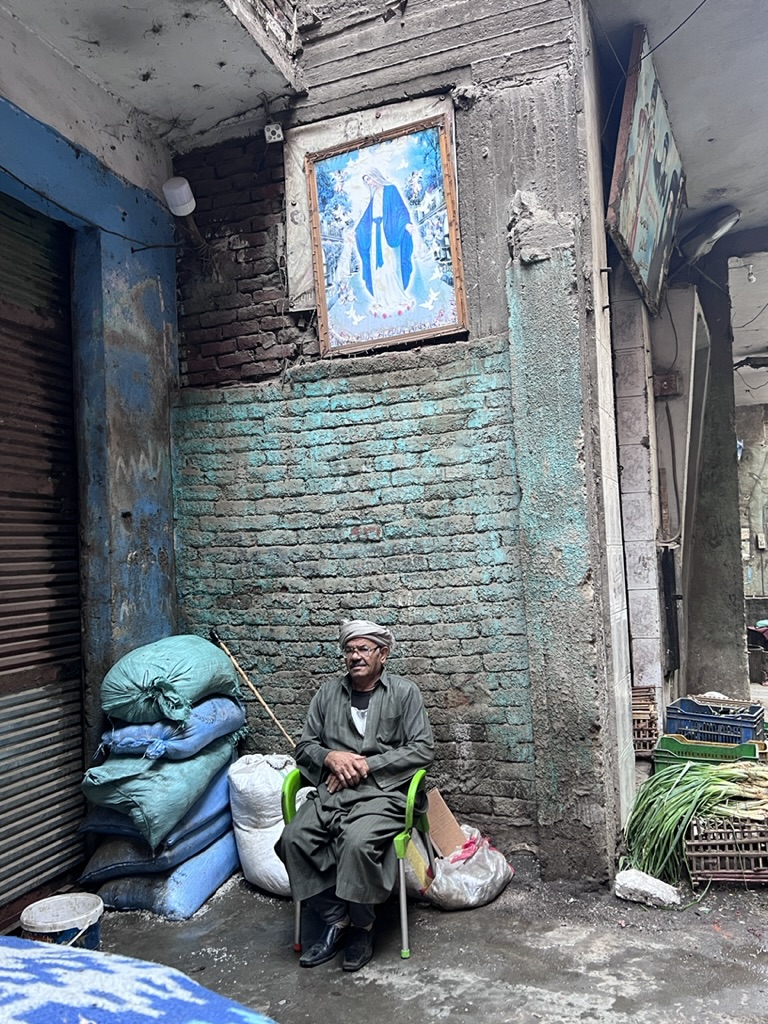
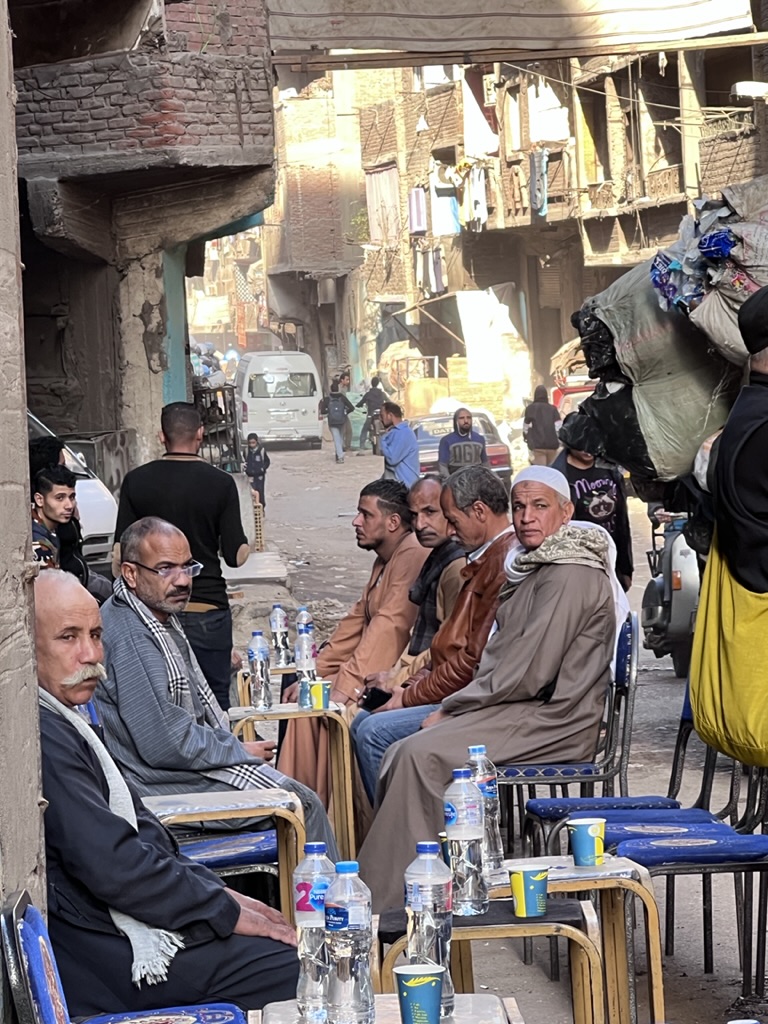

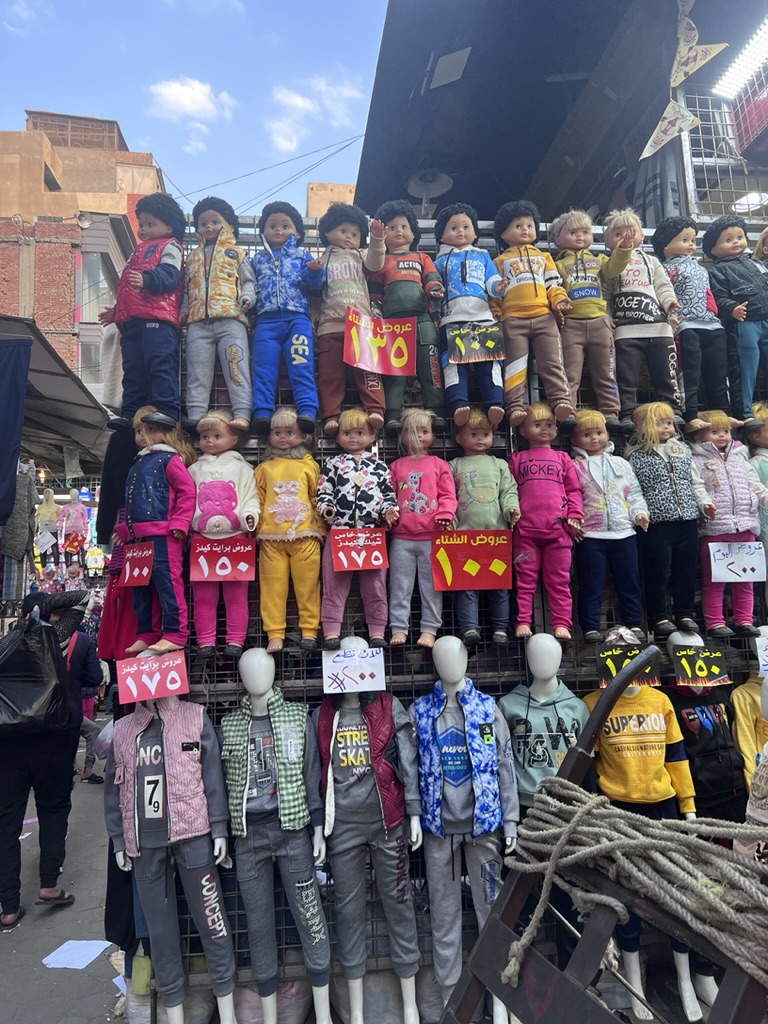
For years, the Zabbaleen had moved around the city, living in makeshift tin huts, trying to avoid the authorities. Then a large group settled under the cliffs of the Mokattam quarries. The area has grown from a population of 8,000 in the early 1980s, into the largest garbage collector community in Cairo, with approximately 60,000 Zabbaleen inhabitants. While Egypt is a Muslim-majority country, the Zabbaleen are Coptic Christians. Because they are discriminated against, even those who can, today, afford to live elsewhere remain in Garbage City because of the tight community.
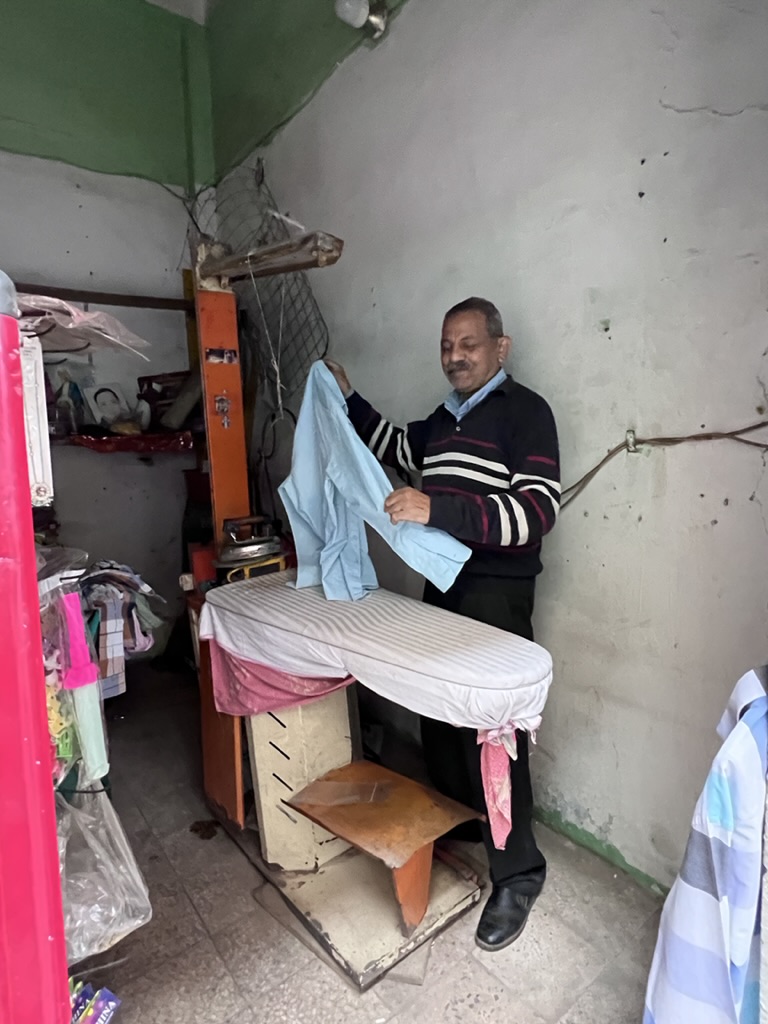
We “strolled” around the area while the taxi waited for us in a designated spot. People were very friendly, although probably curious as to why we were there. We didn’t find anyone who spoke even a word of English, but we smiled and they smiled and we took lots of photos. It was clear that the work was hard and very well organized. It appeared to me that huge bags of garbage were constantly being delivered and then hoisted to “apartments” in 4 or 5 story buildings. Families would sort the contents of the bag and re-bag the contents into different categories and then those new bags would get hoisted down to street level where they were picked up by trucks to go to designated areas.
The neighborhood had all the amenities of thypical neighborhoods: barbershop, café, a few shops, a grocery, etc. all amid piles of garbage and trucks moving about with the garbage. Lots more to say, but we have to get up at 5:00 am to be able to get to the train station to go to Alexandria tomorrow. It was Mike’s birthday today, so in addition to spending it at the local garbage dump, we also went to a very classy and wonderful restaurant called Sachi in a neighborhood called Heliopolis. More on that tomorrow.
And P.S. I’ll tell you our take on the ATMs here it Cairo next time we talk — Fern
Best –
5. Cairo: Metro, Markets, and Mayhem. 12/20/22

Greetings after a totally exhausting day.
Hope you are well and likely either lighting candles or decorating a tree or maybe both! There is very little evidence of either holiday here in Cairo—except if you walk by the large international chain hotels, where you can find Santas and some other Xmas symbols.
Today was a totally hectic day, although that was not the intention.
We set out to visit a bunch of sites, but realized we needed to cash some money or withdraw $ using ATM cards. That turned into quite a production. We walked to the nearest ATM which was about ½ mile from the hotel. It had its own security guard. Mike was able to do his transaction, but after his big withdrawal of $100 in Egyptian pounds when I tried to do the same, the machine was out of money. So we figured we’d wait until we came upon another machine later in the day (they are not seen frequently). We had decided we would try the Metro today (having ridden metros in so many other cities) and take public transit instead of taxis. Finding the Metro station was a lot more difficult than you’d think. Because we had to go to the ATM which was in the opposite direction from the closest Metro station from the hotel, we got a bit turned around and then kept asking “shopkeepers” and pushcart vendors as well as police and passerbys where the metro station was. There is actually very very little English spoken here, except by people in the visitor industry (hotel clerks, servers, etc.) and I suppose if you are circulating among the well-educated and well-heeled elite.
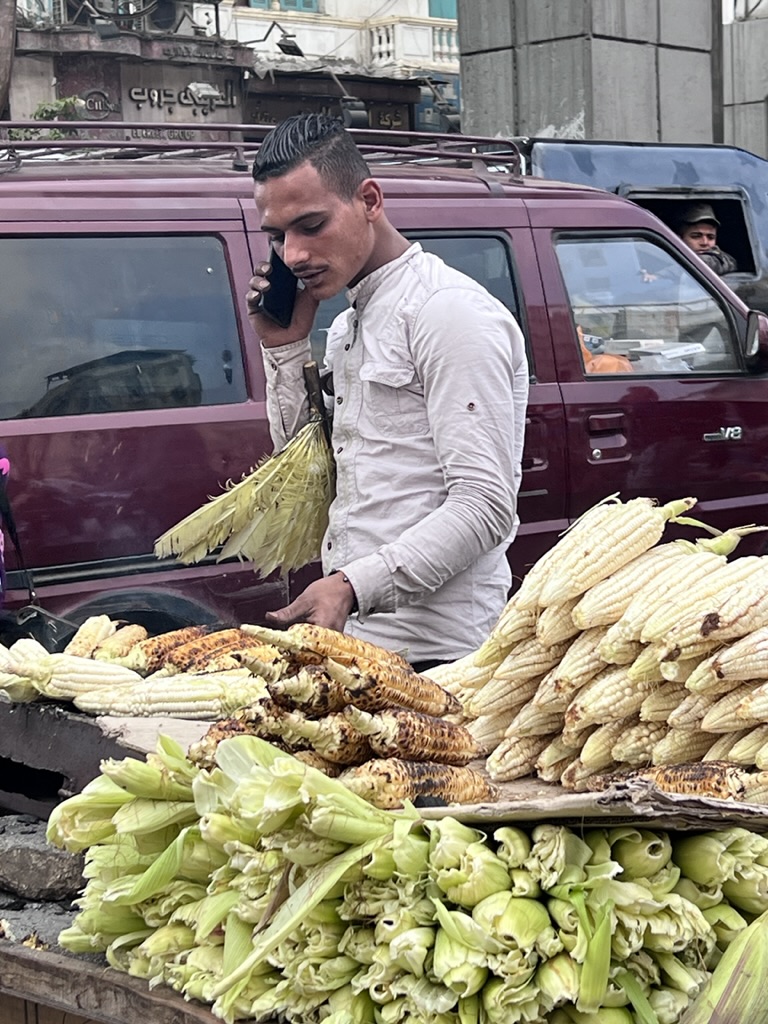
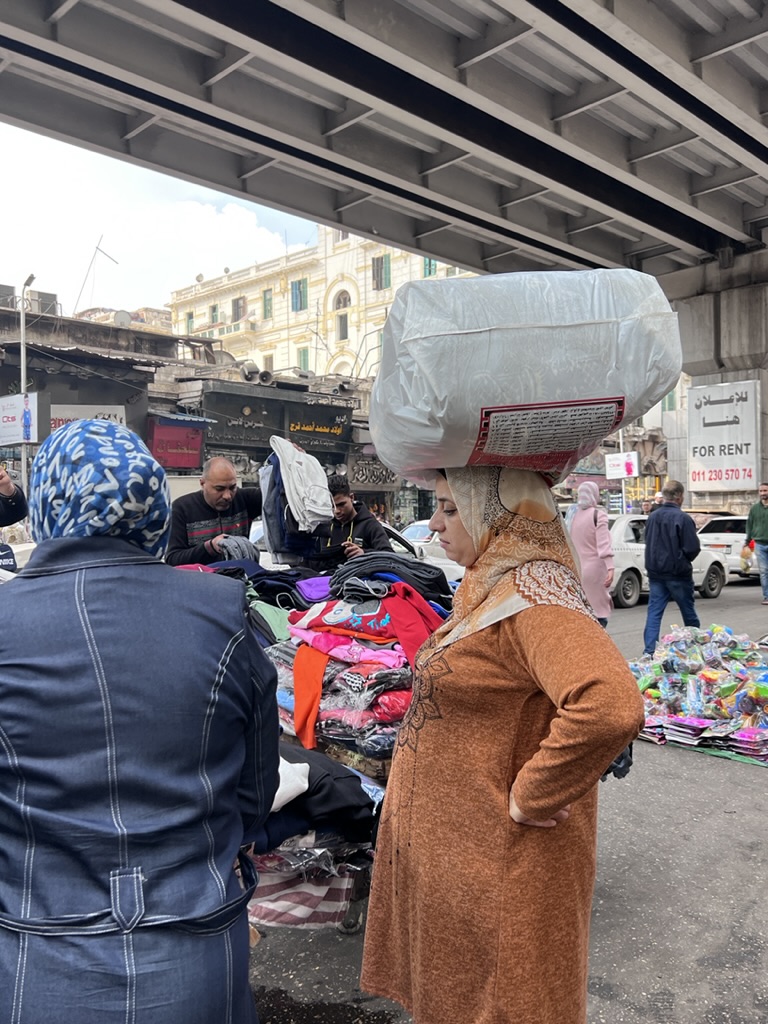
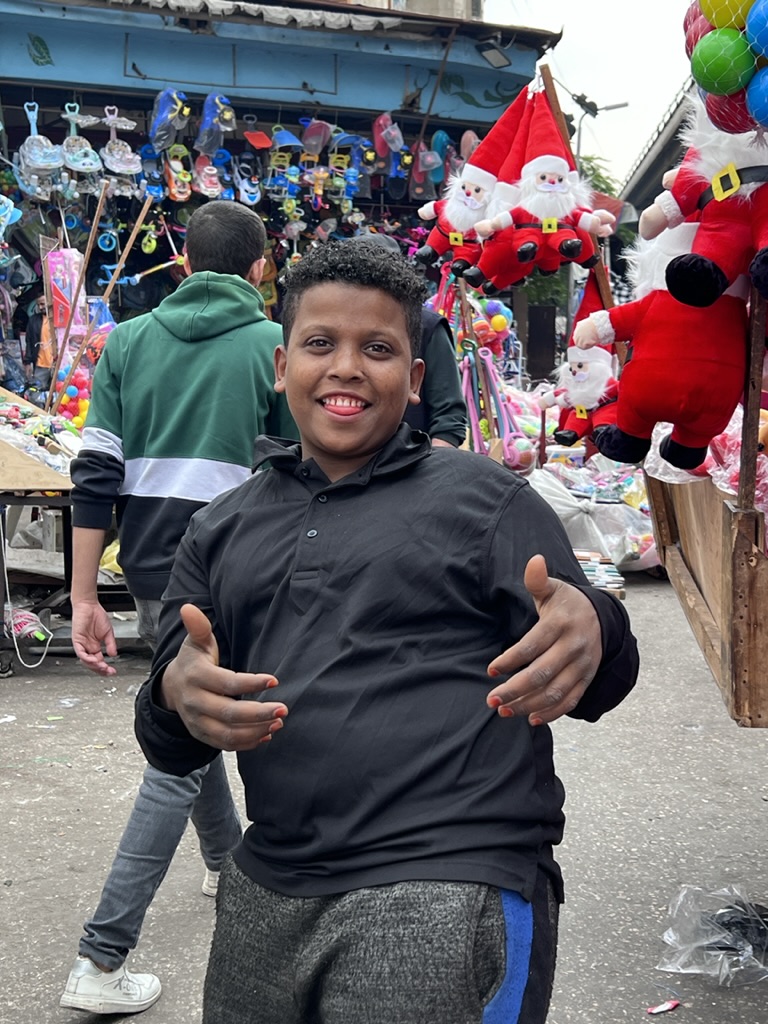

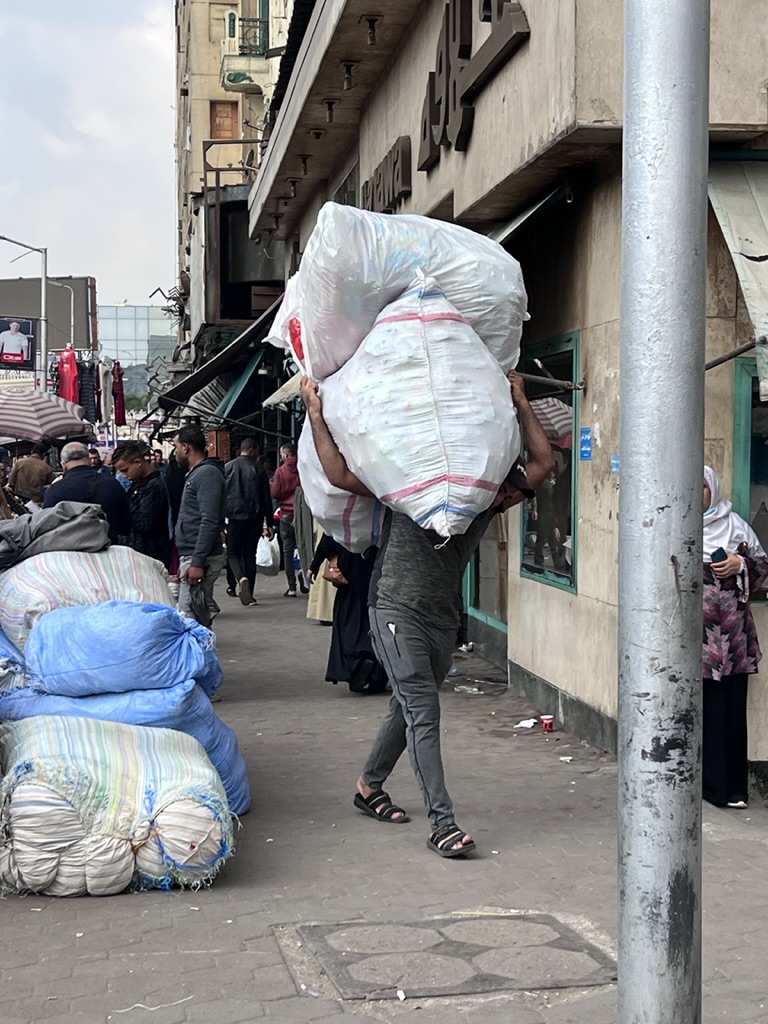
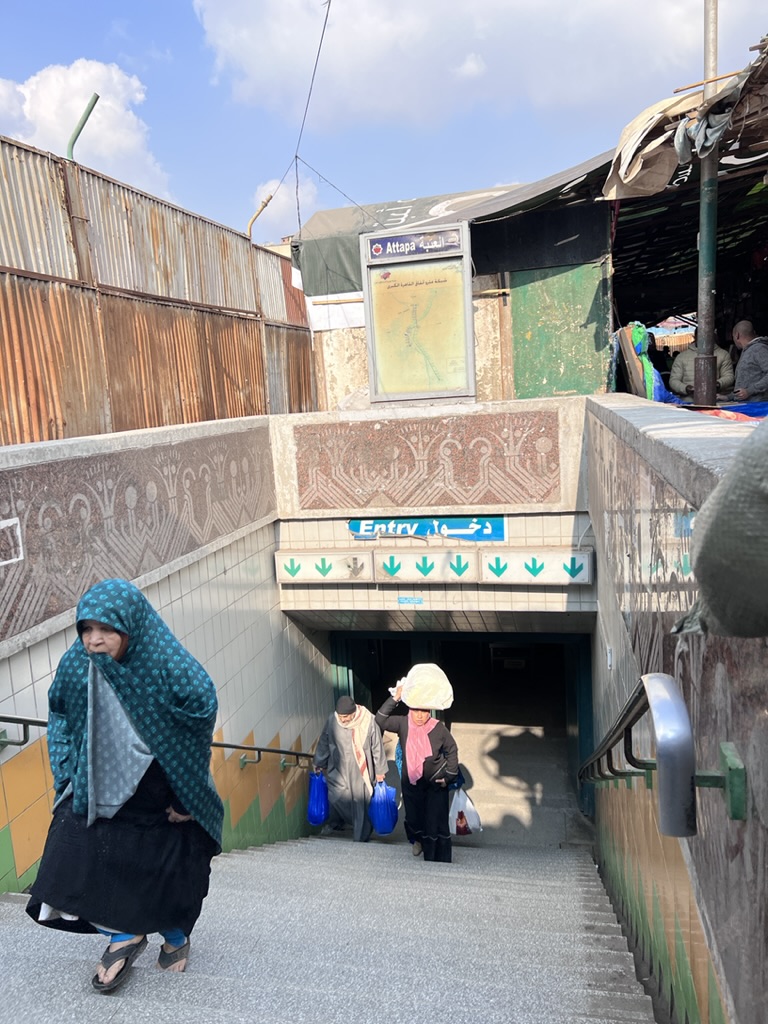
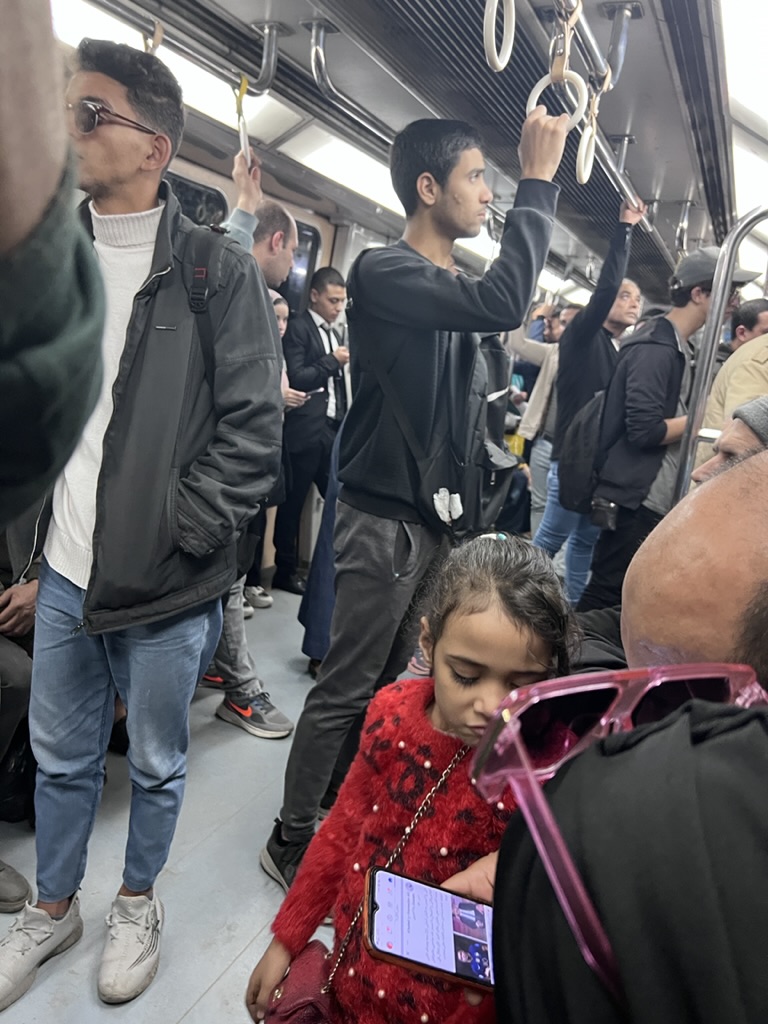
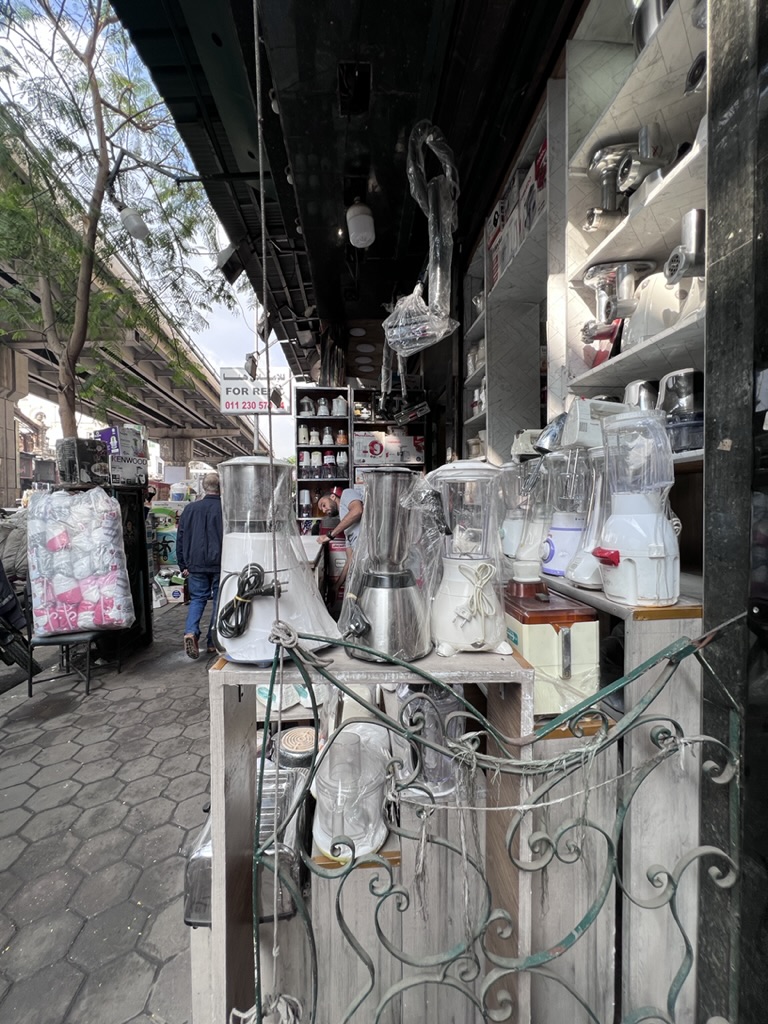
We had a map of Cairo (which is also very rare to find—we bought ours in the museum yesterday—so even the hotel receptionist asked where we got our maps), and GPS so you’d think it would be easy. Most people either didn’t understand what we were asking or didn’t actually know where you do get the Metro. Although it is quite cheap, most marginal people take the very polluting buses or the mini-vans that totally clog the streets but seem to go everywhere without much of a schedule.
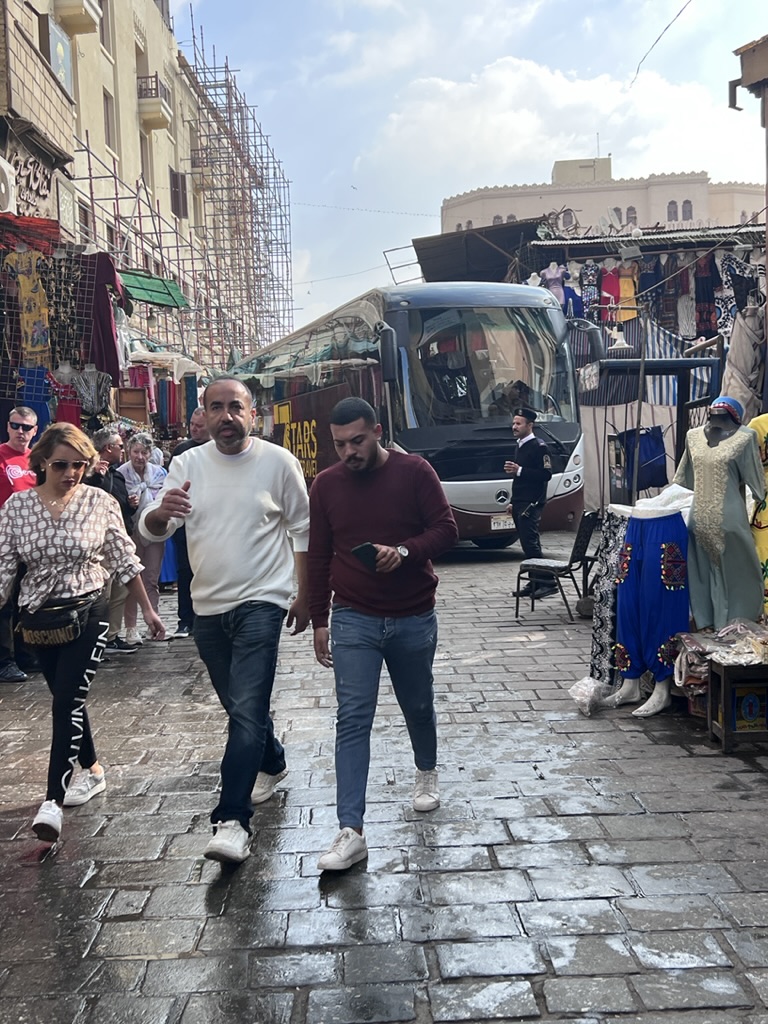
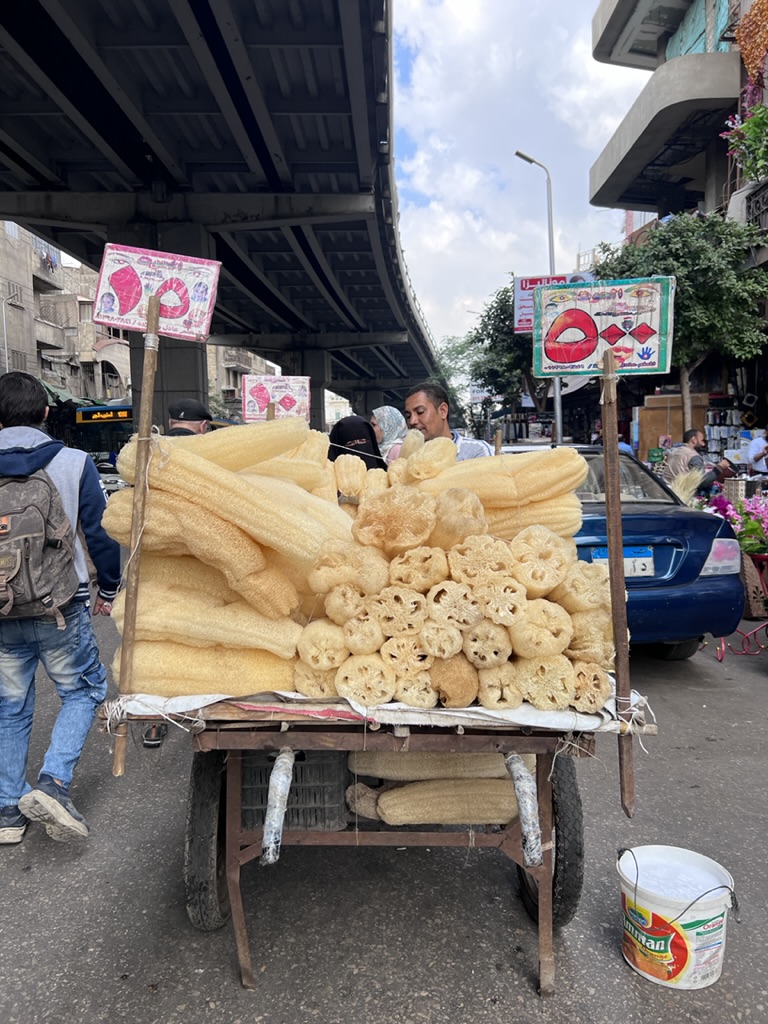
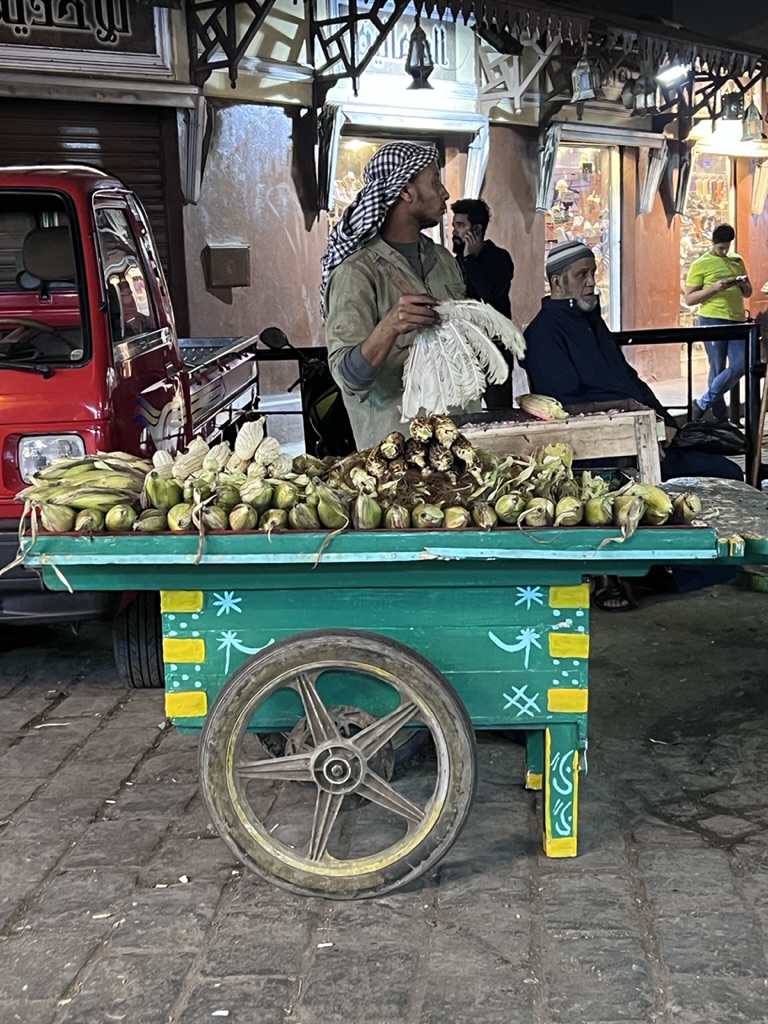
But the walk from the ATM to the Metro which took us about 40 minutes was a site to behold. Every inch of pavement was taken up by vendors selling everything from clothing and shoes to electronics, kitchen supplies, perfume, and any other item you could imagine. At this point we were outside of the walled city and in the thick of daily life. The crowds were unbelievable and we could rarely stay on whatever area remained as sidewalk; and reverted to walking in the streets like everyone else—amid the nightmare of Cairo’s traffic. I think my lung capacity dropped immensely breathing in all the fumes; cannot imagine what level of lung diseases residents here have, especially the traffic “control” people (ha ha) who are out in this all day. Everywhere you walk there are messages from vendors (marketing) blasting from speakers. We finally figured out that they tape their hawker’s pitches and then just play them through a loop on their speaker all day at their cart. So you just hear all these competing messages—very loud to drown out traffic noise. To be honest, we had a great deal of fun watching all of this go by as we sought to find the Metro.
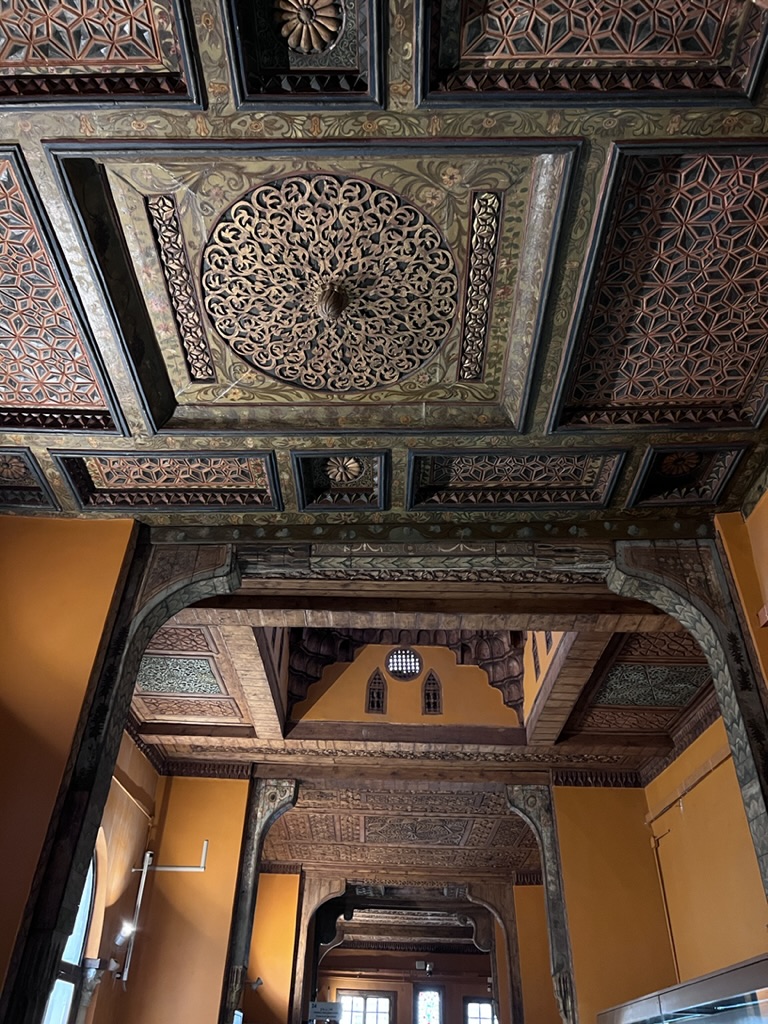
Eventually we found the Attaba station and figured out how to buy tickets (no machines, you line up at the ticket counter) and to figure out the route we needed to get to our first stop—the Coptic Museum. The subways felt much like NY, maybe NY in the 70s! The trains are pretty old and the stations are dreary. Nothing like what we experienced in Uzbekistan a few years ago, where each station was like a museum. Still, it was efficient and we even made changes because we had to go from the green line to the red line to the blue line. We are now quite seasoned Cairo Metro riders. We found our way to what is known as Coptic Cairo—a part of Old Cairo where the Babylon Fortress, the Coptic Museum, the Hanging Church, and many other sites can be found. Coptic Cairo was a stronghold for Christianity in Egypt before and during the Islamic era, and most of its churches were built after the 7th century (such young things!). The Coptic Museum is quite lovely with courtyards and many places to sit and relax. Unfortunately the exhibits are not well lit and there is an unending amount of artifacts such that it sort of all blends together. The best were the wood carved ceilings of the building that graced every room—intricate, delicate wood patterns throughout.
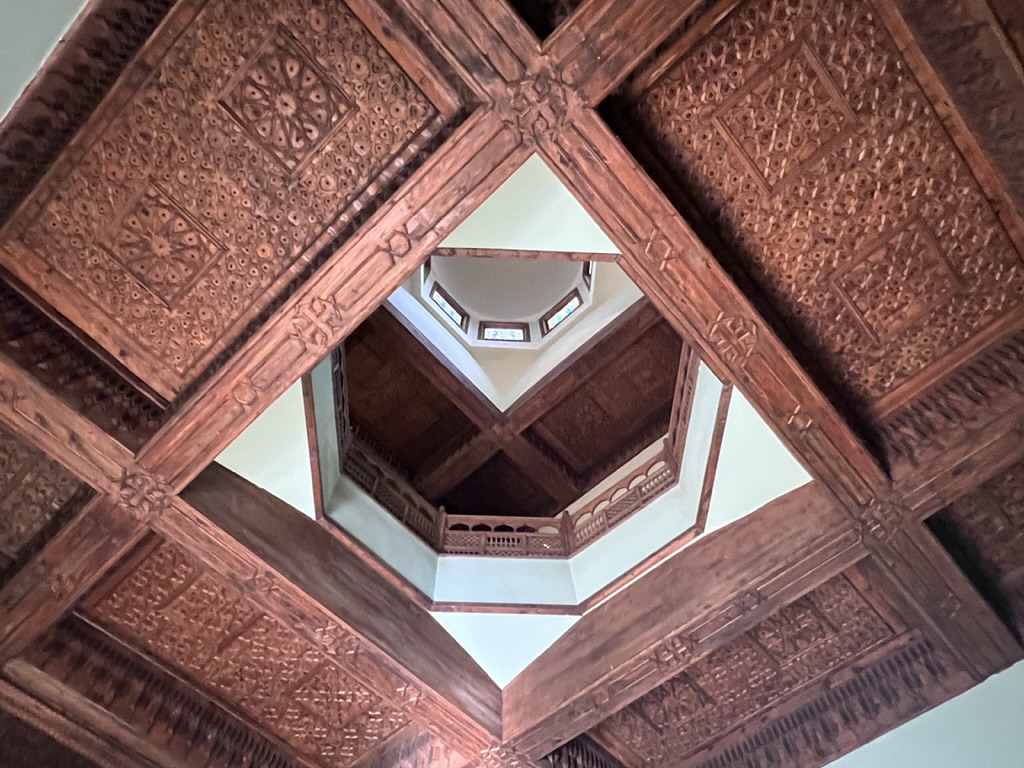

From there we walked to the Church of St George which is circular in plan and then on to the Ben Ezra Synagogue which is also in this same area of Old Cairo. But the synagogue is under renovation so we didn’t see that. Somehow all of these religious institutions seemed to get along and be in close proximity to one another.

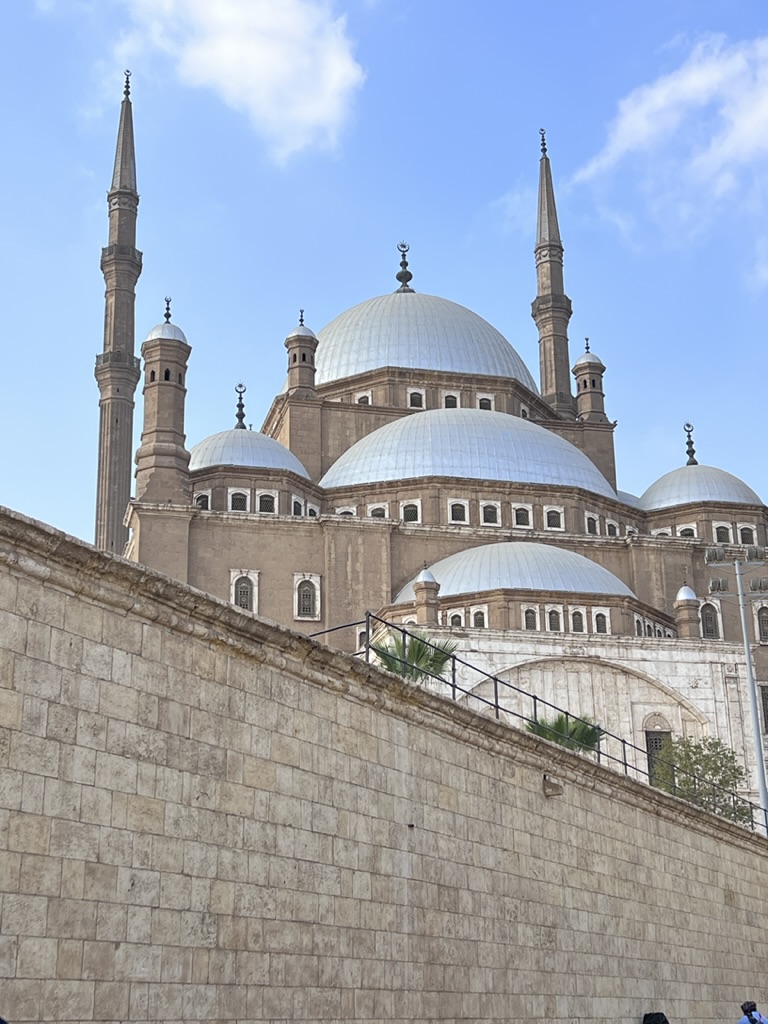
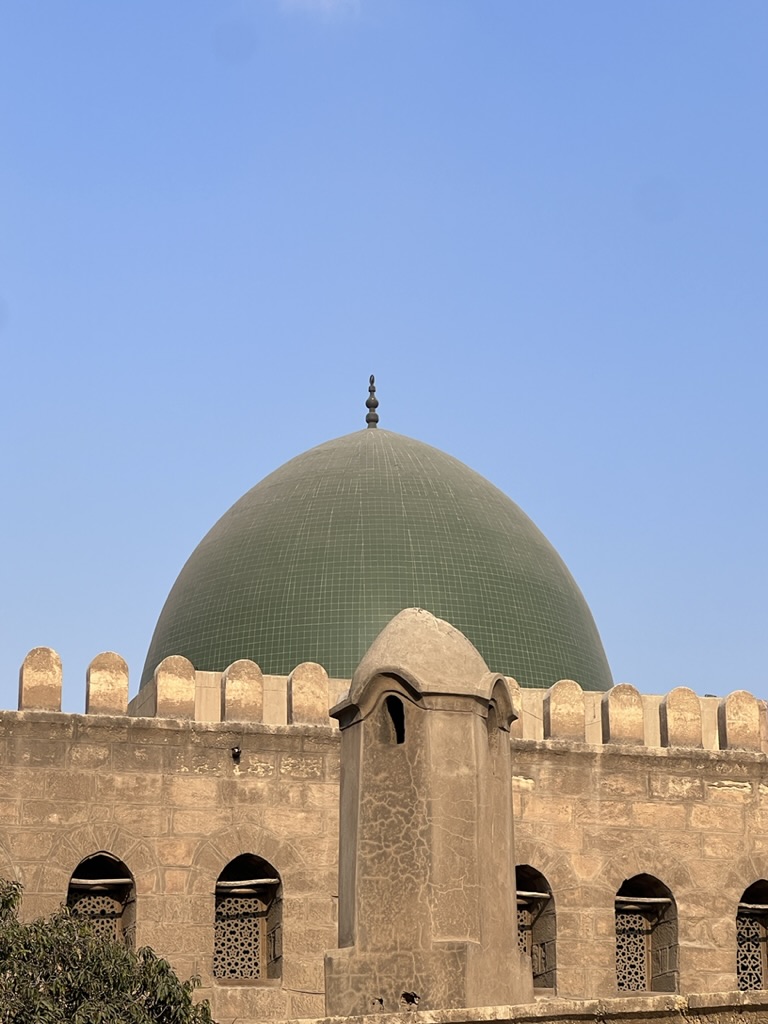
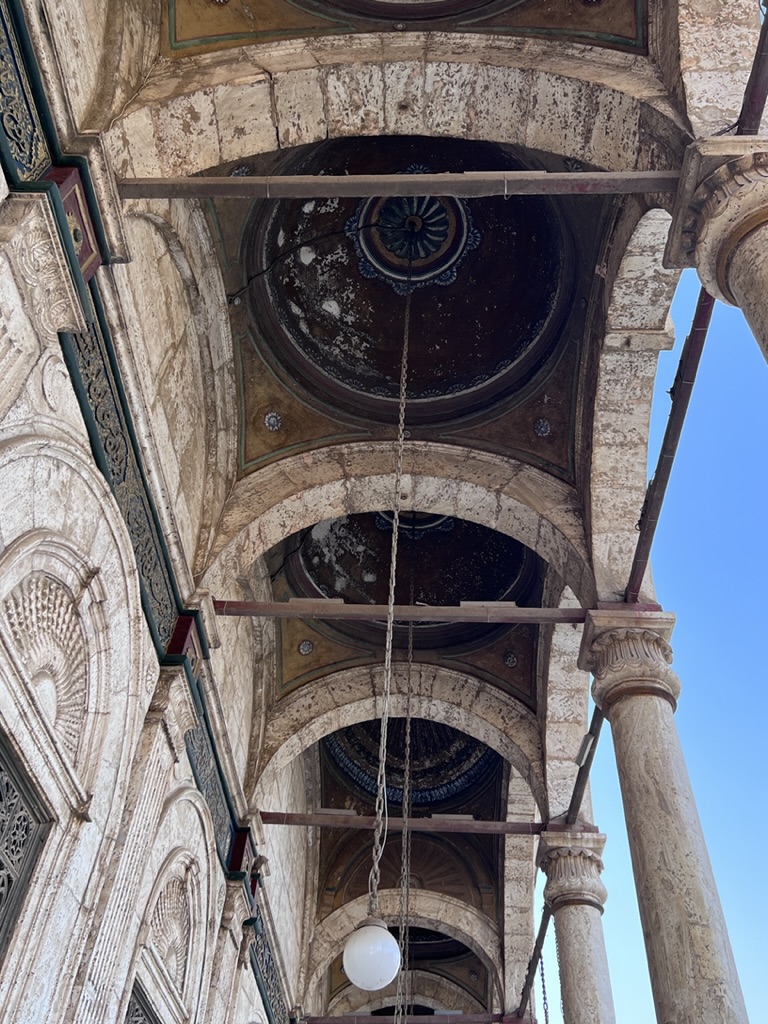
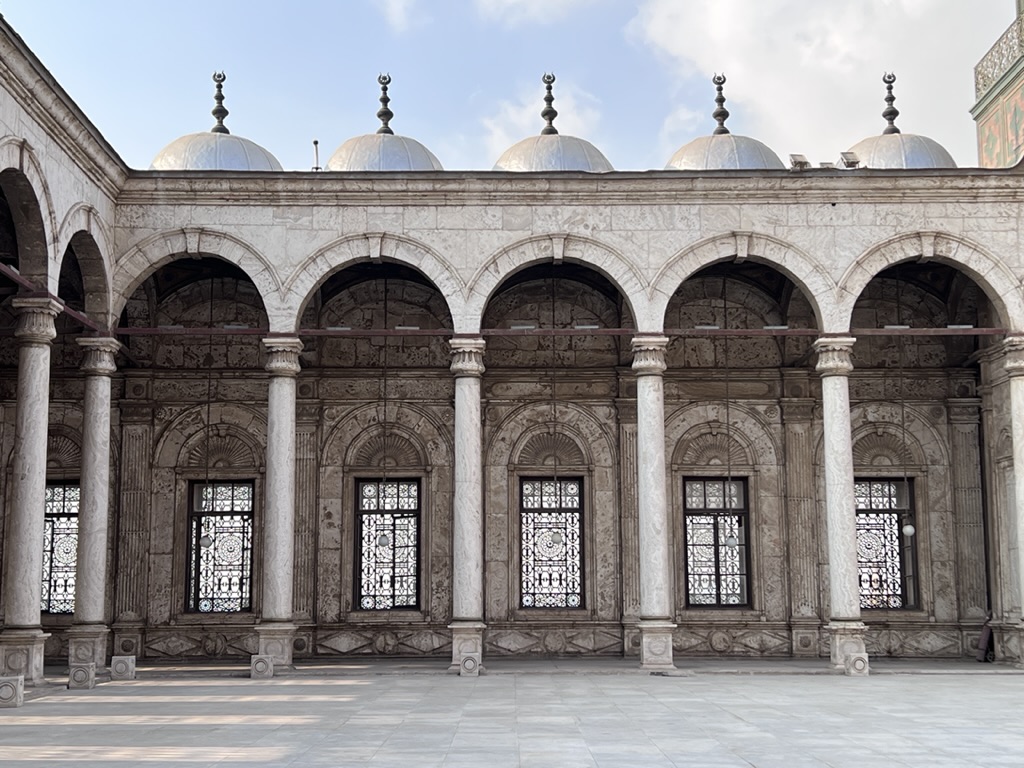
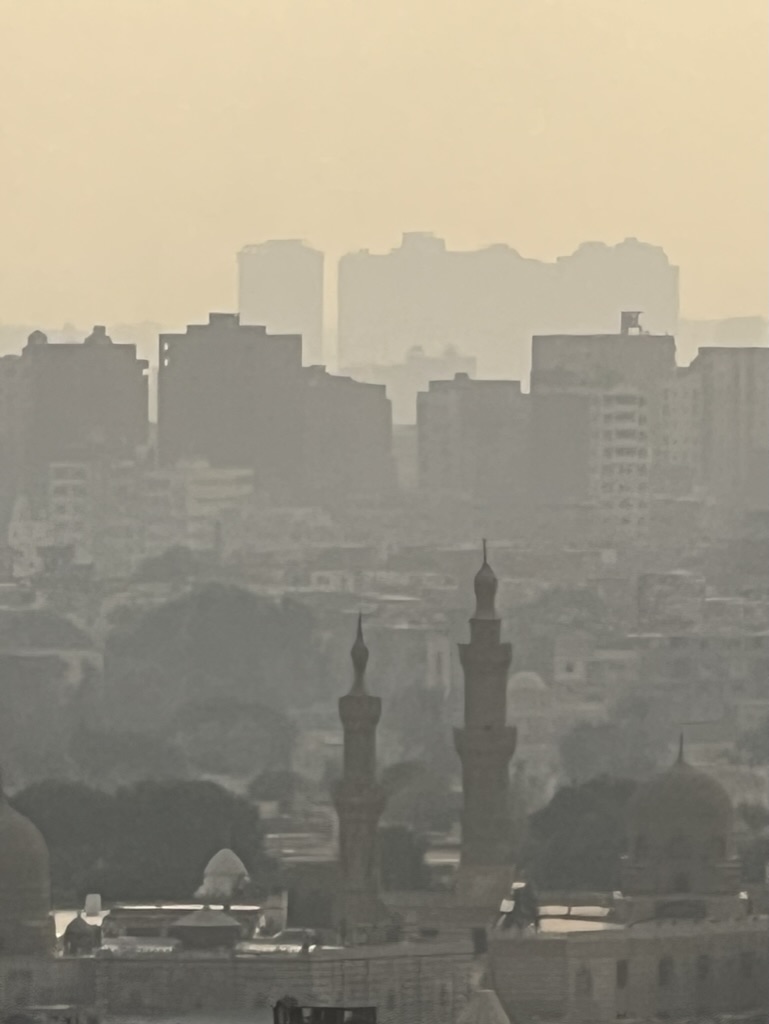
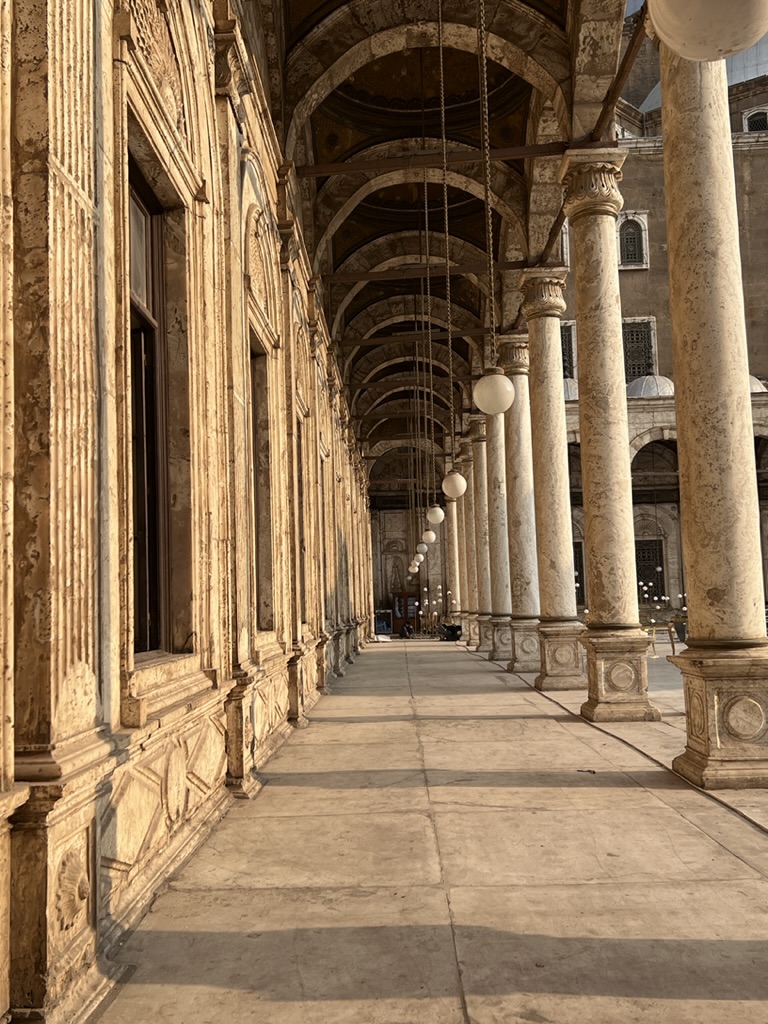
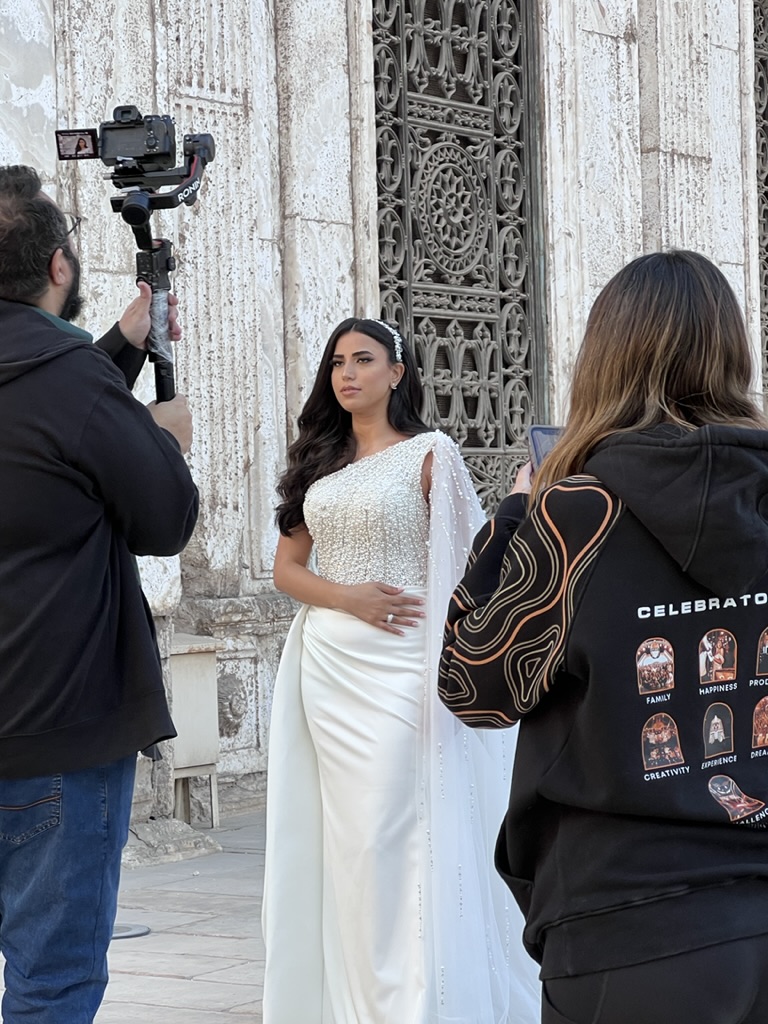
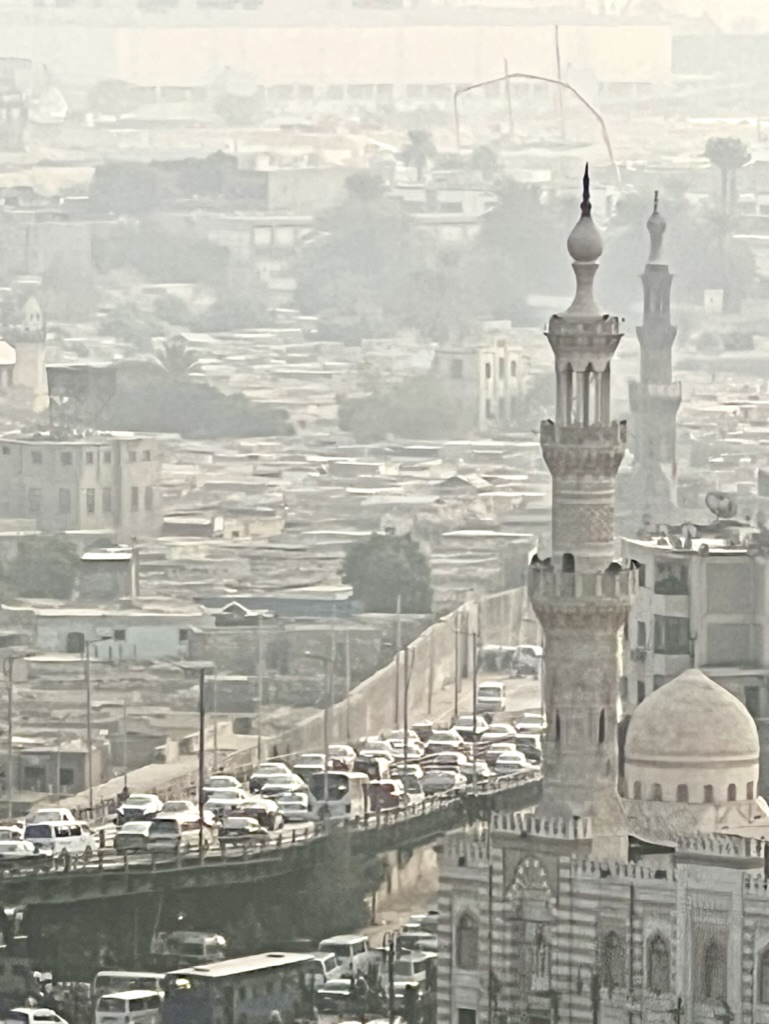
After having our fill, we found a taxi to take us to the Citadel, which was about a 15-minute drive from the Coptic area. As soon as we got out of the taxi, several other taxi drivers called to us to say they could drive us to the top of the hill where the entry to the mosque was. They kept saying it was a long walk and all uphill. But we persevered on our own and the walk was really not that long and not that difficult. The Citadel is a medieval, Islamic-era structure built as a fortification by Saladin and further developed by subsequent Egyptian rulers. It was home to rulers for about 700 years until the 13th Century. It was also the seat of government. Its location on a hill near the center of Cairo commands an incredibly impressive vantage point that overlooks the city and manages to dominate the Cairo skyline. Today it is a preserved site that includes mosques and museums. The largest of the mosques is the Mohammed Ali Mosque. The space is huge with one gigantic dome surrounded by others. There is a huge courtyard from which you can see the whole city for miles around. While we were there they were setting up for what is likely to be an amazing wedding (actually couldn’t believe they “rent” the place out for events!) We managed to get a peek at the bride.

Then we took another taxi (you’re probably shocked at the fact that we need so many taxis, but it’s really the only way to get around, and they are very very reasonable, even with the gigantic tips we give for keeping us alive during the drive.
We headed to Zamalek — an affluent district on the northern part of Gezira Island in the Nile River that is connected to the rest of Cairo by three bridges—sort of like Manhattan, and interestingly one taxi driver said it was the “Manhattan of Cairo.” Despite its affluence exhibited by beautiful and stately residential buildings (probably built in the 1920s) and the chic shops (we got there too late to do any shopping), there’s also a lot of neglect on some of the buildings due to poor maintenance. Apparently, there is some kind of rent control in some buildings and thus there are lower and middle income people living in Zamalek as well as the wealthy. There’s also something called the Egyptian Sports Club that takes up a huge amount of land but keeps the island very green.
We had read about a restaurant that sits right on the Nile at the northern tip and figured that would be a good place to have a cocktail and some appetizers so we asked the taxi to take us there. Must say, this was the best driver ever. He wasn’t talking on the phone the whole time (holding the phone since they don’t have Bluetooth); he wasn’t driving without hands; he wasn’t zipping along. When we got out of the taxi we learned that Sequoia was closed, perhaps for renovations. Fortunately, the driver was still there (probably trying to figure out if he’d find another fare). Didn’t know where to go even though we had read there was an abundance of cafes and bars in Zamalek; we didn’t have time to look anything up for fear we’d lose the driver. So, Mike said he saw a Hilton as we were driving that was pretty close. The driver took us there. We figured there would be some kind of bar at the top where we could have a drink and then do a little research about dinner options.
The Hilton turned out to be from around the ‘70s and was definitely past its prime. There wasn’t anything on the roof and the first floor “restaurant” was pretty seedy. But by then we were also in search of electrical outlets to power our phones (too many photos!) so we hunkered into a table (actually kept moving because it was hard to find outlets). The menu was pretty bleak, so we just talked and once the phones were somewhat charged we decided to leave. No one seemed to care. We spent a little time looking for a restaurant on our phones once we had some power. We didn’t want to go too far, we wanted something good… and somehow we wound up in the most strange of places: described as “Cairo’s premier, award-winning, dining and entertainment venue. Originally a floating palace from the turn of the century, Le Pacha was transformed into a magical place in 1992. Moored off the banks of Zamalek in Cairo, Le Pacha quickly became a landmark on the Nile with its nine restaurants … and spectacular views of the Nile and city.”
I think we were so exhausted that our restaurant radar was down. Normally that kind of description would turn us off.. but I think we had planned to have drinks with a view by the water and so this looked possible. Also, we couldn’t really decide what kind of food we wanted so the nine restaurant options seemed to work since we could delay selecting until we got there. We wound up having drinks in one place (not very good drinks and appetizers not up to par with what we’ve been having – and we were definitely spoiled by Taboula last night) and then going to “Le Steak” for dinner. It was described as a French bistro. It was fine (we shared a chateaubriand which was enough meat to feed six people). At least it was rare. All fine, nothing to write home about.
Naturally, La Pancha didn’t have any “city taxis” waiting at the entrance so we told the “concierge” we needed a taxi and up popped some guy in a fairly new car—definitely not a taxi, but also not Uber. Just a guy and a car. We hopped in and he took us to yet another drop off so we could walk into Gamaleya to our hotel. The route from this drop off took us down a street where they were selling (at 10 pm) restaurant supplies and equipment along with other household goods—selling this stuff out of tiny little spaces with all their products out on the street. Again, motorcycles whizzing by in both directions, an occasional car that got permission to drive inside, kids, pedestrians, dogs, cats – all scurrying about … and us. As we turned one corner horns were blasting (not unusual since horns seem to be the way cars move about given that there aren’t any (or very very few) traffic lights (in a city of 20 million).. .but this was different. There was a large black car and lots of people dressed up and dancing and clapping behind the car. I’m guessing it was a wedding. We sort of joined in with the crowd, and made it “home.”
I figured out that the music in the streets ends at about 2 am when some shops close up—just in time to get ready for the call that alerts you to the first morning prayer at about 5 am.
Tashabuk alsalama – Peace be with you.
Not certain of our agenda for tomorrow, but on Thursday we will take the train to Alexandria and meet up with a former doctoral student of mine from my days at ASU.
Best –
Fern
4. Cairo: Museums and Driving. 12/19/22
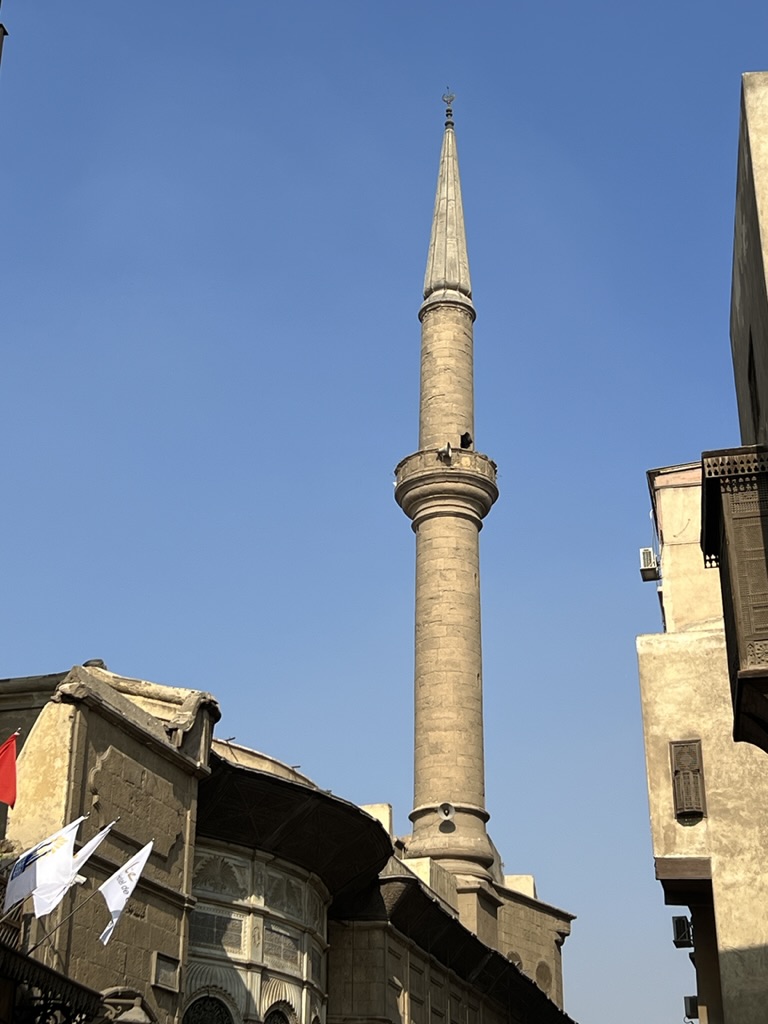
Happy Monday and Happy Hanukah–
Yet another busy day. Decided to just have breakfasts here at Le Riad de Charme. This way we don’t lose a lot of time trying to find breakfast joints and the Riad breakfasts are quite good. Tried the “continental” today: scrambled eggs, Egyptian version of croissants, fruit platter, jams, yogurt, some kind of spreadable cheese with cranberries, and juice— so we were good. Then again, the hotel needed to deal with our charge card and again they had to go outside to get good reception to use their charge machine. Second world interacting with first world.
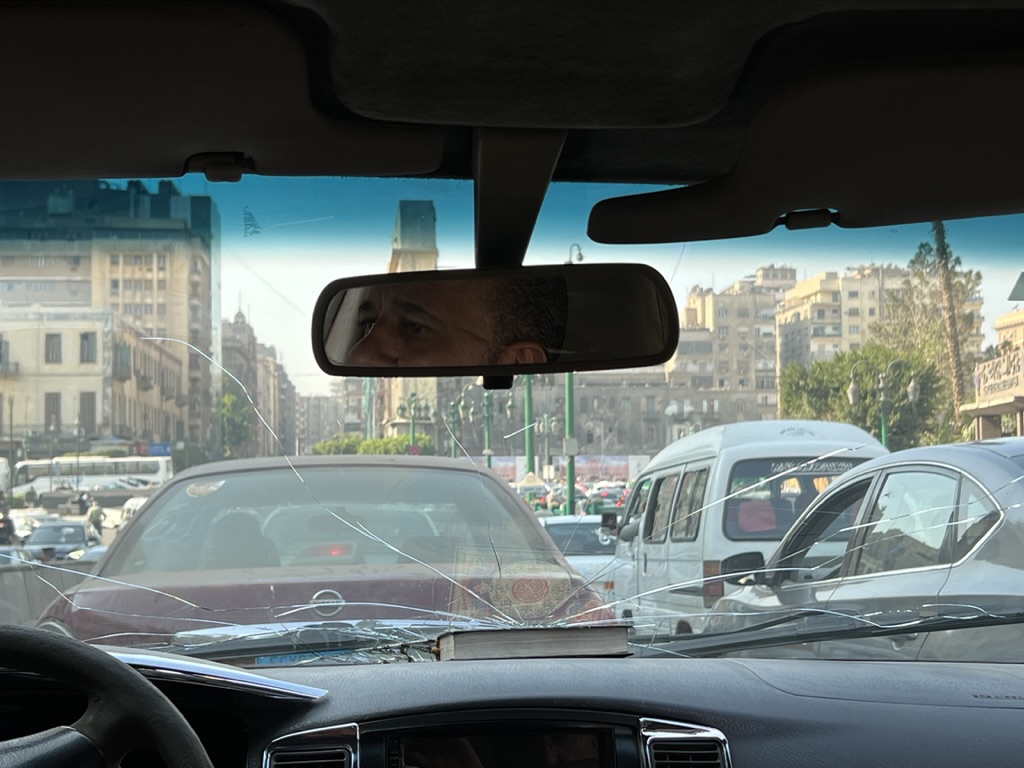
By now we are quite expert at getting outside the Gamaleya to find taxis, so off we went. Got into a pretty beat up one today and once we were in the taxi, we realized the windshield was pretty cracked. But we were only going about two miles, so figured it was fine. The 2 miles took about 30 minutes due to traffic; would have walked if we had realized this. Figured we’d get there faster in taxi but that was probably not correct. Still, it’s amazing to be a passenger as the cars move around like bumper cars in an amusement park. We headed first to Tahrir Square, also known as “Martyr Square,” which has been the location and focus for political demonstrations in the city for decades. The 2011 Revolution as well as the resignation of President Mubarak took place at the Square, which is really more like a traffic circle.
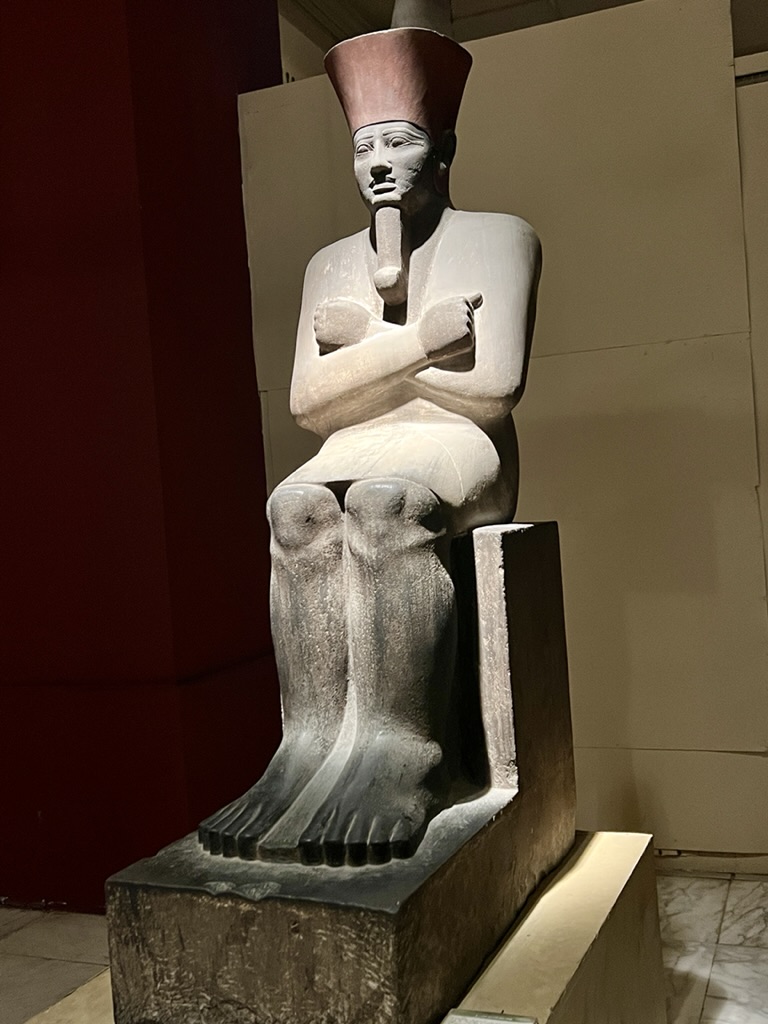
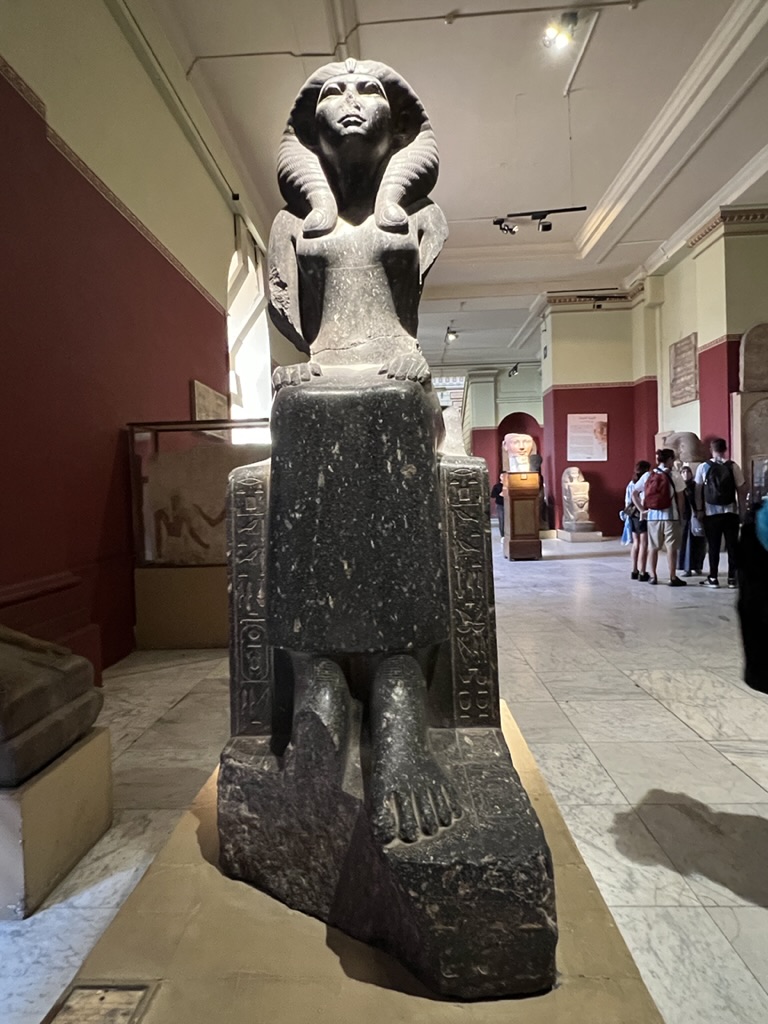
As I noted in yesterday’s piece, today was to be our “museum day,” so we strolled (in the terribly polluted air) from Tahrir Square to the Egyptian Museum (often called the Cairo Museum). It’s the oldest and largest archaeological museum in the Middle East and has the largest collection of Pharaonic antiquities in the world. The building is about 120 years-old. But come 2023, a new museum called the Grand Egyptian Museum (GEM) will open in Giza (not too far from the pyramids) and it will be much larger than this museum. We actually saw the new museum yesterday from the taxi, but it won’t open for a few months, and in reality, I think the opening date may be unknown; the project has been going on for years with many different anticipated opening dates (over many years). It does however look fairly close to complete.
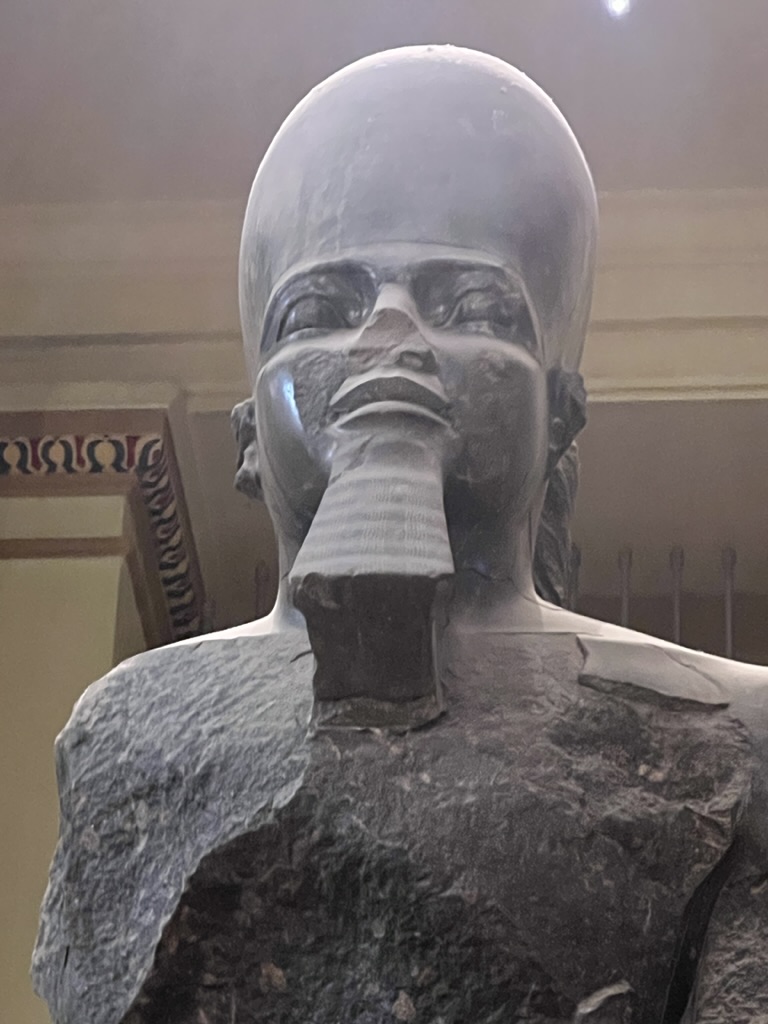
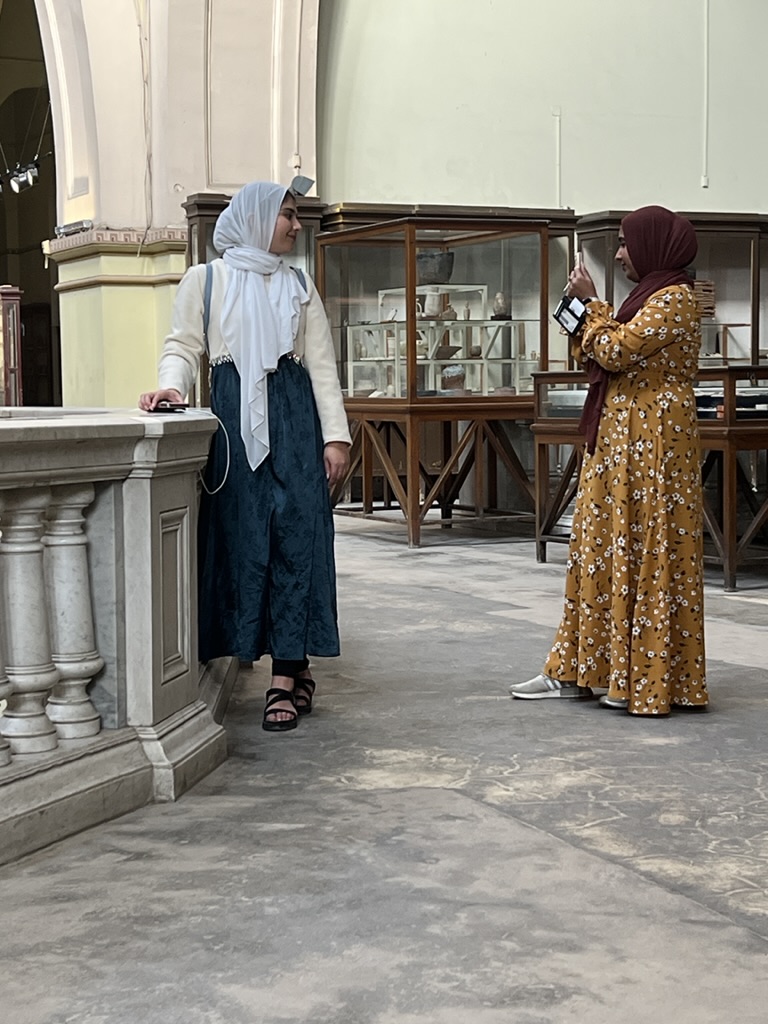


From there, we took another taxi (city taxi, this time without a broken or cracked windshield) to the National Museum of Egyptian Civilization, a new museum situated in the ancient district of Al Fustat. It’s interesting architecturally and also in terms of exhibit design which is fairly interactive and gives a layman’s overview of Egyptian history and civilization. It also now houses the “royal mummies” that were previously exhibited at the Egyptian Museum we had just visited. The NMEC is bright with soaring spaces and many fun ways to understand the history of this complex country.
Mike and I had arranged to meet at the gift shop so that we could go our separate ways inside the museum. I got there first and was sitting on a bench when two women in full burkas sat on the bench with me. They had a young child. I surmised that either one of the women was the sister or was a nanny for the 18-month-old who was being a bit fussy. I smiled at the little girl who was hiding behind her mother’s deep black burka. The kid responded and then the women talked with me. A first for me to talk to someone in a full burka. Turns out they (and the husband who joined them soon after) are from Yemen. Their English was not very good, but we could communicate in simple sentences. I then took pictures of the kid and they took pictures of me! The women did not want to be photographed.

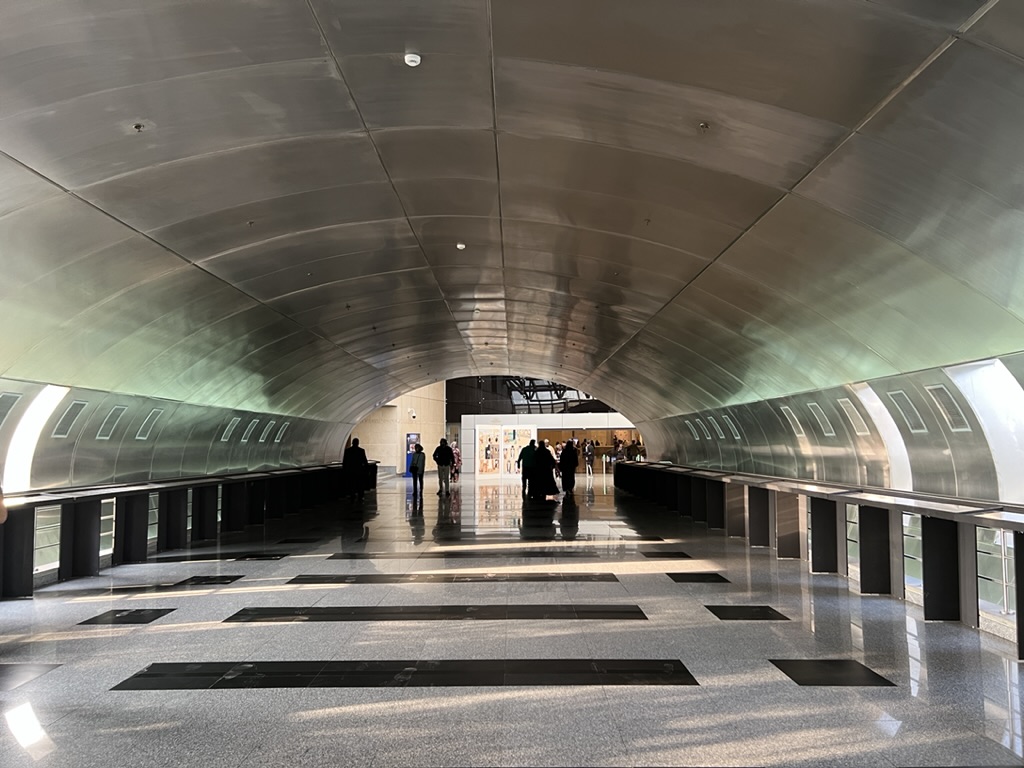
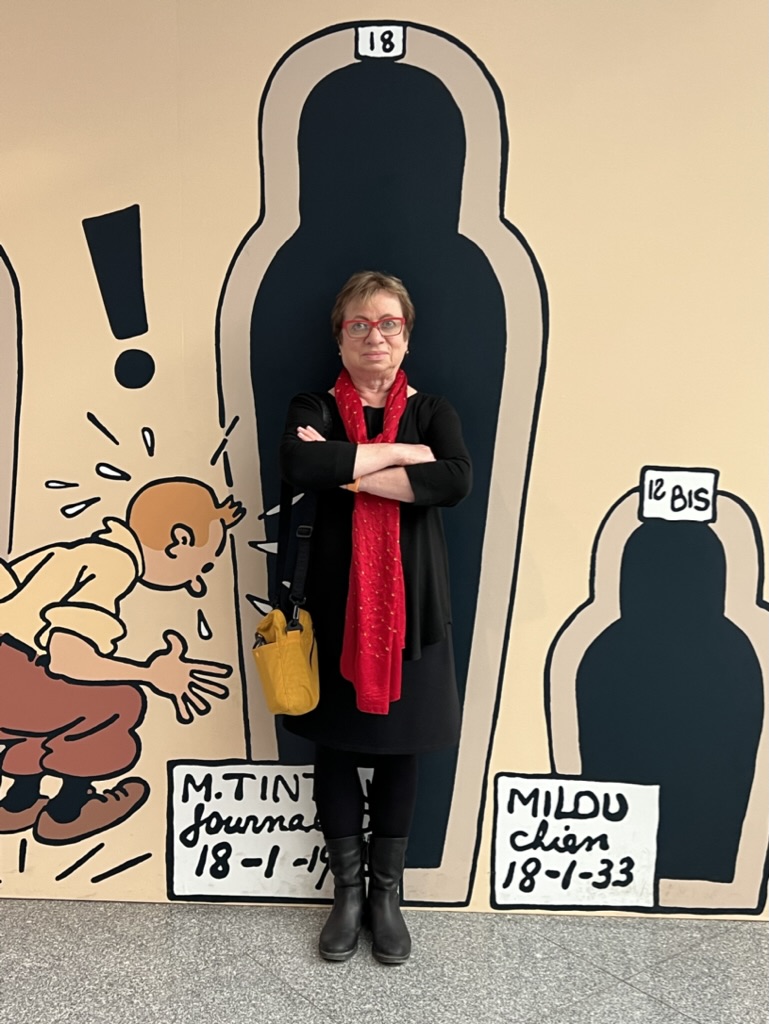
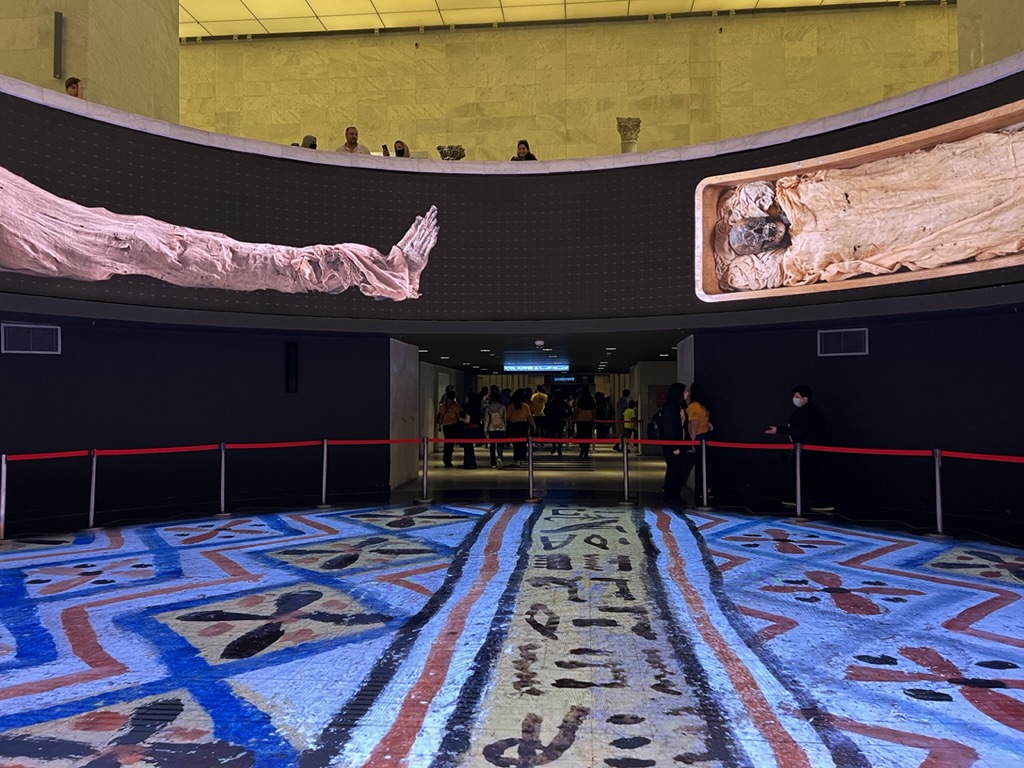

Mike and I left the museum and got into yet another city taxi. This guy should get a medal. As he wove in and out of traffic and between cars with just 6 inches to spare, we noticed that he was driving stick shift, while all the way talking on his phone (which he held in his hand; no one has GPS or Bluetooth for their phones) and also holding Mike’s phone to ensure he was headed in the right direction. Additionally, he talks a lot with his hands. So, I’d say his hands were barely ever on the steering wheel.. We made it alive to the walls of the city and headed to the Riad, exploring yet another way to get to our hotel from outside the walls.
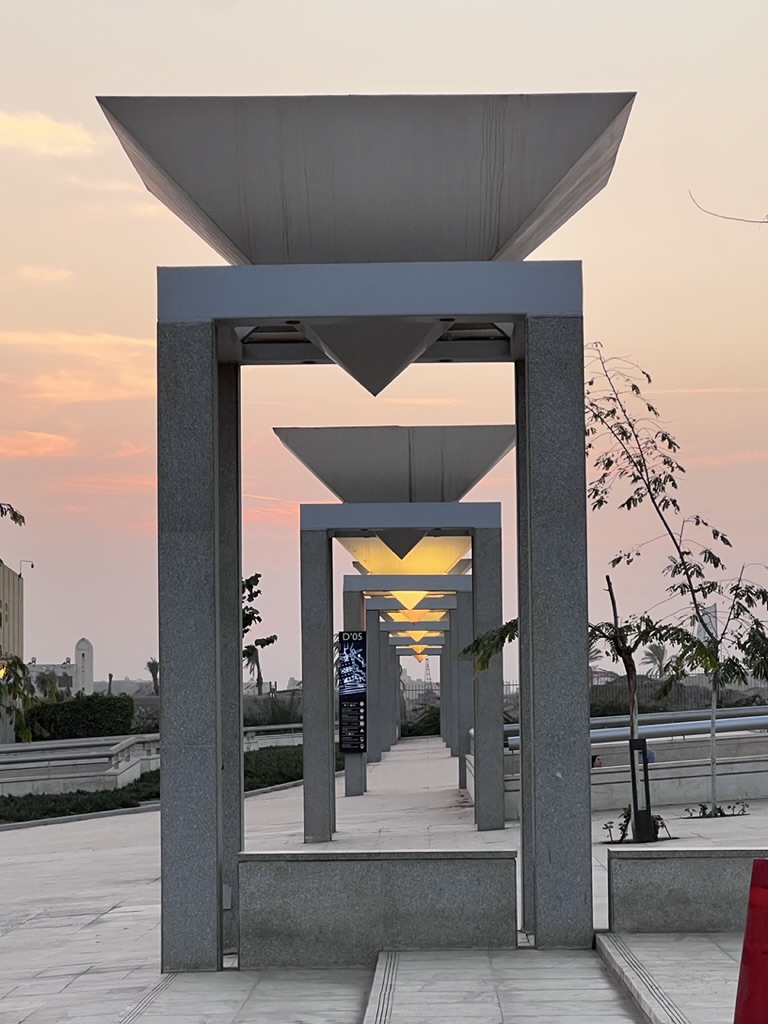
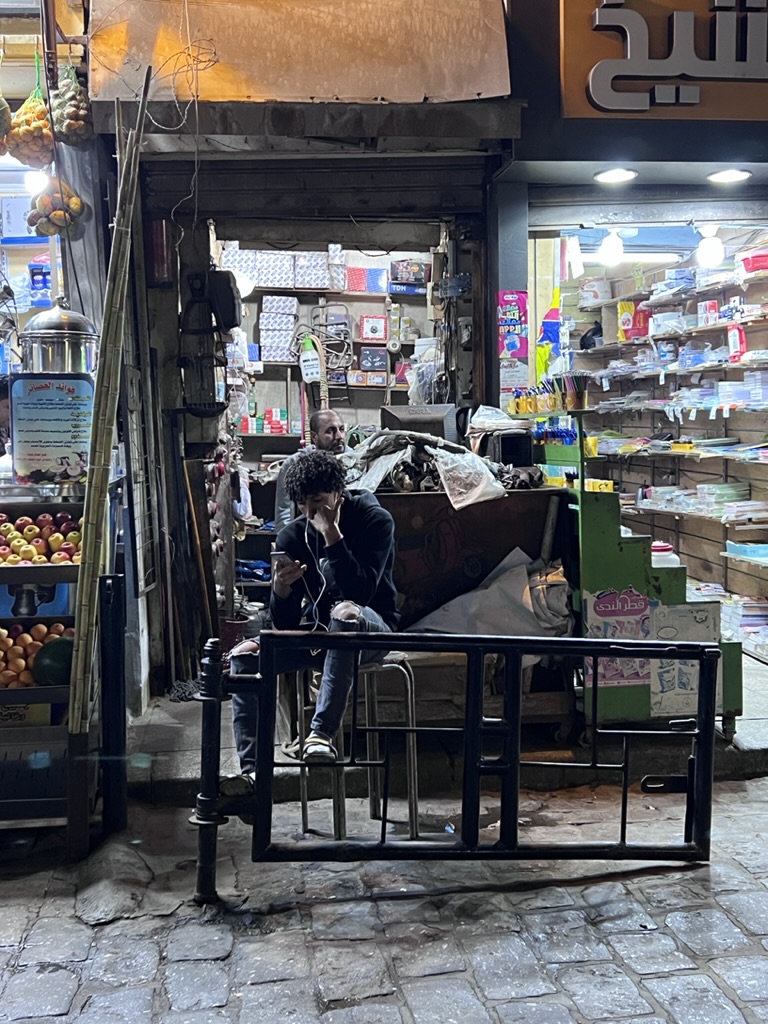
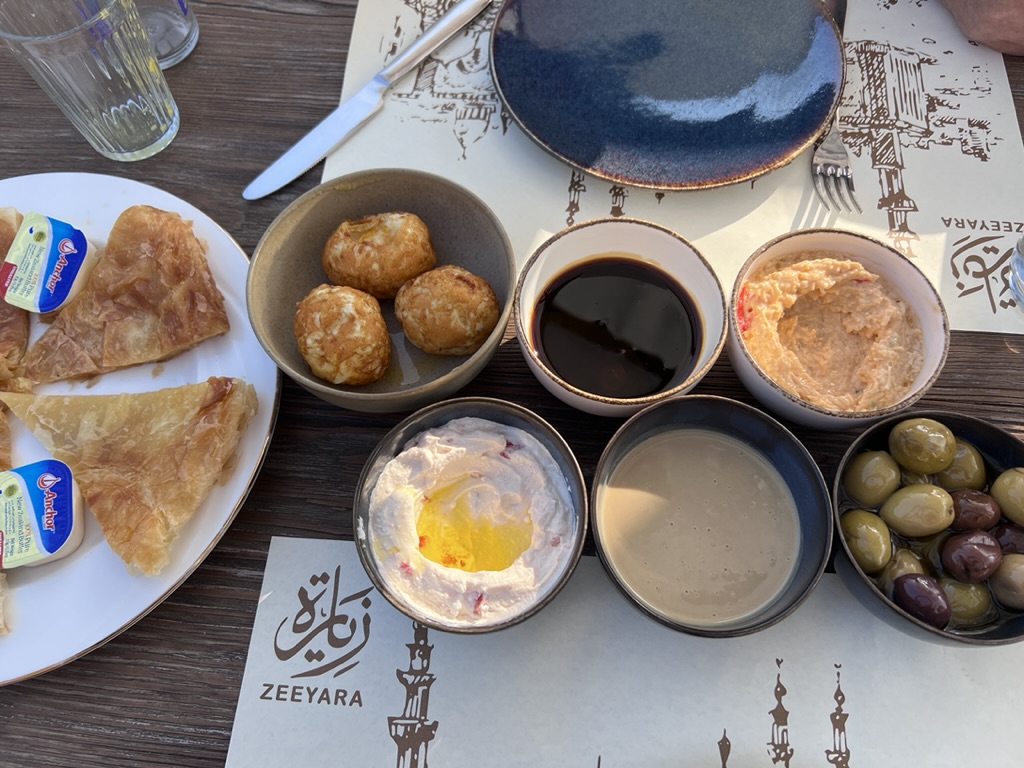
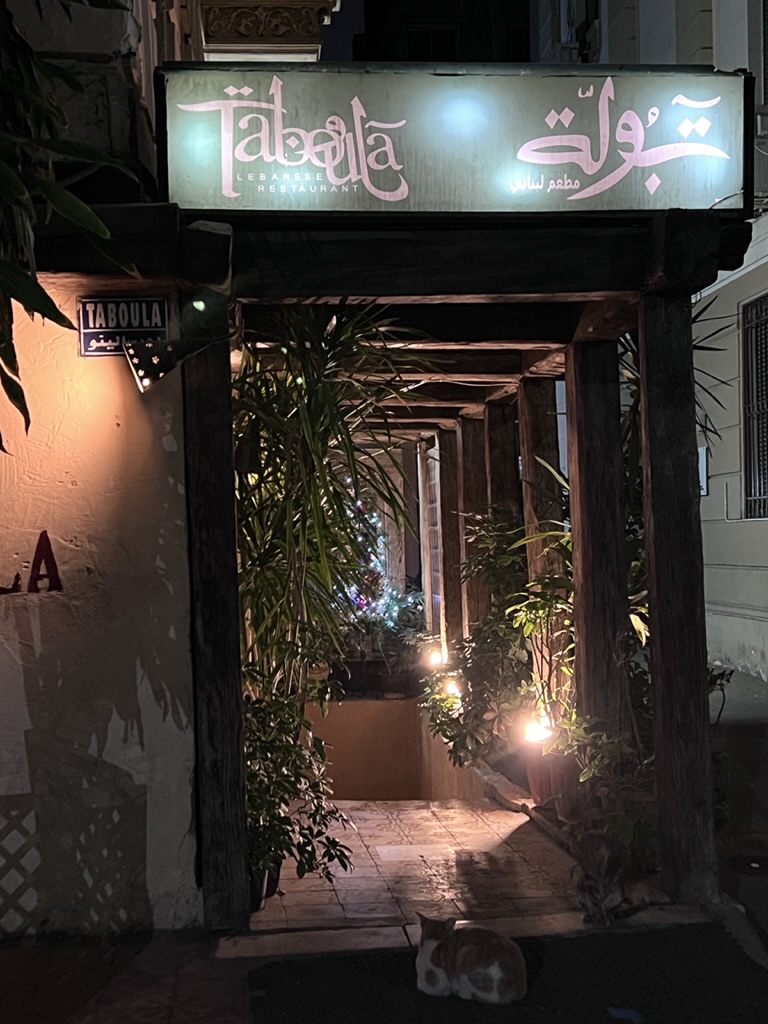
Tonight we caught a cab to have dinner at Taboula, a Lebanese restaurant. Abdul, our taxi driver, was very friendly and chatty. He knew no English, but I think we understood one another. He got us to the little restaurant we wanted to try (Taboula) based on our GPS directions and once we got there was smart enough to ask how long we’d be… so that he can come back to take us “home.”
Food at Taboula was really good and we lingered for dessert. Together we agreed, Abdul should come back to pick us up. He came about 90 minutes later and all was well. More tomorrow.
That’s it for me..
Fer n
3. Cairo, Egypt… 1st, 2nd, 3rd Worlds in 45 Minutes… Avoiding guides and camel poop! 12/18/22
Greetings from Cairo –
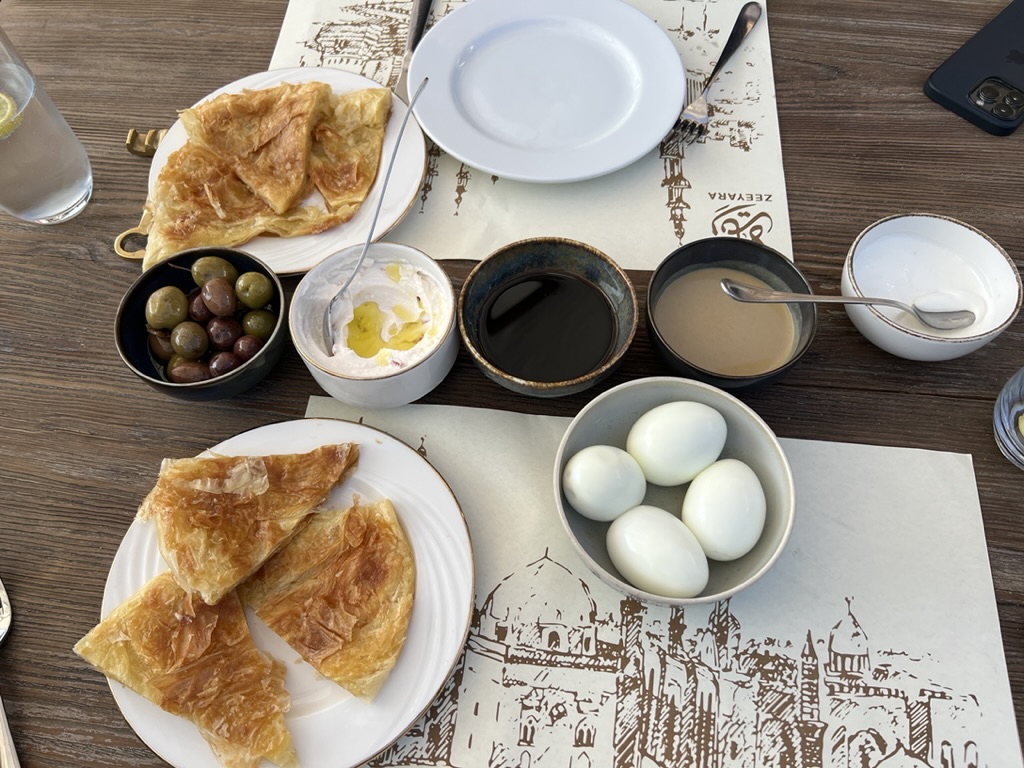
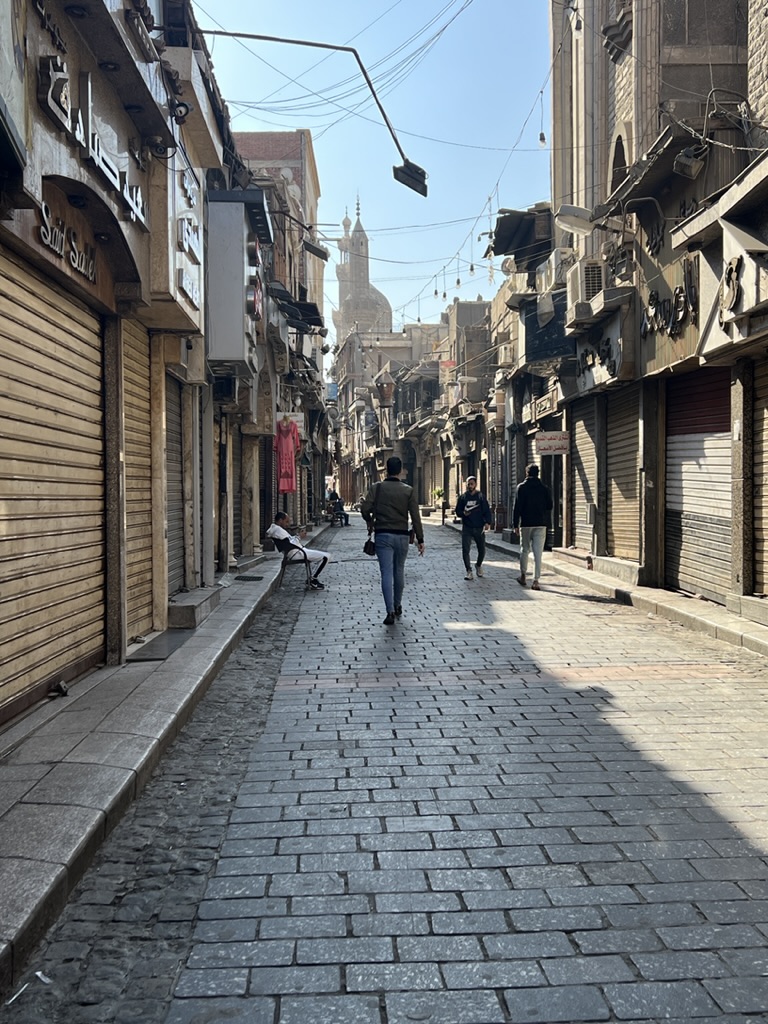
Following breakfast (the Egyptian countryside option, today—but somehow with plain hard-boiled eggs today and absent the hummus replaced with some other spread), we headed out of the Gamaleya (old section of town where we are staying) in search of a taxi. Theoretically, the entire area of Gamaleya is pedestrian-only, although deliveries are made all day, so there are cars, trucks, bikes, and motorbikes (although not really clear that the motorbikes are making deliveries. But, no taxis or private cars are allowed—although as with everything in Cairo (and developing nations), rules are always broken, so you do see cars and somehow Uber reigns supreme so Uber cars seem to be able to get through the barricades. As most of you know, we are very anti-Uber so we walked about 15 minutes or so to the gates of the Old City in search of a real taxi. Actually, there are many different kinds of taxis, including government approved and also private taxis. The government approved ones tend to be pretty old and beat up, but those are our guys, and we’ve been relying on them. They tend to be white with black trim (and don’t have meters)… Everything is “negotiated.”
We got into one taxi, but he was nervous that he didn’t know where we were going although we showed pictures. He called over a cop who spoke some English and the destination (the Pyramids) was confirmed, along with the price (everything is a negotiation!) We agreed on 150 EP (about $6) for a 30-minute drive; the guy should be given a medal for getting through Cairo traffic. We gave him 200 EP and he was totally grateful. Now a few words on traffic— it’s everywhere; there aren’t any striped lanes; and we have yet to see a traffic light, so I don’t think they exist. Because there aren’t any real lanes, it’s like a ballet of cars merging in and out of non-defined “lanes” and always creating a new “lane;” so on big streets there are about 6 lanes where we would have just 3. There are no pedestrian crosswalks so people—like the cars—take their lives in their hands and also do the ballet of getting part way across and then waiting for a short opening and dashing across—baby carriages, shopping carts and all. And of course, as in most developing countries (and NYC) the rule of the roost is the horn. On any given street, it’s a constant honking of horns. So, it’s quite an experience to be either a passenger or a pedestrian.
The drive from our hotel in the 13th Century old section to the Pyramids took us through many different neighborhoods, including the ‘new Cairo,’ which I’d say is pretty first-world with department stores, spiffy hotels that are all part of international chains, decent sidewalks, and classy apartment buildings. It also took us through sections of town that were definitely second-world with dilapidated housing covered with air conditioners hanging every which way amid crumbling infrastructure. And of course, there were the Third World sections with virtually no infrastructure and housing that didn’t have any air conditioning to address the totally horrific heat of the summer. But, streets are clean (despite not having a real garbage collection system), there is minimal begging, and no one visibly sleeping in tents.
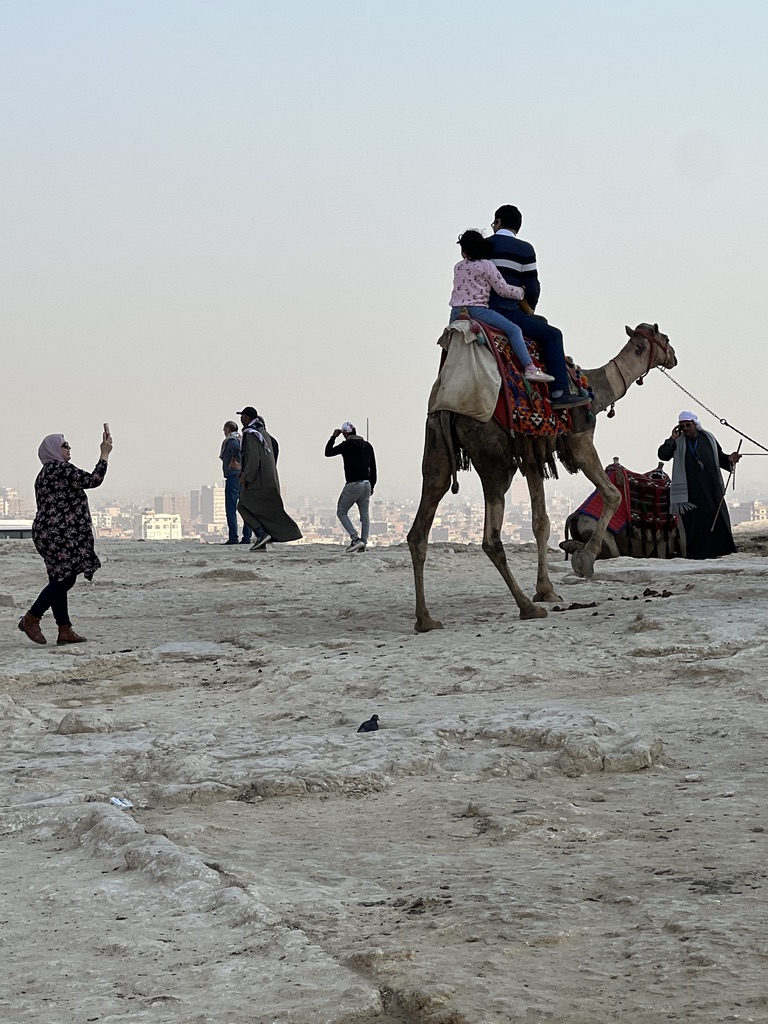

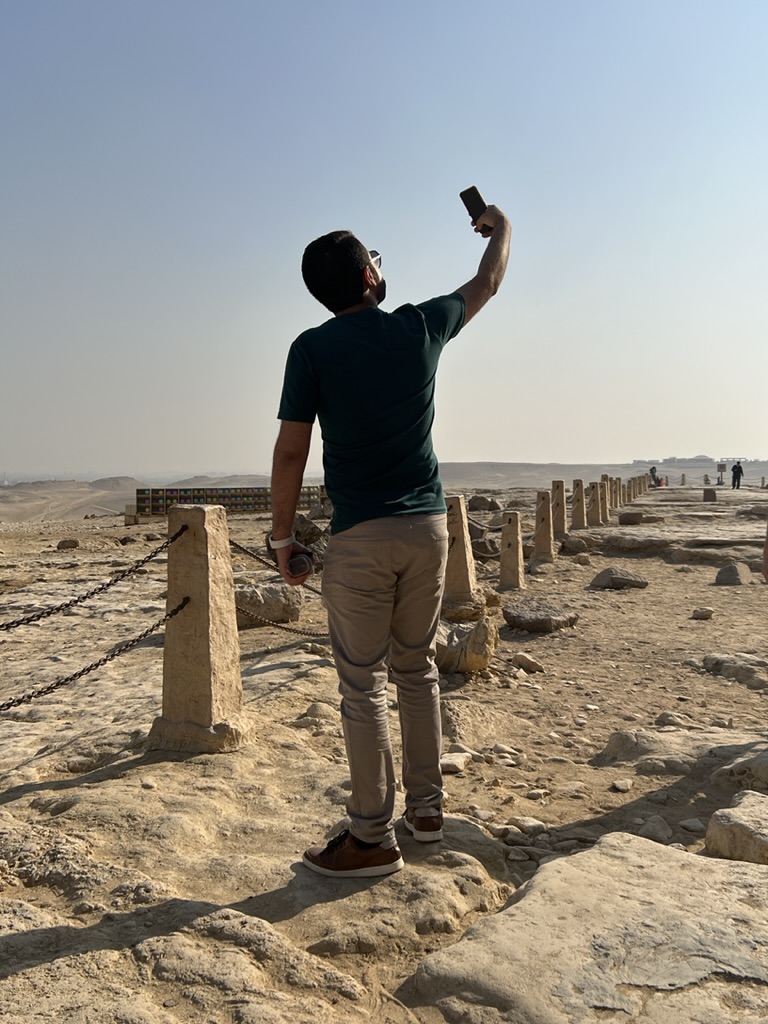
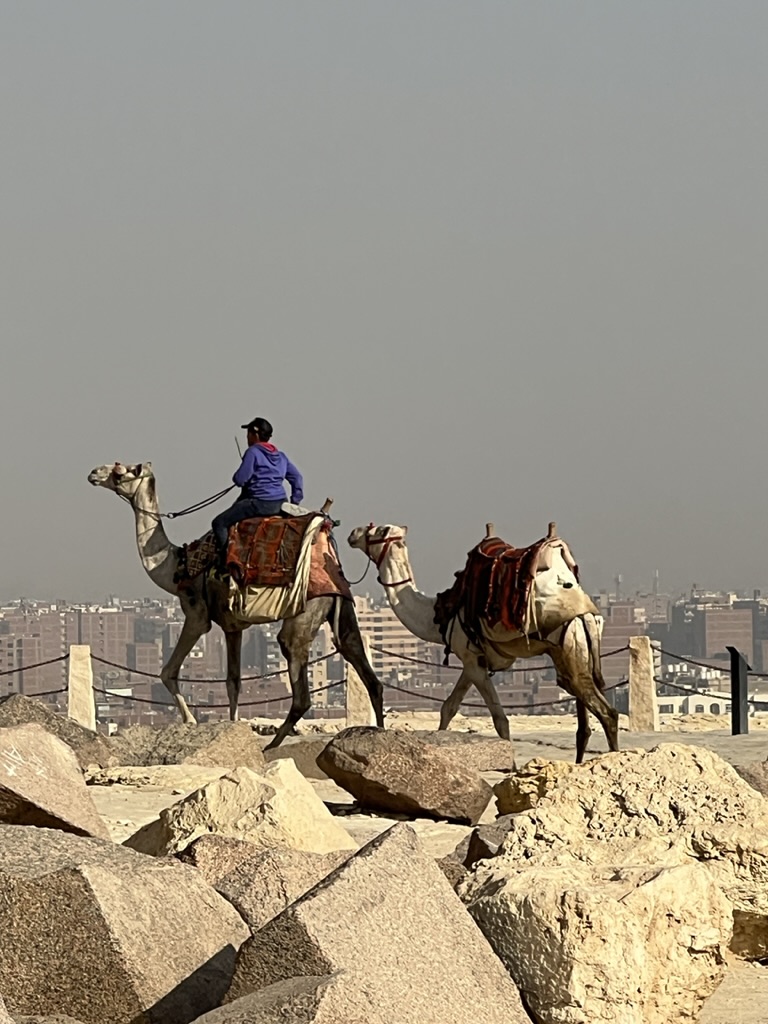
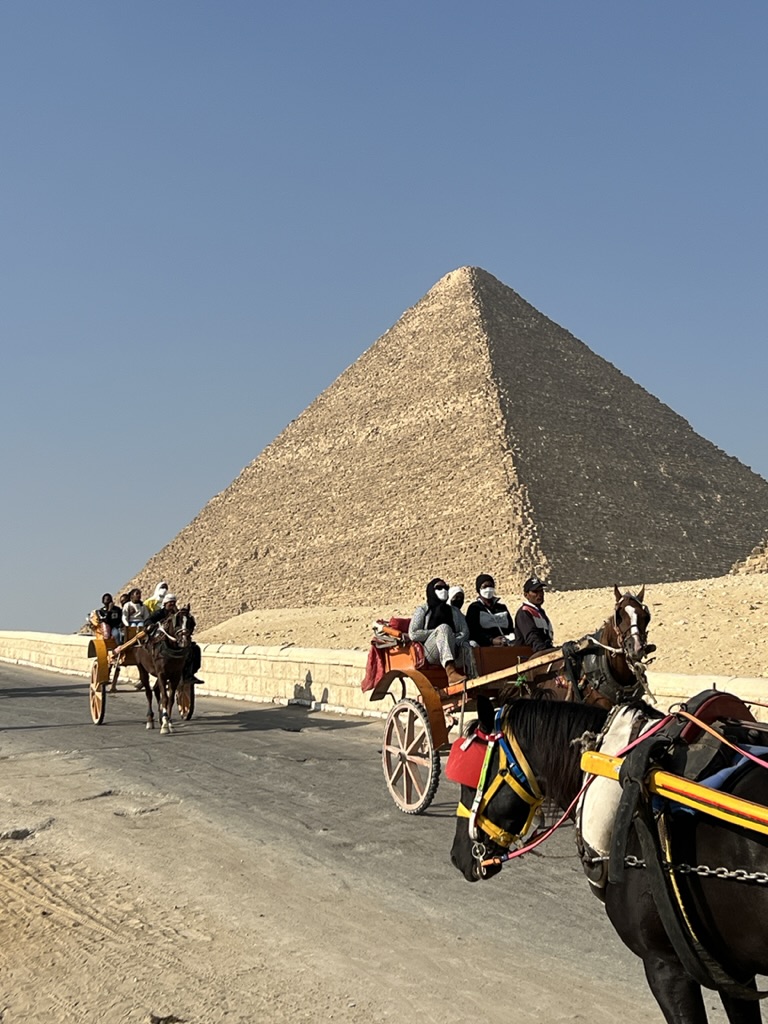
Back to driving: We’ve seen near-impossible driving and walking conditions in India, Thailand, and parts of Latin America… but maybe this one is the most severe. (Or perhaps I say this each time we are traveling!) Anyway, we made it alive to the Pyramids. And then it was even more chaotic—just getting tickets and figuring out where one goes. We were determined not to have a guide, so we needed to navigate this alone. We were practically surrounded by wannabe guides (most of whom had all sorts of credentials around their necks) and by men who wanted to get our tickets for us, for a fee or ‘small tip’ and others telling us what we needed to do and not do. One said, “You cannot go in as a pedestrian; you must use either the “buggy” (horse driven) or a camel.” Naturally we shirked them all off and waited ‘on line ‘ by ourselves to purchase tickets. Well, there really wasn’t any “line”– more like just elbowing your way to the ticket guy, alongside those guys who purchase tickets for a fee.. They are purchasing dozens of tickets at a time. But hey, we are New Yorkers at heart, and we can do this. We got the tickets in just a few minutes. Then you have to figure out where the entrance is. Signage doesn’t exist here! But it was all good fun, although Mike was getting increasingly annoyed at all these guys (and it is just men) who would not let up—trying to get us into a horse drawn carriage. But we persevered and managed to escape guys who take your picture with the pyramids as a backdrop, the camel rides, the horse-drawn carriages, the ever-present “helpers” who “just want to do you a favor”, the guides, and more. By the way, after today, I could easily become a member of PETA (People for the Ethical Treatment of Animals – a group I always saw as fringe), given that those horses (and there are hundreds of them) are being worked to the bones and they don’t appear to have any water areas for them; the camels are scrawny and definitely overworked.
Must say seeing the pyramids was a bit underwhelming—except for the scale and the recognition of the age and what it took to build them. And that was sad, given all the years of art history I endured in college. The site is in pretty bad shape with lots of rubble to climb over and around. Lots of tourists—mostly taking bizarre photos (or having them taken by the “helpers”) where they hold their arms out so that the photo looks as if they are “holding” the pyramid and other such tricks. All the limestone that initially “covered” the pyramids has been removed, and it is apparent that the stone is eroding, which is unfortunate. Without any sort of “path” system or signage, everyone just meanders which made me think that we were all walking on top of some fairly sacred ground and significant architectural areas—and we don’t know what impact that is having. So in some ways, that too, adds to the loss of the sacredness of the place.
I gather the effort to go inside the pyramids and see the interior spaces is a great experience according to many. After reading up on what that experience is like we opted not to do that. I’m a bit claustrophobic and there are a lot of very narrow spaces you need to get through; you also have to crawl through some areas and given Mike’s knees I think that would have been challenging. But more than that, I think we were really turned off by how little has been done to make the experience worthwhile. No brochure when you get your tickets, the only maps are what you might have in your own guidebook, if you have a guidebook; no logical way to move between the sites – you just sort of walk around (and even in December it’s hot in the sun. So, we hiked up to the base of the largest pyramid and walked about half-way around it, and then went to see the sphynx. We also saw a few of the smaller pyramids. And then we hiked down, trying to figure out how to avoid the guys at the entry/exit who were likely to tell us that “they had to find us a taxi.” All of that happened, but we managed to find our own taxi and made a quick decision to head to one of the very well-advertised fancy hotels to get a snack of some sort. We decided on the Marriott Mena House, which as I recalled from the research we had done in selecting a hotel, seemed less obnoxious and less ostentatious as many of the others. So off we went with a very sweet taxi driver who knew no English and who had never been to the Mena House. Because of this two-, three-, or maybe four-tiered taxi system, the “street taxis” (as some call them) cater mostly to locals (and us). Thus, those drivers know the part of the city where real Egyptians live, not the areas tourists frequent. And these “street taxis” don’t have GPS and the drivers don’t have GPS on their phones.
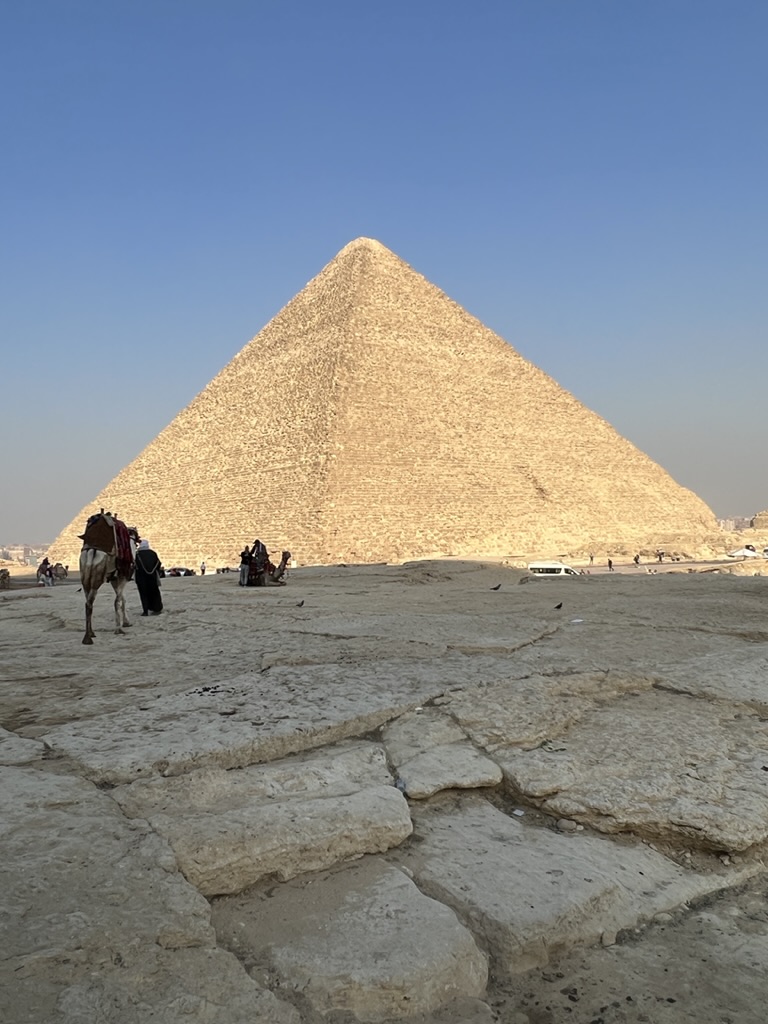
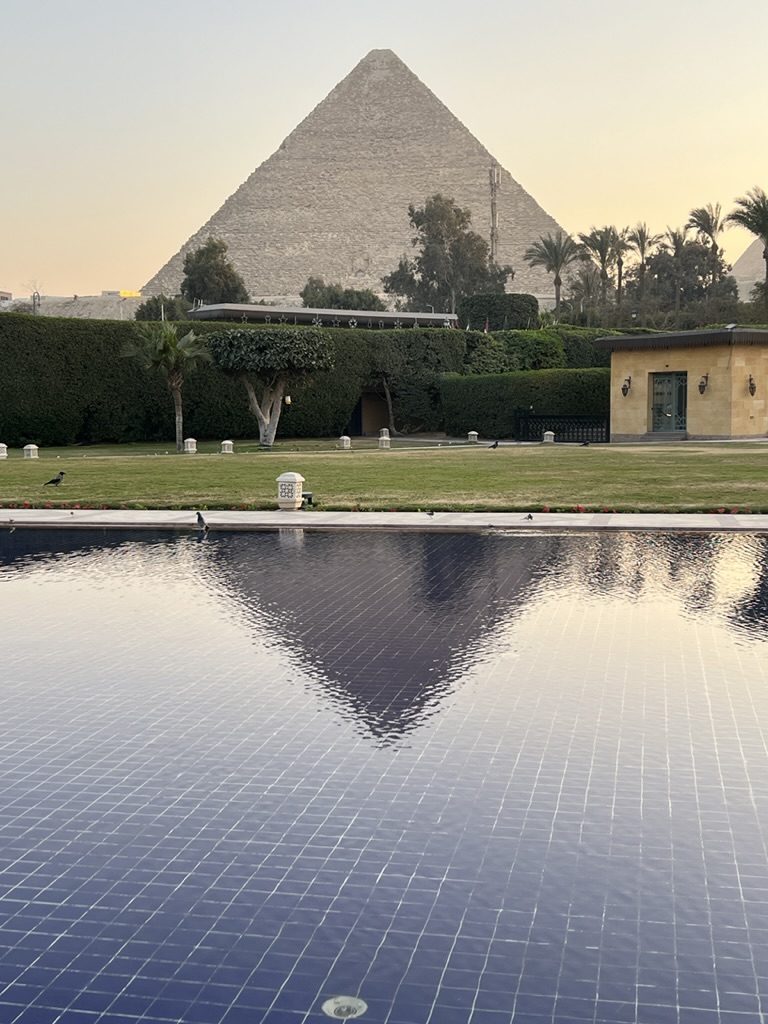
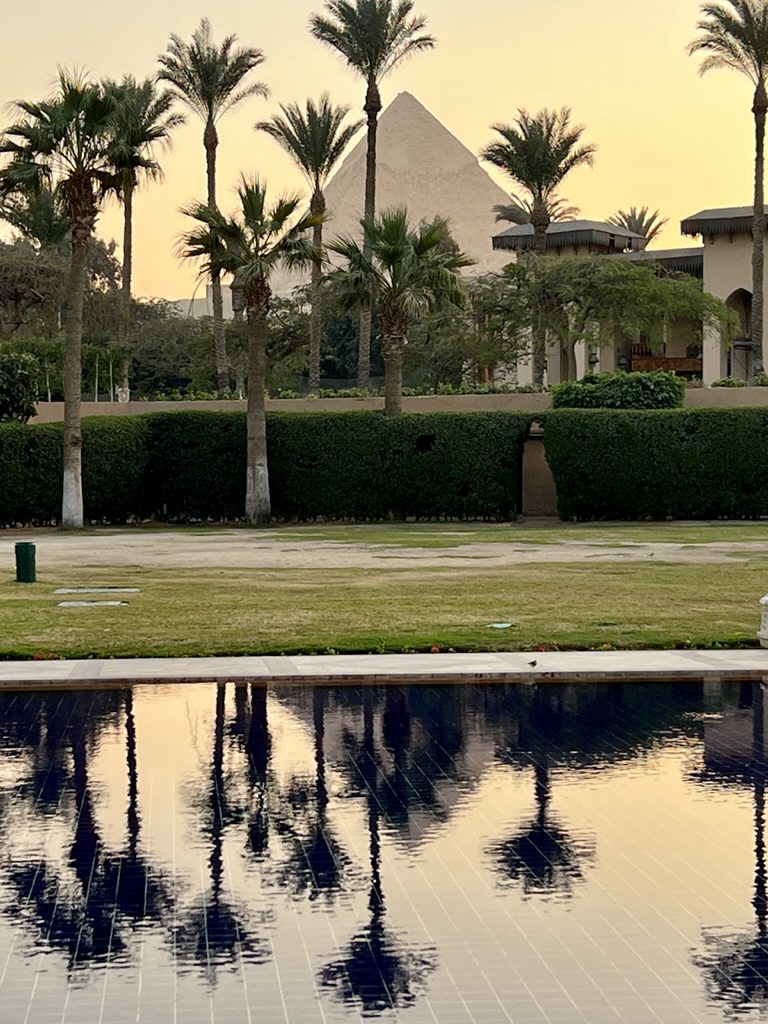
He got us to Mena House, but there were several missed turns, and it took longer to get there than it should. Once we arrived, the driver had to navigate many barriers set up to stop unofficial and unwelcome cars and vehicles (like ours). (We had a similar situation in Bangkok many years ago when we got very attached to hailing “tuk-tuks” as our desired mode of transportation; the drivers would always drop us off about a block from our hotel because tuk-tuks were considered too low class to come to the hotel.) Anyway, after the maze of barricades and the sniffing dog at the Mena House, the driver was directed to let us out of the taxi, and he drove off. We then had to go through two metal detectors as we “entered the grounds” and as we went to the reception area to ask which restaurant might be open. Once we headed to the restaurant, we faced yet another metal detector (although this guy just waved us through). We are white and professional (although might not have looked so great after walking about 4 miles in and out of the pyramid area in the dusty sand), so I’m not sure what others might face. We had a late lunch near a reflecting pool at Mena House and I’d rate it 2.5 out of 5, but the outdoor space was comfortable, and we had great views of the very pyramids we had just seen up close. The photo in this email where the pyramid is reflecting in a pool with palm trees is one of those views—it eliminates all the ground chaos at the pyramid, no camels to be seen, no hawkers, no horse-drawn buggies! Just the splendor of the pyramid form which you can watch while having a martini. Oh, the music playing in the background at Mena House while we ate Perry Como (as compared to the Egyptian Pop we hear at our place.!) So, now we were really happy we were not staying in any of these Giza hotel locations and were grateful for our little and very authentic Riad.
The Marriott was definitely first world. (Guests were mostly Americans but also Middle Easterners (or so it seemed to us).
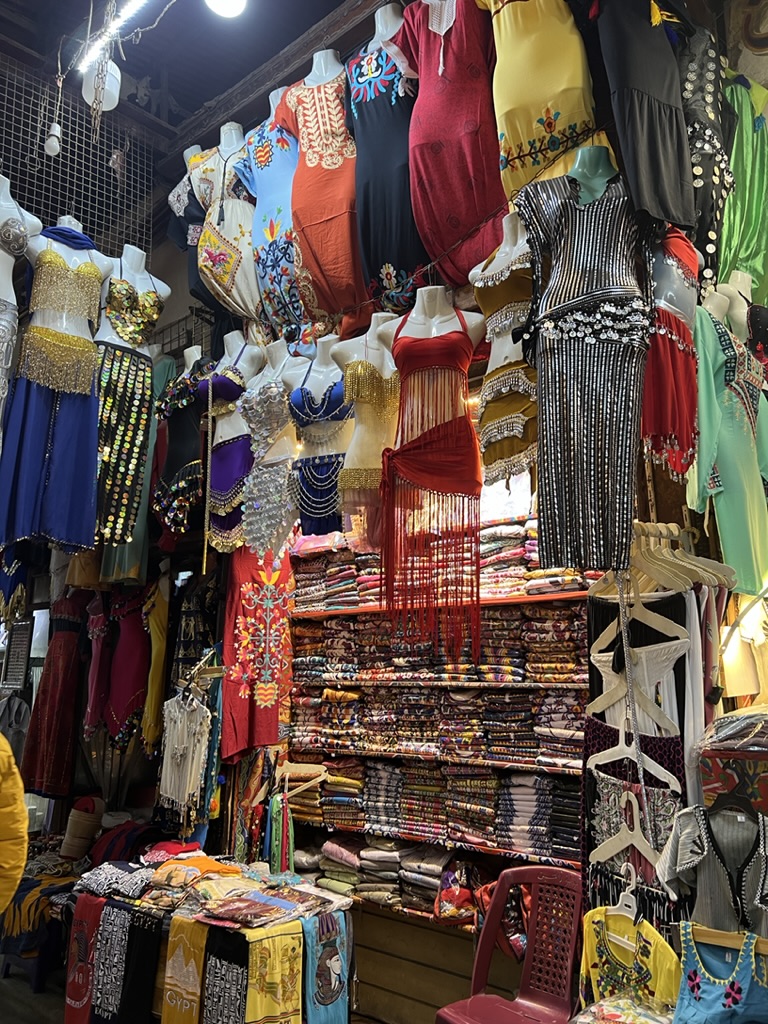
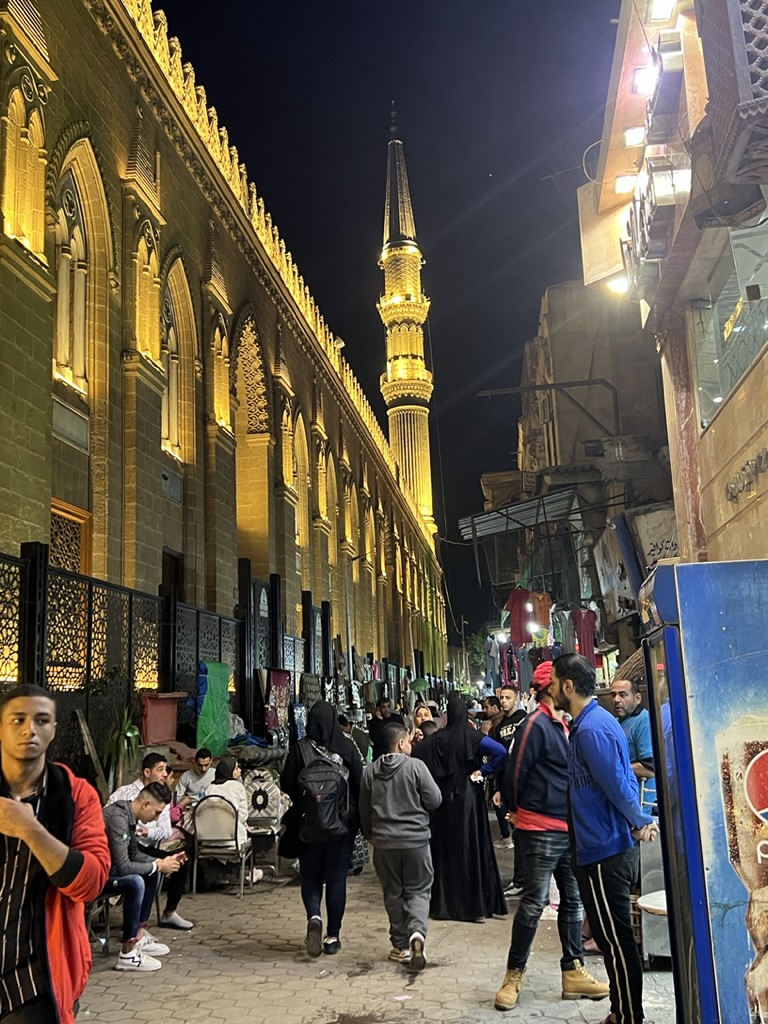
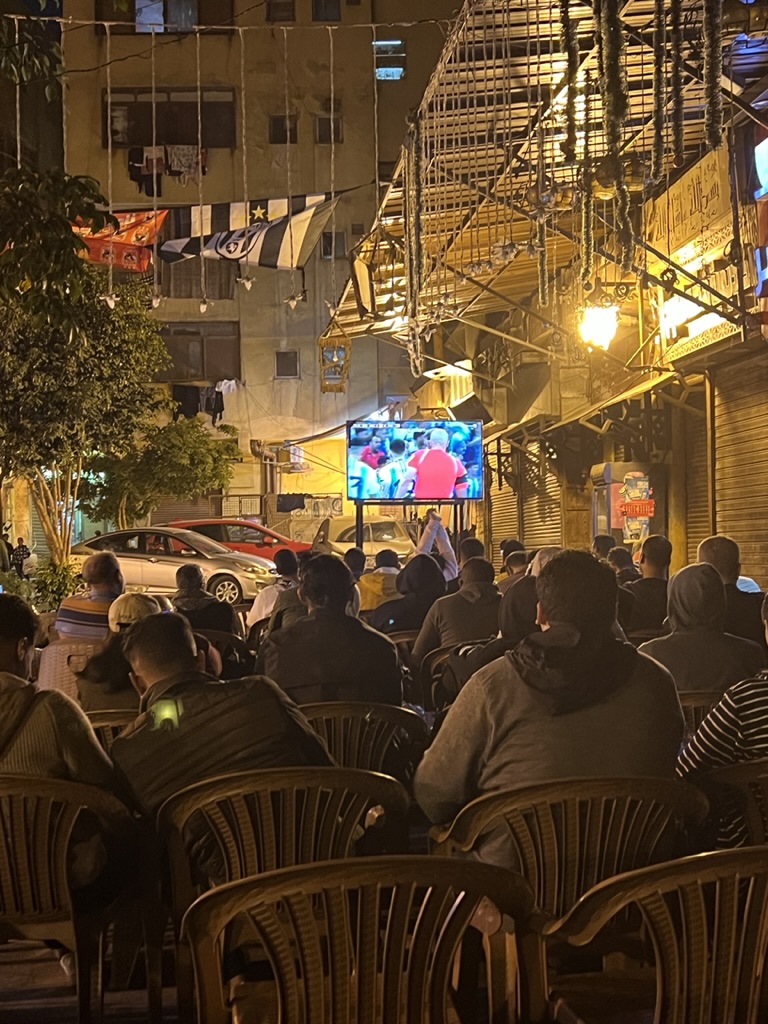
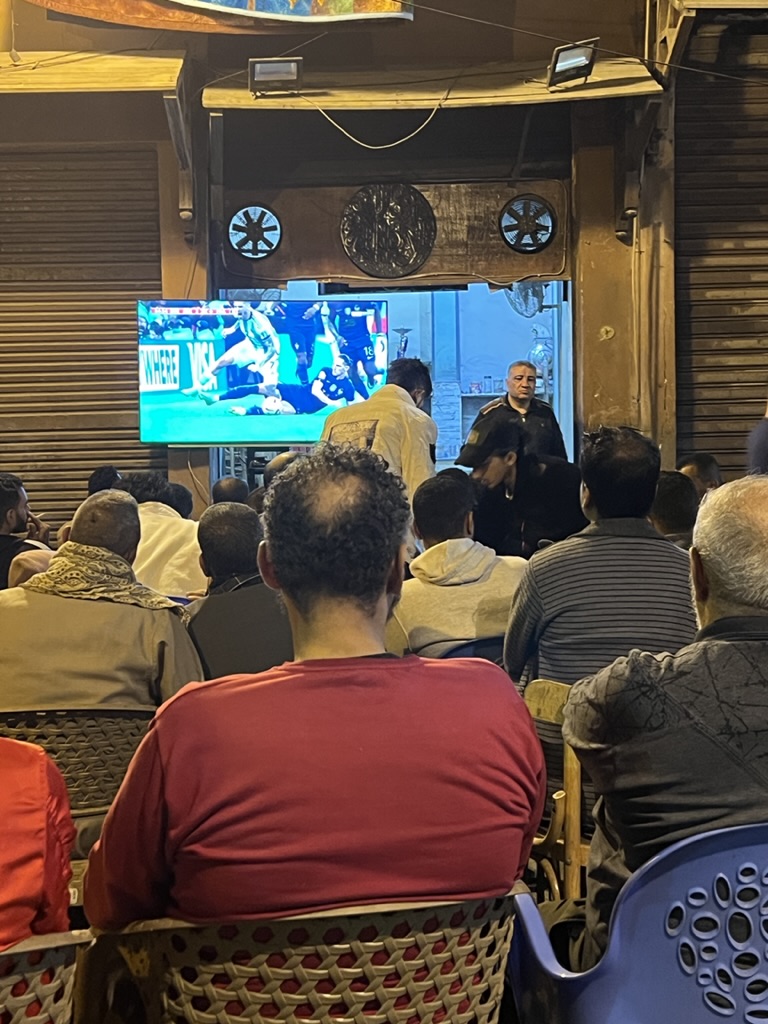

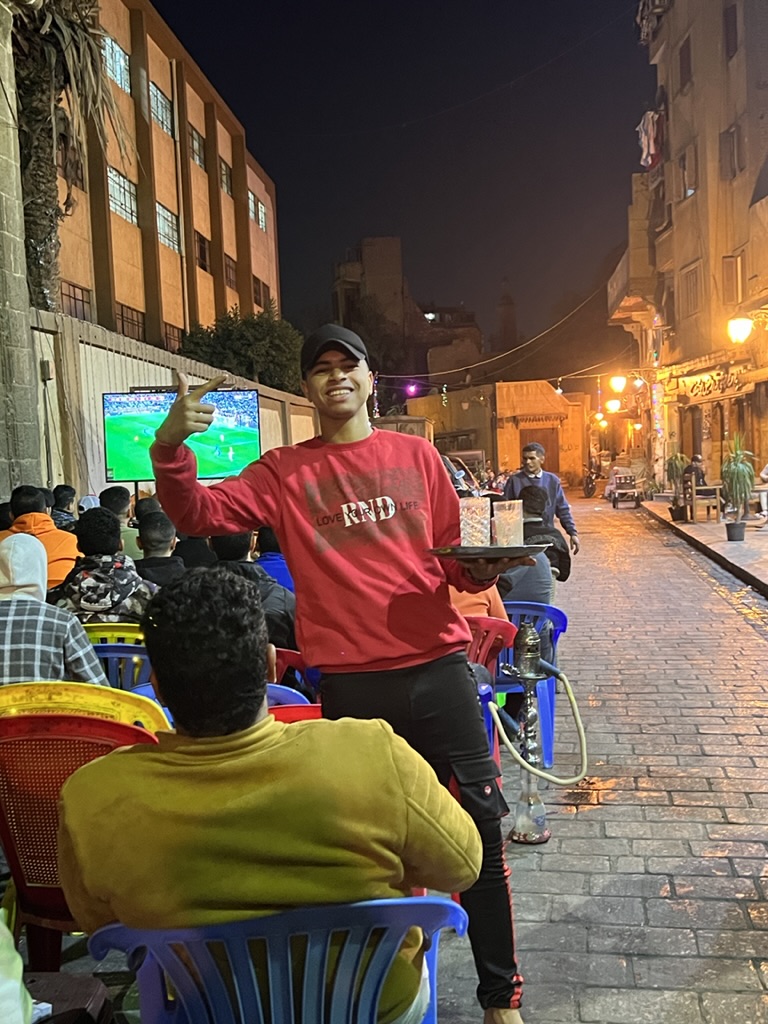
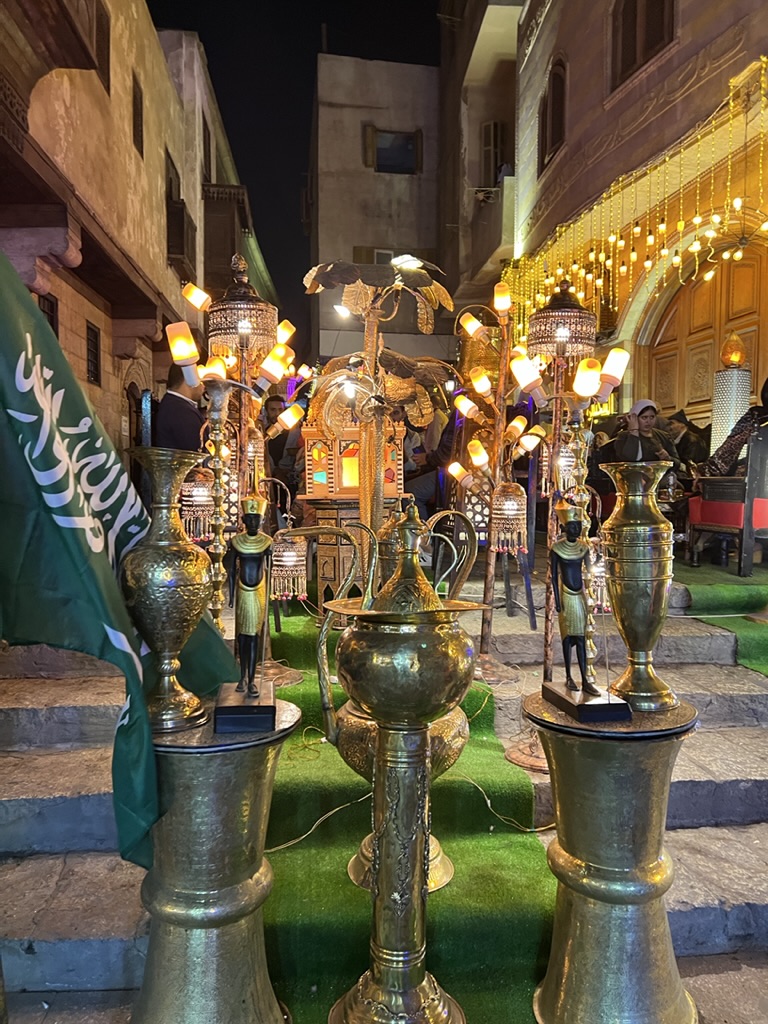
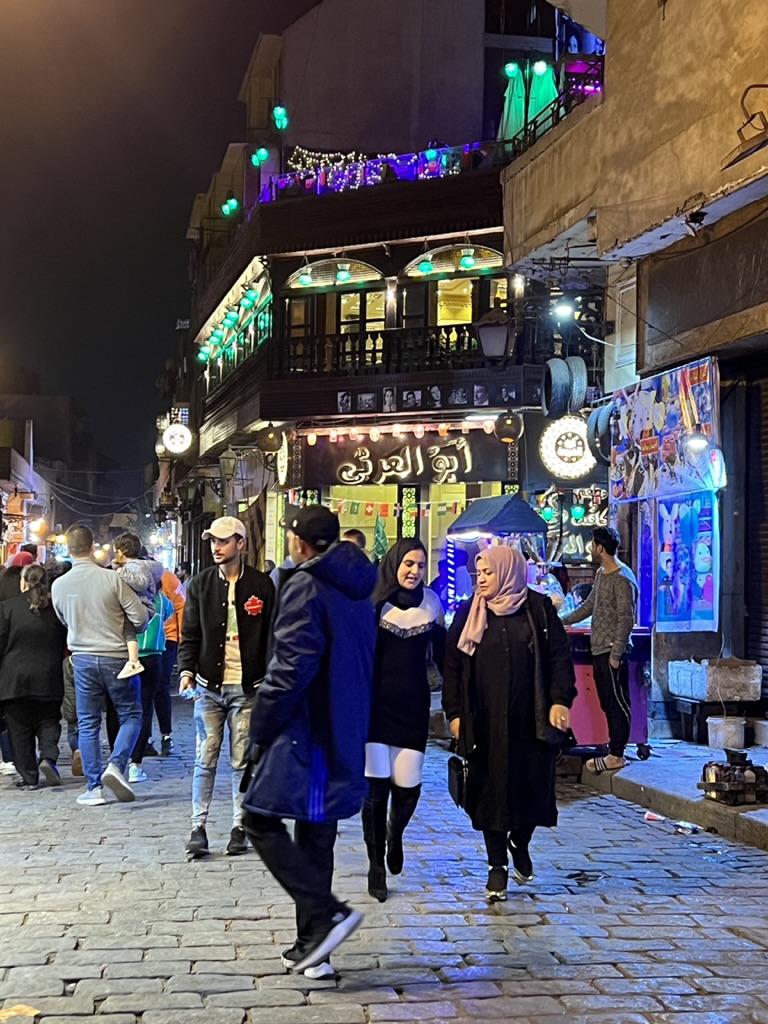
Then the fun started as we left the restaurant and asked about a taxi. The concierge said we could call for an Uber—again with the Uber! We declined and asked for them to get us a taxi. He responded by telling us he could call a limousine for us! We again said a taxi/a city taxi would be ideal. He told us to leave the grounds of the hotel (which by the way is probably one of the original hotels in the area, so it’s a bit aged, and is not all that good of a hotel) and walk onto the public areas where we will find many of these city taxis. The ultimate insult—we were not good enough for a Marriott… perhaps it would be a struggle if it was the Ritz Carlton, but a Marriott? And a total rebuke of their own taxi system. But how would we find a taxi ? By the time we were close to the gates of the Marriott, a guy stopped us and asked where we were headed; he was driving some really big SUV. We explained where we were headed, and he stopped another car that was leaving the Marriott. I think it was a worker from the hotel. He asked if he’d be interested in earning a little extra money; he was not a taxi driver. He graciously drove us to our neighborhood; we paid him what we paid the taxi driver. He couldn’t get into the old city, so we walked through the extremely large market with thousands of stalls and made it back to the hotel. It was especially fun to walk through the market tonight as there were clusters of chairs throughout the market facing television sets so that everyone (actually only men) watched the World Cup. No beer, since the whole Gamaleyan area bans alcohol. But the fans were just as enthusiastic without the buzz.
By then it was about 6:30 and we were totally beat. We opted to eat at our hotel on the roof—we were the only guests; everyone was watching the World Cup and we, too, followed on our phones. When Argentina won, there was a huge cheer from the streets below which continued for hours.
That’s it for me.. Sorry for the length. By the way, it’s now after midnight and the music in the street is still at a pretty high volume (such that we hear it in our 4th floor room) and the streets are still lively. Tomorrow we will visit a few other neighborhoods. We are here for three more full days and then we’ll take a train to Alexandria for the day.
All the best –
Fern
2. Cairo, Egypt. December 17 2022
‘ahlan (أهلا) – or Helo — Apologies for the length. As always, feel free to delete.
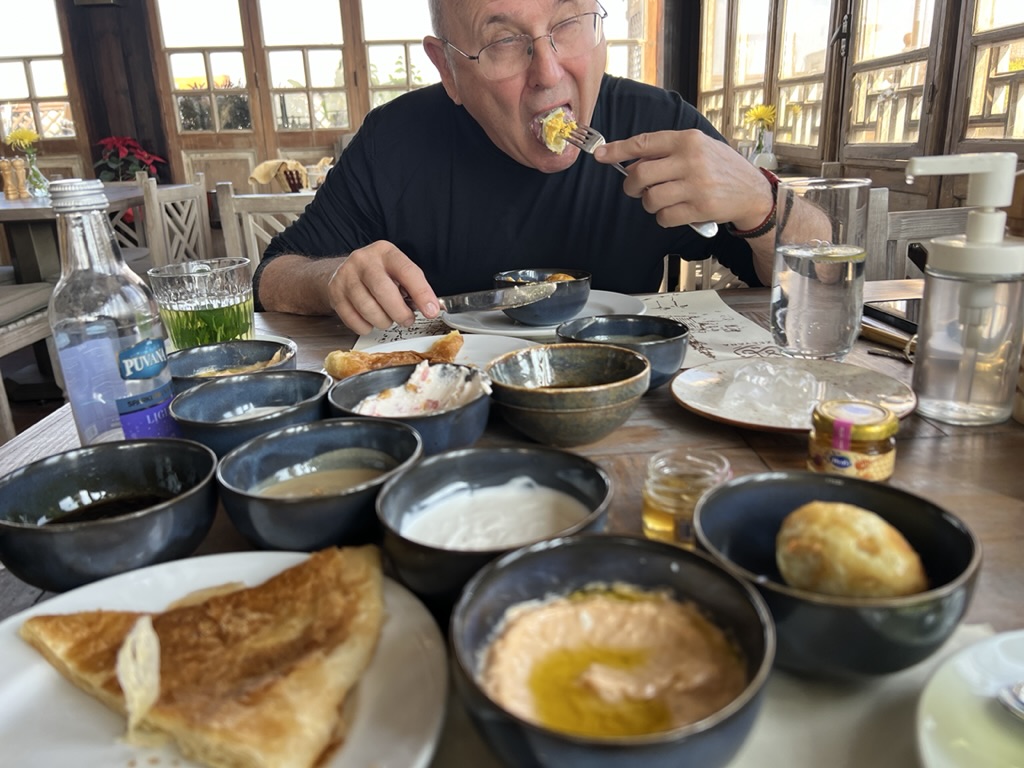
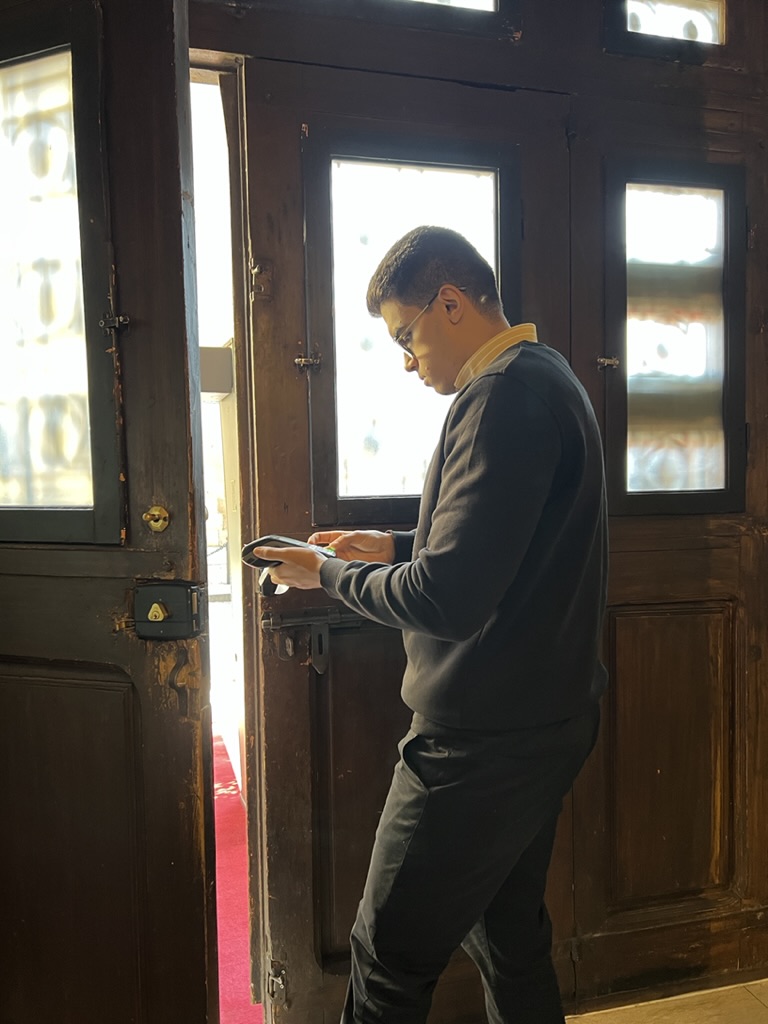
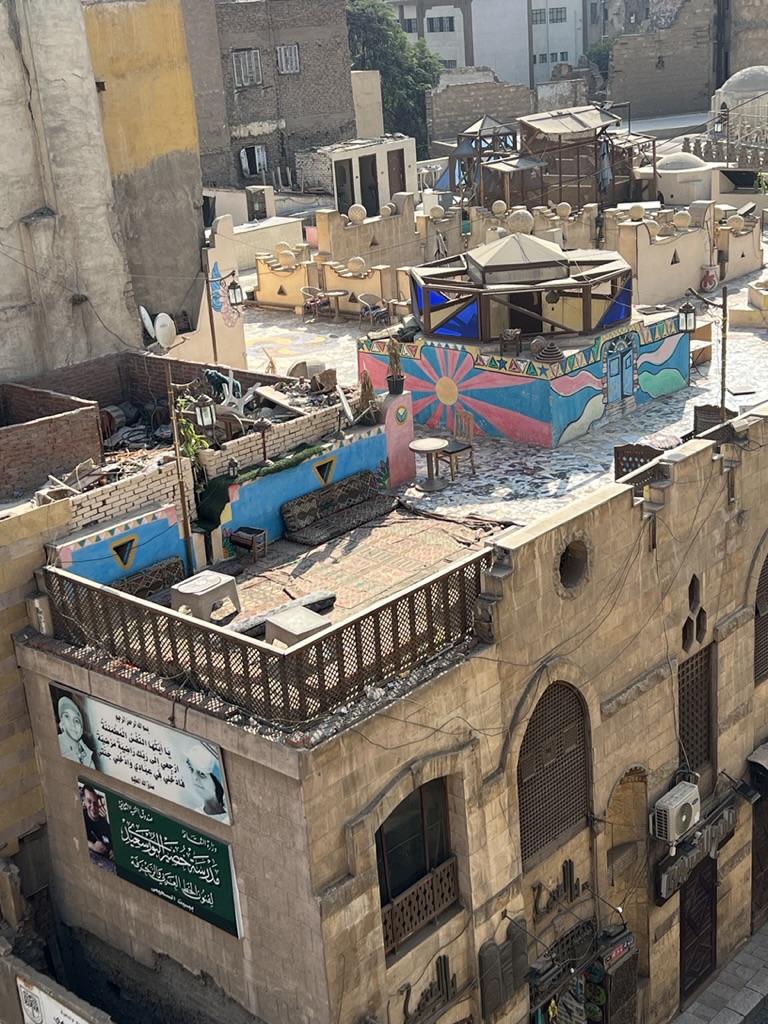
Note photo of front desk guy at hotel, trying to get a signal for the credit card payment machine —by holding the entry door open.
Began our first real day in Cairo with breakfast on the roof of our hotel (apparently, we booked for two days of breakfasts here at the hotel (?), and no breakfasts for the remaining five days; there were three choices: continental (boring); Egyptian country breakfast; and Egyptian breakfast. We both opted for the country breakfast which our waiter (with minimal English) recommended with a big smile. It consisted of about 5 different “spreads:” labneh, a sweet cheese mixed with cranberries (very yummy), hummus (naturally), a sweet sour cream, molasses, and tahini. Along with this came several flaky flat pastry “breads” (to die for) for the spreads, two semi-hard-boiled eggs that must have been deep fried for a quick second and dipped into bread crumbs before the dipping—very tasty. And of course, fresh mint tea—just fresh mint leaves and boiling water.
The restaurant was packed, but we were the only foreigners. There was one large table occupied by women; no men. Mike suspects it’s a women’s group making plans to change social norms. If so, they’ve got a long way to go! One funny thing about the table of Muslim women was that they were all talking at once and in heated discussions with what looked like multiple conversations at the same time. I could close my eyes and absent the hijabs it could be my family or any Jewish family dinner (at least those who grew up in working class Brooklyn).
Then we began our day-long journey. We walked through scores of the tiny streets and alleys of our “neighborhood” –- some barely passable— with pedestrians, motorcycles, cars, delivery vehicles, etc. Much of the goods is delivered by young guys on bicycles carrying every imaginable product on their heads (not unlike what we’ve seen in many parts of Southeast Asia).
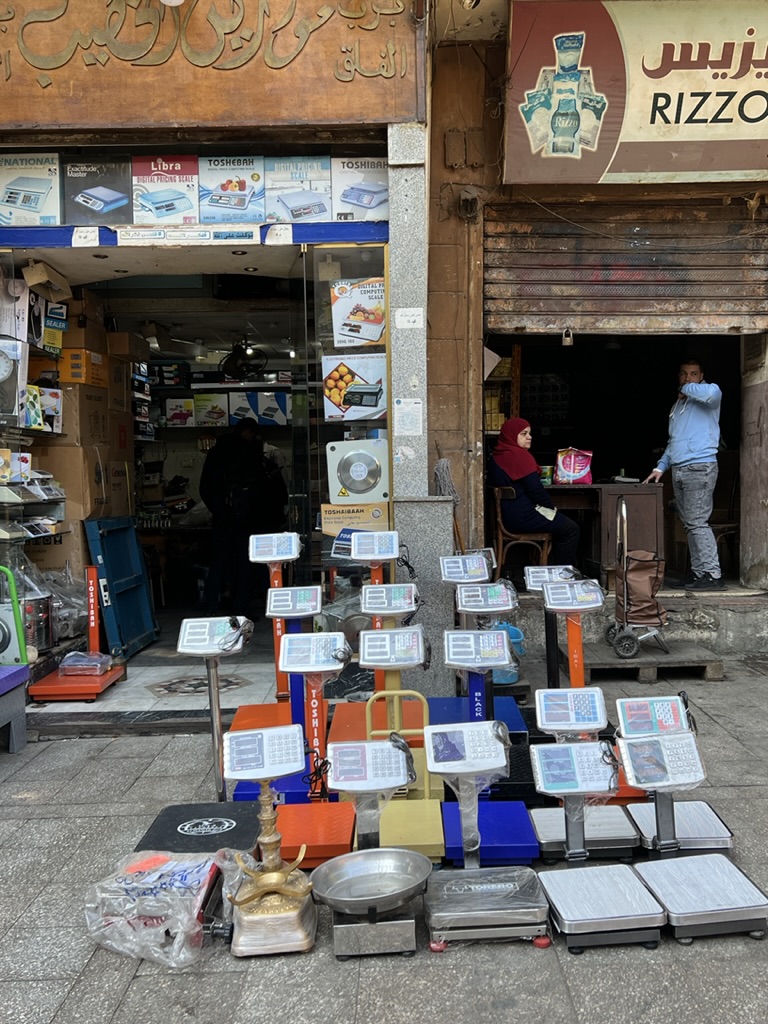
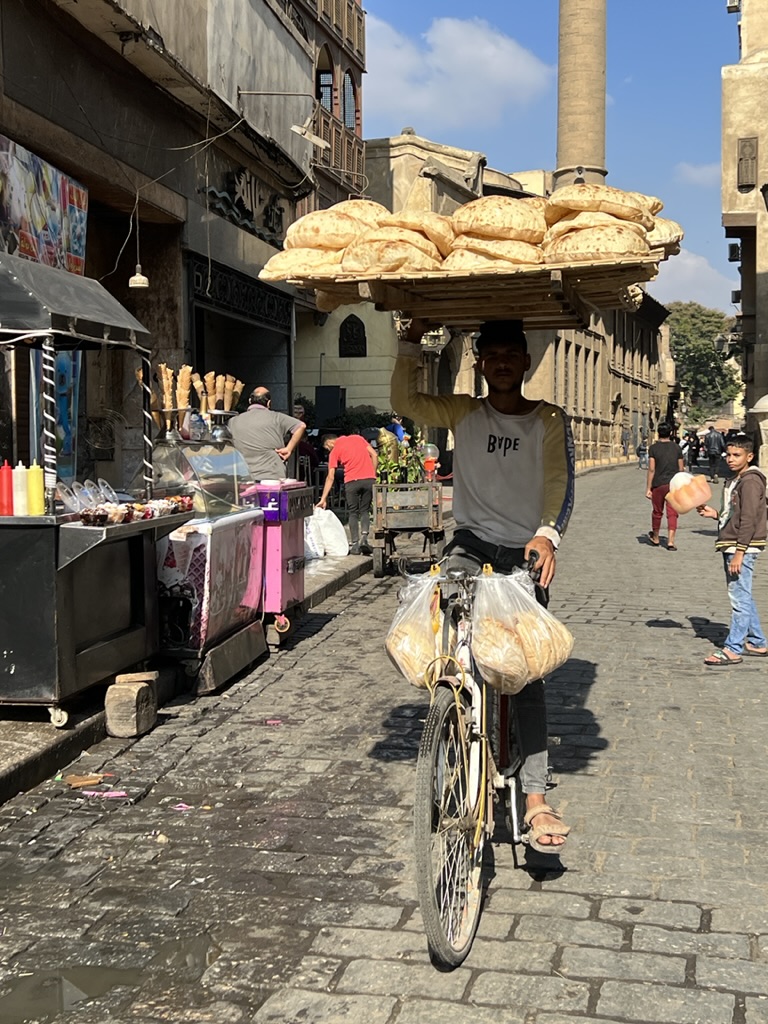
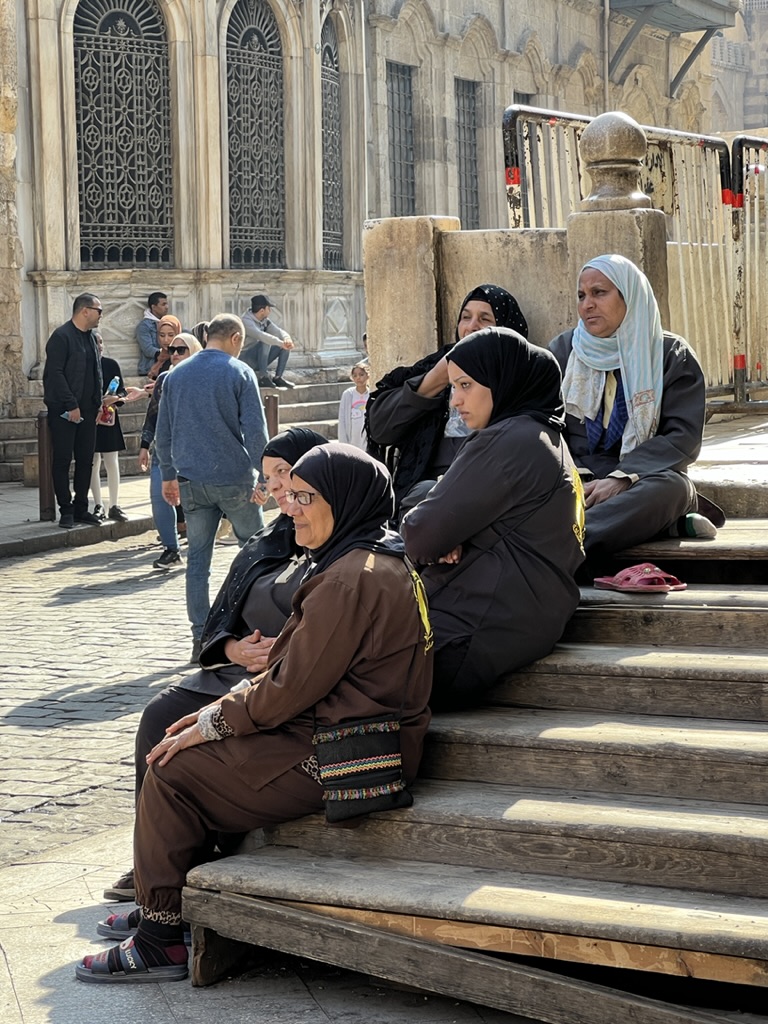
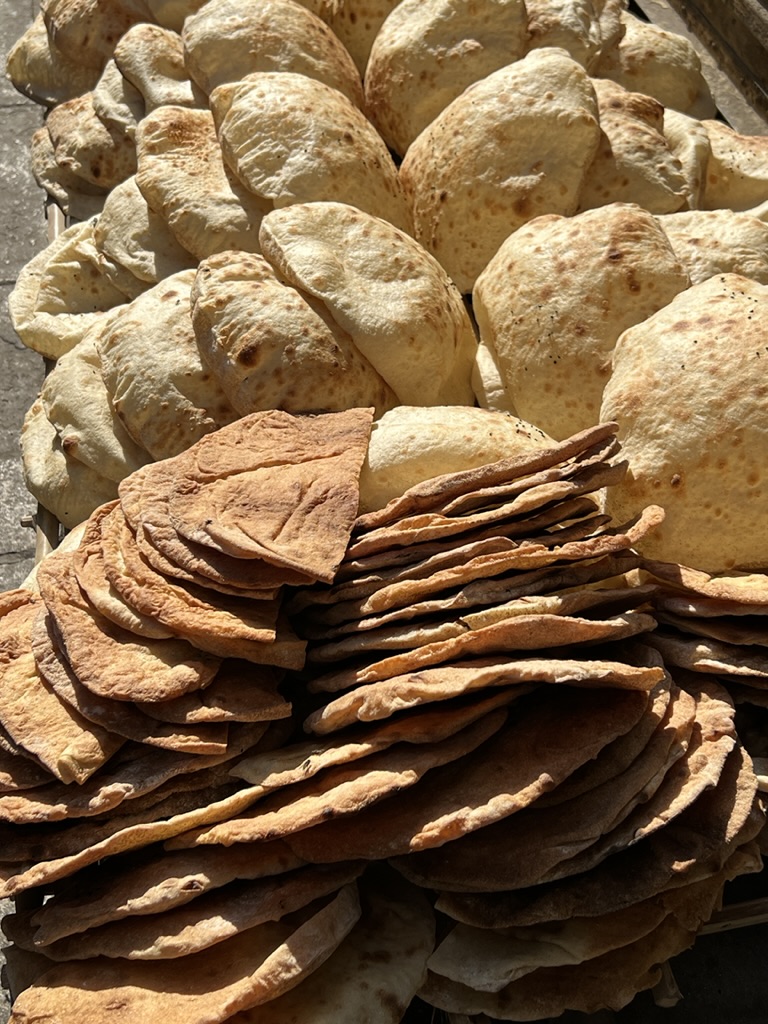

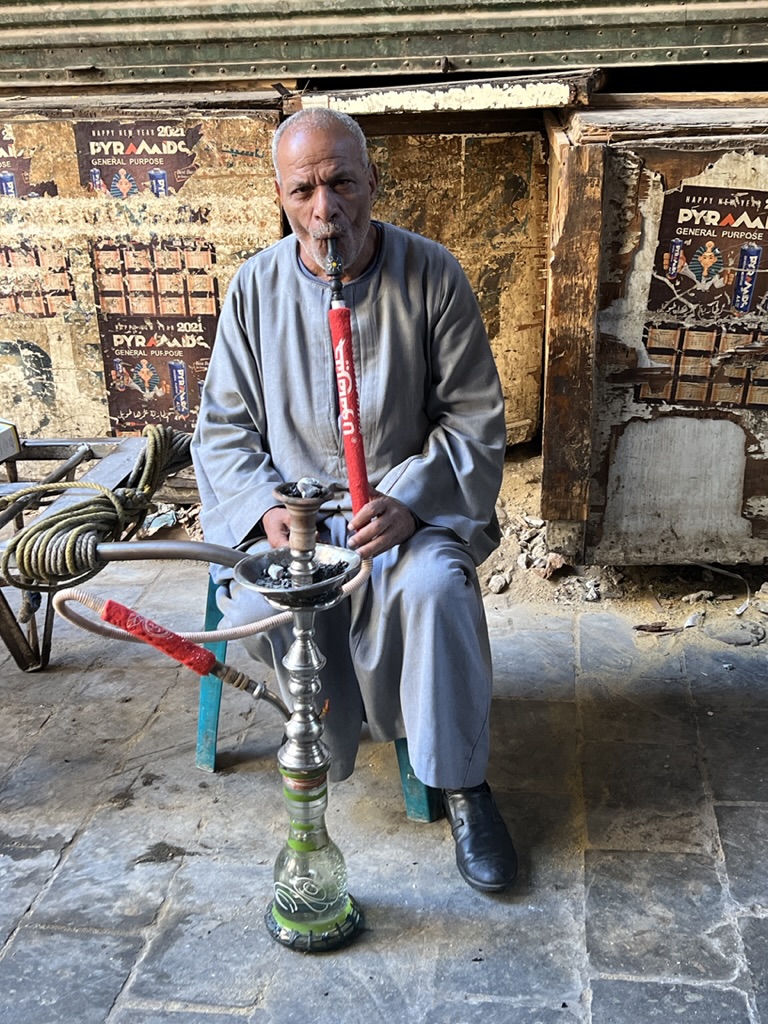

Aside from the amazing smells and visuals, wherever you stroll (and stroll we did to the tune of nearly 13,000 steps today – too bad we’re eating such rich foods I don’t think the walking is having any impact), the real sensual stimulation are the sounds which go well into the wee hours of the night. I think the music in the streets ended at about 2:30 am… just in time to prepare for the call to prayer from the mosques which starts at about 5 a.m.! More than that, some kind of Egyptian pop music is constantly blaring from the little shops and pushcart-style shopping places that line the street. Everyone, and I mean everyone—from kids to parents, to shopkeepers, to school kids, to passersby are on cell phones—women in burkas to teenagers wearing rip-off American jeans and tee-shirts—everyone is on their phone—talking (loudly), or texting, or maybe playing Wordle (in Arabic?). And when they are not on their phones, they are yelling across the way to a shopkeeper in another “store.” Some of the shops are barely 80 square feet. So, the sounds are mesmerizing… and then there is the shuffling of feet that are in slipper style shoes, and the engines of the cars and motorcycles. And people singing in the street!
Walking along those little shops that line the streets and merge into the Khan Khalili souk and Bazaar and the shops that stay open til around midnight, was also a bit of a comparison to my youth where my grandfather had a tiny men’s clothing store in Brooklyn. He loathed the fact that night-time television took customers away and he had to start closing up at around 8 pm, and in later years even earlier.
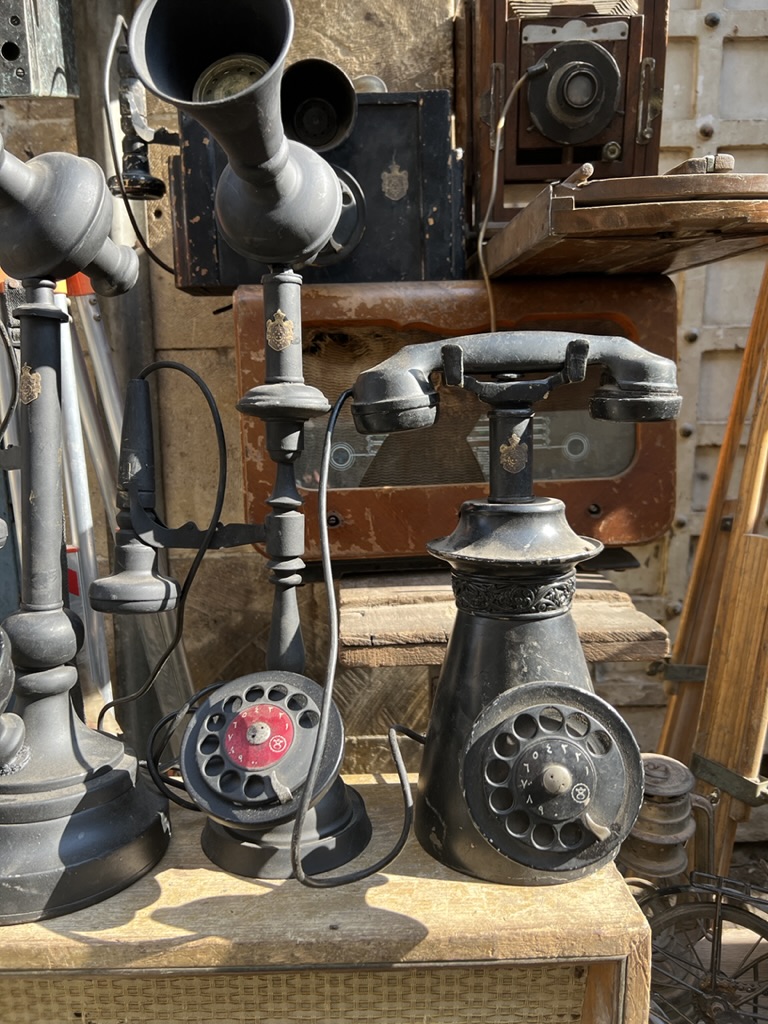
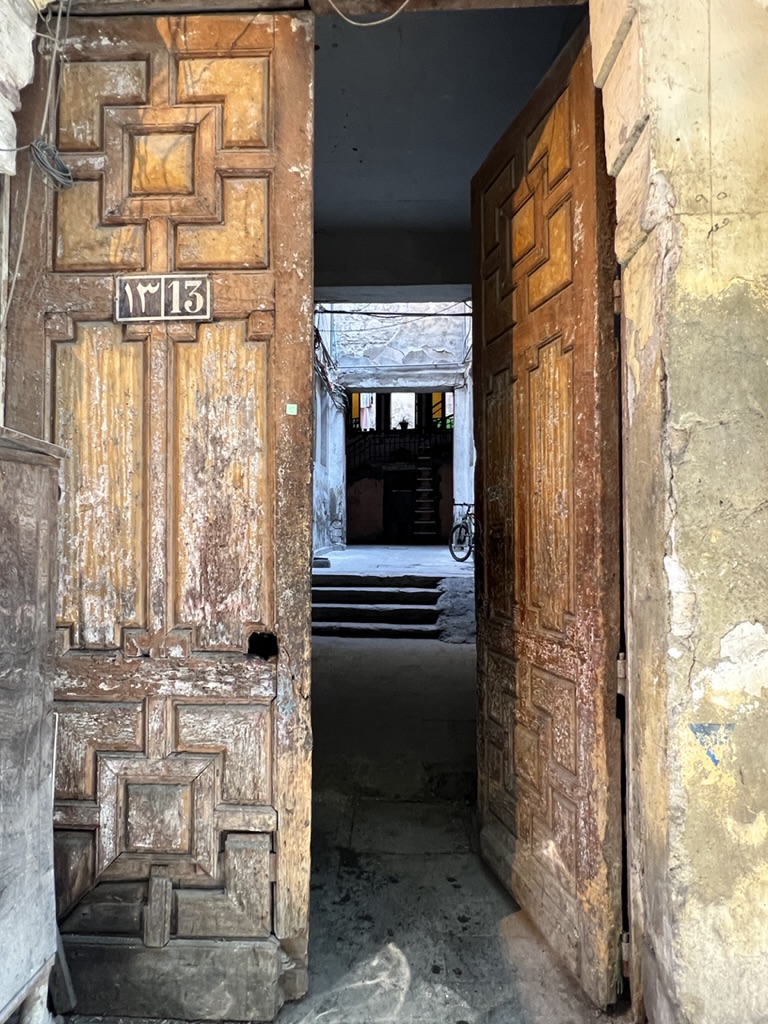

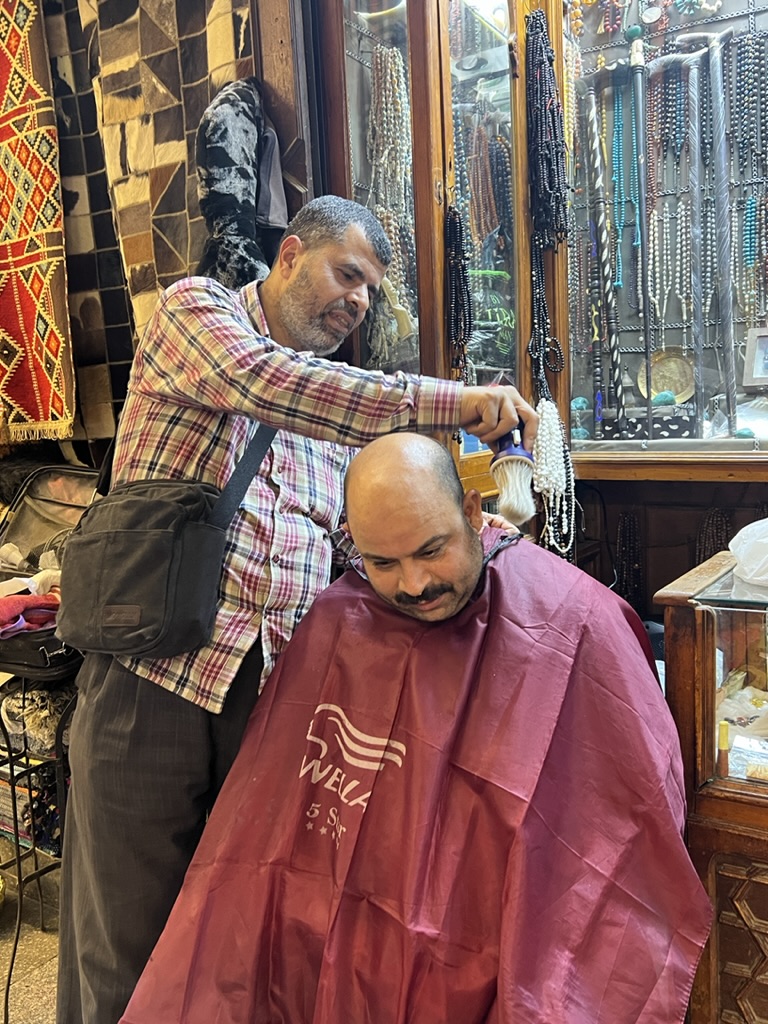
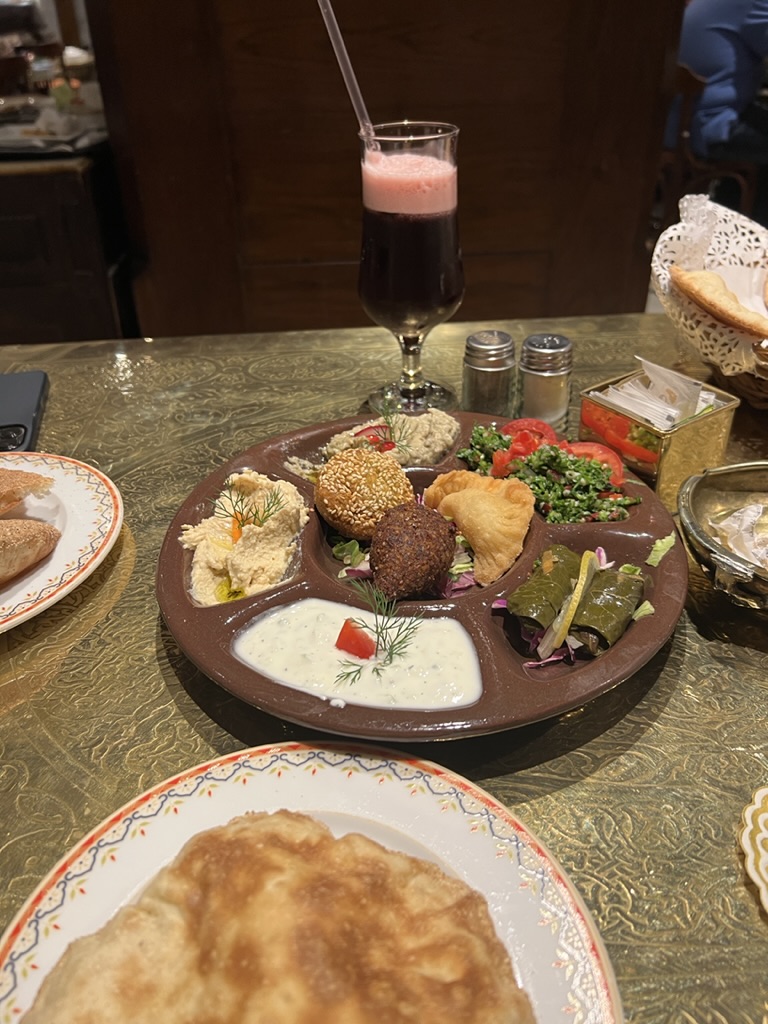
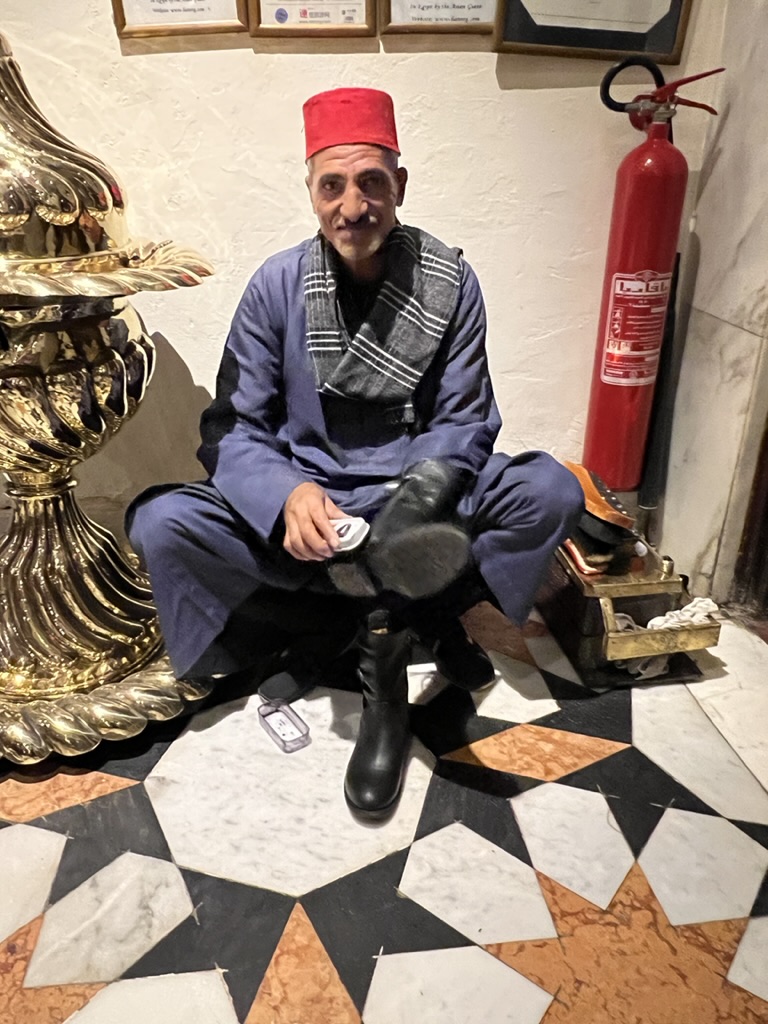
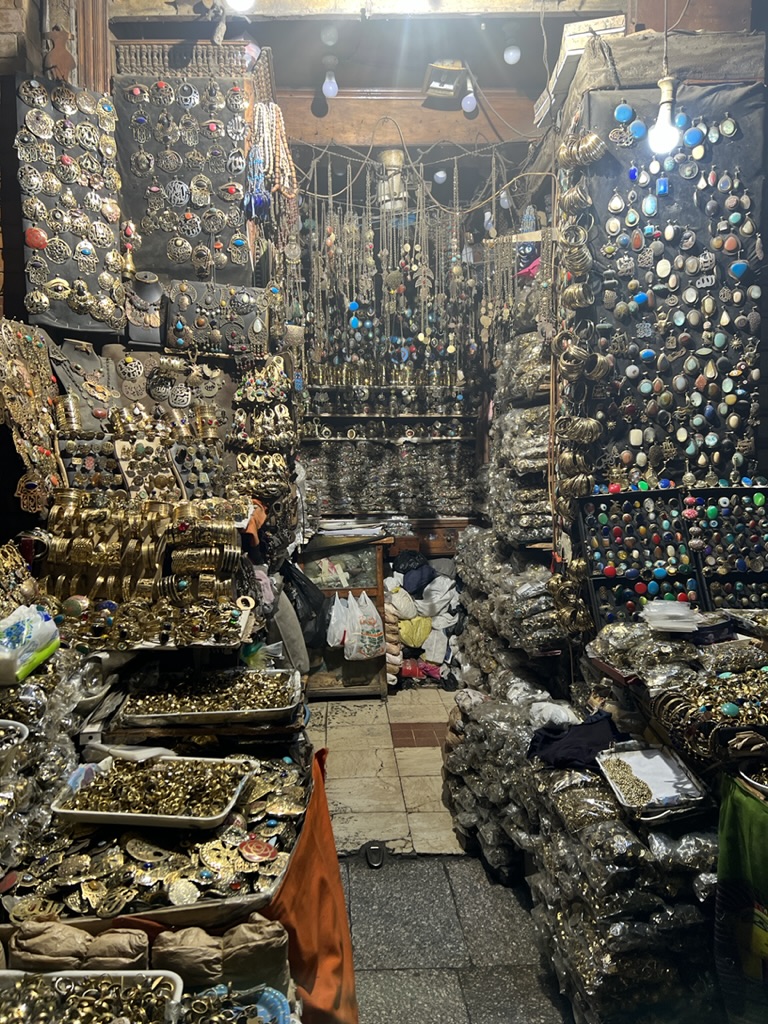
This Khan Kalili market has been the center of trade in Cairo since the 13th Century. It was originally just one building but now refers to the whole area of streets and the maze within the bazaar. They say it is the oldest open-air market in the Middle East. After zigzagging throughout the area, we wound up at Naquib Mahfouz Café which is located near one of the gates to the bazaar. It was recommended by the young receptionist at the hotel. It’s a Moorish building with all sorts of nooks and crannies. We were still full from breakfast so we opted for just the mezze platter to share—more than enough and actually quite good. Oh – one funny thing. Sitting in a little corner of the restaurant, cross-legged on the floor, was a guy shining shoes. No sooner did we sit down at our table, when he sprung into action trying to get to shine my shoes. As I glanced around, I was probably the only one not wearing sneakers, so I was an obvious hit. He told me it would cost (the equivalent of) $8; I agreed and he brought over a little rug for me to put my feet on, while he shined my shoes and while we ate. The cost was about the same as lunch. But I figure the guy needs the money and it was an easy way to “spread the wealth.” Seemed as if he left right after doing my shoes (boots), so maybe he earned his daily quota with that one sale. Funny thing about how there is no market for shoe shiners anymore, any where. Used to be an old guy at the Oakland Airport who had regular customers; he’s been long gone ever since everyone flying is wearing some kind of sneaker (or flip flops).
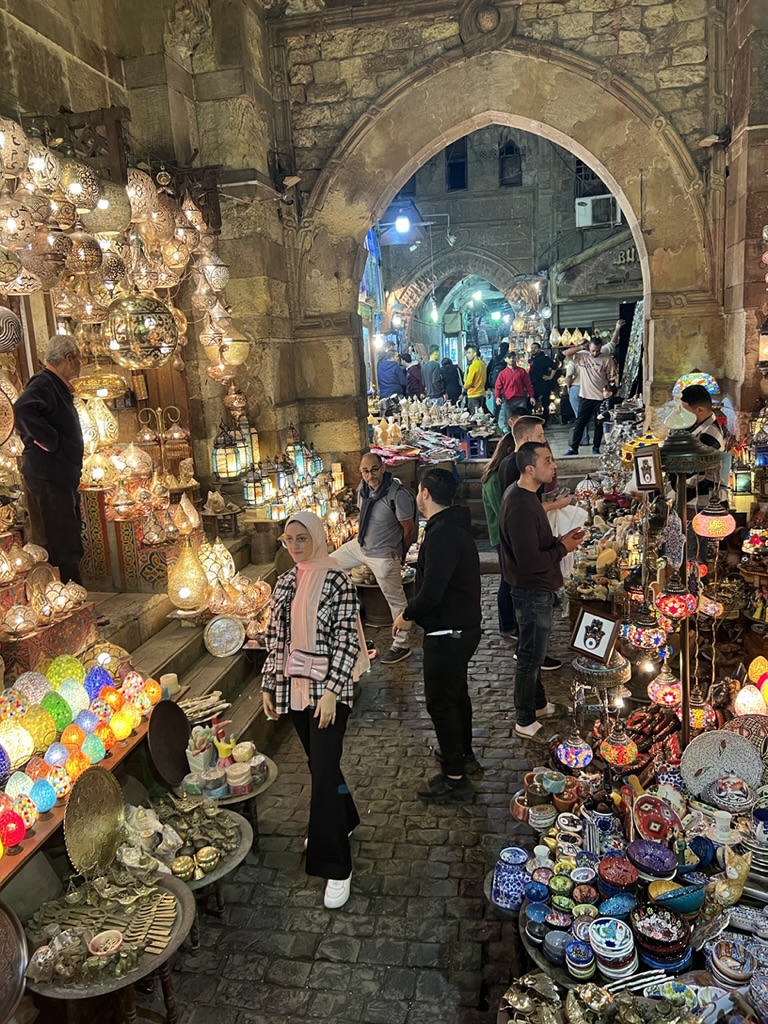
Then we walked more and put our lives in our hands as large tourist buses barreled down many of these very narrow streets with people eating in cafes lining each side of every street. The buses had less than 6” clearance and at one point I was sort of sandwiched between the moving bus and a barricade when someone came and moved the barricade a bit for me to have some breathing room. I guess some tourists “visit” the market from a bus window.
Later in the evening, we decided to venture to an upscale restaurant situated inside the Four Seasons Hotel located on the Nile. We walked to the outer gates of the Gamaliya (where our hotel is) to get a taxi to the Four Seasons. The desk clerk at the hotel said if we got to the gate, we’d find lots of taxis. (He was surprised we didn’t use Uber.) Tried to explain the politics, but then just figured we’d walk to the gate (about 15 minutes). We were prompted to leave the old city for dinner, despite having a really good meal last night, because alcohol of all sorts, including wine, is banned from all but a few parts of Cairo. Naturally, you can get alcohol in these upscale hotels that cater to tourists. We got into a pretty beat up taxi with a nice driver who spoke no English. As we approached the hotel, dogs had to check out the car and guards asked a few questions before they allowed us and the taxi entrance to the hotel grounds. I had forgotten but this same thing happened when we were traveling in Kenya and in Tanzania. Rather insulting and humbling for the driver. They weren’t too interested in us, although when we did get inside the hotel, one of the many doormen literally escorted us into the restaurant. Fortunately, he didn’t pick us up when we were finished eating so we were able to peek around the 5-star digs.

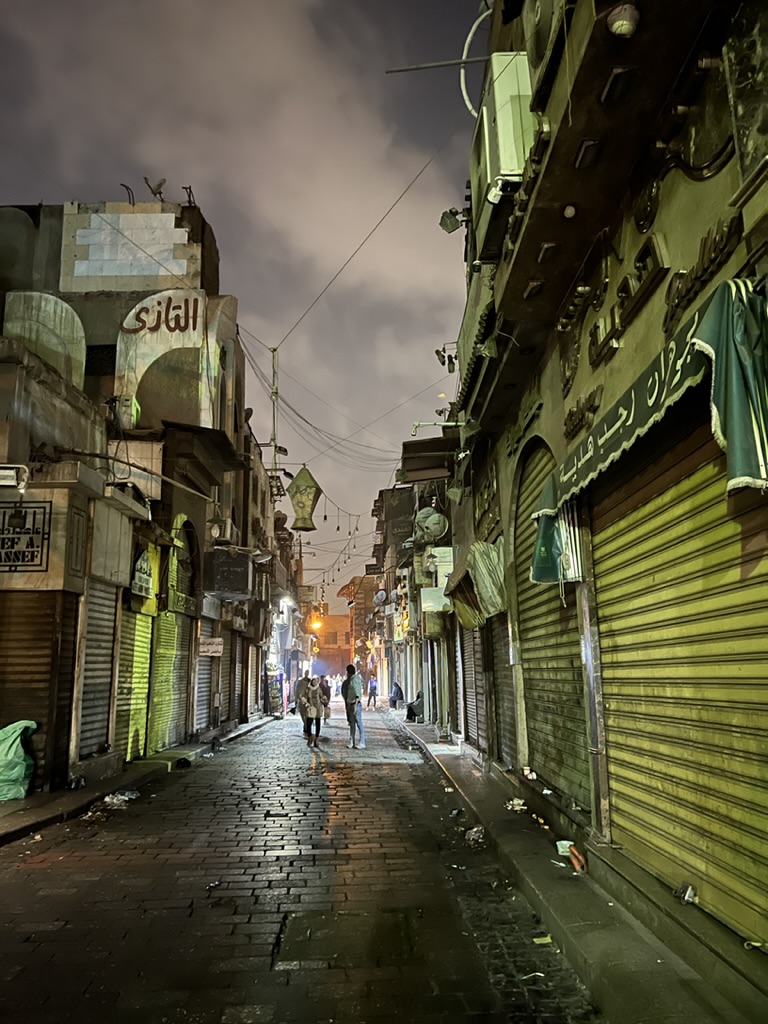
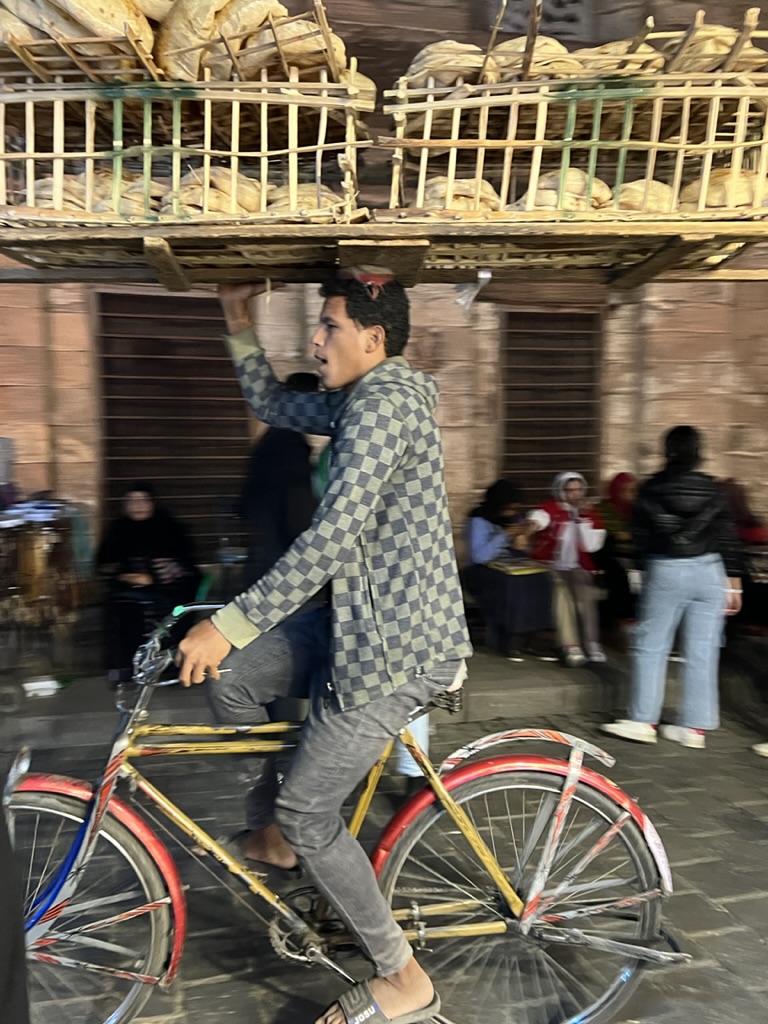
The restaurant, Zitouni, was billed as serving North African food. It was all good, but hardly “spectacular” and of course about four times the price of restaurants in the Gamaliya. But, then again, we did have cocktails and wine! When we exited the hotel, we asked one of the doormen to please get us a taxi (again the Uber conversation), and he proceeded to call for a taxi. We waited a few minutes and a spanking new, very clean white taxi arrived, Since the process is to ask the price of the fare, we did that. (It cost us 70 EP/about $3, to get to the Four Seasons, although we gave a tip equal to an additional 50%.) This guy said “200 pounds” or about $8.50 for the exact same ride. We told the driver we just paid 70 pounds for the same ride and offered 100, but he drove off. He also said he had no idea where our hotel is located. The Four Seasons guy said he’d have to “go onto the streets” to get a “regular city taxi” for us, rather than the “hotel taxi,” and he did. Up drove a beat-up old taxi and we headed to the Riad. We tipped the guy well and he was most grateful for the work. He dropped us at the gate; it was about midnight; and we strolled the now somewhat quieter (and some even deserted) streets of the Gamalya area. Some persistent shopkeepers were still holding court; restaurants and cafes were brimming with locals; and music was playing (loudly) as we neared our hotel (which is often guarded by our own little sphynx – a sleeping cat.
So, we saw the two Cairos. The one where people live and work and serve the others who probably drive folks to the Four Seasons and the one where Egyptians appear to only be the servers, cleaners, and doormen who cater to foreigners (mostly wealthy Arabs it seemed) with lots of money. The Old Cairo and the New Cairo, as the literature around here describes the centuries-old areas with incredible architecture that is in bad need of repair and the upscale neighborhoods filled with new, shiny buildings and modern conveniences.
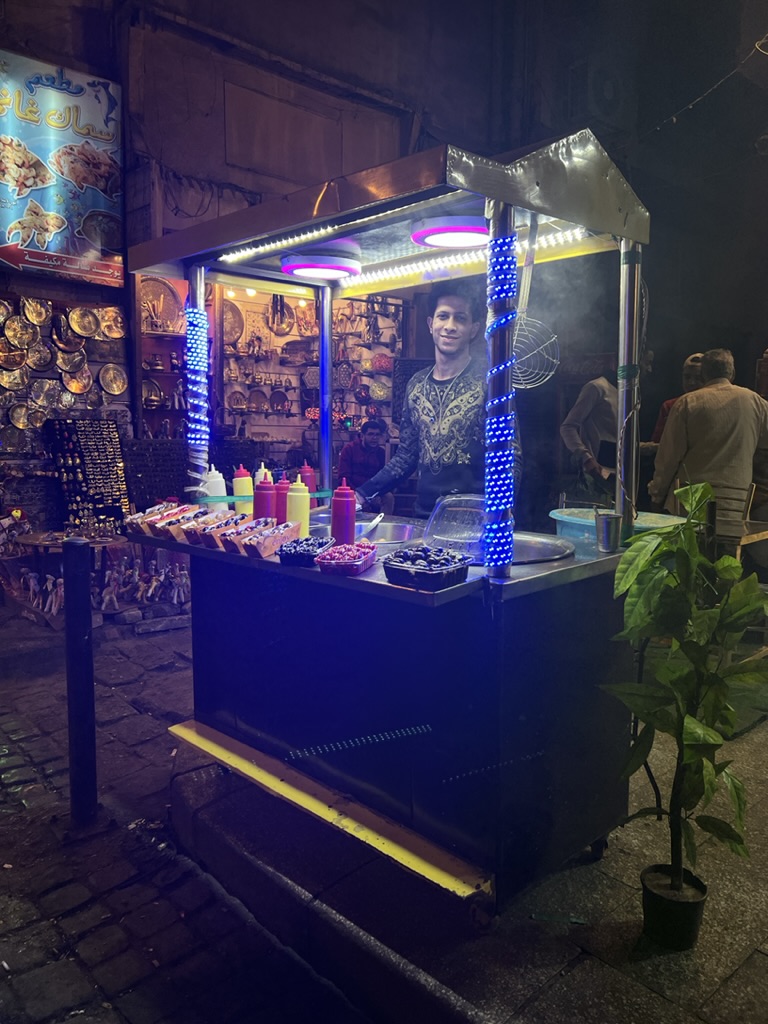
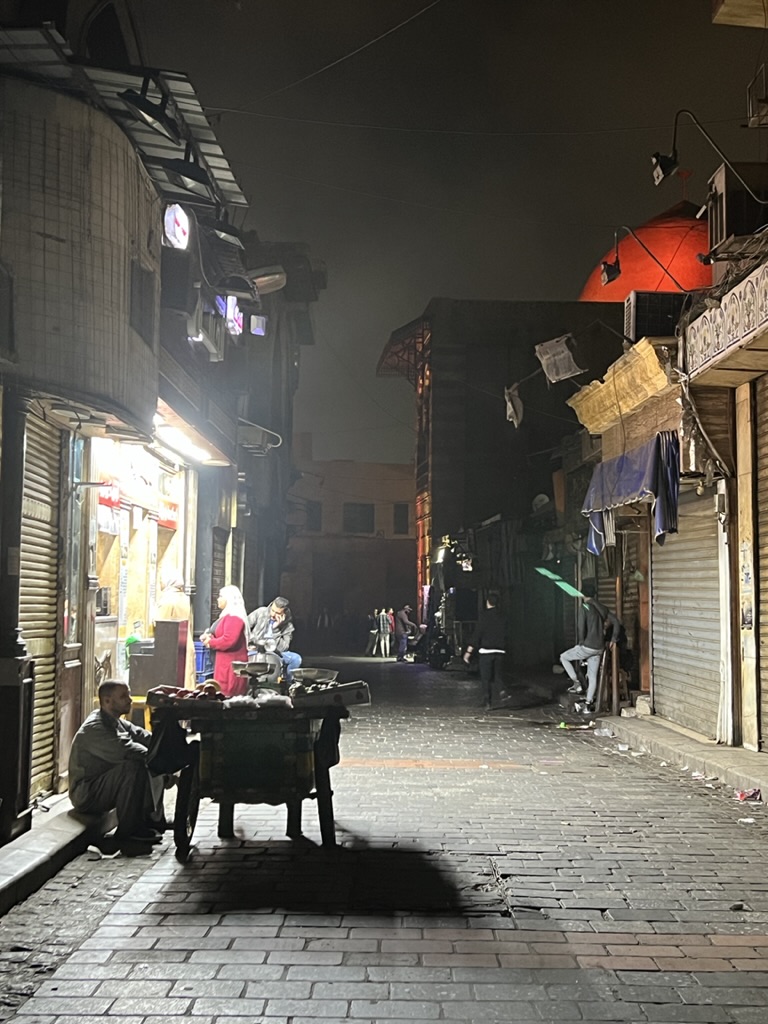
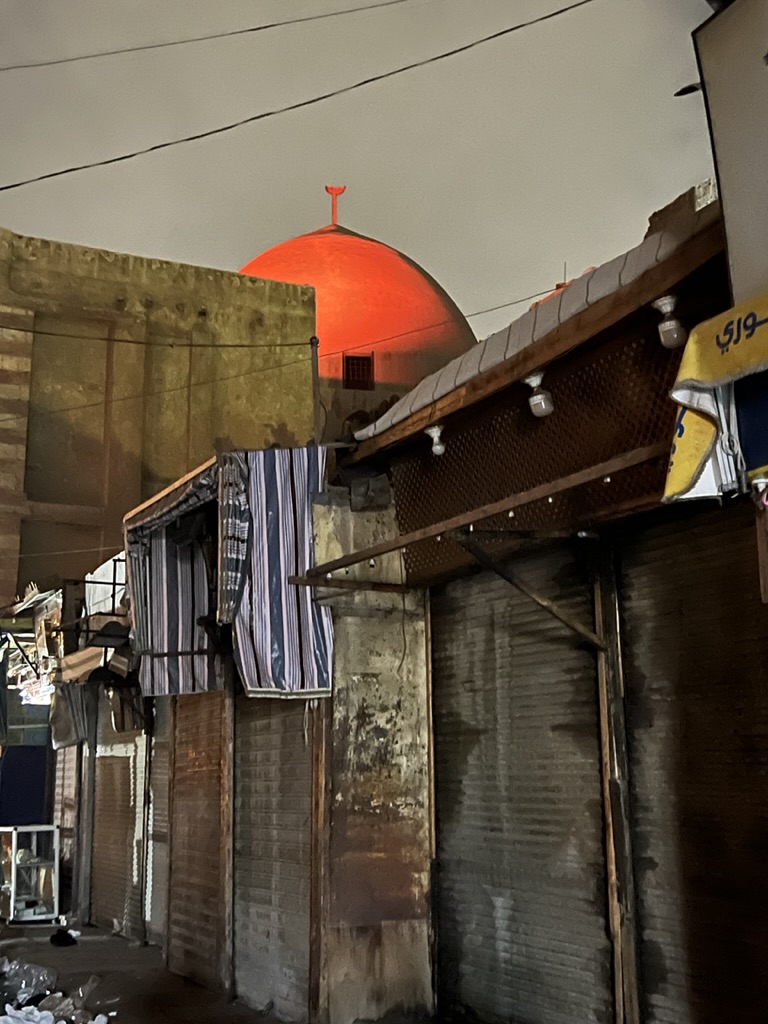

As-Salamu alaikum (Peace be with you); more tomorrow.
PS – funny sign in our rather large and very modern bathroom at our hotel; guess the plumbing isn’t quite up to par.
1. Arrived in Cairo… Very very late: Dec. 15, 2022
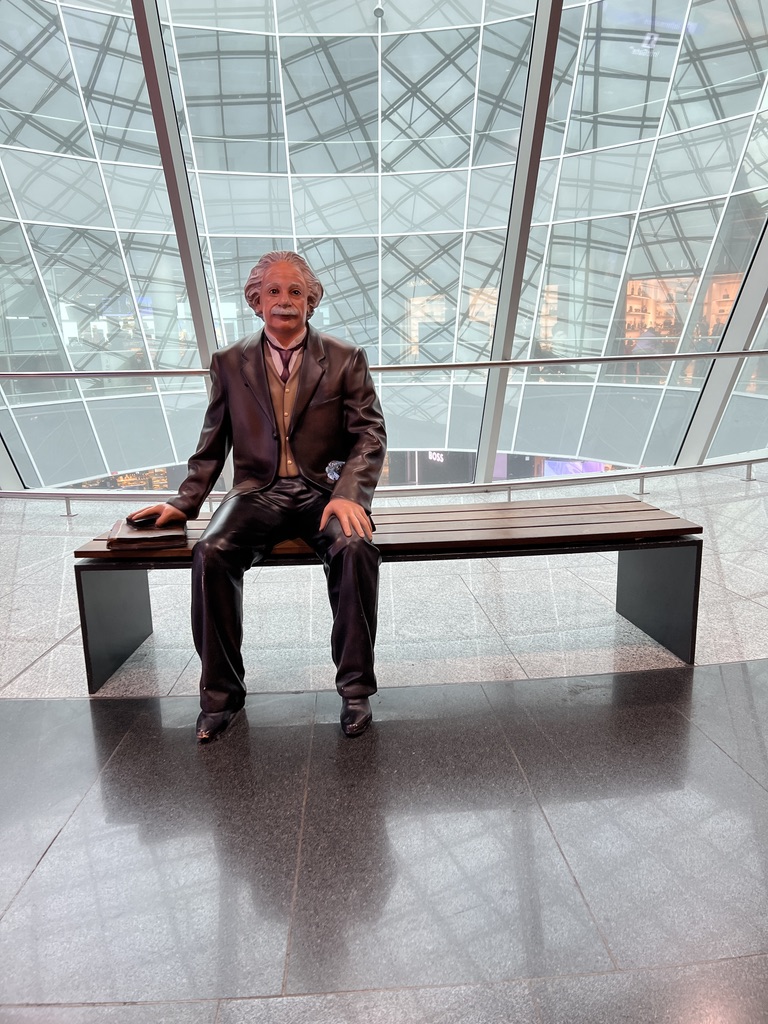
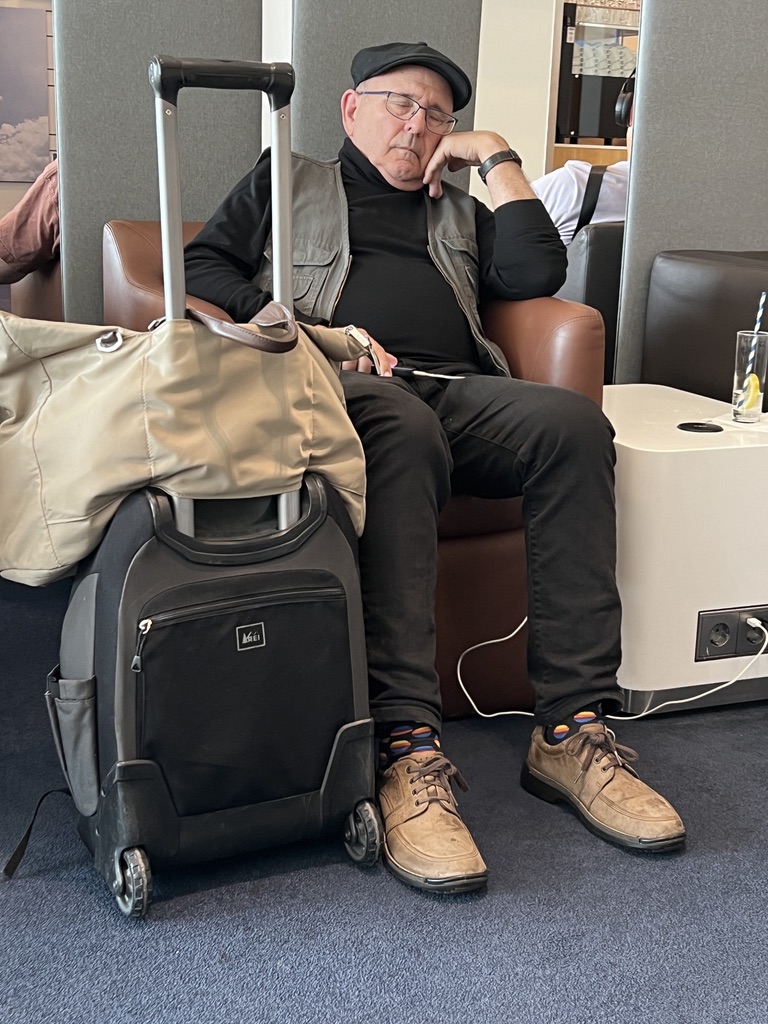
Greetings –
The plan (up until just 5 days ago) was to head to Addis Ababa and Lalibela — in Ethiopia, and then to move on to Egypt (Cairo/ Luxor/ Aswan) and to Jordan (Amman and Petra, and one stop along the drive) and then to Israel (a few nights in Jaffa, Jerusalem, and Akko),. And then to Geneva for a very brief family visit to meet very new grandniece. But alas, plans changed by the hour. First, we decided to ditch Geneva and go in the spring—mostly because of the sheer inconvenience of having to pack for winter weather when the rest of the trip would be in the 60s; and we figured that a one-week old baby might not be as interesting as a three or four-month baby (by then I’m sure she’ll be able to chat and play with us!!) So that got changed and shortened the trip by a few days.
Then about 8 days ago I woke up with a strange “lump” on the right side of my face – kind of below the ear and above the chin—a bit like mumps; didn’t hurt at all, but it was visible and I could feel it when I touched it. I wound up in Urgent Care and the doc thought it was some kind of enlarged lymph node brought about by the fact that I had a cold for a few days (not Covid, just plain old virus coughing and sneezing). She did, however, predict that it could take two months or so to disappear. Said to take Advil. Two days later, given that we were headed to places lacking stellar medical facilities, I decided to see my own doc. She agreed with the diagnosis initially, but also felt it might be swollen salivary gland or something called parotitis, which is usually painful. I have no pain. Anyway, they did an ultrasound which came out fine; totally benign, not infected; she said it needed to take its course and that sucking lemons might be an old wives’ tale that could work. So, we were ready to leave on Monday (packing lots of lemons which we trusted TSA would not take as liquids).
Then on Sunday, my doctor called me and said she was concerned because we had not uncovered what this was and how I got it. We talked for a long time (on a Sunday! – how’s that for a good doctor!) and she felt I should get it drained on Monday—and although it would take several days for the results—it was my call whether or not to take the trip. Again, no pain, no anything. But as it turned out, there was no way I could get in to have it “drained” on Monday; the Interventional Radiologists “have their own process” (their words) as to how the work gets scheduled. And they are totally booked, and it’s holiday season. By then we had canceled the Ethiopia part of the trip (thinking they could do the procedure Monday or Tuesday). We changed our tickets to go straight to Cairo and do the trip, just minus Ethiopia—which is unfortunate since we really wanted to go. We are now trying to see if we can go to Ethiopia in April when we will be headed to Geneva (you know just a hop, skip, and jump to another continent).
Mike and I decided we could monitor this as well from here as from home, given that it looked like the appointment would most likely come in January (at which point I am convinced the whole thing will have disappeared – Fern — ever the optimist). And I figure that if it was an emergency, they would have figured out how to get me in right away. Enough about healthcare.
OK.. so here we are in Cairo. I’m just going to give you a feel of what entry into Cairo was like.
Our flight from SFO to Frankfurt was delayed slightly and then the flight from Frankfurt to Cairo was delayed about two hours. We were pretty beat by the time we landed in the chaos of Cairo. It was about 10:45 pm when we arrived at our hotel. Emerging from Customs at Cairo was like coming to most other developing nations—crowds everywhere and drivers and tour guides hawking to get you to come with them. We expected that, so it wasn’t a big surprise. But we had things to do at the airport – like exchange money. So we just ignored all the guys screaming for attention; we also walked past the lines and lines of drivers holding up signs with peoples’ names who had either pre-booked a taxi or driver or were joining some group or were going to meet up with a tour guide, etc. As you know we love being independent travelers wherever we are.
Got our cash – The US dollar is equal to Egyptian 24 pounds; so when you exchange money you get wads of bills. They even have a 1 Egyptian pound bill which is like 4 cents. And then we had to figure out the taxi scene. One guy was just so persistent that we discussed the fare. He said $25 US dollars, but it was also clear he didn’t have a clue where our hotel was located. Most tourists stay in Gezira, which is actually an island on the Nile and is close to most tourist sites. So naturally, we didn’t want to stay there. We did a little research and decided to stay in the El Gamaleya area right in the thick of things; a very old part of the city which is chock full of people and shops. It’s a Muslim part of the old section of Cairo. I called the hotel to have them explain the directions to the taxi guy (he wasn’t too interested in my GPS directions) and then I asked the hotel how much it should cost. They said $8 US dollars. So we negotiated with the driver and paid $12.
Trying to get his car out of the lot where all the drivers sit while the middleman (yes they are all men) negotiates the deal, was hysterical. Took about as long to get out of the parking lot as to drive to the hotel. And the back seats of the car had seat belts but only the straps, not the little gizmo into which you have to put the strap to secure yourself in the seat. Oh well, can’t have it all.
The drive through the tiny narrow streets which were filled with cars, pedestrians cheek to jowl, tuk tuks, push carts with vendors and then sidewalks totally impassable was great. Technically these are all walking streets with no cars allowed! Anyway, we arrived at Hotel Le Riad de Charme which has about 24 rooms and a rooftop restaurant. We have a little (actually a big) suite with a living room, bedroom, bath, sitting area, and foyers large enough to be additional rooms. Each room is decorated differently and we are in the “Calligraphy Room” (appropriate!). The building is hundreds of years old, but has been updated with modern plumbing (sort of) and electrical (although lots of wires hanging about). The staff could not be friendlier and trying to be helpful, although most do not speak English (except for the reception guy who learned English on YouTube, and is thinking about moving to Capetown! )
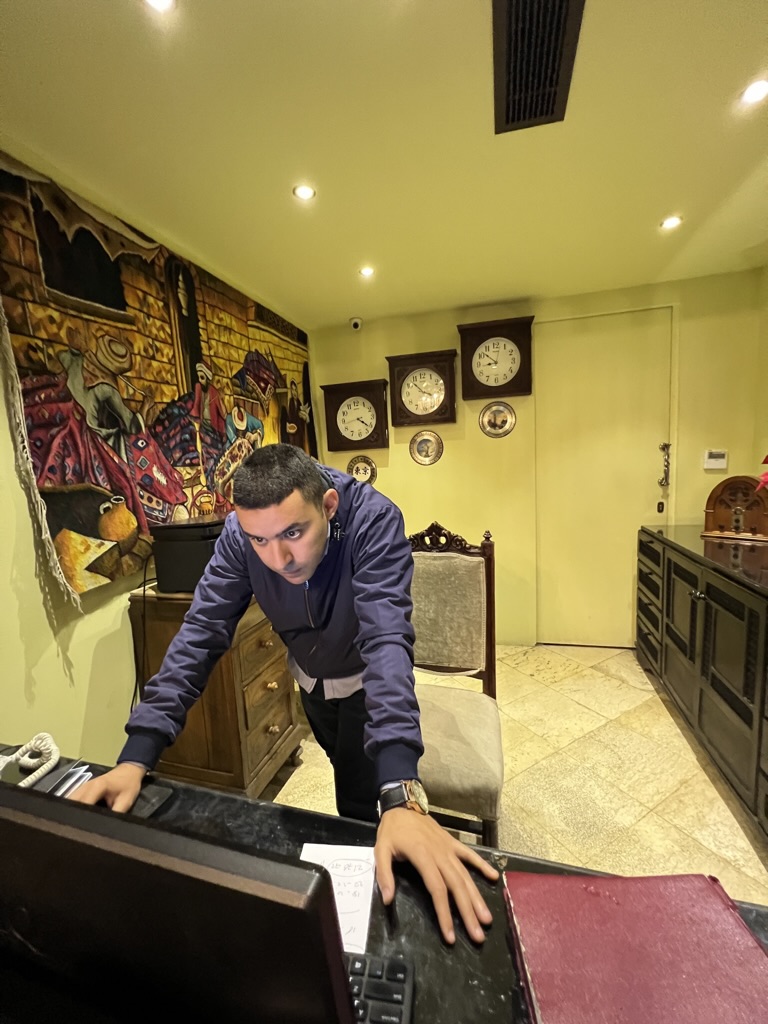
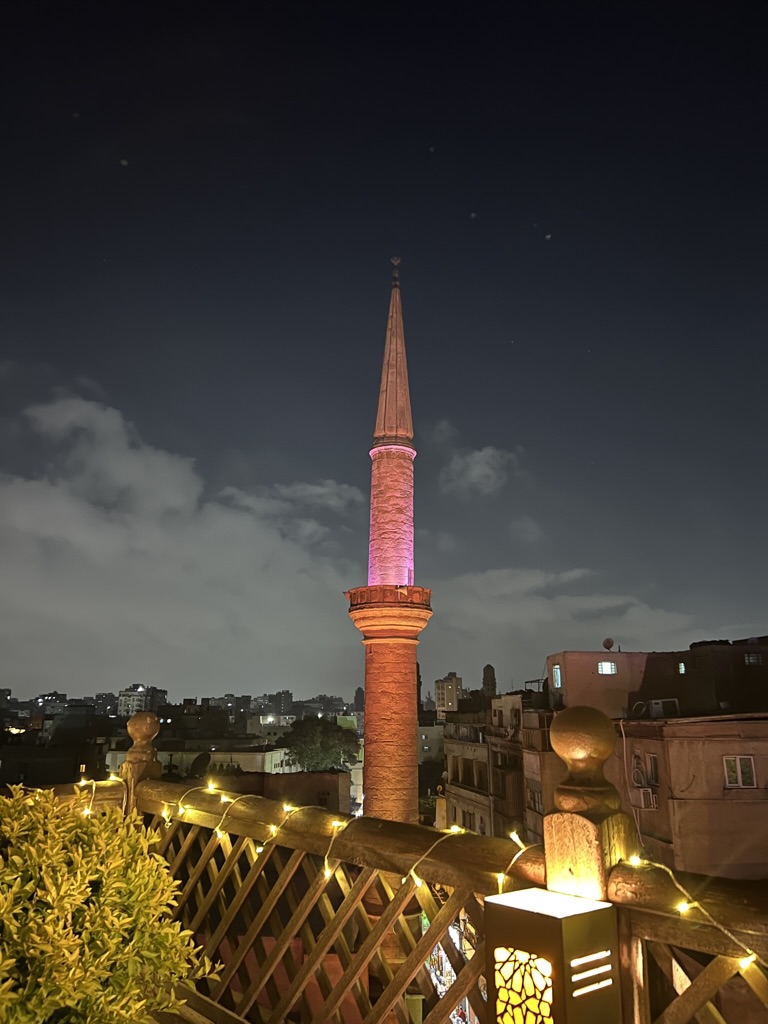
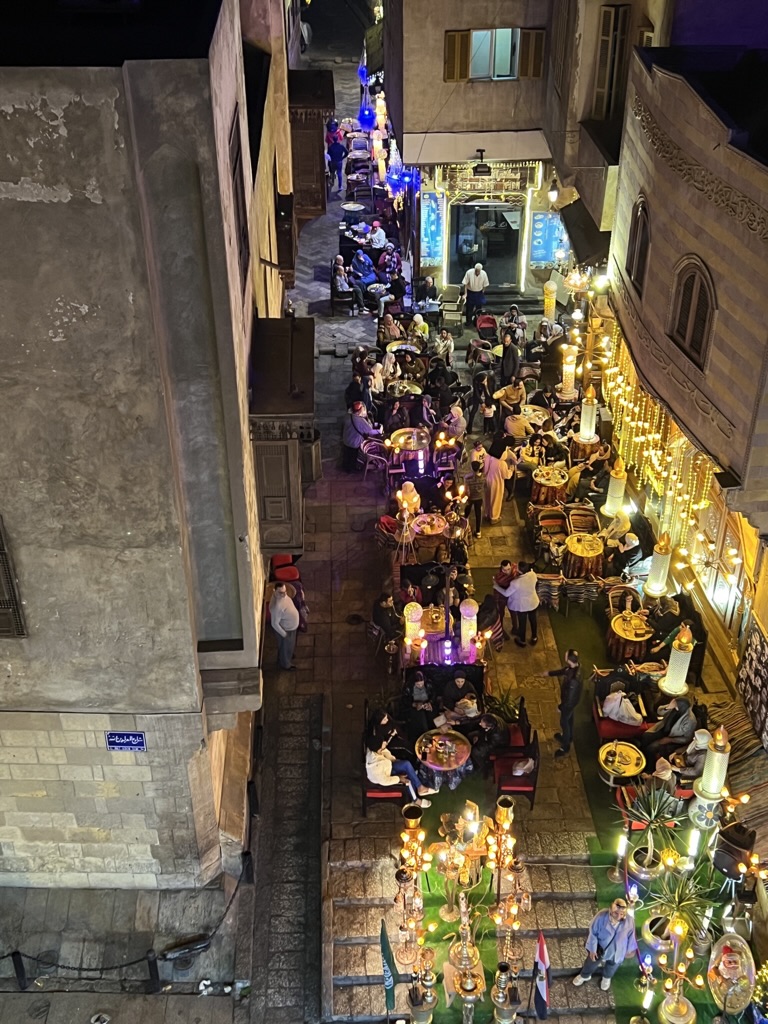

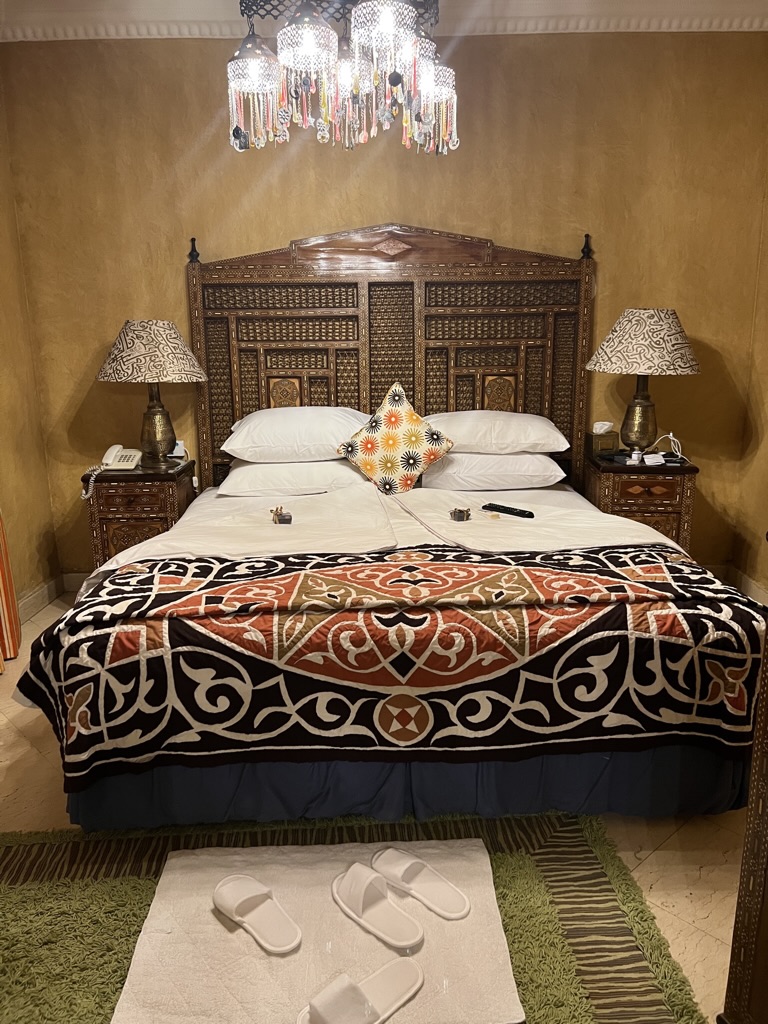
From our little terrace (yes we have a terrace from which we can see quite a few mosques) we can see and hear the life of the city, which we will start exploring tomorrow. We dashed up to the rooftop restaurant to get some dinner; I love Cairo already since even this small restaurant was serving until midnight. My kind of town. And when we finally got to our room at about 12:30 am to settle in and unpack we could hear the crowds below us, selling every imaginable item; eating in little outdoor cafes; and strolling the streets.
And then I needed an emergency call with my IT guy… but turns out it’s just very slow Internet.
If you get this note, then you know the Internet is working and cranking.
Take care. Will be in touch with my daily reports as close to daily as I can.
Best –
Fern
 Fern's Travel Notes