
Greetings
Hope you are well and vaccinated!
So, I rarely write my travel blog when I’m traveling within the US, but given the dearth of travel over the past 18 months (maybe it’s 19 already?), due to COVID-19, just going to the east coast seems exotic and even daring! Thus, I am sending this little series of travel notes to my regular readers. As usual, don’t feel obliged to read it… I’m fine if you just toss it; we all get way too many emails.
I’m on a little “vacation” — about 4 days in DC and 4 days in NY, places I know well—having traveled to DC many, many times and having grown up in NY, and I have returned many times a year since relocating. Still, the whole idea of getting on a plane and being in different surroundings seemed both comforting and also scary. This, from a veteran traveler who’s been to more than 65 countries. This was only my second cross country trip since Covid. But the timing was good; I just finished two large, complex, multi-year projects (with minimum in-person contact) and I was ready for a break.
I’m traveling with my friend Carol from LA (whom I’ve known since graduate school — and I’m not revealing how long ago that was). Carol and I have developed a routine of traveling somewhere every year (Santa Fe, Marfa, Montreal, Aix en Provence, Amsterdam, etc.), but naturally we missed last year (we were supposed to go to Scandinavia). It’s generally Carol’s choice as to the location since I’ve been to many more places and am happy to revisit the good ones. Given the Covid situation we decided to stay stateside this year, although this December Mike and I will hopefully be traveling overseas.
Arrived in DC on Friday night (October 22) and met up at the airport. Miraculously our two flights arrived within 15 minutes of one another; both flights were on time and were at neighboring gates. How’s that for planning? And luck?


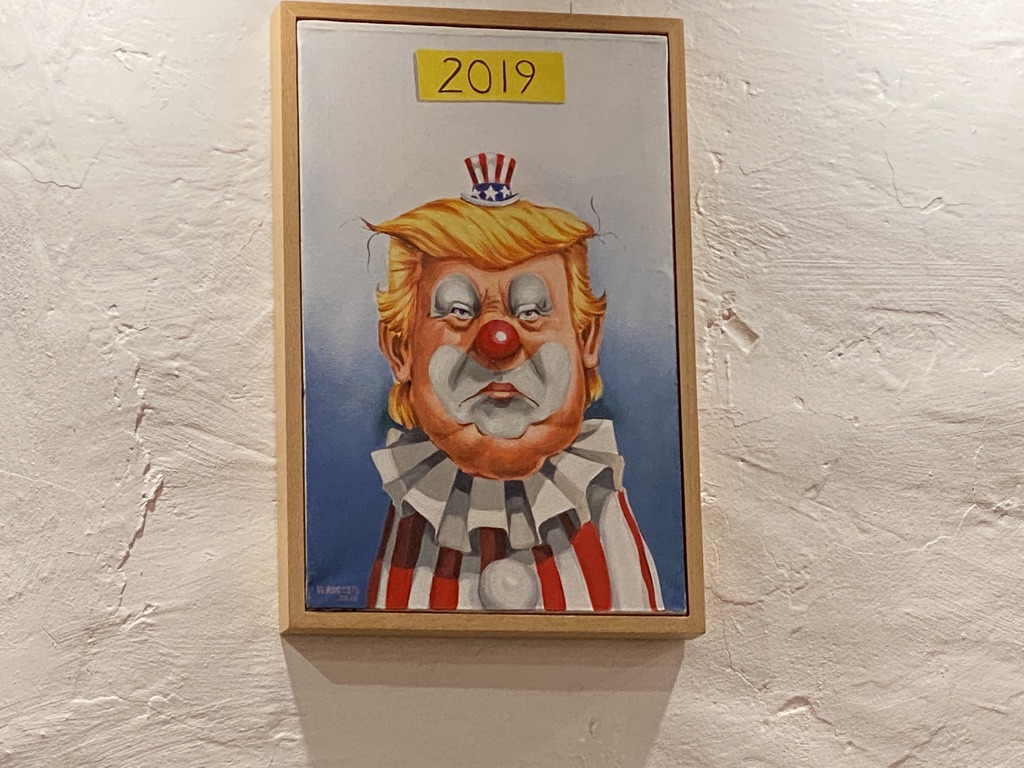
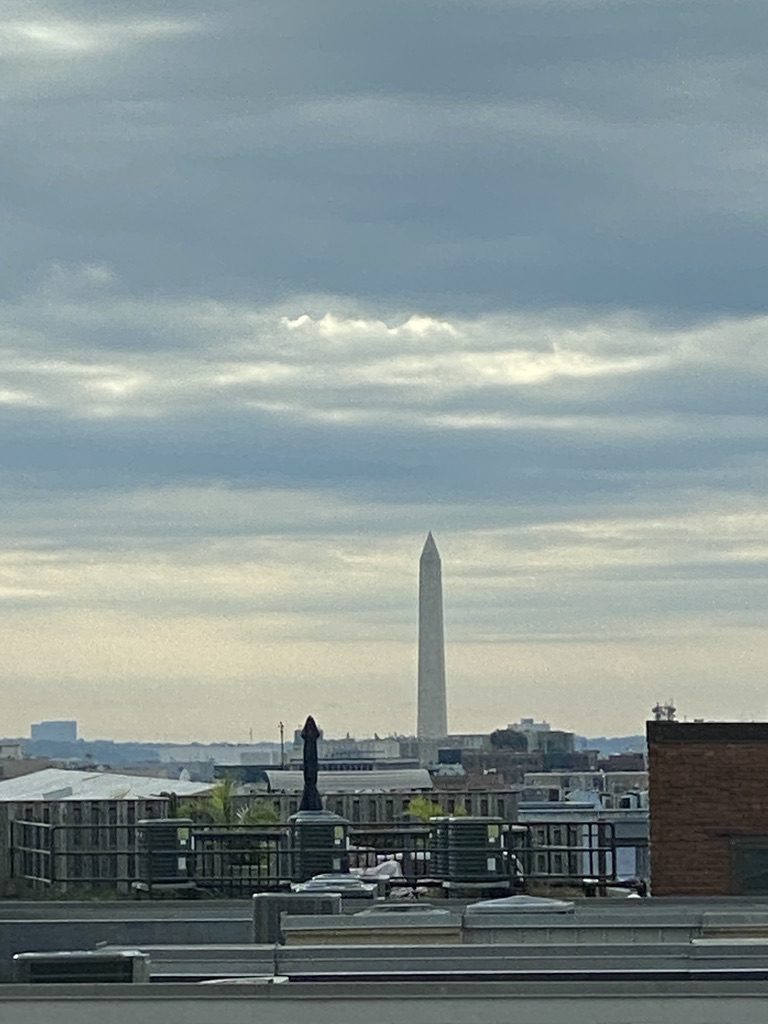
We chose The Line Hotel in the Adams Morgan neighborhood of DC, which has certainly become a very buzzing place since the last time I visited. My room has a distant view of the Washington Monument! We were hungry and it was already about 11:00 pm… Every place we checked out within a three block radius was closing. We were getting kind of desperate and then stumbled on a taco place.. So tacos it would be. As it turned out Taqueria Al Lado was great… margaritas, mojitos, tetillas, aguachiles, and ceviche… and great beers. So we satisfied our hunger in a really upbeat place with great people’s art on the walls – focused on Trump as a clown!
Saturday, October 23
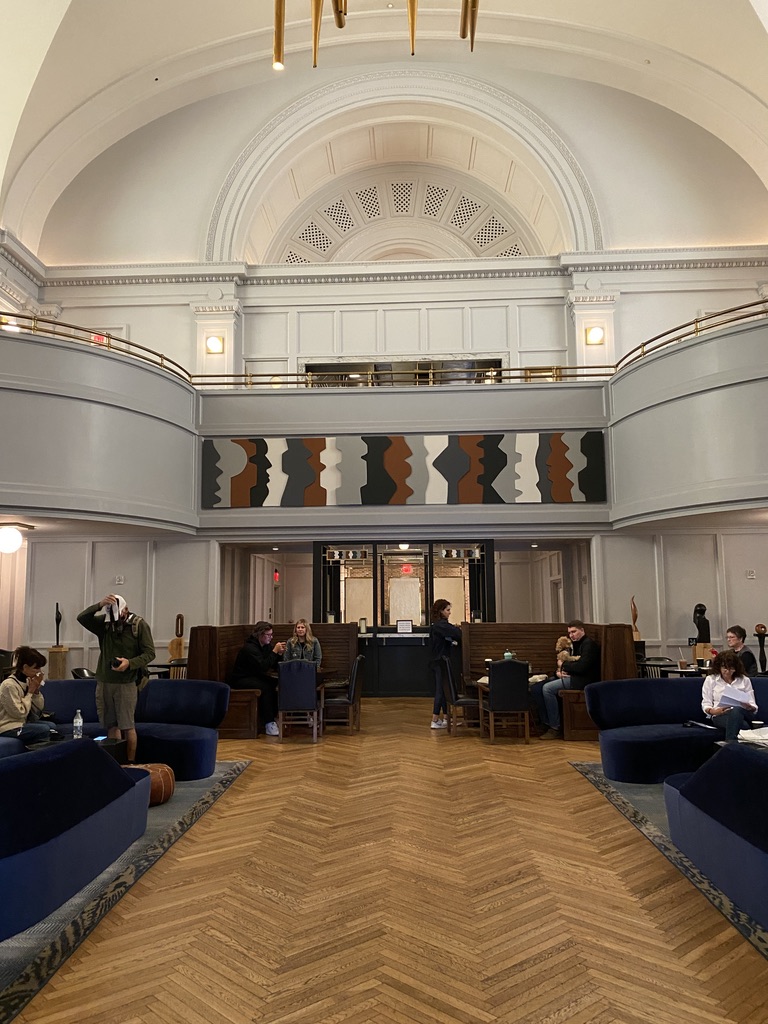
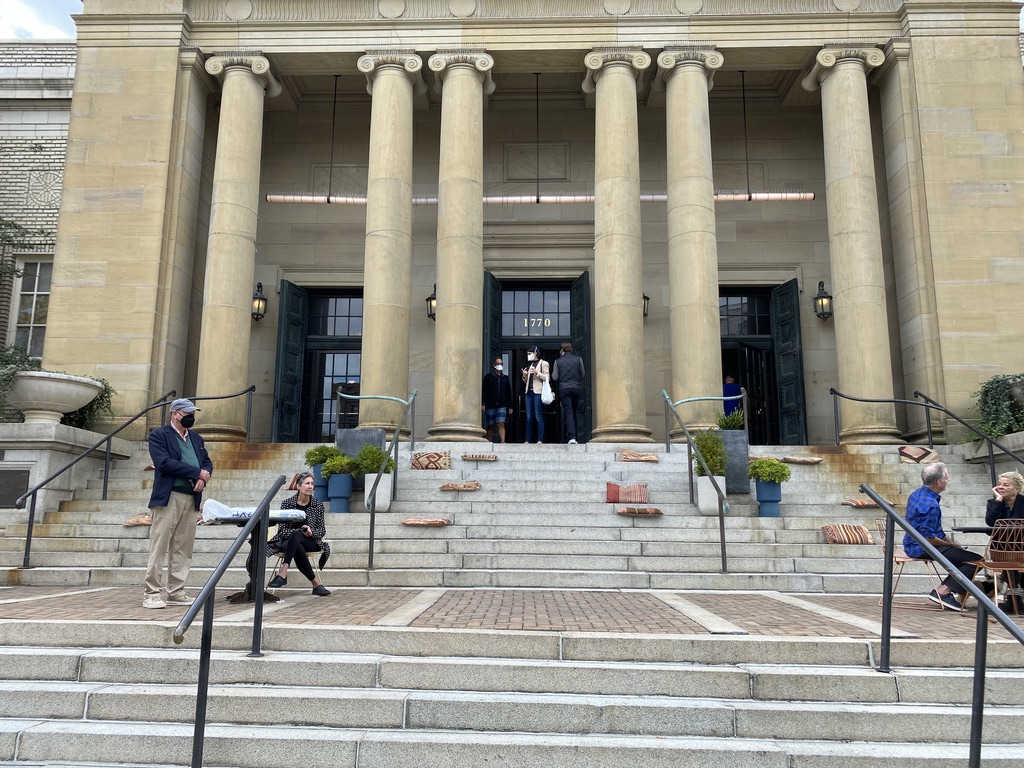

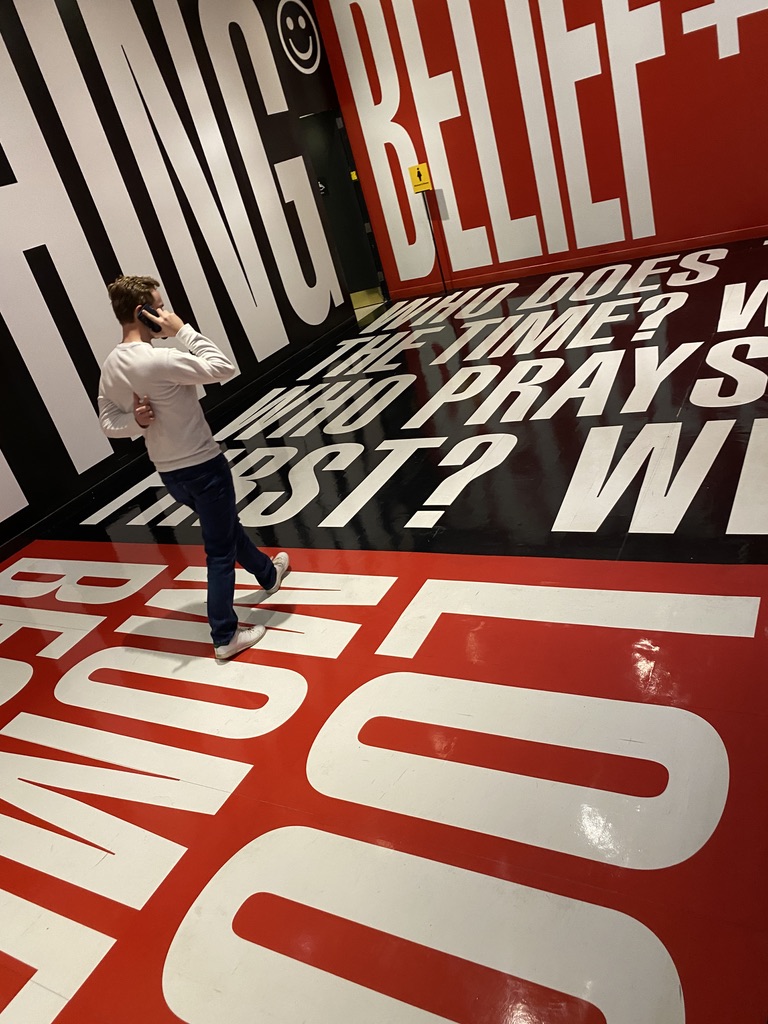
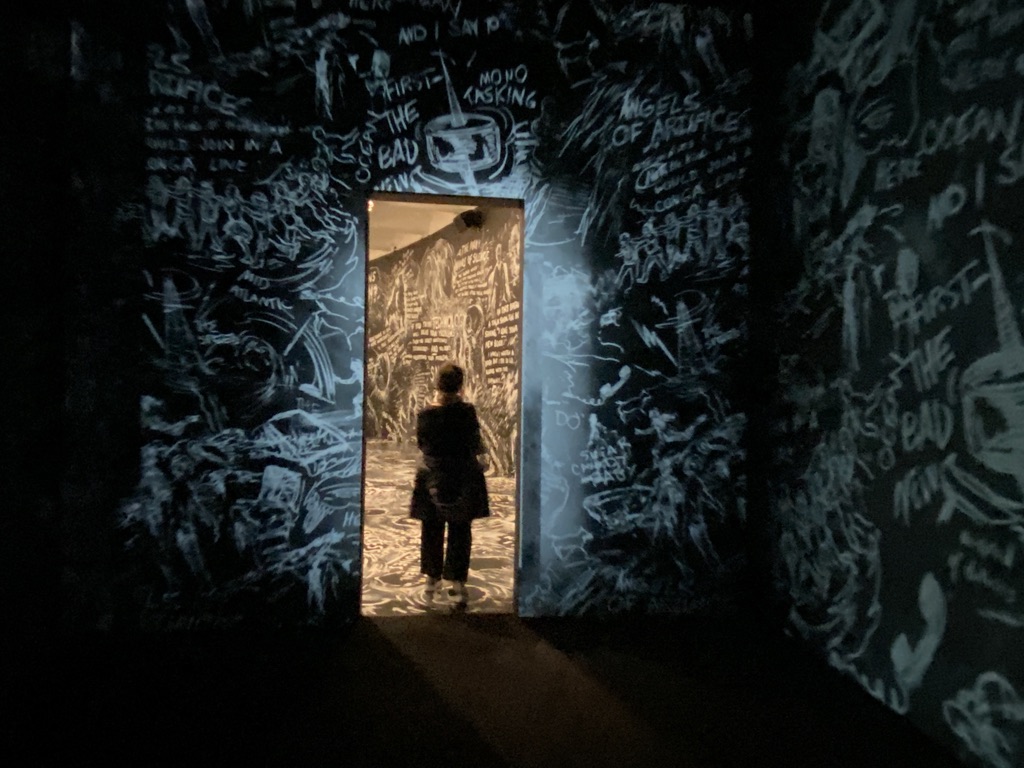
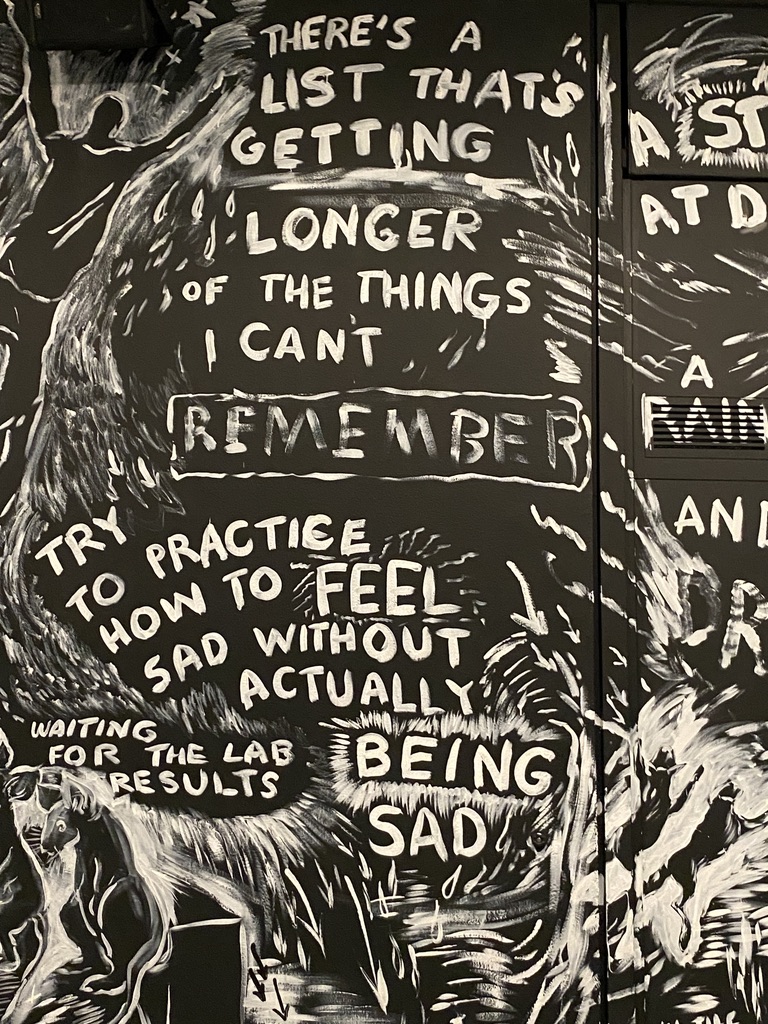
Started the day with breakfast at the Line… which was surprisingly good and quick, since we had a busy day ahead of us.. Took the Metro to the Hirshhorn Museum to see the Laurie Anderson show which was quite striking and political. While most of the pieces (mostly full room installations and experiential) were memorable – one stood out above the others: “Habeas Corpus.” It occupies an entire room and seated in a corner is an oversized three dimensional “white chair” on which Mohammed el Gharani, the youngest detainee at Guantanamo Bay “sits” most of the time and tells his story in his own voice. In reality he is on film that is projected onto the chair so realistically you believe he is sitting there. Gharani is Chadian raised in Saudi Arabia, and after the September 11th attacks, he was sent to Guantánamo and held and tortured for more than seven years. Authorities said he had belonged to a London-based Al Qaeda cell, but in reality he had never been to London and was only fourteen when he was arrested. In 2009, an American judge ruled that the allegations against Gharani were baseless, and he was released. We also spent some time at the Duchamp exhibit which was small but good.
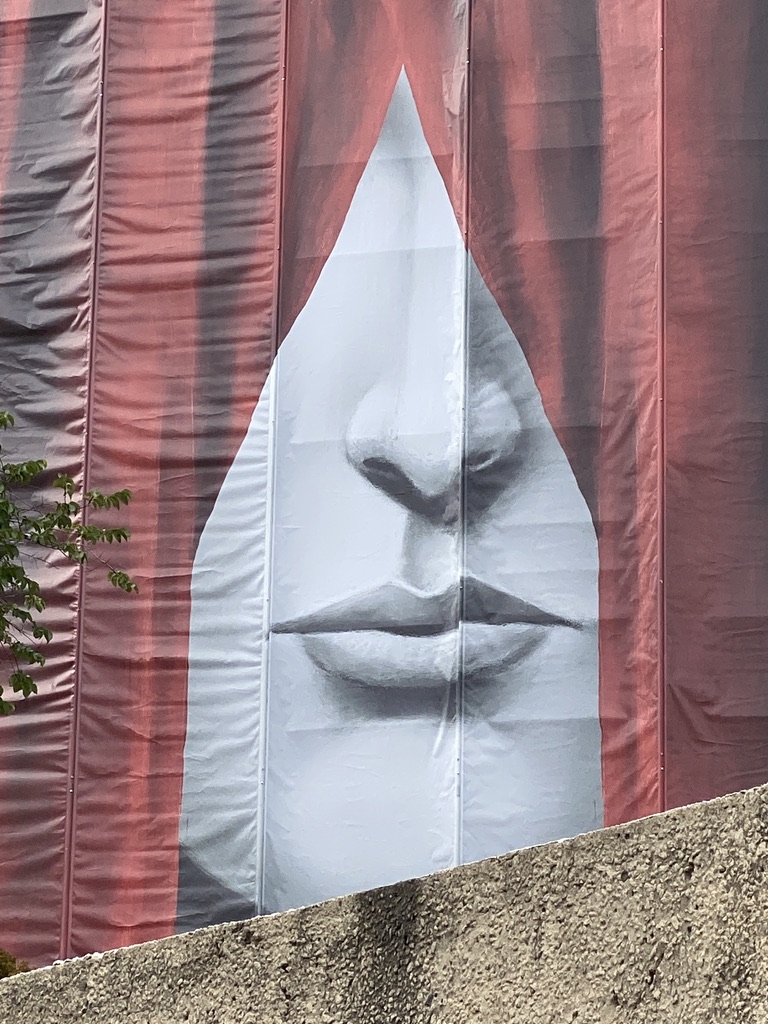
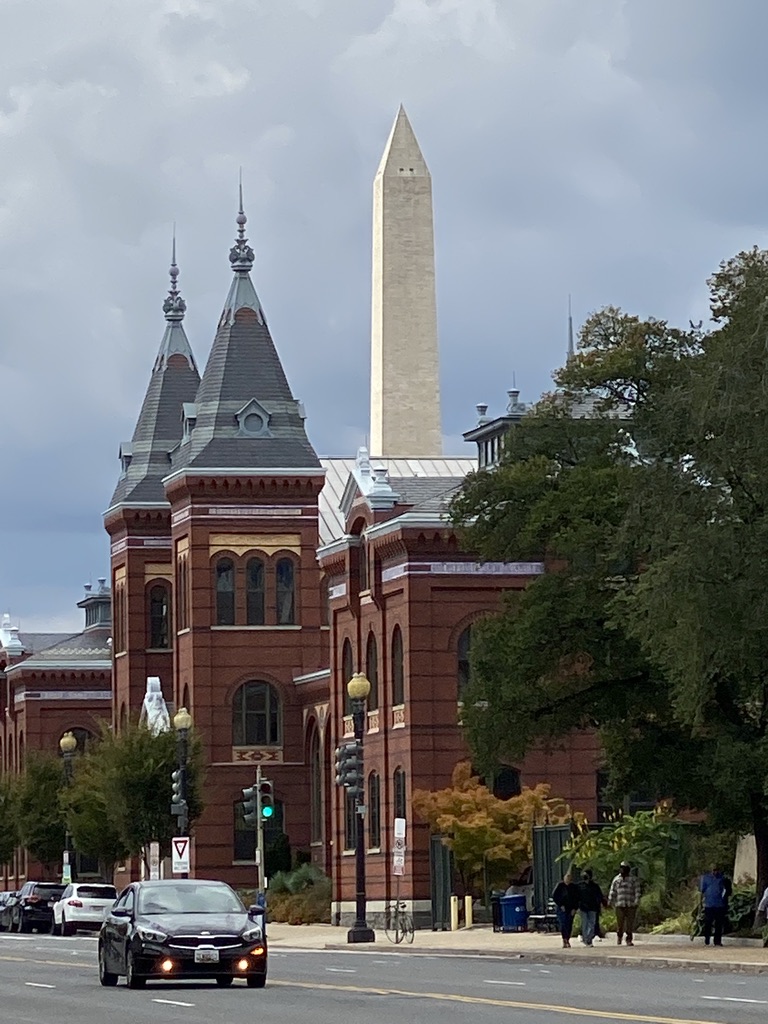

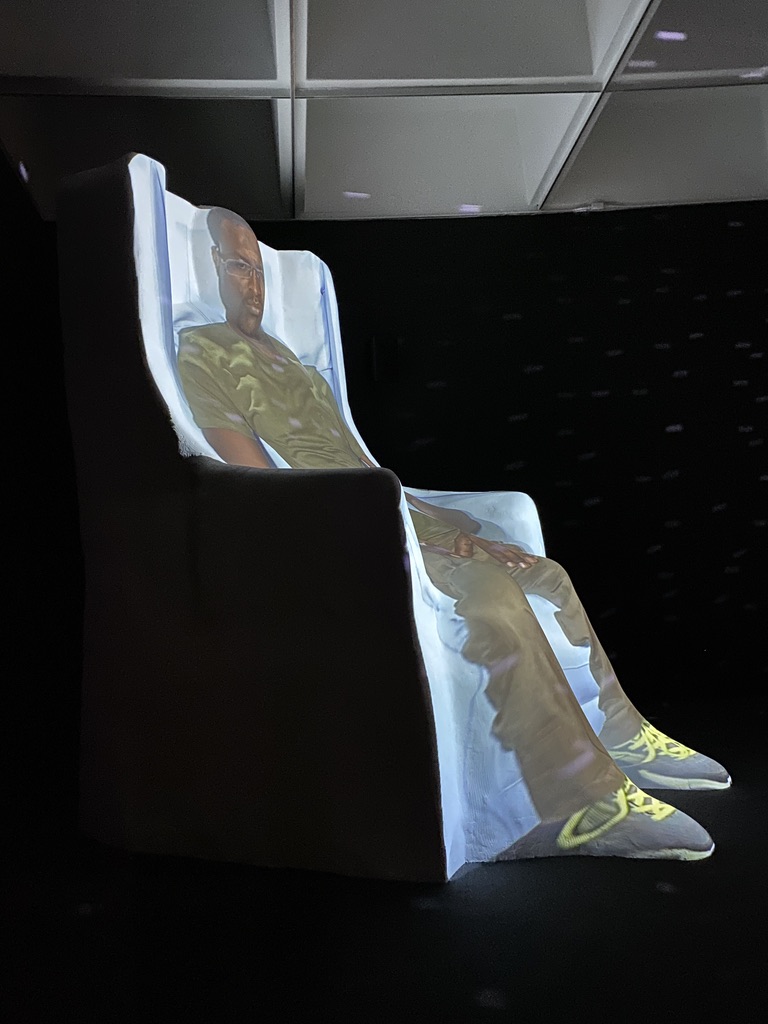
While I thought the content and execution of Anderson’s show was great, my personal feeling is that it should be out on streets and not made precious by being inside a museum… but that’s a long story that ties to my basic dislike of museums as pedestals for art and for making art both precious and unreachable— and therefore negating whatever political message might have been part of the intent. Sure the Hirschhorn is free, so you could argue that the works are approachable; but a quick glance at who is inside the museum makes it clear that not everyone feels welcome in these kind of institutions. I didn’t see a single person of color at the museum. Then again, most are living the situations Anderson raises in her work, so no need to see it in a series of rooms.

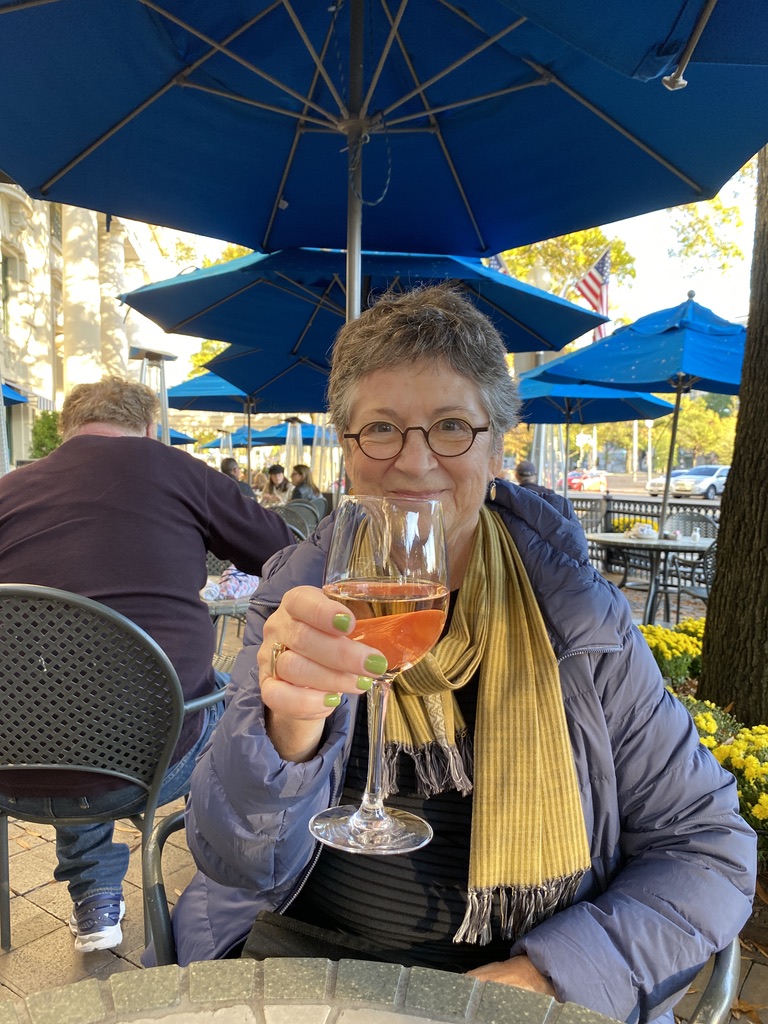
From the Hirschhorn, we walked around the city, through the mall (Carol had not really been to DC much so we hit up some major sites) and ultimately decided to stop for a prosecco and a snack at the Willard Hotel… where we watched the town go by and watched a series of very upscale Washingtonians arrive for a very expensive and formal wedding reception. Like many of you (I assume), I always believed the story that the term “lobbyist” was coined at the Willard because President Grant would come by the hotel lobby for a brandy and a cigar and he was always besieged by people who wanted some sort of legislation.. Thus he called them “lobbyists.” Well, according to the information at the hotel the term was used well before Grant… but the reality remains that Grant would spend time in the lobby and that people would ask for favors.
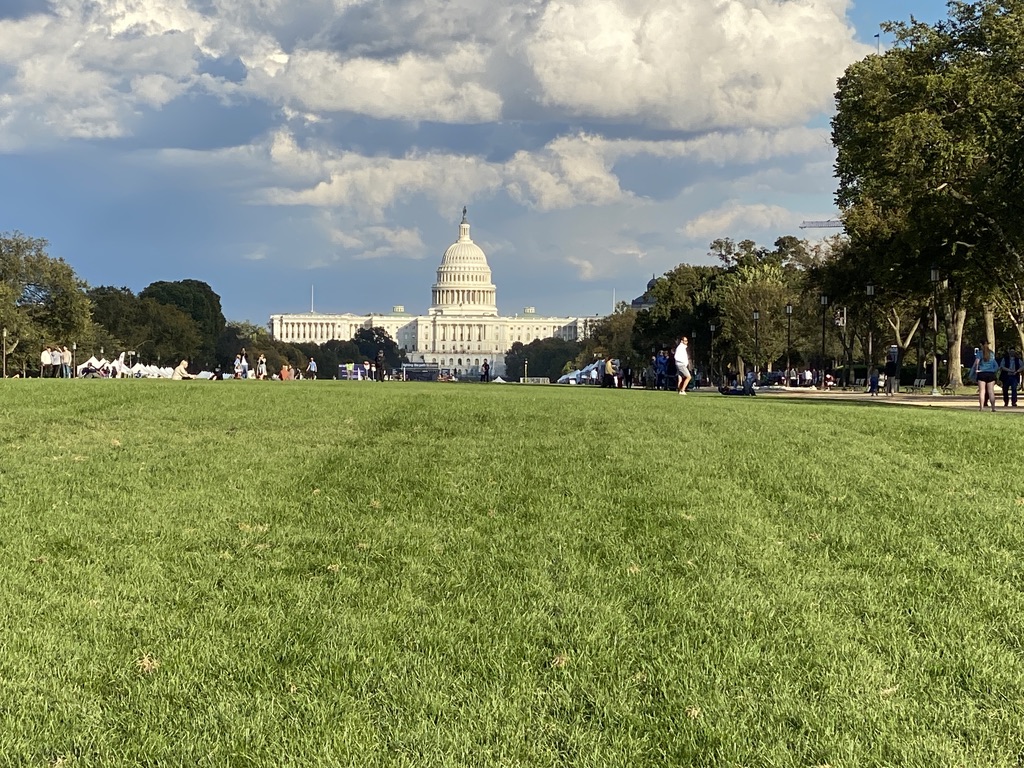
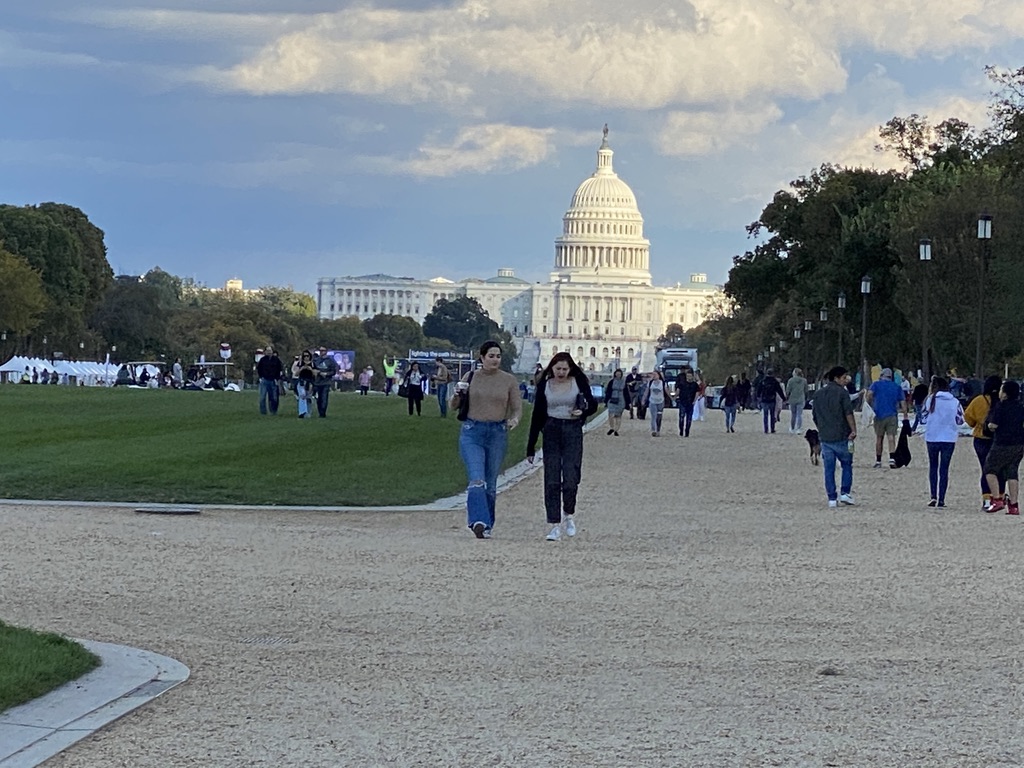
I also realized that while I’ve been to DC many, many times, I’m usually there for meetings, work, etc. and sometimes add an extra day, I’ve never been a “tourist” in DC… so I’ve been looking forward to this.
Following our delightful time at the Willard, we went back to the hotel to freshen up and off we went to Tail Up Goat – a neighborhood restaurant with a Mediterranean menu. Food was fantastic.. We opted for all small plates: scallop crudo with watermelon radish and apples; baby honeynut squash with some kind of dill yogurt and chili crunch; duck breast with charred cabbage which had mint and sumac glaze; pork agnolotti with rutabaga and rosemary. Given that we had walked about 6 miles, we determined we deserved dessert (a really good decision – some kind of toasted corn cake with paw paw custard and madeira wine). We strolled back to the hotel… A good first day.
Sunday, October 24
Following a quick breakfast at the Line, we taxied to the African American Museum where we had reserved tickets for early entry. The taxi ride began a series of conversations with predominantly Ethiopian drivers who are happy to chat if you start the conversations. We learned that they really don’t like Virginia drivers whom they feel don’t understand cities and drive like the suburbanites they are. They also feel DC is very calm now with Biden – no big demonstrations and “no craziness” as they stated they experienced every day with Trump in DC. With Biden, they feel he is “sleeping” all the time, but they prefer it this way. The museum is quite wonderful with an enormous number of exhibits that range from cultural to political to historical to food, culture, music, theater, and more.
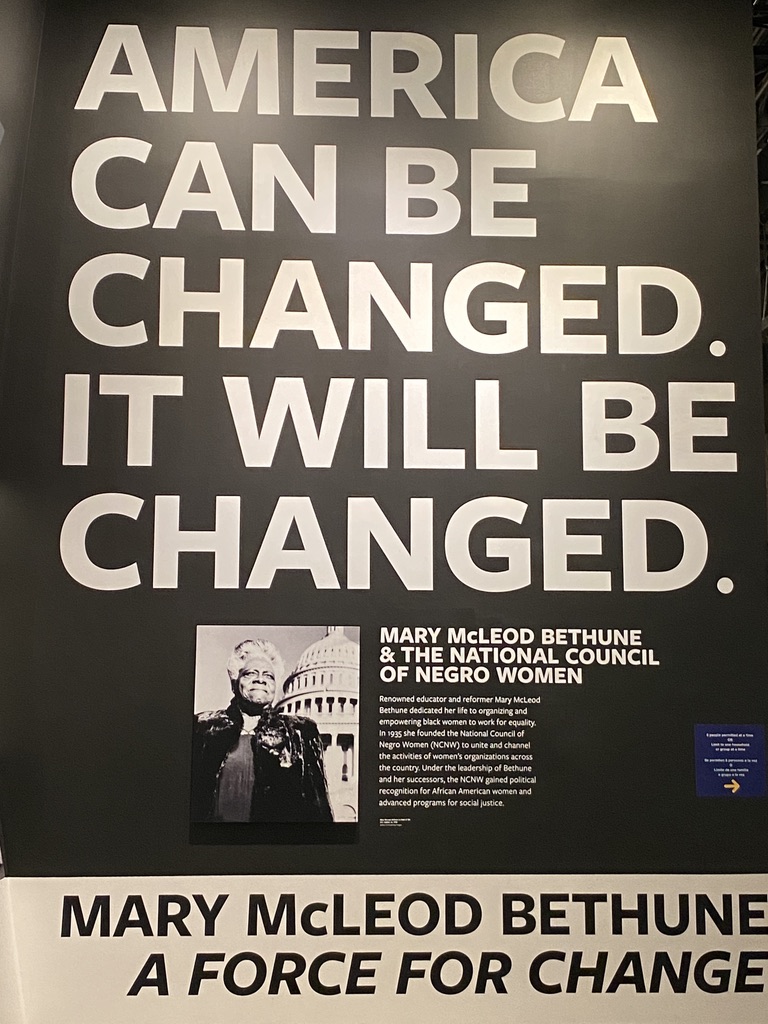


My only disappointment was that there wasn’t more effort to make the museum more interactive and to force visitors to immerse themselves in the culture as well as the reality of daily life..
From the museum we walked to a little nonprofit restaurant called Immigrant food where we had wonderful shakshuka and salads.
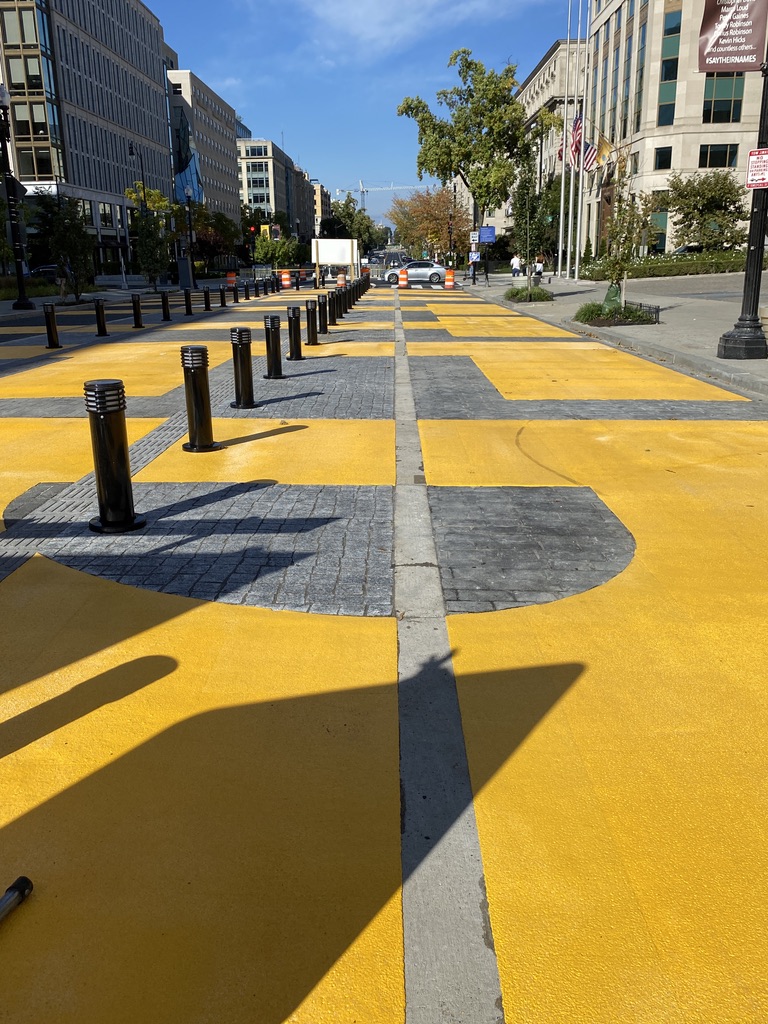
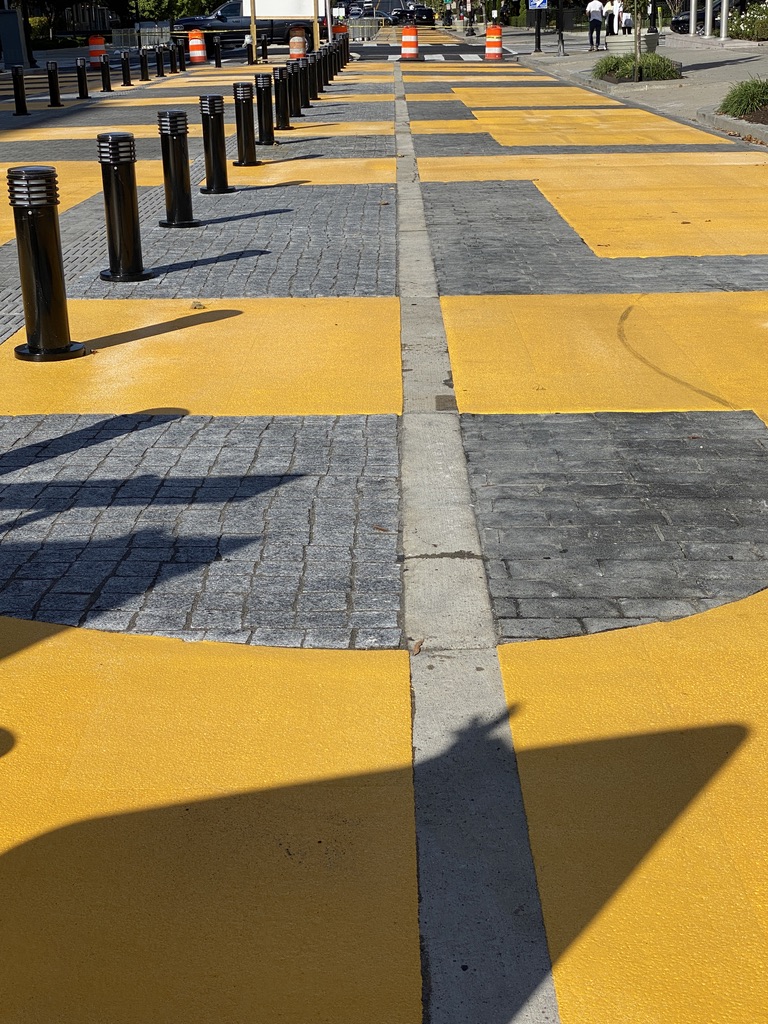
Then it was on to Black Lives Matter Plaza, passing the White House and other official buildings… and then on to Planet Word – a very sweet small museum that focuses on the history of language with very creative and participatory exhibits. The elevator is totally book lined. (In the photo below, we are inside the elevator.)


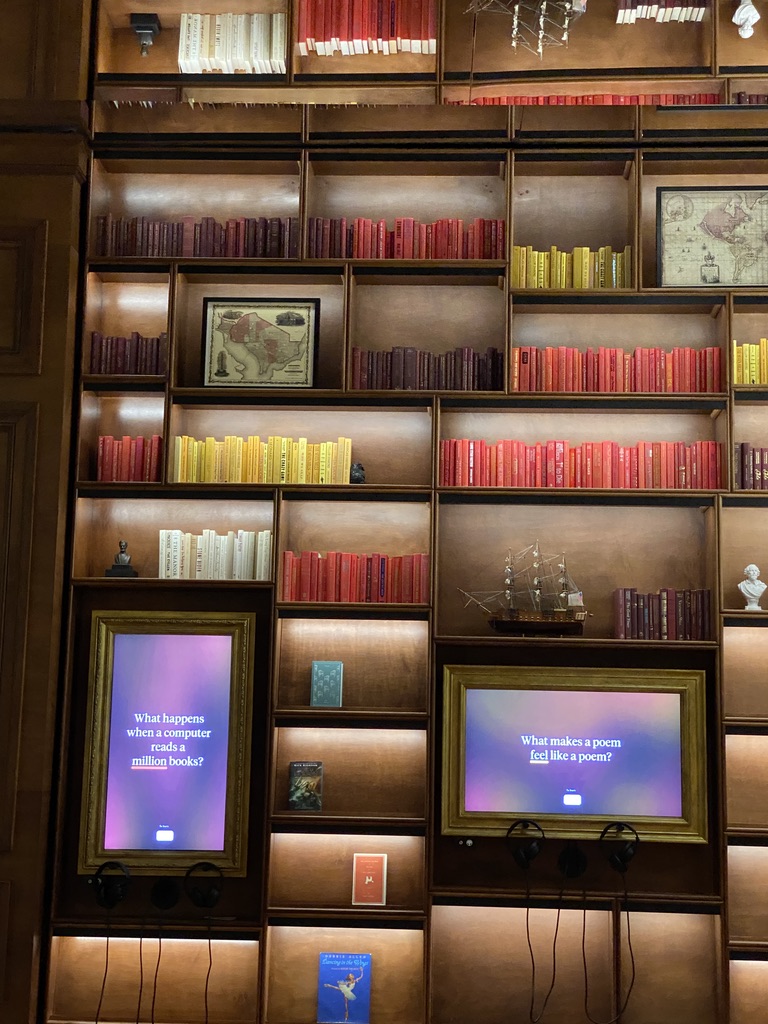
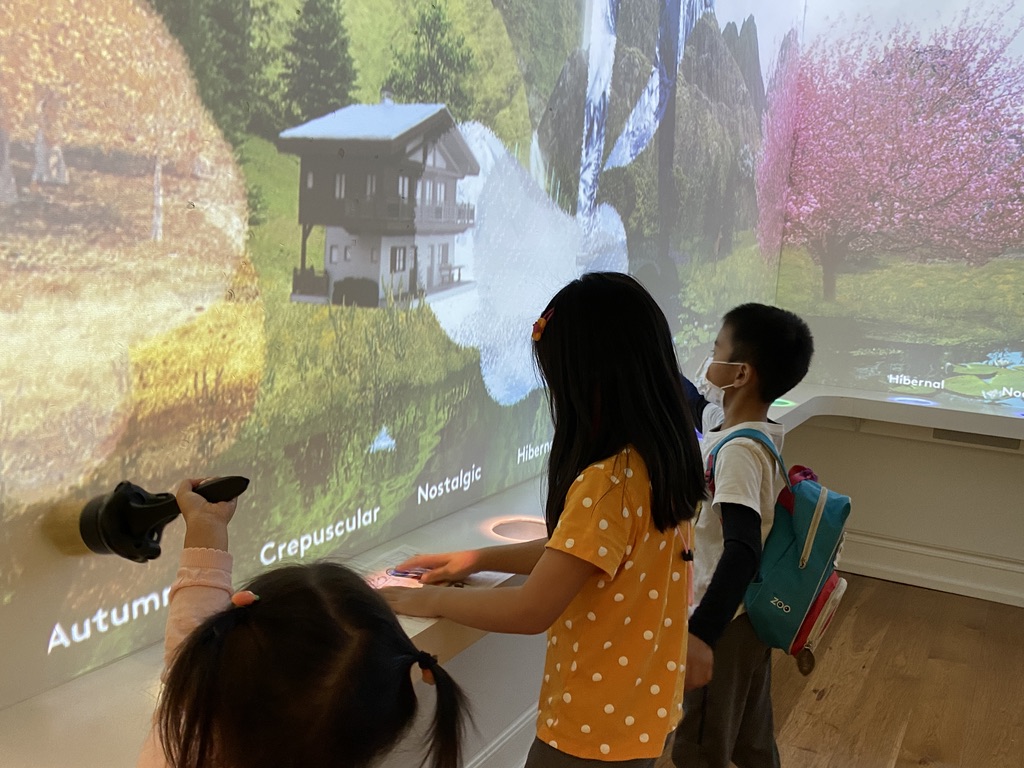
According to my exercise app, we are averaging between 6 and 10 miles per day walking.
We then strolled the streets and stopped at the Hamilton Hotel for a much needed glass of wine and watched both the preparations for a wedding at the hotel and also the skies turn grey as rain approached. We hopped into a taxi and headed for the hotel. Dinner was at the Albi – a Mediterranean treasure for foodies, located in the newly-renovated and gentrified area of the Navy Yard. Foodies, hold on…..
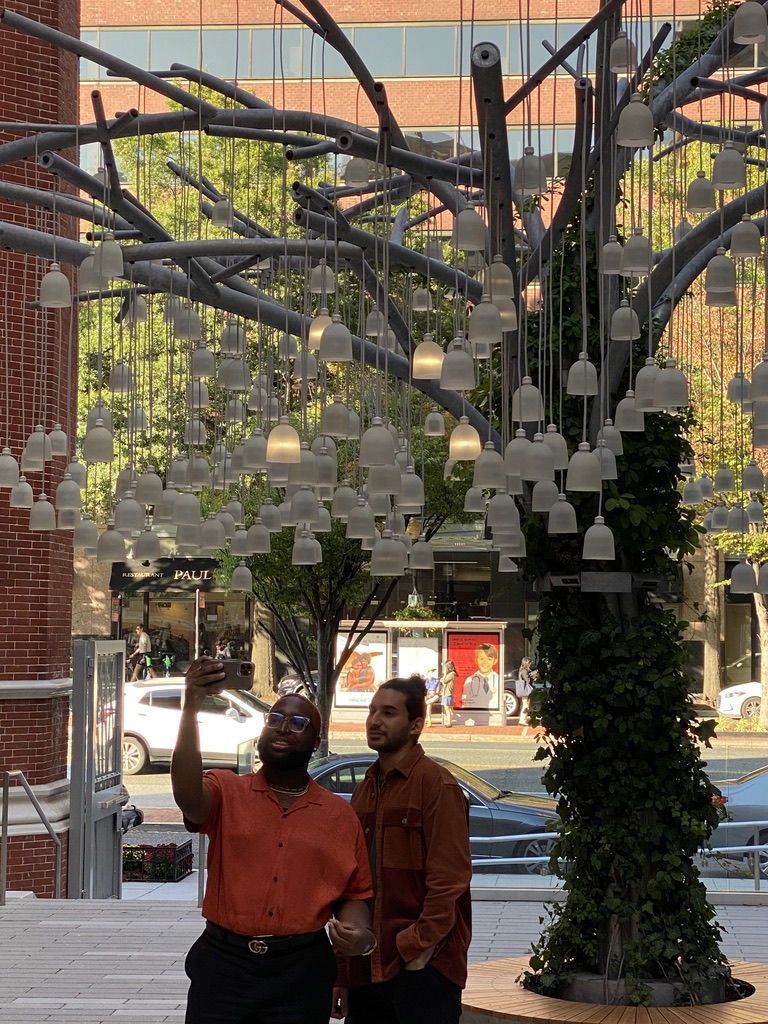

We shared a smashed pumpkin labneh with pecans and shaved apples; yellowfin tuna with bulghur, lettuces, mint, and a bunch of spices; grilled honeynut squash with muhamarra and some other things that were yummy; crab dolmas with corn, peppers, and garlic yogurt; and manti (which I savored all through trips to Turkey). We were tempted by several other dishes but needed to save room for dessert!! And it was well worth it.
Coming next… the remainder of the Washington DC part of the trip. We are well and having a great time.
Fern
Greetings from Oakland, CA- (sent on 1/17/23)
We landed at SFO on Saturday morning at 6:00 AM! By the time we gathered bags, went through customs, and found a taxi in the pouring rain… it was about 7:30 am when we arrived at our house. But we are now settled, and I just wanted to thank all of you for the many comments I got about the posts over the past 4 weeks. It was a good trip, with many highlights that forced us to think about the Middle East in different ways.
Anyway, to close off this series of posts… Following the usual, large, yummy, diverse Israeli breakfast, we strolled Akko one last time and left while it was drizzling… headed for a slow drive to the Tel Aviv Airport. Our flight would not leave until 1:00 AM (actually that would be January 14, sort of late night on the 13th as we calculated it). We needed to return the car at about 6:30 pm, so we had quite a few hours to meander and get lost while driving.

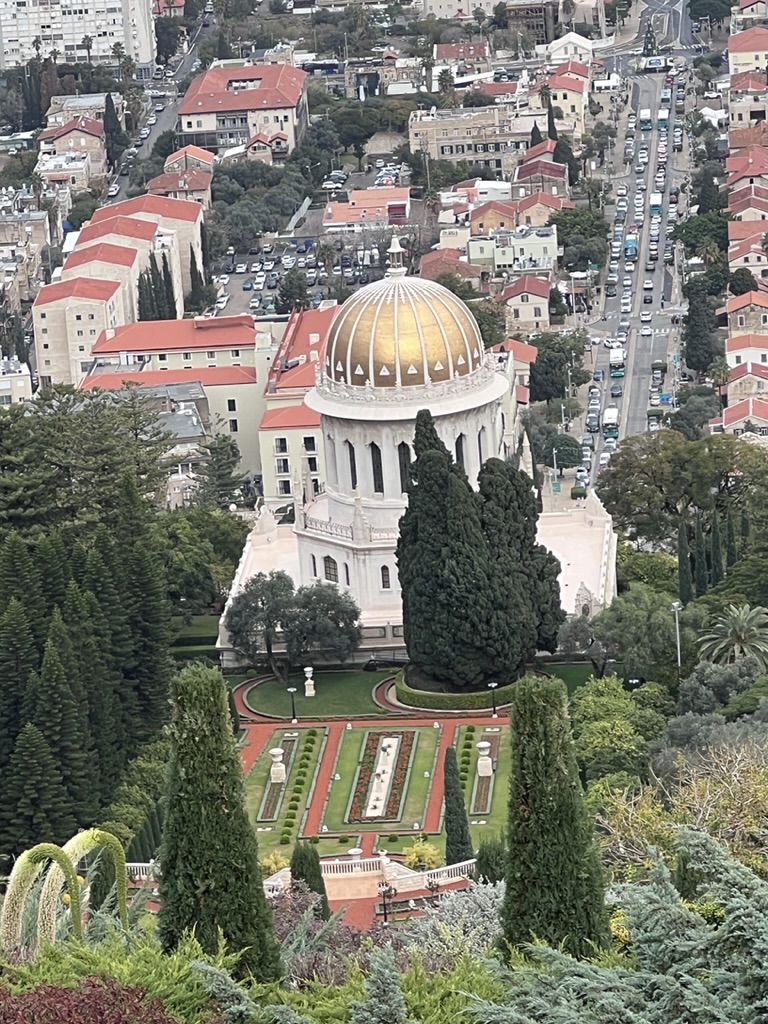

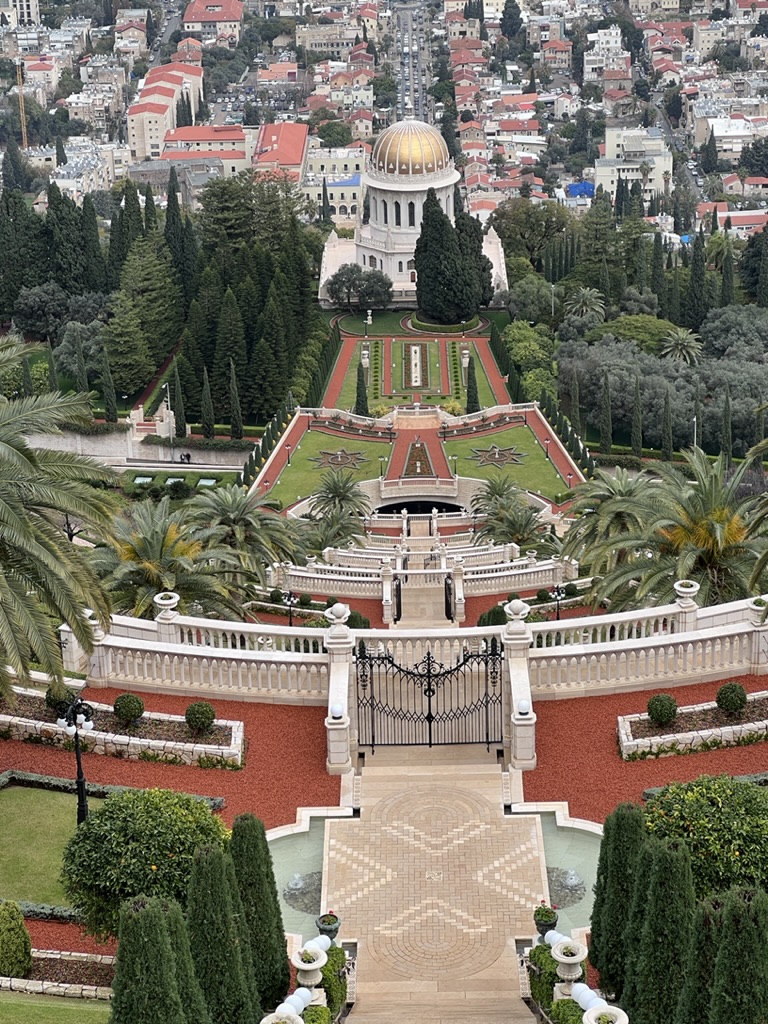
So, we avoided the “freeway” and took small roads ––first to Haifa to see the Bahai Gardens, located way atop the northern slope of Mount Carmel. It’s a series of nineteen terraces with a golden-domed temple (?) that sits on the central terrace. We took a lot of wrong turns to get there so we managed to see a lot of daily life on the streets of Haifa which was interesting. Haifa is the third largest city in Israel with a population of about 400,000. If I should ever return to Israel (highly unlikely, as I think I’ve seen enough and don’t really want to help Israel’s economy; perhaps if there would be a drastic change in Israel’s administration, a recognition of Palestine, and a return of settlement lands—we can dream, can’t we?), Haifa would be a good place to visit for a few days.
It’s a large industrial port city on the Mediterranean with a web of streets that twist, turn, and climb. It doesn’t have a classical “center” and I think most people probably just stop off to see the gardens which are truly magnificent. We didn’t do the walk down through the terraces as you needed a reservation, but we did park near the Louis Promenade which provides spectacular views of the terraces and gardens. They call them the “hanging gardens.”
As we drove through the streets, it felt pretty cosmopolitan. It’s described as a “diverse” city, although the demographics show that it is 82% Israeli Jewish and about 14% Christian and 4 % Muslim. Not sure how “diverse” is defined.
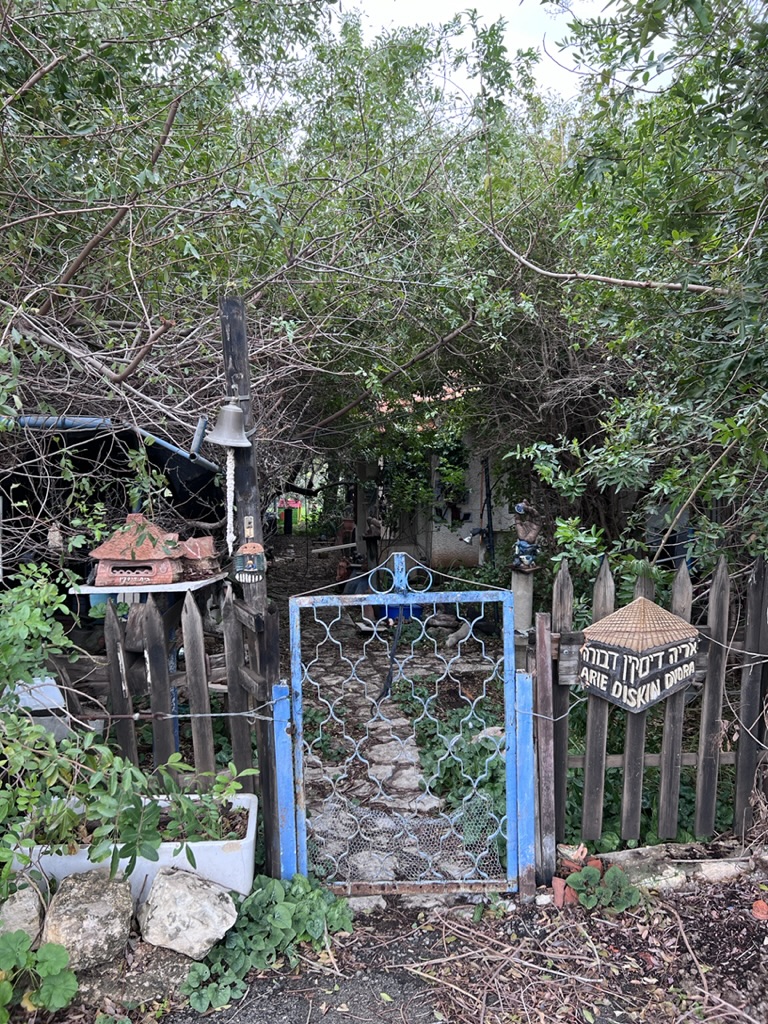


From Haifa we continued to drive south and decided to head to a town called Atlit (purely picked it out on the map rather randomly). It’s a small seaside town that appears to now have some new (architecturally designed) houses that are probably used as weekend get-aways for Tel Aviv urbanites. It’s also home to artists and funky residents who have some very eclectic sculptures and found objects all over their yards. The latter group have obviously been residing in the area for decades, as witnessed by the age of the houses and the weathered sculptures. Wonder how those old-timers are taking to the new, hip, homeowners with much bigger and fancier homes!
We also made a pit stop at Zichron Yaakov, which is a pretty new city with what appears to be an upscale community. It’s close to Israel’s high-tech industry and also has wine growing enterprises. Our plan had been to have a late lunch in Zichron Yaakov, given that we wouldn’t be eating until well after midnight—on the plane. We arrived around 4:00 pm and most streets were deserted, and cafes and restaurants were mostly all closed. Given that our lifestyles don’t automatically trigger that Fridays and Saturdays (Shabat) mean most places are either shuttered or closing early, we missed out on eating in Zichron Yaakov. But we did sense a good vibe in the town. We kept driving and googling but every time we located a restaurant it was about to close. We eventually found ourselves at a mall… and dreaded what food we’d find. We settled for pizza, and it was a pretty good pie… or maybe we were just very very hungry so our taste discrimination was at an all time low.
Found our way to Tel Aviv Airport; returned the rental car which was simple compared to our return in Amman. Hung out at the airport lounge for about 5 hours and made our way back home.
Thanks for all the comments and encouragement to keep up the posts. Hope all is well with each of you.
Looking forward to catching up.
Fern
25. Akko, Israel… Amazing Serendipity. 1/12/23

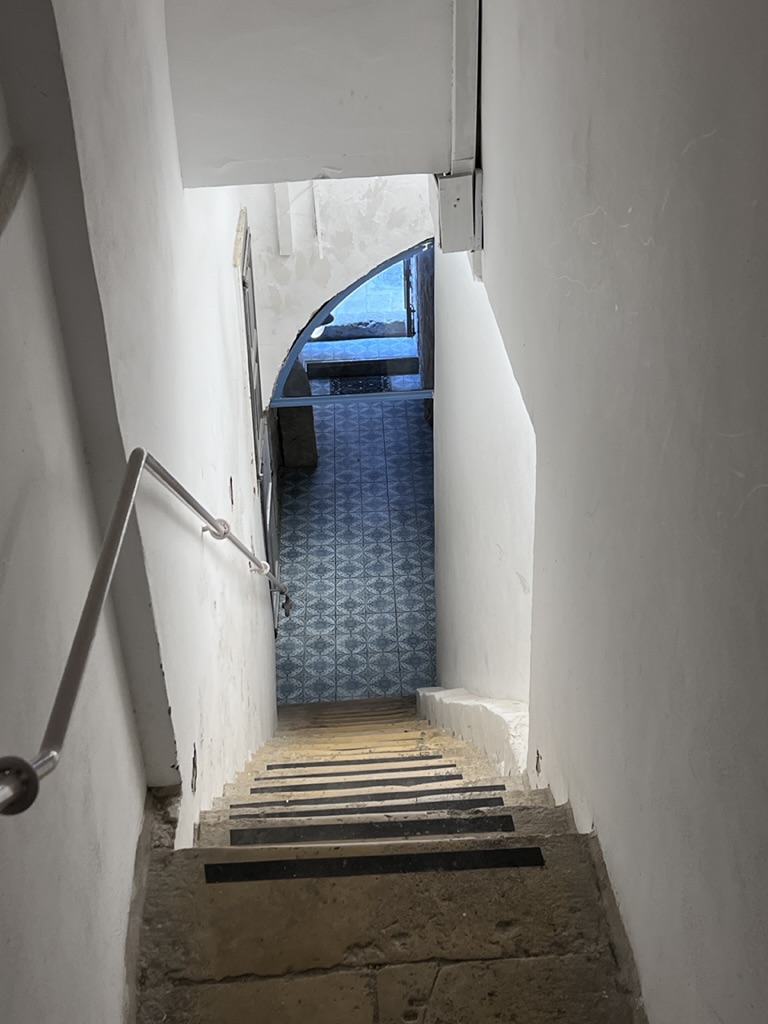
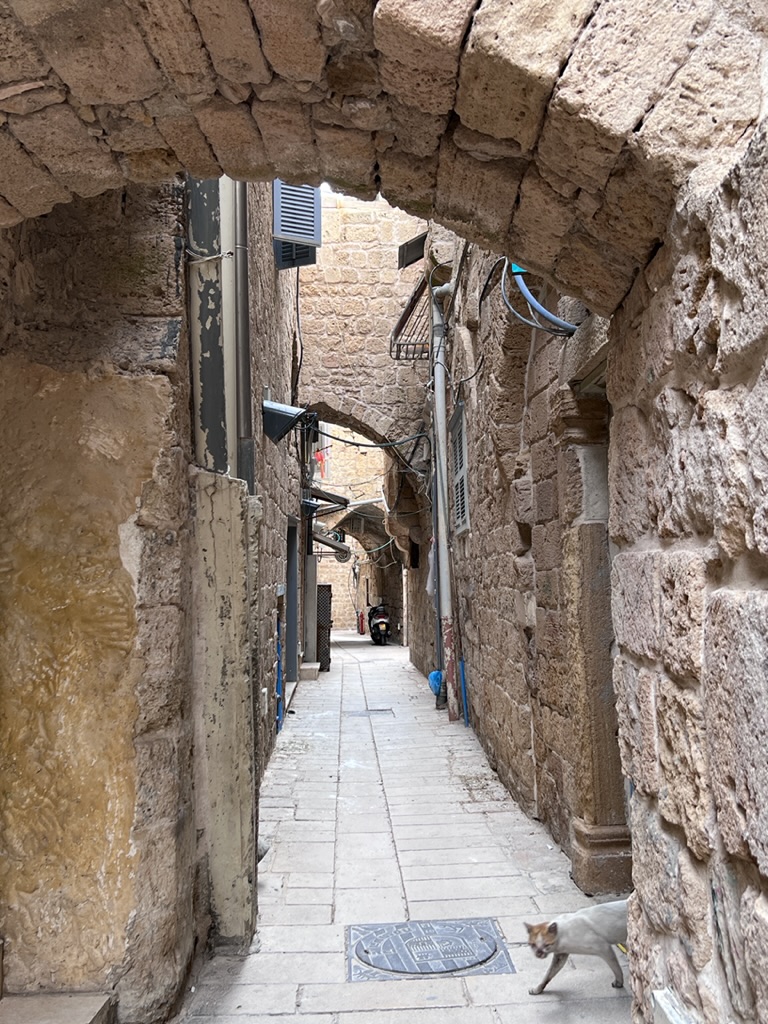

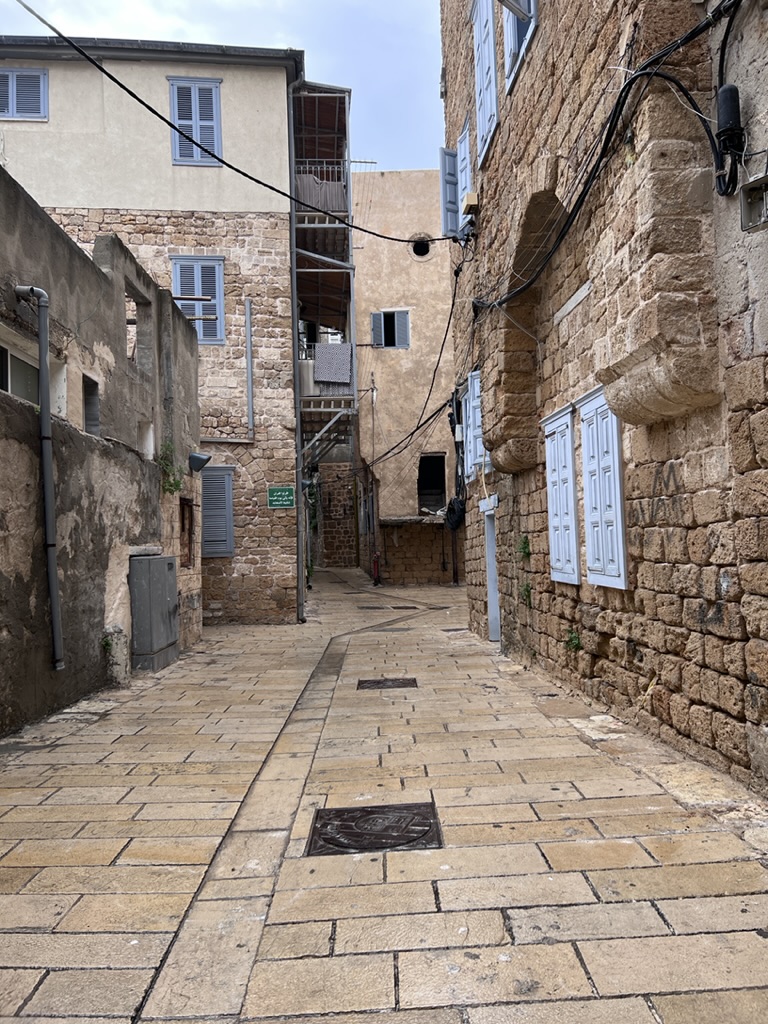
Today we strolled the little alleyways and streets of Akko’s old city, walking through market streets and more market streets.. Oh, we also walked through the underground tunnel (The Templar Tunnel) which was built by monks called “solitary soldiers.” They were the ones who took care of the temple (hence the name ‘templar’). They also protected the Christians who came to the holy land. The templars dug the secret tunnel right under the houses above; the tunnel connected to the Citadel and to the port. It was discovered only in 1994! Water still flows through the tunnel.
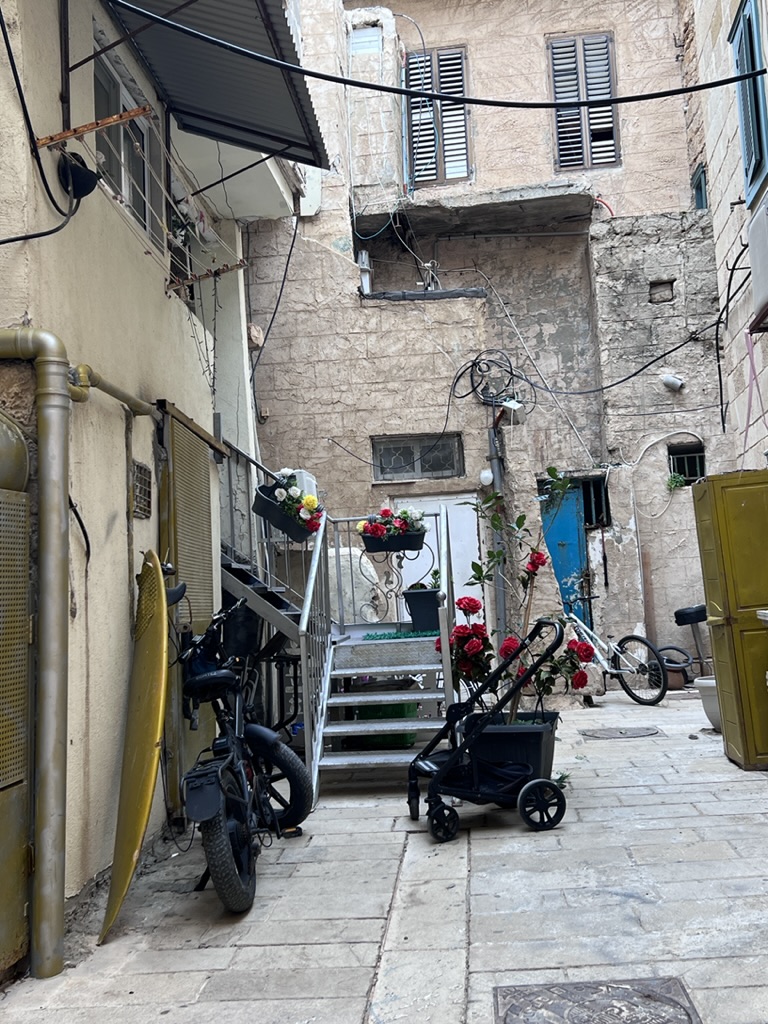
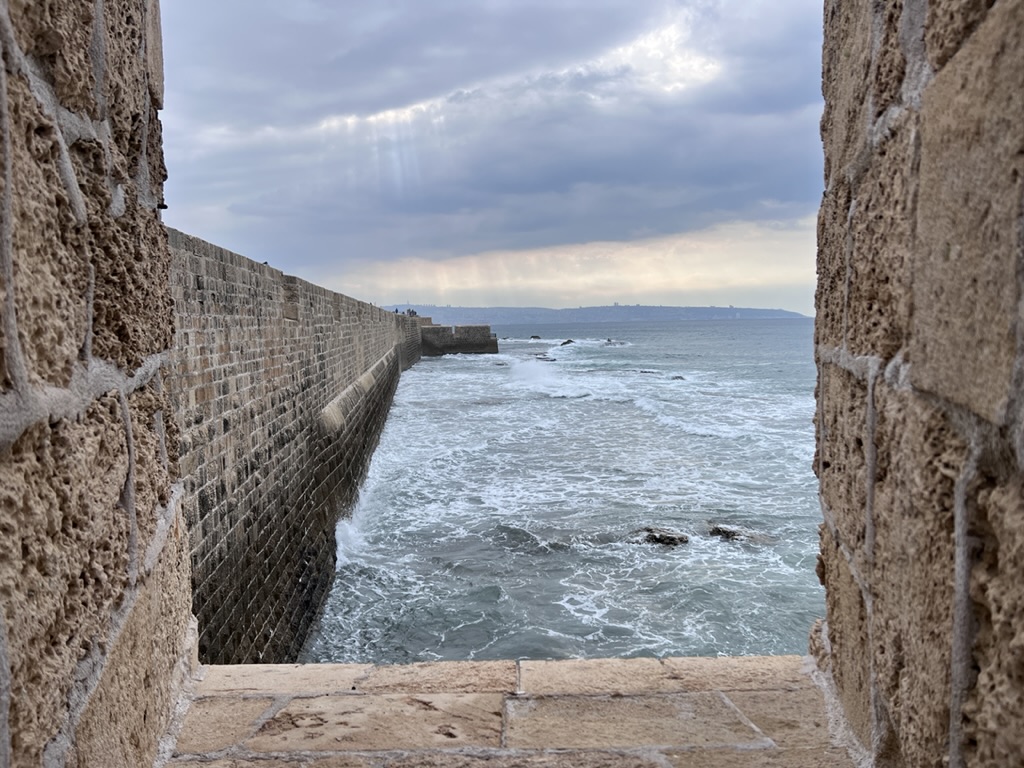
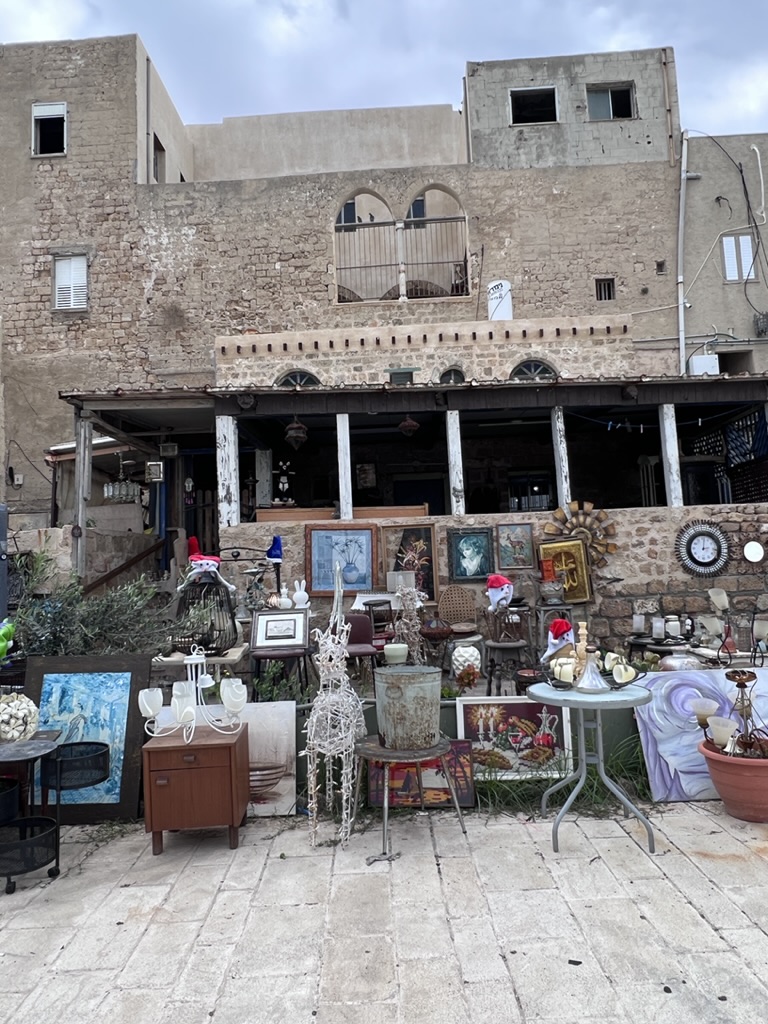

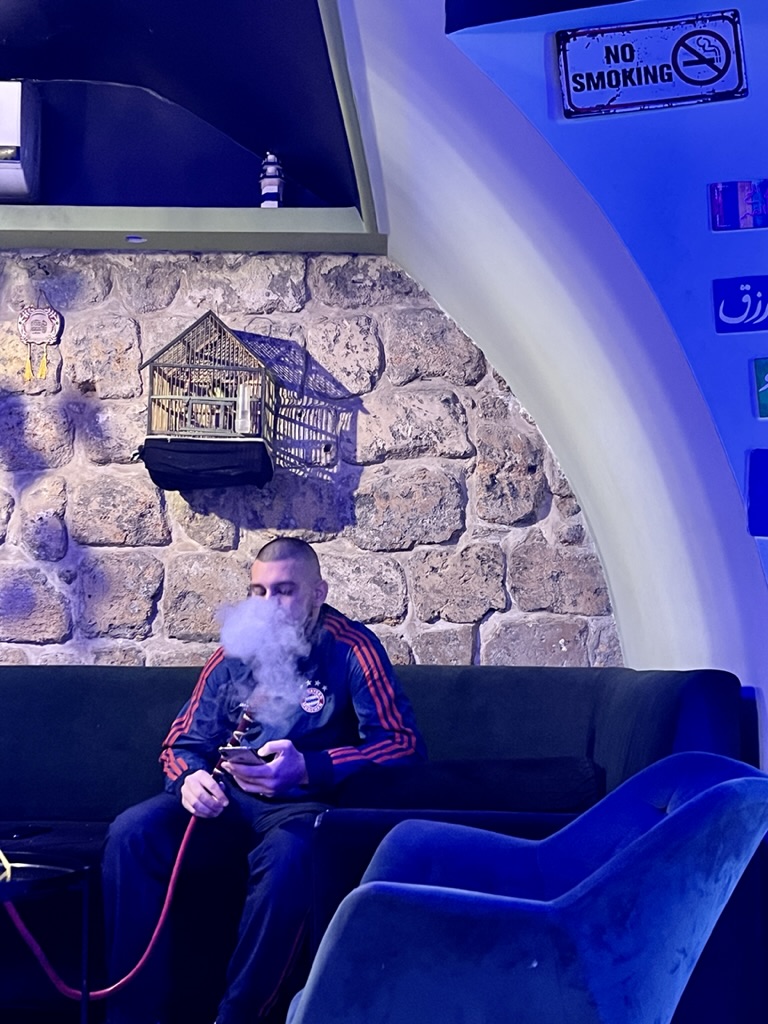
As we strolled, the skies kept getting darker and it began to rain. At first it was fine, because we were covered by whatever covering was in the markets—plastic, roofing, etc. But then it started to rain much harder and we were getting soaked, so we looked for a place to get shelter and maybe some mint tea. There are tons of tiny restaurants, but we really weren’t hungry and didn’t want to take up table space. Finally, we saw a tiny “café” which served coffee (which we don’t drink) but we thought we’d go inside and maybe they could make us tea. It was all men in the little shop, which was very dimly lit, and once inside we realized that most of the men were smoking shisha in hookahs. But we asked the guy who was making some kind of food if we could have tea and so we were fine…sitting in big comfortable couches having our tea and staying dry.


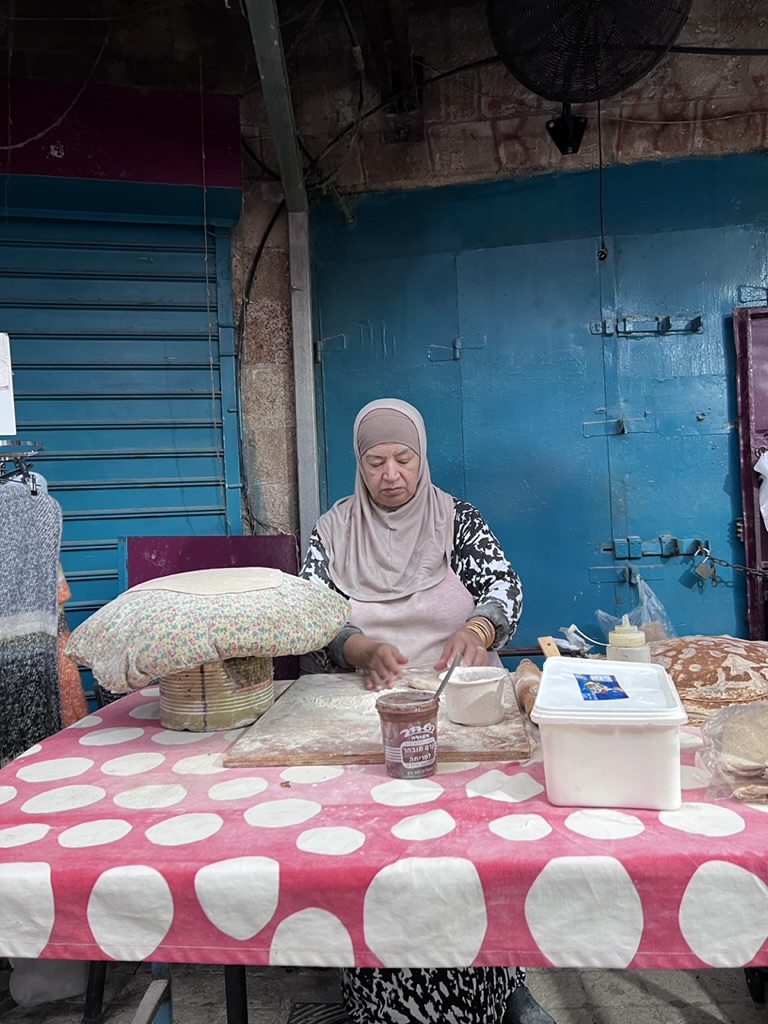
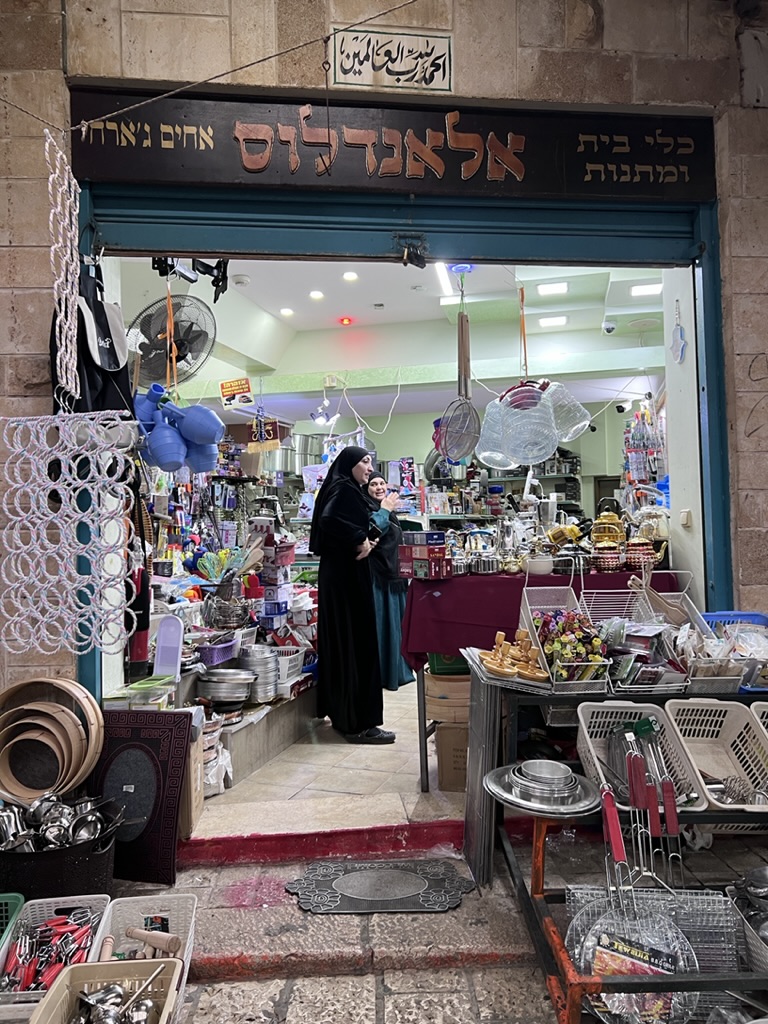
While we waited for the rain to stop (each of us playing Spelling Bee on our phones), a 60-ish year-old man came over and asked where we were from, speaking fairly good English. Turns out he lived in San Jose for about 28 years; he’s an Israeli Arab, born in Akko. His mother was Jewish and his father Muslim, but he was raised Muslim. As we chatted, we found out more and more about him. He has three grown children (none of whom have ever been to Israel—which is disappointing to him—two boys (30 and 33) and one daughter (28); they all live in San Jose (and perhaps the wife as well; he didn’t say). He clearly knew the guys in this café well.
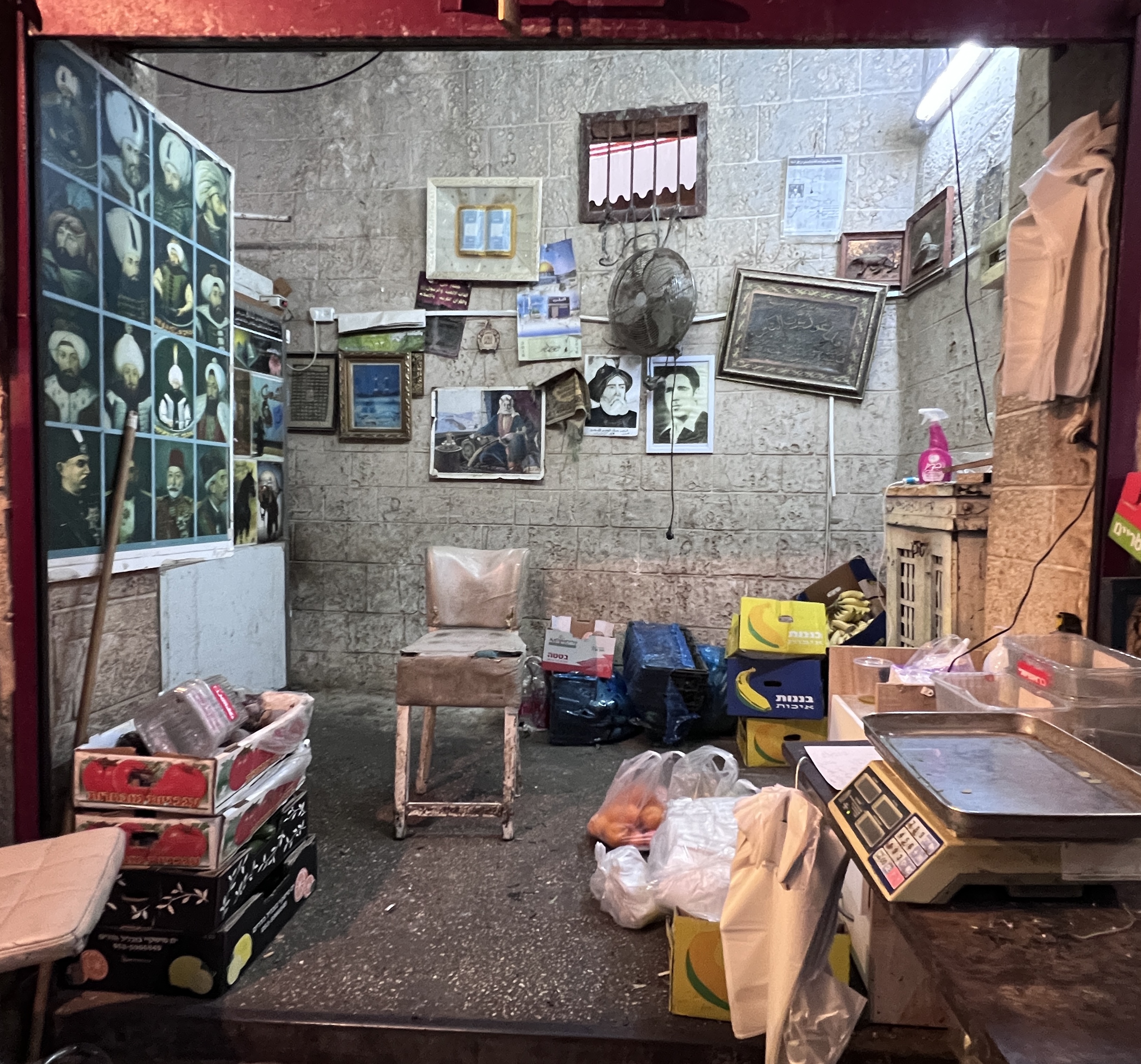
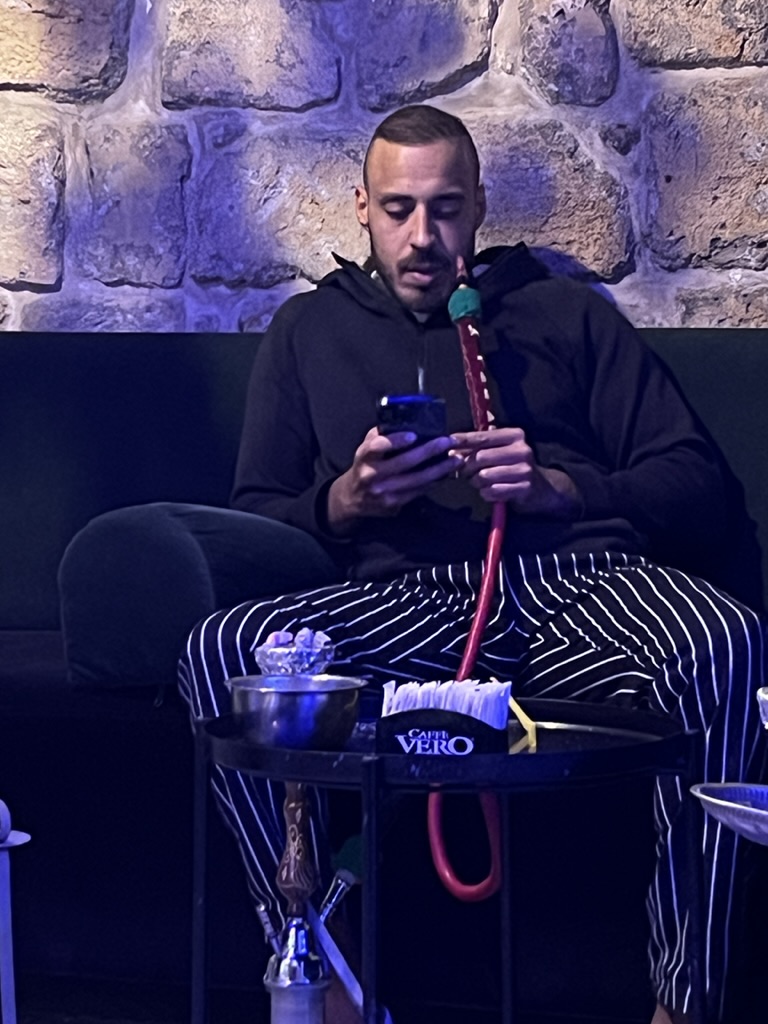
As we talked, he explained that he had built a construction business in San Jose, and he also started a very successful (high volume) pizza place there as well. Then he told us that when he was starting the construction business, he went door to door in many Bay Area cities looking for work and that he met a political woman whose name he said was “D’Angela (??)” He said she hired him to do work and then recommended him to her friends and he did a lot of construction and renovation work for this “D’Angela” and others, when the firm was really small. He said when he met this woman, he didn’t know who she was, but when he told others they explained she was very famous. After a few minutes we realized, he was referring to Angela Davis!!! His firm grew and took on much bigger projects, but he said he owed a lot to her. We also chatted a bit about ages; he guessed that Mike was 62 years old… so Mike was obviously in seventh heaven.
He asked us how we were liking Israel and where we have been. I told him where we’ve gone and about our time in the West Bank. He asked what we thought, and I was very honest with him. He nodded saying it was a terrible situation and he was glad he came from Akko because Akko was a “mixed city.”
I began to be more curious about this guy, Ibraham Baballah. He said to look him up on the Internet when we got home, but I started to google him right then and there. And as I did that, he said “You’ll find that I sued John Ashcroft (Attorney General in the Bush administration) and I won!!”
So, here’s the story (and frankly I remember reading it in the newspapers in 2003: Ibraham (our new best friend), sued the US government and was granted asylum and eventually American citizenship based on the suffering he endured as an Israeli Arab through persecution by the Israeli government and military. He didn’t go into detail, but it included not being able to find work in his field (accounting) and as a fisherman being attacked by the Israeli military on the sea. As a result of the judgement in his favor, he, his wife, and his oldest son who was born in Israel couldn’t be deported from the US.
Ashcroft had the discretion to deny the asylum if the family had a criminal record or posed danger to the US. But his record was clean. The judge determined that Baballah established that he had indeed suffered persecution based on his ethnicity and religion and that he had a genuine fear of future persecution if he returned to Israel. He testified that as the child of a mixed marriage he faced discrimination his whole life. He wound up a fisherman because of this discrimination and that banks in Israel would not hire him. The story is pretty complicated, and it was the fact that he had numerous, very specific incidents to point to that indicated and proved how he was discriminated and how he was treated in Israel, especially by the military. That convinced the judges in the 9th Circuit to grant his asylum request. His attorney was quoted as saying that the implications of this case show that “it doesn’t matter where people come from, that we as a nation are interested in applying our immigration law. Of course Israel is an ally, but if someone suffers persecution, we’re going to apply our laws regardless of where they’re coming from.”
And the American-Arab Anti-Discrimination Committee said “It’s important that a court has recognized that the Israeli state can be very abusive to non-Jewish citizens, especially Palestinian citizens of Israel.”
What serendipity! We go into some tiny shisha place with all men—just to get out of the rain—and we meet this guy whose story is so fascinating. After learning the story, we talked a bit more and were more open about our politics and his plight. He did not return to Israel until just a few years ago to visit and was a little nervous about what would happen at the border, He carries both an Israeli and a US passport. But all went well, and he has returned again.
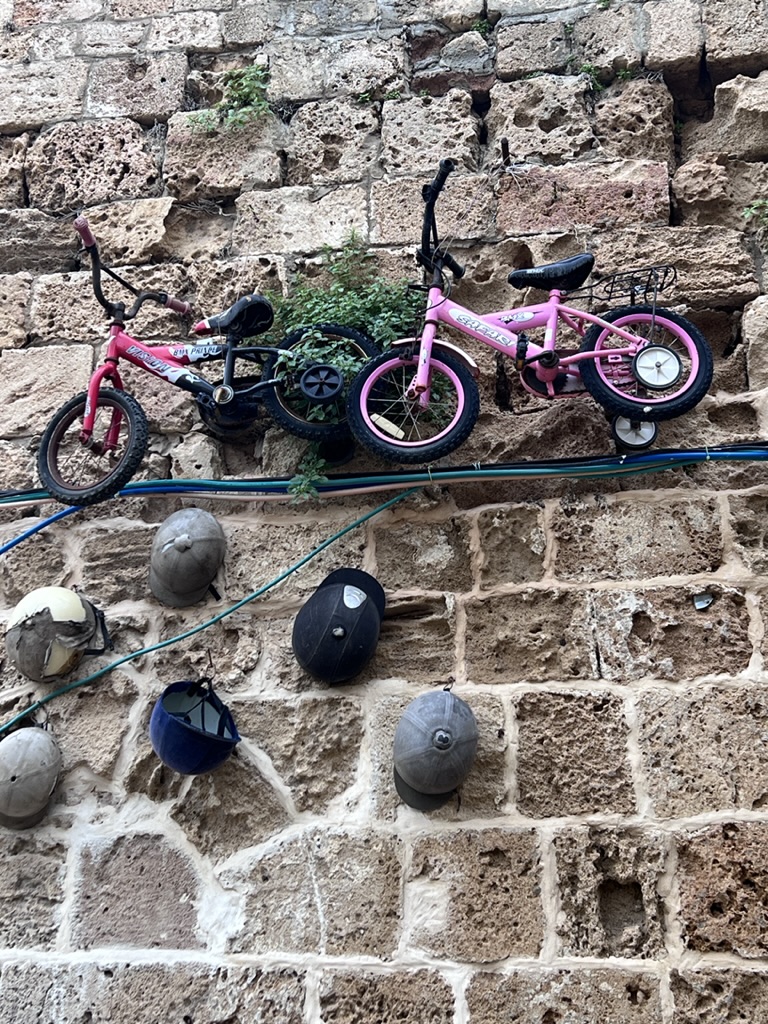
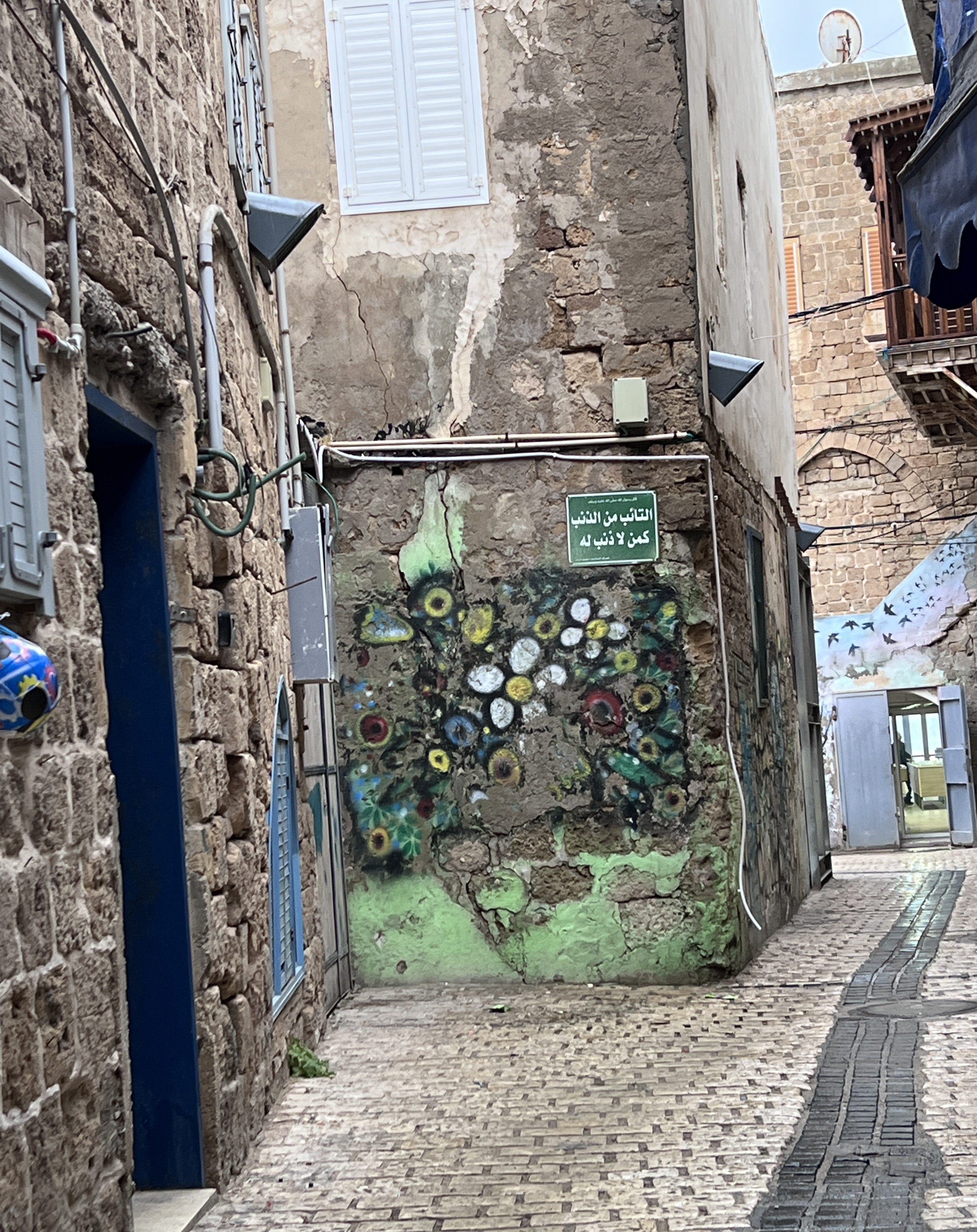
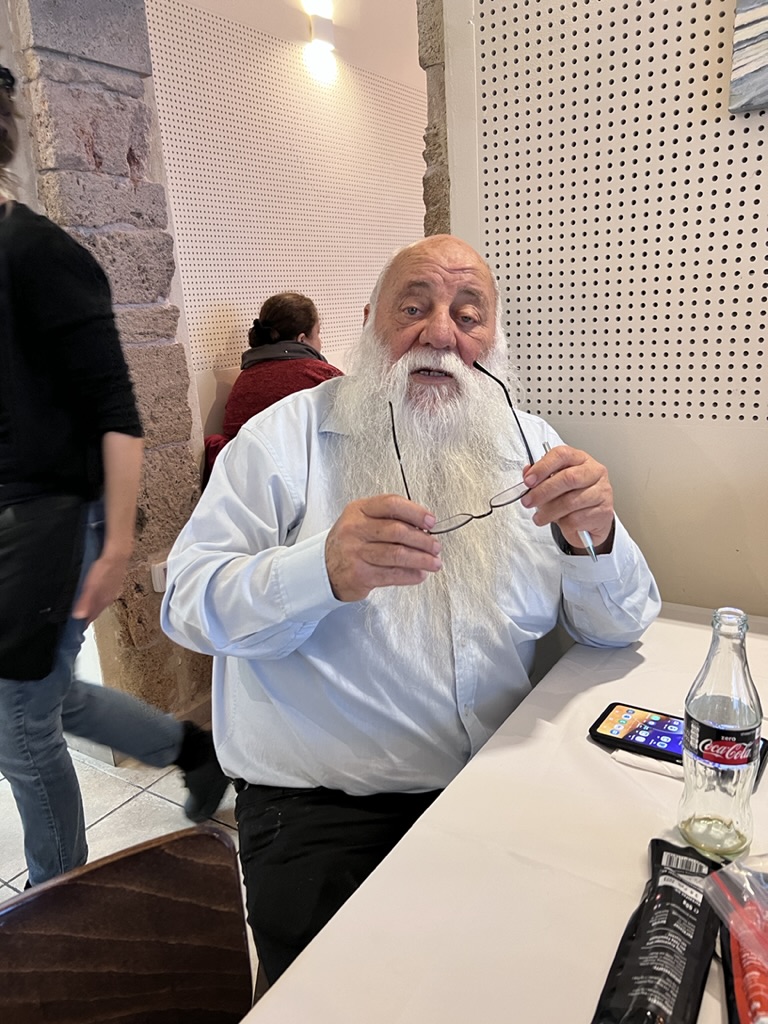
From there we continued to try to stay dry, and walked the market–dashing in and out of little shops and jumping from awning to awning—but to no avail. Anyway, despite the rain, we went back to Uri Buri because I decided I wanted to buy the cookbook (which has been published in many languages). Last night, I almost bought it but then realized it would be heavy to take back. While at our room, I checked online to see if I could get the book… but it’s out of print and the only copies available were about $250, because I supposed it’s rare? So today we went back and bought the book. For about $25. and there was Uri at a table—very willing to autograph it—thus the photo above of me, Mike, and Uri.

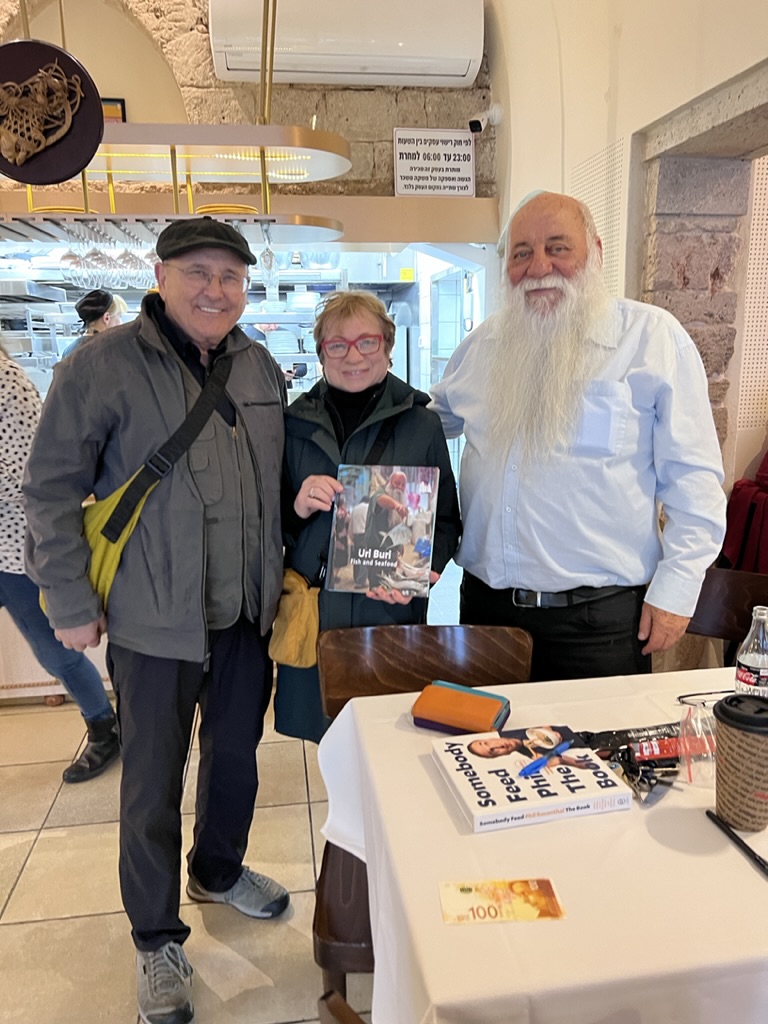
Tonight, we decided—our last real dinner in Israel (except for what we will eat at the airport tomorrow) we will eat again at Uri Buri… More on that tomorrow as I’m going to send this out before dinner.
Best –
Fern
24. Tel Aviv to Akko. January 11, 2023
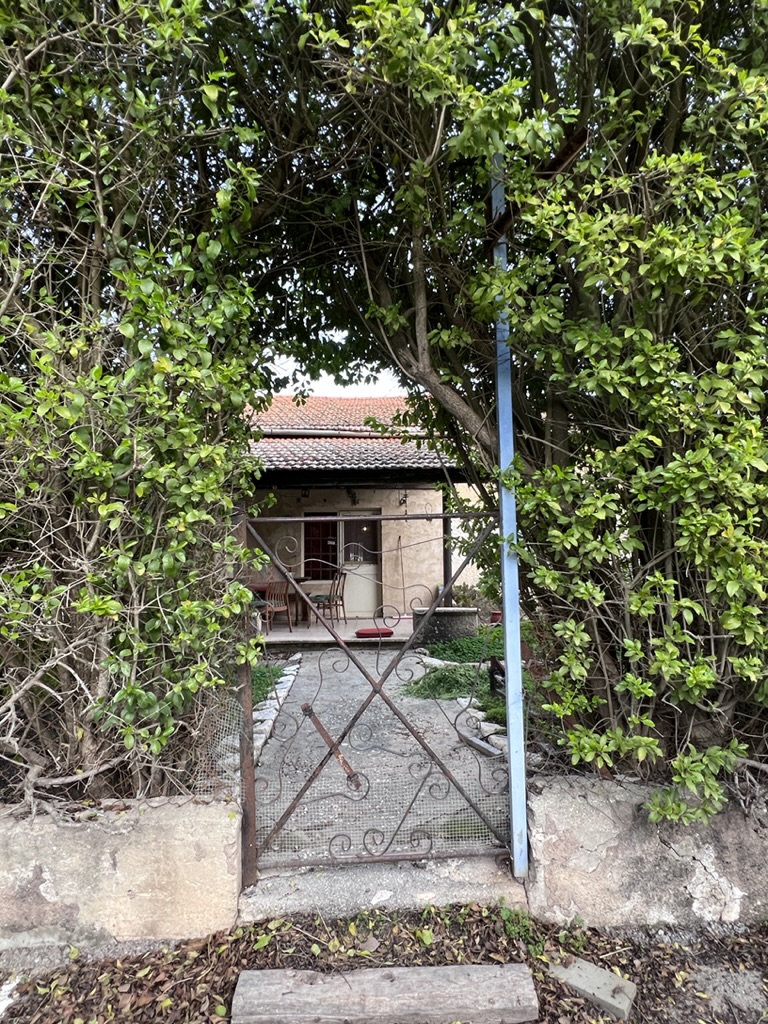
Greetings from Akko—an enchanting seaside city with a “mixed” population (as they say here—meaning that Jews and Arabs and Christians live harmoniously) and an eclectic and artsy town. We arrived a few hours ago.
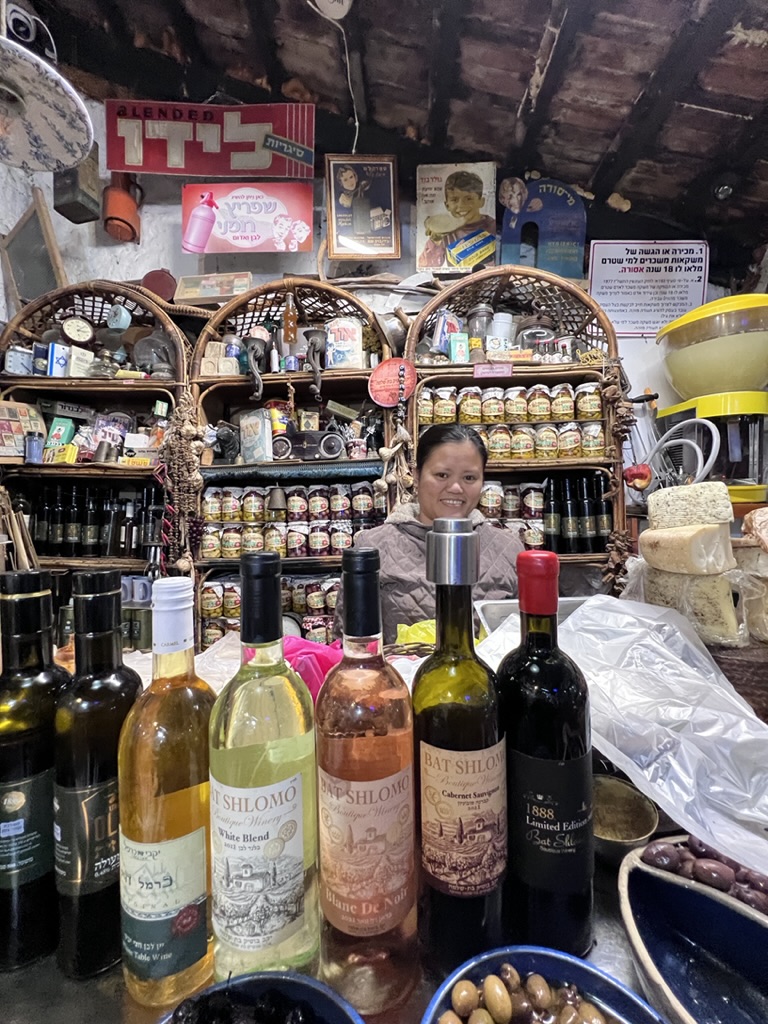
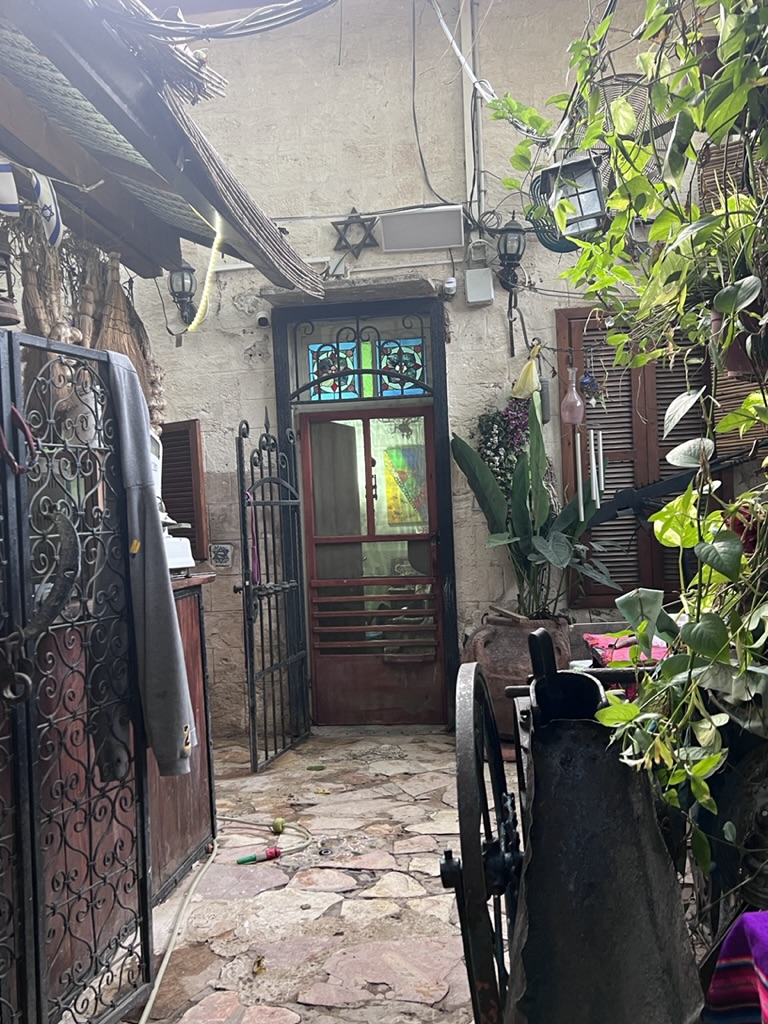
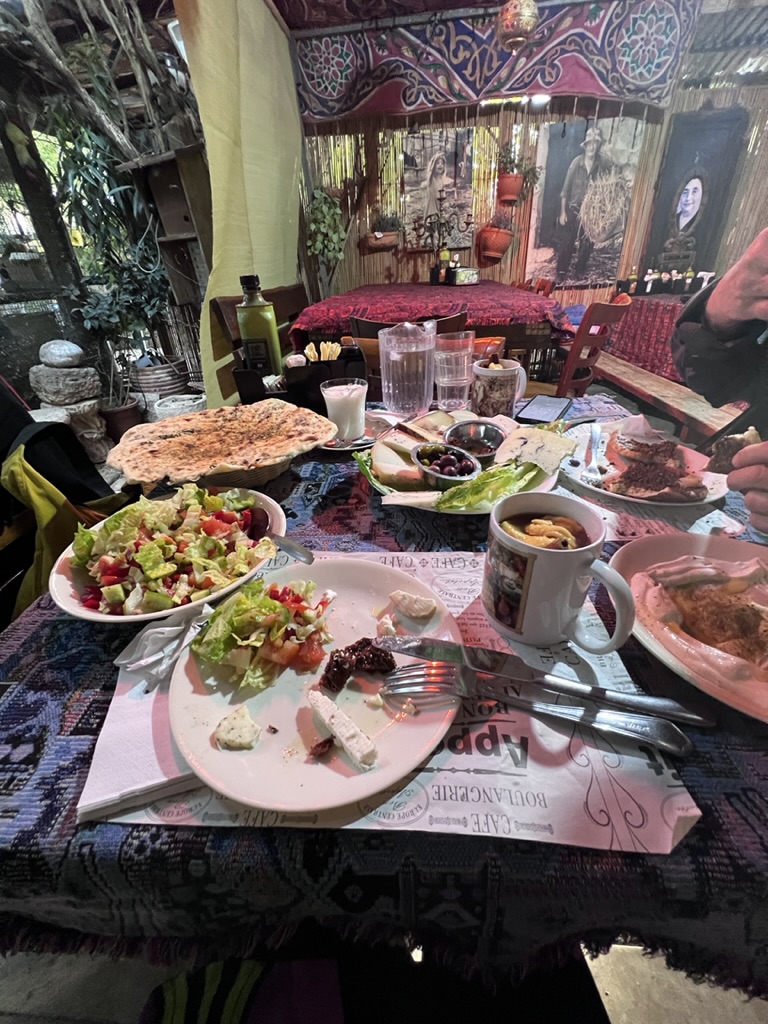
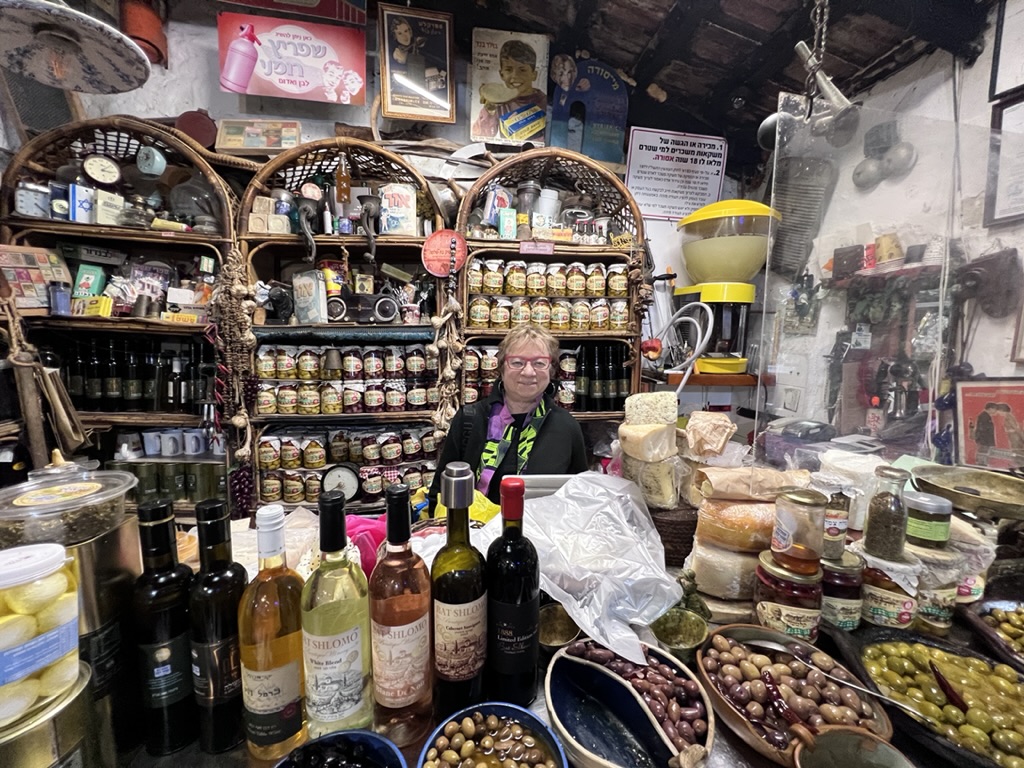
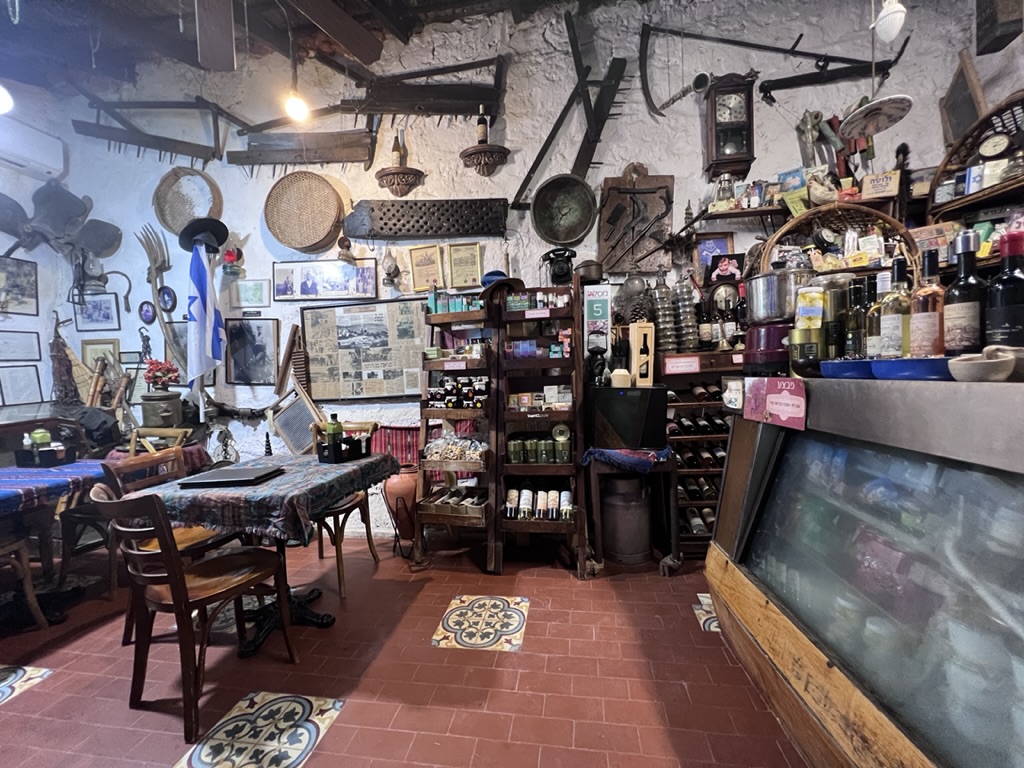
We began the day by heading to Tel Aviv Airport to pick up our rental car which took a lot longer than we anticipated. Finally got into the rental car at about 2:00. We had planned several stops between Tel Aviv and Akko, but traffic was a nightmare and as we inched along, we decided to head directly to Bat Shlomo, a really funky café (and I think the only enterprise in this little “village”). It sells homemade cheeses and other stuff. We settled on the mixed cheese platter which came with 8 different cheeses, sun dried tomatoes, grape leaves stuffed with cheese (naturally!), goat yogurt, labneh with spices, two different kinds of breads and a salad. We could barely eat half of it, but it was all wonderful and it was delightful to sit outside in this very eclectic garden adjacent to the little shop which is chock full of memorabilia of the family that came to Haifa in 1882 from Romania and is now run by the great grandson and his wife (who is Filipino) who live in the original cottage next to the shop.


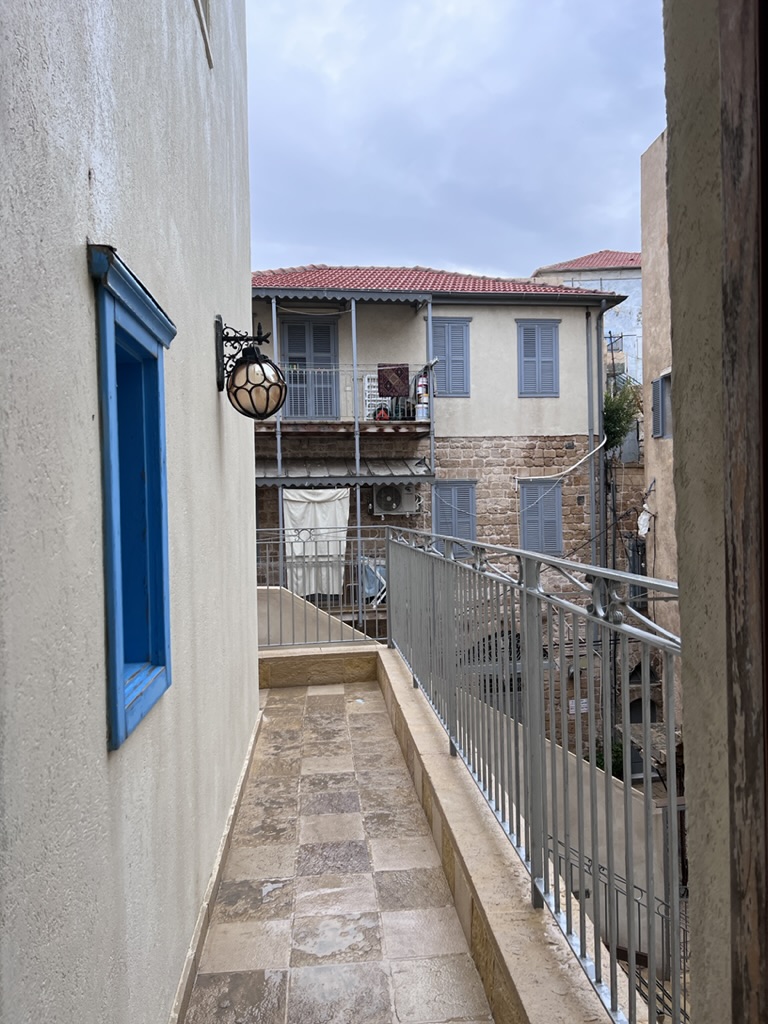
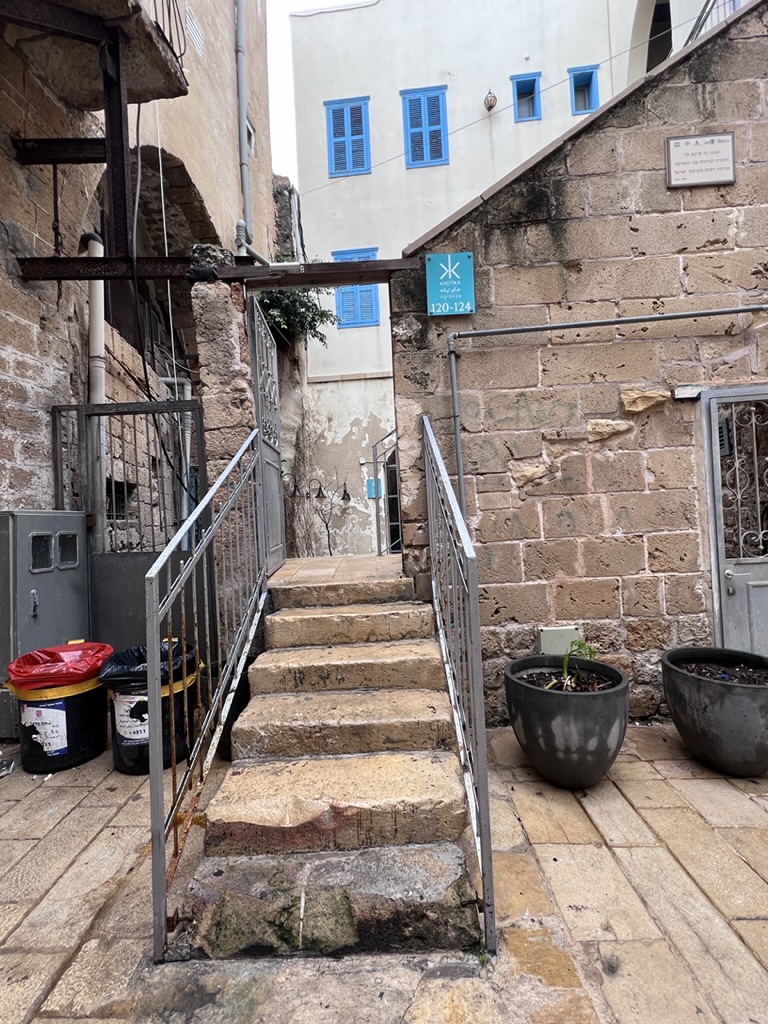
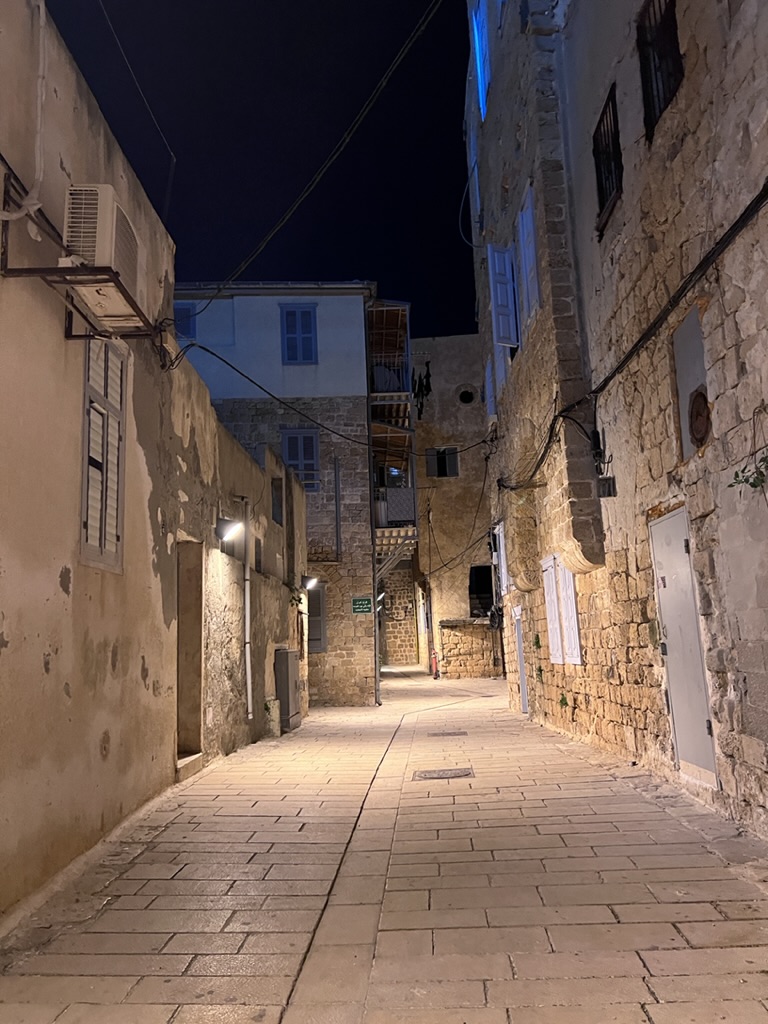
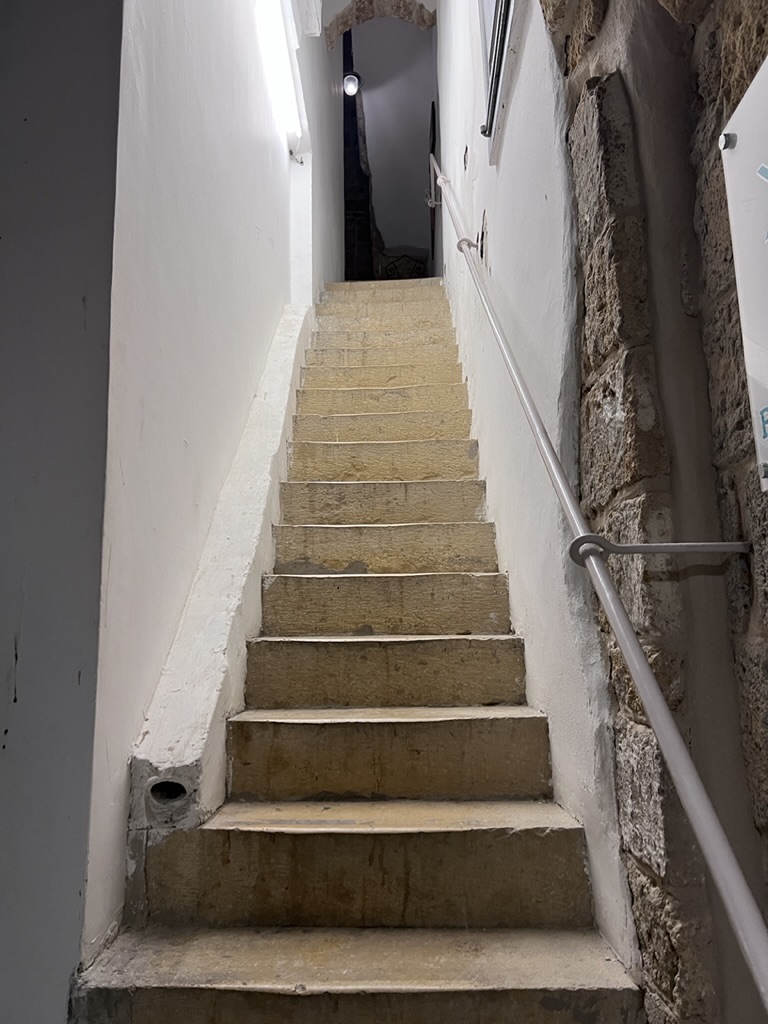
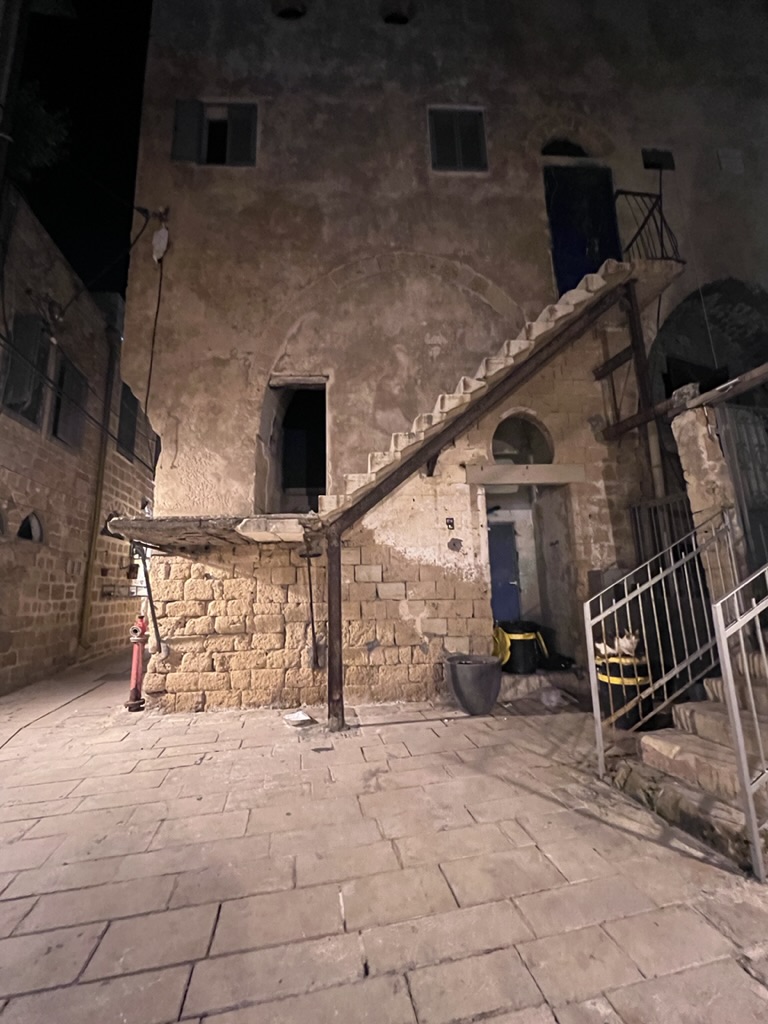
We made some decisions about dinner (where to eat dinner is a very important daily decision). We decided to go to the Uri Buri Restaurant which is only about a 10-minute walk from where we are staying in the Old City. More on that in a minute… Akotika is an interesting hotel in that there really isn’t any hotel building. There is a reception building whose stones that form the walls and arches date to the crusades. But the rooms are scattered into existing buildings within the old city. We have a large room with a terrace (although we have not used any of the terraces in any of the hotels we’ve stayed at because it’s been too cold), a large bathroom (as well as a freestanding clawfoot tub in the bedroom). We are on the second floor, which requires walking up and down about 50 stairs that are pretty steep and not always even. Fortunately, there are railings for most of the ascent. Breakfast is served on the roof of the reception building which requires ascending (and descending) about 90 stairs that are very steep. But the view and the food are worth the climb.

Uri Buri is one of those restaurants that are mentioned by chefs when they discuss Israeli food. The owner is Uri Jeremias and he has an iconic long white beard, so you’d spot him anywhere (as we did while walking around town the following day). The menu is all fish; after all you’re at the sea…why would you think about meat? The restaurant is in the first row of buildings from the sea. Foodies such as Anthony Bourdain and Ottolenghi have eaten at Uri Buri and have mentioned it in posts. He is considered one of the founding fathers of modern Israeli cooking. Supposedly he got his passion for cooking and food while traveling in India, most notably Goa, where he realized the importance of fresh fish and what to do with it. Apparently “buri” is the Hebrew word for “mullet.” The philosophy of the restaurant from the start was that to serve only food that Uri would eat, which was the fish near the restaurant and to use as few ingredients as possible (maximum 8). This was in 1988. So, it was minimalist cooking, I suppose… olive oil, garlic, chili pepper, lemon, and other herbs.
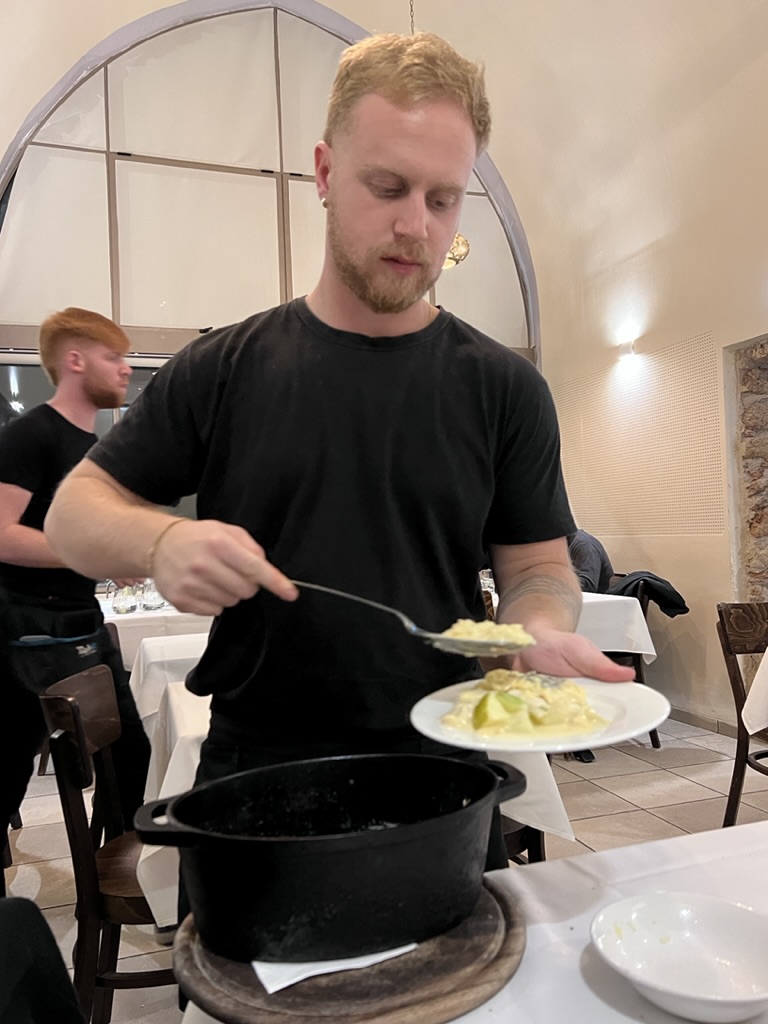
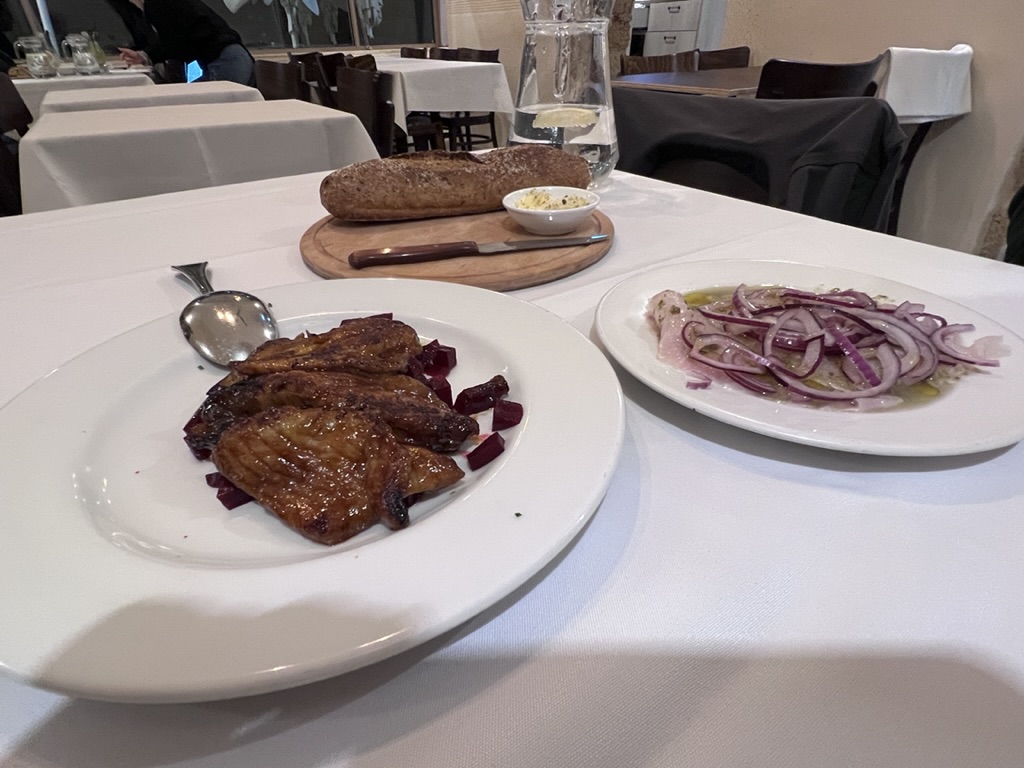

The waiter told us that all the fish they serve is caught that day or a couple of days prior if they are brining or using other methods that require time for marination or other preparations. The restaurant is small, so when you make a reservation they make it clear to call if you change your mind. Anyway, we had a great meal—shared two starters and two half-portion mains. The mains were sea bass in a cauldron (that included coconut sauce, chili, and apples; and a shrimp dish cooked in a cast iron pan with olive oil, garlic, spicy pepper, lemon, and coriander. The starters were: baby St. Peter’s fish in caramel with beet cubes; and the ceviche (meagre?) For dessert we shared the kanafeh (alongside of which was a scoop of rosewater ice cream and a scoop of cardamon ice cream. OK.. enough on food.
Good night… More tomorrow
Greetings-
Here is the second part of the very powerful adventures in the West Bank.
After leaving the shameful display of the occupied city of Hebron (which, as a friend said “Every American Jew should be required to visit.”), we headed to the West Bank city of Bethlehem which is surrounded by walls—many of which are covered with graffiti.
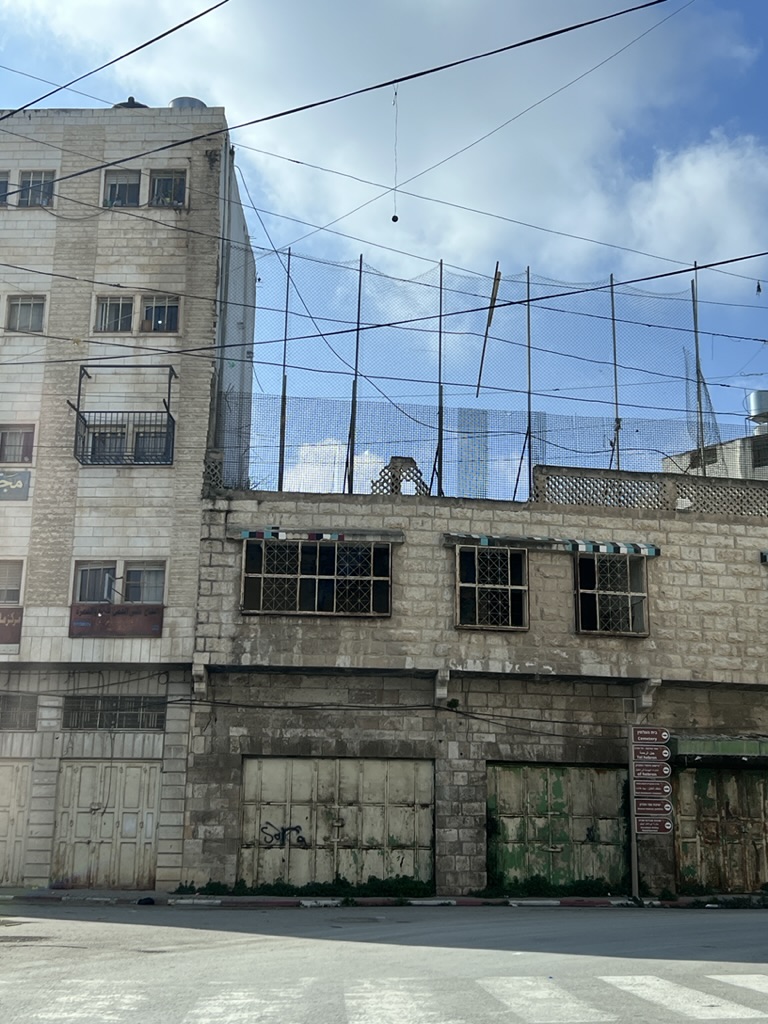
But first one last explanation of Hebron—I believe it is the only Palestinian city that has Israeli settlements in the middle of the city itself. These settlements are choking the old city of Hebron to death. That old city, traditionally the center of Palestinian life is completely filled with barriers, closures, military zones, Israeli soldiers carrying assault weapons (generally drawn and ready to fire) and settlements. It’s created so much fragmentation in the city that it is actually difficult to understand the plan of the Old City .. and it appears that Israel is just trying to eliminate the history and life of Hebron and turn it into a Jewish quarter. The occupation policies do not allow freedom of movement and as such, the social and economic life for Palestinians is destroyed. Israel’s political/military strategy protects and expands the Jewish settlements in the surrounding hills, leaving the “real residents” of Hebron (the Palestinians) helpless and without any economic structure. What was interesting as we drove into Hebron was that there appeared to be plenty of land within Israel’s borders to build housing and “settlements,” without going into the area of Hebron. Frankly, I was embarrassed to be a Jew on this day. I felt like I was witnessing Apartheid. There is nothing “normal” about life in Hebron, for either the Palestinians or for these Jews who live in these ridiculous fenced-in settlement communities.
Onward to Bethlehem…
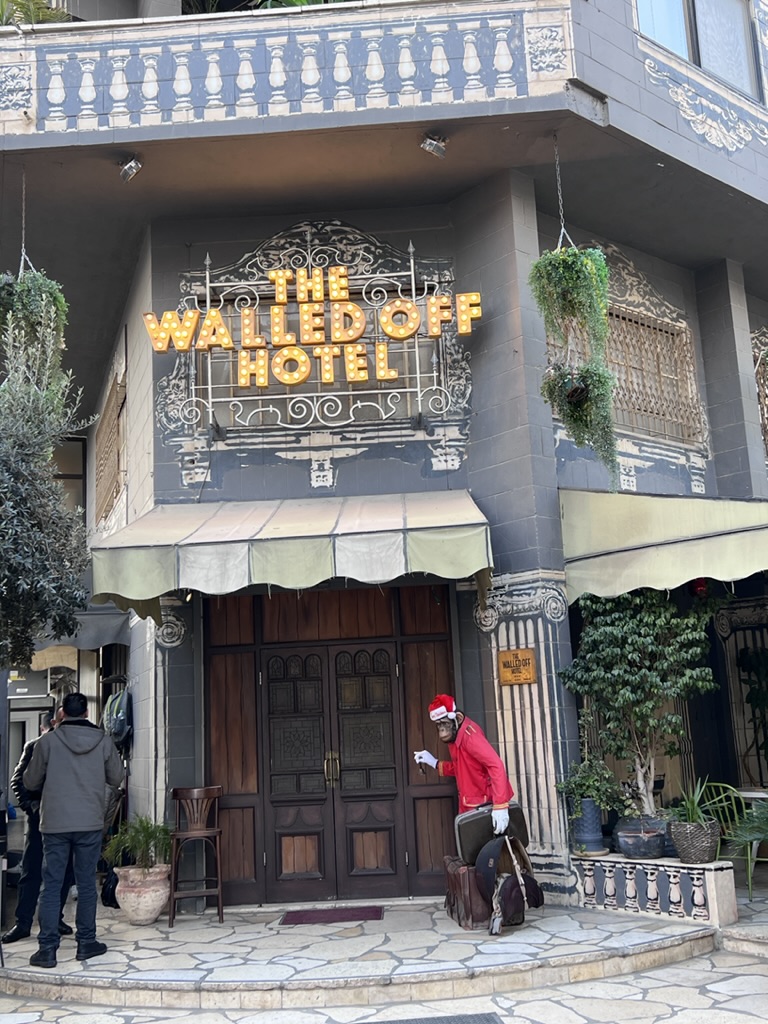
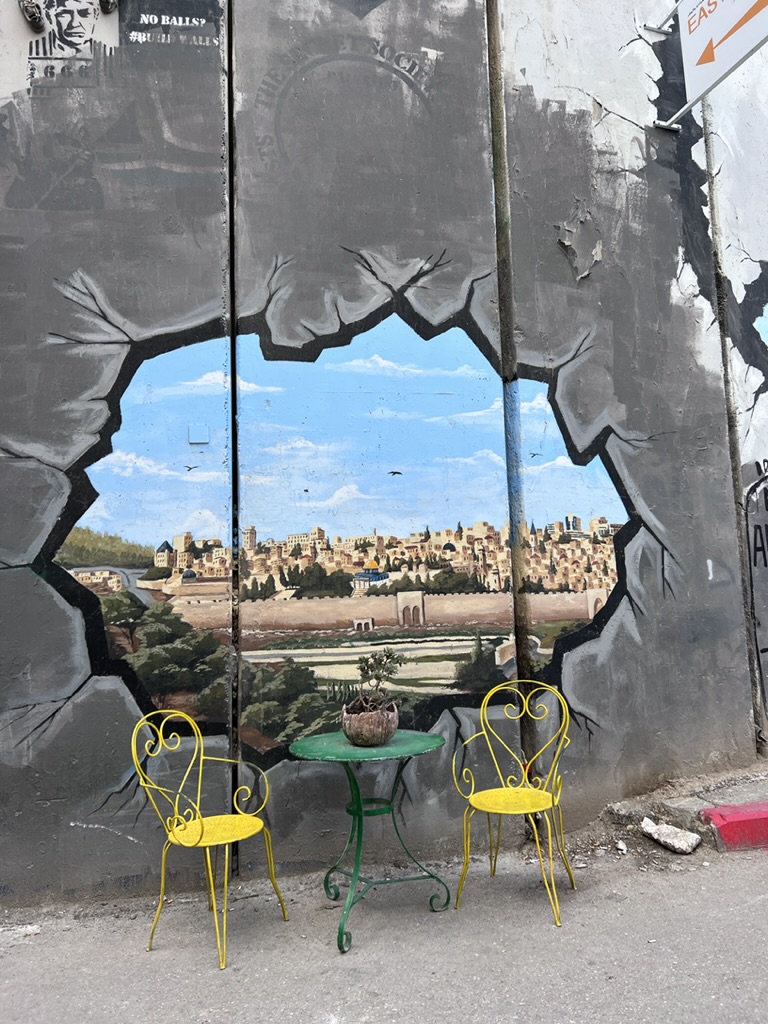
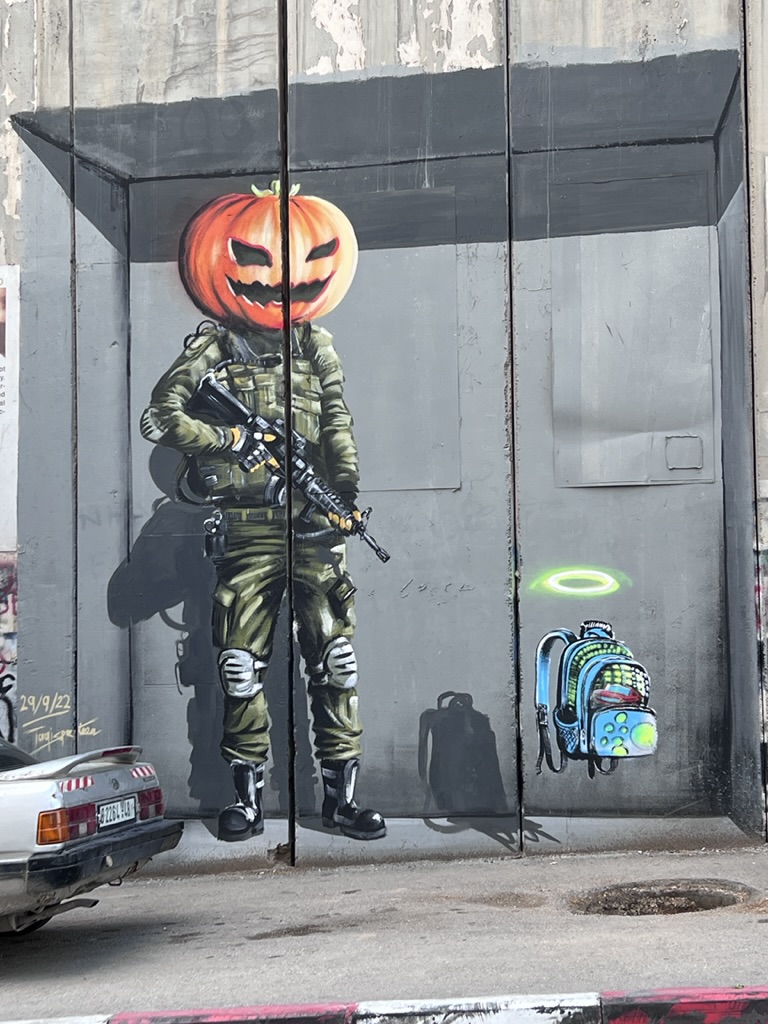
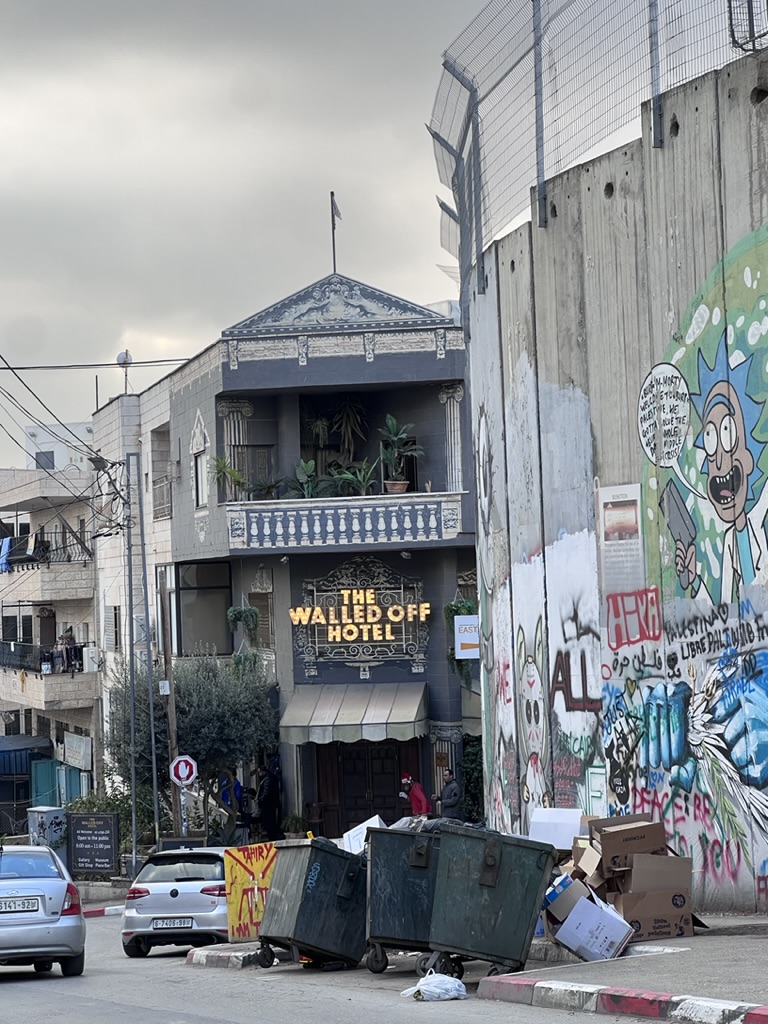
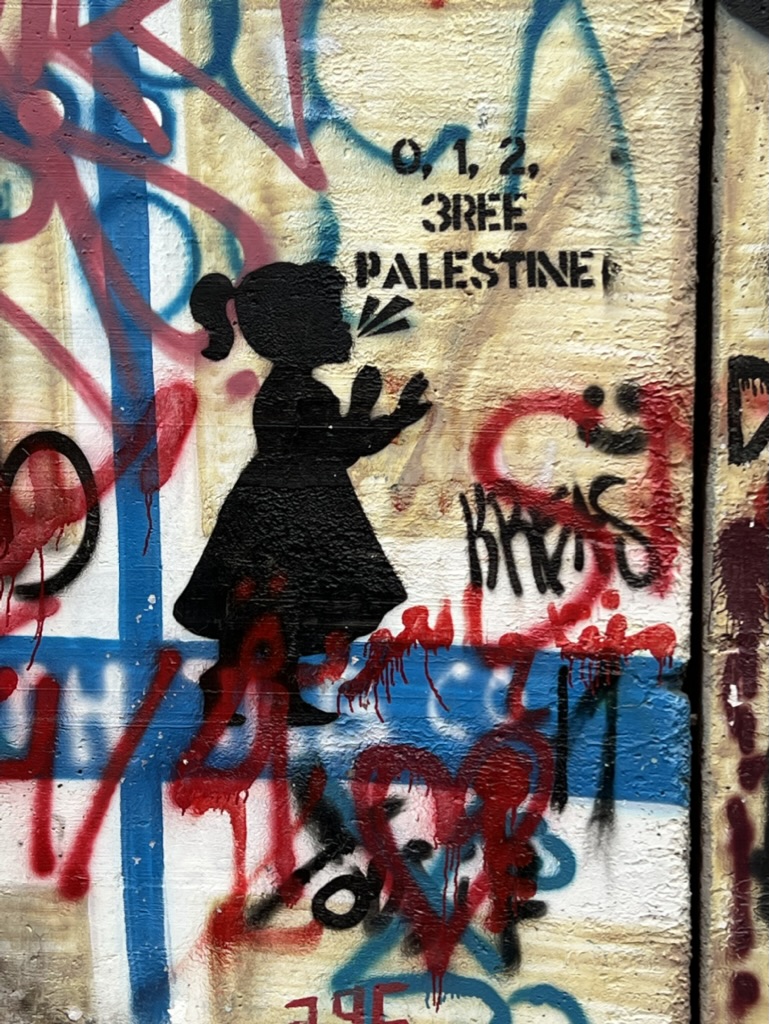
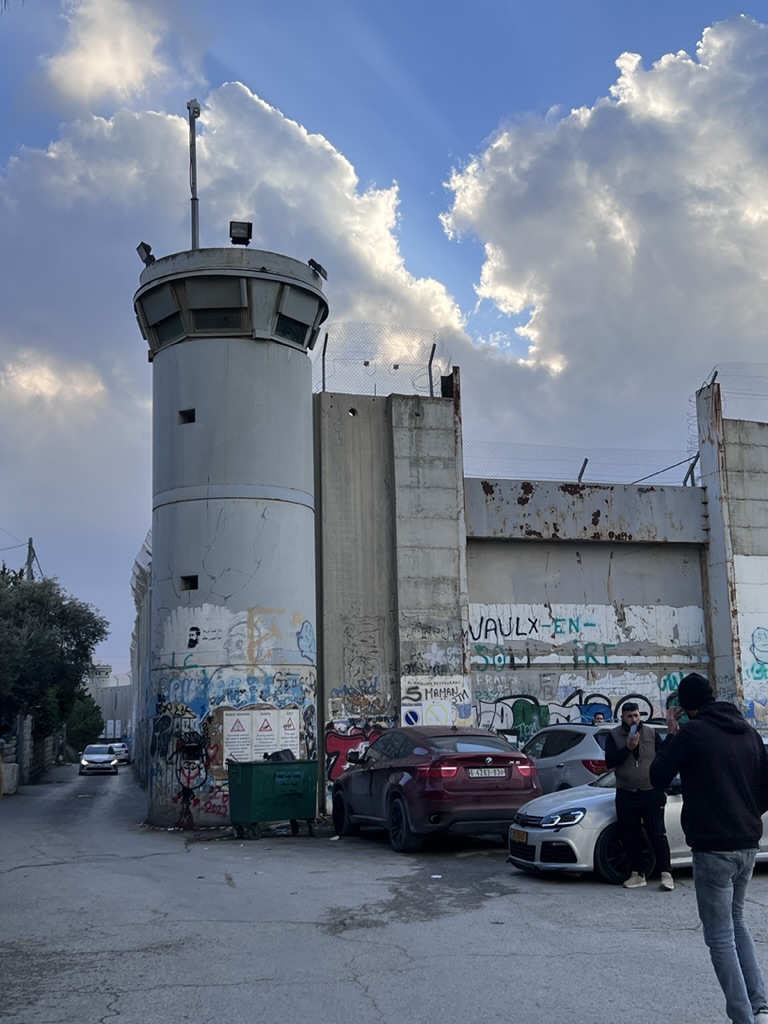
Covered with graffiti, the West Bank barrier wall completely cuts off the city of Bethlehem from the rest of Israel. The wall is now about 20 years old, and the layers and layers of graffiti attest to responses to the situation by mostly foreigners who visit and make their mark. Banksy, the anonymous London-based artist, made his mark on the wall in 2005, with both paintings on the wall and also the development of the “Walled-Off Hotel,” which was established in 2017 (aptly mocking the “Waldorf Hotel” in NY). The Walled Off Hotel was originally set up as a temporary exhibition at a building that sits opposite a portion of the West Bank Barrier (the wall) that separates Bethlehem from the holy site of Rachel’s Tomb (which we did not visit and which has two entrances—one for Jews and one for Palestinians). The hotel is obviously a work of social commentary on the plight of the Palestinians and is billed as “having the worst view of any hotel in the world.” From what I’ve read, the reviews of the “hotel” in which you can actually book a room, have been mixed: some say that the hotel makes profits off tragedy, and is like “war tourism;” but more than 150,000 people have come to see the hotel and thus seen the situation and reality of the conflict and how it plays out in Bethlehem, and perhaps brought money into the town.


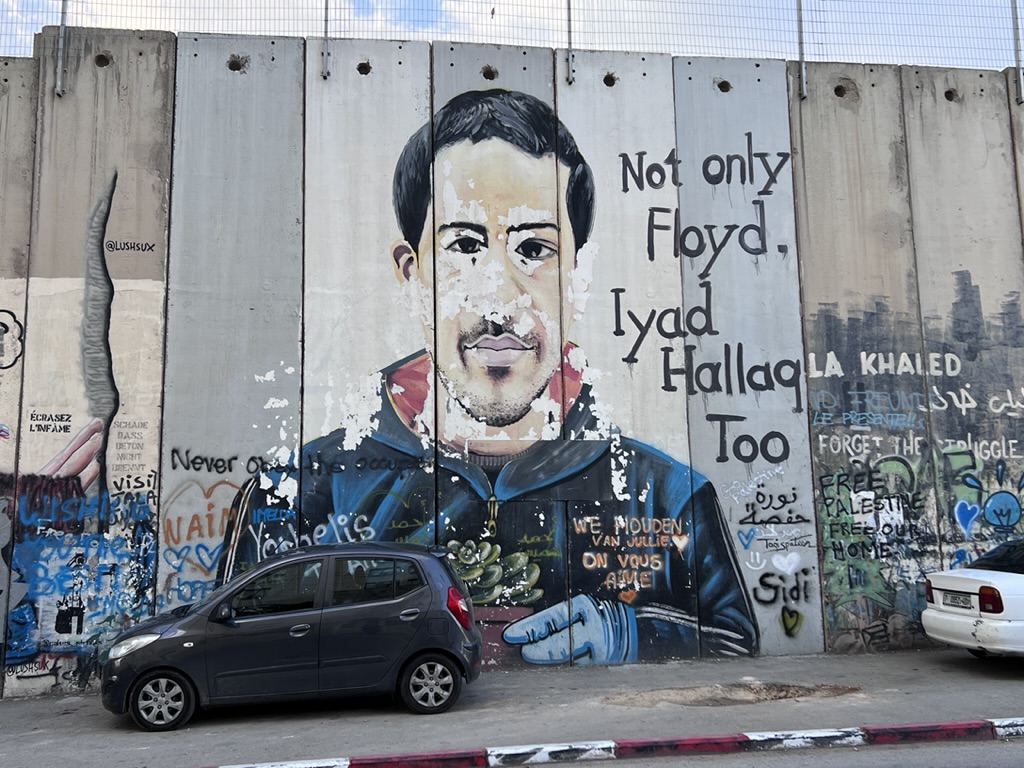
The wall, sometimes called the “separation wall,” is massive, concrete, and twice as tall as the Berlin wall. It twists throughout the region, lining highways and surrounding villages and cutting off cities like Bethlehem. The section of the wall that we saw up close was totally surrounding the city of Bethlehem. We walked many blocks of the wall here to view the political art and to sense life in a functioning Palestinian city, albeit one that has been cut off from access to family, friends, and neighbors. Clearly Trump must have learned from this wall as he chanted “Build the wall!” But this wall is not meant to halt immigration; people in Bethlehem are not interested in moving to Israel. But, they are interested in being able to visit family and friends, which is next to impossible. Charlie, the taxi driver is married to a woman whose family lives in Bethlehem, and he explained how difficult (maybe impossible) it is for her family to visit them in Israel. Charlie and his wife and family always go to Bethlehem because they have Israeli ID cards and it is perfectly OK for them to come to Bethlehem whenever they want, but it doesn’t work for those living in Bethlehem to come to Israel. Something is very wrong with this picture.

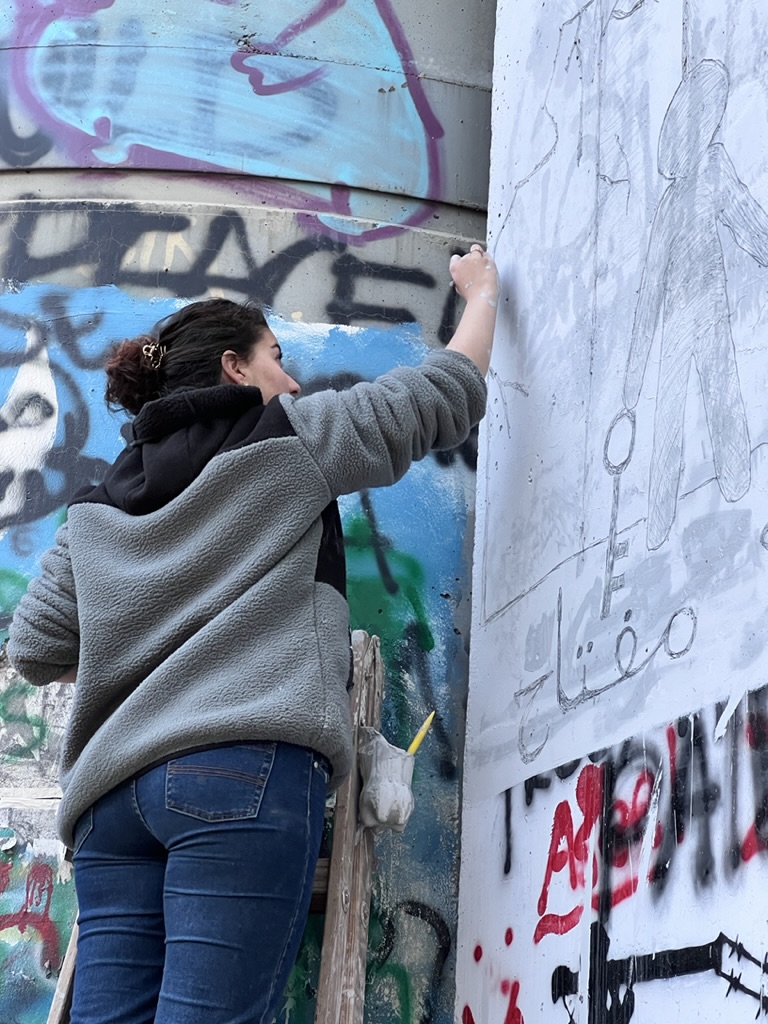
As we strolled the many blocks of the wall, we stumbled upon one young woman who was carefully painting a section with a scene of two young Palestinian children walking hand in hand; one is carrying a large key and the other an olive branch. It turns out that she is one of many Palestinians living in Santiago Chile (go know that there is a large Palestinian community in Chile—didn’t see that when I visited Chile); she is an art student in Chile and has Chilean citizenship. Somehow a group of Chilean students (mostly of Palestinian descent) are in Bethlehem for three weeks—touring, taking classes… and painting the wall with their own creative ideas. We chatted a bit and she explained (not verified elsewhere) that only foreigners can legally paint the wall. She says that if Palestinians paint the wall they can be arrested. There are watch towers all around the wall with soldiers and cameras. We chatted for quite a while, and she explained that one student in her class was painting the wall the other day and he had to escape to Jordan because he was not a Chilean citizen and could be arrested.
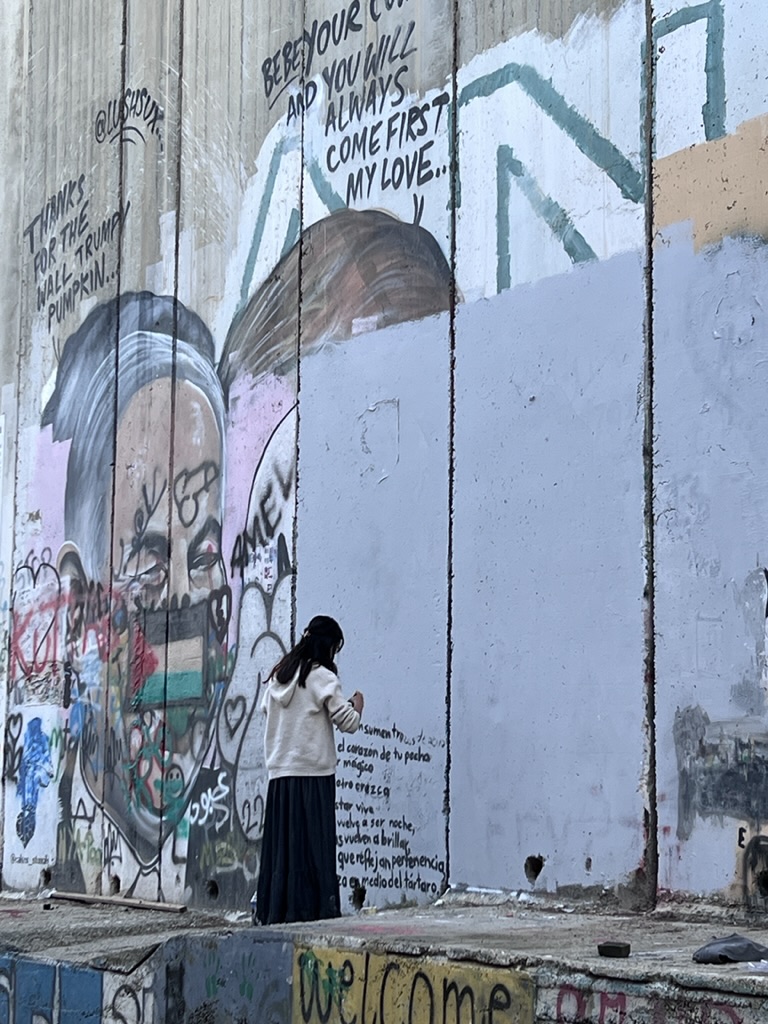
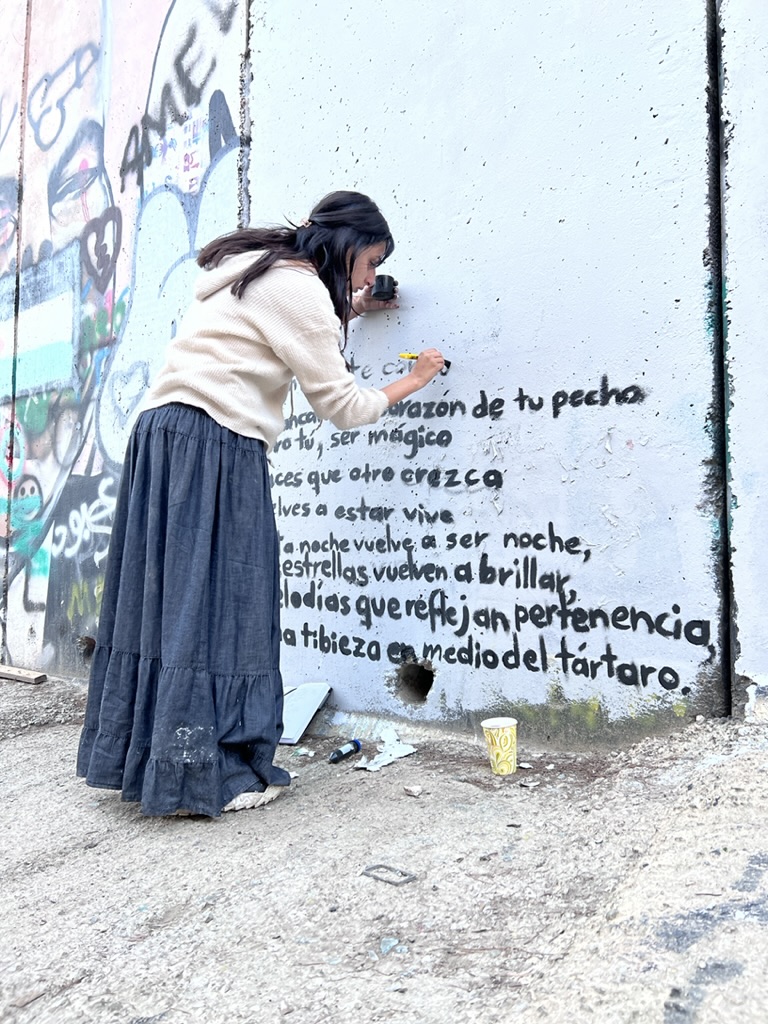
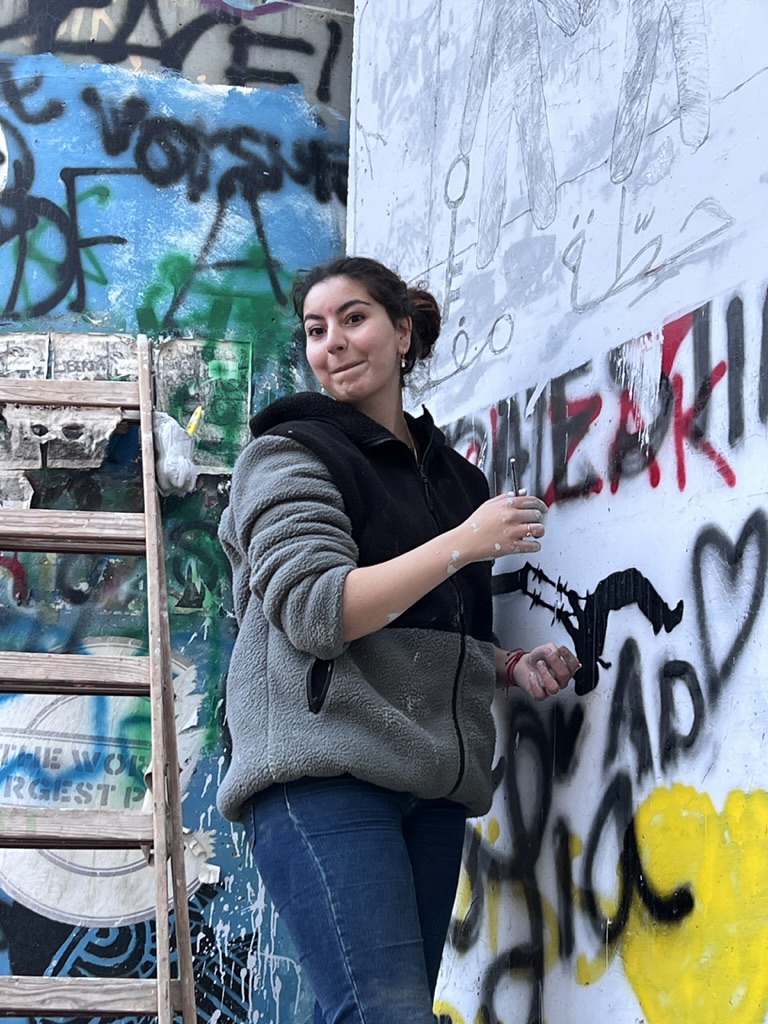
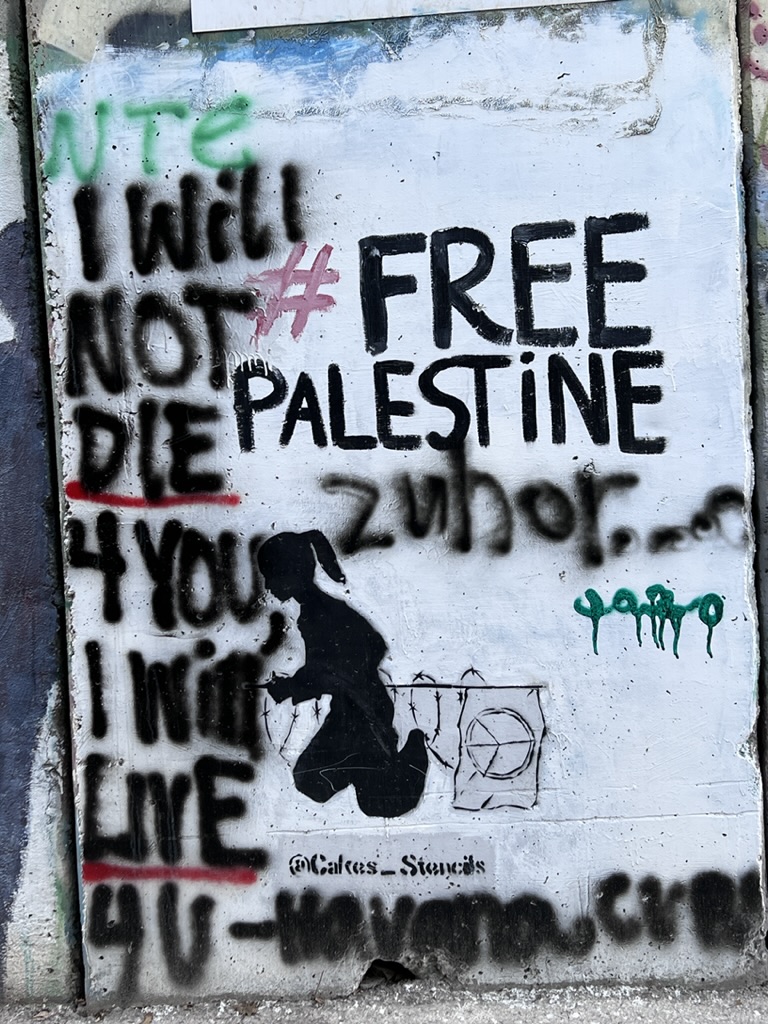
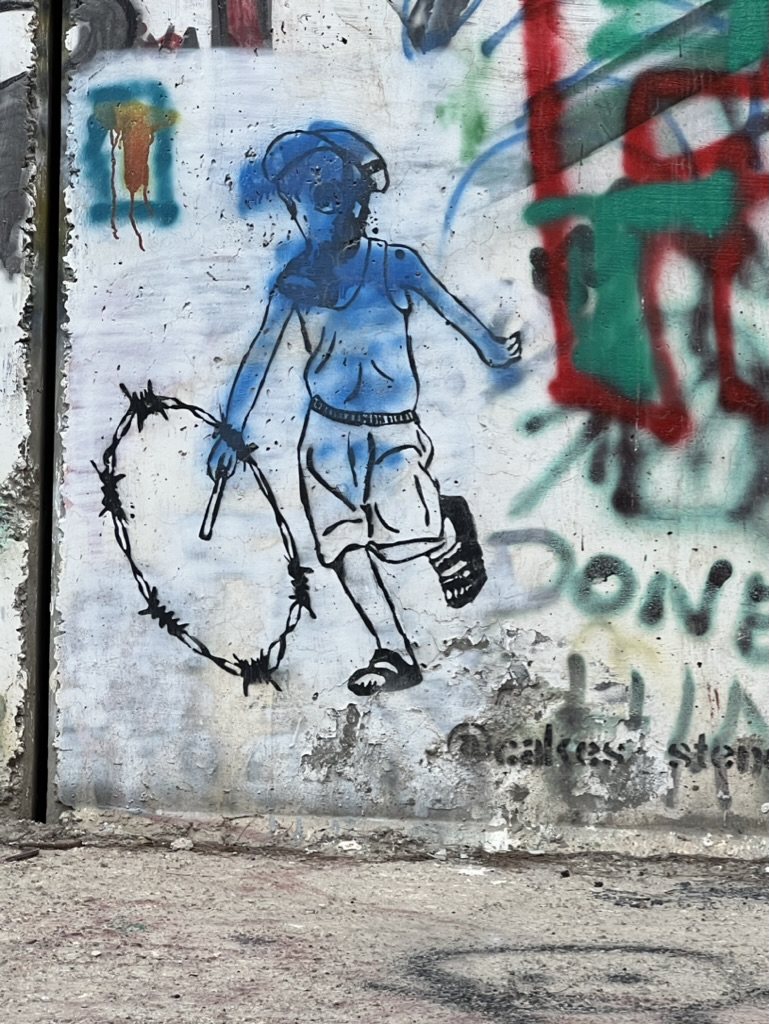
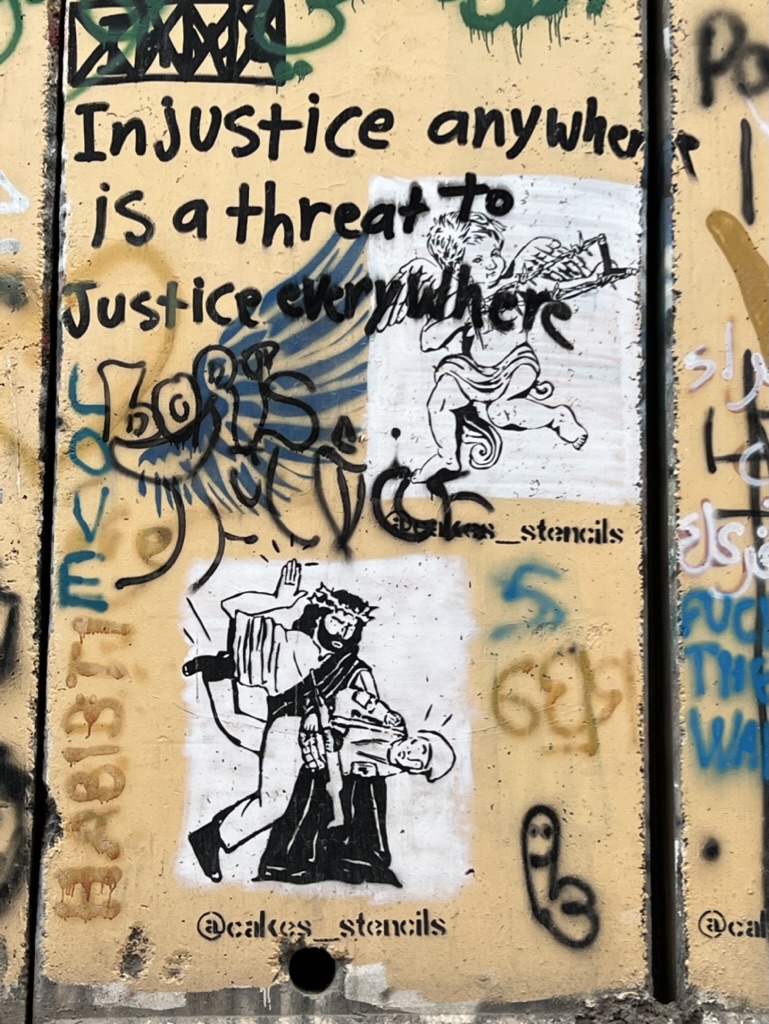
Much of the writing on the wall is in English; some in Spanish, Italian, French, Hebrew, and Arabic (but the Arabic is much less frequent). The dominant language is English. Many of the murals have included some humor, and some confusion about Bernie Sanders vs. Larry David (or maybe they were very attuned to Larry David playing Bernie Sanders on SNL).
The young Chilean woman explained her contribution and the inclusion of the excessively large key as a symbol (held by the young girl in the picture she was painting). She said that many Palestinians living in Chile, still have the keys to their houses in Palestine. They hope some day to return. Some have visited, only to find that their houses are now occupied by Israelis. This story was so hard to take because it was so reminiscent of stories about Jews who fled Germany and other European countries only to return years later to find their houses occupied by other families. How is it possible for Israelis to forget this history. What happened to “Never forget?”
The UN has stated emphatically about the 55-year occupation of Palestine: “There is today in the Palestinian territory occupied by Israel since 1967, a deeply discriminatory dual legal and political system, that privileges the 700,000 Israeli Jewish settlers living in the 300 illegal Israeli settlements in East Jerusalem and the West Bank,” said Michael Lynk, the UN Special Rapporteur for the situation of human rights in the Palestinian territory. Mentioning the lack of rights of people living in the same vicinity, but separated by walls, checkpoints and roads, Mr. Lynk acknowledged that “there are more than three million Palestinians living under an oppressive rule of institutional discrimination and without a path to a genuine Palestinian state that the world has long promised, is their right.” He further defined “apartheid,” as “a system of institutionalized racial segregation practiced in South Africa prior to its dismantling in the early 1990s. “Israel,” he said, “conforms to the definition as a ‘political regime which so intentionally and clearly prioritizes fundamental political, legal and social rights to one group over another, within the same geographic unit on the basis of one’s racial-national-ethnic identity.’”

Walked a bit more and then finally after several hours taxied back to the hotel in Jerusalem. We headed to dinner at The Workshop, located at the old Jerusalem train station. Had yet another amazing meal including a burnt eggplant carpaccio, that had brown butter, pesto, and almonds; followed by a mushroom risotto with mushroom ragout, porcini, chives, parmesan; and smoked brisket, hollandaise sauce, coleslaw, chimichurri and mustard. For dessert we had a wonderful tiramisu.
The shop and the outdoor eating areas are filled with objects and family photos from a more than 150 year span.
Then we fought traffic again and eventually arrived in Akko (Acre in English). More on Akko tomorrow.. our last real day and night in Israel.
Hope the sun may have cdome out breifly for all of the Californnia readers. We are certainly not looking forward to returning to the rain.. the torrential rain we have been hearing about.
All the best…
Fern
23. Part One: Behind the Wall: Hebron. 1/10/23


Greetings after a very long and very intense day on the other side of the wall–
Today was a vey complicated day… I’m posting two notes, because I don’t think I can get everything into just one story.
We hired a driver that a friend in Chicago recommended. We had a few conversations with the driver over the past few days since we were unsure about having a driver. We were pretty clear about what we wanted to see and how we wanted to see it, and didn’t want any sort of “guide.” But our plans also kept changing. Should we go to Hebron? Bethlehem? Nablus? Ramallah? We wanted to get a sense of the West Bank and of the daily life of the Palestinians living there. We also wanted to avoid monuments and religious sites. We really just wanted to walk. Finally, we settled on Hebron, the Palestinian city located in the southern end of the Israeli-occupied West Bank, and Bethlehem, a completely walled off city less than an hour from Jerusalem. This way we’d see one city that is occupied and where Israeli “settlements” point to the difference between the lives of Israelis and the lives of Palestinians (Hebron) and one city that is completely walled off and where it is impossible for Palestinians living in Bethlehem to go to neighboring Jerusalem or for that matter to anywhere in Israel. While Israelis can come and go to Bethlehem, residents of Bethlehem cannot even go to the only airport in Israel—they must get to Amman, Jordan and fly from there. So first our visit to Hebron.

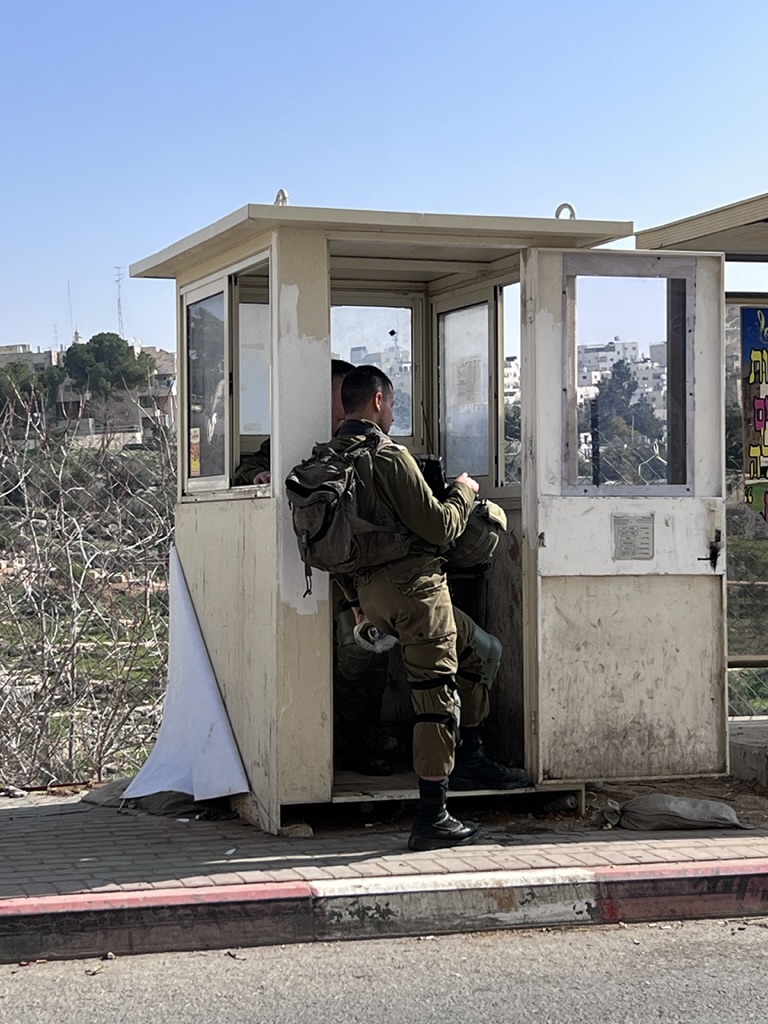
We drove past miles and miles of “wall” on our way to Hebron; passing through numerous Israeli settlements that are large complexes of houses, including multi-story buildings. They are relatively new and have electronic fencing, soldier guard booths, and other security measures to ensure that only residents and Jews can enter. Similarly, bus stops are secured by soldiers as well as large steel bollards to prevent Palestinians from driving into settlers waiting for the bus. The lives of these Jewish residents (settlers) are behind these gates and within those gates they have their own shops, schools, and all the amenities of suburban neighborhoods. There are well over 20,000 settlers (or occupiers) within and around Hebron (according to whatever information I could find) and the number is expanding all the time.
We saw many buses headed to the settlements; they are easily identifiable because they have bulletproof windows and double sets of tires.
On the drive, we chatted with Charlie, our driver, who is Christian and married to a woman whose family lives in Bethlehem (more on that later), who says that the wall that edges the road from Jerusalem to Hebron costs one million dollars per kilometer because of its depth and thickness. According to our own research, the more than 400-mile-long wall actually cost close to 5 million US dollars per kilometer. He also says that the settlers receive free housing and that nearly all of these settlers are orthodox (politically conservative) Jews from other countries, including Russia and the US (currently many Ukrainians are also coming). He calls ALL of the West Bank a ”prison with an open roof.” Some are prisoners by choice in gated communities; others are prisoners not by choice.

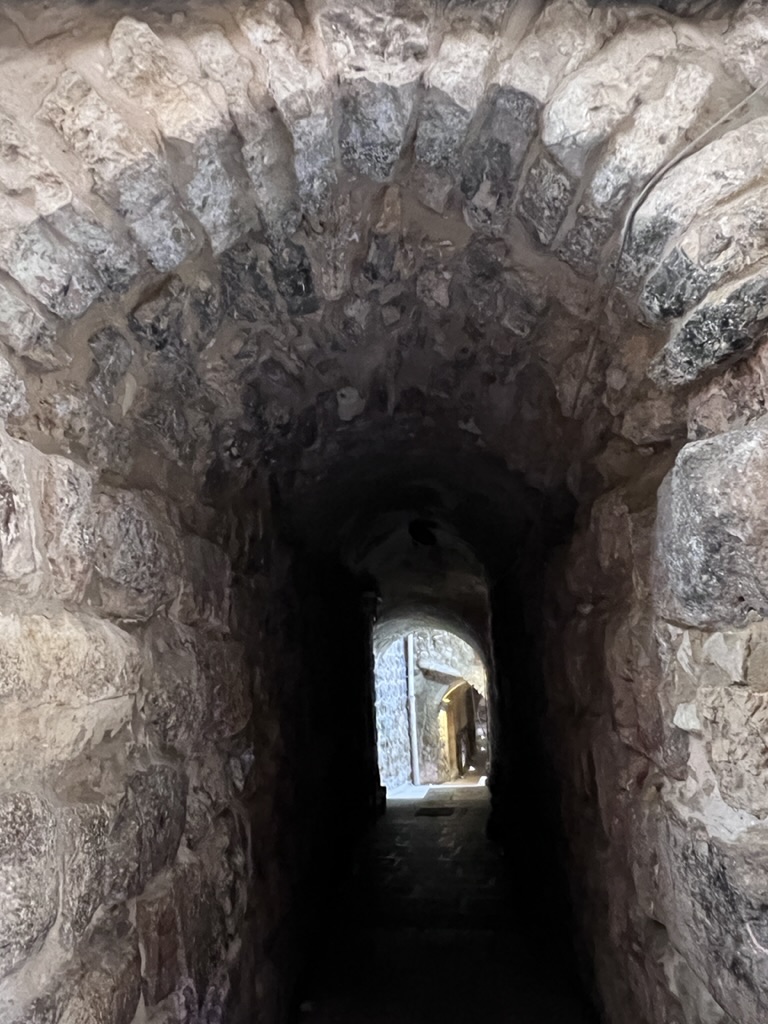

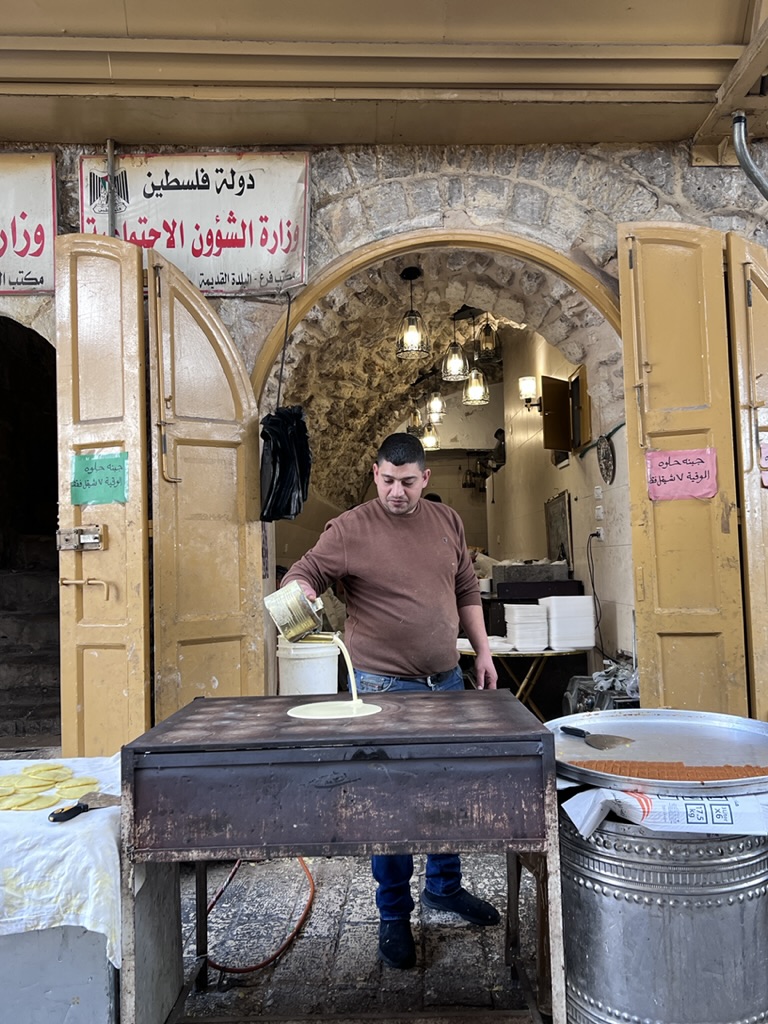
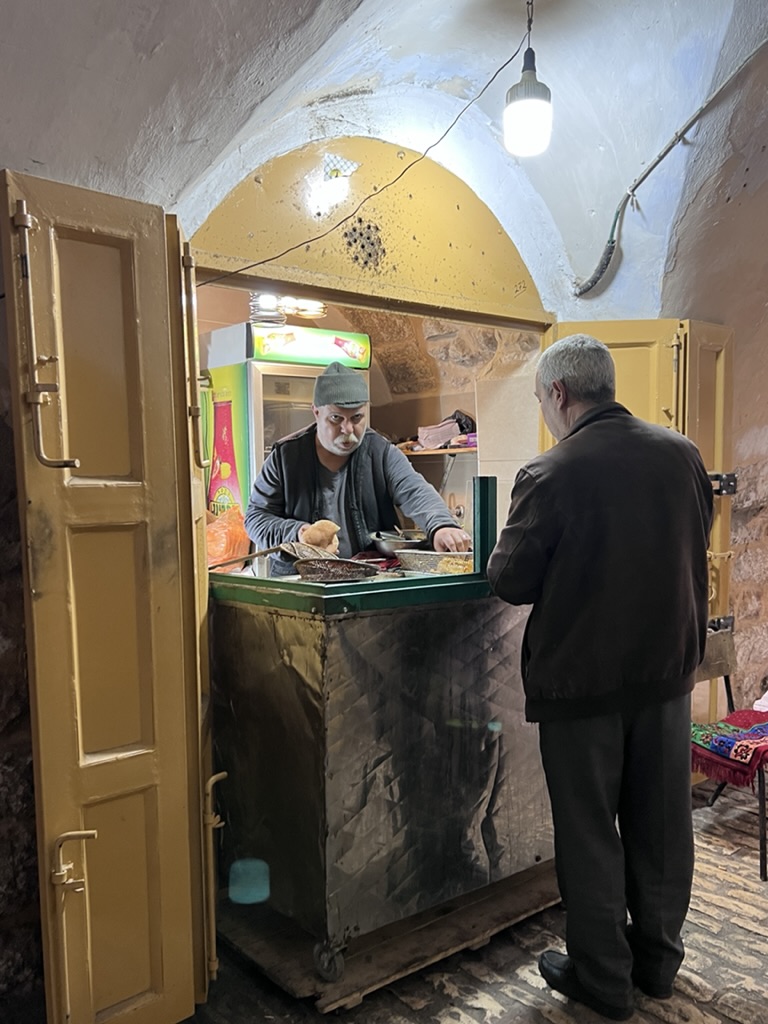
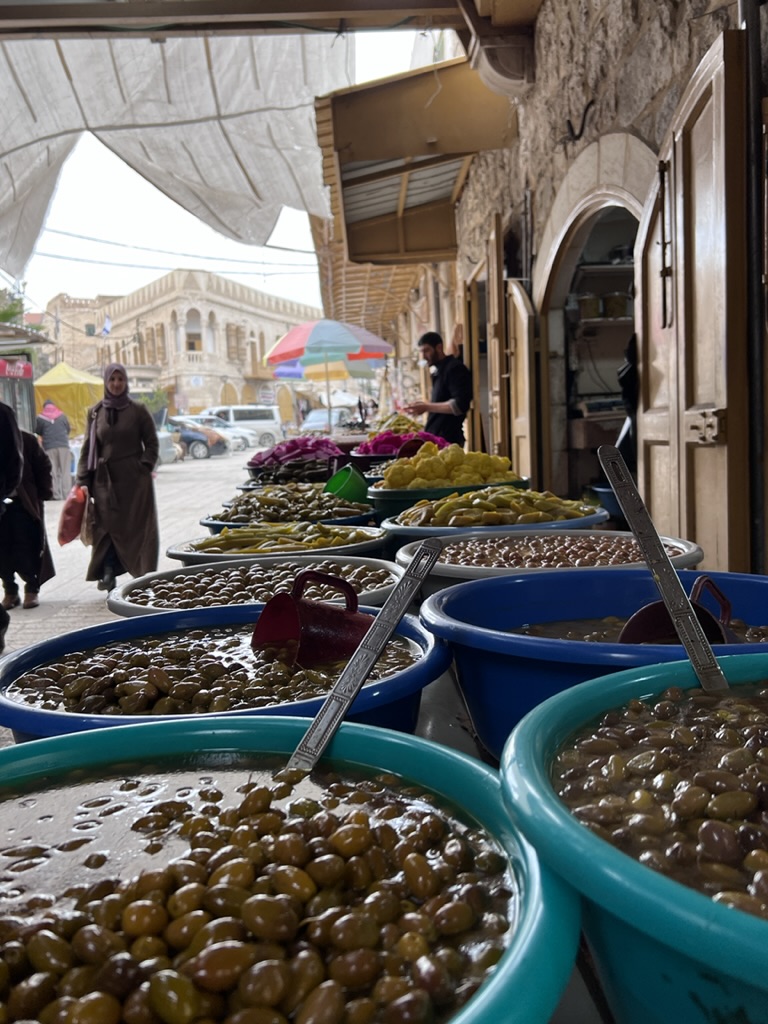
When we got to Hebron, Charlie parked the car and walked us to the entry of the market and then we were on our own. For about two hours or more we walked the Palestinian market and surrounding streets. There was another older Palestinian market which is basically deserted. This is the “newer” market. It’s pretty much like all other markets we’ve been to, except that it is pretty quiet with few shoppers. No Israelis shop here. And there weren’t any tourists. So, it’s become a totally local market for Palestinians. Shopkeepers and others in the market were extremely friendly although only very very few spoke any English. The goods were a combination of fresh produce, meats, and fish and also clothing (pretty much all commercially manufactured) and soaps and kitchen goods. Very few women were in burqas; most were in regular western garb, and some had hijabs.

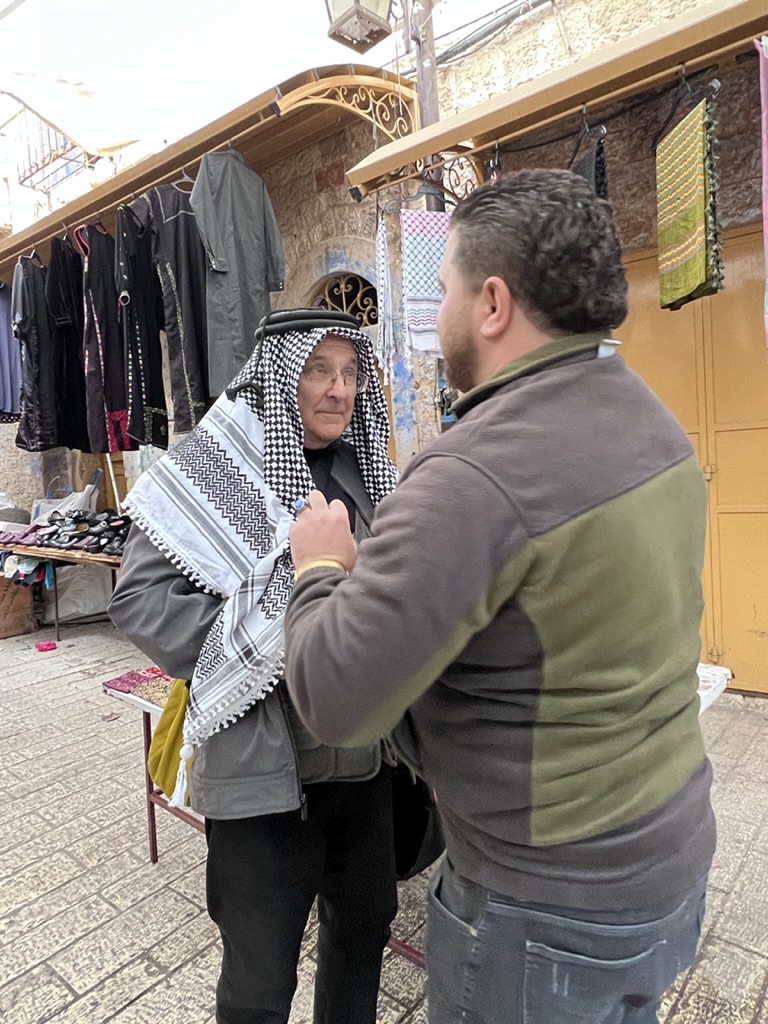
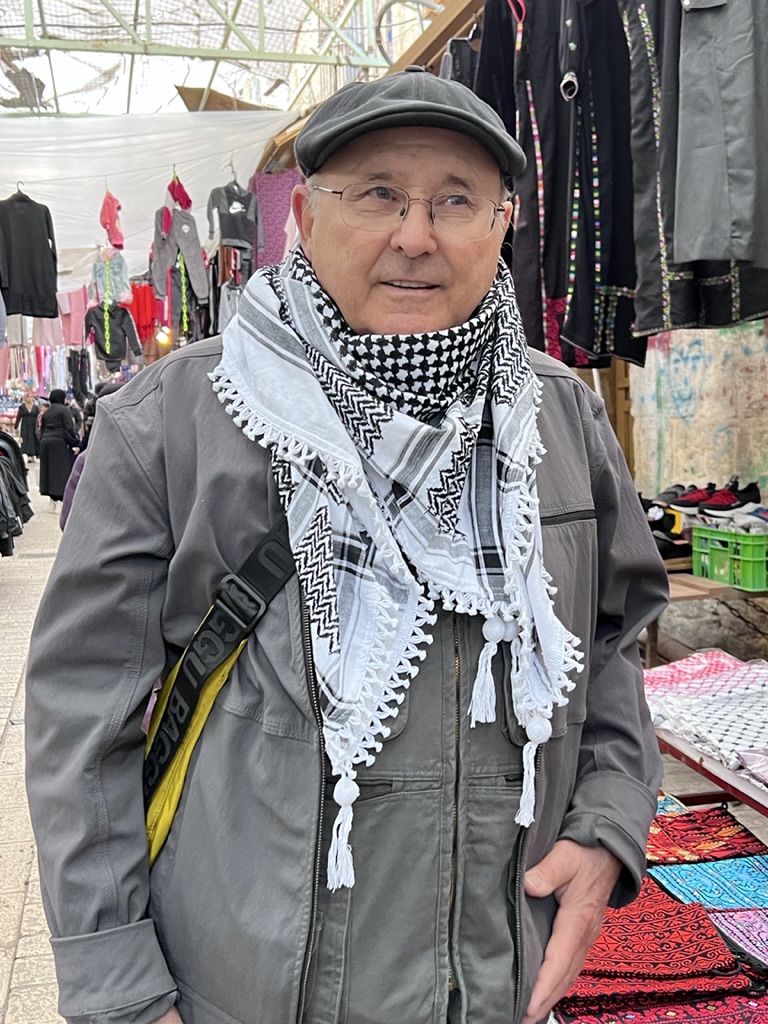
We stopped at a stall (one of many) where the classic Arafat scarf/headgear (keffiyeh) was sold. The shopkeeper was insistent that Mike try the scarf on and showed him how to use it as a scarf wrapping the neck and also as a headpiece as we’ve all seen on Arafat. ran into a stall with products made by women in Palestine who are part of an NGO that supports women in need. We talked with the woman at the table whose English was quite good. We learned that she has traveled to the states numerous times to give talks about the plight of Palestinian women and the current situation in the occupied areas. She was very articulate and pretty much echoed Charlie’s comments about the plight of the Palestinians. She stressed the importance for Westerners to visit Palestine to better understand the issues and she pushed the concept that people need to support both sides in this struggle, to make things equal.
There were many boarded up houses we saw which it seems are now being claimed by Jews although were owned by Palestinians. Jews believe this is their land and they have the historic rights to the land and the structures on it.
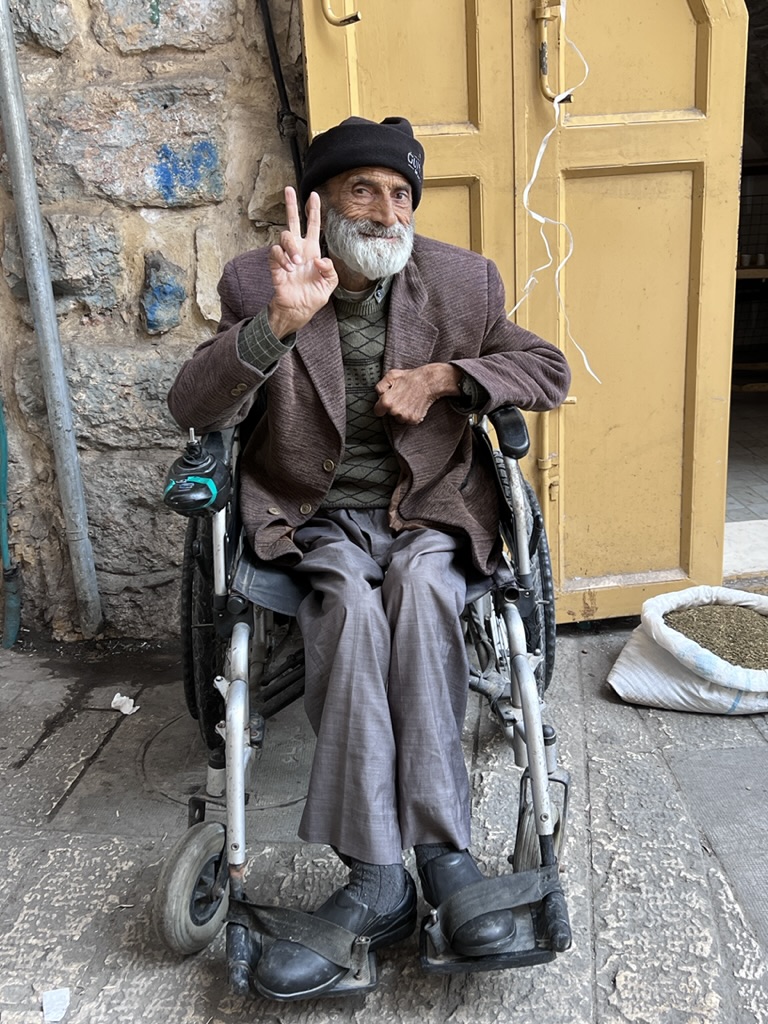
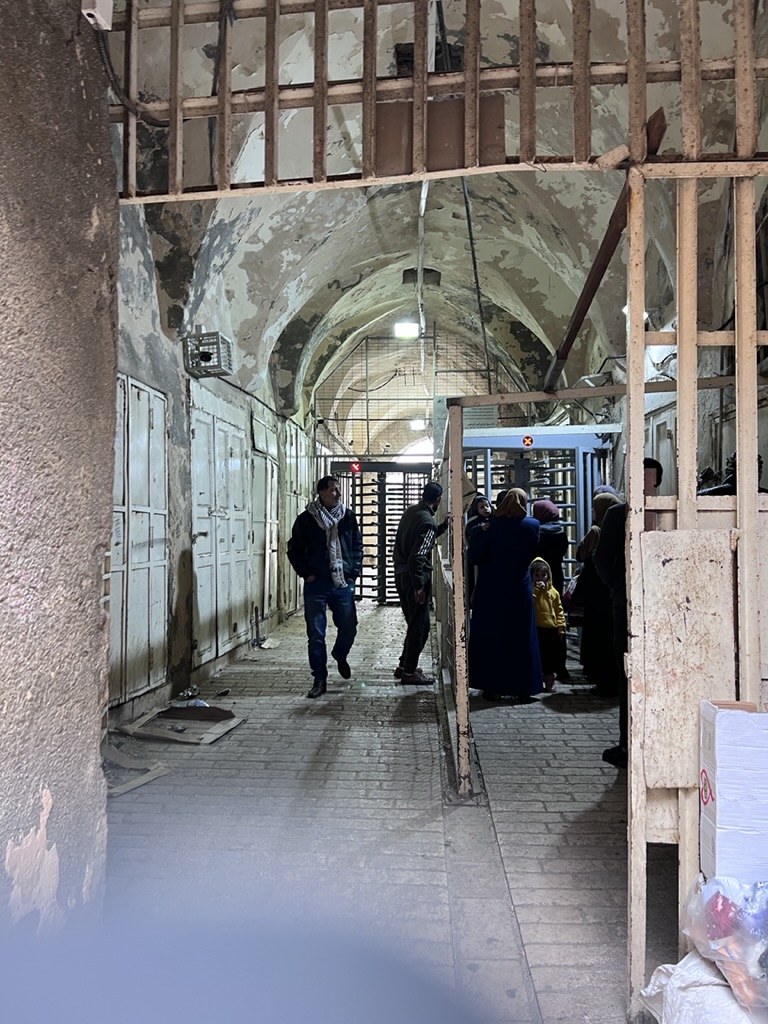
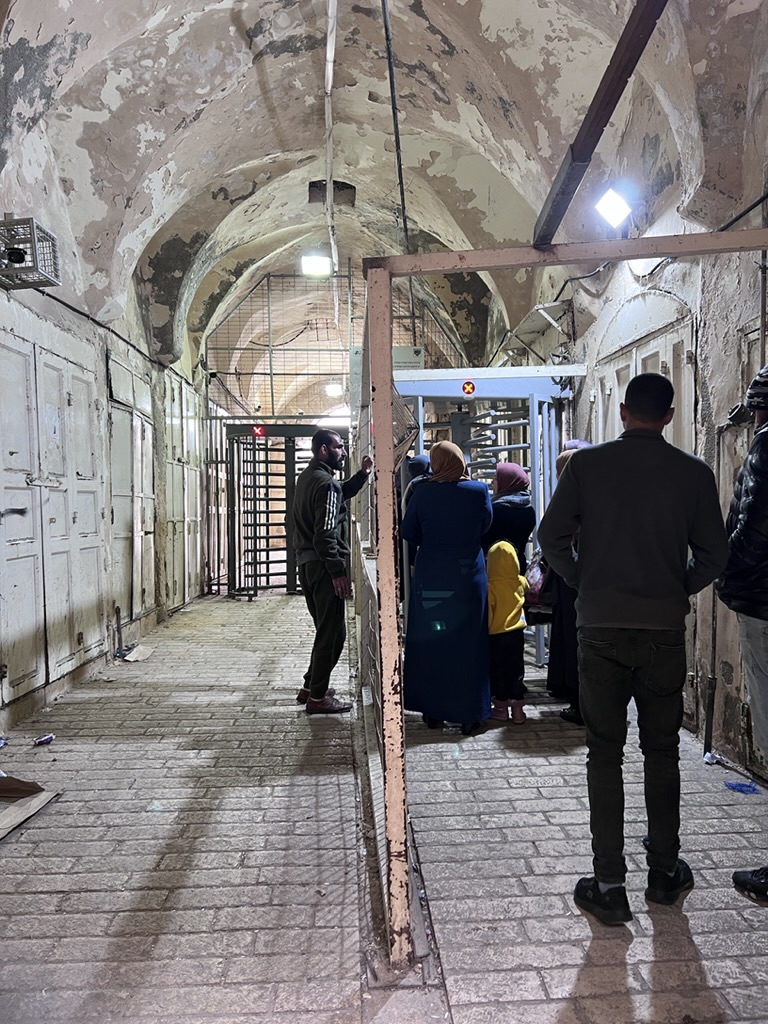
The experience in Hebron was complicated to understand… the origins of this forced separation, and the difficulty of comprehending what life must be like for Palestinians—the isolation, the rules, the limitations, and the powerlessness. In some ways it was especially difficult considering the information and emotional impact of the exhibit at Yad Vashem the day before where we were totally immersed in the loss of freedom and rights of the Jewish people under Hitler. Is there not a relation between these two situations?
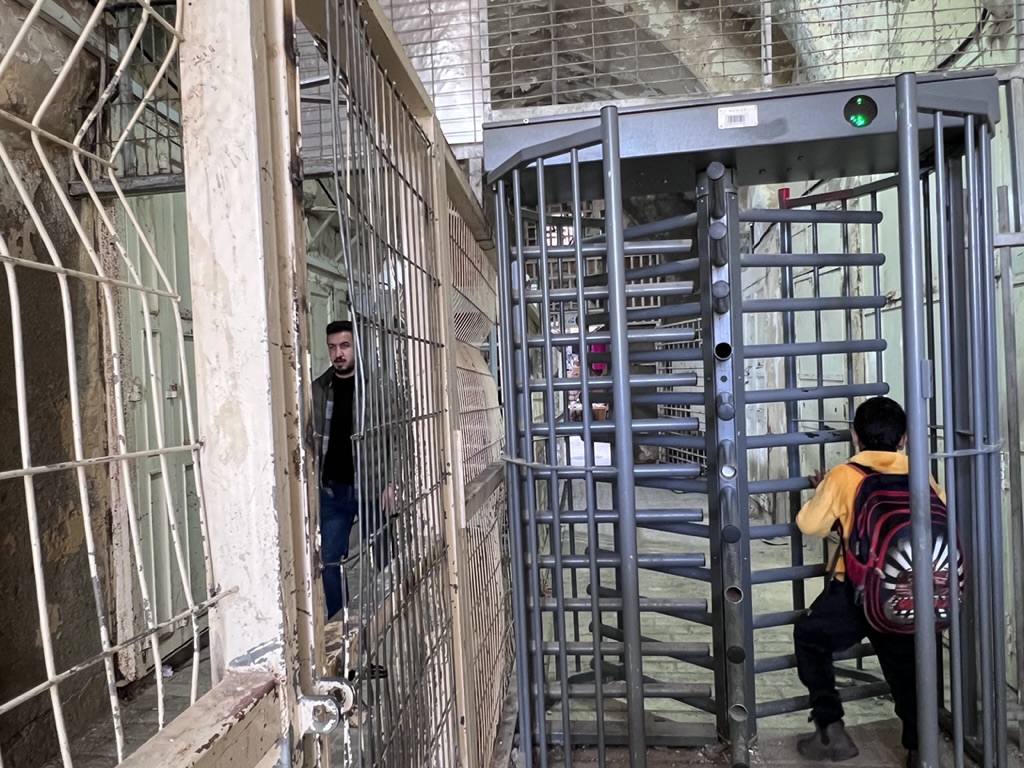
When we were ready to leave, we needed to go on a queue that led us to a full vertical turnstile. Once the turnstile was opened for us to use it (red light/green light) we had to show our passports. Only foreigners and those with special IDs could exit because this took you to Zone B. Maybe I have this slightly wrong.. In any case, we got through after showing our passports and met up with Charlie several blocks away.. to make the drive to Bethlehem where our experience would be different.
So much more to say, but don’t want to run on…
Best –
Fern
22. Jerusalem. 1/9/23
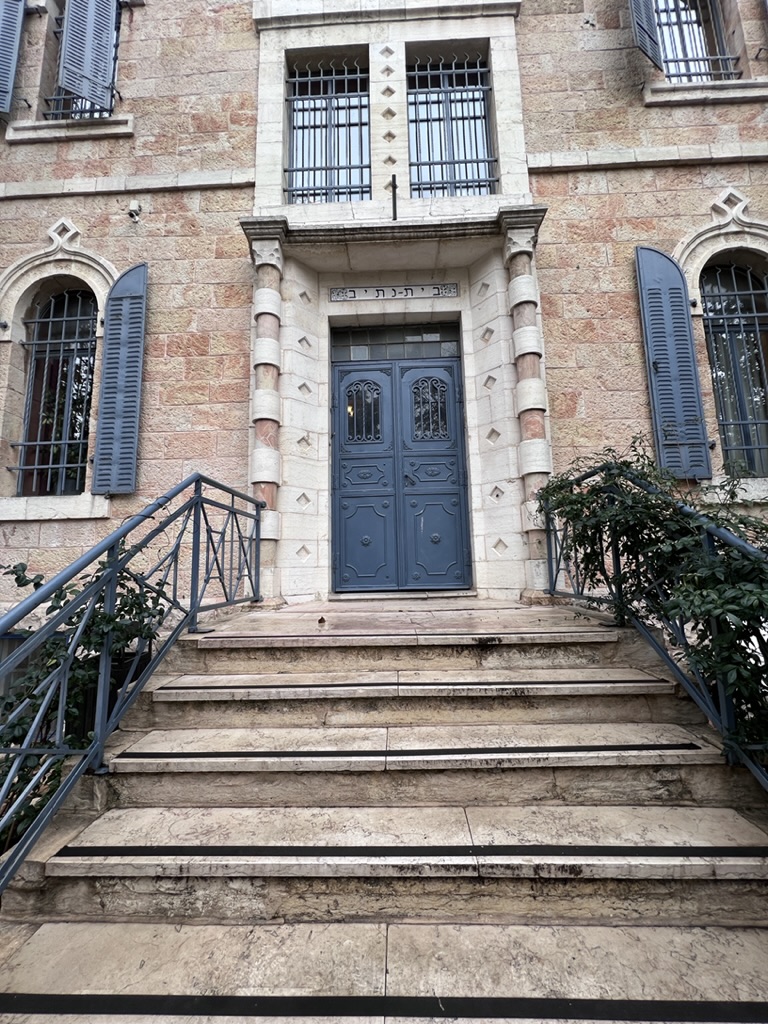

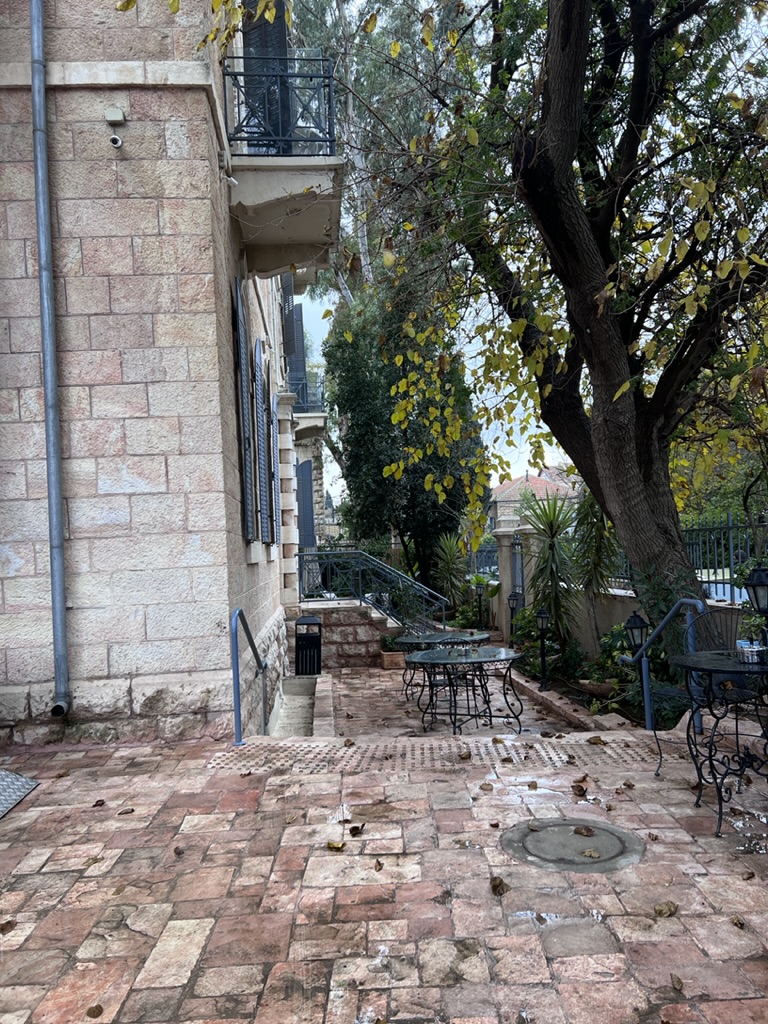
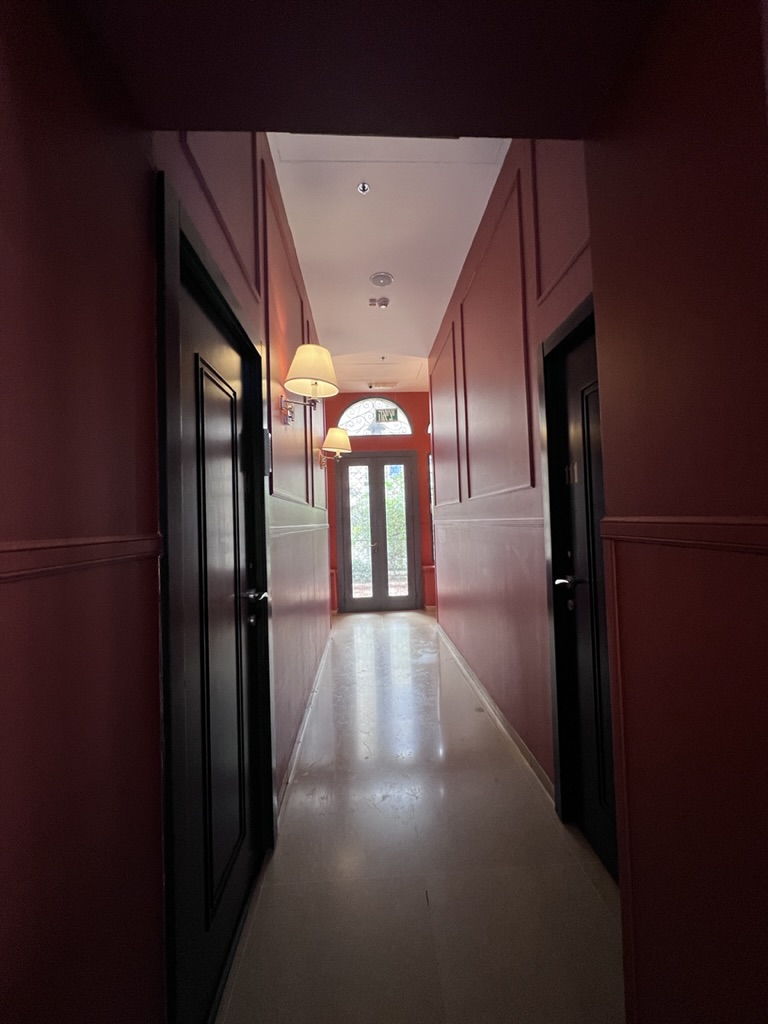
Greetings from Jerusalem (as the countdown begins to our journey home on Friday)
First a little about our hotel (Villa Brown Moshava): The Kharufe family, Christian Arabs from Beil Jaala, built the building prior to 1918. It was known as the Kharufe House. The family paid for the construction with funds earned by Ms. Kharufe through her work as an elite seamstress for the high-society folks of the time. The family purposefully split the house into two sections so that they could live in one half and rent the other half (earning money on the property). Since the creation of the state of Israel, the building became owned by a Jewish agency and initially the name was changed to The Nativ House. First it housed youth from the Diaspora coming to learn about Judaism and Israel; then it was the home of a publishing house and a research institute. In 2003, after an award-winning renovation it became a small hotel.
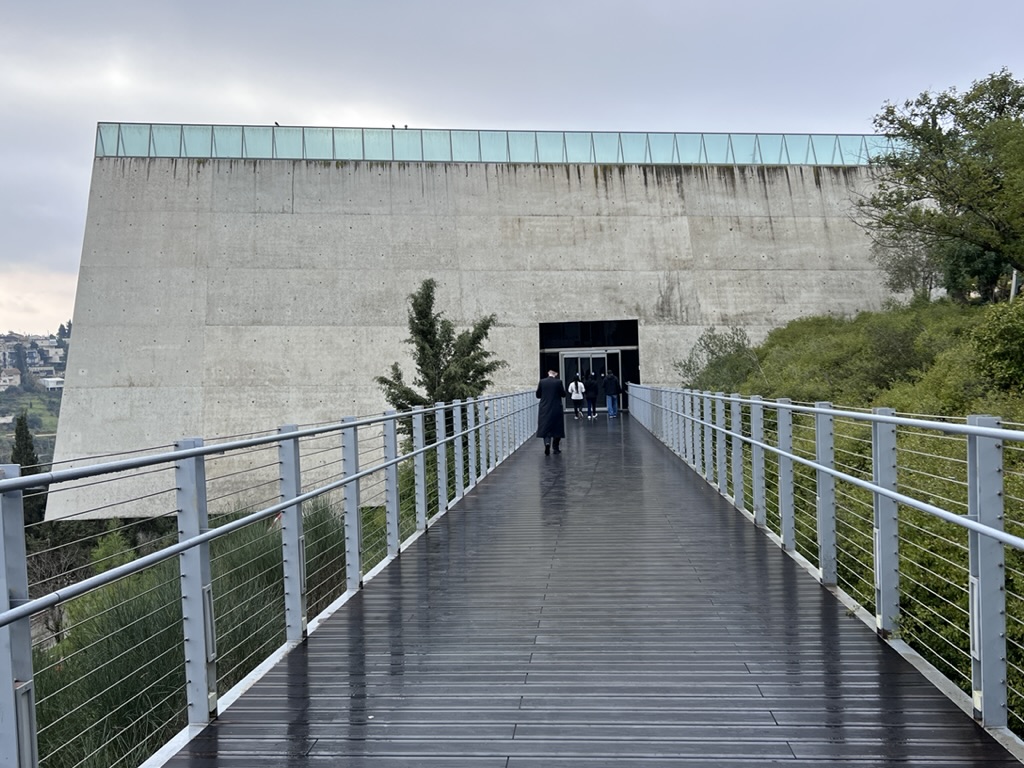
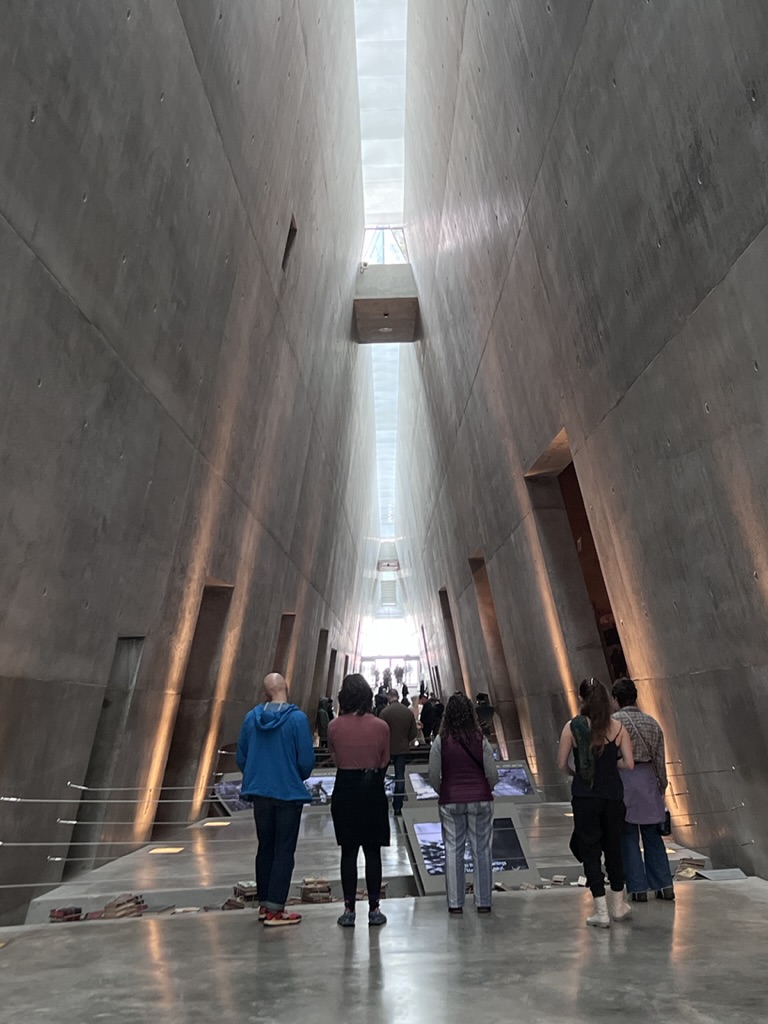
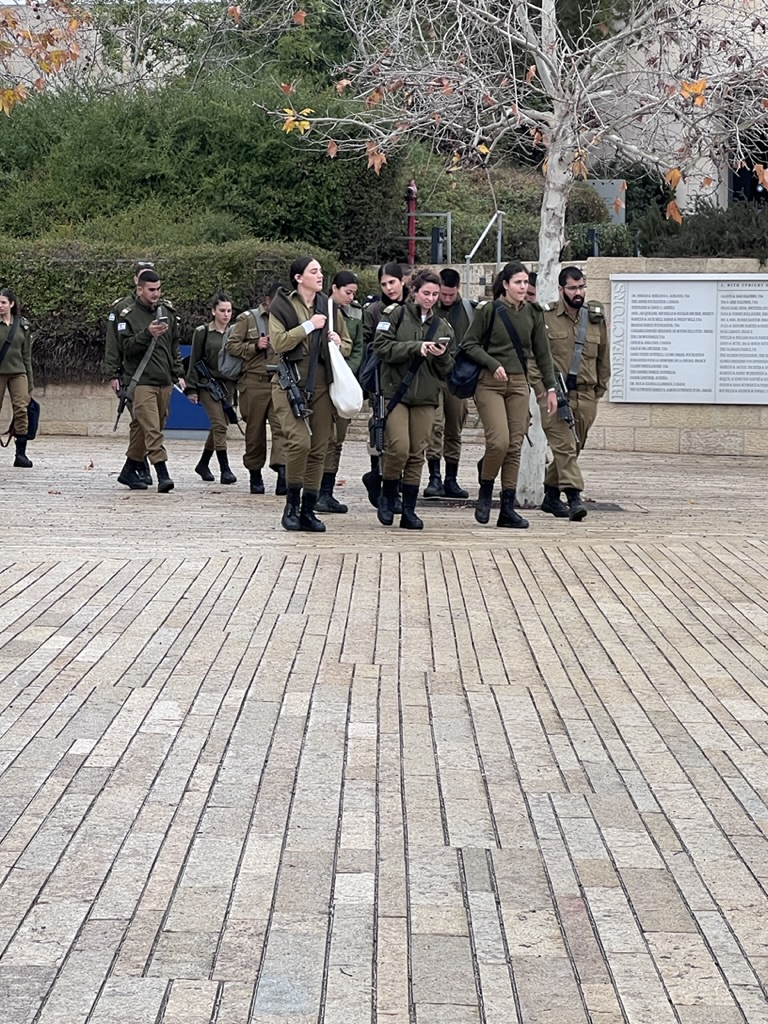
We set out this morning for Yad Vashem, the Holocaust History Museum (designed by Moshe Safde)—a prism shape triangular structure that looks almost suspended above a mountain… with dramatic cantilevers. It’s comprised of two major linear forms that cantilever out over the mountain creating a tall skylit canyon between the two forms that create the central spine of the museum. It’s mostly lit by a skylight that goes the whole distance of the building, enabling the exhibit areas to be dark enough to host many multimedia presentations. The whole building is reinforced concrete. As you exit you get a dramatic view of the city of Jerusalem.
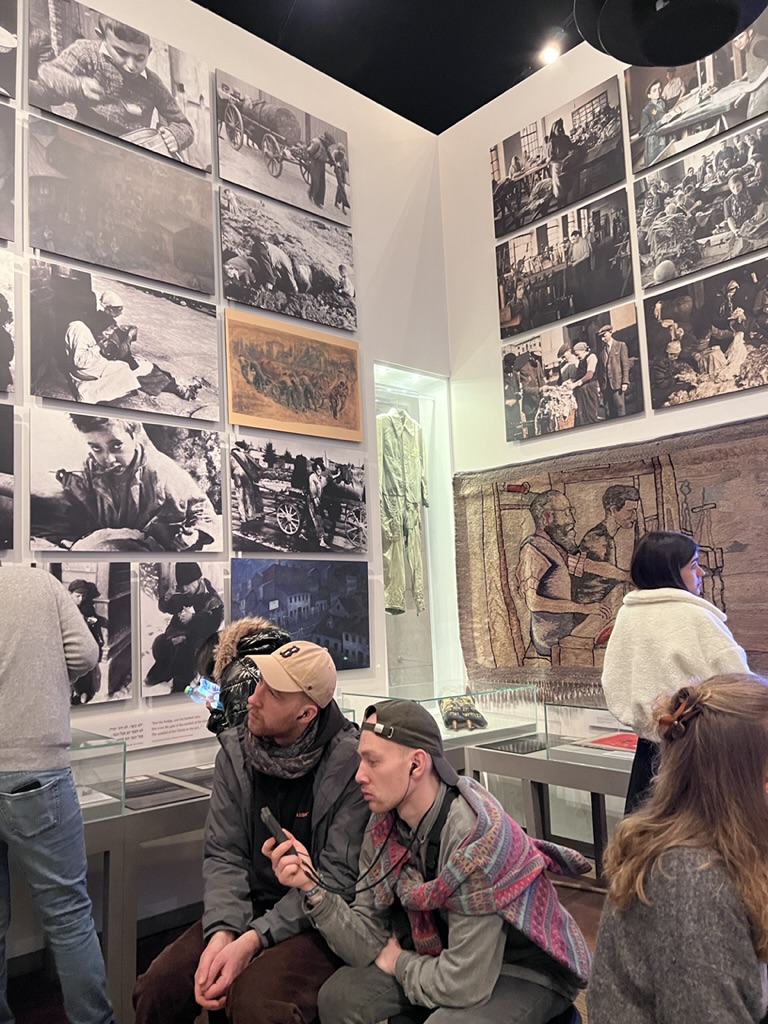

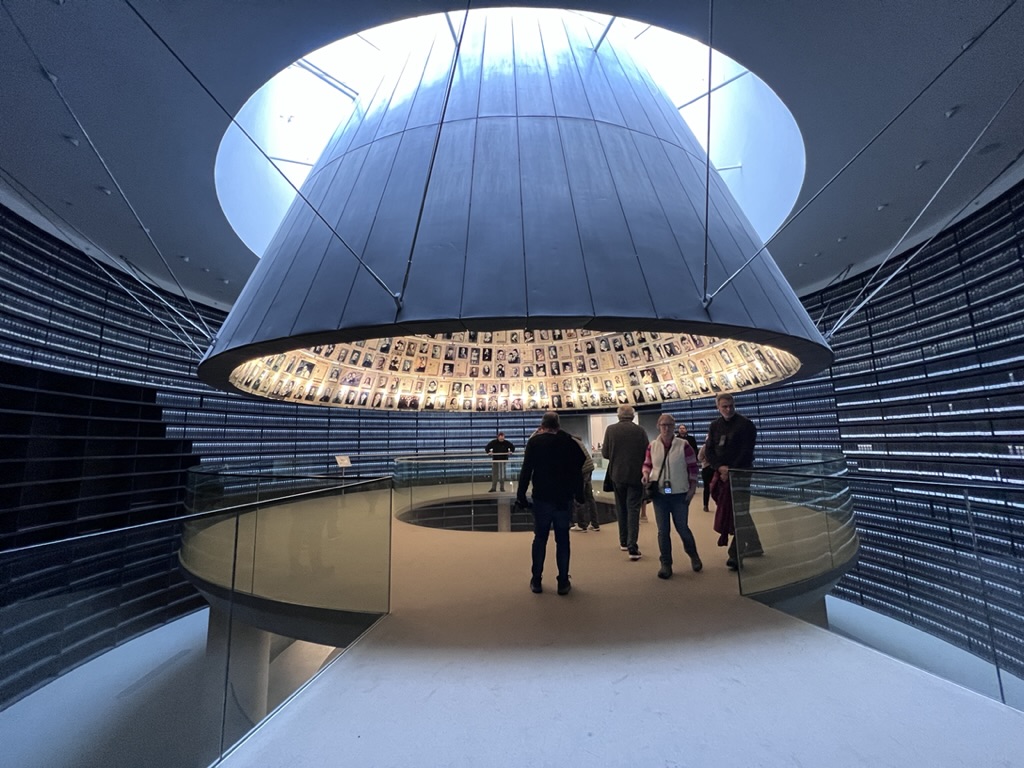
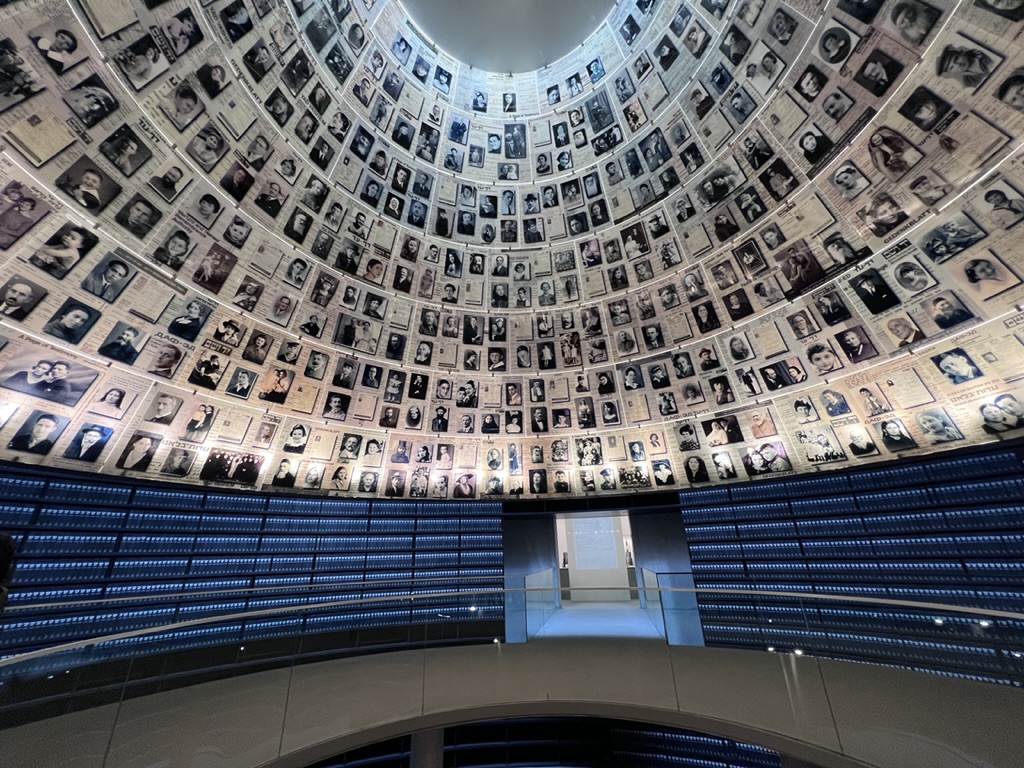
The museum exhibit portrays the Holocaust from both a Jewish perspective and also a personal view through the many artifacts, writings, documents that belonged to the victims, and many survivor testimonies shown through videos and also quotes. It starts with the history of discrimination of the Jews. The site also contains a small synagogue, a children’s memorial, and what looked like a research center. Part of the law that established Yad Vashem required recognizing non-Jews who risked their lives to rescue Jews during the Holocaust. This is called the Righteous Among the Nations who are honored in various ways throughout the exhibit and the building. The exhibit design (which is quite impressive, moving, and extraordinarily well done) forces the viewer to (at the very least) walk through the presentation in its entirety. There are exhibits on either side of the chasm and you then must cross the chasm – constantly criss-crossing the chasm which also has some exhibits. The only way to “skip” a section of the museum would be to backtrack and leave the museum completely—going against the flow of the visitors. While there had been some kind of Holocaust museum for decades, this is now the official museum of the Holocaust in Israel.
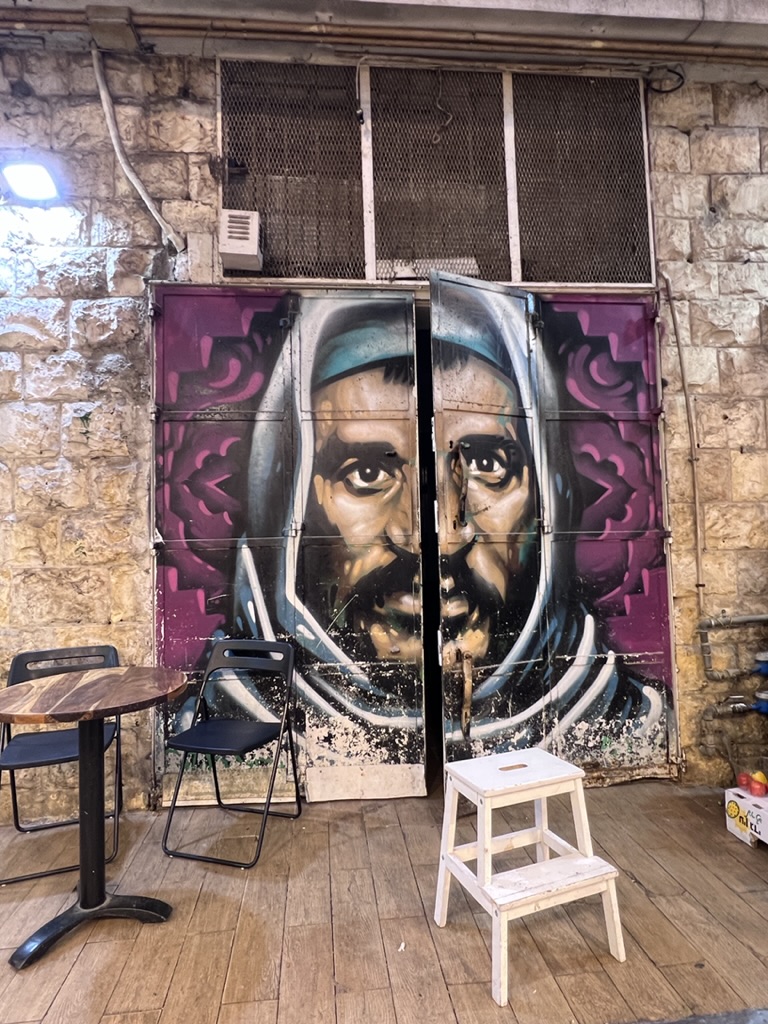
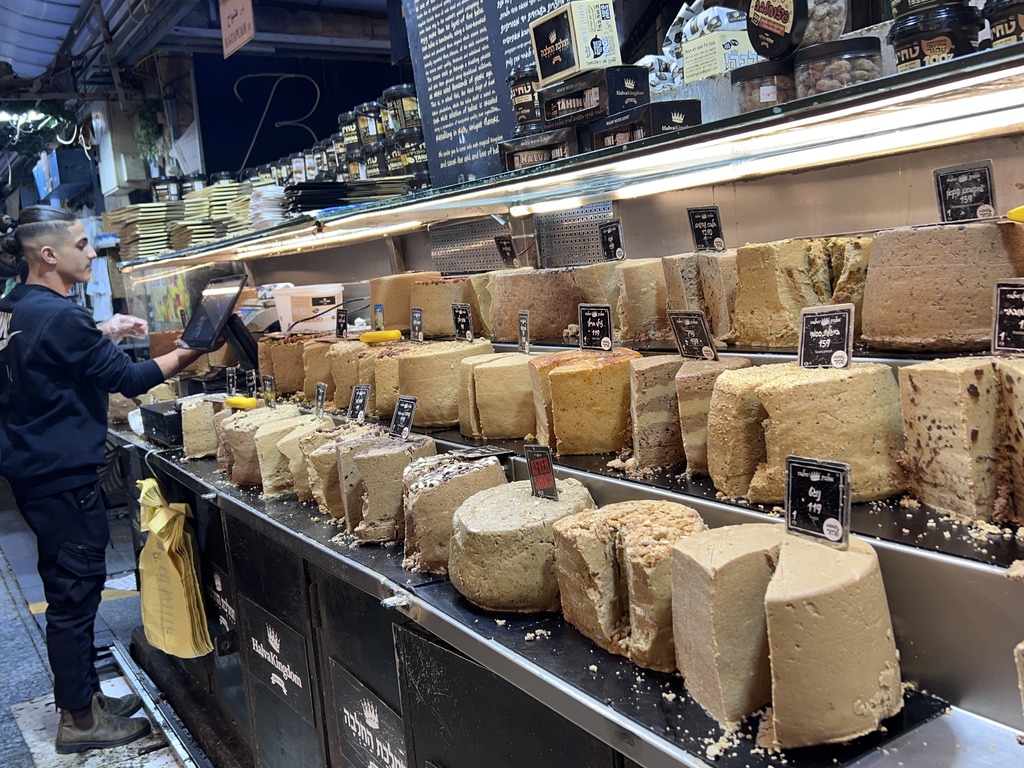
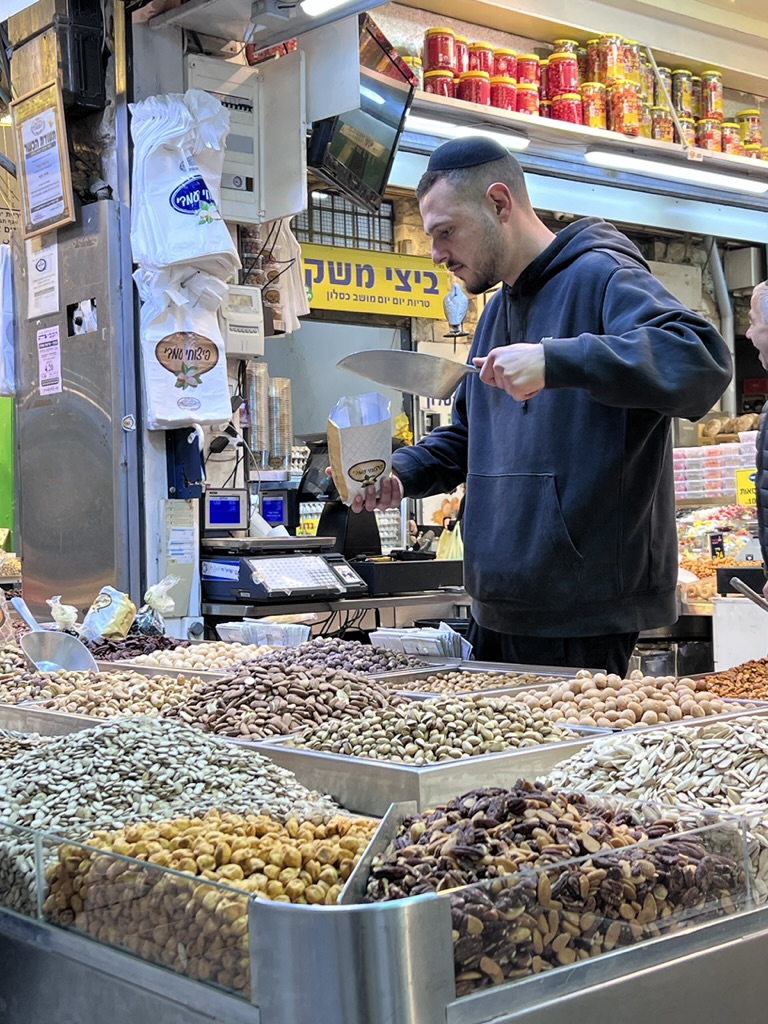

The story of the Holocaust is presented chronologically through giant blow-up photos that often have videos embedded within them, and text, quotes, some three-dimensional models that highlight survivors in their own words. Put together, it’s very powerful and memorable. I spent about three hours in the museum and Mike stayed longer. I left because I wanted to get to Mahane Yehuda Market, which is a sort of mix of old and new.. with tons of produce, fish, and meats and so many little restaurants I’m sure no one knows the count. It’s lively and authentic. I also walked the neighborhood around the market, and then headed back to the hotel. It was overcast all day today and thus, really cold and damp (but it didn’t rain during until evening).
Mike was in the museum for 5+ hours and without me he managed to get completely ripped off by his taxi driver, who he said was very nice and very interesting and spoke good English. Then he told me what he paid and he was really ripped off (about three times what it should cost).
It’s been a good few days here in Jerusalem. Tonight, we went to Talbiya for dinner— near the Jerusalem Theater.

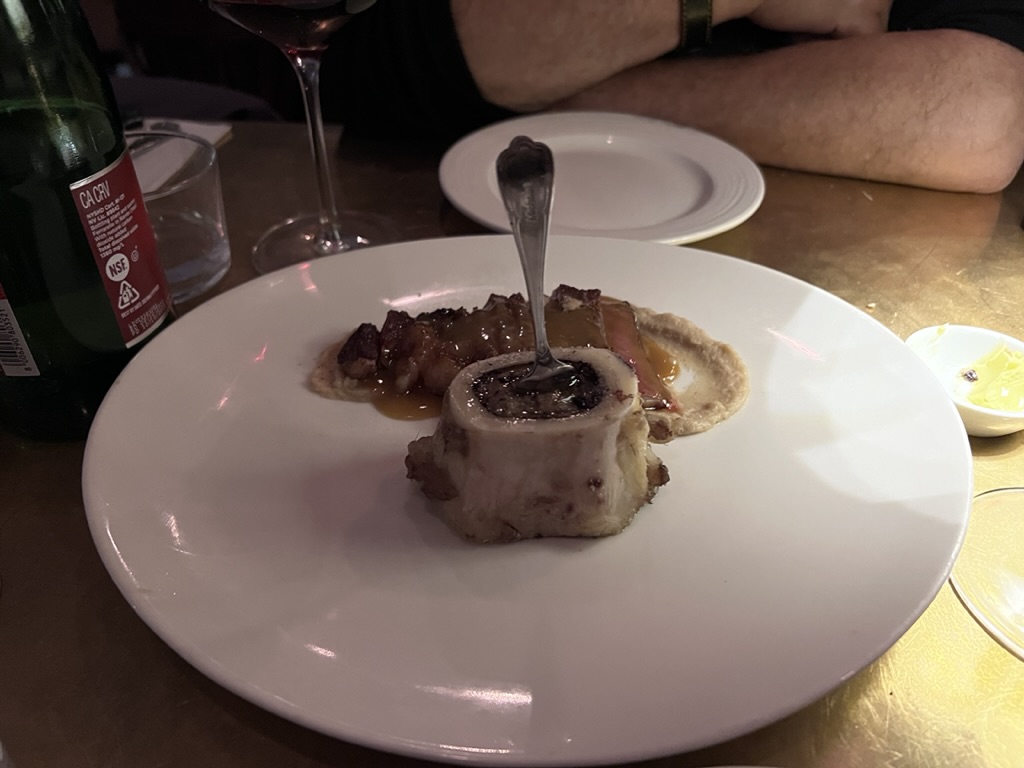
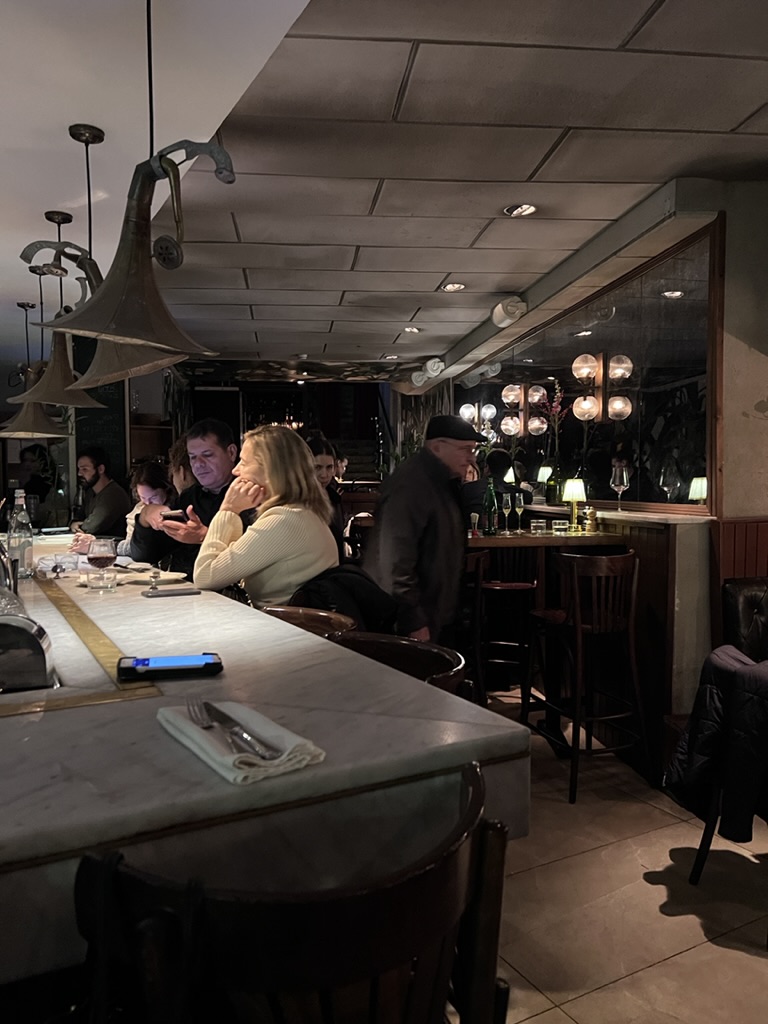
Tomorrow we are headed to the West Bank – Hebron and either Ramallah or Bethlehem. Our plan is to walk the streets and markets of these cities; we will not visit religious sites or monuments unless we just happen to stumble on them. We want to see everyday life. It’s only a day, and a long one, but hopefully we can get a sense of the Palestinian world. We hired a driver to take us to two cities, but not to be a guide.
We leave the next day for two nights in Akko which is up north (we will drive ourselves), and then we head back home.
More tomorrow (or maybe the next day).
All the best
Stay well, stay dry.
Fern
P.S. Updates on our “BenBen Hotel without hot water”: I sent a note to the owner of the hotel and they have refunded our stay at the hotel (which they should have done on the spot); in addition they have committed to two nights free in the future for us or anyone we know who is coming to Aswan. Let me know if you are planning a trip! And the Kempinski Dead Sea has accepted its responsibility for the car issue and has reimbursed us for the $500 cost the rental company charged for the damage to the car. So we are back on track.
21. Religious Intersections; Armenian Mass; Western Wall (and sexism still prevails) 1/8/23



8 January 2023
Hello / Բարեւ / ‘ahlan / שלום / Shalom/ /
Began our day a bit late today… settled into the Villa Brown Hotel Moshava in the German District of Jerusalem; made decision to cut one day from Akko and add that day to Jerusalem because we wound up spending yesterday in Tel Aviv instead of Jerusalem… but started with yet another incredible breakfast… what is it about the middle east that makes breakfasts so large and so good? — Egypt, Jordan, and now Israel are all breakfast specialists. Villa Brown Moshava (our little boutique hotel with just 24 rooms) does not have a restaurant, so they give you a daily coupon to eat at a place that is about 3 minutes down the road, called Caffit–a low key breakfast/brunch/lunch restaurant with an extensive menu for morning fare. Then we searched for an ATM as we were low on cash; and then we found a pharmacy so that Mike could get some cough syrup and something for his chest cold. He’s well stocked now. All of this happened on Emek Refaim Street which is a nice street chock full of shops and cafes and interesting old houses and buildings.
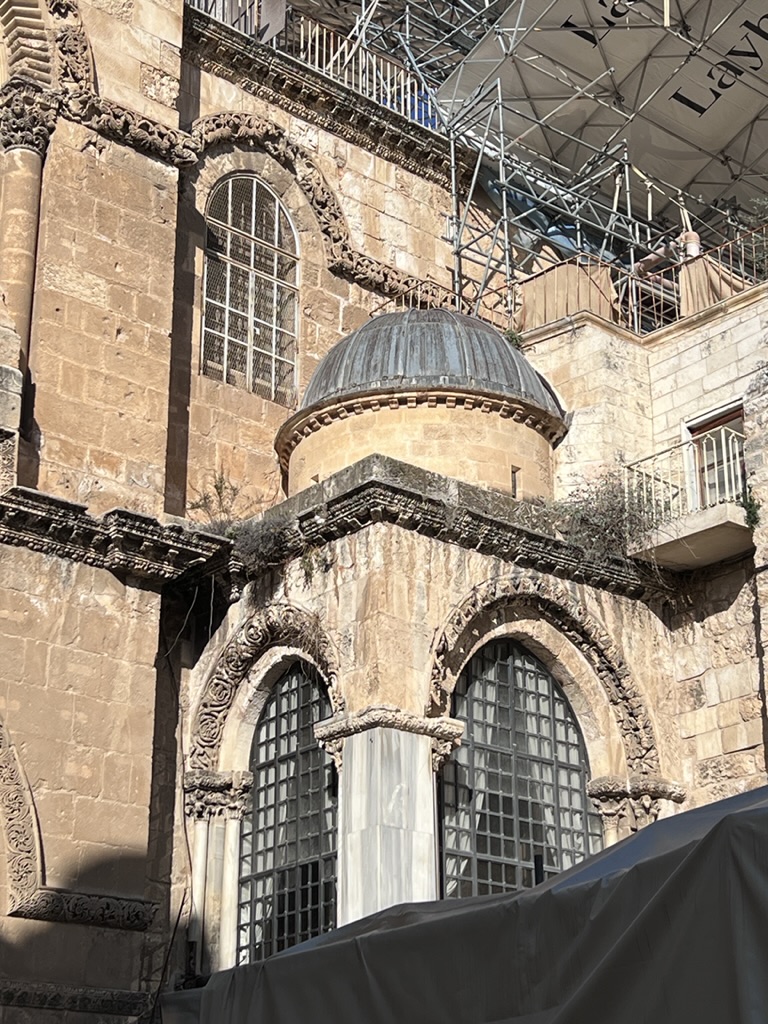
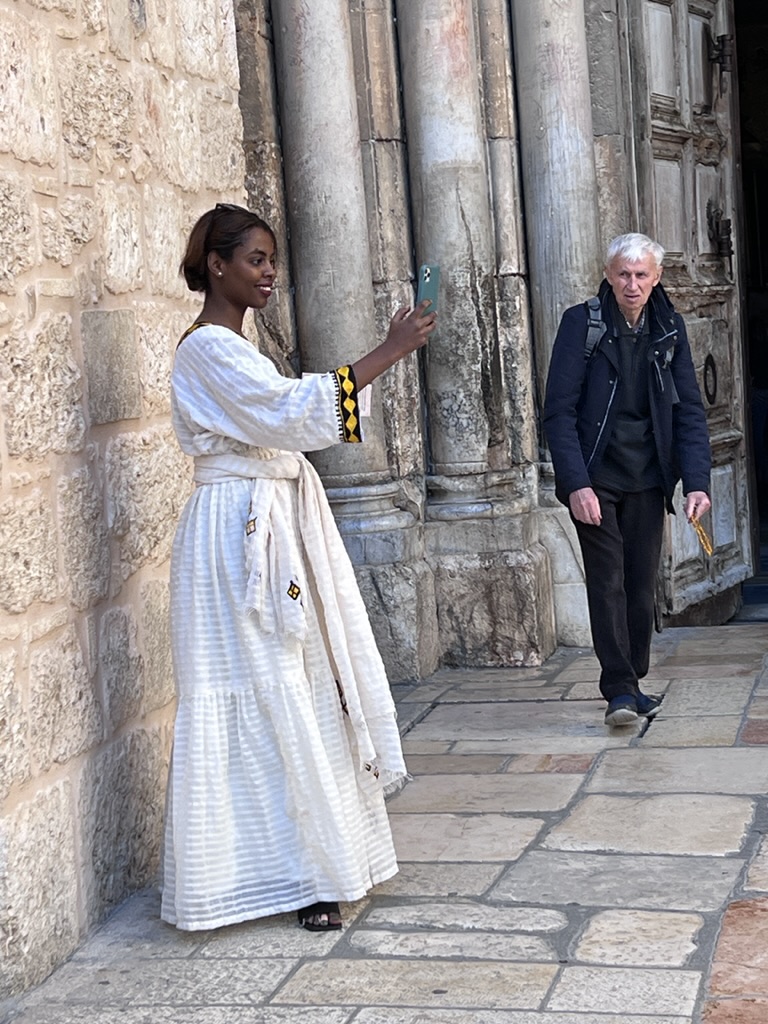
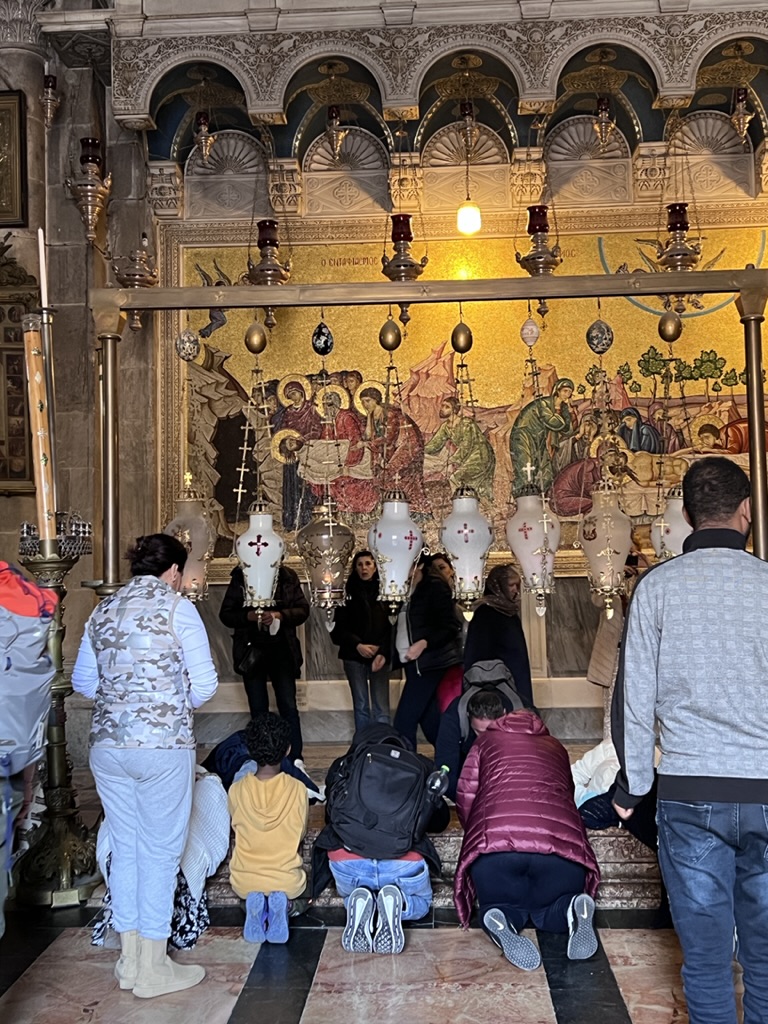
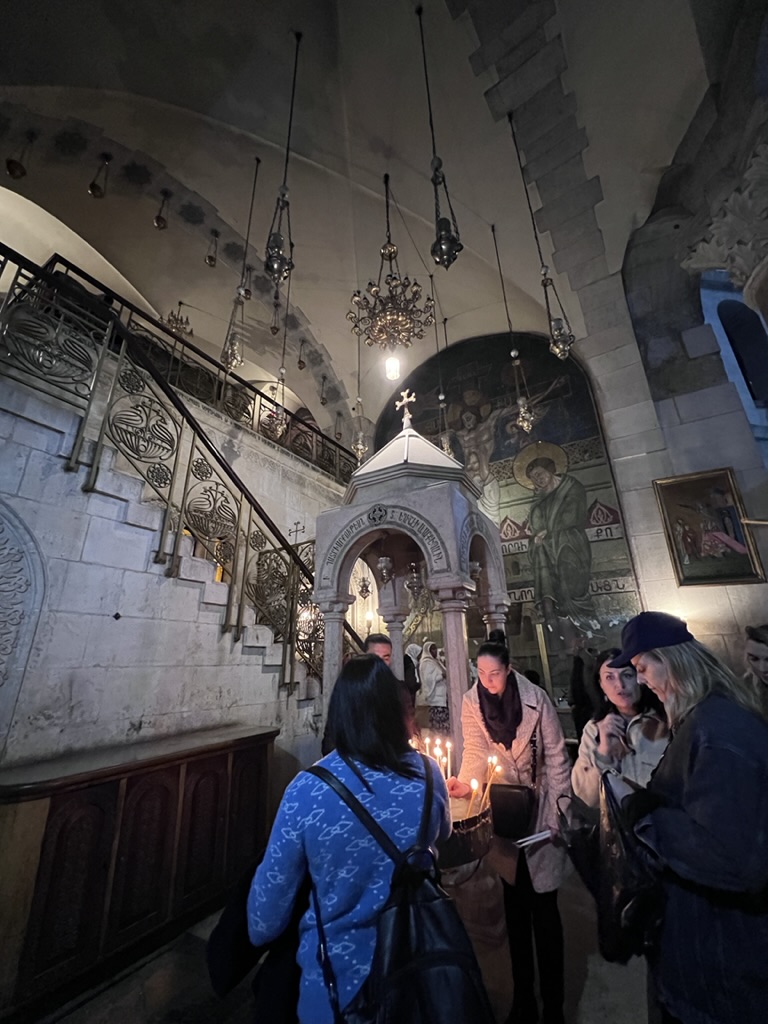
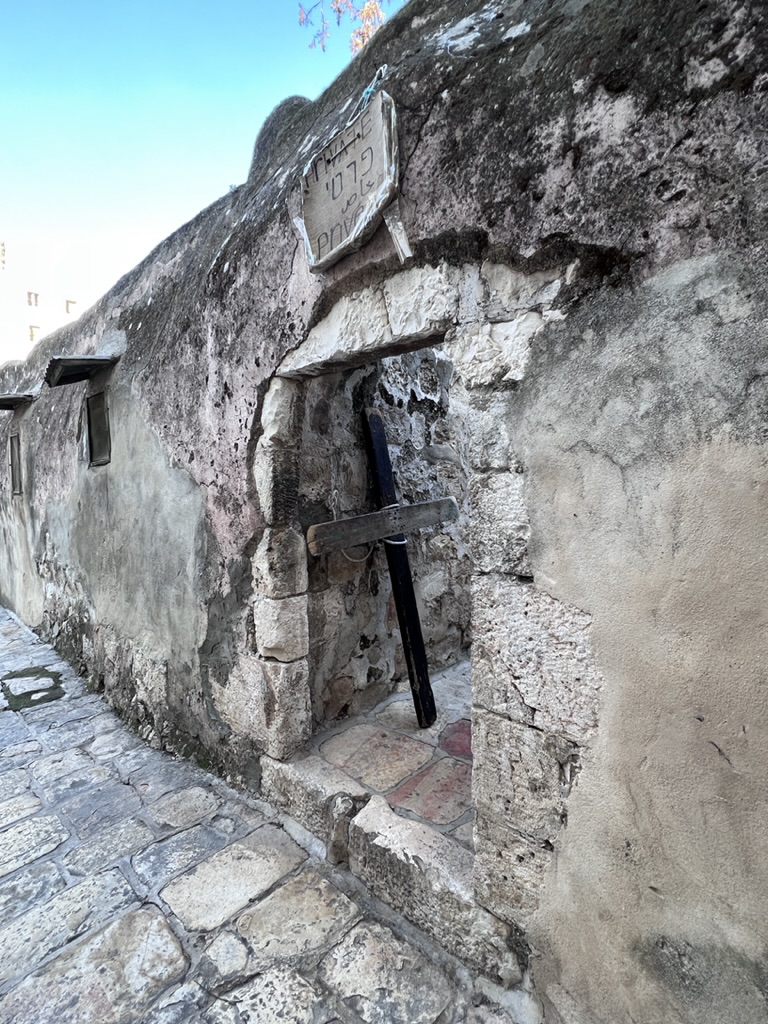
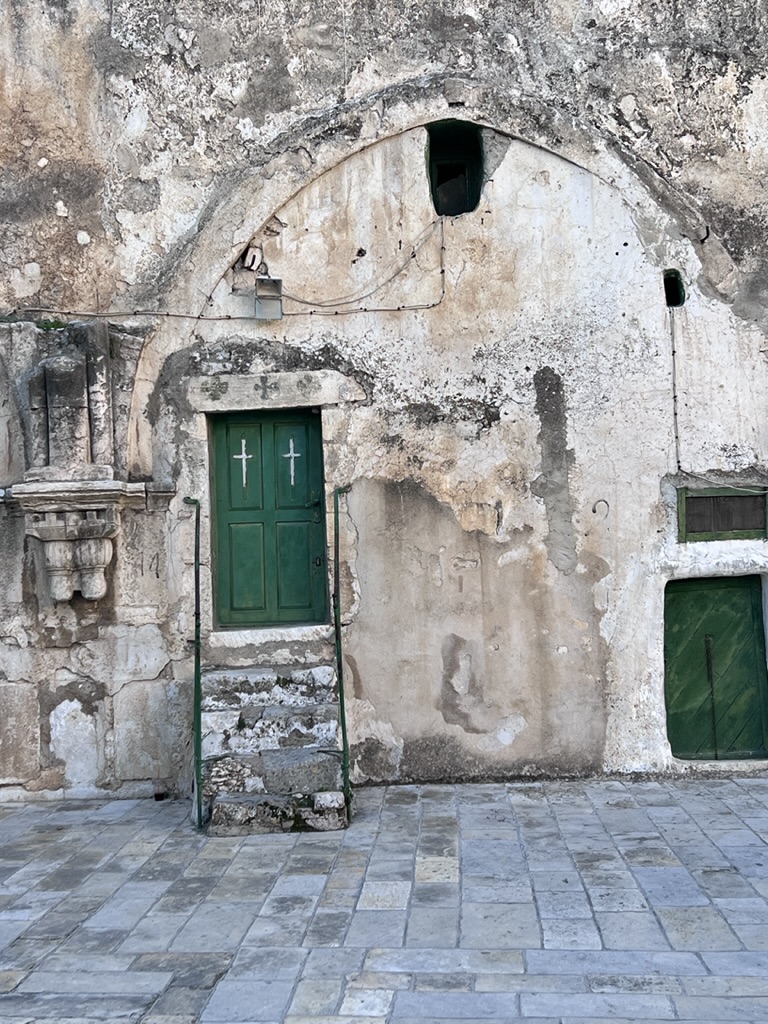
We then figured that instead of walking the whole way to the old city, we should hop in a taxi (using my trusted Gett app) and we headed for the Jaffa Gate. Once there we walked first to the Church of the Holy Sepulchre, in the Christian quarter, built in the 4th century – considered to be the most sacred site in the world for millions of Christians. It’s supposedly the site of the crucifixion, burial, and resurrection of Jesus. The church is a major Christian pilgrimage destination, especially on Sundays, like today. Control of the church is shared by multiple Christian denominations. We also climbed up to the roof of the church where we are told poor Ethiopian pilgrims and monks live in little huts, and where a dome of the chapel can be seen. Apparently, Ethiopians built this tiny village atop the church to continue their claims to the chapel after they had to sell it to the Coptic church in the 17th century. We saw the stone and cement “huts” but we didn’t see any of the monks. We saw many doors that led into private spaces, each with signs saying that the area was private.
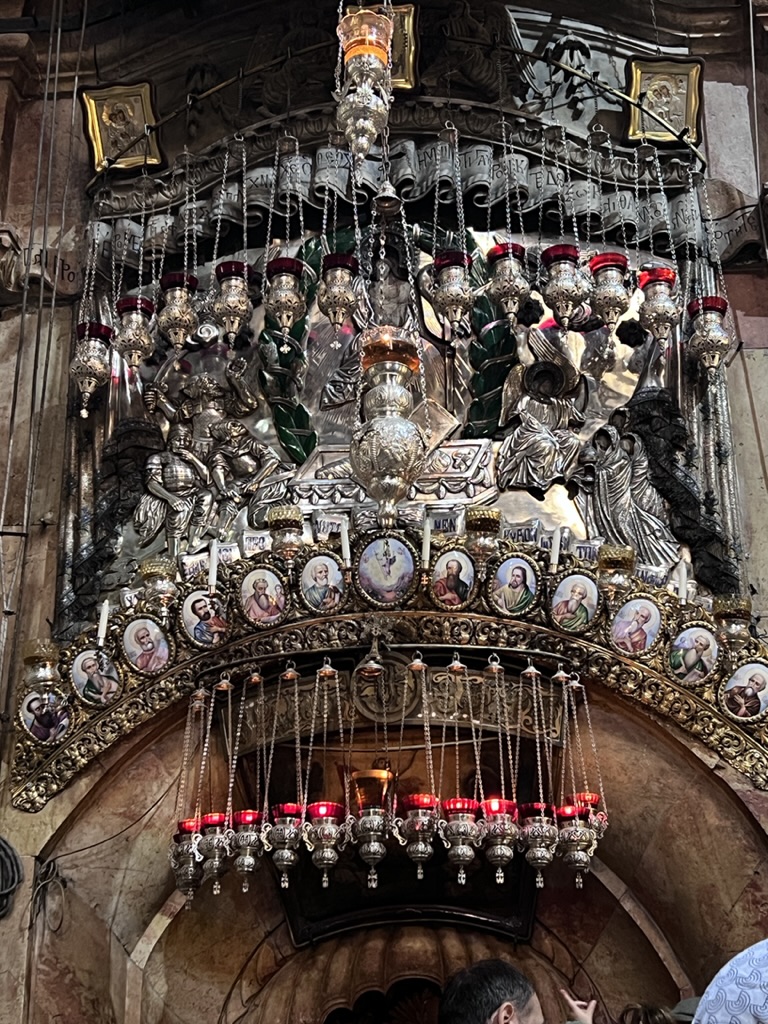

From the Church of the Holy Sepulchre we dashed off to the Church of St. James. It’s nestled within a walled compound in the ancient Armenian Quarter of the Old City. It’s ornately decorated with lots of hanging glass chandeliers and what I think are incense vessels. It dates to AD 420. The church is only open to the public during religious services. The interior, under a vaulted dome, includes a display of massive chandeliers, countless lamps, paintings, carved wood, inlaid mother-of-pearl, bronze engravings, and blue and green wall tiles. The marble floor was covered with purple, green and red carpets when we were there. The service includes (all men) young novitiates (?) and elders (who could use a little dieting) wearing black hoods. Incense and candles are burning everywhere and there’s amazing singing echoing throughout the building (all of which seemed to be in a common tone – no sopranos, no altos). There is a part of the service where the younger dudes place very ornate capes on the older guys. The service has a lot of chanting. There’s no electricity so everything is by the light of candles. Very effective and moving.
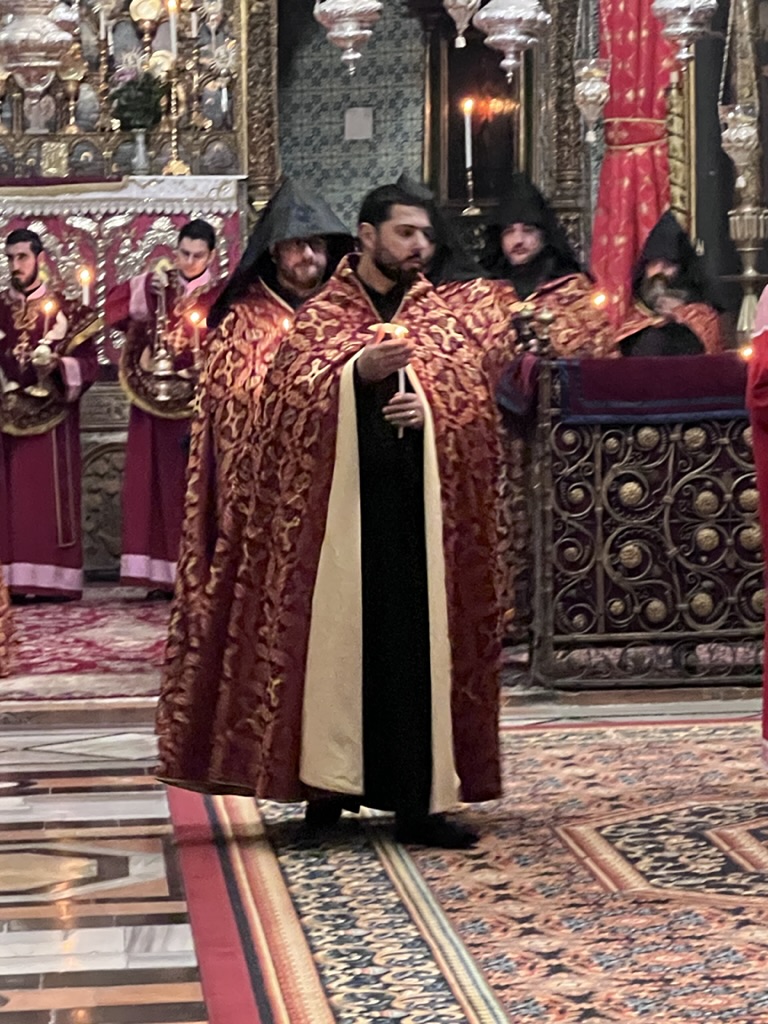
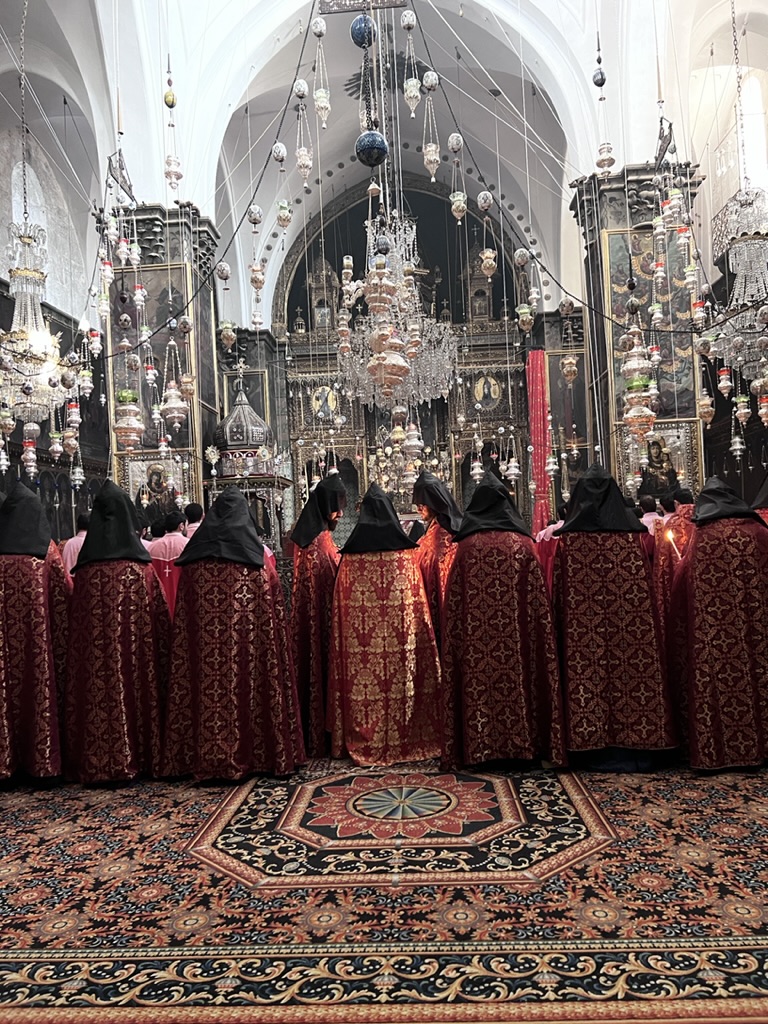
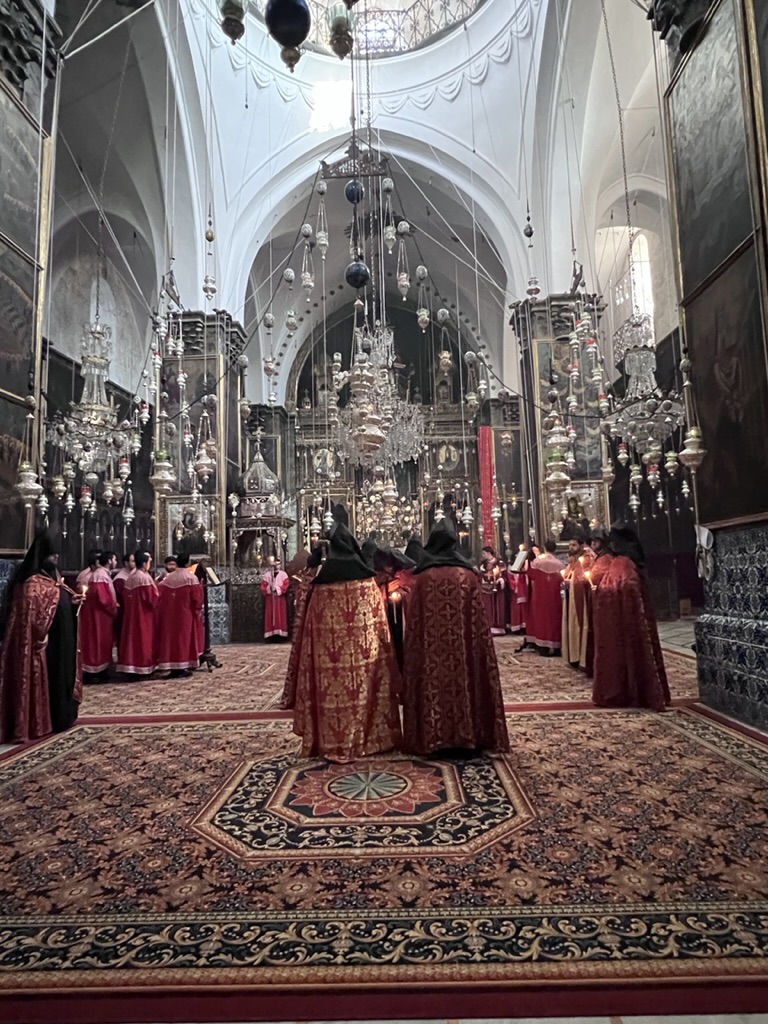
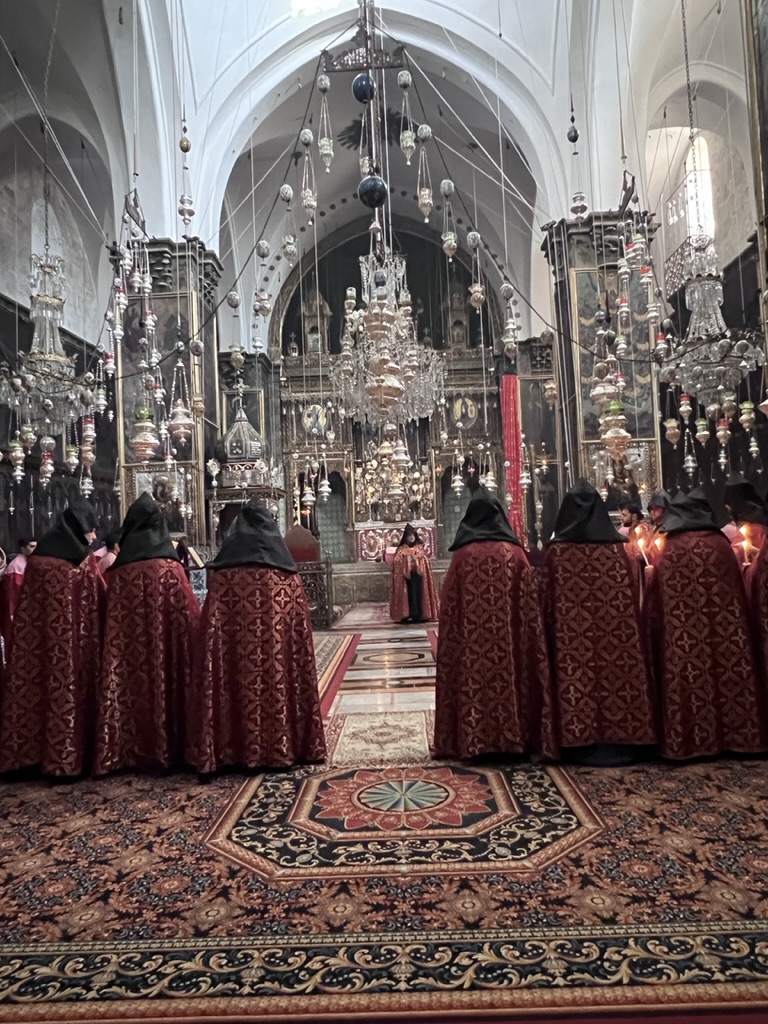
We stayed for the entire service and my take-away is that you cannot become an Armenian monk unless you can carry a tune. Mike says his chest cold immediately improved after sitting through the service and witnessing “a miracle.”
Then we strolled to the Western Wall… which, in my opinion.. was like the pyramids.. a bit of a letdown. Mike and I were walking together, although I was ahead of him, since I walk faster. Suddenly, I turned around and I couldn’t find him… A woman then said to me: “He cannot come in here; he needs to go in the other section.” And I remembered that women cannot “pray” or visit the same part of the wall as men. Mike “protested” by not going to the wall at all, and just sitting on a bench further back and observing the whole scene. I went in briefly but did not touch the wall and I suddenly remembered those memories of not being able to sit in the main section of the synagogue for my brother’s bar mitzvah. The wall, known as the most holy site in the Jewish faith, is the last remnant of the original retaining wall that surrounded the Second Temple that was built more than 2,000 years ago.
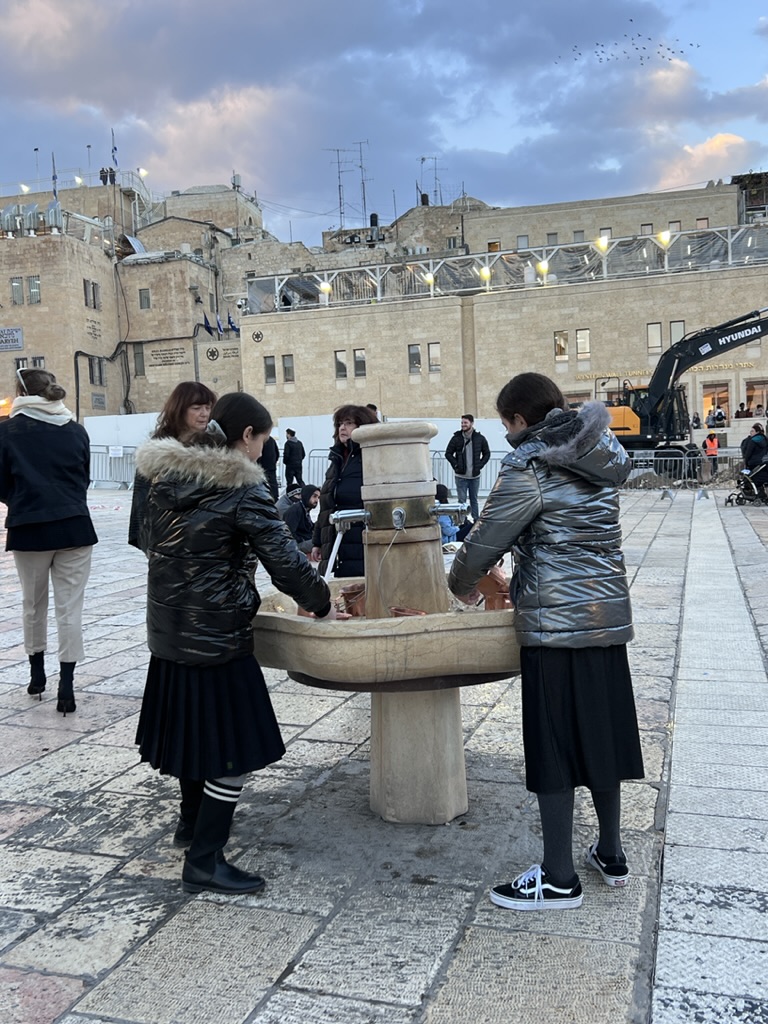
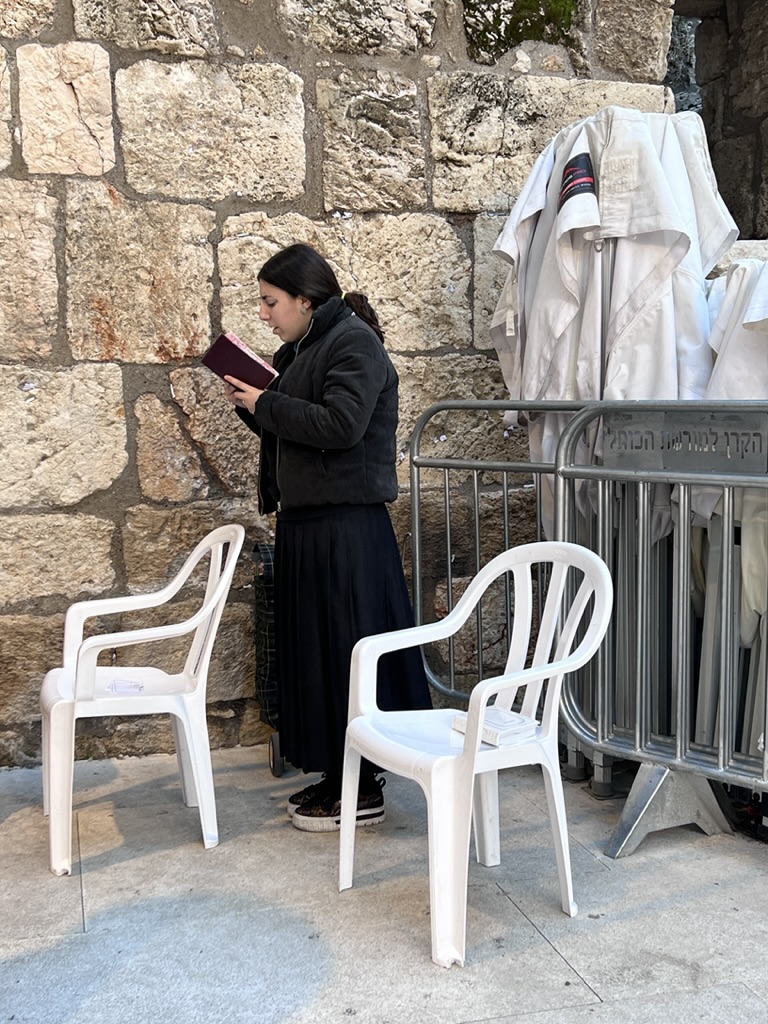
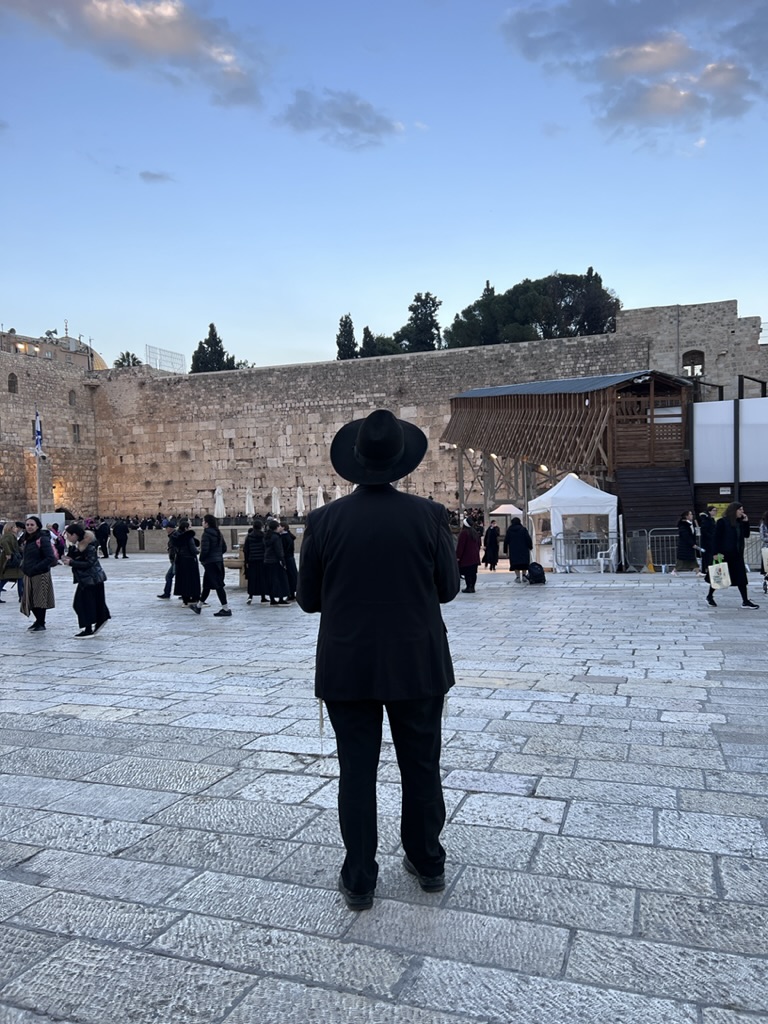
After the temple was destroyed in AD 70, the Jews were exiled from the city, and it became a place of pilgrimage where they would return to lament their loss (therefore, long known as the Wailing Wall). Now it is essentially an open-air synagogue, with divided sections for men and women to pray independently. Worshipers place little notes in the cracks in the wall, believing that these prayers will be answered quickly. Lots of Hasidic men, women, and children.
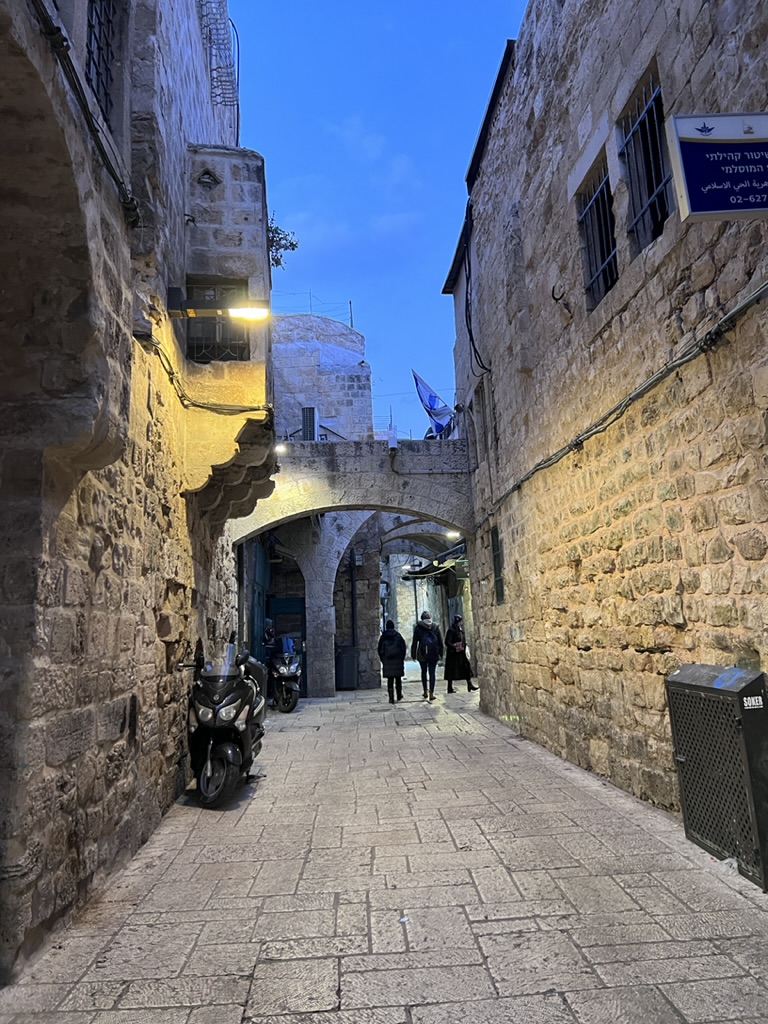
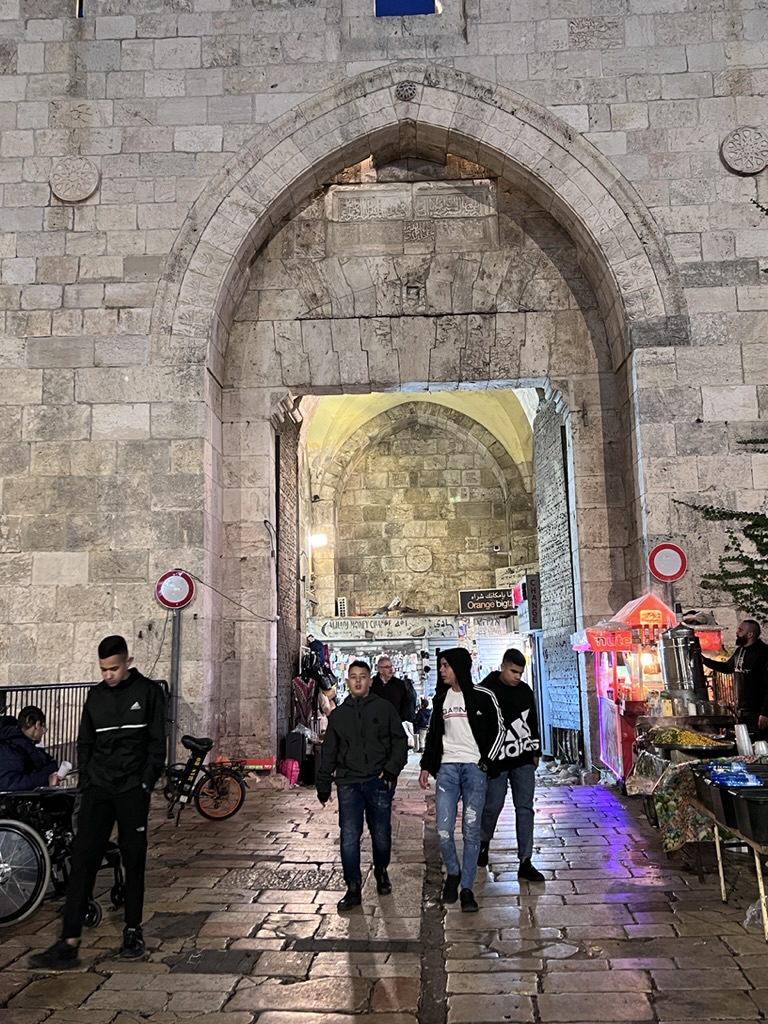
I watched women say their prayers and write little notes on paper that they tucked into the cracks in the wall. And I watched men and women whispering their prayers, into the wall and reaching up with their hands to touch the wall. I met up with Mike in the plaza and we strolled to the Damascus Gate before heading back to the hotel.
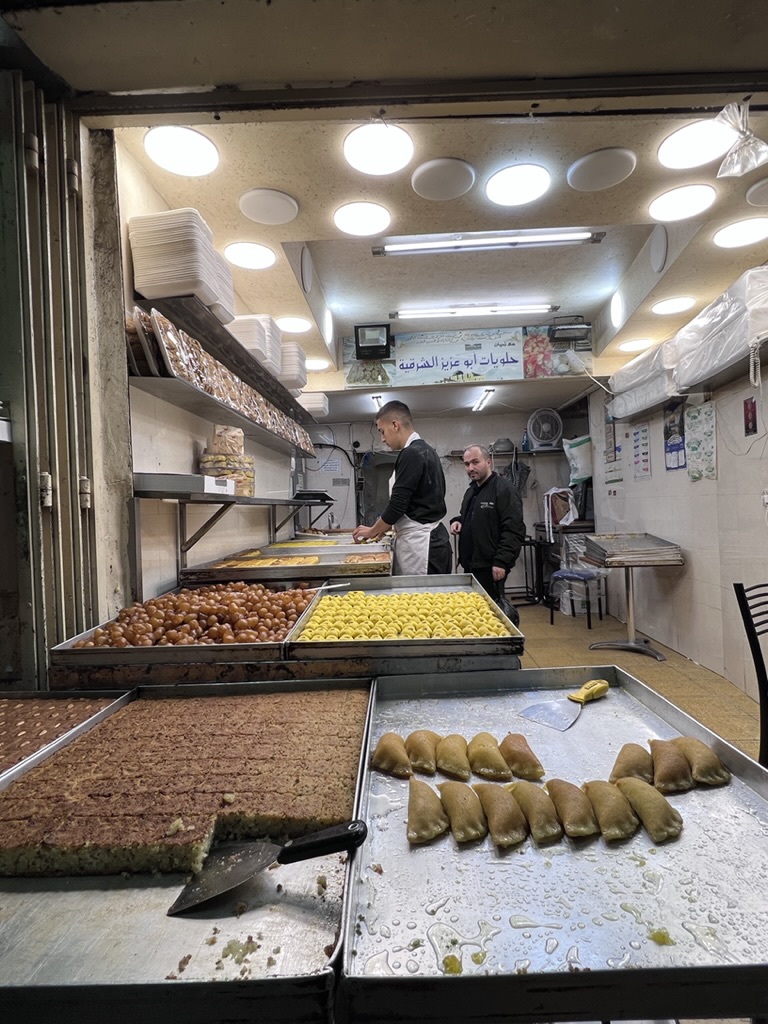
Tonight we ate at Mona, which was listed as being in an “artist’s house”.. which I expected to mean a little cottage. But it was a large elegant building with a stone-walled garden and a working fireplace. It had a rustic feeling although it had a totally modern menu. We started with a beef tartare and an agnolotti stuffed with meat and sitting in a red cream sauce. For the next course we had veal sweetbreads cooked with another wonderful and unusual sauce. We also had barr fish (It’s like sea bass) filleted and sitting on wonderful lemon linguini. Ended the meal with a lovely cheesecake.
Back at the hotel, I want to get this out before I hit the pillow. By the way, Mike now thinks that all of these ancient religions are older versions of QAnon.
Fern
Greetings from Jerusalem –
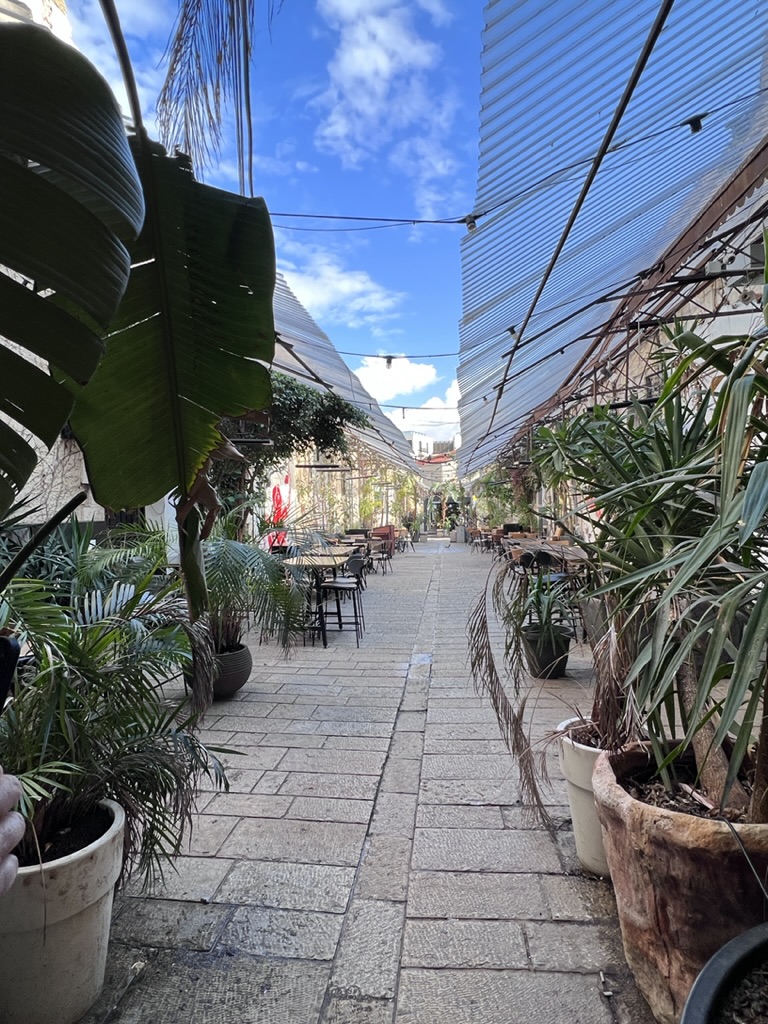
Last night’s dinner at Dalida was great. We sat at the bar where we could watch all the kitchen action. We had the sweetbreads kabob followed by a pasta stuffed with eggplant and spices in a wonderful creamy tomato sauce (really great, but a very small portion) and then a lamb kebab… and of course dessert. The menu is very creative and combines Arab, French, and Italian tastes. Highly recommended.
This morning we learned that because Saturday is Shabbat, the trains don’t run until 8:45 pm! So, we spent the entire day walking in Tel Aviv, which was fun, because it was clear and sunny, although got overcast late in the day. But this new information meant that our “fast train” to Jerusalem would get into the station at about 9:30 pm.
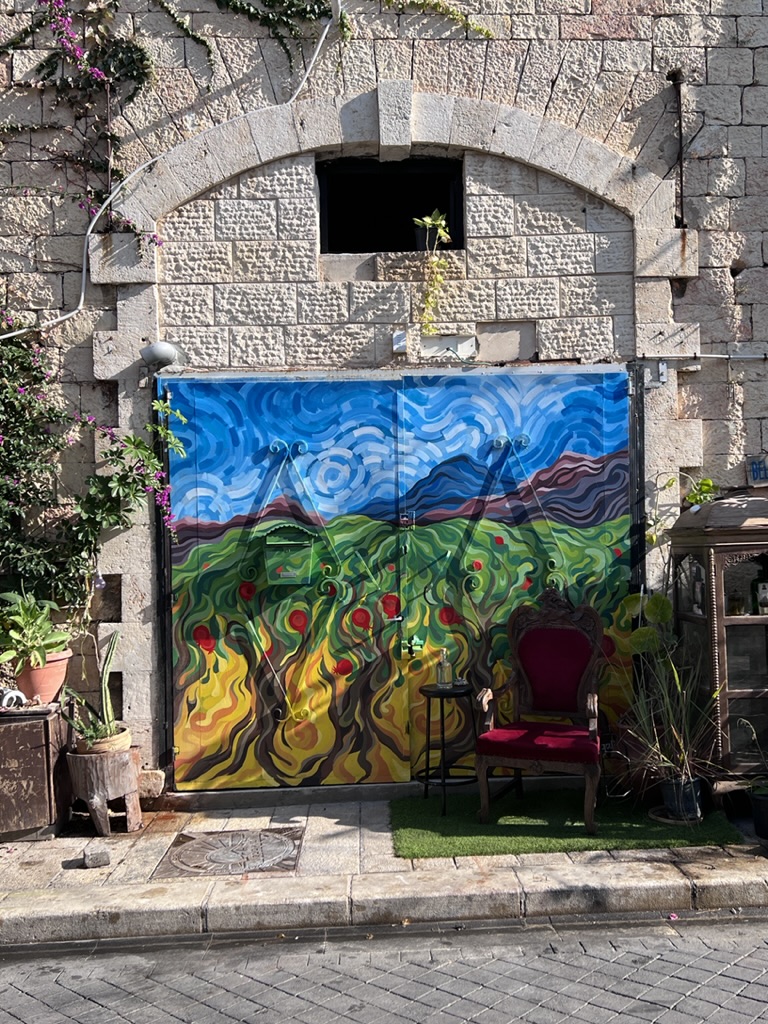
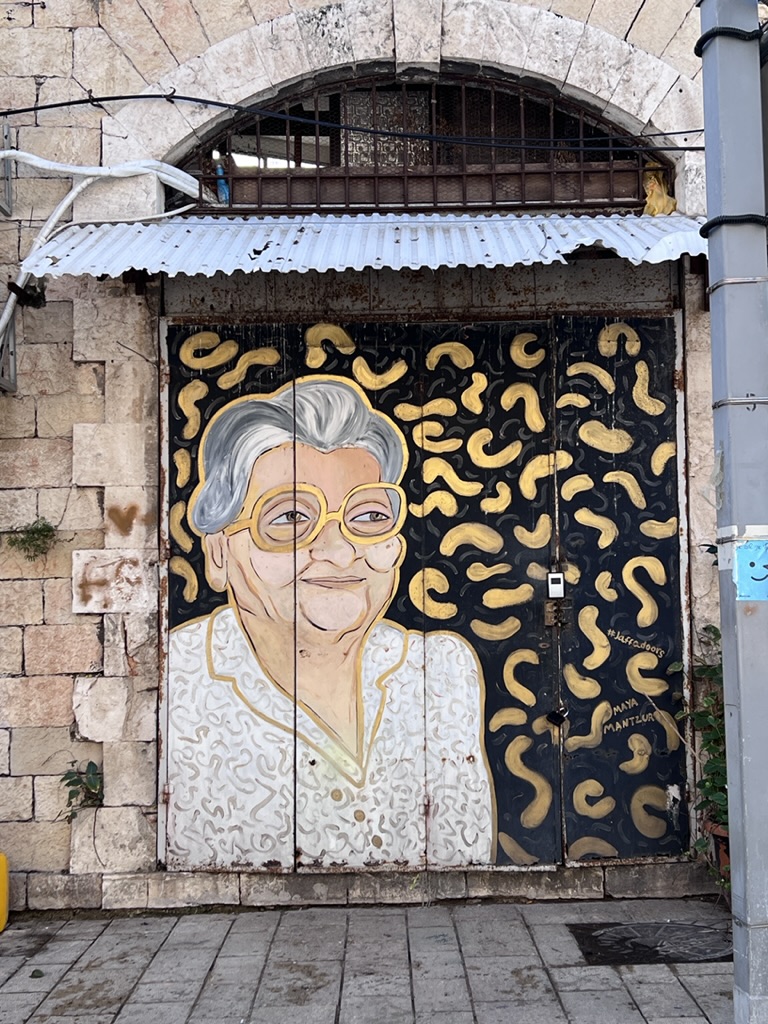
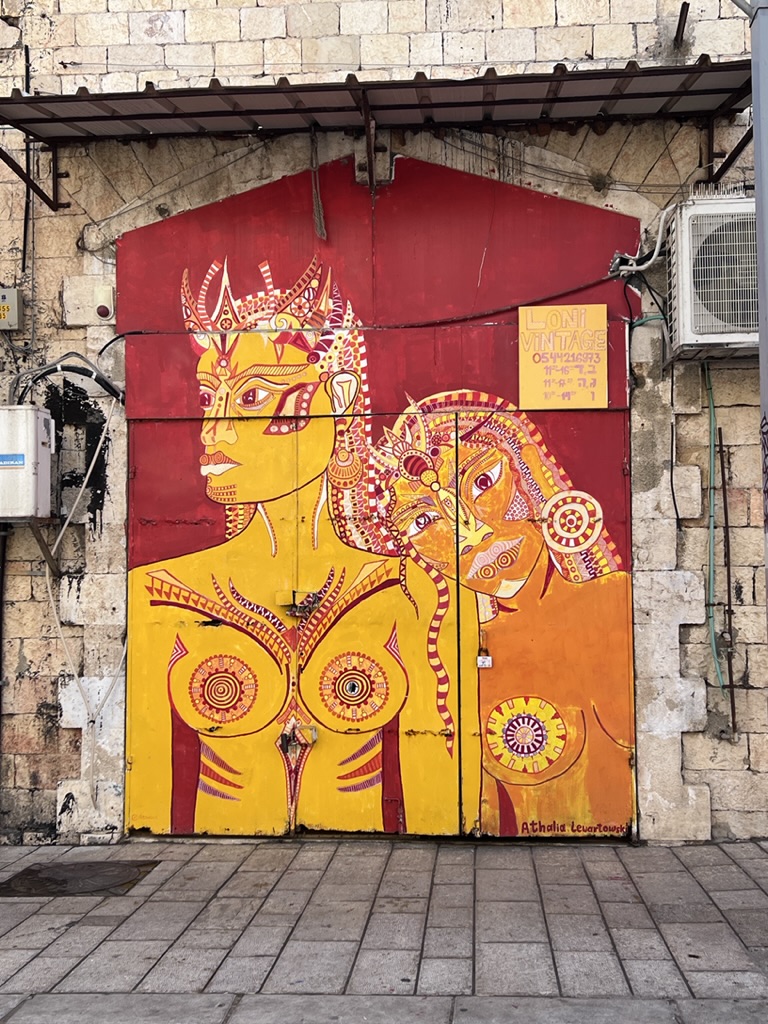
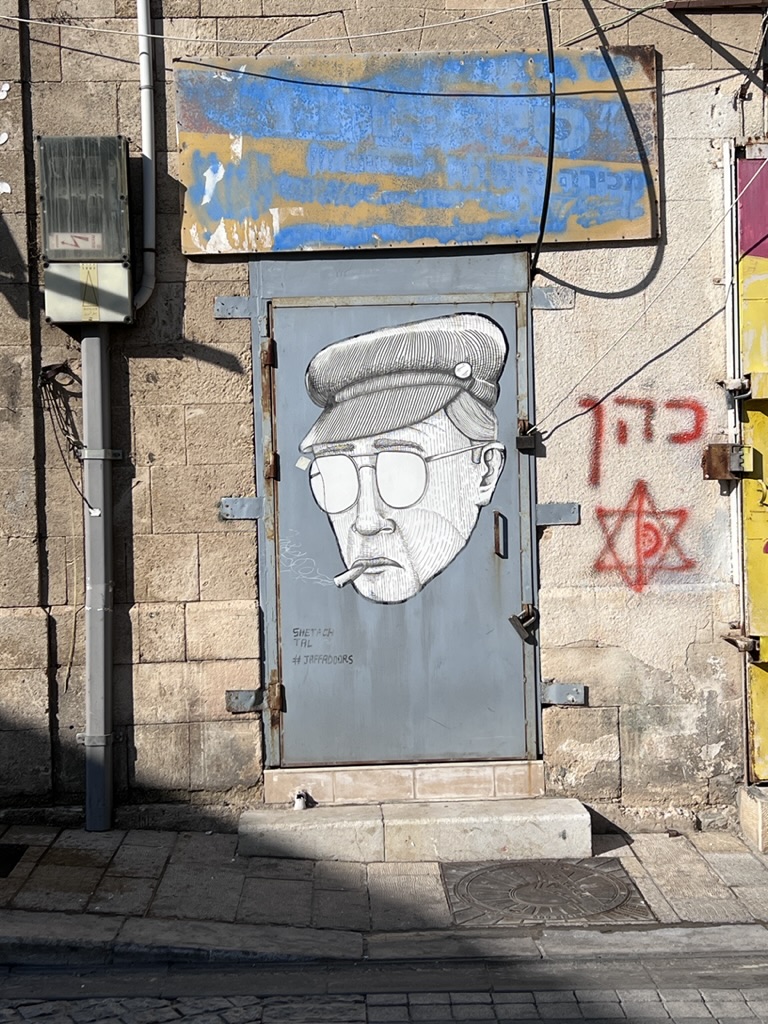
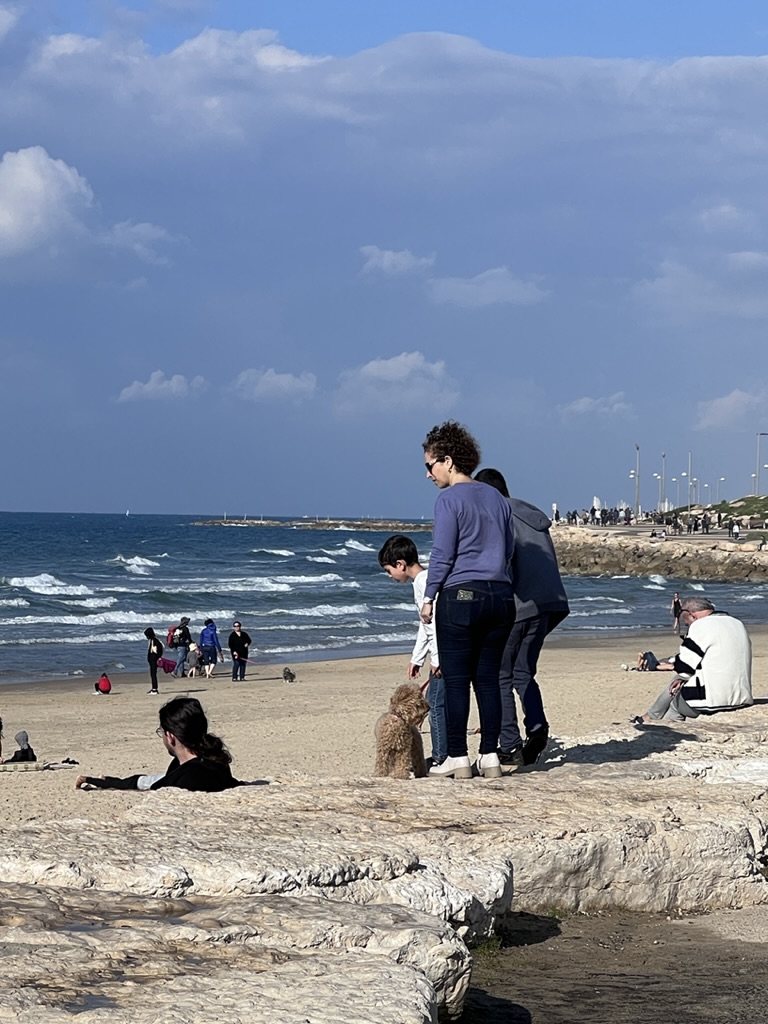
We walked through another area near our hotel filled with murals and then headed to the areas we had not walked yesterday when the rains started. Initially we headed to the long linear park that edges the beach. It was sunny and Saturday, so everyone seemed to be out… soaking in the sun, biking, walking, or sitting in the park area. Mike decided to join the “sitters” in the sun and I strolled ahead meandering through many different neighborhoods and sweet alleyways and pedestrian streets with interesting housing and shops.
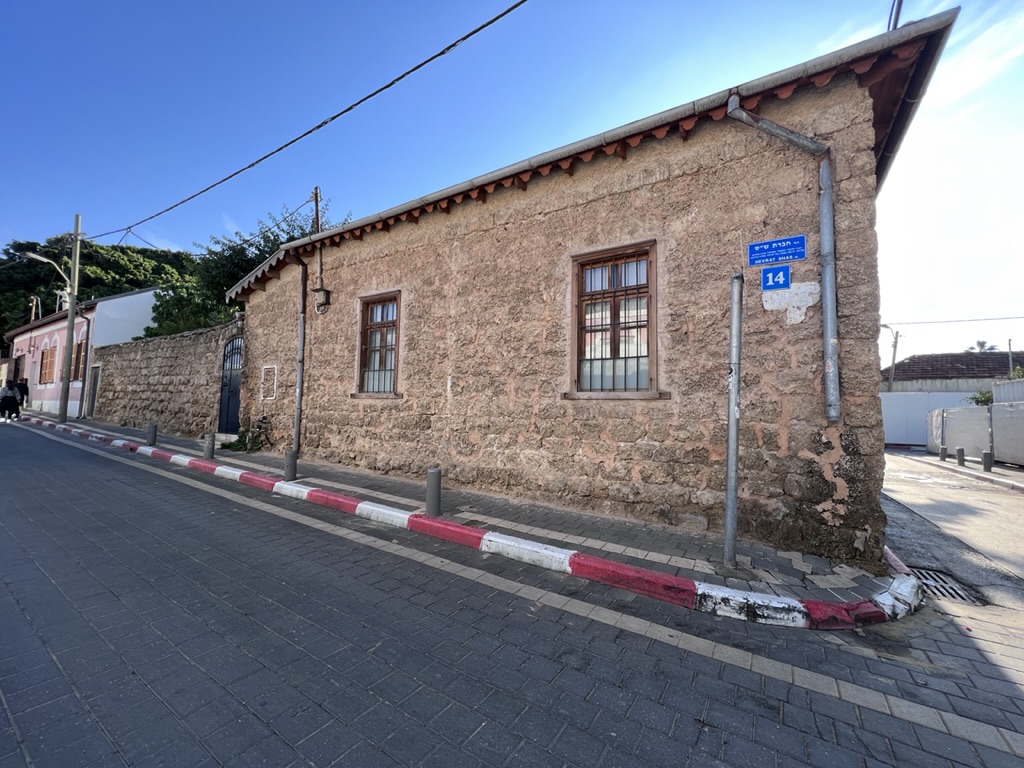
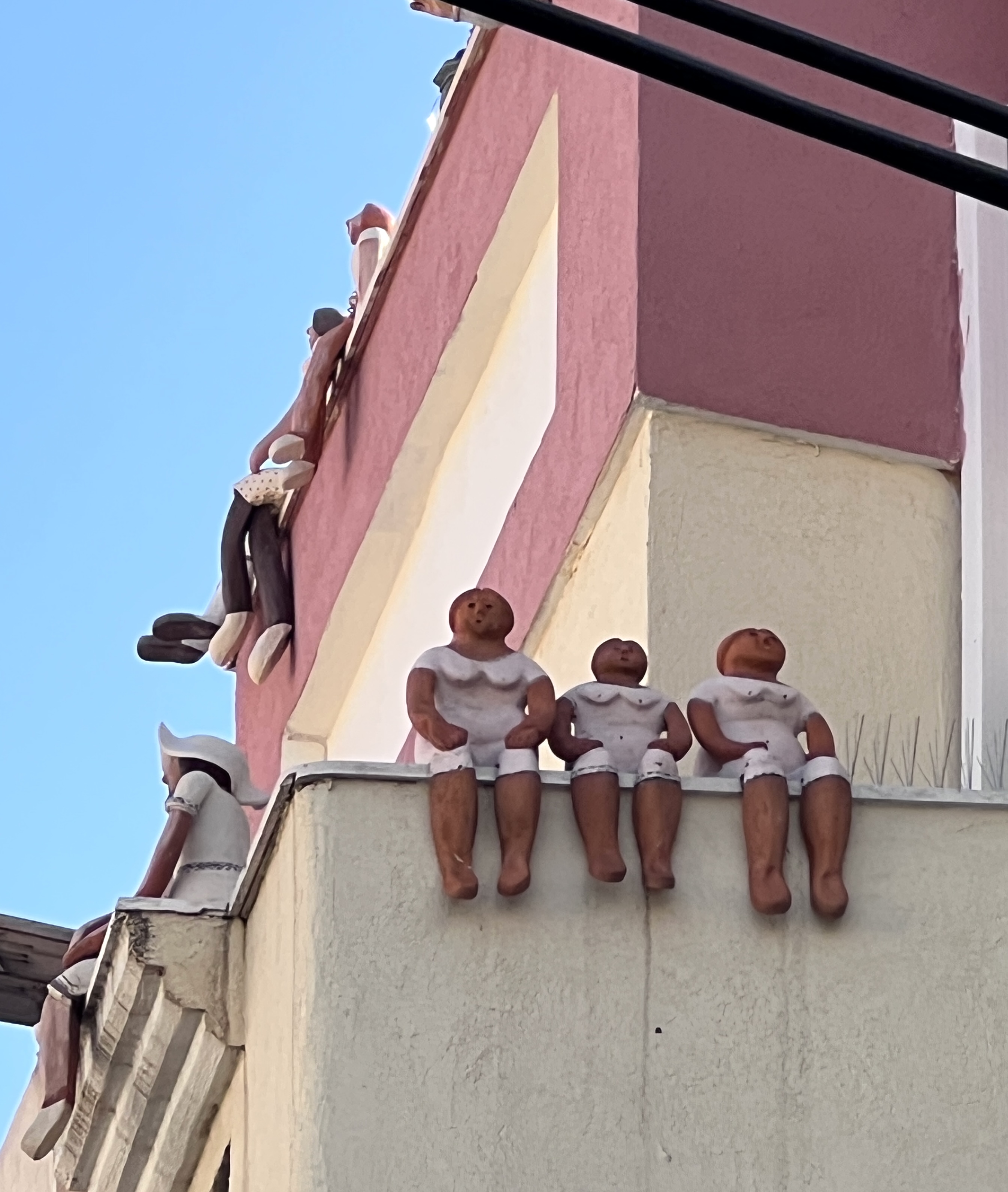
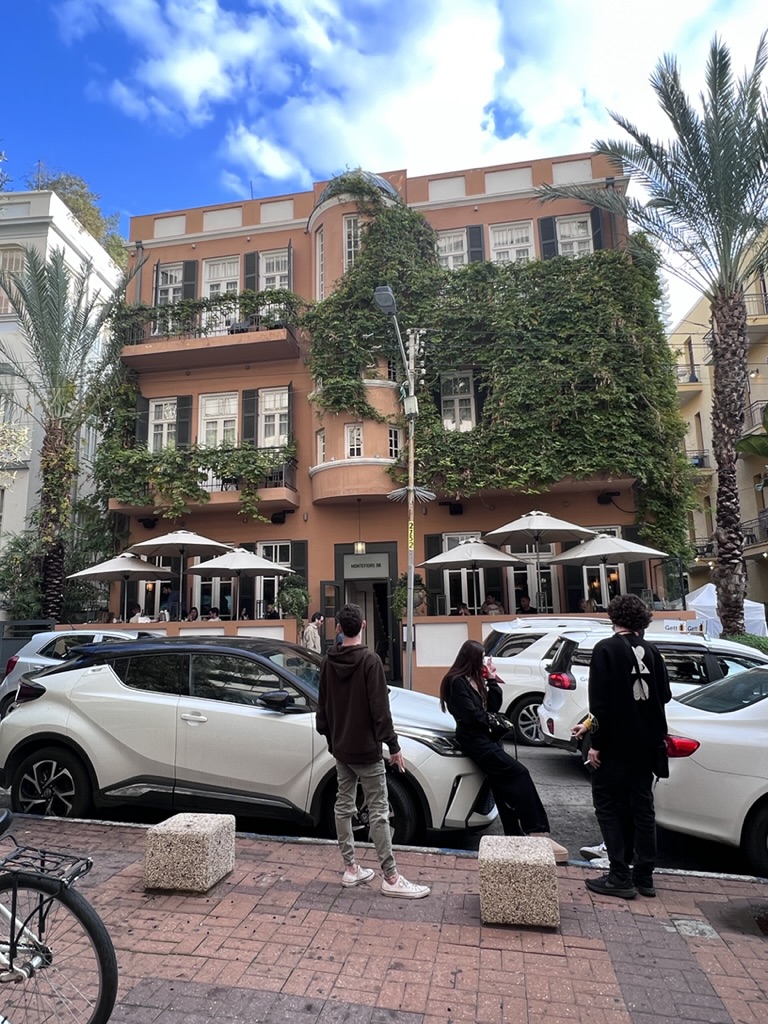
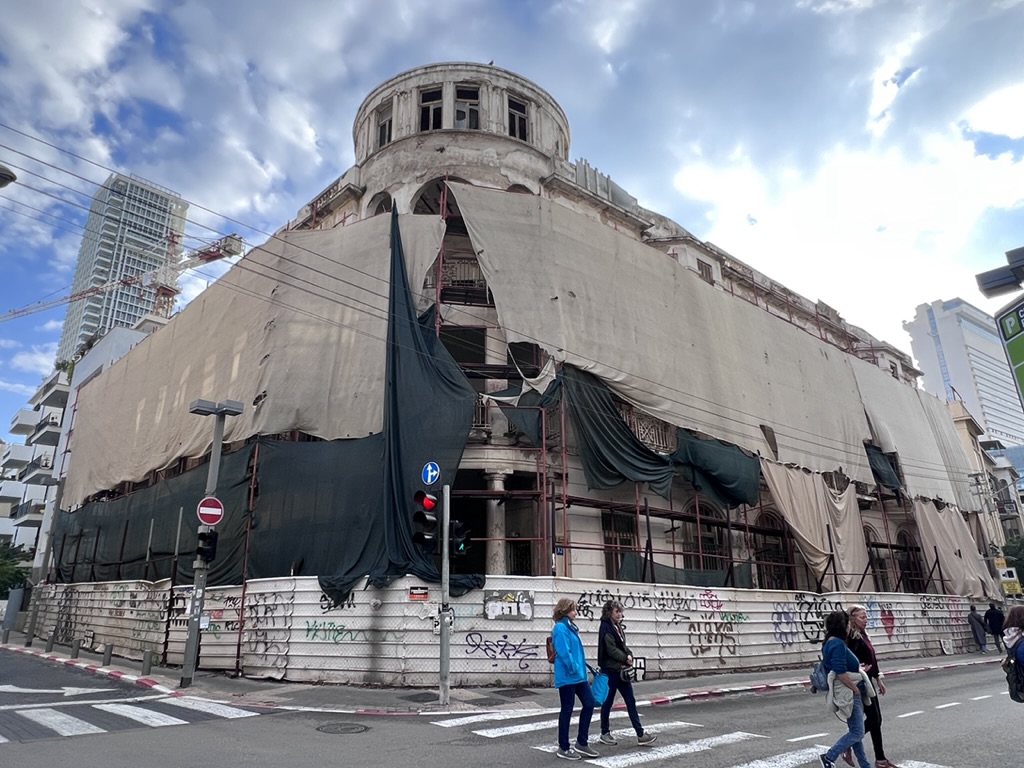
Eventually I found myself on Shabazi Street (good thing I didn’t get there yesterday, or I might have blown the budget shopping in all of the boutiques that lined the street). I suddenly found myself walking around a big crowd that seemed to be waiting for something or trying to get into a shop. I surveyed the situation and realized they were all trying to get into an ice cream store. Since there are many ice cream shops in Tel Aviv, I figured this one must be special, so I joined in and finally got to the counter to place my order. The few people on line speaking English were saying it is the “best ice cream in the world!” Not sure, I’d go that far but it was pretty damn good… very decadent, hand-made, real cream-based gelato and frozen yogurt with over 150 flavors (not every day.. they switch em up; about 20 per day). I tried the pistachio and a nougat/chocolate/chili one. Realized I hadn’t had lunch, so I figured it was important that I get some energy.
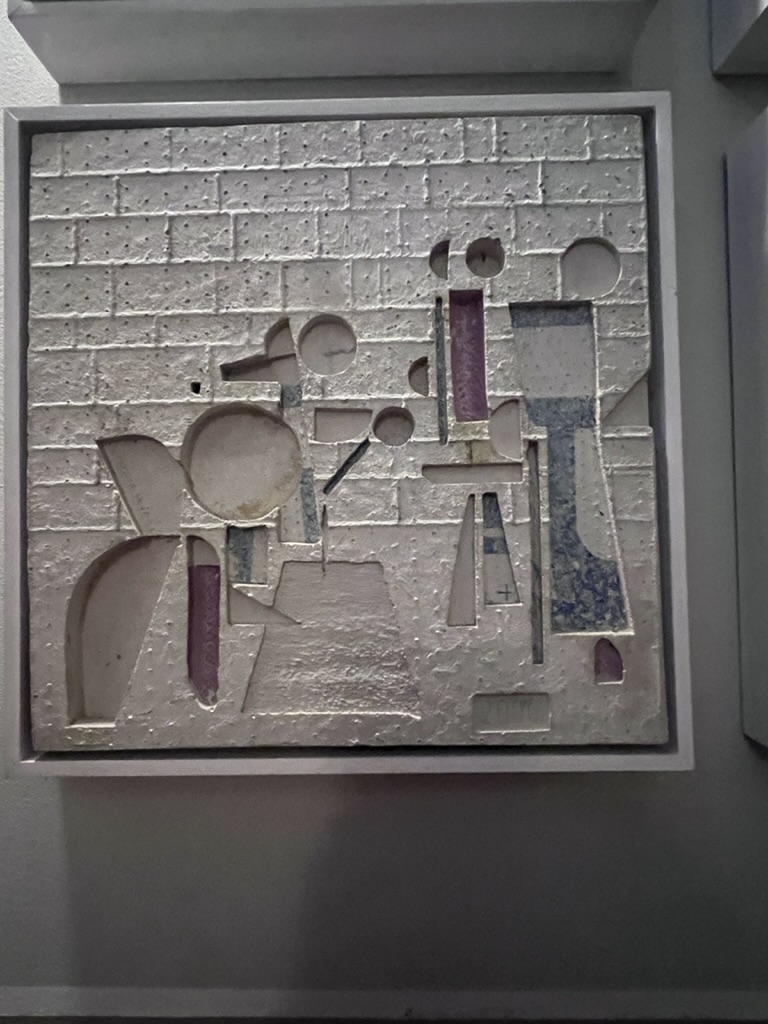
Then Mike called that he was walking as well, having soaked up enough sun—and we agreed to meet at The Norman, an iconic hotel. It apparently began with three residential buildings of different architectural styles, one of which was influenced by the Bauhaus. It has lots of character and history and is quite elegant. Since I hadn’t revealed my little ice cream lunch, I met Mike in the restaurant (Alena) and we ate a late lunch (4:00). We had a wonderful pizza that had eggplant as its base (instead of tomato sauce) and Israeli cheese and spices and then just as it comes out of the oven, they put an egg yolk on top which gets warmed by the pizza. Really rich and very tasty.. Then we followed that with a calamari dish that was also very good.. and paired so well with our wine.
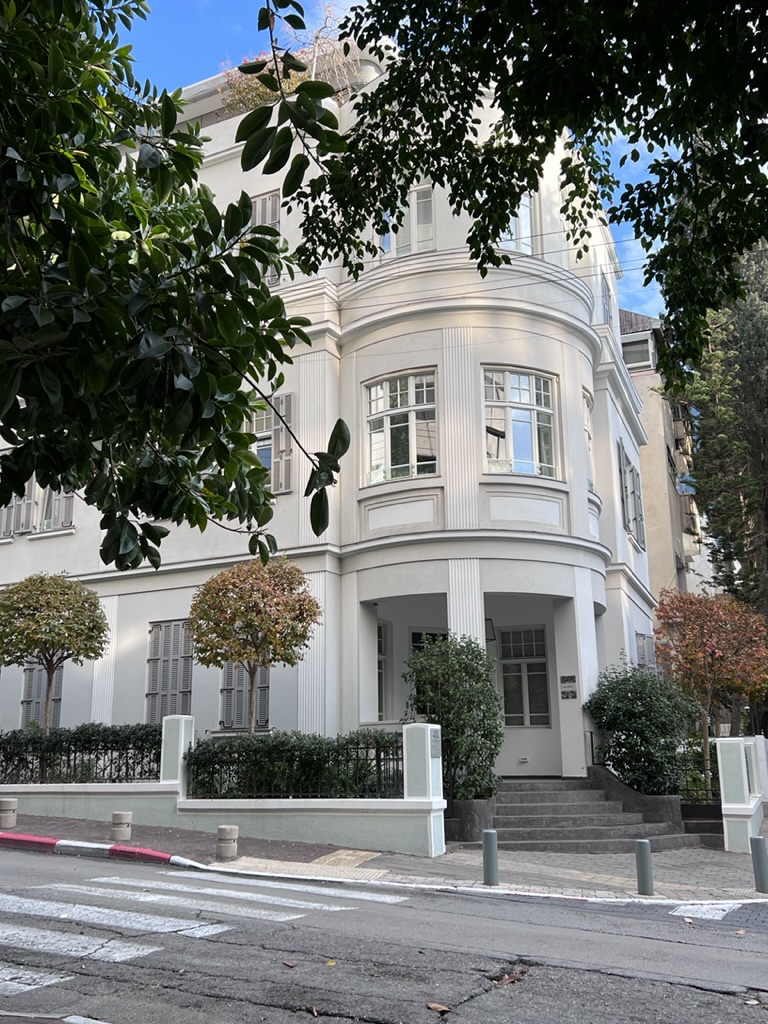
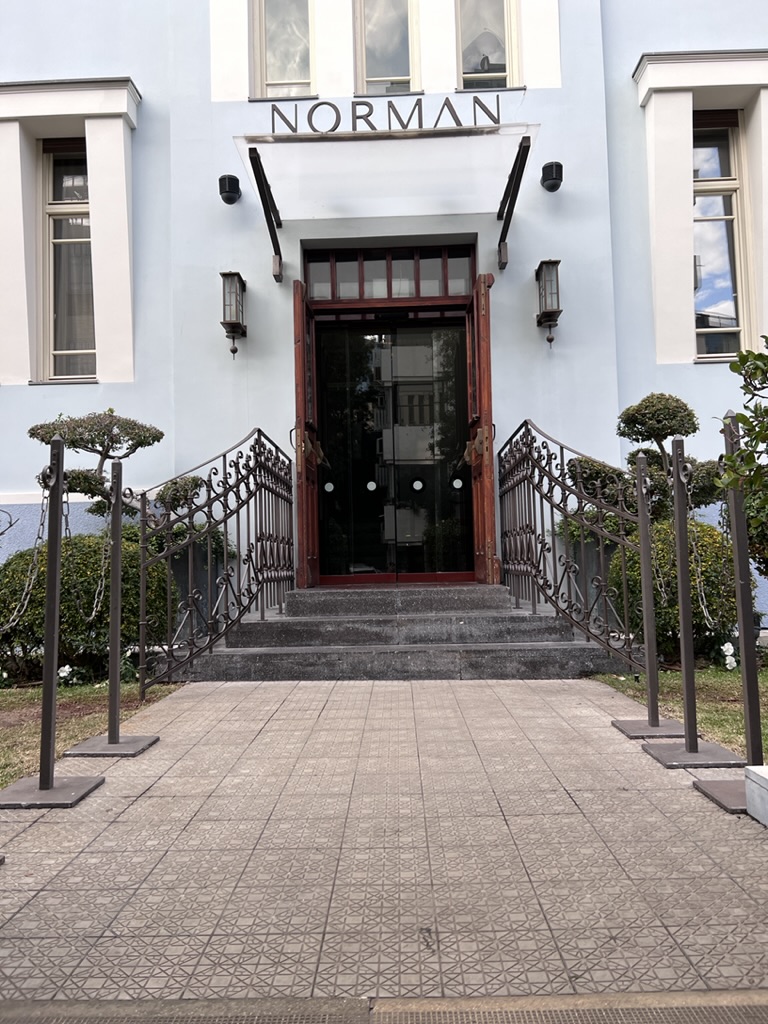
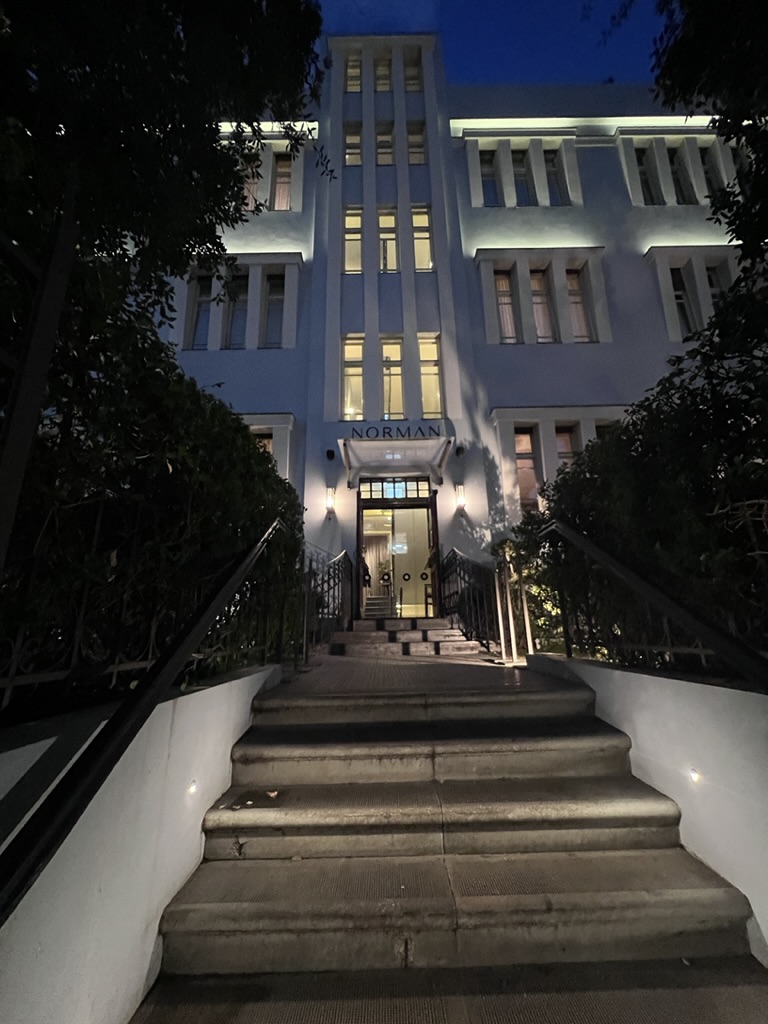
By then it was dark out and we decided to take a taxi back to our hotel area.. Traffic was crazy and many streets in the area of our hotel were totally impassible, so we hopped out of the taxi about 1/3 mile from our destination and walked the rest of the way. By the way, I now have the app Gett (like Curb in NY—where you can both order and also pay for your taxi). So, we just have to punch in our location, and you know when a taxi will come to pick you up. We eventually came back to the Market House Hotel to get our bags and then headed to the train station.
The fast train (45 minutes from Tel Aviv to Jerusalem) was fine. When we arrived, the station wasn’t yet open, so we waited with everyone else for the gates to open. There was some kind of security check and we had all our luggage so I expected a nightmare since most people only had only a backpack. But they asked for our passports and then waved us in. We figured out how to purchase our tickets and which station in Jerusalem we needed (they have three stations). There was virtually no English at the station, but we figured out the track/platform and got on the right train. It was a little cumbersome with our baggage, but the train wasn’t too crowded, and we could take up more than our two seats. Other people did the same.
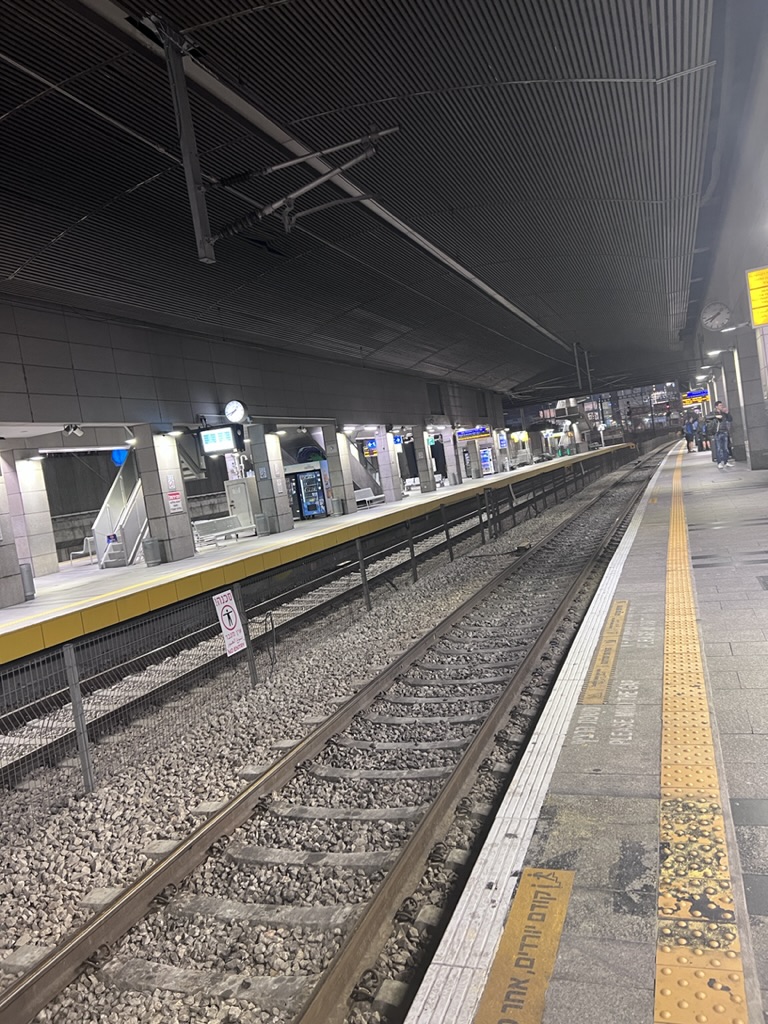
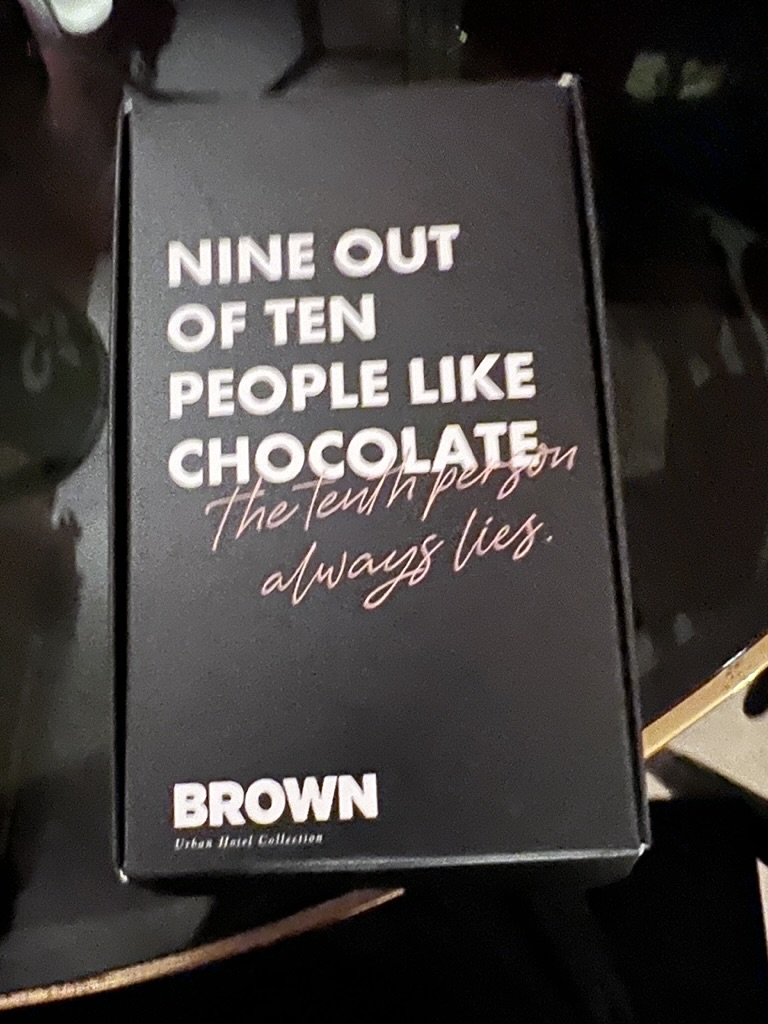
The train and the station were filled with families (with many children in each family) and they needed to navigate carriages and such, so our load was easy compared to them. When we emerged from the train it took two elevators and two escalators to get to the street (not sure why it was designed that way). We found a taxi right near the station and headed to our hotel: Villa Brown Moshava, in the German Quarter. Since it was now a bout 10:30 pm we couldn’t see much enroute, but the hotel is quite nice. It’s a landmark historic building with just 24 rooms. Our room has a little balcony (have no idea what we see since it’s dark outside) and very tall ceilings. The rooms are all small, but elegant. We’re here for three nights, but given that we thought we’d arrive by noon today but instead got here well after dark, we may add another night here and shorten our stay in Akko which is a really small town so maybe we don’t need as much time as we’ve given it. We shall see.
That’s it for now.
Fern
6 January 2023
Greetings from Jaffa, Israel – where we are watching CNN and not missing the shit show the Republicans are creating—Who are these jerks?
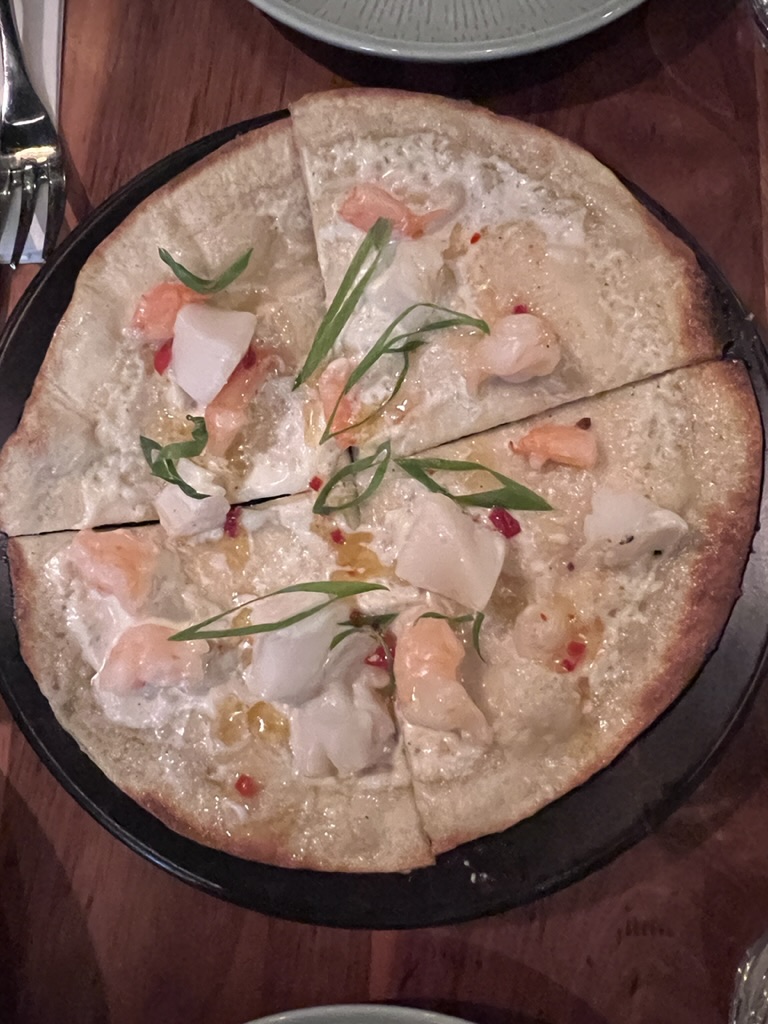
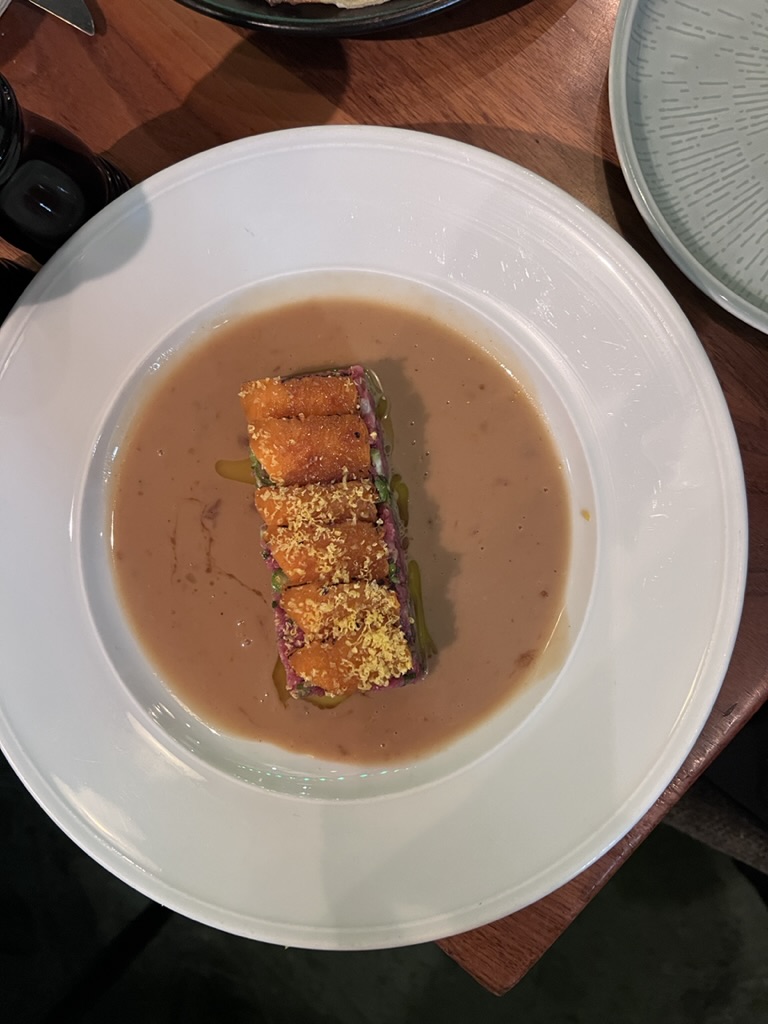
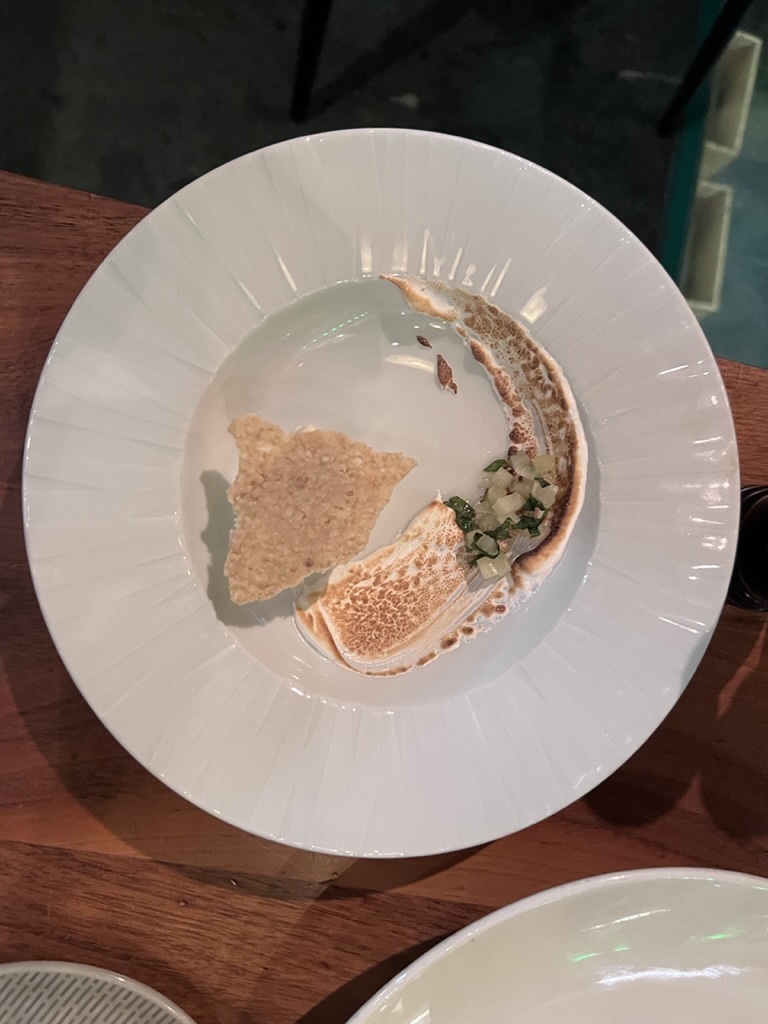
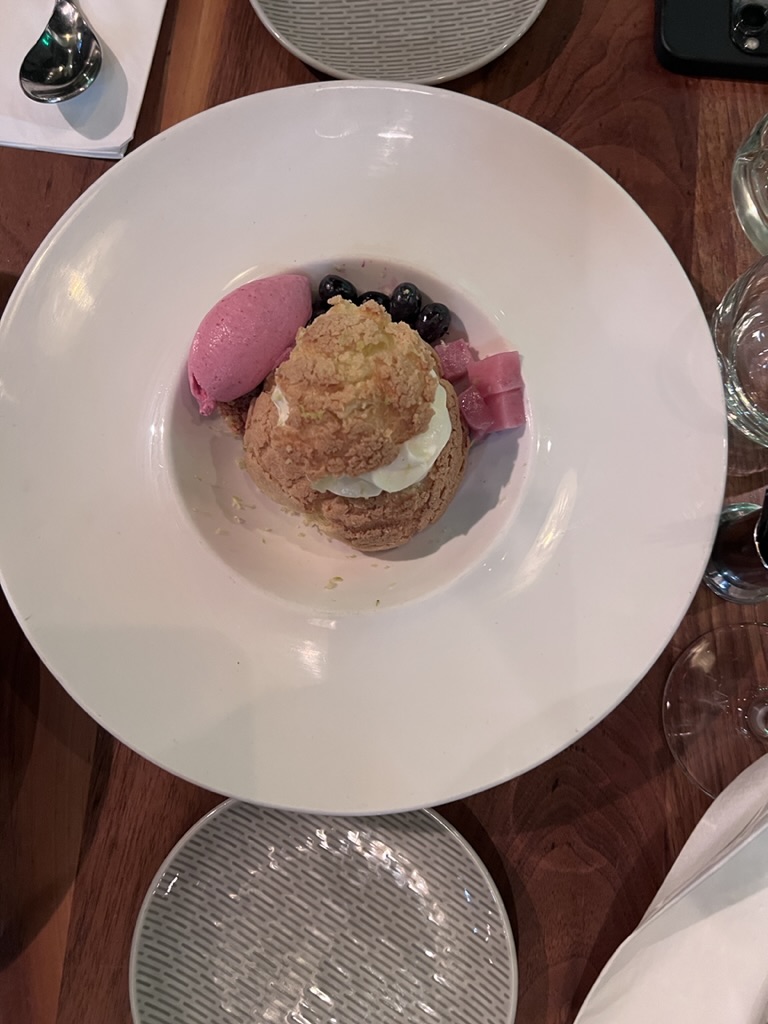
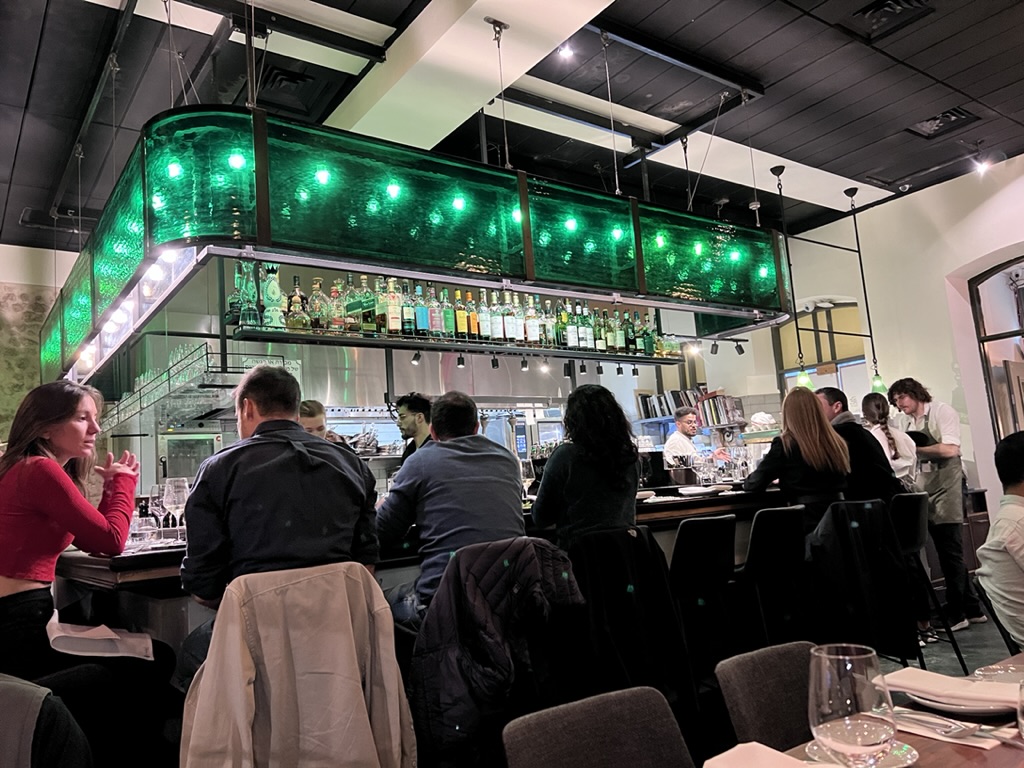
First a little mouthwatering news from Popina – where we had dinner last night (after trying to make reservations for at least four other places and lucked out because there was a cancelation at Popina!) We took a taxi to the restaurant which was in a pretty upscale neighborhood with ultra-modern high-rise buildings. Popina bills itself as serving “modern food,” within the culinary landscape of Tel Aviv, and serving “central-region Israeli food” It’s located in an ancient building that is decorated with clean lines and retro stained glass, stone walls, and a green garden; the kitchen is certainly center stage. We had a hard time making selections since everything sounded so good and the plates coming to neighboring tables looks so yummy.
We settled on two starters [a seafood pizza—what they call “Black Pizza,” which was cooked with goat cheese cream, shrimps and scallops, herbs, and chili oil; and a beef tartare with pumpkin, asparagus, oyster mushrooms and pickled egg yolk, sitting in what I think was demi-glace with mustard cream (?)] We almost ordered another starter called “gin and tonic sashimi” which really sounded good… For the main course, we had the slow-cooked veal cheek with green leaves, Jerusalem artichoke cream, and I think shiitake demi-glace (or something like that). All I can say is that each dish was fantastic. Oh… dessert, we selected chocolate mousse which was served inside some kind of pastry puff; with beet ice cream on the side. And the server brought an extra dessert (just what we needed) something very lemony and very good. I had Israeli wine and Mike (nursing his cold and claiming his drink is medicinal) had three “hot toddies” – He thinks he might be able to claim it on his health insurance.
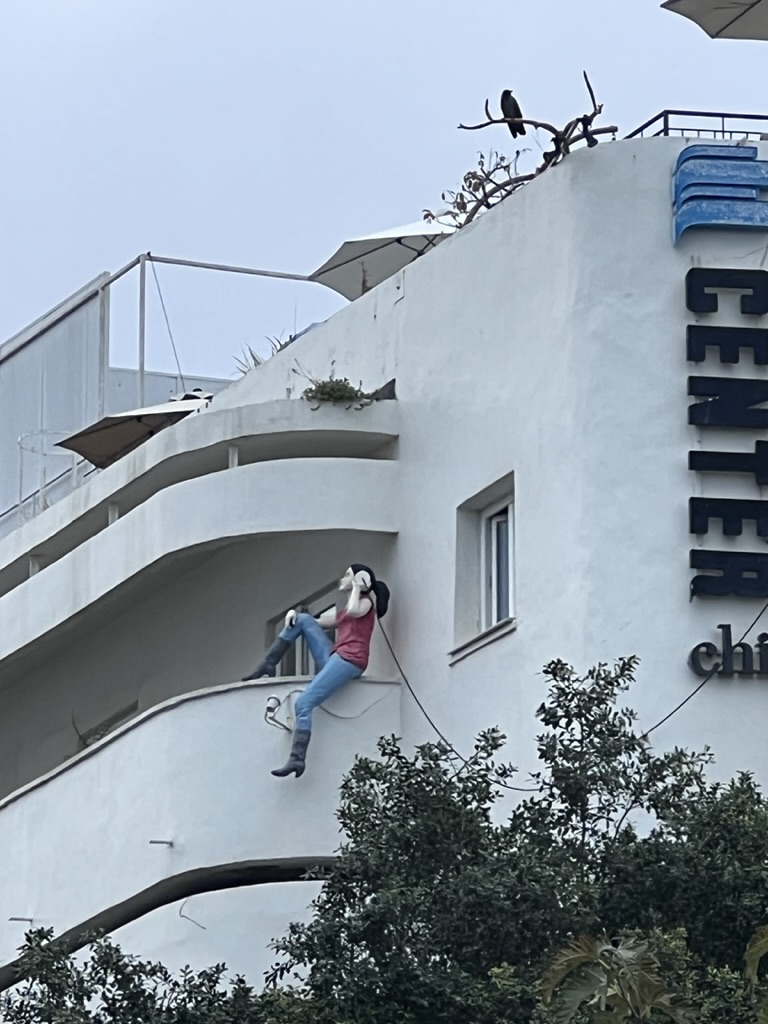
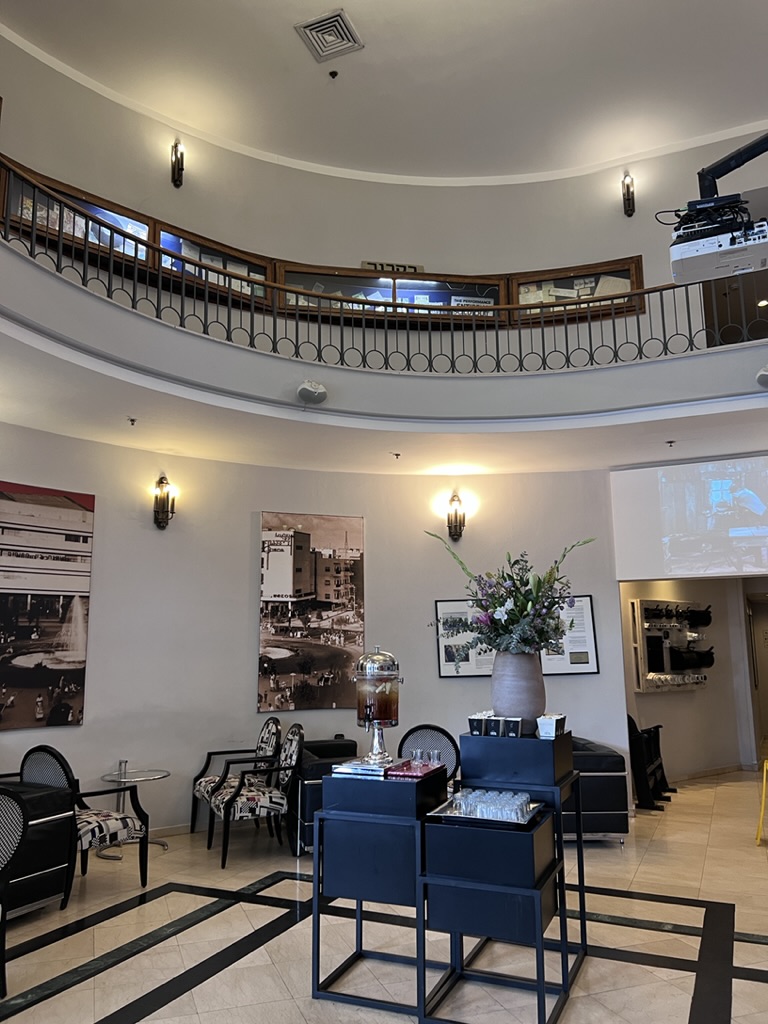
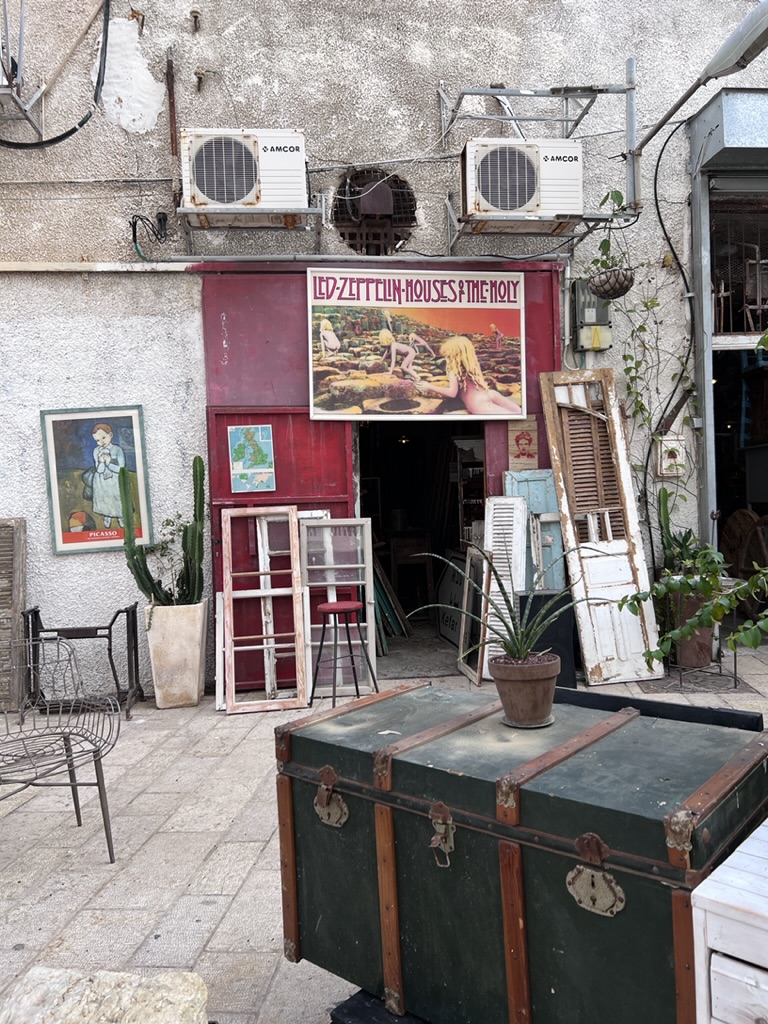
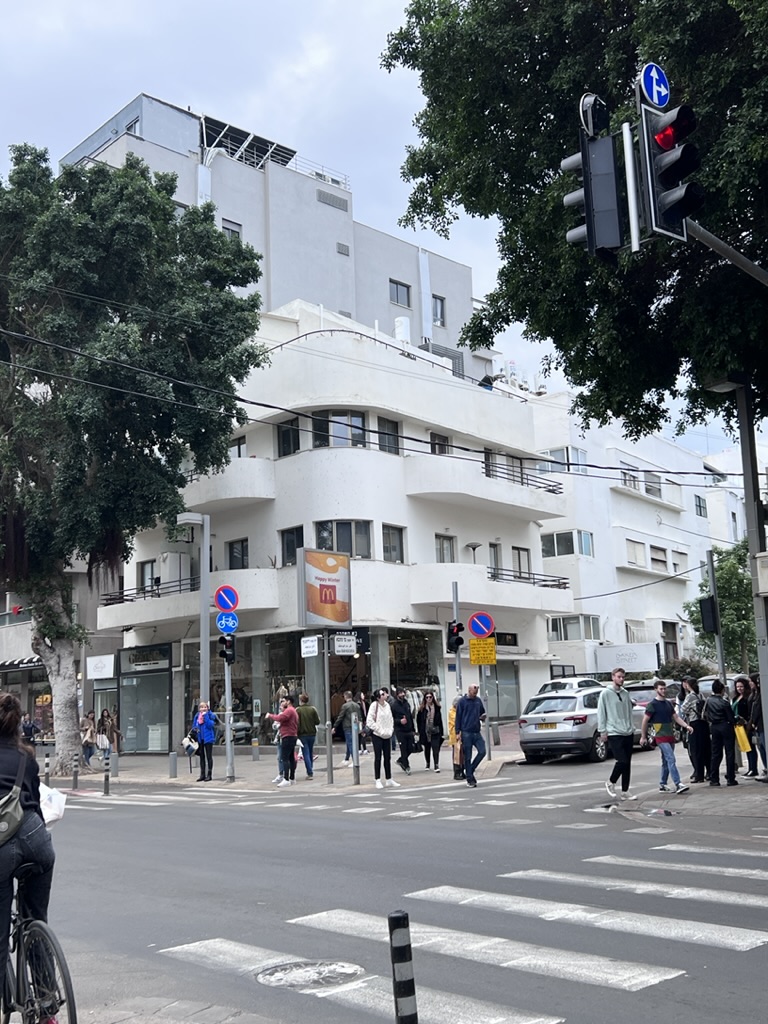
Today, we started out at the Hotel Cinema in the district in Tel Aviv that has a lot of Bauhaus buildings. Turns out that there are many Bauhaus-style buildings here – constructed between 1920 and 1940, by German-Jewish architects who immigrated to Tel Aviv after the rise of the Nazism. Indeed, we learned that Tel Aviv is home to about 4,000 buildings that are in Bauhaus style and that 2,000 of them are protected by preservation rulings. [The Bauhaus school operated between 1919 and 1933 in Germany.]
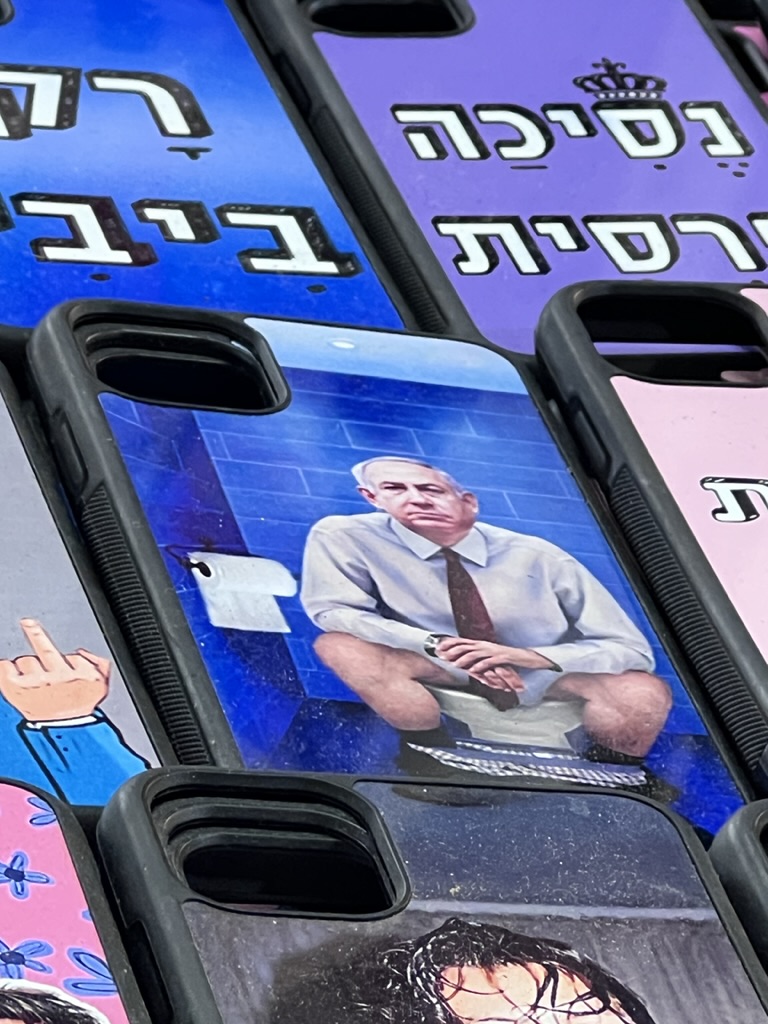
We strolled under the overcast grey sky to the very vibrant and very crowded Carmel Market (Shuk Hacarmel) — the largest market (shuk) in Tel Aviv. Here you can get everything from spices to clothing to electronics to fruits and vegetables to candy to cases for your cellphone (including one that shows Netanyahu sitting on a toilet). The Market is more than 100 years old, nearly as old as the city of Tel Aviv itself. The layout of the market is simple with one street that runs throughout the entire length of the market and several “auxiliary” short side streets.
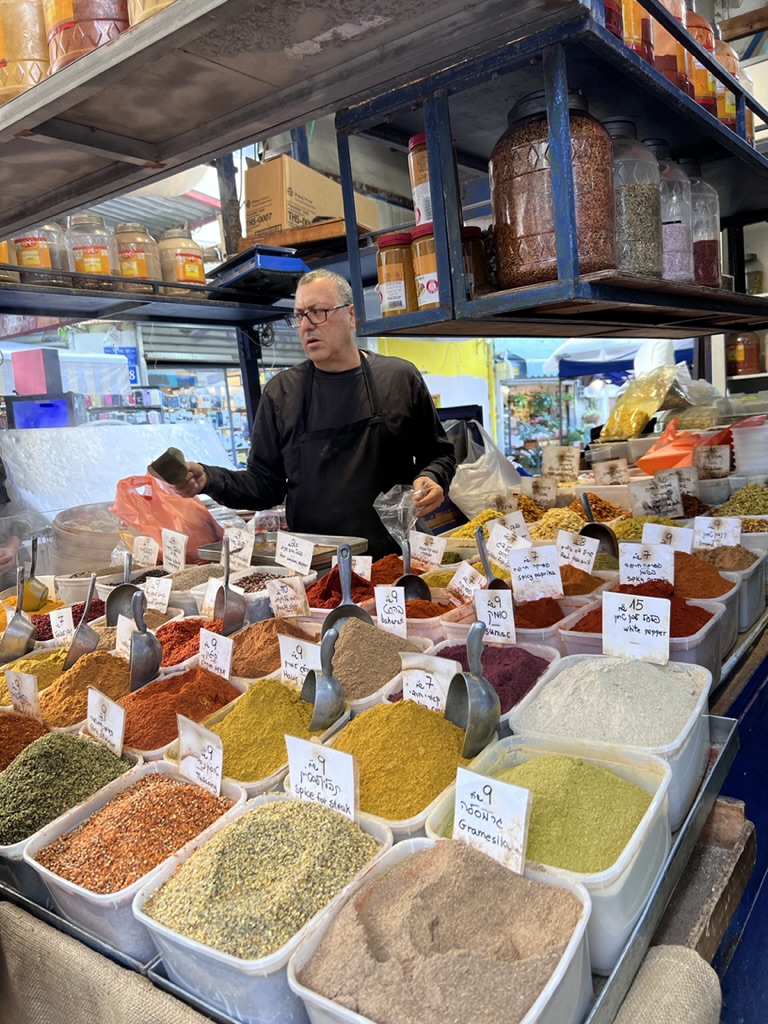
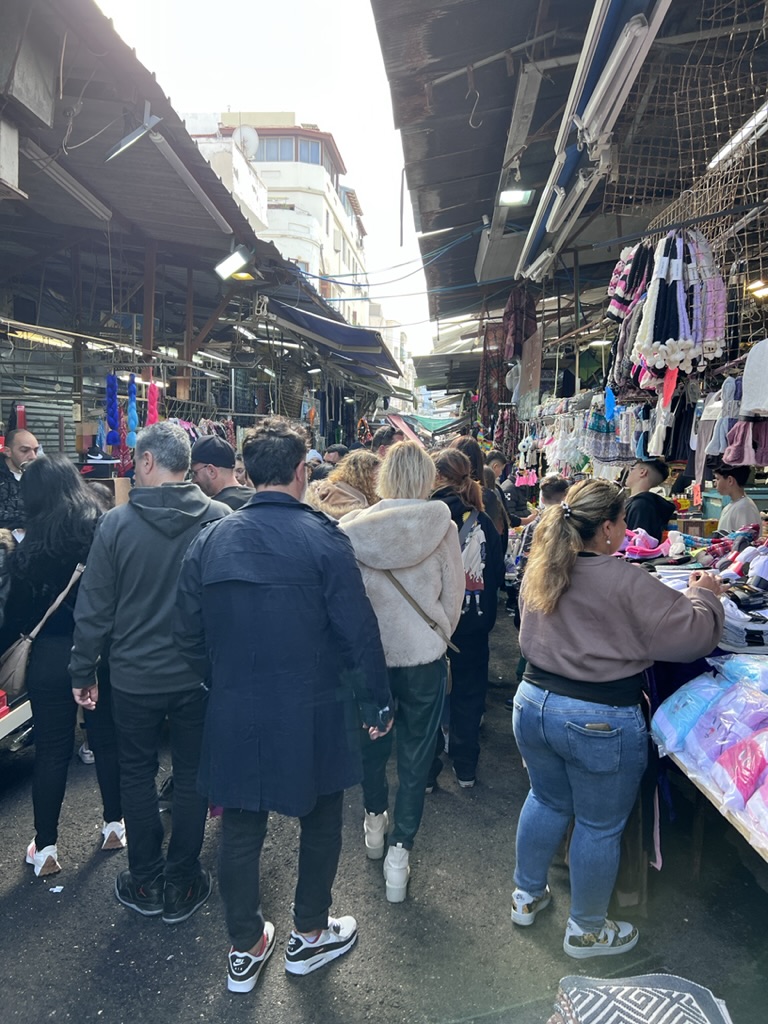
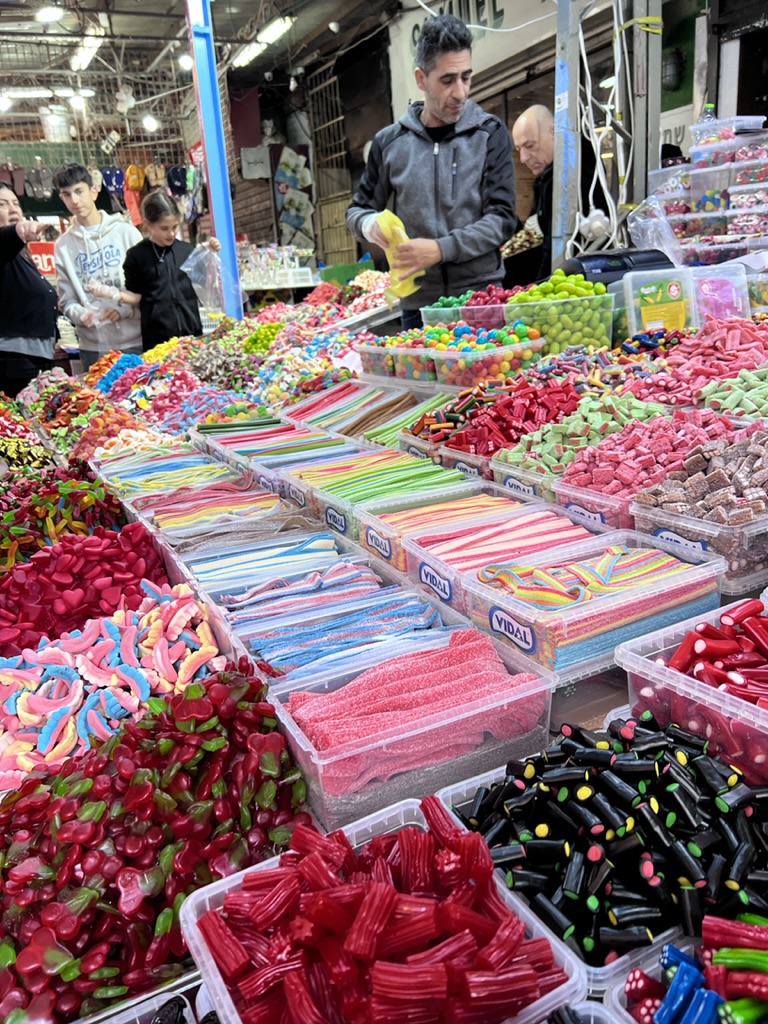
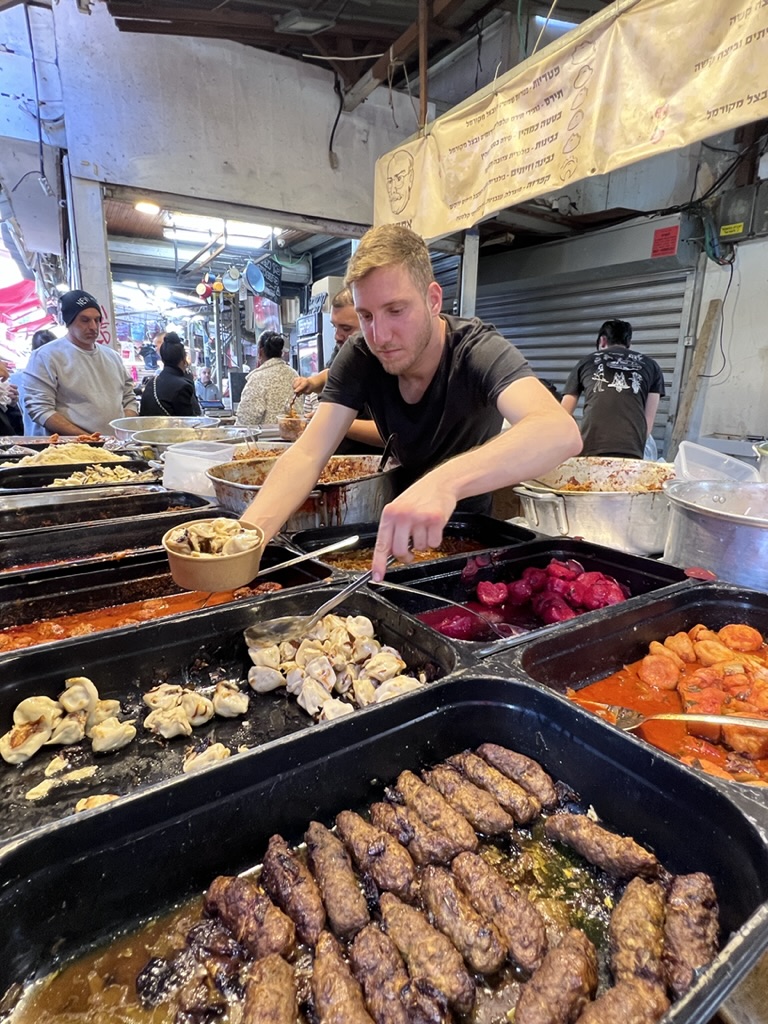
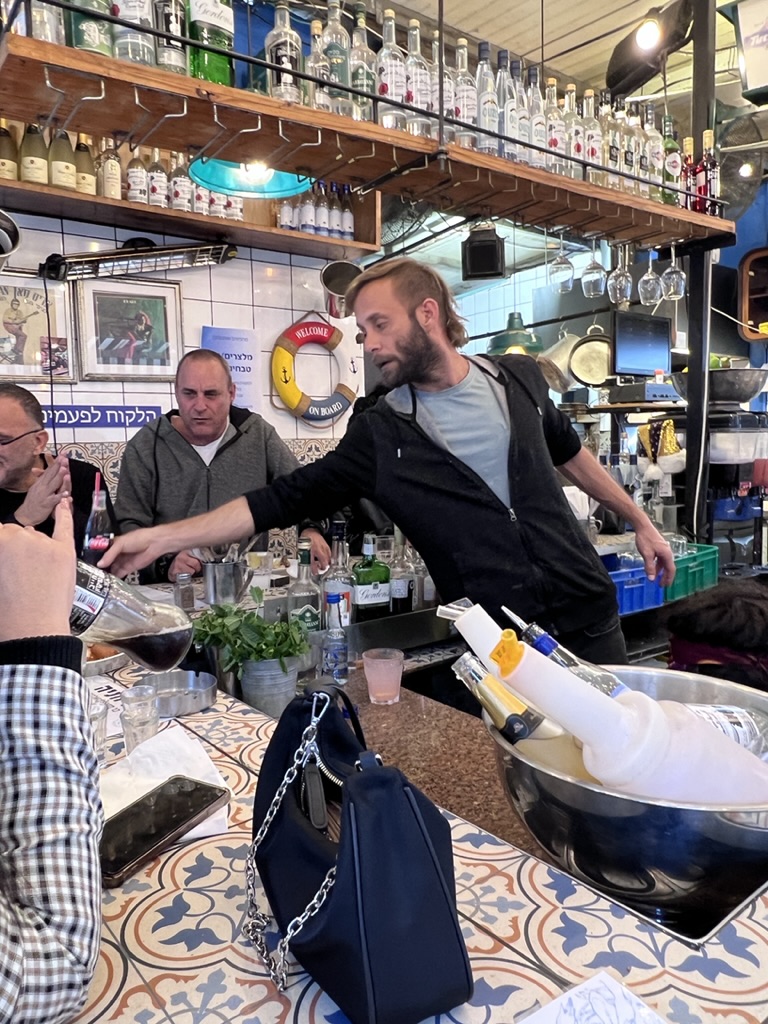
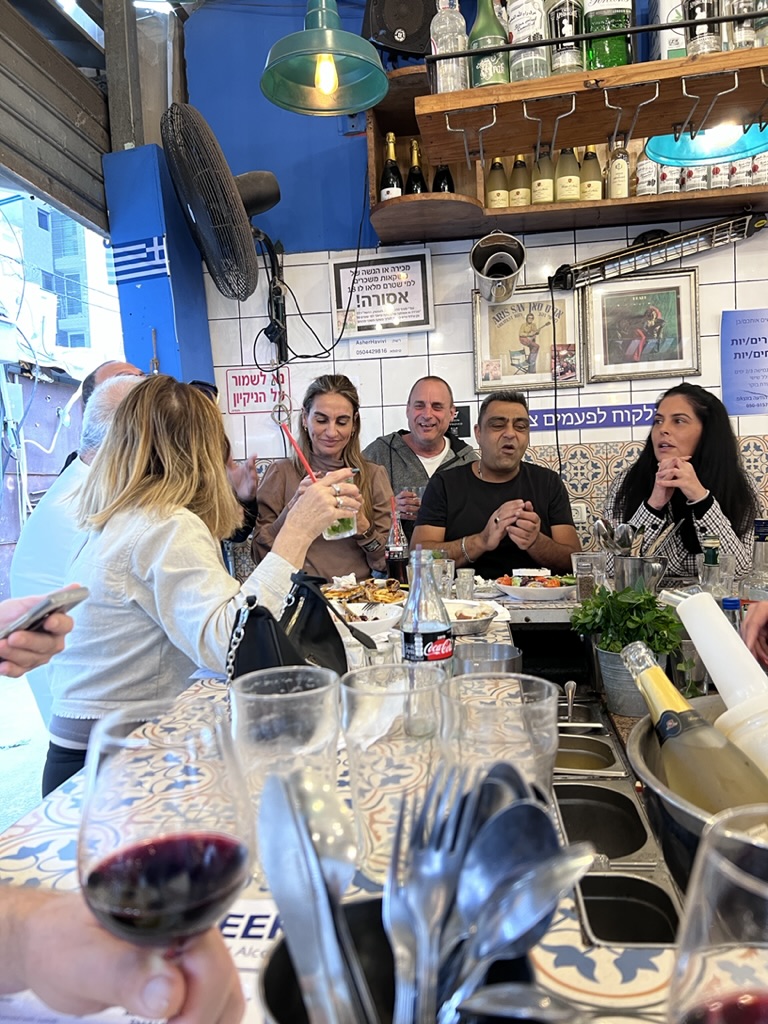
And within the market there are hundreds of little “restaurants” and cafes and food stalls where you can get lots of very appealing foods, breads, desserts, or snacks to eat as you walk. While we weren’t really that hungry, everything looked so good that we just gave up and settled into a little place that I think was called “The Greek.” It was just a counter that surrounded a bar and it was bustling. We were drawn to it because a lot of loud music was playing, and everyone was singing along with the music. We think they were singing Greek songs but in Hebrew (but not knowing either language it was a little difficult to discern). Everyone was drinking lots of Ouzo and eating while they sang. We waited for stools at the counter and once we had our seats (two of the 25+/- seats) we ordered dolmas and zucchini fritters and wine. Everything came with tzatziki and the food was great.
According to my Shazam app, the songs that were playing with literally everyone (except us) singing along very loudly and knowing all of the words came from an album by Gabi Shoshan (love that Shazam!) As we were paying, two people were trying to grab our seats and we chatted very briefly. They said that Israel is good, but that the political leadership of Israel is terrible—they said if you can rate someone as a zero, Netanyahu would be seven time zero.
Then we continued walking through the market and were headed to two particular neighborhoods we wanted to see… but then the rains came. First we just stood under a canopy thinking it might be momentary, but then it was clear this would be a real rain and it would linger.. so we eventually ventured out to the street and found a taxi.
We are about to head to a restaurant called Dalida, which we assume will be as good as all the others. Can’t seem to go wrong with food here. Will report tomorrow.
Oh, a little side story that I forgot to mention in previous notes… I stopped into a small store, thinking I might bring back some of those Dead Sea face and hand cream products. I was perusing the stuff in the little shop when the saleswoman approached me. I said I was just looking, but she continued that I needed to get an “anti-aging cream” as well as some other stuff. Not very good salesmanship! I didn’t buy anything.
All the best –
Fern
 Fern's Travel Notes